
WinSavvy Editorial Standards
How this article was created
Affiliate marketing looks simple from the outside. You share a link, someone clicks, a sale happens, and you earn a commission. But in real business, it is never that easy. A successful affiliate marketing strategy is not built on random links, quick product mentions, or chasing every high-paying program you can find. It is built on trust. It is built on knowing your audience so well that your recommendations feel useful, not forced. It is built on choosing offers that solve real problems, creating content that guides people toward better decisions, and tracking what actually brings revenue instead of guessing.
Build the Strategy Around the Buyer Before You Build It Around the Commission
Affiliate marketing becomes weak when it starts with one question: “Which product pays the highest commission?”
That question sounds practical, but it often leads to poor choices. You may end up promoting a tool your audience does not need, a product that is hard to trust, or an offer that pays well once but damages your brand for years. A strong affiliate strategy starts somewhere else. It starts with the buyer.
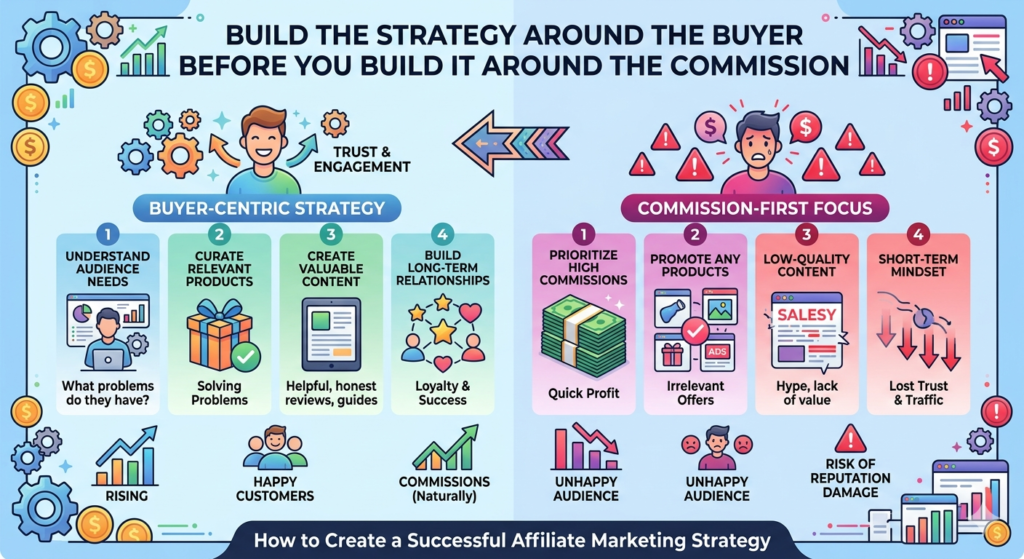
Before you choose a program, write a review, create a comparison page, or reach out to partners, you need to understand the person who will click the link. What are they trying to fix? What do they already know? What are they scared of wasting money on? What have they tried before? What would make them trust your advice?
When you know this, affiliate marketing stops being link placement. It becomes guided decision-making.
Your audience should shape every offer you promote
A good affiliate offer fits into the life of your audience. It should feel like a natural next step, not an interruption.
For example, if you run a blog for small business owners, your readers may need website hosting, email tools, CRM software, accounting tools, design software, project management apps, and legal templates. These products make sense because they connect to the problems your audience already has.
But if the same blog suddenly promotes luxury watches, crypto trading platforms, or random fitness supplements, the trust breaks. Even if the commission is high, the fit is weak. People can feel that. They may not say it out loud, but they notice when a recommendation feels like it was added only to make money.
The best affiliate marketers protect trust like it is their main asset, because it is. Every product you promote either strengthens that trust or weakens it.
Your first job is to map the buyer’s real problems
Start by writing down the biggest problems your audience deals with before they buy. Do not write vague problems like “they need better tools” or “they want to grow.” Go deeper.
A startup founder may not simply need email marketing software. They may need a simple way to follow up with trial users before they forget the product. A freelance designer may not simply need a project tool.
They may need a way to stop clients from sending feedback across ten different places. A new blogger may not simply need hosting. They may need a low-cost setup that does not feel scary or technical.
This level of detail matters because people do not buy products in a clean, logical way. They buy when the pain becomes clear enough, urgent enough, and easy enough to solve. Your affiliate content should help them see that path.
Your offer should match the buyer’s stage of awareness
Not every reader is ready to buy today. Some are just learning. Some are comparing options. Some are close to buying but need proof. Some are already using a product and wondering if they should switch.
A strong affiliate strategy creates content for each stage.
A beginner may need a guide that explains the problem in simple words. A more aware buyer may need a product comparison. A buyer near the end may need a review, discount page, demo breakdown, case study, or checklist.
If you only create review posts, you miss the people who are not ready yet. If you only create educational posts, you may build traffic but fail to convert it.
This is where many affiliate strategies fail. They chase keywords without thinking about the buyer’s journey. They get visitors, but the content does not move those visitors forward.
Choose a niche where trust and money can both exist
Some people choose a niche only because it has high commissions. Others choose a niche only because they like the topic. Both approaches can work for a while, but the best affiliate strategy sits between passion, skill, audience demand, and commercial value.
You need a niche where people have real problems, spend money to solve them, and need guidance before they choose. That last part is important. Affiliate marketing works best when buyers need help making a decision.
If the product is too simple, people may not need much content before buying. If the product is too cheap, the commission may not justify the work. If the product is too random, trust becomes hard to build. But when the topic has clear pain, real choices, and strong buying intent, affiliate content can perform very well.
The best niches often have expensive mistakes
People seek advice when they want to avoid a bad decision. That is why affiliate marketing works well in areas like software, finance tools, business services, education, web hosting, ecommerce tools, health products, travel gear, home equipment, and professional services.
The more risk a buyer feels, the more they value clear guidance.
A person buying a $5 notebook may not read a 3,000-word review. But a founder choosing a CRM for a growing sales team may read several guides, compare pricing, check use cases, and look for trusted opinions. That is where strong affiliate content can influence the sale.
A narrow niche is often stronger than a broad one
Many beginners think a bigger niche means more money. In reality, broad topics are harder to win. If you try to promote “business software,” you compete with huge websites, review platforms, and brands with large budgets. But if you focus on “simple sales tools for small B2B agencies,” your content becomes sharper.
A narrow niche helps you speak clearly. It helps your audience feel seen. It helps search engines understand your site. It also makes your recommendations more useful because you are not trying to help everyone.
A narrow niche does not mean a small business. It means a clear starting point. You can always expand later once you have authority.
Build your strategy around problems, not products
One of the biggest shifts in affiliate marketing is moving from product-led thinking to problem-led thinking.
Product-led thinking sounds like this: “I joined this affiliate program, so now I need to write content about it.”
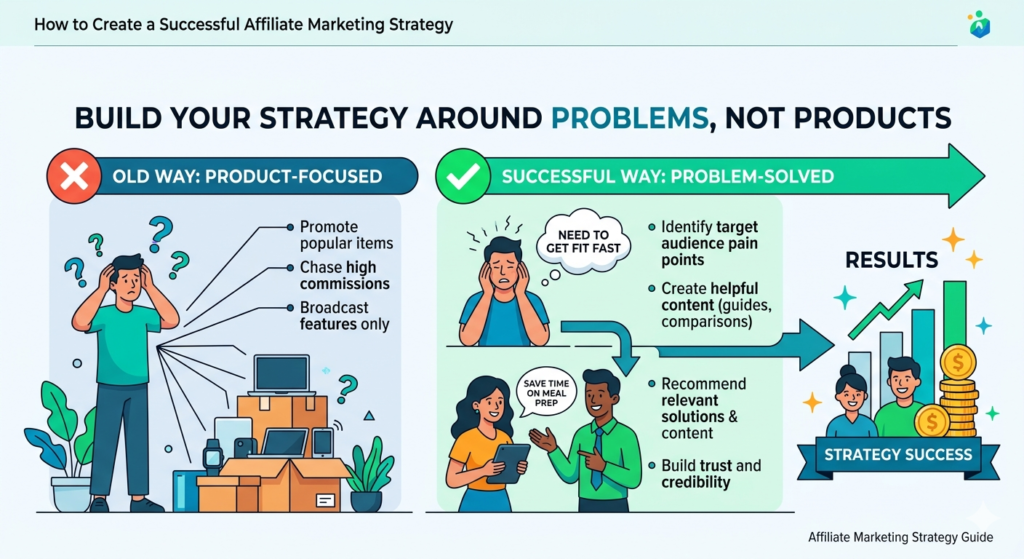
Problem-led thinking sounds like this: “My audience has this painful problem. Which product solves it best, and what content would help them choose?”
The second approach is stronger because it puts the reader first. It also helps you avoid weak content. Instead of writing another generic review, you create useful pages that answer real questions.
For example, instead of only writing “Best Email Marketing Tools,” you could write about why welcome emails fail, how small teams can follow up with leads, how to choose email software when you have no tech skills, or how to compare free plans without getting trapped later.
These topics attract people with real intent. They also give you room to teach, build trust, and recommend naturally.
Problem-led content makes affiliate links feel helpful
When your content solves a problem first, the affiliate link becomes part of the answer. It does not feel like a sales push. It feels like the next step.
This is the difference between saying, “Buy this tool because it is great,” and saying, “Here is the problem, here is why it happens, here are the options, here is what to look for, and here is the tool I would choose in this situation.”
The second version creates confidence. It respects the reader. It also makes the recommendation more persuasive because the reader understands the reason behind it.
Strong affiliate strategy removes bad-fit buyers too
Good affiliate content does not try to convince everyone. It helps the right person say yes and the wrong person say no.
This may sound strange, but it improves long-term results. When you clearly explain who a product is for and who it is not for, you build trust. You also reduce refunds, complaints, and poor customer experiences. Brands value affiliates who send qualified buyers, not just clicks.
If a tool is not good for beginners, say that. If it is too expensive for small teams, say that. If it lacks a key feature, say that. Honest limits make your positive claims more believable.
Pick Affiliate Programs That Protect Your Brand and Support Long-Term Revenue
Once you understand your audience, you can start choosing affiliate programs. This is where strategy matters. A bad affiliate program can waste your traffic. A weak product can damage your trust. A poor tracking system can cost you commissions you earned.
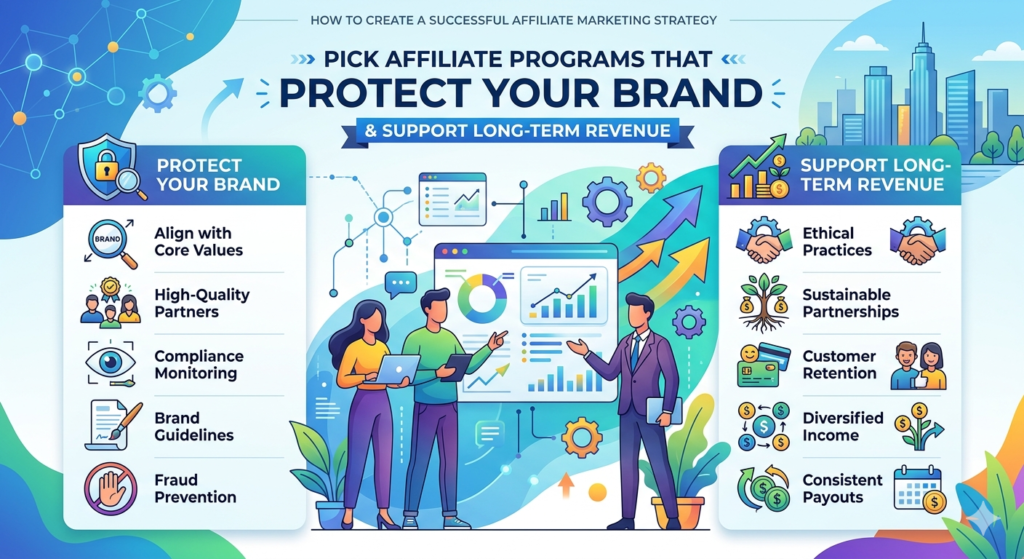
You are not just choosing a product. You are choosing a business partner.
Look beyond the commission rate
A high commission rate can look exciting, but it does not always mean more profit. A program that pays 50 percent on a product no one buys may earn less than a program that pays 20 percent on a product that converts well and keeps customers for years.
You need to look at the full picture. How trusted is the product? Does it solve a real problem? Is the landing page strong? Is the checkout simple? Does the company have good support? Are customers happy after they buy? Is the commission one-time or recurring? How long is the cookie window? Does the brand have a clear refund policy?
All of these factors affect your real earnings.
A lower commission can be better if the product converts
Some companies pay lower commissions because they already have strong brand trust, strong sales pages, and high customer demand. These programs can still be worth promoting because more people buy.
For example, a well-known software tool with a 20 percent recurring commission may outperform an unknown tool with a 60 percent one-time payout. The first one may convert more visitors, retain customers longer, and create stable income.
Do not judge a program by the headline commission alone. Judge it by expected revenue per visitor and by how well it serves your audience.
Recurring commissions can build a stronger base
Recurring commissions are powerful because they can turn one sale into ongoing income. This is common with SaaS products, memberships, subscription tools, and some service platforms.
If your audience needs tools they will keep using, recurring programs can help you build a more stable affiliate business. But you still need to check retention. A recurring commission is only valuable if customers stay.
A tool that pays monthly but has poor product quality may lead to quick cancellations. A tool with slightly lower commission but strong retention may produce more income over time.
Study the product like a buyer would
Before promoting a product, act like a buyer. Visit the website. Read the pricing page. Watch the demo. Try the free trial if possible. Read reviews. Check support pages. Look at refund terms. Study the onboarding process.
Your goal is to understand the buyer experience from first click to purchase and beyond.
This helps you write better content because you are not guessing. You can explain what the tool feels like, where it is strong, where it may fall short, and who will get the most value from it.
First-hand experience makes your content harder to copy
The internet is full of shallow affiliate content. Many reviews simply repeat product features from the company website. That kind of content is easy to copy and hard to trust.
First-hand experience gives your content an edge. You can mention small details that only a real user would notice. You can explain the setup process. You can show where beginners may get stuck. You can compare the product to real alternatives in a useful way.
This is what makes content feel human. It also helps search performance because your page gives more original value than a rewritten product description.
If you cannot test the product, research it deeply
Sometimes you cannot test every product, especially if it is expensive or requires a sales call. In that case, do deeper research. Read customer reviews across trusted platforms. Watch user videos. Study help docs. Compare pricing pages. Look at social comments. Check what real users complain about.
The goal is not to pretend you used it if you did not. The goal is to make your content fair, useful, and honest. You can still create strong content by being clear about what you researched and what type of buyer the product seems best for.
Check the affiliate program terms before you commit
Many affiliates skip the terms and regret it later. Every program has rules. Some do not allow paid search ads. Some ban bidding on brand keywords. Some restrict coupon pages. Some do not allow email promotion. Some have strict rules for social posts. Some only pay commissions after a long approval period.
Read the terms before you build a whole strategy around the program.
Tracking rules can affect your income
Cookie length matters. A cookie is what helps the company know that a buyer came from your link. If the cookie lasts only 24 hours, you may lose credit when people take longer to decide. If the cookie lasts 30, 60, or 90 days, you have a better chance of earning from buyers who return later.
But cookie length is not the only issue. Some programs use last-click attribution, which means the final affiliate before purchase gets the commission. Others may use first-click or custom rules. Some programs may not pay if the buyer uses a coupon from another site. Some may not pay on certain plans.
These details shape your content strategy. If the product has a long sales cycle, short cookie windows may hurt. If the product is often bought after many comparisons, attribution rules matter even more.
Payment reliability is part of the strategy
A great product is not enough if the affiliate program pays late, tracks poorly, or gives unclear reports. Look for programs with good dashboards, clear commission rules, trusted networks, and reliable payment history.
If possible, join programs through known affiliate networks or platforms where tracking and payments are more transparent. Direct programs can also work well, but you should still check how reporting works and who handles support.
Build a balanced offer mix
Do not depend on one affiliate product if you can avoid it. Programs change. Commissions drop. Products get acquired. Tracking breaks. Search rankings shift. A balanced offer mix protects your revenue.
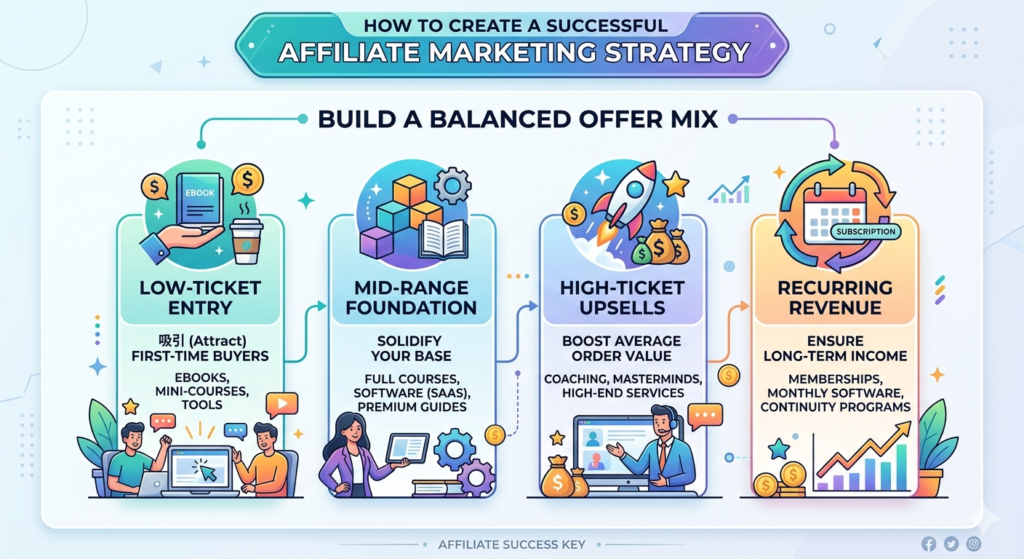
This does not mean promoting everything. It means building a thoughtful set of offers that match different buyer needs.
Use core offers, support offers, and backup offers
Your core offers are the main products you trust most and promote often. These should match your audience’s biggest problems and have strong conversion potential.
Support offers are related products that help the buyer complete the job. For example, if your core offer is website hosting, support offers might include a theme, email tool, SEO plugin, or design tool. If your core offer is a CRM, support offers might include proposal software, call tracking, or sales training.
Backup offers are alternatives you can recommend when your main offer is not a good fit. These are important because honest comparisons increase trust. They also help you earn even when the reader chooses a different path.
Too many offers can weaken trust
Balance matters. If every page promotes a different product, your site can feel scattered. Readers may wonder what you actually believe. Search engines may also struggle to understand your topical focus.
It is better to be deeply useful around a smaller number of strong offers than shallow around dozens of weak ones. Build authority first. Expand later.
Create Content That Moves Readers From Confused to Confident
Content is the engine of affiliate marketing. It brings the audience in, earns trust, explains the problem, compares choices, and leads the reader toward action.
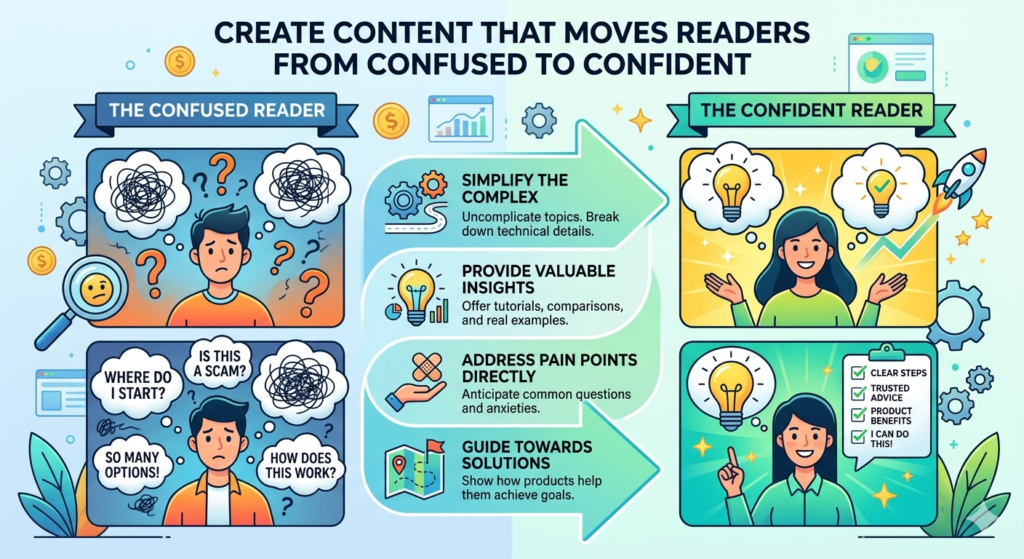
But not all content works the same way. Some content brings traffic but no sales. Some content converts but gets very little traffic. Some content supports trust even if it does not directly earn commissions. A strong strategy needs all of these pieces working together.
Build content around intent, not just keywords
Keyword research is useful, but intent is more important. Intent means what the reader really wants when they search or click.
Two people may search similar words but need different things. Someone searching “what is affiliate marketing” is likely learning. Someone searching “best affiliate tracking software for SaaS” is much closer to buying. Someone searching “ConvertKit vs Mailchimp for creators” may be ready to choose between two tools.
Your content should match that intent exactly.
Informational content builds the relationship
Informational content teaches. It answers questions, explains problems, and helps people understand what they need.
This type of content may not always convert right away, but it builds trust and brings people into your world. It also helps you rank for broader topics and link naturally to more commercial pages.
For example, a guide on “how to build an email list from scratch” can lead readers toward email tools, landing page builders, lead magnet templates, and automation software. The article should teach first. The offers should appear only where they help.
Commercial content captures buying intent
Commercial content is built for people who are comparing products or getting ready to buy. This includes reviews, alternatives, comparisons, best-of guides, pricing guides, coupon pages, and use-case pages.
These pages often bring fewer visitors than broad guides, but each visitor can be more valuable. A person searching for “best CRM for small agencies” has a clear problem and is likely closer to purchase than someone searching “what is a CRM.”
Your affiliate strategy should give special attention to these pages because they often drive the most revenue.
Write reviews that feel honest, not scripted
A good review does not sound like an ad. It sounds like a smart friend helping someone avoid a bad choice.
Most affiliate reviews fail because they praise everything. They list features, add a link, and call it done. But real buyers are not looking for praise. They are looking for clarity.
They want to know what the product does well, where it falls short, who should use it, who should avoid it, how it compares to other options, and whether the price is worth it.
A strong review should answer the buyer’s hidden doubts
Every buyer has doubts. They may wonder if the product is too hard to use, if the free plan is enough, if support is good, if there are hidden costs, if it works for their business size, or if there is a better option.
Your review should bring these doubts into the open. That makes the reader feel understood. It also makes your recommendation more believable.
Do not hide weak points. Explain them clearly. Then show why the product may still be a good fit for the right buyer.
The best review pages have a clear point of view
Do not write a review that tries to please everyone. Take a position.
You might say the tool is best for beginners who want speed, but not ideal for advanced teams that need deep control. You might say the product is great for ecommerce brands but too complex for solo creators. You might say the platform is expensive, but worth it for teams that will use the automation features.
A clear point of view helps readers decide. It also makes your content feel more human.
Create comparison content that helps people choose faster
Comparison content is powerful because it catches people at a high-intent moment. They already know the options. They are trying to decide.
Your job is not to repeat both pricing pages. Your job is to explain the practical difference.
Compare based on real use cases
A useful comparison does not simply say Product A has this feature and Product B has that feature. It explains which one fits which situation.
For example, one email tool may be better for creators who sell courses. Another may be better for ecommerce brands that need product triggers. One project tool may be better for simple task tracking. Another may be better for complex teams with many workflows.
Use cases make the comparison clear. They help the reader see themselves in the decision.
Explain the trade-off behind each choice
Every product choice has a trade-off. A cheaper tool may save money but require more manual work. A powerful tool may offer more control but take longer to learn. A simple tool may be easy to start with but limited later.
When you explain trade-offs, your content becomes more useful. You are not just pushing one product. You are helping the reader make a better business decision.
Build supporting content that feeds your money pages
Your money pages are the pages most likely to earn commissions. These may include reviews, comparisons, best-of lists, and product-led guides.
But money pages often need support. Supporting content helps bring in traffic, build authority, and guide readers toward those pages.
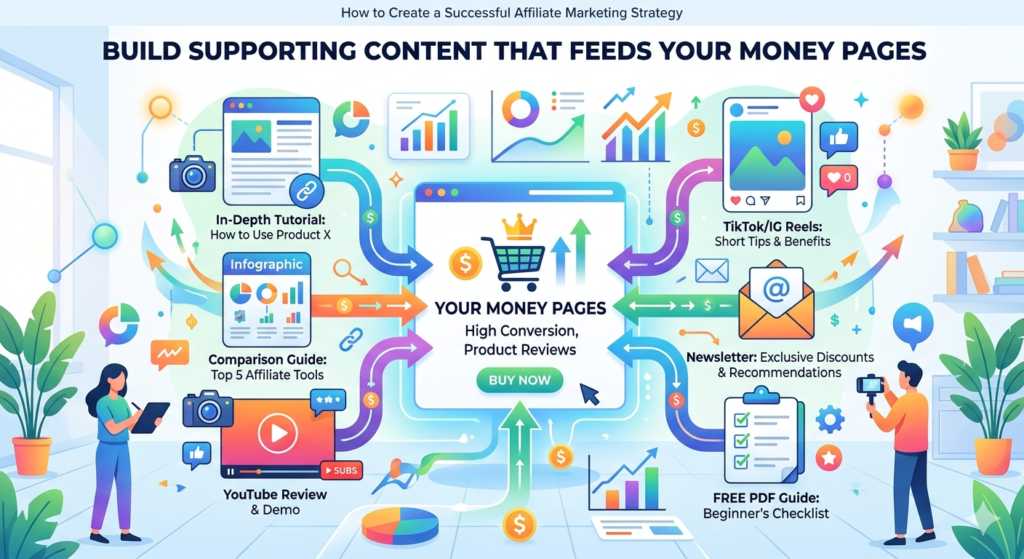
For example, if your money page is “Best Landing Page Builders for Coaches,” your supporting content could cover how to write a landing page headline, why landing pages fail, how to create a lead magnet, how to improve form conversions, and how to follow up with leads.
Each support article can naturally link to the money page when the reader is ready.
Internal links should feel like a guided path
Internal links are not just for SEO. They are part of the reader journey.
When someone reads a beginner guide, link them to the next useful step. When someone reads a problem-focused article, link them to a solution-focused comparison. When someone reads a review, link them to a setup guide or alternative page.
This creates a smooth path from learning to deciding. It also helps search engines understand which pages are most important.
Your content should reduce friction before the click
The reader should feel more confident before they click your affiliate link. That means your content should answer the main questions before sending them away.
Do not rush the click too early. If the reader still feels confused, they may leave and not buy. Help them understand the problem, the product, the fit, and the next step. Then the click becomes natural.
Build a Content Funnel That Turns Attention Into Affiliate Revenue
A good affiliate strategy does not depend on one article doing all the work.
Many people think affiliate marketing is about publishing a review, adding a few links, and waiting for sales. That can happen, but it is not a strong system. A real affiliate funnel has different content pieces that work together. One piece brings people in. Another builds trust. Another helps them compare. Another helps them act.
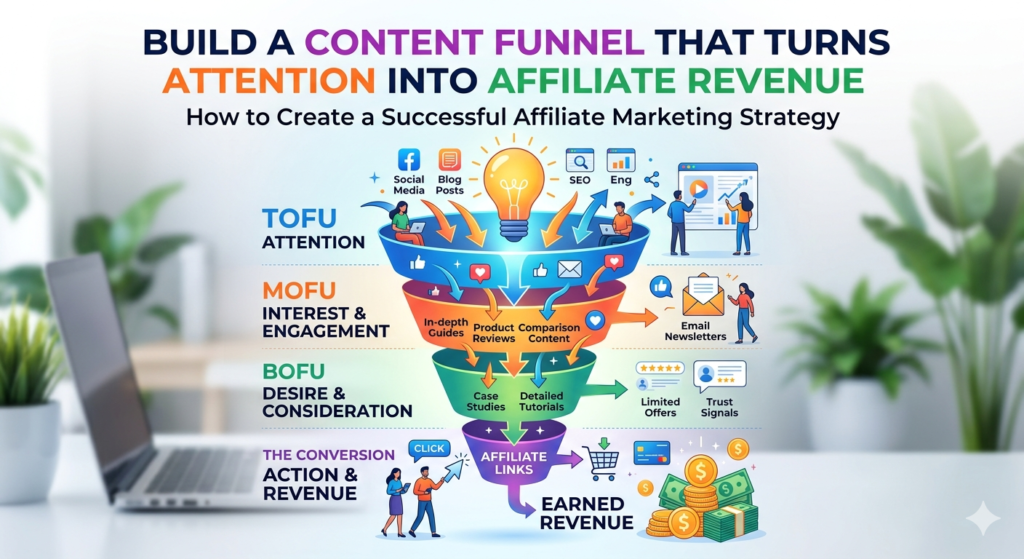
This matters because most buyers do not make a decision the first time they find you. They may read one article today, compare tools next week, and buy later when the problem becomes urgent. If your content is connected well, you stay part of that journey.
The goal is simple. You want to meet the reader where they are and help them move one step closer to a smart decision.
Your affiliate funnel should begin with the problem, not the product
The top of the funnel is where people first become aware of a problem. They may not know which product they need yet. In fact, they may not even know the exact name of the problem.
This is where helpful, simple, problem-led content works best.
For example, someone may search “why am I not getting email subscribers” before they search for an email marketing tool. Someone may search “how to manage client feedback” before they search for project management software. Someone may search “how to track sales leads” before they search for a CRM.
If your content only targets product keywords, you miss these early moments. You let someone else teach the buyer first. That is a mistake because the person who teaches often becomes the person the buyer trusts later.
Early-stage content should make the reader feel understood
At this stage, your content should not push hard. It should help the reader name the problem and see what is really going on.
A strong early-stage article feels like this: “Here is why this problem is happening. Here is what it costs you. Here is what most people try first. Here is why that often does not work. Here is the better way to think about it.”
This kind of content builds trust because it shows that you understand the reader’s world. It also sets up your later recommendations in a natural way.
For example, if you are promoting an email tool, you can write about why small businesses fail to follow up with leads. You can explain that the real issue is not just lack of effort. It is lack of a simple system. Then, later in the article, you can introduce automation as part of the solution.
The product appears because the problem demands it. That is much stronger than forcing a link into a random paragraph.
Early-stage content should lead to deeper content
A beginner guide should not be a dead end. It should guide the reader toward the next step.
If someone reads about why their landing page is not converting, the next step may be a landing page checklist, a guide to better page design, or a comparison of landing page builders. If someone reads about why their sales team is losing leads, the next step may be a CRM selection guide or a review of a simple CRM for small teams.
This is how you build movement. You are not just collecting traffic. You are shaping the journey.
Middle-funnel content should help the reader compare options
Once the reader understands the problem, they start looking at solutions. This is where middle-funnel content becomes important.
Middle-funnel content helps readers understand categories, compare methods, and narrow their choices. It does not always focus on one product. It helps the reader decide what type of product or solution makes sense.
For example, someone may compare email software versus CRM software. They may compare paid tools versus free tools. They may compare done-for-you services versus do-it-yourself platforms. They may compare simple tools versus advanced tools.
This is a powerful place to earn trust because the reader is still forming their opinion.
Category guides can become strong affiliate assets
A category guide explains a whole type of solution. For example, “How to Choose the Right Email Marketing Tool for a Small Business” can explain what features matter, what features are not needed at first, what pricing traps to avoid, and which tools fit different needs.
This is useful because many buyers are not ready for a specific product review. They first need to understand the market.
A good category guide should help the reader feel less confused. It should remove noise. It should explain the real decision factors in plain words.
If every tool says it saves time, improves results, and is easy to use, the buyer needs someone to explain what those claims actually mean. Your guide can do that.
Use-case pages make affiliate recommendations more precise
Use-case pages are often stronger than broad “best tools” pages because they speak to a clear situation.
Instead of writing only “Best Project Management Tools,” you could write “Best Project Management Tools for Marketing Agencies,” “Best Project Management Tools for Freelancers,” or “Best Project Management Tools for Remote Teams.”
These pages work well because buyers want to know what is best for them, not what is best in general. A founder with three people on the team has different needs from a large company with many departments. A solo creator has different needs from an ecommerce brand.
When your content names the situation clearly, the recommendation feels more personal. That can improve trust and conversions.
Bottom-funnel content should make the final decision easier
Bottom-funnel content is where the buyer is close to acting. They may be searching for reviews, alternatives, pricing, coupons, comparisons, or setup details.
This content can drive strong affiliate revenue because the reader already has buying intent. But it also has the highest trust risk. If your content feels biased or thin, the reader may leave.
At this stage, your job is to reduce doubt.
Review pages should feel like decision pages
A strong review is not just a product summary. It is a decision page.
The reader should leave knowing whether the product is right for them. That means you need to talk about fit, cost, setup, daily use, support, limits, and alternatives.
Do not make the review sound perfect. Perfect reviews feel fake. Real buyers know every product has trade-offs. When you name those trade-offs clearly, the reader trusts your praise more.
For example, you might say a tool is very simple to use, but not ideal for teams that need deep custom reports. Or you might say the pricing is higher than some options, but the time saved can make it worth it for busy teams.
This kind of honest detail helps people choose with confidence.
Alternative pages capture buyers who are not fully satisfied
Alternative pages are often very useful in affiliate marketing. People search for alternatives when they are unhappy, unsure, or curious.
If someone searches for “Tool A alternatives,” they are not starting from zero. They already know the market. They may be frustrated by pricing, missing features, poor support, or complexity.
Your page should address the reason they are looking for alternatives. Do not just list other products. Explain which alternative fits which problem.
For example, one alternative may be better for lower budgets. Another may be better for large teams. Another may be better for beginners. Another may be better for advanced reporting.
This gives the reader a useful shortcut. It also lets you promote several products without looking scattered.
Every affiliate page should have one clear job
A common mistake is trying to make one page do too many things. The page teaches, compares, reviews, sells, entertains, and explains every possible detail. The result feels messy.
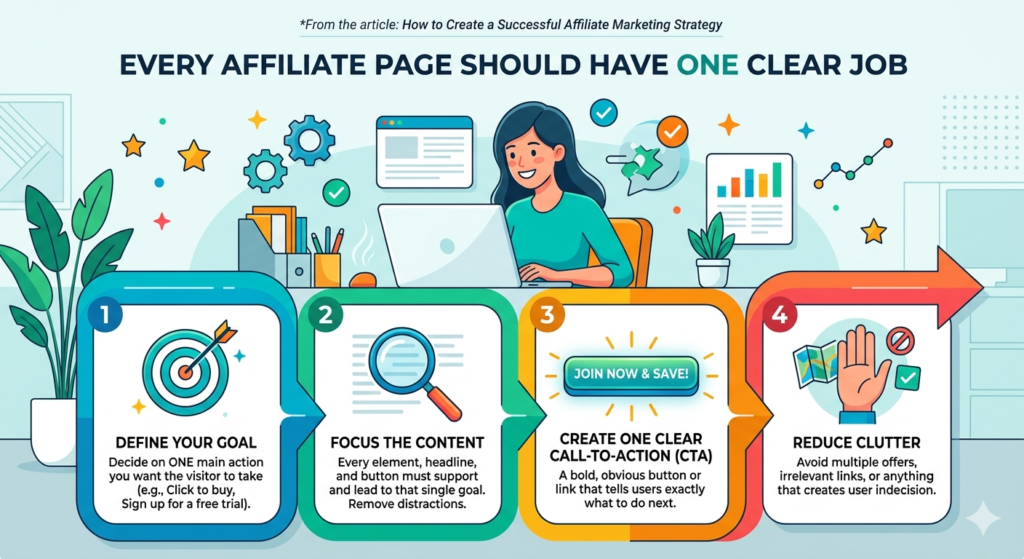
Before you write any affiliate page, decide its main job.
Is the page meant to educate a beginner? Is it meant to compare two products? Is it meant to rank several tools? Is it meant to help someone use a product after buying? Is it meant to capture people looking for a discount? Is it meant to move readers to a demo?
When the job is clear, the writing becomes stronger.
A clear page goal improves the call to action
If the page is educational, the call to action may be soft. You may invite the reader to read a comparison guide or explore a beginner-friendly tool.
If the page is a review, the call to action can be stronger. You may invite the reader to start a free trial, check pricing, or see the product in action.
If the page is a comparison, the call to action should match the winner for each type of buyer. Instead of saying “click here,” explain the reason to click.
For example, “If you want the simplest setup and do not need advanced reports, this is the better place to start.” That feels more helpful than a generic button or link.
The page should remove one major doubt at a time
People do not buy when they feel confused. They buy when the path feels safe enough.
Each section of your page should remove a doubt. One section may explain who the product is for. Another may explain pricing. Another may explain setup. Another may explain key limits. Another may compare it to the closest option. Another may explain what to do next.
This creates a smooth reading experience. The reader feels guided instead of pushed.
Use SEO to Attract Buyers Who Already Want Help
SEO is one of the strongest channels for affiliate marketing because it can bring people who are already looking for answers. These people are not being interrupted. They are asking questions. They are searching for help. They are trying to make a decision.
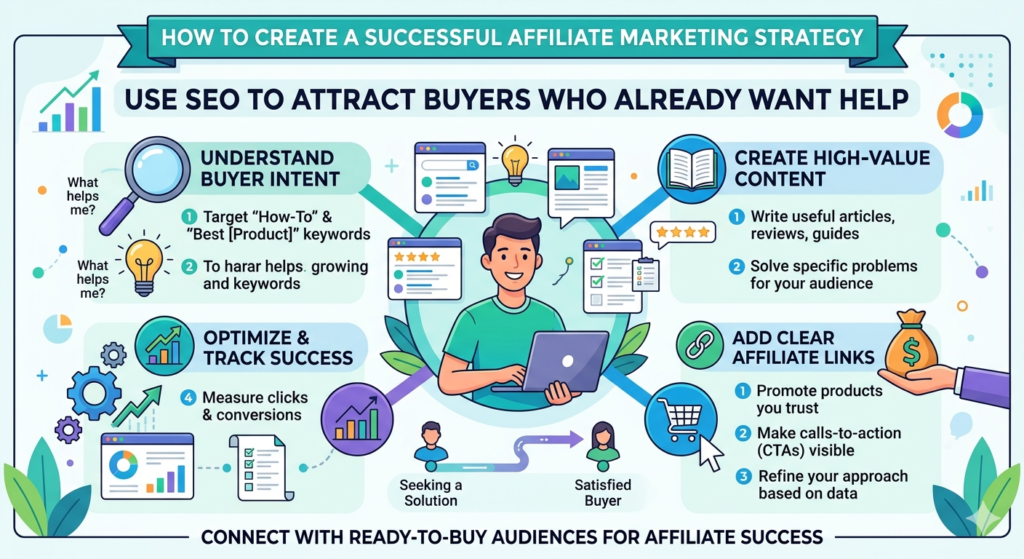
That makes search traffic very valuable.
But SEO for affiliate marketing must be handled carefully. It is not enough to chase keywords with high search volume. Many high-volume keywords bring people who are not ready to buy. Many low-volume keywords bring people who are very close to buying. The smart move is to understand the value behind the search, not just the size of the search.
Search intent matters more than search volume
A keyword with 500 searches a month can be more valuable than a keyword with 10,000 searches a month if the smaller keyword has stronger buying intent.
For example, “what is email marketing” may get many searches, but most readers are learning. “Best email marketing software for coaches” may get fewer searches, but the reader is closer to choosing a tool.
This does not mean you should ignore broad keywords. They can help build authority. But your revenue will often come from keywords where the buyer has a clear need and is comparing options.
High-intent keywords often include specific decision words
Words like best, review, alternatives, comparison, pricing, discount, for small business, for beginners, for agencies, and versus often show stronger buying intent.
These terms tell you the reader is not just curious. They are trying to choose.
For example, a person searching “best affiliate software for Shopify stores” likely has a real need. A person searching “affiliate marketing meaning” may not be ready for a tool yet.
Your content plan should include both, but your revenue forecast should treat them differently.
Low-volume keywords can become hidden profit centers
Many affiliate marketers ignore low-volume keywords because they look too small. That can be a mistake.
Specific keywords often convert better because they match a clear need. If you write a page for “best CRM for solo consultants,” you may not get huge traffic, but the people who arrive may feel the page was written exactly for them.
These pages can also be easier to rank for because fewer sites target them well. Over time, many small pages can create steady revenue.
This is especially useful for newer sites that cannot compete for broad keywords yet.
Build topical authority before chasing the hardest keywords
Search engines need to understand what your site is about. Readers do too.
If your site has one article about email tools, one about travel backpacks, one about credit cards, and one about pet food, it becomes hard to build trust. But if your site has a deep cluster of content around one topic, authority grows faster.
Topical authority means your site covers a subject in depth. You answer the main questions, the beginner questions, the comparison questions, the pricing questions, and the use-case questions.
Content clusters make your affiliate site stronger
A content cluster is a group of related articles around one core topic.
For example, if your topic is email marketing for small businesses, your cluster could include a beginner guide, a tool comparison, several reviews, use-case pages, pricing explainers, setup guides, automation ideas, and common mistakes.
These pages should link to each other in a natural way. The beginner guide links to the tool guide. The tool guide links to reviews. Reviews link to comparisons. Comparisons link back to the main guide where useful.
This structure helps readers move through the journey. It also helps search engines see that your site has depth.
Do not publish random content just to fill a calendar
Publishing more is not always better. Random content can weaken your site. If an article does not support your core topic, your buyer journey, or your authority, it may not be worth writing.
Every piece should have a reason. It should attract the right reader, answer an important question, support a money page, build trust, or help conversions.
This is how you avoid content waste.
Write SEO content for humans first, then polish for search
Affiliate content often sounds bad because it is written for search engines before people. The article repeats the keyword too many times. It says obvious things. It uses long filler sections. It adds generic advice that no real buyer needs.
That may fill a page, but it does not build trust.
Good SEO content should feel clear, useful, and easy to read. The reader should feel like a real person is guiding them.
The opening should prove the page is worth reading
The first few lines matter. Do not start with a dull definition unless the reader truly needs it.
Start by naming the problem, the decision, or the pain. Show the reader that you understand why they are there.
For example, instead of opening a comparison page with “Email marketing tools are important for businesses,” you could start with, “Choosing an email tool is harder than it looks because most platforms promise the same thing, but they do not fit the same type of business.”
That opening creates tension. It gives the reader a reason to keep going.
Each section should move the reader forward
Avoid sections that exist only to include a keyword. Every section should answer a real question or remove a real doubt.
Ask yourself, “After reading this section, does the reader know something useful they did not know before?” If not, cut it or rewrite it.
This is one of the simplest ways to make affiliate content better.
On-page SEO should support the reader experience
On-page SEO is important, but it should not make the page feel stiff. Your title, headings, internal links, image text, and structure should help both search engines and readers understand the page.
A clean structure also improves readability. People scan before they read. If your headings are clear, they can quickly see whether the page will help them.
Headings should say something useful
Weak headings say things like “Features” or “Benefits.” Strong headings explain the point.
For example, “The automation features are useful for small teams that cannot follow up manually” is more helpful than “Automation Features.”
A good heading makes the reader want to continue. It also gives search engines more context.
Internal links should guide, not distract
Do not add internal links just because you can. Add them where they help the reader.
If someone is reading a review and you mention that the product may not be ideal for large teams, that is a natural place to link to an alternatives page. If someone is reading a beginner guide and you explain that choosing the right tool matters, that is a natural place to link to a best-tools page.
Every link should feel like a helpful next step.
Update your best pages often
Affiliate SEO is not a one-time job. Products change. Pricing changes. Features change. Competitors improve. Search results shift. Buyer questions change.
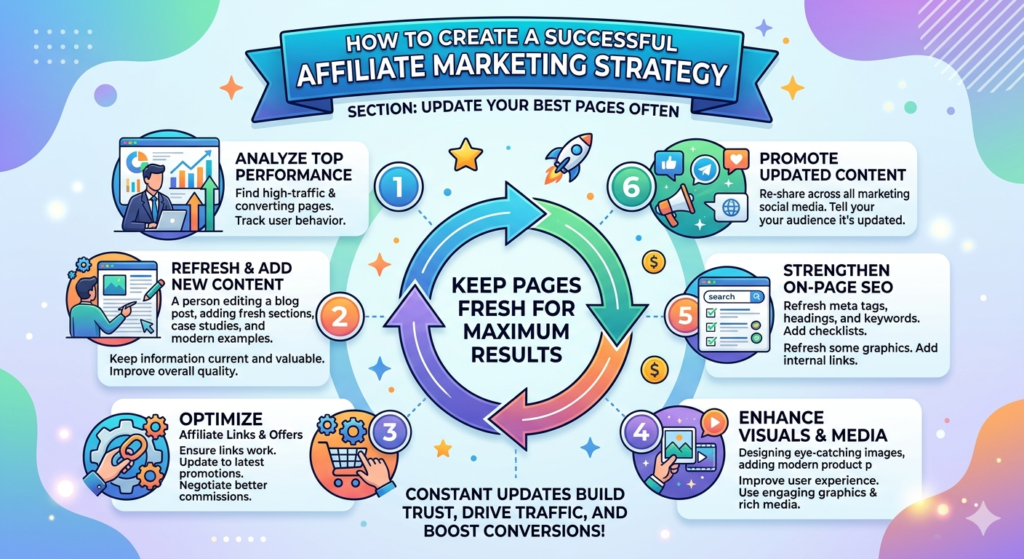
Your best pages need regular updates.
If a review says a product costs one amount, but the pricing has changed, trust drops. If a comparison misses a new feature, the page becomes less useful. If a tool has changed its free plan, your recommendation may need to change too.
Refreshing content can protect rankings and revenue
Updating content helps keep it accurate. It also gives you a chance to improve conversions.
You can add new examples, improve the opening, update screenshots, clarify pricing, improve internal links, answer new questions, and remove outdated claims.
Often, improving an existing page is more profitable than publishing a new one. The page already has history, links, and traffic. A smart update can make it perform better.
Track which pages deserve the most attention
Not every page needs the same level of care. Focus first on pages that already bring traffic, rank near the first page, earn commissions, or support important offers.
These pages are your revenue assets. Treat them like assets. Review them often. Improve them with care. Keep them accurate and useful.
Make Your Affiliate Recommendations Feel Natural and Helpful
The way you place affiliate links matters. A good recommendation feels like guidance. A bad one feels like pressure.
Readers are smart. They know when a link exists only to make money. That does not mean affiliate links are bad. It means the context around the link must earn the click.
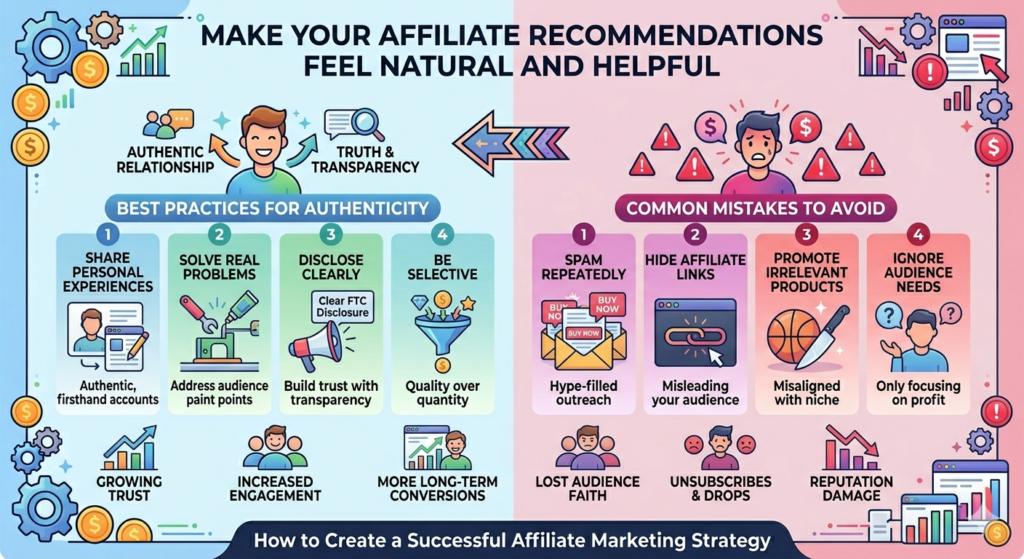
Your goal is not to hide that you are an affiliate. Your goal is to make the recommendation so useful that the reader still values it.
Place links where the reader is ready for the next step
Do not add affiliate links too early without context. If the reader does not yet understand the problem or the product, the link may feel random.
A link works best after you have explained why the product is relevant.
For example, if you are writing about email follow-up, first explain why manual follow-up breaks down. Then explain what a good system needs. Then introduce a tool that helps create that system. At that point, the link feels earned.
Context makes the click stronger
A plain link that says “try this tool” is weaker than a link surrounded by clear reasoning.
The reader should know why they are clicking. Are they checking pricing? Starting a free trial? Comparing features? Seeing a demo? Claiming a discount? Looking at templates?
Make the next step clear. A clear next step reduces hesitation.
Do not overload the page with links
Too many affiliate links can make a page feel desperate. It can also distract the reader.
Use links where they make sense. If you mention the same product many times, you do not need to link every mention. Place links near strong decision points, such as after a clear recommendation, after a comparison, after a pricing explanation, or near the final verdict.
The goal is not maximum links. The goal is maximum trust and action.
Write calls to action that match the reader’s intent
A call to action should not feel generic. It should match the reader’s stage and the reason they are interested.
If the reader is still learning, a softer call to action may work better. If the reader is comparing tools, a direct call to action may make sense. If the reader is near purchase, the call to action should reduce risk and make the next step easy.
Use plain language for calls to action
Simple language works best.
Instead of writing something stiff like “Leverage this solution to optimize your workflow,” say what the reader can actually do. They can check the price. Start a trial. See the templates. Compare plans. Book a demo. View the product.
Clear beats clever.
A good call to action sounds like a helpful next step, not a command.
Tie the call to action to a real benefit
Do not just say “click here.” Give a reason.
For example, if the product is good for beginners, say that the reader can start with the simplest plan. If the product is strong for teams, say they can see how the team features work. If the product has useful templates, invite them to view the templates.
The benefit should connect to the section they just read. That makes the action feel natural.
Be open about affiliate relationships
Trust grows when you are clear. Readers should know that you may earn a commission if they buy through your links. This is not only a legal issue in many places. It is also a trust issue.
A clear disclosure does not have to sound scary. It can be simple and honest. The key is to place it where readers can see it before they click.
Disclosure should not weaken your recommendation
Some affiliates worry that disclosure will hurt sales. In reality, honest disclosure can make your content feel more trustworthy.
Readers understand that creators and publishers need to earn money. What they do not like is feeling tricked. If your content is genuinely useful, a disclosure will not ruin it.
The quality of your advice matters more than the fact that you may earn a commission.
Honesty makes your positive claims stronger
When you explain both strengths and limits, your recommendation feels balanced. This is especially important in affiliate content because the reader knows there is a financial relationship.
If you only praise, they may doubt you. If you are fair, they may trust you.
That trust is what leads to long-term revenue.
Use proof to support your recommendation
People believe recommendations more when they are supported by proof. Proof can come from your own testing, customer reviews, case studies, product data, screenshots, examples, or real use cases.
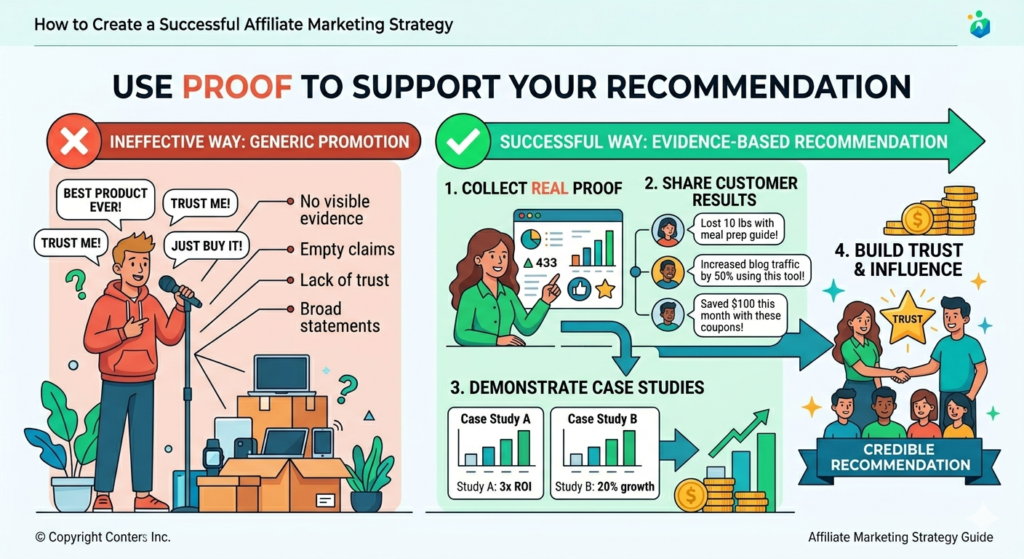
Proof helps the reader feel safer.
Show what the product helps with in real life
Do not only say a tool is easy. Explain what makes it easy. Does it have a clean setup? Does it include templates? Does it avoid too many settings? Does it guide the user step by step?
Do not only say a tool saves time. Explain where the time is saved. Does it automate follow-ups? Does it reduce manual reports? Does it keep client messages in one place?
Specific proof is more persuasive than broad praise.
Use examples that match your audience
If your audience is made of small business owners, do not rely only on enterprise examples. If your audience is freelancers, do not focus on large team workflows. If your audience is beginners, do not use advanced examples they cannot relate to.
Proof works best when the reader can see themselves in it.
Build Partner Relationships That Give You an Edge
Affiliate marketing is often treated like a solo activity. You join a program, get a link, and create content. But the strongest affiliates often build real relationships with the companies they promote.
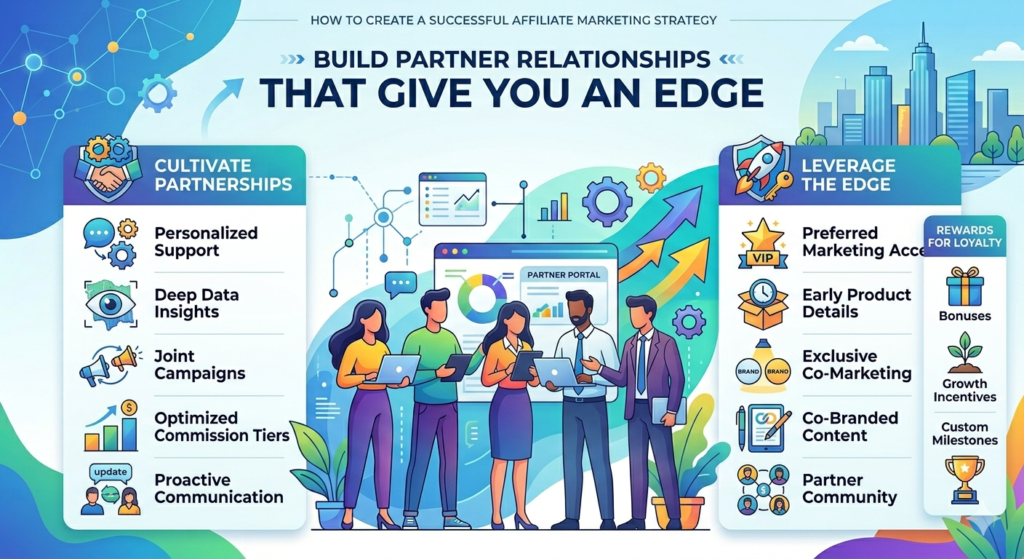
These relationships can lead to better commission rates, custom landing pages, exclusive discounts, early product updates, co-marketing opportunities, and better support.
This can give you a real advantage.
Treat affiliate managers like growth partners
Many affiliate programs have managers who support partners. They want good affiliates to succeed because your success brings them customers.
Do not only contact them when something goes wrong. Build a real working relationship.
Share your plans. Ask which products convert best. Ask what buyer segments are growing. Ask if they have updated messaging, customer stories, or approved creative assets. Ask what objections their sales team hears most often.
This information can make your content much stronger.
Affiliate managers can help you understand what converts
A good affiliate manager may know which landing pages convert best, which plans are most popular, which offers have strong retention, and which buyer types are best fit.
This helps you avoid guessing. It can also help you improve your content angle.
For example, you may think a product is best for startups, but the company may know that agencies convert better. Or you may think the free trial is the main selling point, but the company may know that templates drive more signups.
These details can improve both traffic and conversions.
Ask for assets that improve the buyer journey
You can ask for screenshots, demo videos, product guides, comparison sheets, customer stories, or approved claims. These assets can help make your content richer and more accurate.
You can also ask if they offer special landing pages for affiliates. A landing page that matches your audience can convert better than a generic homepage.
For example, if your audience is small agencies, a landing page focused on agency use cases may work better than a broad product page.
Negotiate once you can show value
When you are new, it may be hard to negotiate. But once you bring traffic, leads, or sales, you have leverage.
You can ask for higher commissions, longer cookie windows, bonuses, exclusive offers, or custom campaigns.
The key is to show value clearly.
Use performance data in your negotiation
Do not simply ask for more money. Show what you are bringing.
You can share monthly clicks, conversion rates, content rankings, email list size, audience details, or revenue generated. You can also explain your future plan, such as creating new comparison pages, updating reviews, or running a focused campaign.
When the company sees that you are serious, they are more likely to support you.
Better terms can change your whole strategy
A higher commission or exclusive offer can make a program more worth promoting. It may justify more content, paid promotion, email campaigns, or deeper testing.
This is why partner relationships matter. They can turn a normal affiliate program into a serious revenue channel.
Work with brands that respect the customer
Your reputation is tied to the products you promote. If a brand treats customers poorly, your audience may blame you for the recommendation.
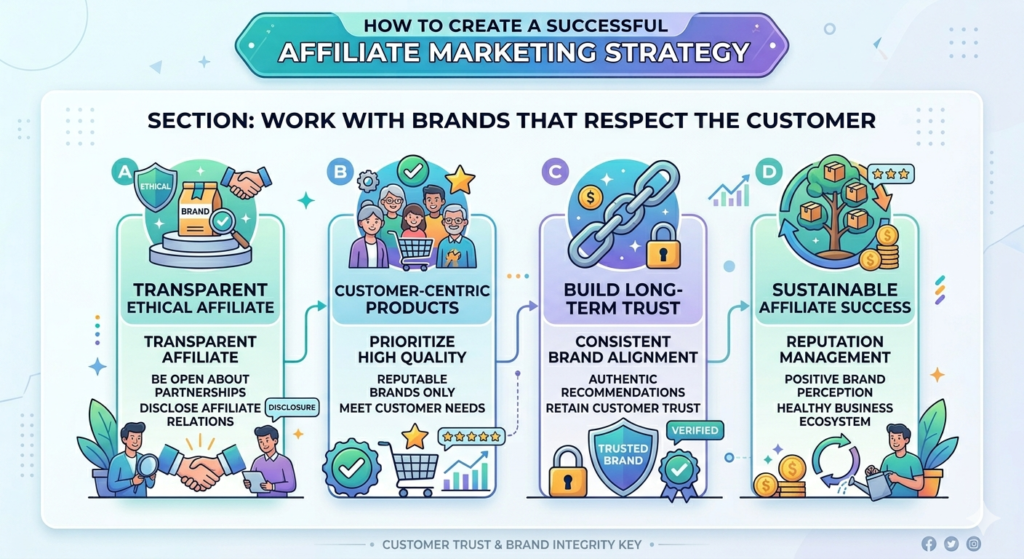
Before building a deep partnership, pay attention to customer support, refund behavior, product quality, and communication.
A bad customer experience can hurt your brand
If readers buy through your link and feel misled, they may not trust your future recommendations. Even if you did not create the product, you made the introduction.
That is why you should care about what happens after the sale.
Look for brands that onboard customers well, respond to support issues, and keep their promises. A lower commission from a trustworthy brand is often better than a high commission from a brand that creates unhappy buyers.
Long-term affiliate revenue depends on customer success
The best affiliate income comes when customers stay, use the product, and feel happy with their choice. This is especially true for recurring commissions.
Customer success is not separate from your strategy. It affects refunds, retention, commission stability, and reader trust.
Promote products that make your audience better off after they buy. That is the foundation of sustainable affiliate marketing.
Design Landing Pages That Help the Affiliate Traffic Convert
Affiliate marketing does not end when someone clicks your link.
That click is only the handoff. What happens next decides whether the visitor becomes a lead, a buyer, or a lost chance. This is why your strategy cannot focus only on content and traffic. You also need to think about the page people land on after they click.
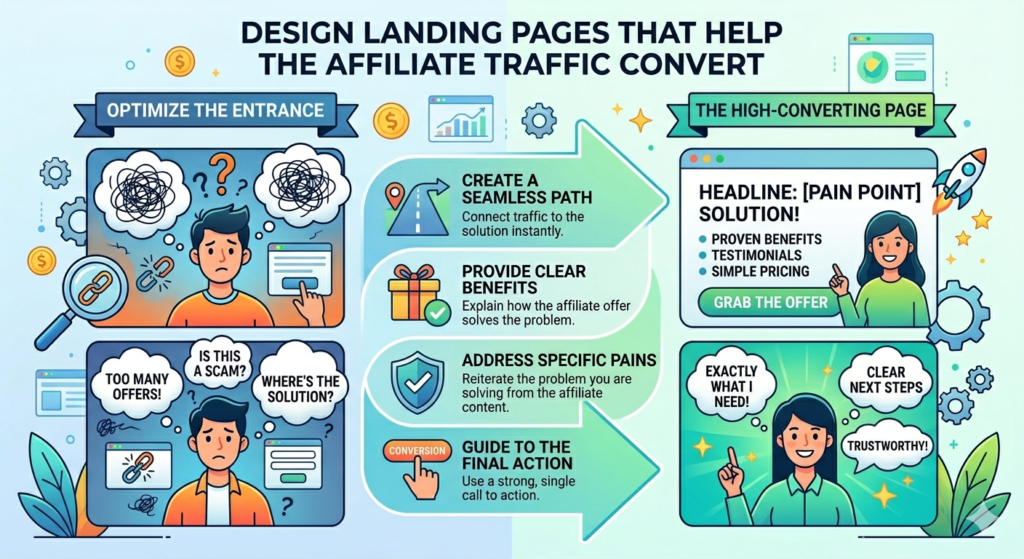
Sometimes that landing page belongs to the brand you promote. Sometimes it is your own bridge page, comparison page, bonus page, or email capture page. Either way, the page must continue the same promise your content made.
If your article speaks to beginners, but the landing page feels complex, people may leave. If your content talks about a specific use case, but the landing page is generic, the buyer may feel unsure. If your review builds trust, but the next page creates confusion, the sale may fall apart.
A strong affiliate strategy makes the full journey feel smooth. The reader should not feel like they have moved from helpful advice to a hard sell. They should feel like they are taking the next clear step.
Your landing page must match the reason behind the click
Every affiliate click has intent behind it. The person clicked because they wanted something. They may want pricing details. They may want a free trial. They may want a demo. They may want to compare features. They may want proof. They may want to see whether the product fits their exact problem.
If the landing page does not match that intent, the click loses power.
For example, if your content says a tool is best for solo consultants and the link sends people to a homepage built for enterprise teams, there is a mismatch. The visitor may think, “This is not for me.” Even if the product is good, the page failed to continue the story.
Message match makes the buyer feel safe
Message match means the landing page repeats and supports the same idea that made the person click.
If your article recommends a tool because it is simple, the landing page should quickly show simplicity. If your article recommends it because it saves time, the landing page should show how time is saved. If your article recommends it for agencies, the landing page should show agency use cases.
This sounds basic, but it is often missed. Many affiliates send all clicks to the same generic page. That may be easy, but it is not always best.
When the page matches the reader’s intent, the buyer feels like they are in the right place. That reduces doubt. It also makes the action feel easier.
A custom landing page can lift trust and conversions
If you send steady traffic to a brand, ask whether they can create a custom landing page for your audience. This is especially useful if your audience is narrow and valuable.
A custom page can mention the audience directly, explain the use case, show relevant proof, and offer a clear next step. It may also include a special bonus, trial, discount, or setup guide.
Even small changes can matter. A page for “small marketing agencies” will often feel more relevant than a page for “all businesses.” A page for “new creators” will feel safer than a page filled with advanced terms and enterprise language.
Use bridge pages when the buyer needs more confidence
A bridge page is a page between your content and the final offer. It can be useful when the product is complex, expensive, new, or needs more explanation.
A bridge page should not be a trick. It should add value. It should help the buyer make a better decision before they visit the product page.
For example, you might create a bridge page that explains your recommended setup, shows who the product is best for, includes a short checklist, shares your bonus, or compares plan options in plain words.
This can work well when the brand’s own landing page is too broad or too technical for your audience.
Bridge pages are useful for complex products
Some products need more context before the buyer is ready. Software tools, business services, courses, financial products, and higher-priced offers often need more trust.
A short affiliate link may not be enough. The buyer may need to know what to expect, what plan to choose, what mistakes to avoid, and how to get value quickly.
A bridge page can answer these questions in your voice. That matters because the reader already trusts you more than the brand. Your explanation can make the product feel easier to understand.
A bridge page should not add friction without purpose
A bridge page is only useful if it makes the buying decision easier. If it simply repeats the same claims, adds another click, or delays the buyer, it may hurt conversions.
The page should have a clear job. It may explain the best plan for your audience. It may show a simple setup path. It may offer a bonus. It may answer common doubts. It may warn people who are not a good fit.
If the bridge page does not reduce doubt or increase desire, remove it.
Your own pages should capture value before sending traffic away
One challenge with affiliate marketing is that once the visitor leaves your site, you may not be able to reach them again. If they do not buy right away, you may lose the relationship.
This is why email capture can be useful, especially for higher-ticket or longer-decision products.
You do not need to block every visitor with a popup or force them into an email list before they can click. That can feel annoying. But you can offer something helpful that makes sense for the page.
For example, if someone is reading about affiliate software, you could offer a simple comparison sheet. If someone is reading about email tools, you could offer a setup checklist. If someone is reading about landing page builders, you could offer a landing page copy template.
The lead magnet should help the same decision the page is already about.
Email capture lets you keep helping after the first visit
Many buyers need time. They may read your article during research, then return days or weeks later to buy. If you have no way to follow up, you depend on them remembering you.
Email gives you another chance to help. You can send useful advice, compare options, answer common questions, share examples, and remind them of the next step.
This is not about spamming. It is about continuing the guidance.
A short email sequence can work very well when it is tied to the reader’s problem. For example, after someone downloads a CRM checklist, you can send emails about choosing the right CRM, avoiding setup mistakes, getting team adoption, and knowing when to upgrade.
Each email can naturally include your affiliate recommendation where it fits.
Do not make the email offer feel separate from the page
The email offer should feel like a natural extension of the content. If the page is about choosing a tool, offer a tool selection checklist. If the page is about comparing two products, offer a decision worksheet. If the page is about starting a new strategy, offer a simple planning template.
When the offer fits the page, people are more likely to join. More importantly, they are more likely to value the emails that follow.
This improves both trust and future conversions.
Improve the conversion path with simple page design
Design affects affiliate revenue. A page can have strong content but still lose readers if it is hard to read, slow to load, cluttered, or confusing.
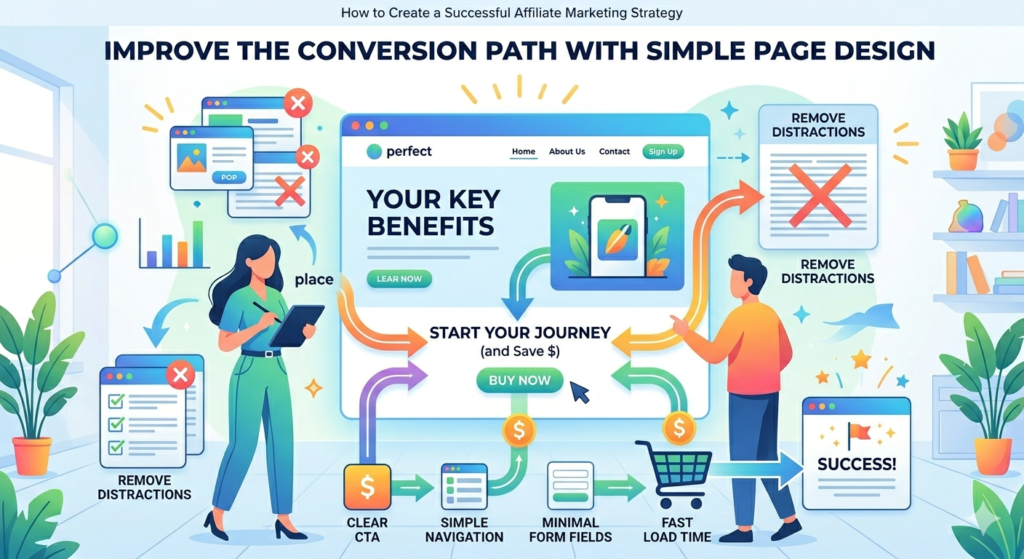
Good design does not need to be fancy. It needs to be clear.
The reader should quickly understand where they are, what the page is about, what they should read next, and what action they can take.
Clarity beats decoration
Many affiliate pages add too much. Too many banners. Too many boxes. Too many buttons. Too many colors. Too many popups. The page starts to feel like a billboard instead of helpful advice.
Simple pages often perform better because they keep attention on the decision.
Use clear headings, short paragraphs, helpful images, comparison tables where needed, and calls to action placed at natural decision points. Make sure the page loads quickly and works well on mobile.
A clean page makes the content feel more trustworthy.
Mobile experience can make or break affiliate revenue
Many readers will find your content on mobile. If your page is hard to use on a phone, you lose money.
Check how your review pages, comparison pages, buttons, tables, and forms look on a small screen. Long tables may break. Buttons may be hard to tap. Popups may cover the content. Images may slow the page down.
A mobile reader should be able to scan, understand, and click without effort.
This is especially important for affiliate content because readers often compare options quickly. If your page feels frustrating, they will return to search results and choose another site.
Use Email Marketing to Turn One Visit Into Many Chances to Earn Trust
SEO and social traffic are powerful, but they can be unpredictable. Rankings change. Algorithms change. Paid costs rise. Social reach drops. Email gives you a more stable way to build a relationship with people who already showed interest.
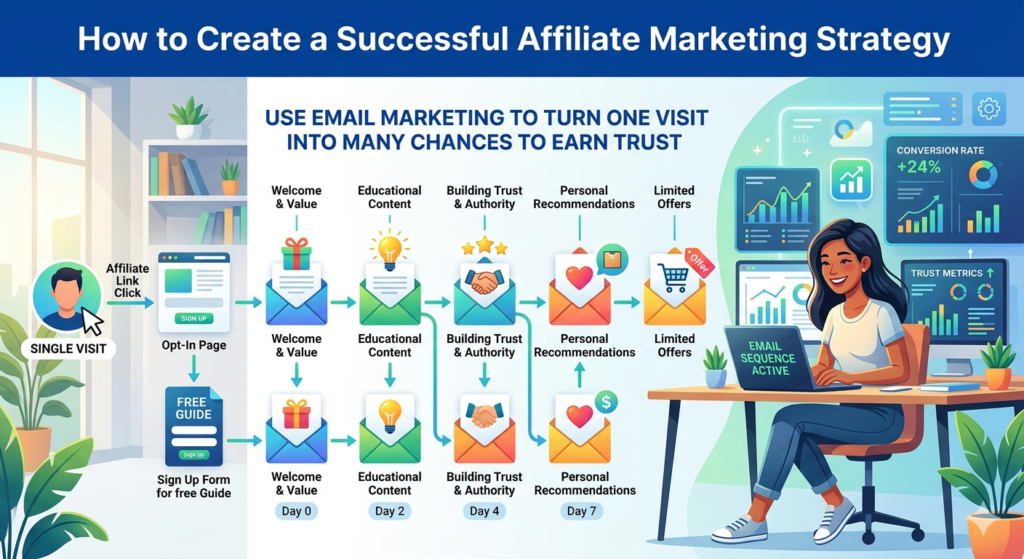
For affiliate marketing, email is not just a traffic channel. It is a trust channel.
A reader who joins your email list is giving you permission to keep helping them. That is a serious advantage. You can educate them over time, send them to your best content, explain your recommendations, and promote offers when the timing is right.
But email must be handled with care. If every email is a sales pitch, people stop listening. The goal is to make your emails so useful that readers are happy to open them.
Build email sequences around the buyer’s problem
The best affiliate email sequences are not random newsletters. They are built around a clear problem.
Someone who downloads a guide about choosing website hosting has a different need from someone who downloads a guide about improving email conversions. Each person should get emails that match the reason they joined.
This makes your follow-up feel personal even when it is automated.
A welcome sequence should teach before it sells
The first few emails should build trust. Welcome the reader, explain what they will learn, and give useful advice quickly.
If you promote too hard in the first email, you may lose people before the relationship begins. But if you wait too long to mention helpful tools, you may miss the moment when they are ready.
The balance is to teach first, then recommend naturally.
For example, an email sequence about starting a blog could explain how to choose a niche, how to plan content, how to set up a simple site, and how to avoid common mistakes. Hosting can be recommended when the setup step appears. An email tool can be recommended when you talk about building an audience. A keyword tool can be recommended when you talk about content planning.
The offers appear at the right time because they support the lesson.
Each email should have one main idea
Do not overload one email with too many lessons or too many links. A focused email is easier to read and easier to act on.
One email might explain the biggest mistake beginners make. Another might compare two common approaches. Another might share a simple checklist. Another might explain when it is time to buy a tool.
When each email has one clear idea, the reader can follow the journey. It also makes your calls to action stronger.
Segment your list based on interest
Not every subscriber wants the same thing. If you send every offer to everyone, your emails become less relevant.
Segmentation means grouping people based on what they care about, what they clicked, what they downloaded, or where they are in the buyer journey.
You do not need a complex system at first. Even simple segmentation can improve results.
Click behavior can show buyer intent
If a subscriber clicks on several articles about one type of tool, that is a signal. If they click pricing guides or comparison pages, they may be closer to buying. If they only read beginner guides, they may need more education.
You can use this behavior to send more relevant content.
For example, if someone clicks a CRM comparison, you can send them a follow-up email about choosing the right CRM plan. If someone clicks a landing page builder review, you can send them examples of landing pages and a checklist for what to build first.
This feels helpful because it matches their interest.
Simple tags can keep your promotions relevant
You can tag subscribers based on lead magnets, link clicks, or topic interests. A person interested in ecommerce tools should not receive the same emails as someone interested in B2B sales software unless the content truly overlaps.
Relevant emails protect trust. They also increase clicks and conversions because the offer fits the reader’s current need.
The more your list grows, the more this matters.
Use story and teaching to make emails feel human
Affiliate emails should not read like product ads. They should feel like helpful notes from someone who understands the problem.
Stories can make this easier. You can talk about a common mistake, a lesson from a client, a problem you faced, or a simple before-and-after situation. The story does not need to be dramatic. It just needs to feel real.
A simple story can make the problem clear
For example, instead of saying, “You need email automation because it saves time,” you could explain how a small business owner gets leads from a contact form but forgets to follow up for three days. By the time they reply, the lead has already chosen someone else.
That story makes the cost of poor follow-up clear. Then an email tool becomes part of the solution.
People remember stories better than claims. They also feel less sold to when the lesson comes through a real situation.
Teaching builds trust before the offer
The more useful your emails are, the more permission you earn to recommend products.
Teach readers how to think. Teach them what to avoid. Teach them how to compare. Teach them what matters and what does not. Then, when you recommend a tool, they understand why.
This is how email turns affiliate marketing from promotion into guidance.
Promote affiliate offers without burning the list
Affiliate promotions can earn well, but too many promotions can damage your list. People joined because they wanted help. If they feel like they are only being sold to, they will stop opening.
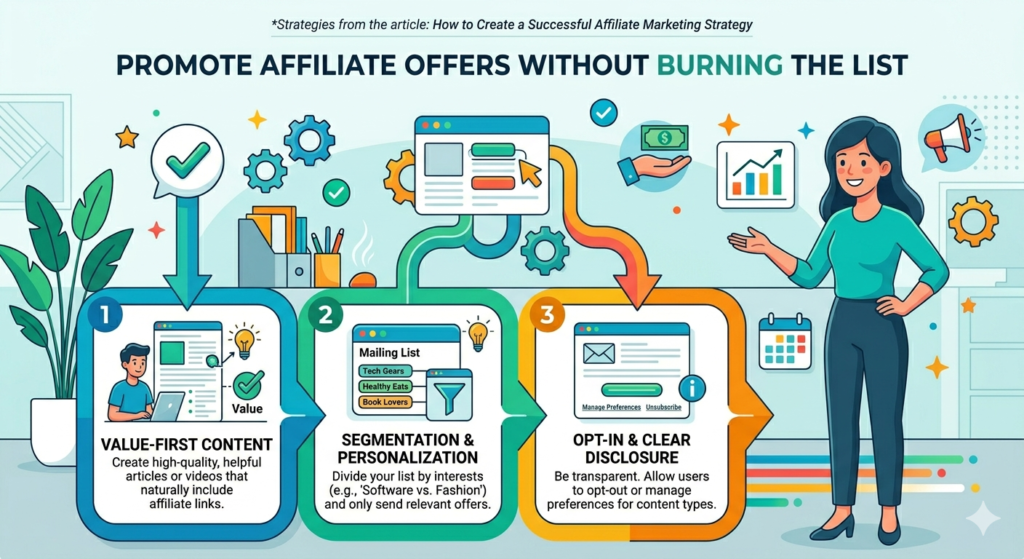
The best approach is to mix value and promotion in a way that feels natural.
Promote when the offer solves the current problem
Do not promote a product just because the brand is running a campaign. Promote it when it matches what your readers are dealing with.
If your email is about fixing slow client approvals, a project management tool fits. If your email is about getting more leads from a website, a landing page builder fits. If your email is about building customer trust, a review tool might fit.
The offer should feel like the next logical step.
Explain who should not buy
This is one of the strongest trust moves in affiliate email.
When you tell people who should not buy, your recommendation feels more honest. You might say the tool is not needed if they are just starting and have no traffic yet. You might say it is too advanced for someone who only needs a simple form. You might say the paid plan is not worth it until they reach a certain stage.
This honesty may reduce some clicks in the short term, but it builds long-term trust. It also helps send better-fit buyers.
Track the Numbers That Actually Show Affiliate Growth
Affiliate marketing without tracking is guessing.
You may think a page is working because it gets traffic. You may think a product is strong because it gets clicks. You may think a campaign failed because it did not bring instant sales. But without the right numbers, you do not really know.
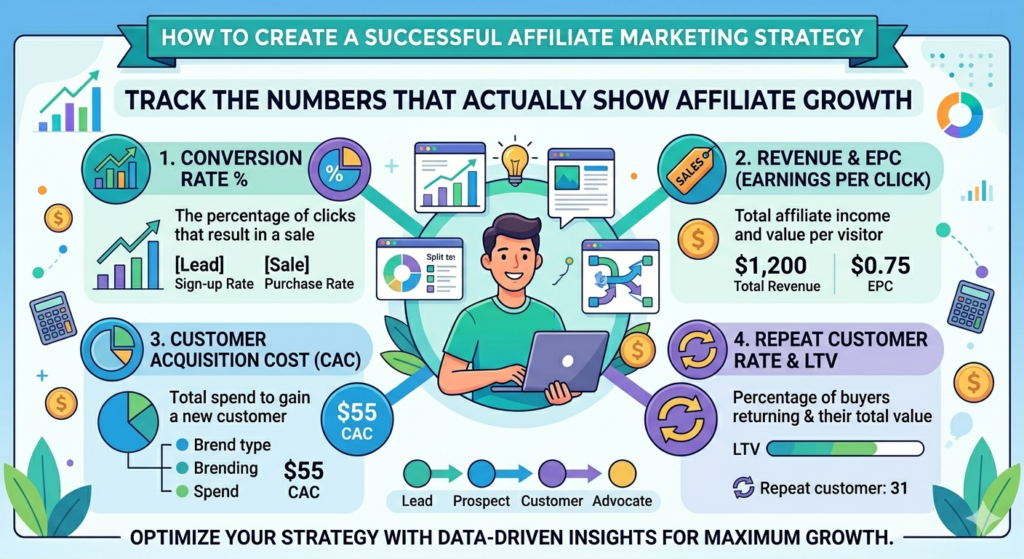
Tracking helps you see what is working, what is weak, and where to improve. It also helps you make better decisions about content, offers, SEO, email, and partnerships.
The goal is not to drown in data. The goal is to track the few numbers that help you grow.
Start with the full path from visit to commission
A visitor may land on your article, read it, click a link, visit the brand’s page, return later, and then buy. Your tracking should help you understand as much of this path as possible.
You may not always see every step because affiliate programs control some of the data. But you can still track enough to make smarter choices.
Page traffic alone is not enough
A page with high traffic may earn very little if the readers are not buyers. A page with lower traffic may earn more if it attracts people with strong intent.
This is why you should look beyond visits. Track clicks, click rate, conversions, commissions, and revenue per page.
If a page gets many visits but few clicks, the content may not make the offer feel relevant. If a page gets many clicks but few sales, the offer may not convert, the landing page may be weak, or the audience may not be a good fit. If a page gets fewer visits but strong sales, it may deserve more internal links, updates, or related content.
Revenue per visitor can reveal your best content
Revenue per visitor shows how much a page earns compared to its traffic. This helps you spot high-value pages.
For example, one guide may get 10,000 visits and earn little. Another comparison page may get 500 visits and earn much more. The second page may be more valuable even though it looks smaller in traffic reports.
This is why affiliate strategy should not worship traffic alone. Revenue quality matters.
Use tracking IDs for every important campaign
Many affiliate programs let you create tracking IDs, sub-IDs, or custom links. Use them.
Tracking IDs help you see which page, email, button, or campaign created the sale. Without them, all clicks may look the same in your dashboard.
This makes improvement much harder.
Track by page and placement when possible
At minimum, track which page sent the click. For important pages, you may also want to track link placement. For example, you may want to know whether clicks come from the top recommendation, the comparison section, the pricing section, or the final call to action.
This can show you how readers behave.
If most conversions come from a detailed pricing section, that tells you pricing clarity matters. If clicks from the top of the page do not convert, but clicks after the comparison do, that tells you readers need more education before acting.
Track email links separately from SEO links
Email traffic behaves differently from search traffic. Subscribers may trust you more. They may also be at a different stage of the journey.
Use separate tracking IDs for email campaigns so you can see how they perform. This helps you decide which emails drive sales, which offers fit your list, and which sequences need improvement.
Watch conversion rate, not just commission
Commission is the final result, but conversion rate tells you how well the journey is working.
Conversion rate can mean different things depending on the step. You can track page-to-click conversion, click-to-sale conversion, trial-to-paid conversion, or lead-to-sale conversion.
Each one shows a different part of the system.
A low page-to-click rate means the content may not be persuasive enough
If people read the page but do not click, the issue may be the content, the offer fit, the link placement, or the call to action.
Maybe the article teaches well but never makes a clear recommendation. Maybe the product appears too suddenly. Maybe the reader does not understand why the tool matters. Maybe the link is buried too low. Maybe the page attracts readers who are not ready to buy.
To improve this, strengthen the recommendation context. Explain the problem, show why the product fits, answer objections, and place the link where the reader is ready.
A low click-to-sale rate means the offer or landing page may be weak
If many people click but few buy, look at what happens after the click.
The product may not match the promise. The landing page may be confusing. The pricing may surprise people. The checkout may be hard. The brand may not be trusted. The affiliate program may have tracking issues. Or the audience may be curious but not ready.
This is where you may need to test another offer, ask the affiliate manager about conversion data, or create a better bridge page before sending people to the product.
Review refunds, cancellations, and customer quality
Many affiliates only look at sales. But refunds and cancellations matter too.
If a product gets many refunds, your revenue may drop and your audience may lose trust. If customers cancel quickly, recurring commissions will not last. If a brand rejects many commissions, you need to understand why.
High refunds can signal a poor fit
Refunds do not always mean the product is bad. They may mean your content is sending the wrong people.
For example, if your content says a tool is simple for beginners but it is actually complex, buyers may refund. If you promote an advanced product to people with small budgets, they may cancel quickly. If you overstate what the product can do, people may feel disappointed.
Better content can fix this. Be clearer about who the product fits, what it does not do, and what buyers should expect.
Customer quality can help you negotiate better terms
Brands care about quality. If your referrals stay longer, buy higher plans, or need less support, you are valuable.
Use this in partner conversations. If you can show that your audience converts well and stays, you may be able to negotiate better commissions or custom offers.
This is another reason to focus on trust instead of quick clicks.
Build a simple monthly affiliate review
Once a month, review your affiliate performance. Keep it simple but consistent.
Look at which pages brought traffic, which pages brought clicks, which offers converted, which links performed, which emails drove action, and which products caused problems.
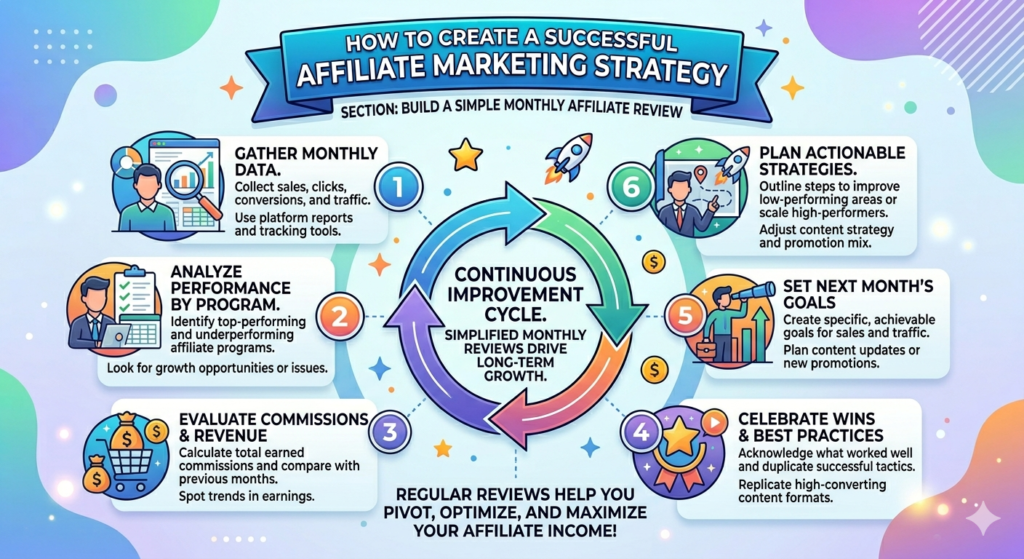
Then choose a few improvements for the next month.
Small improvements compound over time
Affiliate growth often comes from many small changes. A better headline can improve reading. A clearer comparison can increase clicks. A stronger landing page can improve sales. A better offer can raise revenue. An updated review can regain rankings.
One improvement may not change everything. But repeated improvements can create serious growth.
This is why tracking matters. It tells you where to focus.
Do not change everything at once
If you change too many things at the same time, you will not know what worked.
Improve one major thing at a time when possible. Update the intro. Improve the call to action. Test a different offer. Add a comparison section. Change the link placement. Then watch what happens.
Clear testing leads to clear learning.
Conclusion:
Affiliate marketing works best when it feels like guidance, not pressure. The strongest strategy starts with the buyer’s problem, then connects that problem to the right product, the right content, and the right next step.
When you choose offers carefully, write with honesty, build trust through useful content, track the right numbers, and keep improving the journey, affiliate marketing becomes more than a side channel. It becomes a steady growth system.













Comments are closed.