
WinSavvy Editorial Standards
How this article was created
Real estate is not a business where people buy on impulse. A person may look at homes for months before they call an agent. A seller may think about moving for a full year before they ask for a home value. An investor may watch the market quietly before making a move. This is why creative marketing matters so much. Good real estate marketing does not just say, “Call me if you want to buy or sell.” That is too weak. Everyone says that. Strong marketing makes people remember you, trust you, and feel that you understand their needs before they ever speak to you.
Your Marketing Should Make You the Local Guide, Not Just Another Agent
Most real estate marketing starts in the wrong place. It starts with the agent. It says things like “I am here to help,” “I can help you buy or sell,” or “Call me for your real estate needs.” These lines are not bad, but they are too common. They do not give people a strong reason to remember you.
A better way is to stop marketing yourself as only an agent and start marketing yourself as the local guide.
A local guide is not just someone who opens doors and writes offers. A local guide knows the streets, the schools, the parks, the small price changes, the quiet pockets, the fast-moving areas, and the things buyers and sellers actually care about.
A local guide can explain why one side of town is growing faster than another. A local guide can help a young family understand which areas feel calm, which places have better access, and which homes may hold value better.
This is powerful because people do not only choose real estate agents based on licenses or years in business. They choose the person who makes them feel less confused. Real estate is a big life decision. People are scared of making the wrong move. They want someone who can make the whole thing feel clearer.
That is where your marketing should begin.
Build Content Around Local Questions People Are Already Asking
The easiest way to create better real estate content is to listen to the questions people ask every day. Buyers ask which neighborhoods are best for their budget. Sellers ask if now is a good time to list. First-time buyers ask how much money they really need. Families ask about schools, traffic, safety, and daily life. Investors ask where rents are rising and where demand is strong.
Each of these questions can become a strong piece of content.
Instead of only posting a new listing, you can write or film a short guide called “What $500,000 Buys You in Three Different Parts of Our City.” Instead of saying “The market is hot,” you can explain what that really means for a seller with a three-bedroom home in a specific neighborhood.
Instead of sharing a generic market update, you can explain what buyers should do if homes are getting multiple offers in one area but sitting longer in another.
The more local and clear your content is, the more useful it becomes.
People do not save generic posts. They save posts that answer a real question. They do not share empty sales messages. They share helpful guides that make them look smart when they send them to a friend, partner, or family member.
Turn Everyday Real Estate Questions Into Search-Friendly Blog Posts
Your blog can become one of your strongest marketing tools when it is built around real search intent. Search intent simply means the reason someone types a question into Google. A buyer who searches “best neighborhoods near downtown for families” is showing a clear need. A seller who searches “how much does it cost to sell a house” is likely closer to taking action than someone just scrolling social media.
This is why real estate blogs should not be written only for traffic. They should be written for people who may become leads later.
A strong blog post should answer one clear question in depth. For example, if you write about the best neighborhoods for first-time buyers, do not just name a few areas and move on. Explain what kind of buyer fits each area. Talk about price ranges, commute times, home styles, nearby parks, local shops, and what someone may need to watch out for. Share what makes each area different.
This helps in two ways. First, it gives search engines more useful information to understand your page. Second, it helps the reader feel that you know the market in a real way.
Many agents write thin posts that sound like they were copied from a city brochure. That does not build trust. Your goal is to write like someone who walks those streets, speaks to people there, and understands the real trade-offs.
Use Simple Local Comparison Content to Help People Decide
Comparison content works very well in real estate because people are always weighing one choice against another. They are not just asking, “Should I buy?” They are asking, “Should I buy here or there?” They are not just asking, “Should I sell?” They are asking, “Should I sell now or wait six months?”
This gives you a lot of room to create smart content.
You can compare two nearby neighborhoods. You can compare condos and townhomes. You can compare buying a fixer-upper with buying a move-in ready home. You can compare renting for another year with buying now. You can compare selling before renovations with selling after small upgrades.
The key is to be fair. Do not make every answer lead to “buy now” or “sell now.” People can feel when advice is forced. Honest content builds more trust than pushy content.
For example, a post titled “Should You Sell Your Home Before Renovating the Kitchen?” can explain when a light refresh makes sense and when a full remodel may not pay off. You can talk about buyer expectations, local price points, and the risk of spending too much on updates that do not raise the sale price enough.
That type of content helps sellers see you as an advisor, not just a salesperson.
Make Your Listings Feel Like Stories, Not Just Properties
A listing is not only a set of rooms. It is a possible future life. This is where many real estate businesses miss a big chance. They market homes with plain facts. Three bedrooms. Two baths. Updated kitchen. Large yard. Close to shops.

Those details matter, but they are not enough.
Buyers do not fall in love with square footage alone. They imagine mornings in the kitchen, weekend dinners on the patio, kids playing in the yard, quiet evenings in the living room, or short walks to coffee. Good listing marketing helps them see the life inside the home.
This does not mean you should exaggerate. It means you should connect features to real benefits.
An open kitchen is not just an open kitchen. It is a space where the person cooking can still talk to guests or watch the kids. A small office is not just an extra room. It is a quiet place to take calls without working at the dining table. A shaded backyard is not just outdoor space. It is a place to sit outside in the afternoon without feeling baked by the sun.
When you write this way, the home feels more human.
Write Listing Descriptions That Sell the Feeling Without Sounding Fake
A listing description should be clear, warm, and specific. It should not sound like a poem, and it should not sound like every other listing in town. The best listing copy helps buyers understand what makes the home special and why that matters.
Start with the strongest reason someone would want the home. This may be the location, layout, view, updates, yard, price, privacy, school access, or rental potential. Then move through the home in a way that feels natural.
Instead of writing, “Beautiful home with many upgrades,” explain what those upgrades are and why they improve daily life. Instead of saying, “Great location,” explain what is nearby and what that means for the buyer. Instead of saying, “Perfect for entertaining,” describe the flow between the kitchen, dining area, and outdoor space.
The goal is to help the right buyer say, “This sounds like what I need.”
Show the Buyer What Daily Life Could Look Like
The best listing content does not only describe the home. It helps the buyer picture a normal day there.
For example, if the home is near a park, talk about morning walks or weekend time outside. If it has a large dining area, talk about family meals or easy hosting. If it has a split-bedroom layout, explain how it gives more privacy. If it has a low-maintenance yard, explain how it works well for someone who wants outdoor space without spending every weekend on upkeep.
This kind of detail turns plain features into value.
It also helps you attract better buyers. A person who wants that type of lifestyle will feel more connected to the home. A person who does not want it will move on, which is fine. Good marketing is not meant to attract everyone. It is meant to attract the right people faster.
Use Video to Add Warmth That Photos Cannot Carry Alone
Photos are important, but video can do something photos often cannot. Video shows flow. It shows how rooms connect. It shows light, movement, street feel, and small details that make a home easier to understand.
A simple listing video can be more useful than a polished video that feels too distant. You do not always need dramatic music or fancy edits. Sometimes a calm walkthrough with a clear voiceover works better because it feels real.
As you walk through the home, explain what the buyer is seeing. Point out things that photos may not show clearly. Mention how the morning light comes into the living room, how the pantry is placed near the garage entrance, or how the back door leads straight to the patio.
Keep the tone helpful, not sales-heavy. The viewer should feel like you are guiding them through the home, not trying to pressure them.
You can also cut the full video into shorter clips for social media. One clip can focus on the kitchen. One can focus on the backyard. One can focus on the neighborhood. One can answer the question, “Who is this home best for?” This gives you more content from one listing and helps the home reach people in different ways.
Use Neighborhood Marketing to Win Before People Are Ready to Move
Many real estate leads are not ready today. This is one of the biggest reasons agents give up too early. Someone may follow your page for a year before they contact you. A homeowner may read your market updates for months before asking for a price opinion. A buyer may watch your neighborhood videos long before they speak with a lender.
This is normal.
The job of your marketing is not only to catch people at the exact moment they are ready. It is to stay close while they are thinking, learning, and planning.
Neighborhood marketing does this very well because it gives people useful content even before they have a real estate transaction in mind.
Create Neighborhood Pages That Are Better Than Basic Area Guides
Most neighborhood pages are too thin. They say the area is charming, close to shopping, great for families, and full of beautiful homes. That kind of content could describe almost any place. It does not help the reader make a decision.
A strong neighborhood page should feel like a real guide.
It should explain who the area is best for, what types of homes are common, what price ranges buyers may see, what the streets feel like, what local spots people enjoy, and what trade-offs come with living there.
It should also answer questions people may be too shy to ask directly, such as whether parking is hard, whether traffic gets heavy, whether homes need updates, or whether the area is better for quiet living or active city life.
This kind of honesty makes your content more trusted.
If every neighborhood sounds perfect, people stop believing you. But if you say, “This area is a strong fit for buyers who want walkability, but homes may be smaller and parking can be limited,” readers feel you are telling the truth.
Add Real Examples to Make Your Neighborhood Content Stronger
A neighborhood guide becomes much more useful when you add real examples. You can talk about what a starter home may look like in that area. You can explain how prices may change from one street to another. You can show what buyers often get at different budget levels.
You do not need to reveal private client details. You can use general examples from market patterns.
For instance, you might say that buyers with a lower budget may find older homes that need updates, while buyers with a higher budget may find renovated homes closer to the main shopping area. You can explain that some blocks feel busier because they sit near main roads, while others feel calmer because they are deeper inside the neighborhood.
This is the kind of detail people cannot get from a basic listing site.
That is your advantage.
Turn Local Businesses Into Marketing Partners
Local business content can help you reach more people while also making your brand feel connected to the community. You can feature coffee shops, home repair companies, moving services, garden stores, gyms, restaurants, child care centers, and other businesses that matter to local homeowners.
The goal is not to turn every post into an ad. The goal is to show what life in the area feels like.
You can interview a local café owner about why people love the neighborhood. You can ask a landscaper what plants work best in local yards. You can ask a home organizer how sellers can get ready before listing. You can ask a contractor which small updates buyers notice most.
This gives you useful content, builds local relationships, and helps you reach the audience of the business you feature.
When you share the content, tag the business. Many will share it with their own followers. That gives your real estate brand more local reach without needing to spend more on ads.
Build a Personal Brand That Feels Human and Trustworthy
People do business with people they trust. In real estate, this matters even more because the stakes are high. A home is often the biggest purchase or sale in a person’s life. They do not want to feel like a number. They want to feel guided, heard, and protected.

This is why personal branding is not about looking famous. It is about becoming familiar.
When people see your face, hear your voice, read your advice, and watch how you explain things, they start to feel like they know you. That makes the first call much easier.
Share Your Point of View Instead of Only Sharing Updates
A lot of real estate content is too neutral. It reports facts but does not give useful direction. For example, “Inventory is up this month” is a fact. But what does that mean for a buyer? What does it mean for a seller? What should someone do with that information?
Your audience needs your point of view.
If inventory is up, explain whether buyers have more room to negotiate. If mortgage rates change, explain how that may affect monthly payments. If homes are sitting longer, explain what sellers need to do differently with pricing and presentation. If a certain neighborhood is getting more attention, explain why.
This makes your content more valuable because you are not just repeating news. You are helping people understand what it means for them.
Show Your Process So People Trust Your Skill
Many agents only show the final result. Sold signs. Happy clients. New listings. Closing day photos. These are good, but they do not show the work behind the scenes.
Your process is part of your value.
Show how you prepare a home before listing. Explain how you help sellers choose the right price. Talk about how you review offers beyond just the highest number. Share how you help buyers compare homes after showings. Explain what you look for during a walkthrough.
When people see your thinking, they trust your skill.
You can create content around small moments that happen every week. For example, you can explain why a clean entryway matters during showings, why listing photos should not hide layout problems, or why buyers should check water pressure and natural light before getting too attached to a home.
These details make you feel experienced without you having to brag.
Let People See the Human Side Without Losing Professional Trust
Your personal brand should not feel cold. It should feel warm, steady, and real. This does not mean you need to share every part of your private life. It means you should let people see enough of your personality to feel comfortable reaching out.
You can share why you love helping first-time buyers. You can talk about a lesson you learned from a tough negotiation. You can share a small story from a showing that taught you something about what buyers really notice. You can explain why you care about helping sellers avoid stress.
The key is to connect the personal story back to a useful lesson.
If you only post personal updates, people may enjoy them but not see your business value. If you only post business tips, people may respect you but not feel connected. The best real estate personal brand blends both.
It says, “I know what I am doing, and I am also a real person you can talk to.”
Use Social Media as a Trust Engine, Not Just a Posting Habit
Social media can help real estate businesses grow, but only when it has a clear purpose. Posting just to stay active is not enough. Random content creates random results.
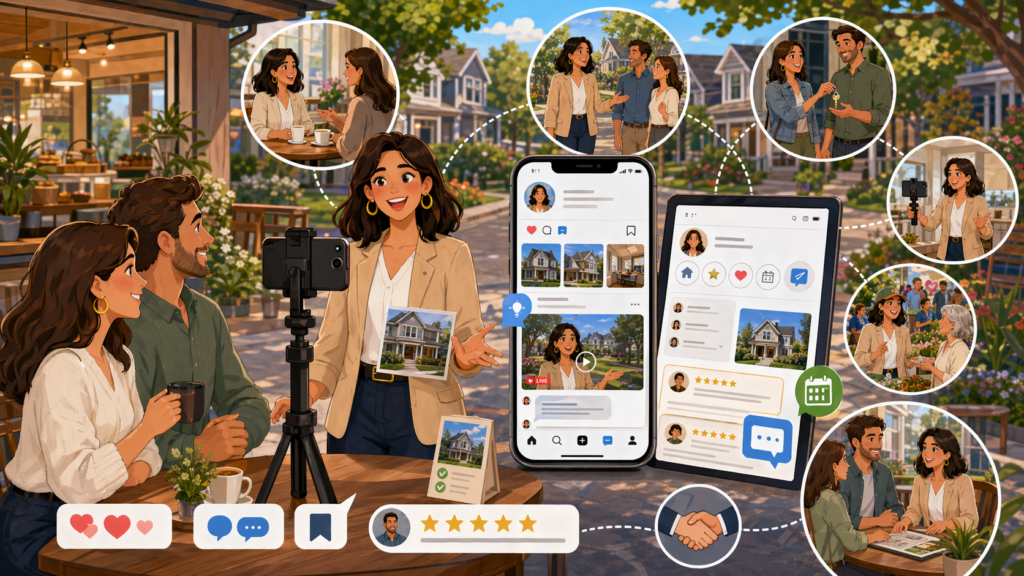
You need to treat social media as a trust engine.
That means every post should help people understand one of three things. It should show what you know, show how you help, or show what it feels like to work with you.
If a post does not do at least one of these things, it may not be worth posting.
Create Content for Buyers, Sellers, Homeowners, and Future Clients
Your audience is not made of only active buyers and sellers. It includes homeowners who may sell later, renters who may buy later, investors watching the market, past clients who may refer you, and local people who simply like learning about the area.
Your content should speak to these groups over time.
For buyers, you can explain how to choose between homes, how to avoid overpaying, how to prepare for showings, and how to understand monthly costs. For sellers, you can explain pricing, staging, repairs, timing, and offer review. For homeowners, you can share maintenance tips, local market trends, and smart upgrade ideas. For future clients, you can share neighborhood guides, behind-the-scenes moments, and simple market lessons.
This keeps your content useful even when someone is not ready to move.
That matters because most people are not ready today. But when they become ready, they are more likely to remember the person who helped them for free before asking for anything.
Build Repeatable Content Themes So You Never Run Out of Ideas
One reason real estate agents struggle with social media is that they try to invent fresh ideas every day. That is hard and tiring. A better way is to create repeatable themes.
For example, one day can be a neighborhood insight. Another can be a buyer mistake. Another can be a seller tip. Another can be a local business feature. Another can be a market myth. Another can be a home tour lesson.
The format can repeat, but the content should stay fresh.
This helps your audience know what to expect from you. It also makes content creation faster because you are not starting from zero each time.
You can take one big idea and turn it into several pieces. A blog post about preparing a home for sale can become a short video about decluttering, a social post about curb appeal, an email about pricing, and a simple story showing a before-and-after moment. One strong idea can feed many channels.
That is how smart marketing works. It does not create more work for no reason. It turns one useful thought into many useful touchpoints.
Make Short Videos That Answer One Clear Question at a Time
Short video is one of the best tools for real estate marketing because it lets people hear your voice and see your face before they ever call you. That matters more than many agents think. A buyer may not know if they trust you from a photo. A seller may not feel ready to book a meeting after reading one caption. But when they watch you explain something in a calm and clear way, they start to feel more comfortable.
The mistake many real estate professionals make is trying to say too much in one video. They try to explain the whole market, the full buying process, or every detail of a listing at once. That makes the video feel heavy. People scroll away because it feels like work.
A better way is to answer one small question in each video.
For example, you can make a short video explaining why the highest offer is not always the best offer. You can make another one about what buyers should check before falling in love with a kitchen. You can make one about why a home may sit on the market even when it looks beautiful online. You can explain why some sellers should not spend money on major repairs before listing.
Each video should feel like a quick, useful answer from a smart local advisor.
The best topics often come from real conversations. If three buyers asked you the same question this month, that question is content. If a seller was confused about pricing, that confusion is content. If someone misunderstood closing costs, inspection terms, or loan timelines, that topic is content.
This keeps your videos natural. You are not acting. You are simply answering the questions people already have.
Use the First Few Seconds to Prove the Video Is Worth Watching
People decide very fast if they will keep watching. This means the first few seconds matter a lot. Do not start every video with your name, company, and a long greeting. You can introduce yourself later or through the caption. Start with the problem.
Instead of saying, “Hi, I’m Sarah with ABC Realty, and today I want to talk about home inspections,” you could say, “A clean inspection report does not always mean the home has no problems.” That makes people curious. It gives them a reason to keep watching.
Instead of saying, “Today we’re looking at market trends,” you could say, “Homes are selling slower in some neighborhoods, but that does not mean buyers have all the power.” That sounds more useful because it hints at a real insight.
The opening should make the viewer feel that they are about to learn something that could help them make a better decision.
After that, keep the language simple. Speak like you are talking to one person across the table. Do not use stiff market terms unless you explain them. Real estate already feels confusing to many people. Your job is to make it feel easier.
Give Every Video a Soft Next Step Without Sounding Pushy
A video should not always end with “Call me today.” When every post asks for a call, people start to tune it out. A softer next step often works better because it feels more helpful and less forced.
You can end by saying that if someone is trying to understand what this means for their home, they can send you their neighborhood and you will point them in the right direction. You can tell buyers to message you if they want a simple breakdown of what their budget may look like in different areas. You can invite sellers to ask for a quick review before they spend money on upgrades.
This kind of call to action feels easier to respond to because it does not demand a big decision right away.
Many people are not ready to meet yet. But they may be willing to ask one small question. That small question can become the start of a real relationship.
Email Marketing Can Turn Quiet Leads Into Future Clients
Email is still one of the most useful tools in real estate because it gives you a direct line to people who already know you in some way. Social media is busy and easy to miss. Ads stop working when the budget stops. But email lets you stay in touch with buyers, sellers, past clients, and local homeowners in a steady and personal way.
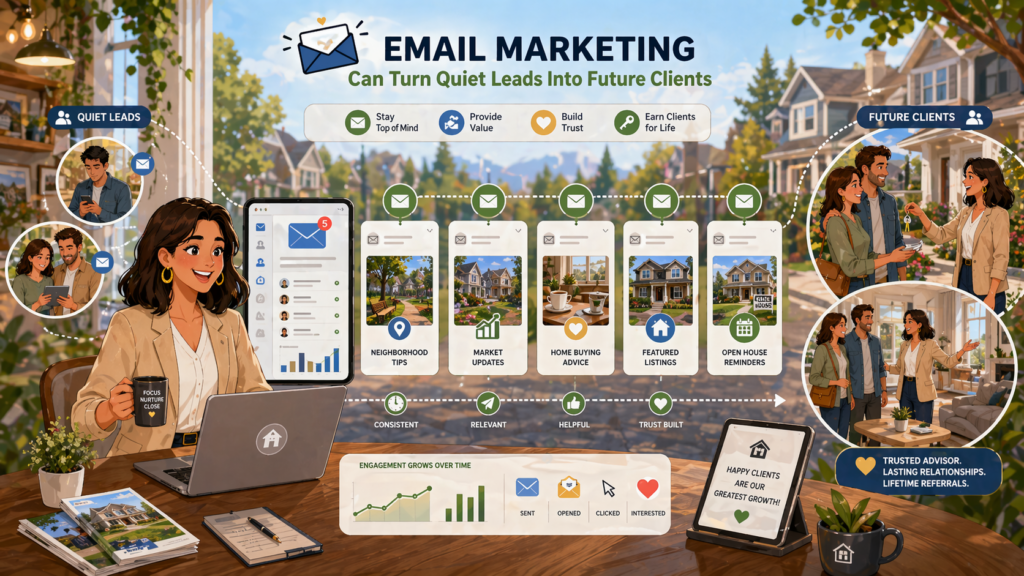
The problem is that many real estate emails are boring. They are either too generic or too sales-heavy. A monthly email that says “Here are the latest listings” may be useful to a few active buyers, but it does not speak to everyone else. A newsletter full of market charts may impress some people, but it may confuse others.
Good email marketing feels like a helpful note from someone who understands the local market.
It should make the reader feel a little smarter after reading it. It should help them make sense of what is happening around them. It should remind them that you are active, sharp, and easy to talk to.
Send Local Emails That Help People Understand Their Own Situation
The strongest real estate emails are specific. They do not speak to everyone in the same way. A first-time buyer needs different advice than a homeowner who may sell in two years. A past client needs different content than an investor. A person looking for a condo needs different guidance than someone looking for a family home.
This is why you should think about your email list in groups.
You do not need a complex system at the start. You can begin with simple groups like buyers, sellers, homeowners, past clients, and investors. Then send each group content that matches what they care about.
For buyers, you can send simple notes about what their budget can buy in different areas, what to know before making an offer, and how to avoid common mistakes. For sellers, you can send advice about pricing, timing, small home improvements, and what buyers are paying attention to right now. For homeowners, you can send local value updates, maintenance ideas, and tips that help them protect their home’s value.
The more the email matches the reader’s life, the more likely they are to open it, read it, and reply.
Make Your Newsletter Feel Like a Real Letter, Not a Flyer
A good newsletter does not need to be long. It needs to feel useful and human.
Start with one clear thought. Maybe you noticed that buyers are becoming more careful about monthly payments. Maybe sellers in one price range are still doing well, while higher-priced homes need better pricing. Maybe a new local development is changing how people view a certain area. Maybe homeowners are asking whether they should renovate before selling.
Open with that idea in plain language.
Then explain what it means. Use simple examples. Avoid sounding like a report. People do not need a lecture. They need a clear view of what is happening and what they should think about.
For example, instead of writing, “Market conditions remain dynamic due to inventory fluctuations,” you can write, “There are more homes for sale than there were a few months ago, so buyers have more choices. But the best homes are still moving fast when they are priced well.”
That is easier to understand. It also feels more honest.
At the end, invite a reply. Ask a simple question. You can say that if they are curious what this means for their home or search, they can send you a quick note. This makes email feel like a conversation, not a broadcast.
Use Follow-Up Emails to Build Trust After Every Lead Comes In
When someone downloads a guide, asks about a listing, attends an open house, or fills out a form, most agents follow up once or twice and then stop. That is a mistake. Many leads are not ready right away. They may still be learning. They may need time. They may be comparing options.
A smart follow-up system keeps helping them without pressure.
After a buyer asks about a listing, you can send a short series of emails that explains how to compare homes, what to watch for during showings, and how to understand the total monthly cost. After a seller asks for a home value, you can send emails about pricing mistakes, simple prep steps, and how to read local demand.
Each email should answer one useful question. It should not beg for a call. It should make the person feel that you are still helping them, even before they hire you.
This builds a quiet kind of trust. By the time they are ready, you are not a stranger. You are the person who has been guiding them all along.
Search Engine Optimization Should Help You Own Local Intent
SEO is one of the most powerful long-term marketing channels for a real estate business. But it only works when you stop chasing broad traffic and start focusing on local intent.
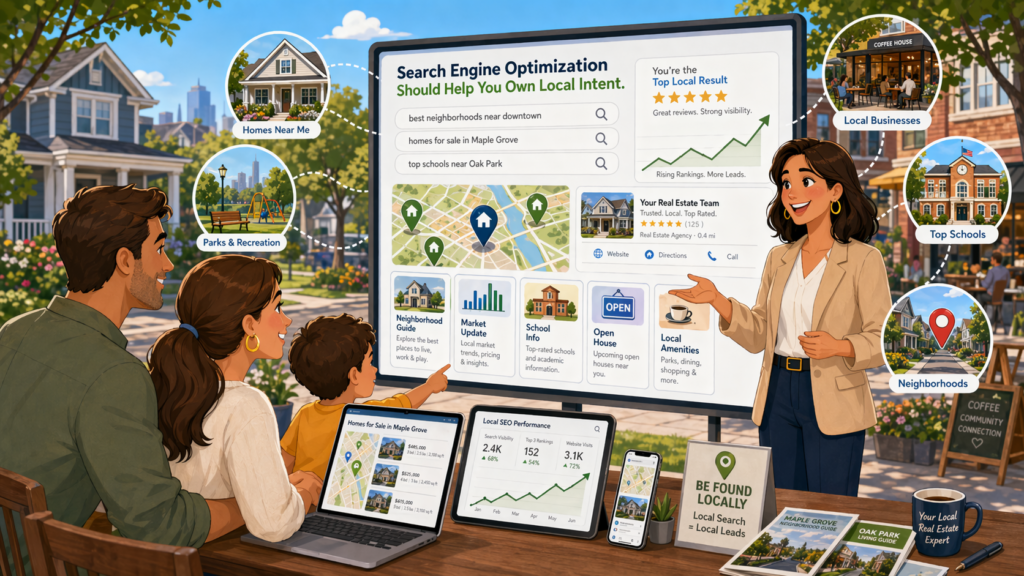
Local intent means the searcher is looking for something tied to a place and a real decision. They may search for homes in a certain neighborhood. They may search for the best area to live near a school district. They may ask whether it is a good time to sell in their city. They may look for the cost of buying a home in a certain market.
These searches are valuable because they often come from people who are already thinking about a move.
The goal is not to rank for every real estate keyword. The goal is to show up when local people are trying to make real choices.
Build Pages Around the Way People Actually Search
People do not always search in neat phrases. They search the way they think. A buyer may type, “best neighborhoods in Austin for young families,” or “is it cheaper to buy a condo or house in Phoenix,” or “how much do I need to buy a home in Tampa.” A seller may type, “should I sell my house before buying another,” or “what adds value before selling a home.”
Your content should match these real questions.
Many real estate websites have only basic service pages. They have a buyer page, a seller page, an about page, and listing pages. That is not enough to win strong search traffic. You need pages that answer deeper questions.
A strong local SEO plan may include neighborhood guides, cost guides, buying guides, selling guides, moving guides, relocation pages, school-area pages, market update pages, and comparison pages.
Each page should be built to help someone take the next step with more confidence.
Write Neighborhood Guides That Are Clear Enough to Be Useful and Honest Enough to Be Trusted
Neighborhood guides should not sound like travel ads. People who are moving need real details. They want to know what the area feels like, what homes cost, what daily life is like, and what trade-offs they should expect.
A strong neighborhood guide can explain the kind of buyer who usually likes the area. It can describe the home styles, price ranges, commute patterns, nearby parks, local food spots, and common concerns. It can explain why someone might choose that area over another nearby area.
This is where your local knowledge can beat large listing websites.
Big websites may have more data, but they often do not explain the human side of a place. They may show listings, maps, and basic facts, but they do not always explain what it feels like to live there. You can.
That is a big advantage.
When you write these pages, be careful not to overpromise. Do not say every place is perfect. Talk about fit. One neighborhood may be great for people who want space and quiet, but less ideal for someone who wants nightlife. Another may be great for walkability, but homes may be smaller or more expensive.
That honesty makes people trust you more.
Use Internal Links to Lead Visitors Toward the Next Useful Page
Internal links are links from one page on your website to another page on your website. They help search engines understand your site, but they also help people keep learning.
For example, a neighborhood guide can link to a blog post about buying in that price range. A seller guide can link to a page about home staging. A market update can link to a home value request page. A first-time buyer article can link to a mortgage prep guide.
This should feel natural. You are not just placing links for SEO. You are creating a helpful path.
Think of your website as a guided conversation. If someone reads about a neighborhood, what would they likely want to know next? If someone reads about selling, what question comes after that? If someone reads about pricing, what fear might they still have?
Your links should answer those next questions.
This keeps people on your site longer and makes your brand feel more useful.
Paid Ads Work Better When They Offer Value Before the Sale
Paid ads can bring fast attention, but they can also waste money quickly. The problem is that many real estate ads are too direct too soon. They ask cold people to book a call, request a showing, or sell their home now. Some people will respond, but many will not because they are not ready yet.
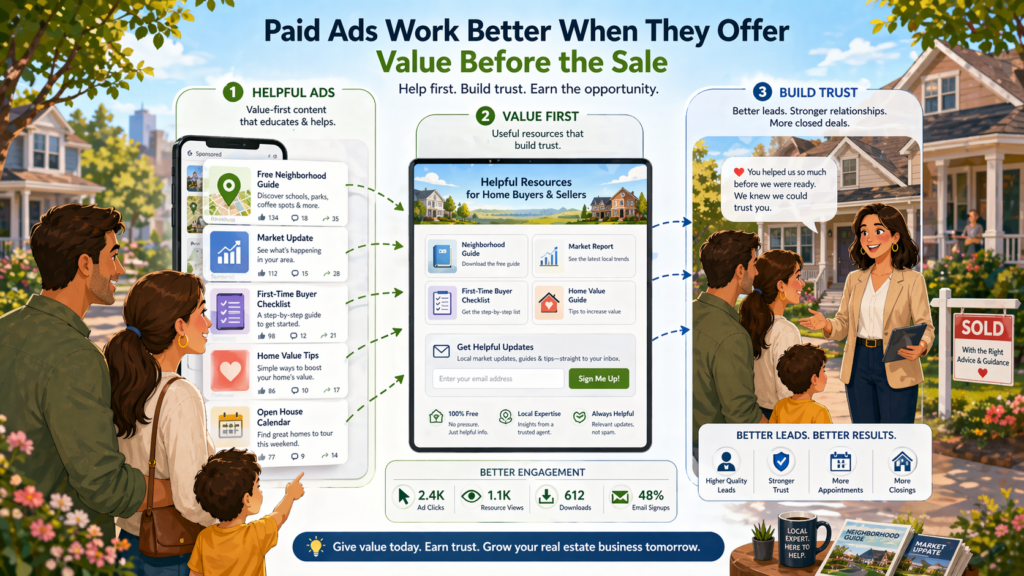
A better ad strategy gives people a useful reason to engage before they are ready for a full conversation.
This is especially important in real estate because the buying or selling journey can be long. Someone may click an ad today and become a client months later. Your job is to create a first step that feels safe and helpful.
Promote Lead Magnets That Solve Real Local Problems
A lead magnet is something useful you offer in exchange for contact information. But it only works if people actually want it. A weak lead magnet feels like a thin brochure. A strong one solves a real problem.
For sellers, a useful lead magnet could be a guide to which home updates are worth doing before listing in your local market. It could be a simple pricing prep checklist. It could be a report on what buyers are looking for in homes like theirs.
For buyers, it could be a guide to what their budget buys in different neighborhoods. It could be a first-time buyer roadmap. It could be a guide to avoiding costly mistakes when making an offer.
The key is to make it specific.
A guide called “Home Buying Tips” sounds too plain. A guide called “What $450,000 Buys You in North Dallas Right Now” feels much more useful. A guide called “Seller Checklist” is fine, but “The 10 Small Fixes That Help Homes Show Better Before Listing in Charlotte” feels stronger.
Specific content gets better leads because it speaks to a real situation.
Send Ad Traffic to Pages That Match the Promise Exactly
When someone clicks an ad, the page they land on must match what the ad promised. If the ad says they will get a local home value guide, the page should focus on that guide. If the ad says they can see what their budget buys, the page should show that clearly.
Do not send every ad click to your homepage. A homepage has too many choices. It makes people think too hard.
A good landing page should have one clear message. It should explain what the person will get, why it matters, and how it helps them. It should include a simple form and a clear next step.
The page should also sound human. Do not make it feel like a cold sales page. Make it feel like a helpful offer from a local expert.
If the ad is for sellers, the page should speak to seller concerns. If the ad is for buyers, it should speak to buyer concerns. If the ad is about one neighborhood, the page should stay focused on that neighborhood.
This match between ad and page helps more people take action.
Use Retargeting to Stay Close Without Chasing People
Most people do not become a lead the first time they visit your website. That does not mean the visit was wasted. Retargeting lets you show ads to people who already visited your site, watched your videos, or engaged with your content.
This is useful because these people are warmer than total strangers. They have already shown interest.
Your retargeting ads should not all say, “Contact me now.” Some can share helpful content. You can show a seller a video about pricing mistakes. You can show a buyer a guide to comparing neighborhoods. You can show someone who viewed a listing a reminder about similar homes.
The tone should be steady and helpful. You are staying visible, not chasing them.
Good retargeting feels like a gentle reminder. Bad retargeting feels annoying. The difference comes down to value. If your ads keep helping people learn, they will feel useful. If they only repeat the same sales message, people will ignore them.
Open Houses Should Feel Like Local Events, Not Walk-Throughs
Open houses are often treated as simple showing windows. The agent puts up signs, opens the door, prints a few flyers, and waits for people to walk in. That may still bring some visitors, but it does not make the event feel special. It also does not give people a strong reason to remember you after they leave.
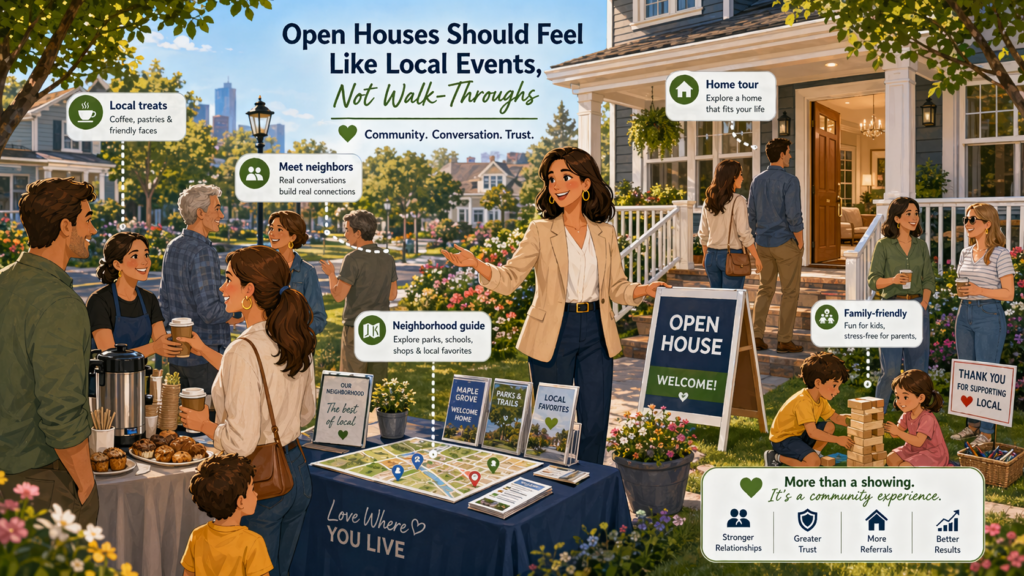
A better open house is not just a viewing. It is a small local event built around the home, the neighborhood, and the kind of buyer who may want that lifestyle.
This does not mean you need to make it expensive or overdone. You do not need a full party. You need more thought. You need to make the visit feel warm, clear, and useful.
When someone walks into an open house, they are not only judging the property. They are also judging you. They are asking quiet questions in their mind. Does this agent seem prepared? Do they know the home well? Do they understand the area? Are they helpful without being pushy? Would I trust this person if I needed to buy or sell?
That is why every open house is also a brand moment.
Make the Open House Experience Easy Before People Arrive
The open house starts before anyone steps inside. It starts with the way you market it.
Most open house posts are too basic. They say the address, time, price, and maybe a few features. That is not enough to create interest. Your promotion should tell people why the home is worth seeing in person.
Instead of only saying that a home has four bedrooms and a large yard, explain who should come see it. You might say that it is a strong fit for a buyer who wants more space without leaving the school district, or for someone who wants a quiet street but still wants quick access to shops and dining.
This helps people self-select. The right people are more likely to come because they understand the fit.
You can also create short teaser videos before the event. Show one detail that photos may not capture well. It could be the way the kitchen opens to the living room, how private the backyard feels, or how much natural light comes into the main bedroom. Keep it simple and real.
The goal is to build enough interest that people feel the home is worth their time.
Give Visitors Useful Context When They Walk In
When people arrive, do not only hand them a flyer and let them wander without guidance. Give them context.
You can welcome them with a short, calm explanation of what to pay attention to. Tell them what makes the home different. Mention any updates, layout benefits, or neighborhood details that matter. Then give them space to explore.
This makes the visit feel more helpful without making people feel followed.
You can also place simple information cards in key areas of the home. In the kitchen, a card can explain when the appliances were updated or how the layout helps with daily use. Near the back door, a card can explain the yard size or outdoor features. In a small office, a card can suggest how the room could work for remote work, study, or storage.
These small touches help people understand value while they walk through the home.
They also show that you think deeply about presentation.
Use the Open House to Create Content Without Making Visitors Uncomfortable
An open house gives you a chance to create more marketing content, but you must do it with care. You should not record visitors without permission, and you should never make people feel like they are part of a show.
Instead, create content before or after the event. Film a quiet walkthrough before guests arrive. Record a short video from the front porch explaining what kind of buyer the home may fit. After the open house, make a simple recap video sharing what visitors asked most often.
This recap can be very powerful.
For example, you can say, “The biggest question today was about how much storage the home has, so here is a quick look at the pantry, closets, and garage space.” Or you can say, “A lot of visitors asked about the neighborhood, so here are three things people like about this area.”
This type of content does two things. It helps people who could not attend, and it shows future sellers that you actively market your listings instead of simply waiting for buyers.
Referral Marketing Works Best When You Make It Easy to Remember You
Referrals are one of the best lead sources in real estate. A referred lead often comes with more trust, less resistance, and a stronger chance of becoming a client. But referrals do not happen just because people liked working with you. They happen when people remember you at the right moment and know how to introduce you.
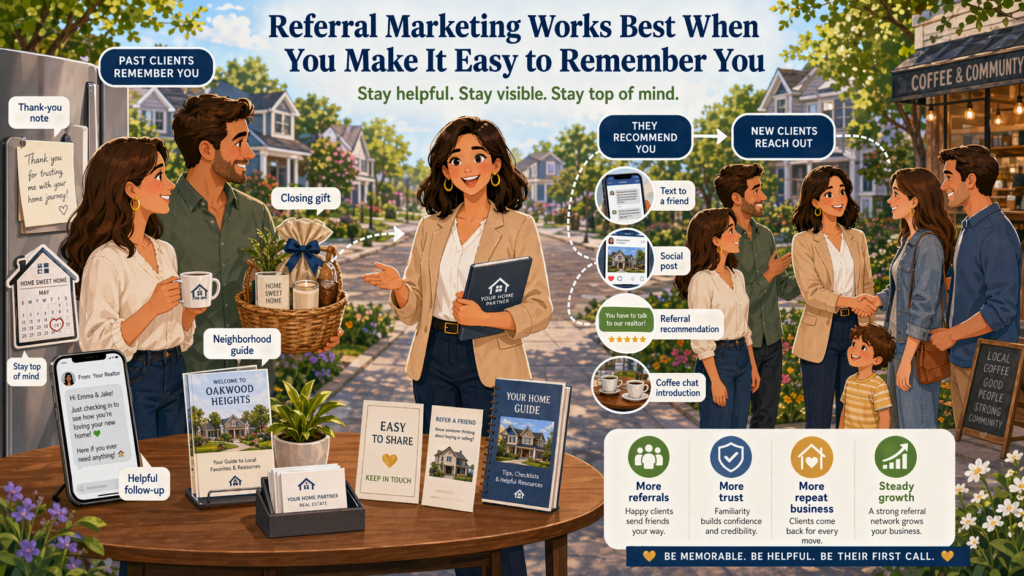
Many agents make the mistake of assuming past clients will naturally refer them. Some will. But most people are busy. They may love your service and still forget to mention your name when a friend talks about moving.
That is why referral marketing needs a system.
A good referral system is not pushy. It is not awkward. It keeps you present in a helpful way so that when someone hears a real estate question, your name comes to mind.
Stay in Touch After the Closing in a Way That Still Feels Useful
The closing table should not be the end of your marketing. It should be the start of a long relationship.
After someone buys or sells, they may not need another transaction for years. But they may know other people who do. They may also need advice about home value, repairs, taxes, local services, or future plans. If you keep helping them, you stay relevant.
The key is to stay in touch with content that fits their life after the move.
For buyers, you can send helpful homeownership tips during the first year. You can explain how to plan seasonal maintenance, how to keep records of home upgrades, and how to think about long-term value. For sellers who moved away, you can still send a kind check-in or offer help connecting them with trusted pros in their new area.
For past clients who still live locally, you can send neighborhood updates, home value trends, and local event notes. This keeps the relationship warm without making every message about buying or selling.
Make Referrals Feel Natural Instead of Forced
Asking for referrals can feel uncomfortable if you do it in a stiff way. The answer is not to avoid asking. The answer is to ask in a natural, helpful way.
Instead of saying, “Please send me referrals,” you can say, “If someone you care about is feeling unsure about buying or selling, feel free to send them my way. I am always happy to answer questions before they make any big decisions.”
That feels different. It is not a demand. It is an offer to help.
You can also make referral moments easier by giving people simple language. For example, in a follow-up email, you might say that if a friend asks about the market, they can simply forward your email or introduce you by text. People are more likely to refer when the action feels easy.
The smoother the referral step, the more often it happens.
Build Small Client Appreciation Moments That People Talk About
Client appreciation does not need to be expensive. It needs to feel thoughtful.
A handwritten note after closing can mean more than a generic gift basket. A small local gift tied to the neighborhood can feel more personal than a random branded item. A quick check-in six months later can stand out because many agents disappear after the deal is done.
You can also host small client events. They do not need to be large. A coffee morning, a family photo day, a home maintenance workshop, or a local market meet-up can bring past clients back into your world.
These events create new touchpoints. They also give clients a reason to talk about you.
When people feel remembered, they remember you.
Community Marketing Can Make Your Brand Part of the Area’s Daily Life
Real estate is deeply local. People want an agent who understands the area, not just the transaction. Community marketing helps you show that connection in a real way.
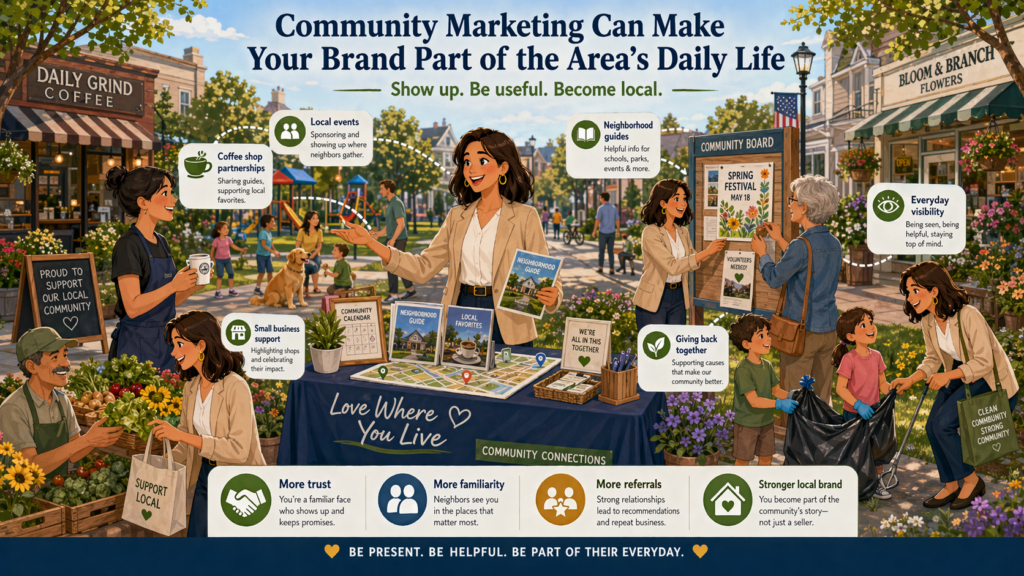
This is not about pretending to care for attention. People can feel when community content is fake. The best community marketing comes from real involvement. It shows that you are present, aware, and invested in the places where your clients live.
When done well, community marketing makes your brand part of the area’s daily life. People see you at local events, in local content, with local businesses, and in helpful local conversations. Over time, you become more familiar.
And familiarity builds trust.
Choose Community Efforts That Match Your Brand and Audience
You do not need to sponsor every event in town. You need to choose the right ones.
Think about the people you serve most often. If you work with young families, school events, youth sports, family festivals, and local parks may be strong fits. If you work with downsizers, community groups, charity events, local arts, and neighborhood meetups may make more sense. If you work with investors, business groups, development talks, and local planning events may be more useful.
The best community marketing sits at the point where your values, your audience, and your local market meet.
When you choose well, your involvement feels natural. It also gives you better content because you are not forcing a connection.
Turn Local Events Into Helpful Content Before and After They Happen
A local event is not only a one-day chance to show up. It can become content before, during, and after.
Before the event, you can share what people should know, where to park, what time to arrive, and why the event matters. During the event, you can share simple moments that show the community feeling. After the event, you can post a recap and thank the people who made it happen.
This kind of content gives your audience useful local information. It also shows that you are active in the community.
You can do the same thing with local changes. If a new park opens, explain what it adds to the neighborhood. If a road project affects traffic, explain what residents should know. If a new business opens, share why it may be worth visiting.
This content may not feel like direct real estate marketing, but it supports your brand. It tells people that you pay attention to the details of local life.
Partner With Local Experts to Add More Value to Your Audience
You do not need to be the expert on everything. In fact, your marketing becomes stronger when you bring in other helpful voices.
You can partner with mortgage advisors, home inspectors, contractors, interior designers, movers, insurance agents, landscapers, and estate planners. The goal is not to create a loud sales network. The goal is to give your audience better answers.
For example, you can interview a home inspector about the most common issues found in older homes in your area. You can ask a lender to explain what buyers should know before changing jobs during the loan process. You can ask a designer which low-cost updates make a home feel brighter before listing.
These partnerships help your audience while also expanding your reach.
They also make you look more connected and resourceful. Clients do not only want someone who knows homes. They want someone who can guide them through the whole process.
Reviews and Testimonials Should Tell Real Stories, Not Just Say You Were Great
Reviews matter because they give people proof. Anyone can say they are helpful, skilled, and trustworthy. A review from a real client carries more weight because it comes from someone who has already gone through the process.
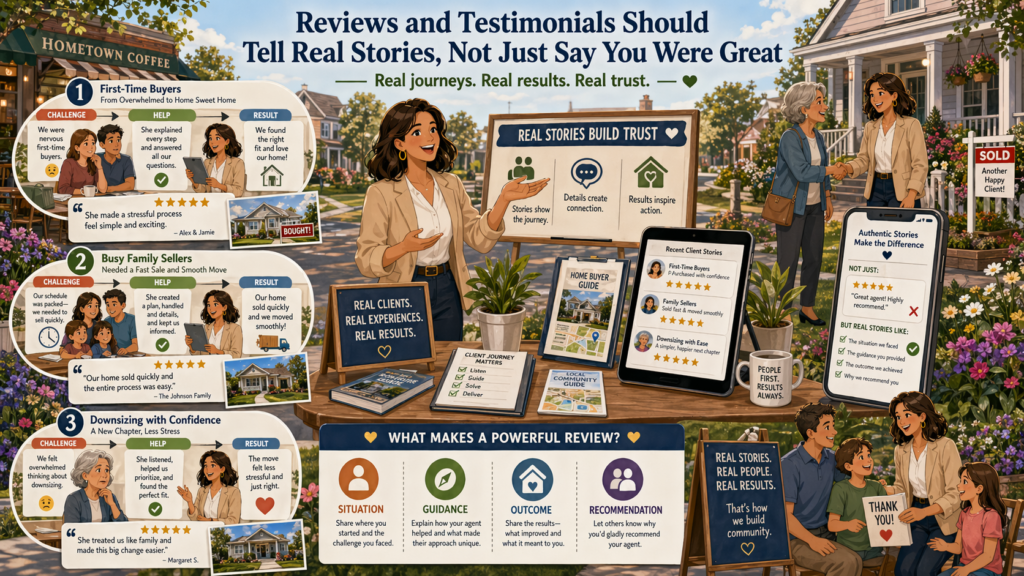
But not all reviews are equally strong.
A short review that says “Great agent, highly recommend” is nice, but it does not say much. A detailed review that explains the client’s problem, your process, and the result is far more powerful.
That kind of review helps future clients see themselves in the story.
Ask for Reviews When the Value Is Fresh in the Client’s Mind
The best time to ask for a review is when the client feels the result most clearly. This may be right after closing, after a tough issue gets solved, or after they thank you for your help. Do not wait too long. As time passes, details fade.
When you ask, make it easy.
Many clients want to help but do not know what to write. You can guide them gently without telling them what to say. Ask them to share what their situation was, what they were worried about, how you helped, and what the outcome was.
This helps them write a review that feels like a real story.
For example, a seller may explain that they were nervous about pricing, but you helped them prepare the home, position it well, and review offers with care. A buyer may explain that they felt overwhelmed, but you helped them compare choices and avoid rushing into the wrong home.
Those details build trust with future leads.
Place Reviews Where They Support the Next Decision
Do not hide all your reviews on one page and hope people find them. Use them throughout your marketing.
A first-time buyer page should include reviews from first-time buyers. A seller page should include reviews from sellers. A neighborhood page can include a client story from someone who moved into that area. A listing presentation can include seller reviews that show how you market homes.
This makes each review more relevant.
If someone is thinking about selling, they do not only want to know that buyers like you. They want to know that sellers trust you with pricing, prep, negotiation, and communication. If someone is buying their first home, they want proof that you can guide nervous buyers with patience.
The right review in the right place can reduce fear at the exact moment it matters.
Turn Client Stories Into Case Studies Without Making Them Feel Cold
A case study can be one of the strongest forms of real estate content, but it should not sound like a corporate report. It should feel like a story.
You can explain the client’s goal, the challenge, the plan, and the result. Keep private details out unless the client gives clear permission. Focus on the lesson.
For example, you can write about a seller who thought they needed a full renovation, but after a walk-through, you helped them focus only on paint, lighting, and staging. The home looked better, launched stronger, and avoided wasted money. That story teaches future sellers how smart prep can matter more than big spending.
You can also write about a buyer who kept losing offers until you helped them adjust their search, improve their offer terms, and focus on homes with less competition. That story teaches buyers that strategy matters.
Case studies show how you think. They also prove that your value is not just access to listings. Your value is judgment, planning, and guidance.
Your Website Should Turn Attention Into Clear Next Steps
A real estate website should not only look nice. It should help people take action. Many real estate websites are full of pages, photos, and search tools, but they do not guide visitors well. People arrive, look around, and leave without doing anything.
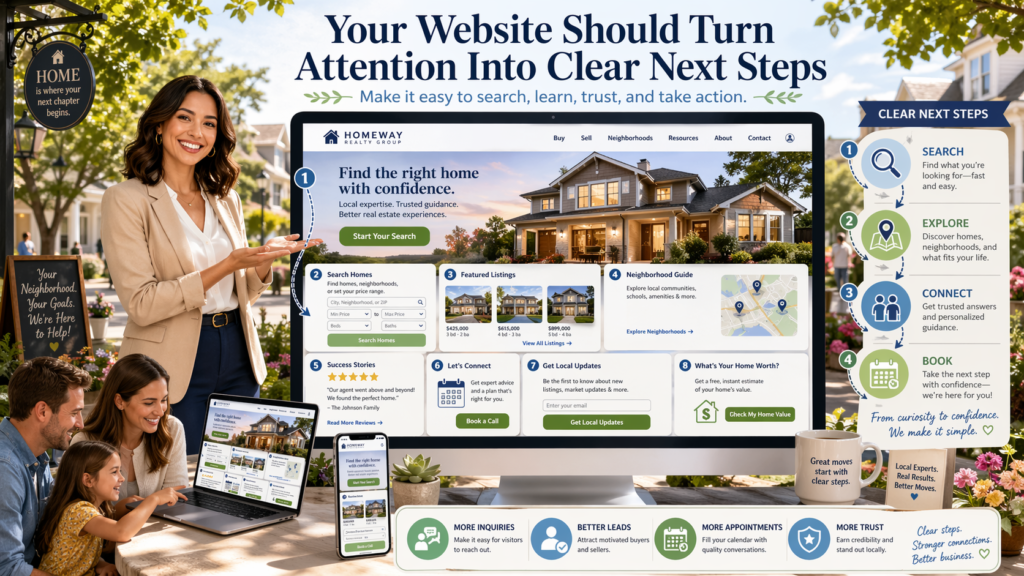
This usually happens because the site is built around the business instead of the visitor’s next question.
A strong website should feel like a helpful path. It should meet people where they are and guide them to the next clear step.
Make Every Main Page Speak to One Type of Visitor
Your homepage can speak broadly, but your main pages should be more focused. A buyer page should speak to buyers. A seller page should speak to sellers. A relocation page should speak to people moving into the area. A neighborhood page should speak to people comparing places to live.
This may sound simple, but many websites mix too many messages on one page.
When a buyer lands on your buyer page, they should quickly feel that you understand their worries. They may be thinking about budget, timing, competition, loan approval, inspections, and whether they are making the right choice. Your page should answer those concerns in simple language.
When a seller lands on your seller page, they may be thinking about price, repairs, timing, showings, and how to avoid leaving money on the table. Your page should speak to those concerns.
The more specific the page feels, the more trust it builds.
Use Calls to Action That Match the Reader’s Readiness
Not every visitor is ready to book a call. Some are still learning. Some are comparing. Some are nervous. If the only call to action on your website is “Contact me,” you may lose people who need a smaller step.
Offer different levels of action.
A ready seller can request a home value review. A curious seller can download a prep checklist. A ready buyer can schedule a consultation. A early-stage buyer can read a budget guide. A relocation visitor can request a local area breakdown.
This gives people a path that matches where they are.
The goal is not to push everyone into the same box. The goal is to make the next step feel easy and useful.
Make Your Contact Forms Feel Personal and Low Pressure
A contact form can either invite people in or scare them away. If it feels too long, too cold, or too demanding, people may leave.
Keep forms simple, but ask enough to respond well. For example, instead of only asking for name, phone, and email, you can include a gentle question like, “What are you hoping to understand right now?” This gives the person room to explain their need.
The language around the form also matters.
Instead of saying, “Submit,” use words that feel more human, such as “Send my question” or “Ask for guidance.” Instead of making the form feel like a sales trap, explain what happens next. Let people know you will reply with helpful direction, not pressure.
Small details like this can improve trust.
Content Marketing Should Teach People Before They Trust You With a Deal
Real estate content works best when it helps people make better choices before they ever become clients. This is where many real estate businesses miss a huge chance. They treat content like decoration. They post because they feel they should post. They write blogs because someone told them SEO matters. They send emails because they want to stay visible.
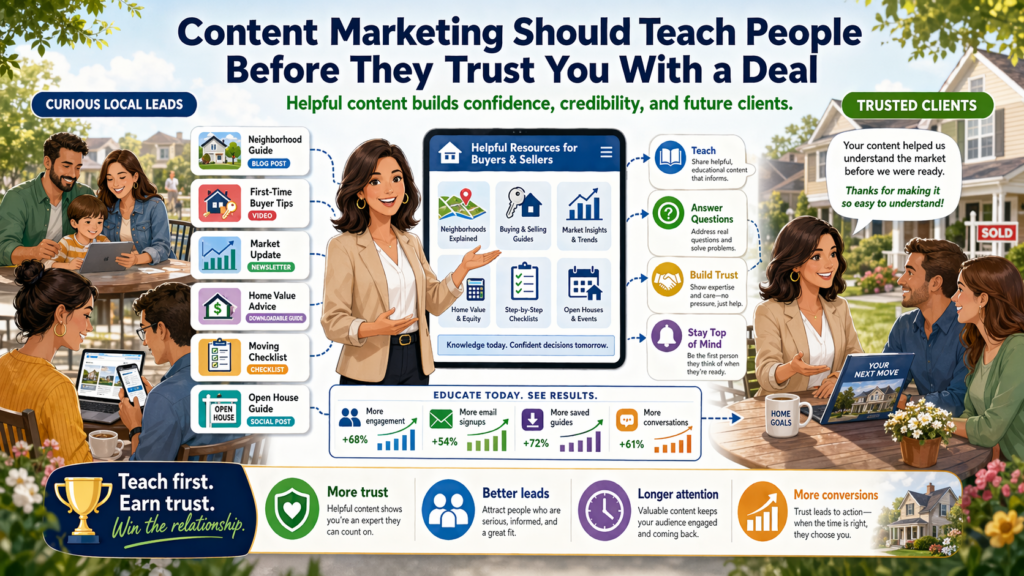
But strong content is not filler. It is sales trust built in public.
When someone reads your advice, watches your video, or studies your local guide, they are asking a quiet question. They are asking, “Does this person understand what I need?” If your content gives a clear, useful answer, that person moves one step closer to trusting you.
This is why your content should not be built around random ideas. It should be built around the real fears, doubts, and decisions your clients face.
A buyer does not only want to know which homes are available. They want to know if they are making a smart choice. A seller does not only want to know what their home is worth. They want to know how to avoid pricing wrong, spending too much on repairs, or choosing the wrong offer. A homeowner does not only want market news. They want to know what that news means for their own future.
Your content should become the bridge between their confusion and your service.
Create Content for Each Stage of the Real Estate Decision
Not every person who finds you is at the same stage. Some are just starting to think. Some are comparing options. Some are close to taking action. If all your content speaks only to people who are ready now, you miss the much larger group that will be ready later.
Early-stage content should help people understand the basics. This can include topics like whether buying makes sense, how to know if they are ready to sell, what to expect in the local market, or how different neighborhoods compare. At this stage, the person may not want a call yet. They want clarity.
Middle-stage content should help people compare choices. This can include posts about buying a condo versus a house, selling before buying versus buying before selling, renovating before listing versus selling as-is, or choosing between two local areas. This is where your advice becomes more strategic.
Late-stage content should help people act. This can include guides on preparing for a listing appointment, getting ready for showings, making a strong offer, reviewing inspection results, or understanding closing steps. At this point, the reader may be closer to reaching out because the need feels more real.
When you create content for all three stages, your marketing works even when people are not ready today. You are not just chasing hot leads. You are building future demand.
Use Your Sales Conversations as Your Best Content Source
Your best content ideas are already hidden inside your daily conversations. Every buyer question, seller concern, objection, and moment of confusion can become a useful article, video, email, or social post.
If one buyer asks whether they should waive an inspection, others are wondering the same thing. If one seller asks whether they should repaint before listing, others are asking that too. If one homeowner wants to know why their neighbor’s home sold faster, that is a strong content topic.
This keeps your content grounded in real life.
It also helps you avoid the trap of writing generic posts that sound like every other real estate website. Instead of guessing what people care about, you are answering what people are already asking.
A strong habit is to keep a simple running note of questions you hear each week. At the end of the week, turn the best ones into content. One question can become a short video. Another can become a blog post. Another can become an email. Over time, this creates a content library that feels deeply useful because it comes from real client needs.
Build Content That Answers the Question Behind the Question
People often ask one question while worrying about something deeper. A seller may ask, “How much is my home worth?” But the deeper question may be, “Can I afford my next move?” A buyer may ask, “Is this a good neighborhood?” But the deeper question may be, “Will I regret choosing this area later?” A homeowner may ask, “Should I renovate?” But the deeper question may be, “Will I get my money back?”
Great marketing answers both.
When you write or speak, do not stop at the surface question. Go deeper. Explain what the person should really think about. Show them the trade-offs. Help them see the decision more clearly.
For example, if someone asks whether now is a good time to sell, the answer should not be a simple yes or no. It should explain that timing depends on their home type, price range, local inventory, personal plans, and next purchase. That kind of answer feels more honest and more useful.
This is how you become trusted. You are not just giving quick replies. You are helping people think.
Local SEO Works Best When Your Website Becomes the Best Local Resource
Most real estate websites look similar. They have listings, an agent bio, a few service pages, and maybe a blog. That is fine, but it is not enough if you want your website to become a real marketing asset.
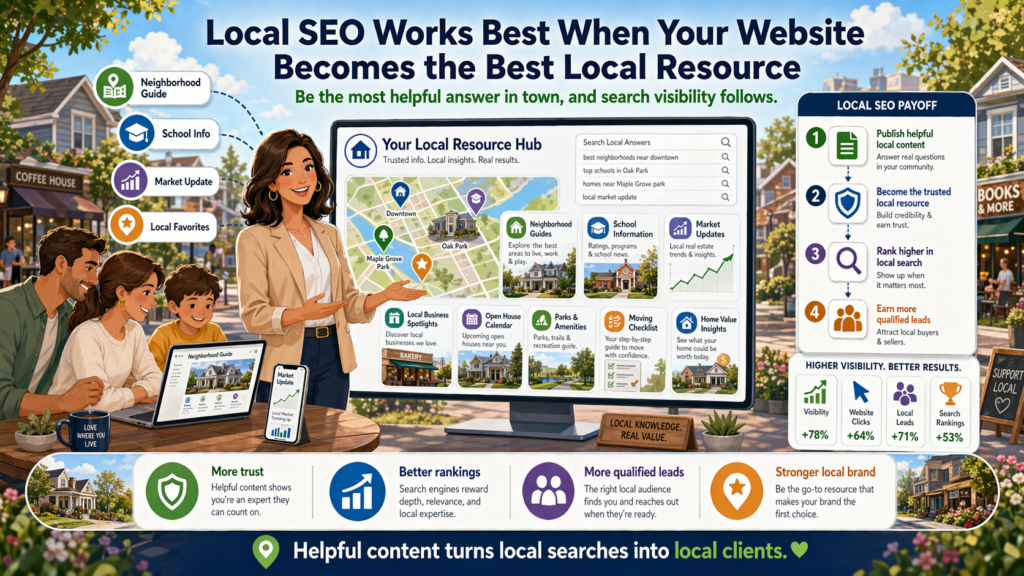
Your site should become one of the most helpful local real estate resources in your market.
That means when someone wants to understand an area, a price range, a buying question, or a selling decision, your website has a clear answer. It should not feel like a brochure. It should feel like a guide.
This matters because search traffic can become one of the most steady sources of leads in your business. Social media posts fade fast. Paid ads need constant budget. But a strong local page can keep bringing visitors for months or years if it answers a real search need well.
The key is to stop writing thin content and start creating pages with depth.
Build Neighborhood Pages That Help People Choose, Not Just Browse
A good neighborhood page should help a person decide if an area fits them. It should not only show homes for sale. Listings are useful, but listings alone do not explain the area.
A strong neighborhood page should describe the feel of the place. Is it quiet, busy, walkable, spread out, newer, older, close to work centers, or better for people who want more space? What kind of homes are common? What price range should buyers expect? What kind of person may enjoy living there? What should buyers be careful about?
This kind of content gives people what listing portals often do not provide. It gives local judgment.
You can also explain micro-areas inside a neighborhood. Sometimes two streets in the same area can feel very different. One section may be closer to shops. Another may have larger lots. Another may have older homes with more charm but more repair needs. These details show that you truly know the market.
When you build neighborhood pages this way, they do more than attract traffic. They pre-sell your expertise.
Add Market Context Without Making the Page Feel Like a Data Dump
Data can be useful, but only if people understand what it means. Many real estate pages add charts, numbers, and market stats without explaining them in plain words. That can make readers feel lost.
Your job is to turn data into meaning.
If prices are rising in an area, explain why that may be happening. Is it because of low inventory, strong school demand, better commute access, new development, or more buyers moving in? If homes are taking longer to sell, explain what that means for sellers and buyers. If one type of home moves faster than another, explain why.
The reader should not have to study the numbers like a report. They should be able to read your page and think, “Now I understand what is going on.”
This is where your human insight matters. Data tells part of the story. Your job is to explain the rest.
Connect Every Local Page to a Clear Next Step
A neighborhood page should never leave the reader stranded. Once someone finishes reading, they should know what to do next.
If they are a buyer, invite them to ask which part of the area fits their budget and lifestyle. If they are a seller, invite them to ask how homes like theirs are performing in that neighborhood. If they are relocating, invite them to request a simple local comparison.
The call to action should match the page.
A person reading about a neighborhood may not be ready to book a formal consultation. But they may be willing to ask, “Would this area fit me?” That is a much softer and more natural step.
Small actions matter. A simple question can lead to a real conversation. A real conversation can lead to a client.
Your Brand Message Should Make People Feel Safe Choosing You
Real estate is emotional. People may talk about price, square footage, rates, and timing, but under all of that, they want safety. Buyers want to feel safe making a big purchase. Sellers want to feel safe trusting someone with their largest asset. Families want to feel safe choosing the right place to live. Investors want to feel safe that the numbers make sense.
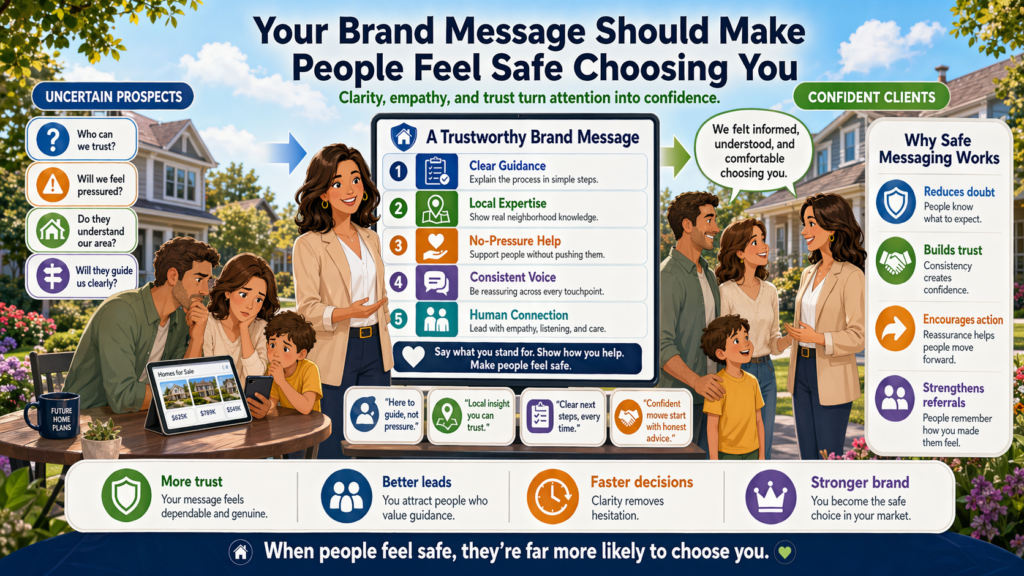
Your brand message should speak to that need.
Many agents build their message around success claims. They talk about being top-rated, award-winning, experienced, or full-service. Those things can help, but they are not enough by themselves. People want to know what your experience means for them.
Instead of only saying you are experienced, explain how your experience protects them. Instead of saying you know the market, explain how that helps them avoid overpaying or underpricing. Instead of saying you give great service, explain how you guide them through each step so they never feel lost.
The clearer your message, the easier it is for people to trust you.
Make Your Positioning Specific Enough to Be Remembered
If your message could fit any real estate agent, it is too broad. “Helping buyers and sellers achieve their dreams” may sound nice, but it does not make you stand out. Almost every agent could say it.
A stronger message is more specific.
You may be the agent who helps first-time buyers make calm, smart choices in a competitive market. You may be the advisor who helps growing families move up without feeling rushed. You may be the listing expert who helps sellers prepare well, price right, and avoid costly mistakes. You may be the local guide for people relocating into your city who need honest neighborhood advice.
Specific positioning does not limit you as much as you may fear. It makes you easier to remember.
People refer specialists more easily than generalists. If a friend says they are nervous about buying their first home, it is easier to remember “the agent who is great with first-time buyers” than “the agent who does everything.”
Use the Same Core Message Across Your Website, Social Media, Email, and Ads
Your brand becomes stronger when people hear the same clear idea in many places. This does not mean repeating the exact same sentence everywhere. It means your message should feel consistent.
If your website says you are a calm guide for first-time buyers, your videos should show that. Your emails should explain buyer questions in a simple way. Your social posts should answer beginner concerns without making people feel silly. Your lead magnets should help new buyers understand the process.
That consistency builds trust.
When your message changes every week, people do not know what to remember. When your message stays clear, it becomes part of your brand.
This is why strong marketing is not only about more content. It is about clearer content. Every channel should point back to the same promise.
Let Your Voice Sound Like a Real Person
People are tired of polished but empty marketing language. They do not want to feel like they are reading a script. They want to feel like a real person is speaking to them.
Use simple words. Say what you mean. Avoid stiff phrases. Do not hide behind fancy real estate terms when plain language works better.
Instead of saying, “We provide comprehensive transaction management solutions,” say, “We guide you through every step so nothing gets missed.” Instead of saying, “We leverage market insights,” say, “We study the local numbers so you can price or offer with more confidence.”
Simple language does not make you look less professional. It makes you easier to trust.
A clear voice is a competitive edge. Many real estate brands still sound cold, formal, and generic. If you sound helpful, direct, and human, you will stand out.
Smart Lead Capture Should Feel Helpful Instead of Hungry
Lead capture is important, but it must be handled with care. People can sense when a website or ad is too eager to grab their information. If every button, pop-up, and form feels pushy, trust drops.
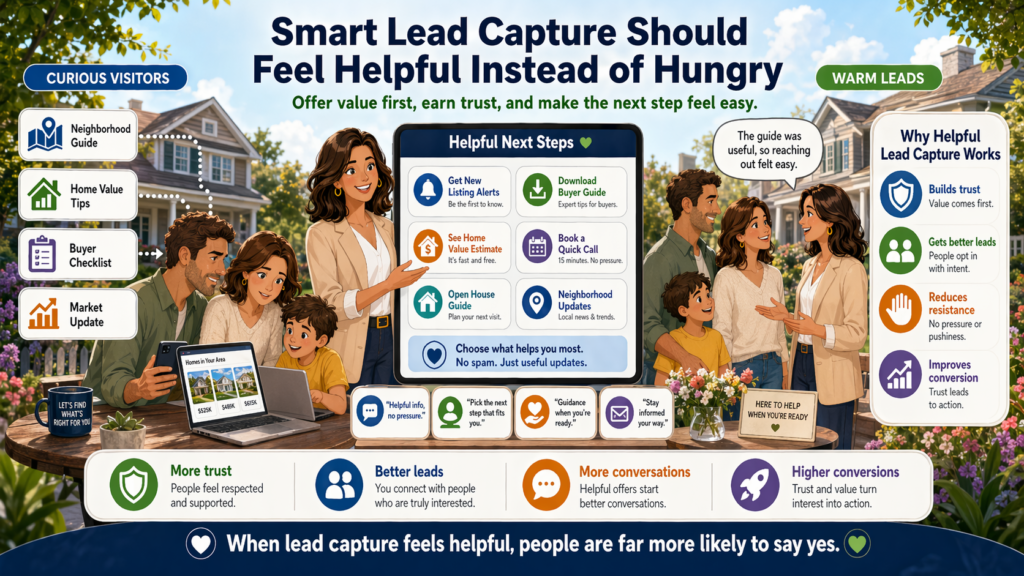
The better approach is to make lead capture feel like help.
A person should feel that sharing their information gives them something useful in return. They should not feel trapped. They should not feel like they are about to be chased by endless calls.
This is especially important in real estate because many people are still early in the process. They may want guidance, but they may not be ready for a sales conversation. If your only offer is “Book a call,” they may leave. If you offer a smaller, helpful step, they may engage.
Create Offers That Match Real Buyer and Seller Problems
A good offer solves a clear problem. It does not need to be long or fancy. It needs to be useful.
For buyers, you can offer a local budget guide that shows what different price ranges can buy in different areas. You can offer a first-time buyer checklist that explains what to do before touring homes. You can offer a neighborhood comparison sheet that helps people narrow their search.
For sellers, you can offer a home prep guide, a pricing mistake checklist, a local market snapshot, or a simple guide to which repairs may matter before listing.
The more specific the offer, the better.
A vague guide called “Real Estate Tips” will not feel urgent. A guide called “What to Fix Before Selling a Home in This Market” feels more useful because it speaks to a real worry.
Use Forms That Ask Only for What You Need at That Moment
Long forms can reduce leads because they ask for too much too soon. If someone only wants a guide, you may not need their phone number, address, budget, timeline, and life story. Asking for too much can make them feel cautious.
Start with the minimum needed to deliver value. For a guide, a name and email may be enough. For a home value request, you may need the property address and a few details. For a consultation, you can ask more because the person is showing higher intent.
Match the form to the offer.
This makes the experience feel fair. The bigger the value and the more serious the request, the more information you can ask for. But if the offer is small, keep the form small.
Follow Up Like an Advisor, Not a Hunter
The way you follow up after a lead comes in can either build trust or break it.
If someone downloads a buyer guide and gets a hard sales call five minutes later, they may feel uncomfortable. But if they receive a helpful email that says, “Here is the guide. If you want, reply with your price range and I can point out a few areas worth watching,” that feels much better.
Your follow-up should match the action they took.
If they requested a home value, they may expect a more direct response. If they downloaded a general guide, they may need a softer path. If they asked about a listing, they may want fast information but not pressure.
The best follow-up feels personal, useful, and calm. It shows you are paying attention. It does not make the lead feel like prey.
Marketing Automation Should Save Time Without Removing the Human Touch
Automation can help a real estate business grow, but only when it supports real relationships. It should never make people feel like they are talking to a machine. The goal is not to replace human care. The goal is to make sure good care happens on time.
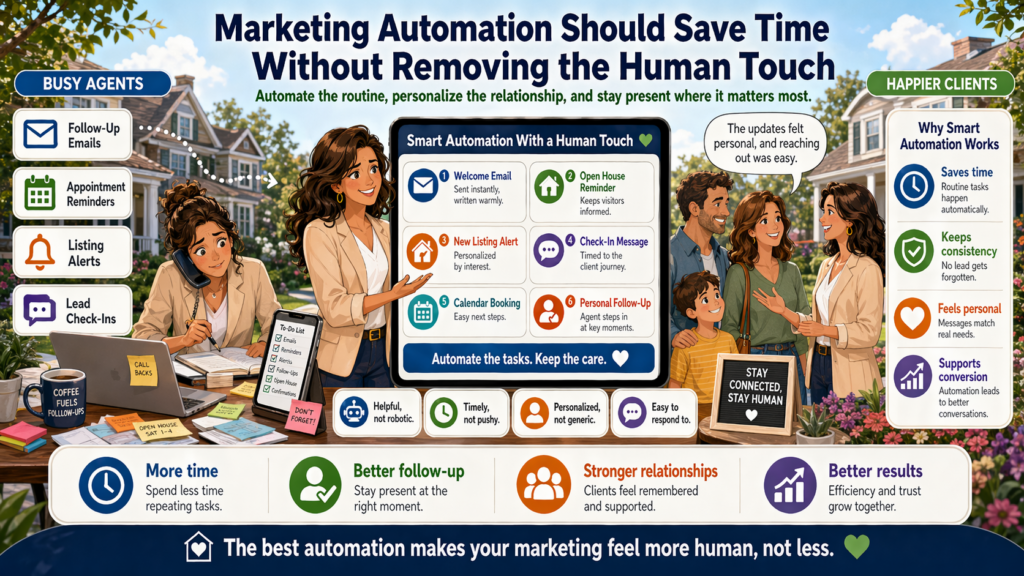
Real estate has many moments where people need simple reminders, helpful education, and steady follow-up. Automation can handle some of this well. It can send a guide after someone requests it. It can remind a buyer what to prepare before a consultation. It can send a seller a few helpful emails after a home value request. It can check in with past clients over time.
But automation should still sound like you.
If your emails feel cold, stiff, and generic, they may hurt your brand. If they sound clear, kind, and useful, they can build trust quietly in the background.
Build Simple Email Sequences Around Real Client Journeys
You do not need a huge automation setup to start. Begin with the most common journeys.
A buyer journey may start when someone downloads a local buying guide. The first email delivers the guide. The next email explains how to think about budget. Another email shares common mistakes to avoid. Another invites them to ask which neighborhoods fit their needs.
A seller journey may start when someone requests a home value or downloads a prep checklist. The first email gives them what they asked for. The next explains how pricing works. Another explains what buyers notice during showings. Another invites them to ask for a simple walk-through before spending money on repairs.
These sequences should not feel like a sales campaign. They should feel like helpful guidance spread over time.
Each email should have one clear point. Keep it simple. Make it easy to reply.
Use Automation to Remember Important Moments
Automation can also help you stay in touch after closing. You can set reminders for home anniversaries, seasonal check-ins, yearly value updates, and client appreciation notes.
These small moments matter because they show that the relationship did not end at closing.
A past buyer may appreciate a note one year after moving in. A seller may appreciate a check-in after their move. A homeowner may appreciate a yearly update on local values. These touches are easy to forget when business gets busy, but automation can help you remember.
The message should still feel personal. Even if the reminder is automated, the note can be written with care.
Keep Reviewing Your Automated Messages So They Stay Fresh
A common mistake is setting up automation once and never checking it again. Markets change. Rates change. Local conditions change. Your voice may change too. If your messages become outdated, they can make your business look careless.
Review your key automated emails every few months. Make sure the advice still fits the market. Update examples. Remove old references. Make the language feel current.
Automation should feel alive, not abandoned.
When done well, it gives every lead a better experience while giving you more time to focus on real conversations.
Creative Direct Mail Still Works When It Feels Personal and Useful
Direct mail may sound old, but in real estate it can still work very well when it is done with care. The problem is not the channel. The problem is that most direct mail is lazy. It looks like every other postcard. It has a smiling headshot, a sold home, a line about getting top dollar, and a phone number. People see it, scan it for two seconds, and throw it away.
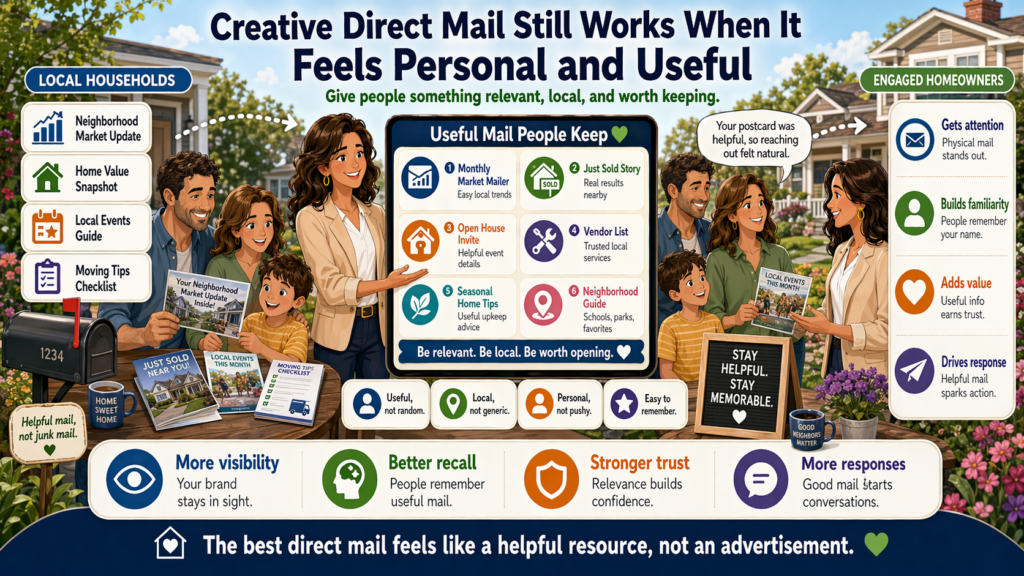
That does not mean direct mail is dead. It means boring direct mail is dead.
A well-planned mail piece can stand out because people receive less thoughtful physical mail than they used to. A useful postcard, short letter, local market note, or home value update can feel more personal than another social media post. It reaches people in their home, where real estate decisions often begin.
The key is to stop treating direct mail like a billboard and start treating it like a helpful local note.
Your mail should give the homeowner a reason to keep reading. It should speak to their area, their home type, or a decision they may face soon. It should feel like it was written for their street or neighborhood, not for every person in the city.
Send Hyperlocal Mail That Speaks to One Neighborhood at a Time
Direct mail becomes stronger when it is narrow. A general message to ten thousand homes may get ignored because it feels cold. A specific message to five hundred homes in one neighborhood can feel far more relevant.
For example, instead of saying, “Thinking of selling?” you can write about what has been happening in that exact area. You can explain that homes with updated kitchens are attracting strong interest, while homes needing major repairs are taking longer. You can mention that buyers are paying close attention to outdoor space, parking, or home office areas in that part of town.
This makes the mail feel informed.
A homeowner is more likely to read something that clearly applies to their own home or neighborhood. They may not be ready to sell, but they may still be curious. Curiosity is often the first step.
Use Direct Mail to Teach, Not Just Ask for Business
The weakest direct mail asks for something too soon. It says, “Call me for a free home value.” That can work sometimes, but most homeowners are not ready to call just because one postcard asked them to.
A stronger approach is to teach first.
You can send a short letter explaining three common pricing mistakes sellers make in that neighborhood. You can send a seasonal home prep note. You can send a simple market snapshot with plain language explaining what has changed. You can send a guide on which small updates may matter before listing.
The goal is to give value before asking for action.
When people feel helped, they are more likely to trust you. When they trust you, they are more likely to contact you when the timing feels right.
Make Every Mail Piece Lead to a Simple Next Step
Direct mail should not end with too many choices. If you ask people to visit your website, scan a code, call your office, follow you on social media, request a report, and book a meeting all at once, they may do none of it.
Give them one clear next step.
For example, you can invite them to request a simple value range for their home. You can ask them to scan a code to read a neighborhood report. You can tell them to email you their address if they want a quick opinion before making any repair decisions.
Keep the step easy.
A homeowner who is not ready for a full listing meeting may still be willing to ask one question. That is enough. Your goal is to start a conversation, not force a decision from a cold piece of mail.
Use Data in a Way That Makes People Feel Smarter, Not Overwhelmed
Real estate has a lot of numbers. Prices, days on market, mortgage rates, inventory, list-to-sale ratios, price cuts, rental yields, and more. These numbers can be useful, but they can also confuse people fast.
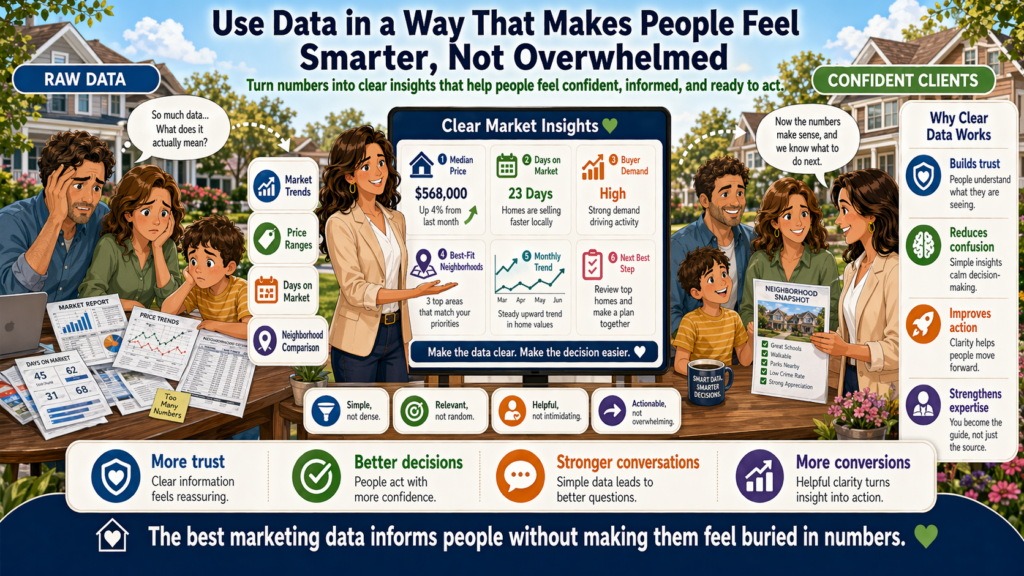
Many agents share data without explaining it. They post a chart and call it a market update. But most buyers and sellers do not know what the chart means for them. They do not want to study a report. They want to know what they should do.
This is where you can stand out.
Do not just show data. translate it into clear advice.
When you explain data in simple words, you become more useful than the numbers themselves. You help people see what is changing, why it matters, and how it may affect their next move.
Turn Market Updates Into Real Guidance
A good market update should not feel like a data dump. It should answer the question people actually care about, which is, “What does this mean for me?”
If inventory is rising, explain whether buyers have more choices. If homes are taking longer to sell, explain what sellers need to do differently. If prices are flat, explain why pricing still matters. If certain homes are still selling fast, explain what they have in common.
This makes your update practical.
For example, instead of saying, “Inventory increased by 12 percent this month,” you can say, “Buyers have a little more room to compare homes now, but well-priced homes in move-in-ready condition are still getting strong attention.” That is much easier to understand.
People do not hire you because you can repeat numbers. They hire you because you can make sense of those numbers.
Create Market Content for Different Types of Clients
A single market update does not serve everyone equally. Buyers and sellers look at the same market from different sides. A first-time buyer may care about affordability and competition. A move-up buyer may care about timing a sale and purchase. A seller may care about price, prep, and buyer demand. An investor may care about rent, cash flow, and long-term growth.
So your content should not always speak to one broad audience.
You can take the same market data and explain it in different ways. For buyers, you can talk about what they should watch during showings and negotiations. For sellers, you can talk about pricing and presentation. For homeowners, you can talk about value trends. For investors, you can talk about demand and rent patterns.
This makes your marketing feel more personal.
It also gives you more content without needing new ideas every time. One market update can become several useful posts, emails, videos, and blog sections.
Use Plain Language to Explain What Most Agents Make Complicated
Simple language is a major advantage in real estate. Many people feel embarrassed when they do not understand terms like equity, appraisal gap, contingencies, absorption rate, or escrow. They may not ask because they do not want to look uninformed.
Your content should make them feel safe.
When you explain things in simple words, you lower fear. You make people feel that they can ask you anything. This is powerful because confused people delay decisions. Clear people take action.
For example, instead of saying, “Absorption rate indicates the pace at which available inventory is being purchased,” you can say, “This shows how fast homes are selling compared with how many are available.” Then explain why it matters.
The clearer you are, the more helpful you become.
Build a Strong Video Library That Works Like a 24-Hour Sales Assistant
A video library is different from random video posting. Random videos may get views for a few days. A video library keeps helping people over time.
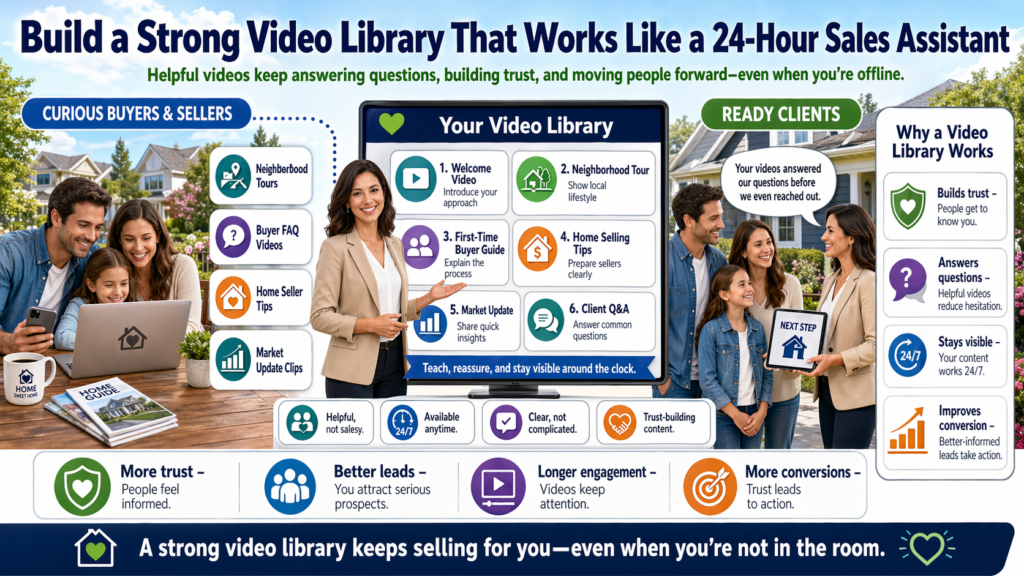
Think of it as a set of answers your future clients can watch whenever they need help. Some videos answer buyer questions. Some answer seller questions. Some explain neighborhoods. Some explain pricing. Some show your process. Some tell client stories.
Together, these videos build trust while you are not in the room.
A person may watch five of your videos before they ever contact you. By the time they do, they may already feel like they know your style, your voice, and your way of thinking. That makes the first conversation warmer and easier.
Create Core Videos for the Questions Every Client Asks
Every real estate business has common questions that come up again and again. These questions should become your core video library.
You can create videos about how to know if you are ready to buy, what happens after an offer is accepted, how inspections work, what sellers should do before listing, how to price a home, how to compare neighborhoods, and how to avoid common mistakes.
These videos do not need to be flashy. They need to be clear.
A simple video of you speaking directly to the camera can work well when the advice is strong. You can also film in homes, neighborhoods, or your office to make the content feel natural.
The point is not to create a perfect show. The point is to make your knowledge easy to access.
Make Neighborhood Videos That Feel Like Real Walkthroughs of Daily Life
Neighborhood videos can be very powerful because they help people feel a place before they visit it. But many neighborhood videos are too generic. They show pretty shots, music, and broad statements. That may look nice, but it does not always help someone decide.
A better neighborhood video should feel like a guided tour.
Talk about what kinds of homes people will find there. Explain who the area may fit. Show local streets, parks, shops, and common home styles. Talk about what people like and what trade-offs they should know about.
For example, you might explain that an area has great walkability but limited parking, or that homes offer more space but require a longer commute. These honest details make the video more trusted.
You do not need to make every neighborhood sound perfect. You need to help the right person find the right fit.
Use Video to Show How You Think Through Problems
Some of the best videos are not about facts. They are about judgment.
You can explain how you help a seller decide whether to accept an offer with fewer contingencies. You can talk through how a buyer should compare two homes at the same price. You can show how you evaluate whether a listing is overpriced. You can explain why a home with fewer upgrades may still be a better buy because of location or layout.
These videos are powerful because they show your brain at work.
Anyone can say they are a strong agent. Fewer people can show how they think. When your audience sees your process, they begin to understand your value.
This is especially useful for people who are unsure why they should hire an agent instead of trying to do more on their own. Your content shows that good guidance can protect them from costly mistakes.
Use Storytelling to Make Your Marketing More Memorable
Facts matter, but stories are easier to remember. A person may forget a market statistic, but they may remember a story about a seller who almost overspent on renovations or a buyer who avoided a bad decision because they slowed down and looked deeper.
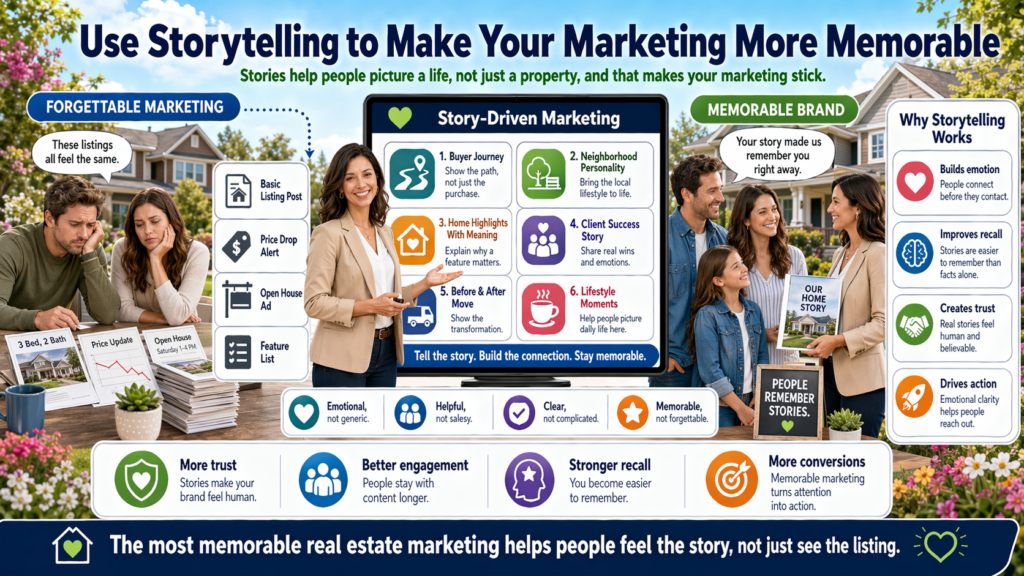
Storytelling works because it makes advice feel real.
Real estate is full of stories. Every client has a goal, a fear, a challenge, and a result. Every home has a reason someone loves it. Every neighborhood has a character. Every deal has a lesson.
When you use stories well, your marketing becomes more human. It stops sounding like a sales pitch and starts feeling like useful experience.
Tell Stories That Teach a Clear Lesson
A good marketing story should not wander. It should have a point.
You can start with the situation. A seller wanted to list quickly but was unsure whether to make repairs. A buyer loved a home but felt uneasy about the inspection. A family wanted more space but was scared to sell before finding the next place.
Then explain the challenge. What made the decision hard? What were the risks? What needed to be handled carefully?
Then share the lesson. Maybe the seller learned that small updates mattered more than a full remodel. Maybe the buyer learned to compare total cost, not just purchase price. Maybe the family learned that timing can be planned with less stress when the process is mapped clearly.
The lesson is what makes the story useful.
Protect Client Privacy While Still Sharing Valuable Lessons
You can tell strong stories without sharing private details. You do not need names, exact addresses, or personal facts. You can keep the story general while still making the lesson clear.
For example, you can say, “A recent seller in a nearby neighborhood was thinking about replacing the entire kitchen before listing. After reviewing the local comps, we found that a lighter refresh made more sense.” That gives the audience a real lesson without exposing the client.
This approach lets you create helpful content from your experience while respecting trust.
It also shows that you are active in the market. People can see that your advice comes from real work, not theory.
Use Before-and-After Stories to Show the Value of Strategy
Before-and-after content is easy to understand. People like seeing change.
In real estate, before-and-after stories can show how a home looked before staging and after staging, how a listing performed after a pricing change, how a buyer’s search improved after narrowing their needs, or how a seller avoided wasting money by choosing the right prep plan.
The key is to explain the thinking behind the change.
Do not only show the result. Explain why the decision worked. Why did the staging matter? Why did the price adjustment help? Why did the buyer’s new search plan make the process easier?
This turns the story into proof of your strategy.
Build Trust With Educational Events and Small Workshops
Educational events can help you meet people before they are ready to buy or sell. This is useful because many people want information before they want a sales conversation. A workshop gives them a safe way to learn and ask questions.
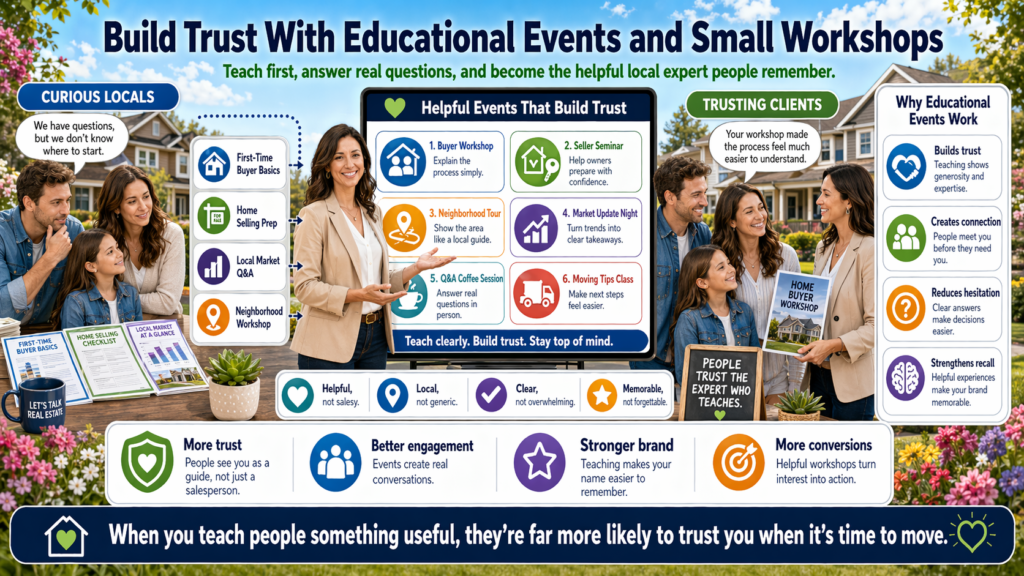
These events do not need to be large. A small group can be better because it feels personal.
You can host a first-time buyer class, a seller prep session, a downsizing talk, a neighborhood market briefing, or a home maintenance session with a local expert. You can host it in person, online, or as a simple live video.
The goal is to become the person who explains real estate clearly.
Make the Event Topic Specific Enough to Attract the Right People
A broad event like “Real Estate 101” may feel too vague. A specific event is more likely to attract people with a real need.
For example, “How to Buy Your First Home Without Feeling Overwhelmed” speaks directly to nervous buyers. “What to Fix Before Selling and What to Skip” speaks directly to homeowners who are thinking about listing. “How to Move Up to a Bigger Home Without Messing Up the Timing” speaks to growing families with a clear problem.
A strong topic makes people feel seen.
It also helps you promote the event more easily because the value is clear. People should know right away what they will learn and why it matters.
Teach Generously Without Turning the Event Into a Sales Pitch
People attend educational events to learn. If the event turns into a long sales pitch, trust can drop quickly. Teach real, useful information. Give examples. Answer questions. Help people leave smarter than they arrived.
This does not mean you should avoid mentioning your service. You can explain how you help with the process, but do it naturally. The teaching should come first.
When people see that you are generous with your knowledge, they become more open to working with you.
A good event should make someone think, “If this person is this helpful for free, they would probably be great to work with.”
Follow Up After the Event With More Value
The follow-up is where many events lose power. Someone attends, learns something, and then never hears from you again in a meaningful way. Do not let that happen.
After the event, send a helpful recap. Share the main takeaways in simple words. Include a next step for people who want personal guidance. You can also send related resources, such as a checklist, neighborhood guide, or short video.
Keep the tone warm and calm.
Some people may be ready to talk right away. Others may need months. A thoughtful follow-up keeps the relationship open without pressure.
Use Partnership Marketing to Reach People Through Trusted Local Voices
Partnership marketing works because trust can transfer. When a local business, expert, or community leader shares your content or introduces you to their audience, people may listen faster than they would to a cold ad.
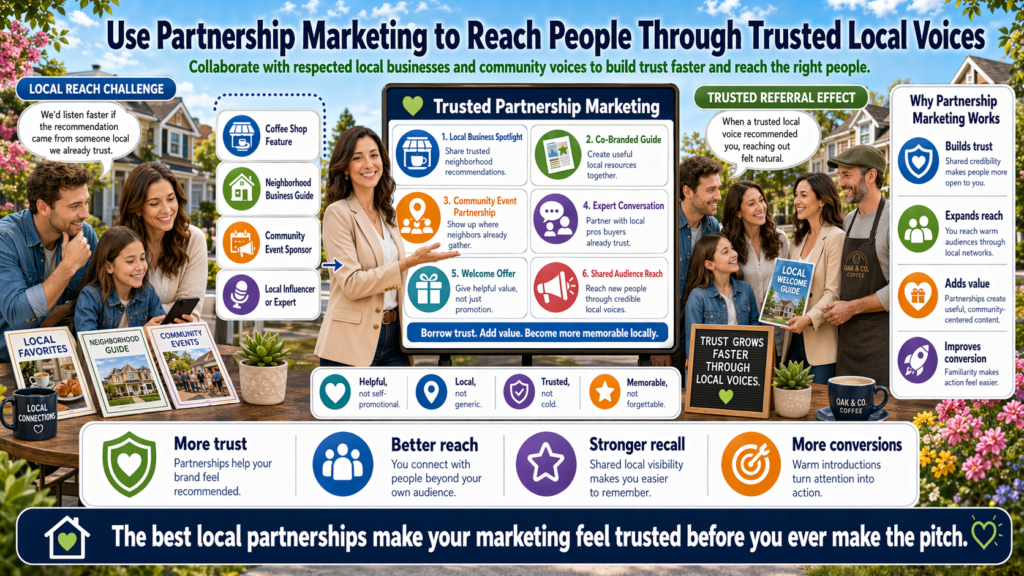
This does not mean asking everyone for referrals. It means building useful partnerships where both sides bring value.
Real estate connects with many parts of local life. Movers, lenders, inspectors, contractors, designers, roofers, landscapers, attorneys, financial planners, divorce professionals, senior living advisors, and local businesses all serve people who may also need real estate guidance.
A strong partnership can help you reach the right people at the right time.
Create Content With Partners Instead of Only Exchanging Names
Many referral partnerships are weak because they are based only on exchanging business cards. A better partnership creates value in public.
You can make videos together, host workshops, write guides, or create simple social content. A home inspector can explain what buyers should look for in older homes. A lender can explain how buyers should prepare before making offers. A contractor can explain which updates may help before selling. A designer can explain how to make a home feel brighter for showings.
This content helps your audience and your partner’s audience.
It also makes the partnership feel real. People are more likely to trust a relationship they can see.
Choose Partners Who Protect Your Reputation
Your partners reflect on you. If you recommend someone who communicates poorly, overcharges, or does weak work, your trust can suffer.
Choose partners with care.
Look for people who are clear, honest, responsive, and good at explaining things. Your clients should feel cared for when you refer them. A partner does not need to be the cheapest. They need to be reliable and aligned with the level of service you want your brand to represent.
A strong partner network makes you more valuable because clients feel that you can connect them with the right help at the right time.
Make the Partnership Helpful for Both Sides
A good partnership should not feel one-sided. Think about how you can help the other person too.
You can feature their knowledge, send them relevant referrals, invite them to events, share their content, or include them in useful guides. When partners see that you care about their success, the relationship becomes stronger.
Over time, this creates a local trust network. You are not just one agent trying to get attention. You are part of a group of helpful local professionals who support the same audience.
Measure the Marketing That Creates Real Conversations, Not Just Likes
Creative marketing is only useful when it helps your business grow. A beautiful video, a smart blog post, or a strong email should not exist only to look good. It should move people closer to trust, action, or referral.
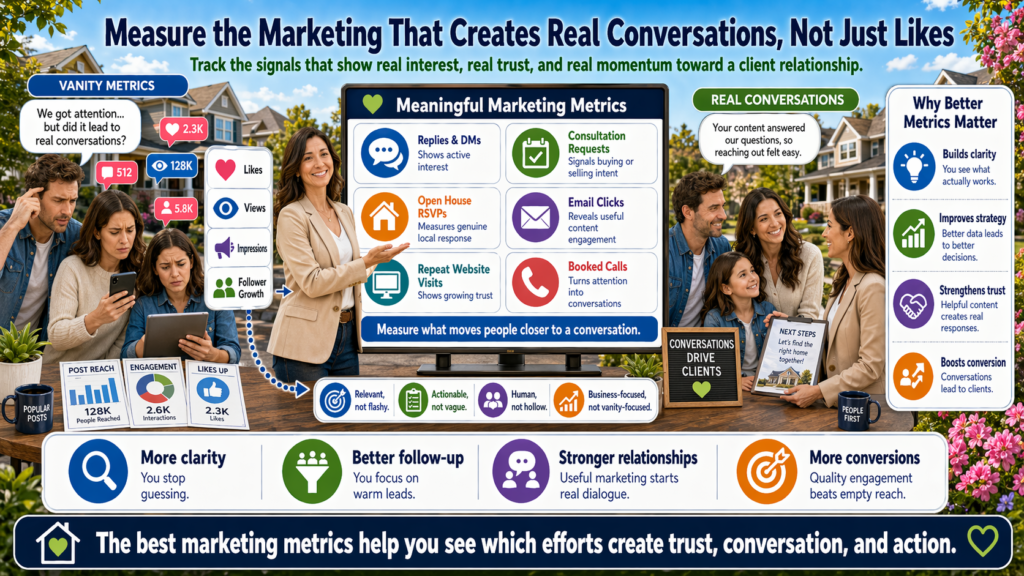
This is where many real estate businesses get stuck. They measure the easiest things, not the most useful things. They look at likes, views, and follower count, but they do not look closely enough at conversations, replies, saved posts, form fills, calls, listing appointments, buyer consults, and referrals.
Likes can be nice, but they do not always mean someone is closer to hiring you. A post with fewer likes may bring one serious seller. A video with a modest number of views may lead to a buyer consultation. An email with a small list may produce a referral from a past client.
So the real question is not, “Did this get attention?” The better question is, “Did this create useful movement?”
Track Each Channel Based on Its Real Job
Every marketing channel has a different role. Your blog may bring search traffic and educate people over time. Your social media may build familiarity and trust. Your email may keep warm leads close. Your ads may create faster lead flow. Your direct mail may help you own a farm area. Your events may turn quiet interest into real relationships.
Because each channel has a different job, you should not measure all of them in the same way.
A neighborhood blog post should be judged by search traffic, time on page, clicks to related pages, and leads from that area. A short video should be judged by watch time, saves, shares, comments, profile visits, and direct messages.
An email should be judged by opens, clicks, replies, and appointments booked. A direct mail campaign should be judged by scan visits, calls, home value requests, and long-term name recall.
This helps you make smarter decisions.
If a post gets many likes but no serious action, it may be good for awareness but weak for leads. If an email gets only a few replies but those replies are from serious homeowners, that email may be very strong. If a blog post brings steady local traffic for months, it may be worth updating and linking to more often.
Look for Patterns Instead of Judging One Post Too Quickly
Marketing needs patience. One post will not tell you everything. One email will not prove your whole strategy. One ad will not define your brand.
Look for patterns over time.
Which topics bring the most questions? Which videos do people save? Which emails get replies? Which blog posts bring visitors who click deeper into your site? Which lead magnets bring people who later become real clients? Which neighborhoods create the strongest response?
Patterns show you what your audience truly cares about.
For example, you may find that your audience does not respond much to broad market updates, but they respond strongly when you explain what those updates mean for a specific neighborhood. You may find that sellers engage more with content about home prep than content about price trends. You may find that buyers respond more to budget comparisons than listing alerts.
Once you see those patterns, you can create more of what works and less of what only keeps you busy.
Treat Replies and Questions as Strong Buying Signals
A reply is more valuable than a like. A question is more valuable than a view. When someone takes the time to ask you something, they are showing trust and interest.
This does not mean every person who asks a question is ready to buy or sell right away. But it does mean they are giving you a door to a deeper conversation.
Pay close attention to the questions people ask after reading your content. If someone replies to a seller email asking whether they should paint before listing, that may be an early listing lead. If someone comments on a neighborhood video asking about commute times, that may be a future buyer.
If someone sends a direct message after a pricing post, they may be closer to action than they first appear.
Your marketing should make these small conversations easy.
That is why soft calls to action work so well. Instead of asking everyone to book a formal meeting, invite them to ask a simple question. A small question can lead to a real need. A real need can lead to a client.
Conclusion
Real estate marketing works best when it feels useful, honest, and human. Buyers and sellers do not want more noise. They want clear answers, local insight, and steady guidance from someone who understands their needs. That is why the strongest marketing is not built on random posts, cold ads, or generic listing updates. It is built on trust.









Comments are closed.