
WinSavvy Editorial Standards
How this article was created
HVAC is one of those industries where people usually do not think about you until they really need you. A homeowner may ignore their air conditioner for months. Then one hot afternoon, it stops working. A business owner may forget about their heating system until the office feels freezing. In that moment, they are not looking for the fanciest brand. They are looking for a company they can trust, call fast, and feel safe hiring.
Build your HVAC marketing around trust before you chase leads
Most HVAC companies want more leads. That is fair. Leads keep the team busy, keep vans moving, and keep cash coming in. But before a homeowner becomes a lead, something else has to happen first.
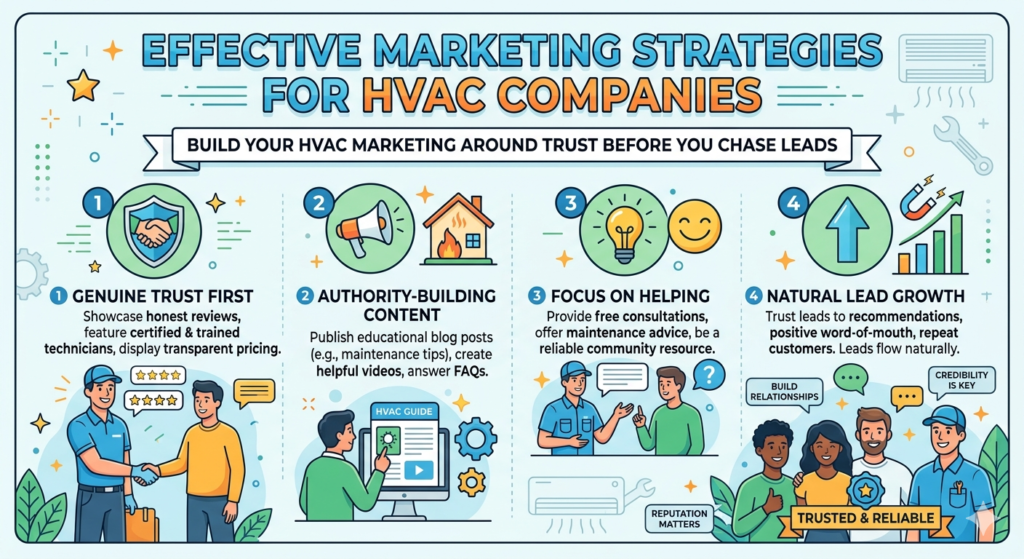
They have to trust you.
That trust may happen in a few seconds. It may happen when they see your reviews. It may happen when they land on your website and see clear service pages. It may happen when your ad sounds honest instead of pushy. It may happen when your Google Business Profile shows real photos, real team members, and recent customer feedback.
In HVAC, trust is not a soft idea. It is the thing that turns a search into a call.
A customer with a broken AC is often not relaxed. They may be hot, tired, and worried about the bill. A customer with a heating problem in winter may feel stressed because their family is uncomfortable. A business owner with a failing HVAC system may worry about staff, customers, and lost work time.
So your marketing has to do more than say, “We fix HVAC systems.” It has to make people feel safe choosing you.
Your customer is not just buying a repair or installation
A customer may say they need AC repair, furnace repair, duct cleaning, a heat pump, or a new system. But underneath that, they want something deeper.
They want the problem handled without drama.
They want someone who shows up when promised. They want honest advice. They want clear pricing. They want a technician who respects their home. They want to feel that they are not being pushed into a repair or replacement they do not need.
This is why HVAC companies should not build marketing only around discounts. Discounts can help, but they are not enough. If your whole message is “cheap service,” you may attract price shoppers who leave as soon as another company offers a lower price.
A stronger message is built around trust, speed, skill, and comfort.
Your marketing should show that you understand what the customer is going through. Instead of only saying “fast AC repair,” explain what fast means. Tell them they can call when the system stops cooling, that your team will check the issue, explain the options, and help them choose the right next step.
That kind of message feels more human. It makes the customer feel guided, not sold to.
Show people what working with you feels like
Most HVAC websites talk about services, but they do not explain the customer experience. That is a missed chance.
A homeowner wants to know what happens after they call. Will someone answer? Will they get a time window? Will the technician call before arriving? Will they get a written estimate? Will the home be left clean? Will they understand the repair before paying?
When your website, ads, and emails explain this in plain words, you remove fear.
For example, instead of saying, “We provide professional HVAC diagnostics,” you can say, “We check your system, explain what we found, and walk you through your repair options before any work begins.”
That sounds simple, but it is powerful. It gives the customer a picture of what will happen. The more clearly they can picture the process, the easier it is for them to call.
Your brand should feel local, helpful, and dependable
HVAC is a local trust business. People want to hire a company that understands their area, their weather, and their type of home.
A family in a hot climate has different worries than a family in a cold one. A homeowner in an older neighborhood may worry about old ductwork, weak airflow, or outdated units. A newer homeowner may worry about energy use, smart thermostats, or warranty rules.
Your marketing should sound like it was made for the people you actually serve.
Do not write like a national company if you are a local HVAC business. Use local language. Mention nearby areas naturally. Talk about common seasonal problems in your region. Show photos of your real vans, real technicians, and real jobs when possible.
This makes your company feel close and familiar.
Customers often choose the company that feels most real. A polished website is good, but a real website is better. A real brand has local photos, clear service areas, team details, honest reviews, and simple copy that sounds like a helpful person wrote it.
Make every marketing channel answer the same trust questions
Your website, Google Business Profile, ads, social media, emails, and reviews should all support the same message.
People should quickly understand who you help, where you work, what you do, and why they can trust you.
If your ad says you offer emergency AC repair but your website does not mention emergency service, the customer may hesitate. If your website says you are family-owned but your Google profile has no photos or reviews, the message feels weaker. If your reviews praise your clean work and fair pricing, your website should echo that same strength.
Strong HVAC marketing is not built from random pieces. It is built from one clear story repeated across every place the customer sees you.
That story might be that you are the trusted local team for honest repairs. It might be that you are the premium installer for high-efficiency systems. It might be that you are the fast-response company for urgent HVAC issues.
Whatever your position is, make it clear everywhere.
Your best marketing starts with the problems customers already feel
Many HVAC companies describe their services in technical terms. Customers do not always think that way.
A homeowner may not search for “capacitor replacement.” They may search for “AC not turning on.” They may not know they need duct sealing. They may search for “one room hotter than the rest of the house.” They may not know they have a refrigerant issue. They may search for “AC blowing warm air.”
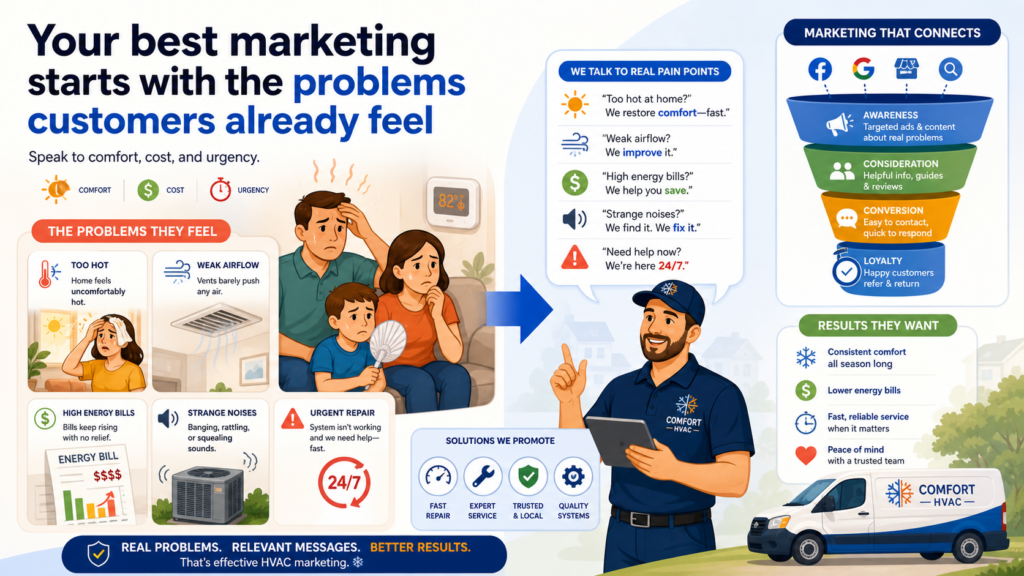
This is why your marketing should be built around real customer problems, not only service names.
Your website should still have service pages for AC repair, furnace repair, HVAC installation, heat pump service, indoor air quality, ductwork, and maintenance. But within those pages, you should use the words customers actually use.
Talk about weak airflow. Talk about strange noises. Talk about high energy bills. Talk about uneven rooms. Talk about short cycling. Talk about bad smells. Talk about systems that run all day but never cool the home.
When people see their exact problem on your page, they feel understood.
That feeling matters. It tells them, “This company has seen this before. They know what to do.”
Use simple words instead of trying to sound technical
Technical skill matters, but technical language can push customers away.
Most customers do not need a deep lesson in HVAC parts before they call. They need to know that you can find the problem and fix it the right way.
So keep your marketing simple.
Say “your AC may be working harder than it should” instead of “your system may be operating below rated efficiency due to restricted airflow.” Say “we help rooms feel more even” instead of “we optimize thermal distribution across zones.” Say “we explain your options before work starts” instead of “we provide consultative diagnostic recommendations.”
Simple words do not make your company look less skilled. They make your company easier to trust.
A smart customer does not want confusing language. They want clear language. The easier you are to understand, the easier you are to hire.
Turn your HVAC website into a sales tool, not just an online brochure
Your website should not sit there like a digital business card. It should bring in calls, booked jobs, quote requests, and maintenance plan signups.
Many HVAC websites look fine at first glance, but they do not sell well. They have a homepage, a few service pages, a phone number, and maybe a contact form. That is not enough anymore.
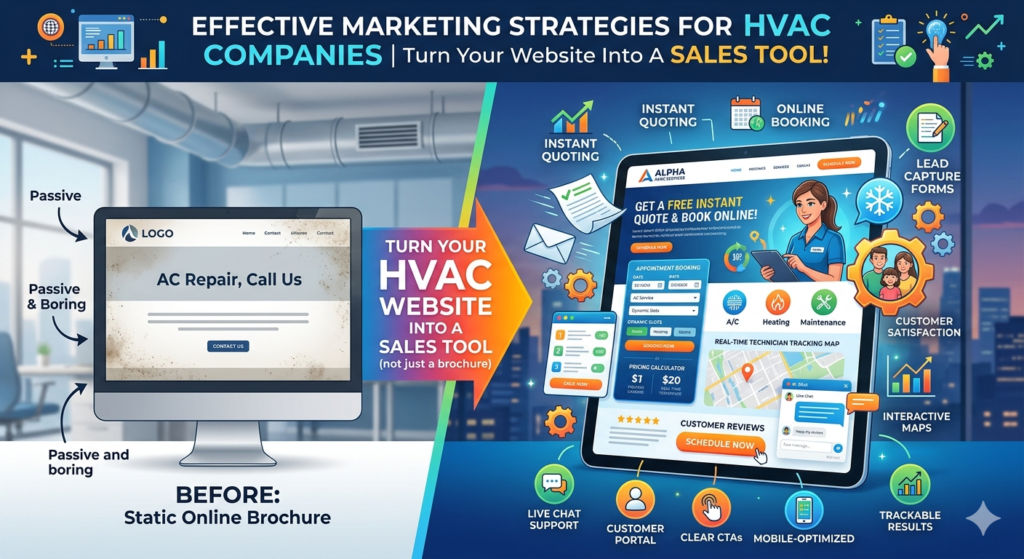
Customers compare you quickly. They may open three or four HVAC websites in a few minutes. They may check reviews at the same time. They may look for pricing clues, service areas, emergency support, financing, and proof that your team is real.
Your website has one main job.
It must help the right customer feel confident enough to contact you.
Your homepage should make the next step obvious
When someone lands on your homepage, they should understand your company within a few seconds.
They should know what you do, where you work, and how to contact you. They should not have to scroll for basic information. They should not have to guess whether you handle repairs, installs, or maintenance. They should not have to hunt for your phone number.
The top of your homepage should speak clearly.
A strong HVAC homepage does not need fancy words. It needs a clear promise. For example, it might say that you provide reliable heating and cooling service for homes in your local area. It might mention same-day service if you truly offer it. It might mention licensed technicians, honest options, or easy scheduling.
The first screen should also include a call button, a simple booking option, and proof that others trust you.
That proof may be your review rating, years in business, warranty details, service badges, or a short line about your local team. Do not overload this area. Keep it clean. Make the phone number easy to tap on mobile.
Most HVAC traffic comes from people using phones. If they have to pinch, zoom, scroll, or search for your number, you are losing calls.
Give visitors one main action to take
A common website mistake is giving people too many choices at once.
You may want them to call, book online, request a quote, join a maintenance plan, read your blog, follow you on social media, and check your financing page. All of those may matter, but they should not compete equally on every page.
For urgent repair pages, the main action should be calling or booking service. For installation pages, the main action may be requesting an estimate. For maintenance pages, the main action may be scheduling a tune-up or joining a plan.
Every page should have a clear next step that matches the customer’s intent.
If someone is reading about AC repair, do not make them work to find the repair booking button. If someone is reading about furnace replacement, do not push them toward a generic contact form with no context. Make the action fit the page.
A good HVAC website feels like a helpful path. It does not make the customer think too hard.
Your service pages should be deep enough to earn trust
Thin service pages are one of the biggest reasons HVAC websites fail to rank and convert.
A page that only says “We offer AC repair. Call us today” does not give Google much to understand. It also does not give customers much reason to trust you.
Each major service deserves its own detailed page. AC repair should have a page. Furnace repair should have a page. HVAC installation should have a page. Heat pump service should have a page. Maintenance should have a page. Ductwork should have a page if you offer it. Indoor air quality should have a page if it is part of your business.
Each page should explain the problems you solve, signs the customer may notice, what your technician checks, what the service process looks like, and when the customer should call.
This does not mean filling the page with fluff. It means giving useful answers in simple language.
For example, an AC repair page can explain why the unit may blow warm air, why airflow may be weak, why the system may turn on and off often, why a frozen coil matters, and why delaying repair can lead to bigger costs.
This helps the customer. It also helps your page match the way people search.
Build pages around customer intent, not just keywords
SEO matters, but you should not write pages only for search engines.
A person searching for “AC repair near me” may want fast help. A person searching for “new HVAC system cost” may be comparing options. A person searching for “why is my furnace making noise” may still be learning. A person searching for “best HVAC company in Dallas” may be ready to choose.
Your website should match these different levels of intent.
Repair pages should be direct and action-focused. Installation pages should educate and reduce fear around cost. Maintenance pages should explain the value of prevention. Blog posts should answer questions and lead readers toward the right service.
When you match intent, your content feels useful instead of forced.
That is the key to modern HVAC SEO. It is not about stuffing words onto a page. It is about becoming the most helpful local answer for the problem the customer has right now.
Your website should remove price fear without locking you into bad quotes
Many HVAC companies avoid talking about price because every job is different. That makes sense. But if your website says nothing about cost, customers may feel nervous.
Price fear can stop people from calling.
You do not always need to show exact prices. In many cases, it is better to explain what affects the price. For repairs, you can explain that the cost depends on the part, the age of the system, the time needed, and whether the issue is simple or complex.
For replacement, you can explain that price depends on system size, efficiency, ductwork, home layout, and installation needs.
You can also explain your estimate process. Tell people that you inspect the system, explain the options, and give clear pricing before work begins.
This kind of price content builds trust without forcing you into one fixed number.
It also helps filter better leads. People who understand the process are less likely to expect a full system replacement for the price of a small repair.
Make financing clear for bigger jobs
For HVAC installations, financing can be a major conversion tool.
A homeowner may know they need a new system, but the total cost can feel heavy. If your website hides financing information, some customers may leave before asking for a quote.
Your installation pages should mention financing in plain words. Explain that options may be available for qualified customers. Explain that monthly payments can make replacement easier to manage. Explain how they can ask about financing during the estimate.
Do not bury this information on a page nobody visits. Put it where buying decisions happen.
Financing should not feel like a trick. It should feel like a helpful option. The message should be calm and clear: if the system needs to be replaced, there may be ways to spread the cost over time.
That can turn hesitation into a booked estimate.
Your website must be built for mobile calls
Many HVAC customers search on their phones. They may be standing near the unit. They may be at work trying to schedule help for home. They may be sitting in a hot room and comparing companies fast.
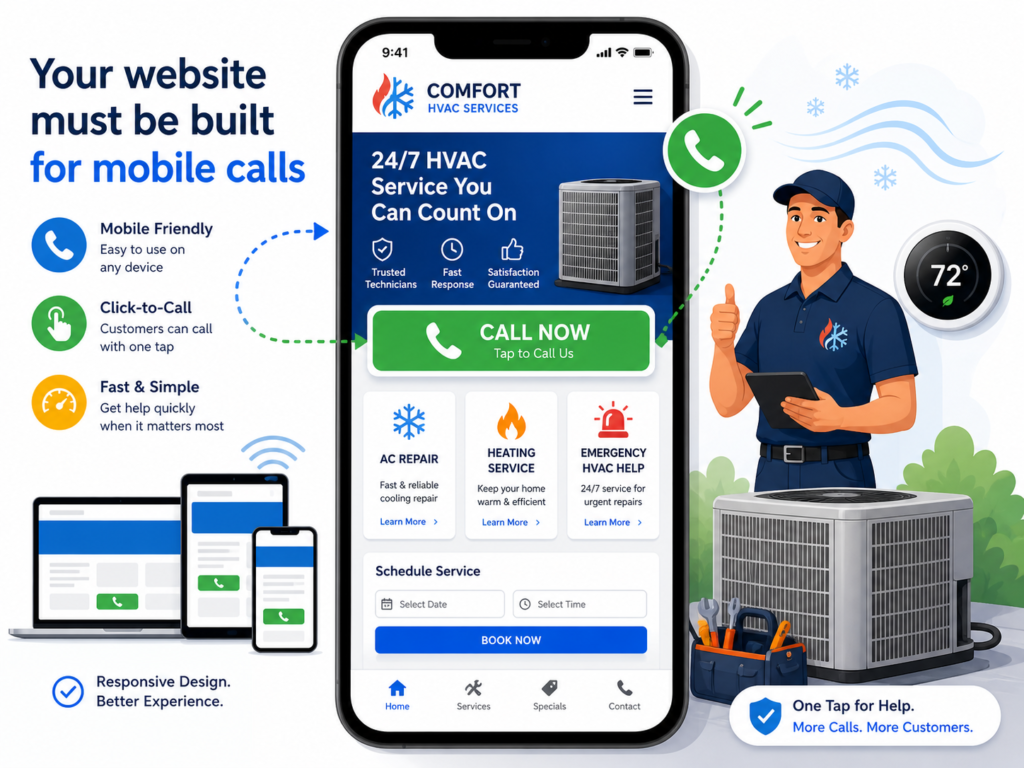
This means your website must work perfectly on mobile.
The phone number should be easy to tap. The booking button should be easy to find. Forms should be short. Pages should load quickly. Text should be readable without zooming. Buttons should not be too small. Photos should not slow the page down.
A slow website hurts trust. It also hurts leads.
When someone has an urgent HVAC problem, they will not wait around for a heavy page to load. They will go back to Google and call someone else.
Keep contact forms short and friendly
A long form can kill conversions.
For most HVAC service requests, you only need the basics at first. Name, phone number, email, service needed, address or service area, and a short message are usually enough. You can collect more details later.
Make the form feel easy. Use simple labels. Avoid asking questions that sound too technical. Do not force the customer to choose from a long list of system types if they may not know what they have.
A good form should feel like the start of a conversation, not a test.
Also, make sure every form submission gets a fast response. A form that goes unanswered is worse than no form at all. If people use your website to ask for help, your team needs a clear process to follow up quickly.
Use local SEO so customers find you at the exact moment they need help
HVAC is one of the strongest local SEO industries because demand is tied to location and timing.
When someone searches “AC repair near me,” they are often close to making a call. When someone searches “furnace repair in my area,” they are not casually browsing. They have a problem and want help.
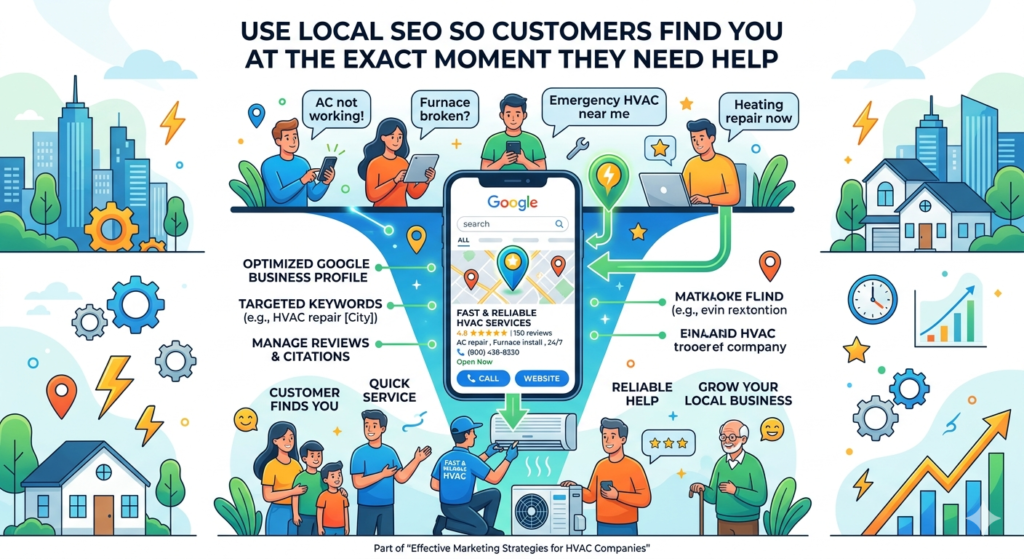
This is why local SEO can become one of your most profitable marketing channels.
Paid ads stop when you stop paying. Referrals are powerful but hard to control. Social media can help, but it rarely captures urgent demand as well as search. Local SEO puts your company in front of people who already need HVAC service.
But local SEO is not just about ranking your website. It is about ranking in the map pack, showing up for service-area searches, earning reviews, building strong location signals, and making your business look like the obvious local choice.
Your Google Business Profile is one of your most important sales pages
For many customers, your Google Business Profile is the first place they judge you.
They may see your rating, review count, photos, hours, services, location, questions, and updates before they ever visit your website. In some cases, they may call directly from your profile.
This means your profile should be treated like a core marketing asset, not a basic listing.
Your business name, address or service area, phone number, website link, categories, hours, and services should be correct. Your main category should match your core business. Your service areas should reflect where you actually work. Your photos should look real and current.
Add photos of your vans, team, tools, completed installs, office, and community work. Real photos help customers feel that your company is active and trustworthy.
Do not let your profile look empty or forgotten. An active profile sends a signal that your business is alive, responsive, and ready to help.
Post updates that match the season
Google Business Profile posts are not magic, but they can support trust and activity.
Use them to share seasonal messages. Before summer, talk about AC tune-ups. During a heat wave, remind people to call if their system is blowing warm air or running nonstop. Before winter, talk about furnace safety, heating checks, and filter changes.
Keep the posts short and useful. Do not write them like ads only. Give people a reason to act.
For example, a post before summer could explain that a quick tune-up can help catch weak airflow, dirty coils, and worn parts before the first major heat wave. Then invite people to schedule service.
This feels helpful. It also supports the idea that your company is paying attention to local needs.
Reviews are not just proof; they are a growth engine
Reviews can make or break HVAC marketing.
A company with many strong reviews has a major advantage. Customers trust other customers. When they see people saying your technicians were on time, polite, honest, and skilled, they feel safer calling you.
But reviews do not happen by accident. You need a simple process.
Ask happy customers soon after the job is done. Make it easy with a direct review link. Train technicians to ask at the right moment. Send a follow-up message after service. Thank people who leave reviews. Respond to reviews in a calm and human way.
The best time to ask is when the customer is clearly pleased. If the system is working, the home feels comfortable, and the customer has just had a good experience, that is your moment.
Do not make the request awkward. A technician can simply say, “I’m glad we got this handled for you. If you feel good about the service, a quick Google review would really help our local team.”
That feels natural.
Respond to reviews like future customers are reading
When you reply to reviews, you are not only speaking to the person who wrote them. You are speaking to every future customer who reads them.
A good response should sound human. Thank the customer by name if appropriate. Mention the service in a natural way. Show that you appreciate their trust.
For a positive review, you might thank them for choosing your team for AC repair and say you are glad the home is comfortable again.
For a negative review, stay calm. Do not argue. A defensive reply can hurt you more than the review itself. A simple, professional response shows future customers that you take concerns seriously.
The goal is not to look perfect. The goal is to look responsible.
People know every business can have an issue. What they want to see is how you handle it.
Build local service pages for the areas that matter most
If you serve several towns or neighborhoods, your website should make that clear.
Many HVAC companies list all service areas in one long paragraph on the homepage. That is not enough if local search is important to your growth.
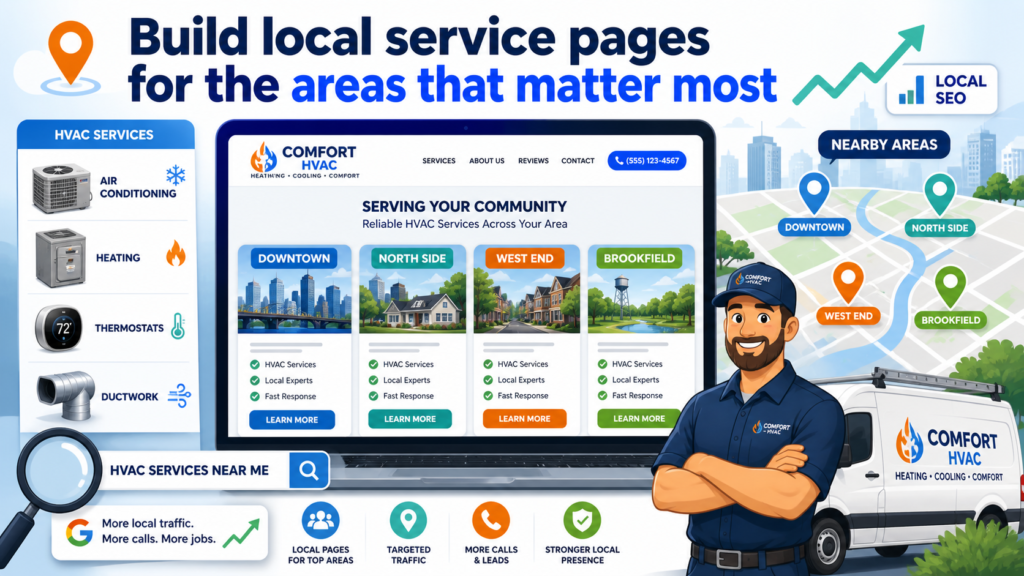
You should create strong location pages for your most valuable service areas. These pages should not be copied and pasted with only the city name changed. That kind of content feels thin and can hurt trust.
Each location page should explain the services you offer in that area, common HVAC problems in that location, nearby neighborhoods you serve, and why local customers choose you.
The page should feel genuinely useful for someone in that city or town.
For example, if one area has many older homes, talk about airflow issues, aging ductwork, and replacement planning. If another area has many newer homes, talk about maintenance, smart thermostat setup, and keeping systems efficient.
Make the page local in a real way.
Connect location pages to real services
A location page should not sit alone.
It should link to your main service pages, and your service pages should mention your core service areas where natural. This helps both users and search engines understand your business.
If someone lands on a page for HVAC service in a certain town, they should easily move to AC repair, furnace repair, installation, or maintenance. If someone lands on your AC repair page, they should understand the areas you serve.
This creates a strong local web of pages.
The goal is simple. When someone in your service area searches for help, Google should clearly understand that your company is relevant, nearby, trusted, and able to handle the job.
Create service pages that bring in ready-to-book HVAC customers
A strong HVAC website is not built around one homepage. It is built around clear service pages that match what people are searching for.
This matters because customers do not all arrive with the same problem. One person may need emergency AC repair. Another may want a furnace tune-up. Another may be comparing the cost of a new heat pump. Another may be worried because one room never gets comfortable.
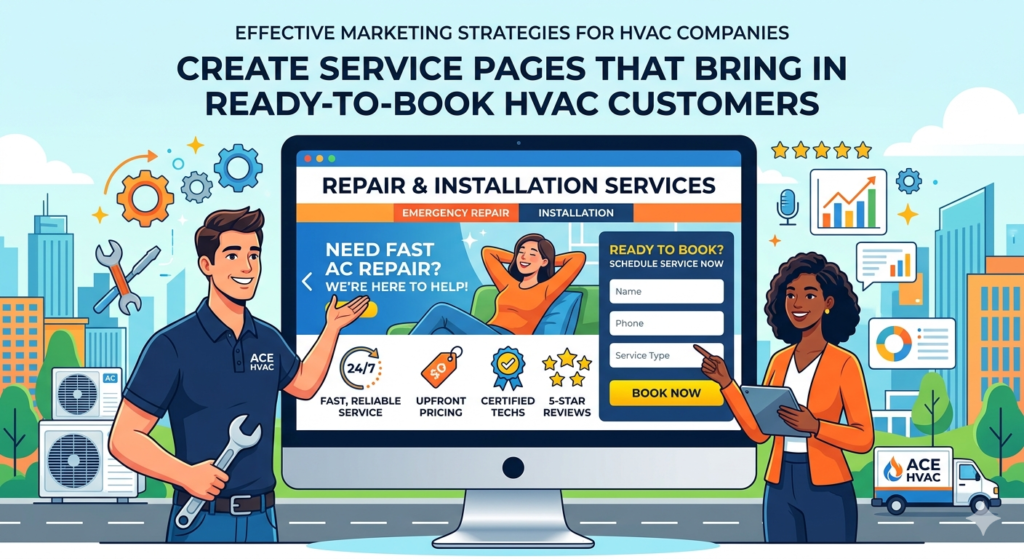
If all of those people land on the same general page, the message becomes weak. It feels too broad. It does not speak directly to the problem in front of them.
That is why every important service should have its own page. A customer looking for AC repair should land on a page about AC repair. A customer looking for furnace installation should land on a page about furnace installation. A customer looking for ductwork help should land on a page that explains ductwork problems in plain language.
This is not just good for SEO. It is good for sales.
When a page matches the customer’s exact need, they feel understood. When they feel understood, they stay longer. When they stay longer, they are more likely to call.
Your AC repair page should speak to urgent discomfort
AC repair is often an urgent service. When someone searches for help, they may already be uncomfortable. Their home may be hot. Their system may be blowing warm air. The unit may be making a strange sound. They may be worried the whole system is about to fail.
Your AC repair page should not waste time.
It should quickly tell people that you can help, where you serve, and how to book. It should explain common signs that an AC needs repair, but it should do so in a calm and clear way. Do not overload the page with technical details. Give enough information to build trust, then make the next step easy.
A good AC repair page should talk about problems customers actually notice. These include warm air, weak airflow, strange noises, water around the unit, bad smells, a system that keeps turning on and off, and energy bills that suddenly rise.
But instead of listing those signs like a checklist, write them into helpful paragraphs. Explain what the customer may be feeling and why it matters.
Explain the repair process so the customer feels safe
A worried customer wants to know what happens after they call.
Your AC repair page should explain your process in simple words. Tell them your technician will inspect the system, look for the cause of the issue, explain what they found, and give repair options before work starts.
This is one of the easiest ways to build trust.
Many homeowners fear being pressured. They worry a technician will use confusing words or push a costly fix. When your page says that you explain the issue clearly before doing the work, you lower that fear.
You can also mention that your team checks the full system, not just the first obvious symptom. This helps position your company as careful and honest. It shows that you are not there to rush through the job. You are there to solve the problem properly.
The best AC repair pages make the customer think, “This company will not leave me guessing.”
Your HVAC installation page should help people make a big decision
HVAC installation is different from repair because the customer is making a larger purchase. They may spend days or weeks comparing options. They may be nervous about cost. They may not know what size system they need. They may not understand efficiency ratings, warranties, or financing.
Your installation page should guide them.
Do not treat installation like a simple service. Treat it like a major life decision for the homeowner. Because to them, that is what it is.
The page should explain when replacement may make more sense than repair. It should talk about old systems, frequent breakdowns, uneven comfort, high energy bills, and repair costs that keep adding up. It should also explain that your team helps the customer choose the right system for their home, not just the most expensive one.
That message matters.
People do not want to feel sold. They want to feel advised.
Give customers a clear path from estimate to installation
A strong installation page should make the buying process feel less scary.
Explain what happens during an estimate. Tell customers that your team looks at the home, system size, ductwork, comfort needs, budget, and energy goals. Explain that they will get options, not pressure.
Then explain what happens after they choose a system. Talk about scheduling, removal of the old unit, installation, testing, cleanup, and showing the customer how to use the new system.
This kind of detail helps people imagine the process. It makes the project feel manageable.
You should also mention warranties, maintenance, and financing if you offer them. These are not small details. They are decision points. A customer may choose you over another company because your page makes the full process easier to understand.
When installation content is clear, it can turn a nervous shopper into a booked estimate.
Your maintenance page should sell prevention, not just tune-ups
Maintenance can be one of the most profitable parts of an HVAC business because it creates repeat customers. It also helps smooth out seasonal demand and keeps your company in front of homeowners before emergencies happen.
But many HVAC companies market maintenance in a weak way. They simply say, “Schedule a tune-up.” That does not explain why the customer should care.
Your maintenance page should sell the value of prevention.
Talk about comfort, lower risk of breakdowns, better airflow, cleaner operation, longer system life, and fewer surprise problems during extreme weather. Keep the language simple. Help the customer understand that a tune-up is not just a quick visit. It is a way to catch small issues before they become expensive.
Customers do not wake up excited to buy maintenance. They buy it when they understand what it protects.
Turn maintenance plans into a trust-building offer
If you offer maintenance plans, explain them clearly.
Do not just say “join our club” or “ask about our plan.” Tell people what the plan includes and why it helps. If members get seasonal tune-ups, priority scheduling, reminders, discounts, or special service benefits, explain that in normal language.
A maintenance plan should feel like a simple way to take care of the home without having to remember every detail.
For example, you can explain that your team reminds the customer when it is time for service, checks the system before peak weather, and helps them stay ahead of surprise repairs.
This makes the plan feel useful instead of optional.
You should also train your technicians to talk about maintenance after a good service experience. If someone just paid for a repair, they may be open to preventing the next one. But the conversation has to be helpful, not pushy.
The right message is not, “Buy this plan.” The right message is, “Here is how we can help you avoid problems like this in the future.”
Your indoor air quality pages should connect comfort with health concerns carefully
Indoor air quality can be a strong service category, but it has to be marketed with care.
People care about dust, allergies, odors, humidity, pet dander, mold concerns, and stale air. But you should avoid making claims that sound too big or too medical. Your job is to explain how your solutions may support cleaner, more comfortable air in the home.
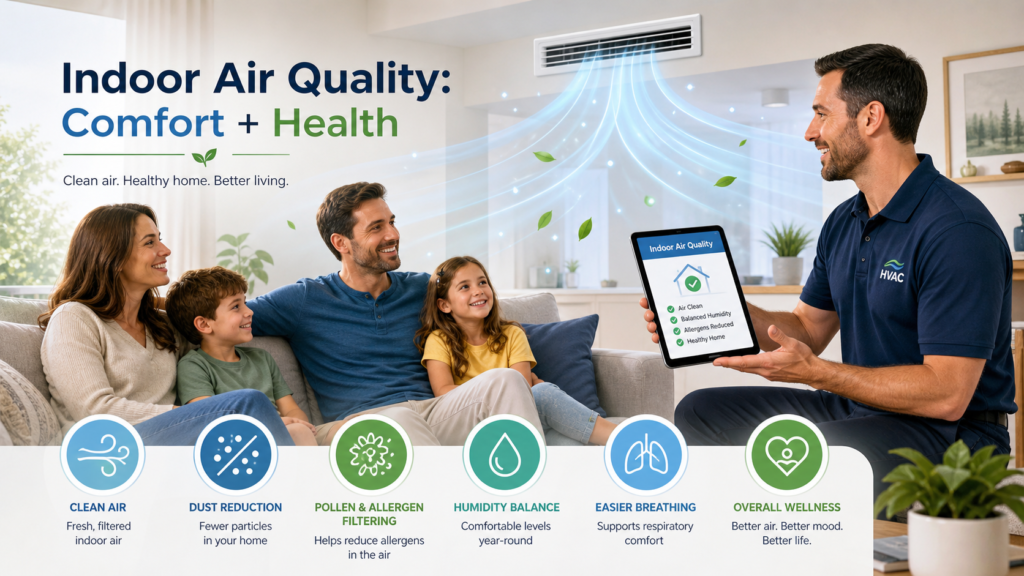
A good indoor air quality page should start with the problems customers notice. They may see dust returning quickly after cleaning. They may smell musty air. They may feel that the home is too dry or too humid. They may notice that certain rooms feel stuffy.
Then you can explain the services you offer, such as air purifiers, humidifiers, dehumidifiers, ventilation support, filter upgrades, duct inspections, or UV lights if those are part of your business.
Keep the tone grounded. Make the page helpful, not fear-based.
Help customers choose the right air quality solution
Many customers do not know which indoor air quality solution they need.
This is where your content can make a big difference.
Explain that the right answer depends on the home, the HVAC system, the concern, and the source of the problem. A humidity issue may need a different solution than a filtration issue. A stale air problem may need a different approach than a dust problem.
This helps customers see that your company is not just selling products. You are diagnosing the real issue.
That is a stronger sales position.
It also creates a natural reason to book an inspection or consultation. The customer does not need to figure everything out alone. They just need to call your team and get clear guidance.
Use content marketing to answer questions before customers call
Content marketing is one of the most underused HVAC growth tools.
Many companies think blog posts are just for SEO. That is partly true, but content can do much more. Good content answers customer questions, builds trust, supports service pages, helps ads perform better, gives your team useful material to share, and keeps your company visible before customers are ready to buy.
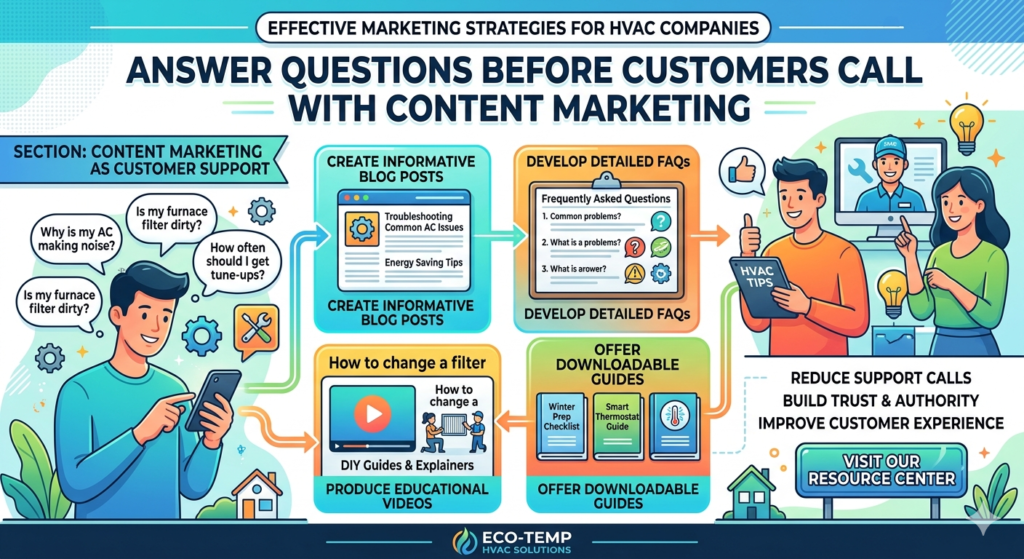
People search HVAC questions all the time.
They search why their AC is blowing warm air. They search how often to change filters. They search whether repair or replacement is better. They search why one room is hotter than another. They search how long HVAC systems last. They search whether maintenance is worth it.
If your company answers these questions better than competitors, you earn attention before the sales call.
Your blog should focus on real customer problems
A good HVAC blog should not be a random collection of topics. It should be built around the questions your customers ask every week.
Start by listening to phone calls, service requests, technician notes, and sales conversations. What do people ask again and again? What are they confused about? What fears stop them from booking? What problems do they delay until they become emergencies?
Those questions should become your content plan.
For example, if many customers ask whether they should repair or replace their AC, that deserves a detailed article. If many homeowners complain about uneven cooling, that deserves a guide. If customers often ask why their energy bill is high, write a clear article that explains possible causes and when to call for help.
This kind of content is powerful because it is grounded in real demand.
It is not content for the sake of content. It is content that supports sales.
Write the way your customers talk
HVAC content should be simple.
Your customer may not know what a blower motor does. They may not know what refrigerant means. They may not understand static pressure, load calculations, or short cycling. They just know something feels wrong.
So write in plain language.
Use phrases like “your AC keeps turning on and off,” “your home does not cool evenly,” “your system runs all day,” and “your furnace smells strange.” These are the words people use when they search. They are also the words people understand.
This does not mean your content should be shallow. You can still be detailed. You can still explain the cause, the risk, and the next step. Just do it in a way that feels like a helpful technician talking to a homeowner at the kitchen table.
That style builds trust fast.
Each blog post should lead readers toward the right service
A blog post should not be a dead end.
If someone reads an article about why their AC is blowing warm air, the article should naturally guide them toward AC repair. If someone reads about the signs of an aging furnace, the article should guide them toward furnace inspection or replacement. If someone reads about high energy bills, the article may guide them toward maintenance, ductwork, or system evaluation.
This does not mean every paragraph should sell.
It means the article should help the reader understand when it is time to call.
The best content gives value first, then offers a clear next step. It might say that some issues can be simple, like a dirty filter, but if the problem continues, the system should be checked by a trained technician.
That is helpful and honest.
Use internal links to move people from learning to booking
Internal links are links from one page of your website to another. They help search engines understand your site, but more importantly, they help customers move forward.
If a blog post talks about AC repair, link naturally to your AC repair page. If it talks about system replacement, link to your installation page. If it talks about seasonal tune-ups, link to your maintenance page.
These links should feel natural. Do not force them into every sentence. Use them where they help the reader.
For example, after explaining that warm air can be caused by several issues, you can say that your AC repair team can inspect the system and explain the best next step.
That link gives the reader a path.
Without it, they may read the article, leave, and call someone else.
Seasonal content can bring in leads before demand peaks
HVAC demand moves with the weather. Your content should move with it too.
Before summer, publish and promote content about AC tune-ups, signs your system may fail, how to prepare for heat waves, and why your AC may not cool well. Before winter, focus on furnace checks, heating safety, strange furnace smells, uneven heating, and when to replace an old system.
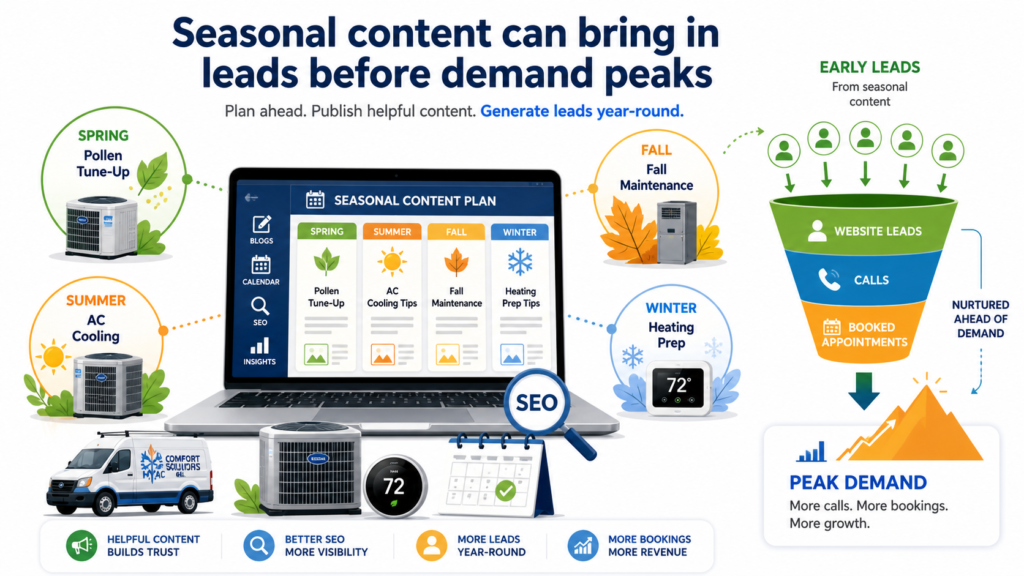
Do not wait until the season is already at its peak. By then, many customers are already searching and competitors are already pushing ads.
Seasonal content should be planned early.
If you want summer traffic, prepare spring content. If you want winter heating leads, prepare fall content. This gives search engines time to find and rank your pages. It also gives you useful material for email, social posts, and ads.
Use weather changes as marketing moments
Weather creates urgency.
The first hot week of the year can trigger AC calls. The first cold snap can trigger furnace calls. Storms, humidity, pollen, and temperature swings can all create HVAC concerns.
Your content and messaging should respond to these moments.
For example, when a heat wave is coming, you can share simple advice about checking filters, keeping vents open, and calling if the AC is blowing warm air or running nonstop. When cold weather is coming, you can remind customers to test their heat before they truly need it.
This is not about scaring people. It is about being timely and helpful.
A company that gives useful advice at the right moment feels more present. Customers remember that. And when they need service, they are more likely to call the company that has been helping them all along.
Run Google Ads with a clear plan instead of wasting money on clicks
Google Ads can work extremely well for HVAC companies, but only when they are managed carefully.
The reason is simple. HVAC clicks can be expensive. If your campaigns are too broad, your budget can disappear fast. You may pay for people outside your service area, people looking for jobs, people searching for DIY advice, or people who are not ready to book.
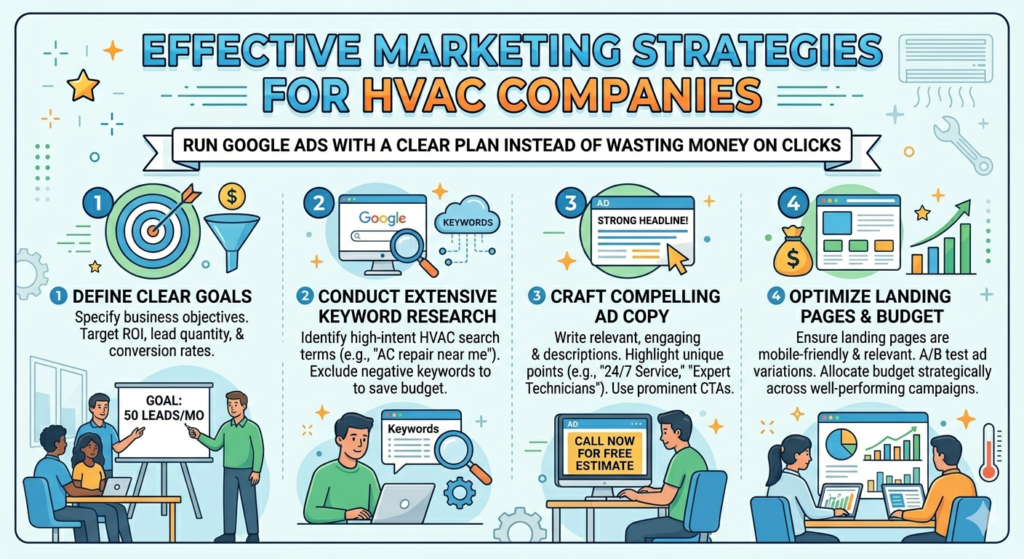
Good Google Ads are not about getting the most clicks. They are about getting the right calls at the right cost.
Before spending heavily, you need to know which services are most profitable, which areas matter most, which calls are worth chasing, and what your team can actually handle.
If your schedule is full, you may want to push installation estimates or maintenance plans. If your repair calls are slow, you may want to focus on emergency and same-day searches. If one town brings better customers than another, your budget should reflect that.
Search ads should match high-intent keywords
The best HVAC Google Ads usually focus on high-intent searches.
These are searches from people who are close to taking action. Phrases like “AC repair near me,” “furnace repair near me,” “emergency HVAC service,” “HVAC company near me,” and “air conditioner repair in [city]” often show strong intent.
These searches are more valuable than broad searches like “how does AC work” or “HVAC tips.” Educational searches can be useful for SEO, but they are often too early for paid ads unless you have a strong strategy.
Your ad groups should be organized by service. AC repair should not be mixed with furnace replacement. Maintenance should not be mixed with emergency service. Installation should have its own message and landing page.
When the search, ad, and landing page all match, performance improves.
The customer feels like they found the right company faster.
Send ad traffic to the right page
One of the biggest Google Ads mistakes is sending every click to the homepage.
If someone clicks an ad for AC repair, send them to an AC repair page. If someone clicks an ad for furnace installation, send them to a furnace installation page. If someone clicks an ad for emergency HVAC service, send them to a page that clearly talks about urgent service.
The landing page should continue the promise from the ad.
If the ad says “same-day AC repair,” the page should mention same-day AC repair if you truly offer it. If the ad says “schedule a furnace estimate,” the page should make estimate booking easy.
This may sound basic, but many campaigns fail because the path feels broken. The customer clicks with one need, lands on a general page, gets distracted, and leaves.
A strong ad campaign keeps the path tight.
Search. Click. Trust. Call.
Track calls so you know what is really working
You cannot manage HVAC ads well if you do not track calls.
Form fills are useful, but many HVAC leads happen by phone. If you only track website visits or clicks, you may think a campaign is working when it is not. Or worse, you may turn off a campaign that is actually driving good phone calls.
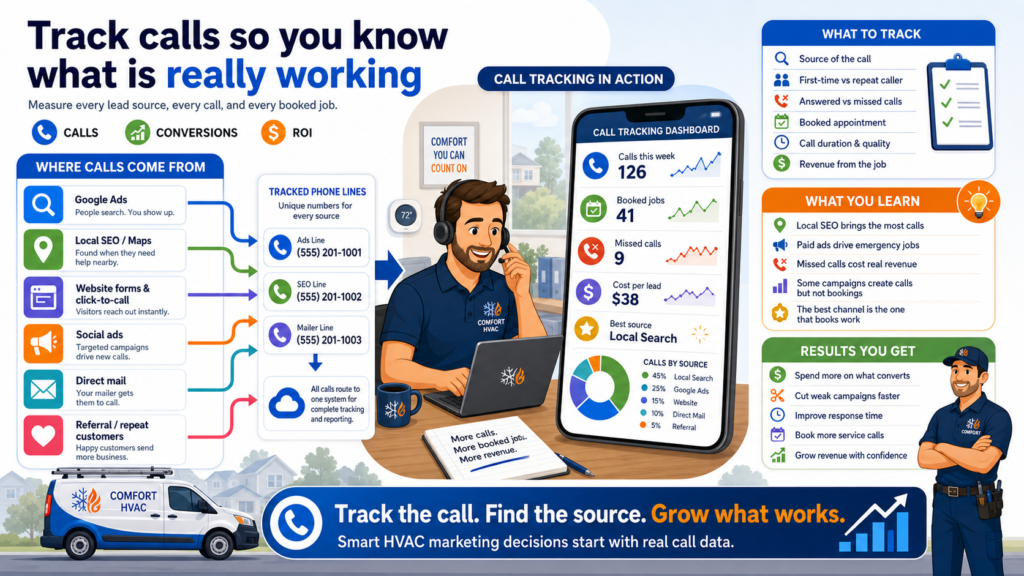
Use call tracking so you can see which ads, keywords, and pages produce leads. But do not stop there. Track call quality too.
A call from someone asking for service in your area is different from a wrong number. A booked job is different from a price shopper. A replacement estimate is different from a small repair.
The more clearly you track lead quality, the better your decisions become.
Listen to calls to improve both ads and sales
Call recording, where legal and properly disclosed, can teach you a lot.
You may find that ads are bringing in good leads, but the phone team is missing them. You may find that customers keep asking the same pricing question. You may find that people are confused about your service area. You may find that your booking process is too slow.
This is where marketing and operations meet.
If your ads generate calls but those calls do not turn into jobs, the problem may not be the ads. It may be the way calls are answered. It may be slow follow-up. It may be weak booking scripts. It may be unclear pricing language.
A good HVAC marketing system does not only drive leads. It helps the whole company convert them.
Use local service ads when you want more phone calls from serious customers
Local Service Ads can be a strong channel for HVAC companies because they appear near the top of Google for local service searches. They are built for people who want to contact a nearby provider quickly. This makes them a good fit for repair calls, urgent service, tune-ups, and estimate requests.
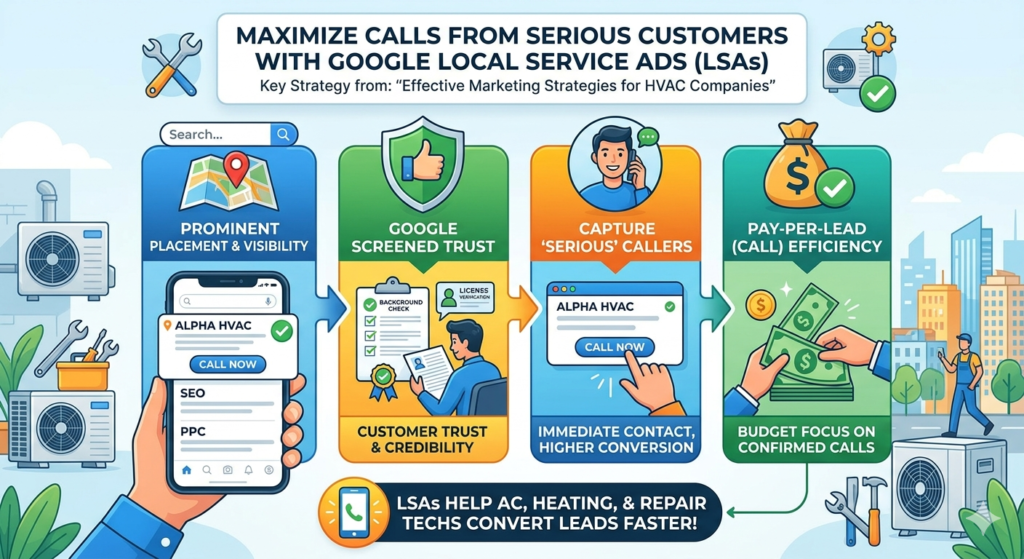
But like any paid channel, they need control. You should not treat them as a “turn it on and hope” tool. You need to manage service areas, job types, reviews, response speed, and lead quality.
The biggest benefit of Local Service Ads is that they can help you show up when people are ready to act. The biggest risk is that you may pay for leads that do not fit your business if your settings are too loose or your follow-up is slow.
So the goal is not just to get more calls. The goal is to get more of the right calls.
Your profile must make customers feel safe before they contact you
Local Service Ads work best when your profile looks strong. Customers compare providers quickly. They may look at your review count, rating, years in business, service area, hours, and whether your business looks active.
If your profile looks thin, you may lose the lead before the phone rings.
Make sure your business details are correct. Your service categories should match the work you actually want. Your service areas should not be too wide unless you can truly serve them well. Your hours should match when someone can answer the phone or respond fast.
A customer who sends a message or calls from a Local Service Ad is usually not patient. They are often contacting several companies. If your team does not answer or respond quickly, another company will win the job.
This is where many HVAC companies waste money. The ad creates the chance, but the business does not move fast enough to turn that chance into revenue.
Your response speed can decide whether the lead becomes a job
Speed matters in HVAC because the customer’s problem feels urgent.
If someone’s AC stops working during a hot day, they are not waiting three hours for a callback. If someone’s heat is out during cold weather, they want a clear answer now. The first company that responds in a calm, helpful way often has the best chance to book the job.
Your team should have a simple process for Local Service Ad leads. When a call comes in, it should be answered by someone who can book. When a message comes in, it should be answered quickly. If a lead is missed, it should be called back as soon as possible.
Do not rely on good ads to fix a weak response system.
The companies that win with Local Service Ads usually have two things working together. They have a strong profile, and they have a fast booking process. One without the other will not produce steady results.
Choose the job types that match your profit goals
Not every HVAC lead is worth the same amount.
A tune-up, a small repair, an emergency repair, a system replacement estimate, and a maintenance plan signup all have different values. Some calls bring quick revenue. Some create long-term customer value. Some may look small at first but lead to future replacement work.
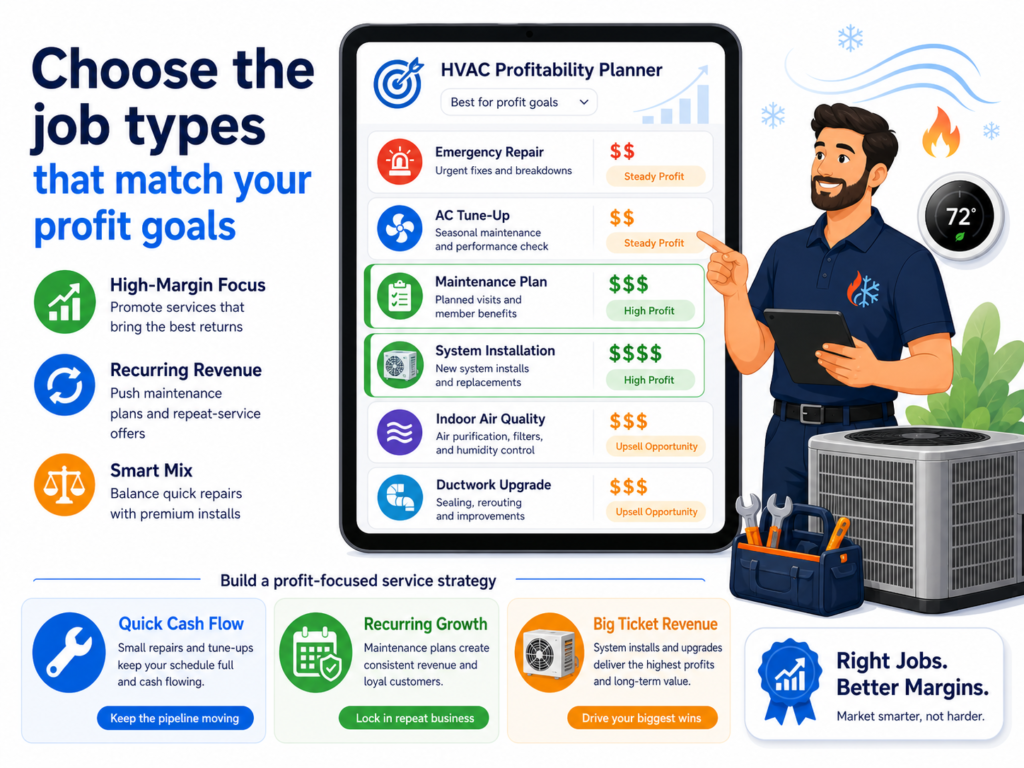
Before you run Local Service Ads heavily, decide what you actually want more of.
If your team needs more repair work, focus on repair-related categories. If you want more installation estimates, make sure replacement and installation are clear in your profile. If you do not want certain jobs, do not leave them active just because they might bring calls.
Marketing should match your business goals.
A company that is short on technicians may not want to flood the schedule with low-value calls. A company trying to grow maintenance plans may want to use service calls as a way to introduce recurring care. A company with installation capacity may want to focus more on replacement estimates before peak season.
Review lead quality often so your budget does not leak
Local Service Ads can create waste if nobody checks lead quality.
You should review the types of calls and messages you receive. Look for patterns. Are people outside your service area contacting you? Are you getting requests for services you do not provide? Are customers asking for prices only and never booking? Are certain areas producing better jobs than others?
This review helps you tighten the campaign.
When a lead is not valid, follow the proper process to dispute it if the platform allows it. But do not rely only on disputes. Fix the source of the issue when you can. Adjust categories, service areas, hours, and business details so the profile attracts better-fit customers.
The stronger your settings, the cleaner your leads become.
This is how you turn Local Service Ads from a random lead source into a controlled growth channel.
Turn reviews and referrals into a repeatable marketing system
Reviews and referrals are two of the most powerful forms of HVAC marketing because they come from trust. People believe other customers more than they believe ads. They believe neighbors. They believe friends. They believe family members. They believe a local homeowner who says your technician showed up on time and explained everything clearly.
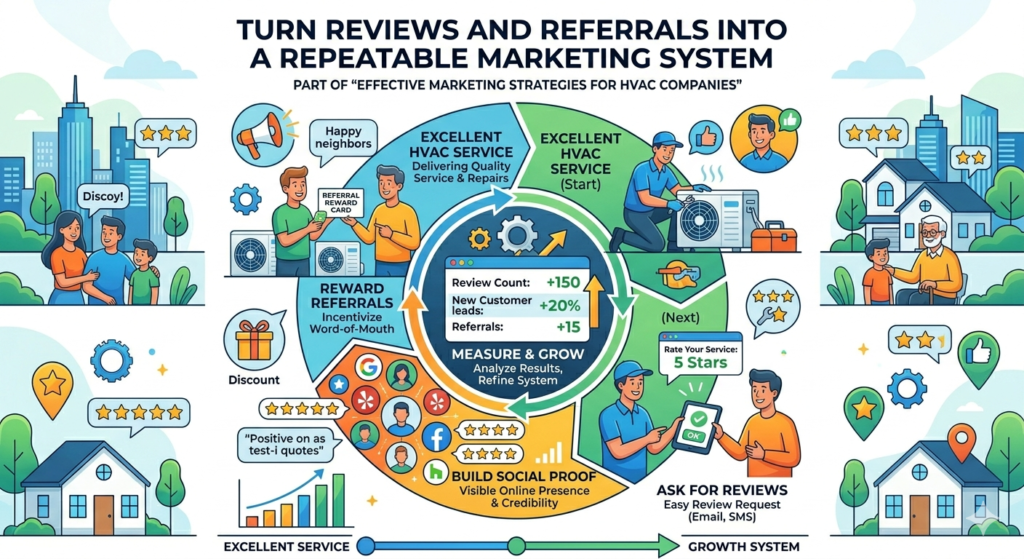
The problem is that many HVAC companies leave reviews and referrals to chance.
They do good work, hope people talk about it, and then wonder why growth feels uneven.
You need a system.
A review system helps happy customers share their experience online. A referral system helps customers send new people your way. Together, they lower your cost per lead and make every paid marketing channel work better.
When a person sees your ad and then finds dozens or hundreds of strong reviews, the ad becomes more believable. When a homeowner hears your name from a neighbor and then sees your website, the website becomes more convincing.
Trust stacks up.
Ask for reviews at the moment of highest customer happiness
The best time to ask for a review is when the customer feels relief.
The AC is cooling again. The heat is working again. The strange noise is gone. The technician was polite. The price was explained. The house feels comfortable. That is the moment when the customer is most likely to say yes.
Do not wait a week. Do not send a cold review request long after the job. The emotional moment has passed by then.
Your technicians can play a major role here. They should not beg for reviews or pressure customers. They should simply recognize when a customer is happy and ask in a natural way.
A good request can sound simple and human. The technician can say that they are glad the issue is fixed and that a quick Google review would really help the local team. Then your office can send a direct link by text or email.
The easier the process, the more reviews you will get.
Train your team to earn the review before asking for it
A review request works only when the service experience deserves it.
That means reviews start before the job is done. They start when the phone is answered. They continue when the appointment is scheduled. They grow when the technician arrives on time, wears clean gear, protects the home, explains the issue, and leaves the space clean.
Every small action shapes the review.
If your team wants more five-star feedback, they need to create moments worth mentioning. A customer may remember that the technician put on shoe covers. They may remember that the technician explained the repair in plain words. They may remember that the office called before arrival. They may remember that no one pushed them into a decision.
These details may seem small, but they are the exact things people write in reviews.
So do not treat reviews as a marketing task only. Treat them as an operations standard. Great service creates the story. Marketing simply helps customers share it.
Respond to reviews in a way that sells without sounding salesy
Review replies are public. Future customers read them. That means each reply is a small marketing message.
But it should not sound like an ad.
When someone leaves a good review, thank them warmly. Mention the service naturally if it fits. Say you are glad the home is comfortable again. Keep the response short, kind, and specific.
When someone leaves a bad review, stay calm. Do not attack the customer. Do not write a long defense. Do not share private details. A simple response that shows you take concerns seriously can protect your reputation.
Customers do not expect every business to be perfect. They do expect a business to be fair, calm, and responsible.
A poor review response can scare away more people than the review itself. A professional response can show that your company handles issues with care.
Use review language inside your marketing
Your customers often describe your value better than you do.
Read your best reviews carefully. Look for repeated words and themes. Do people mention honesty? Do they mention fast service? Do they mention clean work? Do they mention clear pricing? Do they mention friendly technicians? Do they mention that you did not pressure them?
These are not just nice comments. They are marketing clues.
If many reviews praise your honest explanations, make that part of your website message. If many reviews mention quick response, highlight that in ads. If customers often say your technicians are respectful, use that language on service pages.
This works because it is based on what customers already value.
You are not inventing a brand message in a meeting. You are pulling it from real customer feedback. That makes your marketing feel more natural and more believable.
Build a referral offer that feels simple and fair
Referrals work best when they are easy to understand.
If a happy customer wants to recommend you, they should not have to figure out a complex program. The offer should be simple. It might be a credit, a gift card, a discount on future service, or another thank-you that fits your business.
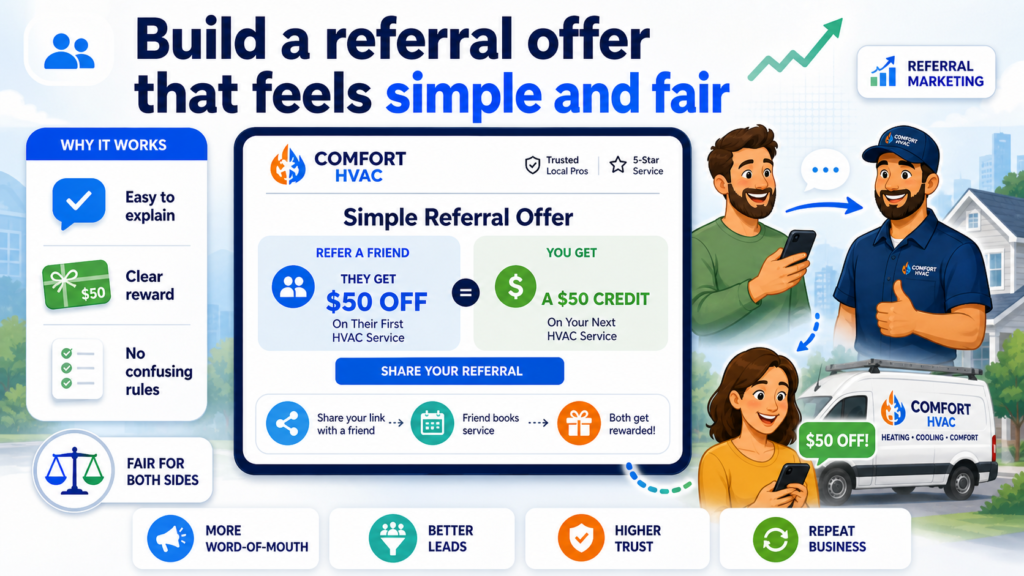
The reward does not have to be huge. It just has to feel fair.
Many customers refer because they like your company, not because they want a reward. The reward simply gives them one more reason to act now.
Make sure your team mentions the referral program at the right time. After a successful service call, the technician or office can let the customer know that you appreciate referrals and have a simple thank-you for anyone they send your way.
Keep it warm. Keep it human.
Make referrals easy to share
A referral program fails when sharing feels hard.
Give customers a simple link, card, or message they can pass along. Make sure the referred person knows how to contact you and mention who referred them. If possible, create a simple page on your website that explains the referral process.
Do not make customers search for details.
You can also include referral reminders in post-service emails, maintenance plan messages, and seasonal campaigns. But do not overdo it. The message should feel like a friendly reminder, not a constant ask.
The best referral marketing sounds like this: “We are grateful when customers recommend us. If someone you know needs heating or cooling help, we would be happy to take care of them.”
That kind of message respects the customer and protects the trust you have earned.
Use email and text follow-up to bring customers back before they forget you
Many HVAC companies spend a lot of money getting a customer once, then do very little to bring that customer back.
That is expensive.
A homeowner who has already hired you is much easier to reach than a brand-new lead. They know your company. They have met your team. They may trust you already. If you stay in touch in a helpful way, you can turn one repair into years of repeat business.
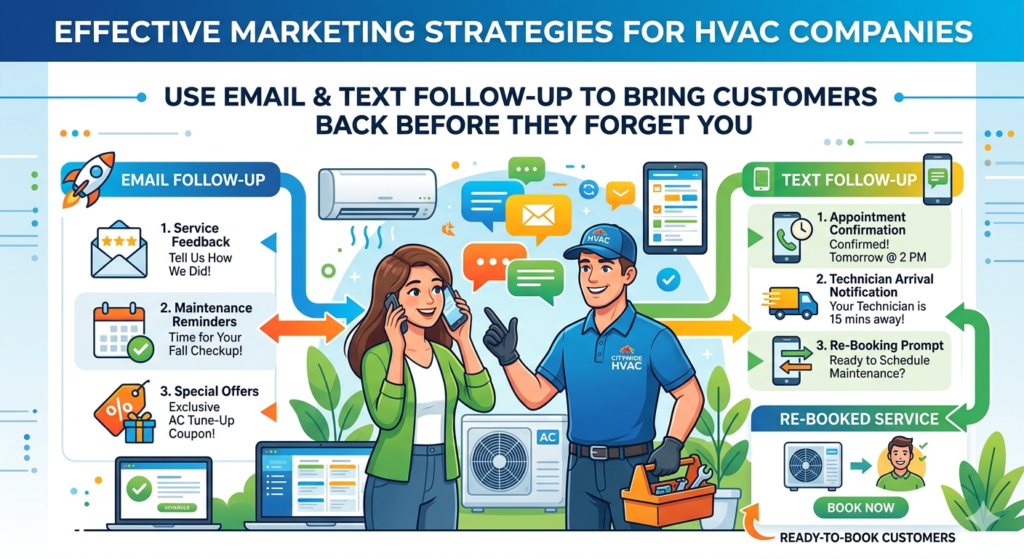
Email and text follow-up help you do that.
These channels are not only for promotions. They are for reminders, education, seasonal care, maintenance plans, replacement planning, review requests, and reactivation.
The key is to be useful. Do not send messages just to send messages. Every message should help the customer take better care of their home or make a timely decision.
Send seasonal reminders before customers have problems
Seasonal reminders are simple, but they can drive a lot of business.
Before summer, remind customers to schedule AC maintenance. Before winter, remind them to check their furnace or heating system. During allergy season, share tips about filters and indoor air comfort. Before extreme weather, remind them what warning signs to watch for.
Timing matters.
If you send an AC tune-up reminder after the first major heat wave, you may already be late. Many systems have already failed, and customers are now in emergency mode. Send reminders early enough that customers can act before the rush.
A good seasonal message should not sound like a hard sell. It should explain why the timing matters.
For example, you can say that a spring tune-up helps catch small AC problems before heavy summer use. That makes the message feel helpful. It also gives the customer a clear reason to book.
Keep reminder messages short, clear, and personal
Email can handle more detail, but text messages should be short.
A text should feel like a helpful note from a local service company. It should say what the customer needs to know and make the next step easy. Do not cram too much into one message.
A good text might remind the customer that it is time for seasonal AC service and invite them to reply or tap a link to schedule.
Emails can go deeper. You can explain what is included in a tune-up, why early service helps, and what signs mean the system should be checked soon. You can include a clear booking button or phone number.
Personalization also helps. Use the customer’s name if your system allows it. Mention the system or service history when appropriate. A message that feels connected to their home will perform better than a generic blast.
Use follow-up after every service visit
The customer journey should not end when the technician leaves.
After a service call, send a follow-up message. Thank the customer. Confirm that you appreciate their business. Invite them to contact you if they have questions. Ask for a review if the job went well. Mention maintenance if it is relevant.
This simple step makes your company feel more professional.
It also gives you a chance to catch issues early. If a customer is unhappy, a follow-up can bring that concern to your team before it becomes a bad review. If the customer is happy, the follow-up can turn that good feeling into public proof.
A strong post-service follow-up system protects your reputation and increases repeat business.
Create different follow-ups for different job types
Not every customer should get the same message.
A repair customer may need a review request and a maintenance plan offer. An installation customer may need system care tips, warranty reminders, filter guidance, and a check-in after a few weeks. A maintenance customer may need a reminder for the next seasonal visit.
Better follow-up feels more relevant.
If someone just bought a new system, do not treat them like a cold lead. Help them understand how to care for it. Explain when to change filters. Remind them about maintenance. Let them know whom to call if they have questions.
If someone had a small repair on an older system, you may later send helpful content about signs it may be time to plan for replacement. Do not push too soon. Just educate.
The goal is to stay useful until the next buying moment arrives.
Win back old customers with reactivation campaigns
Your past customer list may be full of hidden revenue.
Some customers used you once and never came back because they forgot your name. Some moved to another provider because they saw that company more often. Some have not had a problem yet, but their system may now need service. Some may be ready for replacement.
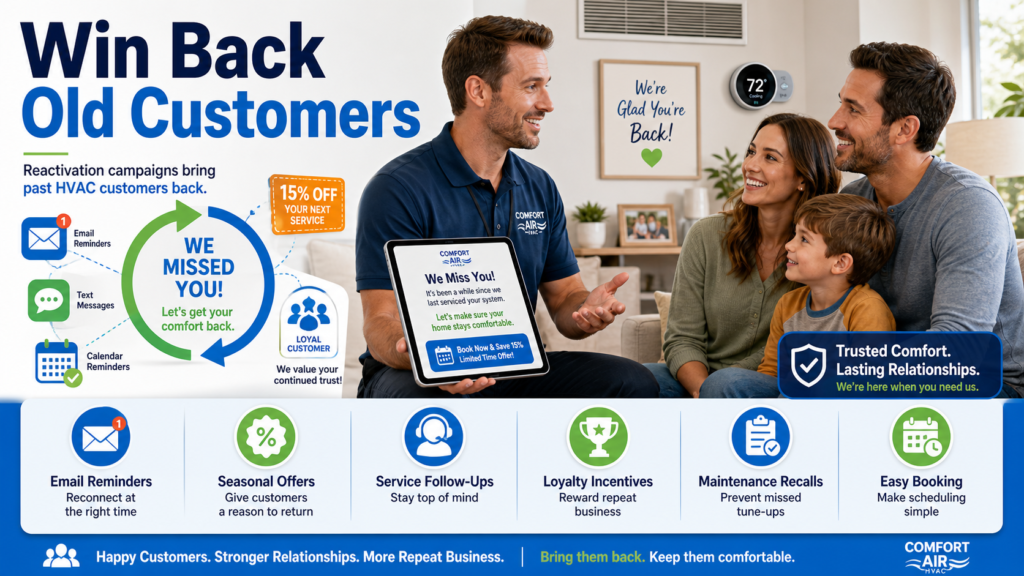
A reactivation campaign helps bring these people back.
Start with customers who have not booked in a while. Send a warm message that reminds them who you are and invites them to schedule seasonal service. Keep the tone friendly. Do not make them feel guilty for not calling sooner.
You can also segment by service history. Customers with older systems may receive a message about replacement planning. Customers who had repairs may receive a maintenance reminder. Customers who installed a system years ago may receive a check-in about performance and comfort.
Make the offer helpful instead of desperate
Reactivation does not have to mean heavy discounts.
A strong offer can be a seasonal tune-up, a comfort check, a priority scheduling window, or a simple reminder that your team is available if they need heating or cooling help.
Discounts can work, but they should not train customers to wait for deals. Use them carefully.
The better strategy is to give people a timely reason to return. For example, before summer, you can remind old customers that early AC checks help avoid long waits during peak heat. Before winter, you can remind them to test their heat before the first cold week.
This kind of campaign feels practical. It helps customers act at the right time. It also fills your schedule before emergency demand hits.
Build social media around proof, people, and local presence
Social media may not always be the main lead source for HVAC companies, but it can still play an important role.
People use social media to check whether a business is real. They look at photos, comments, updates, and the way the company shows up in the community. If your page has not been updated in two years, it can create doubt. If your page shows real people, real work, and helpful local advice, it builds trust.
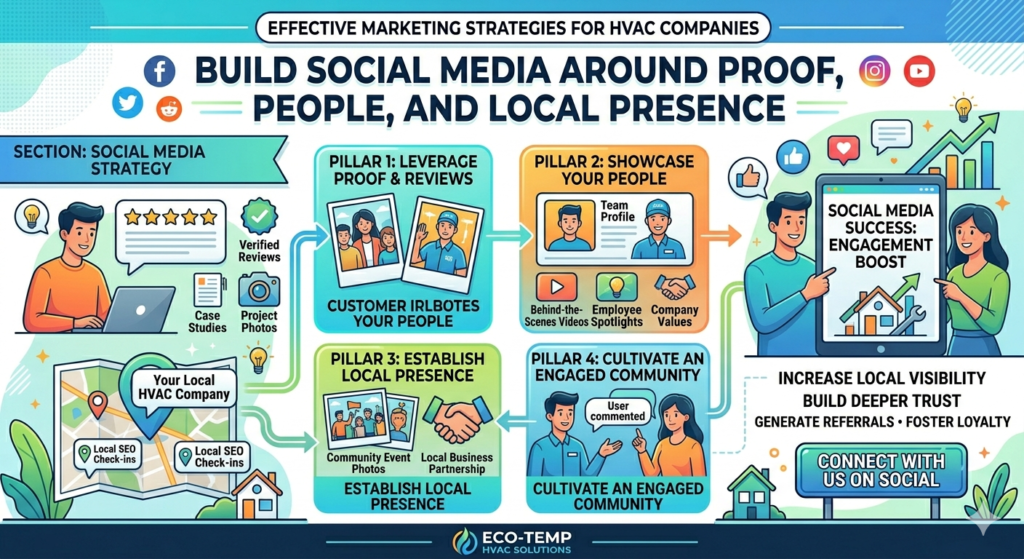
The goal of HVAC social media is not to go viral.
The goal is to stay visible, create familiarity, show proof, and support the rest of your marketing.
A homeowner may see your post today and not need service for three months. But when their AC fails, they may remember your name. That memory can turn into a search, a website visit, or a call.
Show the real people behind the company
HVAC is a people business. Customers let your team into their homes. They want to feel comfortable with the person who may show up at their door.
Social media gives you a chance to make your company feel human.
Share photos of your technicians, office team, training days, community events, new vans, completed installs, and behind-the-scenes moments. Keep it professional, but do not make it feel stiff. A warm, real photo often works better than a polished stock image.
People trust faces. They trust real moments. They trust companies that feel present in the community.
This does not mean every post needs to be personal. But your social feed should not look like a folder of generic HVAC graphics. It should look like a real local company doing real work.
Use job stories without sharing private customer details
Job stories can be very effective.
You can talk about a common problem your team solved, such as an AC that was not cooling evenly or a furnace that needed attention before winter. Explain the issue in a simple way and share the result. Do not share private details, addresses, or anything that would make a customer uncomfortable.
A good job story helps future customers see that you solve problems like theirs.
For example, you might say that your team helped a homeowner whose upstairs rooms stayed too warm. After checking the system and airflow, the team found the cause and helped improve comfort. That kind of post is simple, useful, and trust-building.
It also gives your technicians credit for their work.
Over time, these stories become proof. They show that your company is active, skilled, and helpful.
Share seasonal tips that make homeowners feel prepared
Seasonal tips are easy to create and useful for customers.
Before summer, talk about changing filters, clearing space around outdoor units, checking airflow, and scheduling tune-ups early. Before winter, talk about testing the heat, checking vents, listening for strange sounds, and calling if the system smells unusual or does not warm the home well.
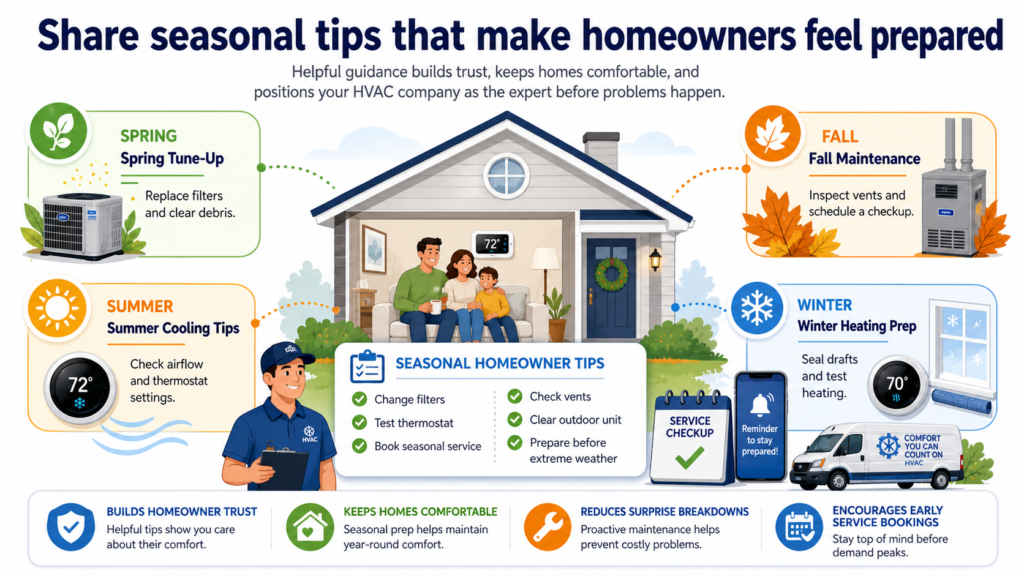
Keep the advice simple.
Do not make homeowners feel like they need to become HVAC experts. Give them practical things they can notice and safe steps they can take. Then explain when it is time to call a professional.
This balance is important. Helpful advice builds trust. Clear next steps bring leads.
Turn common questions into short posts
Your team hears the same questions again and again.
Use those questions as social content. Why is my AC blowing warm air? How often should I change my filter? Why is one room hotter than the others? Should I repair or replace my system? Is a tune-up worth it? Why is my furnace making noise?
Each question can become a short, simple post.
Answer in plain words. Avoid technical overload. End with a calm next step, such as calling if the issue continues or scheduling a system check before peak season.
This kind of content works because it is based on what customers already care about. It also gives your sales and service team something useful to share when customers ask similar questions.
Conclusion
HVAC marketing works best when every part of it builds trust, answers real customer questions, and makes booking simple. Your website, local SEO, reviews, ads, emails, social posts, and phone process should all work together, not separately. The goal is not just more traffic. The goal is better calls, better jobs, stronger repeat business, and customers who remember your name before they need help again.
When you show up early, explain things clearly, follow up well, and make people feel safe choosing you, your HVAC company becomes more than another option. It becomes the trusted local choice.











Comments are closed.