
WinSavvy Editorial Standards
How this article was created
Creative content marketing is no longer about posting more blogs, making more videos, or pushing more social media updates. That approach is too noisy now. Every brand is creating content. Every business is trying to get attention. Every buyer is being pulled in ten different directions before they even finish their morning coffee.
Build Your Content Around the Real Questions Your Audience Is Afraid to Ask
Most brands create content around keywords. That is not wrong. SEO still matters. Search demand still matters. But if you only chase keywords, your content will often sound like every other article on the same topic.
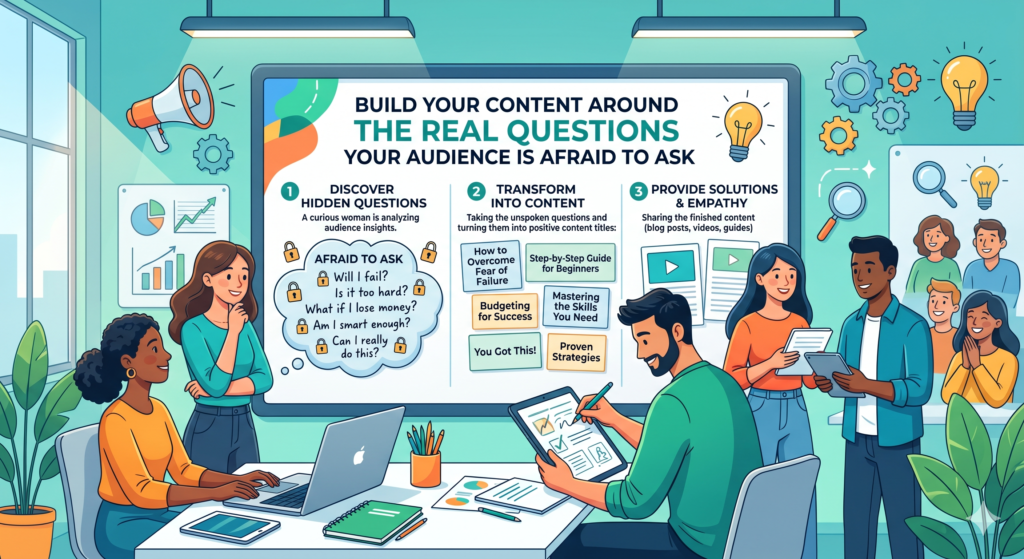
The better way is to start with the real questions hiding behind the search.
A person does not search for “content marketing strategies” only because they want a list of ideas. They may be worried that their current content is not working. They may feel stuck because their competitors seem louder. They may not know what to post next. They may be under pressure from a boss who wants leads, traffic, and proof that marketing is worth the money.
When you understand that deeper need, your content becomes much more useful. It stops sounding like a classroom lesson and starts feeling like a real conversation.
Why Surface-Level Content Fails to Build Trust
Surface-level content gives people answers they already know.
It says things like “know your audience,” “create valuable content,” and “post consistently.” These ideas are true, but they are not helpful by themselves. A reader cannot take that advice and do much with it. They need the next layer. They need to know how to understand their audience, what kind of value matters, and how to stay consistent without burning out.
This is where many brands lose readers. They give general advice and then wonder why people leave the page.
A strong content marketer does not stop at the obvious answer. They keep asking, “What does the reader need to do next?” Then they shape the content around that next step.
For example, instead of writing a basic article called “How to Know Your Audience,” a stronger angle would be “How to Find the Questions Your Best Customers Ask Before They Trust You.” That title speaks to a real business problem. It also promises a more useful answer.
How to Find the Questions That Matter Most
The best content ideas often come from sales calls, support chats, customer emails, review sites, social comments, and client meetings. These places show you the words people use when they are confused, worried, excited, or ready to buy.
Do not only look for questions that sound polished. Look for messy questions. Look for repeated doubts. Look for the small things people keep asking before they make a decision.
A buyer may not say, “I need a content strategy that supports my funnel.” They may say, “We keep posting but nothing happens.” That plain sentence is gold. It tells you the pain. It tells you the emotion. It gives you the language your content should use.
You can turn that into an article, a video, a LinkedIn post, a webinar, or a landing page section. The idea is not just to answer the question. The idea is to make the reader feel seen.
Why This Works So Well for SEO and Conversions
Google is not only looking for pages that mention a keyword. It is trying to show pages that satisfy the searcher. A page that answers the real question behind the search has a better chance of keeping people engaged.
That means people stay longer. They read more. They click to another page. They may sign up, inquire, or return later. These actions matter because content is not just about ranking. It is about creating movement.
When your content reflects the exact problems your audience is facing, it becomes easier for them to trust your brand. They feel like you understand them before they explain themselves. That is one of the strongest positions a brand can have.
Turn Customer Doubts Into Content Assets
Every doubt a customer has can become a piece of content.
If people worry that your service is too expensive, create content that explains the cost of doing nothing. If people wonder whether your solution is right for small teams, create content that shows how small teams can use it without extra stress. If people fear they will not get results, create content that explains what results depend on and how to improve the odds.
This kind of content works because it removes friction. It answers questions before the sales call. It helps buyers think clearly. It makes your brand look honest, not pushy.
The Best Content Often Says What Competitors Avoid
Many brands avoid hard topics because they are afraid of losing leads. They do not want to talk about price. They do not want to explain who their product is not for. They do not want to compare themselves with other options. They do not want to admit that success takes time.
But this is exactly the content that builds trust.
When a brand is clear about limits, costs, trade-offs, and mistakes, people listen. They know you are not just trying to sell them. You are helping them make a better choice.
A creative content strategy should include content that feels brave. Not rude. Not dramatic. Just honest.
You can write about why some content campaigns fail. You can explain when SEO is not the first channel a brand should invest in. You can show what happens when a business creates content without a clear offer. You can compare organic content with paid ads in a fair and simple way.
This type of content may not always be the most comfortable to create, but it often becomes the most useful.
How WinSavvy Would Use This Approach
For a digital marketing agency like WinSavvy, this strategy can be very powerful. Instead of only publishing broad topics like “content marketing tips,” the brand can create deeper pieces that answer real concerns.
A strong article could explain why traffic does not always turn into leads. Another could show how to fix blog content that ranks but does not convert. Another could break down why small brands should not copy large brand content strategies.
These topics are not just educational. They are commercial in a smart way. They show skill. They show experience. They help the reader understand the problem better. And when the reader is ready for help, the agency that explained the problem clearly becomes the natural choice.
Create Content Pillars That Make Your Brand Easier to Remember
A brand becomes easier to remember when it stands for a few clear ideas.
Many businesses make the mistake of creating random content. One week they talk about SEO. The next week they talk about email. Then social media. Then branding. Then AI. Then productivity. Each piece may be useful on its own, but the whole content system feels scattered.
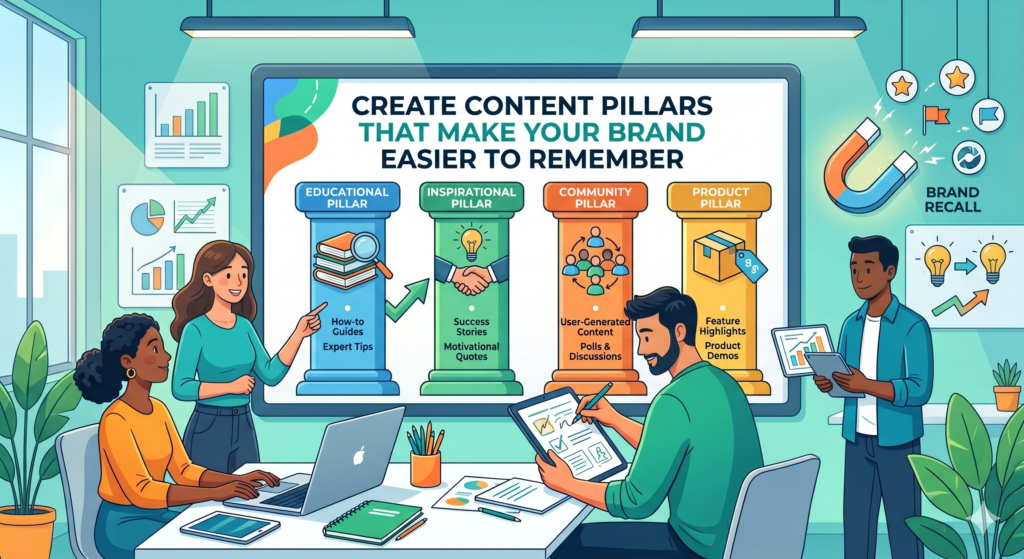
When content feels scattered, people may read it once, but they do not form a strong memory of the brand.
Content pillars solve this problem. They give your brand a clear structure. They help your audience understand what you are known for. They also make it much easier to plan content without starting from zero every time.
What a Content Pillar Really Means
A content pillar is not just a category on your blog. It is a main idea your brand wants to own in the mind of your audience.
For example, “SEO” is too broad to be a strong pillar by itself. A sharper pillar could be “SEO that turns traffic into revenue.” That has a point of view. It tells people what kind of SEO you care about. It also makes your content more focused.
“Content marketing” is also broad. A stronger pillar could be “content that builds trust before the sales call.” That gives your brand a clearer voice. It helps readers understand why your approach is different.
A good pillar should connect to your audience’s pain, your service, and your unique view of the market.
Why Pillars Make Content More Strategic
Without pillars, you may create content based on whatever idea sounds good that day. This leads to gaps, repeats, and weak internal linking. It also makes it harder to guide readers from awareness to action.
With pillars, every article has a job.
Some pieces attract people at the start of the journey. Some help them understand the cost of the problem. Some compare options. Some prove your method works. Some help them take the next step.
This makes your content feel connected. A reader can move from one piece to another without feeling lost. Search engines can also understand your topical focus more clearly.
For example, if your pillar is “content that turns readers into leads,” you can build many supporting articles around it. You can cover blog structure, lead magnets, call-to-action placement, search intent, buyer pain points, content upgrades, case studies, and conversion-focused landing pages.
Each article supports the larger idea. Over time, your brand becomes known for that idea.
How to Choose the Right Pillars
The right pillars should come from the overlap between your market, your audience, and your offer.
Start by asking what problems your best customers pay you to solve. Then ask what beliefs you want your audience to adopt before they buy from you. Finally, ask what topics you can speak about with real depth.
This matters because content should not only attract readers. It should attract the right readers. If a topic brings traffic but has no link to your business model, it may not be worth heavy investment.
A digital marketing agency could build pillars around lead generation, search-led growth, content conversion, brand trust, and marketing systems. These are close enough to the service offer to drive business value. They are also broad enough to support many articles.
Make Each Pillar Feel Like a Strong Point of View
The strongest content pillars are not plain topic buckets. They carry a belief.
A weak pillar says, “We write about social media marketing.”
A stronger pillar says, “Social media should create trust, not just attention.”
That small shift changes everything. Now the content has a voice. It has a standard. It can challenge bad advice. It can explain what most brands get wrong. It can teach readers how to think better.
This is how you move from content production to thought leadership.
Why a Point of View Makes Content More Creative
Creativity becomes easier when your brand has a clear point of view. You are no longer just reporting facts. You are shaping the conversation.
For example, many brands talk about posting more on LinkedIn. A brand with a sharper view might say, “Most LinkedIn content fails because it tries to impress peers instead of helping buyers.” That statement gives you room to create a strong article, a video, a carousel, a webinar, or a sales enablement asset.
The idea has tension. It challenges a common habit. It gives the audience a reason to pay attention.
Good content often starts with useful tension. It points to something the reader has seen but may not have named yet.
How to Keep Pillars From Becoming Repetitive
Content pillars should create focus, not sameness.
If every article says the same thing in a slightly different way, readers will notice. To avoid this, each pillar should include different angles. You can explain the problem, teach a process, share examples, compare options, break myths, show mistakes, answer objections, and tell stories.
For example, within a pillar about “content that builds trust,” you could write about how to use founder stories, how to write comparison pages, how to create honest pricing content, how to use customer language, how to show proof without sounding fake, and how to build trust with educational email sequences.
The pillar stays the same, but the angle changes.
That is how you build depth without repeating yourself.
Use Story-Driven Content to Make Your Brand Feel Human
People remember stories better than plain advice.
This does not mean every piece of content needs to sound like a novel. It means your content should show real situations, real problems, real turning points, and real outcomes. Stories help readers see themselves inside the content. They make lessons easier to understand.
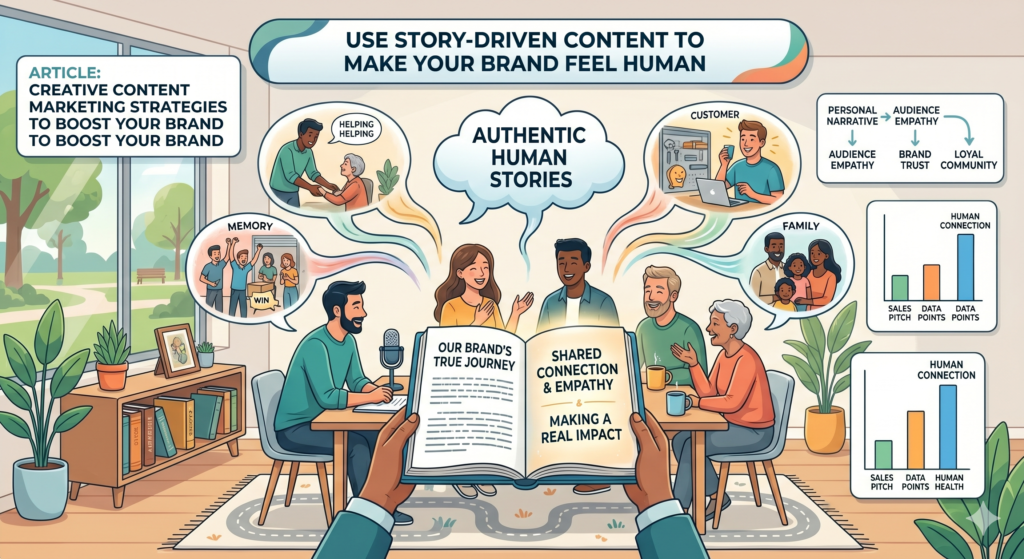
A strategy article becomes stronger when it explains what a brand was doing wrong, what changed, and what happened next. A case study becomes stronger when it shows the messy middle, not just the final win. A social post becomes stronger when it starts with a moment your audience recognizes.
Story-driven content works because people do not make decisions only with logic. They need to feel the problem. They need to picture the result. They need to believe that change is possible.
Why Stories Make Strategy Easier to Understand
Strategy can feel abstract. Words like positioning, funnel, awareness, differentiation, and conversion can sound useful but still feel far away from daily work.
Stories bring those ideas down to earth.
Instead of saying, “Brands need better positioning,” you can tell the story of a company that was getting traffic but no leads because its content spoke to everyone. Then you can show how narrowing the message helped the right buyers understand the offer faster.
That story teaches positioning without making the reader work too hard.
It also makes the advice more believable. Readers can see the cause and effect.
The Simple Story Shape Every Brand Can Use
A strong content story does not need to be long. It only needs a clear shape.
First, show the situation. What was happening? What was the brand trying to do? What was not working?
Then show the friction. What made the problem hard? What mistake did the team keep making? What did they misunderstand?
Then show the shift. What changed? What did they finally notice? What action did they take?
Then show the lesson. What can the reader learn from it?
This story shape works in blog posts, case studies, emails, landing pages, video scripts, webinars, and sales decks. It keeps content moving. It also prevents the writing from feeling flat.
How to Use Small Stories When You Do Not Have Big Case Studies
Many brands think they need huge success stories before they can use storytelling. They do not.
Small stories work too.
You can tell the story of a common client mistake. You can describe a conversation with a founder. You can share what you noticed after reviewing ten websites in the same industry. You can explain how one headline change made an offer clearer. You can show how one customer question revealed a bigger content gap.
These small moments often feel more real than polished case studies. They help the reader trust your experience.
A small story might begin with a line like, “A founder once told us, ‘We have traffic, but no one books a call.’ When we looked at the blog, the issue was clear. The content was answering beginner questions, but the service was built for serious buyers.”
That opening feels human. It creates a scene. It pulls the reader in.
Make the Customer the Hero, Not the Brand
One of the biggest mistakes in brand storytelling is making the company the hero.
The brand talks about how smart it is, how hard it worked, how great its system is, and how impressive its results are. But the reader does not want a brand victory speech. The reader wants to know what the story means for them.
In strong content marketing, the customer is the hero. The brand is the guide.
Your content should make the reader feel capable. It should help them see the path forward. It should show that your brand understands the road because you have helped others walk it.
What This Looks Like in Practice
Instead of writing, “Our agency helped a client grow leads by improving their content strategy,” you can write, “The client had strong expertise, but their content was not showing it. Their best ideas were trapped in sales calls and internal notes. Once those ideas were turned into clear articles, comparison pages, and lead-focused guides, buyers had more reasons to trust them before booking a call.”
The second version still shows skill, but it does not brag. It explains the problem and the shift. It helps the reader see what they may be missing in their own business.
That is the key. Story-driven content should make the reader think, “This sounds like us.”
Why Human Content Wins in a World Full of AI Content
As more brands use AI tools to create content, the internet is filling with articles that sound clean but empty. The writing may be correct, but it often lacks lived experience. It does not show judgment. It does not tell real stories. It does not reveal what the brand has learned from actual work.
Human content stands out because it has texture. It includes examples, trade-offs, opinions, mistakes, and lessons. It speaks like someone who has been in the room.
This is a major chance for brands that are willing to create deeper content.
AI can help with research, outlines, and drafts. But the strongest content still needs human insight. It needs the details that come from client work, customer calls, failed campaigns, hard choices, and real wins.
That is what makes a brand worth listening to.
Turn One Strong Idea Into Many Useful Content Pieces
Creative content marketing does not mean creating new ideas every day.
In fact, chasing new ideas all the time can hurt your strategy. It spreads your energy too thin. It makes your message weaker. It causes your best ideas to disappear after one post.

The smarter move is to take one strong idea and express it in many useful ways.
This is not lazy. It is strategic. Your audience does not see every piece of content you publish. Even when they do, they may need to hear the same idea in different formats before it sticks.
A strong idea deserves more than one life.
Why Repurposing Is Not Copying
Many marketers think repurposing means taking a blog post and pasting pieces of it across social media. That is the weakest form of repurposing.
Real repurposing means reshaping the idea for the platform, the audience, and the moment.
A blog post can become a short LinkedIn story. A section of that post can become an email. A strong example can become a video script. A framework can become a webinar. A customer question can become a sales enablement page. A data point can become a visual guide.
The core idea stays the same, but the delivery changes.
How to Choose Ideas Worth Repurposing
Not every idea deserves to become a full content system. Some ideas are small. Some are useful once. Some are not close enough to your business goals.
The best ideas to repurpose are ideas that explain your brand’s point of view. They answer a repeated customer question. They support a key service. They help buyers make a decision. They can be explained from many angles without becoming thin.
For example, “content should build trust before the sales call” is a strong repurposing idea. You can turn it into articles about blog strategy, case studies, pricing pages, comparison content, founder-led content, email nurturing, and sales support.
It can also become social content, short videos, workshop topics, lead magnets, and client onboarding material.
That is what a strong idea does. It keeps giving.
Build a Content Engine Around Core Ideas
A content engine is not just a posting schedule. It is a system that helps one idea move across many channels with purpose.
Start with a deep asset. This could be a long blog post, a guide, a webinar, or a research report. Then break that asset into smaller pieces. Each smaller piece should have its own angle, not just a copied paragraph.
For example, a guide on creative content marketing could become a LinkedIn post about why most content feels forgettable. It could become an email about how to find hidden customer questions.
It could become a short video on turning objections into content. It could become a checklist for reviewing old blog posts. It could become a landing page section about WinSavvy’s content strategy process.
This way, one strong asset supports many touchpoints.
Match the Format to the Buyer’s State of Mind
Different formats work for different moments.
A busy founder may not read a long guide during the workday, but they may read a short post that names a problem they are facing. Later, when the pain becomes more urgent, they may come back to read the full article. After that, they may download a checklist or book a call.
This is why your content should not live in only one format.
Long-form content is great for depth, SEO, trust, and education. Short-form content is great for reach, reminders, and quick insight. Email is great for nurturing. Case studies are great for proof. Webinars are great for teaching and relationship building. Landing pages are great for turning interest into action.
Each format plays a different role.
Why the Same Message Needs Different Shapes
People learn in different ways. Some want detail. Some want examples. Some want steps. Some want stories. Some want proof. Some want to compare options.
If you only publish one version of an idea, you force everyone to consume it the same way. That limits your reach and impact.
A creative strategy gives the same core message different shapes. This helps your audience meet the idea where they are.
A simple example would be a topic like “why your blog traffic is not turning into leads.” One person may need a full article. Another may need a short diagnostic email. Another may need a visual map. Another may need a case study. Another may need a service page that explains how you solve it.
The idea is the same. The use is different.
How to Keep Repurposed Content Fresh
Repurposed content becomes boring when every piece says the same thing in the same order.
To keep it fresh, change the entry point.
One piece can start with a mistake. Another can start with a story. Another can start with a question. Another can start with a before-and-after. Another can start with a strong opinion. Another can start with a simple test the reader can apply.
For example, instead of repeating “create content that builds trust,” you can explore different angles.
You can ask, “Would your best sales rep send this article to a serious lead?” You can explain, “Why ranking for broad keywords may attract the wrong buyer.” You can show, “How one customer objection can become five content pieces.” You can teach, “How to turn a sales call question into a blog section that converts.”
Same theme. New angle. Better content.
Use SEO as a Trust Strategy, Not Just a Traffic Strategy
SEO is often treated like a traffic game. Brands want rankings, clicks, and more visitors. Those things matter, but they are not the full goal.
The real power of SEO is trust.
When your brand appears at the exact moment someone is trying to solve a problem, you earn attention with strong timing. If your answer is clear, useful, and honest, you earn trust. If your content keeps helping them across the journey, you become a safe choice.
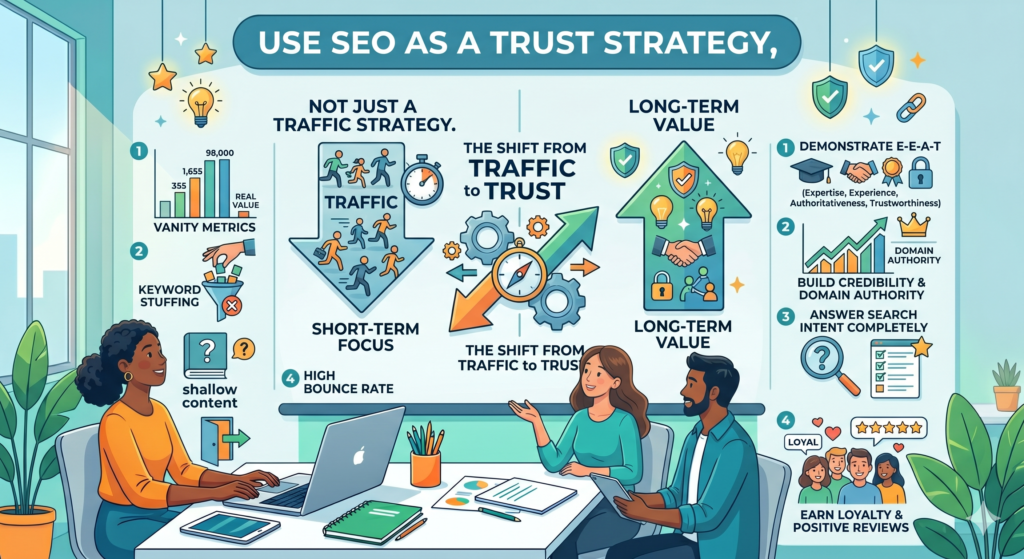
That is much more valuable than empty traffic.
Why Traffic Alone Does Not Build a Brand
A page can get thousands of visits and still create no business value. This happens when the topic is too broad, the reader is not the right fit, or the content does not guide them anywhere useful.
For example, a digital marketing agency could rank for a broad topic like “what is marketing.” That may bring traffic, but many readers will be students, beginners, or people who are not ready to hire. The traffic may look good in reports, but it may not lead to serious conversations.
A better SEO strategy focuses on the topics that match real buyer problems.
These topics may have lower search volume, but they often bring better leads. A search like “why is my blog traffic not converting into leads” shows a much stronger business need than a broad search like “blogging tips.”
Search Intent Should Shape the Whole Page
Search intent means what the person really wants when they type a query.
If someone searches for “content marketing ideas,” they may want examples. If they search for “content marketing strategy for B2B SaaS,” they likely want a more detailed plan. If they search for “content marketing agency pricing,” they may be closer to making a buying decision.
Each page should match that intent.
A common mistake is writing every article in the same style. Some pages need teaching. Some need comparison. Some need proof. Some need a direct answer. Some need a clear next step.
When the format matches the search intent, the page feels useful faster. That keeps readers engaged and improves the chance they will trust your brand.
How to Use SEO Without Sounding Robotic
Many articles sound robotic because they are written for keywords first and humans second. They repeat the same phrase too often. They answer basic questions in a stiff way. They use headings that feel forced.
Good SEO writing is different. It uses the keyword as a guide, not a cage.
The page should still sound natural. The headings should feel like real questions and useful promises. The examples should feel specific. The content should move from one idea to the next like a helpful conversation.
A strong SEO article does not make the reader feel like they are reading a search engine document. It makes them feel like someone finally explained the topic clearly.
Build Topic Clusters That Move Readers Toward Action
A topic cluster is a group of related pages that support one main theme.
But the real purpose of a cluster is not just to please search engines. It is to help readers move deeper into trust.
For example, if your main theme is “content marketing strategy,” your cluster could include pages on audience research, content pillars, SEO content, thought leadership, lead magnets, content audits, case studies, distribution, and conversion tracking.
Each page answers a different need. Together, they show that your brand understands the full problem.
Internal Links Should Feel Like Helpful Guidance
Internal links are often added for SEO, but they should also help the reader.
A link should feel like a natural next step. If someone is reading about blog strategy, you can guide them to a deeper page about content audits. If they are reading about lead generation, you can guide them to a page about conversion-focused landing pages. If they are reading about brand trust, you can guide them to a case study.
This makes your website feel like a guided path, not a pile of random posts.
When done well, internal linking helps readers stay with you longer because each next page feels useful.
Every SEO Page Should Have a Clear Business Role
Before creating any SEO page, ask what job it will do for the business.
Will it attract early-stage readers? Will it educate leads? Will it answer objections? Will it support sales calls? Will it explain your process? Will it help people compare options? Will it bring in buyers with urgent problems?
This question keeps your content focused.
A page without a business role may still get traffic, but it may not help the brand grow. A page with a clear role can support both search visibility and revenue.
That is how SEO becomes a brand asset, not just a traffic channel.
Build Original Research Content That Gives Your Brand Authority
One of the fastest ways to make your content stand out is to stop only commenting on what others have already said.
Most brands create content by reading the top-ranking pages, mixing the same ideas together, and publishing a slightly different version. That may help fill a blog, but it rarely builds real authority. Readers have seen that kind of content before. Search engines have seen it too.
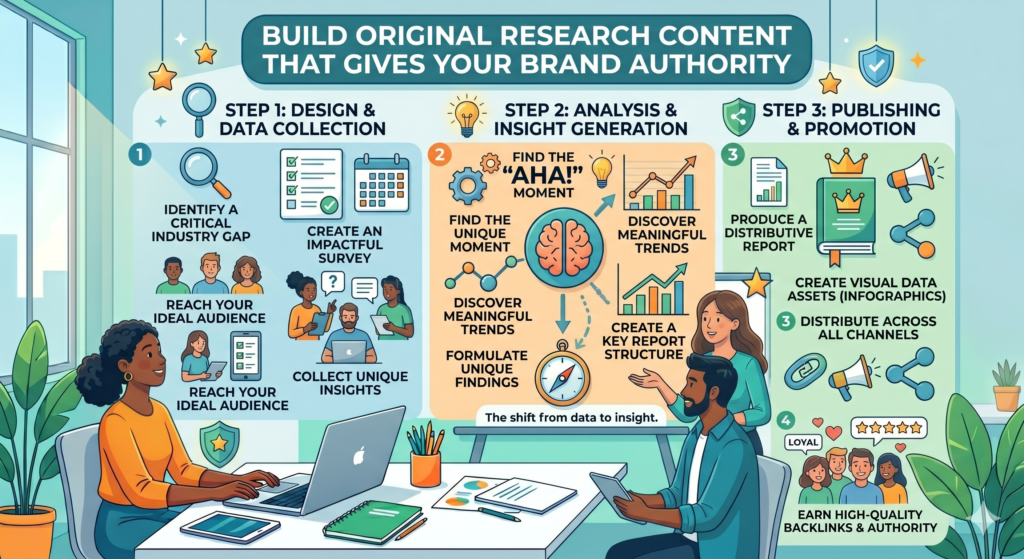
Original research changes the game.
It gives your brand something new to say. It creates data, insights, stories, and proof that competitors cannot simply copy without pointing back to you. It also gives your audience a reason to trust your thinking because you are not just sharing opinions. You are showing what you found.
Original research does not always need to be expensive or complex. You do not need a huge survey firm. You do not need thousands of responses. You need a smart question, a clear audience, and a useful way to turn what you learn into content.
Why Original Research Makes Content More Valuable
People trust content more when it is backed by real findings.
If you say, “Many brands struggle with content consistency,” that may be true, but it sounds general. If you say, “After reviewing 50 B2B blogs, we found that most brands publish often but fail to guide readers toward a clear next step,” the point becomes stronger. It feels observed. It feels earned.
That is the power of research-led content. It turns simple advice into useful evidence.
This also helps your brand become part of the larger conversation. Other writers, marketers, founders, and journalists are always looking for fresh insights. If your research is clear and useful, they may mention it, quote it, link to it, or share it.
That can support SEO, brand reach, and trust at the same time.
How to Start Small With Research Content
A brand does not need to start with a large industry report. A small study can work very well if the question is sharp.
For example, WinSavvy could review 100 service business websites and study how many have clear calls to action on their blog posts. It could analyze 50 SaaS pricing pages and look at how many explain value in simple language. It could study 200 LinkedIn posts from B2B brands and find what kinds of posts get real buyer engagement instead of shallow likes.
These are not huge research projects, but they can produce strong insights.
The key is to choose a question your audience already cares about. Research should not be random. It should help your ideal customer understand a problem that affects growth, trust, leads, sales, or brand strength.
How to Turn Research Into Many Content Assets
A single research project can become much more than one blog post.
The main report can become a long-form article. The most surprising finding can become a LinkedIn post. The strongest chart can become a visual for social media. The method can become a behind-the-scenes email. The lessons can become a webinar. The findings can support service pages, sales decks, and client conversations.
This is why research content is so useful. It gives your brand a bank of original ideas.
You can keep returning to the findings for months. You can compare them with future data. You can build yearly reports. You can create benchmarks your audience starts to watch for.
That is how a brand moves from publishing content to owning a conversation.
Choose Research Topics That Support Buying Decisions
The best research content does not only attract attention. It helps the buyer make a smarter decision.
A report about “the best time to post on social media” may get interest, but it may not be close enough to a digital marketing agency’s core offer. A report about “why high-traffic blogs fail to generate leads” would be much more useful for an agency that helps with SEO and content strategy.
That topic speaks to a real business pain. It also connects naturally to the agency’s service.
This is where research becomes strategic. You are not just trying to publish something interesting. You are trying to create proof around the problems your business solves.
How to Frame Research So It Does Not Feel Dry
Research content often fails because it reads like a school report.
The data may be useful, but the writing feels cold. The reader sees numbers but does not understand what to do with them.
To avoid this, every finding should answer a simple question: “So what?”
If you find that many blog posts have weak calls to action, explain why that matters. It means brands may be spending money to attract readers but failing to guide them toward the next step. It means content teams may be measuring traffic while missing lead quality. It means the blog may be working as a library but not as a growth tool.
That explanation makes the data useful.
Research should not only show what happened. It should explain what it means and what the reader should do next.
How to Add Human Insight to Data
Data tells part of the story, but experience makes it useful.
When you share a finding, add your interpretation. Explain what you have seen in client work. Show the mistake behind the number. Describe the pattern that keeps showing up.
For example, if your research shows that most B2B blogs do not link to service pages, you can explain why that happens. Many teams treat the blog as an education hub only. They are afraid of sounding too sales-focused. But because they never connect the content to the offer, readers leave without understanding how the brand can help.
That is the kind of insight readers value. It turns data into strategy.
Create Content That Helps Buyers Before They Are Ready to Buy
Most people do not become customers the first time they find your brand.
They may read one article, leave, come back weeks later, watch a video, compare options, ask a teammate, check reviews, and then finally reach out. This means your content must do more than capture attention in one moment. It must build trust over time.
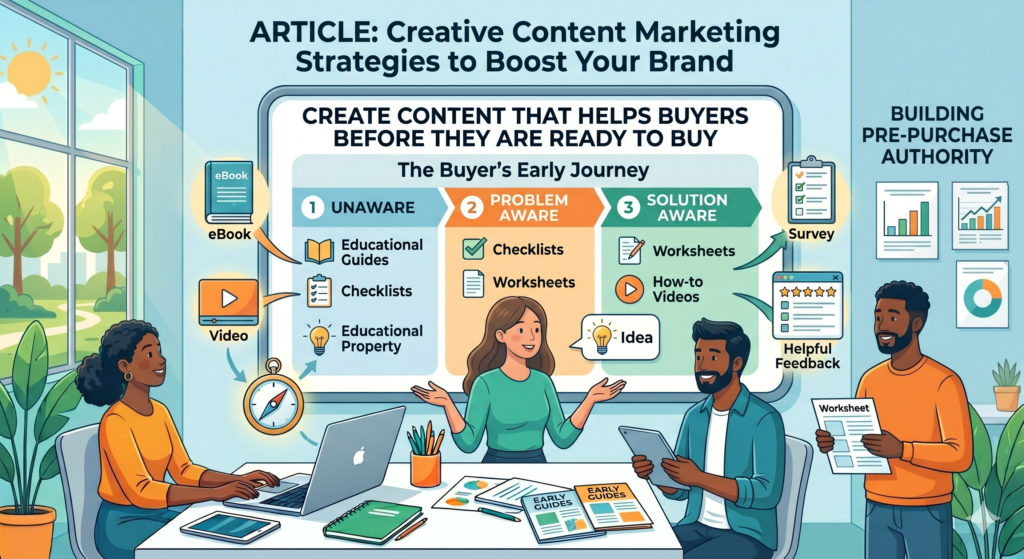
Creative content marketing works best when it serves buyers before they are ready to speak with sales.
This is where many brands miss a huge chance. They create content for people who are already looking to buy, but they ignore the people who are still trying to understand their problem. By the time those people become ready, they may already trust another brand.
Why Early-Stage Content Matters
Early-stage content helps people name their problem.
A founder may not know they need a content strategy. They may only know that their blog is not bringing leads. A marketing manager may not know they need a content audit. They may only know that traffic is flat and the team is tired of guessing what to publish.
If your content helps them understand the real issue, you become part of their thinking early.
This is powerful because the brand that helps people define the problem often becomes the brand they trust to solve it.
How to Create Content for Problem-Aware Readers
Problem-aware readers know something is wrong, but they may not know the best solution yet.
They ask questions like, “Why is our website not converting?” or “Why are our blog posts not ranking?” or “Why do people read our content but never book calls?”
These questions are rich content opportunities.
Your job is not to rush into a pitch. Your job is to explain the problem clearly. Show the common causes. Help the reader see what is likely happening. Give them a simple way to check their own situation.
For example, an article about blog traffic not converting could explain that the issue may come from weak search intent, unclear calls to action, poor internal links, thin examples, or content that attracts the wrong audience. Then it can show how to spot each issue.
That kind of content is helpful. It also naturally positions your brand as the guide.
How to Avoid Giving Away Too Much Without Holding Back
Some brands worry that helpful content will give away their best ideas for free.
That fear is understandable, but it usually comes from seeing content the wrong way. A serious buyer does not hire you because you hide the basic steps. They hire you because they trust your judgment, experience, and ability to execute.
When you teach well, you prove that you understand the work.
You do not need to reveal every internal process, template, or client detail. But you should explain enough for the reader to make real progress. Thin content does not protect your value. It weakens trust.
The more useful your content is, the more likely serious buyers are to think, “If this is what they give away for free, their paid work must be even better.”
Build Trust With Content That Reduces Risk
Buying a service feels risky.
The buyer may worry about wasting money. They may worry about hiring the wrong agency. They may worry that the work will take too long. They may worry that leadership will not support the plan. They may worry that results will be hard to measure.
Strong content reduces those fears.
It helps buyers understand what to expect before they talk to you. It explains how the process works. It shows what success depends on. It makes the unknown feel less scary.
Create Content Around Buyer Fears
Buyer fears are some of the best content topics you can use.
If buyers fear slow results, create content about how long SEO and content marketing usually take and what early signs show progress. If they fear wasted spend, create content about how to judge whether content is worth the investment.
If they fear poor agency fit, create content about what to ask before hiring a content marketing agency. If they fear unclear reporting, create content about the metrics that actually matter.
This kind of content is not just educational. It is trust-building.
It shows that your brand understands the decision from the buyer’s side, not only from the seller’s side.
Explain Trade-Offs Honestly
Every marketing choice has trade-offs.
SEO can create long-term value, but it takes time. Paid ads can bring faster traffic, but costs can rise. Social media can build reach, but it may not always lead to direct sales quickly. Long-form content can build authority, but it needs depth and patience.
When your content explains trade-offs honestly, readers trust you more.
They know you are not trying to sell one magic answer. You are helping them choose wisely.
For WinSavvy, this kind of honesty can become a strong brand edge. Many agencies promise fast growth in vague terms. A more trusted agency explains what growth takes, what can go wrong, and how to make better decisions from the start.
Build Community-Led Content That Makes Your Audience Feel Involved
Creative content marketing is not only about broadcasting your ideas. It is also about listening.
Some of the strongest content comes from the audience itself. Their questions, stories, comments, complaints, and wins can shape content that feels alive. When people see their own thoughts reflected in your content, they feel more connected to the brand.
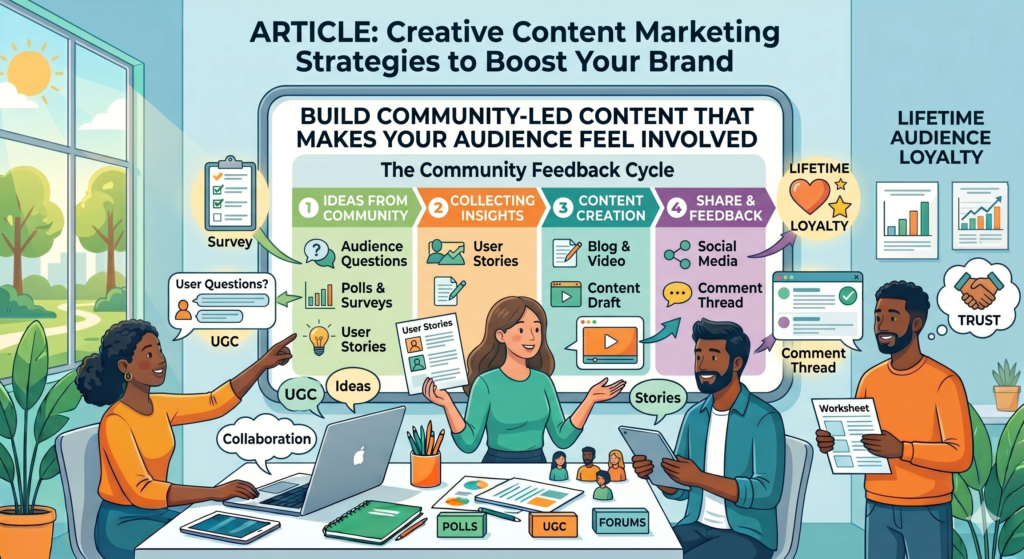
Community-led content does not always mean managing a large online group. It can be as simple as paying close attention to what your audience says and turning those insights into useful content.
Why Community Makes Content More Relevant
Your audience is always telling you what they care about.
They tell you through search queries, comments, emails, calls, reviews, sales objections, support tickets, and social posts. If you listen closely, you can find content ideas that are far more useful than anything you would create in a meeting room.
The benefit is simple. You stop guessing.
Instead of asking, “What should we post this week?” you can ask, “What is our audience already trying to understand?”
That shift makes content sharper.
Turn Comments and Questions Into Strong Content
A single customer question can become a powerful article.
For example, if someone asks, “How many blog posts do we need before SEO starts working?” that can become a full guide. It can cover quality, search intent, topical depth, internal links, domain strength, competition, and time. It can also explain why publishing volume alone is not the answer.
That one question reveals a common misunderstanding. Many brands think SEO is only about the number of posts. A strong article can correct that belief and teach a better way to think.
This is how community-led content becomes strategic. You are not just answering questions. You are shaping how your market understands the work.
Use Audience Language Instead of Boardroom Language
Your audience may not use the same words your team uses.
A marketing team may say “conversion optimization.” A founder may say, “People visit our site but do not contact us.” A strategist may say “content-market fit.” A business owner may say, “Our posts do not bring the right clients.”
The plain version is often stronger.
It sounds closer to the reader’s real life. It also makes your content easier to understand. When you use the words your audience uses, they feel like the article was written for them.
This is very important for writing at a simple reading level. Simple does not mean shallow. It means clear. It means the reader does not have to fight the sentence to get the idea.
Invite Your Audience Into the Content Process
People value what they help shape.
When you ask your audience what they are struggling with, what they want to learn, or what they disagree with, you do more than gather ideas. You build a small sense of ownership. People are more likely to read content when they feel the topic came from a real conversation.
This can be done through email replies, LinkedIn questions, polls, short surveys, webinars, client interviews, or direct messages.
The goal is not to turn every answer into content. The goal is to notice patterns.
Create Content From Real Conversations
A real conversation has more energy than a generic topic.
For example, “How to Improve Content ROI” is fine. But “A Founder Asked Why Their Blog Gets Traffic But No Leads. Here Is the Real Issue” is stronger. It has a scene. It has a person. It has tension. It makes the reader curious.
This does not mean you should reveal private details. You can protect names, industries, and sensitive information. The point is to use real patterns from real conversations to make the content feel grounded.
Readers can sense the difference between content written from experience and content written from a template.
Let Customer Wins Shape Your Content
Customer wins can become more than case studies.
They can teach your audience what good decisions look like. They can show how small changes add up. They can reveal what was fixed, what was ignored, and what finally moved results.
For example, if a client improved lead quality after changing their blog topics, you can create content about why topic choice matters more than posting frequency. If a client got better conversions after rewriting service pages, you can create content about why clear messaging beats clever wording.
If a client built trust through comparison content, you can explain why honest comparison pages help buyers feel safer.
This kind of content uses proof without sounding like a brag.
It teaches through the win.
Use Content Design to Make Every Page Easier to Read and Act On
Great content is not only about the words.
The way a page looks and feels also affects whether people read it, trust it, and act on it. A strong article can fail if the page is hard to scan, the sections feel crowded, or the next step is unclear.
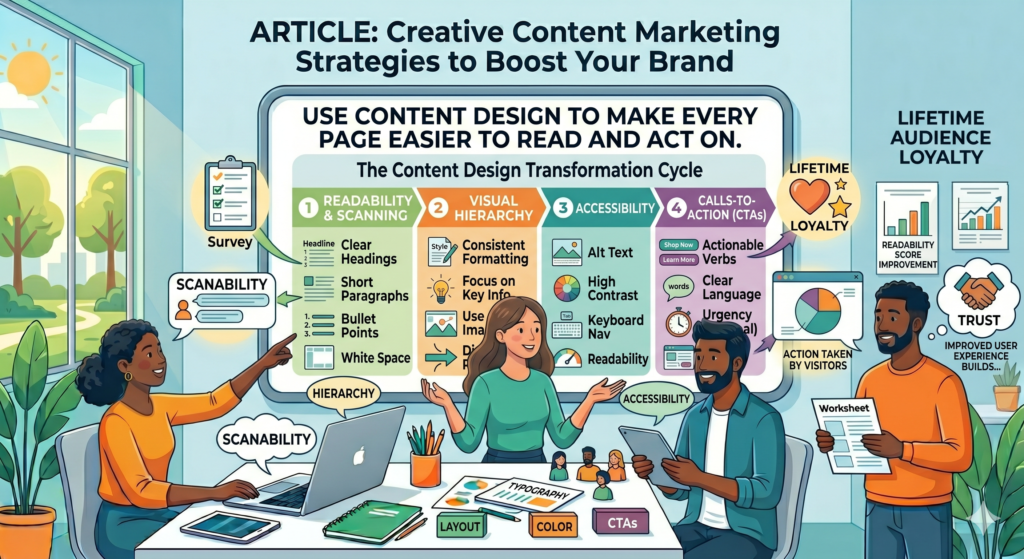
Content design is the bridge between writing and user experience. It helps readers move through the page without feeling lost.
This matters even more today because people do not read online the way they read books. They scan. They pause. They jump around. They look for signals that the page is worth their time.
Your content must help them do that.
Why Readability Is a Growth Tool
Readability is not a small writing detail. It affects business results.
If people land on a page and feel overwhelmed, they leave. If the content looks dense, they may assume it will be hard to understand. If the headings are vague, they may not know where to focus. If the next step is hidden, they may enjoy the article but never take action.
A readable page keeps people moving.
It gives them enough space to think. It breaks ideas into clear sections. It uses headings that guide, not decorate. It explains one point at a time.
This is especially important for complex services like SEO, content strategy, and digital marketing. The work can feel hard from the outside. Good content design makes it feel easier to understand.
Use Headings as a Reading Path
Headings should not be labels only. They should tell a story.
A reader should be able to scan your headings and understand the flow of the article. Each heading should make them want to read the next section.
For example, a weak heading might say “Content Ideas.” A stronger heading might say “Create Content From the Questions Your Buyers Already Ask.” The second version is clearer. It promises value. It also tells the reader why the section matters.
This is why headings are one of the most important parts of long-form content. They keep readers from feeling lost.
Keep Paragraphs Short but Not Empty
Short paragraphs help online reading. But that does not mean every sentence should stand alone.
Too many one-line paragraphs can make content feel choppy. It can also look like a forced copywriting trick.
The better approach is to keep paragraphs focused. Each paragraph should carry one clear idea. Some can be short for emphasis. Others can be a little longer when an idea needs room.
The goal is rhythm. The writing should feel easy to follow, not broken into random pieces.
Make the Next Step Feel Natural
Every strong content page should guide the reader somewhere.
That does not mean every section needs a hard sales pitch. In fact, too many calls to action can make content feel pushy. But the reader should never reach the end and wonder what to do next.
The next step should match the reader’s stage.
If the reader is early, invite them to read a related guide. If they are comparing options, invite them to view a case study. If they are problem-aware, invite them to get an audit or book a strategy call. If they are not ready to talk, invite them to join an email list or download a useful resource.
The key is relevance.
Calls to Action Should Feel Like Help
A good call to action does not feel like an interruption. It feels like the next helpful move.
For example, after an article about why blog traffic is not converting, a natural next step could be a content audit. The offer matches the problem. The reader has just learned what may be wrong, and now they may want expert help finding the exact issue.
That is much stronger than a generic “Contact us today.”
The more specific the next step, the more useful it feels.
Use Content to Build a Journey, Not a Dead End
A blog post should not be a dead end.
It should connect to other parts of your website in a way that helps the reader keep learning. This can include related articles, service pages, case studies, tools, guides, or email signups.
When each page connects to the next smart step, your content becomes a journey.
That journey helps readers move from interest to trust to action. It also helps your brand turn content into real business value.
Create Interactive Content That Makes People Spend More Time With Your Brand
Most content asks people to sit back and read.
Interactive content asks them to take part.
That small shift can make a big difference. When people click, answer, choose, calculate, compare, score, or test something, they are no longer passive. They are involved. They are thinking about their own situation. They are giving your brand more attention than they would give a normal article.
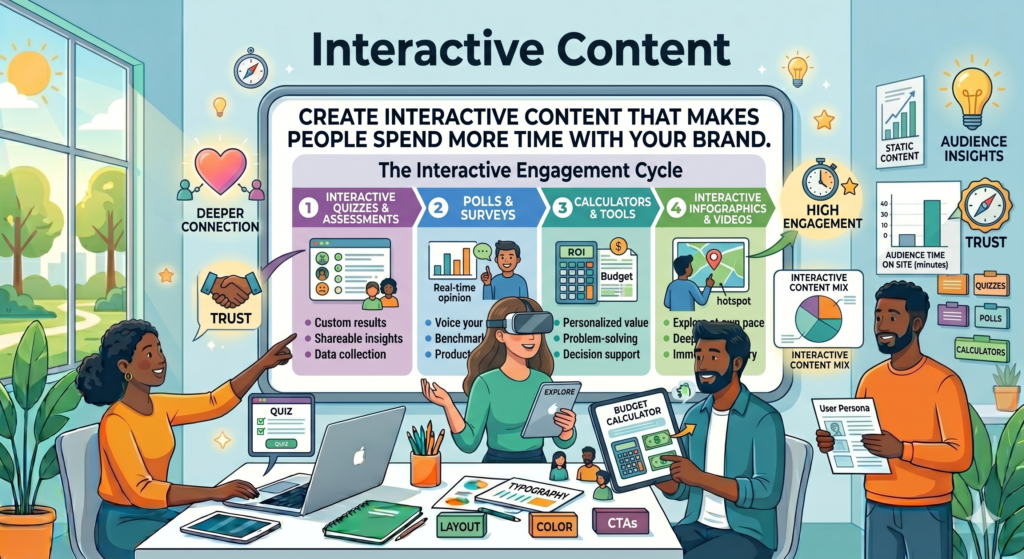
This is why interactive content can be so powerful for brand growth.
It does not need to be complex. It can be a quiz, a calculator, a scorecard, an audit tool, a self-check guide, a content idea generator, a pricing helper, or a simple assessment. What matters is that it helps the user learn something about themselves.
People love useful reflection. They want to know where they stand. They want to know what is missing. They want to see what to fix first.
A smart interactive asset gives them that clarity.
Why Interactive Content Works Better Than Plain Advice in Some Cases
Plain advice can be useful, but it often stays general. It tells the reader what they should do, but it does not always help them see what applies to their own business.
Interactive content closes that gap.
Instead of telling a reader, “Your content needs a clear call to action,” you can let them answer a few questions about their blog. Does each post guide the reader to a next step? Does the post connect to a service page? Does the article speak to a buyer pain? Does it include proof? Does it match search intent?
By the end, the reader does not just understand the advice. They see their own gaps.
That makes the content more personal.
How a Simple Scorecard Can Become a Lead Magnet
A scorecard is one of the easiest interactive assets to create.
For a digital marketing agency like WinSavvy, a strong scorecard could help businesses rate their content marketing strength. It could ask about strategy, audience clarity, SEO focus, content quality, internal links, calls to action, lead capture, distribution, and measurement.
The user answers simple questions and gets a score. But the score itself is not the real value. The real value is the explanation behind it.
If someone scores low on audience clarity, the scorecard should explain what that means. It should show why vague audience targeting weakens content. It should offer a simple next step. If someone scores low on conversion, it should explain why traffic without a clear path often fails to create leads.
This turns a simple tool into a teaching asset.
It also creates a natural bridge to your service. If the scorecard shows that the reader has gaps, they may want help fixing them. That is a much warmer lead than someone who only downloaded a generic PDF.
How to Keep Interactive Content Useful and Not Gimmicky
Interactive content fails when it feels like a trick.
A quiz that only exists to collect emails will not build trust. A calculator that gives vague results will not help. A scorecard that tells everyone they need to hire you will feel fake.
The asset must give real value even if the user never buys.
That means the questions should be thoughtful. The results should be specific. The advice should be honest. The user should leave with a clearer view of their problem.
For example, if a business has strong SEO but weak conversion, the result should say that clearly. It should not pretend every area is broken. If a business has good traffic but poor lead quality, the tool should explain that the issue may be topic fit, not volume.
The more honest the output, the more trust it creates.
Use Interactive Content to Learn More About Your Audience
Interactive content does not only help the user. It helps your brand learn too.
When many people use a scorecard or assessment, you start seeing patterns. You may notice that most businesses struggle with calls to action. You may find that many teams have no clear content pillars. You may see that companies publish often but rarely update old content.
These insights can guide your future content strategy.
They can also become original research. You can publish findings like “What We Learned From 500 Content Marketing Scorecards” and explain the most common gaps. That kind of content is useful because it comes from real audience behavior.
Ask Questions That Reveal Real Buyer Problems
The best interactive content asks questions that connect to business problems.
Do not ask questions just because they are easy. Ask questions that reveal something meaningful.
For a content marketing scorecard, a weak question would be, “Do you publish blog posts?” That only tells you whether the company creates content. A stronger question would be, “Do your blog posts guide readers toward a next step that matches their stage of the buying journey?” That tells you much more.
A weak question would be, “Do you use SEO?” A stronger question would be, “Do you choose keywords based on both search demand and buyer value?” That reveals whether the brand is thinking strategically.
Good questions help the user think better. They also help your team understand what kind of support the audience may need.
Turn Tool Results Into Follow-Up Content
The value of interactive content grows when you follow up well.
If someone completes a content audit tool, do not send a plain thank-you email. Send a useful breakdown. Explain what their score means. Share a related article. Offer a simple next step. Invite them to review one area first.
If their biggest gap is content conversion, send them a guide on improving calls to action. If their biggest gap is SEO focus, send them a guide on choosing better content topics. If their biggest gap is brand trust, send them examples of proof-led content.
This makes the experience feel personal without needing a heavy manual process.
It also keeps the conversation going.
Build Content Around Your Brand’s Strongest Opinions
Safe content is easy to ignore.
Many brands avoid strong opinions because they do not want to upset anyone. They write content that sounds balanced, polite, and correct. There is nothing wrong with being fair. But if your content never takes a clear stand, it becomes hard to remember.
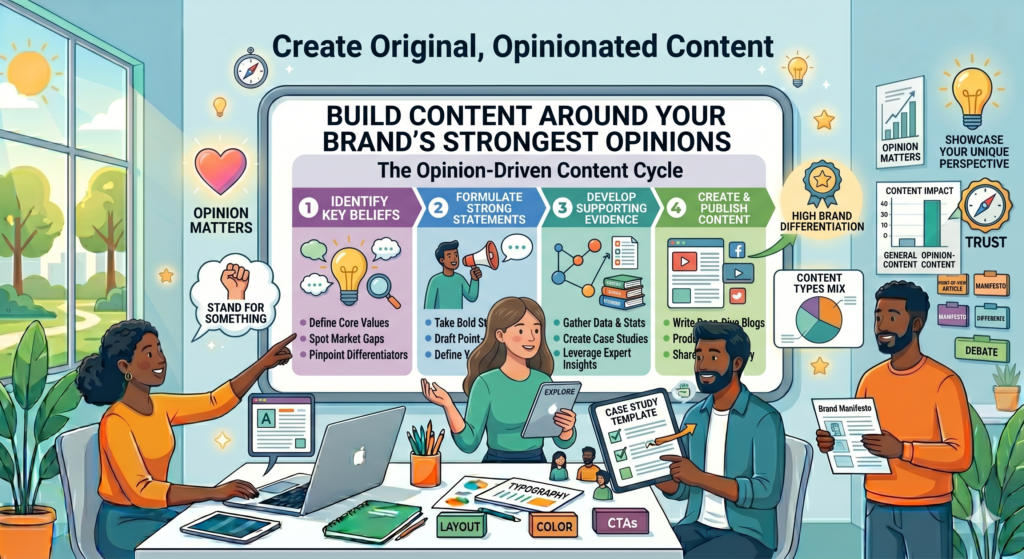
A strong brand needs a point of view.
That does not mean being loud for attention. It does not mean attacking competitors. It does not mean making extreme claims. It means saying what you believe, why you believe it, and how that belief shapes your work.
Opinion-led content makes your brand feel more alive. It gives people something to agree with, question, share, or discuss.
Most importantly, it helps the right people recognize that your brand thinks the way they want a partner to think.
Why Clear Opinions Make Content More Trustworthy
A clear opinion shows judgment.
Anyone can repeat common advice. A strong marketer explains what matters, what does not, what is overrated, what is risky, and what works only in certain cases.
That kind of content feels more useful because business decisions are full of trade-offs.
For example, it is easy to say, “Publish content consistently.” But a sharper opinion would be, “Publishing every week does not matter if every article targets the wrong reader.” That statement helps the audience think more clearly.
It challenges a common habit. It also opens the door to a deeper strategy.
How to Find Your Brand’s Core Opinions
Your best opinions usually come from your repeated experience.
Look at the problems you keep seeing. Look at the advice you often disagree with. Look at the mistakes clients make before they come to you. Look at the beliefs you have to change before your work succeeds.
Those patterns often reveal your point of view.
For WinSavvy, strong content opinions might sound like this: traffic is not the goal if it does not bring the right leads. Content should support sales, not sit apart from it. SEO should be tied to buyer intent, not vanity volume. Simple messaging beats clever wording. Strategy matters more than publishing speed.
Each of these opinions can become a content asset.
They can become blog posts, social posts, videos, email topics, webinar themes, or service page sections.
How to Share Opinions Without Sounding Harsh
A strong opinion does not need to sound angry.
The best tone is clear, calm, and useful. You can challenge an idea without insulting anyone. You can say what is wrong with a common tactic and then explain the better path.
For example, instead of saying, “Most brands are terrible at content,” you can say, “Many brands work hard on content, but their strategy gives them little chance of seeing results.” That is direct, but fair.
It names the problem without shaming the reader.
This matters because your goal is not to make the audience feel foolish. Your goal is to help them see the issue clearly enough to fix it.
Turn Opinions Into Repeatable Content Themes
A strong opinion should not appear once and disappear.
If it is truly central to your brand, it should show up again and again in different ways. This does not mean repeating the same sentence. It means exploring the belief from many angles.
For example, if your belief is that “content should build trust before the sales call,” you can turn that into many themes.
You can write about how educational content lowers buyer fear. You can explain why comparison pages help serious prospects. You can show how case studies reduce doubt. You can teach brands how to answer pricing questions with confidence. You can break down how content supports sales teams.
The same belief keeps showing up, but each piece teaches something new.
Why Repetition Helps People Remember Your Brand
People rarely remember a brand after one article.
They remember patterns. They remember what you keep saying. They remember the way you explain problems. They remember the beliefs that show up across your content.
That is why strategic repetition matters.
A brand should not sound scattered. It should return to its core ideas with fresh examples and new angles. Over time, those ideas become linked to the brand.
When a prospect thinks, “We need content that brings better leads, not just more traffic,” you want them to think of WinSavvy.
That does not happen by accident. It happens because the brand keeps teaching that idea clearly.
Use Opinions to Attract Better-Fit Clients
Clear opinions do more than create engagement. They also filter your audience.
The wrong-fit clients may not agree with your approach. That is fine. Strong content should not attract everyone. It should attract people who value the way you think.
If your brand believes in long-term content systems, your content should not overpromise overnight results. If your brand believes in clear strategy, your content should not suggest that random posting is enough. If your brand believes in simple messaging, your content should not hide behind buzzwords.
This helps buyers understand what it would be like to work with you.
By the time they reach out, they already know your thinking. That makes sales conversations easier and more focused.
Use Case Study Content to Show Proof Without Sounding Like a Sales Pitch
Case studies are one of the most powerful content types a brand can create.
But many case studies are boring. They follow the same tired format. The client had a problem. The company provided a solution. The result was amazing. The end.
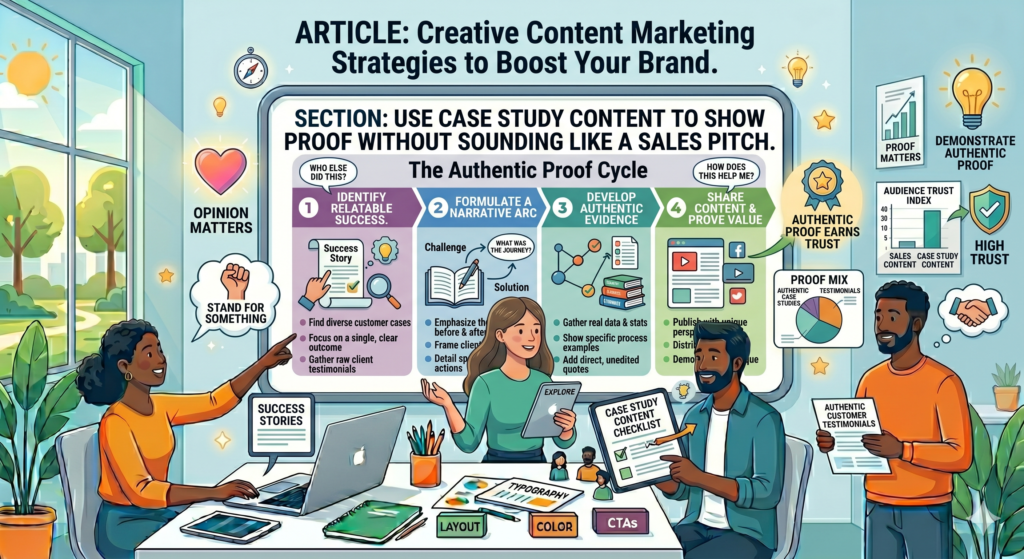
That structure may be clear, but it often feels too polished. It skips the real thinking. It hides the hard parts. It reads like a sales document instead of a useful story.
A better case study teaches.
It shows the reader what was wrong, why it mattered, how the team found the issue, what choices were made, what changed, and what others can learn from it.
When a case study teaches well, it does not feel like bragging. It feels useful.
Why Teaching-Based Case Studies Build More Trust
A buyer does not only want to see that you got results.
They want to know how you think.
They want to know whether you understand problems like theirs. They want to know whether your process is thoughtful. They want to know whether your results came from a repeatable method or a lucky moment.
A teaching-based case study answers those questions.
It explains the thinking behind the work. It gives enough detail for the reader to see your skill. It also makes the result feel more believable.
Show the Before State Clearly
The before state is often the most important part of a case study.
If the reader does not understand the starting problem, they will not fully value the result.
Do not rush through it. Explain what was happening before the work began. Was the client getting traffic but no leads? Were they ranking for weak keywords? Were their service pages unclear? Were their blog posts too broad? Was their content not connected to the sales process?
The more clearly you describe the before state, the easier it is for the reader to see themselves in it.
This is where empathy matters. You are not showing the client as foolish. You are showing that the problem is common, understandable, and fixable.
Explain the Insight That Changed the Strategy
Every strong case study should include a turning point.
This is the moment when the real issue became clear.
Maybe the client thought they needed more blog posts, but the real issue was that their existing content targeted the wrong search intent. Maybe they thought their website needed a design refresh, but the deeper problem was unclear messaging. Maybe they thought they had a traffic problem, but they actually had a trust problem.
This turning point is where the case study becomes interesting.
It shows judgment. It proves that your team does not just execute tasks. You diagnose problems.
Make Results Feel Concrete and Believable
Results matter, but they need context.
A case study that says “we increased leads by 300 percent” may sound impressive, but it can also feel empty if the reader does not understand how it happened or what changed.
Strong proof needs a story around it.
Explain what actions led to the result. Explain what time frame was involved. Explain what was measured. Explain what other factors may have played a role. Honest context makes the result more trustworthy.
Use Specific Changes Instead of Vague Claims
Vague claims weaken case studies.
Do not only say, “We improved the content strategy.” Explain what changed.
Maybe you rewrote blog introductions to match search intent faster. Maybe you added internal links from educational posts to service pages. Maybe you changed calls to action based on reader stage. Maybe you built comparison content for buyers near decision. Maybe you updated old articles that had rankings but weak conversions.
These details make the case study useful.
They help the reader understand what real content work looks like.
End With a Lesson the Reader Can Use
A case study should not end only with the result.
It should end with a lesson.
For example, the lesson might be that more traffic does not always mean better leads. Or that content should be judged by its role in the buyer journey. Or that old blog posts can become strong lead drivers when updated with clearer intent and stronger next steps.
This gives the reader something to take away.
It also makes the case study feel less like a pitch and more like a helpful guide.
Create Founder-Led and Expert-Led Content That Feels Personal
People connect with people faster than they connect with logos.
That is why founder-led and expert-led content can be so effective. When a real person shares lessons, beliefs, stories, and decisions, the brand feels more human. It becomes easier to trust.
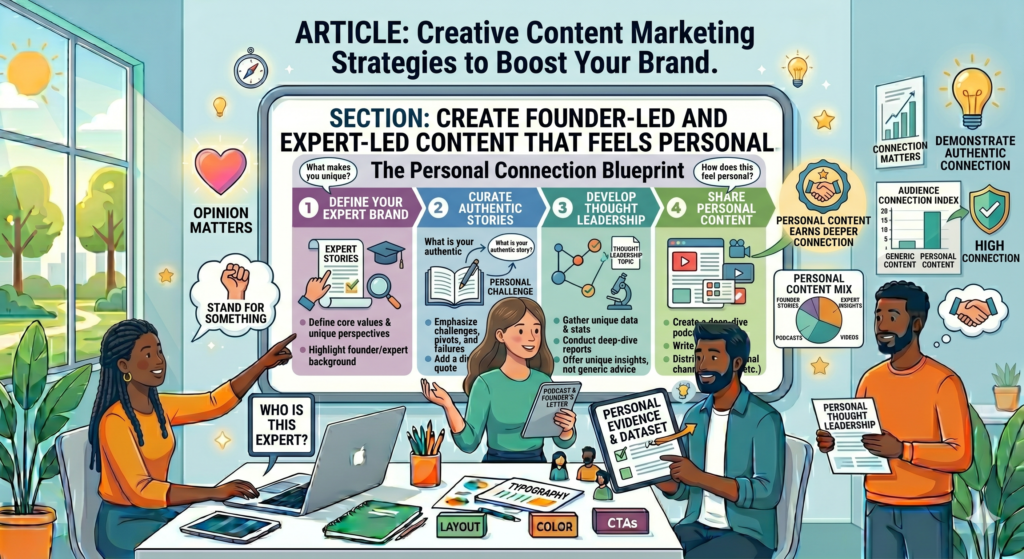
This does not mean the founder has to become a full-time influencer. It does not mean every expert needs to post daily. It means the brand should capture the thinking inside the company and turn it into content people can use.
Every company has hidden expertise. It lives in client calls, strategy notes, team meetings, audits, and hard-won lessons. Founder-led content brings that thinking into the open.
Why Expert Content Feels Stronger Than Generic Brand Content
Generic brand content often sounds too polished.
It avoids strong views. It uses safe language. It speaks in a voice that could belong to any company.
Expert content feels different because it carries lived judgment. It says, “Here is what we have seen. Here is what we would do. Here is the mistake we would avoid. Here is the trade-off most people miss.”
That kind of content is harder to copy.
A competitor can copy a topic. They cannot easily copy your experience.
Capture Ideas From Real Work
The best expert content often starts inside daily work.
After a client call, ask what question came up. After an audit, ask what pattern appeared. After a strategy session, ask what belief changed. After a campaign review, ask what surprised the team.
These small notes can become strong content ideas.
For example, if the team notices that many brands have blog posts with no clear next step, that can become an expert-led article. If the founder keeps seeing businesses chase high-volume keywords that bring weak leads, that can become a sharp LinkedIn post or a detailed guide.
The goal is to build a habit of capturing insight while it is fresh.
Turn Expert Thoughts Into Simple Language
Experts often use complex words because they are close to the work.
But the audience needs clarity.
The job of the content writer is to translate expert thinking into simple, useful language without removing the depth. This is where great content becomes valuable. It makes smart ideas easy to understand.
For example, instead of saying “We aligned content assets with funnel-stage intent,” say “We matched each article with the kind of question the buyer was asking at that point.” The second version is easier to read and still says something meaningful.
Simple language does not weaken expertise. It proves it.
Build a Repeatable Voice Around Real People
Founder-led content should not feel random.
It should connect to the brand’s main views. The founder or expert can share stories, lessons, mistakes, and opinions, but they should all support the larger brand message.
For WinSavvy, that message might be that content should be clear, useful, search-focused, and tied to real business growth. Founder-led content can return to that idea often.
Use Personal Stories With a Clear Point
A personal story should not exist only to be personal.
It should teach something.
A founder can share a lesson from a failed campaign, a hard client conversation, a surprising website audit, or a moment when a simple change made a big difference. But the story should always lead to a useful takeaway.
The reader should not be left thinking, “Nice story.” They should think, “That helps me see my own problem better.”
That is what makes personal content strategic.
Make the Brand Feel Accessible
Expert-led content also makes a brand feel easier to approach.
When people see how you think, they feel less distance. They understand your values. They get a sense of your style. They may feel like they know you before they ever speak with you.
This can make sales calls warmer.
The buyer does not come in cold. They already know your views. They may have read your stories. They may have seen your advice. They may already trust the way you explain things.
That is the quiet power of personal content.
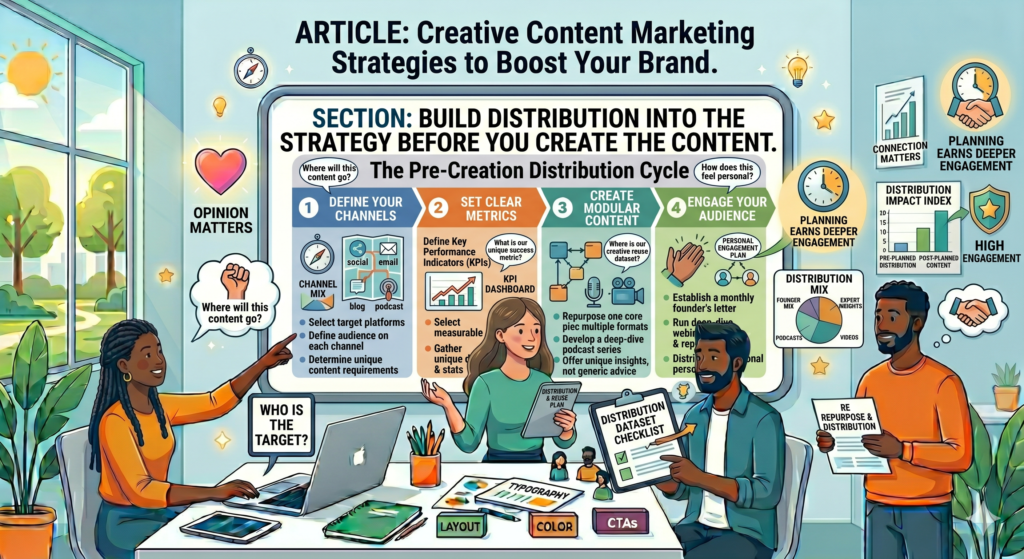
Build Distribution Into the Strategy Before You Create the Content
A great piece of content can still fail if nobody sees it.
Many brands treat distribution as an afterthought. They spend days or weeks creating the article, video, guide, or report. Then, once it is published, they share it once on social media and move on.
That is not a strategy. That is hope.
Content needs a clear path to reach people. Before you create the asset, you should know where it will be shared, who it is for, how it will be reused, and what action it should support.
Distribution is not the boring part of content marketing. It is the part that gives your ideas a real chance to work.
Why Content Should Not Depend Only on Organic Search
SEO is powerful, but it takes time.
A strong article may take weeks or months to rank. In competitive markets, it may take even longer. If your whole content strategy depends only on search traffic, your best ideas may sit quietly for too long.
This is why distribution must start early.
A new article can support email. It can support LinkedIn. It can support sales calls. It can be shared with leads. It can be used in outreach. It can be turned into short videos. It can become part of a webinar. It can be added to a nurture sequence. It can be sent to partners. It can become a talking point for the founder.
The goal is to make one strong piece work harder.
Choose the Distribution Channel Before Writing
Before writing any major content asset, ask where it will live beyond the blog.
If the article will be shared on LinkedIn, the opening should include a strong point of view that can also become a social post. If it will be sent to leads, the article should answer a question that often comes up in sales conversations. If it will support SEO, the structure should match search intent. If it will be used in email, the article should include ideas that can be turned into a short series.
This does not mean one article has to do everything. It means the content should be built with its future use in mind.
A piece created only for publishing is often weaker than a piece created for movement.
Make Content Easy for Your Team to Share
Sometimes content fails because sharing it feels like extra work.
The sales team does not know when to use it. The founder does not know what to say about it. The social team has to create posts from scratch. The email team does not know which section matters most.
This is a systems problem.
When you publish a major piece, create a simple distribution note for the team. Explain who the content is for, what problem it solves, when to share it, and what message to use with it. This does not need to be complex. It just needs to remove friction.
For example, if WinSavvy publishes a guide on why blog traffic is not converting, the note could explain that the article is useful for leads who already have content but are unhappy with results.
The sales team can send it after calls where the prospect says traffic is not turning into leads. The founder can share the main insight on LinkedIn. The email team can turn it into a short nurture message.
This kind of support helps content travel farther.
Use Owned Channels to Build Long-Term Attention
Social platforms are useful, but they are rented spaces.
Algorithms change. Reach rises and falls. A post that performs well today may disappear tomorrow. That does not mean social media is bad. It means your strategy should not depend only on it.
Owned channels give your brand more control.
Your website, email list, customer community, webinars, and private events are owned or semi-owned spaces where your relationship with the audience is stronger. These channels help you stay connected even when social reach changes.
Email Turns Content Into a Relationship
Email is one of the best ways to extend the life of content.
A blog post may get one visit from a reader. An email list allows you to keep helping that reader over time. You can send useful ideas, new guides, case studies, event invites, and simple lessons that build trust.
The key is to make email feel helpful, not noisy.
Do not only send announcements. Send insight. Send short stories. Send practical lessons. Send answers to questions your audience is already asking.
If someone reads an article about creative content marketing and joins your list, the next email should not feel like a sales blast. It should feel like the next helpful step. It could explain how to choose content pillars, how to find customer questions, or how to turn one idea into many pieces.
This keeps the relationship warm.
Sales Teams Should Use Content as a Trust Tool
Content can make sales conversations easier.
A good article can answer a question before a call. A case study can reduce doubt. A guide can explain the cost of a problem. A comparison page can help a buyer make sense of options. A research report can prove that your brand understands the market.
But this only works if the sales team knows the content exists and knows how to use it.
Content should be mapped to common buyer moments. When a lead says they are not sure if SEO is worth it, send content that explains when SEO makes sense and when it does not. When a lead says they need faster results, send content that compares short-term and long-term channels.
When a lead says they have traffic but no leads, send content that explains conversion gaps.
This makes the brand feel helpful before it asks for money.
Refresh Old Content So It Keeps Working Harder Over Time
Many brands are addicted to new content.
They keep publishing more and more, while older articles quietly lose value. Rankings drop. examples become old. links break. calls to action no longer fit. The content still exists, but it no longer performs the way it could.
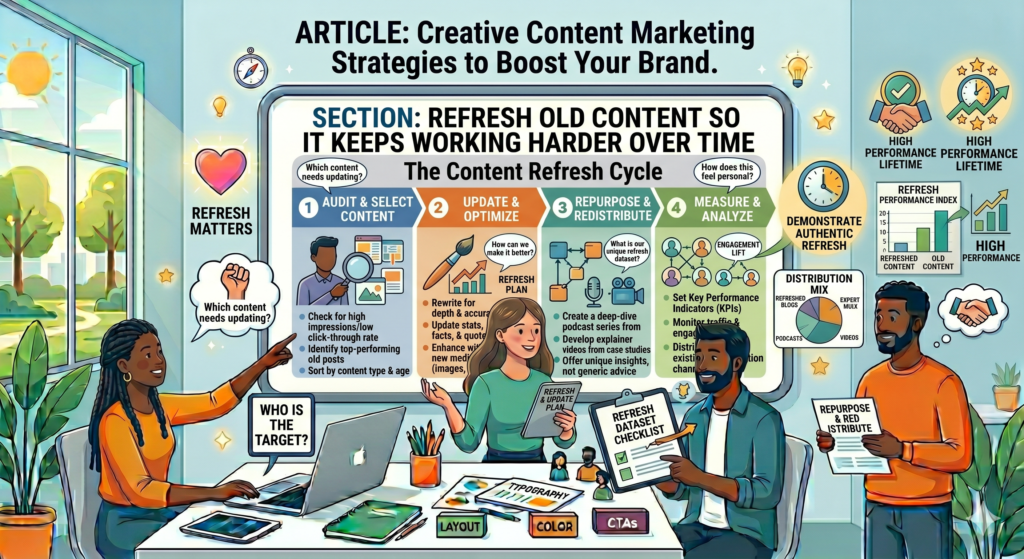
Refreshing old content is one of the highest-return content marketing moves a brand can make.
It is often faster than creating something new. It builds on pages that already have history. It helps protect rankings. It improves user experience. It can turn forgotten posts into real business assets.
A content strategy that ignores old content is leaving money on the table.
Why Old Content Decays
Content does not stay strong forever.
Markets change. Search results change. Buyer questions change. Competitors publish better pages. Your own services may change. Data may become old. Examples may no longer reflect the current world. A post that once felt useful can start to feel thin or dated.
This is normal.
The problem is not that content gets old. The problem is that many teams do not have a system to review and improve it.
Look for Pages With Hidden Potential
Not every old article deserves a refresh.
Some topics may no longer matter. Some pages may attract the wrong audience. Some posts may have no link to your business goals. Updating those may waste time.
The best refresh targets are pages with hidden potential.
These are pages that already get impressions but low clicks. Pages that rank on page two of search results. Pages that bring traffic but few leads. Pages that answer a valuable buyer question but feel outdated. Pages that used to perform well but have dropped.
These pages are worth studying because they already have some traction. A smart update can improve them faster than starting from zero.
Refresh for Intent, Not Just Keywords
A weak content refresh only adds more keywords.
A strong refresh improves how well the page satisfies the reader’s need.
Start by asking what the searcher wants now. Look at the current search results. Notice what kinds of pages are ranking. Are they guides, tools, examples, templates, comparisons, or service pages? Then compare your page to that need.
Maybe the article needs clearer steps. Maybe it needs stronger examples. Maybe it needs updated data. Maybe it needs a sharper opening. Maybe it needs a better call to action. Maybe it needs a section that answers a question competitors cover well.
The goal is not to make the page longer for no reason. The goal is to make it more useful.
Turn Old Content Into a Stronger Buyer Journey
Old content often fails because it was written before the brand had a clear strategy.
Maybe the article ranks, but it does not link to anything useful. Maybe it brings readers in but does not guide them toward the next step. Maybe it teaches well but never explains how the brand can help.
Refreshing content gives you a chance to fix this.
Improve Internal Links With Purpose
Internal links should not be random.
When you update old content, look for places where the reader may need more help. Link to related articles, service pages, case studies, tools, or guides that make sense.
If an article explains content strategy, it can link to a deeper article about content audits. If it explains SEO mistakes, it can link to a service page about SEO strategy. If it explains trust-building content, it can link to a case study that shows the idea in action.
This helps readers move through your site with less effort.
It also helps search engines understand how your content connects.
Update Calls to Action Based on Reader Intent
Many old blog posts end with weak calls to action.
They say things like “contact us” or “learn more,” but they do not match the reader’s problem. A stronger call to action should feel like the next logical step.
If a reader is learning why content is not converting, offer a content audit. If they are reading about SEO strategy, offer a strategy consultation. If they are reading a beginner guide, offer a useful checklist or email series.
The call to action should not feel forced. It should feel helpful.
This is how old content starts supporting business growth more directly.
Use Visual Content to Make Complex Ideas Easier to Understand
Visual content is not just decoration.
A strong visual can make a complex idea simple. It can help readers remember a framework. It can show a process faster than words alone. It can turn a long explanation into something people want to save and share.
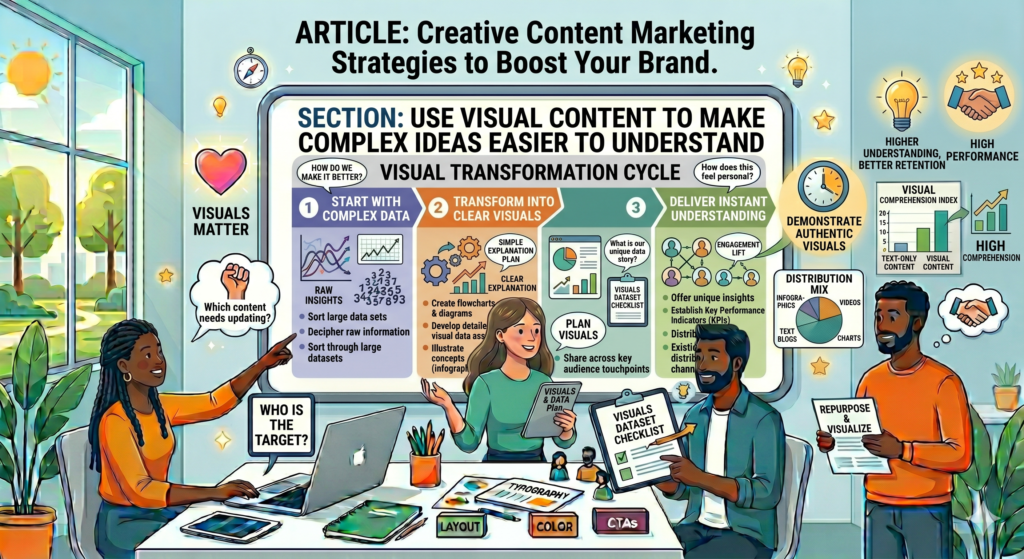
For content marketing, visuals are especially useful because many ideas are connected. Buyer journeys, content funnels, SEO clusters, distribution systems, and conversion paths can be hard to explain in plain text. A simple visual can make them much easier to understand.
But the visual must serve the idea. It should not exist only to make the page look pretty.
Why Useful Visuals Build Trust
A useful visual shows that your brand can make things clear.
That is a strong trust signal. When people are confused, they trust the brand that helps them see the path.
For example, instead of only explaining how content supports the buyer journey, you can show a simple map. At the top, a person has a problem. In the middle, they compare options. Near the end, they need proof and confidence. Beside each stage, you can show the content that helps.
That kind of visual makes the strategy easier to understand.
It also makes the brand look more thoughtful.
Turn Your Frameworks Into Visual Assets
Every brand should have a few simple frameworks.
A framework is just a clear way of explaining how you think. It could be a content audit model, a trust-building model, a lead quality model, or a content distribution model.
Once you have a framework, turn it into a visual.
For WinSavvy, one useful framework could show how content moves from attention to trust to action. Another could show why traffic fails when search intent, offer clarity, and calls to action are not aligned. Another could show how one core idea becomes a blog post, email, social post, webinar, and sales asset.
These visuals can live inside blog posts. They can be used on LinkedIn. They can appear in sales decks. They can become part of client reports. They can be reused again and again.
That is how visual content becomes a strategic asset.
Keep Visuals Simple Enough to Understand Quickly
A visual should reduce confusion, not add to it.
Many brands create visuals that are too crowded. They include too many arrows, boxes, labels, colors, and tiny words. The result looks impressive but feels hard to use.
A strong visual should make one idea clearer.
If the visual explains a process, keep the steps simple. If it compares two options, make the difference easy to see. If it shows a framework, remove anything that does not help the reader understand the main point.
The test is simple. Can someone understand the visual in a few seconds? If not, it may need to be simplified.
Use Visual Content Across the Full Funnel
Visuals are useful at every stage of the buyer journey.
At the awareness stage, they help explain problems. At the consideration stage, they help compare options. At the decision stage, they help show process, proof, and expected outcomes.
This makes them far more useful than many brands realize.
Use Visuals to Explain Problems
Problem visuals are powerful because they help readers name what is going wrong.
For example, a visual could show why a blog gets traffic but no leads. It might show traffic entering from broad informational searches, then dropping off because the page has no buyer path, no internal links, no offer, and no trust signals.
That visual helps the reader see the gap.
Once they see the gap, they are more open to fixing it.
Use Visuals to Explain Your Process
Service businesses often struggle to explain their process clearly.
A visual can help.
Instead of writing a long paragraph about how your agency works, show the main stages. For example, discovery, audit, strategy, content creation, optimization, distribution, and review. Then explain what happens at each stage in simple words.
This makes the service feel less risky. The buyer can see what they are getting. They can understand how the work unfolds. They can picture the journey before they commit.
That kind of clarity can increase trust before the sales call.
Create Comparison Content That Helps Buyers Make Smarter Choices
Buyers compare before they buy.
They compare agencies. They compare tools. They compare channels. They compare doing the work in-house versus hiring help. They compare SEO with ads. They compare content marketing with social media. They compare short-term cost with long-term value.
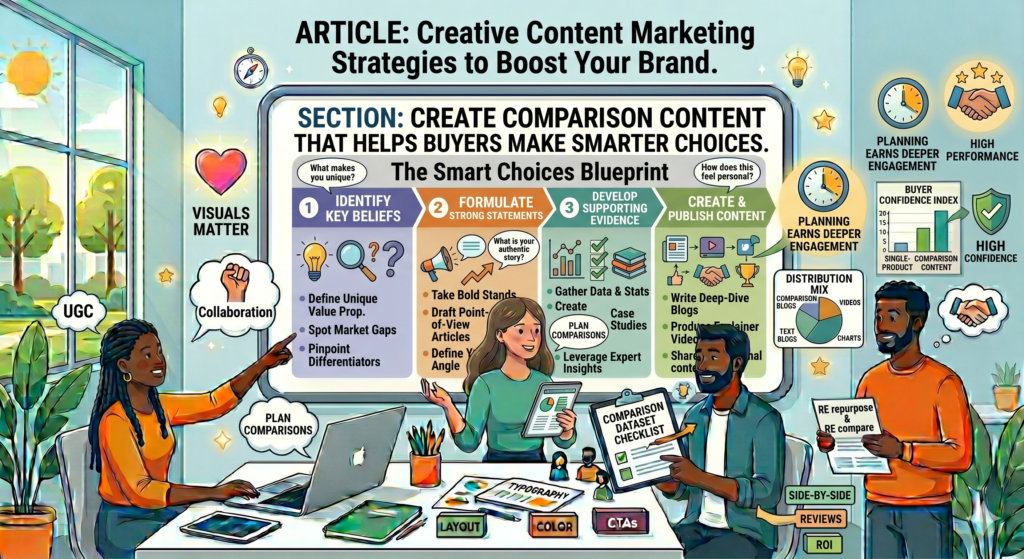
If your brand does not help them compare, someone else will.
Comparison content is one of the most useful and underused forms of content marketing. It meets buyers when they are closer to making a decision. It helps them understand trade-offs. It builds trust because it shows you are willing to be honest.
Why Comparison Content Attracts Serious Buyers
A person reading comparison content is often more serious than someone reading a beginner guide.
They are not just learning what a topic means. They are trying to choose.
That makes comparison content valuable.
For example, a search like “SEO agency vs in-house SEO team” shows a real business decision. A search like “content marketing vs paid ads” shows a budget question. A search like “freelance writer vs content marketing agency” shows a hiring question.
These topics may not always have huge search volume, but they often have strong buying intent.
Make Comparison Content Fair and Useful
Comparison content should not be a fake sales pitch.
If every comparison ends with your service being the best choice for everyone, readers will not trust it. A fair comparison explains when each option makes sense.
For example, paid ads may be better when a company needs fast testing and has the budget to support it. SEO may be better when a company wants long-term compounding traffic and has patience to build.
In-house content may be better when the company has strong internal expertise and enough team capacity. An agency may be better when the company needs strategy, execution, and outside experience without hiring a full team.
This kind of honesty helps buyers self-select.
It also makes your brand look more mature.
Use Comparison Content to Teach Decision Criteria
A buyer may not know how to compare options well.
Your content can help them understand what factors matter. For example, when comparing content agencies, they should not only look at price. They should look at strategy quality, SEO skill, industry understanding, writing depth, conversion focus, reporting, communication, and ability to turn expertise into clear content.
This helps the reader make a better decision.
It also gives your brand a chance to show what you value.
If WinSavvy believes content should drive business outcomes, its comparison content should teach buyers to judge agencies by more than word count or posting frequency. It should help them ask whether the agency understands search intent, lead quality, brand voice, content distribution, and conversion paths.
Build Comparison Pages Around Real Buyer Questions
The best comparison topics often come from sales calls.
When prospects ask, “Should we hire an agency or build a team?” that is a content topic. When they ask, “Should we focus on SEO or LinkedIn?” that is a topic. When they ask, “Do we need long-form blogs or landing pages first?” that is a topic.
These questions reveal decision friction.
Content can reduce that friction before the sales call.
Answer the Question Directly Before Adding Detail
Comparison content should not make readers wait too long.
Start with a clear answer. Then explain the details.
If the best choice depends on the situation, say that clearly. Then explain what it depends on.
For example, if comparing SEO and paid ads, the answer may be that paid ads are better for faster testing while SEO is better for long-term trust and compounding search visibility. But the right choice depends on budget, timeline, offer clarity, competition, and current website strength.
That kind of answer is clear without being simplistic.
Use Examples to Make Trade-Offs Easy to See
Trade-offs are easier to understand with examples.
A startup with a new offer and no proof may need paid ads and direct outreach before investing heavily in SEO. A B2B service firm with strong expertise and a long sales cycle may benefit from SEO-led content that builds trust over time. An ecommerce brand with seasonal demand may need a mix of paid campaigns, email, and content.
Examples help readers apply the advice to their own situation.
They also make the content feel more practical.
Measure Content by the Actions That Matter, Not Just the Numbers That Look Good
Content marketing can look successful on paper and still fail in the business.
A page can get traffic but no leads. A post can get likes but no sales conversations. A video can get views but no trust. A report can get downloads but no follow-up. This is why content measurement must go beyond surface numbers.
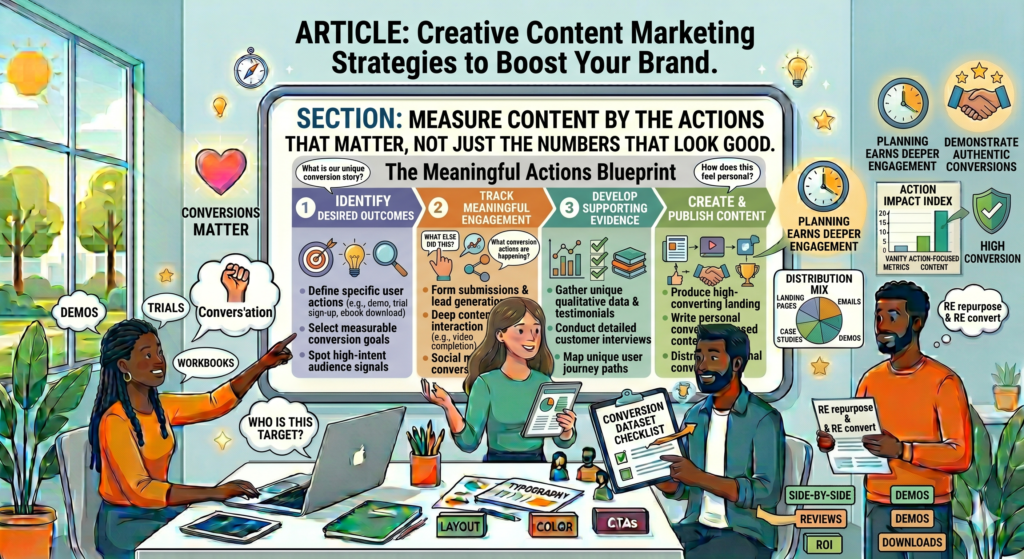
The goal is not to collect impressive metrics. The goal is to understand whether content is helping the brand grow.
That means measuring the actions that matter.
Why Vanity Metrics Can Mislead Your Strategy
Vanity metrics are numbers that look good but do not always show business value.
Traffic can be a vanity metric if it comes from the wrong audience. Social likes can be a vanity metric if they come from peers who will never buy. Email subscribers can be a vanity metric if they never engage. Keyword rankings can be a vanity metric if the terms do not match buyer intent.
These numbers are not useless. They just need context.
A smart marketer asks what the number means.
If traffic is growing, are the right pages growing? If rankings are improving, are they tied to valuable topics? If leads are increasing, are they qualified? If people are reading, are they taking the next step?
This is how measurement becomes useful.
Match Metrics to the Content’s Job
Each piece of content should be measured based on its role.
An early-stage guide may not generate leads right away. Its job may be to attract the right audience, earn trust, and move readers to another page. A comparison article may be judged by assisted conversions, sales conversations, or demo requests.
A case study may be judged by how often sales uses it and whether it helps close deals. An email sequence may be judged by replies, clicks, booked calls, or lead quality.
This matters because not all content should be judged the same way.
If you expect every article to produce direct leads, you may undervalue content that builds trust earlier in the journey. If you only measure traffic, you may overvalue content that brings unqualified readers.
Good measurement starts with a clear job.
Track Movement, Not Just Visits
The most useful question is often, “What did the reader do next?”
Did they click to a service page? Did they read a related article? Did they sign up for a resource? Did they book a call? Did they return later? Did they engage with an email? Did they share the content with a teammate?
These actions show movement.
Content should move people from confusion to clarity, from doubt to trust, and from interest to action. The metrics should help you see whether that movement is happening.
Use Measurement to Improve Content, Not Just Report It
Reporting should lead to better decisions.
Too many teams create monthly reports that show numbers but do not change the strategy. They track traffic, rankings, clicks, and leads, but they do not ask what to do next.
Measurement should help you decide what to create, update, cut, expand, or distribute more.
Find Patterns in Your Best Content
Look at the content that performs best, but do not stop at the numbers.
Ask why it worked.
Was the topic tied to a strong pain point? Did the title speak clearly? Was the search intent strong? Did the page include better examples? Did it have a more natural call to action? Was it shared by the founder? Did sales use it often?
These patterns can guide future content.
If your best leads come from articles about content conversion, create more around that theme. If comparison pages bring serious buyers, build more comparison content. If case studies help close deals, create more teaching-based case studies.
This is how the strategy gets sharper over time.
Cut or Rework Content That Does Not Serve the Brand
Not every piece of content should stay as it is.
Some content should be updated. Some should be merged. Some should be redirected. Some should be removed. Some should be left alone because it supports trust even without high traffic.
The decision should be based on business value.
If a page has weak traffic, weak relevance, and no clear role, it may not deserve more effort. If a page has low traffic but helps close sales, it may be very valuable. If a page has high traffic but attracts the wrong audience, it may need a stronger call to action, better internal links, or a clearer angle.
A mature content strategy is not just about adding more. It is about improving the whole system.
Build a Content Culture That Keeps Ideas Flowing
Creative content marketing is not only a marketing department job.
The best ideas often come from people outside the content team. Sales hears buyer objections. Customer support hears confusion. Founders hear market concerns. Product teams know what users struggle with. Account managers know what clients value after they buy.
If those insights stay trapped in conversations, the content team has to guess. If those insights are captured, the brand gets a steady stream of useful ideas.
This is what a content culture does. It turns the whole company into a source of market insight.
Why Content Teams Need Access to Real Customer Conversations
A content team that never hears customers will eventually write from assumptions.
The writing may be polished, but it will miss the real pain. It may target topics that sound good internally but do not match the questions buyers ask. It may use words that the company likes but the audience does not use.
Customer conversations fix this.
They show what people actually care about. They reveal the fears behind objections. They uncover simple phrases that can become strong headlines. They show which problems are urgent and which are only interesting.
Create a Simple Insight Capture System
A content culture does not need a complex process.
It can start with one shared place where team members add useful questions, objections, stories, and patterns. The sales team can add questions from calls. The support team can add repeated confusion. The founder can add market observations. The content team can review these notes weekly and turn them into topics.
The system should be easy, or people will not use it.
The goal is not to collect perfect ideas. The goal is to collect raw material. A rough customer question is often more valuable than a polished topic idea because it shows real language.
Turn Internal Expertise Into Public Trust
Every company knows things its audience would find useful.
The problem is that much of that knowledge stays internal.
A content culture brings that knowledge out. It turns a sales objection into a blog post. It turns a support question into a guide. It turns a founder belief into a LinkedIn post. It turns a client lesson into a case study. It turns a team process into a framework.
This helps the brand sound more experienced because the content is built from real work.
Make Content Quality Everyone’s Concern
Content quality is not just about grammar.
It is about accuracy, usefulness, clarity, and trust. That means the content team should work with experts, but experts should also respect the reader’s need for simple language.
The best content often comes from a partnership. Experts bring depth. Writers bring clarity. Marketers bring strategy. Designers bring structure. Sales brings buyer insight.
When these groups work together, the final content is much stronger.
Build Review Processes That Improve Content Without Slowing It Down
Review processes can help or hurt.
If too many people review content without a clear role, the piece can become slow, bland, and over-edited. Everyone adds comments. The strong point of view gets softened. The article loses energy.
A better review process gives each person a clear job.
One person checks accuracy. One checks brand voice. One checks SEO. One checks conversion path. One makes the final call.
This keeps quality high without turning content into a committee project.
Protect the Human Voice
As content grows, brands often become more formal.
They create rules, templates, and approval layers. Those things can help, but they can also drain the life from the writing.
Protecting the human voice is important.
The content should still sound like it was written by someone who cares. It should have clear views, real examples, simple words, and natural rhythm. It should not sound like a policy document.
A strong brand voice is not just a style choice. It is part of trust.
Bring All Creative Content Marketing Efforts Back to One Clear Brand Promise
Creative content can take many forms.
You can create research, stories, videos, guides, tools, case studies, emails, social posts, visuals, webinars, comparison pages, and more. But all of it should connect back to one clear promise.
What does your brand help people achieve?
If that promise is unclear, even good content can feel scattered. If the promise is clear, every piece of content strengthens the brand.
For WinSavvy, that promise may be simple: helping businesses turn content, SEO, and digital marketing into clear, trusted growth systems. That kind of promise gives the content direction. It tells the audience what the brand stands for. It helps every article, guide, and campaign feel connected.
Why a Clear Brand Promise Makes Content More Powerful
People do not remember every article they read.
They remember the feeling and the main idea.
If your content consistently helps them think more clearly about growth, trust, leads, and strategy, they begin to connect those ideas with your brand. That is how content builds memory.
A clear promise also helps your team make better choices. When deciding whether to create a topic, you can ask whether it supports the promise. When reviewing a draft, you can ask whether it strengthens the promise. When choosing a call to action, you can ask whether it moves the reader closer to that promise.
This keeps the content focused.
Make the Promise Visible in the Content
A brand promise should not only live on the homepage.
It should show up in how you explain problems, how you teach, how you choose topics, how you tell stories, and how you guide readers.
If your promise is about helping brands grow through clearer content, your articles should always value clarity. If your promise is about strategy, your content should not give random tips. If your promise is about trust, your content should be honest about trade-offs and limits.
The content itself should prove the promise.
That is much stronger than simply stating it.
Use Every Major Content Asset to Reinforce the Same Core Message
A strong content system has a clear center.
Each major asset should reinforce the same core message from a different angle. One article may show why content needs strategy. Another may show how SEO builds trust. Another may show how case studies reduce doubt. Another may show how comparison pages help buyers choose. Another may show how distribution gives content more reach.
Different topics. Same belief system.
This is how brands become known for something.
Turn Content Into a Growth Asset, Not Just a Marketing Task
Content marketing should not feel like a box to check.
It should be a growth asset that helps your brand earn attention, build trust, educate buyers, support sales, and create demand over time.
That only happens when content is planned with care. It needs strategy, creativity, distribution, measurement, and real human insight. It needs a clear voice. It needs strong ideas. It needs a deep understanding of the audience.
Most of all, it needs patience.
Great content does not always create results overnight. But when it is built well, it compounds. A strong article can keep bringing the right readers for years. A useful case study can support many sales calls. A clear framework can become part of how your market thinks.
A research report can earn links and authority. A simple email can bring a quiet lead back into the conversation.
That is the power of creative content marketing when it is done with purpose.
The Final Test for Every Content Idea
Before creating any content, ask one final question.
Will this help the right person think better, trust us more, or take a useful next step?
If the answer is no, the idea may need more work.
If the answer is yes, you have something worth building.
This simple test keeps content from becoming noise. It forces the team to focus on value, trust, and action.
Why Creative Content Marketing Is Really About Being Useful in a Memorable Way
Creativity is not just about being different.
It is about making your message easier to notice, easier to understand, easier to remember, and easier to act on.
The brands that win with content are not always the loudest. They are the clearest. They know their audience well. They say useful things. They show proof. They share real insight. They guide buyers with care. They make complex problems feel easier to solve.
That is what creative content marketing should do.
It should make your brand feel like the helpful expert your audience was hoping to find.
And when your content does that again and again, your brand does not just get attention. It earns trust. It earns memory. It earns demand.
Conclusion:
Creative content marketing is not about chasing the loudest idea in the room. It is not about posting more just because everyone else is posting more. It is not about using every platform, every trend, or every new tool just to look active.
It is about helping the right people trust your brand before they ever become buyers.
That is the real goal.






Comments are closed.