
WinSavvy Editorial Standards
How this article was created
Engine oil is not a product people buy for fun. Most drivers do not wake up thinking about oil grades, engine protection, heat control, or sludge buildup. They think about their car starting on time, running smoothly, saving fuel, avoiding repair bills, and lasting longer. That is where smart marketing begins.
Start by selling the real problem, not just the engine oil
Most engine oil marketing fails because it starts too close to the product. The brand talks about viscosity, additives, synthetic blends, engine cleanliness, and long drain intervals before the customer even understands why any of it matters.
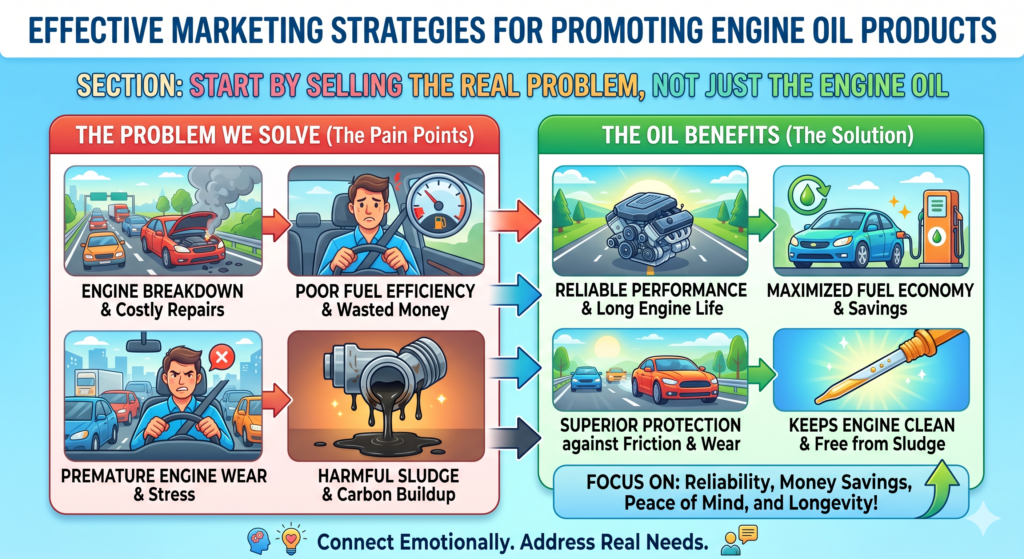
That is not how most buyers think.
A car owner is not walking around thinking, “I need better lubrication performance under high heat.” They are thinking, “I do not want my car to break down.” A bike owner is not thinking, “I need stable oil performance under friction.”
They are thinking, “I want my bike to feel smooth and powerful.” A fleet owner is not thinking, “I need a premium lubricant with advanced protection.” They are thinking, “I need my vehicles on the road, not sitting in the workshop.”
This is where smart marketing begins.
Before you sell the oil, sell the cost of ignoring the oil. Before you talk about what is inside the bottle, talk about what happens inside the engine when the wrong oil is used for too long.
Engine oil marketing works best when it begins with what the buyer already fears
Every strong engine oil campaign should begin with a real buyer fear. Not a fake fear. Not a dramatic fear. A real one.
People fear repair bills. They fear breakdowns on the road. They fear poor mileage. They fear engine noise. They fear smoke. They fear reduced resale value. They fear getting cheated by a mechanic. They fear buying the wrong product. They fear choosing a cheap oil today and paying for engine damage later.
These fears are already in the buyer’s mind. Good marketing does not create them. It gives them shape.
For example, instead of saying, “Our engine oil has superior wear protection,” a stronger message would be, “Your engine works hard every time you drive. The right oil helps protect it from daily wear before that wear becomes a repair bill.”
That is simple. It is clear. It connects the product to a real outcome.
The best engine oil marketing does not make the customer feel foolish. It makes them feel informed. It should not sound like a lecture from an engineer. It should sound like useful advice from someone who understands vehicles and cares about helping the customer make a better choice.
Most customers do not care about oil until something goes wrong
Engine oil is usually a low-attention product. Many customers only think about it when the service reminder comes, when the mechanic suggests a change, when the vehicle starts making noise, or when they see a leak, smoke, or drop in performance.
That means your marketing must work before the buying moment.
If you wait until the customer is standing at the counter, the decision may already be shaped by price, habit, or mechanic suggestion. But if your brand has educated the buyer earlier, the customer walks into the buying moment with a clear preference.
This is why educational content is so powerful for engine oil brands.
A customer may ignore a product ad, but they may read or watch content like “Why your engine sounds louder after long drives,” “How often should you change engine oil in city traffic,” or “Why cheap oil can cost more in the long run.”
These topics meet the customer where they are. They do not force the product into the conversation too early. They first help the buyer understand a problem. Then the product becomes the natural solution.
That is how trust is built.
The best message connects oil to money, comfort, and vehicle life
When writing ads, landing pages, product pages, social posts, or packaging copy, always connect the oil to things the buyer cares about in daily life.
A normal customer may not fully understand engine deposits, oxidation, or viscosity breakdown. But they understand repair costs. They understand fuel bills. They understand a smoother ride. They understand a vehicle that starts without trouble.
They understand getting better life from a car, bike, truck, tractor, or machine they paid hard-earned money for.
So the message should not stop at “protects against deposits.” It should explain what that means.
It means the engine stays cleaner.
A cleaner engine can run better.
A better-running engine can feel smoother.
A smoother engine can help the customer drive with more confidence.
This is the bridge your marketing has to build. Technical features matter, but they must be translated into human value.
A strong campaign should make the buyer feel the risk of waiting
Engine oil is easy to delay. A driver may think, “I will change it next week.” A rider may think, “The bike is still running fine.” A fleet owner may delay maintenance to save money this month.
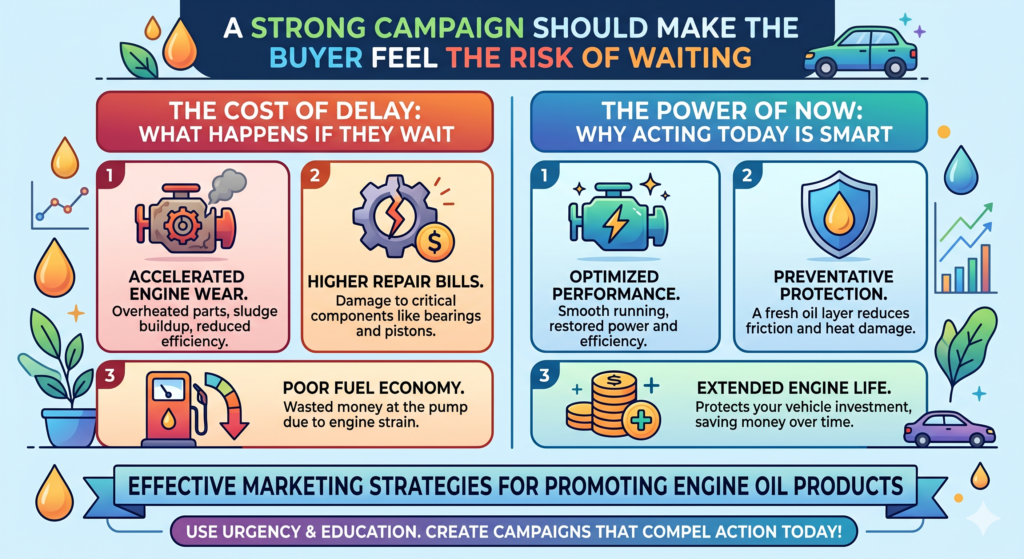
Your marketing must make delay feel risky without sounding pushy.
For example, a campaign can show that engine wear does not always announce itself loudly at first. It can happen slowly. The vehicle may still run, but the engine may already be working harder than it should. This kind of message is useful because it creates urgency in a calm and believable way.
Do not use scare tactics that feel fake. Do not say the engine will fail tomorrow if the customer does not buy your oil today. That sounds cheap. Instead, explain that small maintenance choices protect large investments.
A line like “An oil change costs little compared to engine repair” is simple, strong, and easy to believe.
That is the kind of idea engine oil brands should build around.
Position the engine oil for a clear buyer type instead of trying to impress everyone
Many engine oil brands try to sound perfect for every vehicle and every driver. That makes the message weak.
A product that claims to be ideal for city drivers, highway drivers, old engines, new engines, bikes, cars, trucks, tractors, premium users, budget buyers, mechanics, fleet managers, and retailers will not feel personal to anyone.
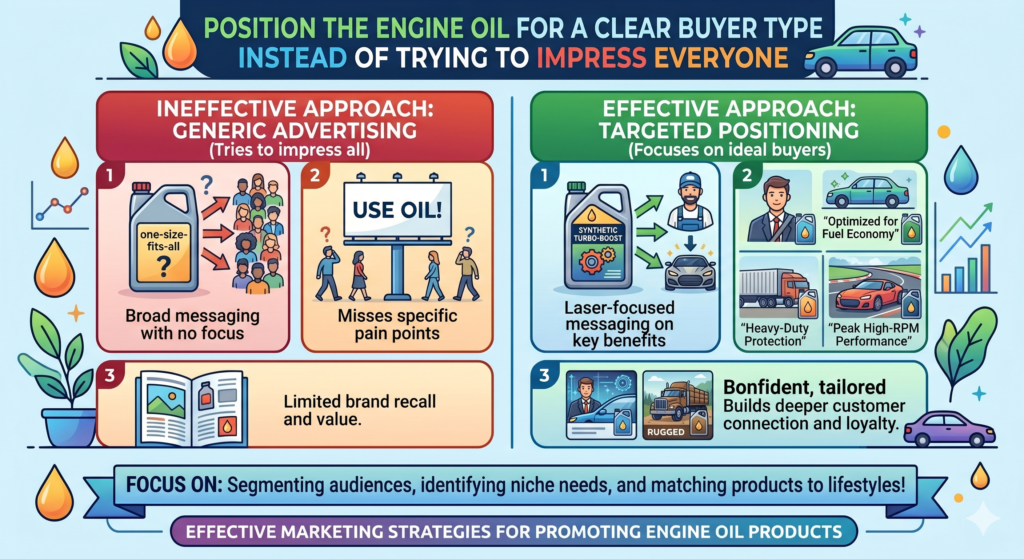
Strong marketing needs focus.
The buyer should be able to see the product and think, “This is made for me.”
That does not mean the brand can serve only one market. It means each product, campaign, and channel should have a clear target. One message can speak to city car owners. Another can speak to motorcycle riders. Another can speak to diesel fleet operators.
Another can speak to workshops. Another can speak to price-sensitive customers who still want reliable protection.
Product positioning should make the choice easier, not harder
The engine oil category is already confusing for many buyers. They see different grades, labels, claims, prices, and pack sizes. They may not know the difference between mineral oil, semi-synthetic oil, and fully synthetic oil. They may not know what 5W-30 or 10W-40 means. They may not know which oil is right for their vehicle.
If your marketing adds more confusion, you lose.
Positioning should make the choice simpler.
Instead of saying everything at once, give each product a clear job in the buyer’s mind. One oil can be positioned for daily city driving. One can be positioned for high-mileage engines. One can be positioned for heavy-duty diesel use.
One can be positioned for riders who want smooth pickup. One can be positioned for premium vehicles that need advanced protection.
This helps the buyer choose faster.
It also helps dealers, mechanics, and retailers sell faster. When your trade partners can explain the product in one simple sentence, your sales process becomes much stronger.
City drivers need a different message than highway drivers
City driving is hard on engines in a way many customers do not understand. Short trips, traffic, heat, frequent braking, and long idle time can make the engine work under stressful conditions. The vehicle may not travel far, but the engine may still be working a lot.
This is a strong marketing angle.
For city drivers, the message should focus on daily protection, heat control, engine cleanliness, and smooth performance in traffic. The copy should feel close to their life.
A campaign could say, “Your car may move slowly in traffic, but your engine is still working hard.”
That line is simple because it takes something the customer experiences every day and turns it into a reason to care about oil quality.
Highway drivers need a different message. They may care more about long-distance protection, stable performance, fuel use, and confidence during extended drives. Their fear is not traffic wear. Their fear is being far from help when something goes wrong.
So the message should change.
For them, the oil is not just a maintenance product. It is peace of mind on long routes.
Older vehicles need a message built around care and continued life
Owners of older vehicles often have a different mindset. Some are worried about rising repair costs. Some know their engine is not as smooth as before. Some want to keep the vehicle running for a few more years. Some may not want to spend on premium oil because the vehicle is old.
This is where the brand has to be careful.
Do not make older vehicle owners feel like they are driving something poor or weak. Instead, speak with respect. Show that older engines deserve proper care because they have already served the owner well.
The message can focus on protection for aging engines, smoother running, reduced stress, and better care for vehicles with more kilometers on the road.
A strong line could be, “A trusted engine deserves trusted protection.”
That feels human. It gives dignity to the vehicle and the owner.
Fleet buyers need numbers, proof, and uptime
Fleet buyers do not think like normal car owners. They care about cost per kilometer, service intervals, downtime, fuel use, engine life, warranty support, and supply reliability. Emotional ads alone will not move them.
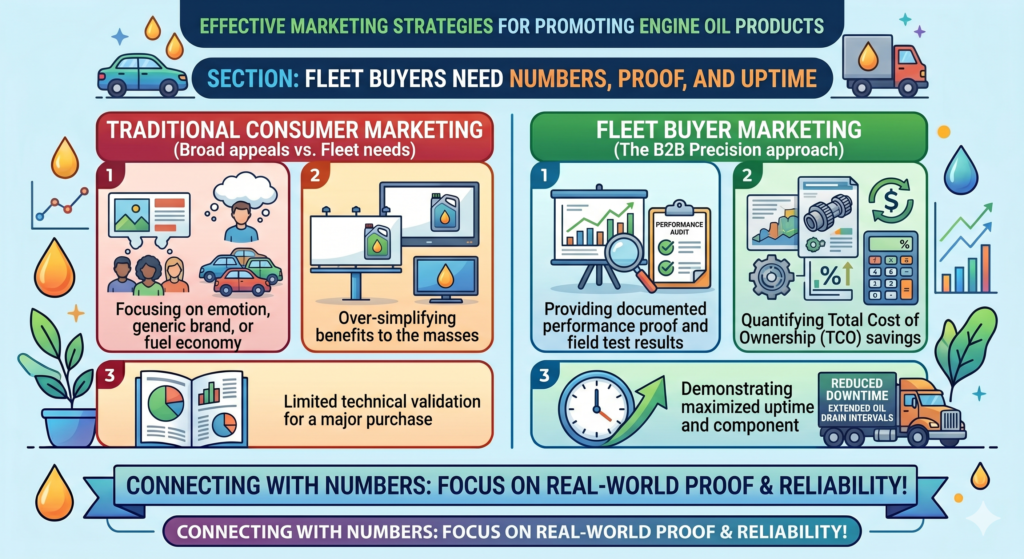
For fleet marketing, your strategy must be more practical and proof-heavy.
You need case studies, comparison charts, service support, bulk supply plans, maintenance education, and clear savings claims that can be backed up. Fleet owners want to know if your oil can help reduce breakdowns, extend engine life, improve maintenance planning, and keep vehicles moving.
The copy should be direct and business-focused.
A fleet buyer does not need a poetic campaign. They need a reason to trust you with vehicles that make them money every day.
Build trust before pushing the sale
Engine oil is a trust product. The customer cannot see it working after it is poured into the engine. They cannot easily judge quality by looking at the bottle. They cannot test the product in the shop. They have to believe the brand, the mechanic, the dealer, the review, the recommendation, or the proof shown to them.
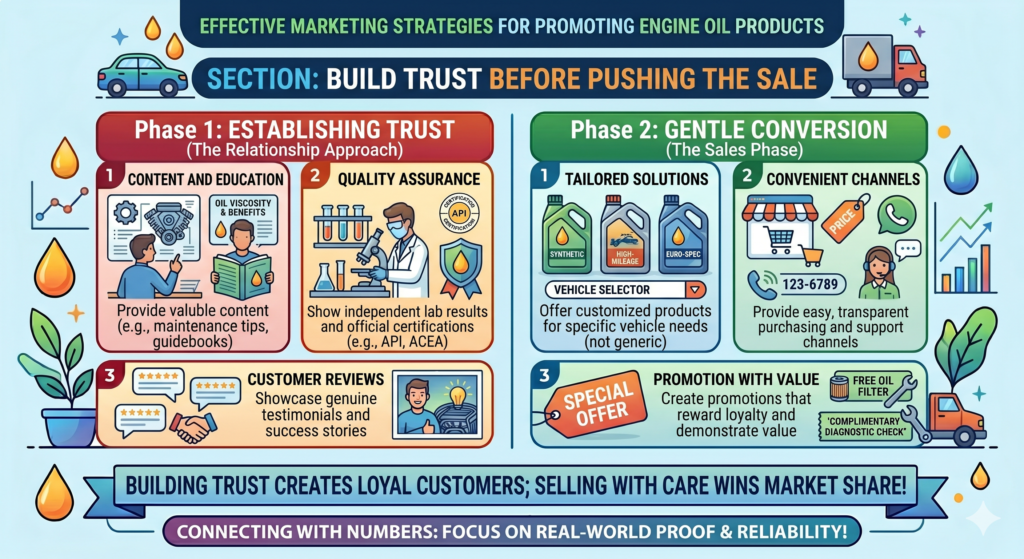
That means trust is not a nice extra. It is the core of the sale.
If customers do not trust the oil, a lower price may not save the brand. If they trust the oil, they may pay more because the risk of choosing wrong feels bigger than the savings from buying cheap.
Trust comes from proof, not loud claims
Many engine oil ads sound the same. They say the oil is powerful, advanced, superior, high performance, long lasting, or trusted. These words are common. Because they are common, they do not carry much weight unless they are backed by proof.
A better approach is to show why the buyer should believe you.
Proof can come from certifications, vehicle compatibility, lab testing, mechanic approval, user reviews, fleet results, long-term brand history, manufacturing standards, clear packaging information, and strong after-sales support.
The goal is not to overload the customer with technical data. The goal is to make the customer feel safe choosing your product.
Trust grows when the brand is clear, specific, and honest.
If the oil is best suited for certain vehicles, say so. If it meets certain standards, show them. If it is designed for certain conditions, explain them. If the customer should check the owner’s manual before choosing a grade, say that too.
Honest guidance builds more trust than aggressive selling.
Mechanics are often more trusted than brand ads
For many engine oil buyers, the mechanic is the real decision-maker. The customer may walk into the workshop with no fixed oil choice. Then the mechanic recommends a brand, and the customer agrees.
This is why mechanic marketing is one of the most important parts of engine oil promotion.
But this does not mean handing out posters and expecting loyalty. Mechanics recommend products that help them protect their reputation. If a mechanic suggests an oil and the customer later has trouble, the customer may blame the mechanic. So the mechanic needs to trust the product first.
Brands should train mechanics, support them, educate them, and make the product easy to explain. A mechanic should know which oil to recommend for which vehicle, what benefit to mention, how to answer price objections, and how to explain the difference between product variants.
When mechanics understand the product clearly, they become stronger sellers without sounding like salespeople.
Retailers need simple selling points they can repeat
Retailers also influence engine oil sales, especially when customers buy from spare parts shops, fuel stations, supermarkets, and local auto stores. But retailers are busy. They cannot study every product deeply. They need quick, simple selling points.
Your brand should give retailers short and clear product explanations.
For example, one product may be “best for daily city cars.” Another may be “better for older engines.” Another may be “made for heavy-duty diesel use.” Another may be “for riders who want smoother performance.”
These simple ideas help retailers guide customers without confusion.
Retail marketing should also make the pack easy to understand. If the bottle looks crowded with technical words, the customer may hesitate. If the front label clearly shows the main use case, grade, vehicle type, and benefit, the product becomes easier to pick.
Customer reviews should be used as trust assets
Engine oil brands often underuse customer reviews. This is a mistake, especially online.
A good review can do what an ad cannot. It can make the product feel real. When buyers see other drivers saying the engine feels smoother, the noise reduced, mileage stayed steady, or the oil worked well for their vehicle, the product becomes easier to trust.
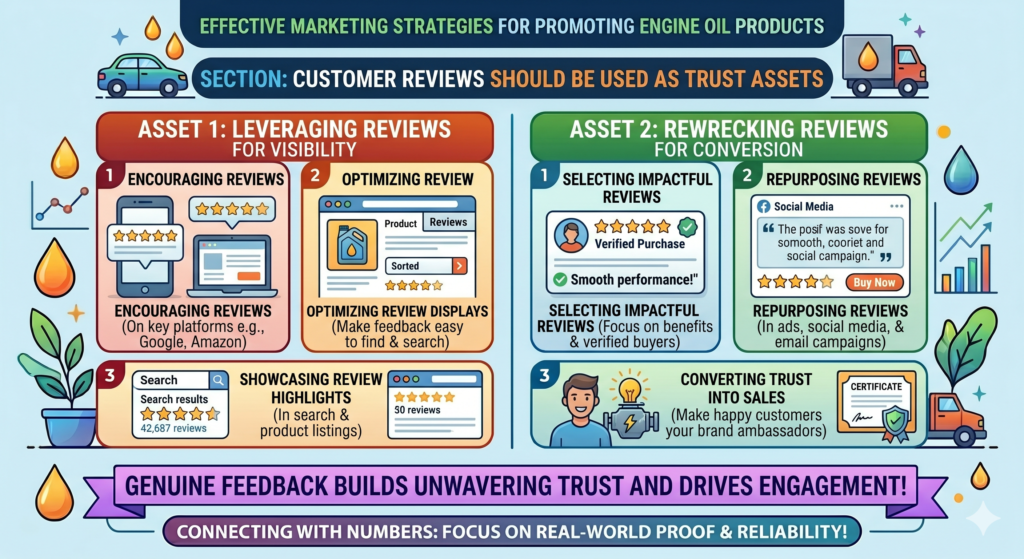
Reviews should be collected, organized, and used across product pages, social posts, ads, dealer material, and marketplace listings.
But the best reviews are not vague. “Good product” is fine, but it does not sell strongly. A better review says what vehicle the customer used it in, what problem they were trying to solve, and what result they noticed.
Your post-sale marketing should guide customers to leave useful reviews. Ask them to share the vehicle type, driving condition, and what they liked after using the oil. This makes future reviews more helpful and more believable.
Use education as the main engine of demand
Engine oil buyers often need education before they need promotion. If they do not understand the risk, the difference, or the right choice, they will often buy based on price or habit.
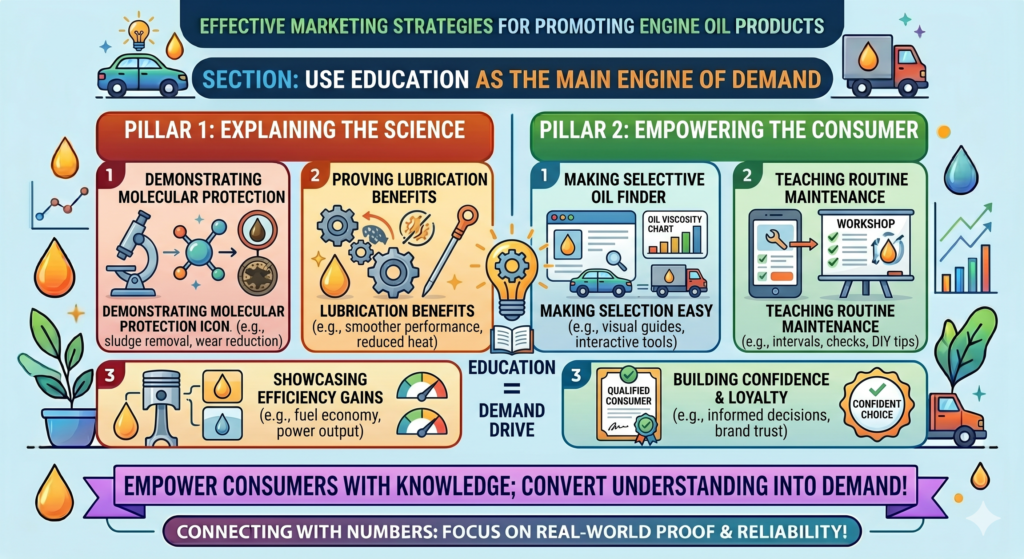
Education changes that.
When a brand teaches well, it becomes more than a seller. It becomes a guide. That is powerful because people trust guides more than pushy brands.
Educational content should answer the questions buyers are already asking
The best content ideas are not hidden in a boardroom. They are already inside customer conversations.
Customers ask mechanics when to change oil. They ask which grade is right. They ask why synthetic oil costs more. They ask if they can mix oils. They ask if engine oil affects mileage. They ask why the engine sounds rough. They ask if cheap oil is safe. They ask whether old vehicles need special oil.
Each of these questions can become a blog post, video, short reel, service poster, WhatsApp message, email, product page section, or dealer training note.
This kind of content works because it begins with real buyer doubt.
A person searching “how often should I change engine oil” may not be ready to buy in that exact second, but they are close to a maintenance decision. If your brand gives a clear and helpful answer, you earn attention before the sale happens.
That is how content creates demand.
Blog content should be practical, not written for search engines alone
Search traffic is useful, but content should not sound like it was written only to rank. A blog about engine oil must feel helpful to a real person.
The writing should be simple. The advice should be clear. The examples should feel close to daily driving. The article should explain what to do next.
For example, a weak blog says, “Engine oil is essential for lubrication and performance.” That is true, but it is dull.
A better blog says, “If your car spends most of its time in traffic, your engine may be working harder than you think. Even when the car is barely moving, heat and friction are still building inside the engine. That is why oil choice and oil change timing matter.”
This sounds more human. It explains the problem in a way the reader can feel.
Every blog should lead the customer toward a smarter action. That action may be checking the oil grade, booking an oil change, finding a nearby dealer, comparing product types, or asking a mechanic about the right option.
Video content should show what words cannot explain quickly
Engine oil is invisible once it goes into the engine, so video can help make the value easier to understand.
Short videos can explain simple topics like oil color, oil change timing, engine noise, signs of old oil, differences between oil types, and mistakes drivers make. Workshop videos can show mechanics explaining why they choose a product. Animation can show how oil moves through the engine and protects metal parts.
The key is to keep videos simple.
Do not make every video sound like a technical class. A strong engine oil video should answer one question at a time. It should open with a real problem, explain it in plain words, and end with a clear next step.
For example, a video can start with, “Does your engine sound rough after long traffic hours?” That is a stronger opening than, “Today we will discuss lubricant performance.”
The first line feels like the customer’s life. The second feels like a lecture.
Local language content can build deeper market trust
Engine oil is often sold through local networks. Drivers, riders, mechanics, and shop owners may feel more comfortable in their own language. If your brand only speaks in formal English, it may sound distant in many markets.
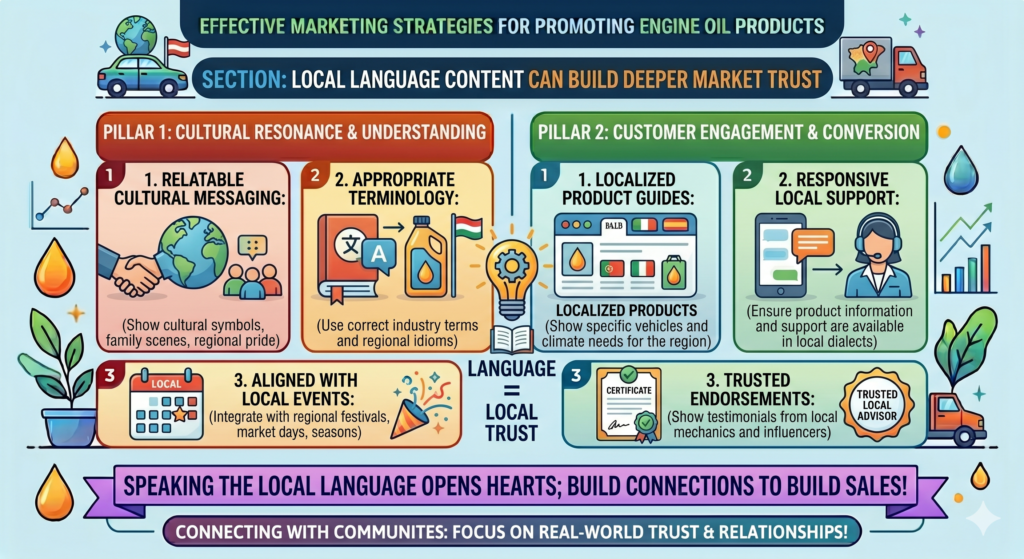
Local language content can make the brand feel closer.
This does not mean simply translating the same ad. It means adapting the message to local driving habits, climate, road conditions, vehicle types, and buyer behavior.
For example, in a hot region, the content can focus on heat and engine stress. In a farming area, it can speak about tractors, long working hours, and seasonal maintenance. In a city, it can focus on traffic and stop-start driving. In a region with many two-wheelers, it can speak directly to riders.
The closer the content feels to the buyer’s world, the stronger it becomes.
Win the mechanic network with respect, training, and real support
Mechanics can make or break an engine oil brand. In many markets, they are not just service providers. They are trusted advisors. Customers ask them what to use, when to change, and which brand is worth buying.
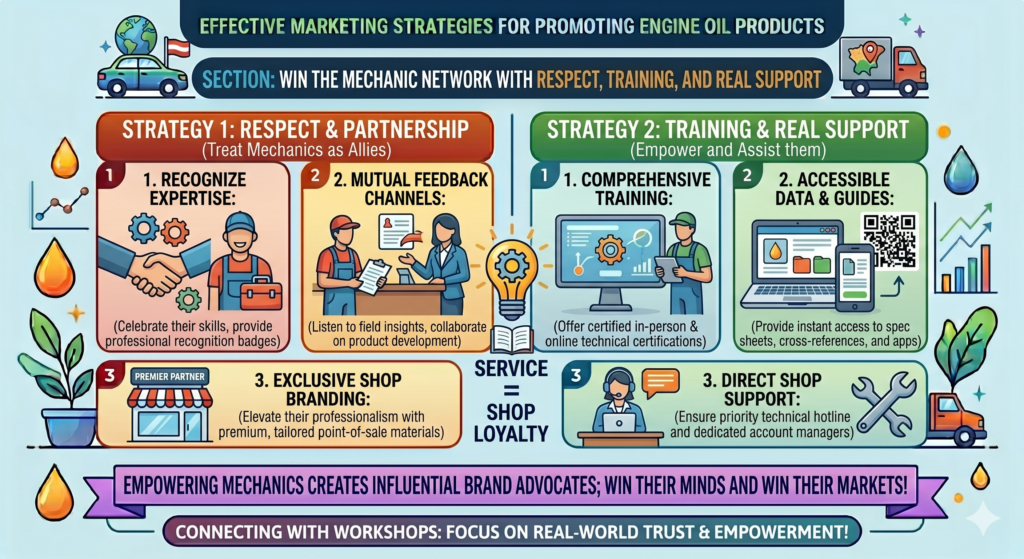
This makes mechanic relationships a major growth channel.
But many brands treat mechanics only as a sales route. They offer schemes, gifts, posters, and discounts, but they do not build real respect. That approach may create short-term push, but it rarely builds deep loyalty.
A better strategy is to help mechanics become more trusted, more skilled, and more successful.
Mechanics support brands that support their reputation
A mechanic’s reputation depends on the products they recommend. If the oil performs well, the customer may return. If the customer feels the vehicle runs better, the mechanic gains trust. If the product causes doubt, the mechanic may lose future business.
So the brand must reduce the mechanic’s risk.
This can be done through clear product training, easy recommendation charts, warranty support, quick complaint handling, and simple customer education material the mechanic can use in the workshop.
A mechanic should not have to guess which oil to use. The brand should make the decision easy.
When mechanics feel confident, they recommend with more force.
Training should be short, useful, and repeatable
Mechanic training does not need to be long or formal. In fact, short and practical training often works better.
Teach mechanics how to explain oil grades in simple words. Teach them how to handle customers who ask for cheaper oil. Teach them how to identify driving conditions that need better protection. Teach them how to explain synthetic oil without using complex terms. Teach them how to suggest the right oil change timing based on real use.
The training should not feel like a corporate presentation. It should feel like a tool that helps them earn trust and increase service value.
A good training session should give the mechanic words they can use the same day with customers.
For example, instead of saying, “This oil offers superior thermal stability,” the mechanic can say, “This oil holds up better when the engine gets hot, especially in traffic or long rides.”
That is the kind of sentence that sells.
Workshop branding should educate customers while they wait
Many customers spend time waiting at service shops. This is a perfect moment for engine oil education.
Wall posters, counter cards, service reminder stickers, oil change charts, and small display stands can help shape the buyer’s decision. But the content must be useful, not just decorative.
A poster that only shows a bottle and a slogan may not do much. A poster that says, “Three signs your engine oil may need changing” can start a conversation. A counter card that explains “Why the right oil grade matters” can reduce customer doubt. A service sticker that reminds the next oil change date can bring the customer back.
Workshop branding should help the mechanic sell without forcing a hard pitch.
Loyalty programs should reward quality behavior, not just volume
Many engine oil brands run mechanic loyalty programs. These can work, but they should be designed carefully.
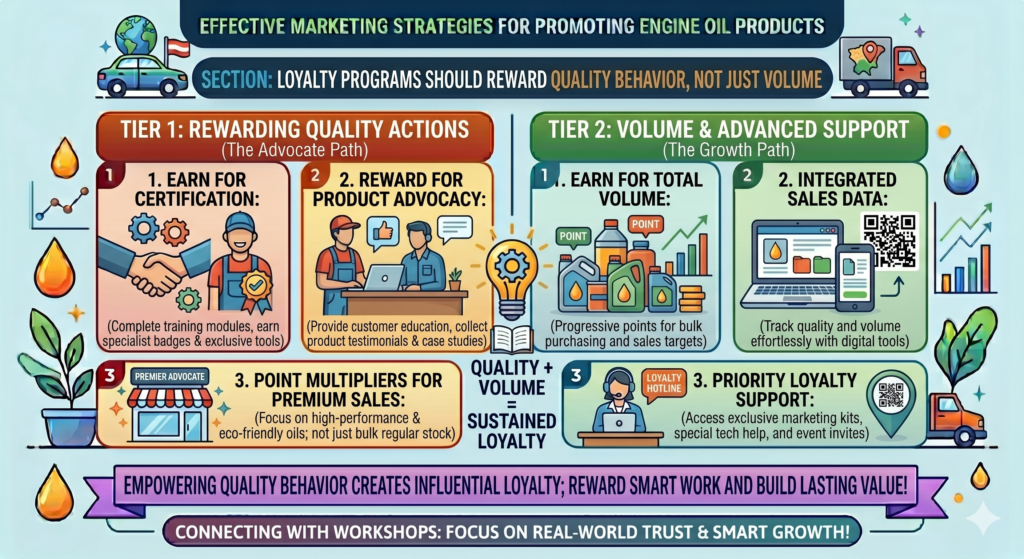
If the program only rewards volume, mechanics may push the product even when it is not the best fit. That can damage trust. A smarter program rewards training completion, correct product recommendation, customer education, repeat purchase, and service quality.
The goal is not just to make mechanics sell more bottles. The goal is to make them better brand partners.
A mechanic who understands the product, uses it properly, explains it clearly, and brings customers back is more valuable than one who only sells because of a short-term reward.
That is the difference between a scheme and a real channel strategy.
Make retail shelves easier to win with clear packaging and simple in-store messaging
Engine oil is often bought in a rushed setting. The customer may be at a spare parts shop, a service center, a fuel station, or a large store. They may not have time to compare every label. They may not fully understand the grades. They may ask the shop owner for help, or they may simply pick the brand they recognize.
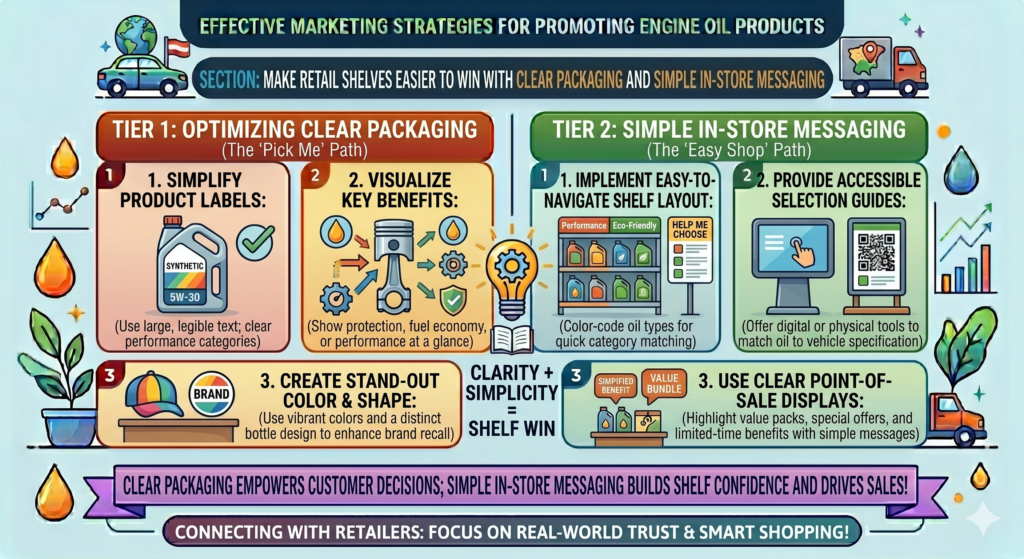
This means the shelf is not just a place where the product sits. It is a selling space.
Your packaging, display, and in-store message must do a lot of work quickly. The customer should be able to understand what the oil is for, why it is good, and why it is worth choosing without needing a long explanation.
The bottle should explain the product before the salesperson does
Many engine oil packs look busy. They carry too many claims, too many symbols, and too many technical words. This may look impressive to the company, but it can confuse the buyer.
Good packaging should guide the eye. The customer should quickly see the vehicle type, oil grade, main benefit, and trust proof. If the oil is for motorcycles, that should be clear. If it is for diesel engines, that should be clear. If it is made for high-mileage engines, that should be clear. If it is fully synthetic, that should be easy to notice.
A confused buyer often delays, asks for the cheapest option, or lets the retailer decide. A clear pack helps the buyer feel more confident.
Strong packaging turns doubt into faster decisions
Every package should answer the buyer’s silent questions. Is this right for my vehicle? Is this safe? Is this a trusted product? Why does it cost this much? What makes it different from the one next to it?
If the front of the pack only says “premium protection,” it does not answer enough. A stronger pack might say that the oil is made for daily city driving, long engine life, smoother running, or heavy-duty use. The wording should still be short, but it should be specific.
Specific words sell better than broad words.
“Helps protect engines in daily traffic” is more useful than “advanced performance.” “Made for high-mileage cars” is more useful than “next-generation formula.” “For diesel engines under heavy load” is more useful than “extreme power.”
Simple does not mean weak. Simple means easy to choose.
In-store displays should reduce price pressure
When a customer sees many oil brands together, price becomes very visible. If your product costs more, you must explain the reason before the customer asks.
A good display can do this.
It can show that the oil helps protect the engine from wear. It can show that the right oil may reduce future repair risk. It can show that a small saving on cheap oil may not be worth the risk to a valuable engine. It can show product fit by vehicle type. It can show mechanic approval, warranty support, or performance proof.
The goal is to shift the buyer’s mind from “Which oil is cheapest?” to “Which oil is safer for my engine?”
That shift is important.
In-store marketing should not attack cheaper brands. It should calmly explain the value of choosing better protection. When the message feels helpful, it builds trust. When it feels too aggressive, it creates doubt.
Retailers should get sales tools that are easy to use during busy hours
Retailers do not have time for long speeches. They need quick tools.
A small comparison card can help them explain the difference between product variants. A simple oil recommendation chart can help them match oils to vehicle types. A counter mat can show common oil change mistakes. A small QR code can let customers check the right grade or watch a short video.
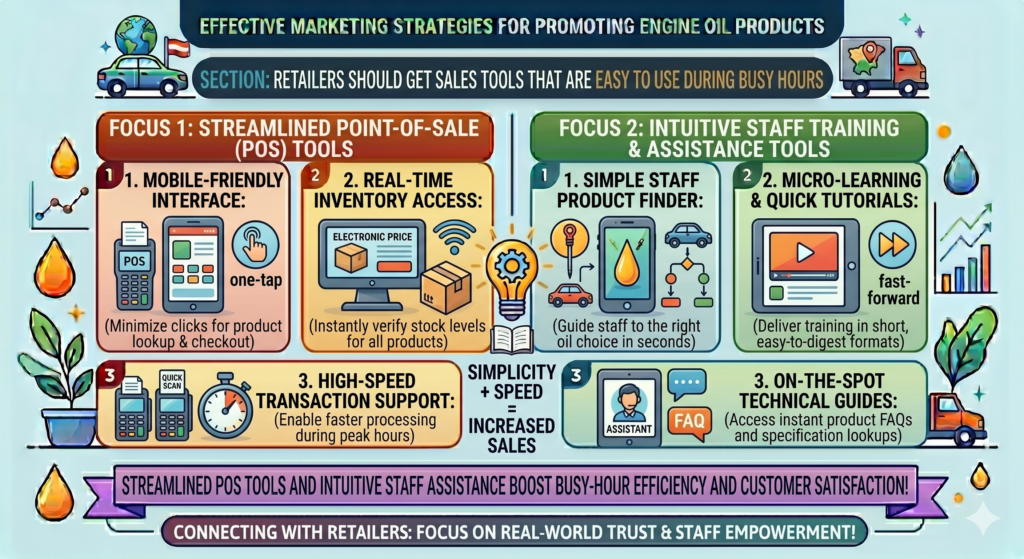
These tools should make the retailer’s job easier. If they are too complex, they will not be used.
A strong retail program should think like the shop owner. What questions do customers ask every day? Where do customers get confused? What objections stop the sale? What answer can the retailer give in ten seconds?
When you design for the real shop floor, your brand becomes easier to sell.
Build a local-first marketing plan because engine oil sales are often won close to the buyer
Engine oil is a category where local trust matters a lot. People may see national ads, but the final purchase often happens through a nearby workshop, parts shop, petrol pump, dealer, or online seller that delivers quickly.
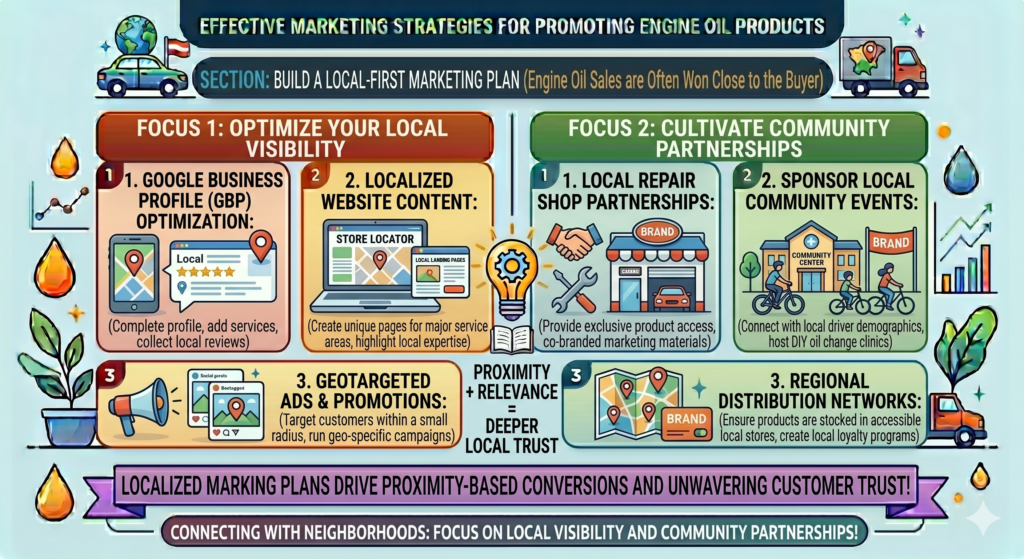
This means your marketing should not only chase big reach. It should also build local presence.
A customer may remember your brand from an ad, but they still need to see it near them. A mechanic may like your product, but they need steady supply. A retailer may want to sell it, but they need demand in the area. A driver may be interested, but they need to know where to buy or change the oil.
Local marketing connects all these points.
Local visibility turns brand awareness into actual sales
Awareness is useful, but it is not enough. A customer can know your brand and still buy another oil if yours is not visible, available, or recommended at the moment of need.
This is why local marketing must connect ads, retail, workshops, and availability.
If you run ads in a city, make sure nearby dealers have stock. If you promote a product for bike riders, make sure local bike workshops know how to recommend it. If you run a fuel economy message, make sure retailers can explain it. If you create demand in one area but the product is hard to find, you waste money.
Local marketing works best when sales and marketing move together.
Geo-targeted ads should send buyers to nearby purchase points
Digital ads can be powerful for engine oil, but only when they lead to a clear next step. A person who sees an ad should not be left wondering where to buy.
Geo-targeted campaigns can promote nearby workshops, retailers, oil change camps, fuel stations, or online delivery options. The ad can speak to local driving conditions too.
In a hot city, the message can focus on heat protection. In a crowded metro area, it can focus on stop-start traffic. In a highway-heavy region, it can focus on long-route confidence. In an industrial area, it can focus on diesel and heavy-duty use.
This makes the message feel more relevant.
A general ad says, “Protect your engine.” A local ad says, “Protect your engine through daily city traffic.” That small change can make the message feel closer and more useful.
Oil change camps can create trial and build community trust
Oil change camps are old-school, but they still work when done well. They create real contact between the brand and the buyer. They also give the brand a chance to educate people while the product is being used.
A good oil change camp should not be treated like a one-day sales stunt. It should be part of a larger plan.
Before the camp, promote it locally through workshops, WhatsApp groups, social posts, posters, and retailer networks. During the camp, explain the product clearly, check customer needs, capture vehicle details, and offer service reminders. After the camp, follow up with care tips, next oil change reminders, and nearby purchase points.
This turns a simple event into a customer relationship.
Local partnerships can make the brand feel familiar faster
Engine oil brands can grow faster when they partner with trusted local players. These may include garages, driving schools, taxi groups, bike clubs, transport unions, farm equipment service providers, local car communities, and fleet service centers.
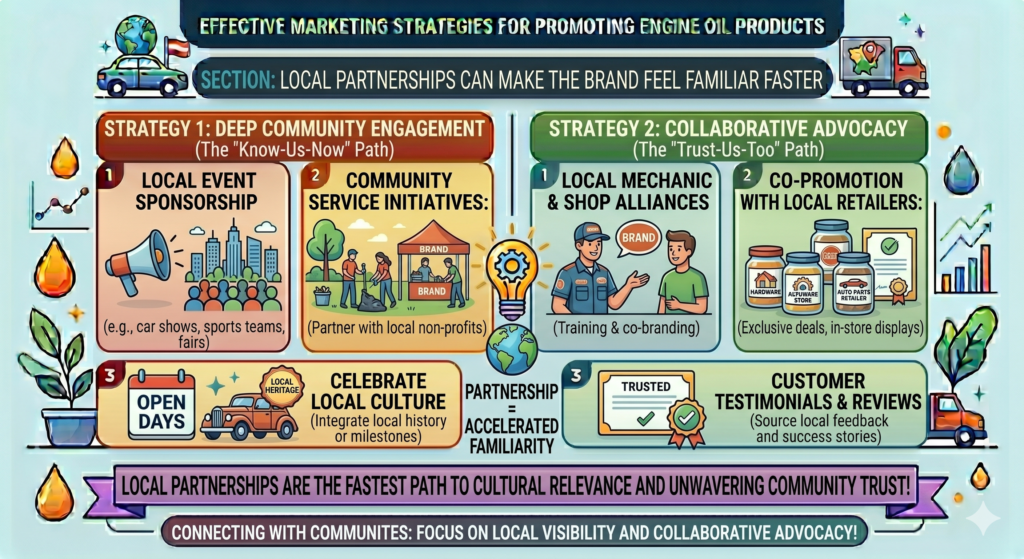
The key is to choose partners who already have trust with the audience.
A small taxi association may influence many vehicle owners. A respected bike workshop may shape what riders buy. A local garage owner may be more trusted than a large brand ad. A farmer equipment dealer may guide oil choices for tractors and machines.
Local partnerships work because they borrow trust, but they must be handled with care. The brand should not simply pay for promotion and disappear. It should offer training, support, product knowledge, and reliable supply.
When the partner feels respected, the recommendation becomes stronger.
Use digital content to capture buyers before they reach the shop
Many engine oil purchases are influenced before the customer visits a shop. Buyers search online, watch videos, read reviews, compare prices, check product fit, and ask questions in forums or social groups. Even if they later buy offline, digital content can shape their decision.
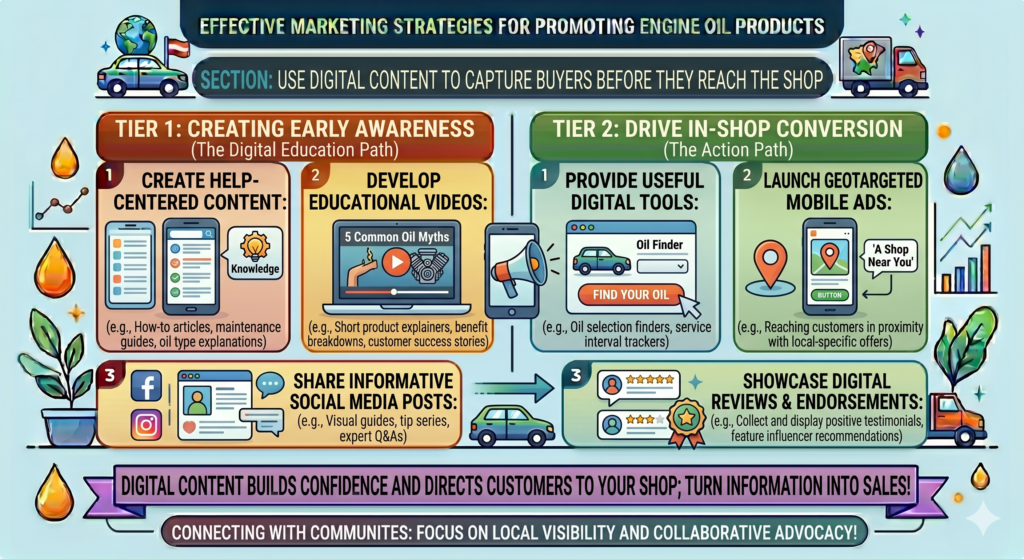
This is why engine oil brands need strong digital visibility.
The goal is not to post random content every day. The goal is to own the questions, doubts, and moments that happen before purchase.
Search content should target real maintenance questions
People search when they are unsure. That makes search one of the best channels for engine oil brands.
They may search for how often to change oil, what oil grade means, whether synthetic oil is worth it, why engine oil turns black, what happens if oil is not changed, or which oil is best for their vehicle type.
Each search is a chance to build trust.
A strong SEO strategy should not only target product keywords like “best engine oil.” Those keywords are useful, but they are crowded and often price-driven. The bigger opportunity is to answer practical questions across the full maintenance journey.
For example, a buyer may first search, “Why is my engine making noise?” Later, they may search, “Can old engine oil cause engine noise?” Then they may search, “Best engine oil for old car.” If your brand appears across this journey, you become familiar before the purchase.
SEO pages should guide the reader toward the right product without sounding pushy
Educational SEO content should not read like a hidden ad. It should help first and sell second.
A good article explains the issue clearly, gives useful advice, and then shows how the right product helps. The product should enter the article only when it feels natural.
For example, in an article about city driving and engine stress, the brand can explain how traffic creates heat and frequent engine load. Then it can guide the reader to choose oil suited for stop-start conditions. After that, it can show the right product from the brand’s range.
This flow feels helpful.
The reader learns something, sees the need, and then gets a clear next step. That is much better than forcing product links into every paragraph.
Product pages should answer objections before the buyer leaves
Many engine oil product pages are too thin. They show the pack, price, grade, and a few claims. That is not enough for a buyer who is unsure.
A strong product page should answer the questions that stop people from buying. Who is this oil for? Which vehicles can use it? What kind of driving is it best suited for? What does the grade mean? How often should it be changed? Is it suitable for older engines? Is it safe for long drives? What standards does it meet? What do customers say?
The page should also make buying easy. It should show pack sizes, nearby availability, online buying options, and a clear call to action.
When a page answers doubts clearly, conversion improves.
Short videos should turn common doubts into simple answers
Short videos are useful because they fit how people consume content today. But they must be planned with purpose.
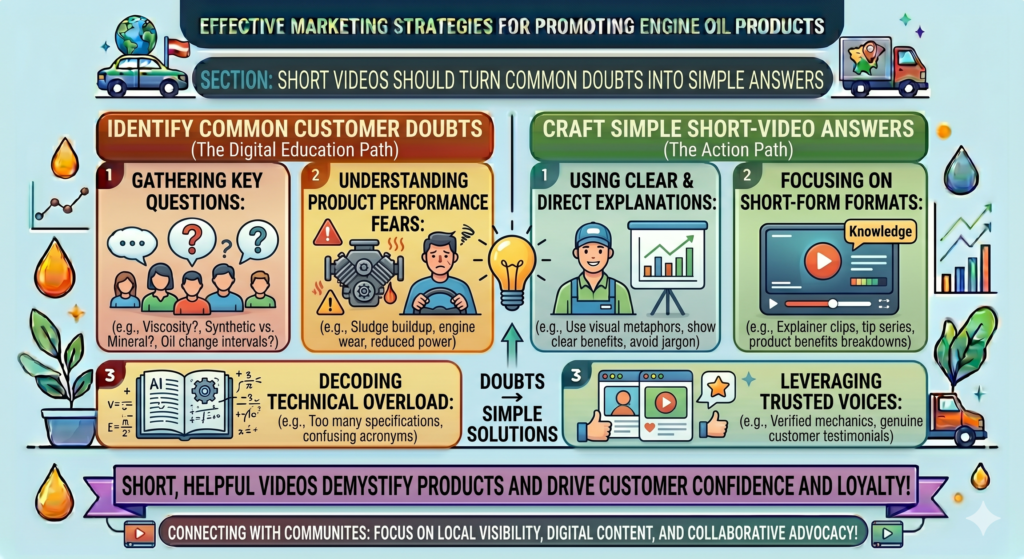
A strong short video should answer one small question. It should not try to explain everything about engine oil in thirty seconds.
One video can explain why oil turns dark. One can explain why oil change timing matters. One can explain what happens in traffic. One can explain how to check oil level. One can explain why the cheapest oil may not be the best choice. One can show a mechanic answering a common customer question.
The format should feel real and useful. A mechanic speaking in a workshop may build more trust than a polished studio video. A simple demonstration may work better than a heavy animation. A clear voice, real setting, and practical answer can go a long way.
Make marketplace listings work harder for conversion
Online marketplaces are now a serious sales channel for engine oil. Many customers compare brands, prices, reviews, delivery speed, and pack sizes before buying. Some know exactly what they want. Others are still unsure.
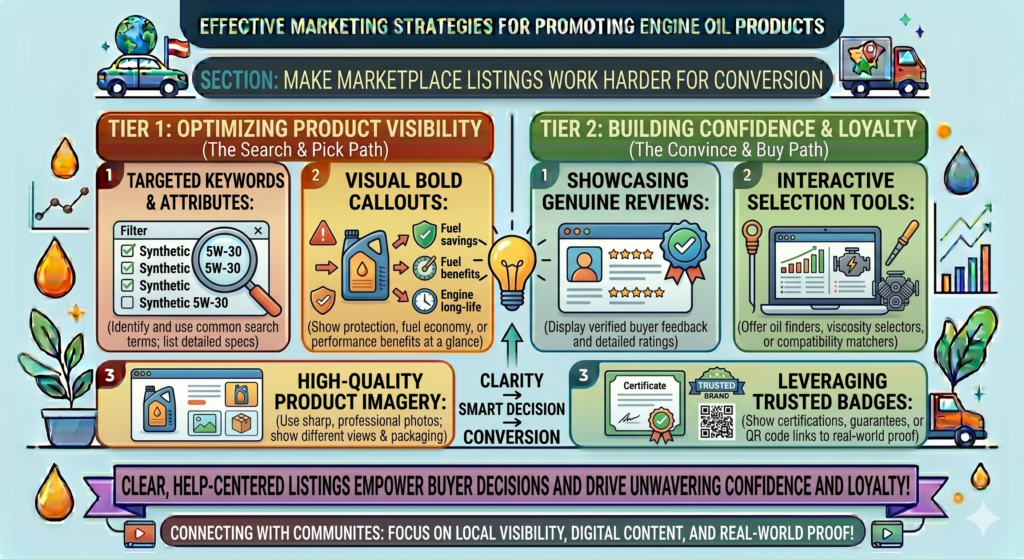
Your listing must serve both groups.
For the buyer who knows the product, the listing should make purchase easy. For the buyer who is comparing, it should make the value clear. For the buyer who is unsure, it should reduce risk.
Marketplace success depends on clarity, proof, and confidence
On marketplaces, your product is surrounded by competitors. The customer can compare prices in seconds. This makes weak listings very expensive.
A good listing title should be clear. It should include the brand, oil type, grade, vehicle type, and pack size. The main image should be clean and easy to read. The secondary images should explain key benefits, usage fit, certifications, and how to choose the right oil.
Do not waste image space on vague claims. Use it to answer buying questions.
If the customer has to zoom in, guess, or search elsewhere, you may lose the sale.
Images should educate, not just display the bottle
Many brands use marketplace images only to show the pack from different angles. That is useful, but not enough.
Secondary images should act like a mini sales page. One image can explain the main benefit. One can show the right vehicle type. One can explain the driving condition the oil is built for. One can show trust marks. One can show how the product helps protect the engine. One can show pack size choices.
The customer may not read the full description. But they will often scroll through images. So images must carry the core message.
A strong image might say, “Built for daily city driving and engine heat.” Another might say, “Helps protect against wear during frequent starts and stops.” Another might say, “Check your vehicle manual for the right oil grade.”
This mix of selling and guidance builds trust.
Reviews and ratings must be managed actively
Marketplace reviews can strongly affect engine oil sales. A product with strong reviews feels safer. A product with unanswered complaints feels risky.
Brands should not treat reviews as something that happens by chance. They should actively request reviews from real buyers, respond to concerns, and use feedback to improve product pages.
If customers often ask the same question, add the answer to the listing. If buyers are confused about compatibility, improve the title and images. If people praise smoother performance, use that insight in future copy. If customers complain about leakage or damaged packs, fix packaging and delivery quality.
Reviews are not just social proof. They are market research.
Price offers should protect the brand’s value
Discounts can help online sales, but too much discounting can harm trust. If engine oil is always sold at a heavy discount, customers may start to doubt the real value. Retail partners may also feel undercut.
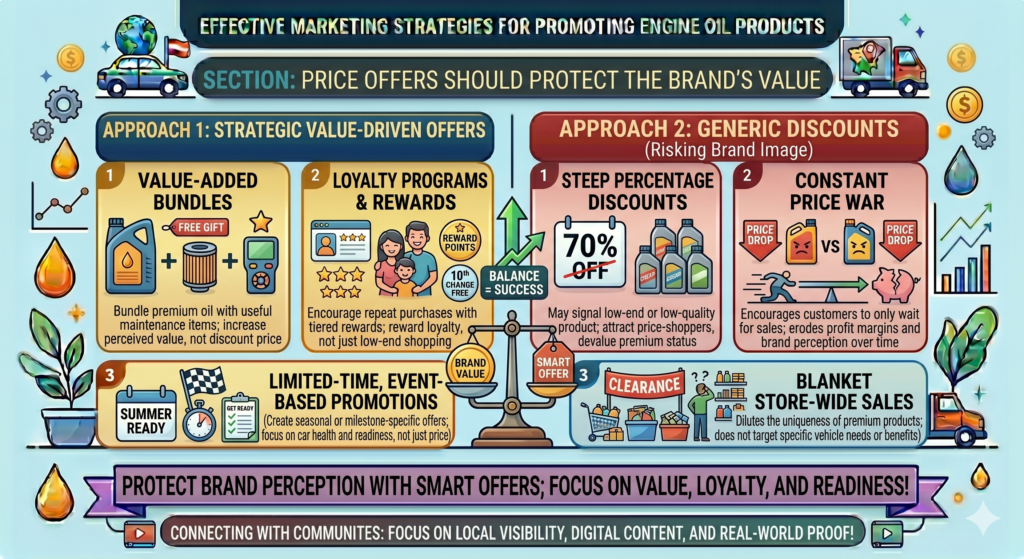
A better approach is to use offers with purpose.
Bundle packs can work for repeat users. Service reminder offers can bring customers back. First-time trial deals can help new buyers test the product. Fleet or bulk packs can serve heavy users. Limited offers around maintenance seasons can create urgency.
The price should support the brand strategy, not weaken it.
Engine oil is a protection product. If the brand trains customers to buy only when the price drops, it becomes harder to defend quality.
Turn product claims into stories buyers can believe
Every engine oil brand has claims. The hard part is making those claims believable.
Customers have heard “best protection,” “high performance,” “advanced technology,” and “trusted quality” many times. These words alone do not move people much anymore. They need context. They need proof. They need stories.
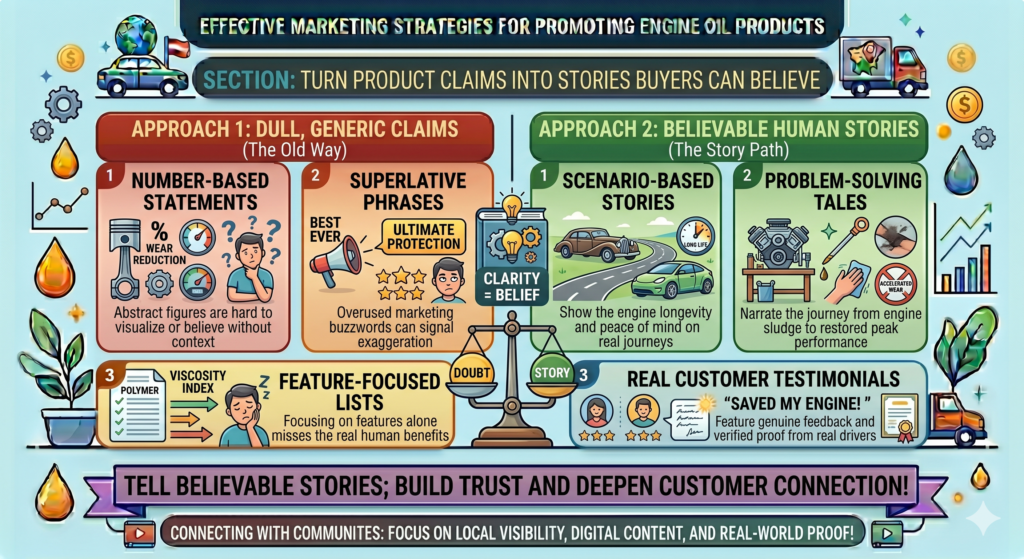
A story does not have to be long or dramatic. It simply has to show the product helping in a real situation.
Strong stories make invisible benefits feel real
Engine oil works inside the engine, where customers cannot see it. That makes storytelling important.
A story can show a delivery rider who depends on his bike through long hours. It can show a taxi driver who needs his car running every day. It can show a family preparing for a long trip. It can show a truck owner trying to reduce downtime. It can show a farmer using equipment during a busy season.
These stories help customers understand why oil matters.
The product becomes part of a larger promise: fewer worries, smoother work, better care, and longer vehicle life.
Customer stories should focus on real use, not perfect acting
The best customer stories feel honest. They do not need overproduced acting or dramatic lines. A real mechanic, driver, rider, or fleet owner explaining why they trust a product can be more powerful than a glossy ad.
The story should include the problem, the usage condition, the product choice, and the result noticed.
For example, a rider may say the bike feels smoother during daily office rides. A taxi driver may say he chooses oil carefully because his car earns for his family. A mechanic may say he recommends the oil for customers who drive in heavy traffic. A fleet owner may say planned oil changes help reduce surprise downtime.
These stories work because they feel close to real life.
Brand stories should connect to care, not just performance
Engine oil marketing often tries to sound tough. That can work in some markets, especially for heavy-duty oils. But care is also a strong emotional angle.
People care about their vehicles because those vehicles carry their work, family, time, and money. A car may take children to school. A bike may help someone reach work. A truck may support a business. A tractor may support a farming season.
When the brand speaks to this care, the message becomes deeper.
The oil is no longer just a fluid. It becomes a way to protect something the buyer depends on.
Proof stories should be simple enough for sales teams to repeat
Stories are not only for ads. They should also help sales teams, retailers, and mechanics explain the product.
If a salesperson cannot repeat your story in a simple way, it is too complex.
A strong proof story may be, “This oil is made for drivers who spend hours in traffic, where engines heat up even when the car moves slowly.” That is easy to remember. It is easy to explain. It is easy to connect to a customer’s life.
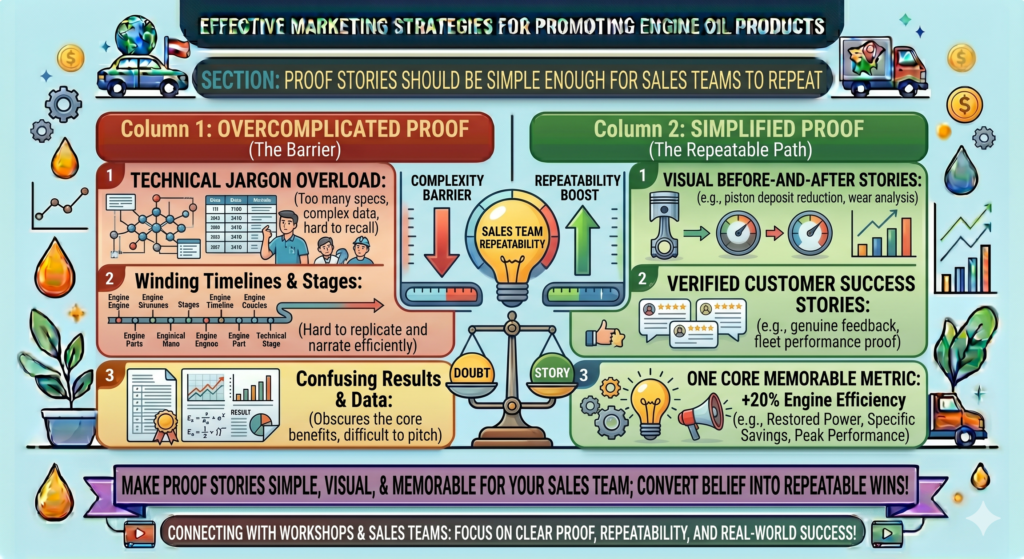
That is the test of good messaging.
It should travel well from brand team to sales team, from sales team to distributor, from distributor to retailer, from retailer to customer, and from mechanic to driver.
Conclusion
Promoting engine oil products is not about shouting louder than other brands. It is about earning trust before the buyer chooses. The strongest strategy starts with real customer worries: engine life, repair costs, smooth driving, fuel use, and safety on the road.
From there, the brand must educate clearly, support mechanics, guide retailers, improve packaging, build local demand, and make online buying simple.
Engine oil is a protection product, so every message should prove one thing: this oil helps the customer take better care of a vehicle they depend on. When marketing does that well, sales follow naturally.














Comments are closed.