
WinSavvy Editorial Standards
How this article was created
A body shop does not grow just because it does good repair work. That may sound unfair, but it is true. Many great shops fix dents, paint cars, handle insurance work, and treat customers well, yet still struggle to keep the bays full every week. The problem is not always skill. The problem is often visibility In this guide, we will look at how your body shop can attract more customers using smart, simple, and practical marketing ideas. We will cover ways to improve your online presence, turn happy customers into referrals, use local search, build stronger community trust, create better offers, and make every marketing dollar work harder.
Start by understanding why people choose one body shop over another
Most people do not choose a body shop the same way they choose a restaurant, a gym, or a clothing store. They usually do not shop for collision repair when life is calm. They search when something bad has happened.
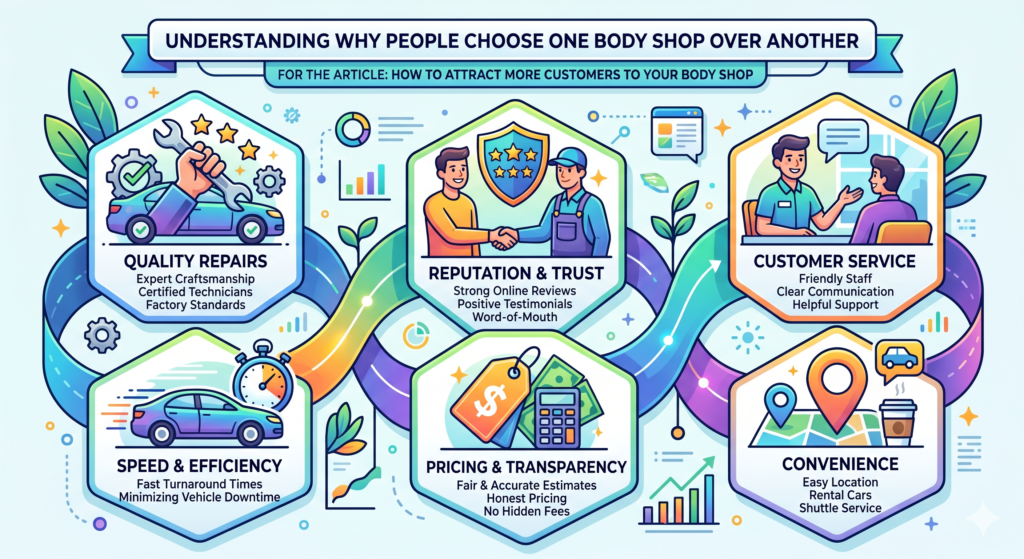
Their car may have been hit in a parking lot. They may have backed into a pole. They may have been in an accident on the way to work. They may be dealing with insurance, police reports, rental cars, and family stress all at once.
That means your marketing has to meet people in a very specific state of mind. They are not just looking for the cheapest repair. They are looking for relief. They want someone who can explain what happens next. They want to know whether their car will look right again.
They want to avoid being taken advantage of. They want the process to feel simple.
This is where many body shops get marketing wrong. They talk only about tools, paint booths, frame machines, and years in business. Those things matter, but they are not always what the customer is thinking about first.
The customer is asking, “Can I trust this shop with my car?” They are asking, “Will they help me deal with the insurance company?” They are asking, “Will I get my car back on time?” They are asking, “Will the repair look like nothing ever happened?”
Your marketing should answer those questions before the customer has to ask them. When your website, Google profile, social media posts, ads, reviews, photos, and phone process all give clear answers, you remove doubt. And when you remove doubt, more people call.
The best body shop marketing starts with trust, not attention
Getting attention is easy for a few seconds. You can run a loud ad, post a discount, or put a big sign near the road. But attention alone does not bring steady customers. Trust does.
A customer may see your name three or four times before they need you. They may pass your shop on the way to work. They may see your repair photos on Facebook. They may notice your Google reviews. They may hear your name from a neighbor. Then, when an accident happens, your shop already feels familiar.
That is the quiet power of trust-based marketing. You are not trying to force people to buy today. You are making sure your body shop becomes the safe choice when the need appears.
Trust grows when your marketing feels real. Use photos of actual repairs from your shop. Show real team members. Explain repair steps in plain words. Share customer stories. Talk about common problems, such as paint matching, bumper repair, frame damage, insurance estimates, and rental car help. The more useful and clear you are, the more people feel that your shop knows what it is doing.
Your customer is not buying a repair, they are buying peace of mind
This one idea can change the way you market your body shop. The customer is not only paying you to fix metal, plastic, paint, or glass. They are paying to stop worrying.
They want to stop worrying about whether the car is safe. They want to stop worrying about whether the paint will match. They want to stop worrying about whether the insurance claim will be hard. They want to stop worrying about being without a vehicle for too long.
So your message should not sound like every other shop in town. Instead of only saying, “We offer collision repair,” explain what that means for the customer. Say that you help drivers get back on the road with clear updates, careful repairs, and a process that is easy to understand. Say that you explain the estimate, guide them through the next steps, and keep them informed while the car is in the shop.
That kind of message feels different because it speaks to the real problem. The damage to the car is only part of the pain. The larger pain is confusion, stress, and lost time. When your marketing promises clarity and calm, people listen.
Build a local brand that people remember before they need you
Body shop marketing works best when your name is already planted in the customer’s mind before an accident happens. The truth is that most drivers are not searching for collision repair every month. They may need you only once every few years. That makes timing hard.
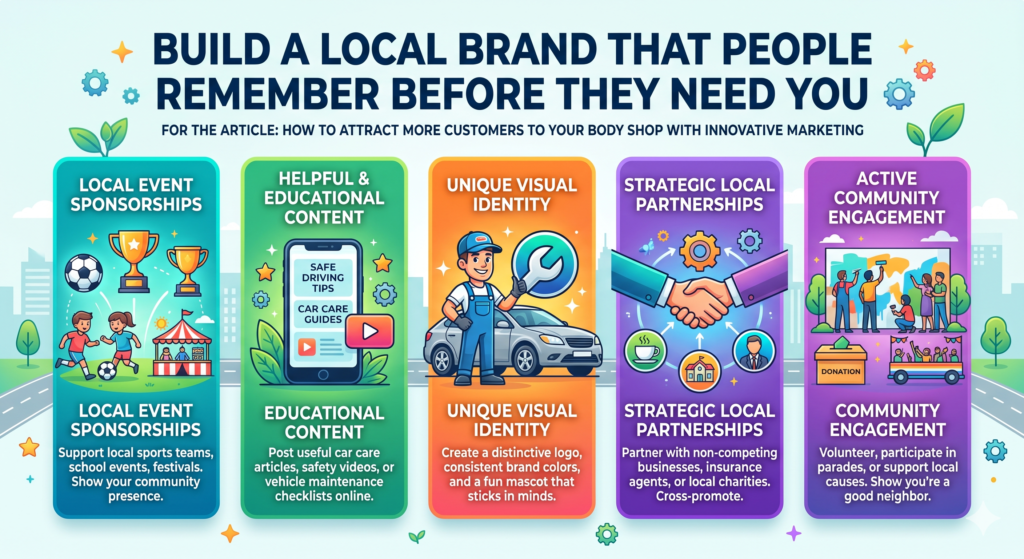
But local branding solves this problem. Local branding means making your shop known in your area for something clear and useful. You do not need to become famous everywhere. You need to become familiar in your service area.
If you serve one city, one county, or a group of nearby towns, your goal is to show up again and again in the daily life of local drivers. This can happen through Google search, local Facebook groups, repair videos, partnerships, sponsorships, customer reviews, local events, and even simple signs that are easy to remember.
Pick one strong promise and use it everywhere
Many body shops try to say too many things at once. They say they are fast, affordable, trusted, certified, friendly, local, advanced, family-owned, experienced, and customer-focused. All of those may be true, but when you say everything, people remember nothing.
Choose one main promise that fits your shop best. Maybe your shop is known for making the repair process simple. Maybe you are known for high-quality paint matching. Maybe you are known for helping customers with insurance claims. Maybe you are known for honest updates and no confusion.
Once you choose that main promise, use it across your marketing. Put it on your website homepage. Use it in your Google Business Profile description. Say it in your social media posts. Train your front desk team to repeat it naturally. Add it to your ads. Build your content around it.
For example, if your promise is making collision repair simple, your content should explain the process step by step. Your website should say what happens after a customer calls. Your reviews should support that message. Your ads should focus on easy estimates, clear updates, and stress-free repairs.
This makes your brand easier to remember. Customers may not remember every service you offer, but they can remember one strong idea.
Make your shop feel local, not faceless
People trust local businesses when they feel human. A body shop website filled only with stock photos of perfect cars can feel cold. It may look clean, but it does not build much connection. Customers want to know who will work on their car. They want to see the place. They want to feel there are real people behind the brand.
Use your marketing to show your local roots. Share photos of your team in the shop. Show before-and-after repair work from real vehicles. Mention the neighborhoods and towns you serve. Talk about local roads, weather damage, parking lot dents, hail issues, winter driving, or common accident spots in your area when it makes sense.
This does not mean your marketing should look rough or unprofessional. It should still look polished. But it should also feel real. A polished local brand feels far more trustworthy than a generic brand that could belong to any shop in any city.
Give people a reason to remember your name
A body shop name alone is not always enough. If your name sounds similar to other shops nearby, customers may forget it. You need memory hooks.
A memory hook is a simple idea that helps people remember you. It could be a phrase, a service angle, a visual style, a community message, or a repeated theme in your content.
For example, your shop might become known as the place that explains repairs in plain English. You could make short videos called “What This Damage Really Means” or “Before You Accept an Insurance Estimate.” You could post simple repair breakdowns that show what happens behind the scenes. Over time, people begin to connect your shop with honesty and education.
Another shop might become known for quick photo estimates. Another might become known for restoring cars to pre-accident condition with careful paint matching. Another might focus on helping busy families handle repairs with less stress.
The key is to give your audience something simple to attach to your name. When someone says, “Do you know a good body shop?” you want your customers to have an easy answer.
Turn your Google Business Profile into your strongest lead source
For most body shops, Google is one of the most important marketing channels. When someone searches “body shop near me,” “collision repair near me,” “auto body repair,” or “bumper repair near me,” they are not just browsing. They usually need help soon.
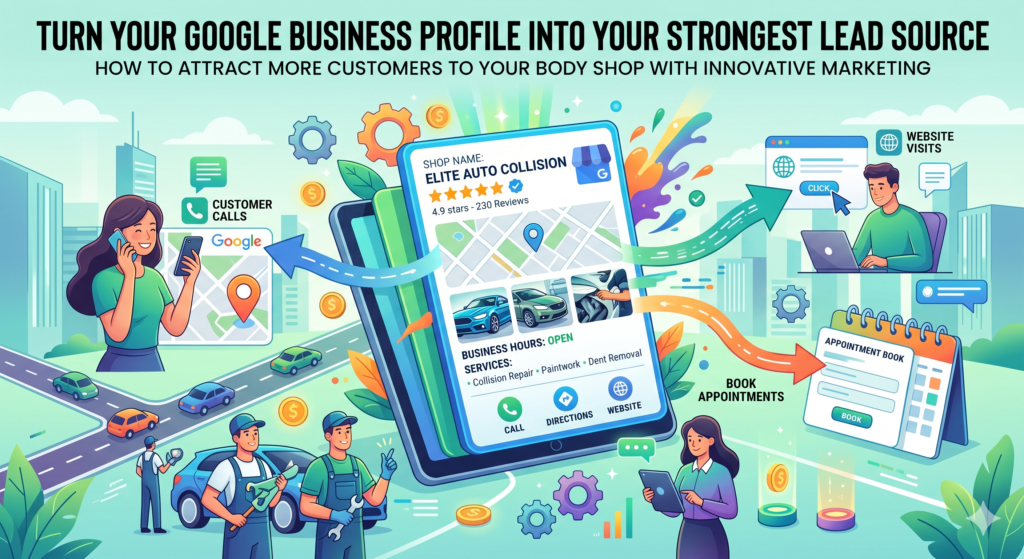
This is why your Google Business Profile matters so much. It often appears before your website. It shows your reviews, photos, location, hours, phone number, services, and directions. For many customers, this profile is your first impression.
If your profile looks empty, outdated, or weak, customers may skip you. If it looks active, clear, and trusted, they are much more likely to call.
Keep every basic detail correct and complete
The simple parts of your Google profile matter more than many shop owners think. Your phone number must be correct. Your hours must be updated. Your address must match your website. Your service categories must be accurate. Your business description should be clear. Your services should be filled out with the terms people actually search.
Do not assume customers will work hard to figure things out. If your profile says you are closed when you are open, you may lose calls. If your phone number is wrong, you lose jobs. If your services are missing, Google may not fully understand what your shop offers. If your photos are old, people may wonder if the shop is still active.
A complete profile sends a quiet signal that your business is organized. That matters in collision repair because customers are already worried about details.
Add real photos that show proof, not just polish
Photos are one of the fastest ways to build trust on Google. Customers want to see your shop, your team, and your work. They want to know that you are not just making claims.
Add photos of your building from the outside so customers can recognize it when they arrive. Add clean photos of your front desk or customer area. Add team photos that feel natural. Add before-and-after photos of repairs, as long as you respect customer privacy and avoid showing personal details. Add photos of paint work, bumper repairs, dent repairs, and finished vehicles.
The goal is not to make every photo look like a luxury car ad. The goal is to show real proof. A customer looking at a damaged bumper wants to see that you have fixed damage like that before. A driver with side panel damage wants to know your team can handle it.
Keep adding new photos every month. An active profile feels alive. An old profile feels forgotten.
Use Google posts to answer urgent customer questions
Many shops ignore Google posts, but they can be useful. You can use them to share short updates, seasonal tips, repair advice, and service reminders. These posts may not bring thousands of views, but they help your profile look active and helpful.
A good Google post might explain what to do after a minor accident. Another might talk about why paint matching takes skill. Another might remind drivers to take photos after a collision. Another might explain that customers can choose their repair shop and do not always have to use the first shop suggested by an insurance company, depending on local rules and policy terms.
Keep the language simple. Write like you are speaking to a stressed driver who needs calm advice. This helps your shop stand out from competitors who only list services.
Make reviews a core part of your marketing system
Reviews are not just nice to have. For a body shop, they are one of the strongest forms of proof. When a customer is stressed and unsure, they trust other customers more than they trust your ads.
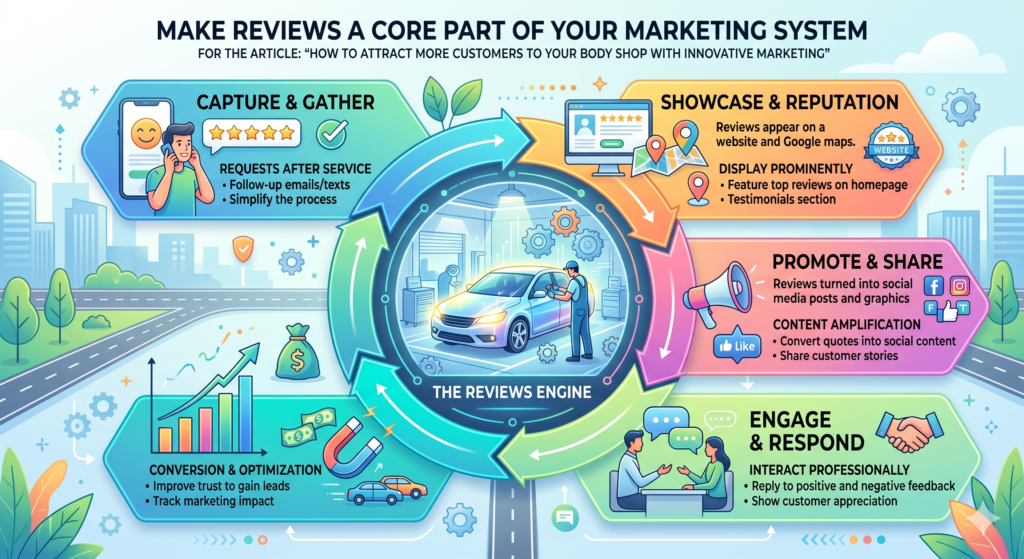
A shop with strong, recent, detailed reviews has a major advantage. It tells new customers that other people have already taken the risk and had a good experience. That lowers fear.
But reviews do not happen by accident. You need a system.
Ask for reviews at the right emotional moment
The best time to ask for a review is after the customer sees the repaired car and feels relieved. That moment matters. They walked in with stress. They are leaving with a car that looks right again. If the team treated them well, that is when they are most willing to share.
Do not make the request feel awkward. Train your staff to ask in a simple, natural way. They can say something like, “We’re glad we could help. If you feel good about the repair and the service, a Google review would really help our local shop.” Then send a direct review link by text or email.
Make the process easy. Do not ask customers to search for your shop, find the profile, and figure it out. Send the exact link. The fewer steps, the more reviews you will get.
Help customers write better reviews without telling them what to say
You should never pressure customers or tell them to write fake praise. But you can help them know what to mention. Many happy customers want to help but do not know what to write.
You can say, “It helps when customers mention what repair we helped with and how the process went.” This gives them a simple guide without putting words in their mouth.
Detailed reviews are more powerful than short ones. A review that says “Great service” is good. But a review that says the shop helped with insurance, kept the customer updated, matched the paint well, and finished the repair as promised is much stronger. It gives future customers real reasons to call.
Reply to every review like future customers are watching
Your replies are not only for the person who left the review. They are also for every future customer reading your profile. A thoughtful reply shows that your shop pays attention.
When someone leaves a good review, thank them in a warm and specific way. Mention the kind of repair if appropriate, but avoid private details. When someone leaves a negative review, stay calm. Do not argue. Do not blame. Do not write a long defensive message. A simple, professional reply can protect your reputation.
For example, you can say that you are sorry the experience did not meet expectations, that your team would like to understand what happened, and that they can contact the shop directly. This shows future customers that you take concerns seriously.
A strong review profile is not about looking perfect. It is about looking trustworthy, responsive, and real.
Build a website that turns worried drivers into booked estimates
Your website should not be an online brochure that only lists services. It should work like your best front desk person. It should welcome people, answer their first questions, build trust, and guide them to take action.
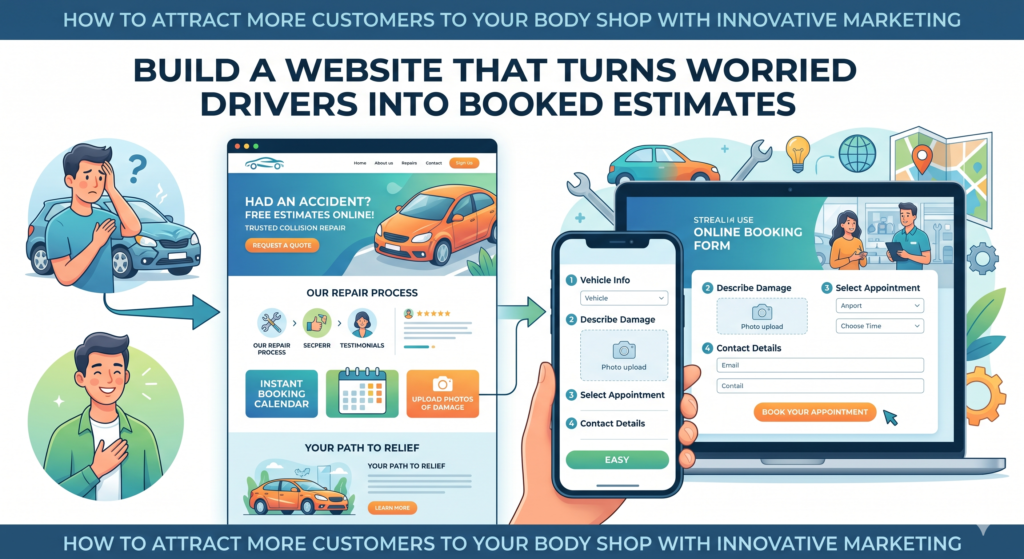
Many body shop websites fail because they are too vague. They say things like “quality repairs” and “excellent service,” but they do not explain the process. They do not show enough proof. They do not make it easy to request an estimate. They do not speak to the customer’s stress.
A strong website can become one of your best sales tools, especially when paired with local SEO and Google ads.
Make the homepage clear within five seconds
When someone lands on your homepage, they should know three things right away. They should know that you repair collision damage. They should know where you are located or what area you serve. They should know what to do next.
Do not hide the main action. If you want people to call, make the phone number easy to tap on mobile. If you want them to request an estimate, place that option near the top. If you offer photo estimates, explain how it works. If you help with insurance claims, say so clearly.
Your homepage should not begin with a long story about the company. That can come later. Start with the customer’s need. They have damage. They need help. Show them that they are in the right place.
A simple opening message could say that your shop helps local drivers repair collision damage, handle the process with less stress, and get back on the road with confidence. That is clear, useful, and customer-focused.
Explain the repair process in plain words
One of the best ways to win more body shop customers is to explain what happens after they contact you. Many people have never dealt with collision repair before. They do not know how estimates work. They do not know what insurance covers. They do not know why hidden damage may change the final repair plan. They do not know how long paint work takes.
When your website explains the process clearly, customers feel safer.
Create a page or section that walks through the journey. Start with the first call or estimate request. Then explain inspection, insurance review, parts ordering, repair work, paint, quality checks, and pickup. Keep each section short and clear. Use simple language. Avoid shop terms that customers may not understand.
This does more than educate. It also sets expectations. Customers who understand the process are less likely to feel confused or upset later.
Show proof with real repairs and real stories
Your website should include proof that your shop can do what it claims. Before-and-after photos are powerful because they show results fast. But do not stop there. Add short stories around some repairs.
For example, you might share how a customer came in with rear bumper damage after a parking lot accident, how your team inspected the vehicle, repaired the damage, matched the paint, and helped the customer get back on the road. Keep the story simple and protect customer privacy.
These stories help people picture their own repair. They make your services feel real. They also help search engines understand what your shop does, especially when you mention services and locations naturally.
Use local SEO so customers find you at the exact moment they need help
Local SEO is one of the best long-term marketing tools for a body shop. It helps your shop show up when people nearby search for repair services. Unlike social media, where people may not need you at that moment, search traffic often comes from people with active demand.
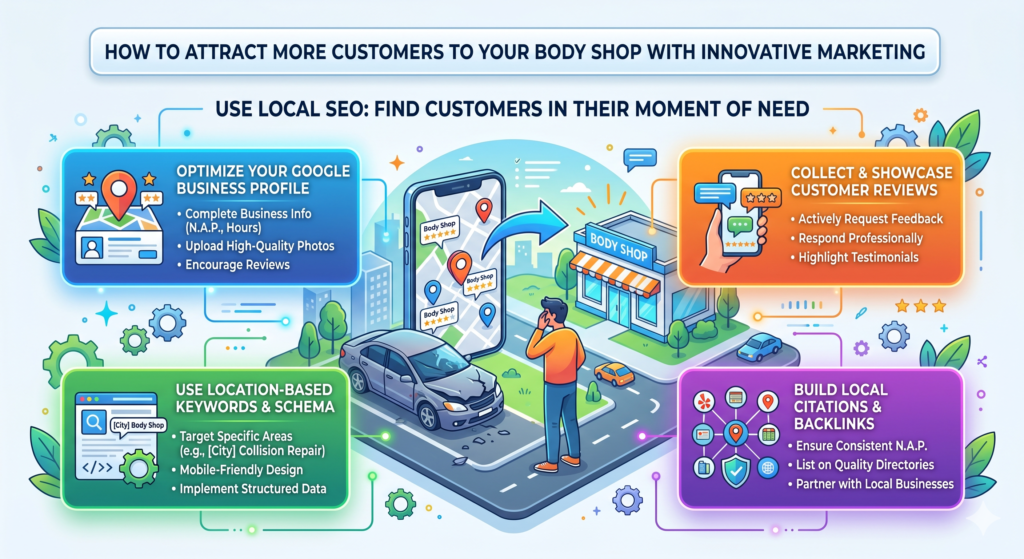
But local SEO is not just about adding keywords to a website. It is about proving to search engines and customers that your shop is a strong local answer.
Create service pages for the repairs customers search for
Many body shops have one page called “Services” that lists everything. That is not enough if you want to rank for different searches. Customers search for specific problems. They search for bumper repair, dent repair, collision repair, auto paint repair, fender repair, scratch repair, frame repair, and insurance claim repair.
Each major service should have its own page if it matters to your business. A bumper repair page should explain common bumper damage, when repair is possible, when replacement may be needed, how paint matching works, and how customers can request an estimate. A collision repair page should explain the full process after an accident. A paint repair page should explain color matching and finish quality.
Do not stuff these pages with repeated keywords. Write them for real people. Answer the questions customers actually ask on the phone. That is usually the best SEO content because it matches real search intent.
Build location pages only when they are truly useful
If your shop serves several nearby towns, location pages can help. But they must be useful. Do not create thin pages that only swap out the city name. That can feel spammy and weak.
A strong location page should explain how your shop helps drivers from that area, how far you are from common roads or neighborhoods, what services you offer, and why customers from that location choose you. Mention local details only when they are natural.
For example, if many customers come from a nearby suburb because your shop is close to a main road, say that. If you often help commuters from a certain area, say that. Keep the page honest and helpful.
Write blog posts that answer urgent repair questions
A body shop blog should not be filled with random car tips just to post content. It should answer questions that bring in real customers.
Good topics include what to do after a minor accident, how to know if bumper damage is serious, whether a scratched panel needs repainting, how long collision repair usually takes, why estimates can change after teardown, and how paint matching works.
These topics attract people who are trying to understand their problem. Some may not book right away, but many will remember the shop that gave them a clear answer.
The key is to write in plain language. Avoid sounding like a manual. Explain things the way your best service advisor would explain them to a customer standing at the counter.
Use photos and videos to make your work easy to trust
Body shop marketing is visual. People want to see results. They want to see damaged cars become clean again. They want to see paint blend smoothly. They want to see dents disappear. This makes photos and videos one of your strongest tools.
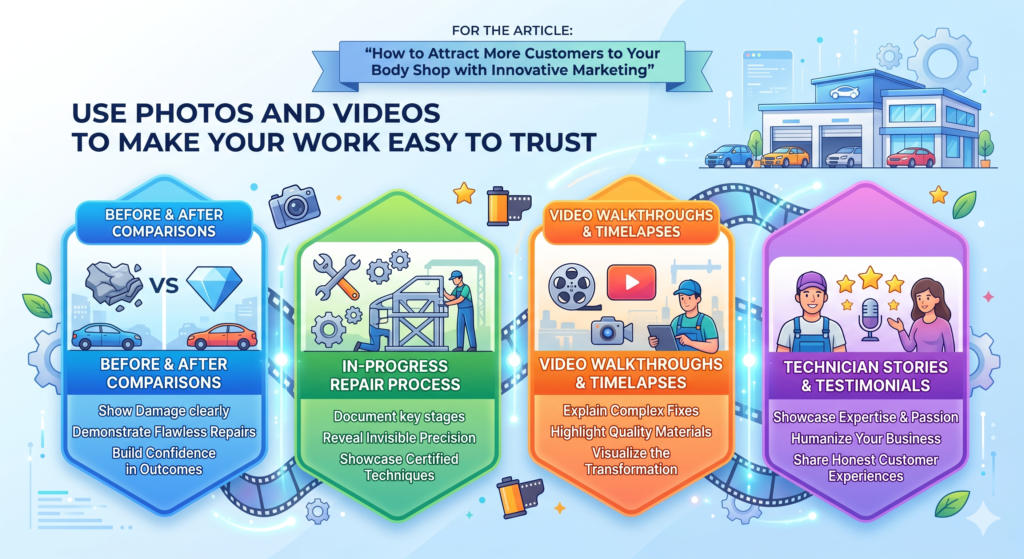
You do not need a full production crew. A modern phone, good lighting, and a simple plan can work very well. The goal is not to create movie-quality content. The goal is to show proof, teach, and make your shop feel real.
Turn before-and-after repairs into simple trust builders
Before-and-after content works because it is easy to understand. A customer can look at a damaged bumper and then see the finished repair. No long explanation is needed.
But the best before-and-after posts do more than show two photos. Add a short explanation. Say what the damage was, what the customer was worried about, what your team repaired, and what the finished result shows. Keep it simple.
For example, you might explain that the vehicle came in with a scraped bumper and cracked paint, the team repaired the surface, matched the color, and restored the finish. This helps people understand the value behind the work.
Always get permission when needed. Avoid license plates and personal details. Make privacy part of your process.
Make short videos that answer real customer questions
Short videos can help your shop stand out because they show personality. Customers get to hear your voice, see your team, and learn from you. That builds trust faster than text alone.
You can make videos about simple questions. What should you do right after an accident? Can you drive with bumper damage? Why does paint matching take skill? Why do some repairs take longer than expected? What does hidden damage mean? How should a customer take photos for an estimate?
Keep videos short and clear. One idea per video is enough. Speak like you are talking to one customer, not giving a speech. You do not need fancy words. In fact, simple words work better.
Post these videos on your website, Google profile, YouTube, Facebook, Instagram, and local pages. One video can be used in many places.
Show the people behind the repair
Cars matter, but people build trust. Show your estimators, painters, technicians, detailers, and front desk staff in natural ways. Introduce team members. Share small behind-the-scenes moments. Show someone checking paint quality or preparing a vehicle for pickup.
This helps customers feel more comfortable before they arrive. They are not walking into a mystery shop. They have already seen faces. They already feel some connection.
Human content is especially useful in a service where trust is everything. People want to believe their car is in careful hands. Show them the hands.
Use paid ads only when they are built around real customer intent
Paid ads can work very well for a body shop, but only when they are used with care. Many shops waste money because they run broad ads to people who are not ready to book. They boost random social posts, target wide areas, or use weak messages like “Call us for auto body repair.” That kind of ad may get views, but views do not pay the bills.
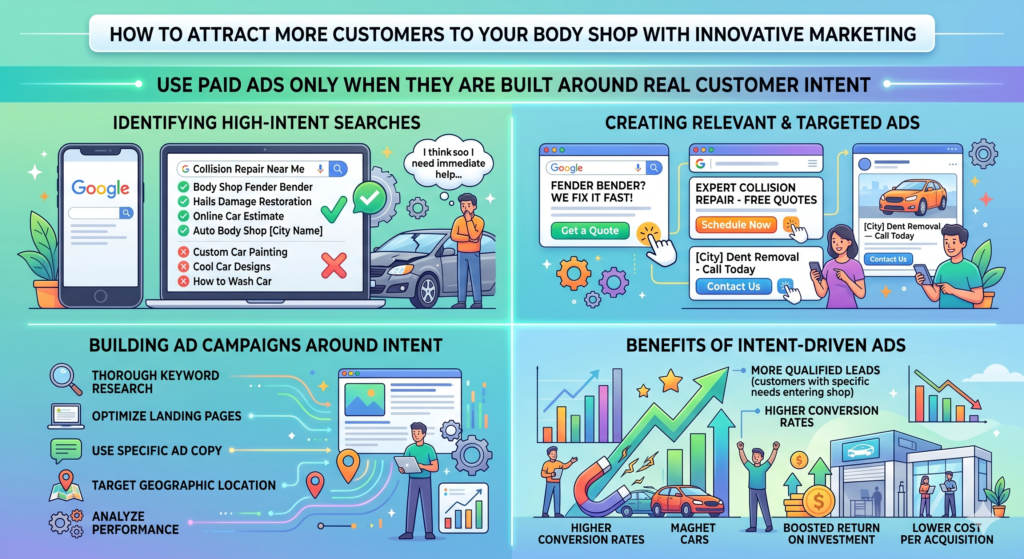
The best paid ads for a body shop focus on people who already have a problem. These are drivers searching for help, comparing shops, checking repair options, or looking for someone nearby. Your ads should not try to convince everyone in town to care about collision repair today. Most people will not. Your ads should reach the people who are already closer to needing you.
This is why Google Ads often works better than broad social ads for direct leads. When someone searches “collision repair near me” or “bumper repair estimate,” they are showing clear intent. They have a need now. If your ad appears at that moment and your message is clear, you have a real chance to win the call.
Social media ads can still help, but they usually work better for retargeting, brand memory, seasonal reminders, and community trust. A driver may not need repair today, but after seeing your shop several times, they may remember you later. The trick is to match each ad channel to the way customers actually make decisions.
Build Google Ads around services people are ready to book
Google Ads should be simple and focused. Do not send every click to your homepage if the search is specific. If someone searches for bumper repair, send them to a bumper repair page. If they search for collision repair, send them to a collision repair page. If they search for paint repair, send them to a paint repair page.
This matters because customers are impatient when they are stressed. If they click an ad about bumper repair and land on a general homepage, they may not take time to search around. They may go back to Google and click another shop. But if the page says exactly what they searched for, they feel understood right away.
Your ad should match the customer’s problem. Your landing page should match the ad. Your call to action should make the next step easy. That simple chain can improve results without spending more money.
Your ad should promise clarity instead of just repair
Most body shop ads sound the same. They say “collision repair,” “free estimates,” “quality service,” and “call today.” These are not bad phrases, but they are common. They do not give the customer a strong reason to choose you.
A better ad speaks to the customer’s real concern. For example, someone with accident damage may want help with the estimate, insurance process, repair timeline, and next steps. Your ad can say that your shop makes collision repair easier with clear estimates, helpful updates, and repairs done with care.
That kind of message feels more human. It does not just say what you do. It shows how you reduce the customer’s stress.
Your landing page should make the phone call feel safe
Many people hesitate before calling a body shop because they do not know what will happen next. They may worry that they will be pressured. They may worry that the repair will cost too much. They may worry that they do not have the right insurance details ready.
Your landing page should calm those fears. Explain what happens after they call. Tell them whether they can send photos. Tell them what information helps your team give better guidance. Tell them that your staff will explain the next steps in plain words.
When the customer knows what to expect, calling feels easier. That is how a landing page turns ad clicks into real leads.
Use retargeting ads to stay in front of people who already showed interest
Not every person who visits your website will call right away. Some are comparing shops. Some are waiting for insurance. Some are checking repair options before making a decision. Some may get distracted and forget to come back.
Retargeting helps you stay visible to those people after they leave your site. These ads can appear on platforms like Facebook, Instagram, YouTube, or across display networks, depending on your setup. The goal is not to chase people aggressively. The goal is to remind them that your shop is still there and ready to help.
A good retargeting ad might say that your team can help them understand their repair options. Another might show a before-and-after repair. Another might invite them to request an estimate. The message should be calm and helpful, not pushy.
Retargeting works best when it answers the next question
A visitor who already saw your website does not need the same basic message again and again. They need a reason to move forward.
If they visited your collision repair page, show them an ad about making the accident repair process easier. If they visited your bumper repair page, show them a simple before-and-after bumper repair. If they visited your estimate page but did not submit the form, remind them that they can request help in a few minutes.
This makes your ads feel more useful. You are not shouting the same message at everyone. You are guiding people based on what they already cared about.
Keep retargeting simple and local
Body shops do not need huge retargeting campaigns with complex creative. You need a few strong messages shown to the right local audience.
Use real shop photos when possible. Use clear words. Mention your location or service area. Make the next step easy. A customer should see the ad and think, “Yes, I still need to handle that repair.”
Retargeting should not replace search ads, local SEO, or reviews. It supports them. It helps people come back after they already showed interest.
Create offers that bring in customers without making your shop look cheap
Offers can help a body shop get more leads, but they must be handled carefully. Collision repair is not like selling shoes or pizza. If you use too many discounts, people may start to question your quality. A damaged car is a serious issue. Customers want a fair price, but they also want safe and careful work.
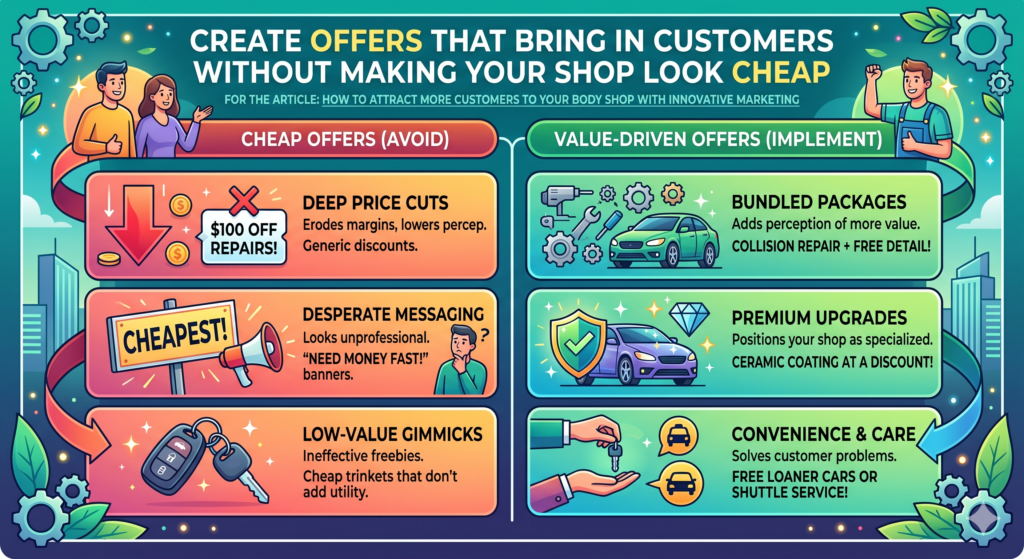
The best offers do not make your shop look cheap. They make the next step easier. They reduce friction. They help customers take action sooner.
Instead of racing to the bottom with discounts, think about what customers actually need in the moment. They may need a quick estimate. They may need help understanding insurance. They may need photo review. They may need clear repair options. They may need guidance after a small accident.
Your offer should solve one of those problems.
Offer a simple estimate process that feels easy to start
A strong offer could be as simple as an easy estimate request. Many customers delay repairs because they think the process will be hard. They imagine taking time off work, driving to the shop, waiting around, and getting confused by repair terms.
If your shop offers photo-based estimate requests, promote that clearly. If customers still need an in-person inspection later, say that in plain words. Do not overpromise. Explain that photos can help your team start the conversation and guide the next step, while some damage may need a closer look.
This kind of offer works because it lowers the first barrier. The customer does not have to fully commit. They only have to start.
Make the estimate page feel like a guided conversation
Your estimate page should not feel like a cold form. It should feel like your team is helping the customer take the next step.
Ask for the basics in simple language. Ask for name, phone number, vehicle details, photos, and a short note about what happened. Explain that better photos help your team understand the damage. Tell them to include wide shots and close-up shots if possible.
Also explain when they can expect a response during business hours. A form without expectations can feel like a black hole. A form with clear next steps feels safe.
Do not hide the limits of an estimate
One mistake shops make is pretending every repair can be priced perfectly from photos. That can create problems later. Hidden damage is common in collision repair, and customers need to understand that early.
Say clearly that the first review helps your team guide them, but the final repair plan may depend on an in-person inspection and parts availability. This honesty builds trust. Customers respect shops that explain the truth before money is involved.
Use value-added offers instead of deep discounts
A value-added offer gives the customer something helpful without cutting the value of your repair work. This can be stronger than a price discount.
For example, you might offer a repair process review, where your team explains the estimate and next steps. You might offer help with photo submission. You might offer a post-repair care guide for painted surfaces. You might offer a quick cosmetic damage check for small dents and scratches.
The point is to add confidence. Customers want to feel guided. If your offer helps them feel less lost, it can bring in more leads without hurting your brand.
An offer should match the kind of customer you want
If you want customers who care about careful repairs, your offer should focus on quality, clarity, and confidence. If your offer is only about being the cheapest, you may attract customers who choose only on price. That can lead to more difficult conversations, lower margins, and less loyalty.
A good body shop offer should make people think, “This shop will take care of me.” It should not make them think, “This is the cheapest place I could find.”
The best offers make the first yes easy
Customers do not always need a discount. They need an easy first step. This is a key marketing idea.
Instead of asking them to decide everything at once, ask them to take one small action. Request an estimate. Send photos. Call to understand the process. Book an inspection. Ask a repair question.
Once they take that first step and your team handles it well, trust begins to grow. That is often what leads to the job.
Build referral systems that make happy customers bring you more customers
Referrals are powerful for body shops because people trust friends, family, coworkers, and neighbors. When someone says, “I used this shop and they treated me well,” that carries more weight than an ad.
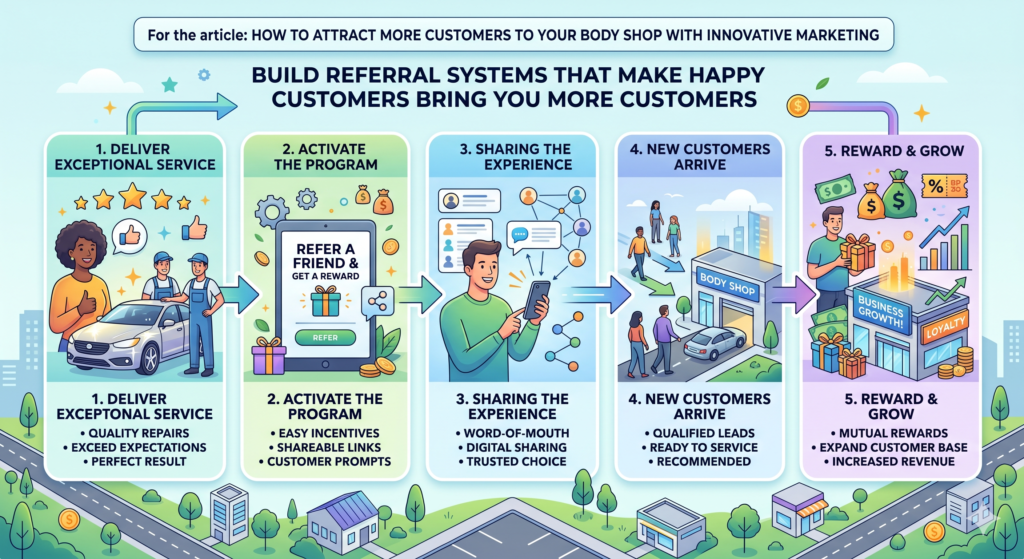
But many shops leave referrals to chance. They hope customers will talk about them. Some do. Most forget, not because they were unhappy, but because life moves fast.
A smart referral system makes it easier for happy customers to remember, share, and recommend your shop.
Give customers a simple reason to talk about you
People refer businesses when the experience is easy to explain. If your shop gives clear updates, helps with insurance, repairs the car well, and treats the customer with respect, that is worth talking about. But you should make the story even easier to repeat.
After a successful repair, you can say something like, “If anyone you know needs help after an accident or with body damage, we’d be glad to take care of them too.” This is simple, natural, and not pushy.
You can also include a small card in the vehicle at pickup that thanks the customer and reminds them that referrals help local businesses grow. Keep it classy. Do not make it feel like a gimmick.
The pickup moment is your best referral moment
When the customer picks up the car and feels happy with the result, they are at their highest point of trust. That is when you should ask for a review and gently plant the referral idea.
Your team can say, “We’re glad you’re happy with how it turned out. If a friend or family member ever needs body repair, we’d be honored if you sent them our way.”
This works because it feels human. It does not feel like a sales pitch. It feels like a local business asking for support after doing good work.
Make referrals easy to track without making them awkward
You do not need a complex referral system at first. Start by asking every new customer how they heard about you. Train your front desk to record the answer. If they say a friend referred them, note the name if they are comfortable sharing it.
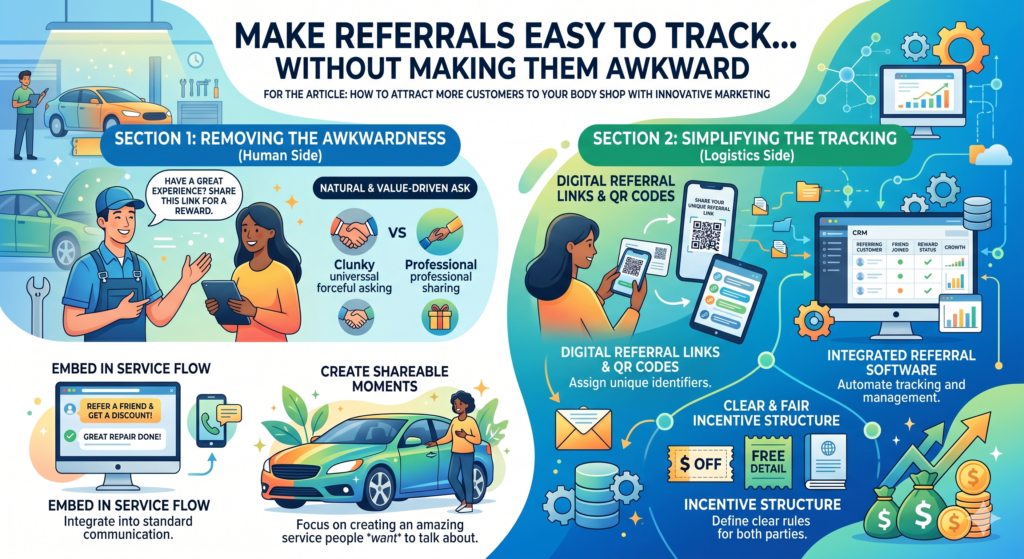
This helps you understand which customers and channels bring in business. It also helps you thank people properly.
A simple thank-you message to the referring customer can go a long way. It shows that you noticed and that you value their support.
Build referral partnerships with businesses that already serve drivers
Customer referrals are one side of the system. Business referrals are another.
Think about local businesses that interact with drivers before, during, or after car problems. Towing companies, car detailers, tire shops, mechanic shops, car rental offices, insurance agents, used car dealers, fleet managers, driving schools, and local car washes may all know people who need body repair.
The goal is not to pressure these businesses. The goal is to build real relationships. If they trust your work and your customer service, they may be willing to refer people when the need comes up.
Partnership marketing starts with making the other business look good
A referral partner takes a risk when they send someone to you. If you do poor work or treat the customer badly, it reflects on them. That means you must make the partner feel safe.
Explain your process. Show your reviews. Invite them to visit the shop. Share examples of your work. Make it clear that referred customers will be handled with care.
The best partnerships are built on trust, not quick deals. When another business knows you will make them look good, they are more likely to send customers your way.
Stay in touch without always asking for leads
Do not only contact partners when you want referrals. That gets old fast. Stay useful.
You can share simple repair tips they can pass to customers. You can explain what drivers should do after a minor accident. You can give them clear information about when cosmetic damage may need a body shop instead of a mechanic.
When you help partners serve their own customers better, you become more valuable to them. That is how long-term referral channels grow.
Use social media to build familiarity before customers need repair
Social media may not always bring immediate leads for a body shop, but it is still valuable. It helps people remember your name. It shows your work. It gives your shop a human face. It builds local familiarity before the customer needs you.
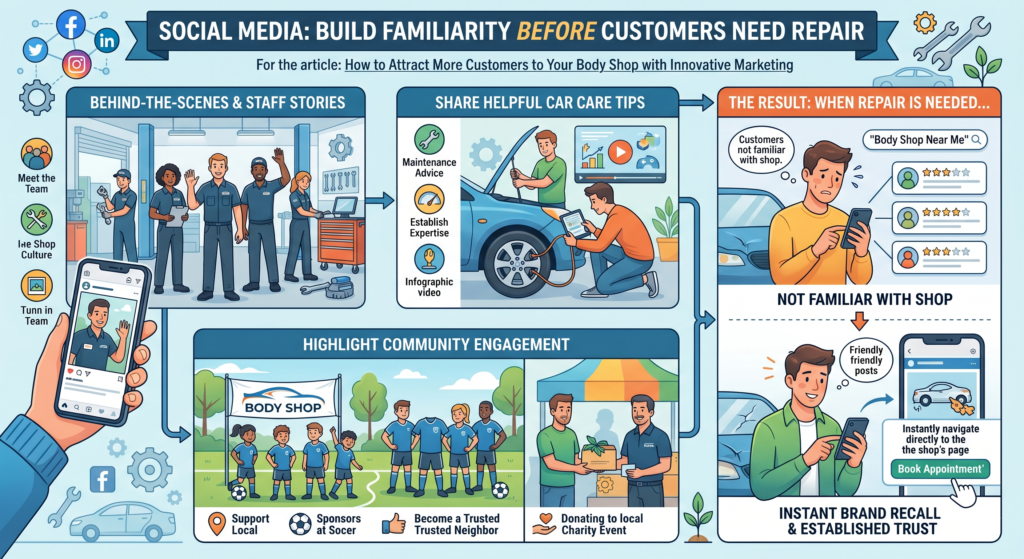
The mistake is treating social media like a billboard. If every post says “Call us today,” people tune out. Good social content teaches, shows proof, tells stories, and reminds local drivers that your shop is active and trustworthy.
Post content that makes people feel smarter and safer
Your social media should answer simple questions that drivers actually have. Many people do not understand body repair. They do not know what damage is serious. They do not know what to do after a parking lot hit. They do not know why paint repair costs what it does. They do not know how long repairs can take.
When you explain these things in plain words, people begin to trust you. They may not need you today, but they remember that your shop was helpful.
Teach one small lesson at a time
Do not try to explain the entire repair process in one post. Pick one small idea. Explain why a bumper can hide damage. Explain why paint color can look different under different light. Explain why taking photos right after an accident can help. Explain why a repair estimate may change after parts are removed.
Small lessons are easier to read and easier to remember. They also give you more content ideas over time.
Use real examples from the shop when possible
A real example is stronger than a general tip. If a car comes in with what looks like small bumper damage but has hidden issues behind the cover, you can turn that into an educational post. You do not need to share private details. You can simply explain the lesson.
This shows that your advice comes from real work, not copied content. People can feel the difference.
Do not chase trends that do not fit your shop
It is tempting to copy every social media trend. Some can work, but many will not fit a body shop. You do not need to dance, act silly, or force humor if that does not match your brand.
Your shop can be friendly, warm, and interesting without being fake. A simple repair walk-through can work. A short video from the owner can work. A photo of a finished repair can work. A customer education post can work. A local community post can work.
The best social media strategy is one your team can actually keep doing. Consistency beats random bursts of activity.
Your content should sound like your shop
If your shop is family-owned and calm, let the content feel that way. If your shop is modern and fast-moving, let that show. If your team is known for being patient and helpful, make education the heart of your social media.
Do not let social media turn your brand into something it is not. Customers can sense when content is forced.
Every post should support trust in some way
A post can entertain, teach, show proof, or build local connection. But it should still support trust. Before you publish, ask whether the post helps a local driver feel better about choosing your shop someday.
If the answer is yes, it belongs in your strategy. If the answer is no, it may just be noise.
Use email and text follow-up to turn interest into booked repairs
A lot of body shop leads are lost after the first contact. The customer calls once, asks a question, gets busy, waits for insurance, or decides to “think about it.” Then the shop never follows up. That is a costly mistake.
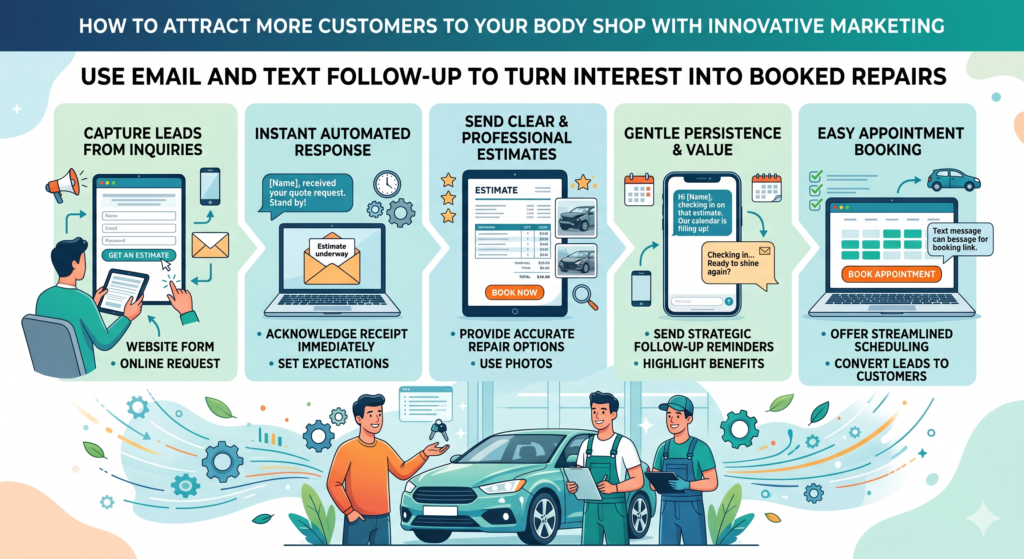
Most people are not ignoring you because they do not care. They are dealing with work, family, stress, and a damaged car. They may have three open tabs from different shops. They may have started an estimate form and stopped halfway. They may have called during lunch and forgotten to send photos later.
This is where simple follow-up can bring in real money. You do not need to bother people. You need to guide them. A helpful text or email can remind them what to do next and make the process feel easier.
Your first follow-up should remove confusion, not add pressure
After a customer calls, submits a form, or asks for an estimate, the next message should be clear and calm. It should thank them, explain the next step, and tell them what your team needs.
A message like this can work well in spirit: “Thanks for reaching out. To help us understand the damage, please send a few photos of the vehicle, including one wide photo and a few close-ups. Once we review them, we’ll let you know the next step.”
That kind of message feels useful. It does not feel like a sales pitch. It helps the customer move forward.
A good follow-up sounds like a helpful person from the front desk
Do not write follow-up messages like corporate ads. Write like a real person at your shop. Use short sentences. Use clear words. Avoid cold phrases like “We value your inquiry” or “A representative will be in touch.” Those lines sound stiff.
A better message sounds human. It tells the customer that your team saw their request and is ready to help. This matters because people often contact a shop when they already feel unsure. A warm reply makes them feel noticed.
Timing matters because body shop leads cool down fast
When someone needs collision repair, they may contact several shops in the same hour. If your shop waits too long to respond, another shop may win the job before you even speak with the customer.
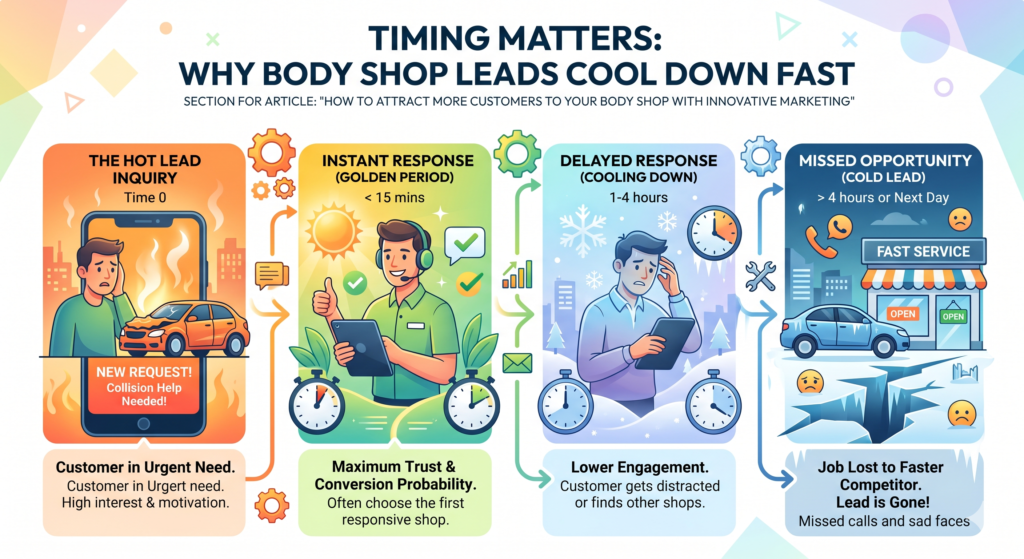
Fast response does not mean rushing the repair. It means showing the customer that you are organized. Even if you cannot give a full answer right away, you can still send a quick message that says you received their request and will guide them through the next step.
Speed builds trust. Silence creates doubt.
Use email to educate customers who are not ready yet
Some customers are not ready to book right away. They may be waiting on an insurance claim. They may not know whether the damage is worth fixing. They may be comparing options. Email can help you stay useful during that window.
Your emails should not be long sales letters. They should answer the questions customers already have. You can explain what happens during an estimate. You can explain why hidden damage may be found later. You can explain how paint matching works. You can explain what customers should bring when they visit the shop.
When your emails teach, they build trust. When they only push for the sale, they get ignored.
A simple repair guide can become a strong lead nurture tool
One smart idea is to create a short “what to do after an accident” guide and send it to people who contact your shop. This guide can explain how to take photos, what information to collect, how to think about insurance, and when to schedule an inspection.
The guide does not need to be fancy. It needs to be useful. If a stressed driver reads it and feels calmer, your shop becomes the trusted choice.
Follow-up should stop when the customer makes a decision
Good follow-up is helpful. Bad follow-up feels annoying. Once a customer books, replies, or says they chose another shop, update your system. Do not keep sending the same reminder messages.
Respect matters. Even when someone does not choose you today, they may remember how professional you were later. A customer who is treated well before the sale may come back next time.
Create a better phone experience because calls are still where many jobs are won
A body shop can spend money on SEO, ads, photos, videos, and reviews, but still lose leads on the phone. This happens more often than owners want to admit.
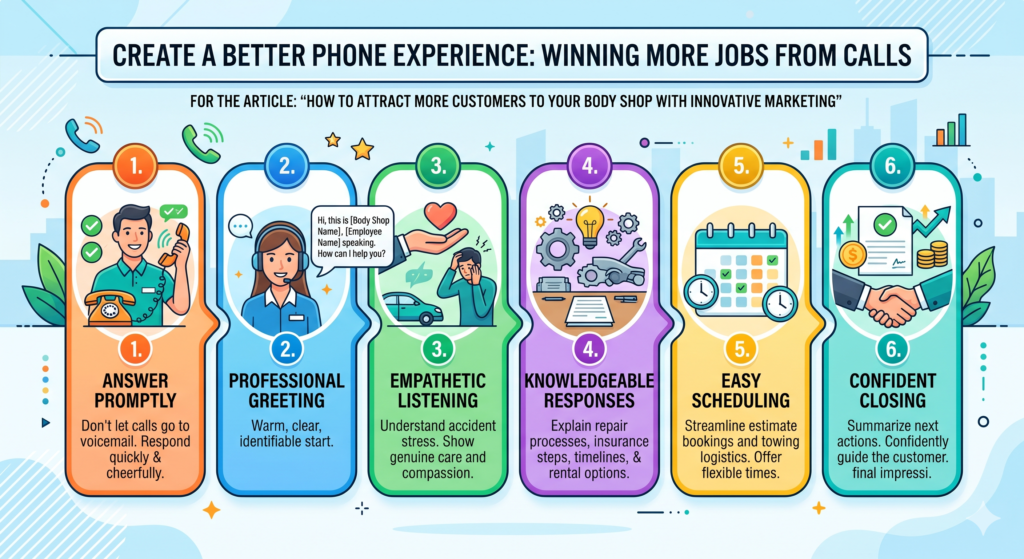
The phone call is where the customer decides whether your shop feels safe. They listen to tone. They notice whether the person sounds rushed. They judge whether the shop seems helpful. They decide whether they want to bring the car in.
If the call feels cold, confusing, or impatient, the customer may hang up and call someone else. If it feels calm and clear, the customer is more likely to book.
Train your team to lead the call with care and control
A customer calling after an accident may not know what to say. They may start with a messy story. They may not know the year of the car, the type of damage, or what insurance wants. Your team should not make them feel foolish.
The best phone process guides the customer gently. Start by asking what happened. Then ask whether anyone was hurt if the accident was recent. Then ask about the vehicle, the damage, insurance status, and whether the car is safe to drive. After that, explain the next step in plain words.
This gives the call structure without making it feel robotic.
The first thirty seconds set the tone for the whole repair
When the phone rings, the greeting should sound warm and steady. A rushed “Body shop, hold please” can hurt trust right away. A calm greeting with the shop name and a helpful tone tells the customer they reached the right place.
That first moment may seem small, but it matters. Customers are often choosing between shops that offer similar repairs. The shop that feels easier to talk to has an edge.
Your team should explain the next step before ending the call
A common mistake is ending the call before the customer knows what to do next. The customer may have asked one question, but they still need direction.
Before the call ends, your team should make the next step clear. Should the customer send photos? Visit the shop? Bring insurance details? Schedule an inspection? Wait for a claim number? The answer should be simple.
A customer who knows the next step is less likely to drift away.
Track calls so you know where leads are coming from
If you do not track calls, you are guessing. You may think most leads come from referrals when many are actually coming from Google. You may think ads are not working when the real problem is missed calls. You may think your website is weak when the phone experience is the bottleneck.
Call tracking helps you see what is really happening. You can learn which marketing channels bring calls, which calls become estimates, and which estimates become jobs.
Missed calls are hidden lost revenue
Many shops lose leads simply because no one answers. A customer with a damaged car may not leave a voicemail. They may just call the next shop.
If missed calls are common, fix that before spending more on ads. Make sure calls are answered during business hours. Have a plan for lunch breaks, busy front desk moments, and after-hours inquiries. Even a clear voicemail and fast callback can save leads.
Listen to real calls to improve the customer journey
Call recordings, where legal and properly disclosed, can help you improve training. You may hear that customers ask the same questions again and again. You may find that your team gives unclear answers about estimates. You may discover that callers are confused about insurance.
These insights can improve your website, ads, email follow-up, and staff scripts. The customer is already telling you what they need. You just have to listen.
Build trust with insurance-related content without sounding like an insurance company
Insurance is one of the biggest sources of stress in body repair. Many customers do not understand their policy, their rights, their deductible, or the repair process. They may also feel pushed in different directions by claim handlers, adjusters, and repair networks.
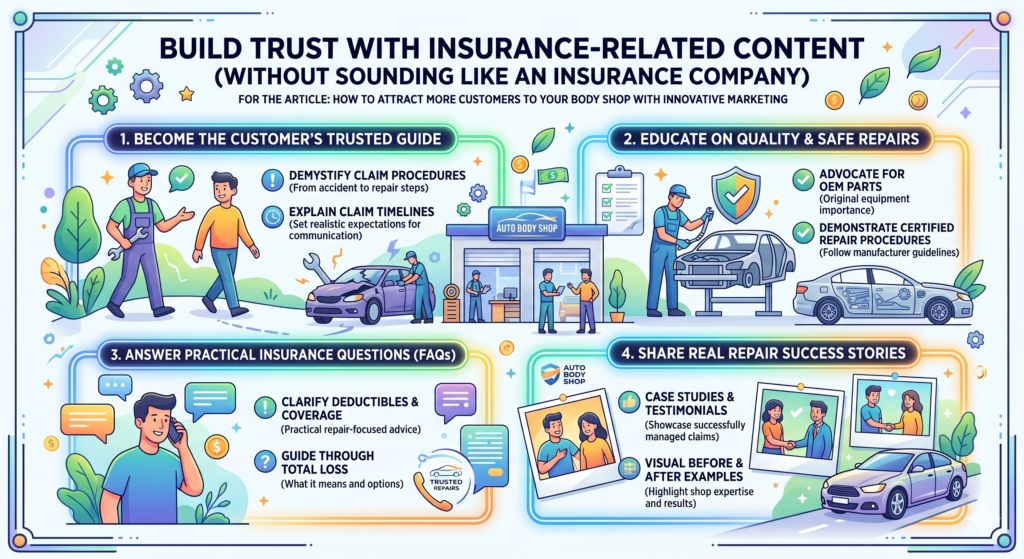
Your shop should not give legal advice unless you are qualified to do so. But you can still explain the repair process in simple terms. You can help customers know what questions to ask. You can make the situation feel less scary.
Explain the insurance repair process in plain language
A strong body shop website should have a page that explains how insurance-related repairs work. It should not be written like a policy document. It should sound like a helpful conversation.
Explain that the customer usually starts a claim, gets a claim number, and then works with a shop to inspect the damage. Explain that the visible damage may not show everything. Explain that once repairs begin, the shop may find hidden damage and may need to work with the insurance company on updates.
This kind of content helps customers feel prepared. It also helps them see your shop as a guide, not just a repair provider.
Do not make promises that depend on the insurance company
Be careful with wording. Do not promise that insurance will cover everything. Do not promise exact timelines when approvals, parts, and hidden damage can affect the job. Do not promise that every claim will be simple.
Instead, promise what you can control. You can promise clear communication. You can promise careful inspection. You can promise to explain what your team sees. You can promise to help the customer understand the repair steps.
Honesty is better than overpromising. It protects trust.
Make common insurance terms easier to understand
Customers may hear words like estimate, supplement, deductible, claim number, adjuster, preferred shop, and total loss. These words can confuse people.
Create content that explains these terms in simple language. Keep it calm and clear. When customers understand the words, they feel less lost. When they feel less lost, they are more likely to trust the shop that helped them.
Position your shop as the customer’s repair guide
A customer may feel like the insurance company controls the whole process. Your marketing can remind them that they still need a repair team that cares about the vehicle and the repair quality.
Again, the tone matters. Do not sound angry or combative. Sound helpful. Say that your role is to inspect the vehicle, explain the damage, repair it with care, and keep the customer informed.
Trust grows when customers feel someone is on their side
After an accident, people often feel pulled around. They may get calls, emails, forms, and instructions from many places. If your shop can be the calm voice in the middle, that is a major advantage.
Your content should make customers feel that they will not have to figure everything out alone. That is a strong marketing message because it speaks to the real fear behind the repair.
Insurance content can also improve local search
Many people search questions about insurance and body shops. They may search whether they can choose their own body shop, how collision estimates work, or why repair costs change. If your website answers those questions well, you can attract people earlier in their decision process.
These visitors may not all book right away, but they are valuable. They are local drivers with a real repair need or a likely repair need. Helping them early gives your shop a better chance to win the job later.
Create community visibility so your body shop becomes a familiar local name
A body shop is a local business. That means community trust matters. People want to use a shop that feels connected to the area, not one that feels hidden or unknown.
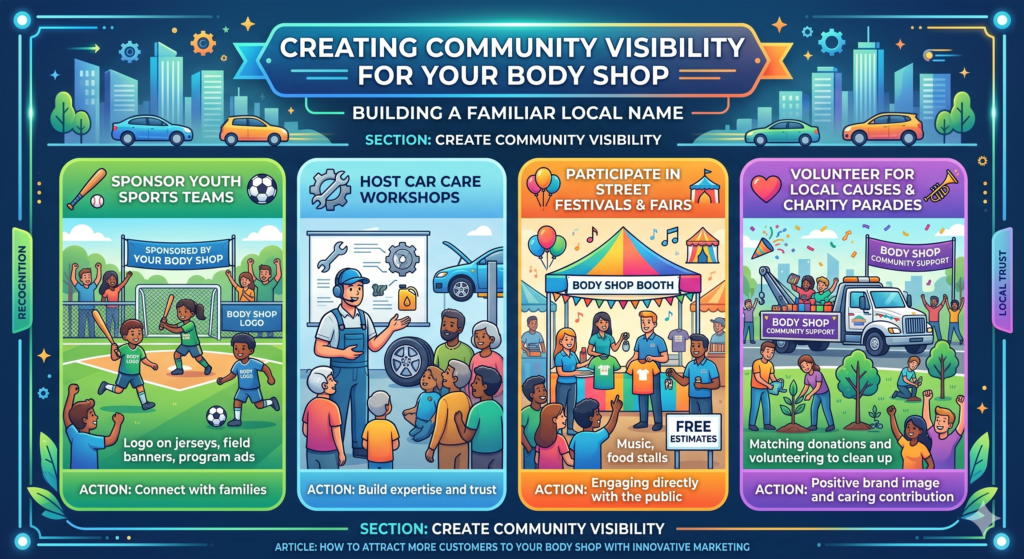
Community marketing does not have to mean spending a lot of money. It means showing up in ways that make sense. It means being seen, being useful, and being remembered.
Partner with local groups in ways that fit your brand
Your shop can support local schools, youth sports, charity events, driver safety programs, trade schools, or community fundraisers. The best choice depends on your area and your values.
Do not sponsor things only for a logo placement. Look for ways to be useful. If a high school has a driver education program, your shop could share simple tips on what to do after a minor accident. If a local event brings families together, your shop could support it and share a friendly message about safe driving.
Community marketing works when people can feel the connection.
Local goodwill grows slowly, but it lasts
A single sponsorship may not bring ten repair jobs right away. That is not always the point. The point is that people start seeing your name in trusted local places. Over time, your shop becomes familiar.
When a need appears later, familiar feels safer than unknown. That is how community marketing supports long-term growth.
Choose fewer local efforts and do them well
You do not need to support every event in town. It is better to choose a few efforts that fit your shop and show up consistently. This keeps your brand from feeling scattered.
If your shop cares about safe driving, build around that. If your shop cares about helping local families, build around that. If your shop wants to support skilled trades, connect with schools and training programs. A clear community theme is easier to remember than random sponsorships.
Use local PR to tell real stories about your shop
Local media, neighborhood blogs, chamber websites, and community pages are often looking for useful stories. Your body shop may have more story ideas than you think.
You can talk about seasonal driving damage, hail repair readiness, winter accident tips, safe teen driving, how to handle parking lot damage, or how supply delays affect repair timelines. You can also share human stories, such as employee milestones, local hiring, training programs, or community service.
The best PR angle is useful to the reader
A story that only says your shop is great is not very interesting. A story that helps local drivers avoid stress is much stronger.
For example, a piece about what drivers should do in the first ten minutes after a minor accident can be useful. A piece about how to take better damage photos for an estimate can be useful. A piece about why small bumper damage should not always be ignored can be useful.
When you lead with value, your shop still gets attention, but it feels earned.
Local links can also help your SEO
When local websites mention and link to your shop, it can help search engines see your business as more connected to the area. This should not be your only reason for community marketing, but it is a useful side benefit.
The main goal is trust. The SEO lift is a bonus.
Turn every finished repair into fresh marketing proof that keeps working after the car leaves
A completed repair should not only be the end of a job. It should also become part of your marketing engine. Every happy customer, every clean repair, every smooth handoff, and every clear update gives you material that can help the next customer trust you faster.
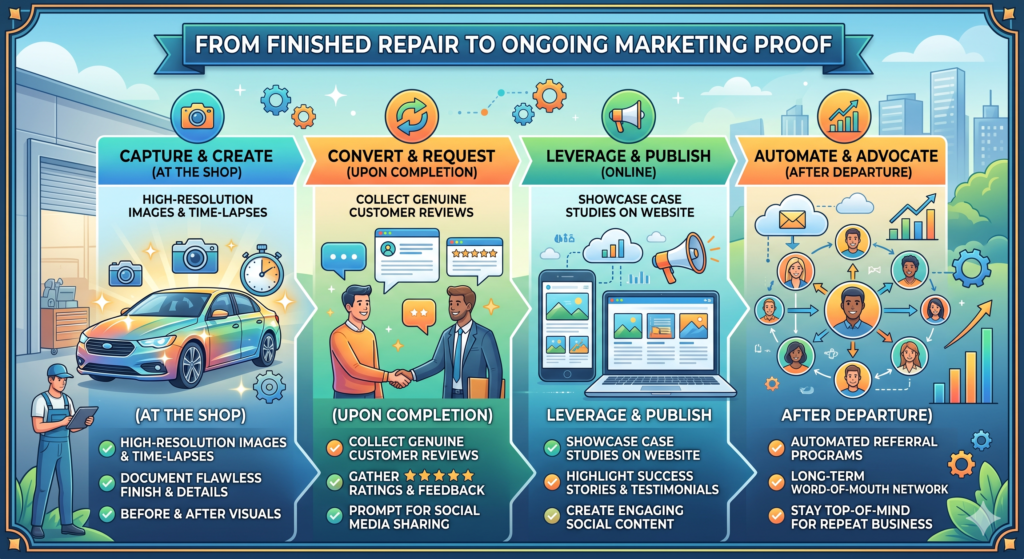
Many body shops do great work every day but fail to capture it. The car leaves, the customer is happy, and the proof disappears. That is a missed chance. Your shop is already doing the hard part. Marketing simply helps more people see it.
This does not mean you need to turn every repair into a big case study. It means you should build a simple habit of collecting proof. Take photos when allowed. Save customer feedback. Notice common repair stories. Pay attention to the moments where your team solves a real problem. Those moments can become website content, social posts, Google updates, email stories, and sales tools.
The best proof is not always dramatic. A small bumper repair can still show skill. A clear paint match can still build trust. A customer who says your team made the process easy can still help another stressed driver choose you.
Build a repair story library that your team can use again and again
A repair story library is a simple collection of photos, notes, and customer comments from real jobs. It does not need to be complex. It can start with a folder on your computer and a short form your team fills out after strong repairs.
The goal is to save the kind of proof that future customers care about. What kind of damage came in? What was the customer worried about? What did your team do? What was the final result? Did the customer say anything positive at pickup?
Over time, this library becomes very valuable. Your website can use it. Your social media can use it. Your ads can use it. Your front desk can use it when a caller asks, “Have you repaired this kind of damage before?”
The best repair stories focus on the customer’s worry, not just the damage
A repair story should not only say that a car had a damaged door or cracked bumper. It should explain what the customer was worried about. Maybe they were afraid the paint would not match. Maybe they needed the car back for work. Maybe they were confused about the insurance process. Maybe they thought the damage was small but wanted to make sure the car was safe.
When you frame the story around the worry, future customers connect with it. They see themselves in it. They think, “That sounds like my situation.” That is much more powerful than a plain before-and-after photo.
Your marketing becomes more human when it shows the problem behind the problem. The dent matters, but the stress matters more.
A simple story can be used in many places
One good repair story can become a website section, a Google post, a Facebook post, an Instagram caption, a short video script, an email, and even part of a sales conversation. This is how you get more value from the work you are already doing.
You do not need to create brand-new content every day from scratch. You need to reuse strong proof in smart ways. A story that works on social media may also help a website visitor trust your shop. A story that works in an email may also help your front desk explain the process.
Good marketing is not always about creating more. Often, it is about using what you already have better.
Make customer pickup a marketing moment without making it feel forced
The pickup moment is one of the most important points in the customer journey. The customer sees the finished repair. They feel relief. They may be excited to have their car back. They may feel grateful that the stress is over.
This is the perfect time to strengthen the relationship. But it has to be done with care. Do not turn the moment into a pushy sales pitch. Make it feel like a natural close to a good experience.
Your team can explain the repair, answer final questions, give care tips, ask for a review, and gently mention referrals. This should feel helpful, not scripted. The customer should leave feeling respected and confident.
Walk the customer through the finished work in plain language
Do not just hand over the keys. Take a moment to show the customer what was repaired. Explain the work in simple words. Point out the repaired area. Mention any care instructions, especially if paint work was done. Ask if they have questions.
This step builds trust because it shows pride in the work. It also helps the customer understand the value of what they paid for or what insurance covered.
A customer who understands the repair is more likely to appreciate it. A customer who appreciates it is more likely to leave a review and tell others.
Give customers something useful to take with them
A small printed or emailed repair care guide can make your shop feel more professional. It can explain how to care for fresh paint, when to wash the car, what to watch for, and who to call if they have questions.
This kind of guide is simple, but it creates a strong impression. It tells the customer that your care does not stop the second they pay or sign. It also gives them something with your shop name on it that they may keep.
Useful follow-through is marketing. It makes people remember how you made them feel.
Create campaigns around real moments when drivers are more likely to need you
Body shop demand can rise and fall based on weather, road conditions, travel seasons, school schedules, and local events. Smart marketing pays attention to these moments. Instead of running the same message all year, you can create campaigns that match what drivers are dealing with right now.
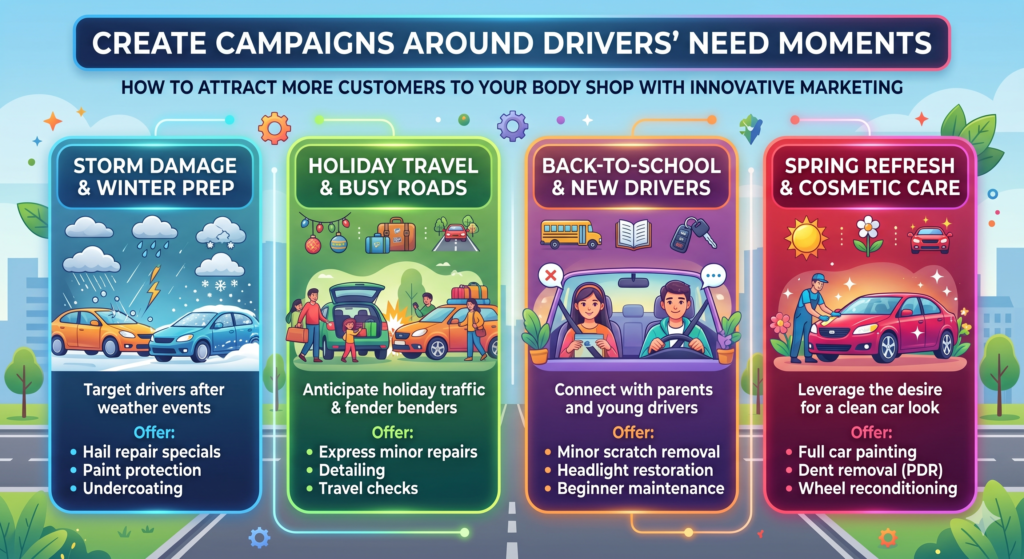
This makes your marketing feel timely. It also helps your shop become part of the customer’s real life. When the roads are icy, talk about what to do after a slide-off. When hail season approaches, explain how to document damage. When school starts, share safe driving reminders for busy parking lots. When holiday travel begins, remind people to check their vehicle and know what steps to take after an accident.
Seasonal marketing works because it meets customers where their attention already is.
Build weather-based marketing that helps drivers before and after damage happens
Weather can drive body shop demand. Hail, snow, ice, heavy rain, wind, fallen branches, and sun damage can all lead to repair needs. Your shop should have ready-made content for these moments.
When bad weather is expected, share helpful guidance before the damage happens. Tell people how to protect their cars when possible. Explain where to park during hail risk. Remind drivers to take photos if damage occurs. Tell them not to ignore broken lights, sharp bumper damage, or loose panels.
After weather events, shift the message. Explain how to inspect the vehicle, what photos to take, and how to contact your shop for guidance. Keep the tone calm. People may already be frustrated. Your job is to make the next step easy.
Prepare content before the season starts
Do not wait until a storm hits to create every post, email, and website update. Prepare ahead of time. Write your hail damage page before hail season. Prepare winter driving posts before the first major snow. Create a few simple graphics or videos that can be used when needed.
This helps you respond quickly. When people start searching, your shop is ready. When competitors are scrambling, your content is already in place.
Fast, useful communication during a local event can bring in strong leads because the need is immediate.
Keep the message helpful instead of fear-based
Do not scare people just to get calls. Fear-based marketing can feel cheap, especially when people are already dealing with damage. Be direct, but be calm.
Say what drivers should check. Explain when damage may need a professional look. Tell them how to take the next step. Let your helpfulness create trust.
A calm expert stands out more than a loud advertiser.
Use calendar-based campaigns to stay visible all year
Not every campaign needs to be tied to damage. Some can be tied to the calendar. Back-to-school season, holiday travel, spring cleaning, summer road trips, and year-end insurance timing can all create useful content angles.
For example, before summer travel, your shop can talk about checking for old damage before a long trip. Around the holidays, you can share advice for parking lot accidents, which can happen when shopping areas are crowded. At the start of the year, you can remind people not to keep putting off cosmetic damage that may affect resale value.
These campaigns keep your shop active even when a customer does not need you that day. They build memory.
A campaign should lead to one clear action
Every campaign should have a simple next step. It might be to request an estimate, send photos, call the shop, read a guide, or schedule an inspection. Do not ask people to do too many things at once.
If the campaign is about hail damage, the action might be to send photos for review. If it is about parking lot damage, the action might be to book a quick inspection. If it is about paint scratches, the action might be to ask whether the scratch can be repaired before it spreads or worsens.
One campaign, one message, one next step. That keeps the customer from feeling confused.
Repeat the campaign across channels with small changes
A good campaign should not live in one place. Use it on your website, Google profile, Facebook, Instagram, email, text follow-up, and even in-shop signs. Change the wording slightly for each channel, but keep the main idea the same.
This repetition helps people remember. They may see your message on Facebook, then later search Google and recognize your shop. Recognition reduces hesitation.
Use customer data to make smarter marketing decisions instead of guessing
Many body shops make marketing decisions based on feelings. They say, “I think Facebook works,” or “I do not think the website brings calls,” or “Most of our customers come from word of mouth.” Sometimes they are right. Many times, they are guessing.

Good marketing needs data, but it does not need to be complicated. You do not need a giant dashboard to make better decisions. You need to know where leads come from, which leads turn into estimates, which estimates turn into repair orders, and which jobs are most profitable.
When you know those numbers, you stop wasting money on marketing that looks busy but does not produce real work.
Track the full path from first contact to completed repair
A lead is not the same as a customer. A phone call is not the same as a booked job. A website visit is not the same as revenue. This is why you need to track the full path.
Start with the first contact. How did the person find you? Google search? Google ad? Referral? Facebook? Insurance agent? Passing by the shop? Then track whether they requested an estimate, whether they booked, whether the repair was completed, and what type of work it was.
Over time, patterns appear. You may find that Google leads book more often than social media leads. You may find that referrals bring higher-value work. You may find that certain service pages bring better customers than others. You may find that some ads generate calls but not jobs.
That information helps you spend smarter.
Ask every customer how they found you
This is one of the simplest tracking habits, and it costs nothing. Your front desk should ask every new customer how they heard about the shop. The answer should be recorded in the same place every time.
Do not rely only on software tracking. A customer may see your Facebook post, read your reviews, search your name on Google, and then call from your website. The true path can be messy. Asking the customer gives you extra insight.
The exact answer may not be perfect, but after many customers, trends become clear.
Measure repair value, not only lead count
Some marketing channels bring many small leads. Others bring fewer leads but better jobs. If you judge only by lead count, you may make the wrong choice.
Track the kind of work each channel brings. Does it bring small cosmetic repairs? Larger collision jobs? Insurance-related work? Fleet work? Repeat customers? Referral customers? This matters because not every lead has the same value.
The best marketing is not the marketing that brings the most noise. It is the marketing that brings the right customers at the right cost.
Review your marketing numbers every month
Marketing should not be something you check once a year. A monthly review helps you catch problems early and double down on what works.
Look at website traffic, calls, estimate requests, Google profile views, reviews, ad spend, booked jobs, and revenue by source if you can. Keep the review simple. The goal is not to drown in numbers. The goal is to make better decisions.
If calls are up but bookings are flat, the phone process may need work. If website traffic is up but forms are low, the pages may not be clear enough. If ads bring clicks but no calls, the offer or landing page may be weak. If reviews are slowing down, your review request process may need attention.
Small monthly fixes beat big yearly overhauls
A body shop does not need to rebuild its entire marketing every few weeks. Small changes can make a big difference over time.
Improve one service page. Add new photos to Google. Train the front desk on one call question. Test one ad message. Ask for reviews more consistently. Update one email. Build one new partner relationship.
These small improvements compound. After a year, your marketing system is much stronger because you kept improving it instead of ignoring it.
Stop paying for marketing you cannot explain
If you are paying for ads, directory listings, SEO, social media, or any agency service, you should understand what it is doing for your shop. You do not need to know every technical detail, but you should know the purpose, the results, and the next move.
Marketing should not feel like a mystery bill. If something is not producing leads, trust, visibility, or useful data, question it. Your budget should work as hard as your repair team does.
Make your body shop easier to choose than every other shop nearby
At the end of the day, body shop marketing is about making the customer’s choice easier. A stressed driver is comparing options quickly. They look at reviews. They scan websites. They check photos. They call. They listen to how they are treated. They ask themselves which shop feels safest.
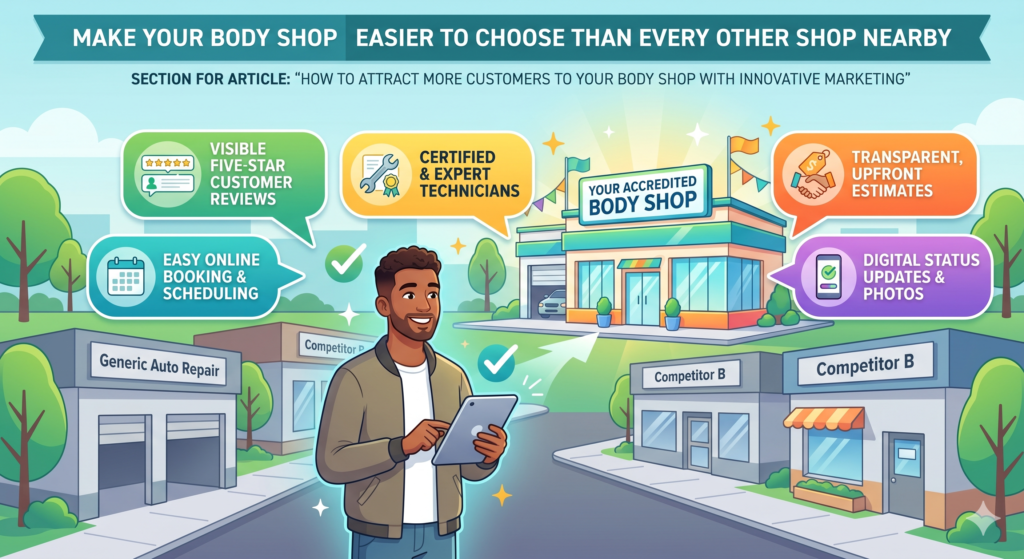
Your job is to remove doubt at every step.
Make your Google profile stronger. Make your website clearer. Make your photos more real. Make your reviews more visible. Make your phone process warmer. Make your estimate process easier. Make your follow-up more helpful. Make your local presence more familiar.
None of these steps require tricks. They require care, consistency, and a deep understanding of what customers feel when they need a body shop.
The shop that explains wins more trust
Many customers do not understand collision repair. They do not know what is normal. They do not know what questions to ask. They do not know how to compare shops beyond reviews and price.
When your shop explains things clearly, you become easier to trust. Education is not just content. It is sales. It is service. It is brand building.
A customer who feels informed is more likely to move forward. A customer who feels confused is more likely to delay or choose someone else.
Simple words are a competitive advantage
You do not need to sound technical to sound skilled. In fact, simple words often show more confidence. A true expert can explain hard things in a way normal people understand.
Use plain language on your website, in your calls, in your emails, and in your videos. Explain what matters. Avoid repair jargon unless you define it. Make customers feel smart, not small.
That kind of communication can set your shop apart in a market where many competitors still sound cold or unclear.
Every clear answer reduces friction
Every question you answer before the customer asks is one less reason for them to hesitate. How do estimates work? Can they send photos? Do they need a claim number? How long might the repair take? What if hidden damage is found? What happens at pickup?
When these answers are easy to find, customers feel more ready to contact you. That is how clarity turns into leads.
The shop that feels most human often gets the call
People do business with people, especially when they are stressed. A body shop may have equipment, certifications, and years of skill, but the customer still wants to know they will be treated well.
Show your people. Use a warm voice. Reply to reviews. Share real stories. Follow up with care. Make the process feel personal.
Innovation in body shop marketing does not always mean using the newest tool. Sometimes it means using modern tools to feel more human at scale.
Technology should make the customer experience warmer, not colder
Online forms, text updates, call tracking, email follow-up, retargeting ads, and CRM tools can all help. But they should not make your shop feel robotic. Use them to respond faster, explain better, and remember details.
The best technology supports better service. It does not replace it.
Your marketing should feel like your best employee
Imagine your best employee talking to a nervous customer. They would be calm, clear, helpful, honest, and patient. That is how your marketing should feel.
Your website should talk that way. Your ads should talk that way. Your emails should talk that way. Your social posts should talk that way.
When every part of your marketing sounds like a helpful human, your shop becomes easier to trust.
Build a customer journey that makes every step feel easy before the customer even asks for help
The strongest body shop marketing does not stop when someone clicks, calls, or walks in. That is only the start. If you want more customers, you need to think about the full journey from the first moment a driver notices your shop to the moment they pick up their repaired car and tell someone else about you.
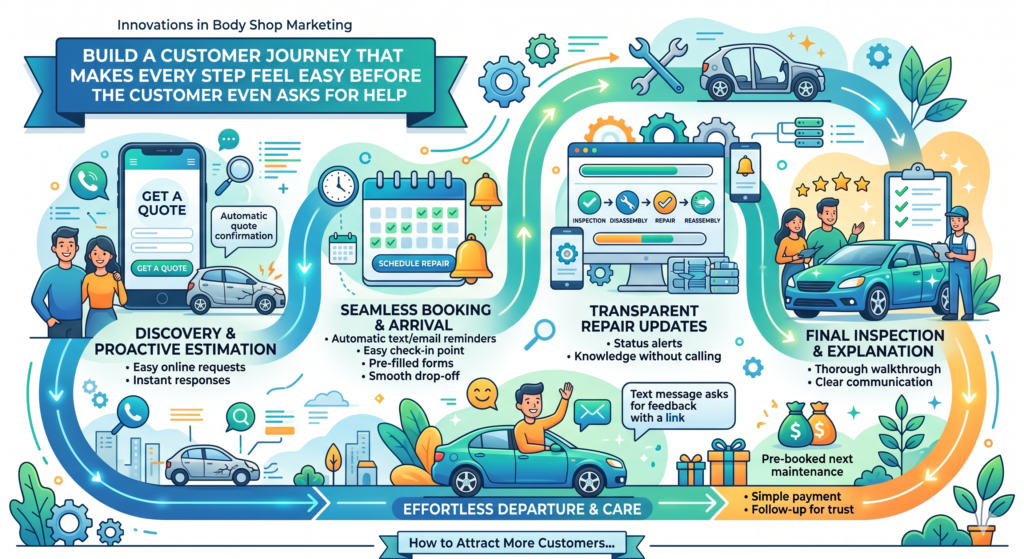
Most body shops focus on getting leads. That matters, but it is not enough. If the journey after the lead feels slow, unclear, or stressful, you lose trust. And when trust drops, customers either leave, delay, complain, or never refer anyone.
A strong customer journey makes people feel guided. It tells them what happens next. It removes small moments of doubt. It makes your shop feel organized. That kind of experience becomes marketing by itself because customers talk about businesses that make hard things easier.
Map the customer journey from the driver’s point of view
To improve your marketing, do not start by asking what you want customers to do. Start by asking what customers feel at each stage.
Before they find you, they may feel stressed, annoyed, or unsure. When they search online, they may feel rushed. When they call, they may feel nervous. When they drop off the car, they may worry about cost and time. While the car is being repaired, they may wonder what is happening. At pickup, they want relief and proof that the job was done right.
When you understand those feelings, your marketing becomes sharper. You stop writing generic messages and start solving real concerns.
The first stage is fear, so your message must create calm
A customer with vehicle damage is not usually in a relaxed buying mood. They may be worried about safety, money, insurance, and transportation. This means your first message should not be loud or clever. It should be calm and clear.
Your website, ads, and Google profile should quickly tell them that your shop can help them understand the damage, plan the repair, and take the next step without confusion. The words should feel steady. The design should feel clean. The phone number or estimate button should be easy to find.
Calm is a selling point. In a stressful moment, the calm shop stands out.
The middle stage is uncertainty, so your process must stay visible
Once the customer has contacted you, the biggest danger is silence. A customer who does not hear from the shop may start to worry. They may wonder if parts were ordered. They may wonder if the estimate changed. They may wonder if anyone is actually working on the car.
Clear updates can prevent this. Even short updates help. A message saying that parts are being reviewed, repairs are moving forward, or paint work is scheduled can reduce anxiety. Customers do not need every tiny detail. They need to feel that the shop is paying attention.
This is also marketing because the customer is forming a story in their head. Either the story is, “They kept me informed,” or it is, “I had to keep chasing them.” One story creates referrals. The other creates bad reviews.
Make your estimate process feel simple enough for busy people
The estimate process is often where customers decide whether your shop feels easy to work with. If the process feels confusing, they may look elsewhere. If it feels simple, they are more likely to move forward.
A strong estimate process does not mean promising a final price from a few photos. It means helping the customer understand what kind of review is possible, what information you need, and what may happen next.
Give clear photo instructions that normal drivers can follow
Many customers do not know how to photograph damage. They may send one blurry close-up, or they may send photos from angles that do not help. Instead of getting frustrated, guide them.
Tell them to take one photo of the whole side or area of the car, then a few closer photos of the damage. Ask them to include photos from different angles if the damage is deep, cracked, or near a light, wheel, door, or bumper edge. Keep the instructions simple and friendly.
This helps your team, but it also helps the customer feel capable. They are not guessing. They are following a clear path.
Explain why an in-person inspection may still be needed
Some customers may think a photo estimate should be final. If the final repair plan changes later, they may feel surprised. You can prevent this by explaining the limits early.
Say that photos can help your team start the conversation, but some damage is hidden behind panels, bumpers, lights, and trim. An in-person inspection may be needed to confirm the full repair plan. This is not a weakness. It is honest. It shows that your shop cares about accuracy.
When customers understand this upfront, they are less likely to feel misled later.
Create stronger content by answering the questions your front desk hears every week
One of the easiest ways to create high-performing marketing content is to listen to your own customers. Every question they ask on the phone, at the counter, by email, or through social media can become content.
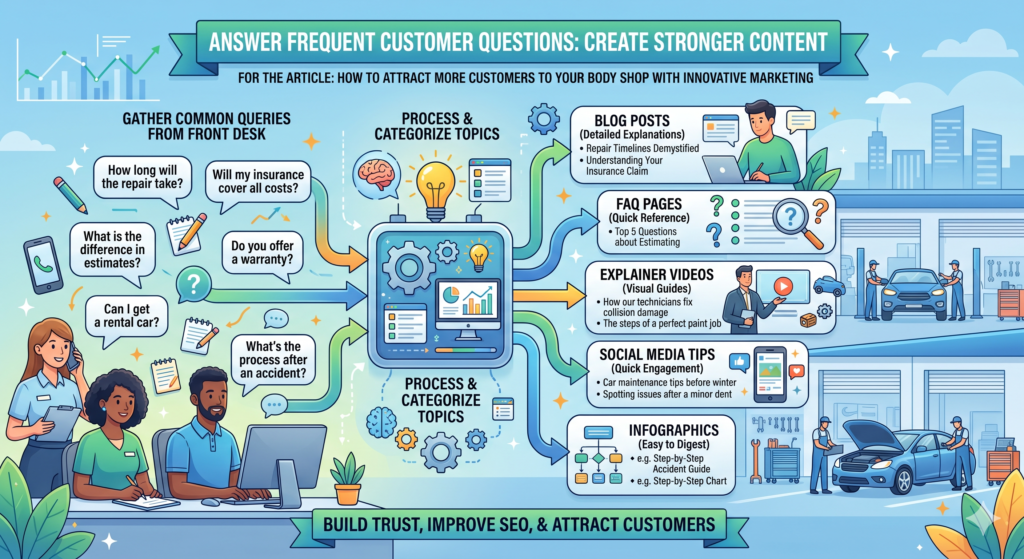
This is powerful because you are not guessing what people care about. They are telling you. If five people ask whether bumper damage is safe to drive with, that is a blog post, a short video, a Google post, and a social post. If customers keep asking how long repairs take, that should be explained on your website. If people keep asking about insurance, create content that makes the process easier to understand.
Good content does not have to be fancy. It has to be useful.
Turn common customer questions into search-friendly pages
Search engines reward useful answers because users are looking for help. A body shop has many chances to answer local repair questions better than competitors.
You can create content around common questions such as whether a dent can be repaired without repainting, what happens if a bumper cover is cracked, why paint matching is not always simple, how long collision repairs may take, what hidden damage means, and what drivers should do after a minor accident.
Each page should answer the question clearly. Do not write long empty paragraphs just to reach a word count. Explain the issue, describe what the customer should look for, tell them when to contact a shop, and make the next step easy.
The best content sounds like a service advisor, not a textbook
A customer should feel like a helpful person is explaining the answer. Avoid stiff language. Avoid long technical terms unless you explain them. Use the kind of words your customers use.
For example, customers may say “my bumper is hanging,” not “my bumper cover assembly is displaced.” They may say “paint scratch,” not “clear coat damage.” Your content should match their language first, then explain the proper repair idea in simple words.
This helps both people and search engines. People understand you faster. Search engines see that your page matches real search behavior.
Every helpful page should lead naturally to contacting the shop
Education should not end with a dead stop. After answering the question, guide the reader to the next step. If the topic is bumper damage, invite them to send photos or schedule an inspection. If the topic is paint scratches, explain that your team can look at the damage and tell them what repair options may fit.
Do this in a natural way. Do not suddenly switch into a hard sales pitch. The page should feel like advice that ends with help being available.
Use content to pre-sell your standards before customers compare price
Many customers compare body shops by price because they do not know how else to compare them. Your content can change that.
When you explain why repairs need proper inspection, why paint matching takes skill, why cheap repairs can cause problems, and why clear communication matters, you help customers judge value better. They begin to see that the cheapest quote is not always the best choice.
This does not mean you should attack cheaper shops. That can sound bitter. Instead, teach customers what quality looks like. Show them what questions to ask. Explain what good repair planning includes. Help them make a smarter decision.
Teach customers what can go wrong with rushed repairs
Customers often do not know the risks of rushed or careless work. They may only see the surface. They may think that if the car looks good from a distance, the repair is fine.
Your content can explain simple warning signs. Poor paint matching, rough edges, gaps between panels, warning lights, loose trim, moisture near repaired areas, and uneven finish can all signal problems. Keep the tone helpful, not scary.
When people understand the risk, they value careful work more. That makes your shop more attractive to customers who want the job done right.
Make quality feel practical, not fancy
Do not talk about quality as if it is only about pride. Talk about what quality means for the customer. It means the car looks right. It means parts fit properly. It means the paint finish blends well. It means the process is explained. It means the customer knows who to call with questions.
Quality becomes easier to sell when customers see how it affects their daily life.
Use automation in a way that saves time without making your shop feel cold
Innovation in marketing does not mean replacing human service. It means using better systems so your team can serve people faster and more clearly. Automation can help with follow-ups, review requests, missed calls, estimate reminders, appointment confirmations, and post-repair care.
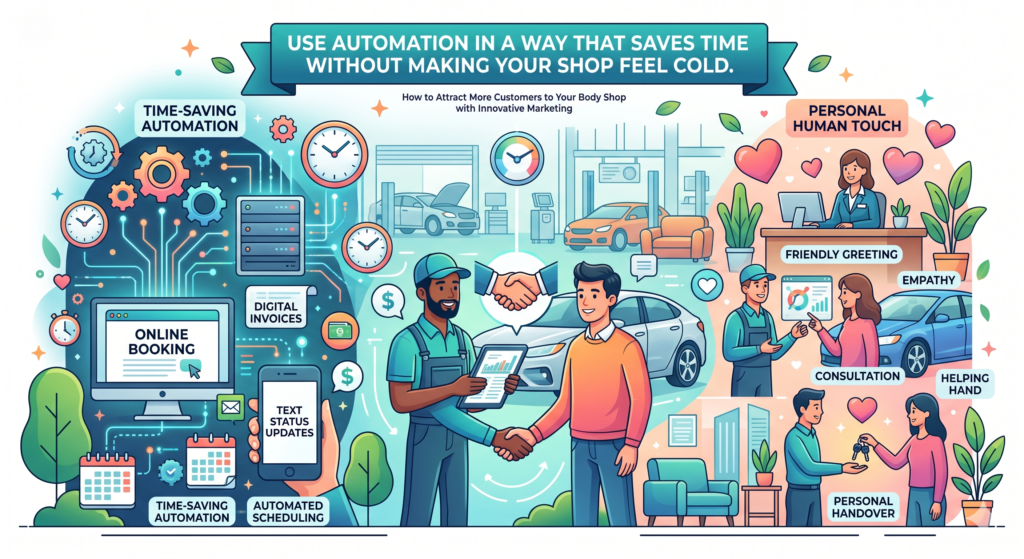
But automation must be written and managed carefully. If it feels cold, customers may ignore it. If it feels helpful, it improves the whole experience.
Automate small reminders that help customers take the next step
A customer may forget to send photos. They may forget an appointment time. They may forget to leave a review after pickup. A simple automated reminder can help.
The message should sound human. It should be short, clear, and useful. It should remind the customer what to do and why it matters.
For example, if a customer started an estimate request but did not upload photos, the reminder can gently explain that photos help the team review the damage and guide the next step. If a customer has an appointment, the reminder can confirm the time and tell them what to bring.
Automation should reduce effort for both sides
Good automation helps the customer and the shop at the same time. The customer gets clear guidance. The shop gets fewer missed appointments, fewer incomplete forms, and fewer confused calls.
This means your staff can spend more time on real conversations instead of repeating the same basic instructions all day. That improves service without adding pressure to the team.
Keep automated messages easy to stop or change
Customers should never feel trapped in a message flow. If they reply, your team should see it. If they already booked, reminders should stop. If they ask a question, a person should answer.
Automation should support the relationship, not take over the relationship.
Use a simple CRM so no lead gets forgotten
A customer relationship system does not need to be complex. At its core, it should help you track who contacted the shop, what they needed, what step they are in, and what follow-up is needed.
Without a system, leads live in notebooks, inboxes, sticky notes, call logs, and memory. That is risky. People get busy. Messages get buried. Follow-ups get missed.
A simple CRM keeps the pipeline visible. It helps your team know which customers need a call, which need photo instructions, which are waiting for insurance, and which are ready to schedule.
A lead should always have a next step
Every open lead should have a clear next action. The customer needs to send photos. The shop needs to call back. The estimate needs review. The appointment needs confirmation. The claim number is needed. The customer needs a reminder.
If there is no next step, the lead may go cold. A CRM helps prevent that.
Track lost leads so you can improve the system
When a customer does not book, record why if you can. Maybe they chose another shop. Maybe they delayed repair. Maybe insurance directed them elsewhere. Maybe the price was higher than expected. Maybe they never replied.
This information is useful. If many leads go silent after the first estimate, follow-up may need work. If many choose another shop because of timing, capacity or scheduling may be an issue. If many are confused about insurance, your education content may need to be stronger.
Lost leads are not just failures. They are feedback.
Strengthen your reputation by making bad moments easier to recover from
Even the best body shop will face problems sometimes. Parts can be delayed. Hidden damage can change the timeline. Insurance approvals can slow things down. Customers can misunderstand the process. A repair may need a second look.
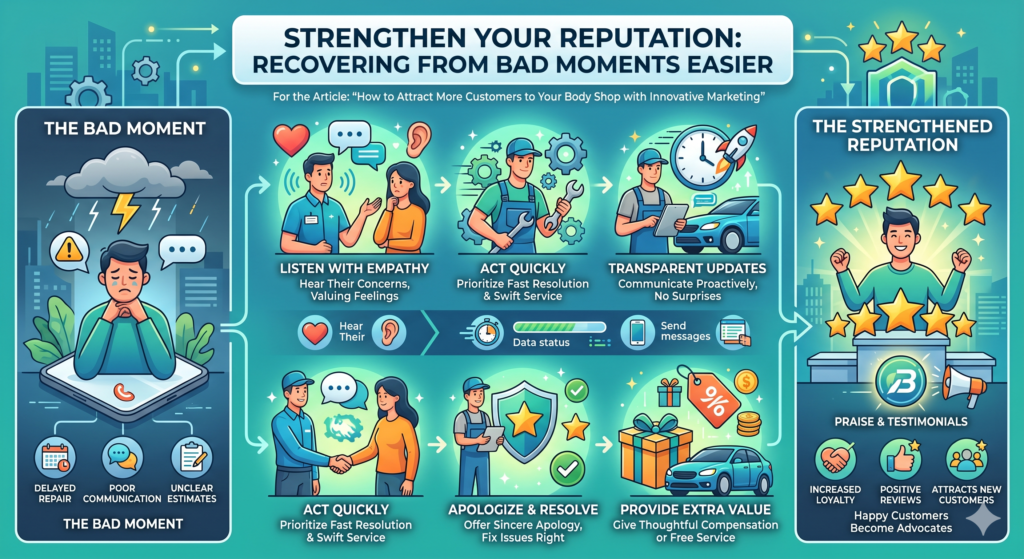
Reputation is not built by pretending problems never happen. It is built by handling problems well.
A shop that communicates clearly during a hard moment can still earn trust. A shop that goes silent during a hard moment can lose it fast.
Communicate delays before the customer has to ask
One of the fastest ways to upset a customer is to make them chase updates. If there is a delay, tell them early. Explain what happened in simple words. Tell them what your team is doing next. Give the clearest timeline you can without making promises you cannot control.
Customers may not love delays, but they usually handle them better when they are informed. Silence makes delays feel worse.
Honest updates protect reviews
Many negative reviews do not come from the problem itself. They come from how the problem was handled. A customer may accept that a part was delayed. They may not accept being ignored.
If your shop builds a habit of honest updates, you reduce the chance that small problems turn into public complaints.
Explain the reason without sounding like you are making excuses
There is a difference between explaining and blaming. Do not make the customer feel like they are stuck in a fight between your shop, suppliers, and insurance. Keep the message calm.
Say what changed, why it matters, and what happens next. That is enough.
Use complaints as a way to improve the customer experience
A complaint can be painful, but it can also show you where the customer journey is weak. Maybe your estimate explanation was unclear. Maybe pickup instructions were rushed. Maybe updates were too rare. Maybe the website created an expectation that did not match reality.
Listen for patterns. One complaint may be random. Repeated complaints point to a system issue.
Respond quickly and privately when possible
If a customer is unhappy, try to speak with them directly. A fast phone call can solve problems that would grow worse over email or review replies. The goal is not to win an argument. The goal is to understand what happened and find a fair way forward.
Even when the customer is upset, stay steady. A calm response can protect your brand.
Public responses should show maturity
If a negative review appears, reply in a way that future customers will respect. Do not reveal private details. Do not attack the customer. Do not write a long emotional reply.
A short, calm response that says your team takes concerns seriously and invites the customer to contact the shop is usually stronger. Future customers are watching how you handle pressure.
Conclusion
Attracting more customers to your body shop is not about shouting louder than every other shop in town. It is about becoming easier to find, easier to trust, and easier to choose.
The shops that grow are not always the ones with the flashiest ads. They are the ones that understand what drivers feel after damage happens. They know customers are stressed. They know people want clear answers. They know trust matters more than clever slogans. They know a repair job is not just about fixing a car. It is about helping someone get back to normal.







Comments are closed.