
WinSavvy Editorial Standards
How this article was created
Starting a digital marketing agency sounds simple from the outside. You help businesses get more traffic, leads, sales, and attention online. But once you step closer, you see the real truth. A digital marketing agency is not one business idea. It is a group of many possible business models.
Start a Local SEO Agency for Small Businesses That Need Customers Nearby
A local SEO agency is one of the strongest business ideas for a new digital marketing agency because the need is clear. Local businesses do not always care about followers, brand fame, or fancy reports. They care about phone calls, store visits, bookings, and people finding them when they search online.
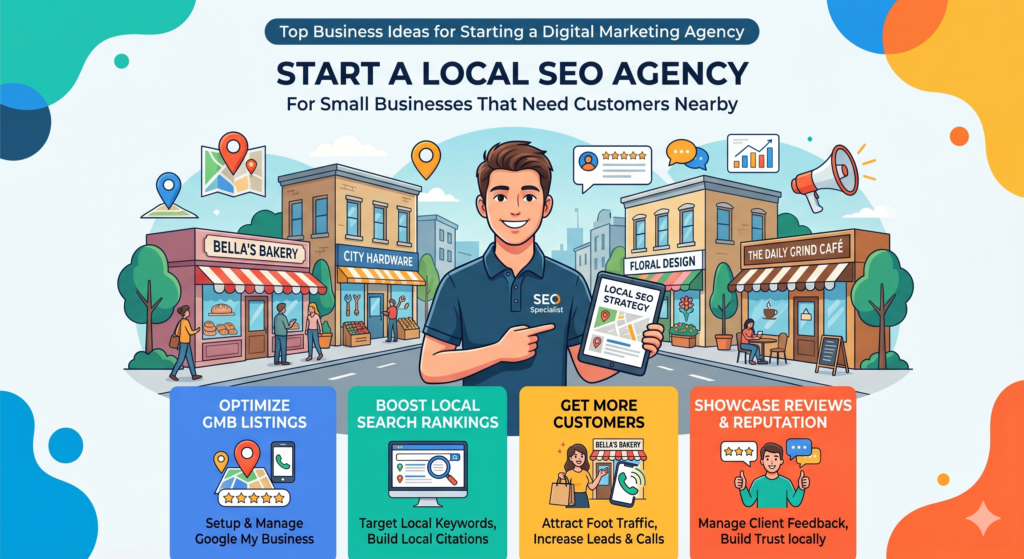
Think about a dentist, plumber, law firm, salon, clinic, repair company, restaurant, gym, or real estate agent. These businesses win when they appear in local searches. When someone types “best dentist near me” or “emergency plumber in Dallas,” the business that shows up first gets the call. That is why local SEO is so valuable.
Why Local SEO Is a Strong Agency Model
Local SEO is easier to explain than many other marketing services. A business owner may not understand complex funnel terms, but they understand Google Maps. They know that if their competitor appears above them, the competitor is getting more leads.
This makes selling easier. You are not selling an abstract idea. You are selling visibility where buying intent is already high. People searching locally are often ready to act. They are not just browsing. They need help now.
Local SEO also works well as a monthly service. Clients need ongoing work because rankings change, reviews keep coming in, competitors improve, and Google Business Profiles need updates. This gives your agency recurring income instead of one-time project work.
How to Position a Local SEO Agency
The worst way to position a local SEO agency is to say, “We help businesses rank on Google.” That is too broad. Every SEO agency says that. A stronger message is more direct and tied to money.
You could say, “We help local service businesses get more calls from Google Maps without relying only on paid ads.” This is clearer because it names the client, the result, and the channel.
You can also go deeper by choosing one type of local business. For example, you could build an agency only for dentists, personal injury lawyers, med spas, roofers, HVAC companies, or home service brands. This makes your message sharper. A dentist will pay more attention to “SEO for dental clinics” than “SEO for small businesses.”
What Services You Can Sell
A local SEO agency can offer Google Business Profile optimization, local keyword research, on-page SEO, review growth support, local landing pages, citation cleanup, content writing, and basic website fixes. But you should not present this as a long menu.
Clients do not buy tasks. They buy outcomes. So instead of saying you offer “citation building,” explain that you clean up business listings so Google trusts the business more and customers see the right phone number, address, and hours.
Your core offer could be a monthly local visibility package. It can include profile updates, review strategy, local content, website improvements, and reporting. The goal should be simple: more local search visibility, more calls, and more booked jobs.
How to Make This Agency Profitable
The key to profit is process. Local SEO has many repeated steps. Once you learn how to optimize one Google Business Profile, build one local landing page, or audit one service-area website, you can create a system and repeat it.
This is why local SEO is a good first agency model. You do not need a huge team at the start. You can build simple templates for audits, reports, keyword maps, review request messages, and monthly updates.
The best clients are not the smallest businesses with no budget. They are businesses where one new customer is worth real money. A roofer, lawyer, dentist, or med spa can often earn hundreds or thousands from one new lead. That makes your service easier to justify.
The Main Mistake to Avoid
Many new local SEO agencies sell cheap packages to any business that will listen. This creates a problem fast. Low-paying clients often need the most education, the most calls, and the most proof. They also leave quickly when results take time.
A better path is to choose clients with strong customer value and a clear need. Then build a service that is simple, focused, and tied to real business growth. If your work helps a business get more calls every month, you are not just another vendor. You become part of their growth engine.
Build a Paid Ads Agency for Businesses That Want Faster Leads
SEO is powerful, but it takes time. Paid ads can move faster. That is why a paid ads agency can be a strong business idea for someone who understands numbers, testing, and direct response marketing.
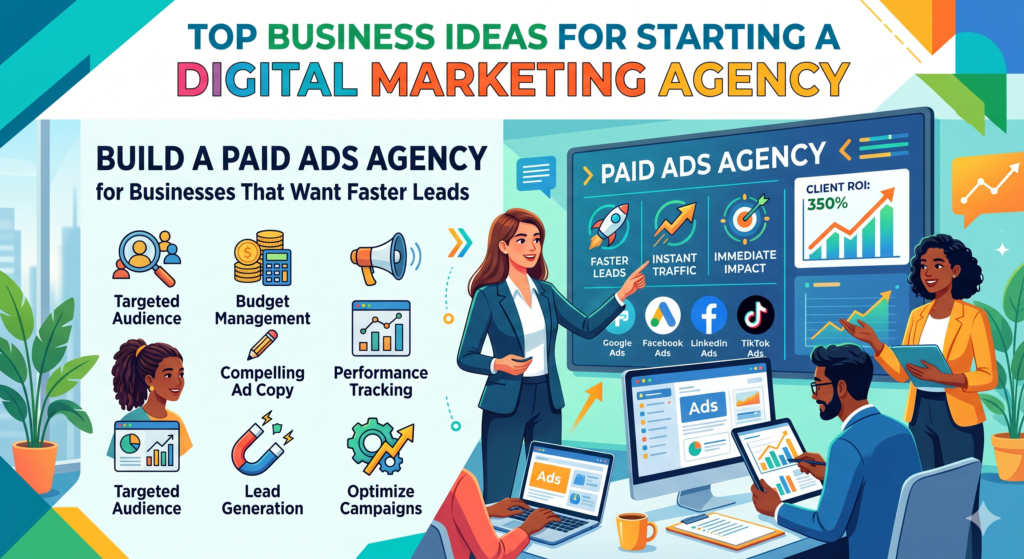
Paid ads are attractive because clients can see activity quickly. Campaigns go live. Traffic starts. Leads come in. Sales can be tracked. This makes paid ads easier to connect to revenue when tracking is set up well.
Why Paid Ads Agencies Are Still in Demand
Many businesses try to run ads by themselves and waste money. They boost random posts, target the wrong people, write weak copy, send traffic to poor landing pages, and then decide ads do not work.
In most cases, the problem is not the ad platform. The problem is the strategy.
A strong paid ads agency does not just push buttons inside Google Ads, Meta Ads, LinkedIn Ads, or TikTok Ads. It builds a complete path from click to customer. That includes the offer, the audience, the message, the landing page, the follow-up, and the tracking.
How to Position a Paid Ads Agency
A weak paid ads agency says, “We manage Facebook and Google ads.” That sounds like a task. A stronger agency says, “We help service businesses turn ad spend into booked calls through better campaigns, landing pages, and follow-up systems.”
This matters because clients do not want ads. They want results. They want qualified leads, lower cost per lead, more sales calls, and better return on ad spend.
You can also choose a platform niche. For example, you can focus only on Google Ads for high-ticket service businesses. Or you can focus on Meta Ads for ecommerce brands. Or LinkedIn Ads for B2B SaaS companies. A clear focus helps you build better systems and stronger case studies.
What Services You Can Sell
Paid ads work best when your offer includes more than campaign management. If you only manage ads, your results depend too much on the client’s landing page, offer, sales process, and follow-up. That can hurt you even when your campaigns are good.
A better offer includes ad strategy, campaign setup, copywriting, creative direction, landing page feedback, tracking setup, weekly optimization, and simple reporting. For lead generation clients, you can also help improve lead forms, booking pages, and call tracking.
For ecommerce clients, your service may include product feed checks, creative testing, retargeting, offer testing, and revenue reporting. The goal is not to make the dashboard look busy. The goal is to make the money math work.
How to Charge for Paid Ads
Many paid ads agencies charge a flat monthly fee, a percentage of ad spend, or a mix of both. For new agencies, a flat monthly fee is often cleaner because it gives predictable income. As the client grows, you can add performance bonuses or higher tiers.
The important part is to avoid pricing so low that you cannot give the account enough attention. Ads need testing. Testing needs time. If you charge too little, you may end up managing too many accounts and doing shallow work for all of them.
A good paid ads agency must protect its thinking time. The money is not only in launching campaigns. It is in reading the data, spotting weak points, and making smart changes before more budget is wasted.
The Main Mistake to Avoid
The biggest mistake in paid ads is promising results too fast or too strongly. Ads can work quickly, but not every offer is ready. Some clients have weak sales teams. Some have poor websites. Some sell something the market does not want at that price.
That is why your sales process should include a basic readiness check. Before taking a client, review their offer, website, budget, sales process, and past data. If the foundation is too weak, be honest. You can either help fix it first or walk away.
A paid ads agency grows best when it protects client results. Taking every client may bring short-term cash, but it can damage your reputation. Taking the right clients gives you better case studies, better referrals, and better long-term profit.
Create a Content Marketing Agency for Brands That Need Trust Before Sales
A content marketing agency is a powerful idea because many businesses know they need content, but they do not know what to say, how to say it, or how to turn content into leads.
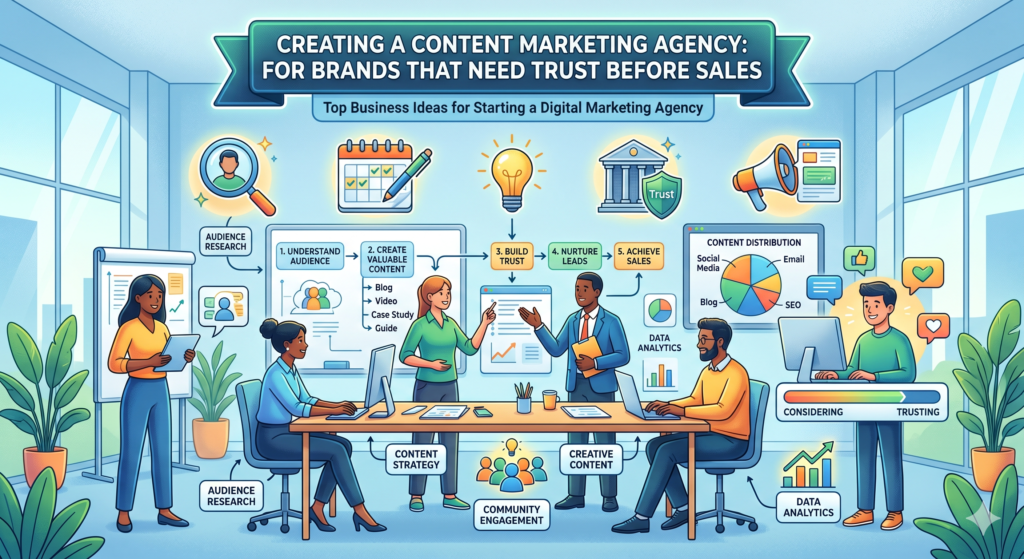
Content is not just blog writing. It can include guides, landing pages, newsletters, case studies, white papers, comparison pages, founder posts, email sequences, and sales support content. Good content helps buyers understand the problem, trust the brand, and take the next step.
Why Content Marketing Works for Serious Businesses
People rarely buy the moment they first hear about a company. They search. They compare. They read. They ask questions. They look for proof. Content helps answer those questions before the sales call.
This is why content works so well for B2B companies, SaaS brands, agencies, consultants, financial firms, legal firms, healthcare brands, and high-ticket service providers. These businesses often sell something that needs trust.
A buyer may not fill out a form after reading one article. But a strong content system can shape how that buyer thinks. It can make the brand feel smarter, safer, and more useful than competitors.
How to Position a Content Marketing Agency
Many content agencies sound the same. They say, “We write high-quality blogs.” That is not enough. A business owner does not want blogs for the sake of blogs. They want traffic, leads, authority, and sales support.
A stronger position would be, “We help B2B companies turn expert knowledge into search-driven content that brings qualified buyers to their website.” This is much more specific. It shows that you understand the purpose behind the work.
You can also position around a content type. For example, you could focus on case studies for SaaS companies, SEO blog content for professional services, founder-led LinkedIn content, or long-form educational guides for high-trust industries.
What Services You Can Sell
A content marketing agency can sell content strategy, topic research, SEO briefs, blog writing, editing, case study writing, newsletter writing, website copy, content refreshes, and content distribution. But again, do not present this as a random list.
Your offer should feel like a system. For example, you could sell a monthly authority content package. It may include keyword research, four deep blog articles, one lead magnet idea, internal linking, and one monthly content report.
Another option is a content engine package for founders. You interview the founder once or twice a month, pull out their ideas, and turn those ideas into articles, LinkedIn posts, email content, and website sections. This works well because many founders have strong ideas but no time to write.
How to Make Content More Strategic
The biggest difference between basic content and strategic content is intent. Basic content answers random topics. Strategic content supports a business goal.
Before writing, ask what the reader needs to believe before they buy. Ask what fears stop them. Ask what questions they ask sales reps. Ask what competitors fail to explain. Ask what proof the company has that others do not.
This turns content into a sales asset. A good article can rank on Google, help sales teams handle objections, warm up leads, and support email campaigns. That is much more valuable than a blog post that simply fills space on a website.
The Main Mistake to Avoid
The main mistake is becoming a low-cost content vendor. Many businesses treat content like a commodity because many writers sell it that way. They charge by the word, write surface-level pieces, and do not connect content to growth.
To avoid this, sell thinking, not just writing. Your research, strategy, positioning, interviews, and content structure are part of the value. The words matter, but the thinking behind the words matters more.
A strong content marketing agency can charge well when it shows clients how content supports traffic, trust, leads, and sales. When your content helps buyers move closer to a decision, you are not just writing. You are building a quiet sales machine.
Launch a Social Media Agency for Personal Brands and Founder-Led Companies
A social media agency can be a smart business idea, but only when it has a clear focus. Many new agencies offer “social media management” in a weak way. They post quotes, design basic graphics, write short captions, and hope engagement grows.
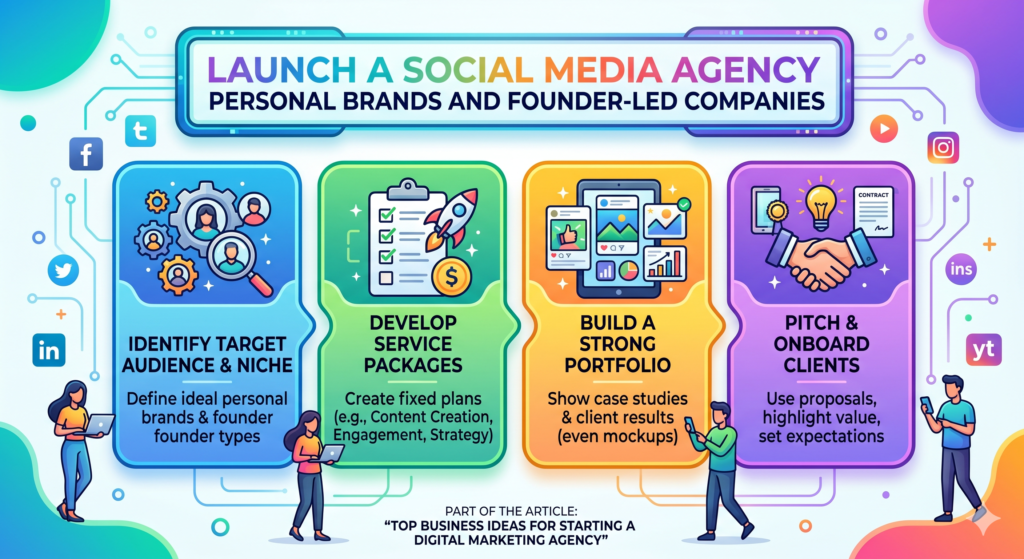
That is not enough anymore.
The better opportunity is to help founders, experts, coaches, consultants, and company leaders build trust through strong ideas. People want to hear from real people. A founder with a clear voice can often build more trust than a company page.
Why Founder-Led Social Media Is Growing
People are tired of faceless brands. They want stories, lessons, opinions, behind-the-scenes thinking, and useful advice. This is why founder-led content works so well, especially on LinkedIn, X, YouTube Shorts, Instagram, and newsletters.
A founder can speak with more honesty than a brand account. They can share lessons from building the company. They can explain what they believe. They can talk about customer problems in a real way.
For B2B companies, this is especially powerful. A strong founder presence can attract partners, investors, clients, employees, podcast invites, and media attention. It can also make sales easier because prospects feel like they already know the person behind the business.
How to Position a Social Media Agency
Instead of saying, “We manage social media accounts,” you can say, “We help founders turn their ideas into content that builds trust, starts conversations, and brings inbound leads.”
This position is stronger because it moves away from posting and toward authority. It also speaks to a clear buyer. A founder does not want random posts. They want the market to see them as credible.
You can also focus on one channel. For example, LinkedIn content for B2B founders is a clean niche. It is easier to build a process, show examples, and explain value. A narrow offer often sells better than a broad one.
What Services You Can Sell
A founder-led social media agency can offer content strategy, founder interviews, ghostwriting, post creation, content calendars, profile optimization, comment strategy, newsletter repurposing, and performance reviews.
The best service usually starts with extracting ideas. Most founders are not short on knowledge. They are short on time and structure. A monthly interview can give you enough raw material to create posts, articles, emails, and short scripts.
You can also create a “voice guide” for each client. This helps keep the content real. It should capture the client’s phrases, views, stories, tone, and topics they care about. Without this, ghostwritten content can sound fake.
How to Make Social Media Content Bring Business Results
Likes are not the goal. They can help, but they are not the whole game. The real goal is trust and conversation.
Strong social content should make the right people think, “This person understands my problem.” It should also create reasons for people to reply, visit the website, join the email list, book a call, or remember the brand when they are ready.
This means every post should have a job. Some posts teach. Some build belief. Some share proof. Some handle objections. Some show values. Some invite action. When you plan content this way, social media becomes more than noise.
The Main Mistake to Avoid
The biggest mistake is treating social media like decoration. Pretty posts are not enough. A founder’s content needs a point of view. It needs real lessons, clear stories, and useful ideas.
Another mistake is making every client sound the same. This happens when agencies use the same hooks, same post formats, and same writing style for everyone. It may save time, but it kills trust.
A strong social media agency protects the client’s voice. It turns their thinking into clear content without making them sound like everyone else. That is where the value is.
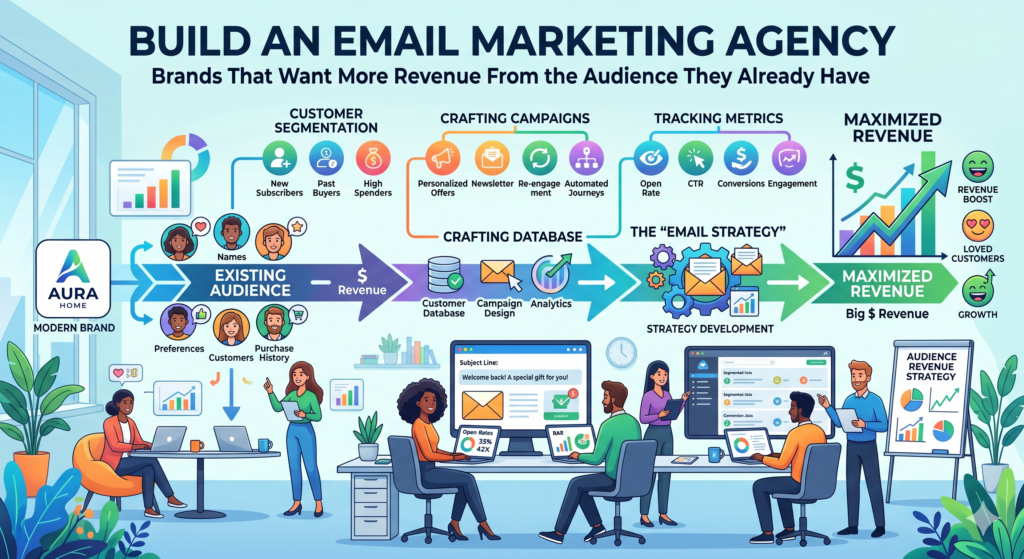
Build an Email Marketing Agency for Brands That Want More Revenue From the Audience They Already Have
Email marketing is one of the most practical agency ideas because it helps businesses earn more from people they already know. Many companies spend heavily to get traffic, leads, and customers, but then they fail to follow up well.
That is a costly mistake.
An email marketing agency helps fix that. You can help brands welcome new leads, recover lost sales, educate buyers, announce offers, bring back past customers, and build stronger relationships over time.
Why Email Marketing Is a Strong Agency Model
Email is direct. You are not fully at the mercy of a social media algorithm. When someone joins an email list, the business gets a channel it can use again and again.
This is especially valuable for ecommerce brands, coaches, course creators, SaaS companies, service businesses, and B2B firms with long sales cycles. Each of these businesses needs follow-up. People do not always buy right away. A good email system keeps the conversation alive.
Email also works well as both a project and monthly service. You can build flows, write campaigns, clean up lists, improve segmentation, and run ongoing tests.
How to Position an Email Marketing Agency
A weak position is, “We write email newsletters.” A stronger position is, “We help ecommerce brands increase repeat sales and recover lost revenue with email flows and campaigns.”
That message is clear because it ties email to money. It also names a specific client and a specific result.
For B2B, your position could be, “We help service businesses turn cold leads and old contacts into warm sales conversations through smart email follow-up.” Again, the focus is not on email as a task. The focus is on what email helps the business achieve.
What Services You Can Sell
For ecommerce, you can sell welcome flows, abandoned cart flows, post-purchase flows, win-back flows, product launch campaigns, customer education emails, and monthly campaign management.
For service businesses, you can sell lead nurture sequences, reactivation campaigns, newsletter systems, sales follow-up emails, webinar follow-up emails, and email list cleanup.
The best way to package this is around revenue moments. A welcome flow helps turn new subscribers into buyers. An abandoned cart flow helps recover lost orders. A win-back flow helps bring back inactive customers. A nurture sequence helps leads trust the business before sales reaches out.
How to Make Email More Valuable
Email becomes more valuable when it is tied to customer behavior. Sending the same message to everyone is simple, but it is not always smart.
A new lead needs a different message than a past customer. A repeat buyer needs a different message than someone who has not opened an email in months. A person who downloaded a guide needs different follow-up than someone who abandoned a checkout page.
This is where strategy matters. You can help clients send better emails based on where people are in the buying journey. That makes the emails feel more useful and less annoying.
The Main Mistake to Avoid
The biggest mistake is writing emails without understanding the customer. Good email does not start with clever subject lines. It starts with knowing what the customer wants, what they fear, what they have tried, and why they have not bought yet.
Another mistake is over-sending without a reason. More emails do not always mean more revenue. The goal is to send the right message at the right time with a clear reason to care.
An email marketing agency can become very profitable because the work is close to revenue. When clients see that your flows and campaigns bring in sales, they are more likely to stay. That makes email one of the best agency models for long-term income.
Start a Conversion Rate Optimization Agency for Businesses Getting Traffic but Not Enough Sales
Many businesses do not need more traffic first. They need to get more value from the traffic they already have.
This is where a conversion rate optimization agency becomes a strong business idea. You help companies improve the pages, forms, offers, buttons, messages, and buying paths that turn visitors into leads or customers.

A business may be spending money on ads, SEO, social media, and email, but if the website does not convert, much of that effort leaks away. CRO helps close that leak.
Why CRO Is a High-Value Agency Model
CRO is valuable because it is close to money. If a website gets 20,000 visitors a month and only 1 percent of them convert, even a small improvement can create a large gain.
This makes CRO easier to justify for businesses that already have traffic. You are not asking them to wait months for results. You are helping them improve what is already happening.
CRO is also strategic. It is not just changing button colors or moving sections around. Real CRO looks at customer behavior, buyer doubts, page clarity, offer strength, proof, speed, mobile experience, and trust signals.
How to Position a CRO Agency
A weak position is, “We optimize websites for conversions.” That sounds common and vague. A stronger position is, “We help ecommerce and service businesses turn more of their existing traffic into buyers, booked calls, and qualified leads.”
This works because it shows the client that you are not trying to sell them more traffic. You are trying to make their current traffic more profitable.
You can also pick one type of CRO work. For example, you could focus on landing page audits for paid ads, checkout optimization for ecommerce stores, SaaS free trial conversion, or lead form improvement for service businesses.
What Services You Can Sell
A CRO agency can offer website audits, landing page audits, heatmap reviews, user journey analysis, copy improvements, A/B test planning, checkout reviews, form optimization, and funnel fixes.
But the offer should not feel like random tasks. It should feel like a clear path. You can start with a conversion audit, then move into a monthly testing and improvement plan.
For example, your first project could review the homepage, top landing pages, product pages, pricing page, and checkout or lead form. Then you create a clear action plan that explains what should change, why it matters, and what result the client should watch.
How to Make CRO More Actionable
CRO becomes powerful when it is tied to real buyer questions. Many websites fail because they do not answer the questions people have before buying.
A visitor wants to know what the offer does, who it is for, why it is better, how much it costs, what happens after they sign up, what proof exists, and what risk they are taking.
If the page hides these answers, the visitor hesitates. If the visitor hesitates, they leave. Your job is to remove that hesitation.
The Main Mistake to Avoid
The biggest mistake is making CRO look like design opinion. Clients do not need another person saying, “I like this layout better.” They need clear reasons based on buyer behavior and business goals.
Another mistake is taking CRO clients who do not have enough traffic. If a site gets very little traffic, it is hard to test changes in a useful way. In that case, your work may still help, but it should be sold as a website improvement or landing page strategy project, not heavy testing.
A CRO agency works best when the client already has traffic, leads, or sales. Then your work can make the whole business more efficient.
Build a Funnel Strategy Agency for Coaches, Consultants, and High-Ticket Service Businesses
A funnel strategy agency helps businesses turn attention into leads and leads into sales. This is a strong agency idea because many experts are good at what they do, but weak at guiding people toward buying.
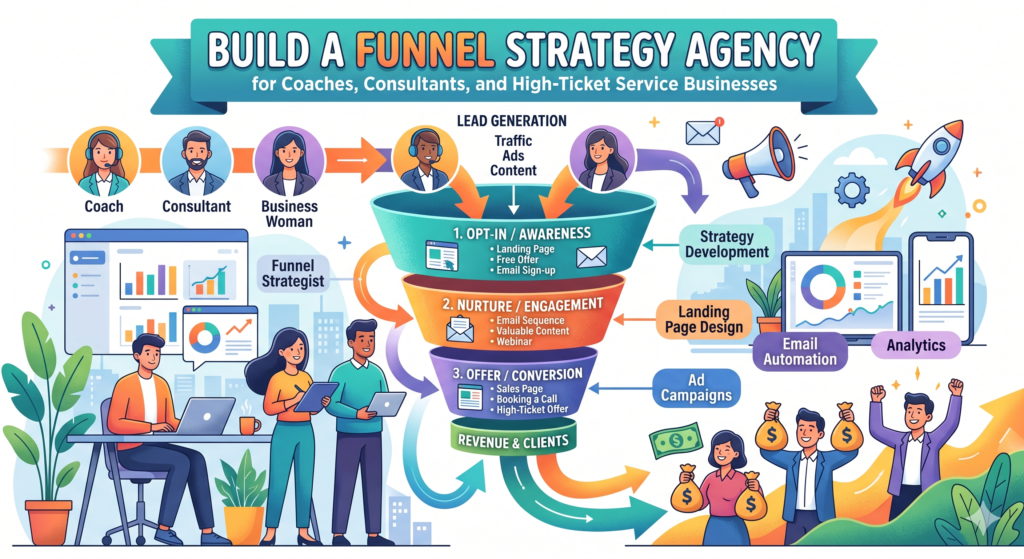
They may have a website, social media page, email list, and sales call link, but the pieces do not connect. A funnel agency brings those pieces together.
For coaches, consultants, agencies, course creators, and high-ticket service providers, this can be very valuable. Their buyers often need trust before they book a call or pay a higher price.
Why Funnel Strategy Is a Strong Offer
A funnel is not just a landing page. It is the full path a buyer follows. That path may start with a social post, ad, blog article, webinar, guide, quiz, or video. Then it moves into email follow-up, proof, education, and a sales call.
Many businesses have parts of this system, but not the full journey. They may get leads but fail to warm them up. They may get calls but attract the wrong people. They may have a good offer but explain it poorly.
A funnel strategy agency fixes the journey.
How to Position a Funnel Agency
A weak position is, “We build funnels.” A stronger position is, “We help high-ticket service businesses turn cold visitors into qualified sales calls through clear offers, landing pages, and follow-up systems.”
This tells the client what you actually help them get. It also makes the service feel bigger than page building.
You can choose one market and become more specific. For example, you could build funnels for business coaches, health consultants, law firms, financial advisors, B2B consultants, or done-for-you service providers.
What Services You Can Sell
A funnel agency can sell offer strategy, landing page copy, lead magnet creation, webinar funnels, quiz funnels, email nurture sequences, booking page optimization, sales page copy, thank-you pages, and tracking setup.
But you should package the work as a system. A simple funnel build may include a lead magnet, landing page, thank-you page, five-email nurture sequence, booking page, and basic tracking.
A more advanced funnel may include ads, webinar slides, sales page copy, retargeting strategy, email campaigns, and sales call follow-up messages.
How to Make Funnels Work Better
The secret to a good funnel is not the software. It is the message. Many funnels fail because they are built around weak offers and unclear promises.
Before building anything, you need to understand the buyer’s pain. What problem is urgent? What have they already tried? What result do they want? What do they not believe yet? What proof would make them feel safe?
Once you know this, the funnel becomes easier to build. The landing page can speak to the real problem. The emails can answer real objections. The call booking page can make the next step feel simple.
The Main Mistake to Avoid
The biggest mistake is selling funnels as magic machines. A funnel cannot save a bad offer. It cannot create trust if the business has no proof. It cannot fix a sales process where nobody follows up.
That is why your agency should check the client’s offer before building. If the offer is weak, fix the offer first. If the audience is wrong, fix the targeting first. If the sales call is poor, help improve that too.
A funnel agency becomes valuable when it looks at the whole customer journey, not just the pages. The real win is not building a pretty funnel. The real win is creating a path that helps the right buyer say yes.
Create a Niche SEO Agency for SaaS Companies That Need Qualified Traffic
A SaaS SEO agency can be a strong business idea because software companies often need steady inbound traffic. Paid ads can work, but ad costs can rise fast. SEO gives SaaS brands a way to attract buyers who are already searching for answers.
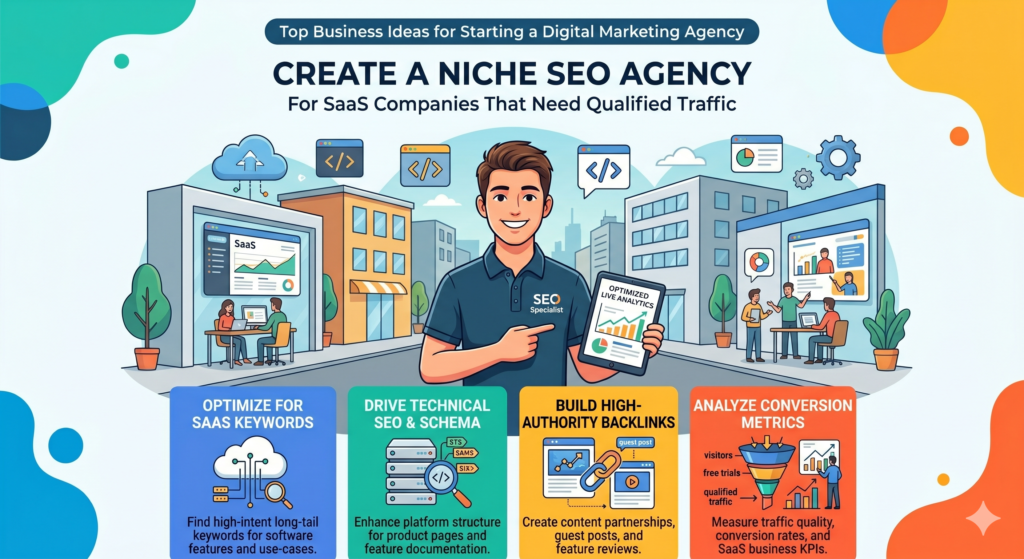
SaaS SEO is different from general SEO. The goal is not just traffic. The goal is qualified traffic from people who may sign up, start a trial, book a demo, or compare tools.
This makes SaaS SEO a more strategic service.
Why SaaS SEO Is Different From Basic SEO
A SaaS buyer often searches across many stages. At first, they may search for how to solve a problem. Later, they may search for software types, product comparisons, pricing questions, and alternatives to tools they already use.
This means SaaS SEO needs a smart content map. You need content for people who are learning, comparing, and ready to buy.
A simple blog plan is not enough. A SaaS company needs feature pages, use case pages, comparison pages, integration pages, template pages, and helpful articles that match real buyer intent.
How to Position a SaaS SEO Agency
A weak position is, “We help SaaS companies get more organic traffic.” Traffic alone is not the strongest promise. A better position is, “We help SaaS companies attract more trial users and demo-ready buyers through search content built around real buying intent.”
This is clearer because it connects SEO to pipeline.
You can also narrow your focus even more. For example, you could help project management tools, HR software, finance software, AI tools, cybersecurity platforms, or sales software companies. The more you understand one type of SaaS buyer, the sharper your strategy becomes.
What Services You Can Sell
A SaaS SEO agency can sell SEO strategy, keyword research, content planning, product-led content, blog writing, comparison pages, technical SEO audits, internal linking, content refreshes, and reporting.
You can also offer a “search growth system” instead of selling single blog posts. This may include a keyword map, topic clusters, monthly content, technical fixes, content updates, and conversion reviews.
For SaaS clients, your work should also connect with product marketing. You need to understand features, use cases, customer pain points, and competitors. That helps you create content that does more than rank. It helps sell the product.
How to Make SaaS SEO More Strategic
The best SaaS SEO content is not written only for Google. It is written for buyers who need help making a decision.
For example, an article about “how to manage remote teams” can be useful, but a page about “best remote team management software” may attract people closer to buying. A comparison page between two tools may be even closer to revenue.
This does not mean every page should be sales-heavy. It means every piece of content should have a clear role. Some content educates. Some content compares. Some content converts. Some content supports retention.
The Main Mistake to Avoid
The biggest mistake is chasing high-volume keywords with low buying intent. A keyword may bring thousands of visitors, but if those visitors are not buyers, the traffic may not matter.
Another mistake is writing content that ignores the product. SaaS SEO should often show how the product helps solve the problem. If the content never connects to the software, it may bring readers but not users.
A SaaS SEO agency can charge strong retainers when it helps clients build organic growth that supports trials, demos, and revenue. The key is to sell search as a growth channel, not just a content task.
Start an Ecommerce Marketing Agency for Online Stores That Need Profitable Growth
An ecommerce marketing agency helps online stores get more sales, improve repeat purchases, and grow profitably. This is one of the most popular agency ideas because ecommerce brands often need help across many parts of the customer journey.
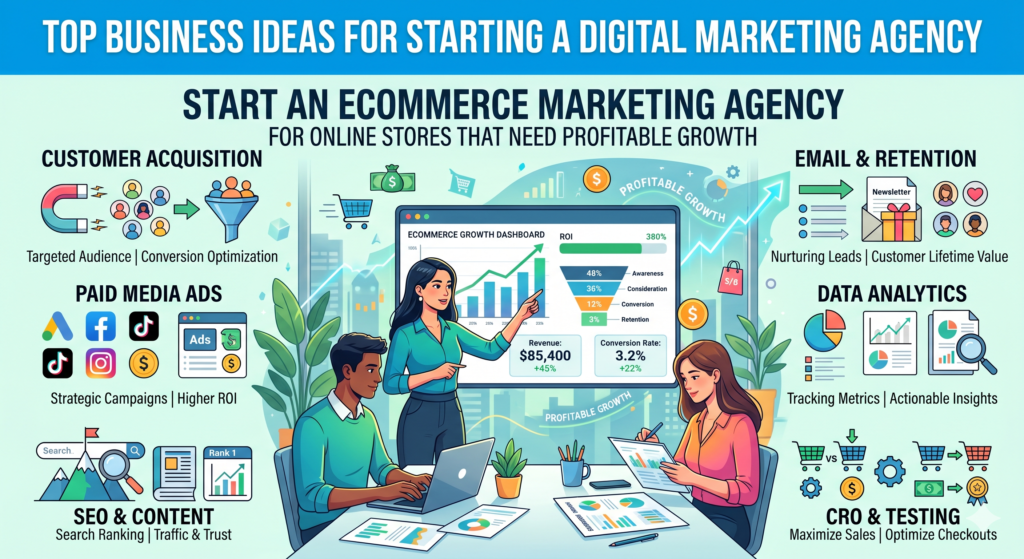
They need traffic. They need strong product pages. They need ads that work. They need email flows. They need offers. They need retention. They need better average order value. The opportunity is wide, but that also means you need focus.
Why Ecommerce Is a Strong Agency Market
Online stores are easy to understand because the result is clear. A store either sells more or it does not. This makes marketing performance easier to measure than in some other industries.
Ecommerce brands also move fast. They launch products, run seasonal campaigns, test offers, and need creative often. This creates ongoing demand for marketing support.
But ecommerce can also be hard. Margins matter. Shipping costs matter. Ad costs matter. Return rates matter. A campaign that brings sales may still be weak if the profit is poor.
How to Position an Ecommerce Agency
A weak position is, “We help ecommerce brands grow online.” That is too broad. A stronger position is, “We help small ecommerce brands increase profitable sales through better ads, email flows, and product page strategy.”
This works because it includes the word profitable. Many ecommerce owners have been burned by agencies that grew revenue but ignored margin.
You can also focus on a type of store. For example, you could serve beauty brands, fitness products, pet brands, fashion stores, home goods, food brands, or subscription ecommerce companies.
What Services You Can Sell
An ecommerce agency can sell paid ads, email marketing, SMS campaigns, product page optimization, offer strategy, creative testing, landing pages, retention campaigns, and customer journey audits.
The smartest path is often to specialize in one revenue lever first. For example, you could become an email and retention agency for Shopify brands. Or you could focus on Meta Ads creative testing. Or you could focus on product page conversion for stores with traffic.
Trying to do everything too early can make your work messy. A focused offer is easier to sell and easier to deliver well.
How to Make Ecommerce Marketing More Profitable
Ecommerce growth is not only about getting new customers. New customers can be expensive. Profit often improves when you help brands get more from each customer.
That may mean better bundles, stronger email flows, smarter upsells, clearer product pages, and better post-purchase campaigns. It may also mean improving repeat purchase rates.
A good ecommerce agency looks beyond the first sale. It asks how the brand can increase order value, reduce waste, bring buyers back, and build a stronger customer base.
The Main Mistake to Avoid
The biggest mistake is focusing only on revenue. Revenue can look exciting while profit stays weak. If ad spend, discounts, shipping, and returns eat the margin, the brand may not actually be growing in a healthy way.
Another mistake is relying only on ads. Ads are important, but ecommerce brands need more than traffic. They need strong creative, clear pages, trust, email follow-up, and retention.
An ecommerce agency can become very valuable when it helps clients grow in a way that protects profit. That is what store owners really want, even when they do not say it clearly.
Build a Marketing Automation Agency for Businesses That Need Better Follow-Up
Many businesses do not lose sales because people are not interested. They lose sales because they do not follow up well.
Leads fill out forms and hear nothing for days. Customers buy once and never receive a smart next step. Sales teams forget old contacts. Email lists sit unused. This creates a strong opening for a marketing automation agency.
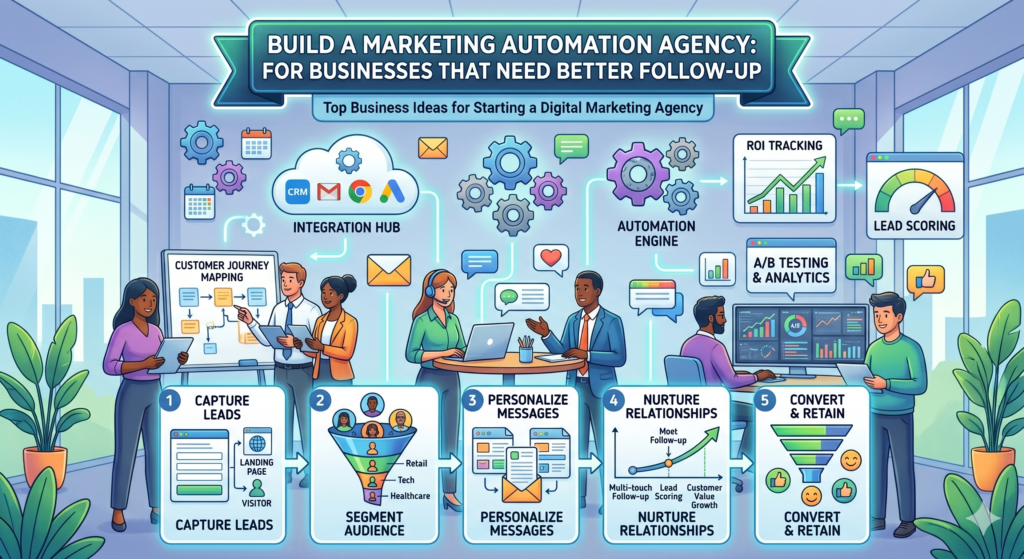
A marketing automation agency helps businesses send the right message at the right time without doing everything by hand.
Why Marketing Automation Is a Practical Agency Idea
Automation saves time, but that is not the only benefit. It also creates consistency. A business can make sure every new lead gets a welcome message, every booked call gets a reminder, every customer gets onboarding, and every inactive contact gets a reactivation message.
This is useful for service businesses, SaaS companies, ecommerce stores, online education brands, real estate teams, clinics, consultants, and B2B companies.
Many of these businesses already use tools like HubSpot, ActiveCampaign, Klaviyo, Mailchimp, GoHighLevel, ConvertKit, or Zoho. But they often use only a small part of what the tool can do.
How to Position a Marketing Automation Agency
A weak position is, “We set up automation tools.” A stronger position is, “We help businesses turn more leads into sales by building follow-up systems that run every day.”
This makes the offer easy to understand. The client does not need to care about the tool first. They need to care about the outcome.
You can also position around a specific platform. For example, you could become a HubSpot automation agency for B2B companies, a Klaviyo automation agency for Shopify brands, or a GoHighLevel setup agency for local service businesses.
What Services You Can Sell
A marketing automation agency can sell CRM setup, lead nurture workflows, email automation, SMS follow-up, pipeline automation, lead scoring, customer onboarding sequences, reactivation campaigns, and reporting dashboards.
A strong starter offer could be a lead follow-up system. This might include a form connection, CRM pipeline, five-message email sequence, SMS reminders, sales alerts, and a simple dashboard.
Another offer could be customer onboarding automation. This helps new customers understand what happens next, how to use the product or service, and how to get value faster.
How to Make Automation Feel Human
The biggest fear with automation is that it can feel cold. Bad automation sounds robotic, pushy, and lazy. Good automation feels timely, helpful, and personal.
The secret is to write messages like a real person. The email should not sound like a machine. It should sound like someone on the team cared enough to guide the customer.
You also need to avoid sending too much. Automation should support the relationship, not annoy people. Every message should have a purpose.
The Main Mistake to Avoid
The biggest mistake is building complex systems before the simple ones work. Many businesses do not need advanced lead scoring on day one. They need fast response, clear follow-up, and fewer dropped leads.
Another mistake is focusing too much on software features. Clients do not want buttons, tags, triggers, and workflows. They want more sales conversations, fewer missed leads, and better customer experiences.
A marketing automation agency works best when it keeps the promise simple. Better follow-up. Better timing. Better results from the leads and customers the business already has.
Create a Personal Branding Agency for Experts Who Need More Trust Before They Sell
A personal branding agency helps experts become easier to trust online. This is different from basic social media management. The goal is not just to post often. The goal is to make the right people understand what the expert knows, what they stand for, and why they are worth listening to.
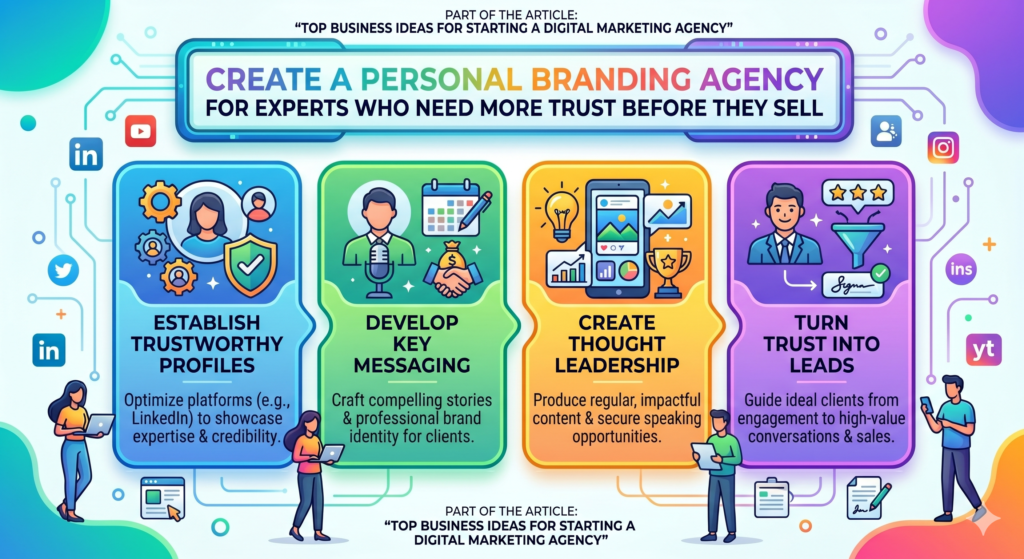
This can be a strong agency idea because many consultants, coaches, founders, lawyers, doctors, advisors, creators, and service providers depend on trust. People do not hire them only because of a logo. They hire them because they believe the person can solve a real problem.
Why Personal Branding Is a Smart Agency Model
Personal branding works because people connect with people faster than they connect with companies. A strong personal brand can create inbound leads, speaking invites, podcast requests, partnerships, job offers, investor interest, and media attention.
It also makes sales easier. When a prospect has read someone’s posts, watched their videos, or followed their ideas for months, the first sales call feels warmer. The prospect already understands the expert’s thinking.
This is why personal branding is not just about looking popular. It is about building trust before the first conversation starts.
How to Position a Personal Branding Agency
A weak position is, “We help you grow your personal brand.” That sounds nice, but it is too vague. A stronger position is, “We help consultants and founders turn their real expertise into content that builds trust and brings better business opportunities.”
That message is clearer because it speaks to a real outcome. The client does not only want attention. They want attention from people who can become clients, partners, or supporters.
You can also focus on a single type of expert. For example, you can serve B2B founders, law firm partners, financial advisors, startup coaches, medical experts, or agency owners. The more specific you are, the easier it is to understand their world and create content that feels real.
What Services You Can Sell
A personal branding agency can offer positioning strategy, profile optimization, content planning, ghostwriting, founder interviews, thought leadership articles, LinkedIn posts, short video scripts, newsletter writing, and content repurposing.
A strong offer could start with a brand clarity session. In this session, you define the client’s core topics, strong opinions, proof, stories, audience, and business goals. Then you turn that into a content system.
This matters because personal branding without strategy becomes random posting. The expert talks about whatever comes to mind. The audience gets confused. The market does not know what to remember them for.
How to Make the Content Sound Human
The best personal branding content sounds like the client, not like the agency. This is where many agencies fail. They use the same hooks, same sentence patterns, and same motivational tone for every client.
To avoid that, you need to capture the client’s real voice. Interview them. Ask about their mistakes, client stories, beliefs, lessons, and strong views. Listen to how they explain things. Notice the words they use naturally.
Then write in a way that keeps their thinking sharp but simple. The content should feel cleaner than their raw thoughts, but it should still sound like them.
The Main Mistake to Avoid
The biggest mistake is chasing fame instead of authority. Viral posts can help, but they do not always bring the right clients. A post can get attention from the wrong audience and still do nothing for the business.
A strong personal branding agency builds around business goals. It asks what the expert wants to be known for, who they want to reach, and what actions they want people to take.
When done well, personal branding becomes a trust system. It helps the client become known for the right ideas by the right people.
Start a Video Marketing Agency for Brands That Need Better Stories and More Attention
Video is one of the strongest ways for businesses to explain ideas, show proof, and build trust. But many businesses struggle with video because it feels hard. They do not know what to record, how to structure it, how to edit it, or how to use it in their marketing.
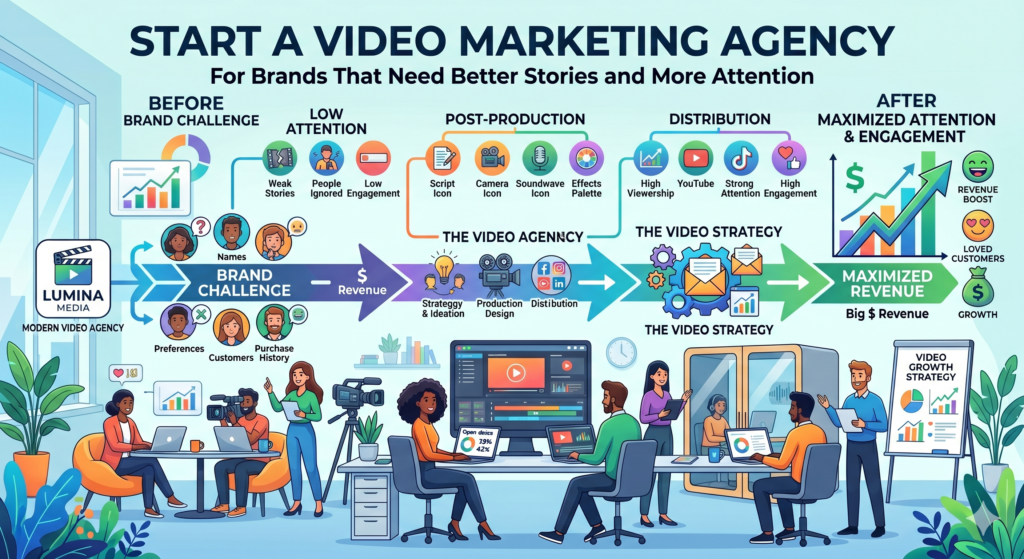
A video marketing agency can solve that problem. You can help brands turn simple ideas into useful videos that attract, educate, and convert customers.
This agency model can work for local businesses, SaaS companies, coaches, ecommerce brands, real estate firms, medical clinics, online schools, and B2B service providers.
Why Video Marketing Has Strong Demand
People want quick answers. They want to see the person, product, process, or result before they trust a business. Video helps with that because it feels more real than text alone.
A short video can explain a service. A customer story can build proof. A founder video can build trust. A product demo can reduce confusion. A simple educational video can bring in leads for months.
Video also works across many channels. One strong recording can become a YouTube video, LinkedIn post, Instagram Reel, TikTok clip, website section, email asset, and sales follow-up tool.
How to Position a Video Marketing Agency
A weak position is, “We create videos for businesses.” That sounds like a production service. A stronger position is, “We help service businesses turn their expertise into short videos that build trust and bring more qualified leads.”
This makes the value easier to understand. You are not only selling filming and editing. You are selling clearer communication.
You can also specialize by format. For example, you can create short-form video systems for founders, YouTube education videos for SaaS companies, testimonial videos for professional services, or product demo videos for ecommerce brands.
What Services You Can Sell
A video marketing agency can offer video strategy, scriptwriting, filming guidance, editing, short-form clips, YouTube optimization, thumbnail direction, video repurposing, customer testimonial production, and monthly content packages.
If you are starting lean, you do not need a full production studio. Many clients can record with simple equipment if you give them strong direction. You can help with topics, scripts, shot lists, and editing.
A strong starter offer could be a monthly short-form video package. You interview the client once, pull out key ideas, and turn the recording into several short videos. This saves the client time and gives them a steady content flow.
How to Make Video More Strategic
Good video starts before the camera turns on. You need a clear reason for each video. Is it meant to answer a sales question? Explain a service? Handle a fear? Show proof? Teach a simple idea? Build the founder’s authority?
When every video has a job, the content becomes stronger. It stops being random. It supports the buyer journey.
For example, a law firm can use videos to explain common legal questions. A SaaS company can show how a feature solves a problem. A coach can share client lessons. A local clinic can explain what patients should expect before booking.
The Main Mistake to Avoid
The biggest mistake is focusing only on editing style. Fast cuts, captions, music, and effects can help, but they cannot save a weak message.
Another mistake is making videos that are all about the company. Buyers care about their own problems first. The video should quickly show that the business understands the viewer’s need.
A video marketing agency becomes valuable when it helps clients say better things, not just look better on camera. Strong video is not about noise. It is about clarity, trust, and action.
Build a Reputation Management Agency for Businesses That Need More Trust Online
A reputation management agency helps businesses improve how they are seen online. This can include reviews, ratings, customer feedback, search results, social proof, and public trust.
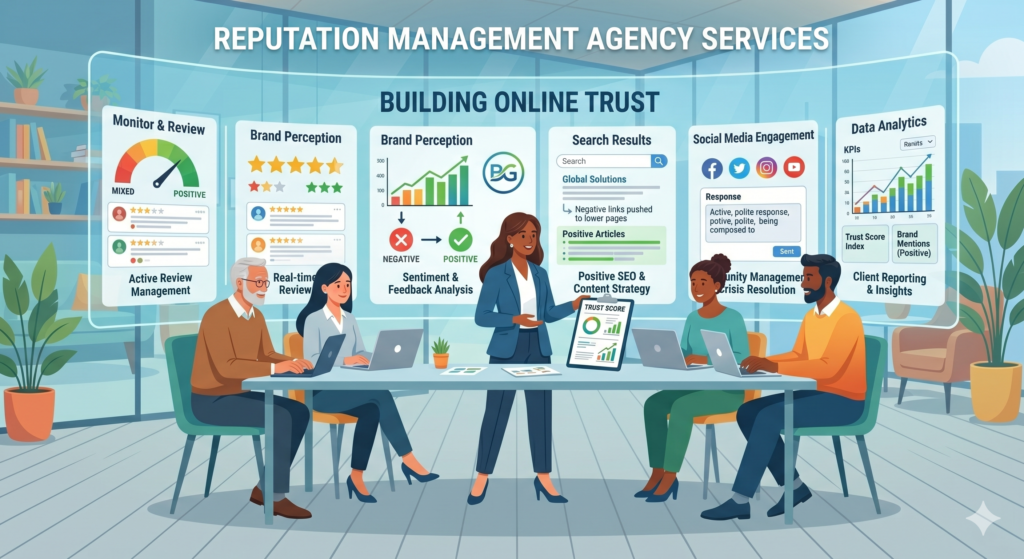
This is a strong agency idea because reputation affects buying decisions. Before people call a business, book a service, visit a store, or buy a product, they often check reviews. If the reviews look weak, outdated, or negative, the business can lose customers before the first conversation happens.
Why Reputation Management Is So Valuable
A good reputation can make every other marketing channel work better. Ads perform better when the brand has strong reviews. SEO works better when searchers trust what they see. Sales calls become easier when prospects have already seen proof.
For local businesses, reputation can be the difference between getting the call and losing it. A customer comparing two plumbers, dentists, clinics, or restaurants may choose the one with better reviews even if both rank on Google.
For online brands, trust signals matter too. Testimonials, case studies, third-party reviews, and customer stories can reduce doubt.
How to Position a Reputation Management Agency
A weak position is, “We help you get more reviews.” That is too small. A stronger position is, “We help local businesses turn happy customers into stronger online trust, better reviews, and more confident buyers.”
This makes the offer feel more connected to growth. You are not just asking customers for stars. You are helping the business look safer and more trusted when people search for it.
You can also focus on review-heavy industries. Good options include dental clinics, med spas, home services, legal firms, hotels, restaurants, healthcare clinics, auto repair shops, and real estate agencies.
What Services You Can Sell
A reputation management agency can offer review generation systems, review response support, feedback surveys, testimonial collection, case study creation, review monitoring, Google Business Profile review support, and trust-building website sections.
A strong offer could include a review request system, monthly review response help, negative feedback routing, testimonial collection, and a simple trust report.
The key is to make the process easy for the client. Business owners are busy. Staff forget to ask for reviews. Customers forget to leave them. Your system should make review requests simple, timely, and natural.
How to Handle Negative Reviews the Right Way
Negative reviews are not always bad if handled well. A business with only perfect reviews can even look less real. What matters is how the business responds.
Good responses should be calm, polite, and helpful. They should not argue in public. They should show future customers that the business listens and cares.
You can help clients create response templates, but the templates should never feel cold. Each response should fit the situation. The goal is not to win a fight. The goal is to show trust.
The Main Mistake to Avoid
The biggest mistake is using shady review tactics. Fake reviews, review gating, or pressuring customers can damage the business. It can also break platform rules and hurt long-term trust.
A strong reputation agency builds honest systems. It helps happy customers share real feedback and helps unhappy customers feel heard before the problem grows.
This kind of agency can keep clients for a long time because reputation is never finished. New customers keep coming. New reviews keep appearing. Trust must be managed every month.
Create a Website Strategy Agency for Service Businesses With Weak Online First Impressions
Many businesses do not need a bigger marketing campaign first. They need a better website. Their current site may look old, load slowly, explain the offer poorly, or fail to guide visitors toward action.
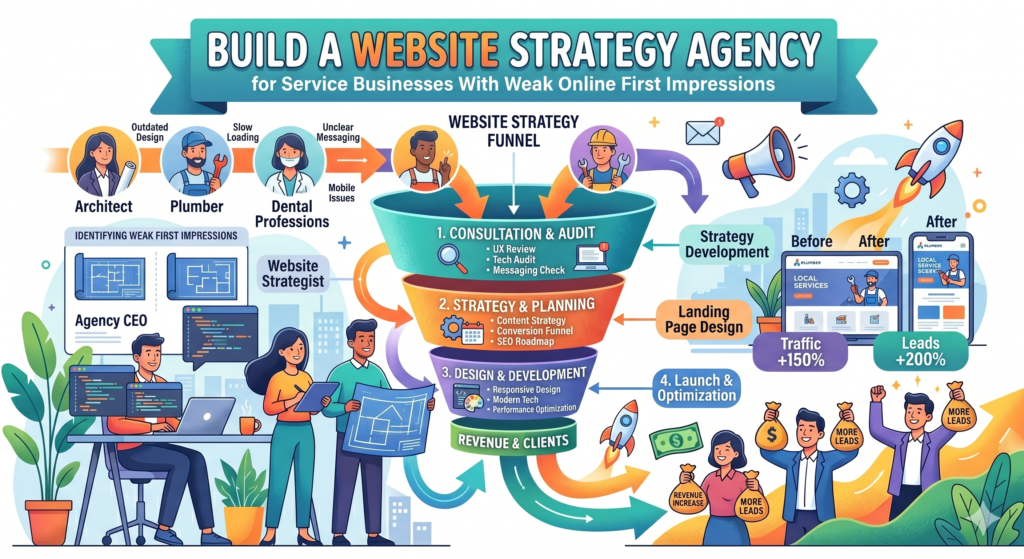
A website strategy agency helps fix that. This is not the same as being only a web designer. The focus is not just how the site looks. The focus is how well the site explains the business and turns visitors into leads.
This can be a strong agency idea for service businesses because their website is often the first serious place a buyer checks before reaching out.
Why Website Strategy Is a Strong Agency Model
A weak website can silently kill growth. A business may get referrals, ad clicks, social traffic, or Google visitors, but if the website feels confusing or untrustworthy, people leave.
Many business owners know their website is not helping, but they do not know what to change. They may think they need a new design when the real issue is the message. Or they may think they need more pages when the real issue is a weak call to action.
A website strategy agency helps connect design, copy, structure, and conversion.
How to Position a Website Strategy Agency
A weak position is, “We build beautiful websites.” Beauty matters, but it is not enough. A stronger position is, “We help service businesses turn outdated websites into clear, trusted, lead-generating sales assets.”
This is much stronger because it speaks to the client’s real pain. They do not just want a pretty site. They want a site that helps people understand, trust, and contact them.
You can focus on industries like consultants, law firms, clinics, home service companies, agencies, accountants, coaches, or B2B service firms.
What Services You Can Sell
A website strategy agency can sell website audits, messaging strategy, homepage copy, service page copy, landing pages, site structure planning, conversion improvements, design direction, and full website rebuilds.
If you do not want to build websites yourself, you can partner with designers or developers. Your agency can own the strategy, copy, and conversion side. This can be very profitable because many websites fail because of weak thinking, not weak code.
A strong starter offer could be a website clarity audit. You review the homepage, service pages, calls to action, proof, mobile experience, and buyer journey. Then you deliver a clear plan for what should change.
How to Make Websites Convert Better
A strong service website should answer simple questions fast. What do you do? Who do you help? What problem do you solve? Why should I trust you? What happens if I contact you? What proof do you have?
Many websites hide these answers behind clever words and vague claims. That creates doubt. A visitor should not have to work hard to understand the offer.
The best websites feel simple, direct, and helpful. They guide the visitor from problem to solution to proof to action.
The Main Mistake to Avoid
The biggest mistake is treating the website like an online brochure. A brochure only describes. A strong website guides.
Another mistake is starting with design before message. If the message is unclear, even a beautiful site will struggle. The words, structure, and offer must be clear first.
A website strategy agency can win strong clients when it shows that a better website is not a cost. It is a business asset that can help every traffic source perform better.
Start a Lead Generation Agency for B2B Companies That Need More Sales Conversations
A B2B lead generation agency helps companies start more conversations with the right prospects. This can be a strong business idea because many B2B companies have good services or products, but they do not have enough qualified sales opportunities.
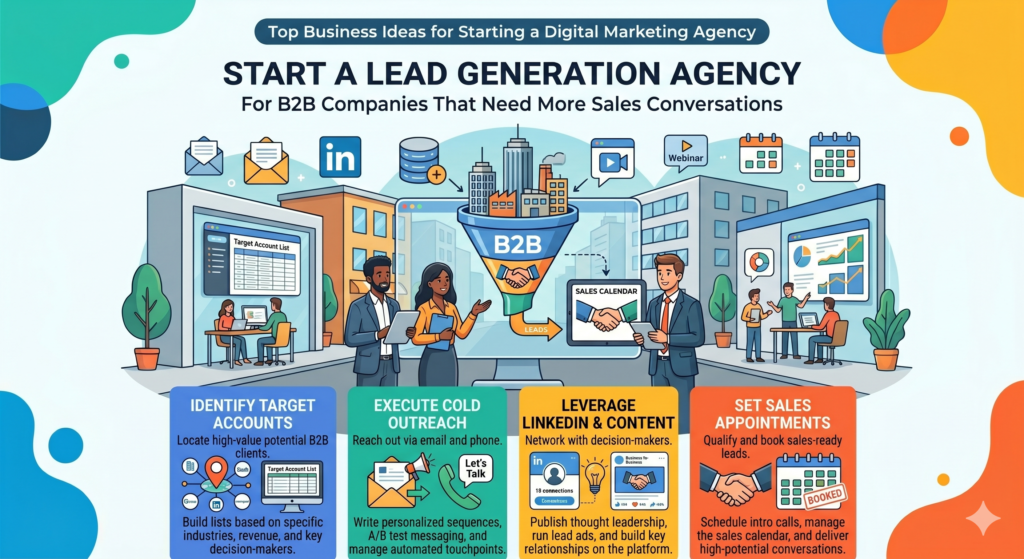
Lead generation can include cold email, LinkedIn outreach, paid ads, lead magnets, webinars, SEO, partnerships, and appointment-setting systems. The key is to focus on quality, not just volume.
Why B2B Lead Generation Is in High Demand
B2B companies often have longer sales cycles and higher deal values. One good client can be worth thousands or even tens of thousands. That makes lead generation valuable when it brings the right opportunities.
Many companies also struggle with consistency. Referrals may come in some months and disappear in others. Sales teams may be busy serving current clients. Founders may not have time to prospect daily.
A lead generation agency can create a steady system for outreach and demand creation.
How to Position a B2B Lead Generation Agency
A weak position is, “We generate leads for your business.” That sounds risky because many lead generation services send low-quality names that never convert.
A stronger position is, “We help B2B service companies book qualified sales conversations with decision-makers who match their best-fit client profile.”
This is better because it focuses on qualified conversations, not random leads. It also shows that you care about fit.
You can narrow the niche by serving software companies, consultants, agencies, recruiters, cybersecurity firms, accounting firms, HR companies, or industrial service providers.
What Services You Can Sell
A B2B lead generation agency can offer ideal customer profile research, prospect list building, cold email copy, LinkedIn outreach, landing pages, lead magnets, appointment setting, CRM setup, follow-up sequences, and campaign reporting.
A strong offer should include strategy before outreach. If the target list is wrong, the campaign will fail. If the message is weak, prospects will ignore it. If the offer is unclear, calls will not book.
The real value is not sending more messages. The real value is reaching the right people with a message that makes sense.
How to Make Lead Generation More Ethical and Effective
Good lead generation should feel relevant. The prospect should feel like the message was written for someone like them. That does not mean every message needs to be long. It means it should show clear understanding.
A strong campaign starts with a narrow audience. Then it speaks to a real problem that audience already has. It gives a simple reason to reply. It avoids pressure and fake urgency.
Follow-up matters too. Many prospects do not reply to the first message. But follow-up should add value, not just repeat the same ask.
The Main Mistake to Avoid
The biggest mistake is selling guaranteed leads without controlling the full sales process. You can influence lead quality, but you may not control how the client handles calls, pricing, closing, or follow-up.
Another mistake is using spammy outreach. Bad outreach can damage a client’s brand fast. It may create short-term activity, but it hurts trust.
A B2B lead generation agency can grow well when it focuses on fit, message, and real sales conversations. The goal is not to flood the client with names. The goal is to help them meet people who are likely to need what they sell.
Build a LinkedIn Marketing Agency for B2B Brands That Need Better Authority
LinkedIn is one of the best platforms for B2B marketing because people use it with a business mindset. They are not only scrolling for fun. They are looking at ideas, people, companies, jobs, partners, trends, and solutions.
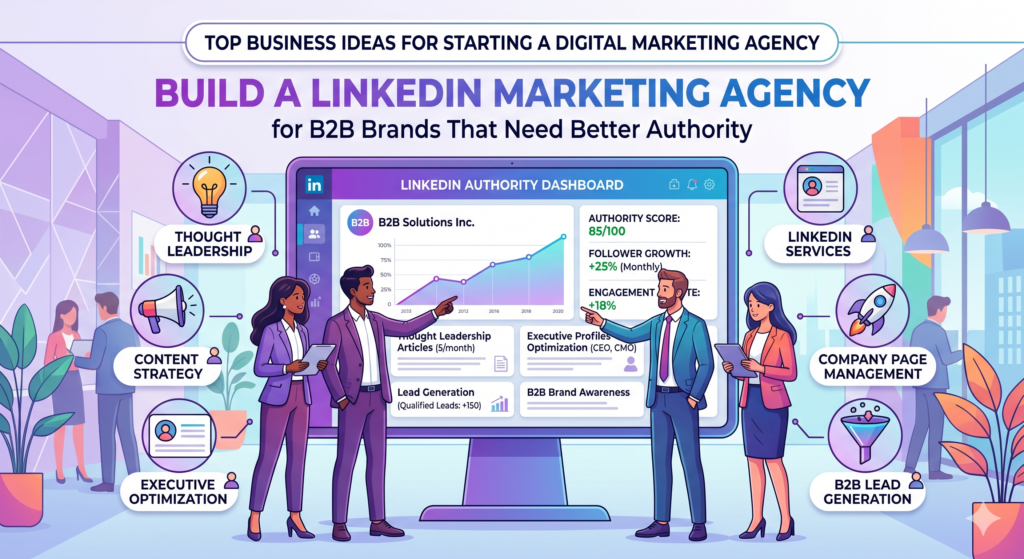
That makes LinkedIn a strong place for consultants, SaaS companies, coaches, agencies, recruiters, founders, and professional service firms. But most brands use LinkedIn poorly. They post company updates that nobody cares about. They share plain announcements. They write like a press release. Then they wonder why nothing happens.
A LinkedIn marketing agency can help fix this by turning LinkedIn into a trust-building and lead-generating channel.
Why LinkedIn Works Well for B2B Growth
LinkedIn works because the audience is already tied to work. People list their roles, companies, industries, skills, and interests. This makes it easier to reach the right people with the right message.
For B2B brands, trust is often built before the sales call. A buyer may see a founder’s post, read a useful company update, watch a short video, or comment on a discussion long before they book a call. LinkedIn helps create these small trust moments.
The value is not always instant. A post may not bring a lead the same day. But over time, strong LinkedIn content can make a company easier to remember and easier to trust.
How to Position a LinkedIn Marketing Agency
A weak position is, “We help companies grow on LinkedIn.” That sounds broad and unclear. A stronger position is, “We help B2B founders and teams use LinkedIn to build authority, start better conversations, and attract qualified sales opportunities.”
This position works because it moves the focus away from likes and followers. It makes the outcome about business growth.
You can also position your agency around a clear client type. For example, you can serve SaaS founders, B2B consultants, recruiters, cybersecurity firms, financial advisors, or agency owners. A specific market makes your content strategy stronger because you understand the buyer better.
What Services You Can Sell
A LinkedIn marketing agency can offer profile optimization, content strategy, ghostwriting, company page content, founder-led content, employee advocacy systems, LinkedIn newsletter writing, lead magnet promotion, comment strategy, and basic outreach support.
A strong service should not only create posts. It should build a system. That system may include weekly founder interviews, content themes, post writing, comment prompts, profile updates, and monthly review calls.
You can also help clients repurpose content. A webinar can become LinkedIn posts. A podcast can become short lessons. A sales call objection can become a helpful post. A case study can become a story about customer transformation.
How to Make LinkedIn Content Stand Out
The best LinkedIn content does not sound like a company talking at people. It sounds like a smart person helping another smart person think more clearly.
Good content should teach something useful, share a real lesson, explain a mistake, challenge a common belief, or show proof. It should be simple enough to read quickly, but strong enough to make the right person pause.
The strongest content often comes from real experience. That is why interviews are so useful. When you ask a founder about client problems, sales lessons, failed experiments, and market changes, you get content that sounds fresh and human.
The Main Mistake to Avoid
The biggest mistake is treating LinkedIn like a place to post ads every day. People do not follow founders or brands because they want constant pitches. They follow because they want ideas, insight, stories, and useful advice.
Another mistake is writing content that sounds too polished. When every post feels like a brand campaign, trust drops. People want clarity, not corporate noise.
A LinkedIn marketing agency can become very valuable when it helps clients become known for the right ideas. The real goal is not only more reach. The real goal is stronger trust with the people who can become buyers, partners, or advocates.
Start a Podcast Marketing Agency for Experts and Brands With Deep Knowledge
Podcasting is a smart agency idea because many experts have more knowledge than they have content. They can talk clearly about their market, customers, and lessons, but they struggle to turn that knowledge into a steady marketing system.
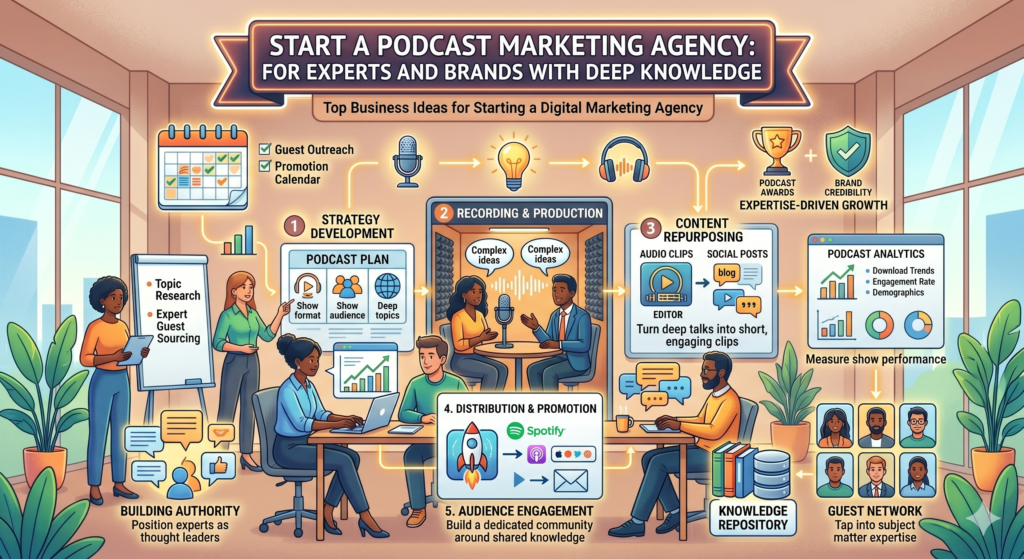
A podcast marketing agency helps businesses plan, record, edit, publish, promote, and repurpose podcast content. This can work well for founders, consultants, coaches, SaaS companies, agencies, investors, educators, and niche media brands.
The real value is not just audio production. The value is turning long conversations into trust-building content that can support the whole marketing strategy.
Why Podcasting Builds Strong Trust
Podcasting works because it gives people time with the expert’s thinking. A blog post may take five minutes to read. A social post may take thirty seconds. A podcast can hold attention for twenty, thirty, or sixty minutes.
That deeper time matters. It helps the audience understand how the person thinks, how they explain ideas, and what they believe. For high-trust businesses, this can be powerful.
A podcast also creates content fuel. One episode can become articles, social posts, email newsletters, short clips, quotes, sales content, and even lead magnets.
How to Position a Podcast Marketing Agency
A weak position is, “We edit and publish podcasts.” That makes the service sound like simple production. A stronger position is, “We help expert-led brands turn conversations into authority content that builds trust and creates business opportunities.”
This position is better because it shows the strategic value behind the work.
You can also focus on a type of podcast. For example, you can serve B2B founder podcasts, consultant interview shows, local business podcasts, SaaS thought leadership shows, or personal brand podcasts.
What Services You Can Sell
A podcast marketing agency can offer show strategy, topic planning, guest research, episode outlines, recording support, audio editing, video editing, show notes, podcast SEO, publishing, guest outreach, social clips, newsletter repurposing, and performance review.
A strong offer could be a monthly podcast engine. You help plan four episodes, edit the recordings, write show notes, create short clips, and turn key ideas into LinkedIn posts or emails.
You can also offer a launch package. Many people want to start a podcast but feel overwhelmed. You can help with naming, positioning, format, intro copy, cover art direction, first episode planning, publishing setup, and promotion.
How to Make a Podcast Useful for Business
A business podcast should not be random. It needs a clear reason to exist. The show should serve a defined audience and support a clear market position.
Before planning episodes, ask what the business wants to be known for. Ask who should listen. Ask what problems the audience cares about. Ask what topics will attract future buyers, partners, or referral sources.
A good podcast does not need millions of listeners to work. A niche podcast with the right listeners can be more valuable than a broad show with empty reach.
The Main Mistake to Avoid
The biggest mistake is treating the podcast as a hobby instead of a business asset. A fun conversation is fine, but if the topics do not connect to the market, the podcast may not support growth.
Another mistake is publishing episodes without repurposing them. Most listeners will not find every episode on podcast apps. The agency should help spread the best ideas across social, email, search, and sales channels.
A podcast marketing agency can stand out by making podcasting easier and more useful. The client gets more than edited audio. They get a repeatable system for turning their knowledge into trust.
Create a Marketing Strategy Agency for Startups That Need Clear Direction Before Spending Money
Many startups do not fail at marketing because they are lazy. They fail because they move without a clear strategy. They try ads, content, SEO, social media, partnerships, and email all at once. Nothing gets enough focus. Money gets wasted. The team gets confused.
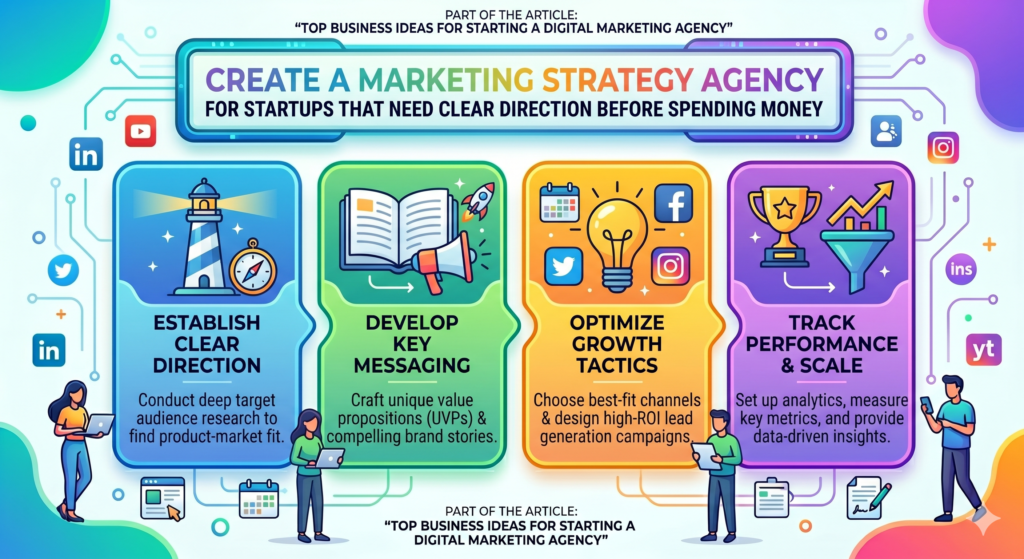
A marketing strategy agency helps startups decide what to do first, what to ignore, and how to connect marketing to growth. This can be a strong agency idea if you enjoy planning, research, positioning, and business thinking.
This model is less about doing every task and more about creating a clear plan the company can follow.
Why Startups Need Strategy Before Execution
Startups often feel pressure to grow fast. That pressure can lead to rushed marketing. They may copy competitors, chase trends, or hire freelancers before they understand their best market.
A good strategy helps answer basic but important questions. Who is the best buyer? What problem is most urgent? Why should they choose this product? Which channel fits the budget and timeline? What offer should be tested first? What message should be repeated?
Without these answers, execution becomes guesswork.
How to Position a Marketing Strategy Agency
A weak position is, “We help startups with marketing.” That does not say enough. A stronger position is, “We help early-stage startups find their clearest market message, strongest growth channel, and first repeatable path to customers.”
This is much more useful because it speaks to the real problem. Startups do not only need more marketing activity. They need focus.
You can narrow your market by serving SaaS startups, funded startups, bootstrapped founders, B2B startups, AI startups, marketplaces, or service-based startups moving into products.
What Services You Can Sell
A marketing strategy agency can sell positioning audits, go-to-market plans, customer research, competitor research, messaging strategy, channel strategy, launch plans, offer testing plans, and growth roadmaps.
A good starter offer could be a thirty-day marketing clarity sprint. During this sprint, you interview the founder, study the market, review competitors, audit current assets, and create a simple growth plan.
The final plan should not be a giant slide deck full of theory. It should tell the client what to do next, why it matters, how to measure it, and what to avoid.
How to Make Strategy Actionable
Strategy is only useful when it changes action. A founder should leave with clear decisions. They should know which audience to focus on, which message to test, which channel to prioritize, and what offer to put in front of the market.
The plan should also include limits. Startups need to know what not to do. Saying no to weak channels is part of good strategy.
Simple plans often work better than complex ones. A startup with a small team does not need ten campaigns. It needs one focused path it can test, learn from, and improve.
The Main Mistake to Avoid
The biggest mistake is giving advice that sounds smart but does not help the founder act. Strategy should not hide behind big words. It should make decisions easier.
Another mistake is building plans without talking to customers. Founder opinions matter, but customer truth matters more. Strong strategy should be based on real buyer pain, real objections, and real market signals.
A marketing strategy agency can charge well because it helps clients avoid waste. When you save a startup from spending months on the wrong message or channel, your value is much bigger than the document you deliver.
Build a Landing Page Agency for Businesses That Need Campaigns to Convert
A landing page agency is a focused and practical business idea. Many businesses run ads, launch offers, host webinars, promote lead magnets, or test new products, but they send traffic to weak pages.
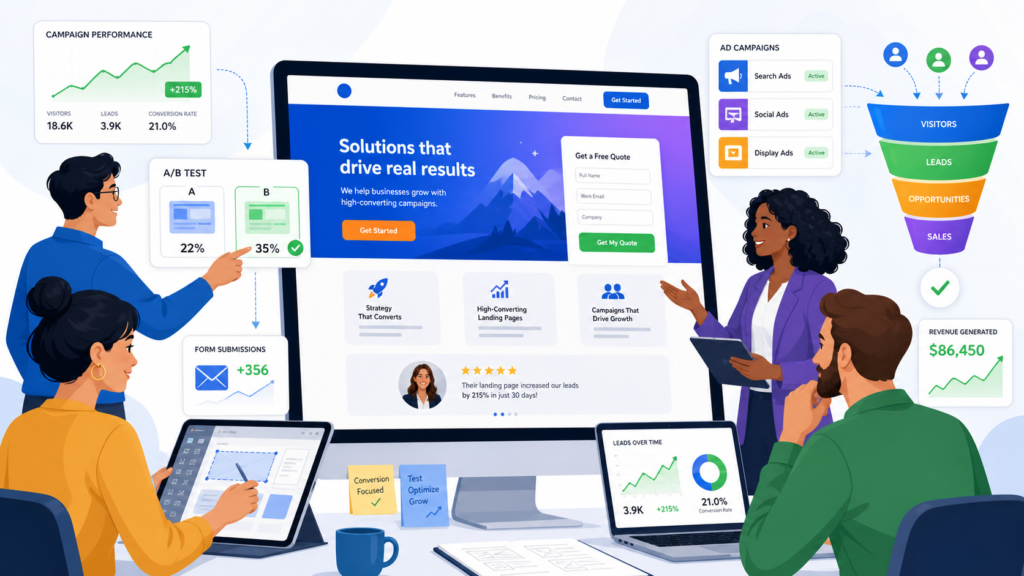
A landing page has one main job. It should help the right person take the next step. That step may be booking a call, buying a product, joining a webinar, downloading a guide, starting a trial, or requesting a quote.
When the page is unclear, campaign money gets wasted. That is why this service can be easy to explain and valuable to sell.
Why Landing Pages Are Easier to Sell Than Full Websites
A full website can feel like a big project. It may involve many pages, many opinions, and long timelines. A landing page is simpler. It is tied to one campaign and one goal.
This makes it easier for clients to say yes. They do not have to rebuild everything. They can test one better page for one offer.
Landing pages are also easy to connect to performance. If the client is already running ads or sending email traffic, you can compare results before and after the page improvement.
How to Position a Landing Page Agency
A weak position is, “We design landing pages.” That sounds like a design task. A stronger position is, “We help businesses turn campaign traffic into more leads and sales with clear, conversion-focused landing pages.”
This is better because it links your work to the result.
You can also specialize by campaign type. For example, you can build landing pages for Google Ads, webinar signups, SaaS demos, ecommerce product launches, local service lead generation, or B2B lead magnets.
What Services You Can Sell
A landing page agency can sell landing page strategy, wireframes, copywriting, design, development, form setup, thank-you pages, A/B test ideas, and conversion audits.
You can offer a full landing page build or a landing page teardown. A teardown is a lower-cost entry offer where you review the page and explain what is hurting conversions.
A full build should include message research, page structure, copy, design direction, mobile review, trust elements, and tracking support. The more complete the service, the easier it is to create better results.
How to Build Landing Pages That Work
A strong landing page must make the offer clear fast. Visitors should know what is being offered, who it is for, why it matters, and what to do next.
The page also needs proof. That proof can include reviews, case studies, client logos, before-and-after stories, numbers, screenshots, or simple explanations of past results.
The page should reduce doubt. If people worry about price, time, trust, risk, or fit, the page should answer those worries clearly. A good landing page feels like a helpful sales conversation, not a wall of claims.
The Main Mistake to Avoid
The biggest mistake is making landing pages look nice but say nothing clear. Design should support the message. It should not cover up weak copy.
Another mistake is using the same page structure for every offer. A webinar page needs different thinking than a product page. A high-ticket service page needs different proof than a free guide page.
A landing page agency can grow quickly because the offer is focused. When clients see that one better page can improve the return from their campaigns, they understand the value.
Start a Marketing Analytics Agency for Businesses That Need Clearer Numbers
Many businesses spend money on marketing but do not understand what is working. They look at traffic, likes, clicks, leads, sales, and reports from different tools, but the numbers do not tell a clear story.
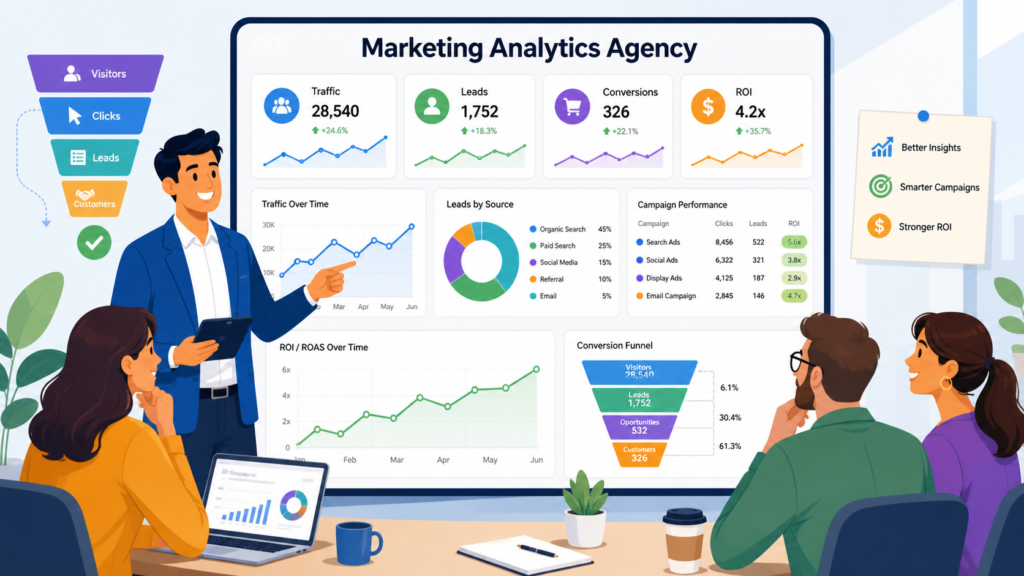
A marketing analytics agency helps businesses clean up their tracking, build useful dashboards, and make better decisions from their data. This is a strong agency idea for people who enjoy numbers, patterns, and business decisions.
You do not need to make analytics sound complex. In fact, the best analytics agencies make the numbers easier to understand.
Why Marketing Analytics Is a Valuable Service
Marketing without clear tracking leads to waste. A business may keep spending on a channel that looks busy but does not bring good customers. Or it may stop a channel that is actually helping because the value is not tracked properly.
Analytics helps connect marketing activity to business results. It can show which campaigns bring leads, which leads become customers, which pages convert, which emails drive sales, and which channels deserve more budget.
This is useful for ecommerce brands, SaaS companies, B2B teams, agencies, local businesses, and funded startups.
How to Position a Marketing Analytics Agency
A weak position is, “We build dashboards.” Dashboards are useful, but they are not the main value. A stronger position is, “We help businesses see which marketing efforts are making money, which are wasting budget, and what to improve next.”
This speaks to the real pain. Business owners do not want more charts. They want clearer decisions.
You can also specialize in one tool or market. For example, you can focus on Google Analytics 4 setup, Looker Studio dashboards, HubSpot reporting, Shopify analytics, paid ads tracking, or B2B attribution.
What Services You Can Sell
A marketing analytics agency can offer tracking audits, dashboard setup, conversion tracking, campaign reporting, data cleanup, KPI planning, attribution reviews, ecommerce reporting, CRM reporting, and monthly insight calls.
A strong starter offer could be a marketing tracking audit. You review the client’s current tools, events, goals, forms, ad tracking, CRM flow, and reports. Then you show what is missing and what needs to be fixed.
After that, you can sell a dashboard and monthly reporting service. The goal is not just to show numbers. The goal is to explain what the numbers mean.
How to Make Analytics Useful for Clients
The best reports are simple. They do not overwhelm the client with every possible metric. They focus on the numbers that connect to decisions.
For a lead generation business, that may mean traffic source, cost per lead, lead quality, booked calls, close rate, and revenue. For ecommerce, it may mean conversion rate, average order value, repeat purchase rate, customer acquisition cost, and revenue by channel.
Each report should answer three questions. What happened? Why does it matter? What should we do next?
The Main Mistake to Avoid
The biggest mistake is drowning clients in data. More numbers do not always mean more clarity. If a dashboard has too many charts, the client may stop using it.
Another mistake is reporting activity instead of outcomes. Clicks and impressions can matter, but they are not the final goal. The client needs to understand how marketing connects to leads, sales, and profit.
A marketing analytics agency can become a trusted partner because it helps clients make better decisions. When you help a business stop guessing, you become more than a marketer. You become part of how they manage growth.
Conclusion
Starting a digital marketing agency becomes much easier when you stop trying to serve everyone. The best agency ideas are built around one clear market, one painful problem, and one result clients care about. You can choose SEO, paid ads, content, email, funnels, analytics, social media, or any other model. But the real win comes from focus.
Pick a niche you understand. Build an offer that solves a real business problem. Create simple systems. Track outcomes. Keep improving your delivery. When your agency helps clients grow in a clear and honest way, referrals, trust, and long-term profit follow naturally.











Comments are closed.