
WinSavvy Editorial Standards
How this article was created
Insurance is built on trust. People do not buy a policy just because they saw a clever ad or a low price. They buy because they believe an agency understands their risks, cares about their future, and can guide them when life gets messy. That is why marketing for insurance agencies has to do more than bring in leads. It has to build confidence before the first call, answer doubts before they become objections, and make your agency the clear choice in a market full of similar promises.
Build a clear position before you spend money on marketing
Most insurance agencies make the same promise. They say they offer great service, fair prices, trusted advice, and many carrier options. These are good things, but they are not enough to make someone remember you. When every agency sounds the same, buyers choose based on price, habit, or whoever follows up first.
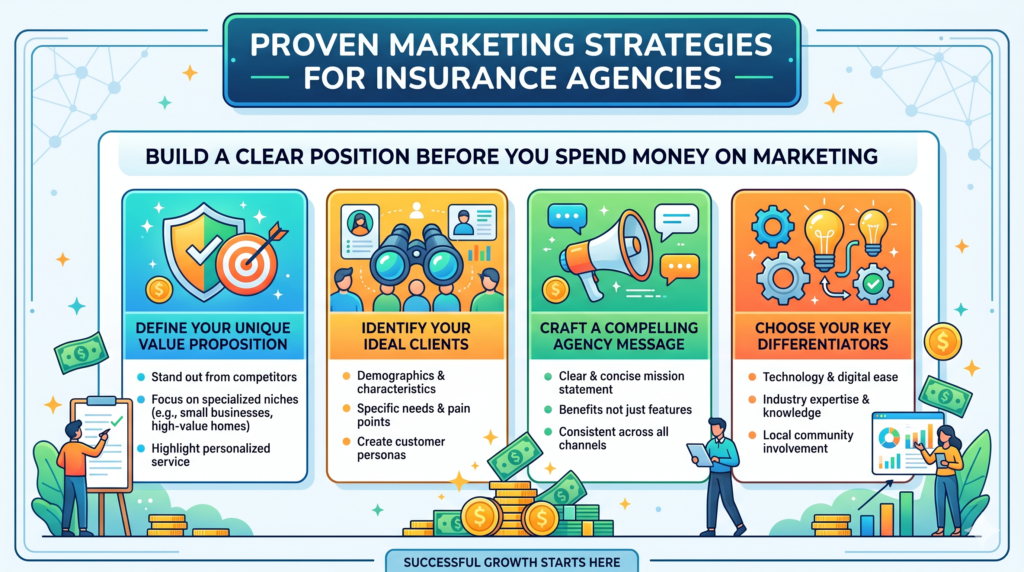
Your first marketing job is not to post more or spend more. It is to make your agency easier to understand.
Your agency should stand for something specific
A strong position tells people why they should choose you instead of the next agency in town. It does not need to be fancy. It just needs to be clear.
You may be the agency that helps young families protect their first home. You may focus on contractors who need fast certificates and clear coverage. You may serve local business owners who are tired of confusing policy renewals. You may be known for helping drivers with complex situations find better options without shame or pressure.
The key is to stop speaking to everyone in the same way. Insurance is personal. A restaurant owner, a new parent, a landlord, and a trucking company do not have the same fears. They do not ask the same questions. They do not care about the same benefits.
Use simple words to describe your best-fit client
Start by looking at your strongest clients. These are not always the clients with the biggest policies. They are the ones who stay, refer, trust your advice, and value your help.
Ask yourself who they are, what they worry about, what they often misunderstand, and why they chose your agency. Then turn those answers into simple language for your website, ads, emails, and sales calls.
Instead of saying, “We offer personalized insurance solutions,” say something more direct, like, “We help local contractors avoid coverage gaps that can delay jobs, hurt cash flow, or put their business at risk.”
That kind of message is stronger because it speaks to a real problem. It also makes the buyer feel seen.
Turn your website into a trust-building sales tool
Your website should not be a digital brochure. It should act like your best producer when no one is available to answer the phone. It should explain what you do, who you help, why people trust you, and what someone should do next.
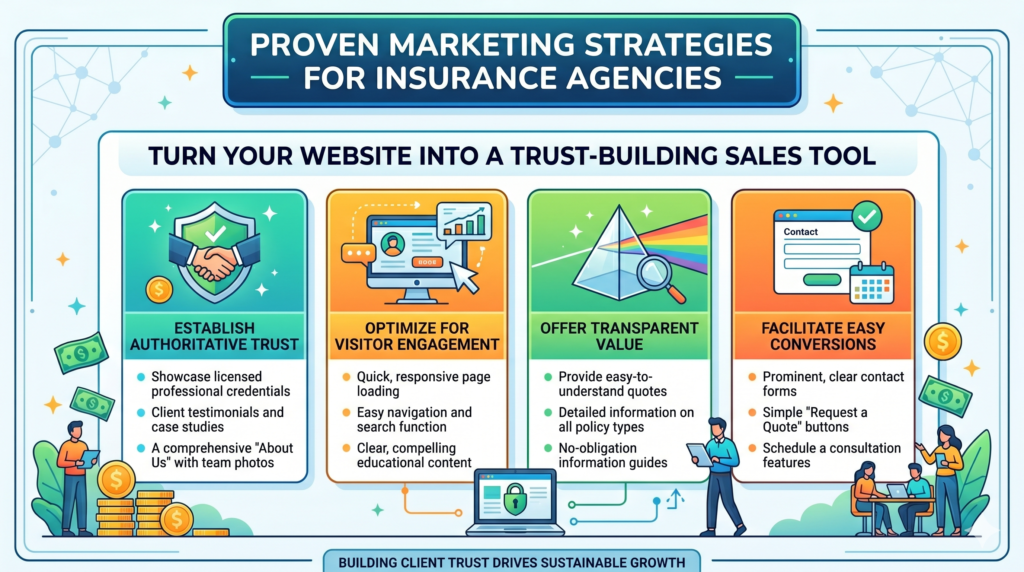
Many insurance agency websites look clean but say very little. They list services, carrier logos, a contact form, and a short “about us” section. That is not enough. A visitor should leave your site feeling safer, smarter, and more ready to talk.
Your homepage should answer the buyer’s first questions
When someone lands on your homepage, they are usually asking a few quiet questions. Can this agency help me? Do they understand my situation? Are they local and real? Will they make this easy? Can I trust them with something important?
Your homepage should answer those questions fast.
Open with a clear headline that says who you help and what outcome you help them get. Then add a short paragraph that explains the problem you solve in plain language. After that, guide the visitor toward one clear action, such as requesting a quote, booking a call, or reviewing coverage.
Do not make people work hard to understand you. A confused visitor rarely becomes a lead.
Each service page should be built around buyer fears
A strong service page does more than define a policy type. People can find basic definitions anywhere. Your page should explain why that coverage matters, where people often make mistakes, and how your agency helps them choose wisely.
For example, a business insurance page should not only say you offer general liability, workers’ compensation, commercial auto, and property coverage. It should explain how one uncovered claim can damage cash flow, stop operations, or create stress that could have been avoided.
A home insurance page should explain replacement cost, deductibles, water damage, roof issues, personal property, and common gaps in simple language. A buyer should feel like they learned something useful before they ever call you.
This is how a website builds trust. It teaches first, then asks for action.
Make local SEO one of your strongest lead sources
Insurance is still a local trust business, even when people start online. Many buyers search for agencies near them because they want someone who understands their area, local risks, state rules, weather issues, property values, business needs, and community norms.
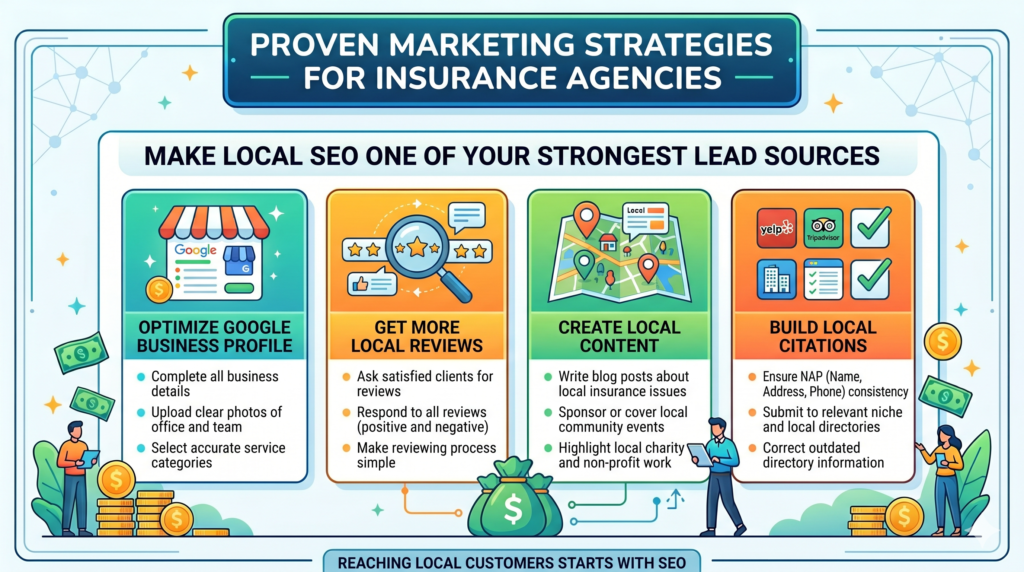
Local SEO helps your agency show up when people are already looking. These are not cold leads. They have intent. They are searching because they need help now or soon.
Your Google Business Profile should be treated like a second homepage
For many people, your Google Business Profile is the first thing they see. They may read your reviews, check your hours, look at photos, scan your services, and decide whether to call without ever visiting your website.
That means this profile deserves real attention.
Your agency name, address, phone number, website, hours, services, and description should be complete and accurate. Your photos should show real people, your office if you have one, and signs that your agency is active.
Your services should be listed in a way that matches what buyers search for, such as auto insurance, home insurance, life insurance, business insurance, renters insurance, or commercial auto insurance.
Reviews are one of your strongest local ranking and conversion tools
Reviews do two jobs at once. They help your agency look more trusted in search, and they help buyers feel safer when choosing you.
The best time to ask for a review is right after a positive moment. That could be after you helped a client save money, explained a confusing policy, handled a claim question, fixed a coverage issue, or completed a smooth renewal.
Do not ask in a cold or robotic way. Make the request personal. You can say that reviews help local families and businesses find honest insurance guidance. This gives the client a reason beyond doing you a favor.
Also, respond to reviews. A warm response shows that your agency pays attention. It also gives future buyers a small preview of how you treat people.
Create content that answers real insurance questions
Content marketing works well for insurance agencies because buyers have many questions. They want to know what coverage means, how much protection they need, why prices changed, what is required, what is optional, and what could go wrong if they choose the wrong policy.
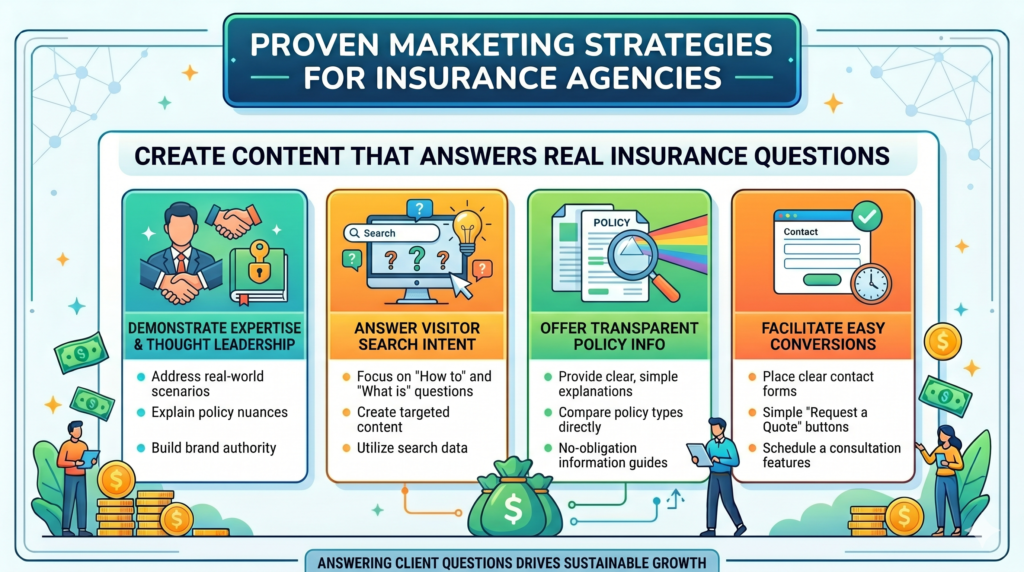
The problem is that many agencies create content that is too broad. They write posts like “Why Insurance Is Important” or “Benefits of Auto Insurance.” These topics are not useless, but they are too basic to stand out.
Good content answers the exact questions buyers ask before they are ready to speak with an agent.
Write for moments of doubt, change, and risk
People pay attention to insurance content when something changes in their life or business. They buy a home. They start a company. They hire employees. They add a teen driver. They buy equipment. They move to a new state. They get a renewal increase. They have a claim. They sign a lease. They take on a new contract.
These are the moments your content should focus on.
A strong article might explain what new homeowners often miss when choosing home insurance. Another could explain why contractors should review coverage before taking larger jobs. Another could show what restaurant owners should check before renewing their business policy.
Simple content can be more powerful than clever content
Your goal is not to impress other agents. Your goal is to help a normal person understand something that feels confusing.
Use plain language. Explain terms with real examples. Show what can happen when a policy is too weak. Help people ask better questions. Give them a reason to talk to your agency before they make a rushed choice.
The best content makes the reader think, “This agency explains things clearly. I should speak with them.”
That feeling is more valuable than a clever headline.
Use landing pages for each major client type
A general website can help, but focused landing pages often convert better. This is because each type of buyer wants to feel like your agency understands their exact world.
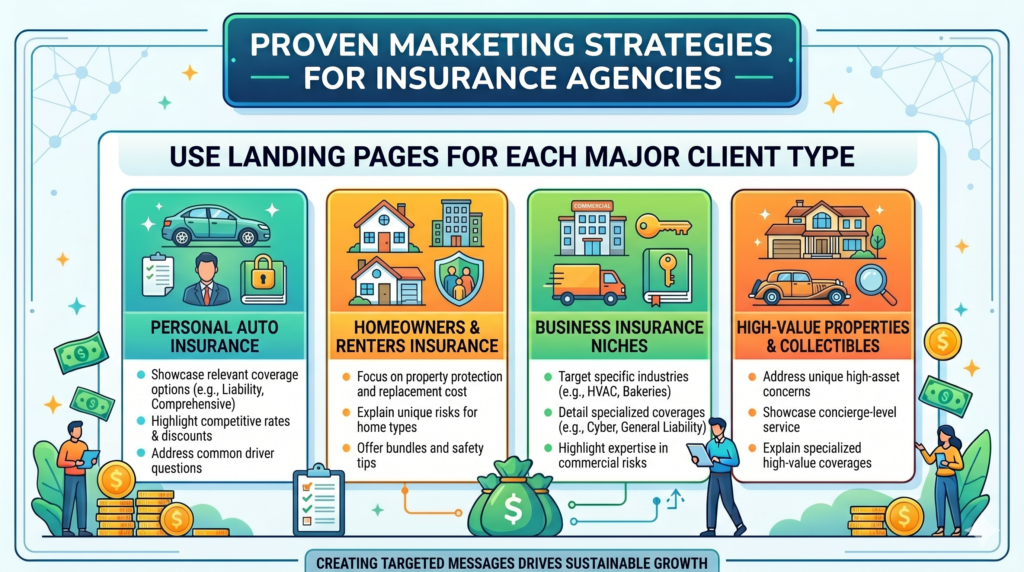
A landlord does not want the same message as a startup founder. A trucking company does not want the same page as a family buying life insurance. A dental office does not care about the same risks as a roofing contractor.
Landing pages let you speak directly to each group.
Build pages around industries, life stages, and local needs
Start with your best client groups. If you serve contractors, create a page for contractor insurance. If you serve landlords, create a landlord insurance page. If you serve restaurants, create a restaurant insurance page. If you serve families, create pages around home, auto, life, and umbrella coverage.
Each page should explain the buyer’s common risks, the mistakes they should avoid, the types of coverage they may need, and how your agency helps them compare options.
Do not make the page only about policies. Make it about the buyer’s life, work, stress, and goals.
A focused page makes ads and SEO work better
When someone clicks an ad about restaurant insurance and lands on a general business insurance page, the message feels weak. But when they land on a page written for restaurant owners, the message feels much stronger.
The same is true for search. A page about “business insurance” may face heavy competition. A page about “restaurant insurance in your city” or “contractor insurance for local builders” may have a better chance of ranking and converting.
This is where strategy matters. You do not need hundreds of pages. You need the right pages, written for the right buyers, with enough depth to be useful.
Build a follow-up system that does not depend on memory
Many agencies lose leads not because the lead was bad, but because the follow-up was weak. A person requests a quote, asks a question, or downloads a guide. The agency responds once or twice. Then the lead gets busy, the producer gets busy, and the opportunity fades.
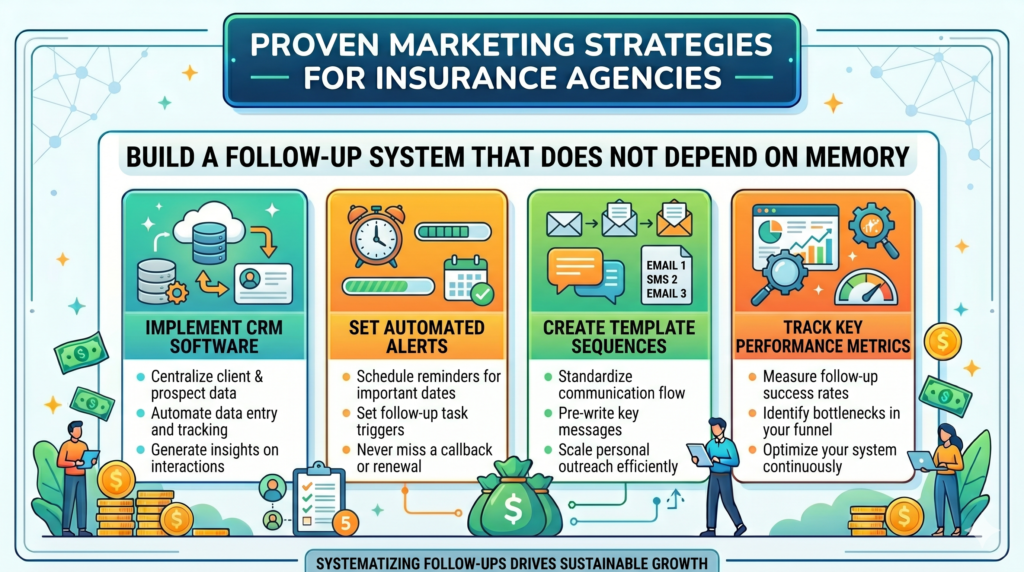
Insurance buyers often need time. They may be comparing options, waiting for renewal, talking to a spouse, checking with a business partner, or trying to understand the quote. If your agency only follows up once, you are leaving money behind.
Follow-up should feel helpful, not pushy
A good follow-up system does not simply ask, “Are you ready to buy?” over and over. That gets annoying fast.
Instead, each follow-up should reduce fear or answer a question. One message can explain what to look for when comparing quotes. Another can warn about choosing based only on price. Another can explain what happens after they switch. Another can offer to review their current policy for gaps.
The tone should be calm and useful. You are not chasing them. You are guiding them.
Use email and phone together with a clear reason
Email is good for education. Phone calls are good for clarity and trust. Text can be useful for simple reminders if the client has agreed to receive it.
The mistake is using each channel without purpose. A call should not just say, “Checking in.” It should offer help with something specific. An email should not be a plain sales nudge. It should help the buyer make a better choice.
For example, after sending a quote, you can follow up with a short email explaining the three things that matter most when comparing coverage. Then your next call can focus on walking them through those points.
That makes the conversation easier and more useful.
Use paid ads to capture intent, not just attention
Paid ads can work very well for insurance agencies, but only when they are used with care. Too many agencies treat ads like a quick lead button. They turn on a campaign, send people to a general page, and hope the leads are good. Then they get frustrated when the calls are weak, the forms are fake, or the cost per lead feels too high.
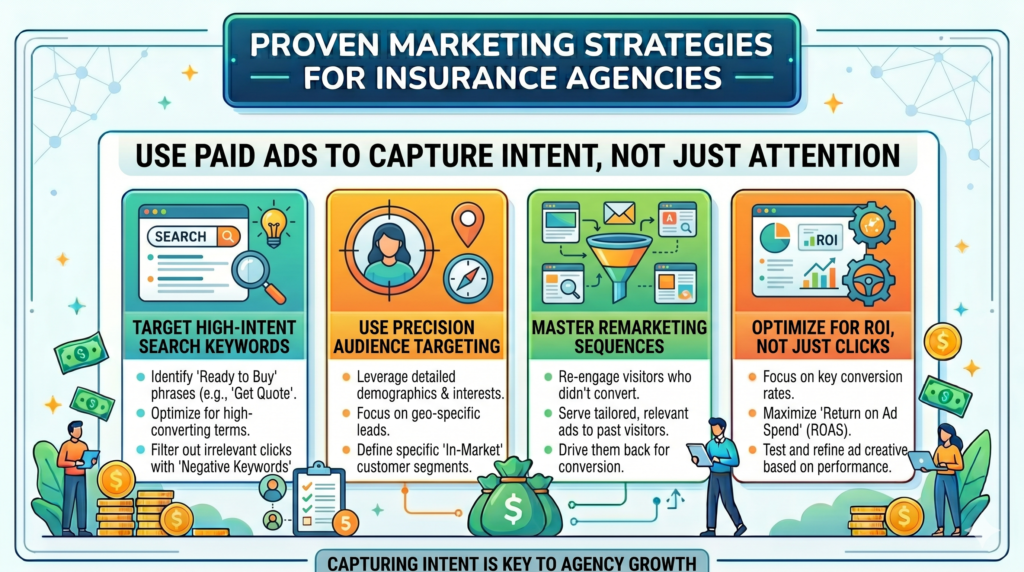
The real value of paid ads is not just reach. It is timing. You can show up when someone is already looking for help, comparing options, or facing a problem they want solved soon.
Search ads should focus on high-intent problems
Search ads are often stronger than broad display ads because the person is already asking for something. Someone searching for “business insurance for contractors near me” is in a very different place than someone who sees a random banner ad while reading the news.
Your search campaigns should be built around clear intent. Separate auto, home, life, commercial, and niche business insurance into different campaigns or ad groups. This helps you match the ad to the buyer’s need.
If someone searches for landlord insurance, the ad should speak to landlords. If someone searches for workers’ compensation, the ad should speak to employers. If someone searches for restaurant insurance, the ad should speak to restaurant owners.
Send each ad to a page that matches the promise
The landing page must continue the same message as the ad. If the ad says you help contractors compare coverage, the landing page should be about contractor insurance. If the ad says you help families bundle home and auto, the page should explain home and auto bundles.
This matters because buyers move fast. If they click and feel confused, they leave.
A strong paid ad page should explain who the page is for, what problem you solve, what coverage may matter, why your agency is trusted, and what the next step is. It should also make contact easy. Phone number, form, and booking option should be visible without making the visitor search.
Paid ads become more profitable when the journey feels smooth. The ad gets attention. The page builds trust. The follow-up turns interest into a real conversation.
Make social media useful instead of noisy
Social media can help insurance agencies, but not in the way many people think. Most buyers are not scrolling Instagram hoping to find a new insurance policy. They are not waiting for a clever post about deductibles. So if your whole social plan is random tips and holiday greetings, it will not do much.
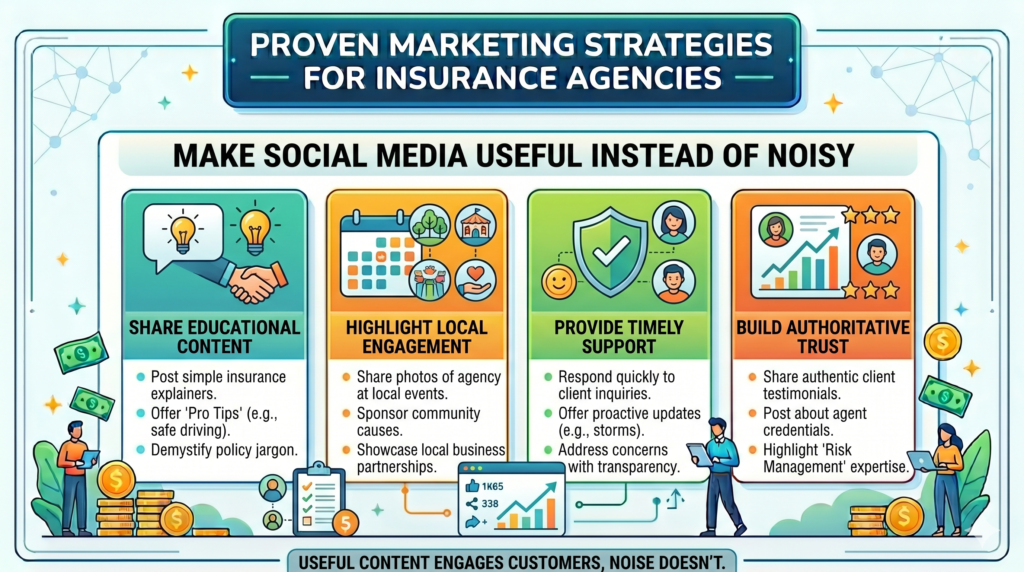
The better goal is to use social media to stay visible, build trust, show your human side, and remind people that your agency is active and helpful.
Post content that makes people feel safer and smarter
Good insurance social content should be simple and useful. You can explain common mistakes, answer common questions, share short stories from client situations without naming people, and talk about local risks.
For example, you can explain why a cheap policy may cost more after a claim. You can explain what new homeowners should check before closing. You can talk about why business owners should review coverage before hiring employees. You can share what families should know before adding a teen driver.
These posts do not need to be long. They need to be clear.
Use real faces and local proof
People trust people more than logos. Show your team. Share photos from local events. Talk about community work. Celebrate agency milestones. Explain why your staff cares about helping clients.
This does not mean every post should be personal. It means your agency should feel real.
A buyer may not call the first time they see your post. But after seeing helpful content again and again, your name starts to feel familiar. Then, when their rate goes up or their business changes, they are more likely to think of you.
Social media is often not the final step before a sale. It is part of the trust-building path.
Build referral marketing into your daily client experience
Referrals are one of the best growth channels for insurance agencies. A referred lead already has some trust before the first conversation. They are often easier to close and more likely to value advice.
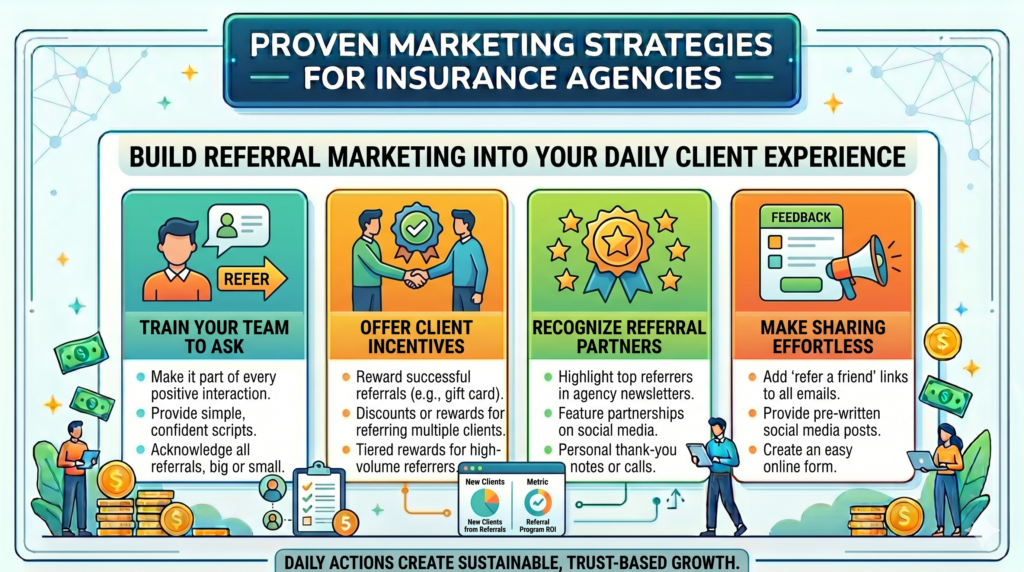
But many agencies treat referrals as luck. They hope happy clients will send people their way. Some will, but hope is not a strategy.
Referral marketing works better when it becomes a natural part of your client experience.
Give clients a clear reason to talk about you
People refer when they feel confident. They need to believe your agency will treat their friend, family member, or business contact well. They also need a simple way to explain why you are worth calling.
That is why your service must be memorable. Fast replies help. Clear explanations help. Honest advice helps. Solving small problems before they become big problems helps.
When a client feels protected and respected, they are more willing to share your name.
Ask at the right moment and make it easy
The best time to ask for a referral is after a clear win. This could be after saving a client money without cutting important coverage, helping them understand a claim, fixing a policy issue, or guiding them through a life change.
The request should feel natural. You might say, “I’m glad we could make this easier. If you know another family or business owner who feels unsure about their coverage, we would be happy to help them too.”
That kind of ask works because it is not pushy. It connects the referral to a real problem you can solve.
Also make the next step simple. Give clients a short message they can forward. Add a referral page to your website. Mention referrals in renewal emails. Train your team to spot moments when clients are especially happy.
Referral growth comes from small habits repeated often.
Use email to stay close before renewal time
Email is one of the most useful tools an insurance agency can have. It is low-cost, simple to manage, and perfect for staying in touch over time. But many agencies only use email for policy updates, renewal reminders, or carrier notices. That is a missed chance.
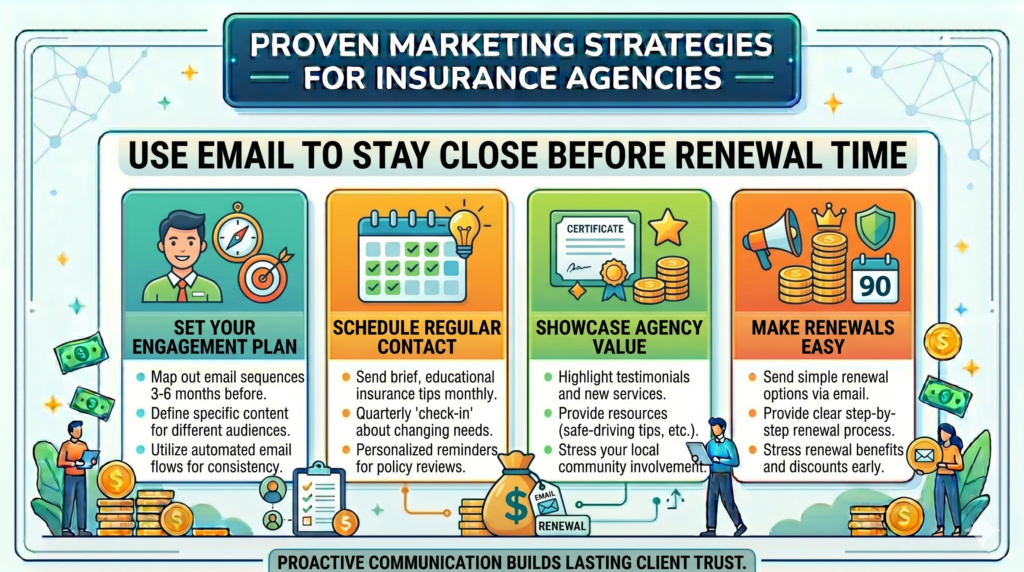
Your email list can help you keep clients warm, educate prospects, increase cross-sells, drive reviews, and reduce churn.
Send emails people would actually want to read
A good agency email does not need to be long. It should help the reader avoid a problem, understand a change, or make a smarter choice.
For personal lines clients, you can send simple emails about storm season, home inventory, teen drivers, life insurance needs, holiday travel, or why rates may be changing.
For business clients, you can send emails about hiring, contracts, certificates, equipment, cyber risk, workers’ compensation, and renewal planning.
The key is to make the email feel timely and useful. Do not send generic “insurance is important” messages. Send advice connected to real moments in the client’s life.
Segment your list so each message feels relevant
Not every client should get every email. A restaurant owner does not need the same email as a homeowner. A family with a teen driver does not need the same message as a retired couple. A contractor does not need the same reminders as a landlord.
Segmenting your list helps your emails feel more personal. You can group people by policy type, business type, renewal date, location, life stage, or past interest.
This does not need to be complex at first. Start with simple groups. Personal lines, commercial lines, life insurance prospects, homeowners, auto clients, and business owners are enough to begin.
When the message matches the person, people pay more attention.
Create a review engine that runs all year
Online reviews are now part of the buying process. Before someone calls your agency, they may check what other people say about you. They want to know if you are responsive, honest, clear, and helpful.
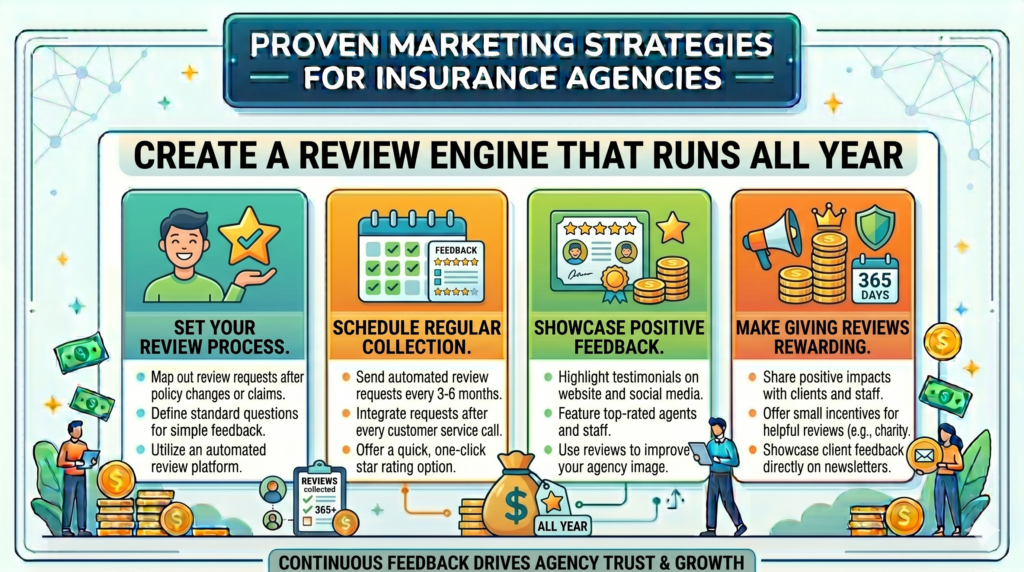
A strong review profile can help you win leads before the first conversation. A weak or outdated review profile can make people hesitate, even if your agency is excellent.
Reviews should be requested as part of service, not as a panic move
Some agencies only ask for reviews when they need to improve their rating or bury a bad review. That makes review building feel rushed and awkward.
A better approach is to make review requests part of your normal client care process.
Ask after positive moments. Ask after a smooth onboarding. Ask after a helpful policy review. Ask after a client thanks you. Ask after a successful claim support experience if the client is happy with your help.
Make the review request short and personal
Clients are busy. If you make the request long, they may ignore it even if they like you.
A simple message works best. Thank them for trusting your agency. Tell them their feedback helps other local people find clear insurance guidance. Give them the review link. Keep it warm and easy.
You should also prepare your team to ask. Producers, account managers, and service staff all create review-worthy moments. If only one person asks, you miss many chances.
Responding to reviews matters too. A kind response shows future buyers that you are engaged. Even a short thank-you can make your agency feel more human.
Use video to explain what words alone cannot
Insurance can feel confusing because people cannot see what they are buying. They are buying a promise, a contract, and future protection. Video helps make that promise feel more real.
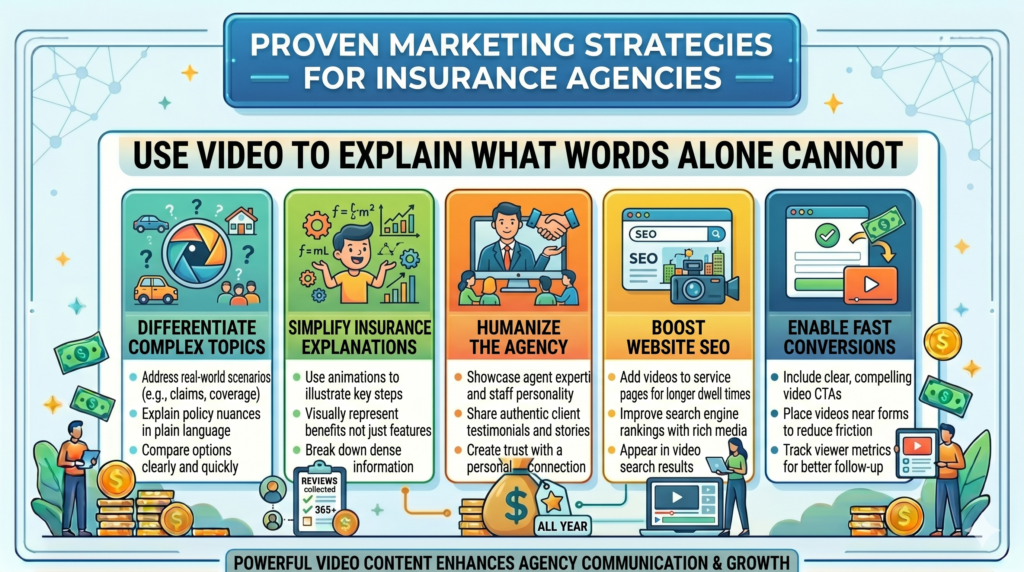
You do not need a studio or expensive gear. A clear phone video with good sound and honest advice can work very well. The goal is not to look like a TV ad. The goal is to build trust.
Short videos can answer common buyer questions
Think about the questions your team answers every week. Those are your best video topics.
Why did my auto rate go up? What is an umbrella policy? Do I need renters insurance if my landlord has coverage? What should a contractor check before signing a job contract? What is the difference between replacement cost and actual cash value?
These questions can become simple one-minute or two-minute videos.
Use video across your whole marketing system
A video does not need to live in only one place. You can post it on social media, add it to a blog post, include it on a service page, send it in a follow-up email, and use it in renewal education.
This makes one piece of work more valuable.
Video also helps people feel like they know you before they call. They hear your voice. They see your face. They get a sense of how you explain things. That can lower the fear of reaching out.
For insurance, that matters. People want to speak with someone who feels calm, clear, and trustworthy.
Turn every renewal into a marketing moment
Renewals are often treated like paperwork. The client gets a notice, your team checks the policy, a new price comes in, and then everyone reacts. If the price is fine, the renewal may feel easy. If the price jumps, the client may panic, shop around, or start questioning the value of your agency.
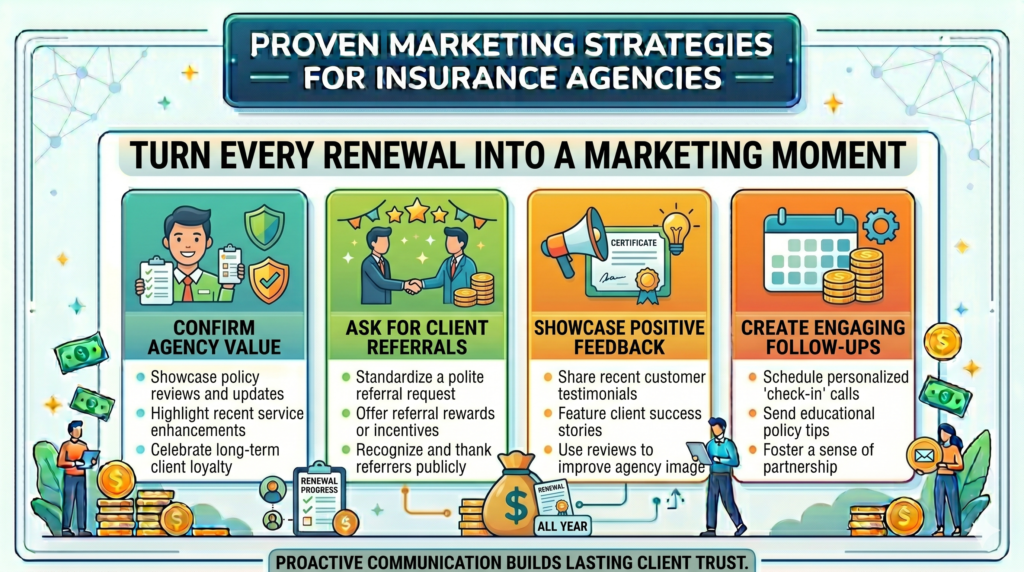
That is why renewals should not be handled like a last-minute task. They should be treated as one of your strongest marketing moments.
A renewal is not just about keeping the policy active. It is a chance to remind the client why they chose you, show them what has changed, explain their options, and prove that your agency is watching out for them. When done well, a renewal can increase trust.
It can also open the door to cross-sells, referrals, reviews, and deeper client loyalty.
Most clients do not think about insurance every day. They may only pay attention when a bill arrives, a claim happens, or a renewal price changes. This means your agency has to use the renewal period to re-educate them.
If you stay silent until the invoice appears, you give the client too much room to create their own story. They may think, “My agency did nothing and my price still went up.” That feeling is dangerous.
Start the renewal conversation before the client feels surprised
A better way is to contact the client before the renewal becomes urgent. The goal is to set the tone early. You want the client to know that your agency is reviewing their account, checking for changes, and preparing them for what may happen.
This is especially important in a market where rates are rising. If a client sees a higher premium without warning, they may blame your agency even if the increase came from the carrier. But if you explain the market early, the client is less shocked. They may still not like the price, but they will understand that you are helping them manage the situation.
Your renewal message should not sound like a dull notice. It should sound like care. You can say that renewal time is a good chance to make sure their coverage still fits their life, home, vehicles, business, staff, contracts, property, or family needs. This changes the renewal from a payment event into an advice event.
For personal lines, ask about life changes. Did they renovate the home? Add a driver? Buy jewelry? Start working from home? Get a dog? Add a pool? Change their commute? These details can affect coverage.
For business clients, ask about payroll, revenue, equipment, vehicles, locations, employees, contracts, subcontractors, cyber exposure, and leases. A lot can change in one year. If your agency does not ask, coverage gaps can grow quietly.
Use the renewal review to show your value clearly
Clients often do not know what your agency does behind the scenes. They may not see the remarketing, the carrier communication, the policy checks, the advice, or the claim support. So you need to make your value visible.
During the renewal, explain what you reviewed. Tell them if you checked limits, deductibles, discounts, coverage gaps, and carrier options. If you advise staying with the same carrier, explain why. If you suggest moving, explain the trade-offs.
Do not just say, “This is the best option.” Tell them what makes it the best option for their situation.
This also helps reduce price-only thinking. When clients only see a premium, they compare only by price. When they understand coverage, risk, service, and claim outcomes, they make better decisions.
A smart renewal process also creates new marketing opportunities. If the client is happy with the review, ask for a review. If they mention a friend who is also upset about rising rates, ask for a referral. If you find missing coverage, explain the benefit of adding it.
If they own a business and have personal policies with you, or the other way around, open that conversation carefully.
The best agencies do not wait for clients to question their value. They use renewals to prove it again and again.
Build cross-sell campaigns that feel helpful, not salesy
Cross-selling is one of the fastest ways for an insurance agency to grow without chasing brand-new leads all the time. You already have trust. You already have the client’s attention. You already know part of their life or business. That gives you a strong chance to help them with more than one policy.
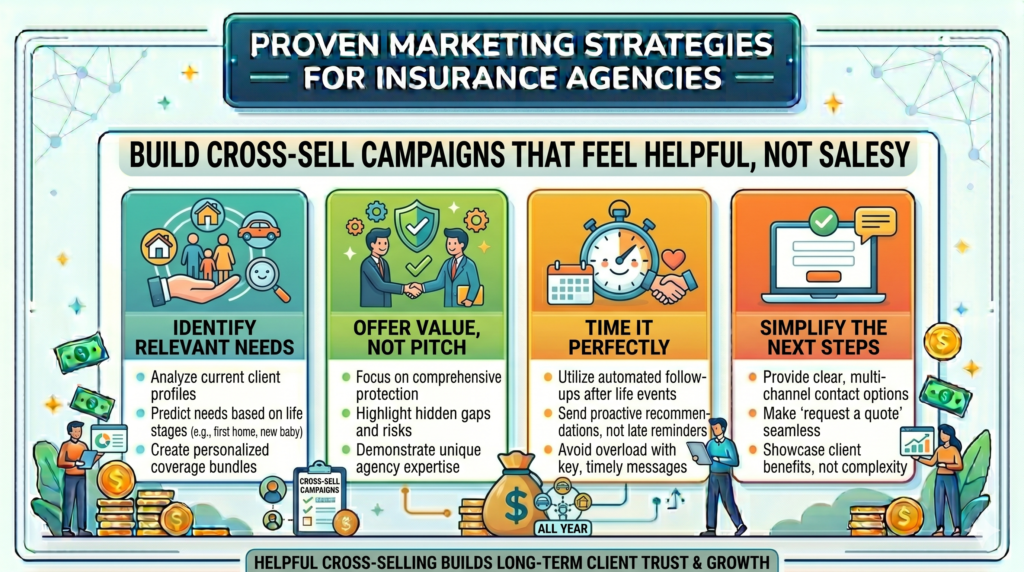
But cross-selling can go wrong when it feels like pressure. If the client feels like you are only trying to sell more, they may pull back. The right approach is to make cross-selling feel like protection, not pitching.
A client who has auto insurance may also need renters, homeowners, umbrella, life, motorcycle, boat, or valuable items coverage. A business owner who has general liability may also need workers’ compensation, commercial auto, cyber, property, professional liability, or employment practices coverage.
But the client may not know what they are missing. They may think one policy protects more than it really does.
That is where your agency can create real value.
Use coverage gaps as the reason for the conversation
The best cross-sell campaigns start with risk, not product. Do not begin by saying, “Do you want to buy another policy?” Start by explaining a common gap.
For example, a client with auto insurance may not know that a serious accident could create costs above their policy limits. That opens the door to an umbrella conversation. A renter may not know that the landlord’s insurance does not cover their personal belongings.
That opens the door to renters insurance. A small business owner may not know that a standard liability policy may not cover cyber events. That opens the door to cyber coverage.
This kind of conversation feels different because it is based on education.
The message should be simple. You can tell the client that as part of your review, you noticed one area that may be worth checking. Then explain the risk in plain words. After that, invite them to have a quick conversation. The goal is not to scare them. The goal is to help them avoid a painful surprise.
Timing matters too. Cross-sell campaigns work better when they connect to moments in the client’s life. Home purchase, marriage, new baby, new driver, business growth, hiring, new vehicle, new equipment, moving, and renewal are all natural times to discuss added protection.
Create simple campaigns by client group
You do not need a complex system to start. Build simple campaigns around common client groups.
For auto-only clients, create a campaign about bundling home, renters, or umbrella coverage. For homeowners, create a campaign about life insurance, flood, valuables, or umbrella coverage.
For commercial general liability clients, create a campaign around workers’ compensation, cyber, commercial auto, or property coverage. For business owners with employees, create education around employment risk, payroll changes, and workplace claims.
Each campaign should have a clear reason. The message should explain why this coverage matters, what mistake people often make, and how your agency can help them review options. Keep it calm and practical.
Cross-selling also improves retention. A client with several policies is usually more connected to your agency than a client with one policy. They have more reasons to stay. They also see you as their insurance guide, not just the place that handles one bill.
But the heart of cross-selling is trust. If a client believes you are protecting them, they will listen. If they believe you are just trying to increase commission, they will resist. That is why every cross-sell message should teach before it offers.
When your agency cross-sells with care, clients do not feel sold. They feel looked after.
Create niche campaigns for the clients you serve best
Many insurance agencies try to market to everyone in the same way. This seems safe, but it often weakens the message. A broad message may reach more people, but it rarely makes anyone feel deeply understood.
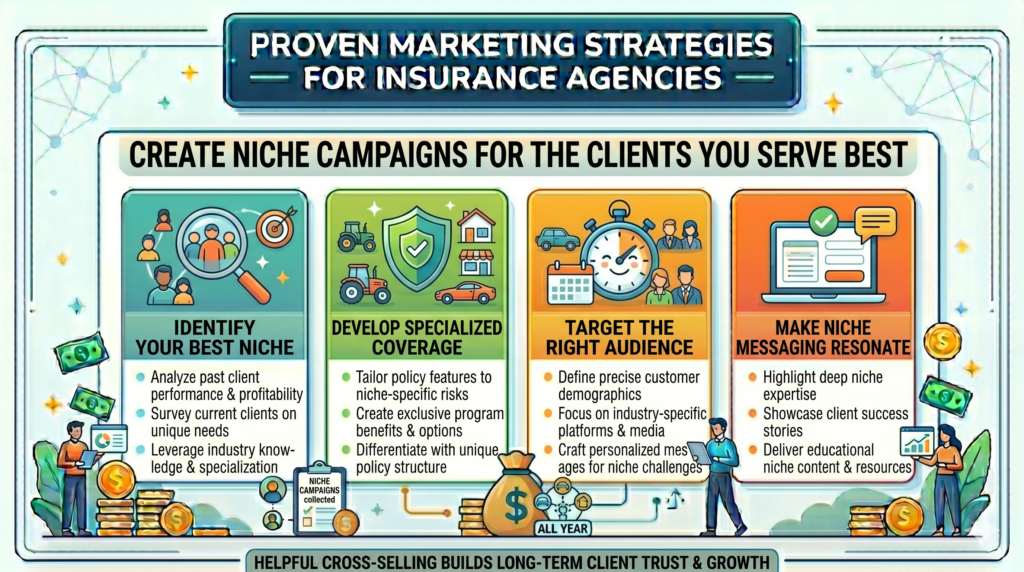
Niche marketing works because it speaks to one clear group at a time. It lets you use the buyer’s language, address their real risks, and show that your agency understands their world.
This does not mean you have to turn away other clients. It simply means your marketing should focus more energy on the segments where you can win. A niche can be an industry, a life stage, a profession, a location, a type of property, or a risk profile.
For example, your agency may decide to build campaigns for contractors, landlords, restaurants, medical offices, trucking companies, first-time homebuyers, high-net-worth families, local retailers, or growing startups. Each group has different fears. Each group needs different proof. Each group responds to different examples.
A niche campaign should sound like it was written for one person
The test is simple. When your ideal buyer reads the page, ad, email, or post, they should think, “This is about me.”
A contractor should see language about job sites, certificates, subcontractors, tools, trucks, bids, contracts, and injury risk. A landlord should see language about tenants, rental property damage, liability, loss of rent, leases, and repairs.
A restaurant owner should see language about equipment breakdown, food spoilage, slips and falls, liquor liability, workers, and delivery risk.
This level of detail creates trust fast. It shows that you are not guessing.
Niche campaigns also help your content strategy. Instead of writing broad posts about business insurance, you can write about the risks restaurant owners miss when adding delivery, what contractors should check before hiring subcontractors, or how landlords can protect rental income after property damage.
These topics are more useful, more searchable, and more likely to bring the right leads.
Build each niche campaign like a small growth engine
A good niche campaign should not be just one landing page. It should include a page, a few supporting blog posts, a simple email sequence, a small ad campaign if budget allows, and a clear follow-up process.
The landing page should explain who you help and what risks you help them manage. The blog posts should answer deeper questions. The emails should educate and invite a conversation. The ads should drive the right people to the page. The follow-up should continue the same message.
This is how a niche campaign becomes a system instead of a one-time effort.
You can also add local proof. If you serve contractors in a certain city or region, say that. If you understand local weather, building rules, business conditions, or common claims, mention it in simple terms. Local knowledge makes the niche message stronger.
Start with one niche. Do not try to build ten campaigns at once. Choose the segment where you have strong clients, strong knowledge, good carrier access, and real growth potential. Build that campaign well. Once it works, repeat the model for another segment.
Niche marketing helps your agency stop sounding like every other agency. It gives your best clients a reason to choose you faster.
Use client stories to make insurance feel real
Insurance can feel boring until something goes wrong. That is one reason marketing it can be hard. People know they need insurance, but they do not always feel the value until a claim, accident, lawsuit, storm, theft, injury, or loss happens.
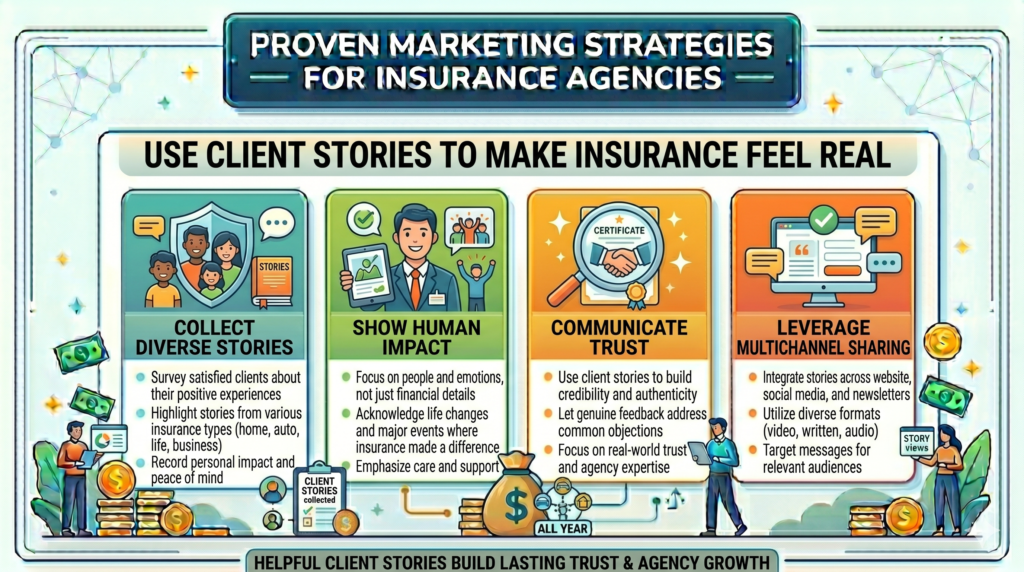
Client stories help close that gap. They make risk real without using fear-based selling. They show how your agency helps in moments that matter. They also help prospects understand why good advice is worth more than a cheap quote.
You do not need to share private details. In fact, you should not. You can tell stories in a safe, general way without naming the client or sharing personal facts. The point is to show the situation, the problem, the lesson, and the value of having the right coverage.
Stories help buyers understand what policies actually do
A policy term may not mean much to a client. But a story can make it clear.
Instead of only explaining umbrella insurance, tell a simple story about a family that realized their auto limits might not be enough after adding a teen driver.
Instead of only explaining business interruption coverage, describe a local business that had to think about how long it could survive if damage forced it to close for weeks. Instead of only explaining cyber insurance, describe how a small company could face stress after a payment scam or data issue.
Stories turn abstract risk into something people can picture.
They also help buyers remember the lesson. A client may forget a definition, but they may remember the story about the business owner who thought a policy covered something it did not.
The best stories are honest and useful. Do not make them dramatic just to get attention. Keep them grounded. Show the mistake, the fix, or the lesson.
Use stories across your website, emails, calls, and social content
Client stories should not sit in one place. They can strengthen your whole marketing system.
On your website, you can use short story sections on service pages to explain common risks. In emails, you can share a brief lesson from a real situation your agency helped with. On social media, you can turn a story into a simple “what to check before this happens” post.
During sales calls, producers can use stories to explain why a coverage option matters.
Stories also make your agency sound more human. A lot of insurance marketing sounds cold because it talks only about policies. Stories bring the focus back to people.
There is one rule to follow: protect privacy. Keep details broad. Change small facts if needed. Do not mention names, addresses, claim amounts, or anything that could identify the client unless you have clear permission.
You can also use review-based stories. If a client leaves a review saying your team made the process easy, build content around that theme. Explain why ease matters when buying insurance. If a review says you helped them understand coverage, talk about your agency’s approach to clear advice.
Storytelling is powerful because it does not feel like selling. It feels like learning from real life. For insurance agencies, that is exactly what good marketing should do.
Build a strong personal brand for the agency owner and producers
People may trust an agency name, but they often connect faster with a person. This is especially true in insurance. A buyer wants to know who will guide them, who will answer when they are confused, and who will help when a claim or coverage problem creates stress.
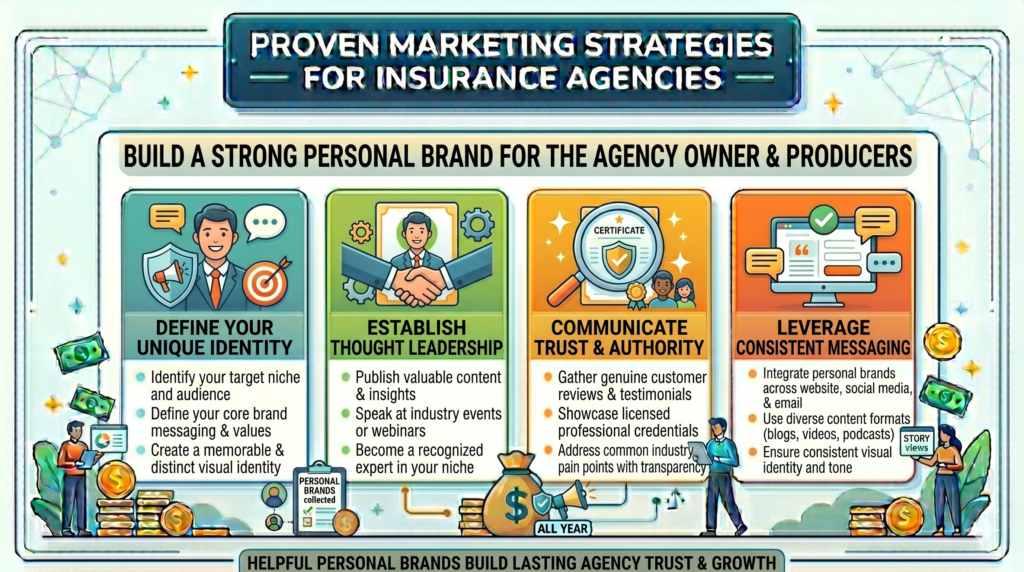
That is why personal branding matters for agency owners, producers, and even key account managers. It gives your agency a human face. It turns advice into a relationship. It makes your marketing feel warmer and more believable.
A personal brand does not mean acting like an influencer. It does not mean posting every part of your life online. It means becoming known for helpful, clear, steady advice in the market you serve.
If your agency works with small businesses, your owner or producer can become known as the person who helps local business owners avoid costly coverage mistakes. If your agency works with families, they can become known for making insurance simple for homeowners, parents, and drivers.
If your agency works with a niche like contractors, landlords, or restaurants, they can become known for understanding that world better than a general agent.
Personal branding works because buyers often want to feel like they already know you before they call. When they have seen your posts, videos, comments, and simple explanations over time, the first conversation feels less cold. They are not speaking to a stranger. They are speaking to someone familiar.
Your personal brand should teach more than it promotes
The biggest mistake agents make with personal branding is talking too much about themselves. They post awards, carrier appointments, sales messages, and general updates. Those things have a place, but they should not be the whole strategy.
The strongest personal brand is built through teaching.
Talk about the questions clients ask every week. Explain why rates change. Share what business owners should check before signing contracts. Explain why cheap coverage can create expensive problems later. Talk about common mistakes new homeowners make.
Share lessons from renewal conversations without naming clients. Show how you think, not just what you sell.
This kind of content helps people trust your judgment.
It also makes your expertise visible. Many agents are very good at their work, but the market cannot see it because they do not share their thinking. When you explain things simply and often, prospects start to understand your value before they become clients.
Show up with a steady voice in the places your buyers already spend time
You do not need to be everywhere. Pick the places that make sense for your market.
For commercial lines, LinkedIn may be very useful. Business owners, founders, operators, real estate investors, and local professionals spend time there. A producer who posts clear advice two or three times a week can slowly become known in the right circles.
For personal lines, Facebook, Instagram, local groups, short videos, and email may work better. People may respond to simple posts about home buying, teen drivers, storm prep, family protection, and rate changes.
The key is to stay steady. A personal brand is not built in one week. It is built by showing up with useful thoughts again and again.
Your voice should sound like you. If you are calm and practical, write that way. If you are warm and story-driven, use that strength. Do not copy the style of a loud marketer if it does not fit your agency. Insurance buyers want trust. Forced personality can hurt that trust.
A strong personal brand also helps with referrals. When clients see your content, they have something easy to share. They can send a post to a friend and say, “This is the person I use.” That is much easier than trying to explain your agency from memory.
Over time, personal branding makes your agency less dependent on cold outreach and price shopping. People come in with more trust because they have already experienced your advice.
Create a simple sales script that supports your marketing promise
Marketing does not stop when a lead comes in. In many agencies, that is where the real problem begins. The ad, website, content, or referral creates interest, but the sales conversation does not match the promise.
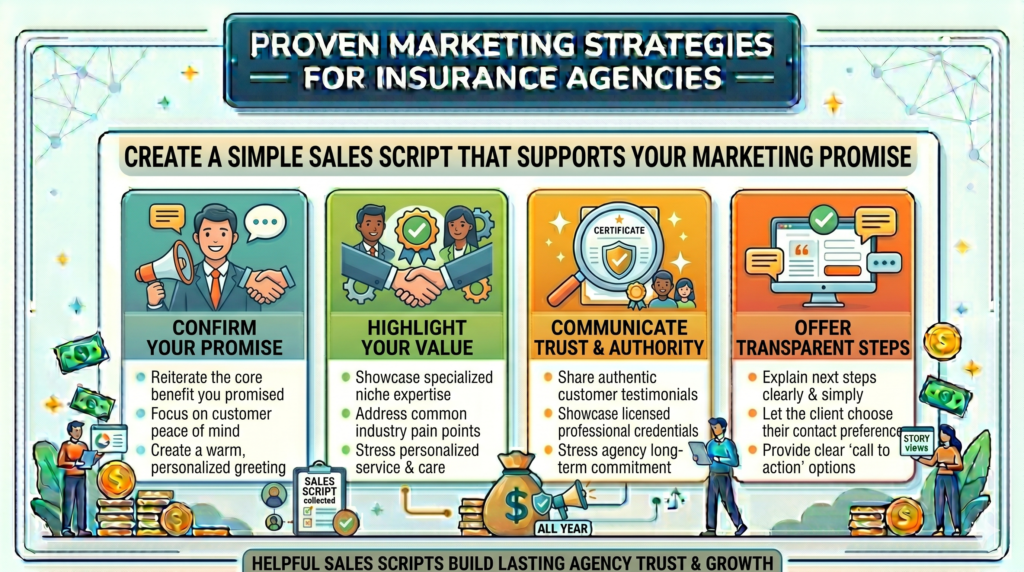
If your marketing says you are helpful, clear, and consultative, but the first call feels rushed or generic, trust drops. If your website says you guide clients carefully, but the sales process jumps straight to price, the buyer may not feel the difference.
That is why your sales script is part of your marketing system.
A good script is not a stiff set of lines. It is a clear path for the conversation. It helps your team ask better questions, uncover real needs, explain value, and guide the buyer without sounding pushy.
Most insurance buyers do not know what they need. They may ask for a quote, but what they really need is help making a smart decision. If your team only collects basic details and sends a price, you become easy to compare with every other agency. If your team asks strong questions and explains risk clearly, you become an advisor.
The first call should slow the buyer down in a helpful way
Many buyers start by asking, “How much will it cost?” That is normal. Price matters. But if you let the whole conversation become about price too soon, you lose the chance to show value.
A strong first call should make the buyer feel heard. Ask what changed, why they are shopping, what they are worried about, what they liked or disliked about their current coverage, and what matters most besides price.
For a homeowner, ask about the home, recent updates, valuables, water risks, roof age, safety features, and past claims. For an auto client, ask about drivers, commute, vehicles, usage, and concerns. For a business owner, ask about operations, employees, revenue, contracts, property, vehicles, tools, data, and growth plans.
These questions show care. They also help you avoid giving weak advice based on limited information.
The buyer may think they only need a quote. Your job is to show that a quote without context can be risky.
Use plain words to explain the trade-off between price and protection
When you present options, do not bury the buyer in policy terms. Explain choices in simple language.
You can say, “This option costs less each month, but it leaves you taking on more risk if there is a large claim.” Or, “This option is higher, but it gives you stronger protection in the areas that matter most for your situation.”
That kind of explanation helps people feel in control. It also reduces the chance that they pick the cheapest option without understanding the downside.
Your sales script should also include a clear way to handle common objections. If someone says they want to think about it, ask what part they are still unsure about. If they say another quote is cheaper, ask whether the coverage is the same before reacting. If they say they need to talk to a spouse or partner, offer a short summary they can share.
The goal is not to trap the buyer. The goal is to guide them with clarity.
A strong script should also end with a clear next step. Do not leave the conversation vague. Tell them what will happen next, when you will follow up, what they should review, and how to reach you with questions.
When your sales process matches your marketing, your agency feels more trustworthy. Every step tells the same story: we listen, we explain, we protect, and we make insurance easier.
Use marketing automation without losing the human touch
Marketing automation can be very helpful for insurance agencies. It can remind leads to respond, educate prospects, send renewal messages, ask for reviews, follow up after quotes, and keep clients engaged all year.
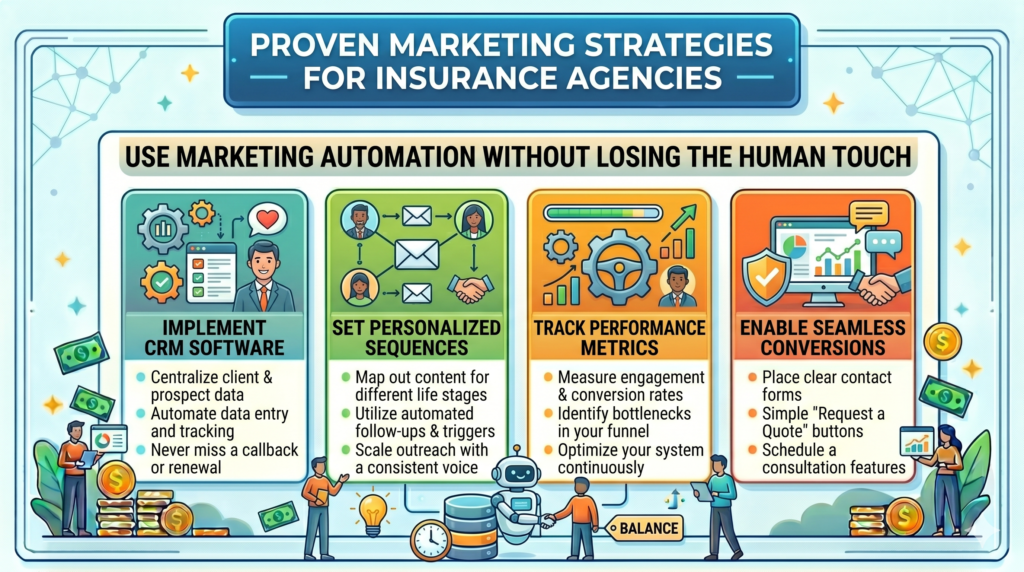
But automation can also hurt trust if it feels cold. Insurance is personal. People do not want to feel like they are just another name in a system. They want help from real people.
The goal is not to automate the relationship. The goal is to automate the reminders, education, and timing so your team can spend more energy on real conversations.
Used well, automation makes your agency feel more attentive. Used poorly, it makes your agency feel careless.
Automate the moments that are easy to forget
Start with the parts of your process that often fall through the cracks.
A new lead requests a quote but does not answer the phone. A quote is sent but the buyer does not reply. A client is coming up for renewal. A new customer needs onboarding emails. A happy client should be asked for a review. A commercial client needs a mid-year check-in. A personal lines client may need seasonal reminders.
These moments are perfect for automation because timing matters. A system can make sure no one is forgotten.
For example, after a quote request, you can send a short email that says your team received the request and will review the details. If the lead does not answer, the system can send a helpful message explaining what information is needed and why.
After a quote is sent, the system can send a simple guide on how to compare insurance options beyond price.
This kind of automation supports the sale without feeling like spam.
Write automated messages like a real person would speak
The words matter. Many automated emails sound stiff because they are written like corporate notices. That is a mistake.
Use simple language. Keep the message focused on one idea. Make it feel like it came from a helpful agent, not a machine.
Instead of saying, “We are following up regarding your recent insurance inquiry,” say, “I wanted to make sure you had what you need to review your quote.”
Instead of saying, “Please contact our office for further assistance,” say, “Reply here if you want me to walk through the options with you.”
Small changes make the message feel warmer.
Automation should also leave room for personal notes. If a producer knows something specific about the lead, they should add it. A short personal line can make a big difference.
You also need to watch frequency. Too many messages can make people tune out. A good automation sequence should feel useful, not relentless. Each message should have a purpose.
For clients, automation can help you stay close without always selling. Send reminders about storm prep, home inventory, employee changes, cyber safety, teen drivers, or renewal reviews. These messages show that your agency is thinking ahead.
But do not let automation replace service. If a client replies, a human should respond. If a lead asks a serious question, do not send them through five more automated messages before someone helps them.
Automation should make your agency more human at scale. That means better timing, clearer education, and fewer missed chances.
Build partnerships with local businesses and trusted professionals
Partnership marketing is one of the most underused growth channels for insurance agencies. Many agencies depend on referrals from clients, but they do not build enough referral relationships with other professionals who serve the same buyers.
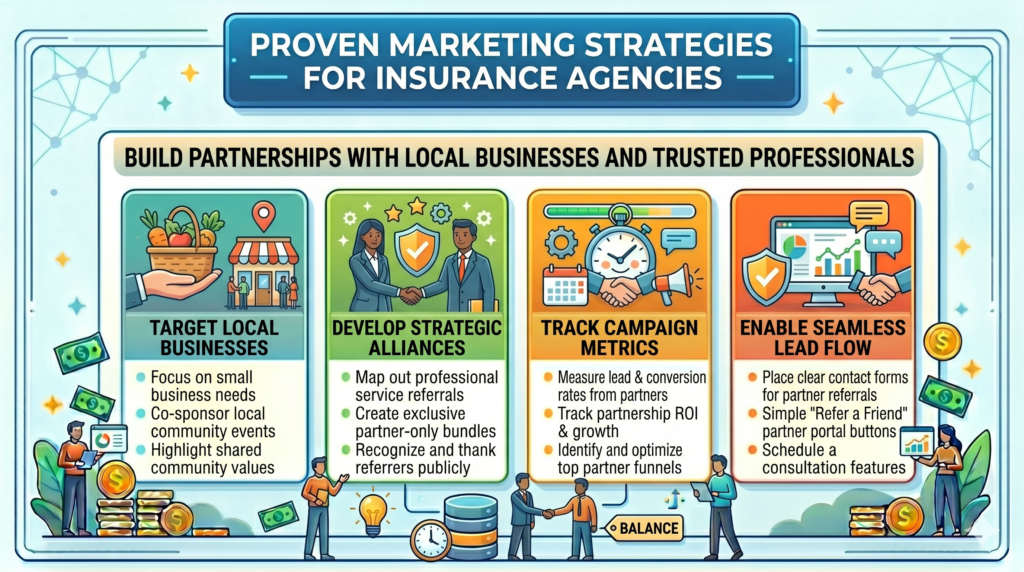
The right partners can put your agency in front of people at the exact moment they need coverage. This works because trust transfers. If a buyer already trusts their realtor, lender, accountant, attorney, payroll provider, bookkeeper, builder, or business advisor, a referral from that person carries weight.
But partnership marketing has to be done with care. You cannot build strong partnerships by asking for leads right away. You have to create value first.
A good partner relationship should help both sides serve their clients better. If your agency makes your partner look good, they will be more likely to send people your way.
Choose partners who already influence insurance decisions
Start by looking at the moments when people need insurance.
Homebuyers often need help during the mortgage and closing process. That makes realtors, lenders, title companies, and home inspectors useful partners. New business owners often need coverage when forming a company, signing a lease, hiring staff, buying vehicles, or signing contracts.
That makes attorneys, accountants, payroll firms, banks, commercial realtors, and business consultants useful partners.
Contractors may need certificates and coverage help when bidding jobs. Restaurants may need coverage when opening, expanding, adding delivery, or applying for licenses. Landlords may need help when buying new properties or changing tenants.
When you understand these moments, you can find better partners.
Do not chase every possible referral source. Focus on people who serve the kind of clients you want. A strong partnership with one good commercial realtor may be worth more than twenty weak networking contacts.
Give partners tools that make referrals easy
Most partners are busy. They may like you, but they will not refer often if it takes too much effort. Make it easy for them.
Create simple resources they can share with clients. A realtor could share a short home insurance checklist. A lender could share a guide on what buyers should know before closing. An accountant could share a business insurance review checklist. A payroll firm could share workers’ compensation reminders.
These resources should not feel like ads. They should help the partner look useful.
You can also offer to educate their clients through short sessions, webinars, lunch-and-learns, or simple Q&A calls. For example, you could teach first-time homebuyers what to know before choosing home insurance.
You could teach business owners what to check before hiring employees. You could teach landlords what coverage issues to review before buying another rental.
Partnerships grow when you show up consistently. Stay in touch. Send useful updates. Refer business back when appropriate. Thank partners when they send someone. Keep them informed without sharing private client details.
Also, protect the partner’s trust. If they refer someone, treat that lead with extra care. Respond fast. Explain clearly. Do not pressure. The partner is putting their name behind your agency. If you make the client feel safe, the partner will feel safe sending more people.
A strong partnership strategy can become a steady source of high-trust leads. It takes time, but it builds a growth channel that competitors cannot easily copy.
Conclusion
Marketing an insurance agency is not about shouting louder than every other agency. It is about becoming easier to trust, easier to understand, and easier to choose. When your message is clear, your website teaches, your follow-up is steady, your reviews are strong, and your clients feel cared for before and after the sale, growth becomes more predictable.
The best strategy is simple: help people before they buy, guide them when they compare, and support them after they choose you. Do this with patience and consistency, and your agency will not just get more leads. It will build lasting relationships.
















Comments are closed.