
WinSavvy Editorial Standards
How this article was created
Social media is no longer just a place where marketing agencies post client wins, share pretty graphics, or announce new services. It has become one of the strongest growth channels an agency can use to build trust, attract leads, prove skill, hire talent, and stay visible in a crowded market.
Build a Clear Agency Position Before You Post Anything
Most agencies want social media to bring them more leads, more calls, more referrals, and more trust. That is fair. But social media cannot do that well if the agency itself is unclear.
Before your team posts more, films more, designs more, or writes more, you need to decide what your agency wants to be known for. This is the step many agencies skip. They rush into content because content feels productive. But without a clear position, more content only creates more noise.
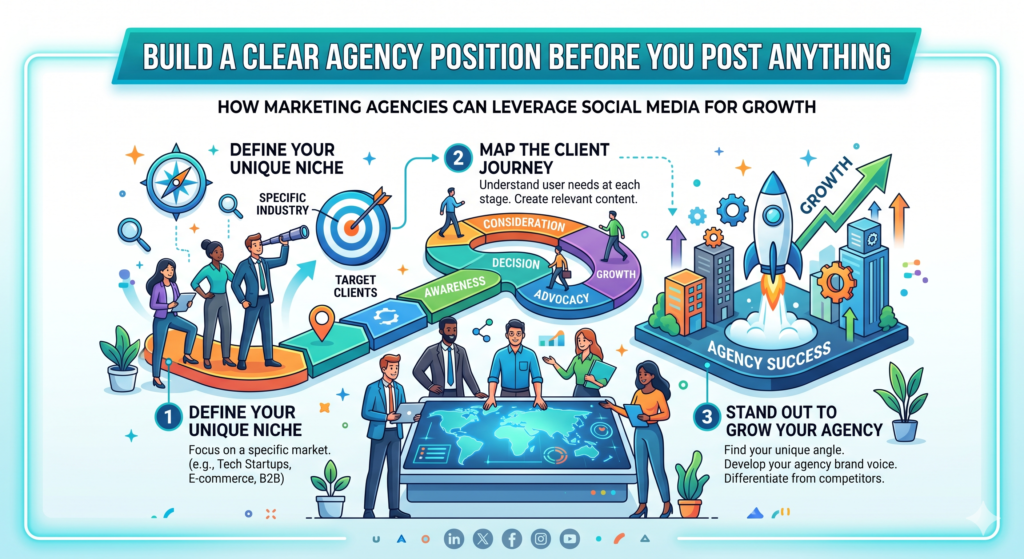
Social media will only grow your agency if people understand what you want to be known for
People do not remember agencies that sound like everyone else. They remember agencies that stand for something clear.
If your agency says, “We help brands grow online,” that may be true, but it is too broad. Every agency can say that. It does not give the buyer a reason to stop, care, or remember you.
A stronger message would be more specific. For example, your agency might say, “We help B2B service firms turn LinkedIn content into qualified sales calls.” That is much easier to understand. The buyer knows who it is for, what channel is involved, and what result matters.
That kind of clarity makes your content stronger. It gives every post a direction. It gives your team a filter. It makes your agency easier to trust because people can quickly understand what you do and why it matters.
Your agency needs a sharp message before it needs more content
Many agencies treat social media like a daily task. They ask, “What should we post today?” But the better question is, “What should this post make people believe about us?”
That question changes the quality of your content.
If you want to be known as the agency that helps founders turn content into sales, then your posts should support that idea again and again. You can talk about content strategy, founder-led posts, social proof, offer clarity, buyer pain, lead quality, and sales conversations. Each topic feels connected because each one points back to the same core promise.
But if you post about everything, people remember nothing.
This is why positioning matters so much. Your agency’s social media should not feel like a random mix of tips, trends, office photos, quotes, and service reminders. It should feel like a clear body of work. Every post should help the right buyer understand your thinking.
When people see your content often enough, they should be able to say, “That agency is really good at this specific thing.”
That is when your social media starts working as a growth asset.
Your agency should not try to sound useful to everyone
Trying to appeal to everyone usually makes your content weaker. It forces your message to become safe and general. And safe, general content rarely gets remembered.
Social media moves fast. People scroll through hundreds of posts, videos, and updates in a short time. They do not stop for content that sounds correct. They stop for content that feels relevant.
That is why your agency must speak to a clear type of buyer.
If you serve ecommerce brands, talk about the real problems ecommerce owners face. If you serve law firms, talk about trust, local visibility, and content that makes complex services easier to understand. If you serve SaaS companies, talk about demand, product education, pipeline, and buyer journeys. If you serve local businesses, talk about reviews, follow-up, lead response, and local search.
Specific content feels more useful because it sounds like it was written for someone real.
A clear audience makes your content stronger and easier to trust
A clear audience does not limit your agency. It sharpens your public message.
Your agency may still work with different kinds of clients. But your social media needs a strong center. Without that center, your page becomes hard to follow. One day you are speaking to startups. The next day you are speaking to restaurants. The next day you are speaking to enterprise teams. The next day you are sharing broad branding advice.
That kind of mix can confuse people.
A sharper approach is to build your content around the type of client you want more of. Speak to their pain. Use their language. Show their problems. Break down their mistakes. Explain the decisions they need to make.
When you do this, the right people feel seen.
A founder may stop because your post explains why their content gets likes but no sales calls. A clinic owner may stop because you explain why paid ads fail when the front desk takes too long to respond. A consultant may stop because you explain why their website sounds smart but does not build trust.
This is how social media creates connection. Not by trying to impress everyone, but by making the right buyer feel understood.
Your positioning should guide every post your agency publishes
Once your position is clear, your team should use it as a content filter. This keeps your social media from becoming scattered.
Before publishing a post, ask whether it supports the way you want the market to see your agency. Does it show your point of view? Does it help your ideal client understand a problem? Does it make your expertise clearer? Does it move the right person closer to trusting you?
If the answer is no, the post may not belong.
This is not about being rigid. It is about being focused. Social media growth does not come from posting every idea. It comes from posting the right ideas often enough that people start to associate your agency with a clear value.
A simple content filter keeps your page from becoming scattered
A content filter can be very simple.
For a growth agency, the filter might be: does this post help founders get better leads and turn them into revenue?
For an SEO agency, the filter might be: does this post help buyers understand how search builds trust, demand, and long-term growth?
For a paid media agency, the filter might be: does this post help businesses spend money more wisely and waste less budget?
For a content agency, the filter might be: does this post show how clear ideas can turn attention into action?
This kind of filter helps your team make better choices. It stops you from chasing every trend. It stops you from posting weak tips just to stay active. It also helps you build a page that feels focused and useful.
The goal is not to publish more content. The goal is to become easier to remember.
When people understand what your agency stands for, they are more likely to follow, trust, refer, and eventually reach out.
Use Social Media to Teach Buyers How to Think, Not Just What to Buy
A lot of agency content tries to sell too soon. It asks people to book a call before they trust the agency. It promotes services before the buyer understands the problem. It talks about packages before it has earned attention.
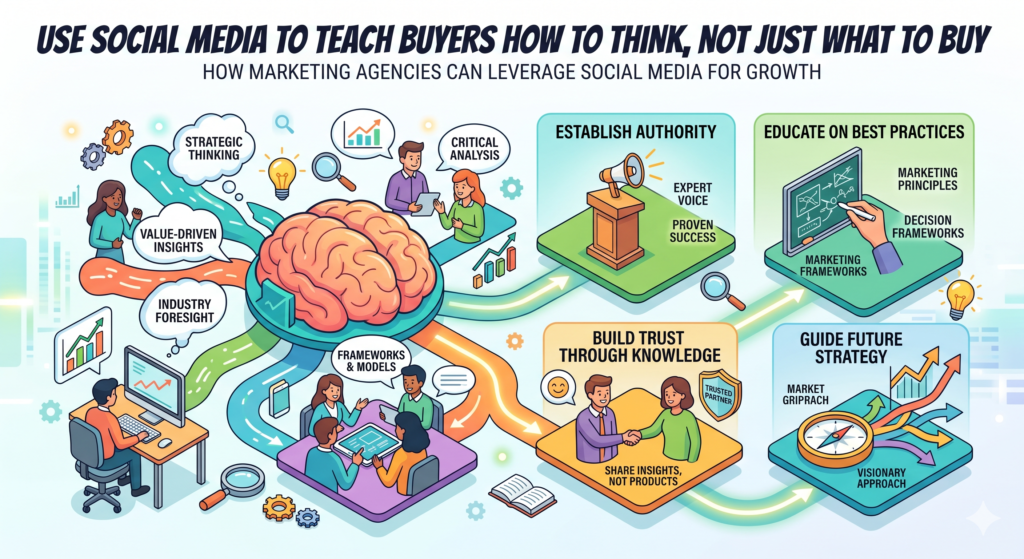
That is not how strong agency growth works.
The best agency content teaches first. It helps prospects see their problems more clearly. It gives them better language. It shows them what is broken, what matters, and what they should do next.
When your agency teaches well, it becomes useful before it becomes necessary. That is a powerful place to be.
The best agency content makes prospects smarter before they become leads
Most buyers are not ready to hire an agency the first time they see your content. They may have a problem, but they may not fully understand it yet.
They may think they need more traffic when they really need a better offer. They may think they need more social posts when they really need clearer messaging. They may think they need more ad spend when they really need a landing page that builds trust.
They may think their content is failing because of the algorithm when the real issue is that the content says nothing new.
Your content should help them diagnose the real issue.
That is what makes educational content so valuable. It meets the buyer before the sales call. It helps them understand what is happening inside their business. It shows them that your agency can see things they may be missing.
Teaching builds trust before the sales call ever happens
Trust is built when your content makes people think, “That makes sense. I never saw it that way before.”
This is why your agency should not only post tips. Tips can be useful, but they are often too shallow on their own. A post that says “post consistently” does not teach much. A post that explains why consistency fails when your message is unclear is far more useful.
The same is true for every service.
Do not just tell people to improve SEO. Explain why rankings do not matter if the page does not match buyer intent.
Do not just tell people to run ads. Explain why paid traffic exposes weak offers faster than organic traffic.
Do not just tell people to post short videos. Explain why short videos work best when they make one painful idea easy to understand quickly.
This kind of teaching makes your agency look experienced. It shows that you understand the deeper issue, not just the surface tactic.
Educational content should come from real client problems
The strongest social content usually comes from real work.
Your sales calls, client meetings, audits, reports, and strategy sessions are full of content ideas. Every question a prospect asks can become a post. Every mistake your team fixes can become a lesson. Every false belief you hear in the market can become a point of view.
This is why agencies should not build social media calendars only from keyword tools or trend lists. Those tools can help, but the best content often comes from direct contact with the market.
If five prospects ask why their LinkedIn posts get likes but no leads, that is a signal. If clients keep thinking SEO means publishing more blogs, that is a signal. If founders keep saying, “We tried content and it did not work,” that is a signal.
Those are not just questions. They are content themes.
The best post ideas are already hiding inside your sales calls and client work
Your agency should pay close attention to the words clients use when they describe their problems.
A client might say, “We are getting leads, but they are not serious.” That can become a post about lead quality.
A founder might say, “People like my posts, but no one books a call.” That can become a post about content that attracts attention but does not create intent.
A business owner might say, “Our ads worked for a while, then stopped.” That can become a post about offer fatigue, landing page quality, and audience saturation.
A marketing manager might say, “Our agency sends reports, but we do not know what to do with them.” That can become a post about reporting that explains decisions, not just numbers.
This kind of content feels real because it comes from real pain. It also helps buyers feel understood. They see their own problem in your words, and that creates trust.
Teach the reason behind the tactic
Many agencies share tactics without explaining the thinking behind them.
They say to post more. They say to improve hooks. They say to use retargeting. They say to add testimonials. They say to create short videos.
Some of that advice may be right. But if it has no context, it does not show much expertise.
A stronger agency explains why a tactic works, when it works, when it fails, and how to judge whether it is worth doing.
That is where your content becomes more strategic.
Your agency should explain why something works, not just what to do
Telling a founder to post three times per week is not as useful as explaining that frequency only helps when the message is clear, the audience is right, and the content is tied to a real buying problem.
Telling a company to add testimonials is not as useful as explaining that vague praise does not reduce risk. Specific proof does. A testimonial that says “great team” is weak. A testimonial that explains the problem, the change, and the result is stronger.
Telling a brand to run retargeting ads is not as useful as explaining that retargeting works only when people already have a reason to care. If the first touch is weak, the second touch will not save it.
This kind of content teaches judgment.
And judgment is what clients pay agencies for.
They do not only want someone who can post, design, write, or launch campaigns. They want someone who can help them make better choices.
When your social media shows that kind of thinking, your agency starts attracting better conversations.
Turn Proof Into Content Without Making It Sound Like Bragging
Proof is one of the strongest things an agency can share on social media. But proof has to be handled carefully.
If your agency only posts big numbers, people may not believe them. If you only post client logos, people may not understand what you actually did. If you only post wins, your page may start to feel self-focused.
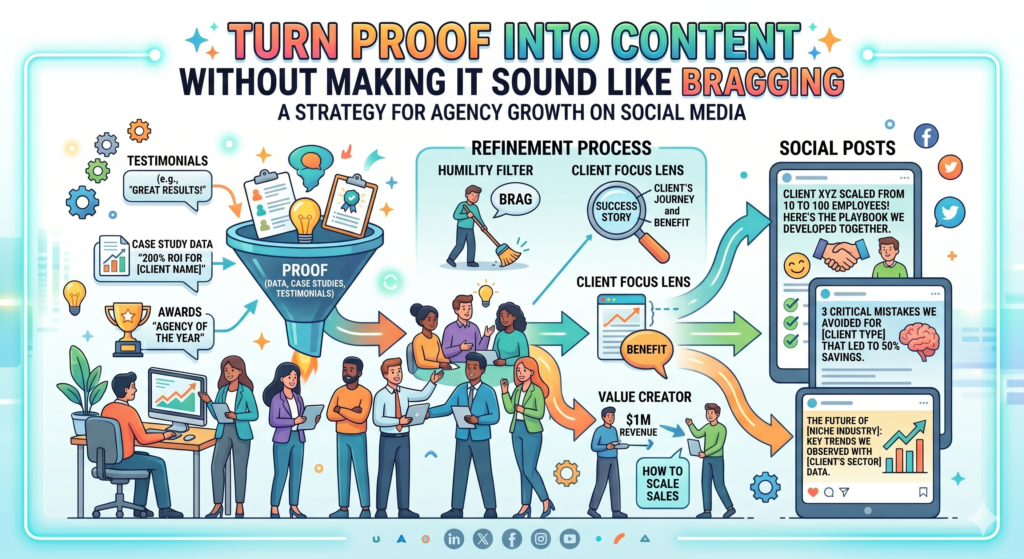
The best proof does more than show success. It teaches through success.
Social media should make your agency’s results easy to believe
Every agency claims it gets results. That is why a result by itself is not enough.
A post that says, “We increased leads by 300%” may catch attention. But serious buyers will still have questions. What was the starting point? How long did it take? What changed? Was the result from strategy, creative, budget, timing, or something else? Could the lesson apply to their business?
Your proof content should answer those questions.
Instead of only showing the final result, show the journey. Explain what was broken before. Explain what your team noticed. Explain what decision made the biggest difference. Explain what you stopped doing and what you started doing.
That makes the result feel real.
Good proof explains the change, not just the final number
A strong proof post might explain that a client had traffic, but weak conversions. The agency found that the landing page was too focused on features and not enough on buyer pain. The team rewrote the page around the main problem, added stronger proof near the call to action, simplified the form, and changed the follow-up flow.
Now the result has meaning.
The reader can see what changed. They can understand the thinking. They can learn from the example even if they never become a client.
That is the goal.
Proof should not sound like shouting. It should sound like a useful breakdown.
When you explain the path behind the result, you make your agency easier to trust. You show that your wins are not random. You show that there is a method behind the work.
Case studies should focus on the business problem first
Many agencies write case studies around the marketing channel.
They say, “We ran Facebook ads.” They say, “We improved SEO rankings.” They say, “We redesigned the website.” They say, “We built a new email flow.”
Those details matter, but they should not be the starting point.
Clients do not wake up wanting channels. They wake up wanting better leads, clearer demand, more sales, lower waste, more trust, and stronger growth.
So your case study content should begin with the business problem.
Maybe the client was spending money on ads but the sales team said the leads were poor. Maybe the website looked good but visitors were not taking action. Maybe the company had strong expertise but no one outside referrals knew about it. Maybe the founder was posting often but the content was not leading to sales conversations.
That is where the story should start.
Buyers care about growth, trust, revenue, and risk before they care about channels
When your proof starts with the business problem, the reader can see themselves in the story.
A founder may not care that you redesigned a landing page. But they do care if the old page was causing good prospects to leave without booking a call.
A business owner may not care that you changed ad creative. But they do care if the old creative was attracting low-quality leads and wasting budget.
A marketing lead may not care that you improved blog structure. But they do care if the old content was bringing traffic that never turned into pipeline.
This is why proof needs context.
Show the problem in plain words. Show why it mattered. Show what your agency changed. Show what improved. Then explain the lesson.
That style makes your agency look both skilled and helpful. It also makes your social media more useful to prospects who are still learning what they need.
Client stories should include lessons others can apply
The best proof content gives the reader something they can use.
You may not be able to share every number. Some clients may not allow it. Some results may need to stay private. But you can almost always share the lesson.
You can explain what the campaign taught you. You can share what most businesses would miss. You can show the before-and-after thinking without exposing private details.
This is especially useful for agencies that work with sensitive industries or private clients.
Useful proof can build trust even when you cannot share every detail
You might say that a client was getting many form fills, but few serious sales calls. Instead of sharing the client name or exact numbers, you can explain that the issue was not traffic volume. The issue was that the page made the offer sound too broad.
Then you can explain how the agency narrowed the message, changed the call to action, added proof for a specific buyer type, and adjusted the follow-up questions.
That story is still useful.
It shows your thinking. It protects the client. It gives prospects a reason to trust your judgment.
This is how agencies can turn everyday work into strong social content. You do not need a massive case study every week. You need to notice the lessons inside your work and share them in a way that helps the market think better.
When your agency does this often, your social media becomes a public record of your expertise.
Choose the Right Platforms Based on Buyer Behavior, Not Agency Ego
A common mistake agencies make is trying to be everywhere.
They open accounts on LinkedIn, Instagram, X, TikTok, YouTube, Facebook, Threads, and every new platform that starts getting attention. At first, this feels smart. It feels like reach. It feels like modern marketing.
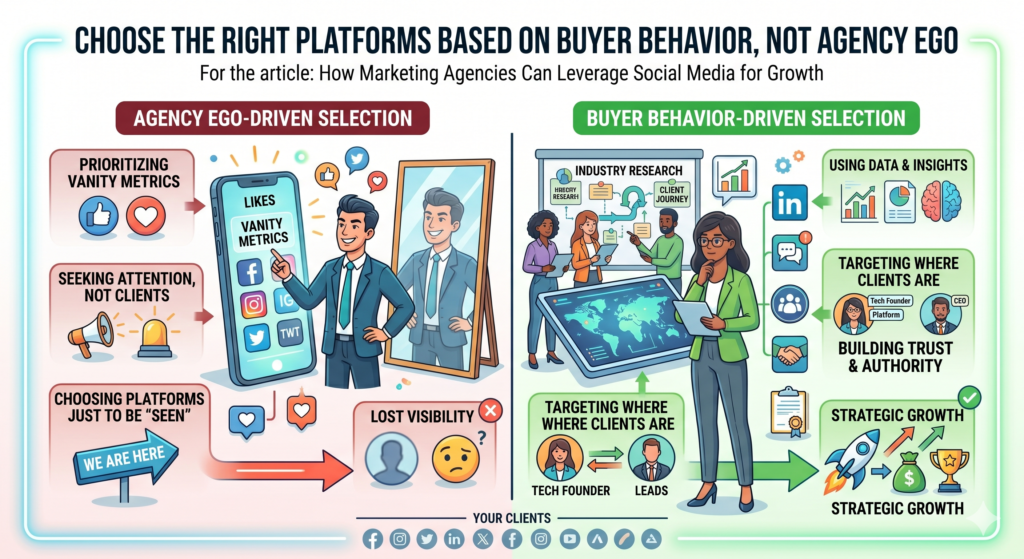
But in practice, it often creates weak work across too many places.
A small or mid-sized agency does not need to dominate every platform. It needs to show up well where its best buyers already spend time, ask questions, compare options, and form trust.
That is a much better way to think about platform choice.
Social media growth is not about being present everywhere. It is about being useful in the right places often enough that the right people start to remember you.
Your best platform is the one your buyers use when they are thinking about business problems
Every platform has a different mood.
LinkedIn is often where people think about business, hiring, growth, leadership, partnerships, and career status. That makes it strong for B2B agencies, SaaS agencies, consulting agencies, content agencies, SEO agencies, and agencies that sell high-trust services.
Instagram is more visual and emotional. It can work well for agencies in branding, design, ecommerce, beauty, fashion, lifestyle, hospitality, fitness, local services, and creator-led businesses.
YouTube is strong when the buyer needs depth. It works when your agency can teach, explain, compare, review, or break down complex ideas in a clear way.
TikTok and Reels can work when short, sharp education fits the audience. They can be useful for reach, but they need a clear content style. Random trend-chasing usually does not build serious trust for an agency.
X can work well for founders, tech buyers, operators, writers, investors, and people who like sharp opinions. But it requires a strong point of view and frequent conversation.
Facebook still matters in certain spaces, especially local business, communities, groups, events, and service niches where buyers are active in private groups.
The mistake is picking a platform because it is popular, not because it matches the buyer journey.
Your agency should study where trust is built before it studies where reach is cheap
Cheap reach can look exciting. A short video can get thousands of views. A trend can bring sudden attention. A funny post can create engagement.
But reach alone does not grow an agency.
An agency grows when the right people start trusting the team enough to take the next step. That may mean following the page, joining the email list, visiting the website, asking for a referral, sending a message, or booking a call.
This is why your agency should ask a deeper question before choosing platforms.
Where do our best buyers go when they are looking for ideas, answers, examples, and proof?
For many B2B agencies, that answer is LinkedIn. Buyers may not be searching for an agency every day, but they are paying attention to useful ideas. They notice smart posts. They see who their peers engage with. They remember the people and firms that explain problems clearly.
For design and brand agencies, Instagram may matter more because buyers want to see taste, style, and execution. A strong visual profile can act like a living portfolio.
For agencies with deep knowledge, YouTube can build high trust because video lets people hear your voice, watch your thinking, and spend more time with your ideas.
The right platform is not always the one with the largest audience. It is the one where attention can turn into trust.
Start with one main platform and one support platform
Trying to manage five platforms well can drain a team fast. Content gets rushed. Strategy gets thin. The same post gets copied everywhere without thought. The agency becomes active, but not effective.
A better approach is to choose one main platform and one support platform.
Your main platform is where you publish your strongest thinking. This is where your agency shows up with the most care. This is where your best posts, videos, ideas, and proof should live first.
Your support platform helps you stretch the value of that content. It may be a place where you repost shorter ideas, share behind-the-scenes clips, build community, or drive people back to deeper content.
This approach gives your team focus. It keeps quality high. It also makes the work easier to manage.
If your agency serves B2B founders, your main platform may be LinkedIn and your support platform may be YouTube or X.
If your agency serves ecommerce brands, your main platform may be Instagram and your support platform may be TikTok or YouTube Shorts.
If your agency sells deep strategy, your main platform may be YouTube and your support platform may be LinkedIn.
The mix depends on your buyer, your offer, your strengths, and your team’s ability to create well.
Focus makes your social media stronger because every platform has a learning curve
Each platform has its own rules, habits, formats, and signals.
LinkedIn rewards useful business insight, strong opening lines, personal points of view, and comments that add value.
Instagram rewards clear visual style, strong hooks, quick value, proof, and content that people save or share.
YouTube rewards watch time, clear topics, strong titles, useful structure, and viewer trust.
TikTok rewards fast attention, strong pacing, simple ideas, and content that feels native to the platform.
This is why copying the same content everywhere rarely works well.
A LinkedIn post may need a sharp written opening. An Instagram Reel may need a visual hook in the first second. A YouTube video may need a clear promise in the title and a tight opening. A carousel may need a strong slide-by-slide flow.
If your team spreads itself too thin, it does not learn any platform deeply enough.
Focus lets you improve faster. You can study what gets saved, shared, commented on, watched, clicked, and turned into conversations. You can learn what your audience cares about. You can improve the format without changing your whole strategy every week.
That is how social media becomes a system.
Do not confuse platform trends with business strategy
Agencies often feel pressure to follow trends because they work for clients. They think they need to look current. They see other agencies posting short videos, memes, hot takes, or founder-style posts, and they feel behind.
But trend-chasing can weaken an agency brand if there is no strategy behind it.
A trend is only useful if it helps your agency say something that matters to your buyer. Otherwise, it is just borrowed attention.
Your agency does not need to use every audio, format, challenge, or content style. It needs to build trust. Sometimes that means using trends. Often, it means ignoring them.
The question is not, “Is this trend popular?”
The question is, “Can this trend help us make a useful point in a way our buyer will respect?”
If the answer is yes, use it. If the answer is no, skip it.
A serious agency can still be creative without becoming random
Some agencies hear this and think focused content means boring content. That is not true.
Focused content can still be creative, funny, bold, emotional, and memorable. The difference is that the creativity serves the message.
A paid media agency can create a funny video about a business owner blaming the algorithm when the real problem is a weak offer.
A content agency can turn common client comments into short skits that teach why vague messaging fails.
A brand agency can show before-and-after design thinking in a way that feels visual and engaging.
An SEO agency can explain search intent using simple everyday examples.
These ideas can feel fresh without being random.
The key is to stay inside your agency’s core world. If your content helps the buyer understand a real problem, it belongs. If it only proves that your team knows how to follow a trend, it may not.
Social media growth is not won by the agency that copies the most formats. It is won by the agency that makes its expertise easy to see, easy to trust, and easy to remember.
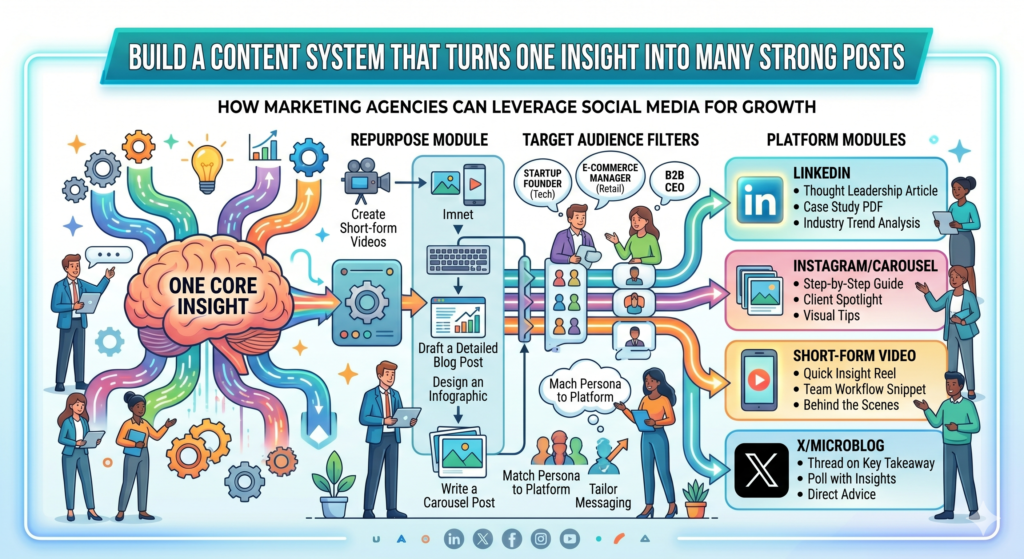
Build a Content System That Turns One Insight Into Many Strong Posts
Many agencies struggle with social media because they treat every post like a fresh start.
Every week, the team sits down and asks what to create. They look at competitors. They check trends. They open a blank document. They try to force ideas.
That is exhausting.
The smarter way is to build a content system. A system helps your agency turn daily work, client lessons, sales questions, campaign insights, and strong opinions into repeatable content.
This matters because social media growth depends on consistency, but consistency is hard without structure.
You do not need a giant content machine. You need a simple way to collect ideas, shape them, publish them, and learn from them.
Your agency should build content from core ideas, not random topics
A random topic might be “SEO tips.”
A core idea is stronger. It might be, “Most service pages fail because they explain what the company does before they explain why the buyer should care.”
That core idea can become many pieces of content.
It can become a LinkedIn post about service page mistakes. It can become a short video showing a weak opening versus a stronger one. It can become a carousel about the order of a high-converting service page. It can become a case study about rewriting a page for more qualified leads.
It can become an email to your list. It can become part of a webinar. It can become a sales call talking point.
That is how content becomes efficient.
Your agency should not always be hunting for brand-new topics. It should be building a library of strong ideas and finding better ways to explain them.
One strong insight can carry more weight than ten shallow tips
Most agency social content is too small.
It gives a quick tip, then disappears. It says something like, “Make your hooks stronger” or “Know your audience” or “Add social proof.” These posts may be true, but they are not deep enough to build authority.
A strong insight has more force.
It explains a problem in a way the buyer has felt but may not have named. It gives the reader a new lens. It makes them say, “That is exactly what is happening.”
For example, instead of saying, “Improve your landing page,” an agency can say, “If your ads are bringing clicks but not leads, your landing page may be answering the wrong question. The visitor is not asking, ‘What do you offer?’ They are asking, ‘Can I trust you to solve this specific problem?’”
That is more useful. It is still simple, but it has depth.
Your content system should be built around these deeper ideas. Not every post has to be long. But every post should have a clear thought behind it.
Create content pillars that match the buyer journey
Content pillars are often used in a lazy way. Agencies choose broad themes like “education,” “tips,” “case studies,” and “company culture.” Those themes are too vague to guide strong content.
A better way is to build content pillars around the buyer journey.
Think about what your ideal client needs to believe before they hire you.
They need to believe their problem matters. They need to believe their current approach may be broken. They need to believe your way of solving it makes sense. They need to believe you have proof. They need to believe your agency is safe to contact.
Your content should help build those beliefs.
This gives you much stronger pillars.
One pillar can expose the hidden cost of the problem. Another can teach your method. Another can show proof. Another can answer buyer objections. Another can explain how to choose the right agency. Another can share behind-the-scenes thinking from your team.
Now your content has a job.
It is not just filling a calendar. It is moving buyers closer to trust.
Each pillar should answer a real question your buyer is already asking
A good pillar is tied to buyer doubt.
If your ideal client is a founder, they may be asking, “Why are we getting attention but not leads?”
If your ideal client is a marketing manager, they may be asking, “How do I prove this channel is worth the budget?”
If your ideal client is a local business owner, they may be asking, “Why are competitors showing up more than we are?”
If your ideal client is an ecommerce brand, they may be asking, “Why are our ads getting more expensive while profit stays flat?”
These questions should shape your content.
A pillar around buyer pain may explain the cost of unclear messaging, weak offers, slow follow-up, or poor lead quality.
A pillar around your method may show how you audit, plan, test, improve, and report.
A pillar around proof may break down wins, lessons, before-and-after changes, and client stories.
A pillar around objections may answer questions about cost, timelines, platform choice, content volume, ad budget, SEO speed, and what happens if past agency work failed.
This approach makes your content much more useful because it is tied to real decisions.
Build a simple weekly rhythm your team can repeat
A content system should not be so complex that the team stops using it.
The best system is simple enough to run every week, even when client work is busy.
Start by collecting raw ideas from sales calls, client calls, audits, reports, team chats, and campaign reviews. Then turn those ideas into a small set of strong posts. Then publish with care. Then review what created saves, replies, comments, calls, clicks, and useful conversations.
This rhythm matters because social media is not just a publishing channel. It is a listening tool.
Your audience tells you what they care about through comments, questions, DMs, shares, saves, and silence. A smart agency studies those signals.
If a post gets strong comments from ideal buyers, write more around that topic. If a video brings poor-fit attention, study why. If a case study leads to sales calls, turn the lesson into more formats. If a post gets likes but no business value, do not overrate it.
Your team should review content by business value, not just engagement
Engagement can be useful, but it can also mislead agencies.
A funny post may get many likes but no serious buyers. A deep post may get fewer likes but lead to three private messages from qualified prospects. A short case study may not go viral, but it may help a referral trust you faster.
This is why your team should judge content by business value.
Did the post attract the right people? Did it start useful conversations? Did it support your positioning? Did it answer a common sales objection? Did it give your sales team a piece of content they can send to prospects? Did it help current clients trust your thinking more?
Those signals matter.
Social media is not only about visible engagement. Some of the best growth happens quietly. A buyer may read your posts for months without liking anything. Then one day they book a call and say, “I feel like I already know how you think.”
That is the real power of a strong content system.
Use Founder and Team Voices to Make the Agency Feel Human
Agencies often hide behind their brand page. The page posts tips, service updates, graphics, and case studies. But there is no clear human voice behind it.
That can be a problem.
People trust people faster than they trust logos. A strong agency brand matters, but human voices make that brand easier to connect with.
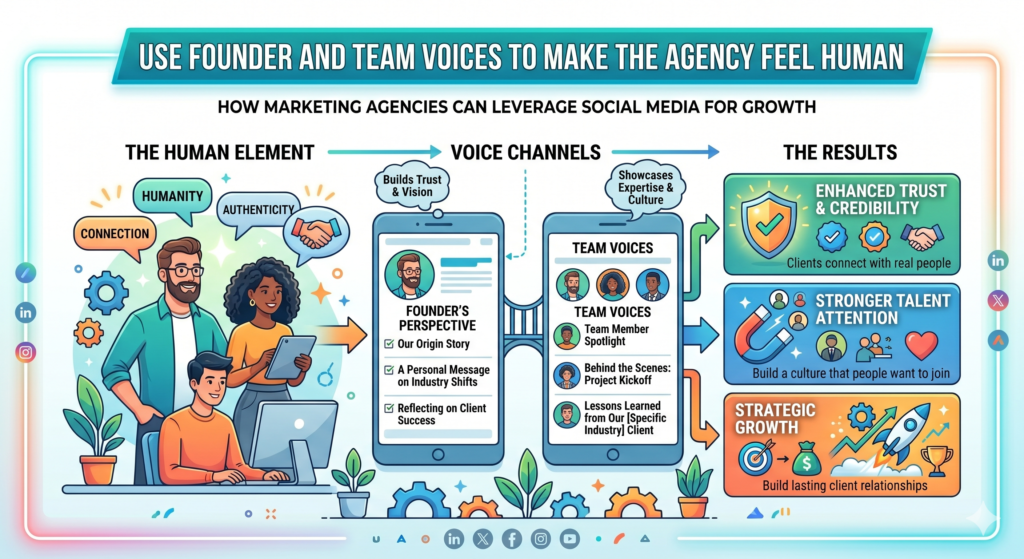
This does not mean every agency founder needs to become an influencer. It means the people inside the agency should share useful ideas, lessons, opinions, and stories in a way that supports the agency’s growth.
Founder-led content can build trust faster than a brand page alone
When a founder or senior strategist shares clear thinking on social media, people pay attention in a different way.
They can hear the person behind the service. They can understand the agency’s beliefs. They can see judgment, taste, and experience. They can also build a relationship with the agency before ever speaking to the sales team.
This is especially powerful for small and mid-sized agencies.
If the founder is still involved in strategy, sales, client work, or thought leadership, their social media presence can become a major growth channel. It can warm up prospects, build authority, attract partners, and create trust at scale.
The content does not need to be loud or personal in a forced way. It simply needs to be useful and honest.
The founder should share thinking that helps buyers make better decisions
Founder-led content works best when it is not just personal updates.
It should combine experience, opinion, teaching, and proof.
A founder can write about what they are seeing in the market. They can explain common mistakes. They can share lessons from client work without naming the client. They can break down why a certain campaign worked. They can talk about what buyers should ask before hiring an agency. They can explain what they no longer believe after years of doing the work.
This kind of content makes the founder feel credible.
It also gives prospects a preview of the agency’s thinking.
When a buyer reads several smart posts from the founder, the agency becomes less risky. The buyer starts to feel that there is real judgment behind the company. That feeling can shorten the sales process because trust has already started forming.
Team voices show depth beyond the founder
Founder-led content is powerful, but the agency should not depend on one person forever.
A growing agency needs to show that expertise exists across the team. Strategists, designers, writers, media buyers, SEO specialists, account managers, analysts, and creative leads all see different parts of the client journey.
Their insights can make the agency’s social presence richer.
A media buyer can explain why cheaper leads are not always better. A writer can explain why simple copy often converts better than clever copy. A strategist can explain why a campaign failed even though the execution looked good. A designer can explain why visual trust matters before the call to action.
These voices help prospects see that the agency has real skill inside the team.
Team content makes your agency feel larger, sharper, and more trustworthy
When only the brand page speaks, the agency can feel flat.
When the team shares ideas, the agency starts to feel alive.
This can also help with hiring. Strong people often want to work at agencies where thinking is valued. When they see team members sharing useful ideas and being trusted to have a voice, the agency becomes more attractive.
It also helps with client trust. Clients want to know that more than one person understands their account. Team content shows depth. It shows that expertise is not trapped with the founder.
The key is to make team content easy. Do not force every employee to become a creator. Instead, build simple ways to capture their thinking.
A strategist can answer one client question per week. A designer can explain one design choice. A paid media lead can share one lesson from campaign testing. A writer can break down one messaging mistake.
These small insights can become strong posts when shaped well.
Human content should still support the agency’s business goals
Being human does not mean posting anything and everything.
Agency leaders sometimes think personal content means sharing random life stories, opinions, meals, trips, or daily routines. That may work for some creators, but for an agency, human content should still connect back to trust, values, expertise, or buyer relevance.
The question is simple.
Does this help people understand who we are, how we think, what we value, or why they should trust us?
If yes, it may belong. If no, it may be better kept personal.
The best personal stories carry a business lesson
A founder can share a story about losing a client if it teaches a lesson about fit, expectations, or communication.
A strategist can share a story about a failed campaign if it teaches a lesson about testing, speed, or wrong assumptions.
A writer can share a story about rewriting a weak offer if it teaches a lesson about clarity.
A designer can share a story about simplifying a page if it teaches a lesson about trust and focus.
This is how agencies can be human without becoming unfocused.
The story pulls people in. The lesson creates value. The agency’s point of view becomes clearer.
That mix is powerful because buyers do not want to hire a faceless vendor. They want to hire people who understand their business, care about the work, and can make smart decisions.
Social media gives your agency a way to show that before the first call.
Turn Social Media Into a Relationship Channel, Not Just a Publishing Channel
Many agencies treat social media like a place to post and leave.
They publish a post, check the likes, maybe reply to a few comments, and then move on to the next piece of content. That is better than doing nothing, but it misses the real power of social media.
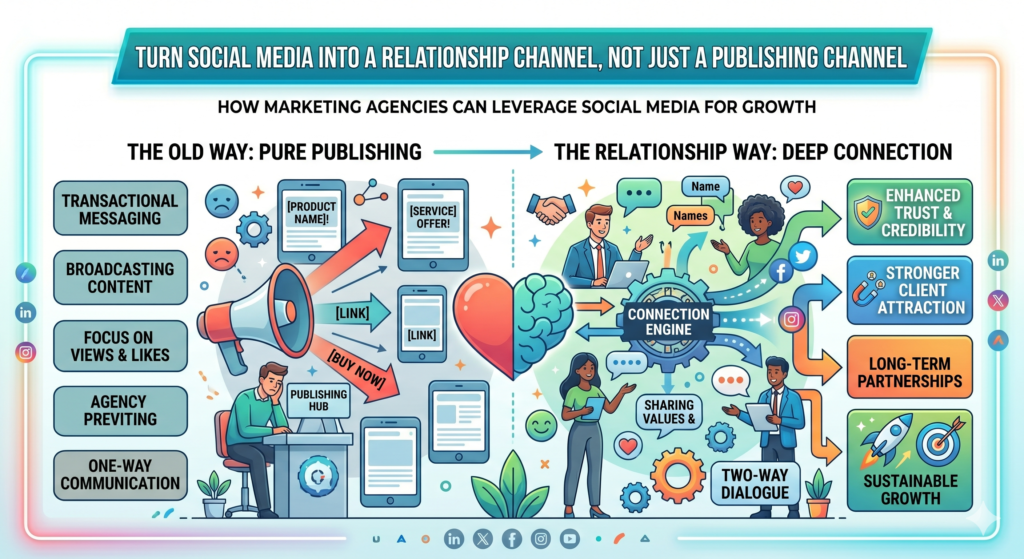
Social media is not only a content channel. It is a relationship channel.
For marketing agencies, this matters a lot because agency sales are built on trust. Most clients do not choose an agency the same way they buy a cheap tool. They need to believe the agency understands their business. They need to feel safe. They need to see judgment. They need to know there are real people behind the work.
That kind of trust is built through repeated contact.
A post can start the relationship. A comment can deepen it. A direct message can continue it. A thoughtful reply can create a sales conversation months later.
Engagement should be treated as business development, not an afterthought
Posting content is only one side of social media. The other side is active engagement.
Your agency should not wait for people to come to you. It should join the right conversations. It should comment on posts from ideal clients, partners, industry leaders, founders, operators, and people who influence your market.
But this should never be done in a fake way.
Weak engagement sounds like, “Great post,” “Totally agree,” or “Thanks for sharing.” These comments may keep your name visible, but they do not build much trust.
Strong engagement adds value. It expands the idea. It gives a useful example. It asks a smart question. It shares a lesson. It gives the original poster something worth responding to.
This is one of the simplest ways for agencies to grow visibility without creating more full posts.
A smart comment can sometimes create more trust than a full post
A thoughtful comment under the right person’s post can put your agency in front of a highly relevant audience.
For example, if a SaaS founder posts about struggling to turn website traffic into demos, an agency can leave a comment that explains one common reason this happens. The comment might say that many SaaS pages explain features too early, while buyers are still trying to understand whether the product solves their main pain. Then it can give a simple way to fix the opening section of the page.
That kind of comment does not feel like a pitch. It feels helpful.
And because it appears inside a live conversation, it can carry more weight than a post sitting alone on your own page.
This works especially well on LinkedIn and X, where comments can be seen by wider networks. But it can also work in Instagram comments, YouTube comments, Facebook groups, and niche communities.
The point is not to spam attention. The point is to be useful where your buyers are already paying attention.
Direct messages should be used with care and respect
Direct messages can create real opportunities, but they can also damage trust fast.
Many agencies use DMs badly. They connect with someone and immediately pitch. They send long cold messages. They pretend to be personal when the message is clearly copied. They ask for a call before giving the person any reason to care.
That approach feels pushy because it treats social media like a numbers game.
A better approach is slower, warmer, and more human.
If someone comments on your post, reply publicly first. If the conversation has a reason to continue, then send a short message. If someone asks a question, answer it without turning it into a pitch. If a prospect engages with several posts, you can thank them and share something useful related to what they liked.
The goal is not to force a sales call. The goal is to start a real conversation.
A good DM feels like a continuation, not an interruption
A strong agency DM should have context.
It might refer to a comment the person left. It might follow up on a problem they mentioned publicly. It might share a useful resource because they asked about a topic. It might thank them for a thoughtful reply and continue the discussion.
This feels very different from a cold pitch.
For example, if a founder comments on your post about weak landing pages, your agency could send a message saying that their point about lead quality was interesting, and that many teams confuse lead volume with sales intent. Then you might share a simple landing page checklist or ask what they are seeing in their own funnel.
That kind of message respects the person.
It gives value before asking for anything. It also creates a natural path to a deeper conversation if there is a real fit.
Agencies should remember that social selling is still selling. But the best social selling does not feel like pressure. It feels like help arriving at the right time.
Build a list of people your agency wants to stay close to
Most agencies think about followers as one large group. But not all followers have the same value.
Some people are ideal clients. Some are referral partners. Some are past clients. Some are industry friends. Some are journalists, creators, or community leaders. Some are future hires. Some are people who may never buy but can open doors.
Your agency should know who these people are.
This does not need to be complex. You can keep a simple private list of people your agency wants to engage with regularly. These may include dream clients, current clients, past clients, partners, founders in your niche, consultants who serve the same audience, and people who often lead useful conversations.
Then your team can make a habit of engaging with them in a real way.
Read their posts. Comment when you have something useful to add. Congratulate them when they share good news. Share their work when it fits your audience. Send useful ideas when relevant.
This is not manipulation. It is relationship building.
Social media growth often comes from small touches repeated over time
A single comment may not lead to a deal. A single DM may not create a referral. A single share may not bring a client.
But small, thoughtful touches can build familiarity over time.
A prospect may see your founder comment on their posts for months. They may read your agency’s breakdowns. They may notice that you share useful ideas without being pushy. They may see others trust you. Then, when they finally need help, your agency is already familiar.
That is how many agency deals happen.
They may look sudden from the outside, but they were built through many quiet moments of trust.
Social media makes these small touches easier. It lets your agency stay present without constantly asking for attention. It lets you build relationships at scale while still sounding human.
The key is to treat engagement as part of growth, not as a leftover task after publishing.
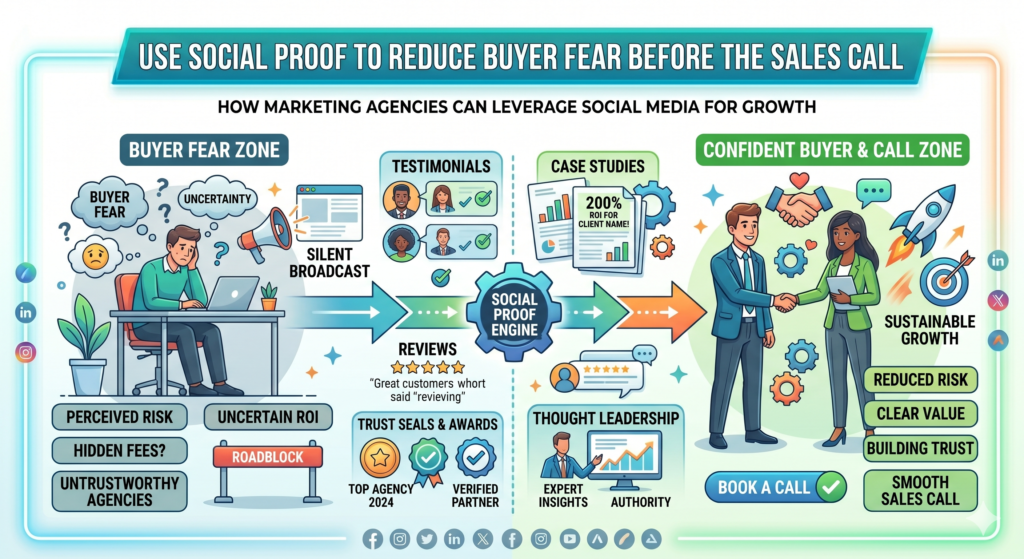
Use Social Proof to Reduce Buyer Fear Before the Sales Call
Hiring an agency can feel risky.
A business owner may have been burned before. A founder may have paid for work that looked good but did not move revenue. A marketing manager may worry about choosing the wrong partner and having to explain poor results to leadership.
This fear is real.
Your social media should help reduce that fear before the buyer ever talks to you.
That is where social proof becomes powerful. But social proof is not only testimonials. It includes client stories, results, reviews, process breakdowns, behind-the-scenes work, screenshots, client comments, before-and-after examples, expert opinions, media mentions, team experience, and proof that your agency knows how to handle real problems.
The goal is simple. Make it easier for buyers to believe that your agency is safe, skilled, and serious.
Buyers need proof that feels specific, not vague
A vague testimonial does not do much.
A quote like “Great team to work with” is nice, but it does not tell the buyer why the agency is strong. It does not explain the problem. It does not show the result. It does not reduce much fear.
Specific proof is stronger.
A testimonial that explains the client’s challenge, what changed, and what improved gives buyers more confidence. It helps them understand what kind of work your agency does and what kind of outcome it can create.
Social media gives agencies many ways to share this kind of proof.
You can turn one testimonial into a story. You can explain what the client was struggling with before they came to you. You can share what the team changed. You can show the lesson behind the result. You can explain why the result mattered to the client’s business.
This turns proof into education.
Strong proof answers the buyer’s hidden questions
Every buyer has questions they may not ask out loud.
Will this agency understand my business? Will they listen? Will they explain things clearly? Will they care about revenue or only deliverables? Will they disappear after the sale? Will they tell me the truth if something is not working? Will they be proactive? Will they make me look good to my team?
Your social proof should answer these hidden questions.
A post about your reporting process can show that you explain what numbers mean, not just send charts.
A client story about changing direction can show that your agency does not blindly follow a plan when the market gives new data.
A behind-the-scenes post about strategy work can show that your campaigns are not built on guesswork.
A testimonial about communication can show that clients feel guided, not confused.
These proof points matter because buyers are not only buying marketing skill. They are buying trust, safety, and confidence.
Show the process behind the result
Agencies often hide the process because they think the result is what matters most.
But buyers want to know how the result happened.
They want to see whether your agency has a real method. They want to know whether you think clearly. They want to understand whether your work is based on research, testing, judgment, or just creative guesses.
That is why process content works so well.
You can show how your team audits a website. You can explain how you choose campaign angles. You can break down how you review ad performance. You can show how you plan content themes. You can explain how your team turns customer research into landing page copy.
You do not need to reveal private client data. You do not need to share every detail. But you can show enough to make your agency feel credible.
Process content makes your agency feel less risky
When a buyer sees your process, they feel more in control.
They understand what might happen if they hire you. They can picture the path. They can see that your work is not random.
This is especially important for agencies selling strategy-heavy services.
A client may not fully understand SEO, paid media, conversion strategy, brand messaging, or lifecycle marketing. If your agency makes the process clear, the buyer feels safer.
For example, instead of saying, “We improve landing pages,” you can show how your team reviews the page. You might explain that you look at the buyer’s main pain, the first screen, the offer, proof placement, call-to-action clarity, friction points, and follow-up path.
That gives the buyer confidence.
It also positions your agency as thoughtful. You are not just changing words or colors. You are making decisions based on how buyers think and act.
Use proof even when you cannot share client names
Some agencies avoid proof content because their clients are private. This is common in B2B, healthcare, finance, legal, enterprise, and competitive markets.
But you can still share proof without breaking trust.
You can share anonymous lessons. You can talk about patterns across accounts. You can explain before-and-after thinking without naming the client. You can describe the type of business without revealing details. You can share process wins, sales feedback, or lessons learned.
The key is to protect the client while still teaching the market.
A post does not need to say the client’s name to be useful. It needs to show that your agency has solved a real problem.
Anonymous proof can still be powerful when the lesson is clear
For example, you might write about a service business that was getting traffic but not enough booked calls. You do not need to name the company. You can explain that the page had strong information, but the opening section was too company-focused. It talked about years of experience before it talked about the buyer’s pain.
Then you can explain what changed.
The page was rewritten around the buyer’s problem. Proof was moved higher. The call to action was made clearer. The form was simplified. Follow-up questions were changed to qualify leads better.
That story is useful even without a name.
It shows your agency’s thinking. It gives the reader a practical lesson. It also proves that your team works on real problems, not just theories.
Over time, these small proof stories add up. They create a feeling of depth. They make prospects think, “This agency has seen my problem before.”
That feeling can make the sales call much easier.
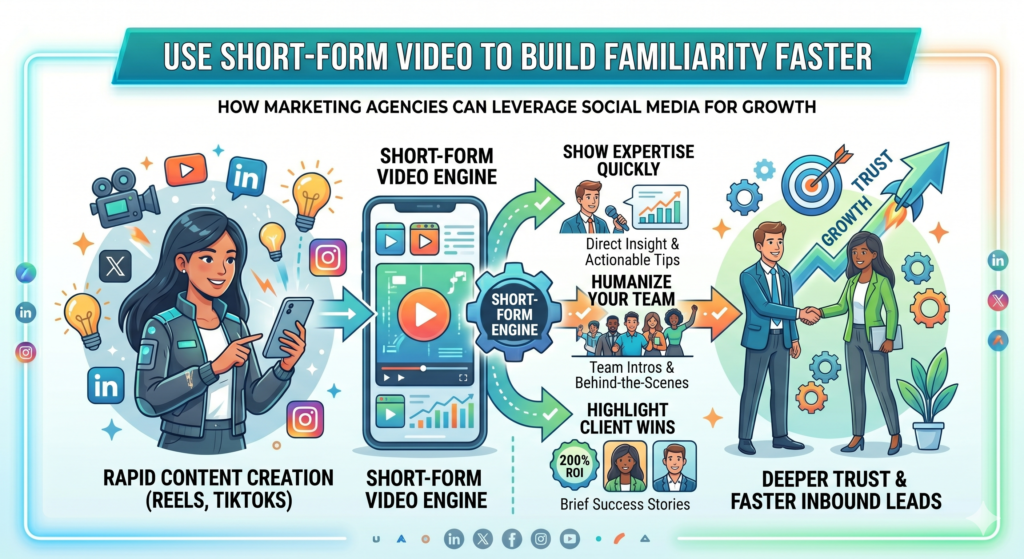
Use Short-Form Video to Build Familiarity Faster
Short-form video can be a powerful tool for agencies, but only when it is used with a clear purpose.
Many agencies use short video because it is popular. They copy trends, point at text on screen, use viral sounds, or create quick tips without thinking about whether those videos build trust with the right buyer.
That can bring views, but views alone do not grow an agency.
The real value of video is familiarity. It lets prospects see the people behind the agency. It lets them hear your tone. It makes your thinking feel more personal. It can make a buyer feel like they know you before they ever book a call.
That is powerful because agency sales often depend on comfort.
If a prospect has watched your founder explain problems clearly for months, the first sales call feels warmer. If they have seen your strategist break down examples, they already trust the agency’s thinking. If they have watched your team explain common mistakes, they may arrive on the call with better expectations.
Short videos should focus on one clear idea at a time
A short video should not try to explain everything.
It should make one point clearly and quickly.
This is where many agencies go wrong. They take a large topic like “how to improve social media strategy” and try to squeeze too much into a thirty-second video. The result feels rushed, thin, and hard to remember.
A better short video starts with one painful idea.
For example, “Your agency content may be getting likes because it is relatable, but not leads because it is not tied to a buying problem.”
That is one idea.
You can explain it in simple words. You can give a quick example. You can end with a clear takeaway.
That kind of video is easier to watch and easier to remember.
One strong point is better than a rushed mini-webinar
A strong short video often follows a simple path.
It starts with a problem the buyer recognizes. It explains why the problem happens. It gives one useful shift. Then it ends before the viewer loses interest.
For an agency, this might sound like a short explanation of why cheaper leads are not always better. Or why posting daily does not fix unclear messaging. Or why a beautiful website can still fail if it does not answer buyer fears. Or why social media content should not only chase reach.
The video does not need to be fancy.
It needs to be clear.
A founder speaking directly to the camera can work. A strategist using a whiteboard can work. A screen recording of a landing page breakdown can work. A quick before-and-after example can work.
The format matters less than the value of the idea.
Use video to show judgment, not just personality
Personality helps, but it is not enough.
Some agency videos are lively but empty. They have energy, but no insight. They feel fun, but they do not make the buyer trust the agency more.
A marketing agency should use video to show judgment.
Judgment means your ability to look at a business problem and explain what matters. It means showing how you think. It means helping the viewer understand what to do, what to ignore, and what to fix first.
This is what serious buyers care about.
They want to know whether your agency can guide them. They want to know whether you can spot problems. They want to know whether you can explain things clearly.
Video is a strong way to show that.
Buyers trust agencies that can explain complex things in simple words
If your agency can explain a hard marketing problem in simple words, that is a huge advantage.
Many business owners feel confused by marketing. They hear terms, reports, dashboards, platform changes, and strategy advice from many directions. They do not always know what matters.
When your videos make things simpler, you become trusted.
For example, a paid media agency can explain that a high cost per lead is not always bad if the leads are qualified and close at a higher rate. An SEO agency can explain that traffic growth means little if the traffic comes from people who will never buy.
A content agency can explain that content should not just attract attention, but help buyers move from doubt to trust.
This kind of clarity is valuable.
It makes prospects feel smarter. It also makes your agency feel safer because buyers believe you will not hide behind confusing words.
Repurpose written insights into video without copying them word for word
Your agency does not need to create video ideas from scratch.
Many of your best video ideas can come from posts, sales calls, client lessons, case studies, audits, and reports.
If a LinkedIn post performs well, turn the core point into a short video. If a client question comes up often, answer it on camera. If a case study has a strong lesson, explain the lesson in simple words. If your team notices a pattern across accounts, turn that pattern into a short video series.
The point is not to read the written post out loud. The point is to translate the idea into a format that feels natural on video.
Good repurposing changes the shape while keeping the insight
A written post can be thoughtful and slow. A video needs to move faster.
So take the core insight and make it more direct.
If the written post says, “Many B2B companies struggle to convert social attention into pipeline because their content is not tied to a clear buyer pain,” the video might start with, “If your posts get likes but no sales calls, the problem may not be your reach. It may be that your content is not talking about a pain people would pay to solve.”
That sounds more natural.
Then explain one example. Keep it tight. End with a clear lesson.
This lets your agency get more value from every strong idea. It also helps different people consume your thinking in different ways.
Some prospects will read long posts. Some will watch short videos. Some will save carousels. Some will listen while walking or working. A good agency content system gives the same strong ideas more than one life.
Build Community Around the Problems Your Agency Solves
Social media growth is not only about broadcasting ideas. It is also about gathering the right people around a shared problem.
This is where community becomes useful.
Community does not always mean creating a large Facebook group or private Slack channel. It can mean building a strong comment section. It can mean hosting live sessions. It can mean running a small founder roundtable. It can mean starting a niche newsletter from your social posts. It can mean creating a recurring LinkedIn discussion around a key topic.
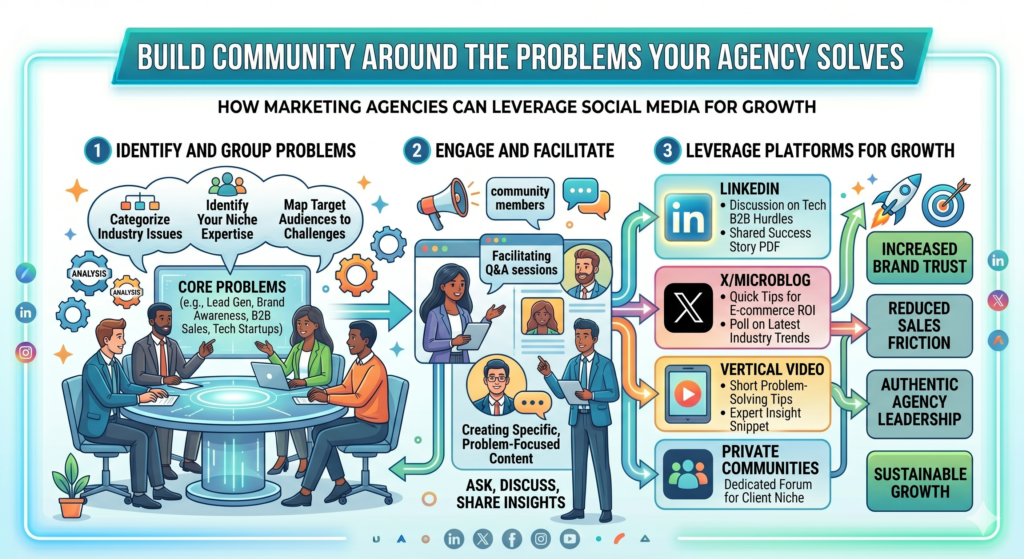
The goal is to move from attention to participation.
When people participate, they feel more connected to your agency. They stop being passive viewers. They become part of the conversation.
A strong community starts with a clear shared pain
People do not gather around vague marketing advice. They gather around problems they care about.
If your agency serves B2B founders, the shared pain might be building pipeline without sounding like every other company.
If your agency serves local businesses, the shared pain might be getting found, trusted, and chosen in a competitive local market.
If your agency serves ecommerce brands, the shared pain might be growing profit when ads are getting more expensive.
If your agency serves professional services, the shared pain might be turning expertise into trust before a sales call.
The clearer the shared pain, the easier it is to build a community around it.
This matters because community gives your agency deeper insight into the market. You hear real questions. You see what people struggle with. You learn what language they use. You notice patterns before they become obvious.
That makes your content, offers, and sales calls stronger.
Your community should make buyers feel less alone and more informed
People engage when they feel understood.
A founder who struggles with content may feel like they are the only one getting likes but no leads. A business owner who wasted money on ads may feel embarrassed. A marketing manager who hired the wrong agency may feel cautious.
Your community can make these people feel less alone.
When your agency talks openly about common problems, people feel safer engaging. When others comment with similar issues, trust grows. When your team answers with care, the agency becomes a helpful guide.
This is not just good for brand warmth. It is good for business.
A person who feels understood is more likely to trust your advice. A person who trusts your advice is more likely to consider your service. A person who has already learned from you is easier to sell to because they understand your thinking.
Use live sessions to create stronger trust
Live sessions can be powerful because they create real-time contact.
A live Q&A, audit session, teardown, workshop, or roundtable can help your agency move from static content to direct interaction.
This can work especially well on LinkedIn, Instagram, YouTube, and inside private groups.
The topic should be narrow and useful. A broad topic like “How to grow your business with marketing” is too vague. A sharper topic like “Why your LinkedIn content gets attention but no leads” is easier to understand and more likely to attract the right people.
A live session also gives your agency more content. The questions can become posts. The recording can become clips. The main lesson can become an article. The objections can shape future sales material.
Real-time teaching helps prospects experience your agency before they hire you
A live session lets prospects see how your agency thinks under pressure.
They can hear how you answer questions. They can see whether you are clear. They can judge whether you understand the problem. They can feel whether your style is a good fit.
That experience can build trust faster than static content.
For example, if your agency hosts a live landing page review, a prospect can watch how your team spots issues. They can see that you care about buyer pain, proof, structure, and action. They can compare that to the vague advice they may have heard elsewhere.
Even if their own page is not reviewed, they still learn.
And when they later need help, your agency feels familiar.
A community should lead to deeper owned relationships
Social platforms are rented spaces. Algorithms change. Reach rises and falls. Accounts can be limited. Platforms can shift focus overnight.
This is why agencies should use social media to build owned relationships.
That means moving the right people toward assets your agency controls, such as an email list, a webinar list, a private event list, a lead magnet, a client education series, or a simple newsletter.
This does not mean pushing people away from social media too soon. It means giving your best followers a reason to go deeper.
If someone likes your content, invite them to get a more detailed guide. If they attend a live session, invite them to join your email list for future breakdowns. If they comment often, invite them to a small roundtable or workshop.
Social media starts the relationship. Owned channels protect and deepen it.
Email gives your agency a stronger way to nurture trust
Email is still one of the best ways to build deeper trust because it is more direct and less dependent on the feed.
A person may miss your LinkedIn post, but they may read your email. They may forget a Reel, but they may save a useful newsletter. They may not comment publicly, but they may reply privately.
For agencies, email can turn social attention into a more stable pipeline.
Your social content can attract. Your email content can nurture. Your sales process can convert.
This creates a stronger growth system than social media alone.
The best agency newsletters are not full of generic updates. They carry the same sharp thinking as your social content, but with more depth. They explain problems. They share lessons. They break down examples. They help buyers make better decisions.
When social and email work together, your agency stops depending only on the algorithm. It starts building a real audience that can grow with the business.
Turn Social Media Into a Lead Nurturing System, Not Just a Lead Generation Tool
Many agencies talk about social media as if its only job is to create new leads.
That is too narrow.
Social media can create leads, but its deeper power is nurturing. It can help people move from not knowing your agency, to noticing your thinking, to trusting your work, to believing you may be the right partner.
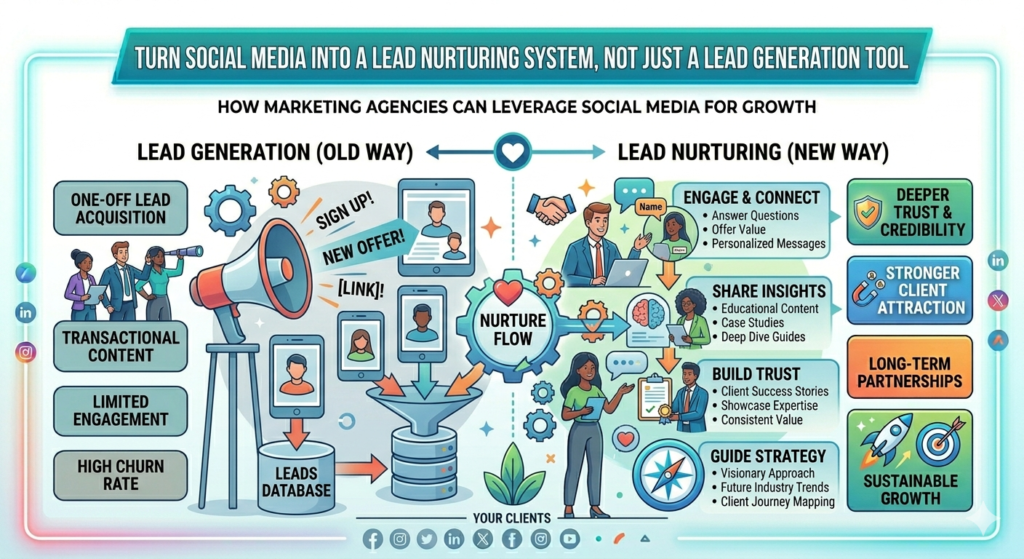
That journey usually takes time.
A business owner may see your posts for months before reaching out. A founder may watch your videos quietly before booking a call. A marketing manager may save your posts and use them in internal meetings long before they contact you.
This is why agencies should stop judging social media only by quick inquiries. Some posts will bring direct leads. Many others will build trust in the background.
A smart agency uses social media to keep warming the right people until they are ready.
Your content should meet buyers at different stages of trust
Not everyone who sees your content is in the same place.
Some people have never heard of your agency before. They need clear, useful ideas that make them stop and pay attention.
Some people know they have a marketing problem, but they are not sure what is causing it. They need educational content that helps them understand the issue.
Some people are comparing agencies. They need proof, process, case studies, and clear points of difference.
Some people are almost ready to book a call, but they still have fear. They need content that answers doubts and makes the next step feel safe.
If your agency only posts one type of content, it will miss many parts of the buyer journey.
For example, if you only post educational tips, people may learn from you but not understand why they should hire you. If you only post case studies, people may see proof but not understand your thinking. If you only post personal stories, people may like you but not see the business value.
Your content should work together. It should create a path.
A strong social feed should feel like a quiet sales journey
A good agency feed should not feel like a hard pitch. But it should still guide people closer to action.
Someone may first see a post that names their pain. Then they may see a post that explains why the pain happens. Then they may see a client story that proves the agency has solved it before. Then they may see a behind-the-scenes post that shows the process.
Then they may see a post that explains who the agency is best for. Then they may see a clear invitation to book a call.
That is not random content. That is lead nurturing.
Each piece has a role.
The pain post creates recognition. The teaching post builds trust. The proof post reduces doubt. The process post lowers risk. The fit post helps the buyer self-select. The call-to-action post makes the next step clear.
This is how social media supports sales without sounding desperate.
Most buyers do not want to be pushed. They want to feel ready. Your content should help them get there.
Your agency should answer sales objections in public
Every agency hears the same doubts on sales calls.
How long will this take? What if we tried this before and it failed? Why does this cost so much? How do we know this will work? What do you need from us? What if our niche is different? Can we start smaller? How will we measure success?
These questions should not live only inside private sales calls.
They should become social content.
When you answer objections in public, you make the sales process easier. You also help future prospects feel understood before they speak with you.
For example, if prospects often ask why SEO takes time, your agency can publish a post that explains why search growth is built in layers. You can talk about technical health, content quality, authority, buyer intent, and how long it takes search engines and users to respond.
If prospects worry that paid ads will waste money, your agency can explain what must be fixed before ad spend increases. You can talk about offer clarity, landing page strength, tracking, follow-up, and lead quality.
If prospects fear content will not create sales, your agency can explain why some content gets attention but never builds demand.
Public objection handling makes private selling much easier
When a buyer has already seen your answer to their concern, the sales call starts from a better place.
They are less confused. They are less defensive. They understand your thinking. They may even use your own words to explain the problem.
This makes the conversation more strategic.
Instead of spending the call correcting basic beliefs, your team can focus on the buyer’s actual business. You can ask better questions. You can diagnose faster. You can discuss fit more honestly.
Public objection handling also filters out poor-fit buyers.
If your agency explains that strong results require client input, some buyers may decide they do not want that level of involvement. That is fine. It is better to lose poor-fit leads early than to win clients who will not support the work.
If your agency explains that cheap leads are not always good leads, you may attract clients who care about revenue, not just vanity numbers.
If your agency explains that social media takes clear positioning, not just more posting, you may attract clients who value strategy.
Your content should not only attract leads. It should attract the right leads.
Calls to action should feel natural, not forced
Agencies sometimes avoid calls to action because they do not want to sound pushy. That is a mistake.
If your content is useful and your agency can help, you should make the next step clear.
The key is to make the call to action fit the stage of the content.
Not every post needs to say, “Book a call.” Sometimes the right action is to comment with a question. Sometimes it is to read a guide. Sometimes it is to watch a deeper breakdown. Sometimes it is to send a message. Sometimes it is to join a workshop. Sometimes it is to book a strategy call.
The best calls to action feel like a helpful next step, not a sudden sales pitch.
If a post explains why landing pages fail, the call to action might invite readers to ask for a simple landing page checklist.
If a post breaks down a client result, the call to action might say that if the reader is facing a similar issue, they can reach out and share what is happening.
If a post answers a common objection, the call to action might invite people to book a call if they want help finding the real cause in their own funnel.
A clear next step helps serious buyers move faster
Serious buyers often appreciate clarity.
They may not want to hunt through your profile, website, and old posts to figure out how to work with you. If they are interested, make the next step simple.
Your profile should also support this. The bio should say who you help and what outcome you create. The link should send people to a useful next step. Your featured posts or pinned content should show your best proof, strongest thinking, and clearest offer.
This matters because social media attention can fade quickly.
A person may be interested today and distracted tomorrow. If your next step is unclear, you may lose them.
A clear call to action does not weaken your content. It respects the reader’s time.
When done well, it says, “If this is the problem you are facing, here is the next useful step.”
That is not pushy. That is helpful.
Use Social Listening to Find Better Content, Better Offers, and Better Sales Angles
Social media is not just a place to speak. It is also a place to listen.
For agencies, listening may be even more valuable than posting.
Your ideal clients are already talking online. They are sharing frustrations. They are asking questions. They are reacting to trends. They are complaining about bad vendors. They are praising good experiences. They are showing what they value, fear, misunderstand, and want.
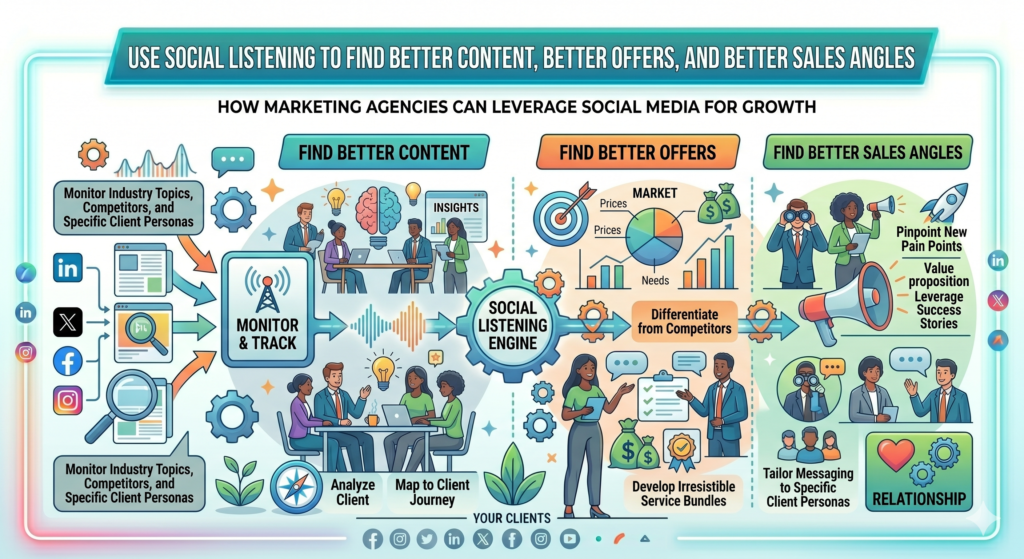
If your agency pays attention, social media becomes a live research tool.
This can improve your content, your offer, your sales calls, your service pages, your lead magnets, your webinars, and even your client work.
Most agencies do not listen deeply enough. They look at likes and comments on their own posts, but they do not study the wider market. They miss the words buyers are already using.
Those words are gold.
Your buyers are already telling you what content to create
Every day, people post questions that can become agency content.
A founder may ask why their content is not converting. A local business owner may complain that leads from ads are poor. A marketing manager may ask how to prove social media ROI. A consultant may say that referrals are slowing down. An ecommerce owner may complain about rising ad costs.
These are not just posts. They are signs of demand.
Your agency should collect them.
The point is not to copy people’s words in a lazy way. The point is to understand what buyers care about in their own language.
When you write content using the language your buyers already use, your posts feel more relevant. They sound less like marketing theory and more like real help.
Great content often starts with the exact words buyers use when they are frustrated
A buyer may not say, “We need a stronger demand generation strategy.”
They may say, “People know us, but nobody is booking calls.”
A buyer may not say, “Our conversion path has too much friction.”
They may say, “We are getting clicks, but no one fills out the form.”
A buyer may not say, “Our positioning lacks differentiation.”
They may say, “We sound like every other company in our space.”
Your agency should pay attention to this language.
Simple words are often more powerful than polished marketing terms because they match how people actually think.
When your post starts with a sentence the buyer has said in their own head, it gets attention.
For example, a post that begins, “If people like your posts but never ask about your service, your content may be solving the wrong problem,” feels direct and useful.
It speaks to a real pain.
That is much stronger than a generic post about improving social media strategy.
Social listening can reveal gaps in your agency’s offer
Sometimes listening shows that your offer is not aligned with the market.
Maybe buyers keep asking for audits before they commit to monthly work. Maybe they are confused about what your service includes. Maybe they want help with strategy before execution. Maybe they are not ready for a large retainer, but they would pay for a focused workshop. Maybe they need internal training because their team will do part of the work.
These signals matter.
Your agency does not need to change its whole business every time someone asks for something. But if you see the same pattern again and again, it may be worth studying.
Social media can show you where buyers feel stuck before they buy.
That can help your agency create better entry points.
A better entry point can turn cold attention into warm demand
Not every buyer is ready for a full agency retainer.
Some need a diagnosis. Some need a strategy. Some need a second opinion. Some need help making the case to leadership. Some need to fix one urgent problem before they commit to a larger plan.
If your agency only offers one big service, some of these buyers may leave without taking any step.
A smart agency can use social listening to create useful entry offers.
This might be a paid audit, a strategy session, a workshop, a teardown, a growth plan, a content review, a landing page review, or a campaign diagnosis.
These offers can be shared through social media in a natural way.
For example, if many prospects are unsure why their social content is not creating leads, your agency could offer a social content audit that reviews positioning, buyer pain, proof, calls to action, and content themes.
That offer feels useful because it matches a real pain.
Social media helps you see that pain before competitors do.
Listening also helps your agency avoid weak assumptions
Agencies are full of smart people, but smart people can still guess wrong.
Your team may think buyers care most about one problem, while the market is talking about another. You may think a topic is too basic, but buyers may still be confused by it. You may think your service is clear, but prospects may describe it in a totally different way.
Listening keeps your agency grounded.
It reminds you that the market decides what matters. Not the agency. Not the content calendar. Not the internal brainstorm.
The more closely you listen, the more precise your content becomes.
The market will often tell you what is unclear before your reports do
If people keep asking the same question, something is unclear.
If people engage with posts about pain but ignore posts about your service, your offer may need clearer framing.
If people save your breakdowns but do not respond to your calls to action, the next step may feel too large or unclear.
If people comment with stories about bad past agency experiences, trust may be the real barrier you need to address.
These signals are not perfect, but they are useful.
A good agency does not treat social media feedback as noise. It treats it as market data.
Then it uses that data to improve.
Your next post gets sharper. Your landing page gets clearer. Your sales script gets more direct. Your offer gets easier to understand. Your case studies answer better questions.
That is how social listening turns into growth.
Build a Social Media Reporting System That Measures Real Agency Growth
Agencies often track the wrong numbers on their own social media.
They look at likes, impressions, follower count, and views. These numbers can be useful, but they do not tell the full story.
A post can get many likes from people who will never buy. A video can get many views but attract the wrong audience. A page can gain followers without gaining trust. A viral post can bring attention but no pipeline.
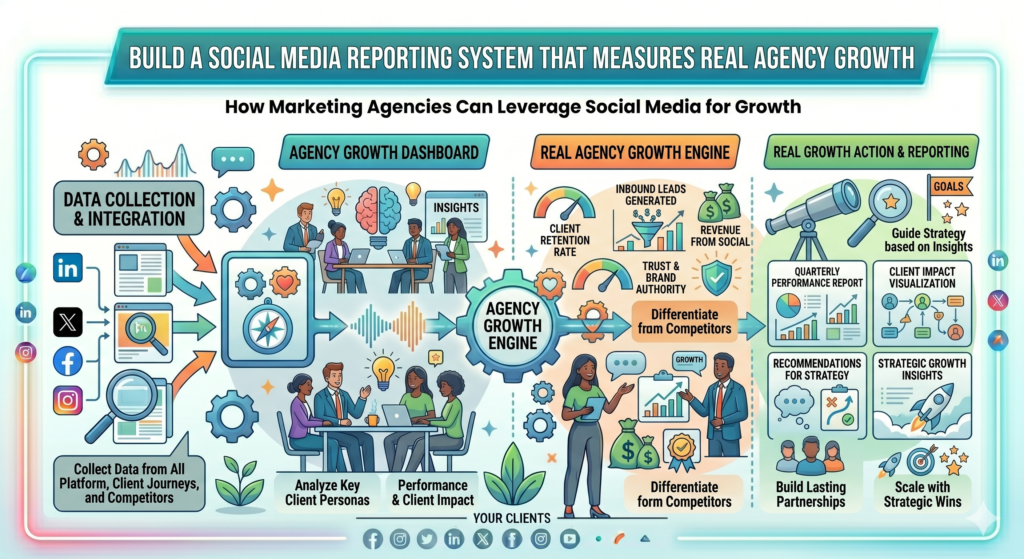
This does not mean engagement is useless. It means engagement needs context.
For agencies, social media reporting should answer a business question.
Is this helping us become more trusted by the right buyers?
If the answer is yes, keep improving. If the answer is no, change the approach.
Measure the quality of attention, not just the size of attention
Big numbers can feel good, but qualified attention matters more.
A post with 50 views from ideal clients may be more valuable than a post with 10,000 views from people who will never hire you. A comment from a serious founder may matter more than 100 likes from random accounts. A saved post from a marketing lead may matter more than a quick reaction from someone outside your market.
Your agency should track signals that show real business value.
These signals may include profile visits from ideal buyers, direct messages, booked calls, referral conversations, website clicks, email sign-ups, comments from decision-makers, sales calls where prospects mention social content, and content used by your sales team to support deals.
These are not always as easy to measure as likes. But they matter more.
A smaller audience can still build a stronger pipeline
Many agencies wait for a large audience before taking social media seriously. That is a mistake.
You do not need a huge following to get business from social media. You need the right people paying attention.
A niche agency with 3,000 relevant followers can outperform a broad agency with 50,000 unfocused followers. The smaller agency may have clearer content, stronger trust, and better-fit leads.
This is why reporting should not reward empty reach.
If your agency serves B2B SaaS founders, then attention from those founders matters. If your agency serves dentists, then attention from local clinic owners matters. If your agency serves ecommerce brands, then attention from operators and founders in that world matters.
Measure the audience you are actually trying to influence.
That will keep your team from chasing content that looks successful but does not support growth.
Track how social content supports the sales process
Social media often influences deals before it gets credit.
A prospect may discover your agency through a post, then visit your website, then join your newsletter, then ask a friend about you, then book a call two months later. If you only ask where the final lead came from, you may miss the role social media played.
This is why your agency should build simple ways to track social influence.
Ask prospects how they first heard about you. Ask what content they remember. Ask whether any post, video, case study, or founder content helped them decide to reach out. Ask your sales team what questions prospects seem to understand already because of your content.
These answers can teach you a lot.
Sales calls can reveal which content is creating trust
Sometimes the most useful reporting comes from listening to sales calls.
If prospects say, “I saw your post about landing pages,” that post matters.
If they say, “Your case study sounded like our exact problem,” that case study matters.
If they say, “I liked how you explained why cheaper leads are not always better,” that point of view matters.
If they say, “I feel like I already know your process,” your process content is working.
These comments should be captured.
They can help your agency understand which ideas create real trust. They can also guide future content.
If one topic keeps showing up in sales calls, write more about it. If one objection keeps slowing deals, answer it publicly. If one case study keeps helping prospects understand your value, turn it into more formats.
This is how reporting becomes useful. It does not just look backward. It improves what you do next.
Review content monthly with strategy, not emotion
Agencies can become emotional about their own content.
A founder may love a post that did not work. A designer may hate a simple post that brought qualified leads. A strategist may want to sound more advanced than the buyer needs. A team may chase formats that feel exciting but do not create business value.
A monthly review helps remove some of that emotion.
Look at what was published. Study what attracted the right people. Study what led to comments, messages, calls, clicks, saves, and sales conversations. Study what got attention but did not support the business. Study what felt hard to create but created little value.
Then adjust.
Your content review should lead to better decisions, not just better reports
A report that only says what happened is not enough.
Your agency should use reporting to decide what to do next.
Maybe you need more proof content because prospects are interested but cautious. Maybe you need more educational content because buyers do not understand the problem yet. Maybe you need clearer calls to action because people engage but do not take the next step. Maybe you need stronger platform focus because the team is spread too thin.
Good reporting creates action.
It helps the agency stop guessing. It also helps the team stay patient. Social media growth takes time, but it should not be blind.
When you know what is working and why, you can build with more confidence.
Avoid the Social Media Mistakes That Make Agencies Look Generic
Social media can grow an agency, but it can also weaken one.
A poor social presence can make an agency look unclear, careless, or average. That may sound harsh, but buyers judge agencies by their own marketing. If your agency says it can help clients grow, but your own content feels weak, scattered, or generic, trust drops.
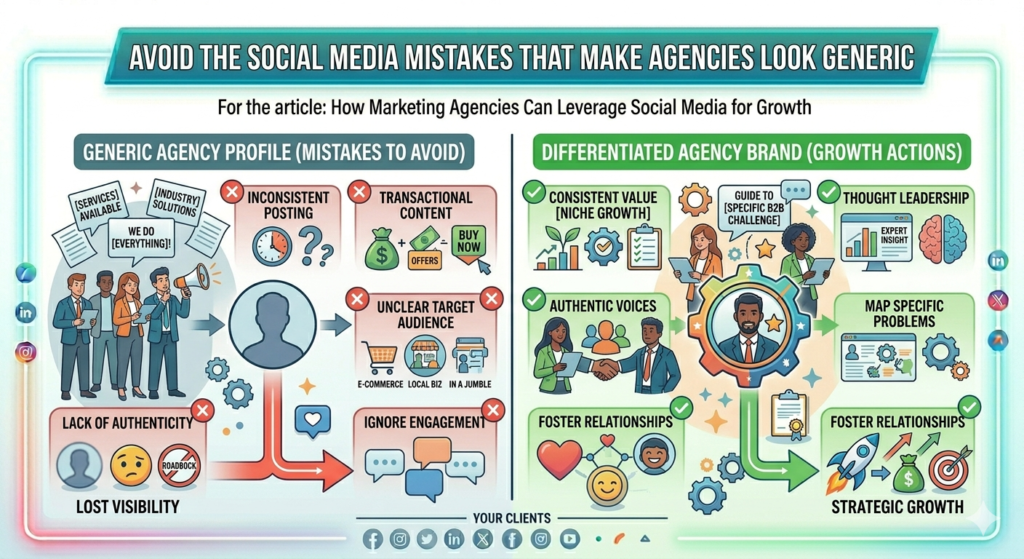
This does not mean your agency needs perfect content. It means your content should reflect the thinking and quality you want clients to expect.
The goal is not polish for the sake of polish. The goal is credibility.
Do not post generic advice that proves nothing
Generic advice is one of the biggest agency mistakes.
Posts like “be consistent,” “know your audience,” “create value,” and “build a strong brand” may be true, but they are too broad. They do not show your agency’s skill. They do not teach the buyer anything new. They do not make your agency memorable.
The problem is not the topic. The problem is the lack of depth.
You can write about consistency in a useful way if you explain why consistency fails without a clear message. You can write about audience research in a useful way if you show how wrong audience assumptions lead to weak campaigns. You can write about branding in a useful way if you explain how trust, memory, and choice work together.
The same topic can be weak or strong depending on how it is handled.
Every post should carry a clear point of view
A point of view does not mean being loud or controversial.
It means your agency has a clear take.
Instead of saying, “Content is important,” say, “Most agency content fails because it tries to teach everyone instead of changing the mind of one clear buyer.”
Instead of saying, “Paid ads need testing,” say, “Many ad tests fail because the agency changes creative before fixing the offer.”
Instead of saying, “SEO takes time,” say, “SEO takes time because trust, authority, and buyer intent are built in layers, not because search is magic.”
These statements are simple, but they have weight.
They show how your agency thinks. They make the reader feel like there is a real person behind the post.
That is what generic content lacks.
Do not copy what other agencies are doing without understanding why
It is normal to study competitors. It is smart to learn from others. But copying blindly is dangerous.
Another agency’s content may work because of its audience, founder voice, market, offer, timing, or history. If you copy the format without understanding the reason behind it, the content may feel empty.
For example, a founder-led post may work for one agency because the founder has years of trust in a niche. A meme may work for another because its audience enjoys that style. A long LinkedIn essay may work for another because its buyers are strategic and patient.
That does not mean the same format will work for your agency.
Your content should fit your buyer, your voice, your offer, and your strengths.
Inspiration is useful only when it is turned into your own strategy
If you see another agency doing something well, study the principle behind it.
Are they using strong opinions? Are they showing proof often? Are they simplifying complex ideas? Are they telling better client stories? Are they using the founder’s voice well? Are they making their process visible? Are they engaging deeply with buyers?
Those lessons are useful.
But your agency needs to turn them into its own system.
Do not borrow the surface. Borrow the thinking, then adapt it.
Your market may need more education. Your buyers may need more proof. Your service may need more process content. Your team may be better at video than writing. Your founder may be stronger in interviews than daily posts.
The best social strategy is not copied. It is designed around your agency’s real strengths and your buyer’s real needs.
Do not let social media become separate from the rest of the business
Social media should not live in a corner.
It should connect with sales, service delivery, hiring, partnerships, email, website content, events, and client success.
When social media is separate, it becomes shallow. The content team creates posts without hearing sales calls. The sales team does not use social posts in follow-up. The delivery team has insights that never become content. The founder has strong opinions that stay in private conversations. The website says one thing while social media says another.
That creates waste.
A strong agency connects these parts.
Sales questions become posts. Client wins become proof. Delivery lessons become education. Social comments become offer research. Popular posts become emails. Case studies become sales assets. Founder thoughts become positioning. Team insights become hiring content.
Social media works best when it reflects the whole agency
Your agency’s social media should feel like a public version of the best conversations happening inside the business.
If your team is learning something from clients, share the lesson. If sales calls reveal a common doubt, answer it. If a project creates a strong result, explain the thinking behind it. If your team has a clear belief about the market, publish it.
This makes social media richer because it is not made from guesses. It is made from real work.
It also helps the whole agency improve.
The content gets better because it is closer to the market. The sales process gets better because content supports it. The delivery team feels seen because their ideas are shared. The brand becomes stronger because the public message matches the private reality.
That is when social media stops being a side task and becomes part of how the agency grows.
Build a Social Media Growth Plan Your Agency Can Actually Follow
A strong social media strategy is not the one that looks best in a slide deck. It is the one your agency can actually follow when client work gets busy, sales calls pile up, reports are due, and the team has limited time.
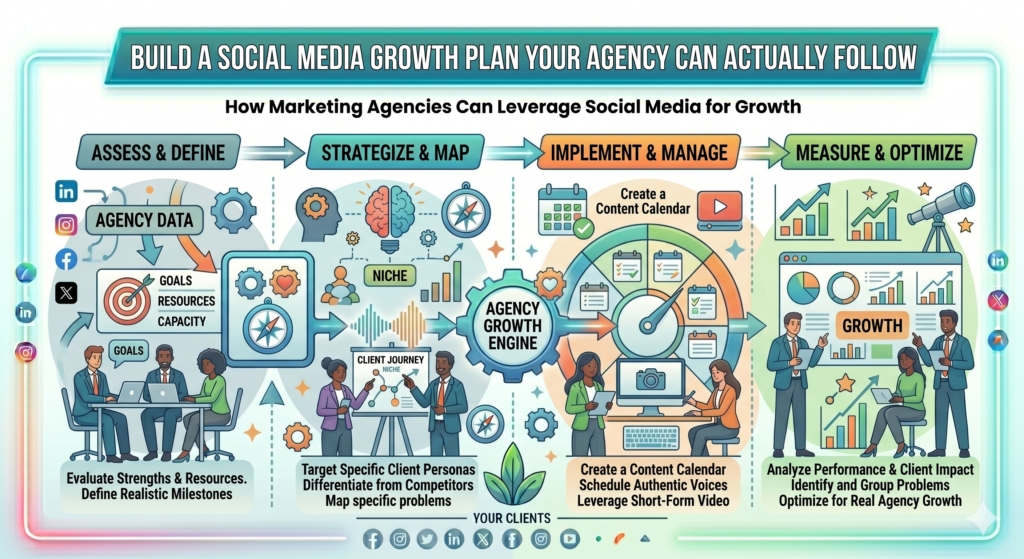
This is important because many agencies create plans that are too heavy.
They plan daily posts on five platforms. They plan videos, carousels, newsletters, lives, case studies, short clips, long posts, founder content, team content, and community engagement all at once. The plan looks smart at first. Then the team gets tired. Quality drops. Posting becomes rushed. The strategy falls apart.
Growth does not come from doing everything. It comes from doing the right things well, for long enough to build trust.
That is why your agency needs a simple plan that is clear, focused, and repeatable.
Your social plan should match your agency’s real capacity
The first question is not, “How much content should we publish?”
The better question is, “What can we publish well every week without lowering quality?”
That answer will be different for every agency.
A small team may be able to publish three strong LinkedIn posts per week, one founder video, and one newsletter. A larger agency may be able to run a full content engine across LinkedIn, YouTube, Instagram, email, and events.
A founder-led agency may rely more on personal posts. A design agency may lean more into visual work. A strategy agency may use long-form posts, live sessions, and deep breakdowns.
There is no single perfect rhythm.
The right rhythm is the one that your agency can maintain while still doing great client work.
Consistency only works when the quality is strong enough to earn trust
Agencies often hear that they need to be consistent. That is true, but consistency does not mean posting weak content every day.
Weak consistency can hurt your brand.
If your agency posts shallow advice every morning, people may see you often, but they may not respect you more. If your posts feel rushed, generic, or disconnected, your presence can start to feel like noise.
Strong consistency is different.
It means showing up often enough with useful, clear, buyer-focused content that people start to trust your thinking. It means your agency keeps returning to the same core problems from fresh angles. It means your content builds a clear memory in the market.
A simple plan done well can beat a huge plan done badly.
For example, an agency that publishes three thoughtful posts each week, comments deeply on ideal client conversations, and shares one strong proof story each month may create more growth than an agency posting daily across six platforms with no clear message.
The goal is not to fill the internet. The goal is to shape how the right buyers see your agency.
Build a monthly theme so your content feels connected
One of the easiest ways to make agency content stronger is to use monthly themes.
A theme gives your content direction. It helps your team create posts that connect to each other. It helps the audience understand your point of view more deeply. It also makes planning easier because you are not starting from zero every week.
For example, a social media agency might choose a monthly theme like “turning attention into leads.” During that month, the agency can talk about why likes do not always lead to sales, how to write content around buyer pain, how to use proof inside social posts, how to create calls to action that feel natural, and how to measure social media beyond engagement.
A paid media agency might choose a theme like “fixing wasted ad spend.” During that month, it can talk about weak offers, poor landing pages, wrong audience assumptions, slow follow-up, poor tracking, and bad lead quality.
A content agency might choose a theme like “making expertise easier to trust.” During that month, it can talk about clear messaging, founder-led content, case studies, educational posts, simple language, and buyer objections.
This makes the content feel like a connected argument instead of random posts.
A theme helps your agency repeat the message without repeating the words
Repetition is important in marketing. People rarely remember a message after seeing it once.
But repetition does not mean saying the same sentence again and again. That becomes boring.
A theme lets your agency repeat the same strategic idea from many angles.
If the theme is “attention is not the same as demand,” your agency can explain it through founder content, client stories, short videos, social audits, carousel posts, sales objections, and live sessions. Each piece feels different, but the core message stays the same.
That is how memory is built.
Your audience starts to understand what your agency believes. They begin to see the problem the way you see it. They start using your language. They become more ready for your offer.
This is one of the hidden benefits of a good social strategy. It does not just promote your agency. It shapes buyer thinking.
And when buyers begin to think like you, they are much more likely to trust you.
Create a simple content workflow from idea to post
A growth plan needs a workflow. Without one, social media becomes dependent on mood, free time, and last-minute effort.
The workflow does not need to be complex. It just needs to make content creation easier to repeat.
Start by capturing raw ideas. These can come from sales calls, client questions, campaign lessons, audit findings, team meetings, comments, DMs, competitor gaps, and market conversations.
Then shape those ideas into clear points. Ask what the buyer needs to learn. Ask what belief the post should change. Ask what example would make the idea easier to understand.
Then choose the right format. Some ideas work best as written posts. Some work best as videos. Some need a carousel. Some need a longer article. Some are better as comments or email.
Then publish and engage. Do not post and disappear. Reply to comments, continue conversations, and watch what people respond to.
Then review the content. Study what created useful attention, not just visible engagement.
Your workflow should protect the agency from last-minute content
Last-minute content is usually weaker.
It often leads to generic posts, rushed designs, unclear messages, and safe ideas. It also puts pressure on the person writing or posting, which makes the whole system feel harder than it needs to be.
A simple workflow removes that pressure.
Your agency can collect ideas during the week and shape them during one focused content session. The team can prepare posts ahead of time. The founder can record several short videos in one sitting. Designers can create templates that keep visuals clean. Strategists can review posts for accuracy. Sales can share objections that need content support.
This turns social media from a daily scramble into a business habit.
It also improves quality because your best ideas are not lost in meetings, calls, or private chats. They are captured and turned into assets.
Many agencies already have enough insight to create great content. The problem is that the insight stays trapped inside the team.
A workflow brings it out.
Make social media part of your agency’s sales system
Social media should not end at the post.
It should connect to your sales process.
When someone books a call, your sales team should know whether they came from social content. When a prospect mentions a post, that insight should be recorded. When a common objection appears in sales calls, it should become content. When a case study helps close a deal, it should be turned into more posts.
This connection makes both social and sales stronger.
The content team learns what buyers care about. The sales team gets better assets to send prospects. The agency’s message becomes more consistent. Prospects feel more educated before the call.
Social media should create warmer, smarter, better-fit conversations.
The best social content can keep selling long after it is posted
A strong post does not have to disappear after a day.
Your sales team can use it again and again.
If a prospect worries that social media will not create leads, send them a post that explains how attention turns into demand. If a prospect cares only about cheap leads, send them a post that explains why lead quality matters more than lead cost alone.
If a prospect is unsure why strategy comes before execution, send them a post that shows what goes wrong when agencies skip diagnosis.
This makes your content more valuable.
It becomes part of the sales conversation. It helps your team explain ideas without repeating the same points on every call. It also builds trust because prospects can see that your agency has been thinking about these issues publicly, not just saying them privately to close a deal.
A strong content library is a sales asset.
Over time, your agency can build a set of posts, videos, case studies, and breakdowns that support every stage of the buyer journey. That is when social media becomes much more than marketing. It becomes part of how your agency wins business.
Turn Your Best Social Media Content Into Sales Assets
Social media should not be treated as content that lives for one day and then disappears. That is one of the biggest wastes agencies make.
A strong post can do much more than get likes. It can help explain your offer. It can answer a sales objection. It can support a proposal. It can help a prospect understand why your method is different. It can give your sales team a simple way to say, “Here is how we think about this problem.”
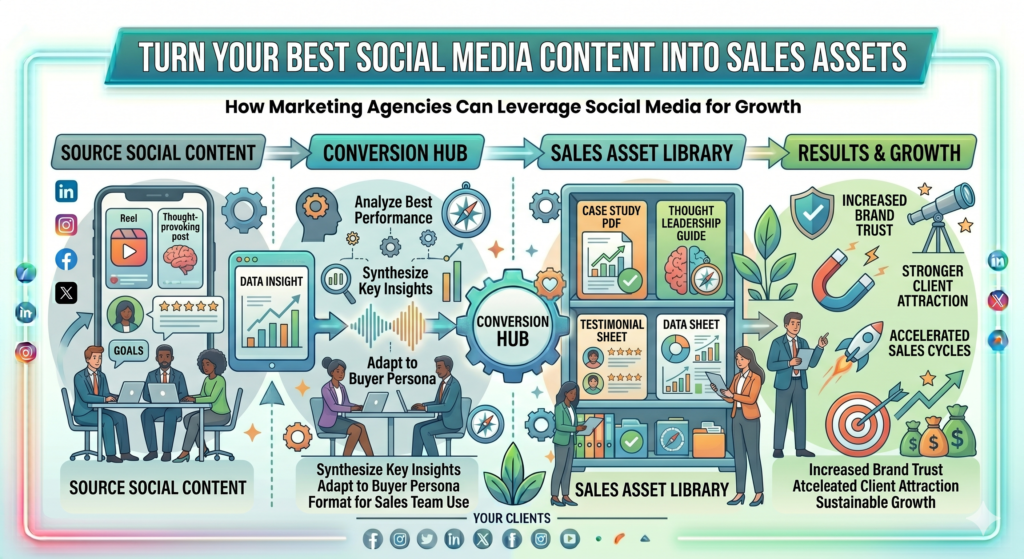
This is where social media becomes more than marketing. It becomes part of the agency’s sales engine.
Many agencies already create smart posts, but they do not reuse them with purpose. They post, get a few comments, maybe celebrate the reach, and then move on. But if a post explains an important idea clearly, it should not be left behind. It should be saved, organized, and used again.
Social posts can help prospects understand your value before they speak to you
A prospect may not fully understand what your agency does at first. They may know they need help, but they may not know what kind of help. They may think they need posting, ads, SEO, or design. But the real need may be deeper.
Maybe they need sharper positioning. Maybe they need clearer proof. Maybe they need a better offer. Maybe they need a stronger funnel. Maybe they need content that supports the sales process, not just content that fills a feed.
Your social content can teach this before the first call.
A post about why content gets engagement but no leads can help a prospect see that their issue is not reach alone. A post about why cheap leads can be expensive can help a prospect think beyond cost per lead. A post about why landing pages fail can help a prospect understand that ads and conversion must work together.
When prospects read this content before speaking with your agency, the sales call becomes easier. They arrive with better language. They understand the problem more clearly. They may already believe in your approach.
That saves time for both sides.
A strong content library can shorten the sales cycle
Agency sales can be slow when prospects need a lot of education. They may ask basic questions. They may compare your agency with cheaper options. They may not understand why strategy matters. They may think all agencies do the same thing.
Your content library can help solve this.
If your agency has clear posts that explain your beliefs, methods, proof, and process, your sales team can send those posts at the right moment.
If a prospect asks why your agency begins with research, send a post explaining why campaigns fail when agencies skip diagnosis.
If a prospect asks why content takes time, send a post explaining how trust is built through repeated useful ideas.
If a prospect asks why the price is higher than another agency, send a post explaining the difference between task delivery and growth strategy.
This does not replace a real sales conversation. It improves it.
The prospect gets time to think. Your team does not have to explain the same idea from scratch each time. The buyer sees that your agency has a clear point of view in public, not just a sales pitch in private.
That builds confidence.
Your agency should organize content by sales use case
A good sales content library does not need to be complex. It just needs to be easy to use.
Your team can organize strong social posts around common sales moments. One group can explain your agency’s point of view. Another can answer common objections. Another can show proof. Another can explain process. Another can compare good and bad approaches. Another can help prospects understand whether they are a good fit.
This makes your content practical.
Instead of searching through months of old posts, your sales team can quickly find the right asset for the right conversation.
This is especially useful when multiple people sell for the agency. It keeps messaging consistent. It helps junior team members speak with more confidence. It also makes sure the agency’s strongest thinking is not trapped with the founder or senior strategist.
Every repeated sales question should become a reusable content asset
If your team answers the same question more than three times, it should probably become content.
If prospects keep asking how long social media takes to work, write a clear post about what social media can do in the first 30 days, 90 days, and 180 days.
If they keep asking why they need strategy before execution, write a post showing what goes wrong when agencies start with tactics too soon.
If they keep asking whether short-form video is worth it, write a post explaining when video helps and when it becomes a distraction.
If they keep asking what makes your agency different, create content that shows your thinking instead of only stating your difference.
This turns sales friction into content direction.
Over time, your agency builds a library that handles many doubts before they slow down a deal.
Social content can also support client onboarding
The value of social content does not end when a prospect becomes a client.
It can also support onboarding.
New clients often need help understanding your way of working. They need to know why you ask certain questions, why research matters, why approvals should not drag, why feedback needs to be specific, why reporting should focus on decisions, and why some results take time.
Your agency can use social content to set expectations early.
A post about how to give useful feedback can help clients avoid vague comments like “make it pop.” A post about why campaign learning takes time can help clients stay patient during testing. A post about why the first month is often about building the foundation can prevent panic when instant results do not appear.
This makes the client relationship smoother.
Better education creates better clients
Agencies sometimes blame clients for poor communication, slow feedback, or wrong expectations. Sometimes that blame is fair. But often, clients simply have not been taught how good agency work happens.
Your content can teach them.
It can show what a strong client-agency relationship looks like. It can explain what information the agency needs to do better work. It can show why fast approvals matter. It can explain how success should be measured. It can teach clients how to judge early signals before final results arrive.
This does not just help clients. It helps the agency.
Better-informed clients are easier to work with. They trust the process more. They give better feedback. They understand trade-offs. They are less likely to panic over every small shift in performance.
That means social media can improve retention, not just acquisition.
Use Employee Advocacy Without Making Your Team Sound Forced
Many agencies want their team members to share content on social media. This makes sense. When employees post, the agency can reach more people. It can also show more depth, personality, and expertise.
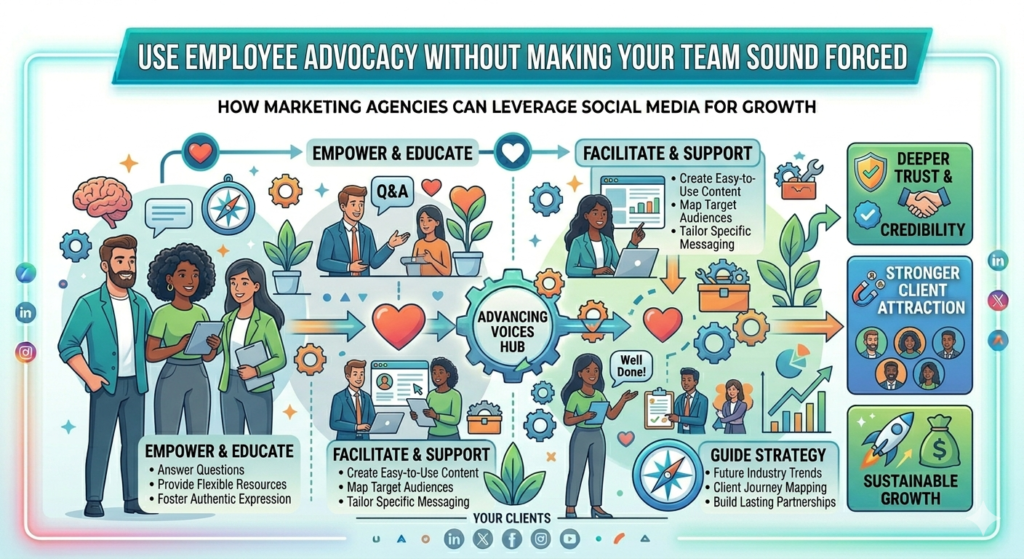
But employee advocacy can go wrong fast.
If the agency forces team members to copy and paste the same post, it feels fake. If everyone shares the same graphic with the same caption, it looks staged. If employees are pushed to post without knowing what to say, they may feel awkward. The result can hurt the brand instead of helping it.
A better approach is to make employee advocacy natural.
Your team should not feel like a distribution tool. They should feel like people with real experience, real lessons, and real voices.
Employee content should begin with what each person actually knows
Not every person on your team should talk about the same thing.
A writer can talk about messaging, clarity, tone, hooks, landing pages, and how to make hard ideas simple.
A designer can talk about visual trust, website layout, brand consistency, and how design supports action.
A paid media specialist can talk about testing, lead quality, campaign mistakes, budget waste, and what numbers really mean.
An SEO specialist can talk about search intent, content structure, technical fixes, and why rankings alone do not equal growth.
An account manager can talk about communication, client expectations, project flow, and what makes agency-client work smoother.
When each person talks from their own seat, the content feels more real.
It also shows that the agency has depth. Prospects can see that expertise exists across the team, not just at the top.
The strongest team content sounds like experience, not a company script
People can feel when a post is written by a brand team and handed to an employee.
It sounds too polished. It lacks personal detail. It feels like marketing copy wearing a human face.
That is not the goal.
A good team post should sound like something the person has actually seen, learned, fixed, or changed their mind about.
For example, a designer might write about how they used to care most about making pages look beautiful, but later learned that the best design also reduces fear and makes decisions easier for the buyer.
A media buyer might write about how a campaign with a higher cost per lead turned out to be better because the leads were more serious and closed faster.
A writer might explain how the simplest headline often wins because buyers do not reward cleverness when they are confused.
These posts feel human because they contain learning.
They are not just announcements. They are lived lessons.
Make it easy for employees to share without pressure
Not everyone wants to post often. That is fine.
Your agency should not force every team member to become a creator. Instead, create a simple support system for people who are open to it.
The agency can help team members turn their ideas into posts. It can ask simple questions after projects. It can capture insights from meetings. It can offer light editing while keeping the person’s voice. It can create optional prompts based on real work.
The key word is optional.
When people feel forced, content becomes stiff. When they feel supported, content becomes stronger.
A simple internal question can unlock strong employee content
You do not need a big process to find good ideas from the team.
Ask simple questions during the week.
What did you explain to a client this week that would help others?
What mistake did you spot more than once?
What changed your mind recently?
What made a campaign work better than expected?
What client question made you pause?
What is something clients often misunderstand about your role?
Answers to these questions can become thoughtful posts.
They can also become brand page content, founder posts, newsletter ideas, or sales assets.
This is useful because your team is close to the work. They see things leadership may miss. Their small observations can become very practical content.
Employee advocacy should protect both the person and the agency
When team members post, the agency should give clear guardrails.
This does not mean controlling every word. It means helping employees understand what should stay private, how to talk about clients safely, how to avoid sharing confidential details, and how to stay aligned with the agency’s values.
A good rule is simple. Share lessons, not private information.
You can talk about a common problem without naming the client. You can explain a process without showing private data. You can share what you learned without exposing sensitive details.
This helps the team feel safe and confident.
Clear guardrails make employee content more confident
People often avoid posting because they are afraid of saying the wrong thing.
If the agency gives them clear boundaries, they may feel more comfortable sharing.
For example, the agency can explain which client details should never be shared, what types of screenshots need approval, how to speak about results, and how to avoid overpromising.
It can also give examples of good employee posts.
This removes guesswork.
The goal is not to turn employees into brand robots. The goal is to help them share honest, useful ideas in a way that protects everyone.
When done well, employee advocacy becomes a growth advantage. It extends reach, builds trust, shows culture, and helps the agency look like a team of real experts.
Use Social Media to Attract Better Partnerships and Referrals
Agency growth does not only come from direct clients.
A lot of strong growth comes from partnerships and referrals. Social media can help with both.
Other consultants, agencies, coaches, software companies, creators, accountants, lawyers, investors, community owners, and industry leaders may already serve the same audience you want to reach. They may not compete with you. They may be able to refer work, invite you to speak, co-create content, or introduce you to better-fit clients.
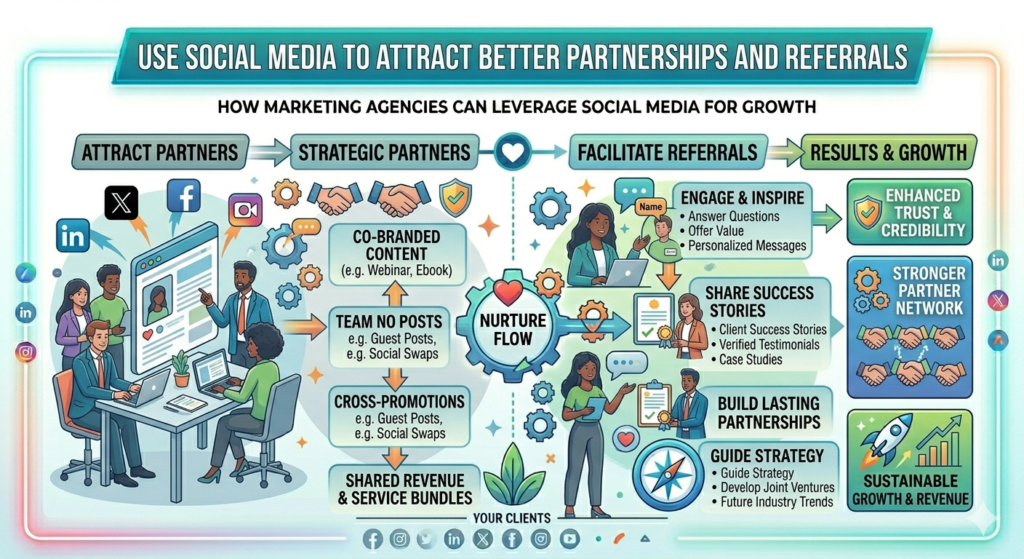
But they need to know what you do and trust how you think.
Social media helps make that happen.
When your agency shares sharp, useful content often, partners can understand your value without needing a long explanation. They can see your point of view. They can see your proof. They can see how you talk to the market.
That makes you easier to refer.
Your content should make referrals easy to understand
People refer agencies when they can describe them clearly.
If someone cannot explain what your agency does in one simple sentence, they are less likely to refer you. They may like you. They may respect you. But when a chance to refer comes up, they may hesitate because your value is unclear.
This is why your social content needs a clear message.
A referral partner should be able to say, “You should talk to this agency. They help B2B service firms turn LinkedIn content into sales calls.”
That is much stronger than, “They do marketing.”
The clearer your social presence is, the easier it is for others to send the right people your way.
Referral partners need language they can repeat
Your social content should give partners simple words to use.
If your agency has a clear belief, repeat it in different ways. If you solve a specific problem, name it often. If you work best with a certain type of client, make that clear. If you have a strong process, explain it simply.
Do not make people guess.
A partner may not understand all the details of your service. They may not know the difference between demand generation, content strategy, conversion strategy, and social selling. But they can remember a clear problem and outcome.
For example, they can remember that your agency helps founders whose content gets attention but not leads.
That line is easy to repeat.
When your content gives people simple referral language, you increase the chance that your name comes up in the right rooms.
Build public relationships with complementary experts
Social media lets agencies build visible relationships with people who serve the same audience.
This can happen through comments, shared posts, interviews, live sessions, webinars, newsletters, guest posts, podcast appearances, and simple public conversations.
These relationships can create trust because people see respected voices interacting with your agency.
If a sales consultant often comments on your content, their audience may start noticing you. If you host a live session with a SaaS advisor, their network may discover your agency. If you share useful thoughts on a partner’s post, you may become familiar to their followers.
This is not about chasing clout. It is about building trust inside the right circles.
The best partnerships are built before anyone asks for a favor
Do not wait until you need referrals to start building partner relationships.
Start by being useful.
Comment on their work. Share their best ideas. Add thoughtful points to their posts. Invite them into useful conversations. Send them insights that might help their audience. Look for ways to support them without immediately asking for something back.
This builds goodwill.
Over time, natural opportunities appear. You may co-host a session. You may trade referrals. You may build a joint guide. You may be invited into a client conversation. You may become the agency they recommend when someone needs your service.
This works because trust has already been built.
Partnerships are stronger when they grow from real respect, not sudden outreach.
Use social media to show who your agency is best suited to help
Referrals are better when they are well matched.
Your agency does not want every possible referral. It wants the right referrals.
That means your social content should help people understand not only who you help, but also who you are not best for.
This may feel risky, but it is powerful.
If your agency is best for companies that want strategic growth, say that. If your agency is not a fit for businesses looking for the cheapest option, make that clear in a respectful way. If your work requires client input, explain that. If your best results come when leadership is involved, say so.
This helps partners refer better-fit clients.
Clear fit signals protect your time and improve lead quality
When your content makes fit clear, poor-fit buyers are less likely to reach out. That is a good thing.
A business that wants instant results with no strategy may not contact you if your content explains that strong work starts with diagnosis.
A prospect looking for the lowest price may not contact you if your content explains the cost of cheap execution.
A company that is not ready to give feedback may not contact you if your content explains why client input matters.
This can reduce lead volume, but improve lead quality.
For agencies, that is often the better trade.
More leads are not always better. Better-fit leads are better.
Social media can help you attract the clients, partners, and referrals that match the agency you are trying to build.
Use Social Media to Create Demand Before Buyers Are Ready to Search
Most agencies think about demand too late.
They wait until a business owner is already looking for an agency. They wait until a founder searches for “best social media agency” or “SEO agency near me” or “paid ads agency for SaaS.” At that point, the buyer is already comparing options. They may already have a shortlist. They may already have opinions. They may already be leaning toward someone else.
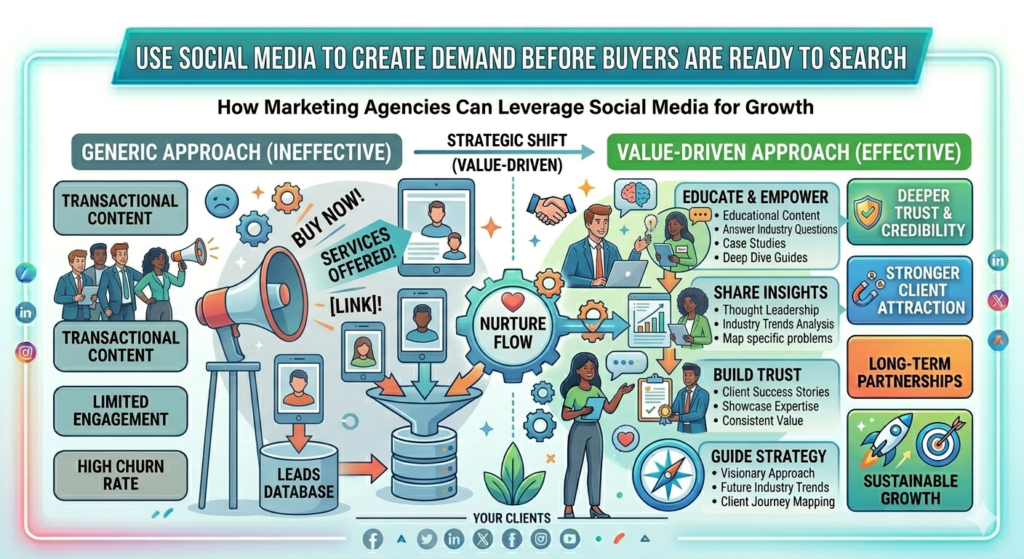
Social media helps agencies reach people before that moment.
This is important because many buyers do not wake up knowing they need an agency. They feel a problem first. They feel stuck. They feel unsure. They notice that growth has slowed. They notice that their content is not creating sales. They notice that referrals are not enough anymore.
They notice that ad costs are rising. They notice that competitors are becoming more visible.
At this stage, they may not be searching for an agency yet. But they are open to learning.
That is where social media can shape demand.
Your content should name problems before buyers know what to call them
A buyer may not know they have a positioning problem. They may simply feel like people do not understand why their company is different.
A buyer may not know they have a conversion problem. They may just feel frustrated that people visit the site but do not book calls.
A buyer may not know they have a content strategy problem. They may only see that posting takes time and does not seem to bring real leads.
Your agency’s content should help them name the issue.
When you name the problem clearly, you create a moment of recognition. The buyer thinks, “That is what we are dealing with.”
That moment is powerful.
It moves the buyer from vague frustration to clear awareness. And when your agency helps create that awareness, you become linked to the solution in their mind.
Demand starts when your content makes hidden pain visible
Many businesses live with marketing problems for a long time because those problems feel normal.
A founder may think it is normal for content to get likes but no leads. A local business owner may think it is normal for ad leads to be poor. A service firm may think it is normal for its website to sound like everyone else. A marketing manager may think it is normal for reports to show activity but not clear progress.
Your content can challenge that.
You can explain that attention without buyer intent is not a content win. You can explain that cheap leads can become expensive if the sales team wastes time on the wrong people. You can explain that a website should not only explain services, but also reduce fear. You can explain that a social strategy should create trust, not just fill a calendar.
This kind of content creates demand because it makes the cost of inaction clearer.
The buyer begins to see that the problem is not small. It is costing them time, money, trust, or growth.
And when they see that, they are more likely to take action.
Demand creation content should challenge weak beliefs
Every market has beliefs that keep buyers stuck.
Some believe more posting will fix weak messaging. Some believe more ad spend will fix a poor offer. Some believe a beautiful brand will fix a confusing story. Some believe traffic is the same as demand. Some believe social media is only useful if it creates leads immediately.
A smart agency uses social media to challenge these beliefs.
This should be done with care. You do not need to insult the buyer. You do not need to sound harsh. But you do need to show them a better way to think.
For example, instead of saying, “Most businesses are doing content wrong,” you can say, “A lot of businesses judge content by engagement because it is easy to see. But the better question is whether the content is changing how the right buyer thinks.”
That is direct, but not rude.
It helps the buyer see a gap in their current thinking.
Strong points of view make your agency harder to replace
If your agency only posts basic tips, buyers may see you as one of many options.
But if your agency changes how they think, you become harder to replace.
A buyer may remember the agency that helped them understand why their content was attracting peers instead of prospects. They may remember the agency that explained why their ads were not the real problem. They may remember the agency that showed them why their service page was answering the wrong question.
That kind of insight creates authority.
It also creates preference.
The buyer starts to feel that your agency understands the issue at a deeper level than others. This can happen long before they are ready to buy. Then, when the buying moment arrives, your agency is not just another name. You are the firm that shaped their thinking.
That is a major advantage.
Demand creation requires patience and repetition
Some agencies give up on demand creation too soon because it does not always create instant leads.
They publish strong educational content for a few weeks, then stop because the inbox is not full. That is the wrong way to judge it.
Demand creation works through repeated exposure.
People need to see your ideas more than once. They need to hear the same belief in different ways. They need to watch your proof grow. They need to see that your agency is consistent. They need time to connect your message with their own problem.
This is why patience matters.
You are not only trying to catch buyers who are ready today. You are building memory with people who may be ready in three months, six months, or a year.
Repetition builds trust when each post adds a new angle
Repeating your message does not mean writing the same post again and again.
It means returning to the same core idea from different angles.
If your agency believes social media should create demand, not just engagement, you can explain that through many stories. You can show it through client examples. You can explain it through mistakes.
You can talk about it in videos. You can answer objections. You can compare strong and weak posts. You can show how content supports sales. You can share what happens when agencies chase reach without strategy.
Each piece adds another layer.
Over time, your audience starts to understand your belief. They may even start using your language.
That is when demand creation becomes real. Your content does not just reach people. It teaches them how to see the problem.
Use Social Media to Improve Your Agency’s Own Brand Trust
Marketing agencies often spend so much time building client brands that they neglect their own.
This is dangerous.
Your agency’s social media presence is often part of your first impression. Before a prospect books a call, they may check your LinkedIn page. They may look at your founder’s posts. They may scan your Instagram. They may watch a video. They may read comments. They may search for proof that your agency knows what it is doing.
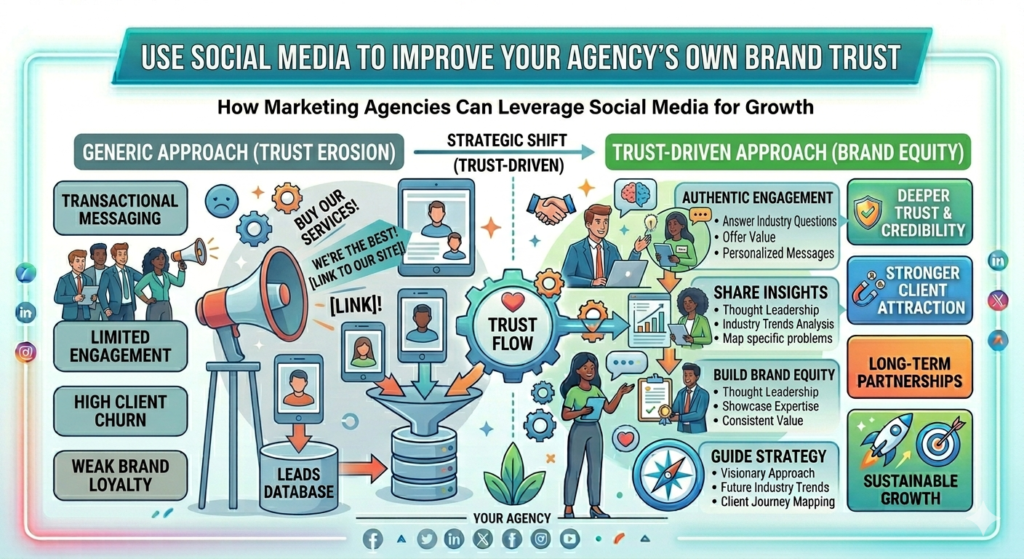
What they find will shape trust.
If your social media feels unclear, outdated, random, or generic, it creates doubt. If it feels sharp, useful, human, and consistent, it creates confidence.
Social media is not the whole brand, but it is a visible part of it. It shows how your agency thinks in public.
Your agency’s social presence should match the quality you sell
If your agency sells strategy, your posts should feel strategic.
If your agency sells content, your content should be clear and strong.
If your agency sells design, your visuals should show taste and care.
If your agency sells social media, your own social media should prove that you understand how attention, trust, and action work.
This does not mean your agency needs to be perfect. No brand is perfect. But there should be a clear match between what you sell and how you show up.
A prospect will naturally ask, “If this agency cannot explain its own value clearly, can it explain mine?”
That may sound unfair, but it is how buyers think.
Your own social media is a sample of your work. It is a trust signal.
Your content is a public proof of your standards
Every post says something about your agency.
A rushed post says something. A generic post says something. A thoughtful post says something. A strong breakdown says something. A clear case study says something. A helpful comment says something.
Over time, these signals add up.
They teach the market what level of thinking to expect from you.
If your agency wants premium clients, your content should reflect premium thinking. That does not mean it needs fancy words or complex design. In fact, clear and simple often feels more premium because it respects the buyer’s time.
Premium thinking means your content has purpose. It is sharp. It is specific. It is useful. It is tied to real business problems. It shows that you care about outcomes, not just activity.
That is what builds trust.
Consistency in voice makes your agency easier to remember
Your agency should sound like itself.
This matters more than many teams realize.
If one post sounds formal, the next sounds like a meme page, the next sounds like a corporate report, and the next sounds like a motivational quote account, the brand becomes hard to remember.
A clear voice helps people feel familiar with you.
For WinSavvy, that voice should feel practical, simple, direct, and helpful. It should sound like an experienced advisor explaining growth in plain words. It should avoid empty hype. It should avoid overused marketing language. It should make the reader feel smarter and clearer after reading.
That kind of voice builds trust because it feels steady.
A clear voice reduces the distance between your agency and the buyer
Buyers often feel that marketing is confusing. They hear too many terms. They see too many dashboards. They receive too much advice that sounds smart but does not help them decide.
A clear voice cuts through that.
When your agency explains hard things in simple words, the buyer feels relief. They feel that you will not confuse them. They feel that you will guide them. They feel that you will tell them what matters and what does not.
That emotional response is important.
People do not only buy based on proof. They buy based on confidence. A clear voice creates confidence because it makes your agency feel easy to understand.
That is why simple language is not a weakness. It is a strength.
Brand trust grows when your agency is honest about trade-offs
Many agency posts make marketing sound too easy.
They promise fast growth, simple fixes, easy wins, and clear formulas. That may get attention, but it can also weaken trust with serious buyers.
Experienced business owners know that growth has trade-offs. They know not every channel works right away. They know budgets matter. They know strategy takes choices. They know some results take time. They know not every campaign wins.
Your agency should be honest about that.
Honesty does not make your content less persuasive. It makes it more credible.
You can explain that social media can create demand, but only when the message is clear and the content is tied to buyer pain. You can explain that paid ads can scale growth, but they can also waste money if the offer and landing page are weak.
You can explain that SEO can build long-term trust, but it needs patience and strong content.
This kind of honesty attracts better clients.
Serious buyers trust agencies that tell the truth before the sale
A buyer may enjoy big promises, but they trust clear truth.
If your agency is honest in public, prospects believe you are more likely to be honest in private. They believe you will not hide bad news. They believe you will not pretend a weak result is strong. They believe you will explain what is working, what is not, and what needs to change.
That is a huge part of agency trust.
Social media gives your agency a way to show that honesty before the sales call.
You can share lessons from campaigns that did not work as expected. You can explain why a common tactic is not right for every business. You can talk about when a client should not hire an agency yet. You can explain what needs to be fixed before marketing spend increases.
This may repel some buyers. That is fine.
It will attract buyers who respect serious work.
Conclusion
Social media can become one of the strongest growth tools for a marketing agency, but only when it is used with purpose.
It is not enough to post often. It is not enough to follow trends. It is not enough to share tips, wins, and service updates. Real growth comes when social media helps the right buyers understand your agency, trust your thinking, and remember your value before they are ready to buy.















Comments are closed.