
WinSavvy Editorial Standards
How this article was created
The home care business is built on trust. Before a family calls you, they are usually not just looking for a service. They are looking for safety. They are looking for kindness. They are looking for someone who can help their parent, grandparent, spouse, or loved one stay comfortable at home without feeling alone, rushed, or ignored.
Build Your Growth Around the Real Reason Families Choose Home Care
Most home care agencies start their marketing in the wrong place. They begin by talking about their services. They say they offer personal care, companion care, respite care, dementia care, meal help, bathing support, and light housekeeping.
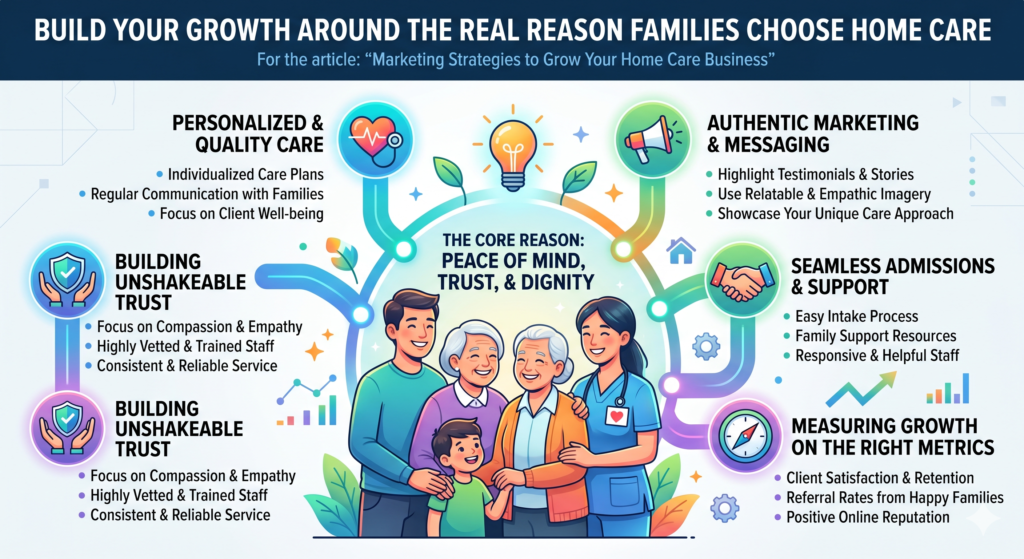
Those services matter, but they are not the real reason families choose an agency.
A daughter does not search for home care only because her mother needs help with meals. She searches because she is scared her mother is not eating well. A son does not call because his father needs companionship.
He calls because he feels guilty that his father sits alone most days. A spouse does not look for dementia care because they want a care plan. They look because they are tired, worried, and unsure how much longer they can manage alone.
This is where strong marketing begins. You must understand the feeling behind the search. When your marketing speaks to that feeling, families pay attention. When it only lists services, they compare you like a price sheet.
Your message should speak to the family before it speaks about the service
Your website, ads, brochures, emails, and calls should make families feel seen. This does not mean using fear. It means showing that you understand what they are going through.
Instead of saying, “We offer professional home care services,” you can say something more human, such as, “When daily care starts to feel too heavy for your family to manage alone, our caregivers step in with steady, kind support at home.”
That kind of message meets the family where they are. It does not sound cold. It does not sound like every other agency. It gives the reader a reason to keep reading because it reflects the problem they are living with.
Your best marketing should reduce stress, not add pressure
Families looking for home care often feel rushed. They may be dealing with a hospital discharge, a sudden fall, memory loss, caregiver burnout, or a parent who refuses help. If your marketing is too pushy, too full of claims, or too hard to understand, it adds more stress.
Your job is to make the next step feel simple.
Make your words calm. Make your pages easy to read. Make your phone number easy to find. Explain what happens after someone calls. Tell families what to expect during the first conversation. Show that they can ask questions without being pushed into a decision.
This matters because many families delay calling. They are not always ready to admit they need help. They may feel guilt. They may worry their loved one will be upset. They may not know what care costs. Your marketing should make that first step feel safe.
Your local promise should be clear and easy to believe
Every home care agency needs a clear promise. This is not a slogan that sounds clever but says nothing. It is a simple statement that tells families why they should choose you.
A strong promise could focus on fast starts, consistent caregivers, dementia-trained support, local ownership, clear family updates, or warm care that helps seniors stay at home longer. The key is that it must be real. It must be something your agency can prove.
If your agency is known for quick care starts after hospital discharge, make that part of your message. If your strength is matching caregivers carefully with clients, say that. If your team gives family members regular updates, explain how that works.
Weak marketing says, “We care like family.”
Strong marketing says, “We help families start safe, reliable care at home within days, with caregivers matched to your loved one’s needs and personality.”
The second message gives people something real to hold onto.
Turn Your Website Into a Trust-Building Machine
Your website is often the first serious place a family checks before calling. Even when someone hears about your agency from a friend, doctor, or discharge planner, they will often visit your website to see if you look trustworthy.
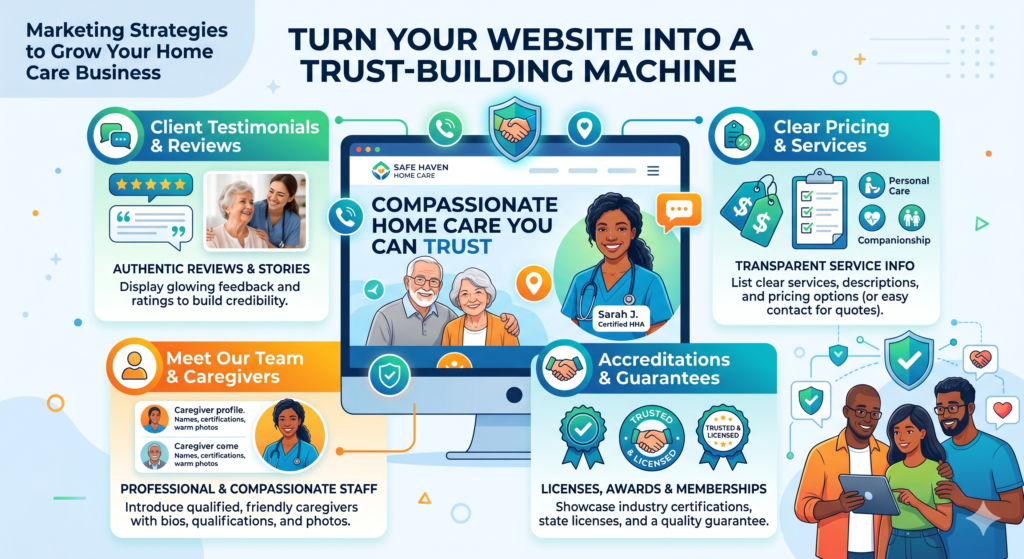
A weak website can quietly kill leads. Families may not tell you they visited and left. They simply choose another agency.
A strong website does three things well. It helps people understand your services, it builds trust quickly, and it makes calling feel easy. It does not need to be fancy. It needs to be clear, warm, and built around what families need to know before they reach out.
Your homepage should answer the questions families already have
Most home care websites waste the top of the homepage. They use a large photo, a vague headline, and a button that says “Learn More.” That is not enough.
The first section of your homepage should quickly answer who you help, where you help, and why families trust you. A visitor should not need to scroll for one minute to understand what you do.
A better homepage message might say, “Kind, reliable home care for seniors in Austin who need help staying safe and comfortable at home.” That tells the visitor what you do, who it is for, and where you serve.
After that, your homepage should guide people through the basic decision. Explain the problems you help with. Show your main care services. Share trust signals. Include short client stories. Explain how starting care works. Then invite them to call or schedule a care consultation.
Your website should make calling feel like a low-risk step
Many families are afraid that calling means they will be sold to. Your website can lower that fear by explaining the call.
Do not just say, “Contact us today.” Say what happens next.
Tell visitors that the first call is a simple conversation. Tell them they can ask about care options, scheduling, pricing, and whether home care is right for their situation. Tell them there is no pressure to decide on the spot.
This small change can lift response because it removes uncertainty. People are more likely to call when they know what the call will feel like.
Your service pages should not all sound the same
Many agencies create service pages that repeat the same basic message with a new heading. Companion care, personal care, respite care, and dementia care pages often sound almost identical. This hurts trust and weakens SEO.
Each service page should speak to a different need.
A dementia care page should talk about safety, routine, confusion, family stress, wandering risks, mood changes, and the need for patient caregivers. A respite care page should speak to family burnout, guilt, rest, and the need to take a break without feeling like you are abandoning your loved one.
A personal care page should gently address bathing, dressing, dignity, privacy, and the discomfort families may feel when a loved one needs hands-on help.
When each page speaks to the real situation behind the service, it becomes more useful. It also has a better chance of ranking because search engines can see that the page deeply covers the topic.
Use Local SEO So Families Find You When They Are Ready to Call
Home care is a local decision. Families are not just searching for general advice. Many are searching for help near them. They type phrases like “home care near me,” “senior care in Dallas,” “dementia care at home in Tampa,” or “caregiver agency near me.”
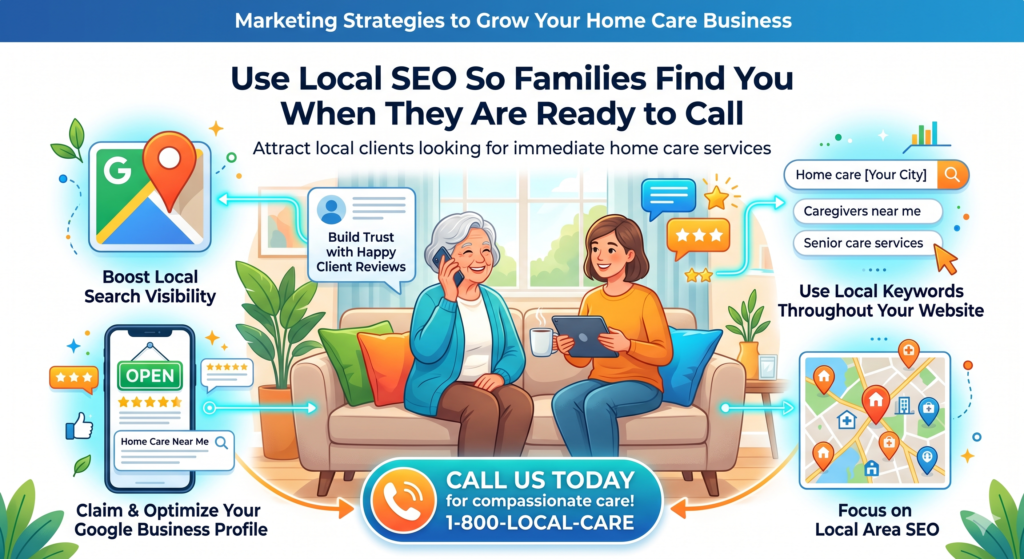
If your agency does not show up in those searches, you are losing some of the highest-intent leads available.
Local SEO is not about tricks. It is about making your agency easy to find, easy to trust, and easy to understand online. When done well, it helps you appear in Google Maps, local search results, and organic pages when families are actively looking for care.
Your Google Business Profile should be treated like a second homepage
For many families, your Google Business Profile is the first thing they see. They may look at your rating, photos, services, hours, reviews, and location before they ever visit your website.
This profile should not be half-filled. It should be complete, active, and written with care.
Your business description should clearly explain your care services, your service area, and the kind of families you help. Your categories should be accurate. Your phone number and website should be correct. Your photos should look real and warm, not cold or generic.
Your services should be listed in detail, with short descriptions that match how people search.
Reviews are one of the strongest local growth tools you have
Families trust other families. A good review can do more than a long sales page because it feels real. It shows that someone else had a positive experience with your agency.
You should have a steady process for asking for reviews. Do not wait until you remember. Build it into your care journey.
After a client has had a good experience, ask the family member if they would be willing to share a few words online. Make it easy. Send the link. Explain that their review helps other families feel more confident when choosing care.
Do not pressure clients. Do not offer rewards for reviews. Just ask at the right moment, in a respectful way.
The best reviews often mention specific details, such as kind caregivers, reliable scheduling, fast help after discharge, better peace of mind, or how the agency supported the family during a hard time. These details help future clients see themselves in the story.
Local pages can help you rank in nearby towns and neighborhoods
If your agency serves several cities, towns, or neighborhoods, you should create strong local pages for your most important service areas. These pages should not be thin copies with only the city name changed. That approach feels lazy and can hurt trust.
A good local page should talk about the area in a useful way. Mention the types of families you serve there, common care needs, nearby hospitals or senior communities if relevant, and the specific services available in that location. It should also include clear calls to action for families in that area.
For example, if you serve Scottsdale, your page should not only say “home care in Scottsdale” twenty times. It should explain how your caregivers support seniors in Scottsdale homes, how families can start care, what types of care are available, and why local families choose your agency.
This makes the page better for both readers and search engines.
Create Content That Answers Real Family Questions
Content marketing can be powerful for home care, but only when it is grounded in real questions. Many agencies publish generic articles that nobody reads. Topics like “Benefits of Home Care” or “Why Choose Us” can help, but only if they are written with depth and real insight.
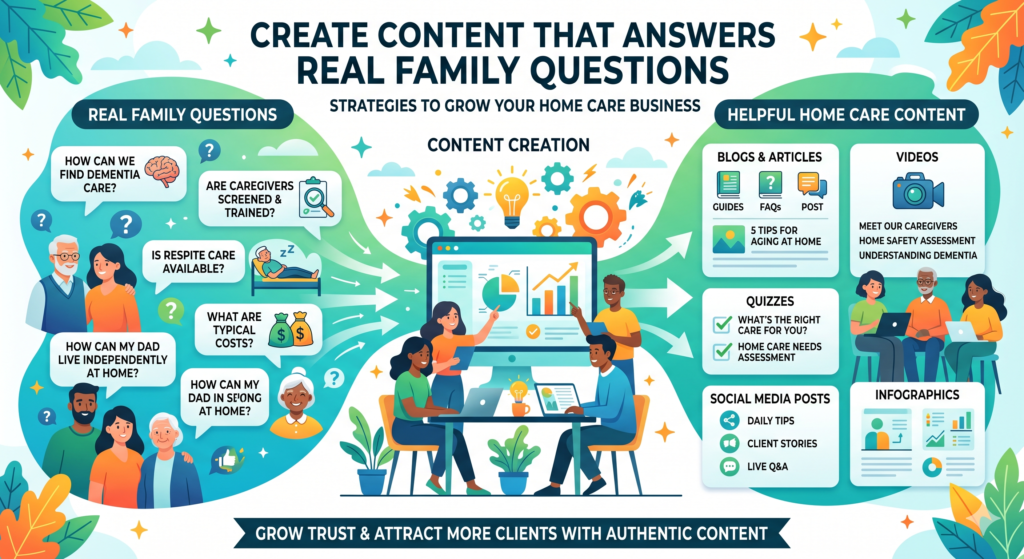
The better approach is to create content around the exact questions families ask before they are ready to call.
They want to know when it is time for care. They want to know how to talk to a parent who refuses help. They want to know what home care costs. They want to know the difference between home care and home health care. They want to know how many hours of care they need. They want to know what to do after a fall, hospital stay, or dementia diagnosis.
When your content answers those questions clearly, you become helpful before you become a choice.
Blog topics should come from sales calls, not guesses
Your best content ideas are already inside your agency. They are in your phone calls, emails, intake notes, and conversations with families.
Listen for repeated questions. When several families ask the same thing, that is a blog topic. When people seem confused about the same issue, that is a page you should create. When families hesitate because of fear, cost, guilt, or uncertainty, that is content that can guide them forward.
For example, if many families ask, “How do I know if my mom needs home care?” you can write a detailed article that explains early signs, safety risks, emotional changes, caregiver stress, and what to do next. That article can rank in search, but more importantly, it can help families make sense of a hard moment.
Each article should lead the reader toward the next clear step
A blog post should not end suddenly. It should gently guide the reader to the next action.
If the article is about signs a parent needs care, the next step could be scheduling a care consultation. If the article is about dementia care, the next step could be calling to talk through safety concerns. If the article is about respite care, the next step could be asking how many hours per week would help the family caregiver rest.
This does not need to feel salesy. It should feel like natural guidance.
A strong ending might say, “If you are starting to wonder whether your loved one needs support at home, you do not have to figure it out alone. A short call with our care team can help you understand your options and decide what level of help makes sense.”
That is clear, calm, and helpful.
Your content should sound like a caring expert, not a medical textbook
Families do not want to read stiff, cold content when they are worried. They want simple answers from someone who understands.
Use plain language. Explain ideas slowly. Avoid big claims. Do not fill pages with jargon. Write the way a kind care coordinator would speak during a thoughtful conversation.
This tone builds trust. It also keeps people reading.
The goal is not to impress the reader with complex words. The goal is to help them feel less confused than they were before they found you.
Make Paid Ads Work by Matching the Right Message to the Right Moment
Paid ads can help a home care agency get leads faster, but they can also waste money quickly. The biggest mistake is sending all traffic to the same basic page with the same basic message.
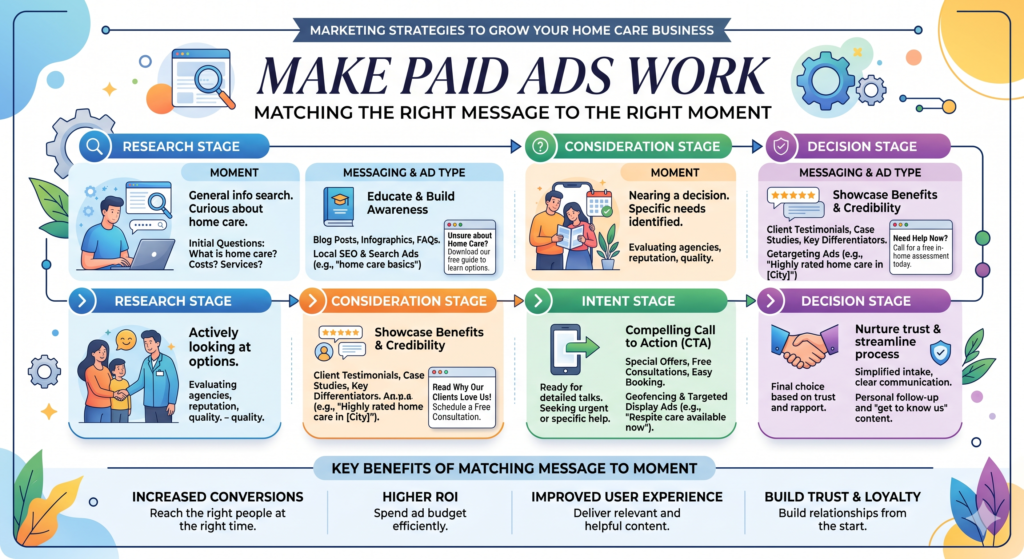
Not every searcher is in the same state of mind.
Someone searching “home care near me” may be ready to call today. Someone searching “how much does home care cost” may still be comparing options. Someone searching “dementia caregiver near me” has a very specific need. Your ads and landing pages should match those different moments.
Search ads should focus on urgent and high-intent needs
Google Search ads are powerful because they show up when someone is already looking for help. For home care, this usually works better than broad awareness ads because the family has intent.
Your ad groups should be tightly focused. One group can target general home care searches. Another can target dementia care. Another can target respite care. Another can target post-hospital care or overnight care if those are services you offer.
Each ad should speak directly to the search.
If someone searches for dementia care, the ad should not simply say “Trusted Home Care Agency.” It should mention dementia care, safe routines, trained caregivers, and support at home. The landing page should continue that same message.
Your landing page should remove doubt before asking for the call
A paid ad landing page has one job. It should help a visitor feel confident enough to contact you.
The page should have a clear headline, warm copy, trust signals, service details, reviews, service area information, and a simple form or phone number. It should explain what happens after the person reaches out.
Do not overload the page with too many choices. If the ad is about dementia care, keep the page focused on dementia care. If the ad is about respite care, keep the page focused on family caregiver relief.
This makes the page more relevant and can improve both conversions and ad performance.
Track calls so you know what is actually working
Many home care agencies run ads but do not track results clearly. They may know how many clicks they got, but not how many real care inquiries came from those clicks.
You need call tracking, form tracking, and lead quality tracking. Not every lead is equal. A low-cost lead that never answers the phone is not better than a higher-cost lead that becomes a long-term client.
Track which keywords create real conversations. Track which campaigns lead to assessments. Track which leads become clients. Then move your budget toward what brings revenue, not just traffic.
This is how paid ads become a growth tool instead of a guessing game.
Build a Referral Engine With Local Partners Who Already Have Trust
Home care grows faster when the right local people know your agency, trust your team, and feel safe sending families to you.
Online marketing is important, but home care is still a relationship business. Many families first hear about care from someone they already trust. That person may be a doctor, nurse, social worker, discharge planner, elder law attorney, physical therapist, senior living manager, church leader, or local senior center staff member.
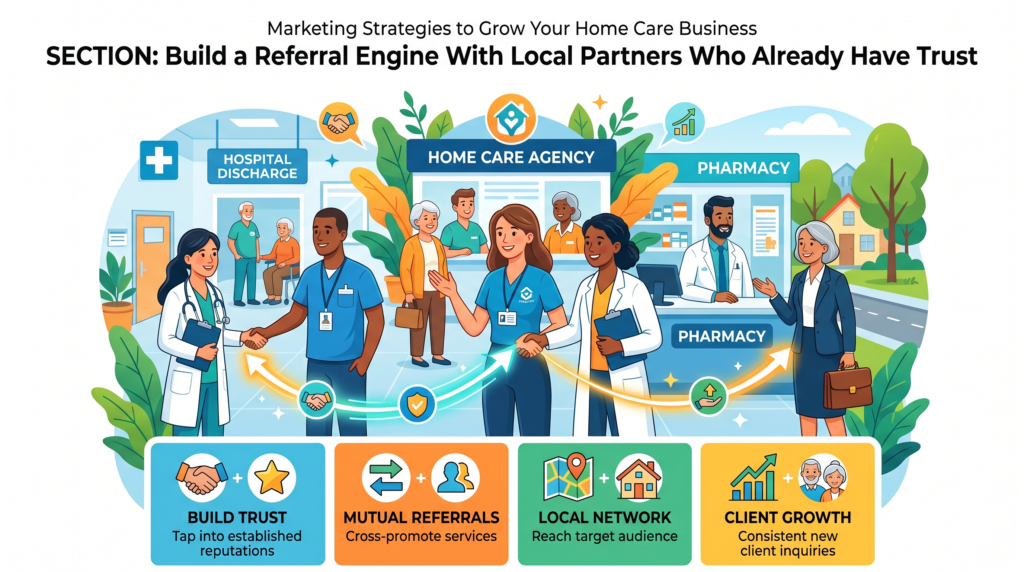
This is why referral marketing should not be random. It should be built like a system.
You do not want to “drop by” once, leave a brochure, and hope people remember you. That rarely works. These local professionals are busy. They meet many providers. They need a clear reason to trust you. More than that, they need to know what makes your agency easy to refer.
Your referral message should make the partner’s job easier
A referral partner does not care about your agency in the same way you do. They care about their patient, client, resident, or community member. They want to know that if they refer someone to you, that family will be treated well.
So your message should not start with, “We are looking for referrals.”
It should start with the problem you help them solve.
A discharge planner may need safe care set up quickly so a patient can go home without delays. A physical therapist may need a reliable caregiver who can help a client follow safe routines at home. An elder law attorney may need a trusted agency for families who are planning long-term care.
A senior center may want education for older adults and caregivers.
When you speak to the partner’s need, you become useful instead of just another agency asking for leads.
Your outreach should be steady, helpful, and never pushy
Referral growth comes from repeated useful contact. This does not mean bothering people. It means showing up with value over time.
You can share a simple one-page guide on signs that a senior may need help at home. You can offer a short talk for family caregivers. You can send a helpful checklist for hospital-to-home transitions. You can call to ask what kinds of home care cases are hardest for them to place.
This builds trust because you are not only asking. You are helping.
The best referral relationships often begin with small acts. You answer quickly. You solve a problem. You communicate clearly. You make the partner look good for referring you. Over time, that becomes your edge.
Your follow-up after a referral can make or break future referrals
Many agencies focus only on getting the referral. They forget that what happens after the referral decides whether more referrals will come.
When a partner sends a family your way, respond fast. Let the family know who referred them, if appropriate. Treat the case with care. After the first conversation or assessment, give the partner a simple update when it is allowed and useful.
A partner does not need private details. But they do need confidence that the family was contacted, supported, and guided.
That follow-up helps them feel safe referring you again. It also shows that your agency is organized, respectful, and serious about service.
Use Reviews, Stories, and Proof to Make Families Feel Safe
In home care, proof is more powerful than promises.
Any agency can say it is caring. Any agency can say it is dependable. Any agency can say families trust them. But when real families say it, the message becomes stronger.
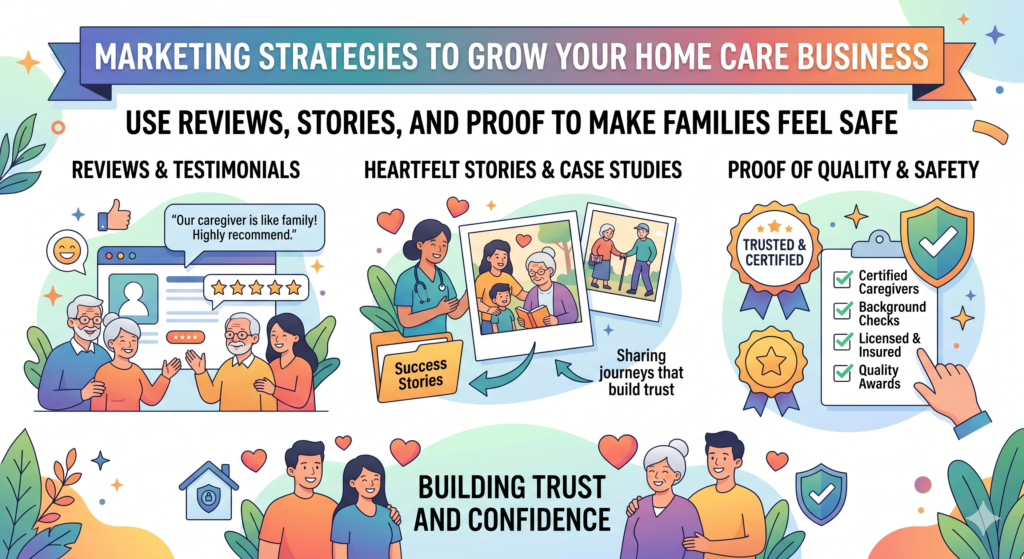
This is why reviews, testimonials, case stories, and simple proof points should be a major part of your marketing. Families want to see that other people have trusted you before them. They want signs that your caregivers show up, listen, help, and treat loved ones with respect.
Proof reduces risk. And when people are making a sensitive care decision, risk is one of the biggest reasons they delay.
Your reviews should be placed where families are making decisions
It is not enough to collect reviews and leave them only on Google. You should use them across your marketing.
Place strong reviews on your homepage. Add service-specific reviews to your service pages. Use short family quotes on landing pages. Add review themes to brochures and referral materials. Mention review highlights during phone calls when they fit the family’s concern.
For example, if a family is worried about reliability, a review that mentions caregivers arriving on time is powerful. If a family is worried that their parent will resist help, a review about a caregiver building a warm bond can help. If a family is nervous after a hospital stay, a review about quick setup and steady support can ease that fear.
Your testimonials should sound real, not polished to death
Do not make every testimonial sound like an ad. Real reviews often have simple words, small details, and honest emotion. That is what makes them believable.
A sentence like, “The caregiver was patient with my dad even on hard days,” can be stronger than a perfect-sounding quote about excellent service. It feels human.
When you ask for testimonials, you can guide families with gentle questions. Ask what problem they were facing before care started. Ask what changed after your team began helping. Ask what they would tell another family in the same situation.
Those answers give you stories that are much stronger than general praise.
Your proof should include more than reviews
Reviews are important, but they are not the only proof you can use.
You can show years in business, number of families served, caregiver screening steps, training standards, response times, local awards, community involvement, or partnerships. You can explain how you match caregivers. You can show what your care process looks like. You can introduce your leadership team.
The goal is not to brag. The goal is to help families believe that your agency is real, stable, and prepared.
A worried family is asking one quiet question the whole time: “Can I trust these people?”
Your marketing should answer that question again and again, in different ways, without sounding forced.
Create a Follow-Up System So Good Leads Do Not Go Cold
Many home care agencies lose leads not because their marketing is weak, but because their follow-up is weak.
A family may call, ask questions, and then go quiet. They may fill out a form but not answer the first return call. They may speak with your care coordinator but need to talk with siblings before deciding. They may be interested but not ready. They may be comparing agencies.
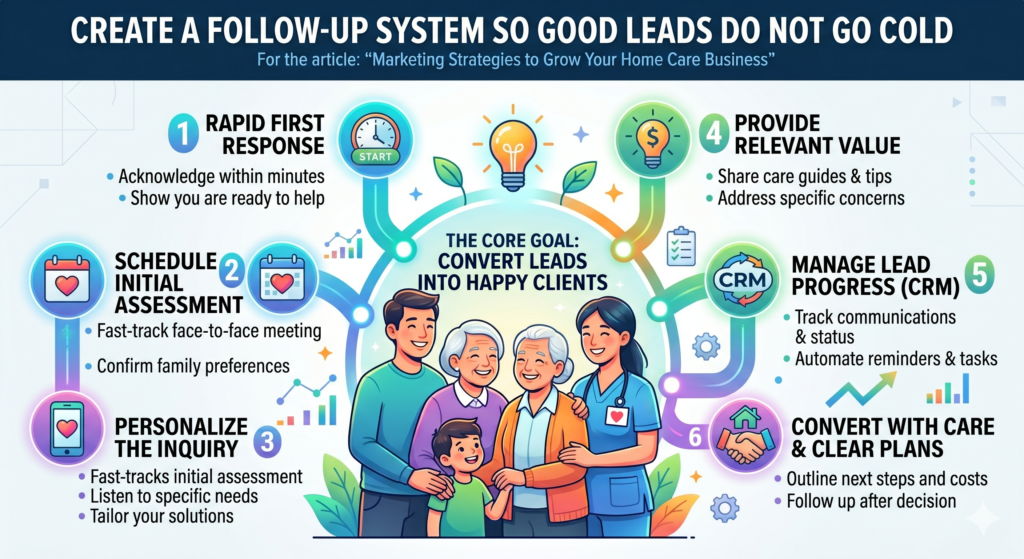
If you only follow up once or twice, you will lose many of these people.
Home care decisions often take time. Even urgent cases can slow down because families are emotional, busy, or divided. A strong follow-up system keeps your agency present without making people feel pressured.
Your first response should be fast and personal
Speed matters. When a family reaches out, they are often in a moment of concern. If you wait too long, another agency may answer first and earn the trust.
Respond as quickly as possible during business hours. If the lead comes after hours, make sure they receive a warm message that explains when they will hear from you. If you offer after-hours support, make that clear.
But speed alone is not enough. The response should feel personal.
Use the person’s name. Mention the service or concern they asked about. Let them know you can help them think through options. Avoid cold scripts that make the family feel like just another lead.
Your follow-up should guide the family through a hard decision
A good follow-up does not just say, “Are you still interested?”
That question puts pressure on the family. It also does not help them move forward.
A better follow-up gives value. You can say, “I know this can be a lot to sort through. Many families we speak with are unsure how many hours of care they need at first. We can help you start small and adjust as your loved one’s needs become clearer.”
This kind of message answers a hidden concern. It makes the decision feel less heavy.
You can also follow up with helpful resources. Send a guide about care options. Share a page about costs. Offer a short call to compare care levels. Remind them that they do not need to have everything figured out before speaking with you.
Your database should be treated like a future growth asset
Not every lead becomes a client right away. Some families may need care in three months. Some may come back after a fall. Some may refer a friend later. Some may need respite care before they need regular care.
This is why your contact list matters.
Stay in touch with useful emails. Send simple, helpful content about senior safety, caregiver stress, dementia support, fall prevention, hospital discharge planning, and signs that extra help may be needed. Keep the tone calm and useful.
Do not send emails that only promote your agency. Send emails that help families feel better prepared.
When the timing is right, they are more likely to remember the agency that kept helping them even before they became a client.
Make Your Brand Feel Human Before Families Ever Call
A home care brand is not just a logo, color, or tagline. It is the feeling people get when they see your agency online, speak with your team, read your content, or hear your name from someone else.
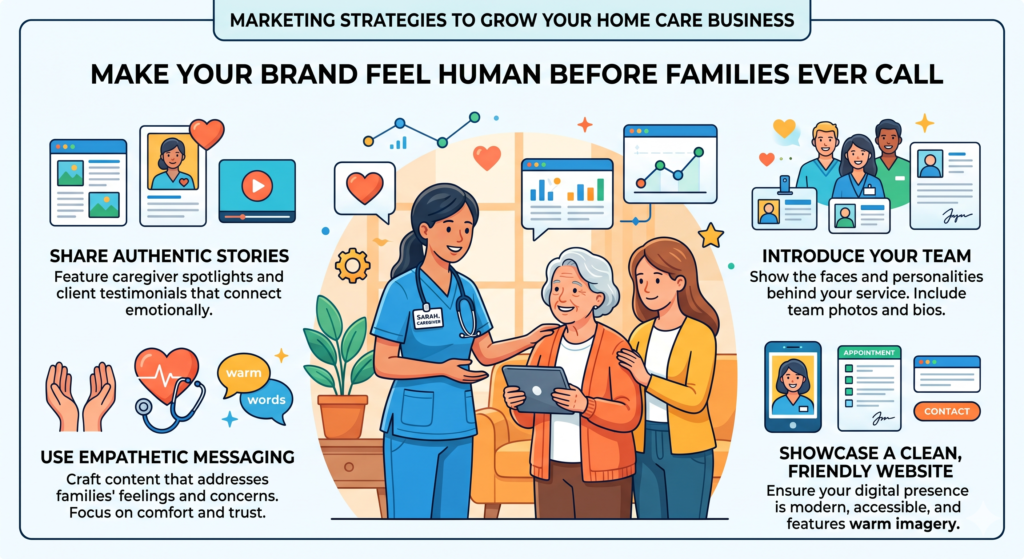
Families are not looking for a clever brand. They are looking for a safe one.
Your brand should feel warm, steady, clear, and local. It should help people feel that there are real humans behind the agency. This is especially important because home care can feel scary to families who have never hired help before.
Show the people behind your agency
Many home care websites feel faceless. They use stock photos, vague copy, and generic service pages. That makes the agency feel replaceable.
You can stand out by showing your real team.
Introduce your owner, care managers, coordinators, and caregivers when possible. Share why your agency exists. Explain what your team believes about care. Talk about the standards you use when hiring. Show what kind of people families will speak with when they call.
You do not need to reveal every private detail. You simply need to make the agency feel real.
Your photos should build comfort, not just fill space
Photos matter because people judge trust quickly. If your website only uses staged images that look like every other agency, the brand feels less personal.
Use real photos when you can. Show your office, your team, community events, caregiver training, or warm everyday moments that reflect your values. Make sure every photo feels respectful and professional.
Avoid images that make seniors look helpless or sad. Families want support, but they also want dignity for their loved ones. Your visuals should show care with respect.
Your voice should be clear across every channel
Your website, ads, emails, brochures, social media posts, and phone scripts should all sound like the same agency.
If your website is warm but your emails are cold, the experience feels uneven. If your ads promise personal care but your phone greeting feels rushed, trust drops. If your brochures are full of stiff words, families may not feel the warmth you want to show.
Choose a simple voice and use it everywhere. Speak with care. Be direct. Avoid jargon. Explain things in plain words. Sound like a helpful guide, not a sales machine.
That consistency makes your agency easier to trust.
Use Social Media to Build Familiarity, Not Just Post for the Sake of Posting
Social media can help a home care business grow, but only when it is used with a clear purpose. Many agencies post random holiday graphics, short care tips, and stock images because they feel they “should” be active. The problem is that this kind of posting rarely builds trust or brings in serious leads.
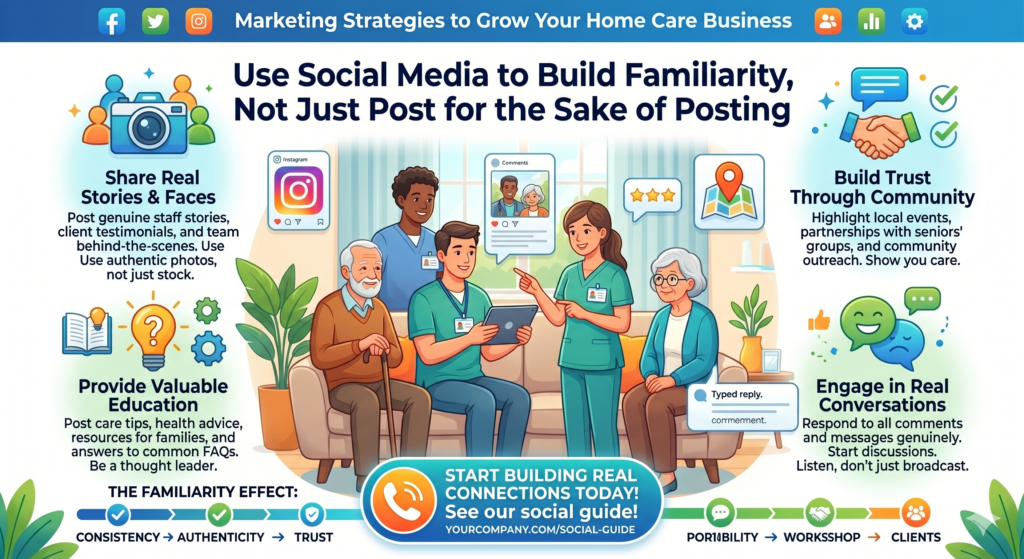
Home care social media should not feel like noise. It should make local families more familiar with your agency. It should show your values, your people, your care style, and your role in the community. When done well, social media helps families feel like they already know you before they ever call.
This matters because home care is a high-trust service. Families often need to see your name several times before they feel ready to reach out. Social media gives you a soft way to stay visible without always selling.
Your social content should answer what families are already feeling
The best social posts do not simply say, “We offer home care.” They speak to the real moments families face.
A daughter may be wondering why her mother is forgetting meals. A son may be worried about his father driving. A spouse may feel tired from caring for someone with dementia. An adult child may feel unsure about bringing up home care without upsetting a parent.
Your posts should meet these moments with simple, kind guidance. You can write about signs that a loved one may need help, how to start a care conversation, what to do after a fall, how respite care supports family caregivers, and how small home safety changes can reduce stress.
These topics work because they are useful before they are promotional. They show that your agency understands real family life, not just service packages.
Your social pages should show real warmth and local presence
Families want to know that your agency is active, human, and connected to the community. Social media is a good place to show that.
Share photos from local events, caregiver appreciation days, senior center talks, charity efforts, team training, and community partnerships. Talk about your service area in a real way. Mention local needs, local resources, and local stories when appropriate.
This helps your agency feel less like a company on a screen and more like a trusted local care team.
But be careful with privacy. Never share client details without clear permission. Never use personal stories in a way that feels careless. Home care marketing must protect dignity at all times.
Your social media should invite conversation in a gentle way
You do not need every post to push people to call. In fact, too many sales posts can make your page feel cold.
Instead, invite small actions. Ask families to think about whether their loved one is safe at home. Encourage caregivers to take breaks. Invite people to read a helpful guide on your website. Remind them that they can ask questions before they are ready to start care.
A good post might say, “If you are starting to worry about your parent living alone, you do not have to make a big decision today. Start by noticing what has changed. Are meals being skipped? Is the house less tidy than usual? Are medications being missed? These small signs can help you understand when extra support may be needed.”
That kind of message does not feel pushy. It feels helpful. And helpful content builds trust over time.
Improve Your Phone Process Because Calls Are Where Growth Is Won
Marketing does not end when the phone rings. In many home care agencies, that is where the real sale begins.
A family may find you through Google, read your reviews, visit your website, and then call with hope and worry. If that call feels rushed, cold, confusing, or too focused on price, the lead can be lost in minutes.
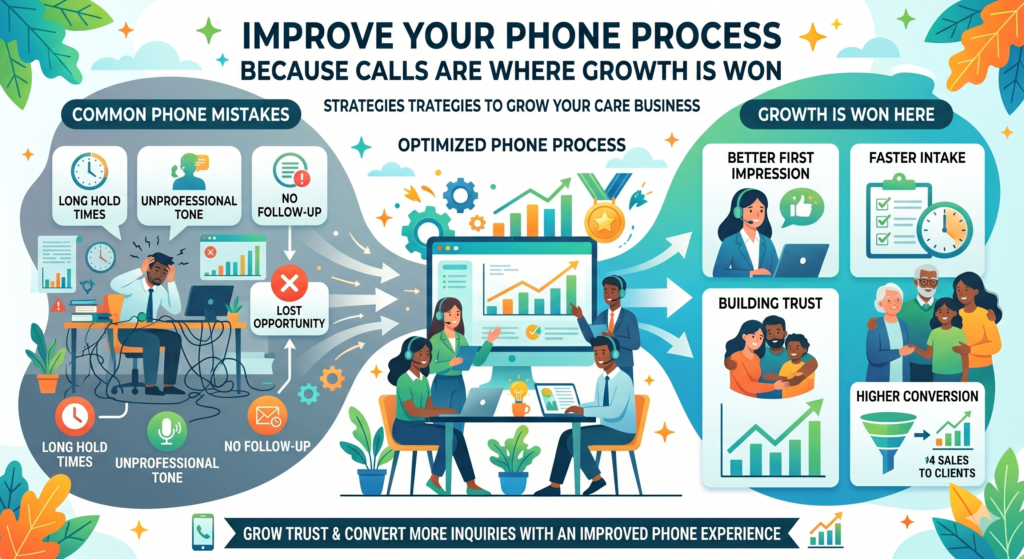
The phone process is one of the most important parts of home care marketing because it turns attention into action. A strong call builds trust. A weak call wastes the money and effort spent getting the lead.
The first call should feel like support, not intake
Many agencies treat the first call like a form. They ask name, address, service needed, hours needed, start date, and budget. Those details matter, but if the call feels like a checklist too soon, the family may not feel heard.
Start with care before data.
Ask what is happening. Let the caller explain. Listen for emotion. Are they scared after a fall? Are they tired from caregiving? Are they under pressure because a hospital discharge is coming? Are they worried their parent will reject help?
When you understand the real situation, you can guide the call better. You also show the family that your agency is not just trying to book hours. You are trying to help.
Your team should know how to answer price questions with care
Price is one of the hardest parts of home care sales. Families often ask about cost early because they are nervous. Some agencies avoid the question. Others answer too quickly and lose the chance to explain value.
The best approach is clear and calm.
You can give a simple range if that fits your agency policy, but you should also explain that the right care plan depends on needs, schedule, and level of support. Then guide the family back to the situation.
For example, your team might say, “I can absolutely help you understand cost. The final amount depends on how many hours your loved one needs and what kind of support is safest. Before I give you the best estimate, can I ask what has changed at home recently?”
This keeps the conversation honest while still showing care.
Every call should end with a clear next step
A call should never end with vague words like, “Call us back if you need anything.” That puts the full burden back on the family.
Instead, guide them to a clear next step. That may be an in-home assessment, a follow-up call with another family member, sending care information by email, or helping them understand service options.
If they are not ready, schedule a follow-up. Do not leave it open.
A better ending sounds like, “It sounds like your family is still talking through the best option. Why don’t I call you on Thursday afternoon after you have had time to speak with your brother? I can answer any new questions and help you compare what level of care may make sense.”
That is helpful, respectful, and much stronger than waiting.
Build Caregiver Recruitment Into Your Marketing Strategy
A home care agency cannot grow if it cannot hire and keep good caregivers.
This is why caregiver recruitment should be part of your marketing strategy, not a separate problem handled only when staffing gets tight. Families choose your agency because of trust, but they stay because of the caregivers. If you do not have enough strong caregivers, your lead generation will eventually create stress instead of growth.
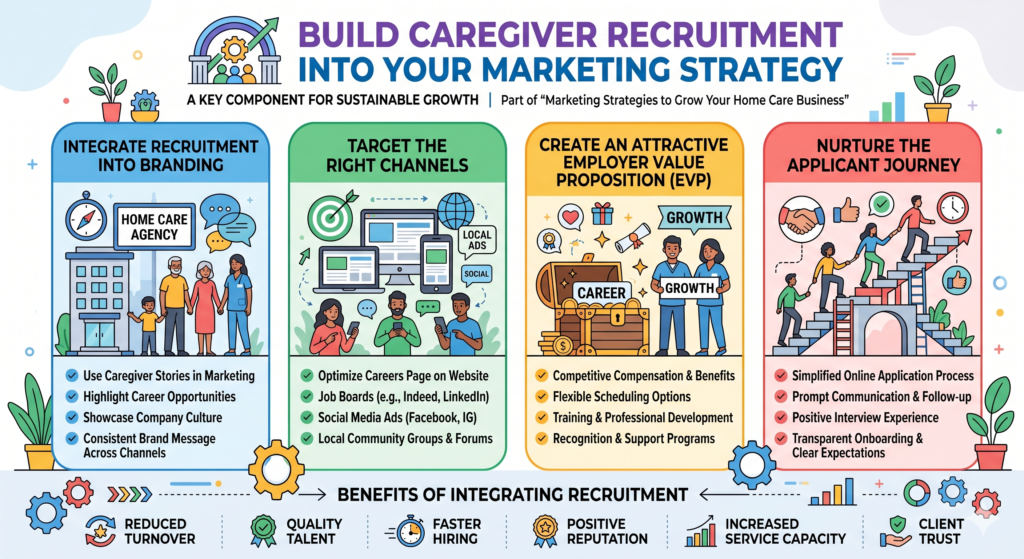
Recruitment marketing matters because caregivers also compare agencies. They look at your pay, schedule options, culture, reviews, values, and how your team treats them. If your agency looks cold or unclear, good caregivers may choose another employer.
Your caregiver message should be as strong as your client message
Many home care agencies put effort into client-facing marketing but treat caregiver job posts like plain ads. They list duties, requirements, and pay, but they do not give caregivers a reason to care.
A better recruitment message speaks to what caregivers want.
They want respect. They want steady hours. They want fair pay. They want clear communication. They want to feel safe with the clients they serve. They want a team that answers the phone when they need help. They want to know their work matters.
Your hiring pages and job posts should reflect that.
Instead of only saying, “Now hiring caregivers,” explain why caregivers stay with your agency. Talk about support, training, flexibility, recognition, and the kind of care culture you are building.
Your website should have a caregiver page that feels human
Your caregiver recruitment page should not feel like an afterthought. It should be warm, clear, and easy to apply from.
Explain who is a good fit for your agency. Describe the kind of clients caregivers may support. Share what your team does to help caregivers succeed. Include real caregiver quotes if you have them. Explain the application steps so people know what to expect.
Just like family leads, caregiver applicants need clarity. If the process feels simple, they are more likely to apply.
Your page should also be easy to find. Add a clear “Careers” or “Become a Caregiver” link in your website menu. Some agencies hide this page, then wonder why they do not get enough applicants.
Happy caregivers can become one of your strongest brand signals
Families notice how caregivers are treated. Referral partners notice too. When your agency has a strong care team, it becomes part of your reputation.
Use your marketing to show caregiver appreciation. Share training moments. Celebrate work anniversaries. Highlight your values. Show that your agency respects the people delivering care.
This helps with recruitment, but it also helps with client trust. A family is more likely to choose an agency that appears to care for its caregivers because that suggests better care for clients too.
Growth is not only about getting more leads. It is about building the team that can serve those leads well.
Use Email Marketing to Stay Close to Families Before and After They Need Care
Email marketing is often ignored by home care agencies, but it can quietly create strong growth. Not every family is ready to start care the first time they visit your site or speak with your team. Some are still thinking. Some are waiting for a parent to agree. Some are watching a situation get worse over time.
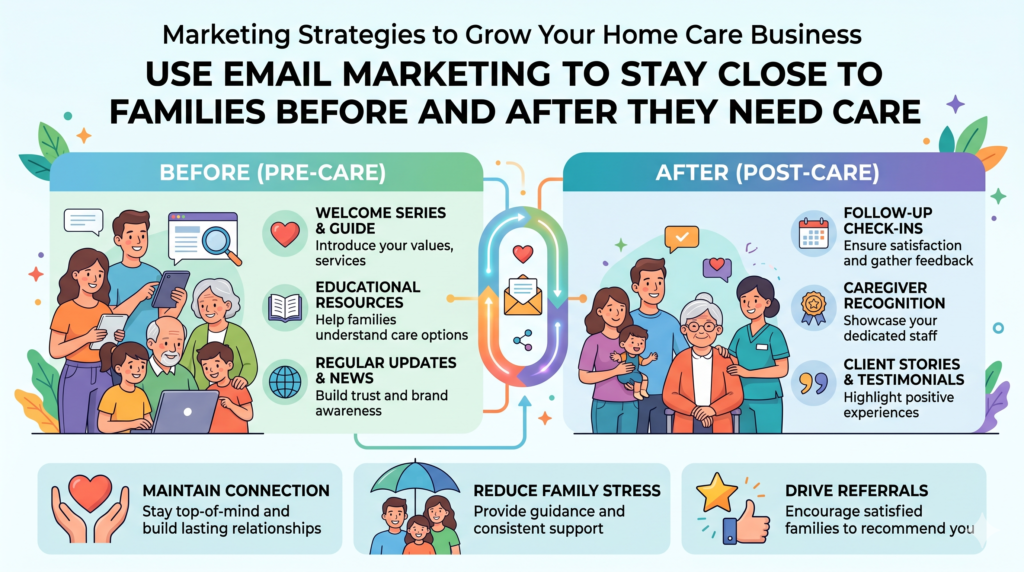
Email helps you stay close during that gap.
It also helps you support current clients, past clients, referral partners, and family caregivers. The key is to make your emails useful. If every email is only about your services, people will stop reading. But if your emails help families make better care decisions, they become a trust-building tool.
Your email list should be built through helpful offers
People do not join an email list just because an agency says, “Subscribe to our newsletter.” That feels vague. They need a reason.
Offer simple resources that match real family concerns. You could create a guide on signs that a parent may need help at home. You could offer a checklist for making the home safer after a fall. You could provide a short guide on talking to a parent about care. You could create a hospital discharge planning checklist.
These resources do not need to be fancy. They need to be useful.
When someone downloads a guide, your follow-up emails can continue the conversation. You can explain care options, share common mistakes to avoid, describe what an assessment looks like, and invite them to ask questions.
Your emails should feel like advice from a trusted guide
A good home care email sounds calm and personal. It should not feel like a loud sales message.
Use short paragraphs. Focus on one topic at a time. Give practical advice. Speak to the family’s situation. Help them notice signs, reduce risk, or understand choices.
An email about caregiver burnout might explain that feeling tired does not mean someone has failed their loved one. It might talk about how respite care can help the family caregiver rest while keeping the loved one safe. It might end with a gentle offer to discuss care options.
This kind of email builds trust because it supports the reader instead of pushing them.
Email can also strengthen referral relationships
Referral partners need regular reminders too. They are busy, and even if they like your agency, they may forget unless you stay visible.
Send short, useful emails to local partners. Share senior care tips, discharge planning support, caregiver education topics, or updates about your agency. Keep the message focused on how you can help their patients, clients, residents, or community members.
A partner email might explain how your agency helps families after a hospital discharge, what signs show a senior may not be safe alone, or how quickly your team can respond to new care needs.
The goal is to stay top of mind without becoming annoying. Useful, simple, steady contact wins.
Create Offers That Make the First Step Easier
Many families delay contacting a home care agency because the decision feels big. They may think calling means they are committing to care. They may worry about cost. They may fear being judged. They may feel unsure whether their loved one really needs help yet.
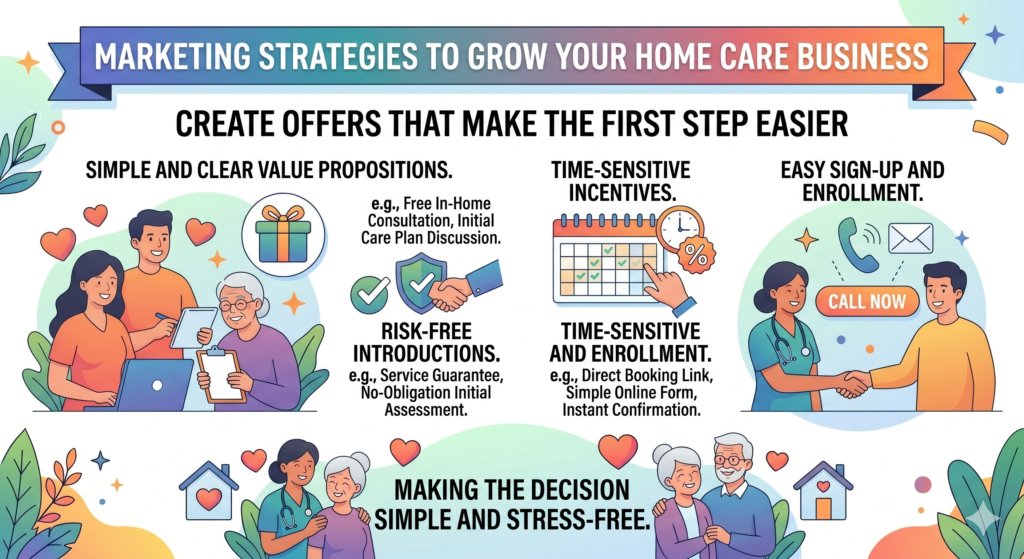
A strong offer lowers that barrier.
In home care, an offer does not need to be a discount. In fact, discounts can sometimes weaken trust if they make the service feel cheap or rushed. A better offer makes the first step feel safe, simple, and helpful.
Your first offer should focus on clarity, not pressure
One of the best offers for a home care agency is a free care consultation. But many agencies say this without explaining what it means.
Do not just write “Free Consultation.” Explain the value.
Tell families they can use the consultation to talk through their situation, understand care options, ask about cost, and learn what level of help may fit. Make it clear that they do not need to know exactly what they need before calling.
This is powerful because many families are confused. They are not always shopping in a straight line. They are trying to understand what is happening and what to do next.
You can create different offers for different care needs
A general consultation is useful, but you can make offers more specific.
For dementia care, you might offer a “Home Safety and Dementia Care Call” where families can talk through risks like wandering, confusion, sundowning, and caregiver stress. For post-hospital care, you might offer a “Hospital-to-Home Care Planning Call” to help families prepare for a safe return home.
For respite care, you might offer a “Family Caregiver Relief Call” to help a tired spouse or adult child understand how a few hours of help each week could support them.
These offers feel more relevant because they match the family’s exact concern.
A family dealing with dementia is more likely to respond to a dementia-specific offer than a broad “contact us” button. Specificity makes your marketing feel more personal.
Your offer should be repeated in every important place
Do not hide your main offer on one contact page. Use it throughout your marketing.
Place it on your homepage, service pages, blog posts, Google Business Profile, email signature, social media posts, brochures, and paid ad landing pages. Mention it during calls with referral partners. Add it to local pages.
The more clearly you repeat the first step, the easier it becomes for families to act.
But keep the wording warm. Instead of pushing people to “Book Now,” use language that fits the emotional weight of the decision. Say, “Talk with our care team,” “Ask a care question,” or “Schedule a simple care consultation.”
Small wording changes can make your agency feel more human.
Build Landing Pages for Each Main Care Need
A landing page is a focused page built for one clear purpose. For a home care agency, that purpose is usually to turn a worried visitor into a phone call, form fill, or consultation request.
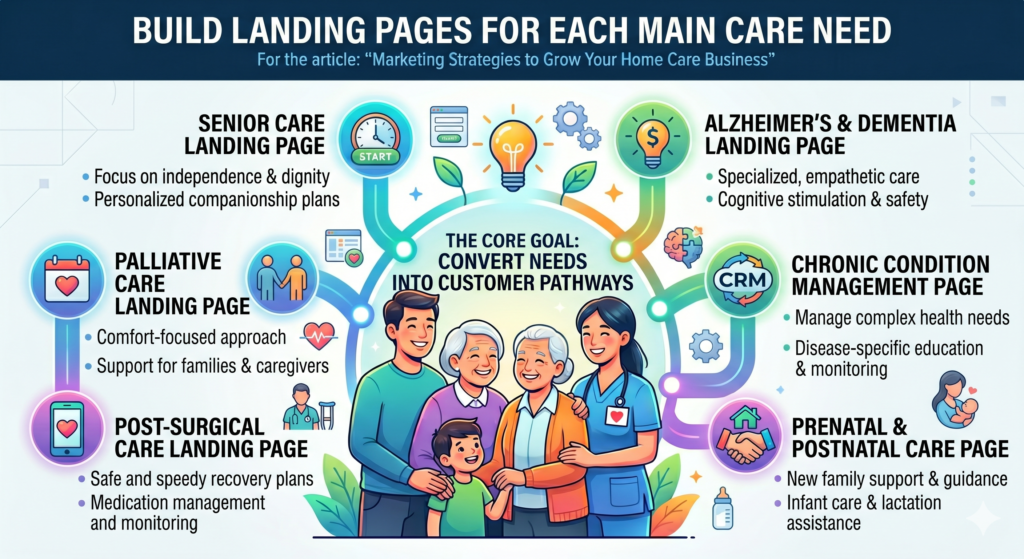
Many agencies send every visitor to the homepage. This is easy, but it is not always smart. A homepage must speak to many people at once. A landing page can speak to one person with one clear need.
That matters because families are not all looking for the same thing.
One family may need dementia care. Another may need overnight care. Another may need help after a hospital stay. Another may need respite care for a tired spouse. If all of them land on the same general page, the message may feel too broad. But if each person lands on a page written for their exact situation, trust grows faster.
A strong landing page should match the family’s urgent concern
The first job of a landing page is to show the visitor they are in the right place.
If someone clicks an ad for dementia care, the page should talk about dementia care right away. It should not begin with a general message about all home care services. The family should quickly see that you understand memory loss, confusion, changing routines, caregiver stress, and safety at home.
If someone clicks a page about post-hospital care, the message should speak to safe recovery, fall risks, medication reminders, meal support, mobility help, and the stress families feel after discharge.
The closer the page matches the visitor’s concern, the more likely they are to stay.
Your page should explain the problem before explaining the service
Families do not always know the name of the service they need. They know what is happening at home.
They know Dad fell twice this month. They know Mom is forgetting to eat. They know their spouse wakes up at night and wanders. They know they are tired and need relief.
Start there.
Before you explain your care service, describe the situation the family may be facing. Show them you understand the real problem. Then explain how your agency helps.
This order matters. When people feel understood, they are more open to your solution.
Your landing page should make the next step feel safe
Every landing page should have a clear next step, but it should not feel aggressive.
Use simple language that lowers pressure. Explain that the family can call to ask questions, understand care options, and talk through what level of support may make sense. Add your phone number near the top and bottom of the page. Use a short form that does not ask for too much too soon.
A form with too many fields can scare people away. Ask for the basics first. Name, phone number, email, care need, and a short message are often enough to begin.
The goal is not to collect every detail through the form. The goal is to start a real conversation.
Use Community Education to Become the Local Expert Families Remember
Home care businesses grow when the community sees them as helpful before they need them. One of the best ways to do this is through education.
Families often do not know when care is needed. They do not know how to plan for aging. They do not know how to handle parent resistance. They do not know how to support someone with dementia. They do not know what questions to ask after a hospital stay.
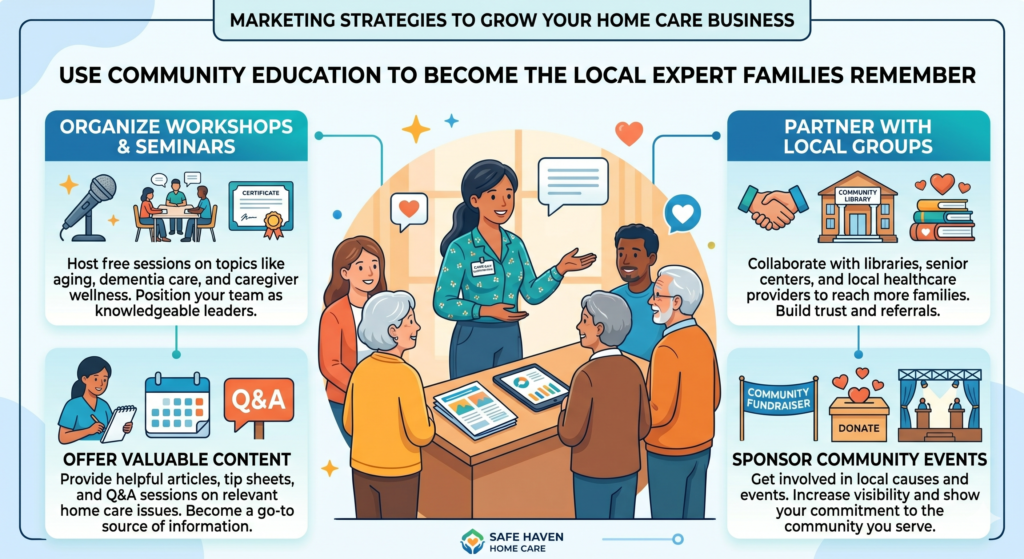
If your agency teaches these topics in a clear and kind way, people remember you.
Community education does not need to be complicated. It can happen through small talks, local workshops, webinars, printed guides, partner events, and simple classes for family caregivers.
Your education topics should solve real local problems
Do not choose topics because they sound professional. Choose topics because families actually need them.
A strong topic might be about how to know when a parent is no longer safe alone. Another might focus on how to talk to an aging parent about accepting help. Another could explain how to prepare the home before a senior returns from the hospital. Another could teach family caregivers how to reduce burnout.
These topics work because they are close to real life.
When people attend a talk like this, they may not be ready to hire care that day. But they leave with your agency in their mind. Later, when the need becomes real, your name feels familiar.
Your events should feel helpful, not like a sales pitch
The fastest way to lose trust during an educational event is to turn it into a long ad for your agency.
Teach first. Sell gently, if at all.
Give practical advice. Explain signs to watch for. Share common mistakes. Walk families through simple next steps. Use real examples without sharing private details. Leave time for questions.
At the end, you can invite people to call your agency if they want help thinking through a care situation. That is enough.
When you teach well, people already understand your value. You do not need to push.
Your education content can be reused across many channels
One good workshop can become many marketing assets.
You can turn the talk into a blog post. You can create short social media posts from the main ideas. You can record a short video. You can create a printable checklist. You can send the topic to referral partners. You can use common questions from the event to create new website content.
This makes education one of the most efficient marketing strategies for a home care agency.
You do the work once, then use it in many ways. More importantly, the content is based on real questions from real families, which makes it much stronger than guessing.
Create a Clear Sales Path From First Contact to Start of Care
Marketing brings people to your agency, but your sales path turns interest into clients.
This path should be simple, clear, and easy for families to follow. Many agencies lose leads because the process feels unclear. Families do not know what happens after the first call. They do not know when an assessment takes place. They do not know how care starts. They do not know who they will meet or what they need to prepare.
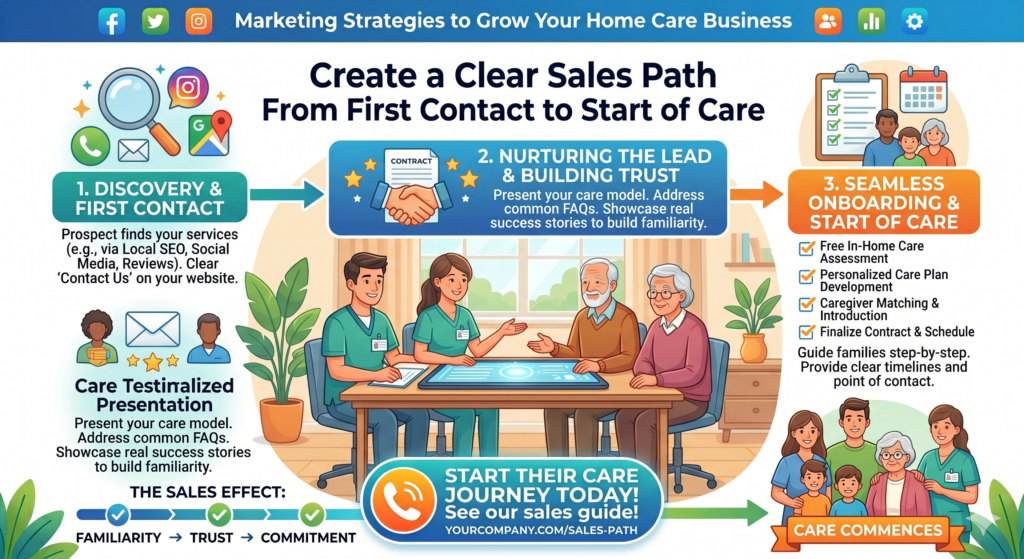
When the path is unclear, families feel more stress. When the path is clear, they feel safer moving forward.
Your process should be explained before families ask
Do not make families guess how your agency works. Explain the steps on your website, in your emails, and during the first call.
A simple process might begin with a care call, then a home assessment, then a care plan, then caregiver matching, then the first care visit. You do not need to make it sound complex. In fact, the simpler it sounds, the better.
Families want to know that there is a plan.
They want to know that you will not just send someone without understanding their loved one. They want to know that the caregiver will know what to do. They want to know that changes can be made if needs shift.
Your care assessment should be positioned as a relief, not a hurdle
Some families may feel nervous about an assessment. They may think it means they are being judged. They may worry their home is not ready. They may fear their loved one will refuse.
Your marketing should explain the assessment in a softer way.
Describe it as a simple conversation where your team learns about the loved one’s needs, routines, safety concerns, personality, and family goals. Explain that it helps you recommend the right level of care and match the right caregiver.
This makes the assessment feel helpful instead of formal.
Your start-of-care communication should build confidence
The moment before care starts is emotional. Families may feel relief, guilt, doubt, and hope all at once. Your communication during this stage matters.
Tell them who will arrive, when they will arrive, what the caregiver will help with, and who to call with questions. Follow up after the first visit. Ask how it went. Listen closely. Make small changes quickly if needed.
This is not just operations. It is marketing.
A strong start creates trust, better retention, and more referrals. A poor start can undo everything your website, ads, reviews, and sales process worked hard to build.
Use Video to Make Your Agency Feel Real and Trustworthy
Video is powerful in home care because it lets families see and hear the people behind the agency.
A written page can build trust, but a warm video can build trust faster. It shows tone, care, patience, and personality. It helps families feel that your agency is made of real people, not just a logo and a list of services.
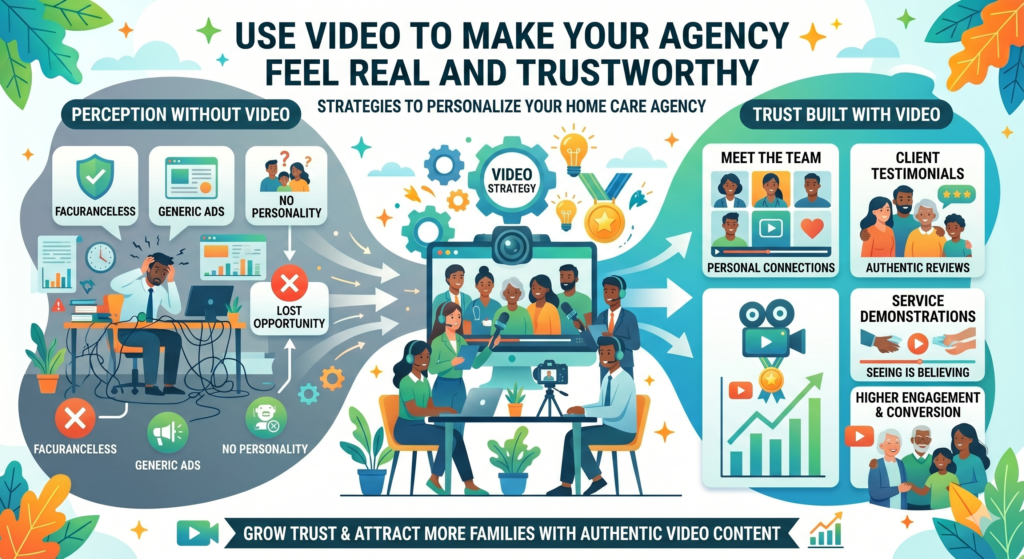
You do not need expensive production to use video well. Clear sound, good light, and honest words are often enough. In fact, overly polished videos can sometimes feel less real. Families want calm, helpful, human content.
Your first videos should answer the questions families ask most
Start with simple videos that answer common questions.
You can record a short video explaining when a parent may need home care. Another can explain what happens during the first care call. Another can talk about how caregiver matching works. Another can explain respite care. Another can discuss dementia care at home.
These videos do not need to be long. They need to be useful.
A care manager speaking clearly for two minutes can be more effective than a fancy brand video that says very little.
Your videos should reduce fear and uncertainty
Families often delay action because they do not know what to expect. Video can make the process feel less scary.
A video from the owner or care coordinator can explain that the first call is not a commitment. It is a chance to ask questions and understand options. A video about the care assessment can show that the visit is friendly and respectful. A caregiver introduction video can help families feel more comfortable with the idea of someone coming into the home.
This is where video shines. It turns an unknown process into something more familiar.
Your videos should be used across your full marketing system
Do not post a video once and forget it.
Add videos to your homepage, service pages, landing pages, emails, social media, and Google Business Profile. Send helpful videos to families after phone calls. Share short clips with referral partners when the topic fits.
One good video can support many parts of your marketing.
The key is to keep each video focused. Do not try to cover everything at once. One video should answer one concern. That makes it easier to watch, easier to share, and easier to use in follow-up.
Measure the Numbers That Actually Lead to Growth
A home care agency cannot improve what it does not measure.
Many agencies look only at surface numbers. They check website visits, social media likes, ad clicks, or how many leads came in. These numbers can be useful, but they do not tell the full story.
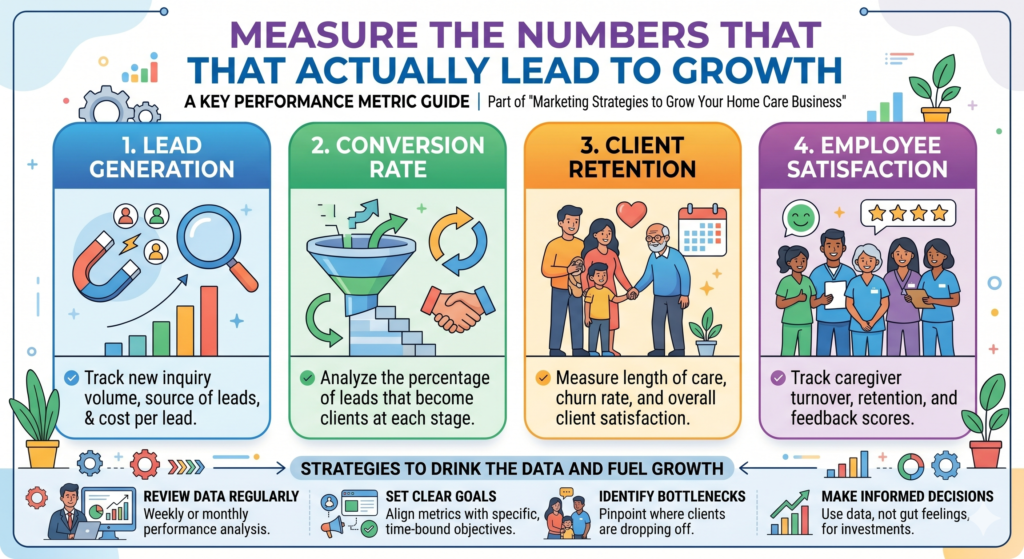
Growth depends on deeper numbers. You need to know which marketing channels bring real inquiries. You need to know which inquiries become assessments. You need to know which assessments become clients. You need to know which clients stay long enough to create profit.
Without this, marketing becomes guesswork.
Your tracking should connect marketing to revenue
The most important question is not, “How many leads did we get?”
The better question is, “Which leads became good clients?”
A campaign that brings many poor-fit leads may look successful at first. But if those leads cannot afford care, live outside your service area, need services you do not offer, or never start care, the campaign is not really working.
On the other hand, a campaign with fewer leads may be very profitable if those leads become long-term clients.
Track the full path. Look at source, inquiry type, care need, assessment booked, client started, hours per week, and length of service. Over time, this shows which channels deserve more money and which need to be fixed.
Your team should review lead quality, not just lead volume
Lead quality is easy to ignore when everyone is busy. But it is one of the best ways to improve marketing.
Set a regular time to review recent leads. Look at where they came from. Talk about which ones were strong and which ones were not. Notice patterns.
Maybe dementia care leads from search ads convert well. Maybe broad Facebook leads are cheap but weak. Maybe referrals from one hospital often become good clients. Maybe a local page for one town brings calls, but the calls are outside your service area.
These patterns help you make smarter decisions.
Your marketing reports should be simple enough to use
A report does not need to be complicated to be useful. In fact, many complicated reports are ignored.
Your agency should have a simple view of the numbers that matter. Look at leads by source, calls answered, consultations booked, assessments completed, new clients started, cost per client, average weekly hours, and revenue by source.
The goal is not to drown in data. The goal is to see what is working clearly enough to act.
Good tracking helps you stop wasting money and double down on what brings real growth.
Build a Marketing Calendar So Growth Becomes Consistent
Many home care agencies market in bursts. They post for a few weeks, run ads when leads slow down, visit referral partners when census drops, and write content only when someone has time.
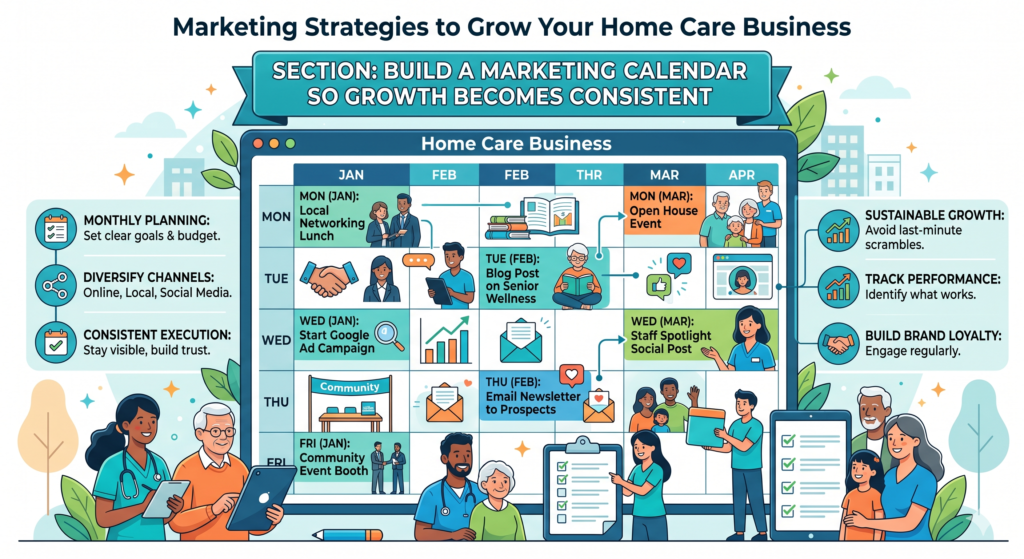
This creates uneven growth.
A better approach is to build a simple marketing calendar. The calendar keeps your agency visible even when things get busy. It helps your team know what to publish, who to contact, what campaigns to run, and what message to focus on each month.
Consistency matters because families and referral partners rarely act the first time they see you. They need repeated trust signals over time.
Your calendar should follow the real needs of families through the year
Home care demand often connects to seasonal moments and family life.
After holidays, adult children may notice that a parent has changed. In winter, fall risks and isolation may become bigger concerns. During summer, family caregivers may need respite support. Around hospital discharge planning periods, families may need quick help at home.
Your marketing calendar should reflect these moments.
Plan content, emails, social posts, partner outreach, and local education around what families are likely thinking about at that time.
Each month should have one main message
Do not try to talk about every service all the time. That makes marketing feel scattered.
Choose one main theme each month. One month can focus on fall prevention. Another can focus on dementia support. Another can focus on respite care. Another can focus on post-hospital care. Another can focus on helping families talk to aging parents about accepting help.
This makes your marketing easier to create and easier for people to remember.
The same monthly theme can shape your blog post, emails, social content, referral partner handouts, and short videos. This gives your message more power because people see it in several places.
A simple calendar is better than a perfect one nobody follows
Do not make the calendar so complex that your team cannot keep up.
Start with a plan you can actually follow. That may mean one blog post a month, one helpful email every two weeks, two or three social posts a week, one partner outreach focus per month, and one review request process that runs every week.
Once that becomes steady, you can add more.
Marketing growth does not come from doing everything at once. It comes from doing the right things again and again, with a clear message and strong follow-through.
Conclusion
Growing a home care business is not about shouting louder than every other agency. It is about becoming the name families trust when they are facing one of the most personal decisions of their lives.
The families who need you are not just shopping for care hours. They are looking for peace of mind. They want to know their loved one will be safe, respected, and treated with patience. They want to know they can ask questions without being pressured. They want to know that if they choose your agency, life at home will feel more stable, not more stressful.















Comments are closed.