
WinSavvy Editorial Standards
How this article was created
A banquet hall is not just a space with tables, lights, chairs, and a stage. It is where families celebrate big days, companies host important events, couples begin their married life, and communities come together. But here is the hard truth. Even the most beautiful banquet hall can stay empty if people do not know why they should choose it.
Build a clear brand story around the kind of events your banquet hall is best known for
A banquet hall becomes easier to market when people can quickly understand what it stands for. Many banquet halls try to sell themselves to everyone. They say they are perfect for weddings, birthdays, baby showers, corporate meetings, school events, family parties, award nights, religious events, and everything else. While this may be true, it often makes the brand feel unclear.
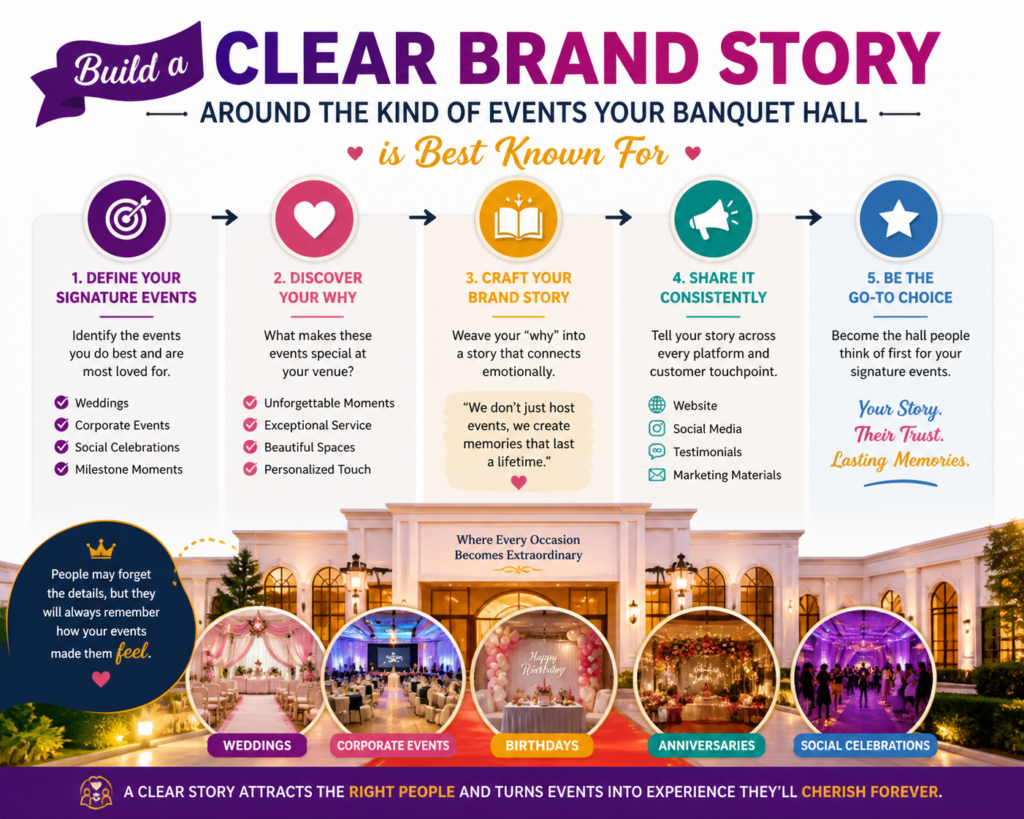
People do not remember a hall because it can host “all kinds of events.” They remember it because it feels like the right place for their kind of event.
This is why your first creative marketing strategy should be to build a simple brand story. Your brand story is not a long company history. It is the main idea people should connect with your venue. It tells them what kind of feeling your banquet hall creates.
Your banquet hall should not sound like every other banquet hall
Most banquet hall websites and ads sound almost the same. They use lines like “perfect venue for every occasion,” “best banquet hall in town,” “make your day special,” or “affordable packages available.” These lines are common, so people stop noticing them.
Instead, your brand should say something more specific. For example, a hall that is popular with large families could position itself as the place where big celebrations feel smooth and stress-free.
A smaller premium hall could become known for intimate events that feel warm, elegant, and personal. A modern hall could focus on stylish events for young couples, product launches, and social gatherings.
The goal is not to limit your business. The goal is to become easier to remember.
A clear brand story helps people choose faster
When someone is planning an event, they already feel pressure. They need to manage guests, food, dates, budget, decoration, parking, timing, and family opinions. If your marketing adds more confusion, they move on. But if your message feels clear, they feel safer.
A strong brand story can reduce doubt. It helps people think, “This place understands what I want.” That feeling matters more than most venue owners realize.
For example, instead of saying your banquet hall has “beautiful interiors and great service,” you can say that your hall is designed for families who want a grand event without the stress of managing ten different vendors. That message is more useful because it speaks to a real problem.
Your brand story should show what makes your hall different in plain words. Maybe your strength is easy parking. Maybe it is flexible food options. Maybe it is the way your team handles last-minute changes. Maybe it is your lighting, stage, bridal room, sound system, or central location. Whatever it is, connect it to the customer’s life, not just to your features.
Turn your past events into proof of your brand story
Your past events are one of your strongest marketing assets. Yet many banquet halls only use them as photo galleries. A photo gallery is helpful, but it does not tell the full story. People need context. They want to know what happened, what the challenge was, how the hall was used, and why the event worked well.
This is where your marketing can become more creative. Instead of posting random photos from an event, turn each event into a small story. Explain what the client wanted, how the space was arranged, how many guests attended, what kind of setup was used, and what made the event special.
This makes your venue feel real. It helps future customers picture their own event in your space.
Simple event stories can sell better than polished ads
A polished ad can create attention. But a real event story can create trust. When people see that another family or company had a successful event at your hall, they feel more confident. They are not just looking at your claims. They are seeing proof.
For example, you could write a short story about a 300-guest engagement ceremony where the family wanted a grand look but needed the event to stay within a fixed budget. You could explain how the seating plan, lighting, entrance setup, and decoration choices helped create a premium feel without waste.
This type of story is useful because it gives ideas to future customers. It also shows that your team knows how to solve problems.
Your website, Instagram captions, Facebook posts, Google Business Profile updates, and email follow-ups can all use these event stories. Over time, your banquet hall stops looking like just a room for rent. It starts looking like a trusted event partner.
Make your website sell the experience before it sells the space
A banquet hall website should do much more than display photos, packages, and contact details. It should guide visitors from interest to inquiry. Many people who land on your website are not ready to book right away. They are comparing options. They are checking if your hall fits their event. They are trying to sense whether your team is reliable.
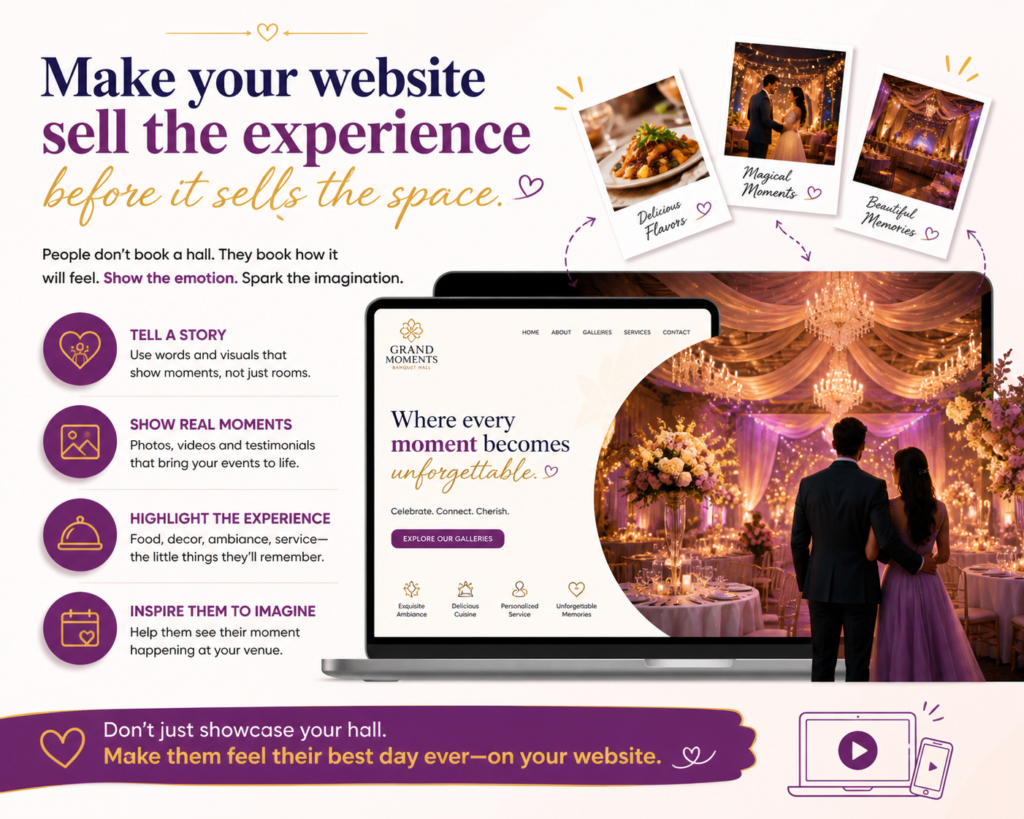
If your website only gives basic information, it may not create enough confidence. A good website should answer questions before people ask them. It should make the visitor feel that your hall is organized, professional, and easy to work with.
Your homepage should answer the customer’s biggest questions quickly
The homepage is often the first serious touchpoint a customer has with your banquet hall. It should not open with vague words. It should quickly explain who the hall is best for, where it is located, what event sizes it can handle, and why people choose it.
A visitor should not have to dig through five pages to know whether your hall can host their event. If your hall fits 100 to 500 guests, say it clearly. If you offer decoration, catering, parking, or event planning support, make it clear. If your hall is near a known landmark, mention it in a simple way.
This does not mean your homepage should feel crowded. It means every section should have a purpose.
A strong first screen can increase inquiries
The first screen of your website matters a lot. This is the part people see before they scroll. It should include a clear headline, a short support line, a strong image, and a simple action such as checking availability or requesting pricing.
For example, a better headline than “Welcome to Royal Palace Banquet” would be “A spacious banquet hall in South Delhi for weddings, receptions, and family celebrations of 100 to 500 guests.” This headline gives real information. It helps the right visitor stay.
The support line can then explain the emotional value. You might say that your team helps families plan smooth, beautiful events with flexible layouts, vendor support, and clear packages. This tells the visitor what life will feel like if they choose you.
Your call to action should also be simple. “Check Available Dates” is often stronger than “Contact Us” because it matches what event planners actually need. They first want to know if the date is open.
Your service pages should be built around event types
Most banquet halls make the mistake of having one general page for all events. This can hurt both SEO and conversions. A wedding customer has different concerns than a corporate customer. A birthday customer has different needs than someone planning a religious event.
That is why your website should have separate pages for your main event types. You can have pages for weddings, receptions, engagement parties, birthday parties, corporate events, baby showers, anniversary parties, and other important categories.
Each page should speak directly to that customer. It should explain how the space can be used, what setup options are available, what support your team offers, and what guests usually care about for that event.
Event pages help both Google and customers understand your hall
Separate event pages make your website easier to rank in search engines. Someone may search for “wedding banquet hall near me,” while another person may search for “corporate event venue in Jaipur” or “birthday party hall for 100 guests.” If your website has only one general page, it may not match these searches well.
But SEO is only one part. These pages also help people feel understood. When a bride or groom lands on a wedding page, they want to see wedding-related photos, seating ideas, stage setups, bridal room details, and guest flow. They do not want to scroll through corporate seminar photos.
The same is true for corporate clients. They want to know about projector setup, sound, seating style, parking, food timing, and professional service. They may care less about floral stage decoration.
When each page matches the visitor’s need, the inquiry becomes warmer. The person feels like your venue is already close to what they want.
Use local SEO to appear when people are actively searching for a venue
Local SEO is one of the most important marketing channels for banquet halls because most people search for venues near a specific area. They may search for “banquet hall near me,” “wedding hall in Andheri,” “party hall near Rajouri Garden,” or “reception venue in Noida.” These searches often come from people who are already serious.
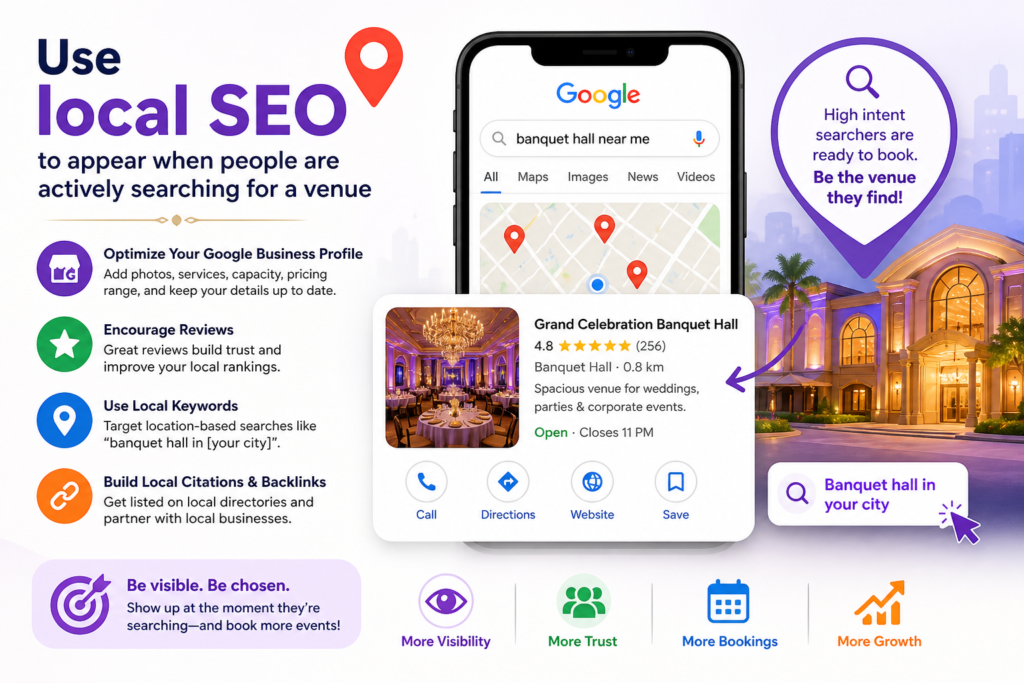
This makes local SEO different from social media. Social media can create interest, but local search often captures demand that already exists. If your banquet hall is not showing up when people search, you are losing high-value leads to competitors.
Your Google Business Profile should be treated like a sales page
Many banquet halls create a Google Business Profile and then forget about it. They add the address, phone number, a few photos, and opening hours. That is not enough. Your Google profile is often the first place people judge your venue.
Before they visit your website, they may look at your rating, reviews, photos, questions, location, and recent updates. If your profile looks empty or outdated, it can create doubt. If it looks active and well-managed, it can create trust.
Your profile should have fresh photos, clear service categories, correct contact details, updated business hours, and regular posts. You should upload photos from real events, empty hall setups, entrance areas, stage designs, dining space, parking, washrooms, and guest areas. People want to see the full experience, not just the best corner of the hall.
Fresh photos can make your profile feel alive
A banquet hall is a visual business. People want to see what the venue looks like now. If your Google photos are old, dark, or low quality, they may assume the hall is not well maintained. This may not be fair, but it is how people judge online.
You should add new photos every week or every few weeks. These do not all need to be professional photos. Clear phone photos can also work if they show real setups, clean spaces, lighting, food counters, entrance decor, and happy event moments.
The key is to make your profile feel current. A profile with recent photos feels more trustworthy than one that has not changed in years.
You can also add short updates about available dates, seasonal packages, new decoration themes, recent event setups, or festival bookings. These posts may not bring huge traffic on their own, but they show activity. They also give searchers more reasons to contact you.
Reviews should be collected with a clear system
Reviews are not just nice to have. They are one of the biggest trust signals for a banquet hall. A person may forgive a simple website if the reviews are strong. But if reviews are weak, old, or missing, even a beautiful website may not be enough.
The problem is that many happy customers do not leave reviews unless you ask them. They finish the event, thank your team, and move on. This is why you need a review collection system.
The best time to ask is shortly after the event, when the client is still happy and the memory is fresh. The request should be personal, simple, and direct. Instead of sending a cold message, thank them for choosing your hall and say that their review will help other families or event planners make a confident choice.
Specific reviews are more powerful than general praise
A review that says “good hall” is helpful, but a review that mentions the staff, food, parking, decoration, cleanliness, and smooth event handling is much stronger. You cannot force people to write specific words, but you can guide them gently.
When you ask for a review, you can say they may mention what they liked most, such as the service, event setup, food, location, or overall experience. This gives them ideas without making the review feel fake.
You should also reply to every review. A simple, warm reply shows that your team pays attention. It also gives future customers another sign that you care.
Bad reviews should not be ignored. If someone complains, reply calmly. Do not argue. Thank them for the feedback, explain that you take it seriously, and invite them to speak with your team. A mature response can sometimes protect your brand more than a perfect rating.
Create visual content that helps people imagine their own event in your hall
Banquet hall marketing depends heavily on imagination. People are not just buying square feet. They are buying a feeling. They want to picture the entrance, the stage, the seating, the photos, the food area, the lighting, and the way guests will react when they walk in.
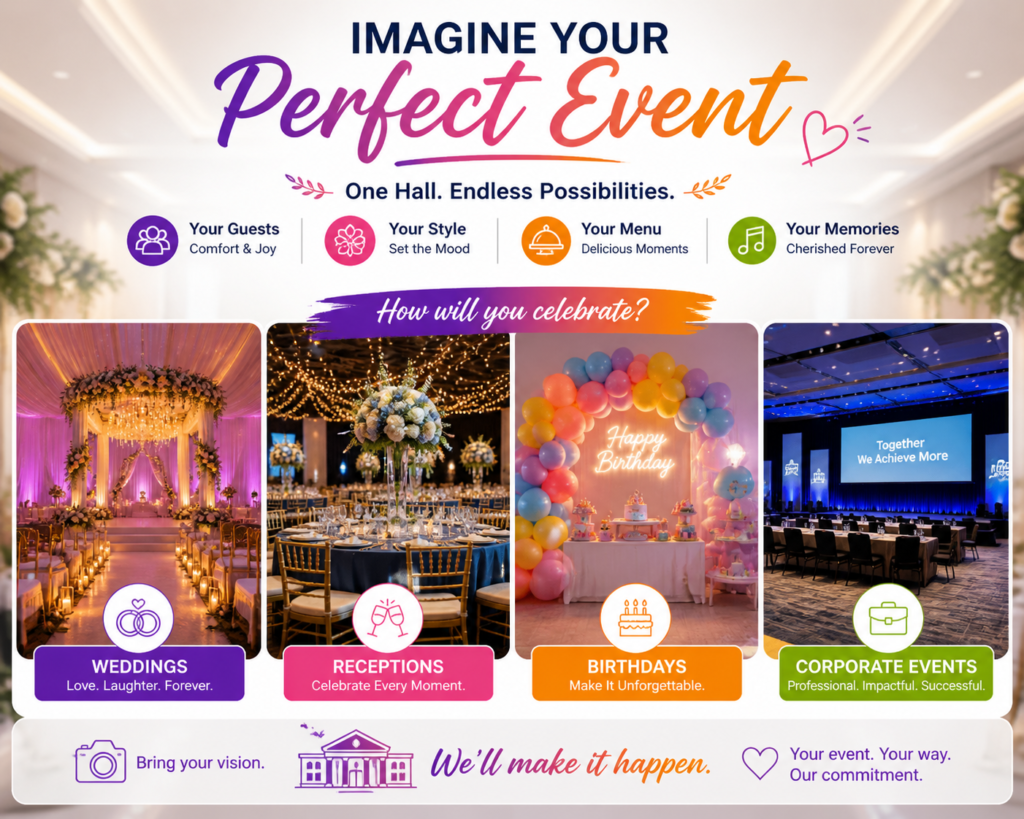
This is why visual content should be at the center of your marketing. But the goal is not to post random beautiful photos. The goal is to help people imagine their own event inside your venue.
Show the same space in many different styles
One of the biggest mistakes banquet halls make is showing the same type of decoration again and again. This makes the venue feel limited. A customer may think, “This hall looks nice, but it is not my style.” In reality, the space may be flexible. But if your content does not show that flexibility, people may never know.
You should show how the same hall can look for different events. Show a wedding setup, a reception setup, a birthday setup, a corporate setup, a simple family lunch setup, and a premium evening event setup. Show different seating styles, lighting moods, stage designs, table layouts, and entrance looks.
This helps customers see more possibilities.
Before and after content can be very persuasive
Before and after content works well because it shows transformation. People love seeing an empty hall become a beautiful event space. It also helps them understand the value of your team and vendor network.
You can record short videos that start with the hall being prepared and end with the final setup. You can show the stage being built, lights being tested, tables being arranged, flowers being placed, and the final walk-through before guests arrive.
This type of content feels real and satisfying. It also shows the work behind the event. Customers may not fully understand how much effort goes into a smooth celebration. When they see the process, they respect the service more.
Before and after content can be used on Instagram Reels, YouTube Shorts, Facebook, your website, WhatsApp, and even in sales follow-ups. It gives your team something more interesting to share than basic package details.
Use video walkthroughs to remove doubt before the visit
Many people want to visit a venue before booking, but they may shortlist only a few places first. A strong video walkthrough can help your hall get onto that shortlist. It gives people a better feel for the space than photos alone.
A good walkthrough should not be too fast. It should show the entrance, parking, lobby, main hall, stage area, seating area, dining area, washrooms, bridal or changing room, and any extra spaces. The video should feel like a real tour.
You can add a simple voiceover that explains what the viewer is seeing. Keep the words natural. Mention capacity, layout options, lighting, guest movement, and event support. Do not turn it into a hard sales pitch.
A walkthrough should answer silent questions
When people watch a venue video, they are asking questions in their mind. Is the space big enough? Is it clean? Does it look modern? Will elderly guests be comfortable? Is there enough room for food counters? Where will the stage go? Is the entry good for photos? Is parking easy? Will guests feel crowded?
Your walkthrough should answer these silent questions. That is what makes it useful.
You can create different walkthroughs for different event types. A wedding walkthrough can focus on the stage, bridal room, entry path, and photo areas. A corporate walkthrough can focus on seating, screen placement, sound, registration desk, and food service flow.
This makes the same venue feel more relevant to different buyers.
Use social media as a trust-building channel, not just a photo album
Social media is often the first place people check after hearing about a banquet hall. They want to see whether the venue is active, stylish, trusted, and popular. But many banquet halls use social media like a storage folder for event photos. They post images without context, captions, or strategy.
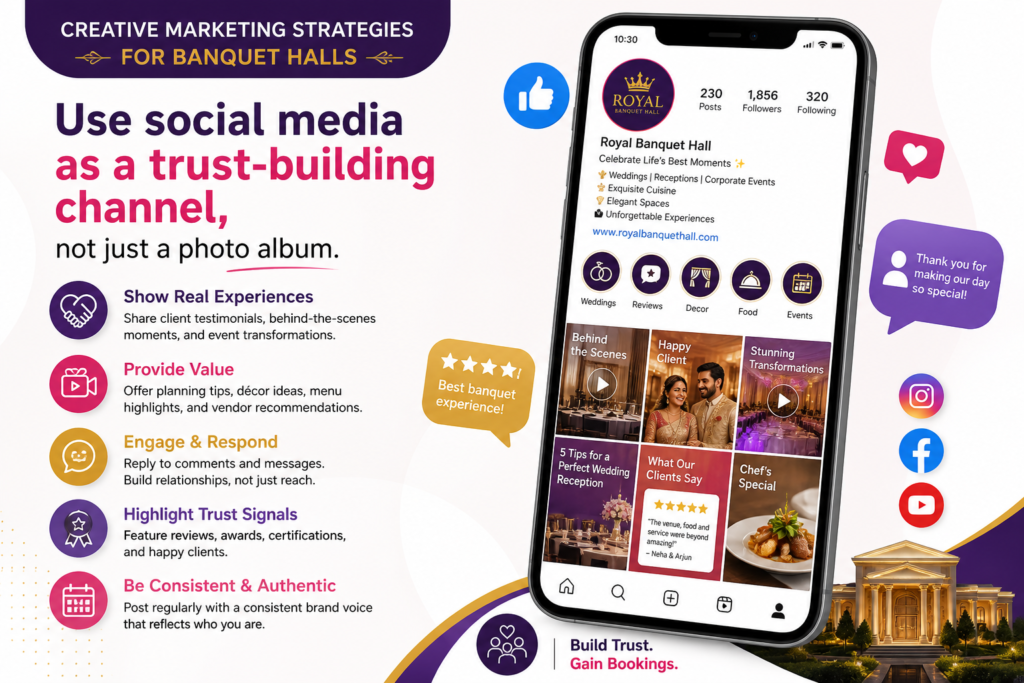
This is a missed chance. Social media should help people trust your venue and take the next step.
Every post should have a clear reason to exist
A banquet hall does not need to post every day just for the sake of posting. It needs to post with purpose. Some posts should inspire. Some should educate. Some should prove trust. Some should answer common questions. Some should show real events. Some should push people to inquire.
When your content has a clear purpose, your page becomes more useful. People stay longer because they are learning something or imagining something.
For example, instead of posting a stage photo with the caption “Beautiful wedding setup,” you can explain what made the setup work. You can mention that the couple wanted a soft, elegant look, so the decor used warm lights, open space near the stage, and a clean floral frame that looked good in photos.
That caption gives value. It helps people think about their own event.
Captions should sell the dream and the decision
A good caption does two things. It makes the event feel desirable, and it helps the customer make a smart decision. You can describe the mood of the event, but also explain practical details.
For example, you can talk about how a round-table layout helped guests talk more easily during a family celebration. You can explain how a separate dining flow reduced crowding. You can show how lighting changed the feel of the room after sunset.
These details make your hall look thoughtful. They show that you are not just renting space. You are helping people plan better events.
Social media should also include clear next steps. You can invite people to check available dates, book a venue tour, ask for package details, or message your team with their guest count. The call to action should feel helpful, not pushy.
Reels and short videos should focus on moments, not only decoration
Short videos are powerful for banquet halls because they capture movement, lights, people, music, food, and emotion. But many venues only show decoration reels. Decoration is important, but it is not the full story.
People also want to see the energy of the event. They want to see guests entering, families greeting each other, tables ready before the event starts, the stage lights turning on, the food counters opening, and the team checking final details.
These moments make the venue feel alive.
Human moments make the hall easier to trust
A banquet hall without people can look beautiful but cold. Human moments make it warmer. You can show the team welcoming guests, a planner checking the setup, a family seeing the hall before the event, or staff preparing the dining area.
Of course, you should get permission before posting guests or private moments. But even small behind-the-scenes clips can build trust.
The best social media content makes viewers think, “This looks smooth. This looks well managed. This looks like a place where my event can go right.”
That is the real goal. Not likes. Not views alone. Bookings.
Build a strong lead capture system so every interested person has a clear next step
Getting attention is only half the job. The real money is made when that attention turns into an inquiry, a visit, and then a booking. Many banquet halls lose leads not because people are not interested, but because the next step is unclear, slow, or too much work.
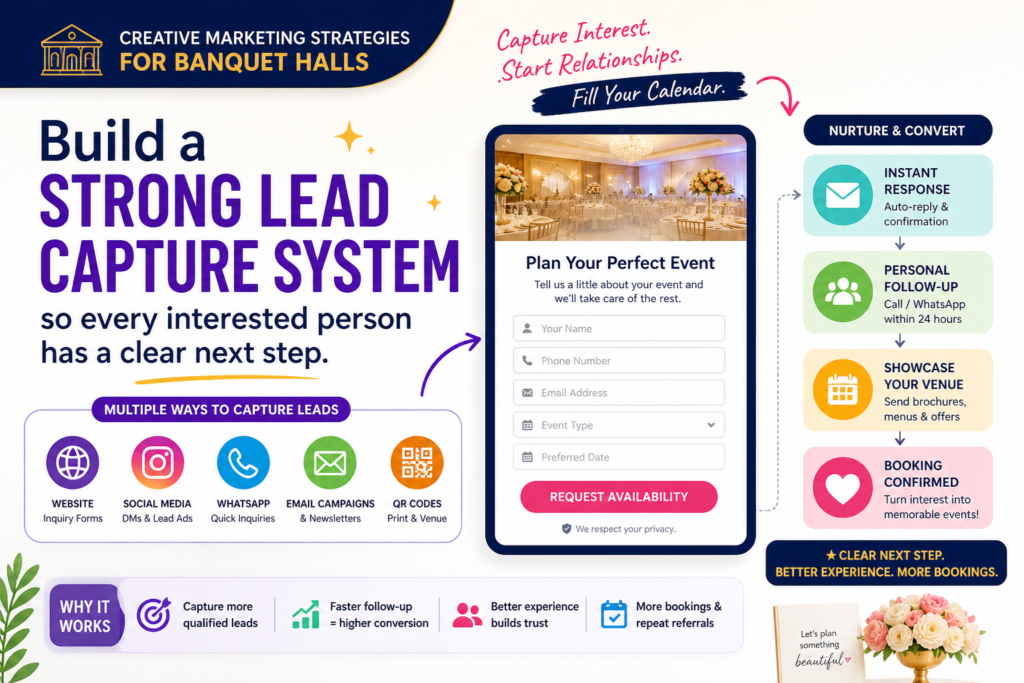
A person looking for a banquet hall is usually comparing many venues at the same time. They may contact five or ten halls in one day. If your team replies late, asks too many basic questions, or sends unclear package details, the lead can go cold very quickly.
Your marketing should not stop at getting people to call. It should guide them smoothly from first interest to final booking.
Your inquiry form should feel easy, not tiring
A long form can scare people away. At the same time, a form that only asks for a name and phone number may not give your team enough information to reply well. The best inquiry form is short but useful.
You should ask for the event date, event type, guest count, name, phone number, and preferred time for a call. These few details are enough to help your team understand the lead and respond with a useful answer.
The form should also make the next step clear. Instead of a dry button that says “Submit,” use words that match the customer’s goal. A button like “Check My Date” or “Get Package Details” feels more useful because it tells the person what they will receive.
The form should promise a clear result
People are more likely to fill a form when they know what will happen next. Do not leave them guessing. Add a short line near the form that explains your team will check availability and share suitable package options based on the event type and guest count.
This small detail can increase trust. It shows that the form is not going into a black hole. It also makes the inquiry feel more personal.
You can also add a simple note saying that your team can help with layout ideas, food planning, decoration options, and venue tours. This makes the person feel that they are not just asking for a price. They are starting a useful planning conversation.
The goal is to make the first step feel light. Once the lead enters your system, your team can guide them further.
WhatsApp should be used as a sales tool, not just a chat box
For banquet halls, WhatsApp is often one of the strongest lead channels. People like it because it feels quick and personal. They can ask questions, send dates, share guest counts, and forward details to family members. But many venues use WhatsApp in a messy way.
They reply with random photos, long price lists, or one-word answers. This creates confusion. A good WhatsApp process should feel organized, warm, and helpful.
When someone messages your banquet hall, your first reply should be fast and clear. Thank them, ask for the event date, guest count, event type, and preferred budget range if needed. Once you have these details, send only the most relevant information.
A simple WhatsApp flow can improve booking chances
You can create a clear reply flow for your team. The first message welcomes the lead. The second message collects basic details. The third message shares suitable options. The fourth message invites them for a venue visit or call.
This does not need to feel robotic. It should sound human and warm. The point is to avoid confusion.
For example, if someone asks for wedding package details, do not send every file you have. Send the wedding package, a few strong photos, a short video walkthrough, and a clear offer to check available dates. If the person has 250 guests, show them setups that match that guest count. If they want a small event, show intimate layouts.
The more relevant your reply feels, the more serious your venue looks.
WhatsApp can also be used for follow-ups. Many leads do not book after the first chat. They may be waiting for family approval, comparing prices, or checking dates. A polite follow-up after one day, three days, and one week can bring many leads back.
Create packages that feel clear, flexible, and easy to compare
Many banquet halls lose customers during the pricing stage. Not always because the price is too high, but because the package feels confusing. When people do not understand what is included, they become nervous. They worry about hidden costs. They fear that the final bill will change later.
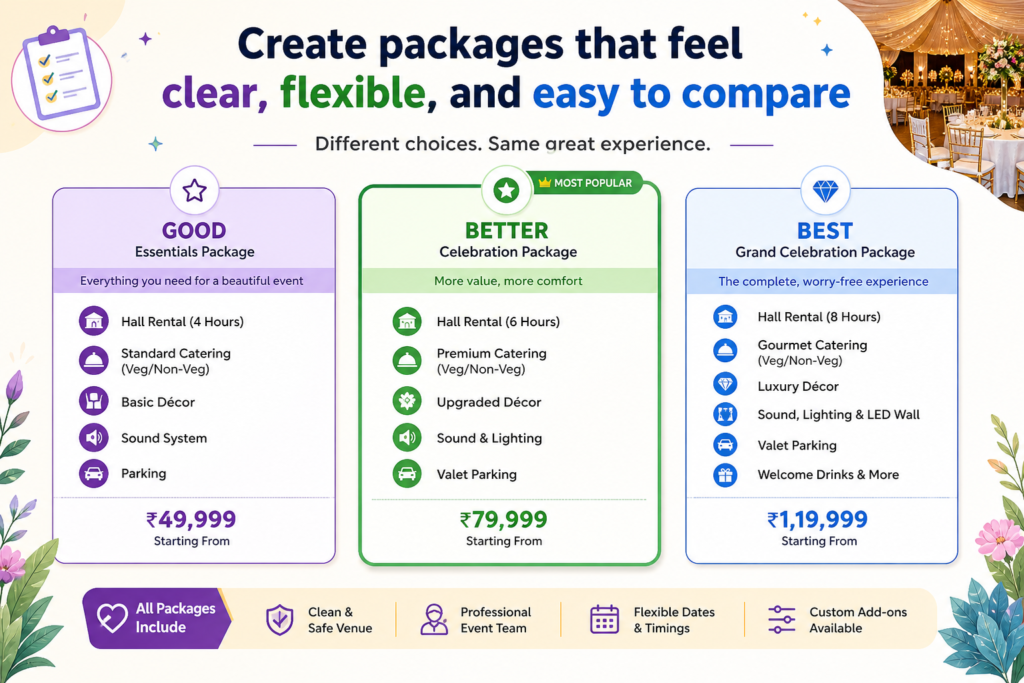
Clear packages can make your marketing stronger because they reduce doubt. A good package does not just show a price. It shows value.
Your packages should be built around customer needs, not internal cost sheets
Venue owners often create packages based on their own cost structure. They think about hall rent, food cost, decoration cost, staff cost, electricity, and vendor margins. These things matter, but customers do not think that way.
Customers think in terms of outcomes. They want to know whether their event will look good, whether guests will be comfortable, whether food will be enough, whether the space will feel premium, and whether the process will be smooth.
Your packages should speak to those needs. Instead of only listing items, explain what kind of event each package is best for. One package may be best for simple family functions. Another may be best for elegant weddings. Another may be best for premium receptions with full decoration and added services.
Naming packages can make them easier to understand
Package names can help people choose faster. Instead of calling them Package A, Package B, and Package C, use simple names that show the level of experience. You can use names such as Essential Celebration, Signature Event, and Grand Experience. The names do not need to be fancy. They just need to make the difference clear.
Each package should have a short description in plain words. For example, the Essential Celebration package could be for families who want a clean, smooth, and budget-friendly event.
The Signature Event package could be for clients who want better decoration, improved food choices, and stronger guest experience. The Grand Experience package could be for people who want a full premium setup with more support and a richer look.
This makes the price easier to accept because the customer can see the difference in value. They are not just comparing numbers. They are comparing experiences.
Your pricing should remove fear before it creates desire
People often hesitate to ask for pricing because they are afraid of being pushed into a sales call. They also worry that the venue may be far beyond their budget. This is why your pricing communication should feel open and helpful.
You do not always need to show full prices publicly if your pricing changes by date, guest count, menu, and event type. But you should still give people a clear idea of how pricing works. You can explain that packages depend on guest count, date, menu selection, decoration level, and extra services.
This helps people understand why prices vary.
Clear pricing language builds trust
Avoid vague lines like “best price guaranteed” or “affordable packages.” These phrases are too common. Instead, say something more useful. Explain that your team shares a clear quote after checking the event date, expected guests, and service needs, so the customer can compare options without confusion.
You can also mention that your team will explain what is included and what may cost extra. This simple promise can make customers feel safe.
In your brochures, website pages, and WhatsApp messages, show package details in a clean way. Do not overload people with too many choices. Too many options can slow down the decision. Give enough detail to create trust, then invite them to speak with your team for a custom quote.
The goal is not to be the cheapest banquet hall. The goal is to be the clearest and easiest to trust.
Use event-based landing pages to capture seasonal demand
Banquet hall demand changes throughout the year. Wedding seasons, festival periods, school functions, corporate year-end events, holiday parties, and social celebration months can all bring different types of leads. If your marketing uses the same message all year, you may miss these chances.
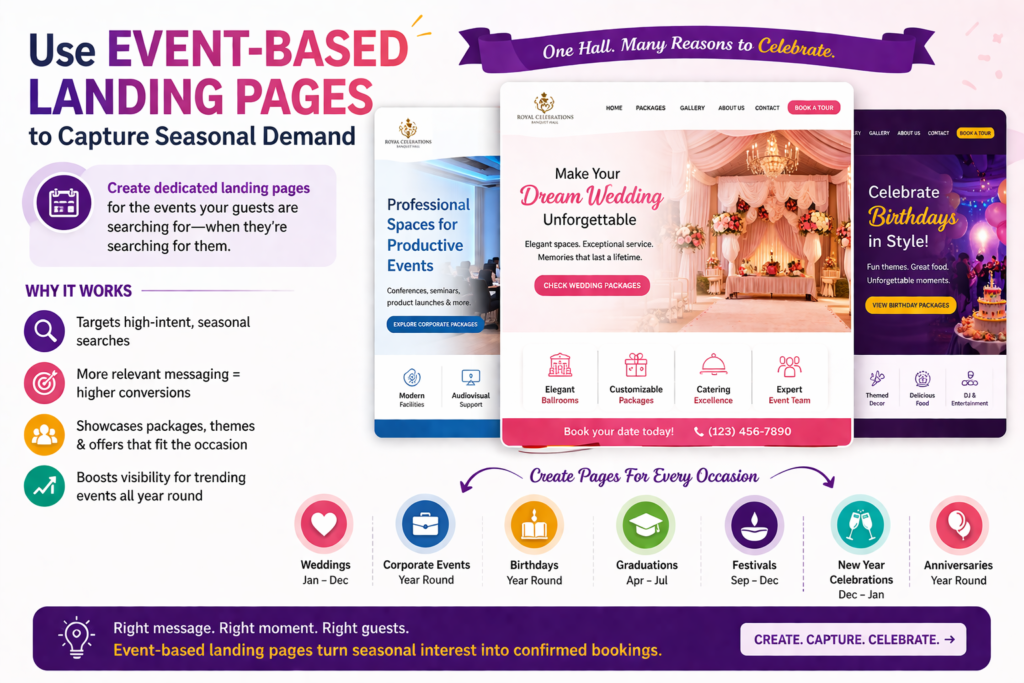
Event-based landing pages help you capture people when they are searching for a specific need. These pages are focused pages built for one event type, one season, or one offer.
A focused page works better than sending every visitor to the homepage
Your homepage has to serve many types of visitors. It must talk to wedding clients, birthday planners, corporate teams, families, and local event organizers. But a landing page has only one job.
For example, a wedding season landing page can focus only on wedding bookings. It can show wedding photos, wedding seating options, bridal room details, stage ideas, food choices, and available date information. A corporate year-end party page can focus on office celebrations, buffet setup, projector support, parking, and smooth guest entry.
When the page matches the search or ad, people feel understood.
Matching the message improves lead quality
If someone clicks an ad for “engagement banquet hall packages,” they should land on a page about engagement events, not a general venue page. The page should show engagement setups, ring ceremony stage ideas, guest seating, food counters, and package options.
This creates a smooth path. The person sees exactly what they were looking for. They do not have to search around your site. That means they are more likely to inquire.
You can create landing pages for weddings, receptions, engagement ceremonies, birthday parties, baby showers, corporate events, festive parties, and small family functions. Each page should have real photos, a short event-focused message, key planning details, customer reviews related to that event type, and a clear inquiry form.
These pages can be used for Google Ads, Facebook Ads, Instagram bio links, WhatsApp follow-ups, and SEO.
Seasonal pages can help you sell dates before competitors do
Many banquet halls wait until the season starts before they begin marketing. By then, serious customers may have already shortlisted or booked venues. You should start seasonal campaigns early.
If wedding season is coming, your wedding landing page should be ready months before peak dates. If companies plan annual parties in December, your corporate party page should start getting promoted before the rush begins. If families book festival events early, your festive package page should be live before the season becomes crowded.
Early marketing makes your hall look more prepared
When you promote early, you do more than capture demand. You also make your brand look organized. Customers feel that your team is ahead of the season and ready to help.
Your seasonal page can include lines about early date checks, flexible layout planning, menu discussions, and tour booking. You can also show limited date availability in a careful way. Do not create fake urgency. But if certain dates are likely to fill fast, say so clearly.
For example, you can mention that weekend dates during peak wedding months are usually booked early, so families should check availability before finalizing other vendors. This is helpful, not pushy.
Seasonal pages can also reduce pressure on your sales team. Instead of explaining the same details again and again, the page does much of the early education. By the time a person contacts you, they already understand the offer better.
Build referral partnerships with vendors who already serve your ideal customers
Banquet hall marketing should not depend only on ads and online searches. Some of the best leads can come from people who are already trusted by your future customers. Wedding planners, decorators, photographers, caterers, makeup artists, DJs, event anchors, corporate planners, travel agents, and local community leaders can all send qualified leads.
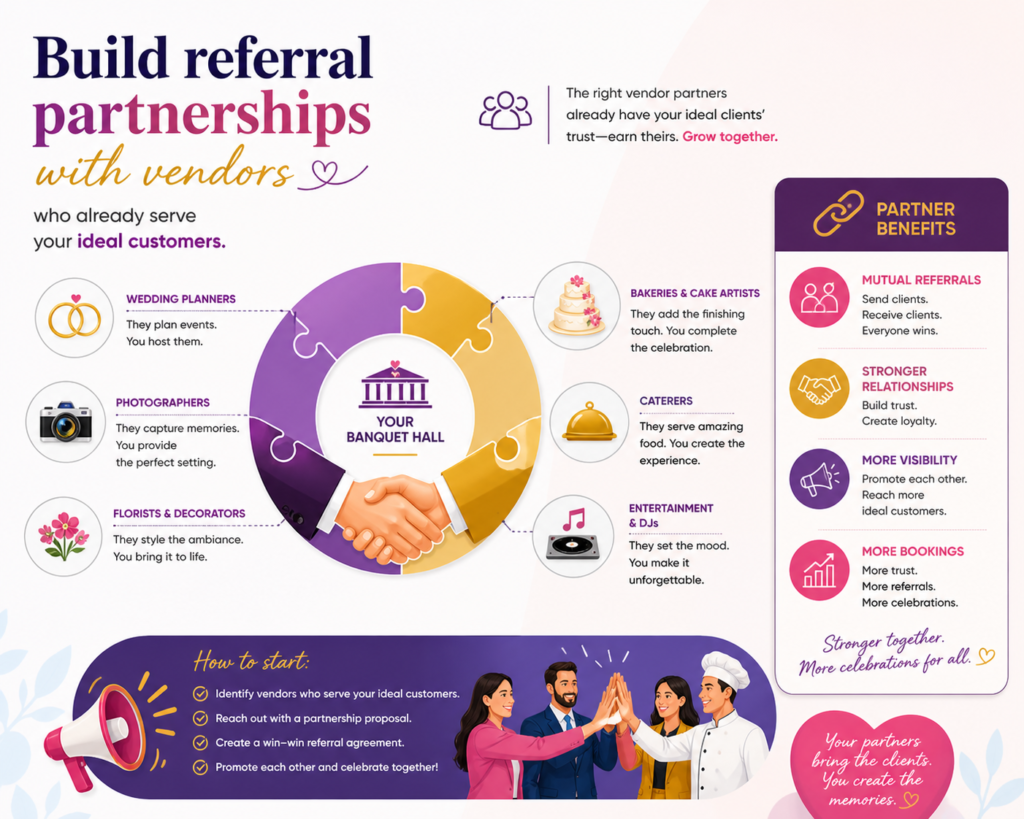
Referral partnerships work because event planning is built on trust. When a customer trusts one vendor, they often ask that vendor for suggestions. If your banquet hall is on that trusted list, you can get leads before the customer starts comparing too many options.
Your referral network should be built with care, not random contact
Many venue owners make the mistake of asking every vendor for referrals without creating a real relationship. This can feel transactional. A better approach is to build a small but strong network of partners who serve the same type of customers you want.
If your hall is best for premium weddings, build relationships with wedding planners, photographers, decorators, and makeup artists who work with that audience. If your hall is good for corporate events, connect with HR consultants, office admins, corporate caterers, and event agencies.
If your hall is known for community events, build ties with local groups and family networks.
Good partners need reasons to trust you
A vendor will only refer you if they believe you will make them look good. Their reputation is on the line too. If they recommend your hall and the event goes badly, the customer may blame them.
This is why you need to make partners comfortable. Invite them for a venue tour. Show them your setup options. Explain your capacity, service process, food flow, parking, and support team. Share photos and videos they can use when speaking with clients.
You can also create a simple partner kit. It can include venue photos, event types, capacity details, location highlights, package ranges, contact details, and the best way to schedule a visit. This makes it easier for partners to refer you correctly.
Partnerships should not feel one-sided. You can also refer good vendors to your clients when appropriate. Over time, this creates a local event network where everyone benefits.
Partner-led content can make your marketing more credible
Your vendor partners can also help you create stronger content. A decorator can talk about stage trends. A photographer can explain what makes a banquet hall good for photos. A planner can share tips on guest flow. A caterer can explain how food service should be arranged for different guest counts.
This type of content is useful because it teaches customers and builds authority. It also shows that your banquet hall works closely with professionals.
Expert content can sell without sounding like an ad
When a photographer says your entrance has good lighting for family portraits, it feels more believable than when you say it yourself. When a planner explains that your hall layout helps guests move smoothly, it adds proof. When a decorator shows different ways your stage can be styled, it helps customers imagine their own event.
You can turn these ideas into short videos, blog posts, Instagram posts, and website sections. The content does not need to be complicated. A simple conversation with a vendor can become a strong marketing asset.
For example, you could create a short video where a decorator walks through your hall and explains three stage styles that work well in the space. Or you could post a photographer’s tips on choosing the best photo corners inside your venue.
This makes your marketing more helpful and less sales-heavy. It also gives your partners visibility, which makes them more likely to work with you again.
Use email and follow-up content to bring undecided leads back
Not every lead books right away. In fact, many people need time. They may need to talk to family, compare venues, check budgets, or wait for a final date. If you only reply once and then stop, you are leaving money behind.
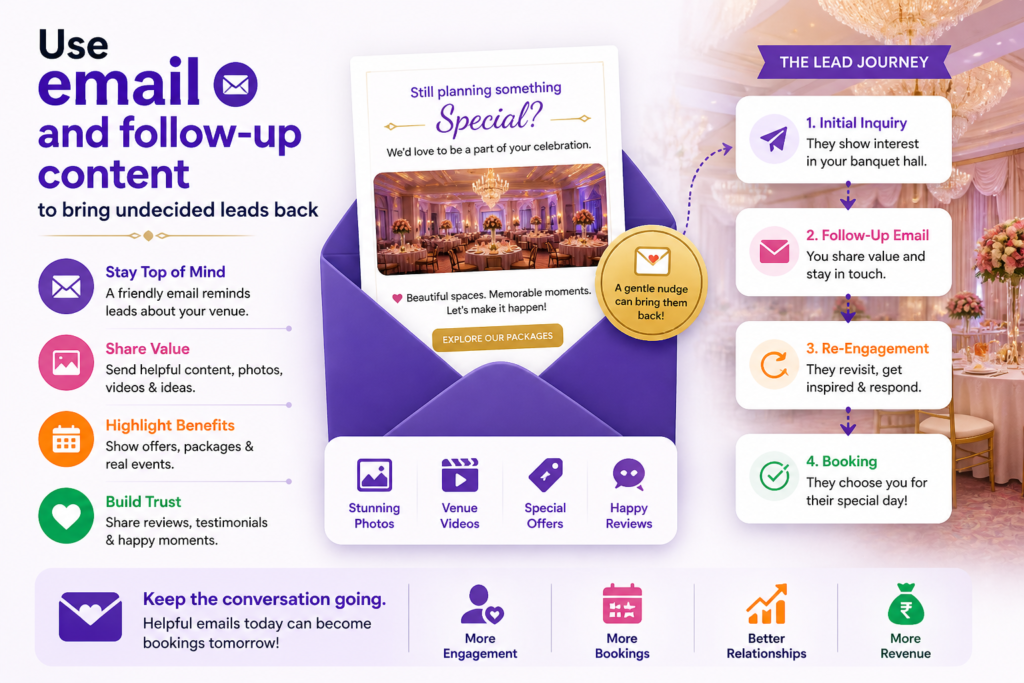
A strong follow-up system can bring back leads that would otherwise disappear. It can also help people feel more confident about choosing your hall.
Your follow-up should help, not pressure
Many sales follow-ups sound desperate. They say things like “Are you interested?” or “Please confirm soon.” These messages rarely add value. A better follow-up gives the person something useful.
You can send a short message with photos from a similar event. You can share a seating idea based on their guest count. You can remind them about date availability. You can invite them for a quick tour. You can answer a common question before they ask it.
This makes the follow-up feel like service, not pressure.
Useful follow-ups keep your hall in the customer’s mind
If a family asked about a 200-guest reception, your follow-up can include a real reception setup for around 200 guests. Explain how the layout worked, where the stage was placed, and how the dining flow was managed. This makes the message relevant.
If a company asked about an annual party, send a short note about how your hall can handle welcome desks, buffet flow, sound, and seating. This shows that you understand corporate needs.
Each follow-up should be short, clear, and personal. Do not send the same generic message to everyone. Even small personalization can make a big difference.
Email can support bigger decisions better than chat alone
WhatsApp is fast, but email is useful for organized details. Many corporate clients, planners, and serious families prefer email when they need to share information with others. A well-written email can make your banquet hall look more professional.
Your email should not be too long. It should thank the person, summarize their event details, explain suitable options, attach or link to photos and videos, and invite them to book a visit or call.
A good email makes comparison easier
People compare venues side by side. If your email is clear, simple, and well organized, it helps them compare you more fairly. If your competitor sends messy details and you send a calm, helpful email, you already look more reliable.
You can also use email to send planning guides. For example, after someone asks about a wedding booking, you can send a guide on how to choose the right banquet hall for guest comfort. After someone asks about a corporate event, you can send a guide on how to plan guest flow for an office celebration.
These guides do not need to be long. They just need to be useful. When your brand helps people make better decisions, it becomes easier to trust.
Turn customer reviews into full marketing assets, not just short ratings
Reviews are often treated like small trust signals that sit on Google and wait to be noticed. That is a limited way to use them. For a banquet hall, reviews can become one of the strongest parts of your marketing because they answer the biggest fear customers have.
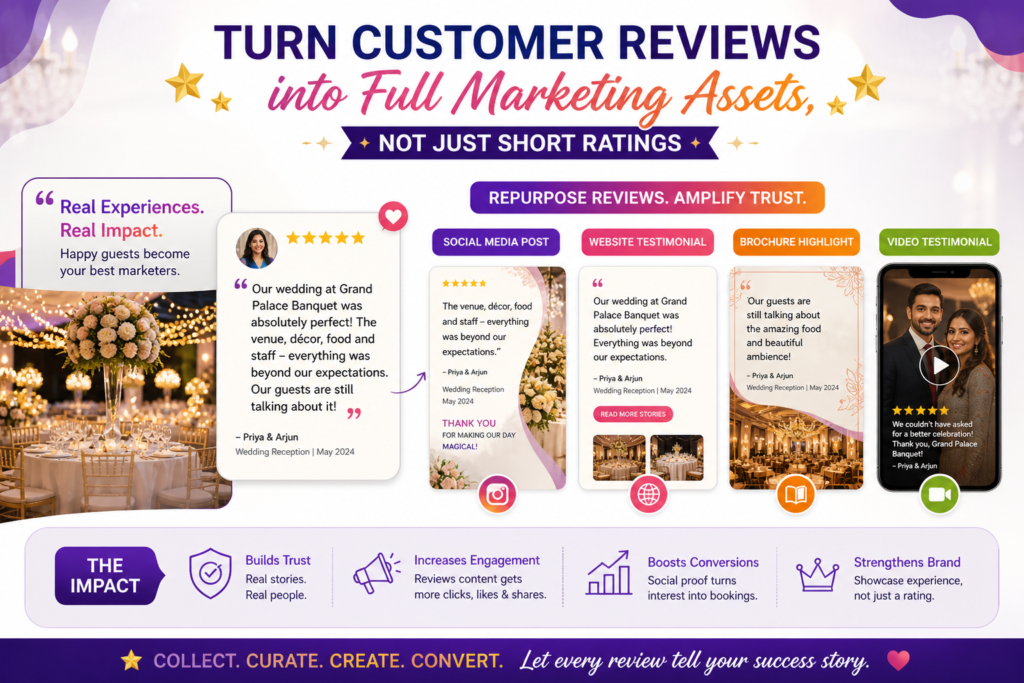
People are not only asking, “Is this hall beautiful?” They are asking, “Can I trust this team with an important day?”
A strong review helps answer that. But the best results come when you do not leave reviews hidden on one platform. You should bring them into your website, social media, sales messages, brochures, landing pages, and follow-up content.
Reviews should be grouped by the concern they solve
Not all reviews do the same job. One review may praise the food. Another may talk about staff support. Another may mention parking. Another may explain how smoothly the event was managed. Instead of showing reviews randomly, group them by the concern they address.
For example, on your wedding page, show reviews from wedding clients. On your corporate event page, show reviews from office teams. On your birthday party page, show reviews from families who hosted birthday events. This makes the proof feel more relevant.
A bride or groom may not care as much about a review from a seminar organizer. A corporate client may not be moved by a review about wedding decoration. The closer the review is to the visitor’s need, the more powerful it becomes.
Specific words from customers can become strong sales copy
Your customers often explain your value better than you do. They may use simple words that feel real and natural. If many reviews mention that your team was helpful, that becomes part of your brand message.
If people keep saying the hall felt spacious, that becomes a selling point. If clients praise how smoothly the event was handled, that tells you what to highlight in ads and website copy.
You should read reviews carefully and look for patterns. These patterns show what customers truly value. Sometimes venue owners think their biggest strength is decoration, while customers may care more about easy parking, clean washrooms, quick service, or polite staff.
Once you find these patterns, use them everywhere. Your website headline can talk about stress-free events. Your ads can mention smooth guest flow. Your WhatsApp messages can include a review that supports the exact concern the lead has.
This makes your marketing feel grounded in real customer experience instead of empty claims.
Video testimonials can build deeper trust
Text reviews are useful, but video testimonials can feel even more personal. When a real customer speaks about their event, future customers can sense emotion, confidence, and relief. This is very valuable for banquet halls because events are high-pressure decisions.
You do not need a studio setup. A simple phone video can work if the sound is clear and the customer feels comfortable. The best time to record is soon after the event, when the client is happy and the experience is fresh.
Ask simple questions. You can ask what event they hosted, why they chose your hall, what they liked most, and whether they would recommend it. Keep it natural. Do not force them to sound polished.
Short testimonial clips are easier to use across channels
A long testimonial may be useful on your website, but short clips are easier to share. A fifteen to thirty second clip can work well on Instagram, Facebook, YouTube Shorts, WhatsApp, and landing pages.
One clip can focus on service. Another can focus on food. Another can focus on the hall setup. Another can focus on how smooth the planning process felt. This lets you use the same customer story in different ways.
You can also add a short written line above the video to set the context. For example, you can say that this family hosted a 250-guest reception and wanted a simple, elegant setup with smooth dining flow. Then the video gives proof.
This is much stronger than posting a random testimonial with no background. Context helps the viewer understand why the story matters.
Create content around real planning problems your customers face
A banquet hall can attract more serious leads by teaching people how to plan better events. Many venue owners think content should only show the hall. But useful planning content can bring in people much earlier in their decision process.
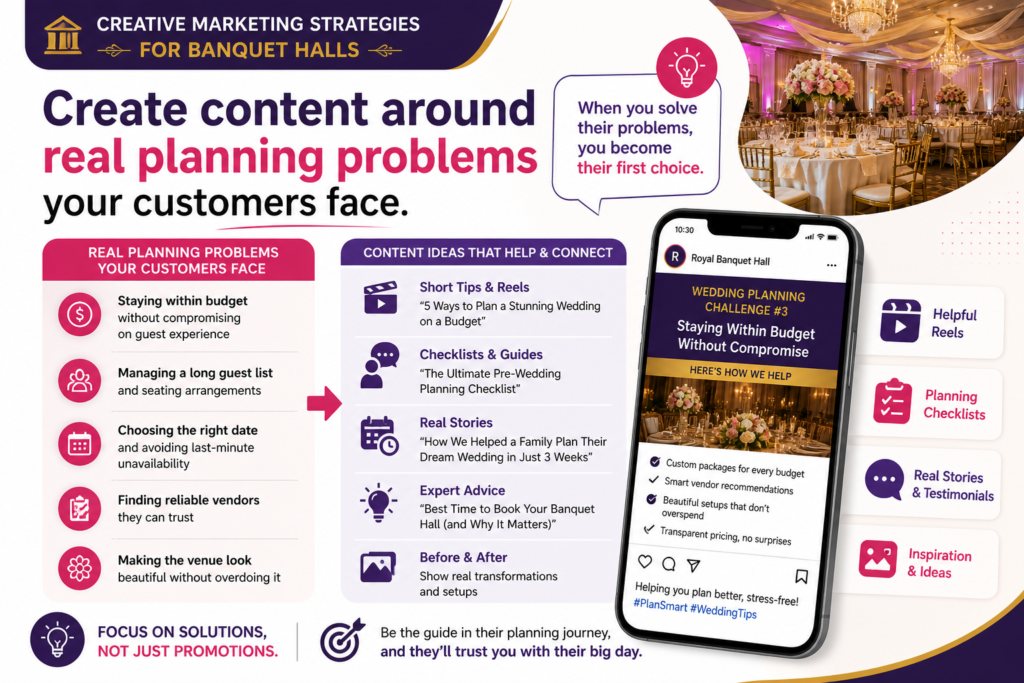
When someone starts planning a wedding, reception, birthday, or corporate event, they have many questions. They want to know how much space they need, how to choose the right seating layout, how to plan food timing, how to avoid crowding, how to keep guests comfortable, and how early they should book the venue.
If your banquet hall answers these questions clearly, your brand becomes helpful before the person even speaks to your team.
Educational content should lead naturally to your venue
Content marketing should not feel like a school lesson. It should help customers make better choices while gently showing why your hall is a strong option. The key is to write about problems your venue can solve.
For example, an article about choosing a banquet hall for 300 guests can explain space, stage size, buffet flow, parking, entry area, washrooms, and seating comfort. While giving advice, you can show how your hall handles these details.
This does not need to sound sales-heavy. You can simply say that when your team plans a 300-guest event, it first looks at guest movement, dining space, stage visibility, and entry flow. That teaches the reader while showing your process.
Helpful content attracts people before they are ready to book
Not every person searches directly for “banquet hall near me” at first. Some search for planning questions. They may search how much space is needed for 200 guests, how to plan a wedding reception, how to choose a party hall, or what to ask before booking a venue.
If your website answers these questions, you can reach them before competitors do. This gives you a chance to build trust early.
Planning content can also be reused. A blog post can become social media captions. A section from the post can become a WhatsApp answer. A few ideas can become short videos. A full guide can become an email follow-up.
The best content saves time for your sales team because it answers repeat questions in a clear way.
Your content should sound like advice from an experienced planner
People do not want generic tips. They want practical advice from someone who has seen many events happen in real life. This is where banquet halls have a big advantage. Your team knows what goes wrong, what works well, and what customers often forget.
Use that experience in your content. Talk about real planning details. Explain why the food counter should not block guest movement. Explain why stage visibility matters for large events. Explain why elderly guests need easy access and comfortable seating. Explain why parking should be discussed before the event day, not after guests arrive.
This kind of advice feels valuable because it comes from real event experience.
The best content reduces fear and builds confidence
Event planning can feel stressful. People worry about making mistakes. Your content should make them feel calmer and more prepared. When your advice helps them avoid problems, they begin to trust your judgment.
For example, you can write about common mistakes families make when choosing a banquet hall. But do it kindly. Do not make customers feel foolish. Explain that many people focus only on decoration and forget guest flow, parking, food timing, and service support.
Then show them how to think better. This positions your banquet hall as a guide.
When customers see you as a guide, they are more likely to contact you. They do not feel like they are dealing with a seller. They feel like they are speaking to someone who can help them protect an important event.
Use paid ads with sharper targeting and stronger messages
Paid ads can work very well for banquet halls, but only when they are built with clear targeting and strong messages. Many halls waste money because they run broad ads with generic photos and weak captions. The ad says the venue is beautiful, affordable, or perfect for all events. That is not enough.
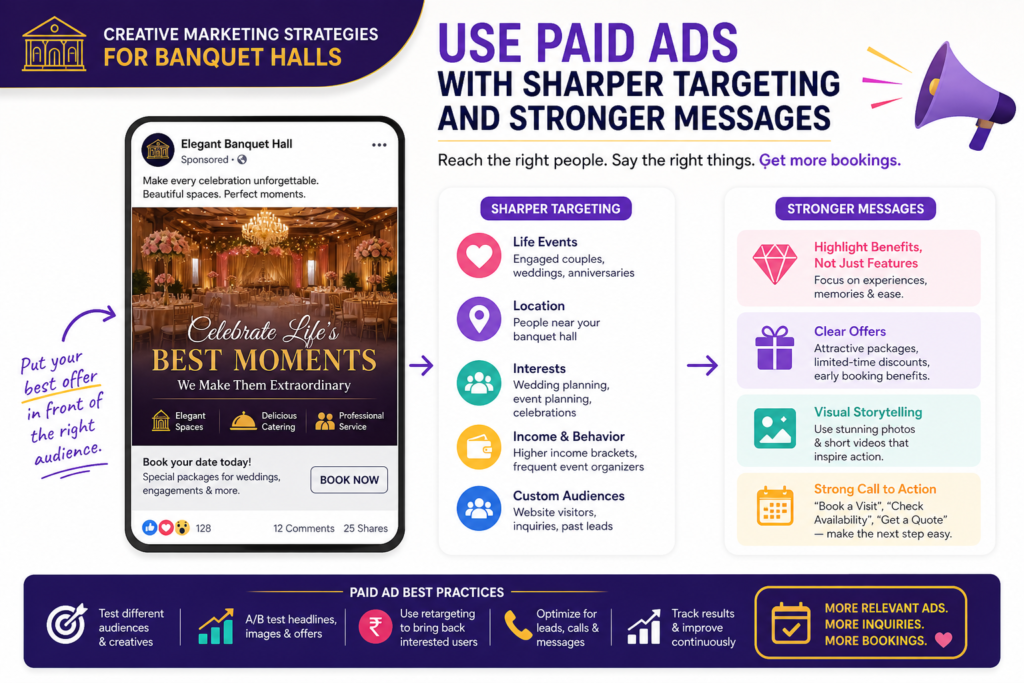
People see many venue ads. To make them stop, your ad must speak to a clear need. It should match the event they are planning, the area they are searching in, and the problem they want solved.
One ad should speak to one type of event
A single ad should not try to sell weddings, birthdays, corporate events, and baby showers all at once. That makes the message weak. Create separate campaigns for separate event types.
A wedding ad should feel emotional, elegant, and family-focused. It should show wedding setups, stage design, guest seating, and couple-focused spaces. A corporate ad should feel organized, professional, and practical. It should show seating, sound setup, food flow, parking, and event support.
When the message is specific, the lead quality improves.
Strong ads show the result, not just the room
A photo of an empty banquet hall may show space, but it may not create desire. A better ad shows the hall ready for an event. It shows the result the customer wants. That result could be a warm family celebration, a grand wedding reception, a smooth corporate evening, or a joyful birthday party.
Your ad copy should also focus on the result. Instead of saying “Book our banquet hall today,” you can say that your hall helps families host beautiful wedding events with smooth planning, flexible seating, and clear packages. That message says more.
For corporate clients, you can say that your venue helps teams host annual parties, award nights, and client events with easy guest entry, food service support, and a professional setup.
The more the ad reflects the customer’s real goal, the better it will perform.
Retargeting ads can bring back people who already showed interest
Most people do not book a banquet hall the first time they see an ad or visit a website. They compare, discuss, delay, and return later. Retargeting helps you stay visible to people who already showed interest.
You can retarget people who visited your website, watched your videos, engaged with your Instagram page, or opened your lead form but did not submit it. These people are warmer than complete strangers. They already know something about your hall.
Retargeting ads should not repeat the same first message. They should answer the next question in the customer’s mind.
Retargeting should build trust step by step
The first ad may introduce your hall. The second ad can show a real event story. The third ad can share a customer review. The fourth ad can invite people to check available dates. This creates a natural journey.
For example, if someone watched a wedding walkthrough video, you can show them a review from a wedding client. If someone visited your corporate event page, you can show them photos from a past company event. If someone checked your pricing page, you can show an ad about clear packages and simple quote support.
This makes your ads feel more relevant. It also helps people remember your hall when they are ready to contact venues.
Retargeting is not about chasing people. It is about staying helpful and visible while they make a decision.
Make venue tours feel like a planned sales experience
A venue tour is one of the most important moments in the sales process. By the time someone visits your banquet hall, they are already interested. But interest does not always turn into a booking. The tour must build confidence, answer doubts, and help the customer imagine their event clearly.
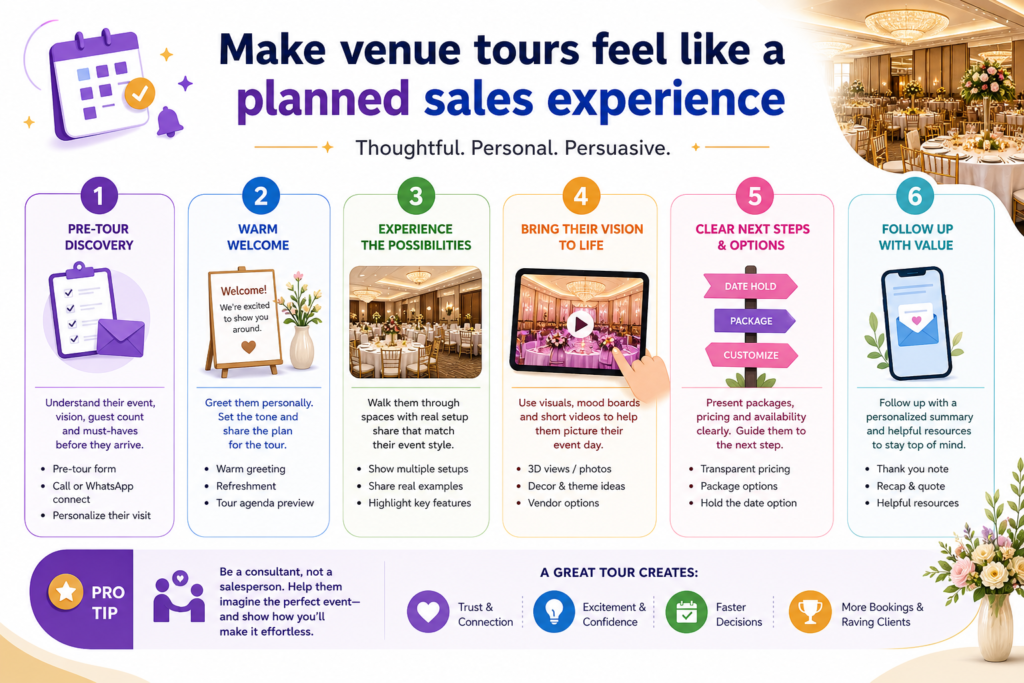
Many banquet halls give casual tours. Someone from the team walks the visitor around, points to the hall, explains the capacity, mentions the price, and waits for questions. That is not enough. A venue tour should feel guided and thoughtful.
Every tour should begin with the customer’s event, not the hall
Before showing the space, ask about the event. Find out the event type, date, guest count, family or company needs, food preferences, decoration expectations, and main concerns. This makes the tour more personal.
If you start by talking about your hall, the visitor may listen politely but not connect deeply. If you start by understanding their event, you can show the hall in a way that matters to them.
For example, a wedding client may care about the stage, entry path, bridal room, guest seating, and photo areas. A corporate client may care about the welcome desk, screen position, sound quality, and food timing. A birthday client may care about kids’ movement, cake table, music, and family seating.
A personal tour makes the space easier to imagine
Once you know the visitor’s needs, describe the hall through their event. Do not simply say, “This is the main hall.” Say that for their 250-guest reception, the stage can be placed here, dining can flow from this side, elders can sit closer to the stage, and the entrance can be styled for photos.
This turns an empty space into a clear plan. The visitor begins to picture the event. That picture is what sells.
You can also show photos and videos during the tour. If the hall is empty, past event visuals help fill the imagination gap. Show setups that match their guest count and event type. Do not show random photos. Make the proof relevant.
A good tour should feel like a planning session, not a property visit.
The tour should end with a clear next step
Many tours end weakly. The visitor says they will discuss with family or the team. The sales person says okay. Then the lead disappears. This is common, but it can be improved.
Before the visitor leaves, summarize what they need and what your hall can offer. Confirm the event date, guest count, package interest, and any special needs. Then suggest a clear next step.
The next step may be holding a date for a short period, sending a final quote, arranging a second visit with family, scheduling a menu discussion, or sharing decoration ideas.
A calm close works better than a pushy close
You do not need to pressure people. In fact, pressure can hurt trust. But you should guide the decision. Customers often need help understanding what to do next.
You can say that based on their date and guest count, the hall seems like a good fit, and the next best step is to review the package with family and confirm availability before the date is taken. This is clear and helpful.
After the tour, send a follow-up message the same day. Thank them for visiting. Share the key points discussed. Include relevant photos, package details, and the next step. This keeps the conversation alive.
A tour should not be treated as the final sales moment. It should start a stronger follow-up process.
Use community marketing to become the familiar local choice
Banquet halls are local businesses. Even if your ads reach people online, many bookings still come from trust built in the local area. People often choose venues that feel known, safe, and familiar. This is why community marketing can be very powerful.
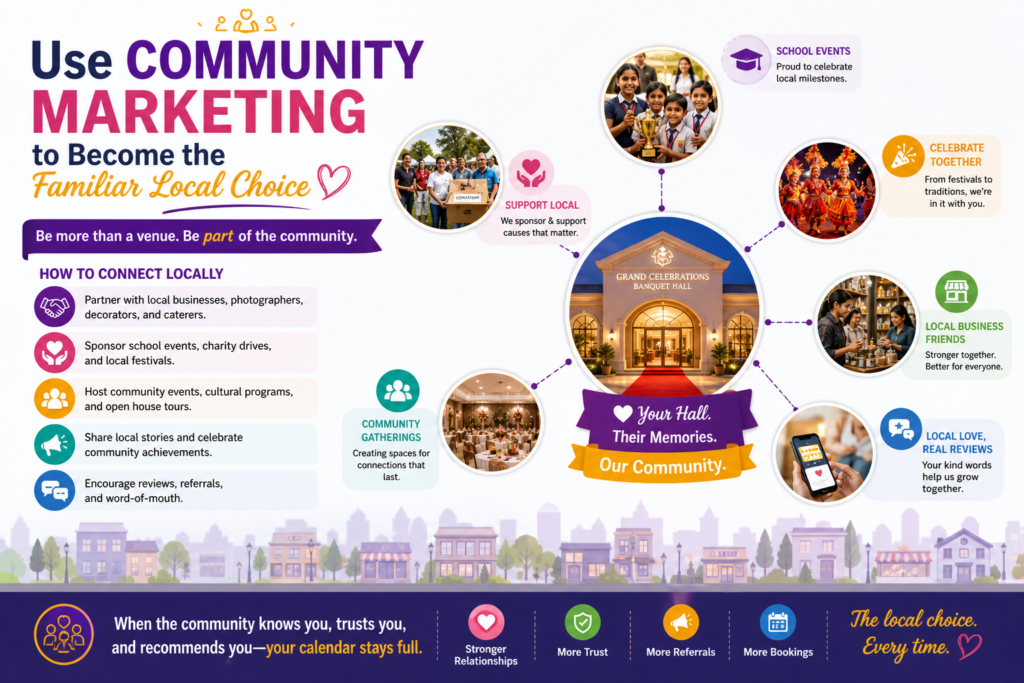
Community marketing means becoming visible and useful in the area around your banquet hall. It is not just sponsorship or banners. It is about building a local presence that people remember when they need a venue.
Local relationships can create steady referral flow
Your banquet hall should be known by nearby residential groups, schools, colleges, offices, religious groups, clubs, associations, housing societies, and local business owners. These groups often need venues for gatherings, annual events, small celebrations, meetings, or family functions.
The goal is to become the venue they think of first. This does not happen through one message. It happens through repeated local presence.
You can invite local group leaders for a small open house. You can offer guided venue tours for society event committees. You can create special packages for nearby offices. You can host small community events that introduce people to your space.
Familiarity lowers booking resistance
When people already know your venue name, they feel less risk. They may still compare options, but your hall enters the shortlist faster. Familiarity is not the same as fame. You do not need everyone in the city to know you. You need the right people in your local area to remember you.
This can also reduce your dependence on discounts. A known and trusted venue does not always have to fight only on price. People may pay a little more when they feel safer and more confident.
Local marketing should be steady. Your team can maintain relationships with office admins, society managers, school coordinators, and event organizers. Send them useful updates, not constant sales messages. Share new setups, available dates for certain event types, and simple planning ideas.
The more you become part of the local event network, the stronger your lead flow becomes.
Open house events can help people experience the hall before booking
An open house is a planned event where potential customers, local partners, vendors, and community members can visit your banquet hall, see sample setups, taste food, meet your team, and understand your packages.
This can work very well because people often need to feel the space before they trust it. Photos help, but walking into a ready setup is more powerful.
You do not need to make the open house too large. A small, well-planned event can be enough. Show one or two seating layouts, a sample stage, a food counter, lighting options, and a simple welcome desk. Have your team ready to answer questions.
An open house can create many content pieces at once
A single open house can produce photos, videos, testimonials, vendor interviews, behind-the-scenes clips, and social media posts. It can also create direct leads from people who attend.
You can invite past clients to share their experience, local vendors to display small samples, and potential customers to explore the hall. This makes the event feel more useful and less like a sales pitch.
After the open house, follow up with every attendee. Thank them for coming, share photos from the event, and offer to check dates for their upcoming functions. This keeps the momentum alive.
An open house also helps your team practice selling the venue in a live setting. You learn what questions people ask, what concerns they raise, and what parts of your hall impress them most. That insight can improve your ads, website, and sales process.
Build a photo and video library that your sales team can use every day
A banquet hall should not treat photos and videos as content for social media only. They are also sales tools. When someone asks about your venue, your team should not waste time searching through old folders, random phone galleries, or messy WhatsApp chats. They should have a clean library of visuals ready to share.
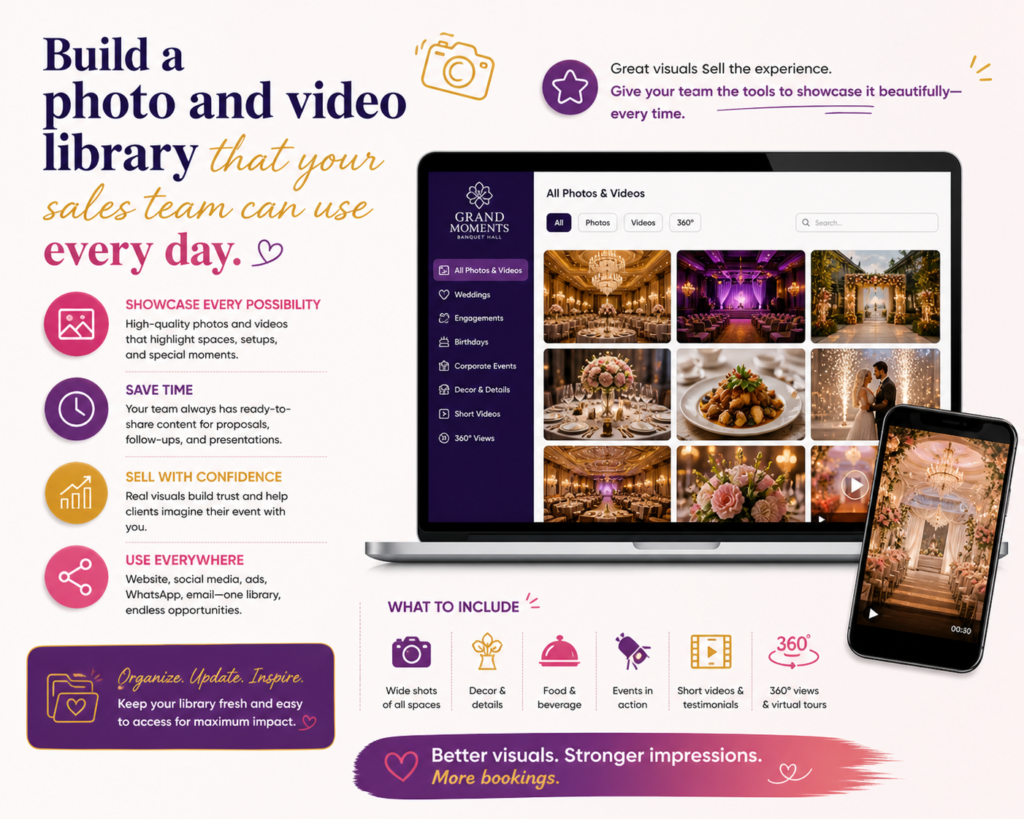
This library can help your team reply faster, sell better, and make each lead feel understood. A person planning a wedding should see wedding visuals. A person planning a corporate event should see corporate setups. A family planning a birthday should see birthday examples. This sounds simple, but many banquet halls do not do it.
When your visual library is organized, your replies become more relevant. That can make your venue look more professional than competitors who send the same ten photos to every lead.
Your visual content should be sorted by event type and guest size
People want to know whether your hall can handle their event. Photos become more powerful when they match the customer’s need. If someone has 150 guests, showing them a 600-guest setup may not help. It may even make them feel the hall is too large or too costly.
If someone has 500 guests, showing a small birthday setup may make the hall look unsuitable.
That is why your content should be sorted by event type, guest count, layout, decoration level, and budget range. Your sales team should be able to quickly find examples that match the lead.
For example, you can keep separate folders for weddings under 200 guests, weddings over 400 guests, engagement events, receptions, birthdays, corporate meetings, award nights, baby showers, and simple family lunches. Each folder should have a few strong photos, one short video, and one walk-through clip if possible.
The right visual at the right time can remove doubt
A lead often has silent doubts. They may wonder if the hall will look empty with fewer guests. They may worry that guests will feel crowded. They may not know how the stage will look. They may be unsure whether the dining area will work well.
When your team sends the right photo or video, that doubt becomes smaller. Instead of saying, “Yes, we can handle 250 guests,” your team can show a real 250-guest event. That proof is stronger than any promise.
This also makes the conversation easier for the customer. They can forward the visuals to family members, partners, or office teams. In many cases, the person speaking to you is not the only decision-maker. Good visuals help them explain your venue to others.
A strong library also saves time. Your team will not have to create a new response from scratch every time. They can still personalize the message, but the material will be ready.
Your best visuals should show both beauty and function
Beautiful photos are important, but they should not be the only focus. A banquet hall is not chosen only for looks. It is chosen for comfort, flow, service, access, and confidence. Your visual library should show those things too.
Take photos of the entrance, parking area, dining setup, guest seating, stage view from the back, buffet counters, washrooms, changing rooms, lighting setup, and staff preparing the space. These may not always be the most glamorous images, but they answer real buyer questions.
People planning events care about the details that affect guests. If your marketing only shows decoration, it may miss the practical reasons people choose a venue.
Functional visuals can help justify your price
When customers compare prices, they often compare venues too simply. They may only look at hall size and decoration. But if your visuals show better guest flow, clean dining space, strong lighting, easy entry, and organized service, you give them more reasons to value your hall.
This matters because price objections often come from unclear value. If people cannot see why your hall costs more, they may choose a cheaper one. But when they understand the full experience, they may feel safer paying more.
Your sales team can use functional visuals during follow-ups. If a lead asks why your package is higher, you do not need to argue. You can show what is included and explain how it improves the event. This keeps the conversation calm and helpful.
Use storytelling in your ads instead of only pushing offers
Most banquet hall ads look like simple announcements. They say the hall is available, packages are open, discounts are running, or bookings have started. These ads can work sometimes, but they often feel flat because they do not create emotion.
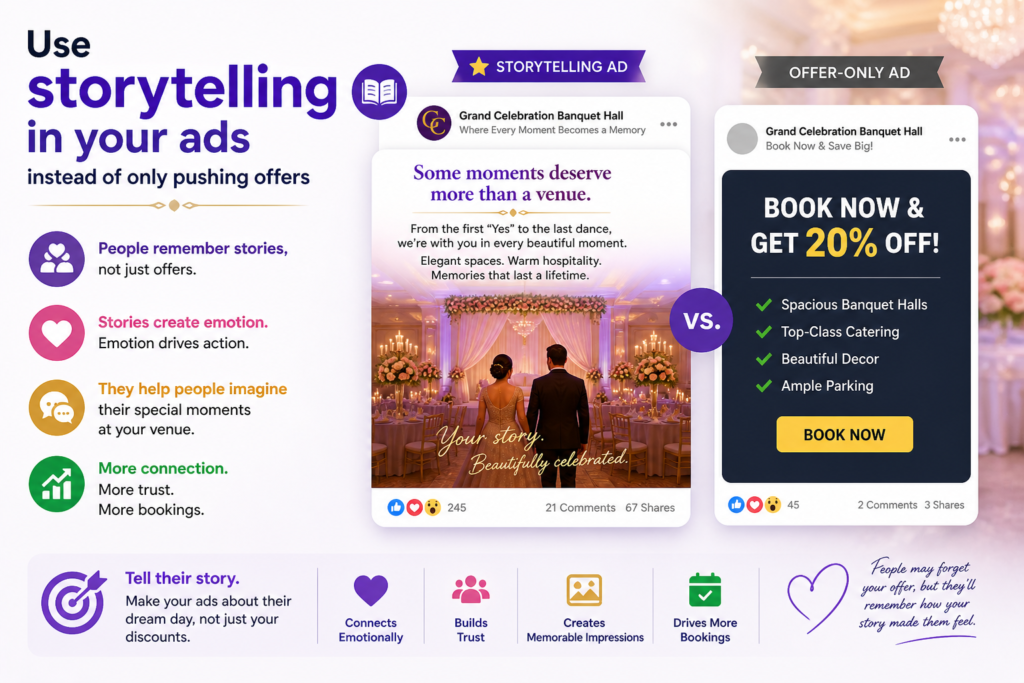
Events are emotional. A wedding is not just a booking. A birthday is not just a party. A company award night is not just a hall rental. Each event has a reason behind it. When your ads use that reason, they become more memorable.
Storytelling does not mean writing long emotional posts. It means building your message around a real customer moment, a real desire, or a real problem.
Your ad should begin with what the customer is feeling
Before someone books a banquet hall, they may feel excited, stressed, confused, or rushed. They may want the event to look beautiful but also stay within budget. They may want guests to enjoy themselves. They may want family members to approve the venue. They may want the day to go smoothly.
Your ad can speak to that feeling. For example, instead of saying “Book our wedding banquet hall,” you can say, “Planning a wedding where every guest feels welcomed and every moment feels smooth starts with the right hall.” This message enters the customer’s world.
It still sells the hall, but it starts with the customer’s desire.
Emotional messages should still stay practical
Emotion gets attention, but practical details create action. A good ad should combine both. After the opening line, mention the event type, guest range, location, and next step.
For example, a wedding ad can talk about creating a warm celebration for families, then mention that your hall supports 150 to 500 guests with flexible seating, stage setup, dining flow, and planning support. This makes the ad feel both inspiring and useful.
The same approach works for corporate events. You can start with the idea that a company event should feel organized from the first guest entry to the final dinner service. Then you can mention sound setup, seating, food counters, parking, and date checks.
This keeps your ads from becoming fluffy. The story pulls people in. The details help them act.
Real event stories can become powerful ad campaigns
One of the easiest ways to create better ads is to use past events as story material. You do not need to reveal private details. You can describe the type of event, the guest count, the main goal, and how your hall supported it.
For example, you can create an ad around a family that wanted a simple but elegant engagement ceremony for 180 guests. The ad can show the final setup and explain how the layout gave guests enough space, kept the stage visible, and allowed smooth dining.
This does more than show a pretty photo. It shows how your hall solves real event needs.
Story-based ads help people picture their own event
When people see a story close to their own situation, they connect faster. A parent planning a birthday can relate to another family’s birthday event. A couple planning a reception can relate to a similar reception setup. An HR manager planning an annual party can relate to a corporate event story.
This is why story-based ads often feel warmer than direct sales ads. They do not shout. They show.
You can create different story ads for different customer types. One can focus on a grand wedding. One can focus on a budget-friendly family function. One can focus on a premium corporate evening. One can focus on a small and intimate ceremony.
Over time, these ads build a richer image of your banquet hall. People begin to see your venue as flexible, experienced, and trusted.
Create a stronger booking experience that makes customers feel safe
Marketing does not end when a lead says they are interested. It continues through the booking process. If the booking experience feels unclear, slow, or stressful, the customer may still leave. A banquet hall must make booking feel safe and simple.
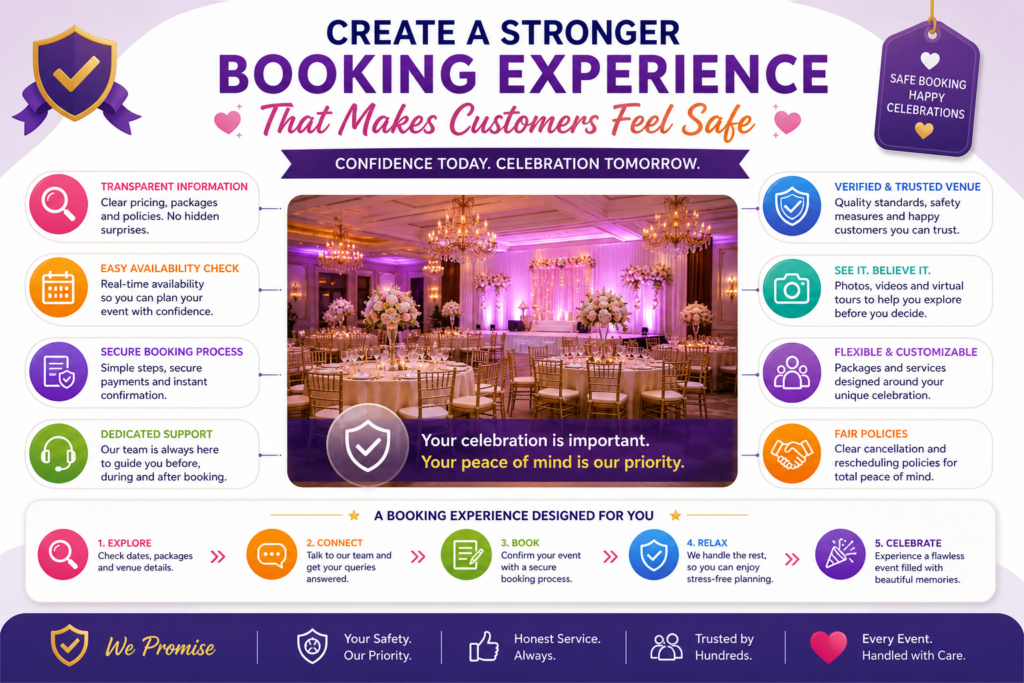
Customers are often nervous at this stage. They may be paying an advance. They may be finalizing a date that matters to the whole family or company. They may worry about what is included, what can change, and what happens if plans shift.
Your booking process should reduce these fears.
Clear documents can prevent confusion later
Every booking should be supported by a simple written agreement. This agreement should explain the date, timing, hall details, guest count, package inclusions, payment terms, cancellation terms, decoration details, food details, extra charges, and contact person.
The language should be easy to understand. Customers should not feel like they are reading a legal puzzle. A clear agreement protects both sides and builds trust.
Many disputes happen because people remember conversations differently. One person thinks something was included. Another person thinks it was optional. Written clarity prevents this problem.
Simple language makes your venue feel more honest
A customer should never feel tricked after booking. If there are extra charges for overtime, outside vendors, special decoration, power backup, cleaning, security, or extra plates, explain them early. This may feel uncomfortable, but it is much better than a surprise later.
Honest pricing and terms can become a marketing advantage. Many people are afraid of hidden costs. If your team is known for clear communication, customers will trust you more.
Your sales team should also summarize the booking in a friendly message after the payment is made. Thank the customer, confirm the event details, and explain what will happen next. This makes the customer feel cared for.
The booking moment should not feel like the end of selling. It should feel like the start of a well-managed event.
A pre-event planning process can create stronger referrals
Once the customer books, your job is not only to deliver the event. Your job is to make the customer feel confident before the event happens. A simple pre-event planning process can make a huge difference.
You can schedule one or two planning check-ins before the event. These check-ins can cover guest count updates, menu choices, decoration needs, seating layout, event timeline, vendor arrival time, and special requests.
This shows that your team is organized. It also reduces last-minute stress.
A smooth planning process turns customers into promoters
People remember how they felt before the event. If they felt confused and ignored, even a decent event may not create strong praise. But if they felt guided and supported, they are more likely to recommend you.
This is important because referrals are a major source of banquet hall bookings. A customer who had a smooth experience can bring future weddings, birthdays, anniversaries, office events, and community functions.
After the event, your team should thank the customer and ask for feedback. If the feedback is positive, ask for a review. If there were issues, listen carefully and fix what you can. This shows maturity and care.
A strong booking and planning experience is not only operations. It is marketing. It gives people a reason to speak well about your hall.
Use menu and food content as a major selling point
Food is one of the most remembered parts of any event. Guests may forget the exact flowers or chair covers, but they remember whether the food was good, served on time, and easy to access. For many families and companies, food can make or break the event experience.
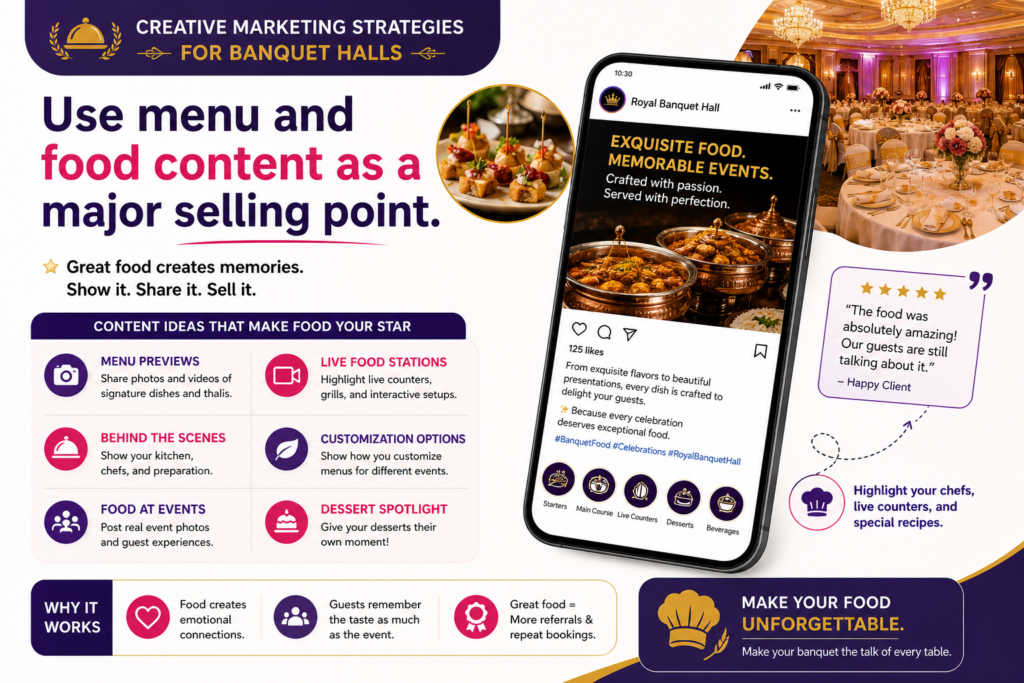
If your banquet hall offers catering or works closely with food partners, your marketing should show this clearly. Do not treat food as a small detail hidden inside a package. Make it part of your selling story.
People want to know what kind of food experience their guests will have. Show them.
Food marketing should focus on guest experience, not only dishes
A menu list is useful, but it is not enough. Customers want to know whether the food will be fresh, hot, well presented, and served smoothly. They want to know if there will be enough space around counters. They want to avoid long lines. They want guests to enjoy the meal without crowding.
Your content should explain how food service works at your hall. Show buffet arrangements, live counters, dining areas, serving flow, and table setups. Explain how your team plans counter placement based on guest count and event type.
This shows that you think beyond the menu.
Good food flow can be a strong sales point
Food flow is a practical detail that customers may not understand at first. But once you explain it, they value it. A poorly placed buffet can create crowding and frustration. A smart layout can keep guests moving smoothly.
You can create content around this topic. For example, explain how a 300-guest reception needs enough counter space, clear walking paths, and proper timing so guests do not all crowd one area. Show photos of past setups where the dining area stayed organized.
This kind of content makes your venue look experienced. It also gives your sales team a useful talking point during tours.
If your hall is known for strong food service, make that clear in your reviews, ads, landing pages, and follow-ups. Food is not just an add-on. It is part of the memory people take home.
Menu tasting can be turned into a marketing moment
If your venue offers menu tasting, do not treat it as a quiet back-end step. It can become a strong trust-building moment. Customers feel safer when they can taste the food before the event. It reduces risk and gives them confidence in the final choice.
You can show short videos of tasting sessions, food plating, chef preparation, or menu discussions. Keep it clean, natural, and tasteful. The goal is not to make the content look like a restaurant ad. The goal is to show care and quality.
Tasting sessions can increase customer confidence
A tasting session gives customers a sense of control. They can choose dishes, adjust spice levels, discuss presentation, and understand how the food will be served. This makes the event feel more personal.
Your sales team can use this as part of the booking conversation. If a lead is unsure, explain how your menu planning process works and how tasting helps finalize choices. This can reduce hesitation.
After a tasting session, send a short summary of the selected items and any agreed changes. This keeps everything clear. It also shows that your team listens.
When food is marketed well, it does not just make people hungry. It makes them trust the event experience.
Make your banquet hall easy to find on maps and local directories
A banquet hall can lose leads if people cannot find it easily. This may sound basic, but it matters a lot. Customers search across many platforms, not just your website. They use Google Maps, wedding directories, local business sites, event platforms, social media pages, and even voice search.
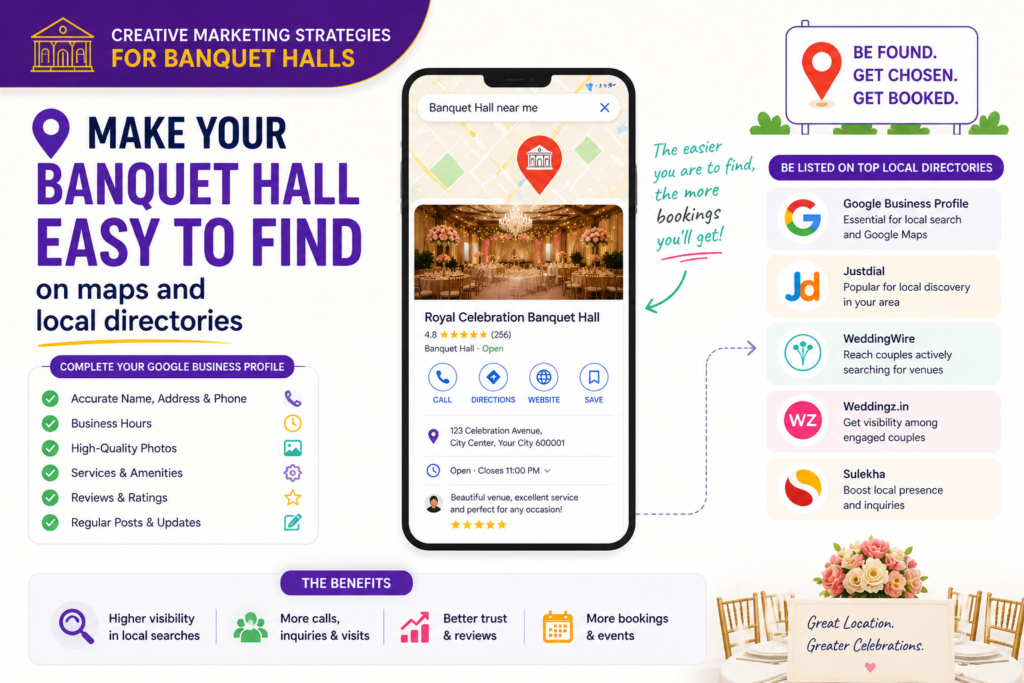
Your venue information must be clear and consistent everywhere. If your name, address, phone number, photos, or timings are different on different platforms, it creates confusion. Confusion reduces trust.
Local visibility is not only about ranking. It is also about making the path from discovery to visit as smooth as possible.
Your business details should be the same across every platform
Your banquet hall name, address, phone number, website link, map location, and opening hours should match across Google, Facebook, Instagram, wedding sites, local directories, and any event listing platform you use. Even small differences can create problems.
If one platform shows an old number and another shows a new one, leads may get lost. If the map pin is wrong, visitors may get frustrated. If photos are outdated, people may judge the hall unfairly.
A simple audit every few months can prevent these issues.
Accurate listings help both people and search engines
Search engines use business details to understand and trust your location. When your details are consistent across the web, your local presence becomes stronger. This can support local SEO and help your venue appear for more searches.
But the human side is even more important. A customer planning an event is already managing many details. They do not want to struggle to find your number, location, or directions. Make it easy.
Your map link should be shared in every serious follow-up. Your website should have clear directions, nearby landmarks, parking notes, and transport information. If your hall is near a metro station, highway, market, hotel, or known area, mention it.
This helps people plan guest arrival, which is often a major concern.
Directory listings should be treated like mini sales pages
Many banquet halls list themselves on wedding and event directories but do not fully use them. They add a few photos, a basic description, and a phone number. That is not enough. A directory profile should work like a small landing page.
It should explain what kind of events your hall is best for, how many guests it can handle, what services are available, and why people choose it. It should have strong photos, fresh reviews, and a clear contact path.
Do not copy the same boring description everywhere. Keep the message consistent, but adjust the wording based on the platform and audience.
Strong profiles can bring leads without heavy ad spend
Some customers trust directories because they can compare venues in one place. If your profile is weak, they may skip you even if your actual hall is better than others. If your profile is strong, you can get leads from people who are already in booking mode.
Your directory photos should show variety. Include wide shots, decorated setups, dining areas, entrance views, and real event examples. Your description should avoid empty claims and focus on real benefits.
For example, say that your hall is suited for families who want a smooth celebration with flexible layouts, clear package support, and easy guest movement. This tells people what life will feel like when they choose you.
Directories should not be ignored once they are set up. Update them often. Add fresh photos. Respond to leads quickly. Track which platforms bring good inquiries. Keep the ones that work and improve the ones that have potential.
Conclusion
Creative marketing for banquet halls is not about chasing every trend. It is about making your venue easier to find, easier to trust, easier to imagine, and easier to book. When people plan an event, they are not only buying a hall.
They are buying peace of mind. They want to know that their guests will be comfortable, the event will look good, the food will be handled well, and the team will not disappear when details become stressful.









Comments are closed.