
WinSavvy Editorial Standards
How this article was created
Insurance agencies do not lose clients because people no longer need insurance. They lose clients because buyers cannot see why one agency is better than another. That is the real marketing problem. Most people do not wake up excited to buy auto, home, life, health, or business insurance. They search when something changes. A car is bought. A home loan is approved. A baby is born. A business grows. A policy price jumps. A claim goes badly. At that point, they want clear answers, fast help, and someone they can trust.
Build Your Insurance Marketing Around Trust Before You Build It Around Traffic
Insurance is not an impulse buy. People do not choose an agency the way they choose a coffee shop or a pair of shoes. They are handing over risk, money, private details, family needs, and in many cases, business protection. That means your marketing must do more than get attention. It must lower fear.
Many insurance agencies make the mistake of chasing traffic first. They want more website visitors, more ad clicks, more quote forms, and more social media reach. Those things matter, but they do not help much if the buyer lands on your site and still feels unsure.
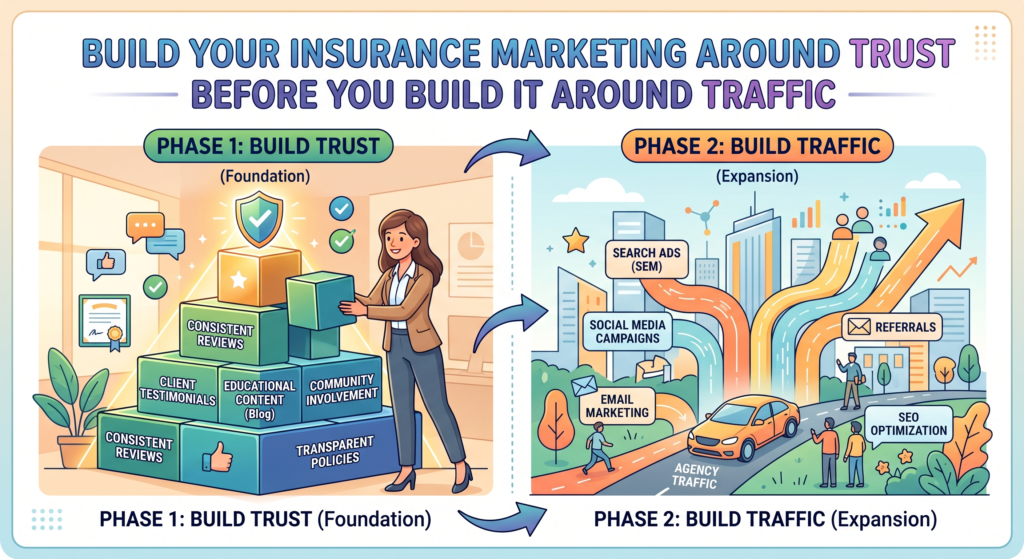
Your first job is to make people feel safe choosing you.
Your marketing should answer the doubts buyers already have
Before someone contacts an insurance agency, they usually have silent questions in their head. They wonder if they are overpaying. They wonder if they have enough coverage. They wonder if the agent will explain things clearly or push a policy that pays the highest commission. They wonder if anyone will actually help when a claim happens.
Good marketing answers these doubts before the buyer has to ask.
Your website should clearly explain who you help, what kinds of policies you handle, how your process works, and why your advice is different from a quote engine. Your Google Business Profile should show recent reviews that mention real service, not just “great company.”
Your emails should teach clients how to avoid gaps in coverage. Your social posts should make insurance feel less confusing.
The best insurance marketing is not loud. It is clear, steady, and useful.
Make your agency feel human before asking for the lead
A lot of insurance websites feel cold. They have stock photos, vague lines like “protecting what matters most,” and forms that ask for too much information too soon. That does not build trust. It makes the agency look like every other agency.
A better approach is to show real people, real names, real faces, and real local proof. Add short team bios that explain not only the role of each agent, but also what type of clients they enjoy helping. Show photos of your office, your staff, your community work, and your client education events if you have them.
You do not need to sound perfect. You need to sound real.
If your agency has served local families for twenty years, say that. If you focus on contractors, dentists, landlords, restaurants, trucking firms, or young families, say that. If your team shops policies across many carriers, explain what that means in simple words.
Trust grows when people understand what will happen next. So instead of saying “Get a quote,” explain the process. Tell them you will review their current coverage, compare options, explain the tradeoffs, and help them choose a policy that fits their risk and budget. That is far more powerful than a plain form button.
Turn Your Website Into a Sales Tool, Not a Digital Brochure
Your website is often the first serious touchpoint between your agency and a future client. Yet many insurance websites are built like old brochures. They list services, add a phone number, and hope people reach out.
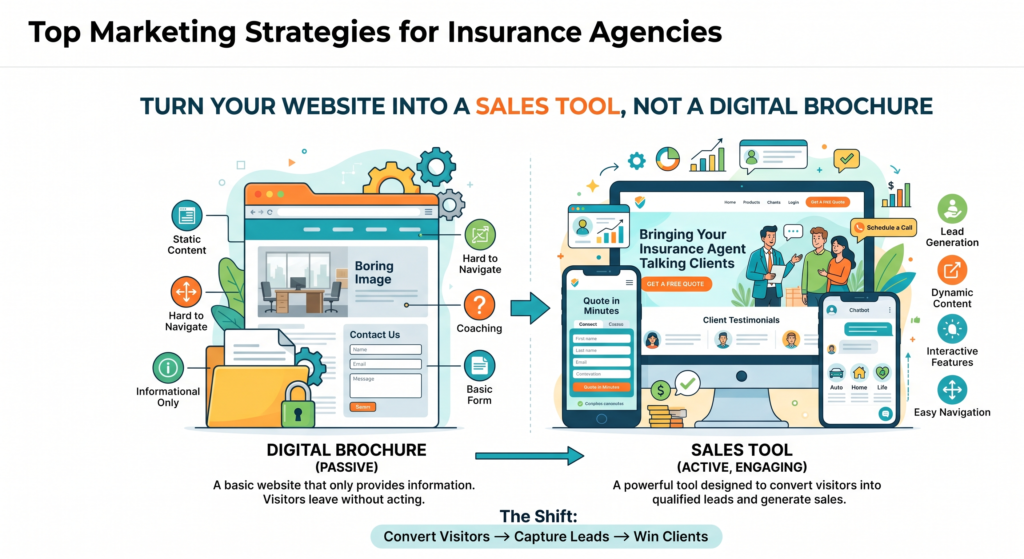
That is not enough anymore.
A strong insurance website should guide the visitor from confusion to clarity. It should help them understand their problem, see your value, trust your process, and take the next step without friction.
Every main insurance service needs its own strong page
One of the biggest SEO and conversion mistakes insurance agencies make is putting all services on one general page. A page that briefly lists auto, home, life, business, health, renters, and umbrella insurance will rarely rank well for each topic. It also gives the visitor very little reason to stay.
Each important service should have its own page.
Your auto insurance page should speak to drivers. Your homeowners insurance page should speak to homeowners. Your business insurance page should speak to business owners. If you serve niches, each niche should also have its own page.
A restaurant owner looking for insurance does not want to read a general business insurance page. They want to know if you understand food spoilage, liquor liability, workers’ compensation, equipment breakdown, and customer injury risk.
This is how your website becomes more useful and more visible.
Search engines need clear pages to understand what you offer. Buyers need clear pages to feel like they are in the right place. When both needs are met, your website starts doing real work for your agency.
Write pages around buyer problems, not policy names alone
A common agency website might say, “We offer commercial general liability insurance.” That is accurate, but it does not connect with the buyer’s real concern.
A better page explains what can go wrong, why the policy matters, what it may cover, what it may not cover, and when a business owner should review their limits. It uses simple examples. It shows the risk in plain language. It helps the reader think, “This agency understands my world.”
For example, a page for contractors should not only say that you offer contractor insurance. It should talk about job site injuries, property damage, subcontractor issues, tools and equipment, certificate of insurance requests, and contract requirements. These are the things contractors actually deal with.
The same idea applies to personal lines. A homeowners insurance page should not just describe coverage. It should explain replacement cost, deductibles, water damage, roof age, personal property, and why cheap policies can become expensive after a claim.
This style of writing does two things at once. It helps your SEO because the page covers topics people search for. It also helps conversion because the visitor feels educated instead of sold to.
Use Local SEO So People Find You When They Are Ready to Buy
Local SEO is one of the most important marketing channels for insurance agencies because many buyers still want an agent they can reach, call, meet, or trust with local knowledge. Even when a policy can be bought online, people often search for an agency near them when they want advice.
Searches like “insurance agency near me,” “home insurance agent in Dallas,” “business insurance broker near me,” and “life insurance agent in Tampa” can bring high-intent leads. These are not casual visitors. These are people already looking for help.
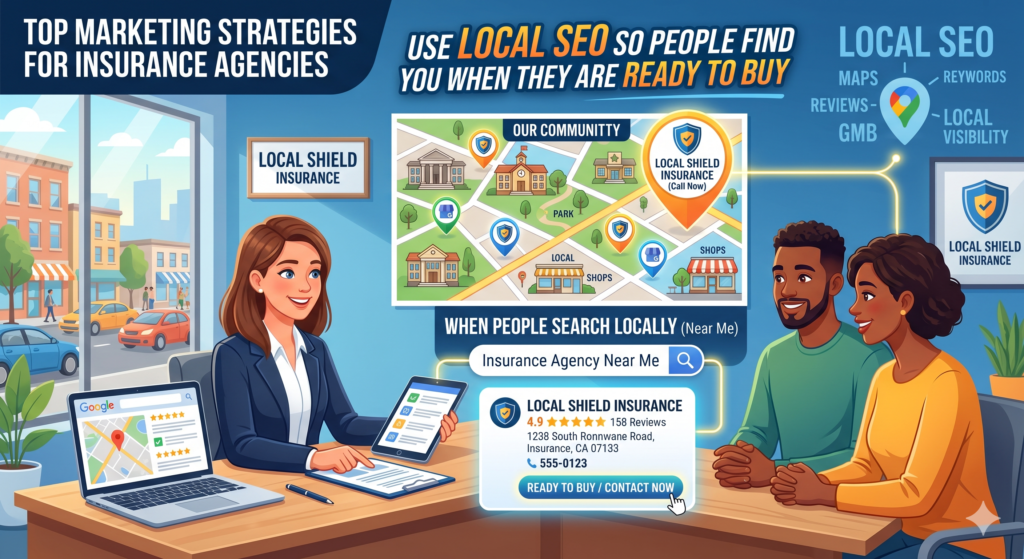
Your job is to show up when that search happens.
Your Google Business Profile should be treated like a second homepage
Many agencies set up their Google Business Profile once and then ignore it. That is a mistake. For local searches, your profile may be seen before your website. It can shape the buyer’s first impression in seconds.
Your profile should have the correct business name, address, phone number, website link, business hours, service categories, service areas, photos, and a clear business description. It should also have regular updates, fresh reviews, and answers to common questions.
A bare profile makes your agency look inactive. A complete profile makes your agency look open, helpful, and trusted.
Photos matter more than many agencies think. Real office photos, staff photos, community photos, and team photos can make your profile feel alive. Buyers are more likely to trust a real local agency than a faceless listing.
Reviews should be earned with a repeatable process
Reviews are one of the strongest trust signals in insurance marketing. But most agencies leave reviews to chance. They only ask when they remember, or they wait for happy clients to do it on their own.
That is not a strategy.
You need a simple review process that runs every week. After a good service moment, ask for a review. This could be after helping someone save money, after resolving a claim question, after binding a new policy, after completing a renewal review, or after helping a business owner get a certificate fast.
The request should feel personal, not automated and cold. A short message from the agent works well because the client knows who helped them. The message should explain that reviews help local people find the agency and make better insurance choices.
Do not ask only for five stars. Ask clients to share their honest experience. The best reviews mention details, such as fast response, clear explanations, claim support, renewal help, or savings with better coverage. These details make the review more believable.
You should also reply to reviews. A thoughtful reply shows future buyers that your agency pays attention. Even a short thank-you can make your profile feel more active and human.
Create Content That Makes Insurance Easier to Understand
Content marketing works very well for insurance agencies when it is done with a clear purpose. The purpose is not to publish random blog posts. The purpose is to answer real buyer questions before, during, and after the sale.
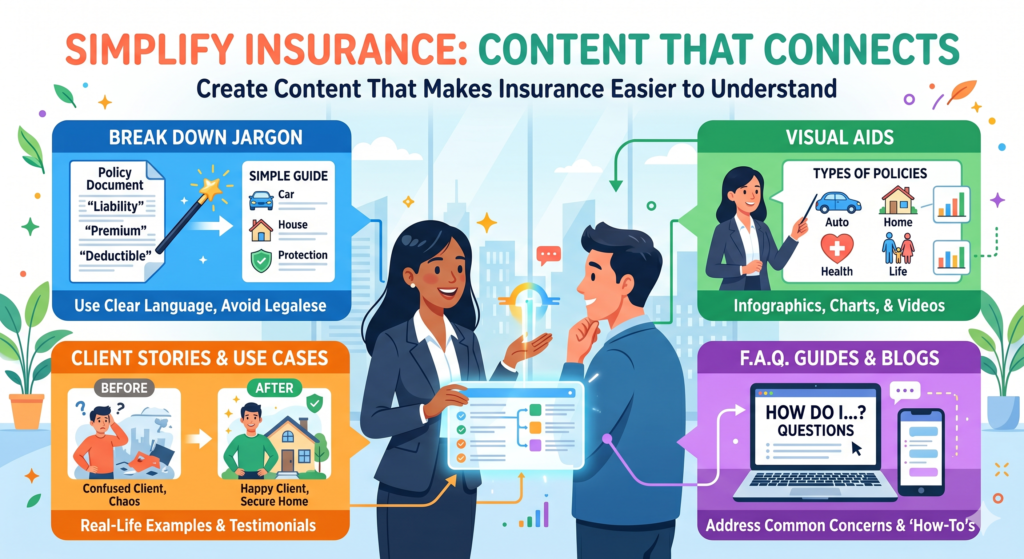
Insurance feels confusing to many people. That confusion creates a chance for your agency to become the guide.
When your content explains coverage in simple words, you build trust. When it helps people avoid mistakes, you build authority. When it answers local or niche questions, you attract better search traffic.
Your best content ideas are hidden in client questions
You do not need to guess what to write about. Your clients already tell you every week.
They ask why their premium went up. They ask if full coverage is a real thing. They ask if their home policy covers floods. They ask how much life insurance they need. They ask why a landlord needs special coverage. They ask if their personal auto policy covers business driving. They ask if a small business really needs cyber insurance.
Each of these questions can become a useful article, video, email, or social post.
The best content often starts with a simple question and gives a clear answer. It does not try to impress the reader. It tries to help them make a better decision.
Write for the person who feels confused, not the expert
Many insurance pages fail because they sound like policy documents. They use terms the buyer does not use. They explain coverage in a way that only another insurance professional would enjoy.
That is not how WinSavvy would advise an agency to write.
Write like you are explaining the topic across a kitchen table. Use short sentences. Use real examples. Compare choices. Explain what can go wrong. Tell the reader when to speak with an agent.
For example, instead of writing, “Policyholders should assess liability exposure based on asset protection goals,” say, “If someone sues you after an accident, your savings, home equity, or future income could be at risk. That is why higher liability limits may matter, even if your state only requires a lower amount.”
That is still professional. It is just easier to understand.
Strong content also avoids fear-based selling. You can talk about risk without scaring people. The goal is not to make readers panic. The goal is to help them see what they may be missing and why guidance matters.
Build Landing Pages for Your Most Profitable Niches
Most insurance agencies are too general in their marketing. They say they help everyone with every type of insurance. That may be true, but it is not always the best way to grow.
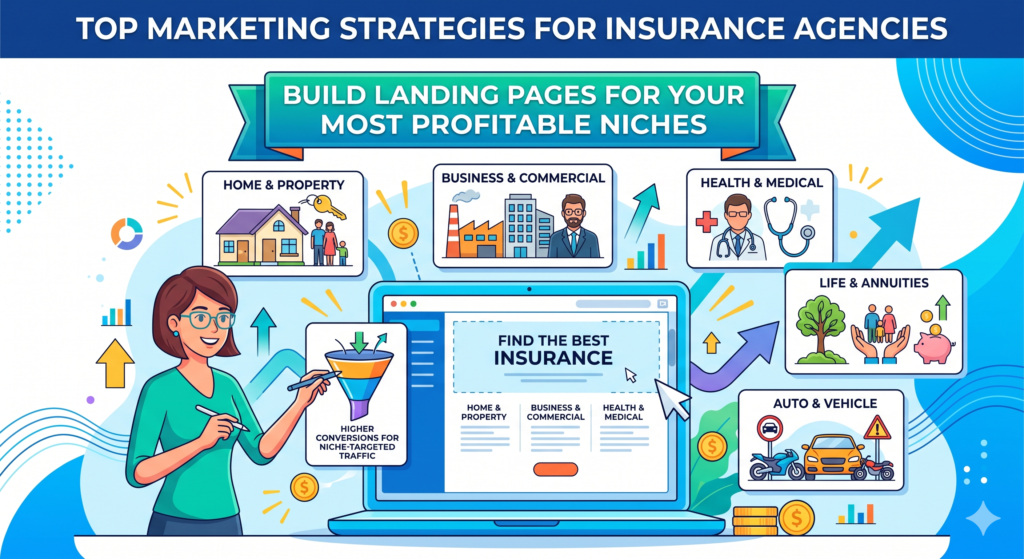
A niche landing page lets you speak directly to a specific type of buyer. That makes your message sharper and your leads stronger.
For example, an agency might create pages for restaurant insurance, contractor insurance, daycare insurance, trucking insurance, dental office insurance, landlord insurance, or high-value home insurance. Each page can explain the risks, coverage needs, common mistakes, and the agency’s process for that niche.
Niche pages help buyers feel understood faster
A general business owner may accept a general business insurance page. But a restaurant owner wants to know if you understand their exact risks. A contractor wants to know if you can help with certificates, subcontractor rules, and job site claims. A landlord wants to know if you understand rental property risks.
When your page speaks to their world, trust builds faster.
This does not mean you pretend to be the only agency that serves that niche. It means you show that you have thought deeply about their needs. You explain what they should look for, what mistakes to avoid, and how your agency helps them compare options.
Each niche page should have a clear next step
A strong landing page should never leave the reader wondering what to do next. At the end of each section, gently guide them toward action. That action could be requesting a coverage review, booking a call, uploading a current policy, or asking for a quote.
The call to action should match the buyer’s stage.
Some buyers are ready for a quote. Others are not. They may want to know if their current coverage has gaps. That is why “Request a coverage review” can sometimes work better than “Get a quote.” It feels less pushy and more helpful.
Your page should also explain what happens after they reach out. Tell them your team will review their needs, compare carrier options, explain the differences, and help them make a clear decision. This simple explanation can increase conversions because it removes uncertainty.
Use Paid Ads Only When Your Follow-Up System Is Ready
Paid ads can work for insurance agencies, but they can also waste money very fast. The problem is not always the ad platform. The problem is often the system behind the ad.
If someone clicks your ad and lands on a weak page, you lose money. If they fill out a form and no one follows up quickly, you lose money. If your team does not track which leads turn into policies, you lose money. If you bid on broad keywords without knowing your close rate, you lose money.
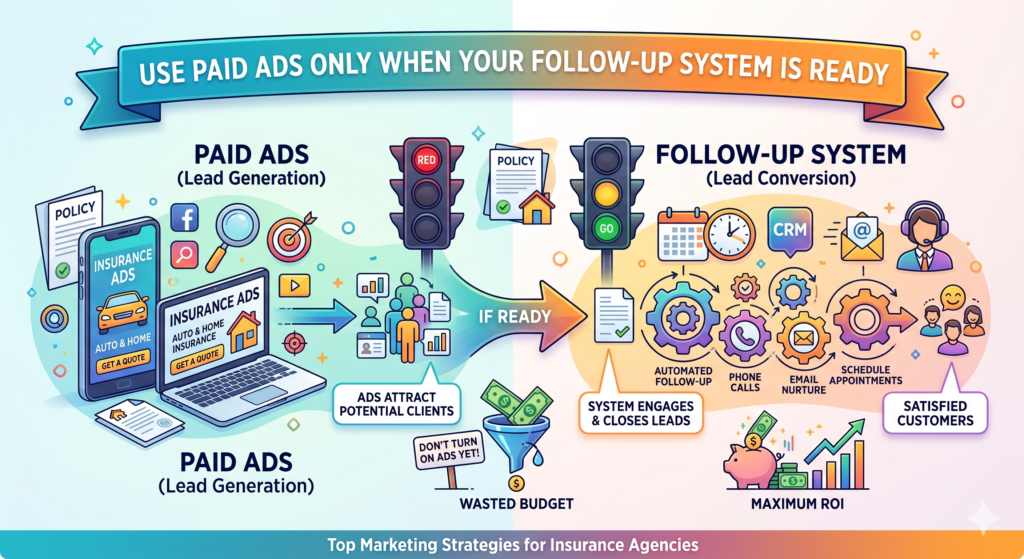
Paid ads should not be used as a shortcut. They should be used to speed up a system that already converts.
Start with high-intent campaigns before broad awareness campaigns
For most agencies, the best place to start is with people already searching for insurance help. These searches may include phrases like “business insurance quote,” “home insurance agent near me,” “contractor insurance,” or “life insurance agency.”
These buyers are closer to action than someone casually scrolling social media.
Search ads can work well because the intent is clear. The buyer has a need, and your agency can appear at the right moment. But the landing page must match the search. If your ad says “Contractor Insurance in Austin,” the page should be about contractor insurance in Austin, not a generic homepage.
Speed matters after every paid lead
Insurance leads get cold quickly. If someone requests a quote from your agency, they may also be contacting two or three others. The agency that responds first with a helpful, clear message often has the advantage.
This does not mean rushing into a hard sell. It means acknowledging the request fast, explaining the next step, and making it easy to continue.
Your follow-up should include a phone call, an email, and if allowed, a text message. The tone should be helpful and specific. Refer to what the person asked for. Tell them what information you need. Explain how long the review may take. Make the process feel simple.
Paid ads should be tracked from click to policy sold. Do not judge success only by cost per lead. A cheap lead that never buys is not cheap. A more expensive lead that becomes a long-term client may be worth much more.
Build an Email System That Keeps Clients Warm Before and After the Sale
Most insurance agencies think of email only as a renewal reminder or a way to send documents. That is a missed chance.
Email can become one of the most useful marketing tools your agency owns because it helps you stay in touch without waiting for the client to call you first. It also helps you educate people over time, which matters in insurance because many buyers are not ready to switch right away.
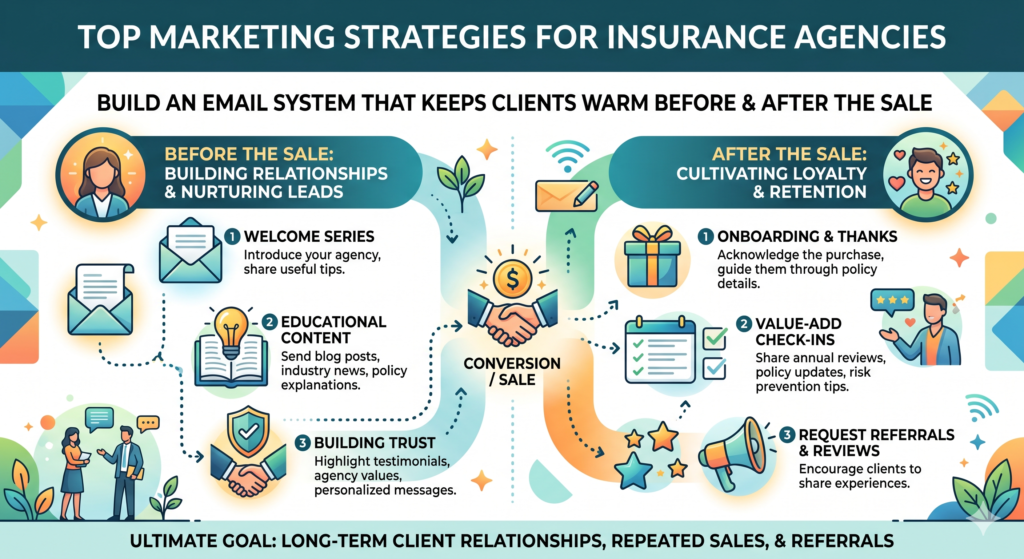
A person may visit your website today, download a guide, ask one question, or request a quote but not move forward. That does not mean the lead is bad. It may only mean the timing is not right. A simple email system can keep your agency in their mind until the timing changes.
Your emails should feel helpful, not like a sales blast
The fastest way to make people ignore your emails is to send only sales messages. “Get a quote today” may work once, but it gets old quickly. A better email system teaches, reminds, and guides.
Your emails can explain why premiums are rising, when to review coverage, what life events should trigger a policy update, what business owners should check before renewal, and how to avoid common claim problems. These topics are useful because they connect to real life.
For personal lines, you might send simple emails about adding a teen driver, buying a new home, reviewing jewelry coverage, preparing for storm season, or checking liability limits. For business lines, you might send emails about employee changes, new equipment, contracts, cyber risk, seasonal hiring, or property updates.
These emails do not need to be long. They need to be clear and useful. The goal is to make the reader think, “My agency is paying attention.”
Segment your email list so every message feels more personal
One big mistake agencies make is sending the same email to everyone. A restaurant owner does not need the same message as a young family buying their first home. A landlord does not need the same message as a life insurance lead.
Segmentation means grouping people based on what they care about. You can group by policy type, client type, lead source, renewal date, location, or industry. Even simple grouping can make your emails much stronger.
If someone requested a homeowners insurance quote, send them a short follow-up sequence about choosing the right deductible, understanding replacement cost, and avoiding coverage gaps. If someone asked about business insurance, send them content about liability, workers’ compensation, certificates of insurance, and claims risk.
This makes your marketing feel less generic.
It also helps with cross-selling. A client who bought auto insurance may need renters, homeowners, umbrella, or life insurance. A business client may need cyber, commercial auto, employment practices coverage, or key person insurance. The right email at the right time can open a helpful conversation without feeling pushy.
Create a Review Strategy That Turns Happy Clients Into Public Proof
Insurance is built on trust, and reviews are one of the easiest ways for strangers to borrow trust from people who already know you.
When someone finds your agency on Google, they may not read every page on your website. But they will often scan your reviews. They want to see if real people had a good experience. They want to know if your team responds fast, explains clearly, helps during stressful moments, and treats clients well after the sale.
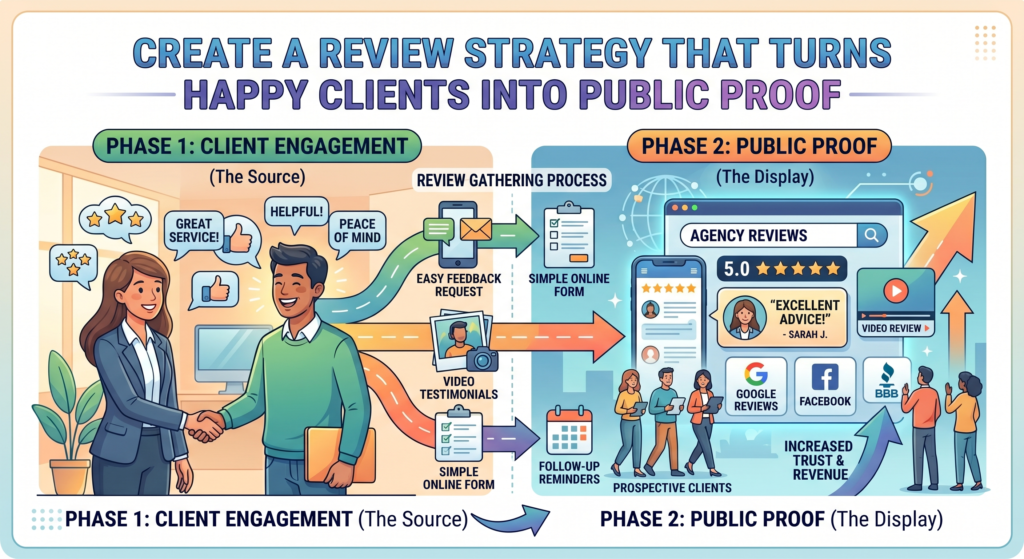
Good reviews can help your agency stand out before a buyer ever speaks to you.
Ask for reviews at the moment of highest satisfaction
The best time to ask for a review is not random. It is when the client has just felt helped.
That moment might come after your agency saves someone money without cutting important coverage. It might come after you help a business owner get proof of insurance quickly. It might come after you explain a confusing renewal. It might come after a client thanks you for helping during a claim.
That is the moment to ask.
Many agencies wait too long. By the time they ask, the client has moved on with life. The good feeling is gone. A strong review process makes the ask part of normal service, not an awkward extra task.
Make the review request simple and personal
The review request should come from the person who helped the client. It should not sound like a corporate message. A simple, warm request works better.
You can say that it was a pleasure helping them and that a short Google review would help other local families or business owners find the agency. Then give them the direct review link.
Do not make people search for where to leave the review. Do not send them to a page with many steps. Make the action easy.
You should also guide without scripting. It is fine to say that they can mention what they found helpful, such as response time, clear explanations, savings, renewal help, or claim support. But never tell them what rating to give or what exact words to use.
Strong reviews are specific. A review that says “Great service” is nice. A review that says “They explained my home coverage, found a better option, and answered every question before closing” is far more powerful.
Reviews also need steady growth. Ten reviews from five years ago will not build as much confidence as a steady stream of recent reviews. A simple weekly review habit can become one of your agency’s strongest long-term assets.
Use Social Media to Create Familiarity, Not Just Visibility
Many insurance agencies struggle with social media because they treat it like a place to post random holiday greetings, carrier updates, or generic safety tips. That kind of content rarely creates real demand.
Social media works better when it makes your agency familiar. People may not need insurance today, but if they see your face, your advice, your local presence, and your helpful posts over time, they are more likely to remember you when they do need help.
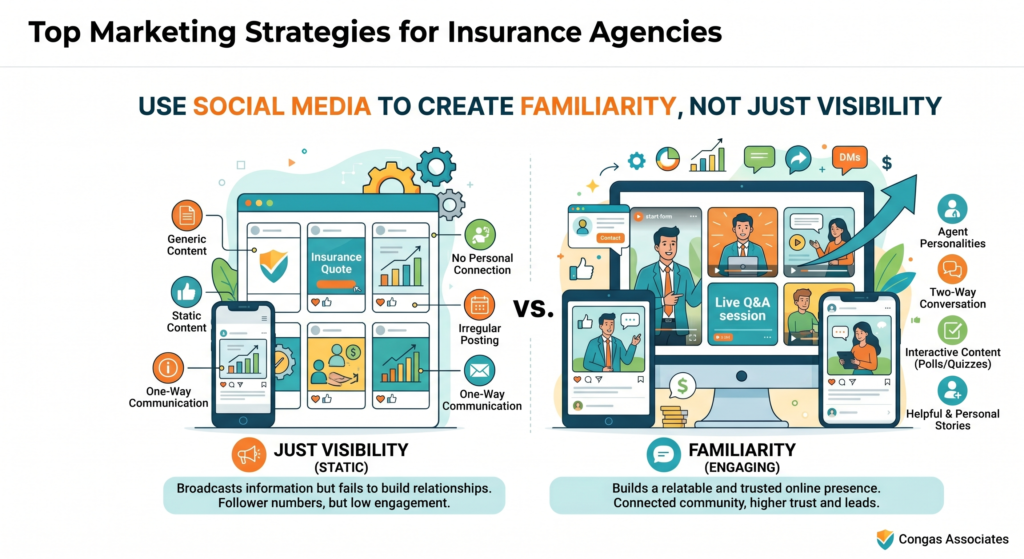
The goal is not to become famous. The goal is to become known in the market you serve.
Show the people behind the agency
Insurance is personal, but many agency social pages feel faceless. They use stock images and safe captions. That makes it hard for people to connect.
Show your team. Share short posts from agents. Explain common questions. Celebrate client education moments without sharing private details. Show community work, office culture, local events, and behind-the-scenes moments.
People trust people faster than logos.
This does not mean every post needs to be personal. It means your agency should not feel like a machine. Buyers want to know who they will be speaking with, especially when the topic is money, risk, family, or business protection.
Turn common insurance questions into simple social posts
Your best social content does not need to be clever. It needs to be useful.
If clients often ask whether their personal auto policy covers delivery driving, create a post about it. If homeowners are confused about flood insurance, explain the difference between water damage and flood damage in simple words. If business owners do not understand certificates of insurance, explain why they matter.
One strong question can become many posts. You can turn it into a short video, a text post, a carousel, an email, and a blog section. This keeps your message consistent without repeating the same words.
Social media should also point people toward deeper action. A post can invite someone to read a full guide, request a coverage review, ask a question, or save the post for later. Do not force every post to sell. But do make it easy for interested people to take the next step.
For local agencies, Facebook and Instagram can work well for community and personal lines. LinkedIn can work well for commercial lines, business owners, professionals, and referral partners. The right platform depends on the market, not on trends.
Build Referral Partnerships That Send Better Leads Than Cold Traffic
Referrals can become one of the strongest growth channels for an insurance agency, but many agencies handle referrals too casually. They wait for happy clients or local contacts to remember them. That is not enough.
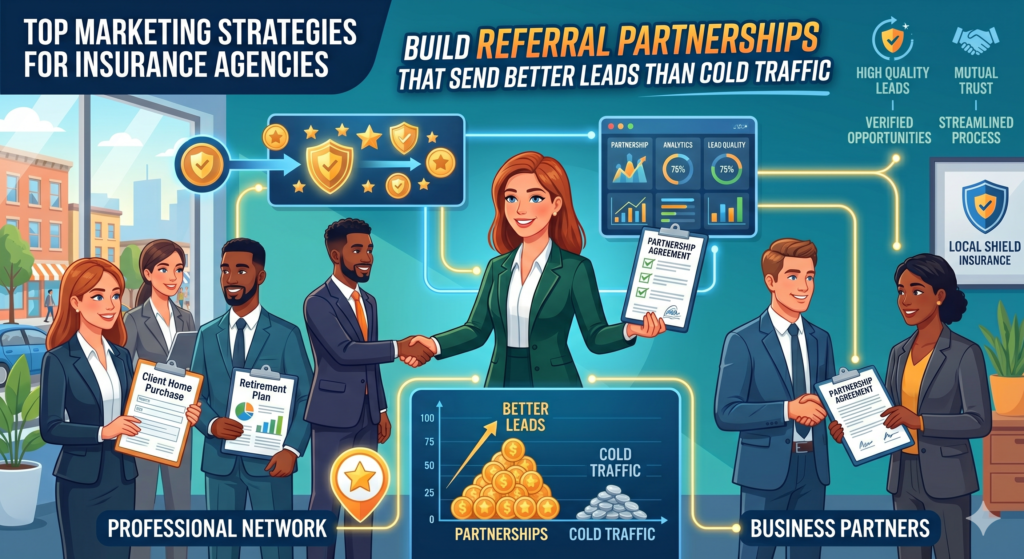
A strong referral system is built on clear relationships, steady value, and easy handoffs.
Insurance connects naturally with many other services. Mortgage brokers, real estate agents, car dealerships, accountants, attorneys, financial planners, HR consultants, payroll companies, builders, property managers, and local business groups can all become valuable referral sources.
But they will only refer to you if they trust that you will make them look good.
Your referral partners need to understand who you help best
A vague referral request is weak. If you tell people, “Send us anyone who needs insurance,” they may not know what to do with that. They may also send poor-fit leads.
Be specific.
Tell real estate agents that you help homebuyers compare coverage before closing and avoid last-minute policy issues. Tell mortgage brokers that your team responds quickly when proof of insurance is needed.
Tell accountants that you help small business owners review risk before growth creates expensive gaps. Tell property managers that you help landlords think through rental property coverage.
The clearer your fit, the easier it is for partners to refer.
Make referring to your agency simple and safe
Referral partners are busy. They do not want a hard process. They also do not want to risk their reputation by sending someone to an agency that does not follow up.
Make the handoff easy.
Give partners a simple way to introduce you by email. Create a short page that explains your process. Share helpful resources they can give to their own clients. Follow up quickly when they send someone. Then thank them and keep them updated without sharing private client details.
The best referral relationships are not built by asking all the time. They are built by being useful.
You can send partners short guides, market updates, coverage reminders, or simple checklists that help their clients. For example, a real estate agent may value a simple “home insurance questions before closing” guide.
An accountant may value a “small business insurance review checklist.” A property manager may value a “rental property risk review guide.”
When you help referral partners serve their clients better, you stop being just another agency asking for leads. You become part of their value chain.
Use Retention Marketing So Clients Do Not Leave at Renewal
Growth is not only about getting new clients. It is also about keeping the clients you already worked hard to win.
Insurance agencies often focus so much on new leads that they forget how much profit leaks out through weak retention. A client leaves when they feel ignored, surprised, overcharged, confused, or unsupported. Sometimes the agency could have saved the relationship with better communication long before renewal.
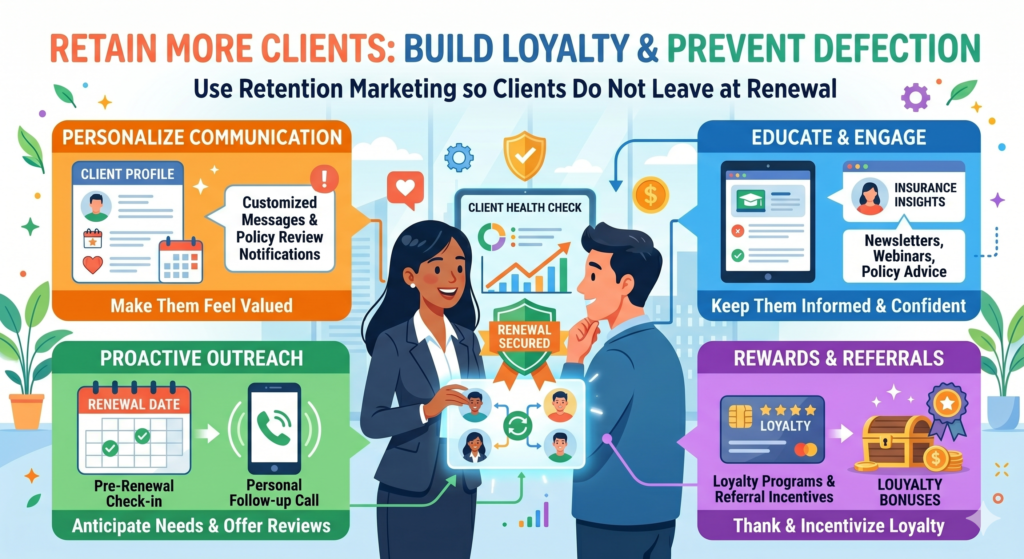
Retention marketing keeps clients informed, valued, and aware of your role.
Do not let the renewal be the only time clients hear from you
If the only time a client hears from your agency is when payment is due or premiums rise, the relationship becomes thin. At that point, the client may see you as a middleman, not an advisor.
You need helpful contact throughout the year.
This can include policy review reminders, seasonal risk tips, claim prevention advice, coverage education, life event check-ins, and business change reminders. These messages do not need to be heavy. They just need to show that your agency is paying attention.
For personal lines, contact can be tied to life changes. Marriage, home purchase, new drivers, renovations, valuables, pets, side businesses, and retirement can all change coverage needs. For commercial lines, contact can be tied to hiring, revenue growth, new locations, new vehicles, contracts, equipment, and cyber risk.
Turn renewals into reviews, not price conversations
Many clients only think about insurance when the renewal price changes. If your agency waits until that moment, the conversation becomes all about cost.
A better approach is to frame renewals as coverage reviews.
Before renewal, reach out and explain that you want to check whether anything has changed. Ask about new assets, new risks, new drivers, home updates, business changes, payroll changes, or contract changes. This makes the conversation about fit, not just price.
If the premium increased, explain why in plain words. If there are options, walk the client through them. If a cheaper policy reduces important coverage, explain the tradeoff clearly. Clients do not always choose the lowest price when they understand the risk.
Retention improves when clients feel guided. They may still care about price, but they are less likely to leave blindly when your agency has made the value clear.
This is also where cross-selling can happen naturally. If you are reviewing a client’s full situation, you may notice missing coverage. That is not pushy when it is relevant. It is service.
Use Video to Make Insurance Feel Clear, Personal, and Less Scary
Video is powerful for insurance agencies because it does something written content cannot always do quickly. It lets people see your face, hear your voice, and feel your style before they ever book a call.
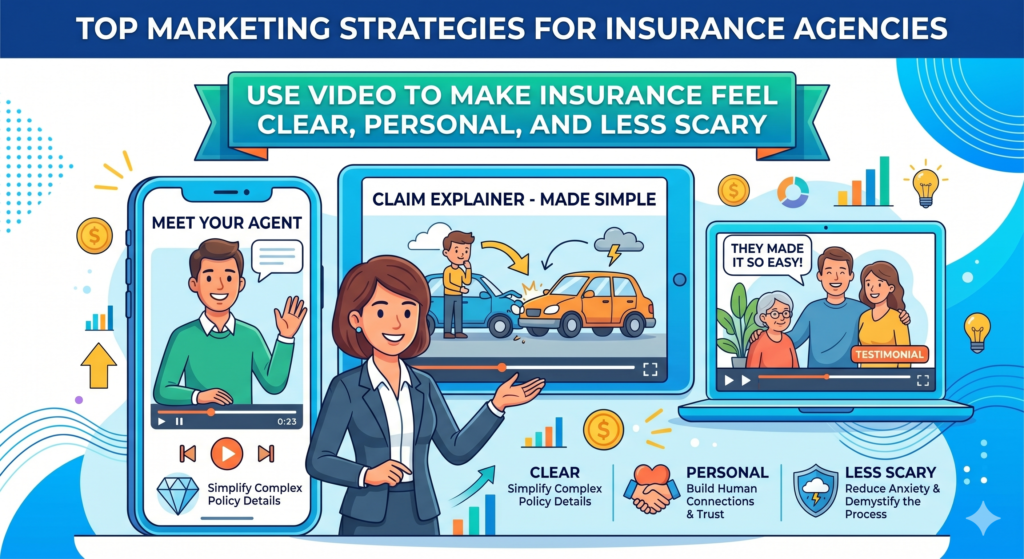
That matters because insurance is full of doubt. People worry that they will be judged for not knowing the right terms. They worry that an agent will rush them. They worry that the policy will be too hard to understand. A simple video can lower that fear.
You do not need a studio. You do not need fancy editing. You need clear, useful answers delivered in a human way.
Short educational videos can answer questions before the sales call
The best insurance videos are not long commercials. They are short answers to real questions.
Think about the questions your agency hears every week. Why did my premium go up? What does full coverage mean? Do I need umbrella insurance? Does home insurance cover water damage? What is workers’ compensation? Why does a landlord need a different policy? What should a small business check before signing a lease?
Each question can become a short video.
The goal is not to explain every tiny detail. The goal is to make the topic easier to understand and invite the viewer to ask for help. A good video should make the viewer feel smarter after watching it.
You can place these videos on your website, YouTube, Google Business Profile, LinkedIn, Facebook, Instagram, and email campaigns. One video can support many channels. That makes it worth the effort.
Keep each video focused on one simple idea
A common mistake is trying to say too much in one video. When the topic is too broad, the viewer gets lost. A better video covers one question, one problem, or one decision.
For example, do not make a video called “Everything You Need to Know About Home Insurance.” That is too wide. Make a video called “Why Your Home Insurance Deductible Matters More Than You Think.” That is easier to follow.
Start by naming the problem in simple words. Then explain why it matters. Then give a short example. Then tell the viewer what to do next.
The next step should feel natural. You might say that if they are not sure whether their policy fits their current home value, your team can review it with them. That is helpful, not pushy.
Video also helps your agency stand apart from quote websites. Quote engines can show prices, but they cannot build the same human connection. When people see a real agent explain risk with care, they begin to understand why guidance has value.
Create a Follow-Up Process That Stops Leads From Going Cold
Many insurance agencies do a lot of work to get leads, then lose them because follow-up is weak. This is one of the easiest places to improve results.
A lead does not become a client just because they filled out a form. They may be busy. They may be comparing options. They may be nervous about switching. They may not understand the quote. They may need to speak with a spouse, partner, lender, accountant, or business manager.
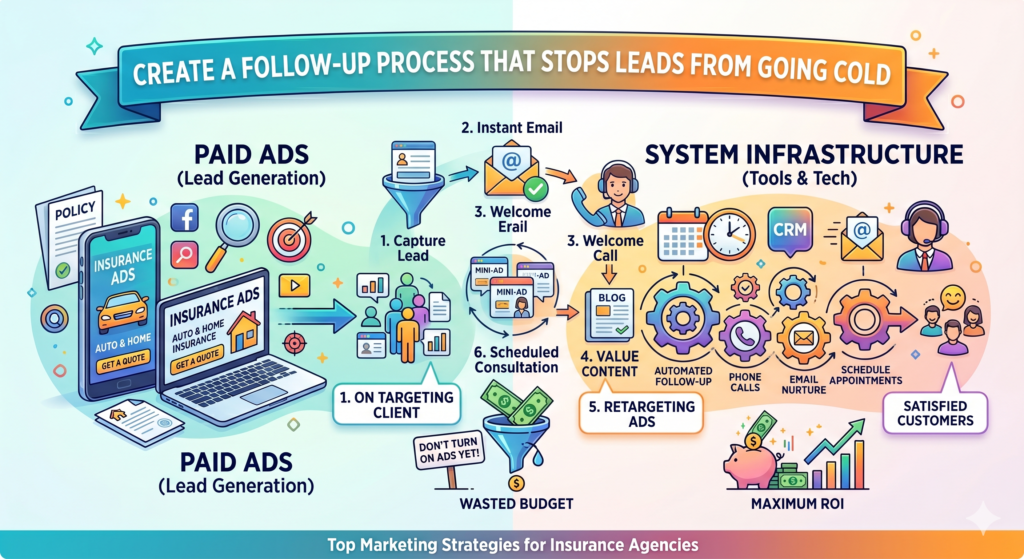
If your agency sends one message and gives up, you are leaving money on the table.
Follow-up should be fast, clear, and useful
Speed matters because insurance buyers often contact more than one agency. The first agency to respond with real help often has an edge. But speed alone is not enough. A rushed message that only says “Call us back” does not create much trust.
Your first response should confirm the request, explain what happens next, and make it easy to continue.
If the person asked for a quote, tell them what details you need. If they asked a coverage question, answer it simply and offer to review their situation. If they downloaded a guide, send a helpful next step based on that topic.
This is where many agencies can sound more human. Instead of using a cold template, write as if a real advisor is reaching out. The message should be warm, clear, and specific to the person’s request.
Use more than one follow-up touch without becoming annoying
Many leads need several touches before they respond. That does not mean you should flood them with messages. It means you should have a thoughtful sequence.
You might follow up soon after the inquiry, then again the next day, then a few days later, then one final time with a helpful resource. Each message should add value. Do not keep saying the same thing.
One message can explain the next step. Another can answer a common question. Another can share a short guide or video. Another can ask if their timing has changed.
The tone matters. You are not chasing. You are helping.
For example, if someone requested a business insurance quote and did not respond, your follow-up could mention that many business owners are not sure what details are needed, so you can start with a simple review of their current policy or basic business information. That removes pressure.
A good follow-up system also protects your team from guessing. Every lead should have a status, a next action, and a clear owner. When nobody owns the lead, the lead disappears.
Use Search Intent to Create Pages That Match What Buyers Really Want
SEO for insurance agencies is not only about ranking for big keywords. It is about understanding what the searcher wants at that moment.
Someone searching “what is umbrella insurance” is looking for education. Someone searching “umbrella insurance agent near me” is closer to buying. Someone searching “best business insurance for electricians” may need both education and a quote. Each search needs a different kind of page.
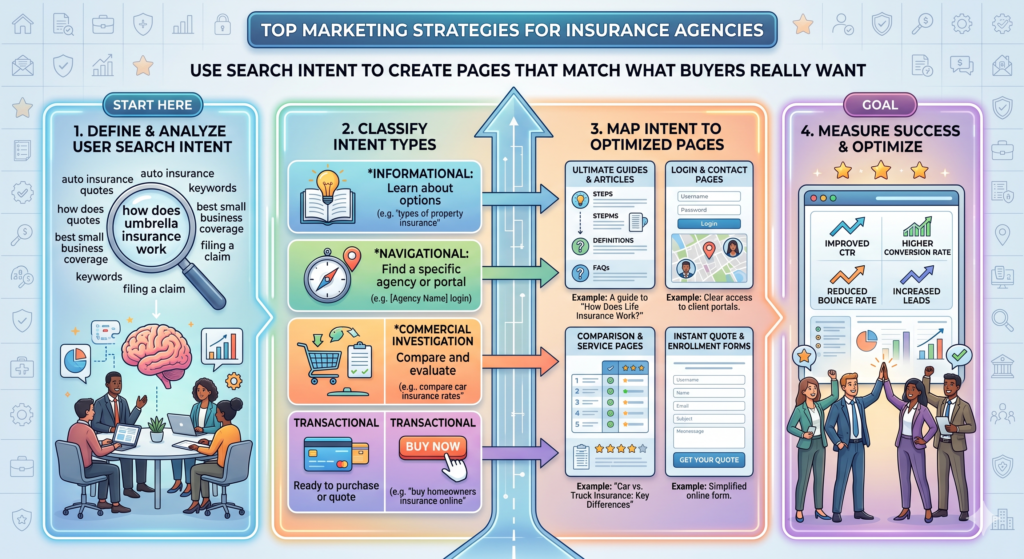
When your content matches search intent, your SEO improves and your leads become better.
Build pages for each stage of the buyer journey
Insurance buyers move through stages. First, they notice a problem or risk. Then they research options. Then they compare providers. Then they take action.
Your website should support each stage.
Educational blog posts help people who are still learning. Service pages help people who know what type of coverage they need. Niche pages help people who want an agency with specific experience. Comparison pages help people who are deciding between options. Local pages help people who want nearby support.
This gives your agency more ways to be found.
A person may first read your article about why home insurance premiums are rising. Later, they may visit your homeowners insurance page. Then they may check your reviews. Then they may request a coverage review. Good SEO supports that whole path.
Do not force every page to sell too quickly
Some agencies make every page sound like a sales pitch. That can hurt trust, especially when the visitor is still learning.
If someone searches “does renters insurance cover theft,” give a clear answer first. Explain what is usually covered, what may be limited, and what the person should check. Then invite them to review their policy or ask your team a question.
Helpful content can still lead to sales, but the order matters. Teach first. Offer help second.
This approach also helps your agency build topical authority. When your site covers insurance questions deeply and clearly, search engines have more reason to see your agency as a useful source. More importantly, buyers have more reason to see you as a guide.
The best SEO content is not stuffed with keywords. It is built around real needs. Use the words people use, not only the words carriers use. If clients say “business car insurance,” you can explain that the formal term may be commercial auto insurance. That helps both the reader and the search engine understand the page.
Build a Clear Brand Message So People Remember Why You Are Different
Many insurance agencies sound the same. They all say they offer great service, competitive rates, trusted advice, and many carriers. Those claims may be true, but they are not enough to make your agency memorable.
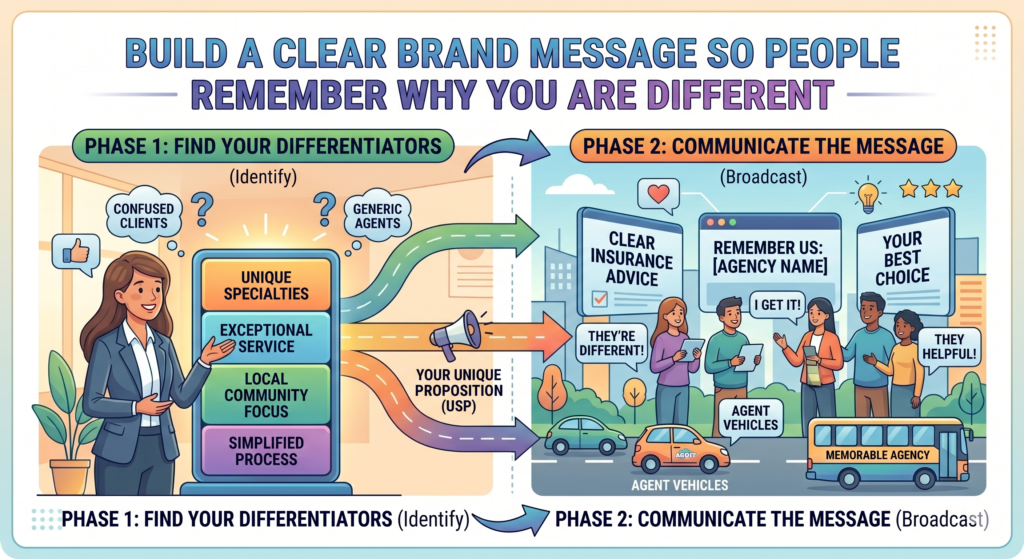
Your brand message should explain why someone should choose you instead of the next agency.
This does not require clever slogans. It requires clarity.
Your message should focus on the buyer’s pain, not your agency’s pride
A strong brand message starts with the client’s problem. People do not come to you because you have a nice logo. They come because they want protection, savings, clarity, speed, confidence, or help with a complex situation.
Your message should show that you understand that.
For example, a weak message says, “We are a full-service independent insurance agency offering personal and commercial lines.” That may be true, but it feels flat.
A stronger message says, “We help local families and business owners compare insurance clearly, avoid costly gaps, and feel confident before they choose a policy.” That speaks to the result the buyer wants.
The best message is simple enough for every team member to use. If your agents, service staff, website, emails, ads, and social posts all say different things, the market gets confused. Consistency builds memory.
Make your difference easy to prove
Do not claim things you cannot show. If you say your agency is fast, prove it with process. If you say you are local, show local knowledge. If you say you explain coverage clearly, publish clear content. If you say you help business owners, create industry-specific resources.
Proof matters more than big words.
You can prove your value through reviews, case examples, educational pages, team bios, response standards, client stories, local partnerships, and simple process explanations. This makes your brand feel real.
Your agency may be different because you serve a niche, offer deep coverage reviews, have strong claim support, work with many carriers, specialize in complex risks, or provide personal service that large platforms cannot match. The key is to choose a difference that matters to the buyer.
A strong brand message should pass one test. When someone reads it, they should think, “That is exactly what I need.” If they only think, “That sounds nice,” the message is too soft.
Use Conversion Tracking So You Know What Is Actually Working
Marketing without tracking is guesswork. You may feel busy, but you may not know which efforts are bringing real clients.
Many agencies track website visits, social likes, or ad clicks. Those numbers can help, but they do not tell the full story. The real question is which channels create quote requests, booked calls, sold policies, retained clients, and profitable accounts.
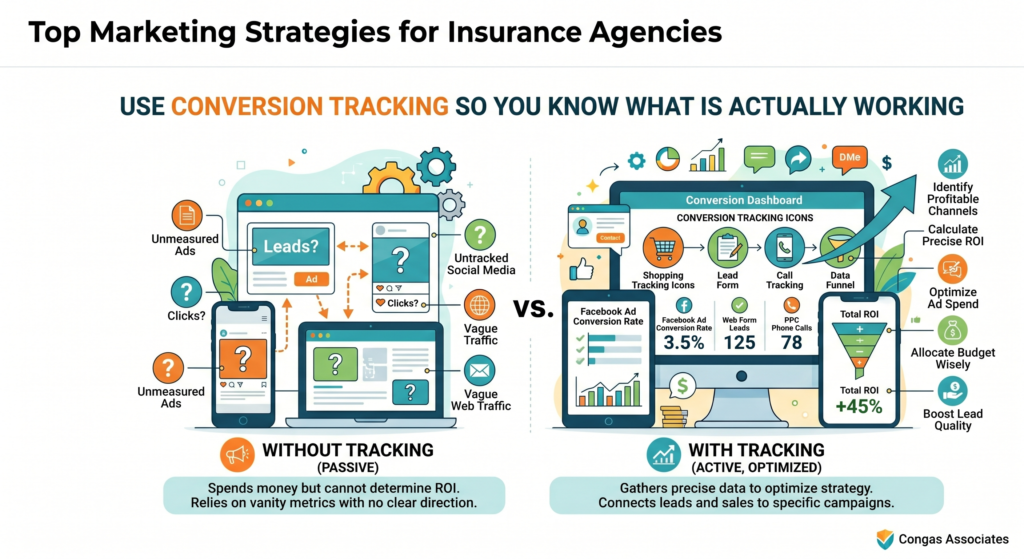
If you do not track that, you may spend more money on weak channels and ignore the ones that work.
Track leads from first touch to sold policy
A strong tracking system connects marketing activity to revenue. That means you should know how a lead found you, what they asked for, who followed up, whether they received a quote, whether they bought, and what policy type they purchased.
This does not have to be complex at first. Even a simple CRM setup is better than scattered notes, inboxes, and memory.
Each lead should have a source. Was it Google search? Google Business Profile? Paid ads? Referral partner? Email campaign? Social media? Direct website visit? Existing client cross-sell? Once you know this, you can judge each channel more honestly.
A channel that sends many low-quality leads may not be as good as a channel that sends fewer but stronger leads.
Measure close rate and lifetime value, not just lead volume
Lead volume can be misleading. One campaign may bring fifty leads and only two clients. Another may bring ten leads and five clients. The second campaign may be much better even though it looks smaller at first.
You should track close rate by source, policy type, location, niche, and campaign where possible.
You should also think about lifetime value. A commercial client who stays for years and adds more policies may be worth far more than a one-time low-premium personal lines client. This does not mean personal lines are not valuable. It means your marketing budget should reflect the true value of each type of account.
Tracking also helps your team improve. If many people request quotes but few buy, the problem may be the sales process, not the traffic. If people visit your pages but do not contact you, the problem may be the page message or call to action. If paid leads do not answer, the issue may be lead quality or follow-up speed.
Good tracking turns marketing from opinion into decision-making.
Create Client Education Assets That Make Selling Easier
One of the smartest ways to market an insurance agency is to create assets that your team can use again and again. These assets educate buyers, support sales calls, help referral partners, and improve follow-up.
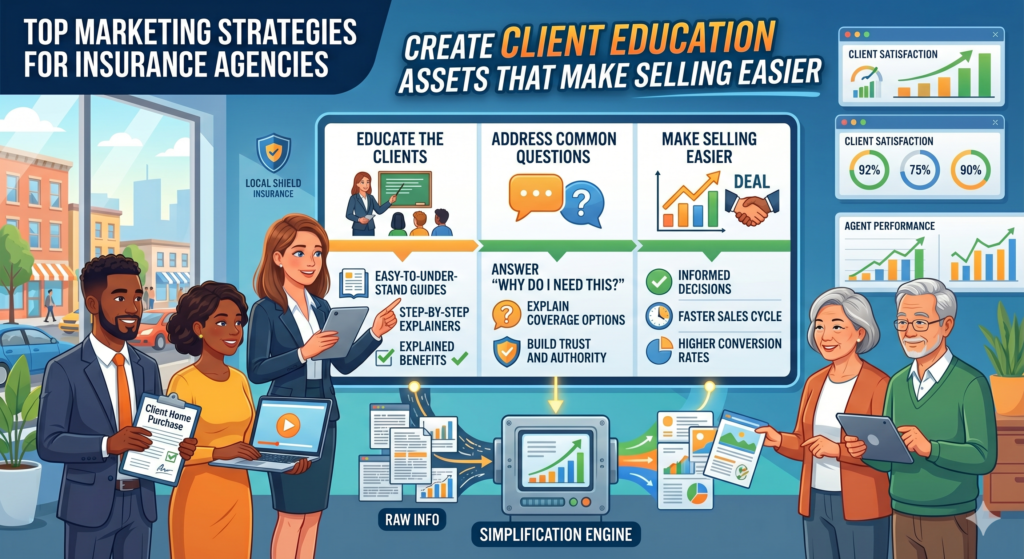
A client education asset can be a guide, checklist, comparison page, short video, email series, renewal review worksheet, or simple explainer. The point is to make a common conversation easier.
When your team repeats the same explanation every week, that is a sign you should turn it into an asset.
Build resources around high-value conversations
Not every topic deserves a full guide. Focus first on the conversations that affect sales, retention, or coverage quality.
For personal lines, useful assets might explain home insurance deductibles, umbrella coverage, teen drivers, flood insurance, life insurance basics, or what to review before buying a home.
For commercial lines, useful assets might explain certificates of insurance, workers’ compensation, cyber coverage, professional liability, contractor risk, or business property limits.
These assets help buyers feel prepared. They also save your team time because the client comes into the conversation with a better starting point.
A good asset should not read like a carrier brochure. It should sound like your agency. It should explain the issue in simple words, show why it matters, and help the reader know what to ask next.
Use education assets in your sales and follow-up process
Do not hide your best guides on your blog and hope people find them. Use them actively.
Send a homeowners checklist before a call with a new homebuyer. Send a certificate of insurance guide to contractors. Send a cyber risk explainer to small business owners. Send an umbrella insurance guide to clients with higher liability exposure. Send a renewal review worksheet before policy renewal.
This makes your agency look prepared and thoughtful.
It also helps prevent price-only conversations. When buyers understand the risks, they are more likely to care about coverage quality. They may still want a fair price, but they become less likely to judge every quote only by the monthly cost.
Education assets also help referral partners. A mortgage broker may appreciate a home insurance checklist they can share. An accountant may value a business insurance review guide. A real estate agent may like a simple flood insurance explainer.
When your resources make other professionals look helpful, they have more reason to send people your way.
Create Location Pages That Feel Local, Not Copied
Local SEO becomes much stronger when your website has pages for the areas your agency serves. But there is a right way and a wrong way to do this.
The wrong way is to create dozens of thin location pages that all say the same thing with only the city name changed. That kind of page does not help the reader. It also makes your agency look lazy.
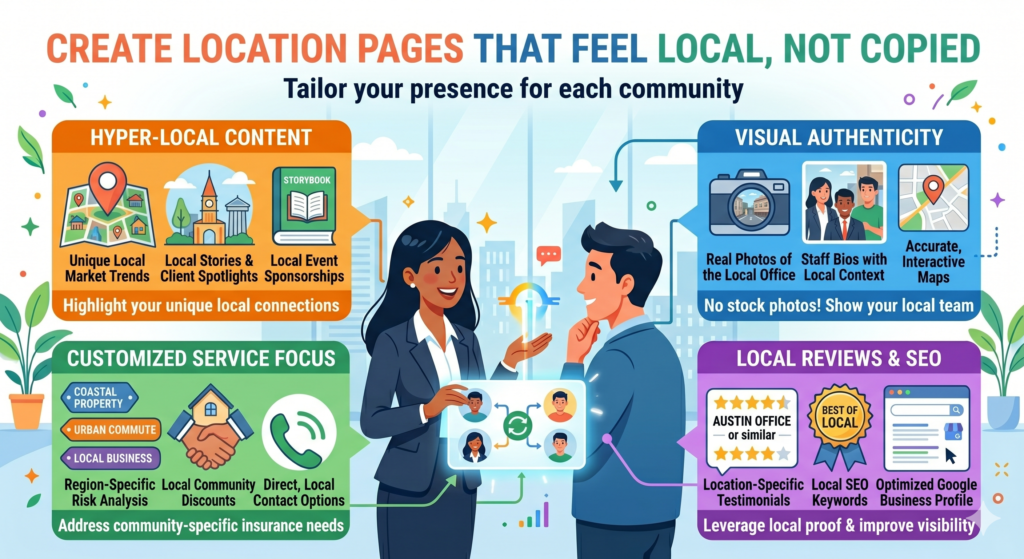
The right way is to create useful local pages that speak to the real insurance needs of people in that area.
A location page should feel like it was written for that community. It should explain what your agency helps with, what local risks may matter, what types of clients you serve there, and how people can work with you.
Local pages should connect insurance needs to local life
A home insurance page for a coastal town should not sound the same as a home insurance page for an inland city. A business insurance page for a growing warehouse district should not sound the same as a page for a tourist-heavy downtown area.
This does not mean you need to overcomplicate the page. It means you should make it feel grounded.
Talk about the kinds of homes, businesses, drivers, weather risks, property concerns, or local industries that matter in that area. If you serve families, contractors, landlords, restaurants, medical offices, or retail shops in that city, explain how your agency helps them make better insurance choices.
The goal is to make the reader feel, “They know my area.”
That feeling helps conversion because insurance often feels more personal when it is local. People want to know that their agent understands the place where they live, work, drive, and own property.
Each location page should have original value
A good location page should include more than your phone number and a generic service list. It should explain your process in that area, show the types of policies you help with, and answer common local questions.
For example, if you create a page for homeowners insurance in a certain city, you can talk about replacement cost, weather concerns, roof age, deductibles, water damage questions, and why local buyers should review more than price.
If you create a page for business insurance in a city, you can talk about local business types, lease requirements, commercial auto needs, workers’ compensation, general liability, and certificates of insurance.
You can also include real local proof where possible. Mention your office location if you have one. Mention the neighborhoods or nearby areas you serve. Add local reviews. Add team photos. Add clear driving or service-area details if they help the reader.
The page should not feel stuffed with city names. It should feel useful.
That is the difference between a page made for search engines and a page made for searchers. The best local SEO pages do both.
Use Community Marketing to Become the Agency People Already Know
Insurance agencies have a natural advantage that large online quote platforms do not have. They can be present in the local community.
That advantage only works if people actually see and remember you.
Community marketing is not just sponsoring a youth team and putting your logo on a banner. That can be part of it, but it is not the full strategy. The real goal is to become known as a helpful local resource.
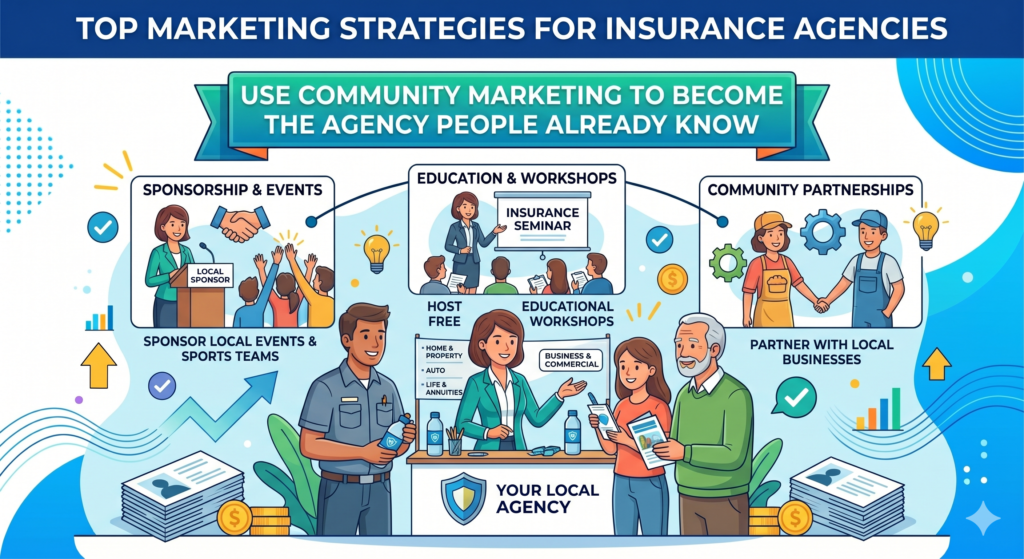
When people see your agency involved in schools, business groups, nonprofit events, neighborhood education, and local partnerships, they start to feel familiar with your name. Familiarity builds trust before the first sales conversation.
Choose community efforts that match your ideal clients
Not every local event is worth your time. A strong community strategy starts with knowing who you want to reach.
If your agency wants more family insurance clients, then school events, homebuyer workshops, parent groups, safety events, and local family-focused programs may fit. If you want more business insurance clients, then chambers of commerce, trade groups, entrepreneur meetups, industry events, and local business education sessions may be better.
The key is not to be everywhere. The key is to show up where your best clients already pay attention.
This matters because community marketing can become expensive and scattered if you say yes to every request. A clear focus helps you choose events that support your growth goals.
Turn community presence into useful content
The value of a local event should not end when the event ends.
If your agency teaches a short session about home insurance for first-time buyers, turn that into a blog post, a video, an email, and a social post. If you sponsor a small business event, write a recap with practical takeaways for business owners. If your team volunteers locally, share the story in a real and humble way.
This helps more people see the work.
It also gives your agency more local signals online. Photos, stories, event recaps, local partnerships, and community pages can make your website and social channels feel more alive.
The best community marketing does not feel like a sales trap. It feels like service. You are helping people understand risk, prepare better, and make smarter decisions.
That is why educational events can work so well. A simple workshop on “What to Check Before You Buy Home Insurance” or “Insurance Questions Every Small Business Owner Should Ask” can create trust faster than a cold ad.
When you teach first, sales conversations become easier later.
Use Cross-Selling as a Service Strategy, Not a Pressure Tactic
Cross-selling can increase revenue, improve retention, and help clients get better protection. But it must be handled carefully.
If cross-selling feels like pressure, clients pull away. If it feels like thoughtful advice, clients appreciate it.
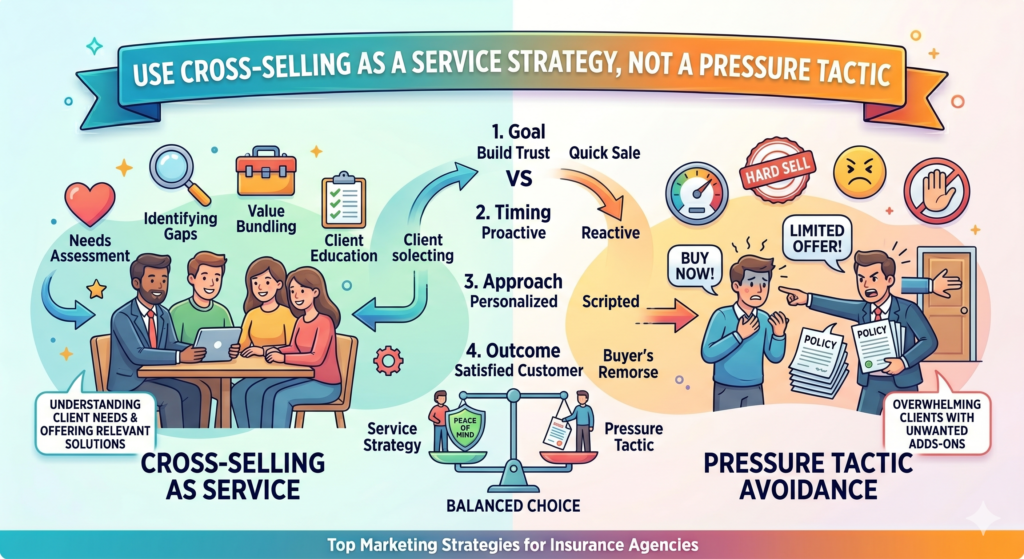
The difference is intent.
Your agency should not cross-sell just to add policies. You should cross-sell because many clients have connected risks. A person with auto insurance may also need renters, homeowners, umbrella, life, or motorcycle coverage.
A business owner with general liability may also need commercial auto, workers’ compensation, cyber, property, professional liability, or employment practices coverage.
The more you understand the client’s life or business, the easier it is to spot real needs.
Start with coverage gaps, not product offers
A weak cross-sell message says, “Would you like to buy life insurance too?” That feels random.
A stronger message starts with the reason. For example, if a client just bought a home, you can explain that many homeowners also review life insurance because they want their family to keep the home if something happens. That is a real need, not a random offer.
If a business owner hired employees, you can explain why workers’ compensation and employment-related risks may need attention. If a client bought a rental property, you can explain why a standard homeowners policy may not fit.
This makes the conversation useful.
Cross-selling should feel like the natural result of understanding the client. When your team asks better questions, better recommendations follow.
Use life events and business changes as triggers
The best time to cross-sell is when something changes.
For personal lines, triggers include marriage, having a baby, buying a home, adding a teen driver, starting a side business, buying valuables, renovating a home, getting a pet, or nearing retirement.
For commercial lines, triggers include hiring employees, buying vehicles, signing new contracts, moving locations, adding equipment, increasing revenue, offering professional advice, or accepting online payments.
These changes create new risks.
Your CRM or agency management system should help your team track these triggers. Even simple notes can make a difference. If a client mentions a renovation, that should lead to a future coverage conversation. If a business client says they are adding delivery vehicles, that should trigger a commercial auto review.
Email can support this process. You can send seasonal or life-event-based messages that invite clients to review coverage when things change.
The best cross-selling line is not “Do you want another policy?” It is “Has anything changed that your current coverage may not reflect?”
That question feels helpful. It also opens the door to better advice.
Conclusion
Marketing an insurance agency is not about chasing every new trend. It is about building trust before the sale, staying useful after the sale, and making it easy for the right people to choose you. When your website explains clearly, your local SEO brings ready buyers, your content teaches, your reviews prove trust, and your follow-up feels human, growth becomes much more steady.
The best agencies do not market only when leads slow down. They build a system that works every week. Start with clarity, serve with care, track what works, and keep improving each part of the client journey.















Comments are closed.