
WinSavvy Editorial Standards
How this article was created
Halloween is not just a day for costumes, candy, and spooky decorations. For smart brands, it is one of the best times of the year to get closer to customers, spark fun emotions, and turn simple attention into real sales. People love Halloween because it gives them permission to play. They dress up, decorate their homes, watch scary movies, share funny posts, visit themed events, and look for deals that feel exciting. This makes Halloween a golden chance for businesses to show personality. It lets your brand step away from normal sales talk and create something customers actually want to notice.
Build a Halloween campaign around one clear spooky story
A Halloween campaign works best when it feels like a small story, not just a sale with pumpkins around it. People remember stories faster than plain offers. A story gives your campaign a shape. It gives customers a reason to follow along, click again, open the next email, visit the store, or share your post with a friend.
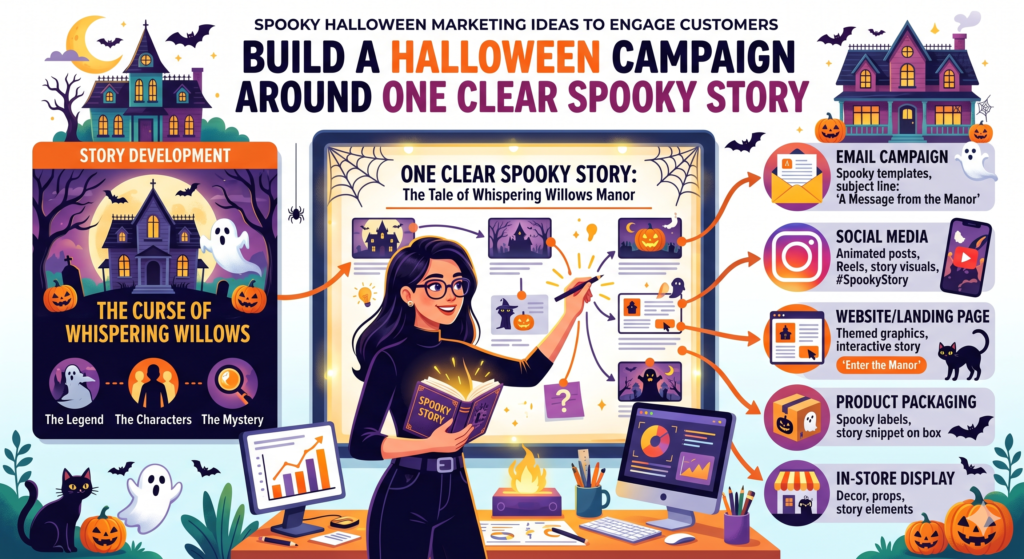
For example, a bakery could create a “missing cupcake mystery.” A fashion brand could launch “the haunted closet.” A SaaS brand could run a “marketing mistakes graveyard.” A gym could create a “zombie survival challenge.” The story does not need to be complex. It only needs to be easy to understand and tied to what you sell.
Your Halloween story should connect directly to your customer’s world
The biggest mistake brands make is creating a Halloween idea that looks fun but has no link to the customer’s real life. If the idea is too random, people may smile, but they will not act.
A good Halloween story should make your product feel useful inside the theme. If you sell skincare, your story could be about “saving your skin from the horrors of dry weather.” If you sell accounting services, your story could be about “the scary numbers hiding inside your books.”
If you sell home decor, your story could be about “turning your home into the most charming haunted house on the block.”
That way, the spooky idea does not sit outside your brand. It pulls people toward your product.
Make the customer the hero of the spooky story
Your brand should not be the main hero. The customer should be. Your brand should act like the guide that helps them win.
Instead of saying, “Our Halloween sale is here,” say something closer to, “Your home is about to become the house everyone remembers this Halloween.” Instead of saying, “Try our Halloween menu,” say, “Bring the treats that disappear first at every Halloween party.”
This simple shift changes the feel of the campaign. It stops sounding like a company asking for attention. It starts sounding like a brand helping the customer enjoy the season better.
The story can run across your homepage, emails, social posts, ads, product pages, and even packaging. Keep the same theme everywhere so people recognize it quickly. Use the same words, the same mood, and the same promise. Repetition of the core idea is good. Repetition of the same sentence is not.
A strong Halloween story gives your campaign a spine. Once you have that spine, every offer, image, caption, and call to action becomes easier to create.
Create a limited-time Halloween offer that feels too fun to ignore
Halloween offers work because the season already has a built-in deadline. Customers know it comes and goes fast. That makes it easier to create real urgency without sounding pushy.
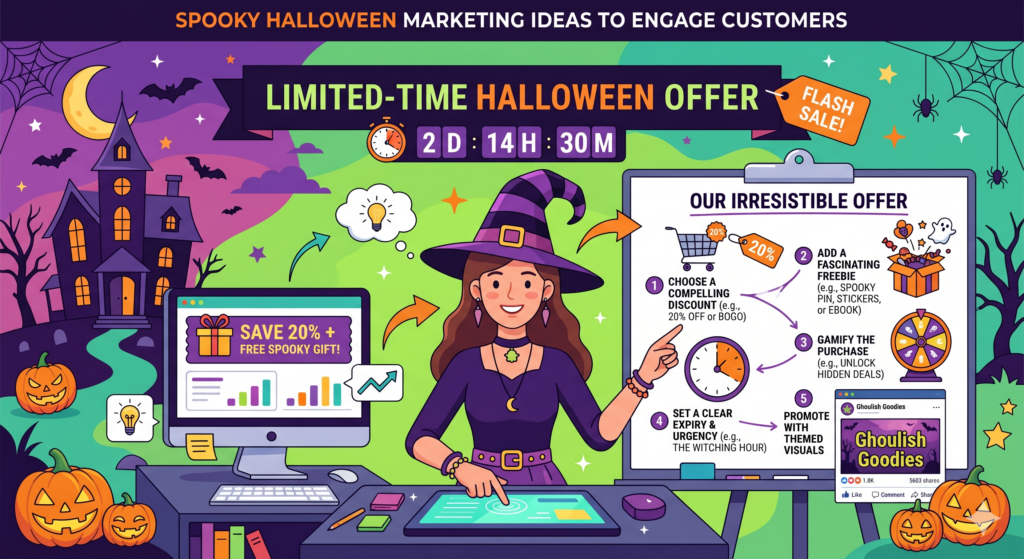
But the offer has to feel special. A plain 10 percent discount with a Halloween name is not enough anymore. People see discounts every day. To make them care, the offer should feel tied to the moment.
A coffee shop could sell a “midnight drink bundle” for one weekend only. An online store could create a “trick or treat cart surprise,” where customers get a mystery gift after checkout. A marketing agency could offer a “website scare audit” that shows what is hurting conversions.
A salon could offer a “costume-ready glow package.” These ideas feel more alive than a basic coupon.
The best Halloween offers mix savings with surprise
Surprise is powerful during Halloween because people already expect mystery. This gives brands a natural way to make offers more exciting.
Instead of showing every detail upfront, you can build a small reveal. A customer may click to “open the coffin” and see their deal. They may spin a Halloween wheel. They may choose between “trick” and “treat.” They may enter their email to unlock a hidden bundle.
The key is to keep the surprise simple. Do not make people work too hard. The fun should lead quickly to the offer. If the game is confusing, the campaign will lose sales.
Make the deadline clear without sounding desperate
Urgency works only when people believe it. Halloween gives you a real reason to set a deadline, so use it clearly.
You can say the offer ends on Halloween night. You can close it after a weekend. You can limit it to the first group of buyers. You can tie it to shipping dates so customers know they must act soon to get items before Halloween.
The deadline should be visible on the landing page, in the email subject line, near the product, and close to the checkout button. Do not hide it. Customers should not have to search for the reason to act now.
Still, avoid loud pressure. Simple wording often works better. Say, “Order by October 25 to get it before Halloween,” or “This bundle disappears after Halloween night.” That feels natural. It fits the theme. It also gives the customer a real reason to move.
A strong Halloween offer should feel like a seasonal chance, not a random discount. When the theme, value, and deadline work together, people are far more likely to click and buy.
Turn your email list into a haunted customer journey
Email is one of the best places to run a Halloween campaign because it lets you build interest over several days. You do not have to say everything in one message. You can create a small journey that starts with curiosity, grows into desire, and ends with action.
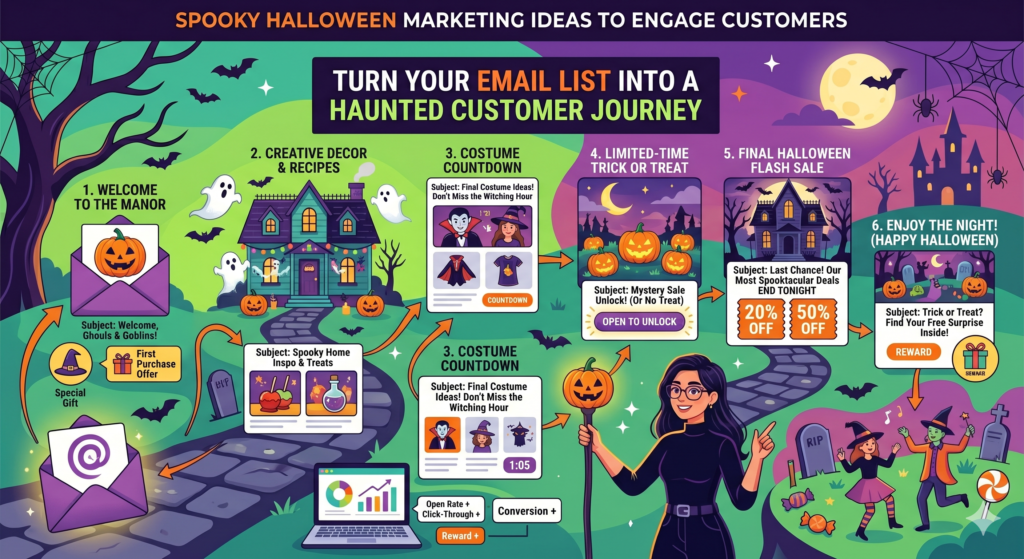
The first email can tease the theme. The second can reveal the offer. The third can show bestsellers or customer favorites. The fourth can add social proof. The final email can remind people that the offer is about to disappear.
This works because customers often need more than one touch before they act. A single Halloween email may get some sales, but a planned sequence can do much more.
Write subject lines that spark curiosity but still stay clear
Halloween subject lines are easy to overdo. If every subject line says “boo,” “spooky,” or “scary good,” customers tune out. The subject line should make people curious, but it should also tell them why opening matters.
For a fashion brand, a subject line like “Your Halloween look is hiding inside” may work better than “Spooky savings are here.” For a service business, “The scariest part of your website is not the design” creates curiosity and points toward value. For a store, “Choose your treat before midnight” gives both mystery and urgency.
The goal is not to be clever for the sake of being clever. The goal is to make the reader feel there is something inside worth seeing.
Make each email do one job only
A common email mistake is trying to say too much. One email talks about the sale, the story, the products, the founder, the shipping deadline, the social contest, and the loyalty program. That feels heavy. Customers do not want to work that hard.
Each email should have one main job. If the job is to tease the campaign, tease it. If the job is to sell the bundle, sell the bundle. If the job is to show proof, show happy customers, reviews, photos, or results. If the job is to create urgency, make the deadline clear.
Keep the writing short, warm, and visual. Use simple words. Make the offer easy to understand. Use one clear call to action. The more focused the email, the easier it is for the customer to act.
You can also segment your list. Send different messages to past buyers, new subscribers, inactive customers, and high-value customers. A past buyer may respond to an exclusive early-access treat. A cold subscriber may need a stronger hook. A loyal customer may love a private mystery gift.
Halloween email marketing should feel like a fun invitation, not a hard sell. When the journey is planned well, each message pulls the customer one step closer.
Use social media to make customers part of the Halloween fun
Social media is where Halloween energy spreads fast. People are already posting costumes, food, home decor, party ideas, memes, and scary moments. Your brand can join that behavior, but it should not just post for the sake of posting. The goal is to give people something they want to react to, share, or join.
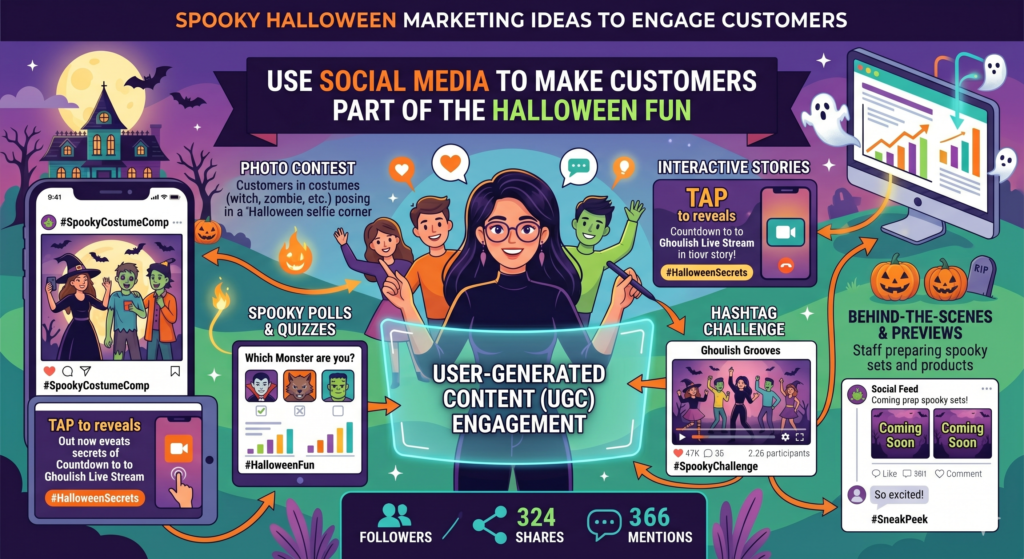
The best Halloween social campaigns often invite customers into the content. They do not only show the brand. They create a moment customers can take part in.
A pet brand can ask followers to share their pets in costume. A restaurant can ask people to vote for the scariest menu item name. A real estate agent can post “haunted house or dream house” style content. A software company can ask users to share their scariest work mistake and turn the best answers into a funny post.
Make participation easy enough that people can join fast
Customers are busy. They may enjoy your idea, but if joining takes too much effort, they will skip it. A good Halloween social idea should be easy to understand in a few seconds.
Ask people to comment with a costume idea. Ask them to vote in a story poll. Ask them to pick between two spooky product names. Ask them to share a photo using a simple hashtag. Ask them to tag a friend who would love the offer.
The easier the action, the more people will join. You can still make the idea creative, but the action should feel light.
Turn customer posts into proof and reach
When people join your Halloween campaign, do not let that content disappear. Repost it. Add it to stories. Use it in emails. Place it on your landing page. Turn the best entries into a recap post.
This does two useful things. First, it makes the people who joined feel seen. That builds a warmer bond with your brand. Second, it shows other customers that real people are taking part. That kind of proof is more powerful than a brand talking about itself.
You can also give a small reward. It does not have to be huge. A gift card, free product, free service upgrade, feature on your page, or early access can be enough. The reward should match the effort you ask for.
Social media should not only be used to announce your Halloween sale. It should create movement around it. When people comment, vote, share, and submit content, your campaign starts feeling like an event instead of a post.
Build a Halloween landing page that sells the campaign clearly
A Halloween campaign needs one clear place where people can land, understand the offer, and take action. That is why a landing page matters. Sending traffic to a normal homepage can weaken the campaign because the message gets lost. A focused landing page keeps attention on the seasonal idea.
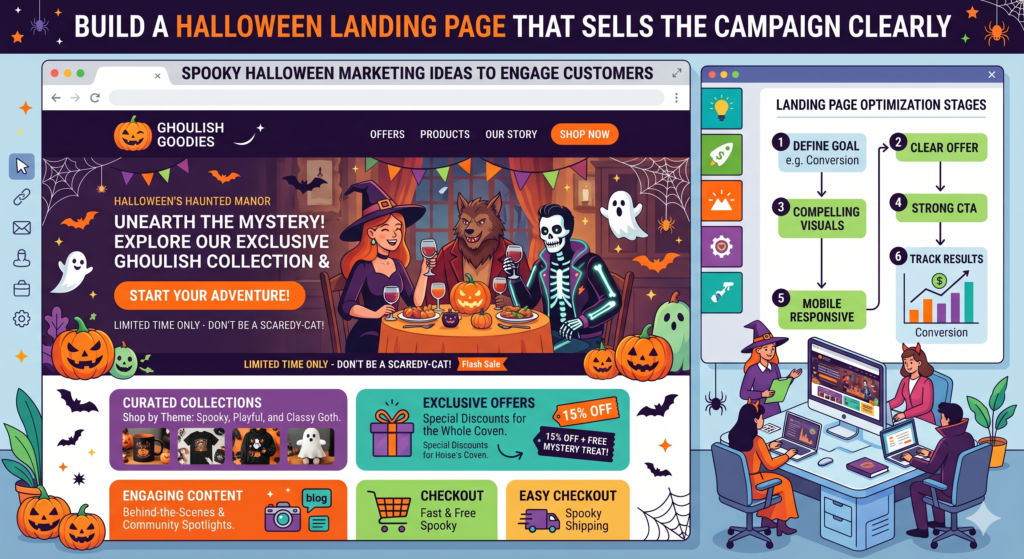
The page does not have to be complex. In fact, simple is better. It should show the Halloween promise, explain the offer, answer the main doubts, and make the next step clear.
Your headline should quickly connect the theme to the benefit. Instead of “Halloween Sale,” a stronger line could be “Get your party-ready treats before they vanish.” Instead of “Spooky Marketing Audit,” say “Find the scary gaps stealing leads from your website.” The second version gives a clear reason to care.
The page should feel festive but still easy to use
Design matters, but it should not hurt clarity. Some brands make Halloween pages so dark, busy, or animated that customers cannot read them easily. That is a costly mistake.
Use seasonal colors, fun images, and spooky touches, but keep the layout clean. The offer should be easy to see. The button should stand out. The product details should be clear. The page should load fast on mobile.
Many people will come from social media or email on their phones. If the page is slow or confusing, they will leave before they even see the offer.
Answer the questions customers ask before buying
A good landing page removes doubt. If the campaign is for products, answer questions about delivery, returns, sizes, ingredients, bundles, and deadlines. If it is for a service, explain what the customer gets, how long it takes, who it is for, and why it is useful right now.
Halloween campaigns often depend on timing, so shipping and booking details are very important. If customers need the item before a party, tell them the last safe order date. If customers need to book a service before Halloween, show the open slots or explain when bookings close.
Add proof where it helps. Use short reviews, customer photos, past campaign results, or quick before-and-after examples. The proof should support the offer, not distract from it.
Your landing page should make the campaign feel real. It should take the fun idea and turn it into a clear path to purchase. A clever campaign can get attention, but a clear landing page turns that attention into money.
Create a Halloween quiz that helps customers choose the right product
A Halloween quiz is a smart way to make shopping feel playful. It gives customers a reason to spend more time with your brand, and it helps them find the right product without feeling sold to.
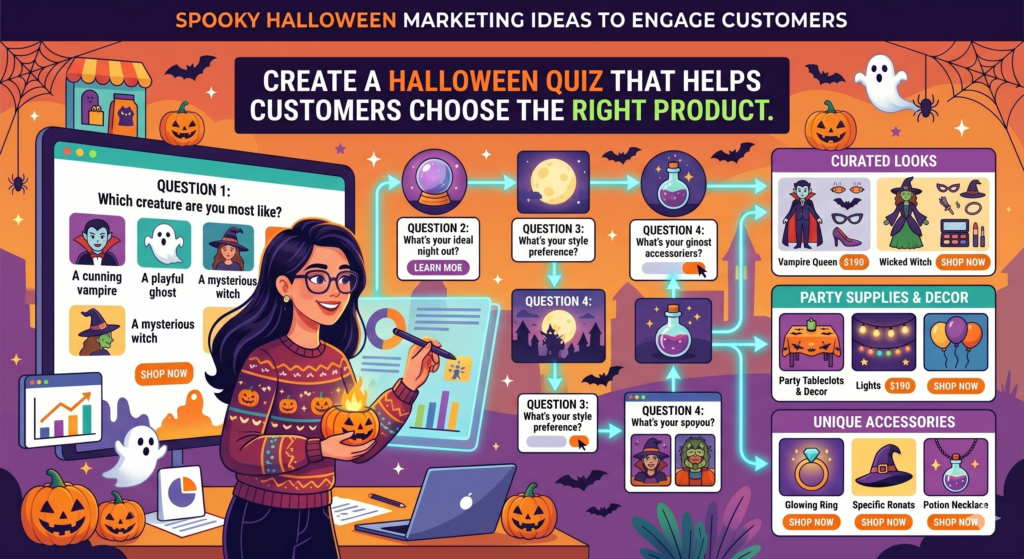
The quiz can be simple. A clothing brand can ask, “What is your Halloween style?” A beauty brand can ask, “Which spooky look matches your mood?” A food brand can ask, “What treat should you bring to the party?” A B2B brand can ask, “What is haunting your marketing funnel?”
The best part is that a quiz feels personal. Instead of showing every product to every visitor, you guide people toward the offer that fits them best. This lowers choice overload. It also makes the final recommendation feel more useful.
Your quiz should lead to a clear buying path
A quiz should not be made only for fun. It should have a business goal. Before you write the questions, decide what action you want people to take at the end.
Maybe you want them to buy a bundle. Maybe you want them to book a call. Maybe you want them to join your email list. Maybe you want them to pick a gift set. The quiz should gently move them toward that action.
For example, if you sell candles, your quiz can ask about scent taste, room size, mood, and Halloween plans. At the end, the result can recommend a “Haunted Movie Night Bundle” or a “Cozy Witching Hour Set.” That feels helpful, not pushy.
Keep the quiz short, visual, and easy to finish
A Halloween quiz should feel light. Five to seven questions are often enough. If it takes too long, people will drop off before they reach the result.
Use simple questions. Make the answer choices fun but clear. Add images if they help people choose faster. Avoid long text blocks inside the quiz. The goal is to make each click feel easy.
The result page matters most. Do not end with a vague personality label and no next step. Give the customer a result that feels fun, then explain what it means, then show the product or offer that matches. Add a clear button that tells them what to do next.
You can also ask for an email before showing the result, but be careful. If the quiz is very light, forcing an email too early can hurt completion. A better way is to show part of the result first, then invite them to enter their email to save it, get a discount, or unlock a special treat.
A Halloween quiz works because it turns browsing into a small experience. It gives customers a reason to interact, and it gives your brand useful clues about what they want.
Run a spooky countdown campaign before Halloween night
A countdown campaign works well because Halloween has a clear finish line. The date is fixed. People know it is coming. That makes the days before Halloween perfect for building excitement and action.
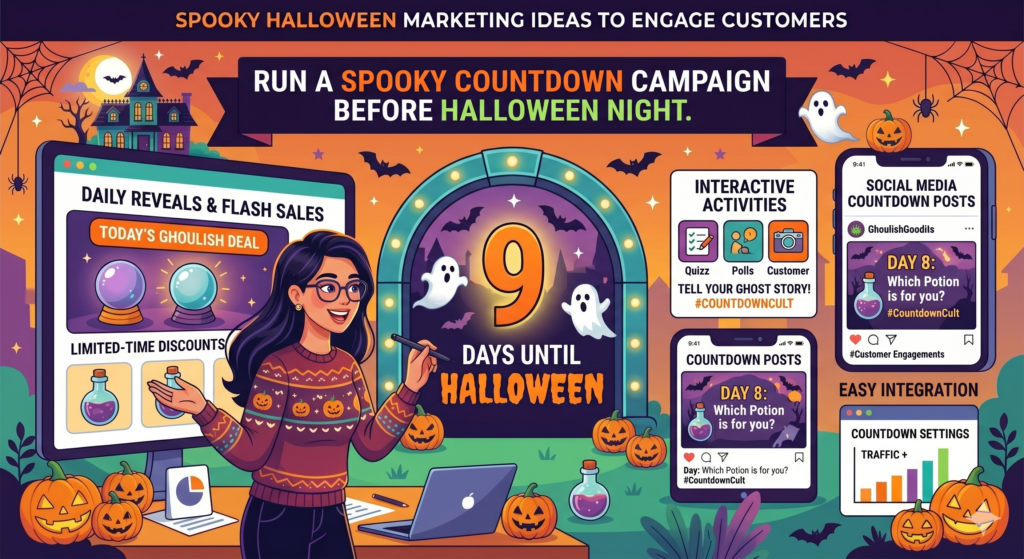
The countdown can start ten days before Halloween, seven days before, or even three days before if your campaign is short. Each day should give customers a reason to come back. That reason can be a new deal, a new clue, a new product, a new video, a new tip, or a new reward.
A countdown also helps you avoid putting all your effort into one post or one email. Instead, you create a rhythm. Customers see your brand again and again, but each touch feels fresh.
Make every day feel like a small reveal
The best countdowns use curiosity. People should feel there is something new to discover.
A retail brand can reveal one product bundle each day. A restaurant can reveal one secret menu item. A coach can share one “business horror story” each day and teach a lesson from it. A marketing agency can reveal one scary website mistake every morning, then invite people to book a fix.
The reveal does not need to be big. It only needs to be worth checking. A simple daily theme can do the job when the writing and offer are strong.
Use the final days to push action harder
The first part of the countdown should build interest. The final part should drive action. As Halloween gets closer, your message should become clearer and more direct.
At the start, you can focus on fun, education, story, and curiosity. In the last two or three days, focus on the deadline. Remind customers what they will miss if they wait too long. Show the offer again. Make the buying path simple.
For product brands, talk about shipping cutoffs, pickup windows, low stock, or party deadlines. For service brands, talk about limited audit slots, booking deadlines, or bonus cutoffs. For local brands, talk about event times, store hours, or last-chance visits.
The countdown should be visible in more than one place. Use email, social posts, stories, website banners, SMS, and paid retargeting if you have the budget. The message should feel connected across channels, not random.
A strong countdown gives your campaign momentum. It also trains customers to expect something from you. That makes your brand easier to remember when they are ready to buy.
Use “scary mistakes” content to sell without sounding salesy
Halloween is the perfect time to talk about mistakes because fear is already part of the season. But this does not mean you should scare people in a harsh way. The goal is to make the problem feel real, then show a simple path out of it.
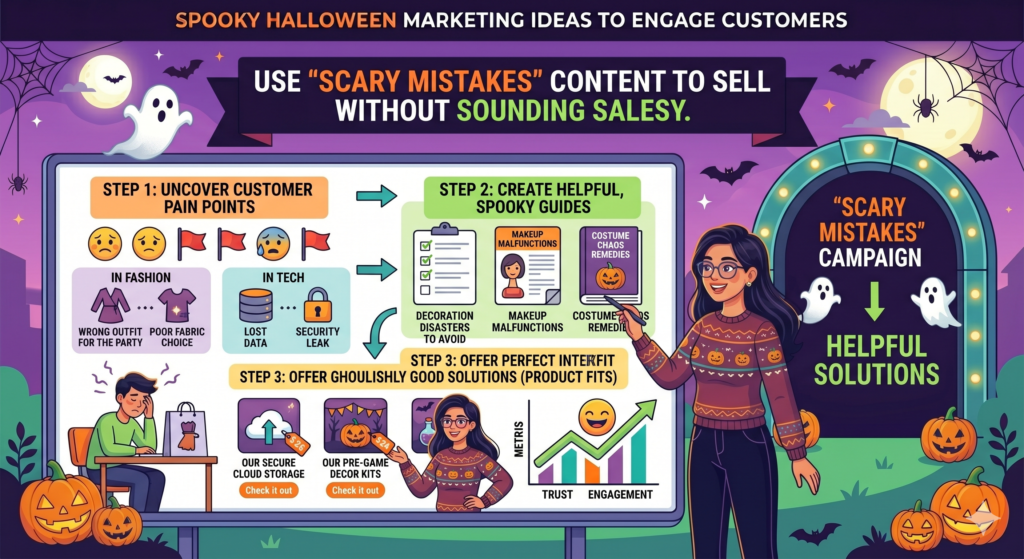
This works very well for service businesses, consultants, SaaS companies, agencies, coaches, and B2B brands. Instead of forcing a Halloween theme onto your offer, you can use the season to talk about the scary problems your customer already wants to avoid.
A marketing agency can write about scary landing page mistakes. A law firm can talk about scary contract gaps. A dentist can talk about scary signs people ignore. A financial advisor can talk about scary money habits. A home repair company can talk about scary home issues that get worse in winter.
The content should teach first and sell second
The reason this idea works is that it feels useful. Customers are not only being entertained. They are learning something that can help them.
Start by naming the mistake in a clear way. Then explain why it matters. Then show how to spot it. Then give a simple fix. After that, connect the fix to your product or service.
For example, a “scary website mistake” could be a slow mobile page. You can explain that people leave when a page takes too long to load. You can show the signs, such as high bounce rate or low mobile sales. Then you can explain a simple fix, such as compressing images and cleaning up scripts. At the end, you can offer a Halloween website audit.
Make fear feel useful, not heavy
Fear can get attention, but too much fear can make people shut down. Keep the tone helpful. Your message should feel like, “Here is what might be hurting you, and here is how to fix it,” not, “Everything is terrible.”
Use simple lines that show the cost of inaction. A weak checkout page can quietly steal sales. A poor email subject line can bury a great offer. A confusing service page can make warm leads leave. These are real fears, but they are also fixable.
This type of content can work as a blog post, short video, carousel, email series, webinar, live stream, checklist, or lead magnet. You can also turn it into a themed offer, like “The Halloween Funnel Cleanup” or “The Fright-Free Website Review.”
Scary mistakes content works because it connects Halloween to real customer pain. It gives you a natural way to sell while still being useful.
Design a trick-or-treat reward experience for your customers
A trick-or-treat campaign is one of the easiest Halloween ideas to understand because people already know how it works. They expect a surprise. They expect a reward. They expect a little fun.
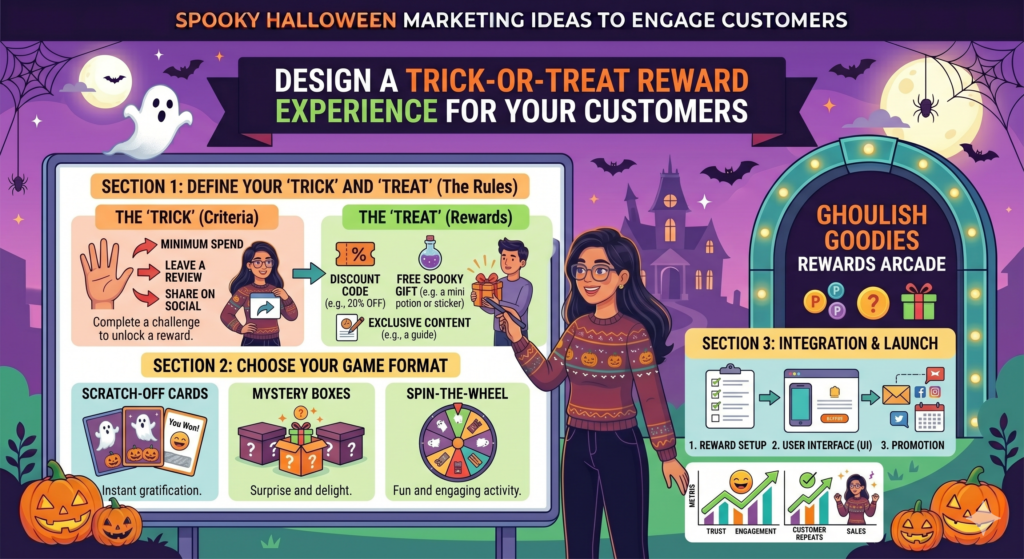
For businesses, this can be turned into a strong engagement tool. Customers can choose between two doors, two cards, two boxes, or two buttons. One gives them a “treat,” such as a discount, gift, free shipping, bonus item, or loyalty points. The other can be a playful “trick,” but it should never make the customer feel punished.
The trick can still be useful. It could be a funny message, a small challenge, a silly video, a free tip, or a lower-value reward. The main point is to make the moment feel like a game.
The reward should match the action you want
Before you choose the reward, decide what behavior you want to drive. If you want more email signups, offer a reward after signup. If you want more orders, give the reward at checkout. If you want social shares, make the reward part of a sharing campaign. If you want store visits, make the reward redeemable in person.
The reward should feel worth the effort. A tiny discount after a long process will annoy people. A nice reward after one simple action will feel fair.
For example, a store can let visitors pick a digital treat after they enter their email. A restaurant can let diners draw a treat card after ordering a Halloween item. An online shop can add a mystery gift to carts over a certain amount. A service business can offer a free mini-audit to the first set of people who claim it.
Do not make the trick feel like a loss
This is important. A Halloween trick can be funny, but it should not leave the customer feeling cheated. If one person gets 25 percent off and another gets nothing, the second person may leave with a bad feeling.
A better approach is to make every outcome positive. One person gets free shipping. Another gets a small gift. Another gets a bonus guide. Another gets a bigger discount. The “trick” can be the lower reward, but it should still have value.
You can also use the trick as a playful challenge. For example, “Your trick is to guess the hidden product name. Get it right and unlock your treat.” That keeps the experience fun without taking anything away.
A trick-or-treat reward campaign works because it adds emotion to a normal offer. It makes the customer feel like they are opening something, not just applying a code. That small shift can increase clicks, signups, and purchases.
Create Halloween bundles that solve one clear seasonal need
Bundles are powerful during Halloween because customers are often shopping for a specific moment. They may need party supplies, gifts, costumes, snacks, home decor, beauty items, pet outfits, or last-minute event help. A bundle saves them time.
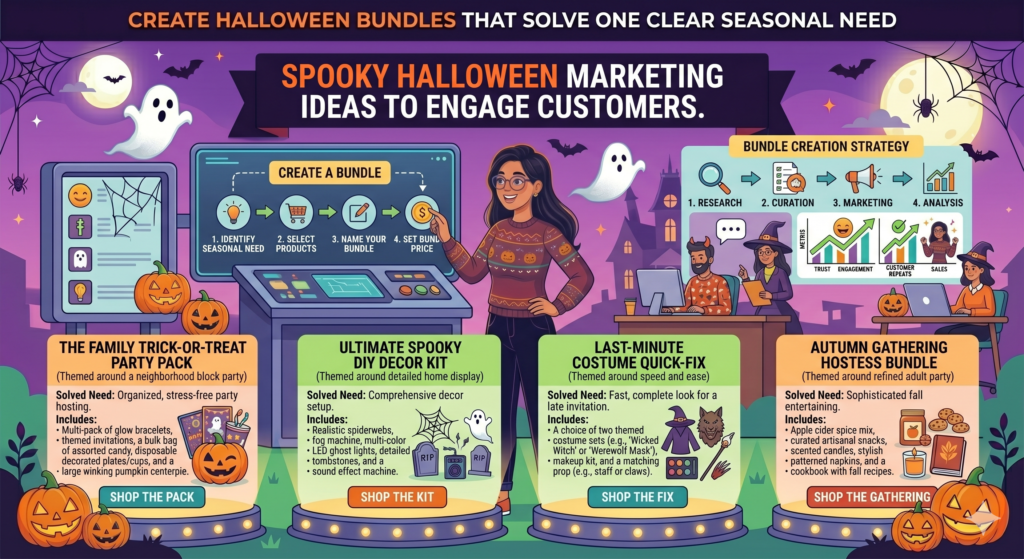
The mistake many brands make is putting random products together and calling it a bundle. A strong bundle should solve one clear need. It should feel like the easiest answer to a seasonal problem.
A bakery can create a “Halloween party dessert box.” A beauty brand can create a “costume makeup survival kit.” A pet brand can create a “spooky pet photo bundle.” A home decor brand can create a “front porch fright kit.” A marketing agency can create a “Halloween campaign launch pack” for small businesses.
Give each bundle a clear reason to exist
Customers should understand the bundle in one quick glance. They should know who it is for, when to use it, and why it is better than buying items one by one.
Do not only say what is inside. Say what the bundle helps the customer do. A “movie night box” is not just snacks and candles. It helps someone create a cozy scary movie night at home. A “party host kit” is not just decor and table items. It helps the host make the party look planned without spending hours shopping.
This is where copywriting matters. The words around the bundle can make it feel more valuable.
Use naming to make the bundle feel special
A good Halloween bundle name can make the offer more fun. But the name should still be easy to understand.
Names like “The Haunted Host Kit,” “The Last-Minute Costume Rescue Box,” “The Pumpkin Porch Pack,” or “The Midnight Movie Bundle” work because they tell a story and suggest a use. They feel more interesting than “Halloween Bundle 1.”
Under the name, add a simple explanation. Tell customers what they get and why it helps. Keep it clear. Do not make them guess.
Bundles can also raise average order value. If customers were going to buy one item, the right bundle can help them buy three or four because the set feels useful. You can make this stronger by showing the normal price, the bundle price, and the limited Halloween bonus.
For service brands, a bundle can combine strategy, setup, and support. For example, a “Halloween Email Boost Pack” can include subject line ideas, email copy, a landing page review, and a last-chance message. The same idea works for social media, ads, design, and local promotions.
A good Halloween bundle feels like a shortcut. It helps the customer get the result they want with less work.
Use local Halloween events to bring people closer to your brand
Local Halloween marketing can be very powerful because the season is social. People go out. Families look for safe events. Friends plan nights together. Communities enjoy small local traditions. This gives local businesses a natural way to create real-world engagement.
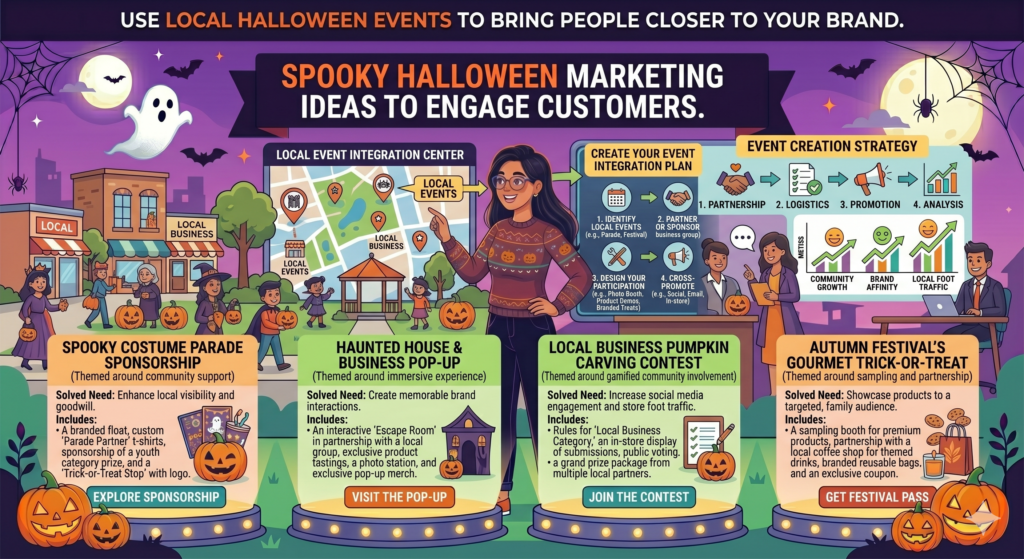
You do not need a huge event. A small, well-planned activity can work. A store can host a costume photo corner. A cafe can run a pumpkin drink night. A salon can offer quick Halloween makeup touch-ups. A gym can hold a themed workout. A bookstore can host a spooky story hour. A real estate office can sponsor a neighborhood trick-or-treat map.
The goal is to make your brand part of the customer’s Halloween memory.
Make the event easy to attend and easy to share
A local event should have a clear reason to come. People should know what will happen, who it is for, when it starts, and what they will get from it.
If the event is for families, make that clear. If it is for adults, say that. If it is free, say that. If people need to book, make the booking path simple. If there is limited space, show that early.
Also think about photos. Halloween is visual, so give people something worth taking pictures of. A themed wall, a fun sign, a costume mirror, a spooky product display, or a branded treat bag can help your event spread online.
Turn the event into content before and after it happens
The event itself is only one part of the campaign. The content around it can bring even more value.
Before the event, share behind-the-scenes setup, sneak peeks, countdown posts, and small teasers. During the event, post stories, quick videos, and customer moments. After the event, share a recap, thank attendees, post photos, and invite people to the next offer.
You can also collect emails or phone numbers during the event. Keep it natural. Offer a small treat, photo download, contest entry, or event-only deal in exchange for signup. That way, the event does not end when people leave. You can follow up later.
Local Halloween events build trust because they make the brand feel real. Customers meet you, see your space, talk to your team, and enjoy something beyond a sale. That kind of connection can lead to repeat visits long after Halloween.
Turn customer fears into helpful Halloween content
Every customer has small fears tied to buying. They worry about wasting money, choosing wrong, missing a deadline, looking silly, buying low quality, or not getting the result they want. Halloween gives you a creative way to talk about those fears without making the message feel heavy.
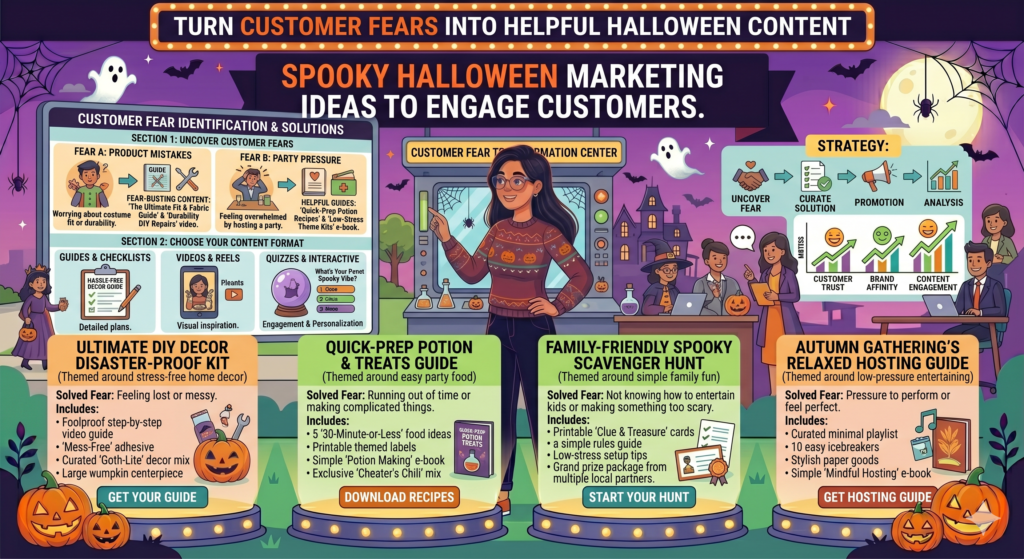
This idea works because good marketing does not ignore doubt. It answers doubt before it blocks the sale.
For example, a costume shop can address the fear of a costume arriving too late. A skincare brand can address the fear of makeup causing breakouts. A caterer can address the fear of running out of food at a party. A marketing agency can address the fear of spending money on ads that do not convert.
Use the fear as the doorway, then guide people to relief
The structure is simple. Name the fear. Show that you understand it. Explain why it happens. Then give a clear way to avoid it.
If your customers fear late delivery, create content around “How to make sure your Halloween order arrives on time.” If they fear picking the wrong product, create “How to choose the right Halloween bundle for your party size.” If they fear poor results, create “How to avoid a Halloween campaign that gets likes but no sales.”
This type of content feels useful because it reduces stress.
Make your product the safe choice without overclaiming
Once you explain the fear, show how your product or service helps. Keep it honest and clear.
You might say your bundle is sorted by party size, so customers do not have to guess. You might say your booking page shows live slots, so they know what is still open. You might say your audit gives them a clear list of fixes, so they are not left wondering what to do next.
Avoid making big claims that sound fake. Simple proof works better. Show reviews. Show examples. Show how the process works. Show deadlines. Show guarantees if you have them.
When you turn customer fears into helpful content, you do more than join a Halloween trend. You remove buying friction. That can make your campaign stronger because the customer feels understood.
Create a Halloween referral campaign customers can share for a treat
A Halloween referral campaign works because the season is already built around sharing. People share candy, costumes, party plans, photos, and fun ideas. Your brand can use that same behavior to bring in new customers through people who already like you.
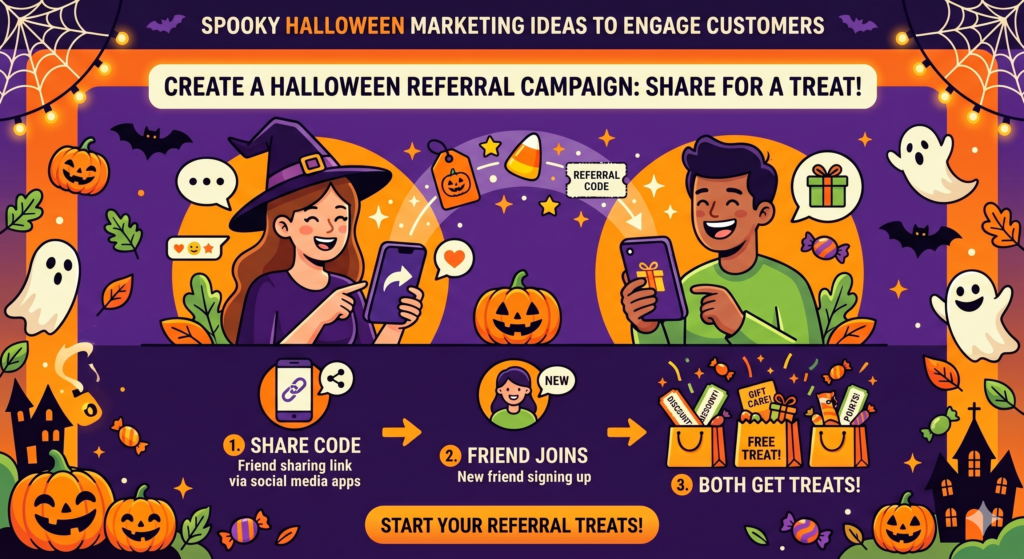
The idea does not need to be complicated. Give your current customers a simple reason to invite a friend. The friend gets a treat, and the customer gets a treat too. This can be a discount, free gift, bonus points, store credit, free sample, service upgrade, or early access to a seasonal offer.
The most important part is to make the referral feel fun, not forced. Halloween gives you playful language to make the invite feel lighter. Instead of “Refer a friend,” you can say, “Bring a friend to the haunted party,” or “Send a treat to someone who needs one.”
A referral offer should be easy to explain in one sentence
If customers cannot explain the referral offer quickly, they will not share it. Keep the reward simple and clear.
For example, “Give your friend 15 percent off, and get 15 percent off your next order” is easy to understand. “Invite a friend and both of you get a mystery Halloween gift” also works because it creates curiosity.
The referral page, email, or message should tell people exactly what to do. It should show the reward, the deadline, and the link they need to share. Do not make customers search for their code. Do not hide the terms in a long block of text. Clear beats clever every time.
A good referral campaign can also work well for local businesses. A salon can give both friends a small service add-on. A gym can give a free Halloween class pass. A restaurant can offer a dessert for both people when they visit together.
Make the shared message sound like something a real person would send
Many referral campaigns fail because the pre-written share message sounds stiff. Customers do not want to send something that feels like an ad.
Write the message in a natural way. It should feel like one friend helping another friend. For example, “I thought you’d like this Halloween deal. We both get a treat if you use my link.” That feels simple and human.
You can give customers a few share options. One version can be funny. One can be short. One can be more direct. This lets people choose the style that feels most like them.
A Halloween referral campaign is not just about getting more traffic. It is about using trust. When a friend shares your offer, it carries more weight than a normal ad. That makes referrals one of the most useful ways to turn seasonal excitement into new customers.
Build a spooky abandoned cart sequence that brings shoppers back
Halloween shoppers often browse fast. They compare costumes, treats, decor, gifts, and party items across many sites. Some add items to their cart and then leave because they get distracted, worry about delivery, or decide to think about it later.
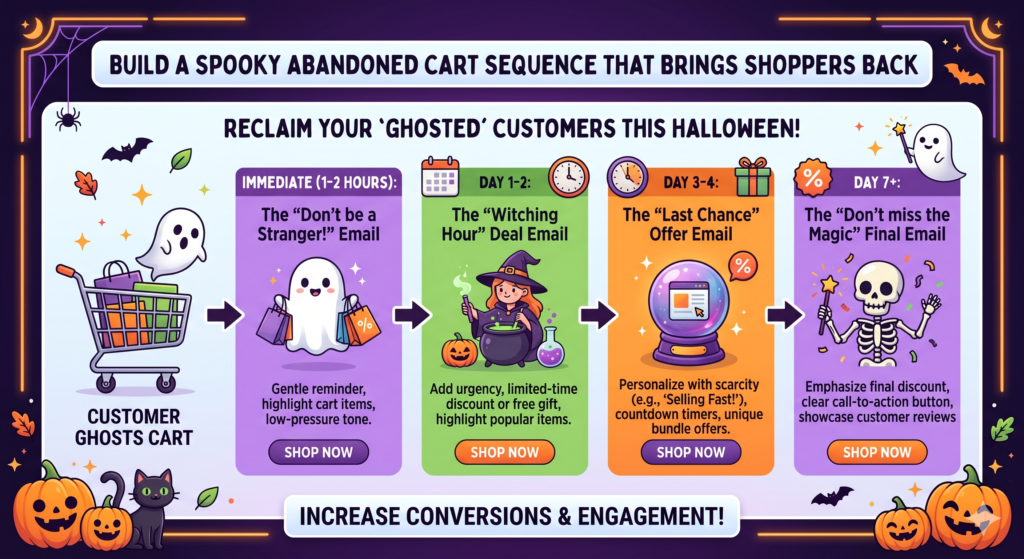
That is why an abandoned cart sequence matters. It gives you a second chance to recover sales that were almost lost.
A Halloween cart message should not feel like a plain reminder. It should connect to the season and the reason the customer was shopping. The tone can be playful, but the purpose must stay clear. Remind them what they left behind, why it matters, and why they should finish soon.
The first cart message should remove the main doubt
Do not assume people left only because of price. They may have had a question. They may have worried the item would not arrive on time. They may have been unsure about size, color, quality, returns, or whether the product was right for their event.
Your first message can say something like, “Your Halloween picks are still waiting.” Then it should show the items and answer the most likely question. If shipping matters, mention the delivery deadline. If sizing matters, link to the size guide. If the product is a gift, mention easy returns or pickup options.
The goal is to make returning feel easy. Do not overload the customer with too much text. The cart items and checkout button should be the main focus.
After that, you can send a second message with a stronger reason to act. This could be low stock, a deadline, a small bonus, or a reminder that Halloween is close.
Use urgency only when it is real
Halloween gives you natural urgency, so there is no need to fake it. If shipping closes on a certain date, say that. If a bundle is limited, say that. If the offer ends at midnight, say that.
Fake urgency can hurt trust. Customers can tell when every product is “almost gone” all the time. Real urgency feels helpful because it protects the customer from missing out.
For example, “Order by October 26 for the best chance of delivery before Halloween” is more useful than “Hurry before it’s gone.” It gives the customer a clear reason to act.
You can also use a small seasonal bonus to bring people back. A free mystery treat, gift wrap, bonus sample, or extra loyalty points can work well. The bonus should feel like a nudge, not a bribe.
A spooky abandoned cart sequence should feel like a helpful tap on the shoulder. It should remind, reassure, and guide the customer back before the Halloween moment passes.
Use Halloween user-generated content to build trust faster
User-generated content is powerful during Halloween because customers are already making visual content. They are dressing up, decorating, baking, hosting, filming, and sharing. Your brand can become part of those moments if you give people a clear reason to include you.
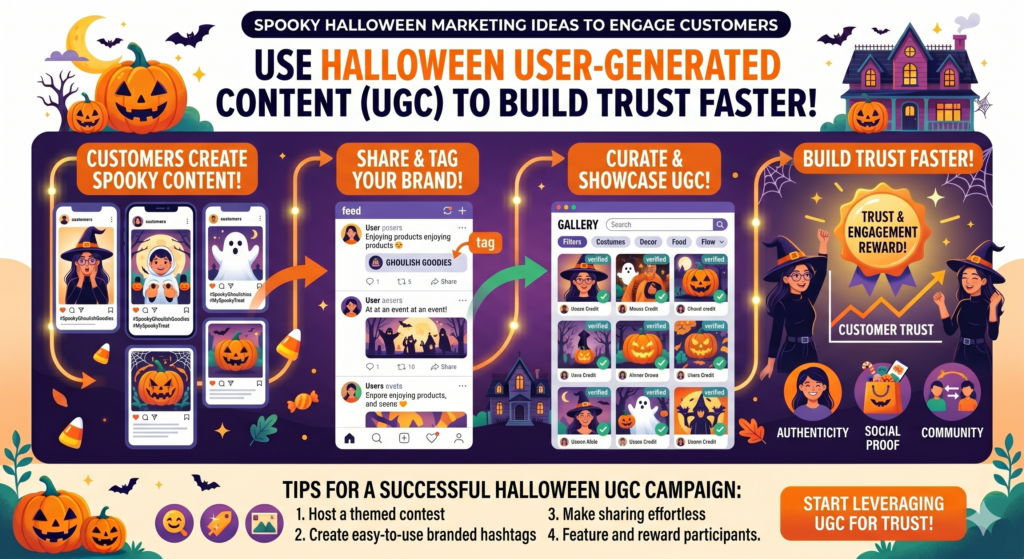
This works especially well for products that show up in real life. Food, fashion, beauty, pets, home decor, fitness, events, and local services can all benefit from customer photos and videos. But service brands can use it too. Customers can share results, stories, wins, lessons, or funny “before and after” moments.
The key is to make the content about the customer’s moment, not just your product.
Ask for content around a theme customers already enjoy
A weak user-generated content campaign says, “Post a picture with our product.” That sounds like work. A stronger campaign gives people a fun reason to post.
A pet brand can run “best dressed little monster.” A bakery can run “show us your spooky dessert table.” A home brand can run “creepiest cozy corner.” A gym can run “zombie workout face.” A marketing agency can run “scariest marketing mistake you survived.”
These themes work because they let customers show personality. People like sharing content that makes them look fun, clever, creative, or helpful.
You should also make the rules simple. Tell people what to post, where to post it, what tag or hashtag to use, and when the campaign ends. If there is a reward, explain it clearly.
Ask for permission before reusing customer content
If customers tag your brand, you can often reshare in stories, but if you want to use their content in ads, emails, landing pages, or future campaigns, ask for permission first. It is a small step, but it builds trust.
A simple message works. Thank them, say you loved their post, and ask if you can feature it. Most happy customers will say yes.
Once you have permission, place the content where it can help new buyers feel safe. Add it to product pages, email campaigns, social proof sections, and retargeting ads. Real customer photos often feel more believable than polished studio shots because they show the product in normal life.
Halloween user-generated content can also give you ideas for next year. Watch what customers actually share. Notice which products show up most. Notice which captions get comments. Notice what people care about. That feedback can shape future campaigns.
When customers become part of your Halloween content, your brand stops speaking alone. The community starts speaking with you.
Create a Halloween loyalty campaign for your best customers
Your best customers should not get the same Halloween campaign as everyone else. They already know your brand. They have already bought from you. That means you can speak to them in a warmer, more personal way.
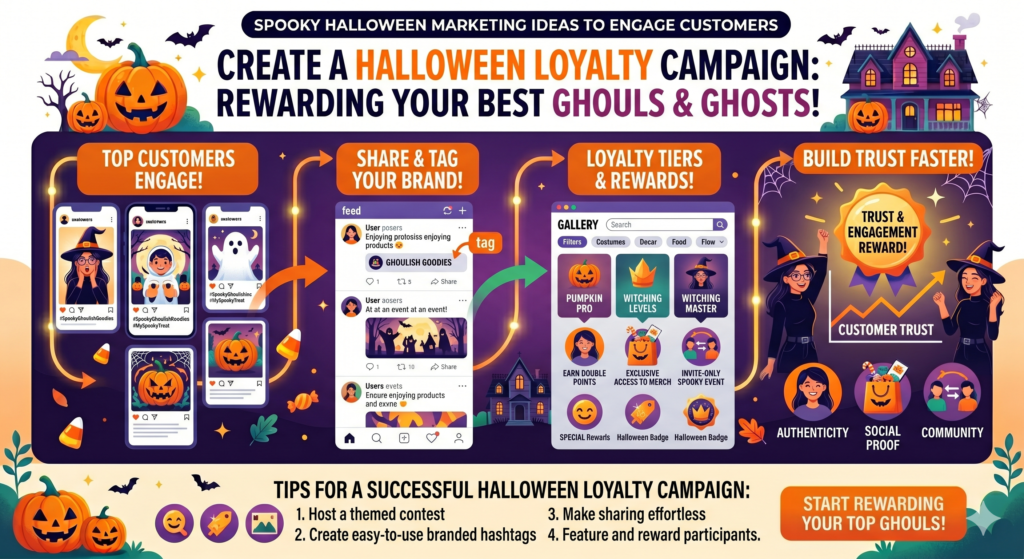
A Halloween loyalty campaign can make these customers feel seen. It can give them early access, a private treat, a better reward, a special bundle, or a hidden offer. This does not have to be expensive. It just has to feel different from the public campaign.
The message can be simple. “You get first pick before the Halloween sale opens.” Or, “We saved a private treat for our favorite customers.” That small feeling of being chosen can drive action.
Give loyal customers a reason to come back before the crowd
Early access is one of the easiest loyalty plays. It works well when stock is limited, booking slots are limited, or the campaign has a strong seasonal deadline.
For example, a boutique can let loyal customers shop the Halloween collection one day early. A bakery can open pre-orders to past buyers first. A salon can reserve Halloween makeup slots for repeat clients. A service business can offer a private strategy audit before public slots open.
This makes loyal customers feel valued. It also helps you generate sales before the main campaign starts.
You can also use a “secret treat” offer. Instead of a public discount code, send loyal customers a private reward. It could be a free add-on, mystery gift, bonus points, free shipping, or a better bundle price.
Personalize the offer based on what customers bought before
A loyalty campaign becomes stronger when it connects to past behavior. If someone bought candles last fall, show them the new Halloween scent. If someone booked makeup last year, remind them to reserve this year’s slot early. If someone bought party supplies, show them a host bundle.
The message does not need to be complex. Even a simple line like “Since you loved our fall collection last year, we wanted you to see this first” can feel personal.
For service brands, you can use past problems or goals. If a client downloaded a website checklist, invite them to a Halloween “scary website mistakes” audit. If they attended a sales webinar, invite them to a “pipeline ghosting” session.
A Halloween loyalty campaign should make your best customers feel like insiders. It keeps them close, increases repeat sales, and gives them another reason to choose you before they look elsewhere.
Use spooky product names to make normal items feel seasonal
You do not always need a new product for Halloween. Sometimes, you can make your existing products feel seasonal through smart naming, packaging, and positioning.
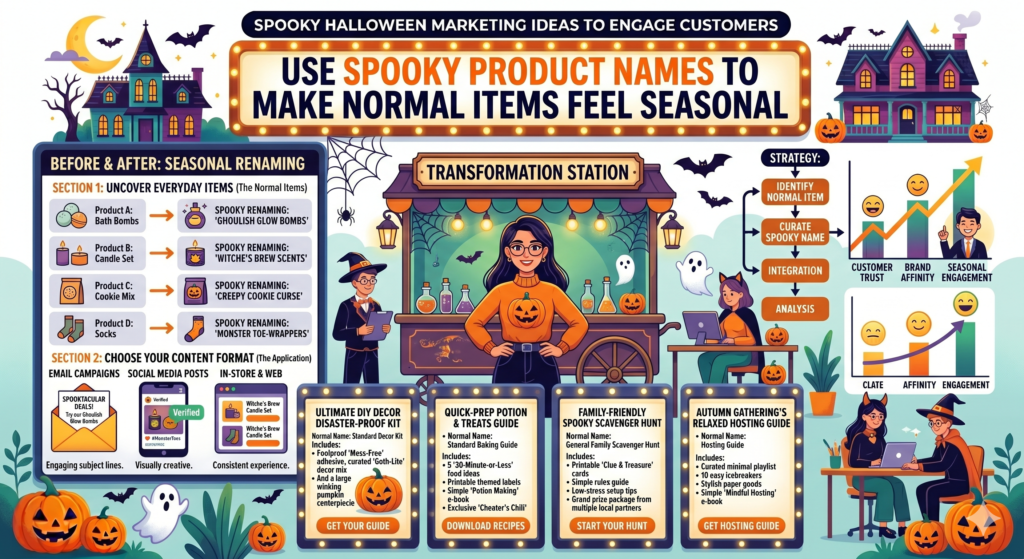
This is useful for brands that cannot create a full Halloween line. You can take what you already sell and give it a seasonal twist. A coffee drink can become “Midnight Mocha.” A candle can become “Witching Hour Vanilla.” A burger can become “The Monster Stack.” A marketing audit can become “The Funnel Fright Check.”
The name catches attention, but the product still needs to be clear. Customers should not be confused about what they are buying.
A seasonal name should add charm without hiding the value
Fun names can help people notice your offer, but they should not make the product hard to understand. If the name is too vague, customers may skip it.
For example, “The Vampire Kit” may sound fun, but it does not explain much. “The Vampire Lip Kit” is better because customers know what it is. “The Midnight Movie Snack Box” is clear because it tells people when and how to use it.
The best seasonal names combine mood and meaning. They sound fun, but they also help customers picture the use.
You can support the name with a short product line. For example, “Everything you need for a cozy scary movie night.” That one sentence does more selling than a long block of text.
Keep the naming style consistent across the campaign
If every product name uses a different style, the campaign can feel messy. Choose one direction and stick with it.
You might use haunted house names, monster names, midnight names, spell names, or mystery names. A beauty brand might use “spell,” “glow,” and “moonlight” language. A food brand might use “monster,” “midnight,” and “graveyard” language. A B2B brand might use “ghosted leads,” “dead pages,” and “scary data gaps.”
When the naming is consistent, the campaign feels more planned. Customers can see that it is not just a random label slapped onto a normal offer.
Spooky names also work well in email subject lines, product cards, menus, social captions, and ads. They make the campaign easier to talk about.
This idea is simple, but it can lift attention fast. A normal product may be useful, but a seasonally named product can feel like something customers should buy now before the moment passes.
Turn Halloween into a themed content series, not just one campaign
Many brands treat Halloween as a one-day promotion. They post once, send one email, and hope something happens. But customers rarely act from one touch. A themed content series gives you more chances to build attention before the final offer.
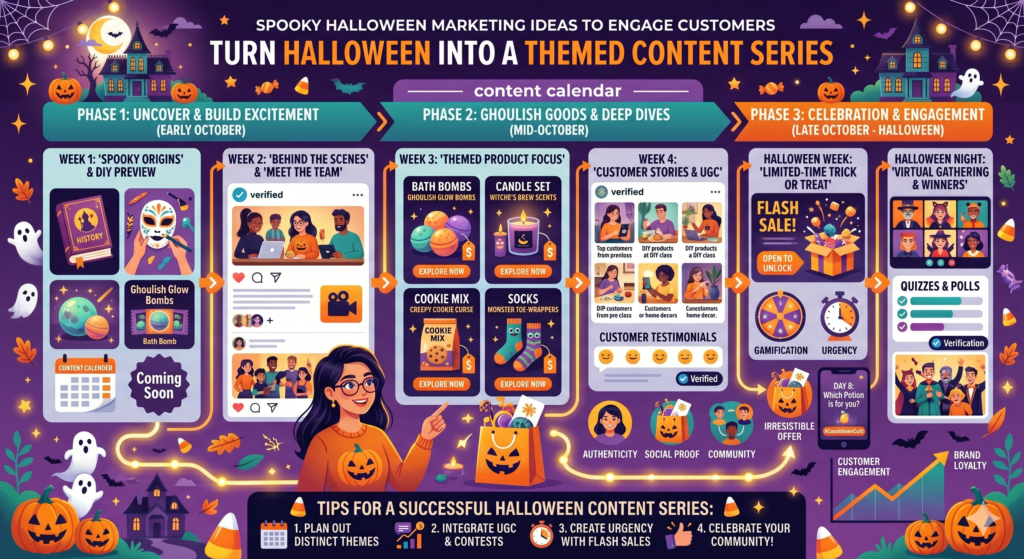
A content series can run for a week, two weeks, or the full month of October. It can include short tips, stories, videos, emails, blog posts, reels, polls, or live sessions. The theme keeps it connected, so each piece feels like part of something bigger.
This is especially useful for brands that sell services or high-consideration products. Customers may not buy right away, but repeated useful content can build trust.
Choose a theme that can stretch across many pieces
A strong series needs a theme with room to grow. “Halloween sale” is not enough. “Seven scary mistakes killing your conversions” gives you seven pieces of content. “Ten treats for better party planning” gives you ten ideas. “The haunted customer journey” can cover awareness, email, landing pages, checkout, and retention.
The theme should connect to what your audience wants. If your customers care about saving time, build the series around shortcuts. If they care about looking good, build it around style ideas. If they care about avoiding mistakes, build it around warning signs and fixes.
After you choose the theme, plan each part before you start publishing. This keeps the campaign from feeling random.
End each piece with a natural next step
A content series should not only educate. It should move people closer to action.
At the end of each piece, invite the reader to do something simple. They can read the next tip, take a quiz, download a checklist, view a bundle, join a contest, book a call, or claim the offer.
The call to action should match the stage of the series. Early content can ask for light action, like commenting or saving the post. Middle content can ask for email signup or product browsing. Final content can ask for purchase or booking.
You can also connect the series with a landing page. Each post or email can send people back to the main Halloween hub. That hub can hold the offer, the countdown, the quiz, the contest, and the best content.
A Halloween content series gives your campaign life. It creates more reasons for customers to see you, trust you, and remember you when they are ready to act.
Use Halloween polls to learn what customers want before you sell
Polls are simple, but they can be very useful during Halloween. They let customers take part without much effort. One tap, one vote, one comment, and they feel involved.
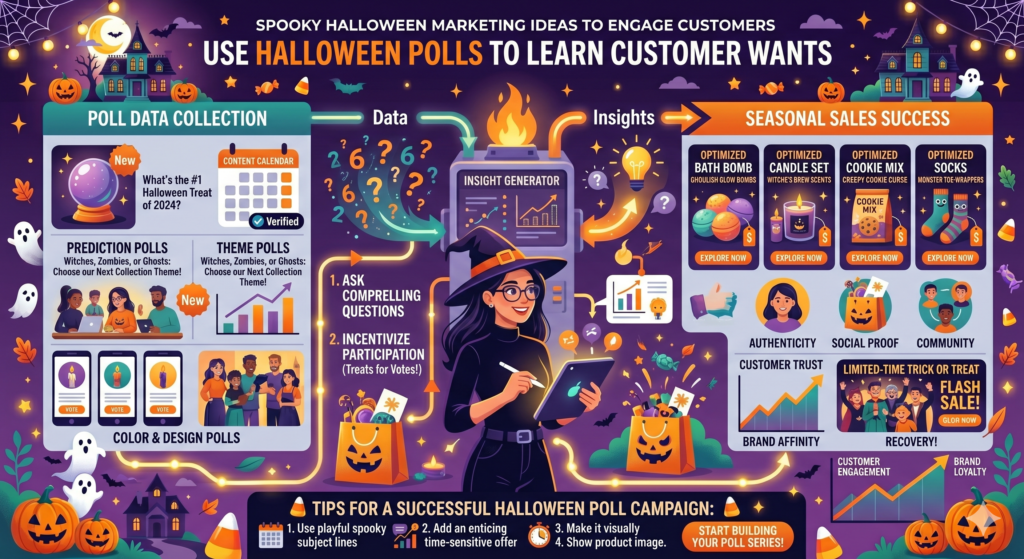
This matters because engagement should not always ask for a big action. Not every customer is ready to buy, share, or enter a contest. But many people are willing to vote. That small action can warm them up for the offer that comes next.
A clothing brand can ask which Halloween look people would wear. A bakery can ask which limited treat should come back. A restaurant can ask followers to choose the next spooky drink name. A marketing agency can ask which business problem feels scariest right now. These small questions create useful signals.
A good Halloween poll should guide your campaign decisions
Do not run polls only for fun. Use them to learn something you can act on.
If customers vote for one product color, push that product harder. If they choose one bundle name, use that name on your landing page. If they say shipping is their biggest worry, make delivery dates clearer in your emails. If they say price is the concern, test a bundle or bonus instead of only a discount.
This makes customers feel heard. It also helps you avoid guessing.
For example, if you are planning a Halloween email offer, you can ask your audience what they would rather get: free shipping, a mystery gift, early access, or a discount. The answer can shape the offer. Even better, when you launch it, you can say, “You voted for it, so we made it happen.”
Turn poll results into content people want to see
Polls create a second content moment after the voting ends. Share the results. Explain what they mean. Show how you are using them.
If 68 percent of your audience chooses a “midnight mystery box,” make that the main product. If most people vote for a scary website audit, turn that into a Halloween service offer. If customers choose one spooky flavor, show behind-the-scenes footage of your team making it.
This is powerful because people like seeing the outcome of something they joined. It closes the loop.
You can use polls on Instagram Stories, LinkedIn, X, email, community groups, website popups, or SMS. Keep the choices short. Make the question clear. Do not ask something so broad that the answers are hard to use.
A Halloween poll may seem small, but it can reduce risk. It helps you create offers with customer input, which makes your campaign feel less like a guess and more like a response to demand.
Create a spooky lead magnet that people actually want
Halloween can be a strong time to grow your email list if your lead magnet feels useful and timely. But it has to be more than a random PDF with a pumpkin on the cover. People will not give their email for weak content anymore.
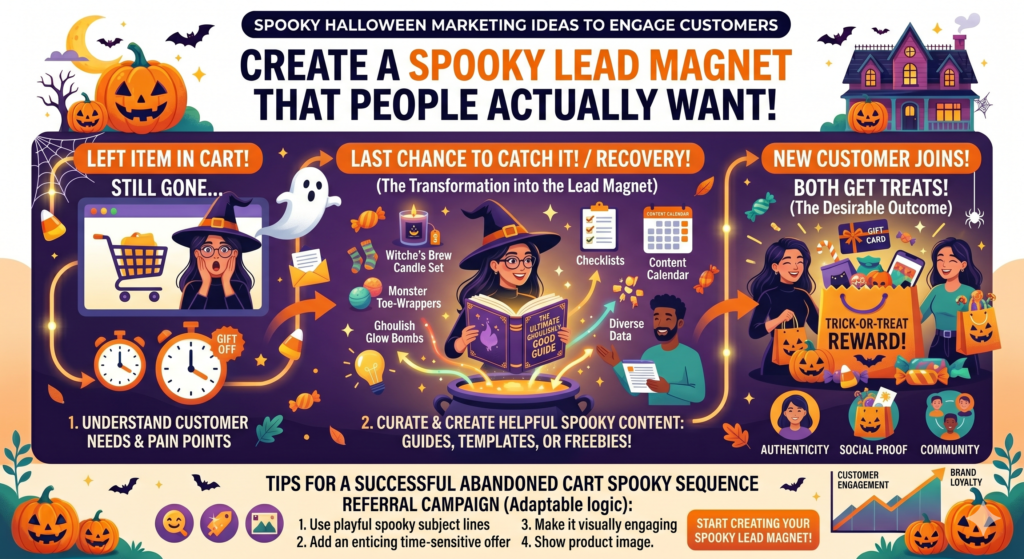
A good Halloween lead magnet solves a real seasonal problem. It gives the customer something they can use right away.
A party store can offer a last-minute Halloween party checklist. A bakery can offer a spooky dessert table guide. A fitness coach can offer a “survive candy season” meal plan. A marketing agency can offer a Halloween campaign planner. A SaaS company can offer a “scary metrics” audit sheet.
The theme gets attention, but the value gets the signup.
The lead magnet should create a clear next step toward your offer
Before you create the lead magnet, decide what you want the person to buy later. The free content should lead naturally to the paid offer.
If your paid offer is a Halloween bundle, the lead magnet can help people choose the right bundle. If your paid offer is an audit, the lead magnet can help them spot the problem. If your paid offer is an event, the lead magnet can help them plan around it.
This creates a smooth path. The free item gives value. The paid offer helps them go further.
For example, a digital marketing agency could offer a “Halloween Campaign Panic Checklist” for small businesses that need fast ideas. Inside the checklist, it can show simple steps for email, social, landing pages, and offers. At the end, the agency can invite readers to book a quick seasonal campaign review.
Keep the signup page short and focused
The landing page for the lead magnet should not be long. People only need to know what it is, who it helps, and why they should get it now.
Use a clear headline. Explain the benefit in plain words. Show what is inside in a short paragraph. Add the signup form. Then follow up with a warm welcome email that gives them the resource and points them to the next step.
Do not ask for too much information at first. Name and email are often enough. If you ask for phone number, company size, budget, and role too early, many people will leave.
The follow-up matters as much as the lead magnet. Send a short email sequence after signup. The first email delivers the resource. The second helps them use it. The third shows a related offer. The fourth adds urgency if the Halloween deadline is close.
A strong Halloween lead magnet helps you capture people who are interested but not ready to buy yet. It turns seasonal traffic into a list you can nurture after the holiday too.
Conclusion
Halloween marketing works best when it feels fun, clear, and easy to join. Customers do not want another lazy pumpkin-themed discount. They want moments that feel playful, useful, and worth sharing. The strongest campaigns use story, surprise, timing, customer input, and real value to turn seasonal attention into action.












Comments are closed.