
WinSavvy Editorial Standards
How this article was created
Black Friday is no longer just a one-day sale. It has become one of the biggest buying moments of the year, and for many brands, it can decide how strong the final quarter looks. Customers wait for it. Competitors plan for it. Ad costs rise because everyone wants attention at the same time. So, if your Black Friday plan is just “offer a discount and run some ads,” you are already behind.
Build your Black Friday plan before your customers start looking
Black Friday success starts long before the first discount goes live. Many brands make the mistake of treating Black Friday like a last-minute campaign. They wait until November, pick a discount, send a few emails, boost a few posts, and hope people buy. That approach may bring some sales, but it rarely brings the best sales.
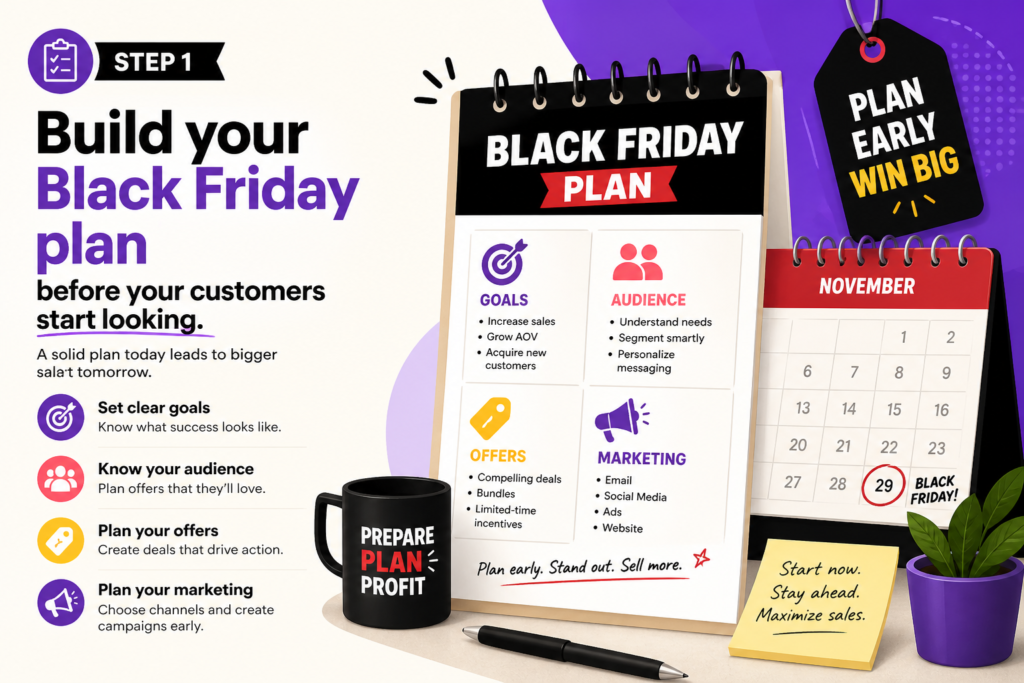
A strong Black Friday campaign begins with planning. You need to know what you want to sell, who you want to reach, what offer will make them act, and what journey they will take from first click to final checkout. When these pieces are clear, your marketing feels smooth.
When they are not clear, your campaign feels rushed, noisy, and forgettable.
Black Friday is crowded. Your customers will see offers from your competitors, big marketplaces, local stores, and brands they have followed for years. If your message is weak, they will scroll past it. If your offer is confusing, they will wait. If your website is slow or your checkout feels hard, they will leave.
That is why the first strategy is not about ads or emails. It is about building the campaign foundation before the pressure begins.
Start with the real business goal behind the sale
Before you choose a discount, decide what Black Friday should do for your business. Not every brand should chase the same goal. Some brands want fast cash flow. Some want to clear old stock. Some want to acquire new customers.
Some want to bring back past buyers. Some want to push high-margin products. Some want to grow email and SMS lists before Christmas.
Each goal needs a different campaign. If your goal is to clear old stock, your offer can be more aggressive. If your goal is to protect profit, you need bundles, gift sets, or value-added offers instead of deep discounts. If your goal is to win new customers, your campaign should focus on simple entry-level products that are easy to understand and easy to buy.
This is where many brands lose money. They see competitors offering 40 percent off and feel forced to match them. But a bigger discount does not always mean a better result. If the discount cuts too deep, you may make more sales but keep less profit. Worse, you may train customers to wait for discounts every year.
Your goal should guide the offer. Your offer should guide the message. Your message should guide the channels. When you start with the goal, the whole campaign becomes easier to build.
Choose one main goal and let every decision support it
Do not try to make Black Friday do everything at once. A campaign that tries to clear inventory, grow new customers, increase average order value, launch a new product, and reactivate old buyers can become too messy. The customer sees too many messages, and the team has too many things to manage.
Pick one main goal. Then choose one or two smaller goals that support it. For example, your main goal may be to increase total revenue. Your supporting goals may be to raise average order value and bring back past buyers. That gives your campaign focus.
You can create bundles, send special offers to past buyers, and build landing pages around higher-value purchases.
Focus does not make your campaign smaller. It makes your campaign sharper.
Audit last year’s data before building this year’s campaign
Your past data can save you from guessing. Even if last year’s Black Friday campaign was not perfect, it can still show you what customers cared about. Look at which products sold fastest, which emails got clicks, which ads wasted money, which pages had drop-offs, and which customer groups spent the most.
This does not have to be complicated. You are looking for useful patterns. Did customers buy single products or bundles? Did new customers spend less than returning customers? Did mobile users leave at checkout? Did one product bring traffic but another product bring profit? Did people respond better to early access or last-chance messages?
These answers help you build a smarter campaign. If one product sold well but had low profit, you may use it as a traffic driver while pairing it with a higher-margin add-on. If returning customers spent more, you may give them early access before sending the offer to everyone else. If mobile checkout had high drop-off, you should fix that before driving paid traffic.
Black Friday is not the time to discover that your product page is weak or your checkout has friction. That work should happen before the campaign starts.
Look beyond revenue and study the buying behavior
Revenue is important, but it does not tell the full story. A campaign can make strong revenue and still hide serious problems. Maybe you sold a lot, but only because the discount was too deep. Maybe customers bought once but never came back.
Maybe your best-selling product created support issues. Maybe your ad spend rose so much that profit became thin.
Look at customer behavior around the sale. Study what people viewed, what they added to cart, what they abandoned, and what they bought together. This helps you build better offers. It also helps you write better copy because you understand what customers were trying to solve.
Good marketing comes from real behavior, not guesses. Your data shows what customers actually did when money was on the line.
Create offers that feel valuable without destroying your profit
A Black Friday offer must do more than look cheap. It must feel like a smart deal. Customers are not just asking, “How much can I save?” They are also asking, “Is this worth buying now?” Your job is to make the answer feel clear.
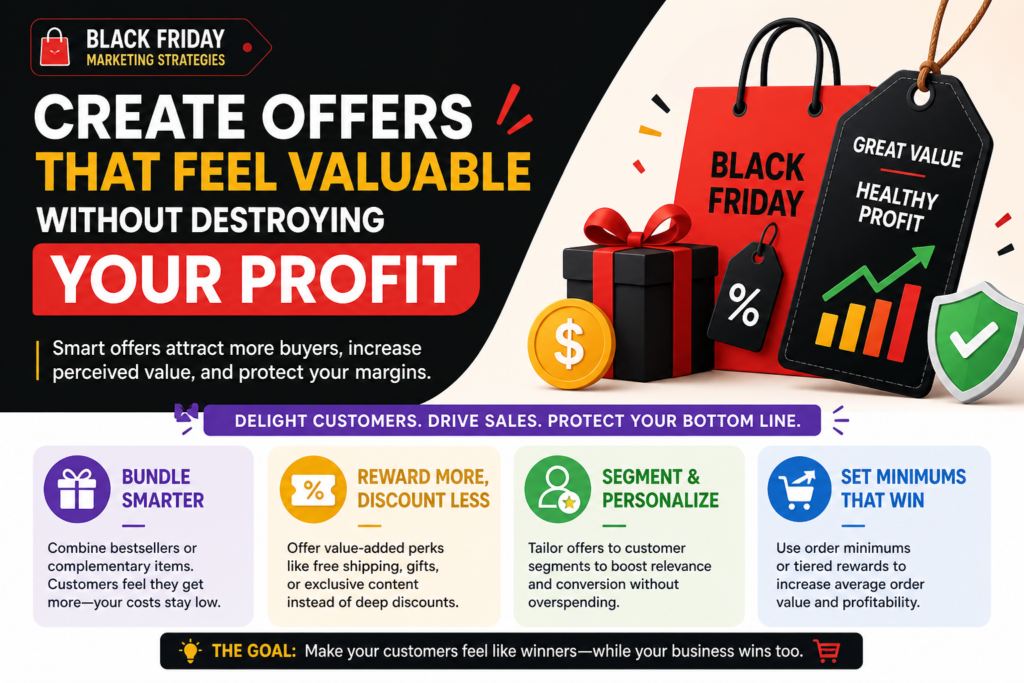
The easiest offer is a flat discount. But easy does not always mean best. A simple 30 percent off sale can work, especially for products with strong margins and simple buying decisions. But many brands need a more careful offer structure.
They need to increase order value, protect profit, and give customers a reason to buy more without feeling pushed.
The best Black Friday offers create urgency while still making sense for the business. They give the customer a clear win, but they do not turn the brand into a bargain bin.
Use bundles to increase order value and make buying easier
Bundles are one of the strongest Black Friday tools because they help both the customer and the business. The customer gets a better deal and an easier choice. The business gets a higher order value and can move more products in one sale.
A good bundle should not feel random. It should solve a clear problem or create a full experience. If you sell skincare, a bundle could be a full winter routine. If you sell software, a bundle could include setup support, templates, and a higher plan for the first few months. If you sell fitness products, a bundle could support a full home workout setup.
The key is to make the bundle feel natural. Customers should look at it and think, “Yes, I need these together.” When a bundle feels useful, it does not feel like a sales trick. It feels like guidance.
Bundles also reduce decision stress. During Black Friday, customers compare many offers. If your store has too many discounted items with no clear path, people may browse and leave. A well-built bundle gives them a simple option that feels complete.
Name your bundles around outcomes, not product parts
The name of the bundle matters. A weak name describes what is inside. A strong name describes what the customer gets. “Three-piece skincare set” is clear, but “Winter Glow Routine” feels more useful. “Marketing template bundle” is plain, but “Launch Faster Toolkit” speaks to a result.
This is not about being clever. It is about making the value easy to understand. Customers move fast during Black Friday. They should not have to work hard to understand why your offer matters.
Your bundle page should explain who the bundle is for, what problem it solves, why the items work together, and how much the customer saves. Keep the message simple. Make the value obvious.
Use tiered discounts to reward bigger carts
Tiered discounts can help you raise average order value without forcing every customer into the same deal. Instead of giving everyone one flat discount, you offer better savings when customers spend more. For example, a customer may save more when they cross a certain cart value.
This works because it gives shoppers a reason to add one more item. If someone is close to the next discount level, they may increase their cart to unlock the better offer. But the offer must be easy to understand. If customers need to do math, the campaign loses power.
The best tiered offers feel simple and fair. They should not create confusion at checkout. The customer should always know how close they are to the next reward. A cart message can help here. Instead of waiting until checkout, show progress as they shop.
A simple message like “You are close to unlocking the next deal” can increase cart size without feeling pushy.
Tiered discounts work especially well when your products are often bought together or when you have strong add-ons. They also help protect profit because the largest discount is tied to a larger purchase.
Make the next step feel small and worth it
The gap between tiers matters. If the next tier feels too far away, customers will ignore it. If it feels close, they will consider adding more. This is why you need to study your normal average order value before setting the offer.
If your average order value is $65, setting the first tier at $70 may work well because it feels reachable. Setting it at $150 may feel too far unless your products are high-ticket. The goal is not to force customers into a much bigger purchase. The goal is to guide them toward a slightly better cart that still feels natural.
A strong tiered offer feels like a helpful nudge, not a trap.
Warm up your audience before Black Friday begins
Many brands wait until the sale starts to talk to customers. That is a mistake. By the time Black Friday begins, people are already being flooded with offers. Their inboxes are full. Their social feeds are full. Their attention is split.
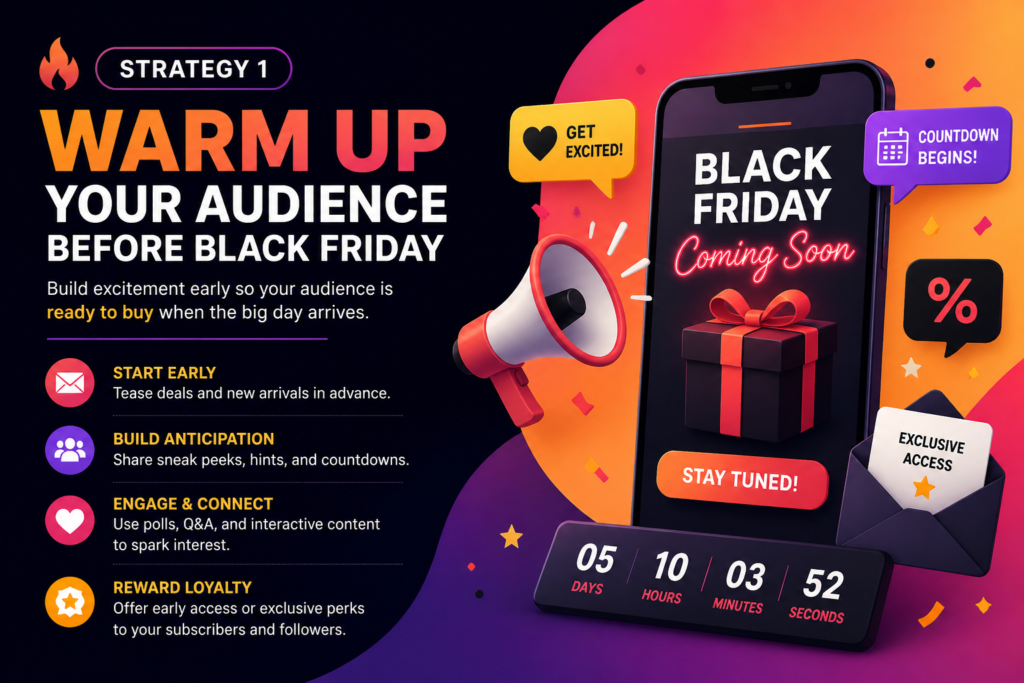
If your brand only appears when you want the sale, you become one more discount in a crowded market. But if you warm up your audience early, you enter the buying period with trust already built. People know what is coming. They know why it matters. They may even be waiting for your offer.
The warm-up phase is where you create interest before asking for the purchase. This can begin weeks before the sale. You do not need to reveal the full offer right away. You can tease the sale, invite people to join an early access list, share gift guides, highlight bestsellers, explain product benefits, and remind customers why your brand is worth choosing.
Black Friday is not only a sales event. It is an attention event. The brands that prepare attention early have a better chance of converting it later.
Build an early access list to create demand before the sale
An early access list gives customers a reason to engage before Black Friday. Instead of simply saying, “Our sale is coming,” you can say, “Join the early access list and shop before everyone else.” This creates a small feeling of privilege. It also helps you identify your warmest buyers before the campaign goes live.
Early access works because it turns passive interest into active intent. When someone signs up, they are raising their hand. They are telling you they may want to buy. That makes them more valuable than a cold visitor.
You can promote early access through your website, email, SMS, social media, paid ads, and even post-purchase messages. The promise should be clear. People should understand what they get by joining. It could be first access, a better deal, limited stock alerts, a bonus gift, or a private shopping window.
Do not make the signup feel heavy. Ask only for what you need. If email is enough, use email. If SMS is important to your campaign, explain why they should share their number. The value must feel worth it.
Treat early access people like your best customers
Once someone joins the early access list, do not ignore them until the sale starts. Send useful messages that build desire. Show bestsellers. Explain what may sell out. Share buying tips. Help them choose the right product before the rush.
This does two things. First, it makes the customer more ready to buy. Second, it reduces pressure on the sale day because the customer already knows what they want.
Your early access audience should feel like they are getting a smoother buying experience, not just another email. Give them clarity before everyone else gets noise.
Use content to help customers decide before the discount drops
Content can play a major role before Black Friday. Many customers are interested, but they are not ready. They may be comparing products. They may be unsure which option fits them. They may like your brand but need one more reason to trust you.
This is where helpful content becomes a sales tool. You can publish buying guides, comparison pages, gift guides, product education, customer stories, and simple “how to choose” articles. The goal is not to stuff the page with keywords. The goal is to remove doubt.
For example, a clothing brand can create a guide on choosing the right winter jacket. A SaaS brand can create a guide on choosing the right plan before year-end. A home brand can create a gift guide for different budgets. These pieces help customers make faster decisions when the sale starts.
Good pre-sale content also supports SEO. People search before they buy. They look for best gifts, product comparisons, deal guides, and reviews. If your content answers those searches, you can bring in traffic before ad costs peak.
Write content that leads naturally into the offer
Your content should not feel like a hard pitch from the first line. It should help first. But it should also guide the reader toward the next step. If the article helps someone choose the right product, the product link should be easy to find. If the guide talks about gifts, the gift collection should be one click away.
The best Black Friday content works like a helpful salesperson. It listens to the customer’s question, gives a clear answer, and then makes the next step simple.
Segment your audience so every message feels more personal
Black Friday emails and ads often fail because they treat every customer the same. A first-time visitor, a loyal buyer, a cart abandoner, and a past customer who has not bought in a year should not all receive the exact same message. They are in different places. They have different levels of trust. They need different reasons to act.
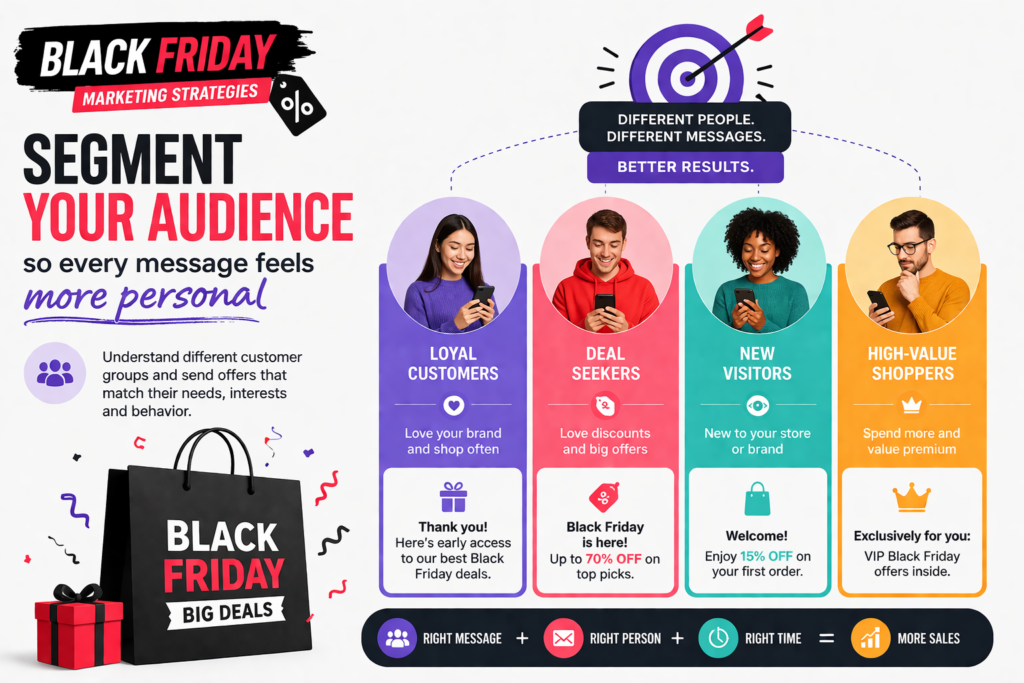
Segmentation helps you speak to people based on what they already know about your brand. This does not mean you need a complex system. It means you should stop sending one broad offer to everyone and start grouping people in simple, useful ways.
When your message feels more relevant, people pay more attention. A returning customer may respond to early access. A new subscriber may need proof and a starter offer. A cart abandoner may need a reminder that stock is limited. A high-value customer may care more about a premium bundle than a basic discount.
This is how smart brands make Black Friday feel less like shouting and more like selling with care.
Send different messages to new buyers and repeat buyers
New buyers need confidence. They may like your offer, but they still need to feel safe buying from you. They may wonder if your product is worth it, if shipping is reliable, if returns are easy, and if other customers are happy. For them, your Black Friday message should not only talk about savings. It should also build trust.
Repeat buyers are different. They already know your product. They already trusted you once. Your message can be more direct because the relationship already exists. You can thank them, give them early access, show products that pair well with what they bought before, or invite them to shop before the public sale begins.
This small shift can make a big difference. New buyers need reassurance. Repeat buyers need recognition. When you give both groups the same email, you miss the chance to speak to them in a way that feels natural.
Use past purchase data to guide the next best offer
Past purchases can tell you what a customer may want next. If someone bought a starter product, show them the next step. If someone bought a product that runs out or needs replacing, remind them to restock. If someone bought a gift last year, show them this year’s gift options.
You do not need to be too clever. The message can stay simple. A line like “Loved your last order? Here are the Black Friday picks that go well with it” can feel helpful without feeling creepy.
The goal is to make the customer’s next choice easier. When you use data to remove work from the buying process, your marketing feels useful.
Treat cart abandoners as warm buyers, not lost buyers
Cart abandoners are some of the most valuable people in your Black Friday campaign. They showed interest. They picked a product. They came close to buying. Something stopped them, but that does not mean the sale is gone.
During Black Friday, people abandon carts for many reasons. They may be comparing offers. They may be waiting for payday. They may be checking shipping costs. They may have been distracted. They may want to see if a better deal appears.
Your abandoned cart message should bring them back with clarity. Remind them what they left behind. Show the value again. Address common doubts. Make the checkout link easy. If stock is truly limited, say so clearly. If the offer ends soon, remind them.
But do not sound desperate. Customers can feel when a brand is pushing too hard. A good cart recovery message feels calm, helpful, and timely.
Make the recovery message match the reason they may have left
A weak abandoned cart message only says, “You left something behind.” A stronger one answers the hidden question behind the delay.
If shipping costs often cause drop-offs, remind customers of your shipping terms early. If customers hesitate on price, show the savings clearly. If they compare products, include a short benefit reminder. If trust is the issue, add reviews or a simple return policy note.
The best recovery messages do not just pull people back. They remove the reason they left.
Build a Black Friday email campaign that sells without sounding pushy
Email is still one of the most powerful Black Friday channels because it reaches people who already know your brand. These are not random visitors. They are subscribers, past buyers, and people who have shown interest. That makes email a strong place to create demand, drive traffic, and close sales.
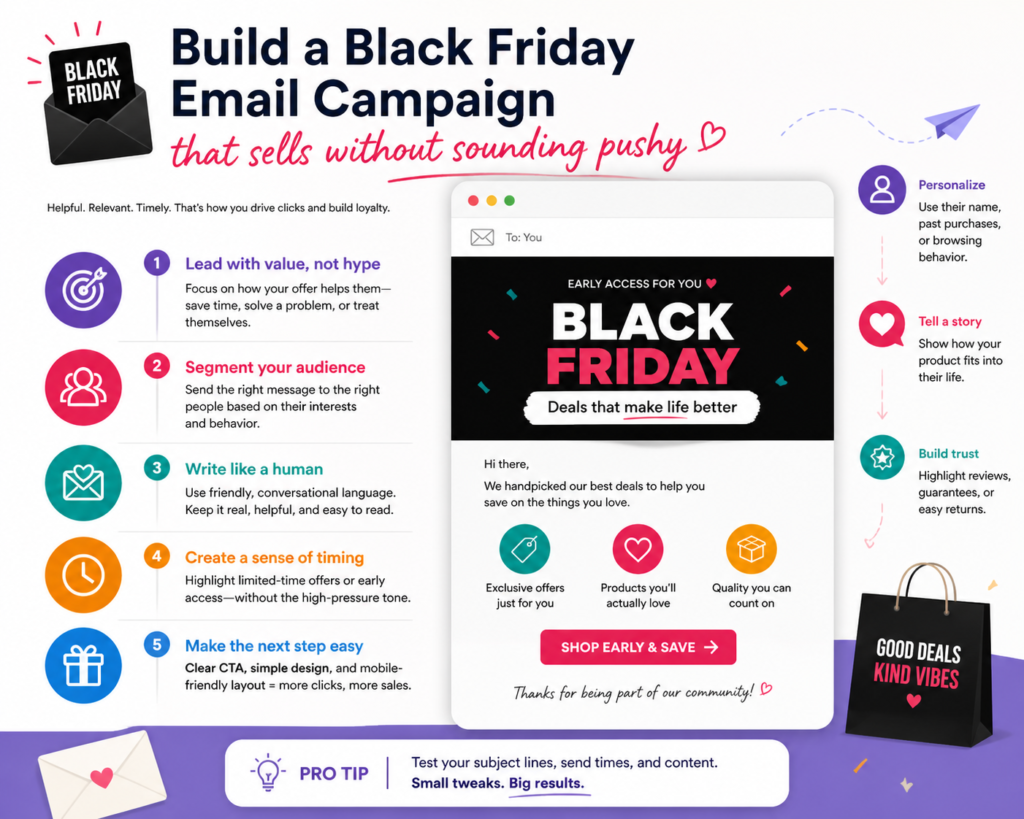
But Black Friday inboxes are crowded. Customers may receive dozens of sale emails in a single day. If your email looks and sounds like every other email, it will get ignored. “Black Friday Sale Starts Now” is not enough. “Huge savings inside” is not enough. People have seen those lines too many times.
Your email campaign needs timing, story, clarity, and urgency. It should not be one email sent on the day of the sale. It should be a short journey that warms people up, opens the sale, reminds them of the value, handles doubts, and closes with a strong final push.
Start the email journey before the sale opens
The first emails should not beg people to buy. They should prepare them. Before the sale starts, let subscribers know what is coming. Tell them when the sale begins, what types of products will be included, and why they should pay attention.
This early stage is also a good time to help people choose. You can send a guide to bestsellers, a gift guide, a “what to buy first” email, or a note about limited stock. These messages help customers build a mental wishlist before discounts go live.
When people know what they want before the sale starts, they are much more likely to buy quickly. This matters because attention drops fast during Black Friday. The longer people wait, the more offers they see, and the harder it becomes to win them back.
Use subject lines that are clear, not clever for the sake of it
A good subject line makes people want to open the email. But it should not confuse them. During Black Friday, customers move fast. If they do not understand the reason to open, they may skip it.
Clear subject lines usually work better than clever ones. Tell people what matters. Early access is live. The bestsellers are included. The sale ends tonight. Your wishlist may sell out. These ideas are simple, but they work because they match what buyers care about.
Do not overuse false urgency. If every email says “last chance,” customers stop trusting you. Save strong urgency for real deadlines.
Write emails like a helpful person, not a loud billboard
Black Friday emails often become too loud. They use too many big claims, too many countdowns, and too much pressure. That can create clicks, but it can also make the brand feel cheap.
A better email feels like a helpful note from someone who understands the customer. It should explain the offer, show the value, and make the next step clear. The copy should be simple. The layout should be easy to scan. The button should tell the customer exactly what happens next.
Your email should answer the questions customers already have. What is the deal? Why is this worth it? What should I buy? How long do I have? Is this a good choice for me? What happens if I do not like it?
The easier you make the decision, the more likely people are to act.
Keep each email focused on one main action
One email should not try to do everything. If you show too many collections, too many messages, and too many buttons, customers may freeze. Choice can slow people down.
Give each email one main job. One email can announce early access. One can highlight bestsellers. One can push bundles. One can answer common questions. One can warn about the final hours.
This does not mean the email must be short. It means the email must be focused. The reader should always know what to do next.
Turn your website into a sales machine before traffic spikes
Your Black Friday campaign can bring people to your website, but your website has to close the sale. This is where many brands lose money. They spend heavily on ads, send strong emails, create exciting offers, and then send customers to pages that are slow, cluttered, confusing, or hard to buy from.
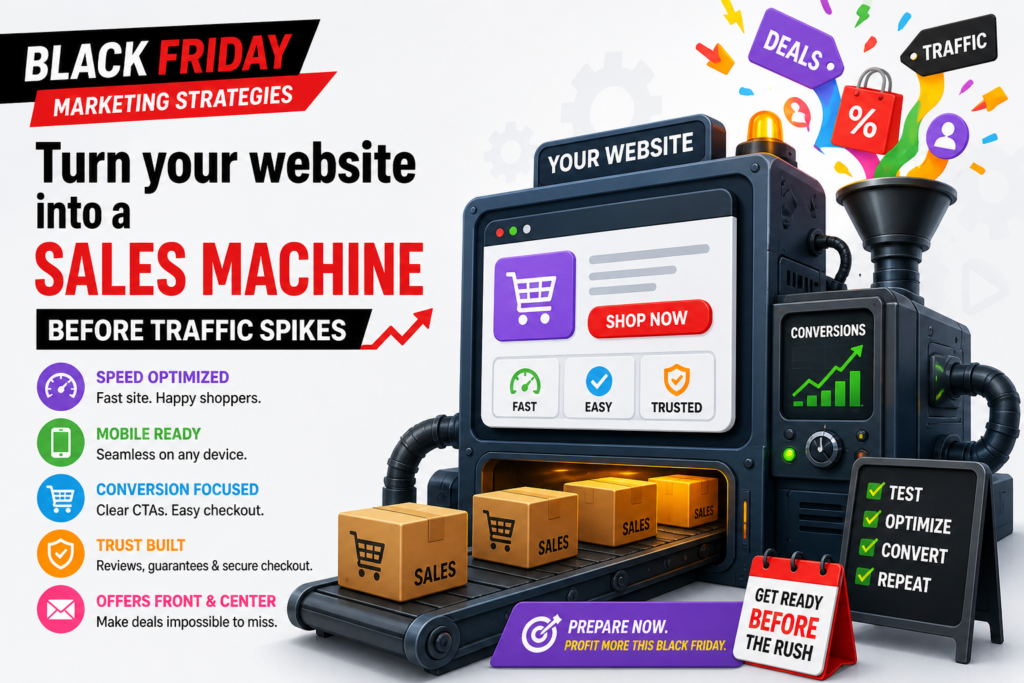
During Black Friday, patience is low. People are comparing deals. They may be shopping from their phones. They may have many tabs open. If your site makes them work too hard, they will leave and buy somewhere else.
Your website should make shopping feel simple. The offer should be clear. The product value should be easy to understand. The checkout should be smooth. The customer should never have to wonder what the deal is, how to claim it, or whether the product is right for them.
A strong website does not just look nice. It removes friction from the buying journey.
Create a dedicated Black Friday landing page
A dedicated landing page gives your campaign a clear home. Instead of sending traffic to your normal homepage, you can guide visitors to the exact products, bundles, and offers you want them to see.
This page should be simple and direct. It should explain the main offer near the top, show the best products or collections, answer key questions, and guide customers toward purchase. It should not feel like a random product dump. It should feel like a planned shopping path.
You can also use this page before the sale begins. Before Black Friday, it can collect early access signups. During the sale, it can show live offers. After the sale, it can shift into Cyber Monday or holiday messaging.
This helps your SEO as well. A strong Black Friday page can build search value over time if you keep the URL and update the page each year instead of creating a new one every season.
Make the page easy to understand in the first few seconds
When a visitor lands on the page, they should understand the sale quickly. What is the offer? Who is it for? What should they do next? If the page takes too long to explain itself, you lose people.
Use a clear headline, a short value message, and a strong call to action. Show the most important products early. If there are different offer levels, explain them in simple words. If there is a deadline, make it visible without making the page feel stressful.
The first few seconds decide whether people stay. Do not waste them with vague copy.
Fix product pages before sending paid traffic
Product pages carry a lot of weight during Black Friday. A landing page may bring customers in, but the product page often decides whether they buy. If your product page is weak, the discount has to work harder. If your product page is strong, the discount becomes the final push.
A good product page explains the product in plain words. It shows clear photos, strong benefits, real reviews, shipping details, return information, and answers to common questions. It should help the customer feel confident.
Do not assume customers already understand your product. Even returning visitors may need reminders. During Black Friday, people move quickly, so your page should make the value obvious.
Put trust signals close to the buying decision
Trust signals should not be hidden at the bottom of the page. Place them near the add-to-cart button and checkout path. This can include reviews, return policy notes, secure checkout messages, delivery estimates, product guarantees, or customer support details.
A customer may be ready to buy but still have one small doubt. If you answer that doubt at the right moment, you can save the sale. Trust signals are not decoration. They are conversion tools.
Use paid ads with sharper targeting instead of bigger spending
Black Friday ad costs are usually high because many brands are competing at the same time. This does not mean you should avoid paid ads. It means you need to be more careful. Spending more is not a strategy. Spending better is.
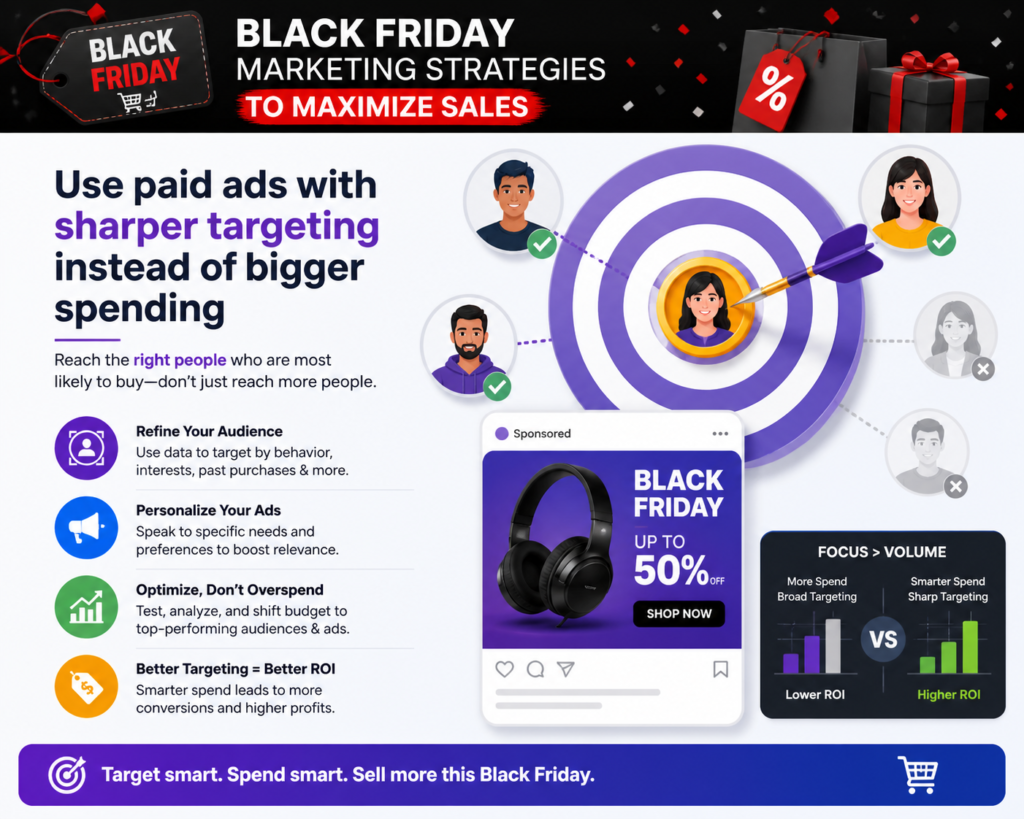
The brands that win with paid ads are the ones that know who they are trying to reach and what message that person needs. They do not send every user to the same page. They do not use one broad ad for every audience. They do not rely only on cold traffic during the most expensive time of the year.
Your paid ad plan should be built around intent. Some people know your brand and need a reminder. Some visited your site and need a reason to return. Some added to cart and need urgency. Some are new and need proof before they trust you.
Each group should see a different message.
Retarget warm audiences before chasing cold traffic
Warm audiences are often more valuable during Black Friday because they already know you. This includes website visitors, email subscribers, video viewers, social followers, past buyers, and cart abandoners. These people are easier to convert than someone who has never heard of your brand.
Retargeting lets you stay visible while they compare options. A customer may visit your site in the morning, leave, see three competitor offers, and then return to you later if your reminder is strong enough.
Your retargeting ads should not just repeat the same sale message. They should match the customer’s stage. A product viewer can see the product again with a stronger benefit. A cart abandoner can see a reminder about the deadline. A past buyer can see a bundle that fits their earlier purchase.
Use different creative for different levels of intent
Someone who watched a short video once does not need the same ad as someone who left items in the cart. The first person may need education and proof. The second person may need urgency and a direct checkout path.
Build your creative around these stages. For lower-intent warm audiences, focus on the main problem your product solves. For product viewers, focus on comparison, reviews, and benefits. For cart abandoners, focus on the exact offer and the reason to act now.
This makes your ads feel more relevant and helps your budget work harder.
Protect your profit by watching more than return on ad spend
Return on ad spend is useful, but it can mislead you during Black Friday. A campaign may show strong revenue while profit stays weak. This can happen when discounts are deep, shipping costs are high, or the product mix is poor.
Look at contribution margin, average order value, new customer cost, repeat purchase potential, and stock levels. You do not need a perfect finance model, but you do need to understand whether your ads are bringing healthy sales or just busy sales.
A cheaper product may convert well but leave little profit. A bundle may have a lower conversion rate but create better margins. A returning customer campaign may look smaller but produce stronger lifetime value.
Black Friday is not just about selling more. It is about selling in a way that supports the business after the sale is over.
Shift budget toward the offers that create better business outcomes
Do not keep spending on an ad just because it gets clicks. Watch what happens after the click. Are people buying? Are they buying profitable products? Are they adding more to cart? Are they coming back later?
As data comes in, shift budget toward the campaigns that support your main goal. If your goal is profit, push higher-margin bundles. If your goal is customer growth, push your best entry offer. If your goal is inventory clearance, push the products you need to move fastest.
Paid ads work best when they are managed with discipline. The goal is not to be everywhere. The goal is to put your money where it can create the best return.
Use SEO to capture shoppers before they are ready to buy
SEO is often ignored during Black Friday because many brands think of it as a slow channel. They assume paid ads, email, and social media are the only channels that matter during a short sales season. That is a costly mistake.
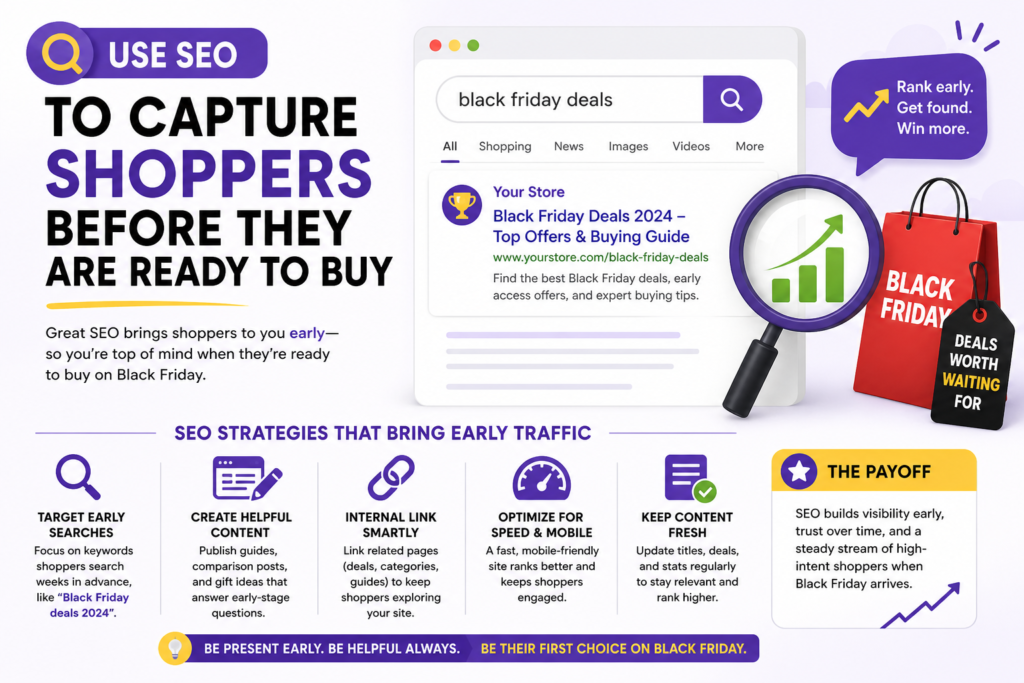
SEO may not work like a switch you turn on overnight, but it can help you reach buyers before the most expensive days arrive. Many shoppers start searching weeks before Black Friday.
They look for gift ideas, product reviews, comparisons, buying guides, discount dates, and brand deals. If your content is already there when they search, you get a chance to shape their decision before competitors flood their inbox.
The best Black Friday SEO strategy is not only about ranking for “Black Friday deals.” That keyword is crowded and often too broad. A smarter strategy is to target searches that show buying intent. These are searches where the customer is already thinking about a product, a problem, a gift, or a comparison.
SEO can also support your paid campaigns. If a shopper sees your ad and later searches your brand or product, your organic pages should help them trust you. When SEO and paid traffic work together, the whole buying journey feels stronger.
Build search pages around real buying questions
Your customers do not always search the way marketers think. They may not type your product name first. They may search for the best gift for a parent, the best tool for a small team, the best winter product for dry skin, or the best home office upgrade under a certain price.
These searches are valuable because they show intent. The customer has a need. They may not know which brand to choose yet. That gives you a chance to step in with helpful content that leads them toward your offer.
Your Black Friday SEO content should answer these questions in plain words. If you sell products, create gift guides, comparison pages, and buying guides. If you sell services or software, create decision guides, use-case pages, and problem-solution content. Each page should help the reader make a better choice.
Do not write content only to fill space. Every section should move the reader closer to a buying decision. Explain who the product is for, why it matters, what problem it solves, and why the Black Friday timing makes sense.
Keep the content useful even after Black Friday ends
A strong SEO page should not become useless after the sale ends. You can create pages that work all year and then update them for Black Friday. For example, a gift guide can stay live after the sale and later be refreshed for holiday shopping. A comparison page can keep ranking long after the campaign ends.
This is better than creating a new page every year and letting old pages die. Keep your strongest URLs alive. Refresh the content. Update the offer. Change the dates. Add new products. Over time, this builds authority and makes it easier to rank again next season.
Black Friday SEO should not be treated like disposable content. It should become an asset that grows stronger every year.
Optimize your Black Friday page for search and conversion
Your main Black Friday page should do two jobs. It should help people find you through search, and it should help visitors buy once they arrive. Many brands only focus on one side. They either create a page stuffed with search terms but weak for sales, or they create a beautiful sales page that search engines cannot understand.
You need both.
Use clear page titles, simple headings, helpful product sections, and copy that explains the offer. Mention the types of deals shoppers can expect, the product categories included, shipping details, return details, and any early access options. If the page is live before the sale starts, use it to collect signups and build demand.
The page should also load quickly and work well on mobile. Search traffic is wasted if the page feels slow or hard to use. During Black Friday, people do not have much patience. A slow page can turn strong demand into lost revenue.
Make your offer clear without stuffing the page with keywords
SEO does not mean repeating the same phrase again and again. That makes the page sound robotic and weak. Search engines and customers both prefer useful content. Write in a natural way. Use the words your customers use, but keep the page focused on helping them.
A good Black Friday page should feel like a smart sales guide. It should explain what is on sale, why it matters, who should buy, and how to take action. When the page serves the customer well, it also gives search engines more reason to understand and trust the content.
Turn social media into a demand-building channel, not just a sale poster
Many brands use social media poorly during Black Friday. They post a discount graphic, add a few urgent captions, and hope people click. That is not enough anymore. Customers see too many sale posts. A basic discount announcement can disappear in the feed within seconds.
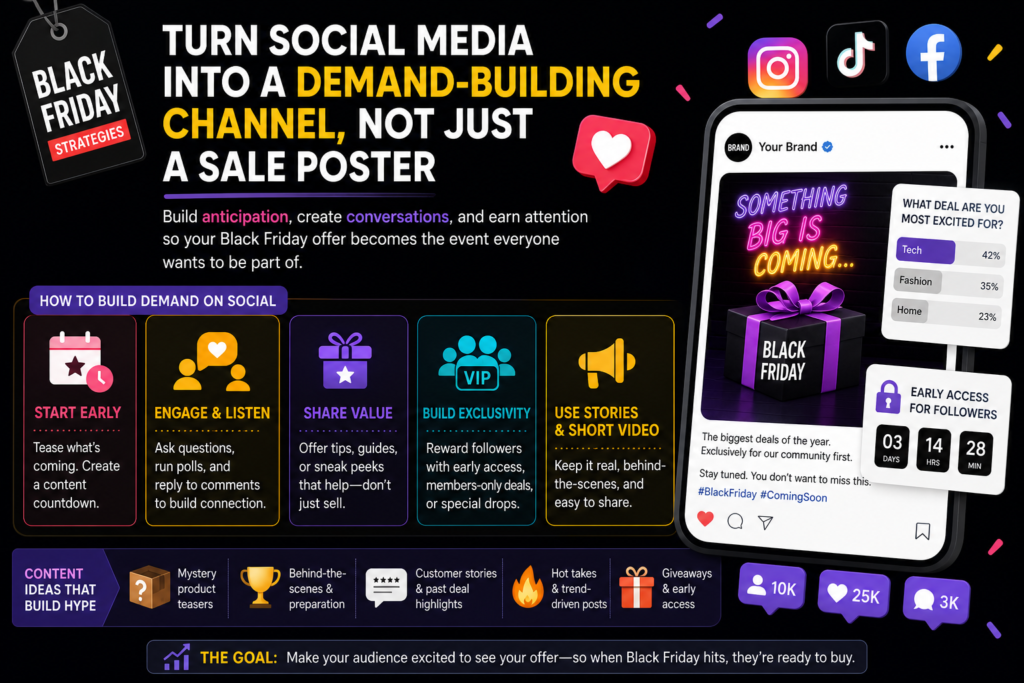
Social media works best when it builds demand before the sale and keeps energy high during the sale. It should not be treated like a notice board. It should feel alive. It should show the product, explain the value, answer doubts, share proof, and make people feel like something worth joining is happening.
The strongest Black Friday social content does not only say, “Buy now.” It shows why people are buying. It shows how the product fits into real life. It makes the offer feel timely, useful, and trusted.
Social media is also where you can create emotional momentum. Email may close sales. Ads may bring traffic. But social can make your campaign feel bigger than a discount. It can make people feel like your brand is active, helpful, and worth paying attention to.
Create content that warms people up before the sale
Before Black Friday begins, your social content should prepare your audience. Show what is coming. Talk about bestsellers. Share customer results. Explain how to choose the right product. Show behind-the-scenes preparation. Let people know when early access opens.
This kind of content helps people decide before the sale starts. It also creates familiarity. When your offer finally goes live, it does not feel sudden. It feels expected.
You can also use social media to learn what people care about. Watch comments, replies, saves, shares, and questions. If people keep asking about sizing, shipping, bundles, or stock, that tells you what to address in your emails, ads, and product pages.
Social content should not sit in a separate box. It should feed the rest of your campaign.
Use product education to make the discount feel more valuable
A discount becomes more powerful when the customer already understands the value of the product. If people do not understand why the product matters, even a big discount may not work.
Use social posts and videos to explain the product in simple ways. Show the problem it solves. Show before-and-after moments if they are honest and relevant. Show how it works. Show what makes it different. Show real customer feedback.
By the time the sale opens, people should not be asking, “What is this?” They should be thinking, “This is the right time to buy it.”
Use short videos to show the product in action
Short videos are powerful during Black Friday because they make the product easier to understand quickly. A customer can see the product, the result, the use case, or the benefit in a few seconds. This is especially useful when attention is low and competition is high.
A good Black Friday video does not need to be expensive. It needs to be clear. Show the product being used. Show the main benefit. Show what is included in the deal. Show how easy it is to order. Show a real person explaining why they like it.
For service businesses or software brands, short videos can still work well. You can show quick demos, customer problems, workflow improvements, founder messages, or simple screen recordings. The goal is to make the offer feel real, not abstract.
Video also gives you more creative options for ads. A strong organic post can become a paid ad. A customer question can become a video answer. A product demo can become a landing page asset.
Keep the video message focused on one idea
Do not try to explain everything in one short video. One video can show the main product benefit. Another can explain the bundle. Another can answer a common question. Another can show social proof. Another can remind people that the sale ends soon.
When each video has one job, the message becomes easier to remember. Customers do not need a full lecture. They need one clear reason to care right now.
Use urgency with honesty so customers act without losing trust
Urgency is one of the most common Black Friday tactics. It works because customers know the sale will not last forever. They also know that some products may sell out. A clear deadline can help people stop delaying and make a decision.
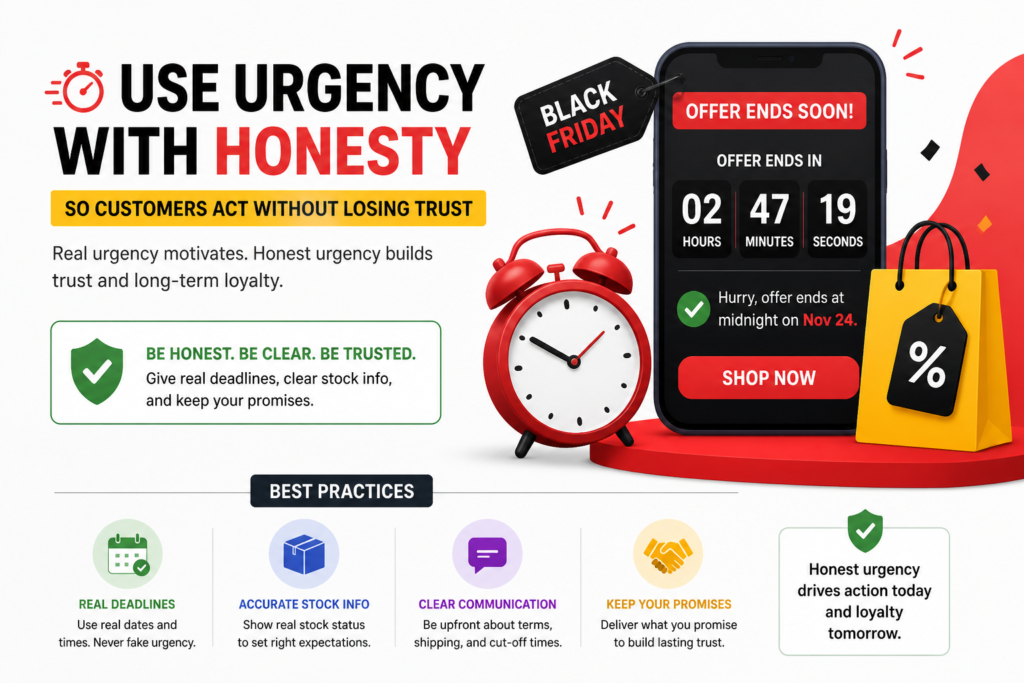
But urgency can easily become harmful when it is fake or overused. If your brand says “last chance” every day, customers stop believing you. If you claim stock is limited when it is not, you weaken trust. If every message sounds like panic, your brand feels less reliable.
Strong urgency is honest, specific, and useful. It gives customers a real reason to act now. It does not trick them. It helps them understand the cost of waiting.
During Black Friday, people often delay because they are comparing offers. Urgency helps them choose. But the urgency must be tied to something real, such as a deadline, limited stock, early access window, bonus gift, shipping cutoff, or bundle availability.
Use deadlines that customers can understand
A clear deadline is one of the simplest ways to drive action. Customers should know exactly when the offer starts and ends. Do not hide the deadline in small text. Do not make it vague. If the sale ends at midnight, say that. If early access ends before the public sale starts, say that.
Deadlines work best when they are repeated across your channels. Your email, website, ads, and social posts should all tell the same story. If one channel says the sale ends tonight and another says the offer lasts through the weekend, customers may feel confused. Confusion slows buying.
You can also create smaller deadlines inside the larger campaign. For example, early access may last one day. A bonus gift may be available for the first group of buyers. A shipping cutoff may apply before a certain date. These moments create reasons to act without relying only on the final sale deadline.
Do not use false countdowns or fake scarcity
Fake urgency can create short-term clicks, but it damages long-term trust. Customers are smarter than many brands think. They notice when countdown timers reset. They notice when “limited stock” never runs out. They notice when “final sale” comes back the next day.
Trust is worth more than one rushed order. If urgency is real, use it. If it is not real, do not invent it. You can still create strong reasons to buy by focusing on value, timing, bonuses, and customer needs.
Honest urgency may feel less dramatic, but it builds a better brand.
Use stock alerts only when they are true
Stock-based urgency can be very powerful. If a product is likely to sell out, tell customers early. If a size, color, plan, bundle, or gift set has limited availability, make that clear. This helps serious buyers act faster.
Stock alerts are especially useful for bestsellers. If customers know an item sells out every year, they may not want to wait. You can mention this in emails, product pages, cart reminders, and social posts.
But stock messages must be accurate. If you say stock is low when it is not, you create pressure without truth. That may hurt customer trust if people notice.
Show useful stock information near the buying point
Stock messages work best when they appear close to the decision. A product page note, cart message, or checkout reminder can be more powerful than a general social post. The customer is already interested, so the information feels relevant.
The message should be calm and clear. You do not need to scare people. A simple note that a product is moving fast or that a bundle is available only while stock lasts can be enough.
Urgency should support the buying decision, not make the customer feel pushed into a bad choice.
Use customer proof to remove doubt before checkout
Black Friday buyers move fast, but they still need trust. A discount can get attention, but proof helps close the sale. Customers want to know if your product works, if your service is reliable, if your shipping is smooth, and if other people are happy after buying.
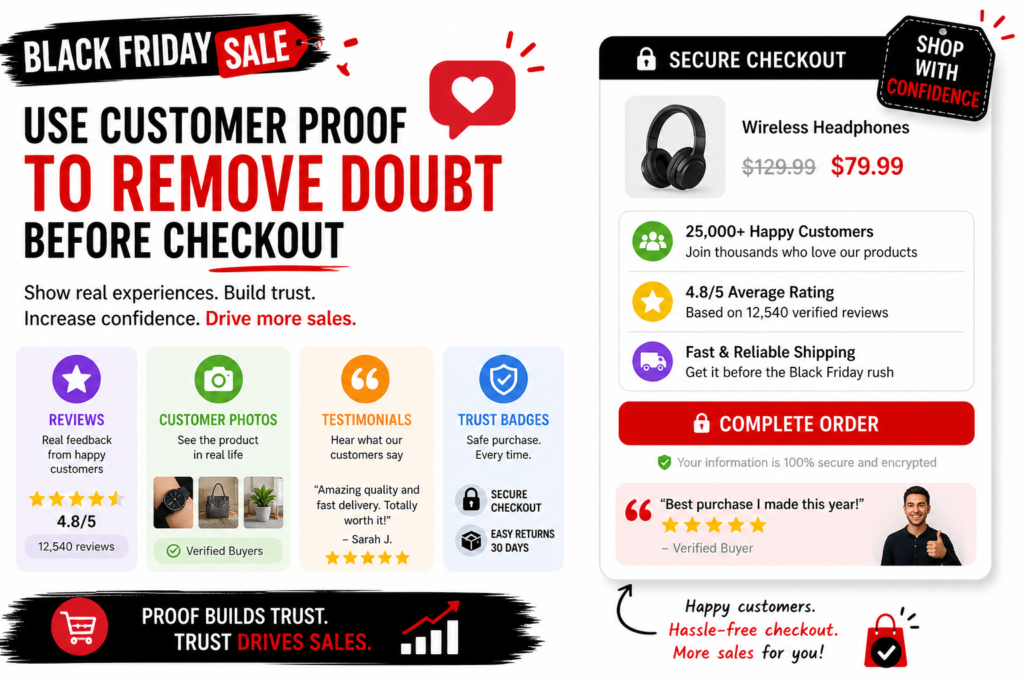
This is why customer proof is so important. Reviews, testimonials, case studies, user photos, ratings, and real customer stories can make the offer feel safer. They show that the product is not just promoted by the brand. It is trusted by people like the buyer.
During Black Friday, proof matters even more because customers are comparing many brands. If two offers look similar, the brand with stronger proof often wins. People do not want to waste money, even during a sale. They want confidence.
Your proof should be easy to see, easy to understand, and close to the buying path.
Place reviews where customers are making decisions
Reviews should not be hidden on a separate page. They should appear on product pages, landing pages, cart pages, and in emails. If a customer is thinking about buying, proof should be nearby.
The best reviews speak to real concerns. They talk about quality, results, fit, speed, ease of use, support, or value. A generic review that says “Great product” is fine, but a specific review is stronger. It gives the customer something real to believe.
You can also group reviews by product or customer type. If you sell to different audiences, show proof that matches each audience. A small business owner may care about different results than a large team. A first-time buyer may care about different details than a loyal customer.
Use proof to answer fear, not just praise the product
Good proof does more than say your brand is great. It answers the doubts that stop people from buying. If customers worry about size, show reviews about fit. If they worry about setup, show reviews about ease. If they worry about quality, show reviews that mention long-term use.
Think of proof as a quiet salesperson. It speaks when the customer is unsure. It helps them feel safe taking the next step.
Bring customer stories into emails and ads
Customer proof should not only live on your website. It should also appear in your Black Friday emails, ads, and social content. A short customer story can make a campaign feel more human. It reminds people that the offer is connected to real results.
You can use a customer quote in an email. You can show user-generated content in a social post. You can turn a review into a short video. You can include a case study in a retargeting ad. These small proof points can make your sale feel more trusted.
For service businesses, case studies are especially useful. A discount or special offer may get attention, but a clear result from a past client can create serious interest. Show the problem, the action, and the result in simple words.
Match the proof to the campaign message
If your campaign is about saving time, use proof that talks about time saved. If your campaign is about better quality, use proof that talks about quality. If your campaign is about gifting, use proof from people who bought gifts.
This makes the message feel stronger. The proof supports the promise. The promise supports the offer. The offer supports the sale.
Make mobile shopping smooth because most buyers will not wait
A strong Black Friday campaign can fall apart on a weak mobile experience. Many customers will see your email on their phone, tap an ad on their phone, browse products on their phone, and even complete checkout on their phone. If that path feels slow or messy, you lose sales that your marketing already worked hard to win.
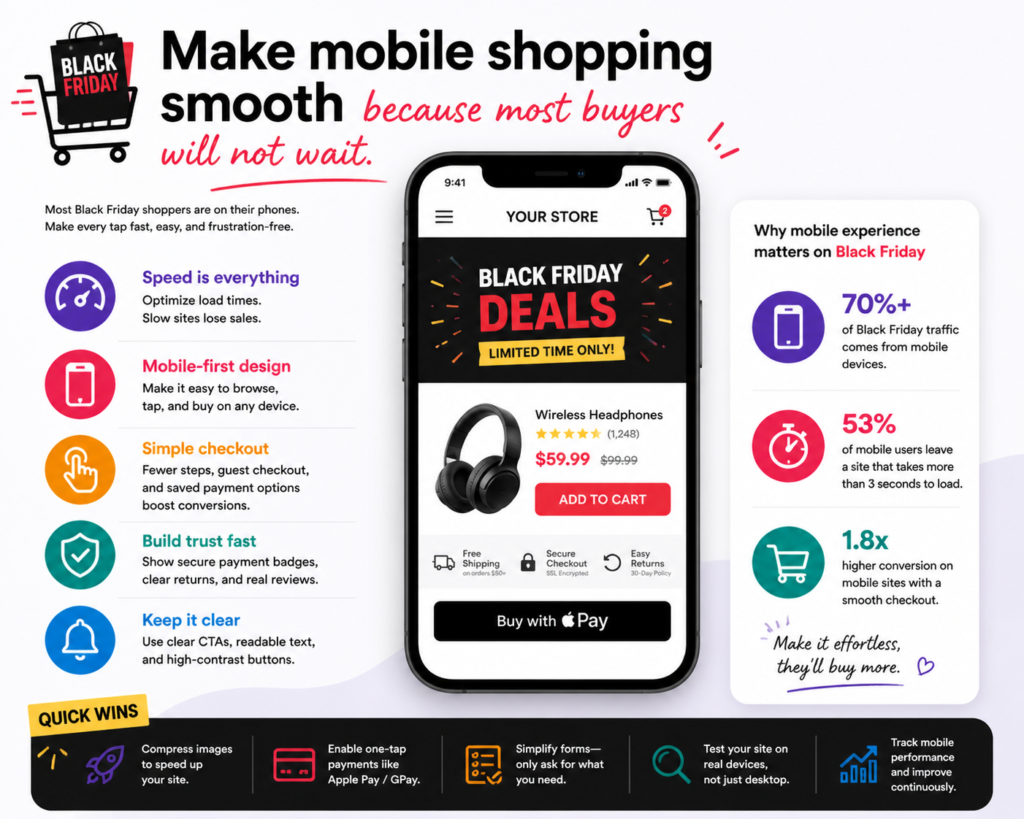
Mobile shoppers are often less patient than desktop shoppers. They may be standing in line, sitting on the couch, watching TV, or comparing deals while doing something else. They are not always giving your site full attention.
That means every extra step, every slow page, every hard-to-read section, and every confusing button can push them away.
Black Friday is not the time to hope your mobile site is good enough. You need to test it before the campaign starts. Open your landing page on a phone. Click through the sale. Add products to cart. Apply the discount. Check shipping details. Complete a test order. Look for anything that feels slow, unclear, or annoying.
Your mobile site should help people buy with the least amount of effort possible.
Keep the mobile page clear, fast, and easy to scan
A mobile page has less space, so clarity matters more. Your headline should explain the offer quickly. Your main button should be easy to see. Your product images should load well. Your text should be short enough to read without endless scrolling, but still clear enough to answer buyer questions.
Many brands make mobile pages too heavy. They add large banners, too many popups, too many moving parts, and too many product blocks. This can slow the page and distract the buyer. During Black Friday, speed and focus matter more than fancy design.
Your mobile page should guide shoppers naturally. They should see the offer, understand the value, browse the right products, and move toward checkout without friction. If they need to pinch, zoom, close popups, or search for the buy button, the experience is not ready.
Make buttons and checkout steps easy to use
Small buttons can hurt sales. If a customer has to tap carefully or scroll too much to find the next step, they may leave. Your add-to-cart button, checkout button, payment options, and coupon fields should be simple to use on a phone.
Keep forms short. Use autofill where possible. Show payment options clearly. If you offer express checkout, make it visible. If discounts apply automatically, say that clearly so customers do not waste time looking for a code.
Mobile checkout should feel like a straight path. Every extra turn creates a chance to lose the buyer.
Reduce popups that block the buying journey
Popups can help collect emails and promote offers, but they can also hurt mobile shopping if used badly. A popup that covers the page at the wrong time can frustrate buyers. A hard-to-close popup can make people leave. Too many popups can make your brand feel desperate.
During Black Friday, customers are already on high alert. They want the deal quickly. If your site keeps blocking them, the experience feels worse. Use popups with care. Show them at useful moments, not every few seconds.
For example, an early access popup can work before the sale starts. A cart reminder can work if someone is about to leave. But once a shopper is already buying, do not interrupt them unless the message helps them complete the purchase.
Test the buying path without assuming it works
Many website issues only appear when you walk through the full path like a customer. Test on different phones. Test on different browsers. Test with slow internet if possible. Check whether the cart updates correctly, whether discount codes work, whether payment buttons show properly, and whether shipping details are clear.
A small mobile problem can become a big revenue problem when traffic spikes. Fixing it before Black Friday is one of the simplest ways to protect sales.
Use SMS carefully to drive fast action without annoying customers
SMS can be a strong Black Friday channel because people see text messages quickly. An email may sit unopened, but a text often gets noticed within minutes. That makes SMS useful for early access, sale launch alerts, stock updates, and final reminders.
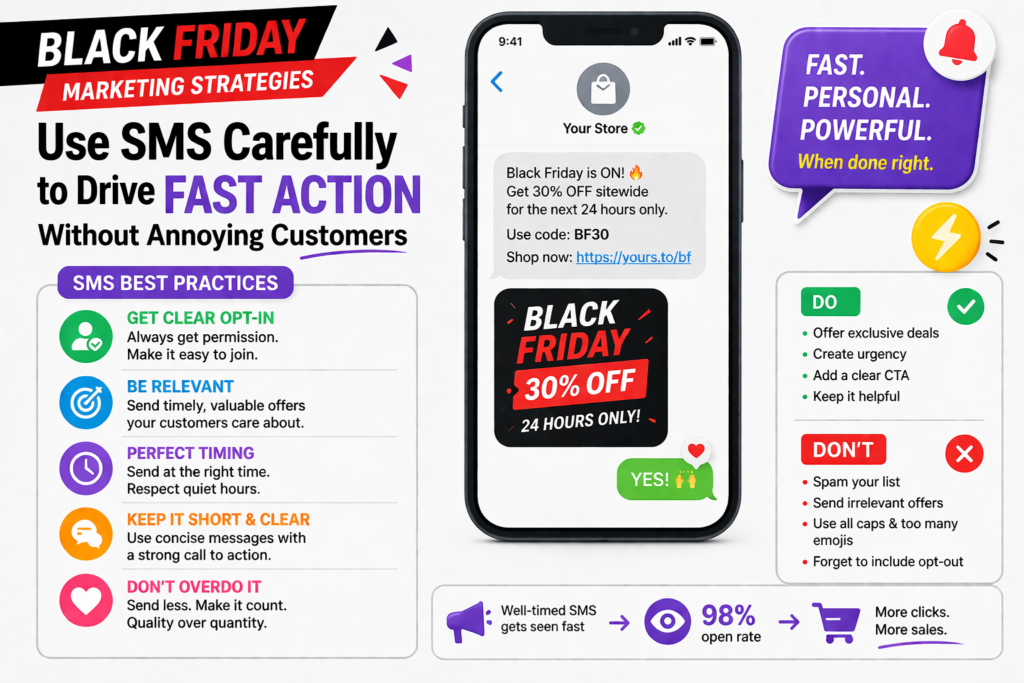
But SMS is also more personal than email. Customers are giving you access to a space they protect. If you send too many messages or make every message sound loud, they may unsubscribe or lose trust. SMS should be used with care.
The best Black Friday SMS messages are short, useful, and timely. They do not try to explain everything. They give the customer one clear reason to act and one easy next step. This works especially well when the audience is already warm.
Someone who signed up for early access is much more likely to welcome a text than someone who barely knows your brand.
SMS should not replace email. It should support it. Email can explain. SMS can remind.
Use SMS for moments when timing truly matters
Not every campaign update deserves a text. Use SMS when speed matters. Early access opening is a good reason. A sale going live is a good reason. A bestseller running low can be a good reason if it is true. A final deadline can also work.
The message should be direct and helpful. Tell customers what is happening, why it matters, and where to go. Avoid long phrases and heavy selling. A text should feel like a useful alert, not a full ad.
SMS also works well for cart recovery, but only when the message feels respectful. If someone left items in their cart, a simple reminder with the checkout link can bring them back. Do not send too many reminders close together. That can feel invasive.
Give SMS subscribers a real reason to stay subscribed
People are more likely to stay on your SMS list when they feel they get something useful. That could be early access, private deals, back-in-stock alerts, or faster updates. If SMS only repeats the same message they already saw in email, it may not feel worth it.
Treat SMS subscribers like a closer audience. Give them clarity and timing. Keep the value real. When customers feel respected, they are more likely to act when your message arrives.
Keep SMS copy simple and human
SMS should sound like a person wrote it. It should not sound like a loud sales banner squeezed into a tiny space. Use simple words. Avoid too many symbols. Avoid fake excitement. Make the message easy to understand at a glance.
A good SMS message gives the customer one job. Shop early access. Complete checkout. Grab the bundle before it sells out. Use the offer before it ends. That is enough.
The link should take them to the right place. If the message talks about a bundle, send them to the bundle. If it talks about their cart, send them to the cart. Do not make them land on the homepage and search.
Do not over-message during the sale window
Black Friday creates pressure, but that does not mean you should text customers every few hours. Too many texts can damage the relationship. It can also make the brand look nervous.
Plan your SMS schedule carefully. Use fewer messages with stronger timing. A launch message, one key reminder, and one final call can often be enough for many brands. If you have separate segments, you can adjust the timing based on intent.
The goal is to help customers act, not make them regret signing up.
Make your offer feel bigger with bonuses instead of only deeper discounts
Many brands think the only way to improve a Black Friday offer is to cut the price more. But deeper discounts are not always the best answer. They can hurt margins, weaken brand value, and make customers wait for sales in the future.
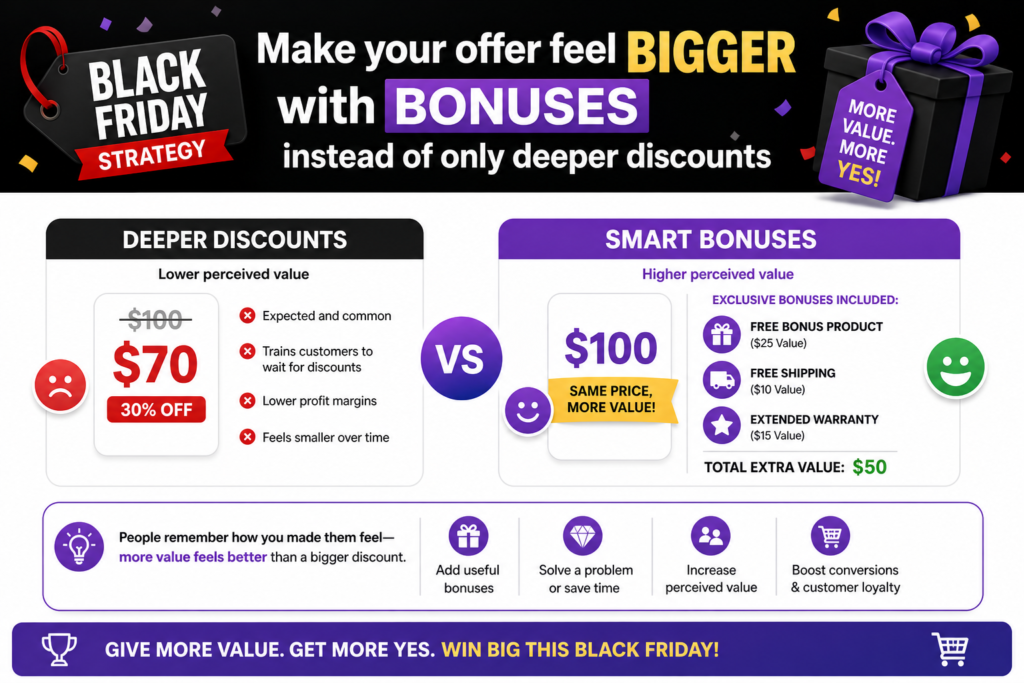
Bonuses can make an offer feel bigger without always lowering the price. A bonus gives customers extra value. It can help them feel like they are getting a better deal while allowing you to protect more profit.
A bonus can be a free gift, free shipping, extended access, a setup session, a template pack, a sample, a warranty upgrade, a service add-on, or a post-purchase guide. The right bonus depends on your business. The key is that it must feel useful. A weak bonus feels like clutter. A strong bonus makes the main purchase easier, better, or more complete.
Bonuses also help your offer stand out. Many competitors may offer the same percent off. Fewer will offer a thoughtful added value that fits the customer’s need.
Choose bonuses that support the main product
A bonus should make the main offer more attractive. It should not feel random. If someone buys skincare, a travel-size product or routine guide may make sense. If someone buys software, onboarding help or templates may make sense. If someone buys a course, a workbook or live session may make sense.
The bonus should answer the question, “What would make this purchase feel easier or more valuable?” When you think this way, the bonus becomes part of the buying reason.
A strong bonus can also remove doubt. For example, setup support can reduce fear for software buyers. A size exchange promise can reduce worry for fashion buyers. A starter guide can help first-time users feel more confident.
Give the bonus a clear name and clear value
Do not bury the bonus in small text. Make it part of the offer story. Give it a clear name. Explain what it helps the customer do. Show its value in simple terms.
If the bonus has a real price value, you can mention it. But do not rely only on the price. Explain why it matters. Customers care more when they understand how the bonus helps them.
A bonus should feel like a smart reason to buy now, not a leftover item added to make the offer look larger.
Use limited bonuses to create honest urgency
A limited bonus can create urgency without cutting prices further. For example, the first set of buyers may receive a free gift. Early access buyers may receive a special add-on. Orders above a certain value may unlock an extra reward.
This works because the customer has a reason to act early. The main sale may last longer, but the bonus gives them a reason not to wait.
The limit must be real. If you say the bonus is available for the first 500 orders, then it should end when those orders are reached. If it is available until a certain time, keep that promise. Honest limits build trust.
Match the bonus limit to your stock and campaign goal
Do not create a limited bonus that becomes hard to manage. If the bonus depends on physical stock, make sure your inventory is accurate. If it depends on a service add-on, make sure your team can deliver it. A bonus that creates support problems can hurt the customer experience.
The best bonus feels exciting to the customer and manageable for the business. It should support sales without creating chaos after checkout.
Create gift-focused campaigns for shoppers who are buying for others
Black Friday is not only about people buying for themselves. Many shoppers are buying gifts. This changes how they think. They may not know the product as well. They may not know the right size, style, plan, or version. They may worry about whether the person receiving the gift will like it.
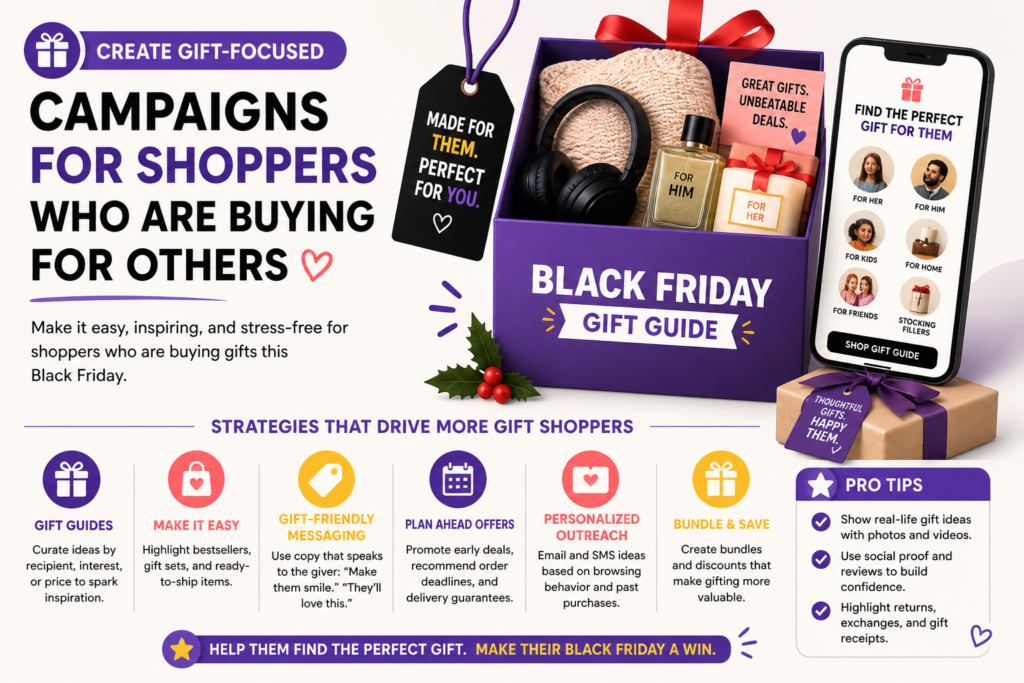
Your marketing should help these buyers choose with confidence. A gift buyer needs simple guidance. They need clear categories, easy recommendations, delivery details, and a return or exchange policy that feels safe.
Gift-focused campaigns can be very powerful because they reduce decision stress. Instead of making shoppers browse your full store, you can guide them by person, budget, need, or use case. This makes the buying path faster.
A customer who is unsure what to buy may leave. A customer who sees a clear “best gifts for new parents” or “best gifts under $50” path may keep shopping.
Build gift guides around real buyer situations
A strong gift guide should not be a random list of products. It should be built around how people actually shop. They may shop by budget, by relationship, by interest, by age, by problem, or by product type.
For example, you can create pages for gifts for busy founders, gifts for remote workers, gifts for skincare beginners, gifts for fitness lovers, or gifts under a certain price. The more useful the guide feels, the more likely people are to trust it.
Each product in the guide should have a short reason why it is a good gift. Do not just show the item. Explain who would like it and why. This helps the buyer feel smart and confident.
Make the guide easy to shop from
A gift guide should not make people work harder. Every product should have a clear path to purchase. If there are sizes or options, explain them. If shipping deadlines matter, show them. If gift wrapping is available, mention it.
The guide should feel like a helpful store assistant. It should reduce the number of choices, not add confusion.
Promote gift cards for buyers who are unsure
Gift cards are often underused during Black Friday. They are useful for shoppers who want to buy but are not sure what to choose. They also help when sizes, colors, or personal tastes make the decision harder.
A gift card can be positioned as a simple, safe gift. You can make it more attractive with a Black Friday bonus, such as a small extra credit when someone buys a certain gift card value. This can increase revenue while giving customers flexibility.
Gift cards also help with last-minute shoppers. If shipping deadlines are tight, a digital gift card can still save the sale.
Make gift cards feel thoughtful, not lazy
Some customers worry that gift cards feel impersonal. Your marketing can help change that. Show how the gift card lets the receiver choose what they truly want. Offer simple message options. Create nice digital designs. Suggest gift card values based on product ranges.
When presented well, a gift card does not feel like a backup. It feels like an easy way to give someone choice.
Use checkout strategy to increase order value without hurting the experience
The checkout stage is where the customer is closest to buying. This is also where many brands either increase revenue or lose the sale. A smart checkout experience can raise average order value, but it must be handled carefully.
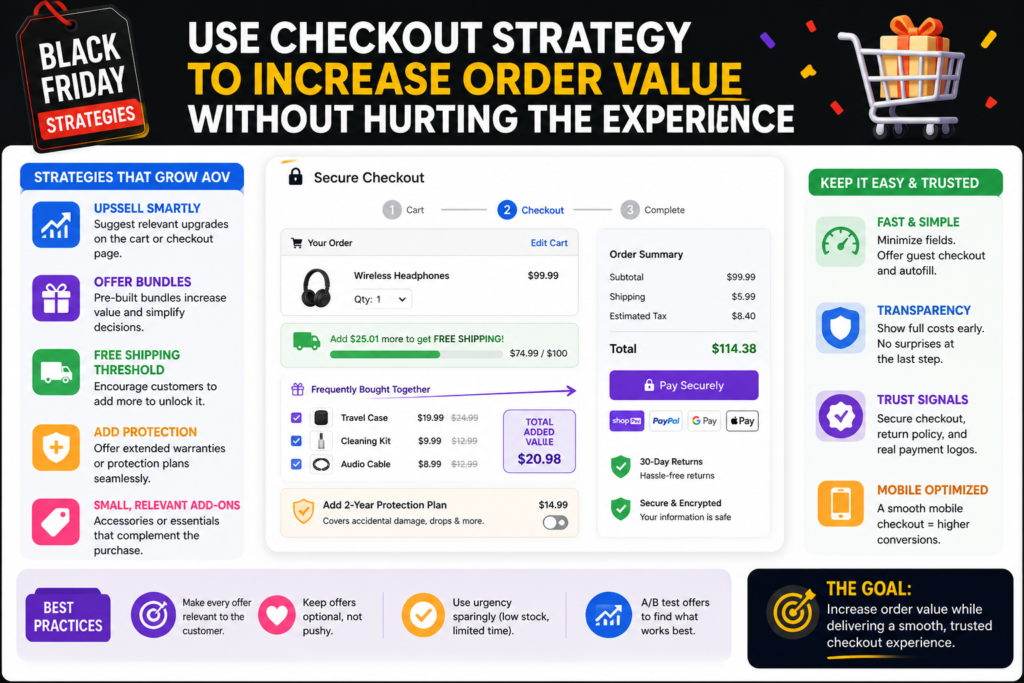
Black Friday shoppers are sensitive to friction. If you add too many upsells, too many popups, or too many steps, you may slow them down. The goal is not to squeeze every possible dollar from the customer. The goal is to offer helpful additions that make sense.
A checkout add-on should feel natural. It should be easy to accept and easy to skip. It should not make the customer feel trapped. When done well, it can increase order value while still improving the shopping experience.
Offer add-ons that match what the customer is already buying
The best checkout offers are closely related to the cart. If someone buys a main product, offer a refill, accessory, protection plan, sample, upgrade, or matching item. If someone buys a gift, offer gift wrapping or a greeting card. If someone buys software, offer onboarding or templates.
The closer the add-on fits the purchase, the better it works. Random offers feel like distractions. Relevant offers feel helpful.
Keep the copy short and clear. Explain why the add-on makes sense. Show the price. Make the choice simple.
Do not let upsells slow down the final purchase
Checkout is not the place for long explanations. If the add-on needs too much education, it may not belong there. Save complex offers for product pages or follow-up emails.
At checkout, the customer should be able to say yes or no quickly. The main purchase should remain the focus. If the upsell makes checkout feel harder, it may cost more than it earns.
Use free shipping thresholds to lift cart value
Free shipping thresholds can be very effective during Black Friday. Many customers dislike paying for shipping, especially after seeing a discount. If they are close to free shipping, they may add another item.
The threshold should be realistic. If it is too high, customers will ignore it. If it is too low, you may lose margin. Use your normal average order value as a guide and set the threshold slightly above it when possible.
Show the progress clearly in the cart. A message like “You are close to free shipping” can encourage customers to add more without feeling forced.
Suggest low-friction products to help customers reach the threshold
If customers are close to free shipping, help them choose a small add-on. Show products that are easy to buy, popular, and relevant. This removes the effort of searching.
The easier you make it to reach the threshold, the more likely customers are to increase their cart. This is a small detail, but during Black Friday traffic spikes, small improvements can create large gains.
Prepare your customer support team before the sale starts
Black Friday marketing does not end when someone clicks the buy button. If customers have questions and your team cannot answer fast, you can lose sales that were almost ready to happen. A strong support plan can protect revenue, reduce stress, and make the whole buying experience feel smoother.
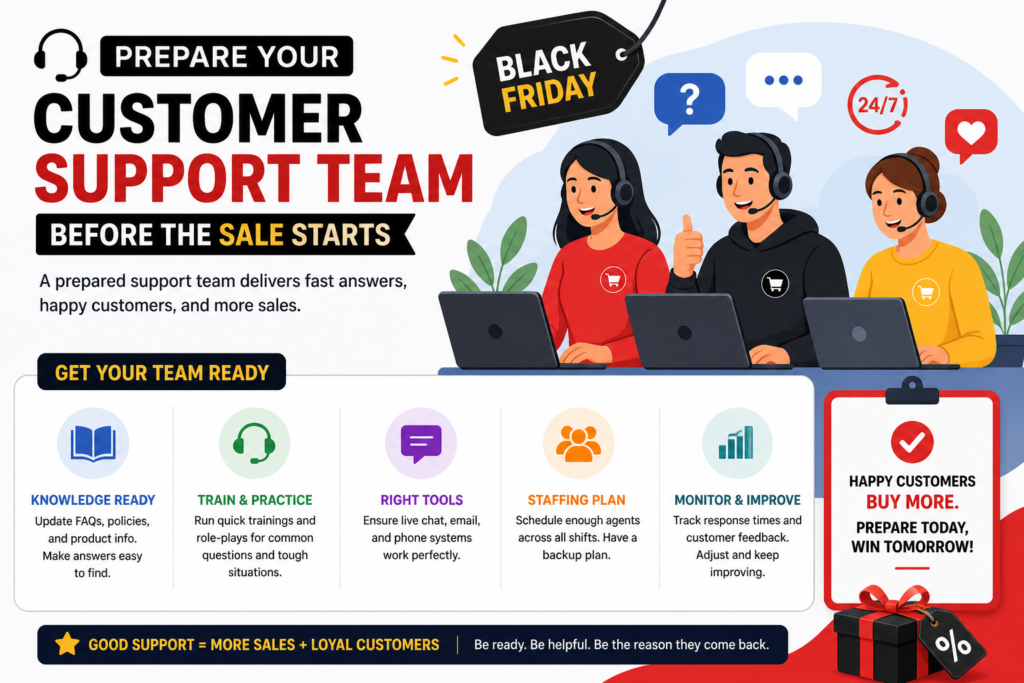
Many customers ask simple questions before they buy. They want to know when the order will arrive, whether they can return it, which size to choose, whether the discount applies automatically, or whether a product will come back in stock. If answers are hard to find, they may leave instead of waiting.
Support is part of marketing during Black Friday. It helps remove doubt at the exact moment a customer is close to buying. A fast, clear answer can turn hesitation into action. A slow or confusing answer can turn interest into silence.
Build a clear answer bank for common Black Friday questions
Before the campaign begins, list the questions customers are most likely to ask. These questions usually come from shipping, returns, discount codes, product fit, order changes, bundle rules, gift options, and stock limits. Then write simple answers your whole team can use.
This answer bank should not sound cold. It should sound clear, calm, and helpful. Customers do not need long policy language. They need plain answers that help them decide.
You can use these answers in live chat, email replies, social media comments, product pages, and FAQ sections. This keeps your messaging consistent across the campaign.
Make your FAQ part of the buying journey
Do not hide your FAQ where only frustrated customers can find it. Put key answers near the sale page, product pages, cart, and checkout. If shipping deadlines matter, show them before checkout. If returns are easy, say that before the customer has to ask.
A good FAQ does not distract from the sale. It supports it. It answers doubts before they turn into abandoned carts.
Train support to save sales without overpromising
During Black Friday, support teams can feel pressure to give fast answers. That is good, but speed should not lead to promises the business cannot keep. If a customer asks whether an order will arrive by a certain date, your team should know the true shipping window. If a product is low in stock, they should know what can and cannot be guaranteed.
Good support protects both the customer and the brand. It helps people buy with confidence, but it does not create problems after the sale.
Support teams should also know which offers are most important. If a customer is unsure, the team can guide them to the right bundle, bestseller, size guide, plan, or gift option. This makes support feel like a helpful sales assistant, not just a problem solver.
Give your team simple rules for difficult cases
Black Friday can bring refund requests, coupon issues, angry messages, delayed orders, and stock questions. Your team needs simple rules for handling these situations. They should know when to offer help, when to escalate, and when to make an exception.
Clear rules reduce stress. They also help customers get fair answers faster. When support is ready, the campaign feels more professional from the outside.
Use live chat and chat flows to help customers choose faster
Live chat can be a strong conversion tool during Black Friday because it gives shoppers answers while they are still on the site. A customer who has to leave the page to search for help may not return. A customer who gets the answer right away may buy within minutes.
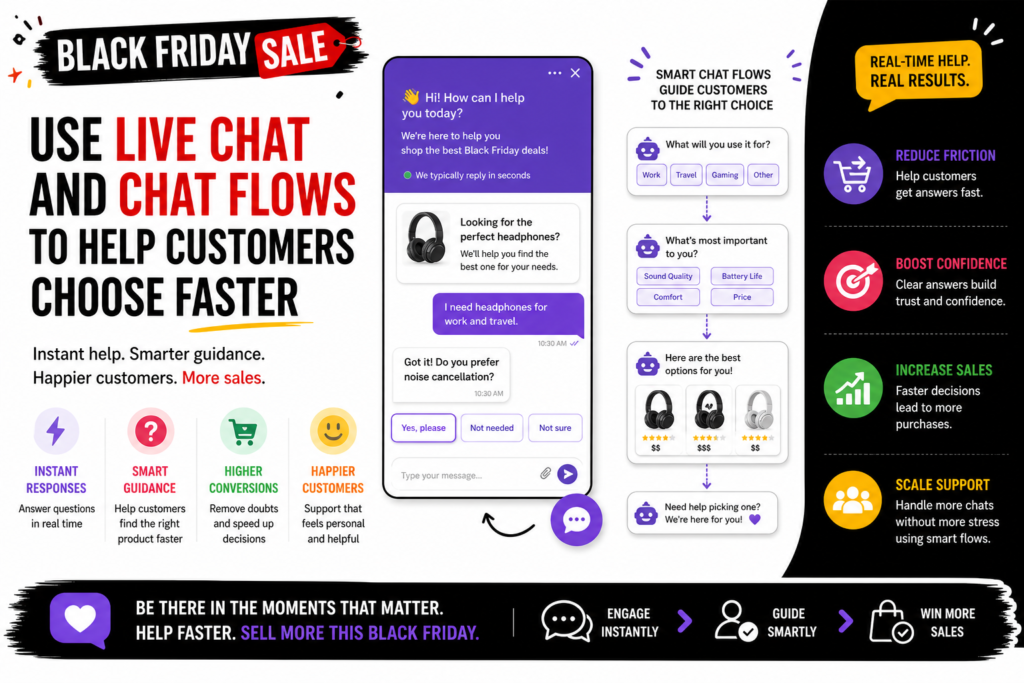
This is especially useful for products that need more explanation. If customers need help choosing a size, plan, bundle, shade, package, or gift, live chat can guide them. It can also reduce cart abandonment by answering concerns before checkout.
But live chat must be planned well. If customers open chat and wait too long, the experience can hurt trust. If automated replies feel robotic or unhelpful, they can create frustration. The goal is to make chat feel useful, not like a barrier.
Use chat prompts that match the page the customer is on
A generic chat message is easy to ignore. A useful chat prompt matches the customer’s situation. On a gift guide page, the prompt can offer help choosing a gift. On a bundle page, it can explain which bundle fits which buyer. On a cart page, it can answer questions about shipping or discounts.
This kind of timing makes chat feel helpful because it appears when the customer may actually need it. It should not block the page or interrupt the buying flow. It should be available without being annoying.
The best chat prompts feel like a friendly store assistant. They do not push. They guide.
Keep automated chat answers short and useful
Automated chat can help during high-traffic periods, but it should not pretend to be smarter than it is. Use it for simple questions like shipping dates, return rules, discount details, size guides, gift options, and order tracking.
If the question is complex, make it easy to reach a real person. Customers get frustrated when chat loops them through useless answers. A bad chat flow can feel worse than no chat at all.
Automation should save time while keeping the customer experience human.
Use chat data to fix weak points during the campaign
Your chat questions can show where your campaign is unclear. If many people ask whether the discount applies automatically, your site copy may need to be clearer. If many ask about delivery dates, your shipping message may be too hidden. If many ask which bundle to buy, your bundle page may need better guidance.
This is valuable real-time feedback. You do not have to wait until the campaign ends to improve. You can update copy, adjust page sections, add FAQs, or clarify emails while the sale is still live.
Black Friday moves quickly, so small fixes during the campaign can make a real difference.
Watch for repeated confusion and solve it at the source
Support teams should not have to answer the same avoidable question hundreds of times. If the same question keeps appearing, fix the page, email, ad, or checkout message that caused it.
This saves support time and helps more customers buy without asking for help. The best support strategy is not only answering questions. It is removing the need for many questions in the first place.
Plan your inventory and fulfillment message before demand spikes
A great Black Friday campaign can turn into a bad customer experience if inventory and fulfillment are not ready. Selling more is only good if you can deliver what you promised. If orders are delayed, products go out of stock without warning, or customers receive poor updates, the short-term revenue can damage long-term trust.
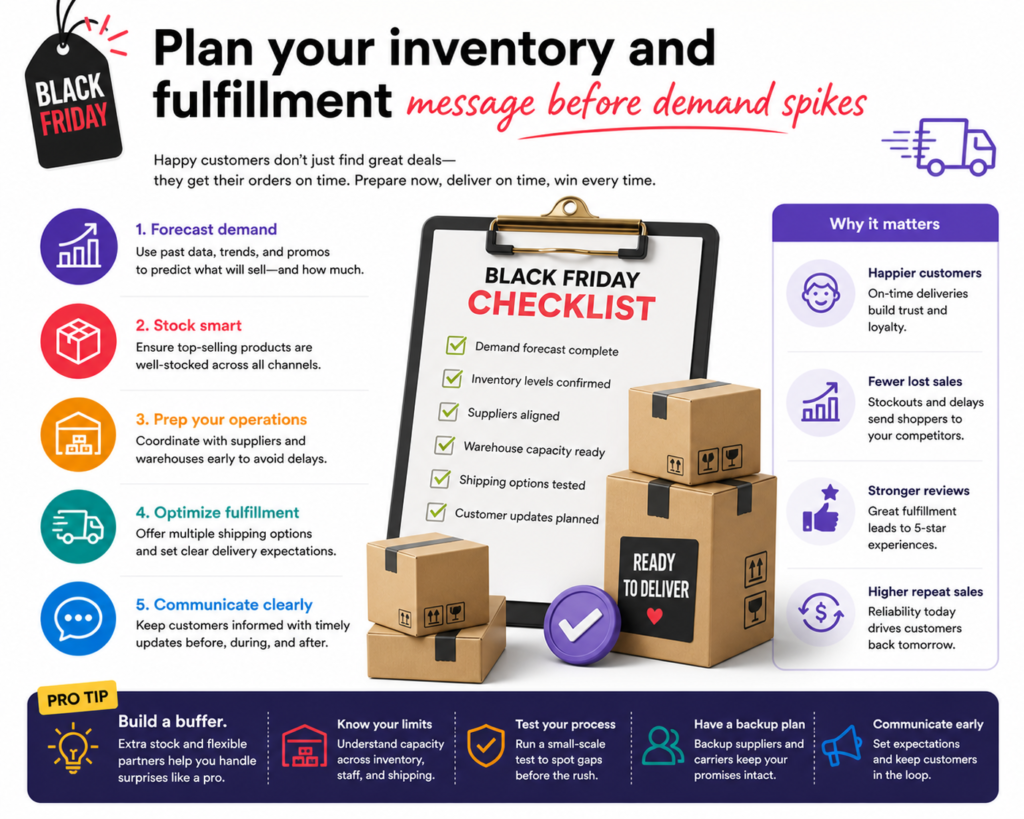
Marketing should not be separated from operations during Black Friday. Your offers, emails, ads, and website messages must match what your team can actually deliver. If a product has limited stock, the campaign should reflect that. If shipping will take longer than usual, customers should know before they buy.
Clear expectations can protect your brand. Customers are often willing to wait when they understand the timeline. They get angry when they feel surprised or misled.
Push the right products based on stock and margin
Not every product deserves the same attention during Black Friday. Some products may have strong demand but low stock. Some may have healthy stock but weak margins. Some may be perfect for bundles. Some may create fulfillment problems if pushed too hard.
Your marketing plan should focus on products that make sense for the business. This means looking at inventory, margin, shipping limits, return risk, and customer demand before deciding what to promote.
If you push a product that sells out too fast, you may waste traffic and disappoint shoppers. If you push products with poor margins, you may increase revenue while weakening profit. If you push hard-to-ship products without a plan, you may create delays.
Create backup offers before you need them
If your main product sells out, you should already know what to promote next. Do not wait until the middle of the campaign to decide. Prepare backup bundles, similar products, gift cards, waitlists, or restock alerts.
This keeps the campaign moving. Instead of sending visitors to dead ends, you can guide them to another useful option. A sold-out product does not have to end the sale if your next step is ready.
Be honest about shipping deadlines and delivery times
Shipping matters a lot during Black Friday because many customers are buying gifts. They want to know whether the order will arrive in time. If the delivery promise is unclear, they may hesitate. If the promise is wrong, they may be upset later.
Show shipping deadlines clearly on your sale page, product pages, cart, checkout, and post-purchase emails. If shipping may take longer because of high order volume, say that in plain words.
This does not weaken the sale. It builds trust. Customers can make better decisions when they know what to expect.
Send post-purchase updates before customers ask
After someone buys, keep them informed. Order confirmation, shipping updates, delay notices, and delivery messages all matter. A customer should not have to contact support just to know what is happening.
Good post-purchase communication reduces support pressure and improves customer satisfaction. It also makes customers more likely to buy again later.
Use retargeting after Black Friday to recover missed sales
Not every interested shopper will buy during Black Friday. Some will browse and leave. Some will add to cart and wait too long. Some will miss the deadline. Some will still be comparing options after the sale ends.
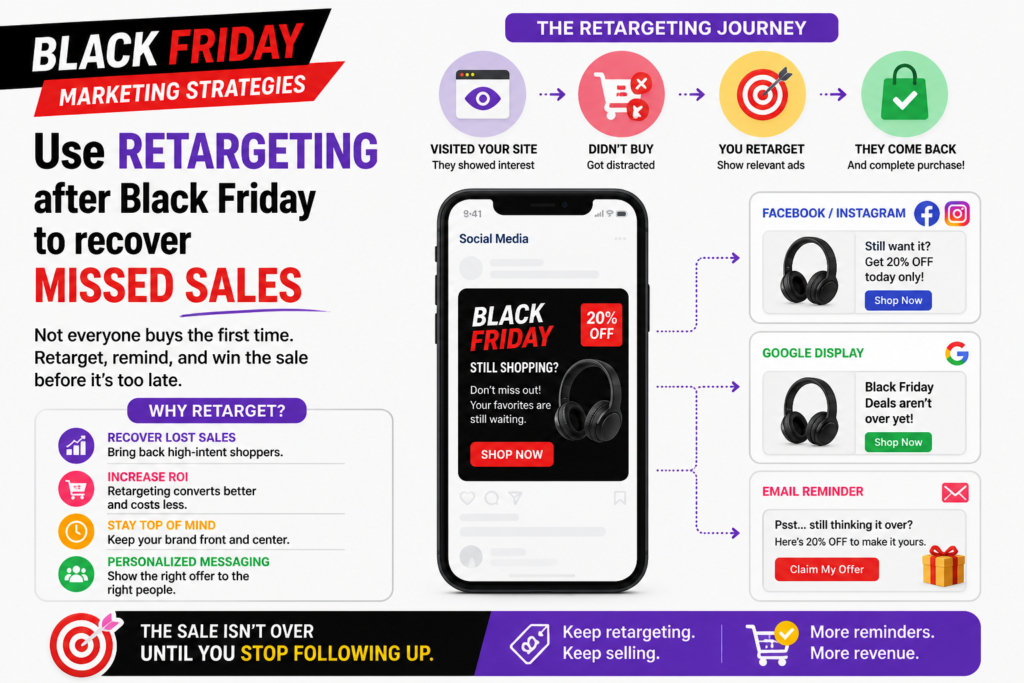
That does not mean the opportunity is gone. Retargeting after Black Friday can help you recover missed sales and move shoppers into Cyber Monday, holiday offers, or year-end campaigns. This is where many brands leave money behind. They stop marketing as soon as Black Friday ends, even though the audience is still warm.
People who visited your site during Black Friday have shown intent. They may still want the product. They may just need a different reason to act.
Create a follow-up offer for people who did not buy
After Black Friday, segment people who visited, clicked, viewed products, or abandoned carts but did not purchase. These people should not receive the same message as everyone else. They need a second chance message that feels relevant.
The offer does not always need to be the same discount. You can use a smaller deal, a bundle, a bonus, free shipping, a gift guide, or a Cyber Monday angle. The key is to give them a reason to come back without making your Black Friday deadline feel fake.
For example, if Black Friday was your biggest discount, Cyber Monday can focus on bundles or bonus gifts instead. This keeps trust while still creating a fresh reason to buy.
Make the follow-up feel helpful, not like pressure
A good follow-up message can say that they may have missed the first offer, but there are still useful options available. Keep the tone calm. Show the products they viewed, answer common doubts, and make the next step simple.
Do not make customers feel punished for missing the sale. Make them feel guided toward another good choice.
Retarget buyers with related offers after purchase
People who bought during Black Friday can also be part of your follow-up strategy. They have already trusted you. If the experience is good, they may buy again soon, especially during the holiday season.
You can show them related products, refill items, accessories, gift options, or upgrades. But timing matters. Do not push another sale too fast if the first order has not even shipped. Start with order updates and helpful product education. Then move into related offers when it feels natural.
The goal is to turn a Black Friday buyer into a repeat customer, not just squeeze one more order out of them.
Use the first purchase to guide the next message
If someone bought a starter product, suggest the next step. If they bought a gift, suggest another gift. If they bought a product that works with accessories, show the best match. If they bought a subscription or service, explain how to get the most value from it.
Relevant follow-up feels useful. Random follow-up feels like noise.
Conclusion
Black Friday can bring a rush of traffic, but traffic alone does not build a strong business. The real win comes from turning that attention into smart sales, happy customers, and repeat buyers.
The best Black Friday marketing strategy starts before the sale begins. You need clear goals, strong offers, useful content, sharp email flows, smooth landing pages, honest urgency, and a buying journey that feels easy from the first click to checkout. Discounts can open the door, but trust, clarity, and timing are what close the sale.

















Comments are closed.