
WinSavvy Editorial Standards
How this article was created
Leasing apartments faster is not just about getting more people to see your listing. It is about getting the right people to notice it, trust it, remember it, and take action before they move on to the next option.
Build Your Apartment Marketing Around the Renter’s Real Reason for Moving
Most apartment marketing starts with the building. It talks about the pool, the gym, the floor plan, the kitchen, the parking, and the location. These details matter, but they are not where the renter’s mind starts.
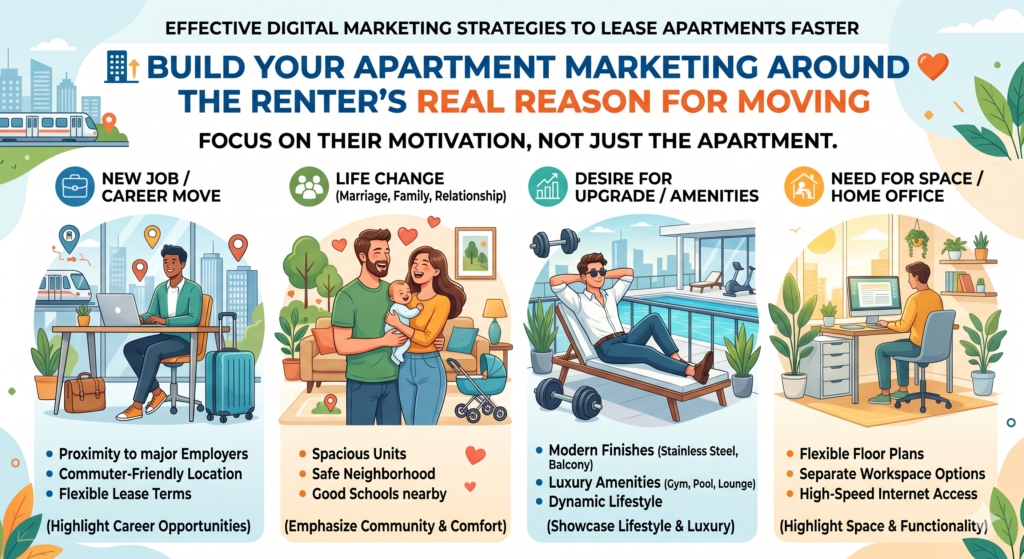
A renter usually starts with a problem.
They need a shorter drive to work. They want more space. They are tired of a noisy building. Their rent went up. They got a new job. They want to live closer to family. They need a pet-friendly place before their current lease ends. They want to stop sharing a home with roommates. They want to feel safe, settled, and proud of where they live.
So, if your digital marketing only says “modern apartments with great amenities,” it may sound nice, but it does not go deep enough. It does not touch the reason the person is searching in the first place.
To lease apartments faster, your marketing has to speak to the life change behind the search.
Your apartment message should make renters feel understood before they book a tour
A renter should see your ad, listing, or website and feel like your property fits the life they are trying to build. This does not happen through fancy words. It happens through clear, direct, human copy.
Instead of saying “luxury one-bedroom apartments available,” you can say, “A quiet one-bedroom apartment close to downtown, built for renters who want less commute time and more breathing room after work.”
The second message works harder. It gives the renter a picture. It speaks to time, comfort, and daily life. It helps them imagine what changes when they move in.
That is the real job of apartment marketing. It should not just describe the unit. It should help the renter picture a better normal day.
Your best message should connect the apartment to daily life
A pool is not just a pool. It is a place to relax after work. Covered parking is not just covered parking. It is less stress when it rains or when someone comes home late. In-unit laundry is not just a feature. It is fewer weekend errands and fewer trips to a shared laundry room.
When you explain features through daily life, they become more valuable.
This is where many apartment ads fall short. They name features but do not explain why those features matter. Renters are busy. They are comparing many properties at once. If you make them do all the thinking, they may move on.
Strong copy helps them connect the dots.
It says, “Here is what we offer, and here is how it makes your life easier.”
Your message should not sound like every other apartment website
Many apartment websites use the same tired lines. They say things like “elevated living,” “modern comfort,” “urban oasis,” and “luxury redefined.” These phrases may sound polished, but they do not say much.
Renters have seen them before. They do not build trust because they feel empty.
Simple words are stronger.
Say the apartment is quiet if it is quiet. Say the commute is easy if the location supports it. Say the building is pet-friendly if it welcomes pets. Say the floor plans are spacious if the layout truly feels open. Say there are flexible move-in dates if renters can move soon.
Clear beats clever almost every time.
The faster a renter understands your value, the faster they can act
A renter should not have to dig through your website to understand why they should care. Your core value should be clear within a few seconds.
This is especially important because apartment searches often happen on phones. A renter may be scrolling while commuting, sitting on a lunch break, or comparing options at night. They are not giving your website full attention. They are scanning.
That means your first message must be sharp.
A strong apartment headline might say, “Pet-friendly apartments near downtown with flexible move-in dates and covered parking.” This works because it gives the renter useful information right away. It answers location, lifestyle, timing, and parking in one simple line.
A weak headline might say, “Welcome to a new level of living.” It sounds smooth, but it does not help the renter decide anything.
Your main message should answer the questions renters already have
Before someone books a tour, they usually want to know where the property is, what it costs, what units are open, whether pets are allowed, what the neighborhood is like, how soon they can move in, and whether the property feels trustworthy.
If your first page does not answer these questions quickly, the renter may leave.
This does not mean every detail has to be stuffed into the first section. It means the path to those answers should be easy. The renter should never feel lost.
Your website, ads, and listings should work together like a good leasing agent. They should guide the renter from interest to action without making the process feel heavy.
Your copy should reduce fear, not just create interest
Renters are not only looking for things they like. They are also trying to avoid mistakes.
They do not want to move into a place with hidden fees. They do not want to deal with slow maintenance. They do not want to apply and then find out the unit is gone. They do not want to waste time touring a place that does not match the photos.
Good apartment marketing should lower these fears.
You can do that by being clear about pricing, showing real photos, adding honest reviews, explaining the application process, showing available units, and making it easy to ask questions.
The more doubt you remove, the easier it becomes for the renter to move forward.
Different renters need different reasons to care
A single property can attract many types of renters. But those renters may care about very different things.
A young professional may care about commute time, parking, nightlife, and fitness options. A family may care about space, schools, safety, and storage. A remote worker may care about quiet rooms, natural light, and strong internet. A pet owner may care about breed rules, pet fees, dog parks, and walking areas.
If your marketing speaks to everyone in the same way, it may feel too general.
That does not mean you need a messy website with too many messages. It means you should create clear sections that speak to the main renter groups your property serves.
Your website should create small moments of recognition
When a pet owner sees a section that clearly explains pet rules and nearby walking spots, they feel seen. When a remote worker sees a section about quiet layouts and work-from-home space, they pay closer attention. When a commuter sees travel times to key job areas, the property becomes easier to compare.
These small moments matter.
They help renters think, “This place fits me.”
That feeling can speed up the leasing decision because the renter no longer sees the apartment as just another option. They see it as a possible answer to their exact need.
Your ads should match the renter group you want to reach
Paid ads often fail because they are too broad. They try to say everything in one small space. That makes the message weak.
A better approach is to run different ad messages for different renter needs.
One ad can focus on pet-friendly living. Another can focus on easy downtown access. Another can focus on move-in specials. Another can focus on quiet one-bedroom units for remote workers.
Each ad should lead to a page that matches the promise in the ad. If the ad talks about pet-friendly apartments, the landing page should show pet details quickly. If the ad talks about move-in specials, the page should explain the offer clearly.
This simple match between ad and page can raise lead quality because renters get what they expected.
Turn Your Apartment Website Into a Leasing Tool, Not Just an Online Brochure
Your website should not just look good. It should help lease apartments.
Many apartment websites are built like online brochures. They show photos, list amenities, share a phone number, and include a contact form. That is useful, but it is not enough when renters are comparing many properties at once.
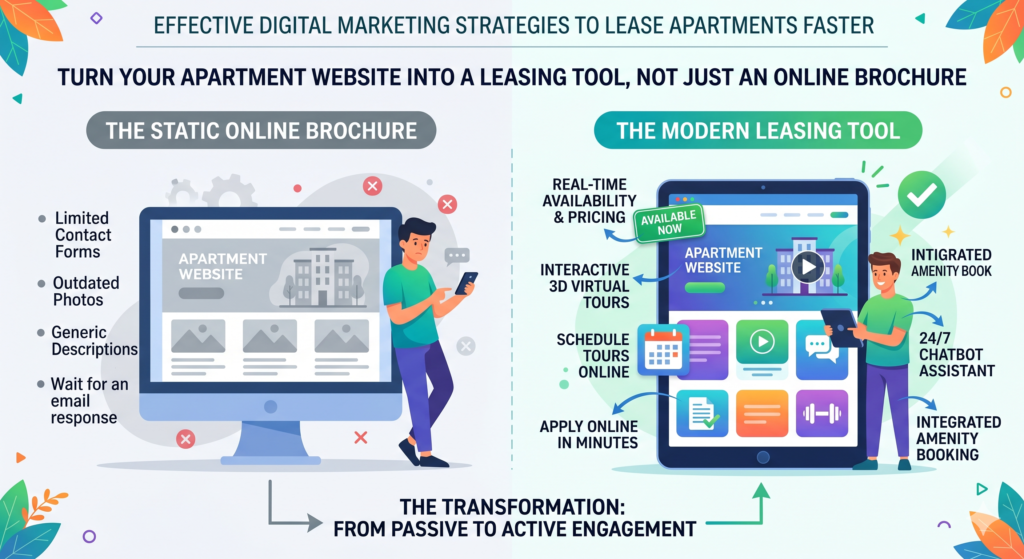
A strong apartment website should guide people. It should help them find the right unit, understand the value, trust the property, book a tour, and apply with less friction.
Every page should have a job.
The homepage should create interest. The floor plan page should help renters choose. The gallery should build desire. The neighborhood page should show daily life. The contact page should make the next step easy. The application page should remove fear.
When the website works this way, it becomes part of the leasing team.
Your homepage should answer the renter’s first questions fast
The homepage is often the first serious touchpoint after an ad, Google search, or apartment listing. It must earn attention quickly.
A renter landing on your homepage is usually asking a few silent questions. Is this in the right area? Can I afford it? Are units open? Does it look clean and safe? Does it fit my lifestyle? Can I bring my pet? Can I tour soon? Is this worth my time?
If your homepage does not answer these questions, the renter may leave before they ever contact you.
A strong homepage should open with a clear headline, a simple value message, strong photos, easy buttons, visible floor plan access, location details, reviews, and clear tour options.
Your first screen should make the next step obvious
The top of the homepage should not be crowded. It should not force people to scroll before they know what to do.
The renter should quickly see what the property is, where it is, why it is worth considering, and what step they can take next.
A clear button like “Check Availability” or “Book a Tour” is stronger than a vague button like “Learn More.” The renter should know exactly what will happen after they click.
This matters because confused people do not take action. They pause. They compare. They leave.
Your homepage should not hide pricing and availability
Some properties avoid showing price ranges because pricing changes often. Others hide availability because they want renters to call first. But this can slow down leasing.
Modern renters expect quick answers. If they cannot find basic pricing or availability, they may assume the property is out of budget or not transparent.
You do not always need to show exact pricing on the homepage, especially if it changes daily. But you should make the path to pricing and available units very easy.
A button that says “View Current Availability” is clear. A section that says “Now leasing one-bedroom and two-bedroom apartments for immediate and future move-ins” also helps.
The goal is to reduce uncertainty.
Your floor plan pages should help renters make a real decision
Floor plan pages are some of the most important pages on the website. They are where interest becomes serious.
A renter who visits a floor plan page is no longer just browsing. They are asking, “Could I live here?”
That page needs to do more than show a small layout image and a price. It should help the renter understand the space.
It should explain the number of bedrooms, bathrooms, square footage, price range, move-in dates, deposit details if available, included features, and what kind of renter the layout fits best.
Your floor plan copy should describe how the space feels
A floor plan image can be hard to understand, especially on a phone. Renters may not know how the space flows or whether their furniture will fit.
Good copy helps.
For example, instead of saying, “A1 floor plan, 720 square feet,” you could say, “This one-bedroom layout gives you a separate living area, a full kitchen, and enough room for a desk near the window, making it a strong fit for renters who work from home or want more space than a studio.”
That kind of copy helps the renter imagine daily life inside the unit.
It makes the floor plan feel real.
Your floor plan page should always lead to a clear action
After someone reviews a floor plan, they should know what to do next. The page should invite them to check current units, book a tour, ask a question, or apply.
Do not leave them at a dead end.
A strong floor plan page can say, “Like this layout? Check the next available move-in date or schedule a tour to see it in person.”
That simple line keeps the renter moving.
Your photo gallery should sell trust, not just beauty
Photos are one of the biggest factors in apartment leasing. Renters may forgive a simple website, but they will not ignore weak photos.
Dark, blurry, outdated, or confusing photos can make a good property look average. Strong photos can make a property feel worth visiting before the renter reads a single paragraph.
But the goal is not just to make the apartment look pretty. The goal is to make the renter trust what they are seeing.
Your gallery should show the full living experience
Many apartment galleries show the same few polished shots. A kitchen. A pool. A gym. A lobby. That is not enough.
Renters want to understand the whole experience. They want to see the bedroom, bathroom, closets, living room, laundry, balcony, parking, hallways, entry areas, mailroom, fitness space, outdoor areas, and nearby streets if the neighborhood is a selling point.
If your property is pet-friendly, show pet areas. If your units have strong storage, show closets. If your property is great for remote workers, show desk setups or quiet corners.
Every photo should answer a question or create desire.
Your photos should match the real tour experience
Over-edited photos can create problems. They may get more clicks, but they can also create disappointment during tours.
The renter should not feel tricked when they arrive. If the photos make the apartment look much larger or brighter than it really is, trust drops fast.
Honest photos lease better in the long run because they attract renters who are a better fit. They also reduce wasted tours.
The best photos make the property look good while still feeling real.
Use Local SEO So Renters Find You When They Are Ready to Move
Local SEO is one of the strongest digital marketing tools for apartment leasing because it reaches renters at the moment they are actively searching.
When someone types “apartments near me,” “pet-friendly apartments in Dallas,” or “one-bedroom apartments near downtown Phoenix,” they are not casually browsing. They are showing real intent.
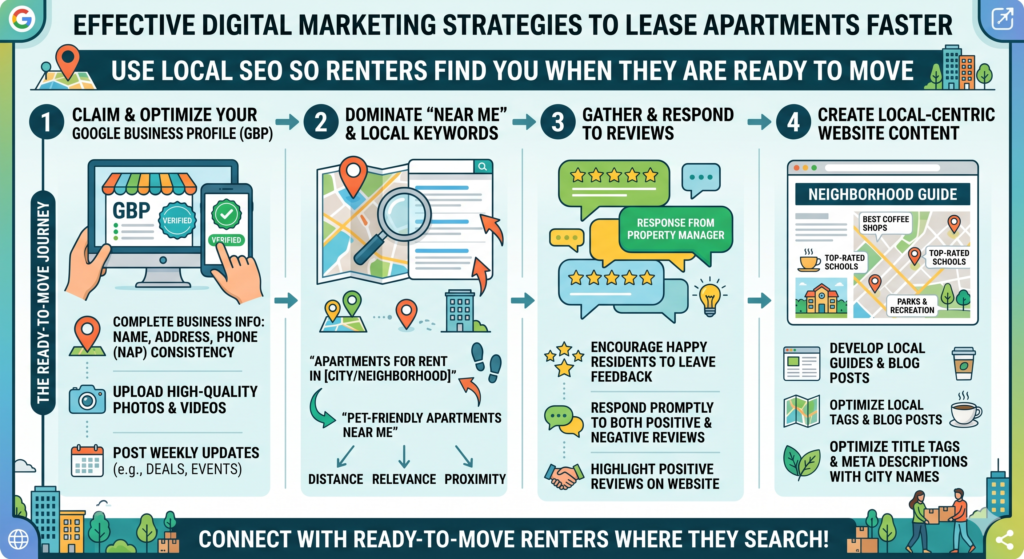
That is why your property needs to appear in local search results, map results, and organic results for the searches that matter in your area.
Your Google Business Profile should be treated like a leasing page
Many properties set up a Google Business Profile and then forget about it. That is a mistake.
For many renters, your Google profile may be the first place they see your property. It shows your photos, reviews, phone number, location, hours, questions, and website link.
If this profile looks weak, outdated, or poorly managed, renters may never visit your website.
Your profile should have fresh photos and complete details
A strong Google Business Profile should include updated photos, correct hours, accurate phone numbers, the right website link, service details, apartment categories, and clear descriptions.
Photos should be refreshed often. Reviews should be answered. Questions should be monitored. Move-in offers can be added through posts when useful.
This makes the profile feel active and trustworthy.
An active profile also helps renters feel that the property team is present and responsive.
Your reviews should be part of your SEO strategy
Reviews help with trust, but they also support local search visibility. A property with steady, recent, detailed reviews often looks more credible than one with old or thin reviews.
The key is not only to get more reviews. It is to get better, more specific reviews.
A review that says “great place” is nice. A review that mentions fast maintenance, helpful leasing staff, clean common areas, quiet units, or easy move-in is far more useful.
Those details help future renters understand what makes the property strong.
Your website should target the way renters actually search
Apartment SEO should be based on real search behavior. Renters often search by location, bedroom type, price range, lifestyle need, and nearby landmarks.
This means your website should include pages and copy that match those searches in a natural way.
A property in Tampa, for example, may need content around “one-bedroom apartments in Tampa,” “pet-friendly apartments in Tampa,” “apartments near downtown Tampa,” and “apartments near the University of Tampa,” if those searches match the property.
Your location pages should be useful, not stuffed with keywords
Some apartment websites try to rank by repeating the city name over and over. That creates bad copy and a poor user experience.
A better location page explains what it is like to live in the area. It talks about commute routes, grocery stores, parks, schools, restaurants, public transport, work centers, and local lifestyle.
The page should help renters decide whether the neighborhood fits their life.
When the content is genuinely useful, it can support both SEO and leasing.
Your SEO content should help people choose faster
Good apartment SEO is not just about traffic. Traffic means little if it does not turn into tours.
The content should help renters make decisions.
A page about pet-friendly apartments should explain pet policies, nearby walking areas, pet fees if possible, and why the property works for pet owners. A page about apartments near a business district should explain commute times, parking options, transit access, and daily convenience.
This kind of content brings in better renters because it matches real needs.
Use Paid Ads to Capture Renters Who Are Ready to Tour Soon
Paid ads can help you lease apartments faster, but only when they are used with a clear plan.
Many apartment communities waste money on ads because they treat them like a quick fix. They boost a post. They run a broad campaign. They send traffic to the homepage. Then they wonder why the leads are weak or why people do not show up for tours.
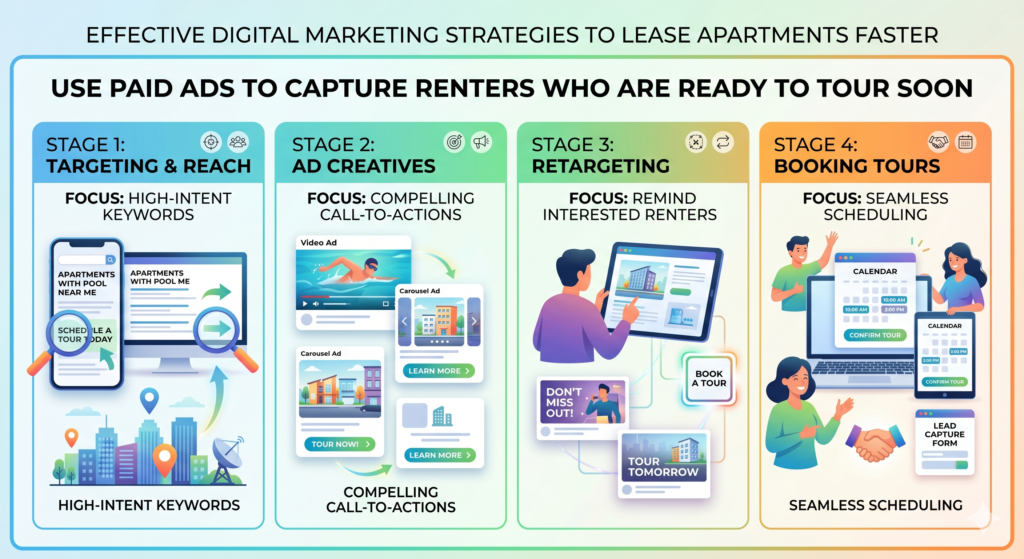
Paid ads are not magic. They are a way to place the right message in front of the right renter at the right time.
The goal is not just to get clicks. The goal is to get qualified renters who are ready to take the next step.
Your ads should match the renter’s search intent
Not every renter is at the same stage.
Some are just browsing. Some are comparing neighborhoods. Some are looking for a place they can move into this month. Some have already toured other properties and are close to making a choice.
Your ads should speak differently to each group.
A person searching “apartments in Charlotte” may still be early in the search. A person searching “2 bedroom apartments in Charlotte available now” is much closer to action. A person searching “pet friendly apartments near South End Charlotte with parking” has a clear need and is easier to guide toward a tour.
This is why search ads can be so powerful for apartment leasing. They let you show up when the renter is already asking for what you offer.
Your best search ads should focus on clear renter needs
A strong search ad should not try to sound clever. It should be useful.
If the property has open units, say that. If there are flexible move-in dates, say that. If pets are welcome, say that. If the location saves commute time, say that. If there is a real move-in special, say that clearly.
A renter does not click because the ad sounds fancy. They click because it appears to match what they need.
For example, an ad that says “One and Two Bedroom Apartments Available Near Downtown” is stronger than an ad that says “Discover Inspired Living Today.” The first ad gives useful information. The second ad could mean almost anything.
Paid search works best when the ad feels like a direct answer to the renter’s search.
Your ad should not promise what the landing page cannot prove
The fastest way to lose trust is to make a promise in the ad and then hide the details on the page.
If the ad says “move-in special,” the landing page should explain the special. If the ad says “pet-friendly,” the landing page should show pet details. If the ad says “available now,” the page should make current availability easy to find.
When the ad and page match, the renter feels they are in the right place. That simple feeling can improve lead quality because the person does not have to search again for what made them click.
Your landing page should be built for one action
A paid ad should not always send renters to the homepage.
The homepage has many jobs. A landing page has one job.
If you are running ads for available one-bedroom units, the landing page should focus on one-bedroom units. If you are running ads for pet owners, the landing page should focus on pet-friendly living. If you are promoting a move-in offer, the landing page should focus on that offer and the units it applies to.
This keeps the experience clean.
A renter clicks because they saw something specific. The landing page should continue that exact story.
Your landing page should remove every possible delay
A strong apartment landing page should load fast, look good on phones, show the main offer clearly, include real photos, give location context, show available floor plans, answer common questions, and make tour booking simple.
The renter should not need to pinch the screen. They should not need to scroll forever. They should not need to fill out a long form just to ask one question.
Every extra step can reduce leads.
That does not mean the page should feel thin. It means the page should feel easy.
The copy should be direct. The buttons should be clear. The form should be short. The phone number should be tappable. The tour option should be visible more than once.
Your form should ask only what you need to follow up well
Many apartment lead forms ask for too much too soon. This can scare renters away, especially on mobile.
At the first step, you usually need a name, phone or email, preferred move-in date, unit interest, and tour preference. You can learn more during follow-up.
A long form may feel helpful to the leasing team, but it can hurt conversion if it creates friction.
The goal is to start the conversation. Once the renter raises their hand, the leasing team can qualify them with care.
Your ad budget should follow real leasing needs
A common mistake is to spread the budget evenly across every unit type, every location message, and every audience.
That is not strategic.
Your ad budget should follow vacancy pressure. If two-bedroom units are leasing slowly, spend more on two-bedroom campaigns. If one-bedroom units are nearly full, reduce that spend or shift the message to future availability. If a certain building or floor plan has more open units, create ads that speak directly to that inventory.
This is how paid ads become a leasing tool instead of a general marketing expense.
Your campaigns should change as availability changes
Apartment marketing cannot be set once and ignored.
Availability changes. Pricing changes. Specials change. Competitors change. Seasonality changes. Local demand changes.
Your ads should reflect this.
If you have immediate move-ins, the message should create urgency. If you are pre-leasing for a future date, the message should focus on planning ahead. If you have a limited offer, the ad should say who it is for and what action to take next.
When ads are tied to real availability, they feel more useful to renters and more valuable to the leasing team.
Your tracking should show leases, not just leads
Lead volume alone can be misleading.
A campaign may bring many leads that never answer the phone. Another campaign may bring fewer leads but more signed leases. If you only look at cost per lead, you may cut the wrong campaign.
The better question is simple. Which campaigns produce tours, applications, approvals, and signed leases?
This requires clean tracking. Your forms, call tracking, tour scheduler, CRM, and leasing team notes should work together as much as possible. Even if the setup is not perfect, you should still track lead source quality in a simple way.
When you know which campaigns bring real renters, your budget becomes sharper.
Make Apartment Listing Sites Work Harder Instead of Treating Them Like Basic Directories
Apartment listing sites can bring strong leads because renters already use them to compare options. But many properties treat these sites like a place to dump basic information.
That is a missed chance.
Your listing is often shown next to many other properties. Renters are comparing photos, prices, offers, reviews, locations, and unit details very quickly. If your listing does not stand out, it may be skipped even if the property is a good fit.
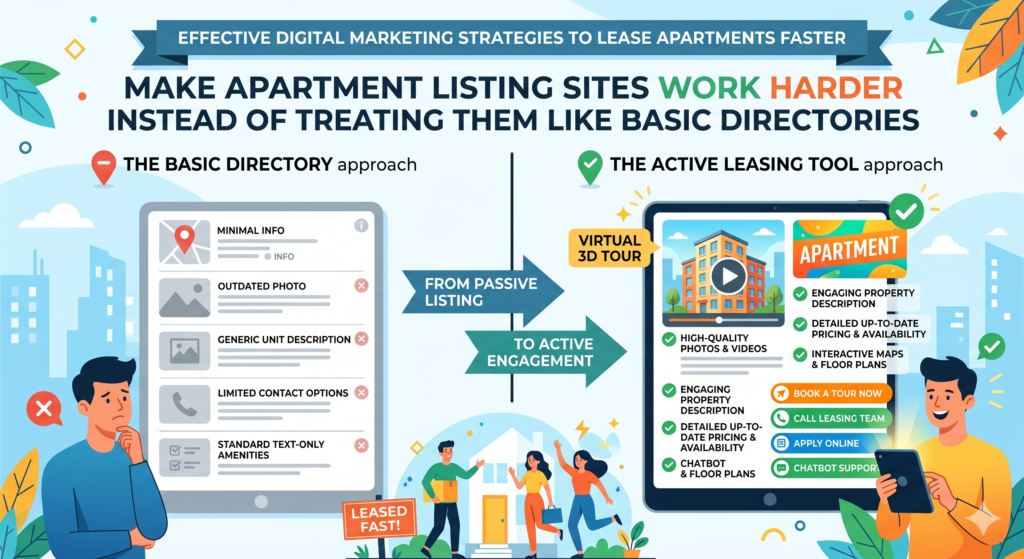
A listing site is not just a directory. It is a sales page inside a crowded marketplace.
Your listing headline should give renters a reason to stop scrolling
Many listings use simple names and generic lines. That does not help much when renters are scanning a long page of options.
Your headline and opening text should quickly show the strongest reason to consider the property.
If your best strength is location, lead with location. If it is pet-friendly living, lead with that. If it is value for the area, make that clear. If it is immediate availability, say it early. If the property has larger layouts than nearby competitors, make that easy to notice.
The first few words matter because renters often decide quickly whether to keep looking.
Your opening copy should not waste space on empty phrases
Listing copy has limited room, so every sentence must work.
Do not open with lines like “Welcome to comfort and style.” That could describe any property. Use the space to say something specific.
A stronger opening might say, “Live five minutes from downtown with spacious one and two-bedroom apartments, pet-friendly spaces, and flexible move-in dates.”
This gives the renter real reasons to continue.
Simple details beat polished filler.
Your listing should speak to the renter’s next question
After a renter sees the photos and price, they usually want to know what makes the property worth contacting.
Your copy should answer that.
Talk about commute routes. Talk about parking. Talk about laundry. Talk about pets. Talk about noise, storage, natural light, work-from-home space, package lockers, safety features, or nearby stores if those are real strengths.
The best listing copy feels like it was written by someone who knows what renters ask during tours.
Your photos should be arranged in the order renters care about
On listing sites, photos can make or break the lead.
Many properties upload photos in a random order. A logo appears first. Then a pool. Then a clubhouse. Then a hallway. Then a kitchen. This can weaken interest because the renter has to work too hard to understand the apartment.
The photo order should tell a story.
Start with the strongest apartment or exterior image. Then show the kitchen, living room, bedroom, bathroom, building features, amenities, and neighborhood lifestyle. If the property’s main strength is the unit interior, lead with that. If the main strength is a resort-style amenity, lead with that only if it is truly a major selling point.
Your first five photos should answer the biggest questions
The first few images should help the renter understand the property fast.
They should show what the apartment looks like, how bright it feels, what the kitchen offers, how the living space works, and what kind of lifestyle the property supports.
A renter may not view every photo. That means the early images must carry the most weight.
Weak first photos can lower clicks even when later photos are better.
Your listing photos should stay current
Outdated photos create problems.
If the property has been updated, the listing should show the updated version. If an amenity is closed or changed, the photos should not create false expectations. If the model unit looks different from available units, the listing should make that clear where possible.
Accuracy builds trust.
Trust leads to better tours.
Better tours lead to faster leases.
Your availability and pricing should be as clear as possible
Renters are tired of listings that feel incomplete. If they cannot understand what is available or what the price range looks like, they may move to another property.
Clear availability helps renters decide faster.
This does not mean you must show every detail on every platform if pricing changes often. But you should keep listings updated enough to avoid frustration.
Your listing should not create dead-end leads
A dead-end lead happens when a renter asks about a unit that is no longer available, a price that has changed, or an offer that has expired.
This wastes time for the renter and the leasing team.
It can also make the property look careless.
Your team should have a simple process for checking listing accuracy. Prices, availability, specials, pet rules, parking details, and contact information should be reviewed often, especially during high leasing seasons.
Your move-in specials should be clear and honest
Move-in specials can increase interest, but vague specials can create confusion.
A line like “Ask about specials” may get some clicks, but it does not create as much urgency as a clear offer. If the offer can be stated simply, state it.
The renter should understand what the special is, who qualifies, when it ends, and what step they need to take.
If there are limits or conditions, be honest. Clear terms reduce disappointment later.
Use Social Media to Build Desire Before Renters Are Ready to Search
Social media is not always the place where renters make their final decision, but it can shape what they remember.
A renter may see your property on Instagram, TikTok, Facebook, or YouTube before they ever search for apartments in your area. They may not be ready to move today, but they may remember the property later because your content made it feel real.
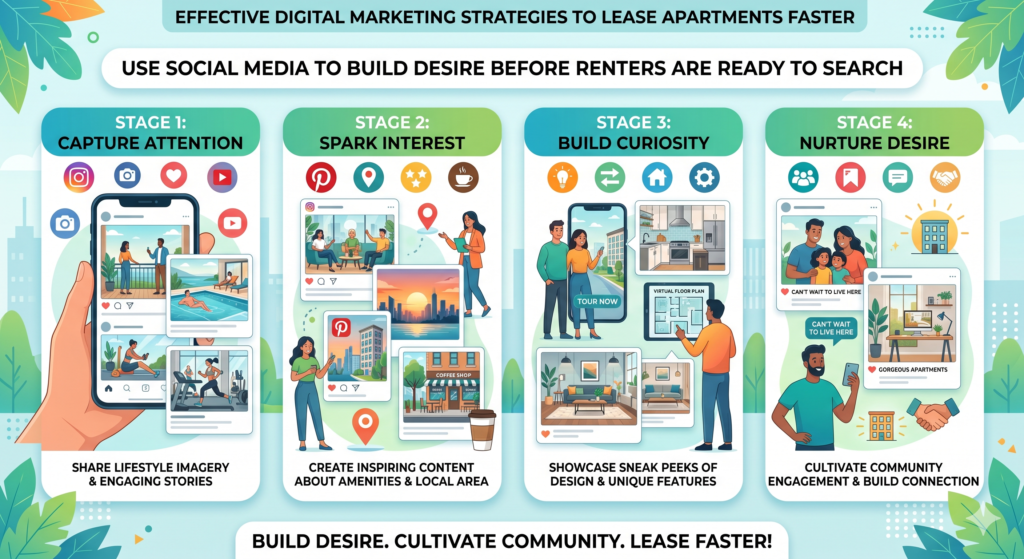
That is the power of social media for apartment leasing.
It builds familiarity before the renter is ready to act.
Your social content should show real life, not just polished rooms
Many apartment social pages look too clean. They post the same staged photos, the same amenity shots, and the same graphics again and again.
That gets boring fast.
Renters want to see what life feels like at the property. They want to see natural light in the morning. They want to see how a living room can be arranged. They want to see a dog walking near the building. They want to see how close the coffee shop is. They want to see the gym being used, the package room, the parking area, the view from a balcony, and the small details that make daily life easier.
Social media works best when it feels alive.
Your short videos should answer real renter questions
Short videos can be powerful because they show space better than photos.
A simple walkthrough of a one-bedroom unit can help a renter understand the layout. A quick video from the front door to the kitchen can show flow. A video of the walk from the parking area to the lobby can answer a practical question. A clip showing the distance to a nearby train stop can make the location feel more useful.
These videos do not need to be perfect.
They need to be clear, steady, and helpful.
A renter does not always need a cinematic video. Sometimes they just need to see what the space really looks like.
Your social posts should make the next step easy
A good social post should not leave the renter wondering what to do.
If a post shows an available unit, the caption should tell people how to ask about it. If a post promotes a tour event, the next step should be clear. If a video shows a floor plan, the caption should mention availability or invite renters to book a tour.
The goal is not to turn every post into a hard sell. That can feel tiring.
But when a post creates interest, it should give the renter a path forward.
Your content should sell the neighborhood, not only the apartment
Renters do not choose only a unit. They choose a daily routine.
They want to know where they will get coffee, buy groceries, walk the dog, meet friends, work out, commute, relax, and spend weekends.
Your social content should help them see that routine.
A property near restaurants can show short clips of nearby spots. A property near parks can show walking routes. A property near a business district can show commute ease. A property near schools or transit can explain daily convenience in simple words.
Your neighborhood content should make the location feel useful
Do not just say “great location.” Show why it is great.
Show that the grocery store is five minutes away. Show the walk to the bus stop. Show the nearby park entrance. Show the local café. Show the weekend market. Show the quiet street behind the building.
These details help renters picture life beyond the apartment walls.
That picture can make the property feel more valuable.
Your local partnerships can create stronger content
Apartment communities can work with nearby businesses in simple ways.
A coffee shop can be featured in a morning routine video. A gym can be mentioned in a neighborhood guide. A pet groomer can be part of a pet-friendly living post. A local restaurant can be included in a weekend plan.
This kind of content helps renters see the area as a place to live, not just a spot on a map.
It also helps the property feel connected to the neighborhood.
Your social proof should come from residents, not only the brand
People trust people more than they trust property ads.
That is why resident stories, reviews, move-in moments, and simple testimonials can help social media perform better.
You do not need to overdo it. Even a short resident quote about helpful staff, quick maintenance, or a smooth move-in can carry weight.
Your resident stories should feel natural
A resident story does not need to be long. It should feel real.
For example, a simple post can say, “Maya moved in last month and said her favorite part is being able to walk her dog before work without leaving the neighborhood.”
That kind of detail feels human.
It gives future renters something they can relate to.
Your team should also be visible
Leasing is personal. Renters often want to know who they will deal with before they visit.
Showing the leasing team can make the property feel warmer and safer. A short video introducing a leasing agent, a quick post about maintenance response, or a simple behind-the-scenes look at tour prep can build trust.
This matters because many renters are nervous about reaching out. A visible, friendly team can lower that fear.
Use Retargeting to Bring Back Renters Who Were Interested but Not Ready
Most renters do not lease after one visit to your website.
They compare. They pause. They ask a friend. They check another property. They wait for payday. They talk to a partner. They look again later.
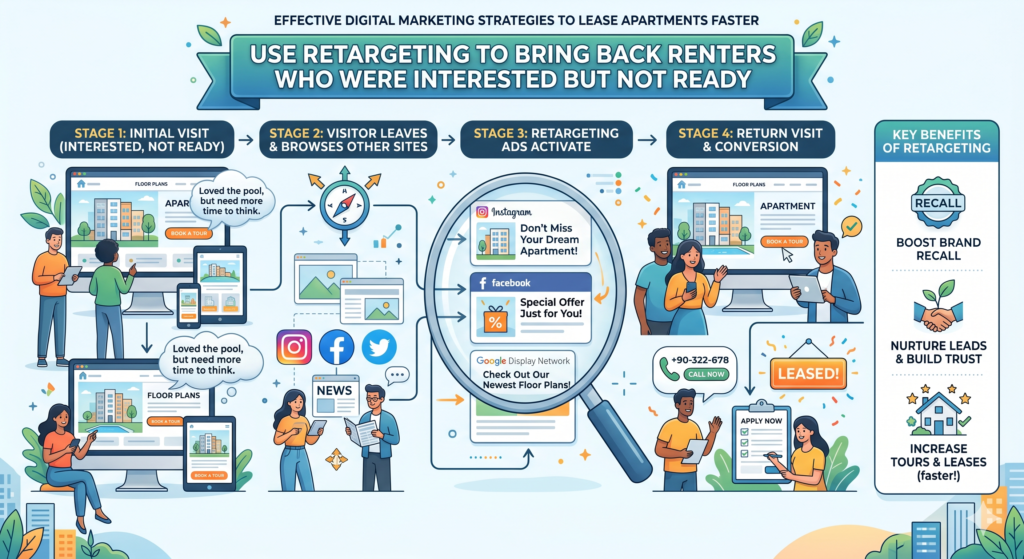
If you do not follow up through retargeting, you may lose people who were already interested.
Retargeting helps you stay in front of renters who visited your site, looked at floor plans, clicked an ad, or engaged with your content but did not take action yet.
Your retargeting should remind renters why they cared in the first place
Retargeting ads should not be random.
If someone looked at one-bedroom units, show them one-bedroom messages. If someone visited the pet page, show them pet-friendly living. If someone checked availability but did not book, remind them to schedule a tour.
This makes the ad feel more relevant.
A general ad may be ignored. A specific reminder can bring the renter back.
Your retargeting message should be simple and timely
A good retargeting ad does not need to say much.
It can say, “Still looking for a one-bedroom near downtown? Tours are open this week.” Or it can say, “Pet-friendly apartments with flexible move-in dates are still available.”
The message should feel like a helpful reminder, not pressure.
Renters are already busy. Retargeting should make it easier for them to return, not make them feel chased.
Your retargeting should lead to the right page
If the renter clicked on a floor plan before, do not send them back to the homepage. Send them back to the floor plan or current availability.
If they engaged with a move-in offer, send them to the offer page.
The page should match the ad so the renter can continue where they left off.
This small detail can make a big difference because it removes extra work.
Your retargeting should stop after the renter takes action
Bad retargeting can hurt the brand.
If someone already applied, they should not keep seeing ads asking them to book a tour. If someone signed a lease, they should not keep seeing move-in specials for new renters.
This creates a poor experience.
Your audience lists should be managed so ads are shown to the right people at the right stage.
Your retargeting should support follow-up, not replace it
Retargeting is useful, but it is not a full follow-up system.
A renter who submits a lead still needs a fast reply. A renter who books a tour still needs reminders. A renter who tours but does not apply still needs a helpful follow-up.
Retargeting keeps the property visible. Human follow-up closes the gap.
The best results come when ads and leasing teams work together.
Your retargeting budget should stay focused
You do not need a huge retargeting budget to make it work. Retargeting audiences are usually smaller than cold audiences.
The key is relevance.
Show helpful messages to people who already showed interest. Keep the creative fresh. Stop showing ads when they no longer make sense. Track whether retargeting brings people back to book tours or apply.
When done well, retargeting can turn lost attention into signed leases.
Turn Email and Text Follow-Up Into a Leasing Accelerator
Getting a lead is not the same as getting a lease.
This is where many apartment marketing plans break down. The ads may work. The website may get visits. The listing may bring inquiries. But if the follow-up is slow, vague, or too generic, good renters slip away.
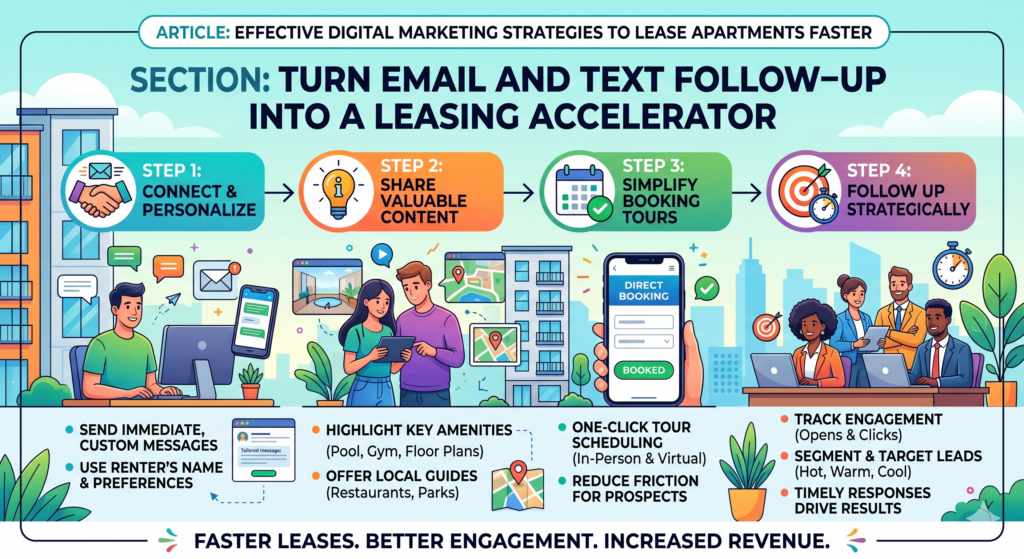
Renters often contact several properties at the same time. The first team to reply with a clear, helpful answer often has the advantage. Not because they are pushy, but because they make the renter’s life easier.
Fast follow-up tells the renter that the property is active, organized, and serious. Slow follow-up creates doubt. If it takes too long to answer before someone moves in, the renter may wonder how slow the team will be after they become a resident.
Your first response should feel personal, not automatic
Automation can help leasing teams respond faster, but the message should not feel cold. A renter can tell when they receive a stiff template that does not answer their question.
If someone asks about a two-bedroom apartment, the reply should mention two-bedroom availability. If they ask about pets, the reply should answer the pet question. If they ask about move-in dates, the reply should speak to timing.
A strong first response makes the renter feel heard.
It should thank them, confirm what they asked about, give the most useful next detail, and guide them toward one clear next step.
Your response should answer the question before asking for the tour
A common mistake is to push for a tour before answering the renter’s basic question.
If someone asks, “Do you allow dogs?” and the reply says, “When would you like to tour?” it feels unhelpful. The renter may not be ready to tour until they know whether the property fits their needs.
A better reply would say, “Yes, we are pet-friendly. Dogs are welcome, and we can send you the full pet policy before your visit. We also have one-bedroom units available for early June move-ins. Would you like to see the available layouts or book a tour this week?”
That kind of answer does two things. It gives the renter what they asked for, and it still moves the conversation forward.
Your follow-up should sound like a person who wants to help
Apartment follow-up should not feel like a sales script.
Renters are making a personal decision. They are choosing where they will sleep, cook, relax, work, and come home every day. A little warmth matters.
Simple human lines work well. You can say, “I know moving can be a lot to sort through, so I’m happy to help you compare layouts.” You can say, “Based on your move-in date, this floor plan may be a good fit.” You can say, “If parking is important, I can also explain the options before you visit.”
This kind of language lowers pressure. It makes the leasing team feel useful instead of pushy.
Your follow-up timing should match how renters make decisions
A renter may not reply after the first message. That does not always mean they are not interested.
They may be at work. They may be waiting to hear from a roommate. They may be comparing prices. They may be checking their budget. They may be nervous about applying. They may have missed the email.
This is why a smart follow-up sequence matters.
One message is not enough.
But the follow-up should not become annoying. It should add value each time.
Your first day of follow-up is the most important
The first few hours after a lead comes in are critical. Interest is fresh. The renter still remembers why they reached out. They may still be looking at your website or comparing your property to others.
Your first response should happen as fast as possible.
If the leasing team cannot respond right away, an automated message can confirm the inquiry and provide useful next steps. But a real follow-up should still come soon after.
The first-day follow-up should be focused on helping the renter take action. It can share availability, answer the main question, offer tour times, and invite them to reply with what matters most to them.
Your later follow-ups should give renters new reasons to respond
Many follow-up sequences fail because every message says almost the same thing.
“Just checking in.”
“Are you still interested?”
“Let us know if you have questions.”
These lines are not harmful, but they are weak. They do not give the renter a strong reason to reply.
A better follow-up gives something useful.
One message can share a specific floor plan that matches their needs. Another can mention a move-in date. Another can answer a common concern. Another can share a resident review. Another can remind them that tour times are open.
Each follow-up should feel like a helpful nudge, not a repeated ask.
Your text messages should be short, clear, and respectful
Texting can work very well for apartment leasing because renters often respond faster to texts than emails. But texting must be handled with care.
A text should be useful and easy to answer. It should not feel like spam.
A good leasing text might say, “Hi Maya, this is Jordan from Lakeside Apartments. We have a one-bedroom available for your June move-in date. Would you like me to send the layout or help you book a tour?”
That message is short, clear, and tied to the renter’s need.
Your texts should make replying easy
Do not ask too many questions in one text. Do not send a long block of information. Do not use stiff language.
A renter should be able to reply in a few words.
You can ask, “Would morning or evening work better for a tour?” You can ask, “Are you looking for a one-bedroom or two-bedroom?” You can ask, “Would you prefer a virtual tour or in-person tour?”
Simple questions get more replies because they reduce effort.
Your texts should respect timing and privacy
Texting is personal. That means timing matters.
Do not send messages too early in the morning or too late at night. Do not send too many messages in a short period. Do not keep texting if the renter asks to stop.
Good follow-up builds trust. Bad follow-up damages it.
The goal is to be helpful, not loud.
Use Reviews to Remove Doubt Before the Tour
Reviews are one of the most powerful parts of apartment marketing because renters know the property will always present itself in the best light.
They expect your website to look good. They expect your ads to sound positive. They expect your photos to show the best angles.
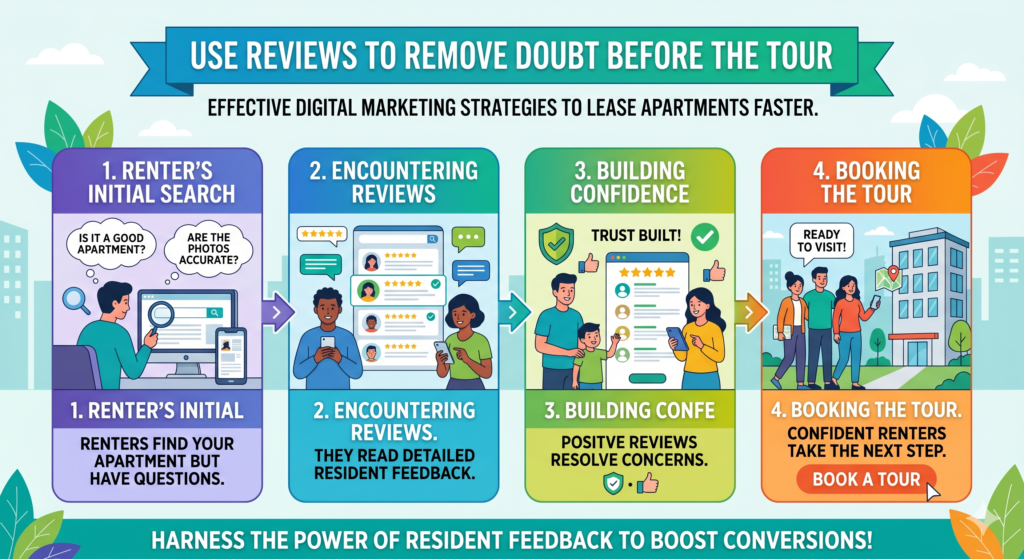
But reviews feel different.
Reviews come from people who have lived there, toured there, or dealt with the team. That makes them more believable.
If your reviews are strong, they can speed up leasing because they answer a question that every renter has in the back of their mind.
“Can I trust this place?”
Your reviews should support the promises in your marketing
If your website says maintenance is responsive, reviews should support that. If your ads say the leasing team is helpful, reviews should reflect that. If your listing says the property is quiet, clean, and well-managed, reviews should help prove it.
When your marketing and reviews match, trust grows.
When they do not match, doubt grows.
For example, if your website says “peaceful living” but several recent reviews mention noise problems, renters will believe the reviews. If your ad says “fast maintenance” but residents complain about slow repairs, the ad loses power.
This does not mean every review must be perfect. No property has complete control over every resident experience. But the pattern matters.
Your team should ask for reviews at the right moments
Many properties ask for reviews only when they are desperate to improve their rating. That is not the best approach.
Reviews should be part of the normal resident experience.
Ask after a smooth move-in. Ask after a maintenance issue is solved well. Ask after a resident renews. Ask after a positive interaction with the office. Ask after a community event if residents seemed happy.
The best time to ask is when the resident has just felt helped.
That is when the review will be more detailed and more honest.
Your review request should be simple and human
Do not make residents feel like they are doing homework.
A simple request works better.
You can say, “We’re glad your move-in went smoothly. If you have a minute, your review would really help future renters know what to expect.”
That feels natural. It explains why the review matters. It does not pressure the resident.
The easier the process is, the more likely people are to leave a review.
Your review responses matter almost as much as the reviews
Renters do not only read reviews. They also read how the property responds.
A thoughtful response can soften the impact of a negative review. A cold or defensive response can make things worse.
Every response is public. It shows future renters how the team handles praise, complaints, and conflict.
Your positive review responses should feel specific
When someone leaves a good review, do not reply with the same generic line every time.
A response like “Thank you for your feedback” is fine, but it does not add much.
A stronger response mentions something specific from the review. If the resident praised the maintenance team, thank them for noticing the team’s care. If they mentioned a smooth move-in, say you are glad the process felt easy. If they praised a leasing agent by name, recognize that person.
Specific replies feel more human.
They also show future renters that the team pays attention.
Your negative review responses should be calm and useful
Negative reviews should never be answered with anger, blame, or long public arguments.
Even if the review feels unfair, the response should stay calm.
A good response should thank the person for sharing, acknowledge the concern, avoid exposing private details, and invite them to continue the conversation directly.
The goal is not to win a debate in public. The goal is to show future renters that the team takes concerns seriously.
A calm response can protect trust even when the review itself is not ideal.
Your best reviews should appear beyond review sites
Reviews should not live only on Google or listing platforms. Strong reviews can also support your website, landing pages, emails, social posts, and retargeting ads.
A good review placed near a tour button can help a renter feel more ready to act.
A review about helpful staff can support a follow-up email. A review about quick maintenance can strengthen a landing page. A review about a smooth move-in can help reduce fear for renters who are close to applying.
Your website should place reviews near decision points
Do not hide all reviews on one testimonial page that few people visit.
Place them where they matter.
A review about the leasing team can appear near the contact form. A review about maintenance can appear near the amenities or resident experience section. A review about location can appear near the neighborhood section. A review about move-in can appear near the application section.
The right review in the right place can answer doubt at the exact moment it appears.
Your reviews should sound real, not over-polished
Do not rewrite reviews until they sound like ads. That removes the thing that makes them powerful.
Real reviews often include simple words, personal details, and natural phrasing. That is what makes them believable.
You can fix small formatting issues if needed, but keep the voice real. Future renters trust language that sounds like it came from an actual person.
Make Virtual Tours and Video Walkthroughs Feel Like a Real Leasing Experience
Virtual tours are no longer a bonus. For many renters, they are part of the basic search process.
Some renters are moving from another city. Some are busy during office hours. Some want to narrow down their choices before visiting. Some prefer to tour online first because it saves time.
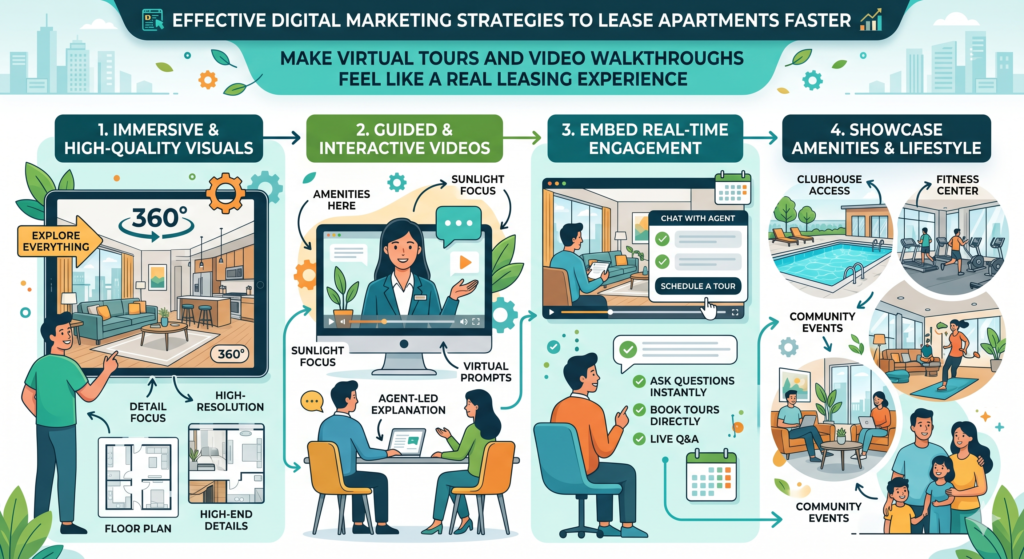
If your virtual tour experience is weak, you may lose renters before they ever step onto the property.
Your video tour should show the apartment the way renters would walk through it
A good video tour should feel natural.
It should start where the renter would enter. It should move through the space in a clear order. It should show the kitchen, living area, bedroom, bathroom, closets, laundry, balcony, and any key details that matter.
Do not move too fast. Do not spin the camera around. Do not skip the practical spaces.
Renters want to understand flow. They want to know how rooms connect. They want to see storage. They want to see light. They want to see the actual feel of the unit.
Your video should include the small details renters care about
A renter may care about things that seem small to the property team.
They may want to see where a couch could go. They may want to know if the bedroom fits a queen bed. They may want to see how much counter space is in the kitchen. They may want to know where the washer and dryer sit. They may want to see the closet depth.
A good walkthrough slows down at these moments.
These details make the tour useful. They also reduce unnecessary questions later.
Your virtual tour should be easy to access from every key page
Do not hide virtual tours deep inside the website.
Place them on floor plan pages, gallery pages, landing pages, and follow-up emails. If a renter asks about a specific unit type, send the matching video when possible.
The faster a renter can see the space, the faster they can decide whether to tour or apply.
Your live virtual tour should feel personal
A recorded tour is useful, but a live virtual tour can be even stronger because the renter can ask questions in real time.
The leasing agent can show the unit, explain the layout, answer concerns, and build a connection.
This is especially useful for out-of-town renters who may need to lease without visiting in person.
Your leasing team should prepare before the virtual tour
A live virtual tour should not feel random.
Before the call, the leasing agent should know what the renter is looking for. They should know the move-in date, bedroom count, budget range, pet needs, parking needs, and any key concerns.
This makes the tour feel tailored.
Instead of giving the same speech to everyone, the leasing agent can point out details that matter to that renter.
Your virtual tour should end with a clear next step
Just like an in-person tour, a virtual tour should not end with a vague goodbye.
The leasing agent should guide the renter toward the next step.
That may be sending the application link, sharing available units, placing a soft hold if possible, explaining fees, or scheduling a follow-up call.
The renter should leave the virtual tour knowing exactly what to do next.
Fix the Tour Booking Process So Interested Renters Do Not Drop Off
A renter who wants to book a tour is showing strong intent.
That moment should be protected.
If the tour booking process is hard, slow, confusing, or full of friction, you can lose one of the most valuable leads you have.
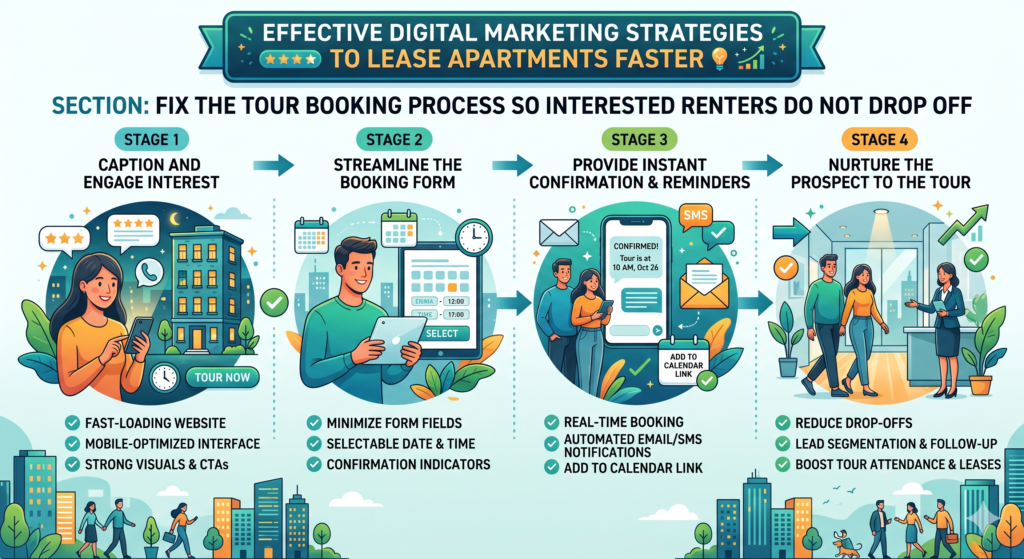
Your tour scheduler should be easy to find and easy to use
The tour button should be visible on the homepage, floor plan pages, contact page, landing pages, and listing pages where possible.
Renters should not have to search for it.
Once they click, the process should be simple. They should be able to choose a tour type, pick a time, share basic contact details, and get a confirmation.
If the process takes too long, people may leave before finishing.
Your tour options should fit different renter needs
Not every renter wants the same kind of tour.
Some want an in-person tour. Some want a virtual tour. Some want a self-guided tour. Some want a quick call before they visit.
Offering options can help more people take action.
The key is to explain each option clearly. A renter should know what to expect before they book.
Your confirmation should reduce no-shows
After someone books a tour, they should receive a clear confirmation with the date, time, address, parking instructions, what to bring, and how to reschedule.
A reminder should go out before the tour.
No-shows often happen because the renter forgets, gets confused, or loses interest. Good reminders help prevent that.
Your tour page should build excitement before the visit
The tour booking page does not have to be plain. It can also help the renter feel more confident.
It can show a few strong photos, mention what they will see, explain how long the tour takes, and remind them what makes the property worth visiting.
Your pre-tour message should ask one useful question
Before the tour, ask one helpful question that improves the experience.
You can ask what matters most in their next apartment. You can ask whether they have pets. You can ask when they want to move. You can ask which floor plan they like most.
This helps the leasing team prepare and makes the renter feel the tour is built around them.
Your leasing team should use tour data to personalize the visit
If the renter booked a tour after viewing a certain floor plan, the leasing agent should know that. If they came from a pet-friendly ad, the agent should be ready to discuss pet details. If they asked about parking, the tour should include parking information.
Personalization makes the tour feel better.
It also shows the renter that the team is paying attention.
Use Better Lead Tracking So You Know Which Marketing Actually Leases Apartments
One of the fastest ways to waste money in apartment marketing is to treat every lead as equal.
A lead from a broad social ad is not always the same as a lead from a Google search for “two-bedroom apartment available now.” A renter who clicks a photo on Instagram may be curious. A renter who checks floor plans, looks at pricing, and books a tour may be much closer to signing.
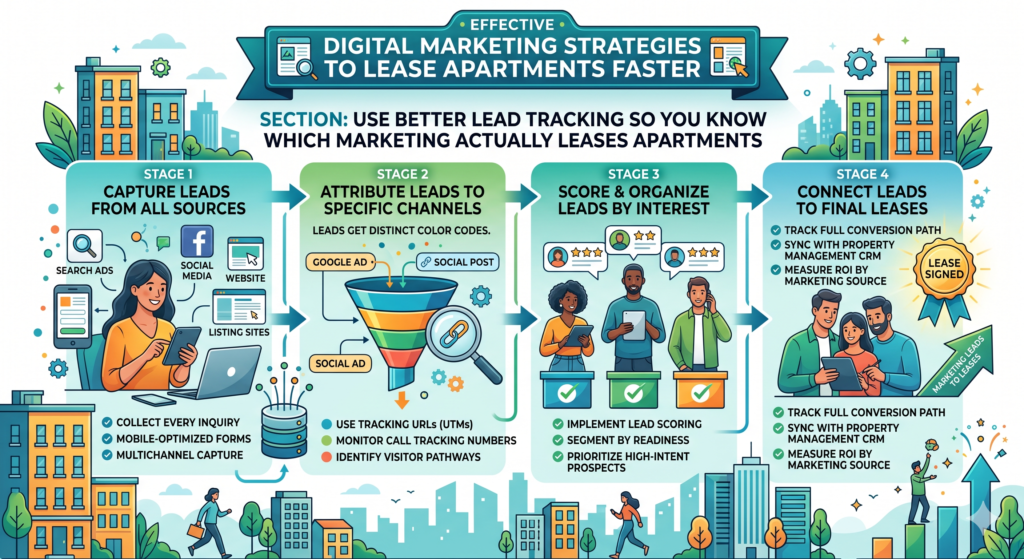
If you do not track the difference, your marketing decisions become guesswork.
You may keep spending on campaigns that look good on the surface but do not create signed leases. You may stop campaigns that bring fewer leads but better renters. You may blame the ad when the real issue is the landing page. Or you may blame the leasing team when the real issue is poor lead quality.
Better tracking helps you see the full path from first click to signed lease.
Your marketing dashboard should not stop at clicks and form fills
Clicks are easy to measure. Form fills are easy to count. But neither one proves that your marketing is working.
A campaign with many clicks can still be weak if those visitors leave quickly. A campaign with many form fills can still be poor if those leads do not answer, do not tour, or do not qualify.
The real goal is not attention. The real goal is occupancy.
That means your tracking should look at the steps that matter most. You should know which sources bring website visits, which sources bring real inquiries, which sources bring booked tours, which sources bring completed tours, which sources bring applications, and which sources become signed leases.
When you can see that path, you can make smarter choices.
Your leasing team should mark lead quality in a simple way
You do not need a complex system to start improving lead tracking.
Even a simple lead quality note can help. The leasing team can mark whether a lead was serious, unqualified, unresponsive, price-sensitive, outside the move-in window, or ready to tour.
Over time, these notes show patterns.
You may find that one channel brings many leads but most are not ready to move. You may find that another channel brings fewer leads but many of them tour. You may find that a certain ad message brings renters who match your best units. You may also find that some landing pages create confusion because renters ask the same questions again and again.
Those patterns are valuable because they tell you where to improve.
Your reports should connect marketing with leasing conversations
Marketing data alone does not tell the full story. Leasing conversations add the missing context.
For example, an ad campaign may show a low cost per lead. On paper, that looks good. But the leasing team may say most of those renters ask for pricing below your range. That means the campaign is not as strong as it looks.
Another campaign may look expensive because the cost per lead is higher. But the leasing team may say those renters are easier to reach, more likely to tour, and more likely to apply. That campaign may deserve more budget.
This is why marketing and leasing teams should talk often.
A simple weekly review can help. Look at which campaigns brought leads, which leads turned into tours, what objections renters raised, what questions came up often, and which units still need attention.
This turns tracking into action.
Your call tracking should reveal which renters are ready now
Many apartment leads still come through phone calls. This is especially true when renters are close to making a choice.
A person who calls may want a quick answer. They may want to confirm availability. They may want to know if they can tour today. They may have seen an ad, checked the website, and decided to speak to someone.
If you do not track calls properly, you may miss a major part of your marketing performance.
Call tracking helps you see which ads, listings, pages, and campaigns drive phone inquiries. It also helps you understand what renters ask before they book a tour.
Your missed calls should be treated like lost leasing chances
A missed call is not just a missed message. It may be a missed lease.
Renters often contact several properties in one sitting. If your team misses the call and another property answers, the other property may get the tour.
This does not mean your team must be perfect every second of the day. But it does mean missed calls should be tracked and followed up fast.
If a call is missed, the renter should get a reply as soon as possible. A text can work well because it is simple and fast. The message can say that the team saw the missed call and would be happy to help with availability or tours.
This small habit can recover leads that would otherwise disappear.
Your call notes should shape your website and ads
The questions renters ask on calls are a goldmine for better marketing.
If many callers ask about parking, your website may need clearer parking details. If many callers ask about pet fees, your pet policy may need to be easier to find. If many callers ask whether the photos show the actual unit, your gallery may need better labels. If many callers ask about move-in dates, your availability section may need to be stronger.
Every repeated question is a sign.
It tells you that renters care about that detail, but your marketing may not be answering it clearly enough.
When you use call notes this way, your marketing becomes sharper over time.
Your leasing reports should help you shift budget quickly
Apartment leasing changes fast.
One week you may need to push studios. The next week you may need to focus on two-bedroom units. One month you may have strong demand. Another month you may need to create more urgency.
Your reports should help you respond to those changes.
If your data is slow or unclear, you may keep spending on the wrong message while vacancies sit open.
Your budget should move toward units that need support
Marketing should follow leasing pressure.
If a certain floor plan is moving slowly, it needs more attention. That may mean new ads, better photos, a stronger landing page, a sharper offer, or better follow-up. If another floor plan is leasing easily, it may not need as much spend.
This sounds simple, but many properties do not do it. They run the same campaigns month after month, even when availability changes.
A smarter approach is to review open units often and match campaigns to the inventory that needs help now.
Your data should show where renters drop off
Sometimes the problem is not traffic. It is the drop-off point.
Renters may click ads but leave the landing page. They may view floor plans but not book tours. They may book tours but not show up. They may tour but not apply. They may apply but not finish the process.
Each drop-off point needs a different fix.
If renters leave the landing page, improve the page. If they view floor plans but do not book, add stronger calls to action and clearer availability. If they book tours but do not show up, improve reminders. If they tour but do not apply, improve follow-up and offer clarity. If they start applications but do not finish, simplify the process and explain fees better.
Good tracking helps you fix the right problem instead of guessing.
Create Offers That Move Renters Without Weakening the Property’s Value
Move-in offers can help lease apartments faster, but they need to be handled with care.
A discount can create urgency. It can help a renter choose your property over another. It can make a slow unit more attractive. But if offers are too vague, too common, or too aggressive, they can train renters to wait for deals.
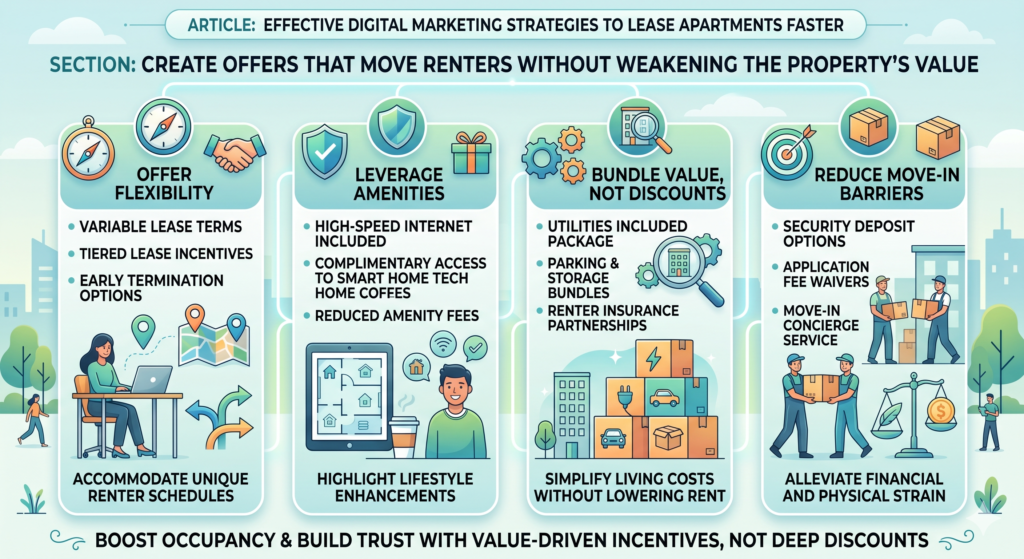
The goal is not to discount blindly.
The goal is to use offers in a smart way that helps renters act sooner while protecting the value of the property.
Your offer should solve a real renter concern
The best offers are not random. They remove a barrier.
Some renters are worried about upfront costs. Some are trying to move quickly but need help with timing. Some are comparing two similar properties and need one clear reason to choose. Some want flexibility because their current lease ends on an odd date.
Your offer should match the barrier.
If upfront cost is the issue, a reduced deposit or waived application fee may help. If timing is the issue, flexible move-in dates may matter more. If the renter is choosing between two properties, a limited move-in credit may create the final push.
The offer should feel useful, not desperate.
Your offer should be clear enough to understand in one reading
A confusing offer slows action.
If the renter has to ask three questions before they understand the deal, the offer is not doing its job. The message should explain what the renter gets, which units qualify, when they need to act, and how they can claim it.
A clear offer might say, “Move in by June 15 and receive one month free on select two-bedroom apartments.” That is easy to understand.
A weak offer says, “Special savings available for a limited time.” That may create mild interest, but it does not create enough clarity.
Clarity drives action.
Your offer should not hide important conditions
Some properties make offers sound better than they are. Then the renter learns later that the deal applies only to a few units, only with a long lease, or only after certain fees.
That creates frustration.
It is better to be honest early. If the offer applies only to select units, say so. If it requires a certain move-in date, say so. If lease terms affect the offer, make that clear.
Honest offers build trust. Hidden details can cost the lease.
Your offer should be tied to urgency without sounding pushy
Urgency helps renters act, but fake urgency can backfire.
If every ad always says “limited time,” renters stop believing it. If specials never seem to end, the message loses power.
Use urgency when it is real.
If only a few units are left, say that. If a special ends on a real date, say that. If current pricing may change, explain that in a simple and honest way.
Your urgency should help renters make a decision, not pressure them
A good urgency message does not scare the renter. It helps them understand the situation.
For example, “We have two units available for early June move-ins, and tour times are open this week” feels helpful. It tells the renter what is available and what they can do next.
A message like “Act now before it’s too late” feels more aggressive and less useful.
Renters are already under pressure when moving. Your marketing should guide them, not add stress.
Your leasing team should know exactly how to explain the offer
A good offer can still fail if the leasing team explains it poorly.
Everyone on the team should know what the offer is, which units it applies to, when it ends, how it affects monthly cost, and how to explain it in plain language.
If one person says one thing and another person says something different, trust drops.
The offer should feel smooth from ad to website to phone call to tour to application.
Your offer should be tested against better positioning
Sometimes a property does not need a bigger discount. It needs a better message.
If renters do not understand why the apartment is worth the price, lowering the price may not be the first answer. You may need stronger photos, clearer floor plan copy, better reviews, better local SEO, or sharper ads.
Discounts can hide weak marketing for a short time, but they do not fix it.
Your marketing should explain value before it presents savings
If the only reason to choose the property is the deal, the renter may keep shopping.
Before you mention the offer, make sure the renter understands the value. Show the location benefit. Show the layout. Show the parking. Show the pet policy. Show the service quality. Show the daily life.
Then the offer becomes a bonus, not the whole reason to lease.
This matters because value-based renters are often better long-term residents than deal-only renters.
Your best offer may not be a discount at all
Not every renter needs money off.
Some renters may respond better to convenience. A faster application process, flexible tour times, early access to a unit, help with move-in timing, reserved parking, or clear pet support can be more meaningful than a small discount.
This is why understanding renter needs matters so much.
A smart offer gives the renter a reason to move forward sooner. It does not always need to cut price.
Build Neighborhood Content That Makes the Apartment Feel Like a Better Life Choice
Renters do not just lease an apartment. They lease a location.
They are choosing where they will buy groceries, walk their dog, drive to work, meet friends, pick up coffee, exercise, relax, and spend their weekends.
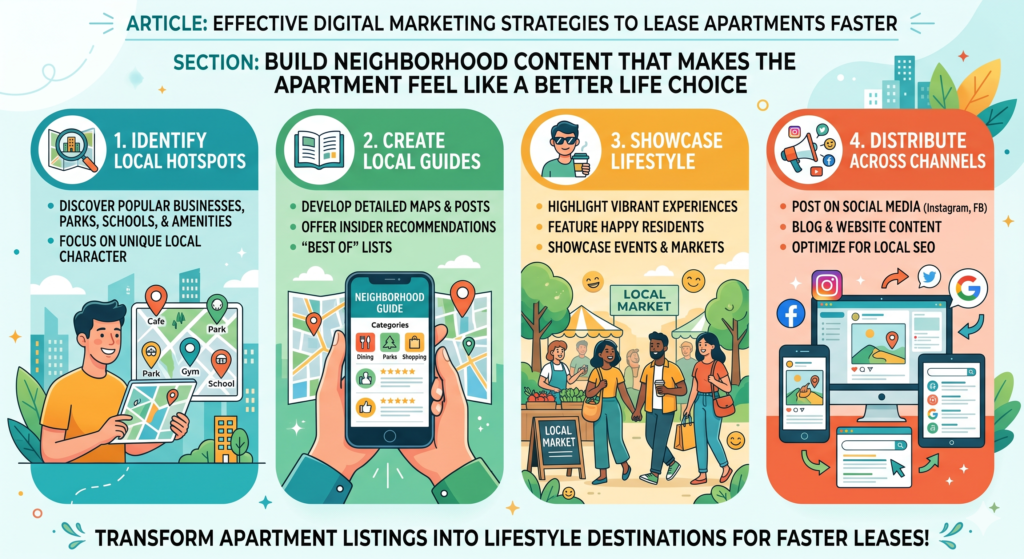
That is why neighborhood content can be so powerful.
A property may have similar units and prices to nearby competitors. But if your marketing does a better job showing the life around the property, renters may feel more connected to your community before they even tour.
Your neighborhood page should help renters picture their daily routine
A strong neighborhood page should not read like a tourist guide. It should feel like a practical guide to living there.
Renters want to know what daily life will feel like. They want to know whether errands are easy, whether the commute makes sense, whether the area fits their lifestyle, and whether they will enjoy being there after work.
Your content should answer those questions in plain words.
Talk about nearby grocery stores, parks, restaurants, schools, fitness centers, public transport, major roads, job centers, hospitals, campuses, and local spots that matter to your target renters.
Your neighborhood copy should connect places to real benefits
Do not just list nearby places.
Explain why they matter.
A grocery store nearby means weeknight errands are easier. A park nearby means better mornings for dog owners. A train stop nearby means less stress for commuters. A coffee shop nearby means remote workers have a second place to work. A gym nearby means renters may not need another long drive after work.
This type of copy turns location into value.
It helps renters see how the apartment can improve their routine.
Your neighborhood page should support local SEO naturally
Neighborhood content can also help your property show up in searches.
Renters often search for apartments near landmarks, employers, schools, transit stops, and popular neighborhoods. If your website has useful content around these places, you have a better chance of matching those searches.
The key is to write naturally.
Do not stuff the page with repeated phrases. Write for the renter first. Mention locations where they make sense. Give helpful context. Make the page genuinely useful.
Search engines and renters both reward content that answers real questions.
Your blog content can capture renters before they choose a property
Many renters begin their search with questions.
They may search for the best neighborhoods for young professionals in a city. They may look for the average rent in an area. They may compare living downtown versus living near the suburbs. They may search for how to find a pet-friendly apartment or what to ask before signing a lease.
This creates a chance to reach renters before they are ready to contact a property.
A blog can help your apartment community become part of that early search.
Your blog topics should match renter decisions
An apartment blog should not be filled with random updates that no one searches for.
It should answer renter questions.
A useful blog could explain how to choose the right floor plan, how to budget for moving costs, what to know before moving to the neighborhood, how to compare apartment amenities, how to prepare for a tour, or how to decide between a studio and a one-bedroom.
These topics bring in people who are actively thinking about moving.
They also build trust because the property is helping before asking for anything.
Your blog should always guide readers toward the next step
A blog post should not end with no direction.
If someone reads a post about choosing a one-bedroom apartment, invite them to view your one-bedroom floor plans. If they read about moving to your neighborhood, invite them to book a tour. If they read about pet-friendly apartment living, guide them to your pet policy or available pet-friendly units.
The next step should feel natural.
The reader came for help. Your property can then show how it fits their need.
Your local content should make your property easier to remember
Renters compare many properties. After a while, they can start to blend together.
Strong local content helps your property stand out.
A renter may not remember every amenity, but they may remember that your property is the one near their favorite coffee shop, close to the dog park, ten minutes from work, or near the weekend farmers market.
Your content should use real local details
Generic location content does not help much.
Lines like “close to shopping, dining, and entertainment” are used everywhere. They are too broad.
Real details are stronger.
Talk about the actual places nearby. Talk about the actual commute routes. Talk about the actual walking paths. Talk about the real reasons people like the area.
The more specific the content, the more believable it becomes.
Your local photos and videos should support the story
If the neighborhood is a major selling point, show it.
Add photos of nearby streets, parks, restaurants, transit stops, and local spots when possible. Use short videos to show the walk from the property to nearby places. Show what the area feels like at different times of day if it helps tell the story.
This makes the location feel real.
A renter can read about a neighborhood, but seeing it helps them imagine living there.
Use Content Marketing to Educate Renters Before They Contact You
Content marketing can help lease apartments faster because it gives renters answers before they have to speak with anyone.
Many renters are nervous when they start looking. They are not always ready to call. They may not know what they can afford. They may not know which floor plan fits them. They may not know what questions to ask during a tour. They may also be comparing several neighborhoods and trying to understand what makes one property better than another.
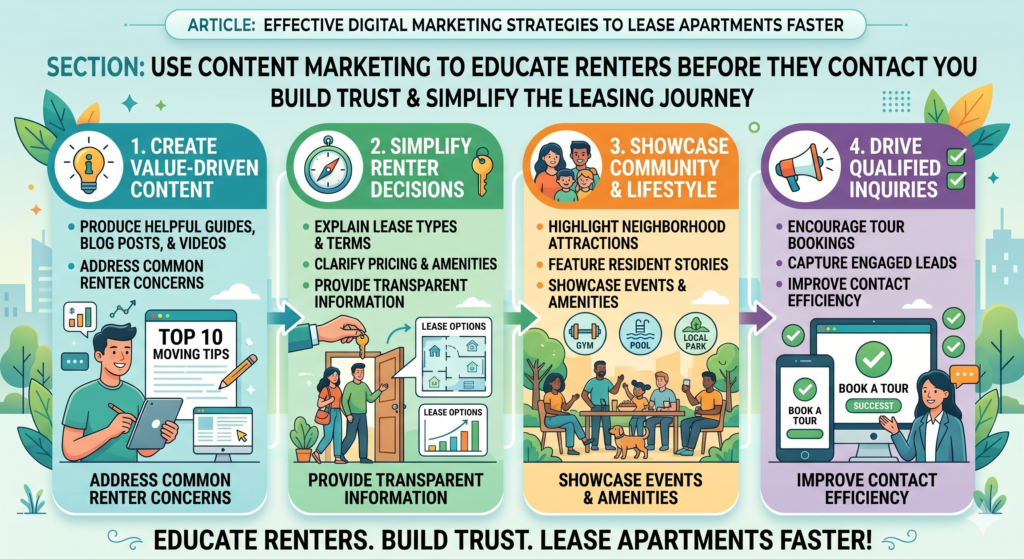
Good content helps them move from unsure to ready.
It also helps your apartment community become more than another listing. It makes your brand feel useful. When renters feel helped, they are more likely to trust you.
Your content should answer the questions renters ask before they lease
The best apartment content does not start with what the property wants to say. It starts with what renters are already asking.
A renter may ask, “How much rent can I afford?” Another may ask, “Should I choose a studio or one-bedroom?” Another may ask, “What should I look for during an apartment tour?” Another may ask, “How do I compare two apartments with different fees?”
Each of these questions can become helpful content.
The goal is not to write just for traffic. The goal is to help the renter make a better decision while gently showing why your property may be a good fit.
Your content should make the leasing process feel less confusing
Moving can feel stressful. Renters may have to deal with deposits, fees, applications, documents, income checks, moving dates, utilities, parking, pets, and lease terms.
If your website explains these things clearly, renters feel more confident.
For example, a simple guide on what to bring when applying for an apartment can save time for both the renter and the leasing team. A guide on how to prepare for a tour can help renters arrive with better questions. A guide on how to compare floor plans can help them choose faster.
Helpful content reduces fear. Less fear means faster action.
Your content should quietly position your property as the easy choice
Content should not feel like a hard sales pitch. But it should still guide the reader.
If you publish a post about choosing a pet-friendly apartment, you can naturally explain what pet owners should look for, such as clear pet rules, outdoor space, nearby walking areas, and simple fee details. Then you can show how your property supports pet owners.
If you publish a post about working from home in an apartment, you can explain the value of quiet layouts, natural light, strong internet options, and space for a desk. Then you can mention which floor plans are best for remote workers.
This is not pushy. It is helpful selling.
You teach first. Then you connect the advice to your property.
Your apartment blog should not sound like a generic real estate site
Many apartment blogs are too broad. They publish posts like “Top Moving Tips” or “How to Decorate Your Apartment” without tying the content to their actual renters, neighborhood, or available units.
That kind of content may fill a blog, but it often does not lease apartments faster.
Better content is more specific.
If your property serves young professionals, write about commute-friendly living, smart space use, and neighborhood convenience. If your property serves families, write about storage, schools, safety, and daily errands. If your property serves students, write about budget planning, roommate choices, and easy access to campus.
The more closely your content matches your renters, the more useful it becomes.
Your content should include local details that renters can actually use
Local details make content stronger because they help renters picture real life.
Instead of writing a basic post called “Why Location Matters,” write about what it is like to live near your specific neighborhood, business district, campus, hospital, park, or transit line.
Talk about real commute routes. Talk about local grocery stores. Talk about nearby gyms. Talk about weekend spots. Talk about how the area feels for different types of renters.
This kind of content can also support SEO because renters often search for apartments near certain places.
But it should never read like keyword stuffing. It should read like a helpful local guide written by someone who understands the area.
Your content should lead people to floor plans, tours, and availability
A blog post should not end with a dead stop.
If someone reads a post about moving to your neighborhood, guide them to your neighborhood page or tour page. If someone reads about choosing between a one-bedroom and two-bedroom apartment, guide them to your floor plans. If someone reads about pet-friendly apartment living, guide them to your pet policy and available units.
This keeps the renter moving.
The next step should not feel forced. It should feel like the natural next thing to do after getting helpful advice.
Make Your Apartment Brand Feel Clear, Human, and Easy to Trust
Branding matters in apartment marketing, but not in the way many people think.
A strong apartment brand is not just a logo, color palette, or fancy slogan. It is the feeling renters get every time they see your property online.
Do they feel this place is clean and well managed? Do they feel the team will respond? Do they feel the property fits their life? Do they feel the price makes sense? Do they feel safe taking the next step?
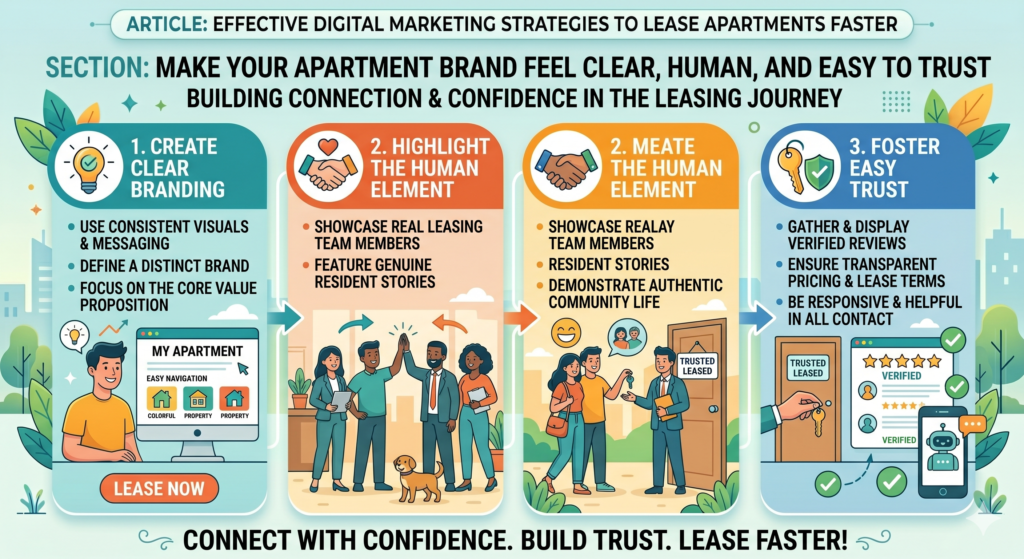
That is brand.
If your brand feels unclear, renters hesitate. If your brand feels polished but empty, renters may not trust it. If your brand feels human and useful, renters are more likely to act.
Your brand voice should sound like a helpful leasing expert, not a cold company
Apartment copy often sounds stiff.
It says things like “Residents will enjoy a premier lifestyle experience with best-in-class amenities.” That may sound formal, but it does not feel human.
A better brand voice sounds clear and warm.
It says, “Come home to a quiet apartment close to the places you visit every week, with parking, pet-friendly spaces, and a team that helps make move-in simple.”
That kind of writing is easier to understand. It feels more real. It gives the renter useful information without making them work.
Your copy should use simple words that renters use in real life
Renters do not usually say they want “elevated urban living.” They say they want more space, better parking, less noise, a shorter commute, a safe building, a clean gym, a good kitchen, or a place that accepts their dog.
Use those words.
Simple language sells because it is easy to process. When people are comparing many apartments, easy wins.
This does not mean the writing should be plain or boring. It means the writing should be clear, specific, and full of real value.
Your brand should stay consistent from ad to tour
A renter should feel the same level of care at every step.
If the ad feels helpful but the landing page is confusing, trust drops. If the website feels polished but the follow-up is cold, trust drops. If the tour is friendly but the application process is unclear, trust drops.
Consistency matters.
Your ads, website, listing pages, emails, texts, tour scripts, and application messages should all feel like they come from the same helpful team.
This makes the whole leasing process feel smoother.
Your brand should highlight what makes the property truly different
Many apartment communities make the mistake of trying to sound like luxury brands, even when that is not their real strength.
Not every property has to be luxury. Some properties win because they are practical. Some win because they are quiet. Some win because they offer more space for the price. Some win because the location is very convenient. Some win because the leasing team is warm and responsive.
Your brand should be built around your true advantage.
Your strongest difference should be easy to explain
If your property’s main strength is location, make that clear everywhere. If it is value, show why the rent makes sense. If it is service, prove it with reviews and response times. If it is space, show layouts and photos that make the space easy to understand.
Do not hide your best selling point under vague language.
Renters should be able to describe your property after one visit to your site. They should be able to say, “That is the pet-friendly place near downtown,” or “That is the quiet one with bigger floor plans,” or “That is the one with flexible move-in dates.”
A clear brand is easier to remember.
Your brand should not promise what the property cannot deliver
Overpromising may get more clicks, but it can hurt leasing later.
If the property is simple and affordable, do not market it like a luxury resort. If the units are older but spacious, focus on space and value. If the property is not in the busiest part of town, focus on peace, parking, or easier access.
Honest positioning attracts better-fit renters.
Better-fit renters are more likely to tour, apply, sign, and stay.
Improve the Application Process So Renters Do Not Quit Near the Finish Line
A renter who starts an application is close to signing. That makes the application process one of the most important parts of apartment leasing.
But this is also where many renters get stuck.
They may feel confused by fees. They may not understand the documents needed. They may worry about approval. They may get busy and forget to finish. They may hit a technical problem. They may decide to compare one more property before paying an application fee.
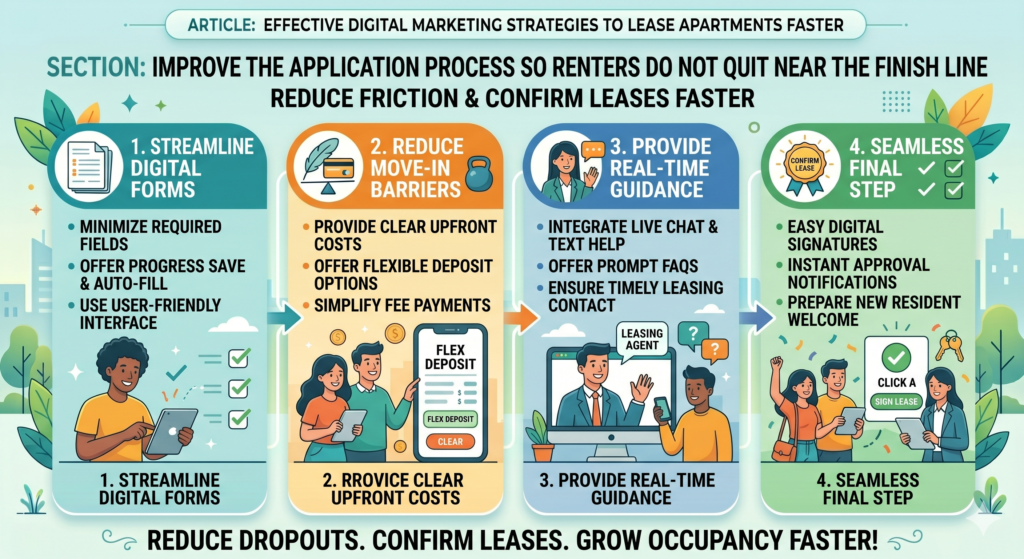
If the process is not clear, you can lose renters at the very moment they are closest to becoming residents.
Your application page should explain what happens next
Renters do not like uncertainty.
Before they apply, they should know what information they need, what fees they may pay, how long approval usually takes, what documents may be required, and who they can contact with questions.
This does not have to be complicated. A simple explanation can make a big difference.
When people know what to expect, they feel safer taking action.
Your application instructions should be written in plain words
Do not make the application page sound like a legal document unless it has to.
Use plain language. Explain each step clearly. Tell renters what they need before they start. Let them know whether they can save progress if they need to come back later.
A confused renter may delay. A confident renter moves forward.
The job of the application page is not only to collect information. It is to reduce friction.
Your leasing team should follow up with people who start but do not finish
An unfinished application is not a lost cause.
The renter may have been interrupted. They may have had a question. They may not have understood a fee. They may have wanted to confirm availability before finishing.
A simple follow-up can recover many of these leads.
The message should be helpful, not pushy. It can say, “I saw you started your application for the one-bedroom layout. Do you have any questions I can help with before you finish?”
That kind of message opens the door.
Your fees should be clear before the renter feels surprised
Unexpected costs can kill trust.
If a renter reaches the application stage and suddenly sees fees they did not expect, they may pause or leave. Even if the fees are normal, the surprise can create doubt.
Clear fee communication helps prevent this.
Your pricing should show the full picture where possible
Renters want to understand the real monthly cost.
Base rent is important, but it is not the full story. Parking, pet rent, utilities, trash fees, amenity fees, application fees, deposits, and other charges may affect the decision.
The clearer you are, the less likely renters are to feel misled.
This does not mean every ad must include every fee. But before the renter applies, the cost picture should be easy to understand.
Your team should explain fees as part of value
Fees feel worse when they are unexplained.
If there is a pet fee, explain what it covers if appropriate. If there is a parking fee, explain the parking benefit. If there is an amenity fee, explain what residents get access to.
The goal is not to defend every cost. The goal is to make the renter feel informed.
Informed renters are less likely to drop off because they feel respected.
Create a Strong Post-Tour Follow-Up That Helps Renters Decide Faster
The tour is a major moment, but the lease is often won or lost after the tour.
A renter may leave interested but not fully ready. They may need to talk to a partner. They may want to compare another property. They may need to check money. They may have one concern they did not mention in person.
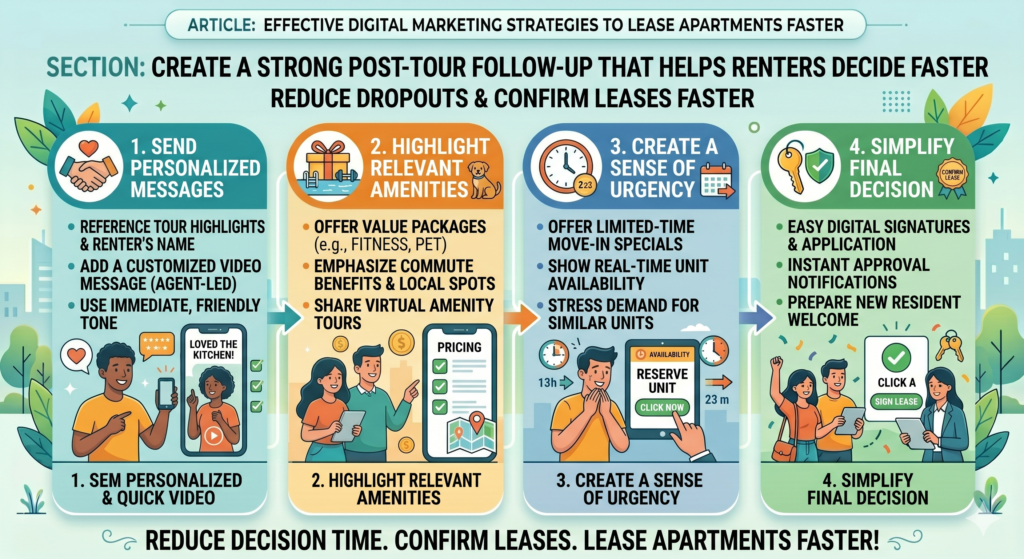
If your post-tour follow-up is weak, the renter may drift away.
A strong follow-up keeps the conversation alive and helps the renter make a clear decision.
Your first post-tour message should be sent while the property is still fresh in their mind
The best time to follow up is soon after the tour.
The renter still remembers the unit. They still remember the leasing agent. They still remember how the space felt. This is the moment to reinforce the best parts of the visit.
The message should not be a generic “thanks for stopping by.” It should mention what the renter cared about.
Your follow-up should recap the renter’s main interest
If the renter liked the balcony, mention it. If they cared about parking, include the parking details. If they asked about pet rules, send the pet policy. If they liked a certain floor plan, send the link to that layout.
This shows that the leasing team listened.
It also helps the renter review the property without having to search again.
A good follow-up makes the decision easier.
Your follow-up should create one clear next step
Do not ask the renter to do five things.
Give one clear next step.
If they are ready, invite them to apply. If they are unsure, offer to answer questions. If they need another look, offer a second tour or virtual walkthrough. If availability is limited, explain that clearly.
The renter should know what to do next without feeling pressured.
Your follow-up should handle common objections before they grow
Renters may not always tell you what is stopping them.
They may quietly worry that the rent is too high, the unit is too small, the move-in date is not right, the fees are unclear, or another property may be better.
A smart follow-up can address these concerns in a helpful way.
Your message can compare value without attacking competitors
You do not need to speak badly about other properties.
Instead, remind the renter what makes your property a strong choice.
You can mention location convenience, included features, service quality, parking, flexible move-in timing, or available layouts. You can share a review from a resident who had a smooth move-in. You can explain the value of the floor plan they toured.
This helps the renter compare without feeling pushed.
Your follow-up should continue for several days when the lead is strong
Not every renter applies the same day.
A simple follow-up sequence after the tour can help. The first message can recap the tour. The next can answer a common question or share a review. Another can remind them about availability or the move-in offer if it is real.
Each message should add something useful.
Do not repeat “just checking in” over and over. Give the renter a reason to reply.
Align Marketing and Leasing Teams So No Lead Falls Through the Cracks
Digital marketing can bring renters to the door, but the leasing team turns interest into signed leases.
If marketing and leasing do not work together, the system breaks.
Marketing may promote units the leasing team is not focused on. The leasing team may not know which ads are running. Renters may ask about offers that agents cannot explain. Leads may come in without enough context. Feedback from tours may never reach the marketing team.
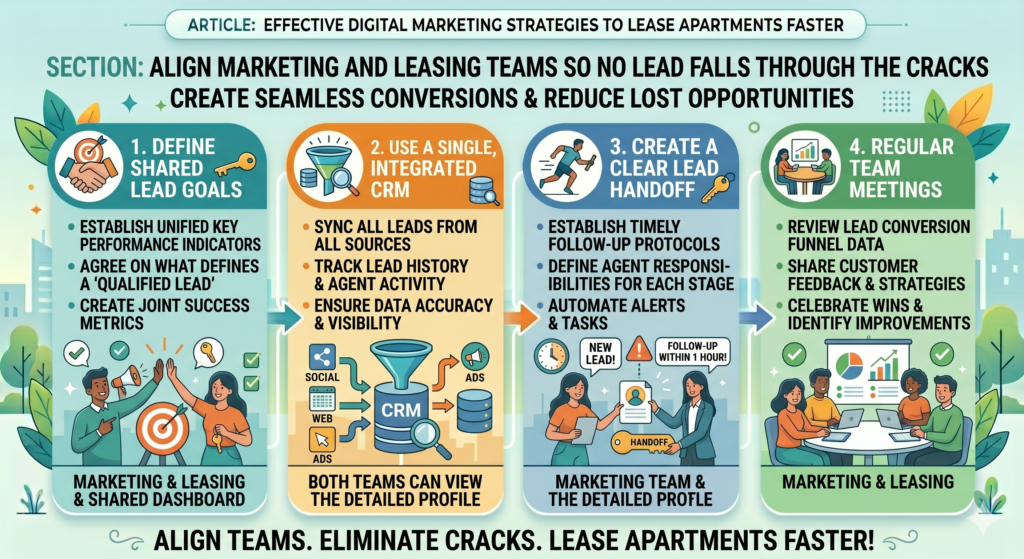
This creates waste.
A faster leasing system needs both sides working as one team.
Your leasing team should know what renters saw before they reached out
When a renter calls or books a tour, the leasing team should know as much context as possible.
Did the lead come from a pet-friendly ad? Did they click a one-bedroom landing page? Did they ask about immediate move-in? Did they view a certain floor plan? Did they come from Google, Instagram, or an apartment listing site?
This context helps the leasing agent personalize the conversation.
Your team should avoid making renters repeat themselves
Renters get frustrated when they already shared details online and then have to repeat everything again on the phone.
If the form asks for move-in date, bedroom type, pet needs, or tour preference, the leasing team should use that information.
This makes the renter feel remembered.
It also makes the process faster.
Your leasing agents should give marketing feedback every week
Leasing agents hear the truth directly from renters.
They know which questions come up. They know which objections are common. They know which floor plans are harder to explain. They know when photos do not match expectations. They know when pricing feels unclear.
That feedback should shape marketing.
If renters keep asking the same question, answer it on the website. If renters love a certain feature during tours, highlight it in ads. If renters are confused by an offer, rewrite it. If renters mention a competitor often, study that competitor’s message.
Your leasing team is one of your best research sources.
Your marketing should support the leasing team with better tools
Good marketing does not end when the lead comes in.
It should give the leasing team tools that help close.
This can include floor plan one-sheets, follow-up email templates, virtual tour links, review snippets, neighborhood guides, pet policy pages, fee explainers, and move-in checklists.
These tools help leasing agents answer faster and more clearly.
Your team should have ready-made answers for common questions
Renters often ask the same questions about pets, parking, fees, utilities, income requirements, move-in dates, deposits, amenities, and lease terms.
If every leasing agent writes a new answer each time, quality can vary.
A set of clear, human answers can help the team respond faster while still sounding personal.
The goal is not to make agents robotic. The goal is to give them strong language they can adapt.
Your marketing assets should be easy to send during follow-up
If a renter asks about a floor plan, the agent should have a direct link ready. If they ask about the neighborhood, the agent should have a helpful guide. If they ask about the application process, the agent should have a clear page to send.
This makes follow-up faster and more useful.
It also keeps the renter inside your leasing journey instead of sending them back to search on their own.
Use Marketing Automation Without Making the Leasing Experience Feel Cold
Automation can help apartment teams lease faster, but only when it is used with care.
A good automation system saves time, gives renters quick answers, and keeps leads from falling through the cracks. A bad automation system makes renters feel ignored by a machine.
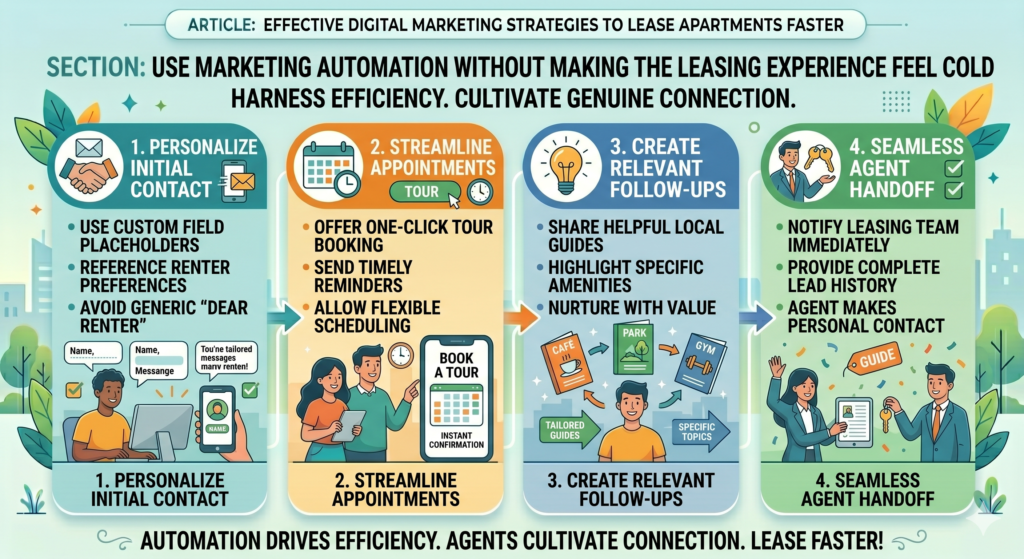
The difference is simple. Good automation feels helpful. Bad automation feels lazy.
Renters do not mind getting an automated message if it gives them what they need. They mind when the message feels generic, does not answer their question, or keeps pushing them toward a step they are not ready to take.
The goal is not to replace the leasing team. The goal is to support the leasing team so renters get faster, clearer, and more useful communication.
Your automation should respond based on what the renter actually did
A renter who asked about a two-bedroom apartment should not receive a generic message about “our beautiful community.” A renter who clicked on pet-friendly apartments should not be sent a message that ignores pets. A renter who booked a tour should not keep getting emails asking them to book a tour.
Automation works best when it responds to behavior.
If someone downloads a neighborhood guide, send them more neighborhood details. If someone checks one-bedroom availability, send them a link to current one-bedroom units. If someone starts an application but does not finish, send a helpful reminder with a contact option.
This makes the message feel timely and useful.
Your automated emails should feel like they came from a real leasing person
The writing should be simple, warm, and direct.
Instead of saying, “Thank you for your inquiry. A representative will contact you shortly,” say something more useful, such as, “Thanks for reaching out about our one-bedroom apartments. We have a few layouts that may fit your move-in date, and I can help you compare them.”
That feels more human.
It also moves the renter closer to the next step because it gives them a reason to reply.
Your automation should never trap renters in a loop
Some apartment marketing systems send the same type of message again and again. The renter asks a question, but the system keeps pushing a tour. The renter books a tour, but the system keeps sending availability messages. The renter applies, but the system still treats them like a new lead.
This creates friction.
Automation should move with the renter’s stage. Once someone takes a step, the next message should match that step. After a tour is booked, send tour details. After a tour is completed, send a recap. After an application is started, send support. After a lease is signed, stop prospect messages and begin move-in communication.
That is how automation feels smart instead of annoying.
Your chatbot should answer simple questions and hand off serious leads fast
A chatbot can be useful on an apartment website, especially after hours. Many renters search at night, during lunch breaks, or on weekends. If they can get basic answers right away, they may stay engaged instead of moving to another property.
But the chatbot should have a clear role.
It should answer common questions, collect basic lead details, guide renters to floor plans, help them book tours, and connect them with a real person when needed.
It should not pretend to handle everything.
Your chatbot should be trained around real renter questions
A chatbot is only helpful if it knows what renters actually ask.
Common questions often include pricing, availability, pet rules, parking, lease terms, income requirements, tour times, application fees, utilities, amenities, move-in dates, and neighborhood details.
If the chatbot cannot answer these well, it may create more frustration than value.
The best way to improve it is to review chat logs often. Look for questions the bot failed to answer. Look for moments where renters dropped off. Look for repeated concerns. Then improve the responses and add better paths.
A chatbot should get smarter over time.
Your chatbot should make it easy to reach a person
Some renters do not want to chat with a bot for long. They may have a specific concern. They may want to speak to someone before applying. They may be ready to tour and just need help choosing a time.
There should always be a clear path to a leasing agent.
A simple line like “Would you like our leasing team to text or call you?” can turn a chat into a real lead. The bot should collect the right details and pass them to the team clearly, so the renter does not have to repeat everything.
Good automation makes the handoff smoother.
Your automated reminders should reduce no-shows and unfinished applications
Two of the most costly leaks in apartment leasing are missed tours and unfinished applications.
Automation can help with both.
A renter who books a tour should get a confirmation, a reminder, and helpful visit details. A renter who starts an application should get a friendly reminder if they stop before finishing.
These messages should not feel pushy. They should feel supportive.
Your tour reminders should make the visit feel easy
A tour reminder should include more than the date and time.
It should include the property address, parking instructions, where to enter, who to ask for, how to reschedule, and what the renter can expect. If the renter asked about a specific unit or floor plan, the reminder can mention that too.
This lowers stress.
It also makes the renter more likely to show up because the visit feels simple and planned.
Your application reminders should remove the reason someone stopped
If someone does not finish an application, there is usually a reason.
They may have had a question about fees. They may not have had documents ready. They may have been unsure about approval. They may have been interrupted. They may have wanted to confirm the unit was still available.
A good reminder should offer help.
Instead of saying, “Complete your application now,” say, “I noticed your application is still open. Do you have any questions about fees, documents, or next steps before you finish?”
That message feels less like pressure and more like support.
Conclusion:
Leasing apartments faster is not about shouting louder online. It is about making the renter’s decision easier from the first search to the signed lease. The renter is already busy.
They are comparing prices, reading reviews, checking photos, studying maps, asking about pets, looking at floor plans, and trying to decide which property feels worth their time. If your marketing adds confusion, they slow down. If your marketing gives clear answers, they move forward. That is the real purpose of digital marketing for apartment leasing.
















Comments are closed.