
WinSavvy Editorial Standards
How this article was created
Most people do not wake up one morning and decide to hand their life savings to the first advisor they find online. They worry. They compare. They read. They ask friends. They check your website. They look at your LinkedIn page. They watch how you explain things. They want to know if you understand people like them. They want to feel safe before they share their goals, fears, income, debt, retirement plans, or family needs.
Start by choosing the exact type of client you want to attract
Many financial advisors make their marketing too wide. They try to speak to business owners, young families, retirees, doctors, tech workers, high-net-worth clients, and people just starting to save, all at the same time. On the surface, this feels safe. It feels like you are keeping your options open.
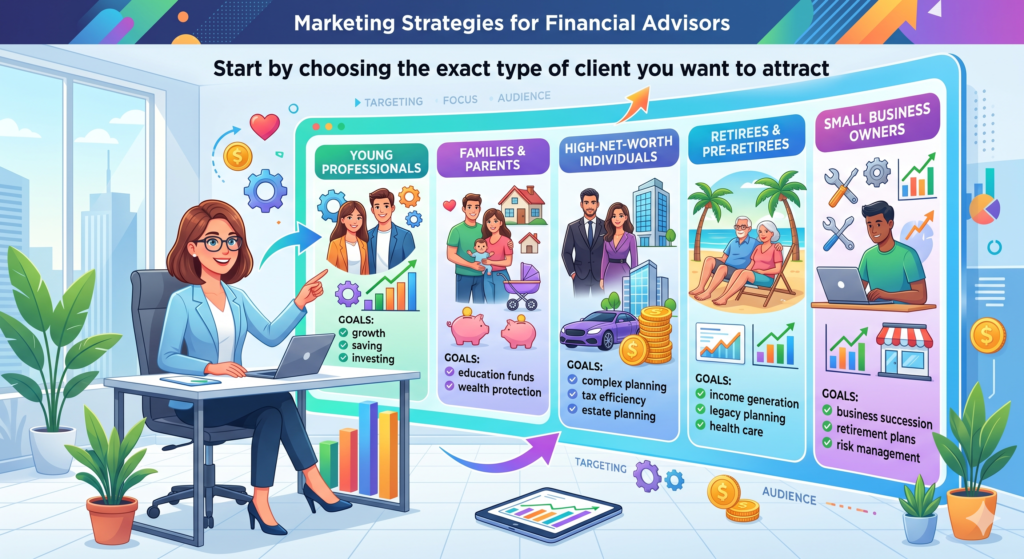
But in real life, broad marketing often makes an advisor easier to ignore.
When your message is too general, people do not feel seen. They read your website and think, “This advisor helps everyone.” That sounds fine, but it does not create a strong reason to act. A person with a very specific money problem wants to feel that you understand their exact life stage, pressure, risk, and goal.
That is why the first real marketing strategy is not posting more on LinkedIn or redesigning your website. It is choosing who your marketing is really for.
Your best clients should shape your message
Look at your current client base and ask a simple question: who do you serve best?
This does not always mean the clients with the highest assets. It may mean the clients who trust your process, value your advice, stay for years, refer others, and have problems you are very good at solving. These clients show you where your strongest market may already be hiding.
For example, you may notice that your best clients are business owners who are earning well but have messy personal finances. Or you may find that you work best with couples five to ten years away from retirement.
Or you may see that you are strongest with widows, physicians, startup employees, dentists, corporate leaders, or first-generation wealth builders.
Once you see this pattern, your marketing becomes much easier. Your website can speak to one clear person. Your content can answer better questions. Your emails can feel more personal. Your calls can become more focused.
The clearer your audience is, the stronger your trust becomes
People trust specialists faster than generalists.
A person nearing retirement does not want vague content about “building financial confidence.” They want to know how to avoid running out of money, when to claim benefits, how to handle taxes, how to reduce risk, and how to turn savings into income.
A business owner does not want the same message. They may care about cash flow, tax planning, exit planning, succession, protection, and separating business wealth from personal wealth.
When your marketing speaks to one group with real care, it creates a feeling of fit. That feeling is powerful. The reader starts to think, “This advisor gets people like me.” That thought is often the first step toward a booked call.
Build your positioning around a problem, not your credentials
Many financial advisors lead with credentials. They talk about years of experience, licenses, designations, firm history, and planning tools. These things matter, but they should not carry the whole message.

Clients do not wake up thinking about your credentials first. They wake up thinking about their problems.
They wonder if they are saving enough. They worry about taxes. They fear making the wrong retirement choice. They feel unsure about market swings. They want to help their children without hurting their own future. They want to sell a business without losing too much to poor planning. They want someone who can make the confusing parts feel clear.
Your positioning should connect directly to those concerns.
Strong positioning makes your value easy to understand
Your positioning is the simple idea people remember about you. It explains who you help, what problem you solve, and why your approach is different.
A weak message sounds like this: “We provide comprehensive financial planning and wealth management services.”
That may be true, but it sounds like every other advisor.
A stronger message sounds like this: “We help business owners turn years of hard work into a clear personal wealth plan before they exit.”
This feels sharper. It names the audience. It names the moment. It names the outcome. It gives the right person a reason to keep reading.
Another stronger message could be: “We help couples within ten years of retirement make confident income, tax, and investment decisions before they stop working.”
Again, it is clear. It is not trying to impress everyone. It is trying to connect with the right people.
Your website should pass the five-second test
When someone lands on your homepage, they should understand what you do within five seconds. They should know who you help and why it matters.
If they have to scroll through long blocks of vague language, they will leave. If the message sounds like every other firm, they will not remember you. If the page opens with a large photo and a soft line like “Your future starts here,” it may look nice, but it does not explain enough.
A better homepage starts with a clear promise. It should make the visitor feel, “This is for me.” Then it should support that promise with plain proof, useful content, and an easy next step.
Your positioning should not sound clever. It should sound true, clear, and useful.
Make your website feel like a trust-building conversation
Your website is often the first serious place a prospect studies you. It is not just a digital brochure. It is your first meeting before the meeting.
A good financial advisor website should answer the quiet questions people have in their heads. Can I trust this advisor? Do they understand my situation? Are they experienced with people like me? What will happen if I reach out? Will I be pressured? Will I feel judged? Can they explain things in a way I understand?
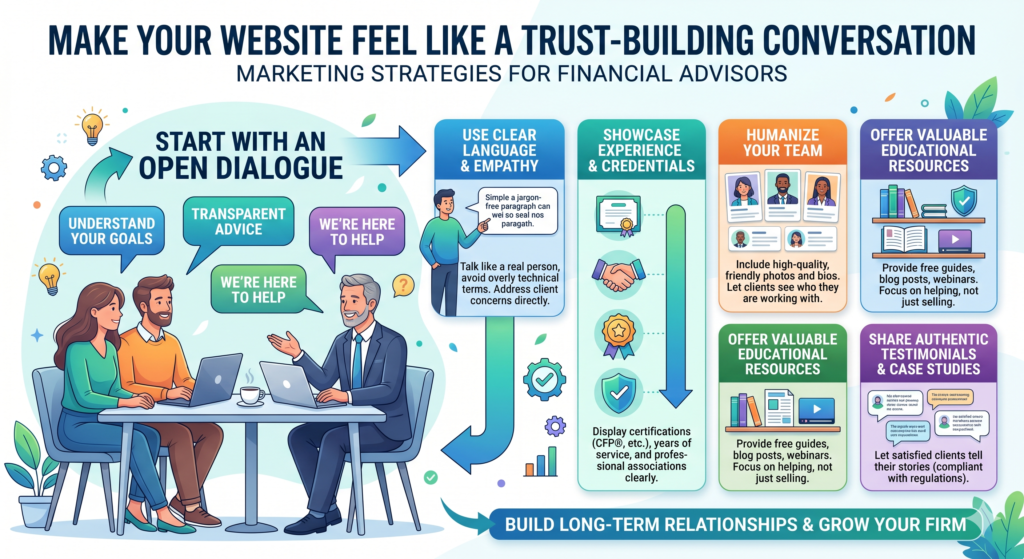
If your website does not answer these questions, people may leave even if they need your help.
Your homepage should guide visitors step by step
A strong homepage should not throw everything at the reader. It should guide them through a calm path.
First, it should show who you help and what outcome you support. Then it should explain the problem in plain language. After that, it should show your method, proof, services, and next step.
The page should feel like a helpful advisor is walking beside the visitor, not like a firm is trying to sell at them.
This matters because money creates emotion. Many prospects feel private stress around financial decisions. Some feel embarrassed that they waited too long. Some feel overwhelmed by choices. Some feel worried that an advisor will use complex words to sound smart.
Your website should lower that pressure. Use simple language. Explain your process. Tell people what to expect. Make the first step feel safe.
Your process page should remove fear
Many advisor websites have a “process” page, but it often feels too thin. It may say something like discover, plan, implement, review. That is common, but it does not explain what the client will actually experience.
A better process page explains the first call, the questions you ask, the documents they may need, how you build the plan, how recommendations are shared, and how ongoing support works.
The goal is to remove uncertainty.
When people know what happens next, they feel more in control. When they feel more in control, they are more likely to book. This is especially important for people who have never worked with an advisor before.
Your process should sound human. It should not feel like a corporate flowchart. It should make the reader think, “I can do this. This feels simple enough to start.”
Use local SEO if your clients come from your area
Even if you serve clients online, local trust still matters. Many people still search for financial advisors near them. They may type “financial advisor in Dallas,” “retirement planner near me,” or “wealth advisor for business owners in Chicago.”

If your firm depends on local or regional clients, local SEO can become one of your strongest long-term growth channels.
Local SEO helps you show up when people nearby are already looking for help. These are often high-intent searches. The person is not just browsing. They may be close to taking action.
Your Google Business Profile should be complete and active
Your Google Business Profile is one of the most important assets for local visibility. It can appear in map results and local search results. It also gives prospects a quick view of your firm, location, reviews, hours, photos, and contact options.
Many advisors create the profile and then ignore it. That is a missed chance.
Your profile should have the correct business name, address, phone number, website, service areas, business hours, and service categories. The description should clearly explain who you help. Photos should look real and professional. The profile should not feel empty.
Reviews also matter. You must follow the rules that apply to your firm and industry, but within those rules, client feedback and online reputation can support trust. Prospects often look for signals that other people have had a good experience.
Local service pages can help you rank for better searches
If you serve several cities or areas, your website can include local service pages. These pages should not be copied and pasted with only the city name changed. That kind of content feels thin and can hurt trust.
A strong local page should speak to the real financial needs of people in that area. For example, a page for a city with many tech workers may discuss equity compensation, stock options, tax planning, and sudden income changes. A page for an area with many business owners may focus on exit planning, retirement savings, cash flow, and succession.
The goal is not to trick search engines. The goal is to show real local relevance.
Your local pages should be useful enough that a real person would read them and feel helped. That is the standard.
Create content around the questions prospects ask before they trust you
Content marketing works very well for financial advisors when it is based on real client questions. It works poorly when it is based on generic topics everyone else has already covered.
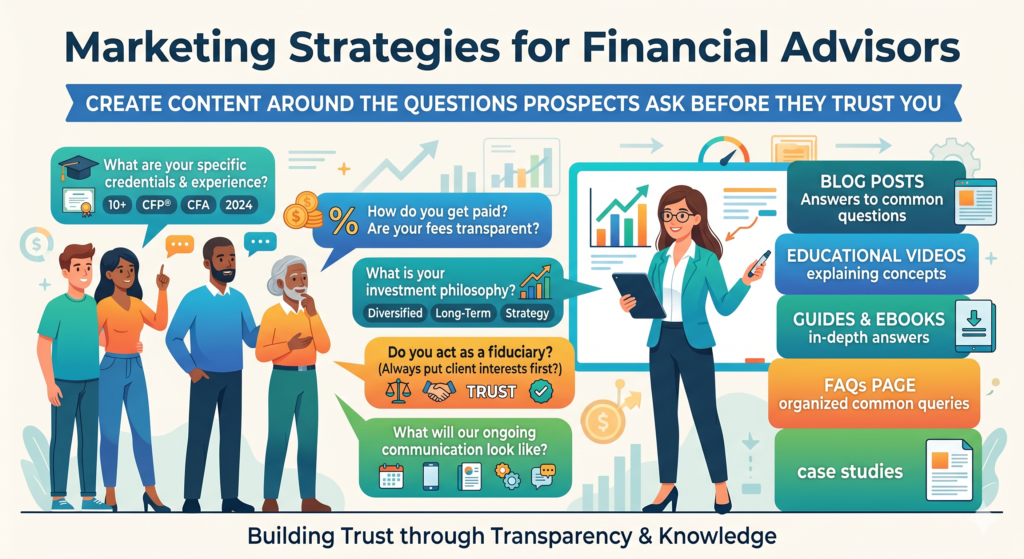
Prospects do not need another thin article about “why financial planning is important.” They need answers to the questions keeping them stuck.
They want to know if they should pay off debt or invest. They want to know how much cash to keep. They want to know how retirement income works. They want to know what happens if the market drops right before retirement.
They want to know how to talk to aging parents about money. They want to know how to reduce taxes after selling a business.
When your content answers these questions clearly, it becomes more than marketing. It becomes proof of how you think.
Your best content topics are hiding in your sales calls
Every discovery call gives you content ideas. Every client meeting gives you content ideas. Every repeated concern is a sign that the market needs education.
If five prospects ask whether they have enough to retire, that should become a blog post, a video, an email, and a webinar topic. If clients keep asking about tax moves before year-end, that should become a seasonal content series. If business owners keep delaying exit planning, that should become a guide.
The best content does not come from guessing keywords alone. It comes from listening.
SEO tools can help you find search demand, but your clients tell you the emotional reason behind the search. That is where the strongest content comes from.
Write for the person, not just the search engine
A blog post should not feel like it was written only to rank. It should feel like it was written to help.
Use plain words. Give clear examples. Explain trade-offs. Show what people often get wrong. Help the reader understand what decision they need to make next.
This kind of content builds trust because it respects the reader. It does not talk down to them. It does not hide behind complex terms. It gives them useful thinking they can apply.
For financial advisors, this is especially important because trust is the real conversion point. A person may read your article today and book a call three months later. Good content keeps you in their mind until they are ready.
Build service pages that sell without sounding pushy
Many advisor service pages are too short. They name the service, add a few general lines, and end with a contact button. That is not enough.
A service page should help a prospect understand the problem, the cost of waiting, the value of solving it, your approach, and what the next step looks like. It should make the reader feel smarter and safer.
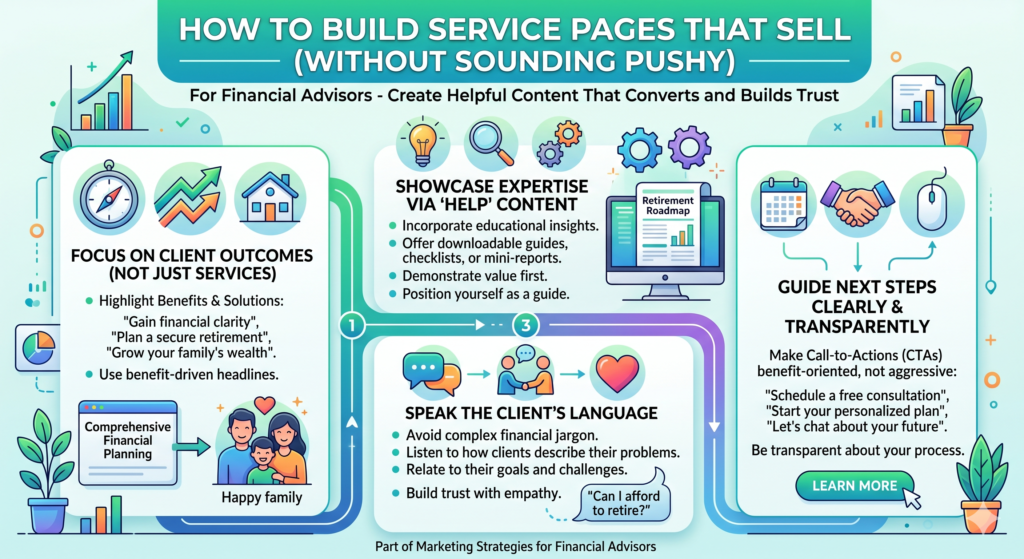
If you offer retirement planning, do not only say that you help people plan for retirement. Explain the questions that come up before retirement. Talk about income, taxes, healthcare, risk, lifestyle, and legacy. Show why planning early can prevent painful choices later.
If you offer investment management, do not only say that you build portfolios. Explain how your investment approach connects to the client’s goals, time frame, risk comfort, and tax situation.
Each service page should answer real buying questions
A strong service page should answer the questions a serious prospect is already thinking.
They may want to know who the service is for. They may want to know when they should seek help. They may want to know what mistakes to avoid. They may want to know how your work is different from using a simple online tool. They may want to know how the service connects to the rest of their financial life.
When the page answers these questions, it feels helpful instead of sales-heavy.
The copy should not pressure the reader. It should guide them.
The call to action should feel low-risk
Many people delay reaching out because the first step feels too serious. They may think they need to have everything ready. They may worry that they will be sold to. They may not know what to ask.
Your call to action should reduce that fear.
Instead of only saying “Contact us,” use language that explains the next step. For example, invite them to schedule a short fit call to see whether your firm is right for their needs. Explain that the call is simple, private, and focused on understanding their situation.
That small shift can improve conversions because it makes action feel easier.
A strong call to action does not beg for attention. It gives the right person a clear and safe way to begin.
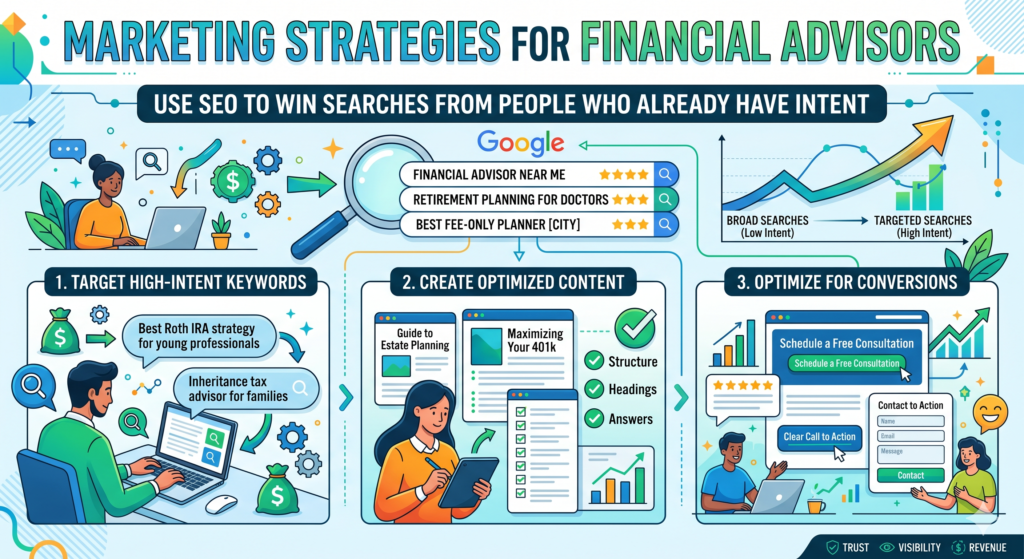
Use SEO to win searches from people who already have intent
SEO is not just about traffic. For financial advisors, SEO is about being found at the exact moment someone is looking for serious help.
This is an important difference.
A person searching “what is compound interest” may be learning. A person searching “retirement advisor for business owners near me” may be ready to talk. A person searching “how to reduce taxes after selling a company” may have a real problem and a high need for guidance.
Your SEO strategy should focus on the second and third type of searches. These are the searches with intent. They show that the person has a problem, a life event, or a decision coming soon.
Your best SEO topics should match urgent life moments
Financial advice often becomes important when something changes. A person gets a raise. A couple has a child. A founder sells a business. A worker receives stock options. A spouse passes away. A family starts thinking about college. A professional nears retirement. An executive changes jobs. A parent needs care.
These moments create questions. Those questions create searches. Those searches create chances for your firm to be found.
If your content only covers broad topics, you may miss the highest-value opportunities. Instead of writing only about “financial planning tips,” create pages around moments that bring people to advice.
For example, a retirement-focused advisor could write about what to do five years before retirement, how to build a retirement income plan, how to handle taxes before retirement, and how to avoid making rushed investment changes before leaving work.
A financial advisor serving business owners could write about planning before selling a business, using business cash flow to build personal wealth, reducing risk when most net worth is tied to a company, and preparing for life after an exit.
These topics are not just more useful. They also attract people with sharper needs.
Keyword research should support strategy, not replace it
Keyword tools can show search volume, but they cannot fully show buyer pain. A topic with low search volume may still bring strong leads if the searcher has high intent.
For example, “financial advisor for dentists selling a practice” may not get huge search volume. But a person searching that phrase is likely much closer to needing help than someone searching a broad phrase like “money tips.”
This is why smart SEO for financial advisors balances data with judgment. You should study search terms, but you should also think like a client. Ask what they would type when they feel pressure, confusion, or risk.
Your content should meet them there.
The goal is not to chase every keyword. The goal is to own the searches that matter most to your best-fit clients.
Turn your blog into a trust library, not a news feed
Many advisors treat their blog like a place to post random updates. One month they write about inflation. The next month they write about budgeting. Then they share a market note. Then nothing happens for four months.
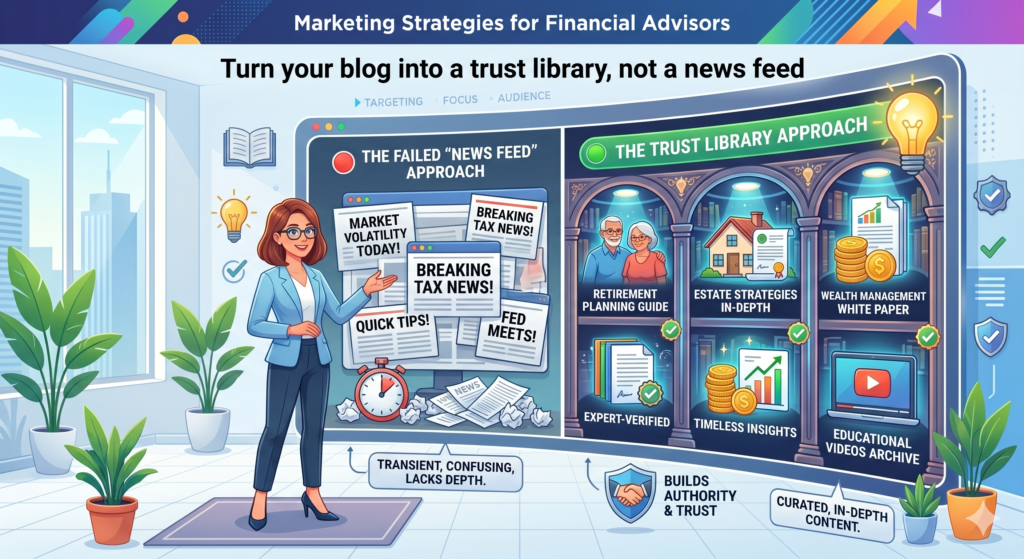
This kind of content does not build a clear brand.
A better approach is to treat your blog like a trust library. Every article should answer a real question your ideal client has. Over time, the blog should become a helpful resource that supports your sales process, improves SEO, and gives prospects a reason to believe you understand their world.
A strong blog has clear content pillars
Content pillars are main topic areas your firm wants to be known for. They keep your content focused and help your audience understand your expertise.
A retirement advisor might build pillars around retirement income, tax planning, investment risk, healthcare costs, and life after work. A firm serving business owners might build pillars around exit planning, cash flow, tax decisions, personal wealth, and succession.
A firm serving young professionals might build pillars around debt, savings, investing, insurance, and career growth.
These pillars help you avoid random content. They also help search engines understand what your website is about.
When you publish many strong articles around the same theme, your site can build more authority on that topic. More importantly, readers start to see a pattern. They begin to connect your firm with the problems they care about most.
Each article should move the reader one step forward
A blog post does not need to close the sale. It needs to move the reader forward.
That may mean helping them see a risk they had ignored. It may mean helping them understand a choice more clearly. It may mean showing them why planning early matters. It may mean giving them a simple next step.
The article should not end in a weak way. It should guide the reader toward action without sounding pushy.
For example, if the article explains retirement income planning, the ending should not just say, “Contact us for help.” It should remind the reader that retirement income choices affect taxes, spending, risk, and peace of mind. Then it should invite them to review their plan before making permanent choices.
This makes the call to action feel natural because it grows out of the topic.
Great blog content builds trust slowly. It shows how you think. It proves that you can explain hard things in simple words. That is a major advantage in a field where many people feel confused.
Create lead magnets that solve one narrow problem very well
A lead magnet is a helpful resource someone receives in exchange for their email address. For financial advisors, it can be a guide, checklist, worksheet, quiz, short video series, or planning tool.
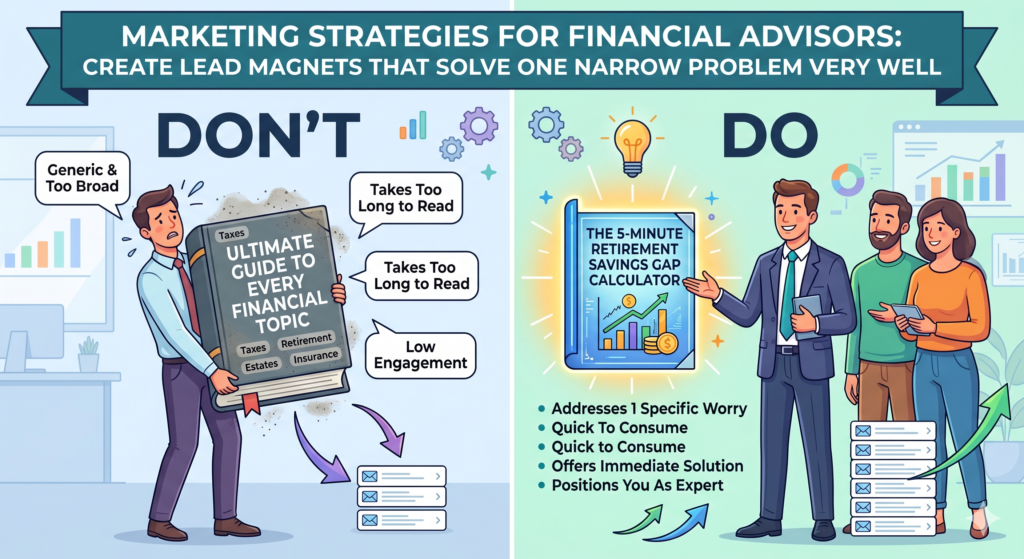
But the lead magnet must be useful. A vague guide like “10 Tips for Better Finances” will not feel strong enough in a crowded market. People already see too many basic tips online.
A better lead magnet solves one narrow problem for one clear audience.
The best lead magnets are tied to a decision
People are more likely to download a resource when it helps them make a decision they are already thinking about.
A person nearing retirement may want a checklist for the five years before retirement. A business owner may want a guide on what to review before selling a company. A family may want a college planning worksheet.
A high earner may want a tax planning checklist. A widow may want a guide on what to handle financially in the first year after losing a spouse.
These resources work because they feel timely and practical. They do not ask the prospect to care about a broad topic. They meet the prospect inside a real situation.
Your lead magnet should be simple enough to finish, but valuable enough to remember. It should not be a long report filled with heavy language. It should help the reader organize their thoughts and spot gaps.
A lead magnet should naturally lead to your service
A lead magnet should not be random. It should connect directly to the work you want to be hired for.
If you help people with retirement income, your lead magnet should reveal why retirement income planning is complex and why guidance matters. If you help business owners plan exits, your lead magnet should show the many personal and financial choices that come before a sale.
If you help executives with equity compensation, your lead magnet should help them see tax, timing, and risk issues.
This does not mean the resource should scare people. It should teach them.
The best lead magnets create a quiet moment of truth. The reader thinks, “This is more important than I realized,” or “I need to look at this more carefully.”
That is where trust begins.
Once someone downloads the resource, your follow-up should continue the same helpful tone. Do not rush into hard selling. Send useful emails that explain the next steps, common mistakes, real examples, and simple ways to think about the issue.
Use email marketing to stay trusted before prospects are ready
Most prospects will not book a call the first time they visit your website. They may not be ready. They may still be comparing options. They may need to talk with a spouse. They may be waiting for a life event. They may simply need more time to trust you.
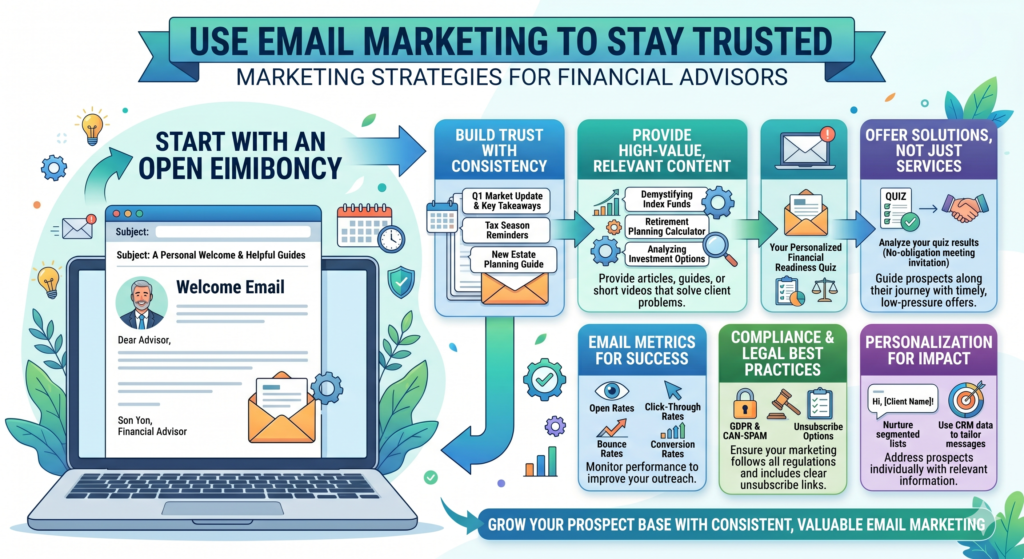
Email helps you stay in their world during that waiting period.
It is one of the most valuable marketing channels for financial advisors because it gives you a direct way to build trust without depending on social media or search engines every time.
Your welcome sequence should make people feel understood
When someone joins your email list, do not send only a basic thank-you message. Use the first few emails to deepen trust.
The first email should deliver the resource they requested and explain what they can expect from you. The next email can speak to the main problem they are facing. Another email can explain your point of view. Another can share a common mistake. Another can show when it may make sense to get help.
This sequence should feel like a calm conversation. It should not feel like a sales funnel.
For example, if someone downloads a retirement checklist, the follow-up emails can explain why retirement planning changes in the final five years of work, how taxes can affect income, why investment risk feels different near retirement, and what to review before choosing a retirement date.
Each email should be useful on its own. That way, even if the person does not book right away, they still feel helped.
Your regular emails should be simple, useful, and steady
After the welcome sequence, send regular emails that keep your firm visible. These emails do not need to be long. They need to be clear and relevant.
You can write about timely planning reminders, common client questions, market context, tax deadlines, retirement choices, estate planning basics, family money talks, or business owner decisions.
The key is to avoid sounding like a newsletter nobody asked for. Each email should have one main idea. It should open with a real concern or question. It should explain the issue in plain language. It should end with a thoughtful next step.
Email also gives you a way to show your personality. Your tone can be calm, warm, and practical. You can write like a real advisor talking to a real client.
Over time, this matters. When the prospect finally feels ready to talk, you may be the advisor they remember.
Build LinkedIn authority without sounding like every other advisor
LinkedIn can be very powerful for financial advisors, especially those who serve professionals, founders, executives, business owners, or high-income earners. But many advisors use LinkedIn in a way that feels too plain.

They post market updates, share links, celebrate firm news, or write broad money tips. There is nothing wrong with these posts, but they often fail to create a strong reason for someone to follow, trust, or contact them.
LinkedIn works better when you use it to show clear thinking.
Your posts should make your point of view easy to see
People do not remember advisors who repeat common advice. They remember advisors who explain money decisions in a way that feels clear, honest, and useful.
Instead of posting, “Start planning early for retirement,” explain what people often misunderstand about the final ten years before retirement. Instead of saying, “Diversification is important,” explain why a business owner with most wealth tied to one company may need a different kind of risk plan.
Instead of saying, “Work with a financial advisor,” explain the signs that someone has outgrown doing everything alone.
This turns basic advice into useful thought leadership.
Your LinkedIn content should make readers think. It should help them see a problem more clearly. It should give them language for something they have felt but not named.
Use stories and real situations without breaking privacy
Stories make financial content easier to understand. But financial advisors must be careful with privacy and compliance. You can still use story-based posts by creating general examples or common situations.
For example, you might write about a business owner who has strong revenue but very little personal wealth outside the company. You might write about a couple that has saved well but still feels nervous about retirement income. You might write about an executive who receives equity but does not have a clear plan for taxes and risk.
These examples do not need names or private details. They simply need to feel real.
A good LinkedIn post should sound like it came from experience, not from a content calendar. It should show that you understand the hidden worries behind financial decisions.
That is how LinkedIn builds authority. Not by being loud, but by being useful in public.
Use video to make trust form faster
Financial advice is personal. People want to know what it feels like to hear you explain something. This is why video can be so useful.
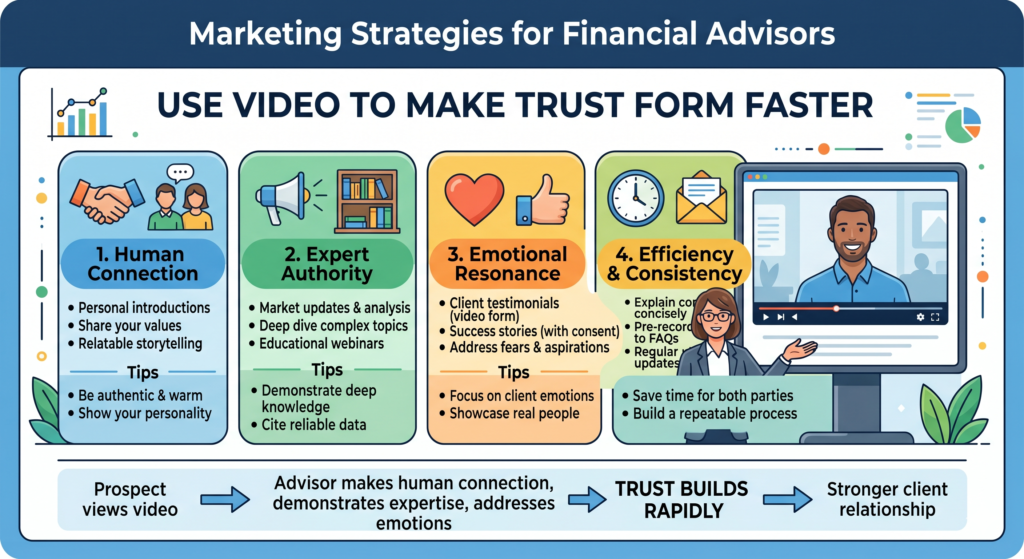
A written page can build trust, but video adds voice, face, pace, and warmth. It helps prospects feel more familiar with you before they book a call.
This does not mean you need fancy production. In fact, simple videos often work better because they feel more real. The message matters more than perfect lighting.
Short educational videos can answer common fears
The best advisor videos are often short and focused. They answer one question, explain one concept, or clear up one mistake.
You can create videos about what to do before retirement, how to think about market drops, why tax planning matters, how to prepare for a first advisor meeting, what business owners should review before selling, or how families can talk about money.
These videos can be used on your website, LinkedIn, YouTube, emails, and landing pages. One strong video can support many parts of your marketing.
The goal is not to become an online star. The goal is to make trust easier.
Your website should include video where trust matters most
Video is especially helpful on pages where prospects are deciding whether to take the next step. Your homepage, about page, process page, and key service pages can all benefit from short videos.
A homepage video can explain who you help and what your firm believes. An about page video can help people feel your human side. A process page video can explain what happens on the first call. A service page video can explain a common problem in simple words.
These videos should not be long speeches. They should feel direct and calm.
Speak like you would speak to a client. Avoid trying to sound polished. Avoid heavy terms. Avoid reading a script in a stiff way. A clear, human explanation is far more powerful than a perfect but cold video.
For financial advisors, trust is not built by looking bigger than you are. It is built by helping people feel safe, seen, and informed.
Use client reviews and proof in a careful, trust-building way
Financial advisors sell trust before they sell service. A prospect may like your website, agree with your content, and still feel unsure. That is normal. Money is personal. The wrong choice can feel costly. So people look for proof before they act.
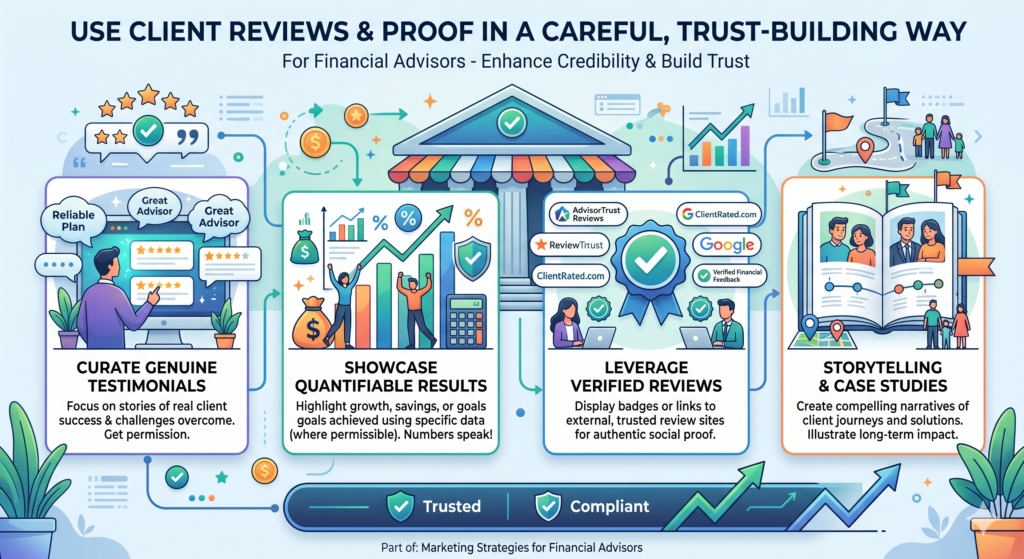
Proof does not always mean flashy claims. In financial services, proof should feel steady, honest, and careful. It should help people see that you are real, experienced, and trusted by others. It should not feel like hype.
The strongest proof often comes from clear signs of credibility. These can include client reviews where allowed, professional experience, case-style examples, media mentions, awards, education, speaking, helpful content, and a clear process. Each signal lowers doubt a little more.
Your proof should match what prospects are afraid of
A prospect is not only asking, “Is this advisor good?” They are also asking deeper questions. Will this person listen to me? Will they explain things clearly? Will they pressure me? Will they understand my needs? Will they be careful with my future?
Your proof should answer those fears.
For example, a review that says you helped someone feel calm and clear can be more powerful than a review that only says you are smart. A process page that shows exactly how meetings work can be more useful than a long list of services.
A simple case-style story about helping a business owner prepare for an exit can show more value than a plain paragraph about exit planning.
The key is to use proof in a way that supports the client’s emotional need for safety.
Compliance should guide how you share trust signals
Financial advisors must be careful with testimonials, reviews, performance claims, and client stories. Your marketing should always follow the rules that apply to your firm, license, location, and compliance team.
But being careful does not mean being silent.
You can still build trust by explaining your process, sharing educational content, using approved reviews, showing your professional background, and writing about common planning situations in a general way. You can show your thinking without revealing private details. You can show your experience without making promises.
The goal is not to stretch the rules. The goal is to make trust easier while staying clean and safe.
When proof feels honest, it works better. People can sense when marketing is trying too hard. A calm, clear, and careful proof strategy fits financial advisors much better than loud promotion.
Make your about page more personal and more useful
Many advisor about pages are too formal. They list job titles, credentials, years of experience, and a few personal hobbies at the end. That gives information, but it often does not create connection.
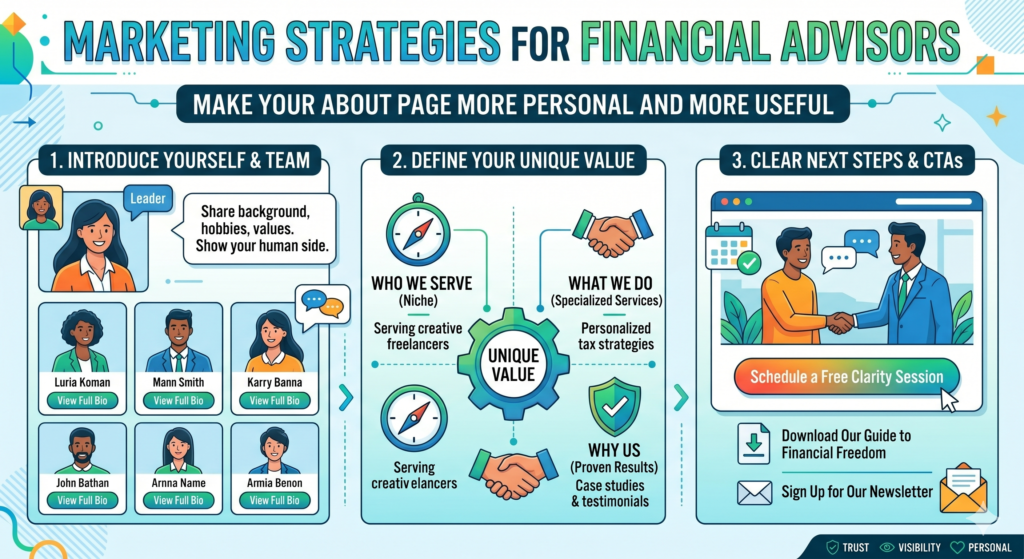
A strong about page should do more than introduce the advisor. It should help the prospect feel why your work matters, who you serve best, and what kind of experience they can expect from you.
People want to know the human behind the advice. They want to see judgment, values, care, and clarity. This does not mean your about page should become overly emotional. It means it should sound like a real person wrote it.
Your story should connect to the client’s story
The best about pages do not talk only about the advisor. They connect the advisor’s story to the client’s need.
For example, instead of saying only that you have worked in wealth management for many years, explain what you learned from helping people make big life decisions. Instead of saying only that you started your firm to offer better service, explain what you saw missing in the industry and how your approach solves that problem.
Your story should answer a simple question: why should this person trust you with this kind of decision?
If you serve retirees, your about page can speak to the care needed when work income stops. If you serve business owners, it can speak to the pressure of turning business success into personal freedom. If you serve young professionals, it can speak to the stress of making smart choices while life moves fast.
The reader should see themselves in your reason for doing the work.
Your bio should be warm, clear, and not too stiff
A bio does not need to sound like a legal document. It can still be professional while sounding human.
Use simple sentences. Explain what you do in plain words. Mention credentials, but do not let them take over the page. Talk about the problems you help solve. Share your values. Let your personality show in a natural way.
A good about page can include your belief about advice. For example, you may believe that financial planning should make life feel lighter, not more complex. You may believe people should understand their plan, not just receive a thick report. You may believe business owners need personal planning long before they sell.
This kind of belief makes your page memorable.
People hire advisors they trust. But before they trust your advice, they often need to trust your intent. Your about page is one of the best places to show that intent clearly.
Create a referral strategy that does not depend on luck
Most financial advisors want referrals. Many get them. But too few have a real referral strategy.
They hope happy clients will mention them. They hope centers of influence will remember them. They hope accountants, attorneys, business coaches, and estate planners will send people their way.
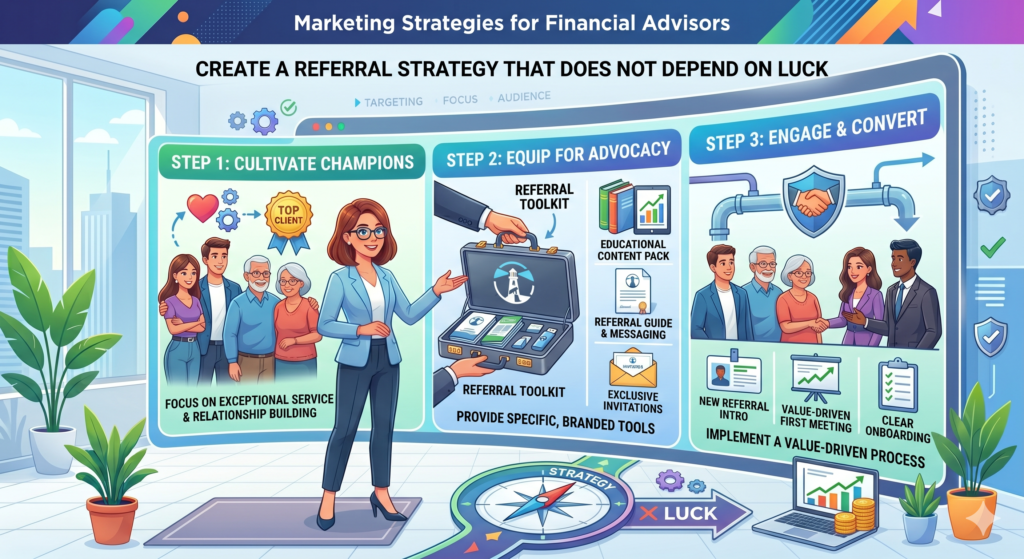
Hope is not a strategy.
A strong referral system makes it easy for the right people to understand who you help, when to refer, and how to introduce you. It also keeps you visible without making you seem needy.
Clients refer more often when they know exactly who you help
Many clients may like you, but still not know who to refer. If they think you help “anyone with money,” they may not think of you at the right time.
You need simple language clients can remember.
For example, you might say, “We do our best work with business owners who are within a few years of selling and want to make smarter personal financial choices before the deal.” Or you might say, “We help couples in their fifties and sixties turn savings into a clear retirement income plan.”
This kind of message gives clients a mental trigger. When they hear a friend mention selling a business or feeling nervous about retirement, they are more likely to think of you.
Referral marketing is not about pushing clients. It is about making your value easy to repeat.
Centers of influence need education, not just networking
Accountants and attorneys can be strong referral partners, but they are busy. They meet many advisors. A casual lunch is not enough to make you memorable.
You need to teach them what situations you are best at handling. Help them understand the signs that someone may need your guidance. Explain how your process works. Show how you make their work easier, not harder.
For example, an estate attorney may need to know that you help clients organize assets, clarify goals, and prepare for family wealth talks. A CPA may need to know that you help business owners think ahead before liquidity events, tax surprises, and retirement choices.
Make the relationship useful. Share insights. Send helpful content. Invite them into simple joint education. Stay in touch in a way that respects their time.
A good referral system is built on clarity, trust, and repeated value. It should not feel forced. It should feel natural because both sides understand the kind of client who benefits.
Build niche landing pages for high-value client groups
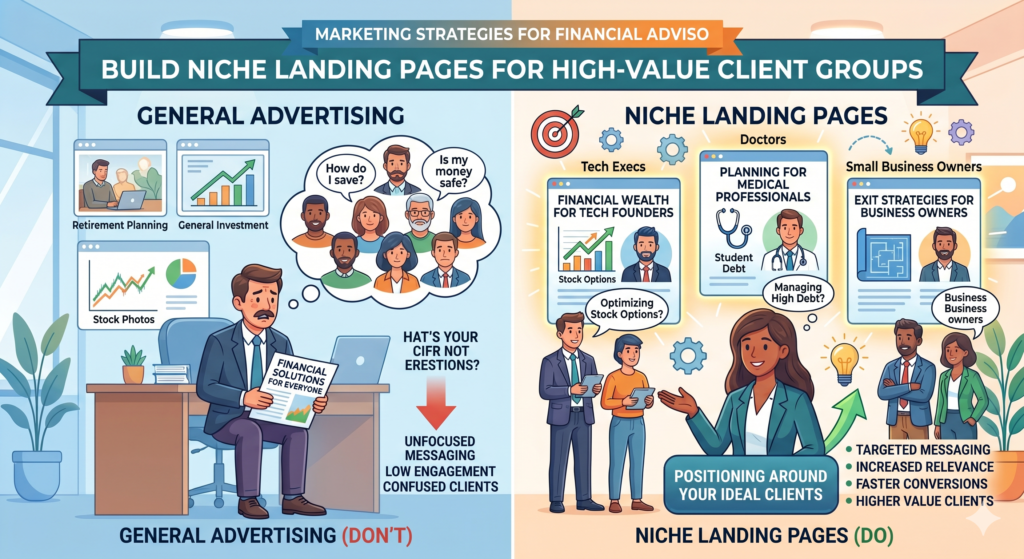
A niche landing page is a page built for one specific type of client. It is not the same as a general service page. A service page explains what you do. A niche page explains how your service applies to a specific person’s world.
This matters because different clients may need the same service for different reasons.
A doctor, founder, business owner, widow, executive, and retiree may all need financial planning. But their fears, questions, tax issues, time limits, and goals are not the same. If they all land on the same general page, the message may not feel personal enough.
Niche pages make prospects feel understood faster
A strong niche page begins with the life situation the reader is facing. It should show that you understand their world before you explain your service.
For example, a page for business owners should speak to uneven income, company risk, tax planning, exit timing, succession, and the challenge of separating business wealth from personal wealth.
A page for executives should speak to equity compensation, concentrated stock, tax timing, career changes, and retirement planning. A page for retirees should speak to income, healthcare, market risk, taxes, and family support.
This kind of page builds trust quickly because the reader does not have to translate your message into their life. You have already done that work for them.
Your page should feel specific without becoming complex. Use plain words. Name real concerns. Explain how your process helps.
Niche pages can support SEO, ads, and referrals
Niche pages are also useful because they can be used across many channels.
If someone refers a business owner to you, you can send them to your business owner page instead of a general homepage. If you run a local SEO campaign, you can connect a city page with a niche page.
If you post on LinkedIn about planning for executives, you can guide readers to a page built for executives. If you run paid search, you can send each audience to a more relevant page.
This improves the whole marketing system.
The page does not need to be long for the sake of being long. It needs to be complete. It should explain who the page is for, what problems they face, what mistakes to avoid, how your process helps, and how to take the next step.
A great niche page makes the reader feel like your firm was built with them in mind.
Use webinars to build trust at scale
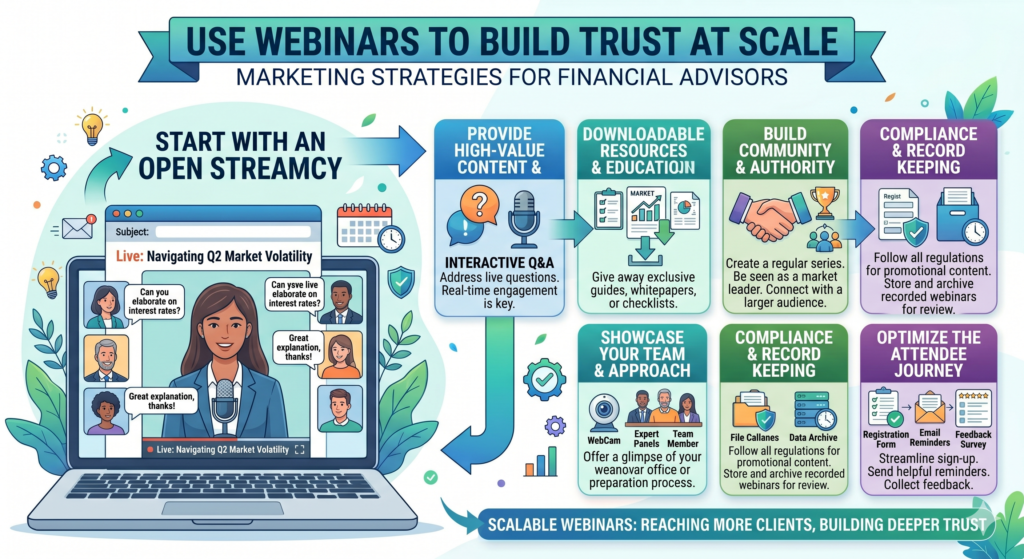
Webinars work well for financial advisors because they create time and attention. A blog post may get a few minutes. A LinkedIn post may get a few seconds. But a webinar can give you thirty to sixty minutes with people who care about one clear topic.
That time is powerful.
A webinar lets prospects hear your voice, see how you explain things, and understand your point of view. It also gives them a safer first step than booking a private call. They can learn from you without feeling exposed.
The best webinars focus on urgent questions
A weak webinar topic sounds too broad. Something like “Financial Planning Basics” may not feel strong enough to make people register.
A better webinar topic speaks to a clear moment or worry.
For example, “What to Review Before You Retire in the Next Five Years” is stronger. “How Business Owners Can Prepare Their Personal Finances Before Selling” is stronger. “How to Think About Taxes, Income, and Risk Before Leaving Work” is stronger.
The more specific the topic, the easier it is for the right person to say yes.
Your webinar should not be a long sales pitch. It should teach. It should help the audience see the issue more clearly. It should explain common mistakes, key choices, and signs that a person may need deeper help.
The follow-up matters as much as the event
Many advisors put effort into the webinar but fail to follow up well. That wastes the attention they earned.
After the webinar, send a simple thank-you email with the replay. Then send a few follow-up emails that expand on the topic. One email can answer a common question. Another can explain a mistake to avoid. Another can share what a planning process looks like. Another can invite people to book a fit call.
The tone should stay helpful. Do not switch from teaching to pressure.
A webinar is often the start of trust, not the end of the sales process. Some people will book right away. Others may wait months. Keep helping them through email and content.
When done well, webinars can create a strong bridge between education and action. They let prospects experience your advice before they become clients.
Create a clear follow-up system for every new lead
A lead is not the same as a client. Someone may download a guide, attend a webinar, fill out a form, or ask a question, but that does not mean they are ready to move right away.
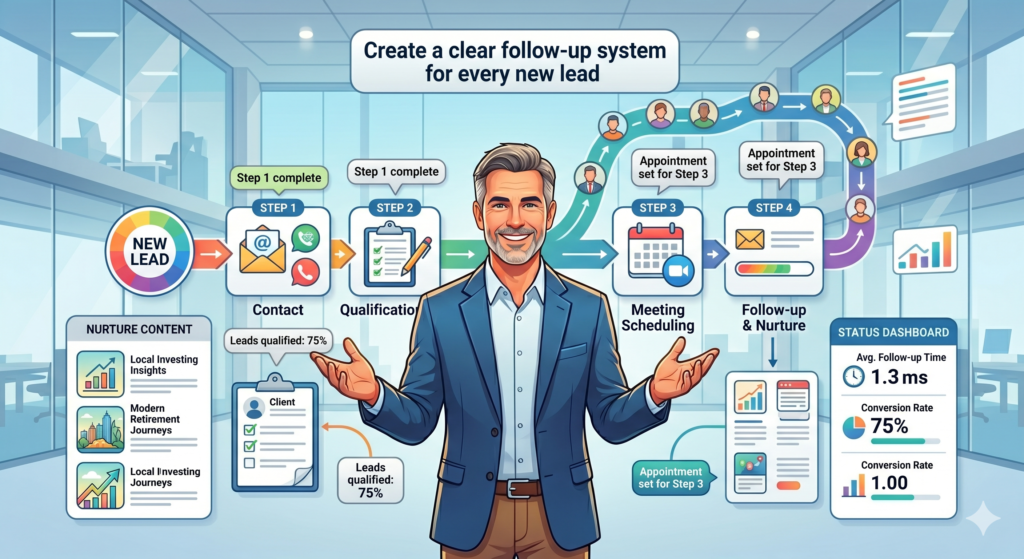
Many financial advisors lose leads because the follow-up is weak, slow, or unclear. They send one reply and then stop. Or they follow up in a way that feels too sales-heavy. Or they rely on memory instead of a simple system.
A strong follow-up system helps you stay helpful without chasing.
Speed matters, but tone matters more
When someone reaches out, reply quickly. A fast response shows care and professionalism. But speed alone is not enough. The message should also feel calm, clear, and personal.
If someone asks about retirement planning, your response should mention their concern and explain the next step. If someone downloads a business owner guide, your follow-up should connect to the decision they may be facing. Avoid sending cold, canned messages that make people feel like a number.
A good first response should make the person feel safe. It should thank them, reflect the reason they reached out, explain what happens next, and make it easy to book or reply.
This is where many firms can improve quickly. Better follow-up can raise results without increasing traffic.
Use a simple lead stage system
You do not need a complex system to start. You need a clear way to track where each lead stands.
A new lead may be someone who just joined your list. A warm lead may be someone who attended a webinar or replied to an email. A sales-ready lead may be someone who visited a service page, asked about fees, or booked a call. A long-term lead may be someone who is not ready yet but still fits your audience.
Each stage should have a next step. New leads get a welcome sequence. Warm leads get more education. Sales-ready leads get direct personal follow-up. Long-term leads stay in your regular email system.
This keeps good prospects from falling through the cracks.
Follow-up is not about pushing people before they are ready. It is about respecting their timing while staying useful. When the need becomes urgent, the advisor who stayed present often gets the call.
Use paid ads only when your message and landing page are already clear
Paid ads can work for financial advisors, but they can also waste money very quickly. The problem is not always the ad platform. The problem is often the strategy behind the ad.
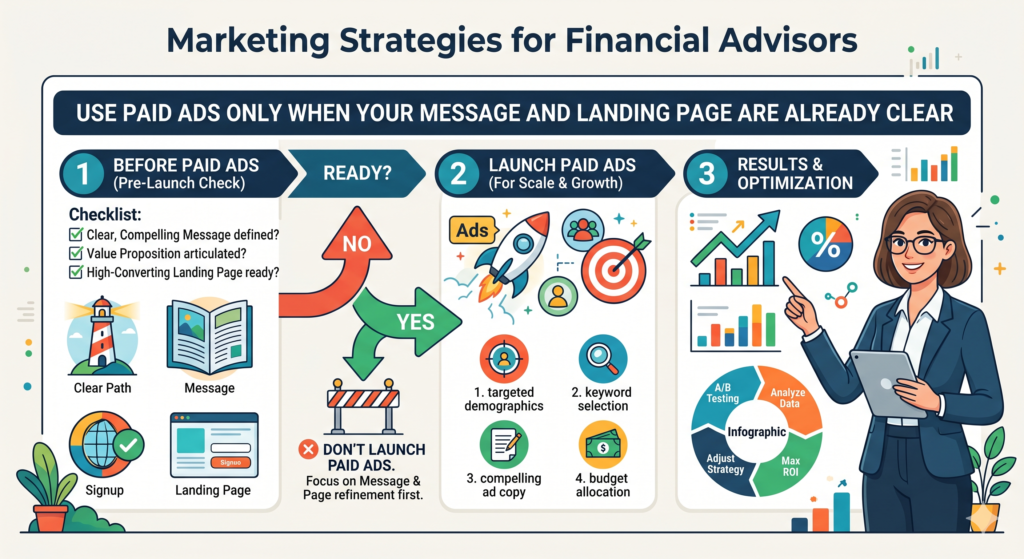
Many advisors run ads before their message is ready. They send people to a weak homepage. They target too broad an audience. They offer a vague guide. They expect strangers to book a call before trust has been built. Then they decide ads do not work.
Ads can work, but only when the full path is strong.
A paid ad is not magic. It is a way to put your message in front of the right person faster. If the message is unclear, the offer is weak, or the page does not build trust, ads will only help you lose money faster.
Paid search works best when the person already knows they need help
Paid search can be useful because it reaches people when they are actively looking. Someone searching for “retirement planner near me” or “financial advisor for business owners” is showing intent. They are not just scrolling. They are asking for help.
This makes paid search different from social ads. With search, the need often comes first. With social ads, the interruption comes first.
For financial advisors, paid search should usually focus on high-intent terms. These terms may cost more, but they are often more valuable because the person is closer to action.
The mistake is chasing cheap clicks. A cheap click from the wrong person is still expensive. A costly click from the right person may be worth it if your service value is strong and your follow-up process is good.
Your paid search ads should match the exact page they lead to. If the ad says you help business owners plan before selling, the landing page should be about business owners planning before selling. Do not send that person to a general homepage and make them search for the answer.
Social ads need a softer first step
Social ads can work, but they usually need a different approach. People on LinkedIn, Facebook, or Instagram may not be looking for an advisor at that exact moment. They may still have a problem, but they are not actively searching.
That means the offer should often be educational, not direct.
A guide, checklist, webinar, or short quiz can work better than asking for a call right away. The goal is to start a relationship. Once the person joins your list, email can build trust over time.
For example, a LinkedIn ad for executives could offer a guide on avoiding common mistakes with equity compensation. A Facebook ad for people nearing retirement could offer a checklist for the five years before retirement. A local ad could invite people to a live retirement planning webinar.
The ad should name a real problem. The landing page should feel safe and clear. The follow-up should teach before it sells.
Paid ads should not be your first marketing move. They should come after your positioning, website, offer, and follow-up are strong enough to convert the attention you buy.
Make your offer clear enough that people know why they should book a call
Many financial advisors do not have a clear offer. They have services, but the offer is not easy to understand.
A service is what you provide. An offer is the reason someone acts now.
“Financial planning” is a service. “A retirement readiness review for couples who want to know if they can stop working in the next five years” is much closer to an offer.
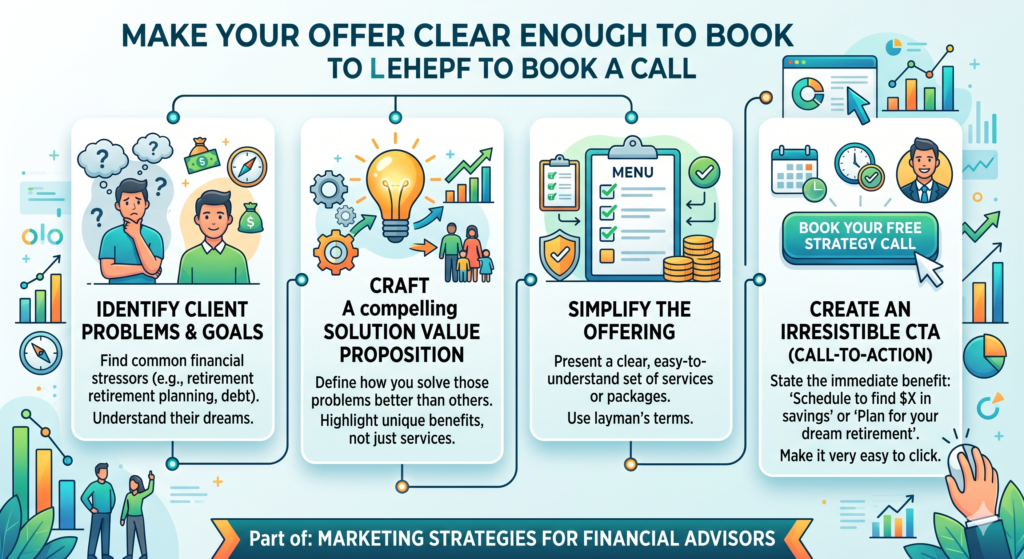
This matters because prospects are busy and unsure. They may know they need help, but they may not know what kind of help to ask for. A clear offer makes the first step easier.
Your first step should feel specific and useful
A weak call to action says, “Schedule a consultation.” That may work for people who are already ready, but it may feel too vague for many others.
A stronger first step gives shape to the call.
For example, you might offer a “fit call” where you learn about the prospect’s situation and see if your firm can help. You might offer a “retirement clarity call” for people who want to understand what they should review before leaving work. You might offer a “business owner planning review” for owners who are within a few years of selling.
The point is not to create a gimmick. The point is to make the first step feel tied to the prospect’s real need.
When the offer is clear, people know why they are booking. They also know what kind of conversation they are entering. This lowers fear and increases action.
The page should explain what happens after they book
Even a strong offer can fail if the next step feels unclear.
People may wonder how long the call is, what they need to prepare, whether there is a cost, whether they will be pressured, and what happens after the call. If your page does not answer these questions, doubt grows.
A simple explanation can make a big difference.
Tell people what the first call is for. Explain that the goal is to understand their situation, answer initial questions, and see whether there is a fit. Let them know whether they need to bring documents. Tell them what the next step may be if both sides agree to move forward.
This kind of clarity builds trust before the conversation begins.
The best offers do not feel like sales tricks. They feel like helpful doors into a larger relationship. They help the right people raise their hand at the right time.
Conclusion
Marketing for financial advisors works best when it feels clear, calm, and useful. People do not choose an advisor because of one clever post or one nice-looking website. They choose the advisor who understands their problem, explains the path, earns trust, and makes the next step feel safe.
Your strategy should start with a clear audience, strong positioning, helpful content, simple follow-up, and a client experience worth talking about. When each part works together, marketing stops feeling random. It becomes a steady trust-building system that attracts better clients and helps your firm grow with purpose.
















Comments are closed.