
WinSavvy Editorial Standards
How this article was created
Referral marketing works because people trust people far more than they trust ads. A happy customer can sell your brand in a way no paid campaign can. They do not sound polished. They do not sound scripted. They sound real. And that is exactly why their words carry weight.
Build a referral offer that feels easy to say yes to
A referral campaign starts with the offer, but the offer is not just about the reward. Many brands make the mistake of thinking a bigger discount will automatically bring more referrals. It can help, but only if the offer feels clear, useful, and fair to both sides.
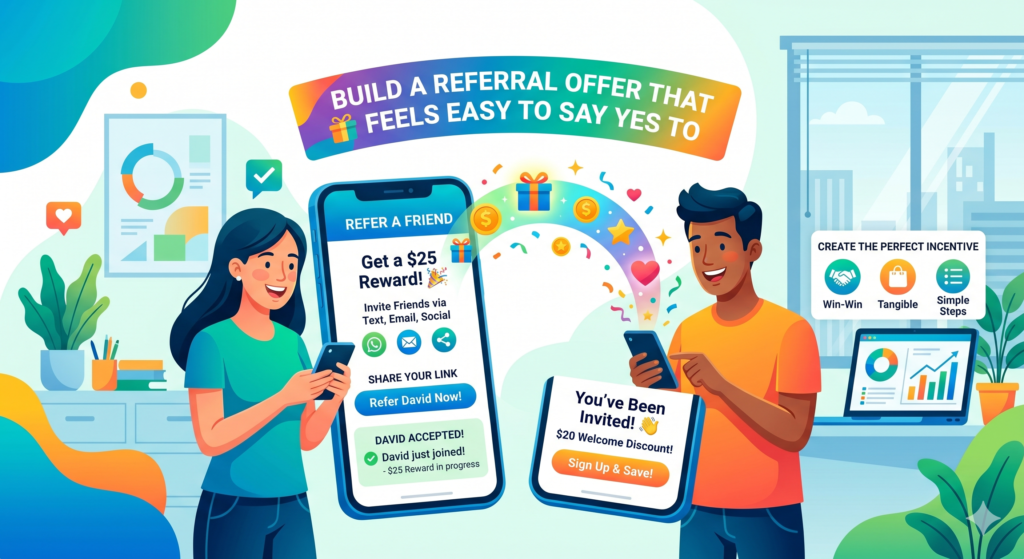
The best referral offers work because they remove doubt. Your customer should know exactly what they get, what their friend gets, and why sharing the offer makes sense right now. If they have to stop and think too much, they will not share it.
If the reward feels weak, they will ignore it. If the message feels awkward, they will avoid it because they do not want to look like they are pushing a sale.
A strong referral offer should make your customer feel like they are helping someone, not selling something. That shift is important. People love sharing things that make them look smart, kind, useful, or ahead of the crowd. They do not want to feel like unpaid salespeople. So your offer should be shaped around the value their friend gets first.
Make the friend’s reward just as strong as the customer’s reward
Many brands reward only the person making the referral. This may bring some action, but it can also make the referral feel selfish. The customer may think, “I am only sending this because I get something.” That small feeling can stop them from sharing.
A better approach is to reward both people. This creates a cleaner emotional reason to share. The customer is not just earning a bonus. They are giving their friend a useful deal, a better start, or special access. That makes the referral feel generous.
For example, instead of saying, “Refer a friend and get $20,” the message can say, “Give your friend $20 off their first order, and we’ll thank you with $20 too.” The second version feels warmer. It puts the friend first. It makes the customer feel like they are opening a door for someone else.
This is especially important for service businesses, SaaS brands, agencies, online stores, and subscription offers. When both people benefit, the referral feels balanced. Nobody feels used. Nobody feels tricked. The offer becomes easier to send and easier to accept.
Frame the referral as a helpful invite, not a sales pitch
The words you use around your referral offer matter a lot. A cold line like “Invite people and earn rewards” may be clear, but it does not create emotion. It sounds like a task. A better message makes the customer feel like they are sharing something useful.
You can say something like, “Know someone who would love this? Send them your private link and give them a better first experience.” This feels lighter and more human. It also gives the customer a reason to think of a real person, not a random group of contacts.
The goal is to make sharing feel natural. Your customer should be able to imagine sending the offer to a friend with a simple note. If the referral feels like a coupon blast, it will not travel far. If it feels like a personal recommendation, it has a much better chance.
Keep the reward simple enough to understand in seconds
A referral offer should not need a long explanation. If the customer has to read terms, compare tiers, or calculate points, you will lose them. Simple rewards are easier to remember and easier to share.
This does not mean the reward has to be boring. It only means the main promise should be clear. “Give $25, get $25” is clear. “Give one free month, get one free month” is clear. “Invite three friends and unlock a private strategy session” can also be clear if the value is strong and the steps are simple.
The more complex your offer is, the more friction you create. Friction kills referrals because referrals are often impulse actions. A customer may think of a friend while reading an email, finishing a purchase, or using your product. If sharing takes too long, that moment passes.
Ask for referrals at the moment of highest trust
Most referral campaigns fail because brands ask at the wrong time. They ask too early, before the customer has seen value. Or they ask too late, when the customer’s excitement has faded. Timing can make the difference between a referral that feels natural and one that feels forced.
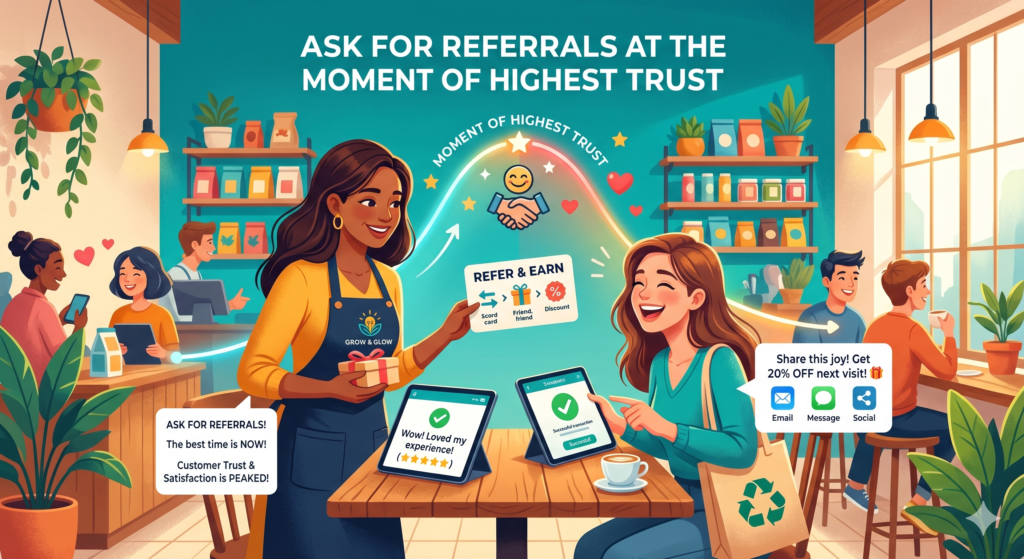
A customer is most likely to refer when they feel happy, relieved, proud, or impressed. These moments are called trust moments. They happen when the customer gets a result, solves a problem, receives great support, leaves a good review, renews a plan, or makes a repeat purchase.
If you ask during these moments, the customer does not need much convincing. They already feel good about your brand. Your request matches their mood. That is why timing is often more powerful than the reward itself.
Find the moments when customers feel a clear win
Every business has moments where customers feel value more strongly. For an ecommerce brand, it may be after fast delivery or after a second purchase. For a software company, it may be after a user completes setup, saves time, or reaches a usage milestone. For a marketing agency, it may be after a client sees lead growth, better rankings, or stronger campaign results.
The key is to map these moments instead of asking randomly. Look at your customer journey and ask where people are most likely to think, “This was worth it.” That is where the referral ask belongs.
For example, a fitness app should not ask for referrals the minute someone signs up. The user has no proof yet. But after they complete a seven-day streak or hit a personal goal, the ask feels much more natural. They have a story now. They can tell a friend, “This helped me stay on track.”
The same idea works for service firms. A digital marketing agency should not ask for referrals right after the contract is signed. The client is still taking a risk. But after a strong monthly report, a campaign win, or a successful launch, the agency has earned the right to ask.
Turn positive customer actions into referral triggers
You should not depend only on manual follow-up. Strong referral systems are built around triggers. A trigger is a customer action that tells you the person may be ready to share.
A customer who gives a high rating is a referral trigger. A customer who leaves a positive review is a trigger. A customer who buys again within a short time is a trigger. A customer who opens several emails, uses your product often, or upgrades their plan may also be ready.
Once you identify these actions, you can create simple referral prompts around them. The message does not need to be long. It should feel like a natural next step.
For example, after a customer leaves a five-star review, you can say, “Thank you for the kind words. If someone you know could use the same result, here is a private link you can share with them.” This works because the customer has already said they are happy. You are not asking them to do something out of nowhere.
Avoid asking when the customer is busy, confused, or waiting
Bad timing can make even a good offer feel annoying. Do not ask for referrals while the customer is still waiting for support, dealing with a failed payment, trying to understand your product, or facing a delay. These moments create stress. A referral request during stress feels tone-deaf.
You should also avoid asking too many times in a short period. Referral fatigue is real. If every email, popup, and dashboard message asks for a referral, customers start ignoring the request. Worse, they may feel like your brand cares more about growth than their experience.
A referral ask should feel earned. When the customer wins, ask. When they are confused, help. When they are upset, fix the problem. This simple rule protects trust.
Make sharing so easy that customers do not have to think
Even happy customers will not refer if the process is hard. People are busy. They may like your brand, but they will not hunt for a link, write a message from scratch, explain your value clearly, and follow up with friends. That is too much work.
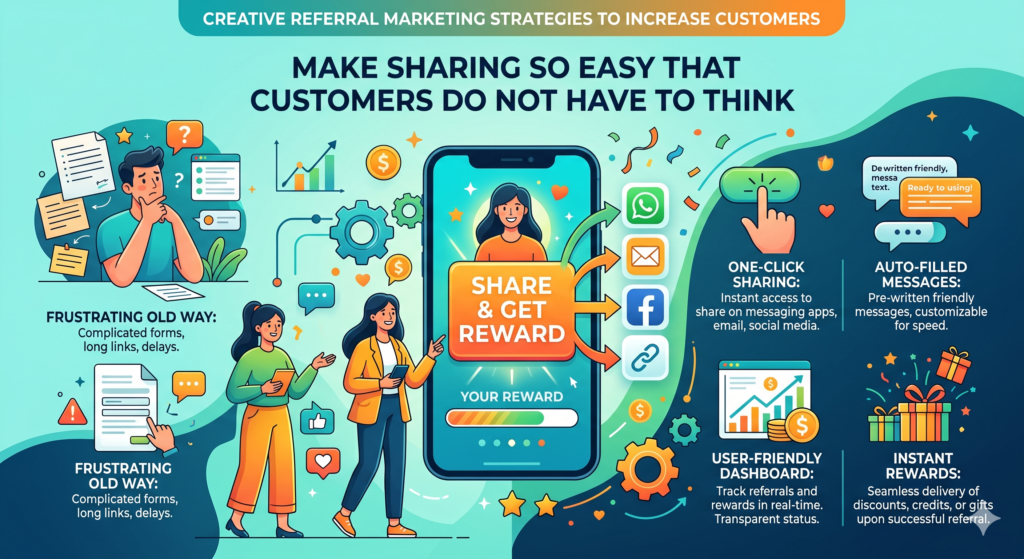
Your job is to remove as much effort as possible. The best referral systems feel almost effortless. The customer can share in a few seconds, with a message that already sounds natural, through the channel they already use.
Ease matters because referrals usually happen in small windows of attention. A customer may think of a friend while checking an order confirmation. They may remember a coworker while reading a case study. They may want to share while using your app. If your referral process is not ready in that moment, the chance can disappear.
Give customers ready-made messages they can edit
Most customers are not copywriters. They may love your product but struggle to explain it in a short, clear way. This is why ready-made referral messages are so useful. They give customers a starting point.
The message should sound like something a real person would send. It should not be too polished. It should not sound like an ad. A simple message works better because it feels more personal.
For example, a referral message could say, “I’ve been using this and thought it might help you too. This link gives you a better first deal.” That is plain, warm, and easy to send. The customer can add their own note if they want, but they do not have to start from zero.
You can create different messages for email, WhatsApp, LinkedIn, SMS, and social media. Each channel has a different style. A LinkedIn message may be a little more professional. A WhatsApp message should feel casual. An email can include more detail. The easier you make each option, the more likely people are to share.
Place the referral link where customers already take action
Do not hide your referral program in the footer. Do not make customers search through account settings. If referrals matter, the link should appear in places where customers naturally engage with your brand.
Good places include order confirmation pages, thank-you pages, customer dashboards, email receipts, post-purchase emails, review request flows, loyalty account pages, and milestone messages. These are moments when the customer is already active.
For a service business, the referral link can also appear in monthly reports, client update emails, project wrap-up messages, and success recap documents. This works well because the referral request is connected to real value.
A client who just saw strong results is far more likely to share than a client who receives a random referral email on a quiet Tuesday. Context helps the ask feel right.
Reduce the number of steps between interest and sharing
A referral flow should be short. The customer should not have to log in again, fill out a long form, choose from too many reward options, or copy confusing codes. Every extra step reduces action.
A clean flow might look like this: the customer clicks “Refer a friend,” sees their personal link, chooses a channel, and sends a ready-made message. That is enough.
If you need more information, collect it later. Do not make the first step heavy. The first goal is sharing. Once the friend clicks, you can guide them through the next stage.
This same rule applies to the referred friend. They should land on a page that explains the offer clearly. They should see who invited them, what they get, and what to do next. If the landing page feels generic or confusing, the referral loses power.
Use customer identity to make referrals feel personal
People refer brands that say something about who they are. This is why identity is so important in referral marketing. Customers are more likely to share when the act of sharing makes them feel smart, helpful, stylish, thoughtful, successful, or part of a group.
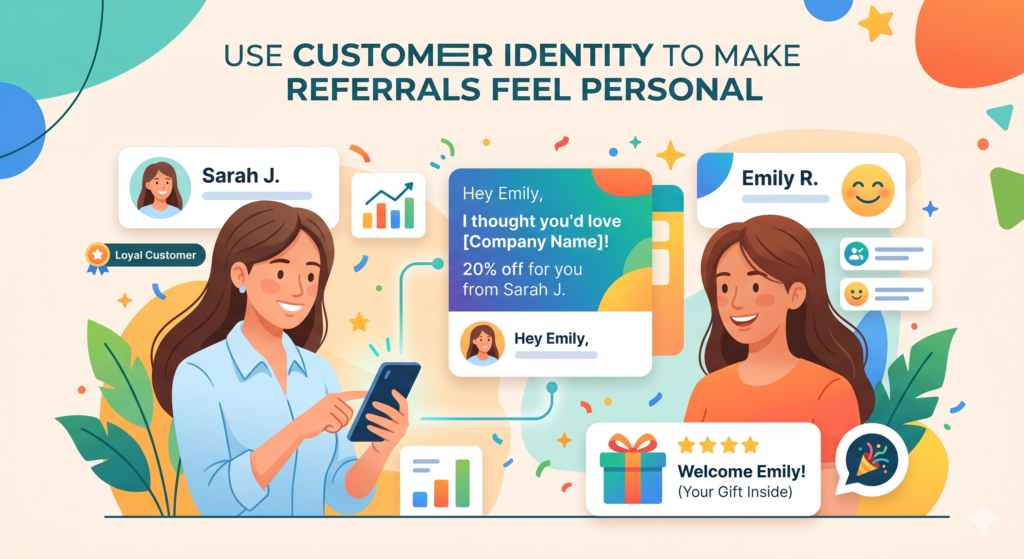
A basic reward can get attention, but identity creates deeper motivation. When customers feel proud to be connected with your brand, they are more willing to talk about it. They do not just share because they get a discount. They share because the brand reflects something they like about themselves.
This is where creative referral marketing becomes more than a growth tactic. It becomes a brand-building tool. You are not only asking people to invite friends. You are giving them a role in your story.
Create referral language that matches how customers see themselves
Your referral message should not sound the same for every brand. A luxury skincare brand, a fitness app, a B2B software tool, and a marketing agency should not use the same words. Each customer group has a different reason for sharing.
A fitness brand might make the customer feel like an accountability partner. A finance app might make the customer feel smart and responsible. A marketing agency might make the client feel helpful to another founder who needs growth. An ecommerce brand might make the customer feel like someone with good taste.
The best referral language speaks to that identity. Instead of saying, “Refer a friend,” a fitness brand could say, “Help a friend start strong.” A marketing agency could say, “Know a founder who needs better leads? Send them our way.” A premium brand could say, “Share your private invite.”
These small wording shifts matter. They turn a basic referral into a personal action.
Let customers feel like insiders, not promoters
People like being early. They like having access. They like being the person who knows about something before others do. You can use this feeling in your referral strategy by making customers feel like insiders.
Instead of saying everyone can refer, you can frame the program as a customer-only invite. This does not have to be fake scarcity. It can simply mean that only customers get a private link to share.
For example, “Your private invite link is ready” feels more special than “Join our referral program.” The first phrase makes the customer feel selected. The second sounds like a task.
This works especially well for launches, beta programs, waitlists, coaching offers, community products, and premium services. People are more likely to share when the invite feels like access, not advertising.
Build referral moments around pride and progress
Customers are more likely to share when they have something to show. This is why progress-based referral prompts can work so well. When someone reaches a milestone, completes a challenge, earns a result, or unlocks a status, they are already in a proud state.
A language learning app can ask for referrals after a user finishes a level. A design tool can ask after someone publishes their first project. A marketing agency can ask after a client sees a strong campaign improvement. A course creator can ask after a student completes a module or earns a certificate.
The message should connect the referral to the moment. You might say, “You just completed your first milestone. Know someone who should start too?” This feels natural because it builds on the customer’s progress.
Pride is a strong sharing driver. When customers feel proud, they want others to know. Your referral system should give them a simple way to turn that pride into action.
Turn your best customers into referral partners before asking everyone else
Not every customer will refer with the same energy. Some customers buy once and leave quietly. Some like your brand but never talk about it. Others become true fans. They open emails, reply to messages, leave reviews, share posts, buy again, and tell people about you without being asked.
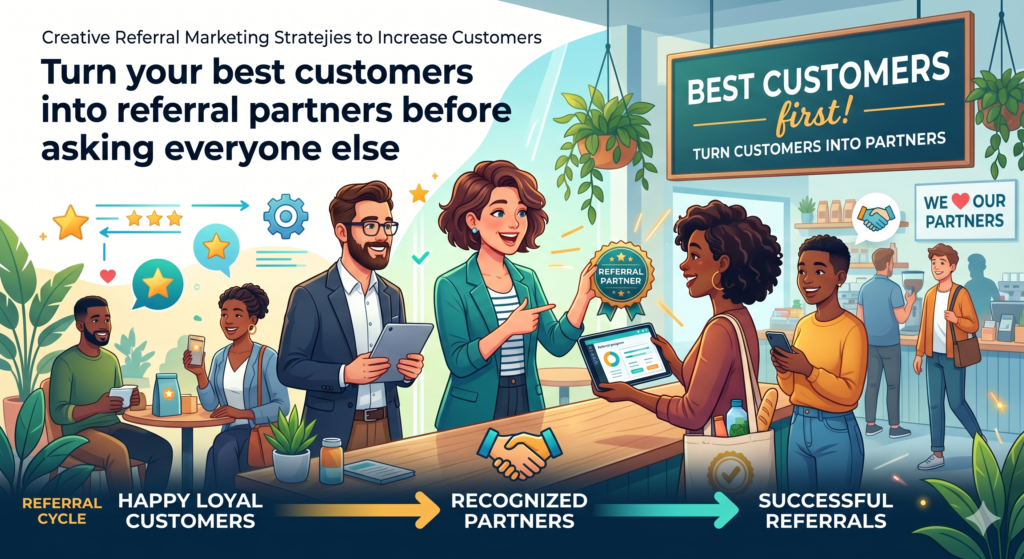
These people should not be treated the same as everyone else. They are your first referral partners. Before you launch a broad referral campaign, you should find these customers and build a closer relationship with them.
A smaller group of active fans can often bring better results than a large group of cold customers who barely remember your brand.
The goal is not to pressure loyal customers. The goal is to invite them into something that feels more personal. When people already like your brand, they often enjoy being seen. They like knowing their support matters. They like being part of your growth story, especially when the relationship feels human.
Find customers who already show signs of loyalty
You do not need to guess who your best referral partners are. Their behavior will usually show you. Look for people who have bought more than once, renewed their plan, left kind reviews, opened many emails, replied to your team, joined your community, attended events, or sent positive feedback.
For service businesses, the signs may look a little different. A strong referral partner may be a client who gives detailed praise after reports, sends fast replies, trusts your advice, renews without stress, or speaks well of your work in meetings. These clients may not always think to refer you on their own, but they may be very willing when asked the right way.
Once you find these people, do not send them the same generic referral email everyone gets. Start with a personal message. Thank them for being a great customer. Tell them why you thought of them. Then explain the kind of person or business you can help.
This matters because strong customers often want to refer well. They do not want to send random leads. They want to know who is a good fit. When you guide them clearly, you make it easier for them to think of the right person.
Give loyal customers a more personal referral invitation
A good personal referral message should feel warm and direct. It should not sound like a mass campaign. It should show that you know the customer and respect the relationship.
For example, a marketing agency could say, “You have been great to work with, and we are glad the campaigns are moving in the right direction. If you know another founder who is struggling to get steady leads, we would be happy to help them in the same careful way.” This feels human. It also tells the client exactly who to think about.
An ecommerce brand could send a different type of message. It might say, “You have been with us for a while, and we are so grateful. We created a private invite for customers like you, so you can give friends a better first order.” This feels like a thank-you, not a demand.
The more personal the request feels, the more likely the customer is to act. People ignore campaigns. They respond to real people.
Make your best customers feel valued before you ask
A referral request should never feel like the first time you truly notice a customer. If the only time you reach out personally is when you want a referral, the ask can feel selfish.
Before asking, show real appreciation. Send a thank-you note. Feature their success if they agree. Offer early access. Give them a small surprise. Invite them to a private session. Share a useful idea based on their needs. These gestures do not need to be costly. They only need to feel sincere.
For a digital marketing agency, this can be very powerful. Before asking a client for referrals, send them a short growth insight they did not ask for. Point out a quick win on their website. Share a competitor angle. Give them a helpful idea they can use right away. Then, when you later ask for a referral, the relationship already feels generous.
Referral marketing works best when it grows out of goodwill. If customers feel seen, helped, and respected, the ask becomes much easier.
Create referral stories that customers can repeat easily
A referral is not just a link. It is a story. When someone recommends your brand, they rarely say, “Use this company because they have a referral program.” They say something like, “This helped me save time,” or “They made the process simple,” or “I finally got the result I wanted.”
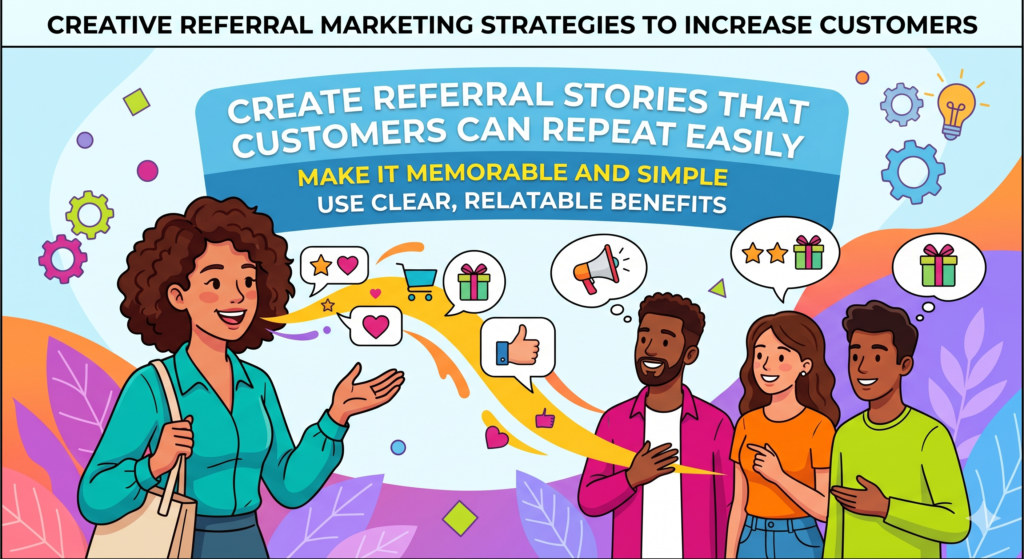
That is why your referral strategy needs a clear story customers can repeat. If customers cannot explain why your brand is useful in one or two plain sentences, they will not refer with confidence. They may like you, but they will not know how to talk about you.
Your job is to give customers simple language that sounds natural. This does not mean scripting them in a fake way. It means helping them understand the strongest reason to share your brand.
Turn your main value into a simple referral sentence
Every referral campaign should be built around a clear sentence. This sentence should explain what your brand helps people do and why that matters. It should be short enough that a customer can remember it.
For example, a project management tool might use the idea, “It helps small teams stop losing work in chats.” A meal service might use, “It makes healthy meals easier on busy days.” A marketing agency might use, “They help growing businesses get better leads without wasting money on random tactics.”
These sentences are not slogans. They are shareable ideas. They give customers a simple way to explain your value.
If your business has many features, this becomes even more important. Customers do not refer long feature lists. They refer outcomes. They talk about what changed after they used you. So keep your referral story close to the result.
Use customer words instead of brand words
The best referral language often comes from customers themselves. Read your reviews, testimonials, support replies, survey answers, and sales calls. Look for the simple phrases customers use when they describe your value.
They may say things like, “It saved me hours,” “I finally understood what to do,” “The setup was painless,” “The team actually listened,” or “I saw results faster than expected.” These phrases are gold because they sound real. They do not feel like marketing language.
Once you find these phrases, use them in referral emails, landing pages, share messages, and thank-you pages. A customer is more likely to share a message that sounds like something they would actually say.
For WinSavvy-style marketing, this is especially useful. Many businesses are tired of vague marketing promises. They want simple, direct outcomes. If a client says, “They helped us stop guessing and gave us a clear plan,” that line may be more powerful than a polished agency tagline.
Give customers examples of who should be referred
Many customers do not refer because they are not sure who would be a good fit. They may know many people, but they need a mental shortcut. You can help by naming the type of person who would benefit.
A referral prompt should not say only, “Know someone?” That is too broad. It should guide the customer’s memory. For example, “Know a founder who is spending on ads but not seeing enough leads?” is much stronger. It helps the customer picture a real person.
For an online course, you might say, “Know someone who wants to learn this but keeps putting it off?” For a software tool, you might say, “Know a team still managing this in spreadsheets?” For a skincare brand, you might say, “Know someone who wants a simple routine that does not feel confusing?”
The more specific the prompt, the easier it is for customers to remember someone. A vague ask creates silence. A clear ask creates names.
Build referral rewards that go beyond discounts
Discounts are common in referral marketing because they are easy to understand. But they are not always the best reward. In some markets, discounts can make your brand feel cheaper. In others, they may attract people who only care about saving money. That does not mean discounts are bad. It means they should not be your only idea.
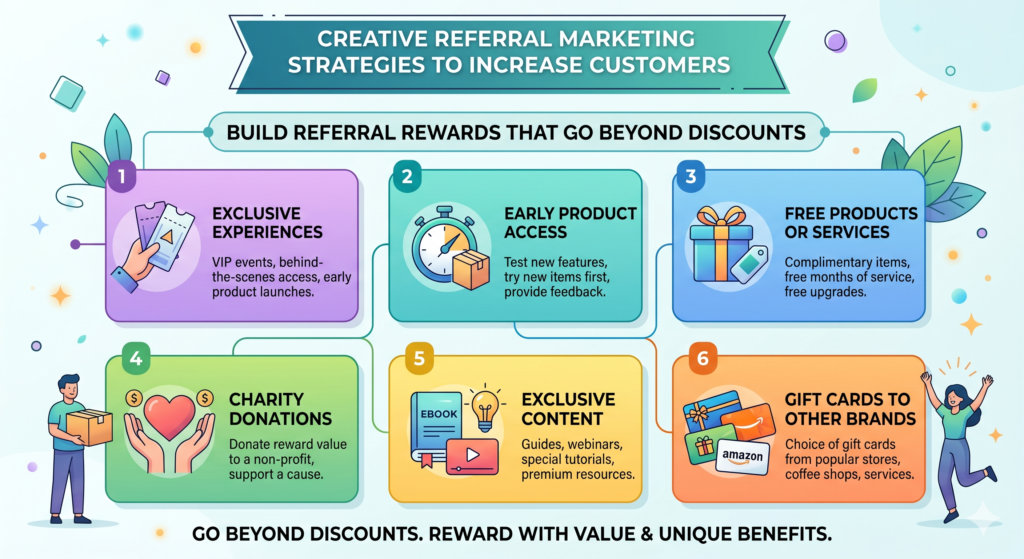
Creative rewards can make referrals feel more exciting and more aligned with your brand. They can also make loyal customers feel special instead of simply paid. The best reward depends on what your customers value most. Some want savings. Some want access. Some want status. Some want help. Some want better results.
When you understand what your customers truly care about, you can design referral rewards that feel much more powerful than a basic coupon.
Offer rewards that improve the customer’s experience
A strong reward does not always need to be cash. In fact, rewards that make the product or service better can be more useful. They keep customers engaged while encouraging referrals.
A SaaS company could offer extra features, more usage, premium templates, advanced reports, or a free month. A course creator could offer a private workshop, bonus lesson, or live review. An ecommerce brand could offer early access, a limited product, or free shipping for a period.
A marketing agency could offer a free audit, a strategy call, or added support for a campaign.
These rewards work because they deepen the customer’s relationship with your brand. They do not just pay the customer to leave and tell someone. They bring the customer back into the experience.
This also helps you protect profit. A discount cuts revenue. An experience-based reward may cost less while feeling more valuable.
Use status as a reward when your audience cares about belonging
Some customers are motivated by recognition. They like reaching levels, unlocking titles, or being part of a special group. This works well when your brand has a strong community, a clear mission, or a customer base that likes progress.
You can create simple referral status levels, but they should not feel childish. The goal is to make people feel appreciated, not trapped in a game. A customer who refers one person could become an insider. A customer who refers three could get early access. A customer who refers five could join a private group or receive a personal session.
For B2B brands, status can be more professional. You might create a partner circle, founder network, client advisory group, or private roundtable. The reward is not just a badge. It is access to better conversations and useful people.
This can work very well for agencies. Clients who refer strong leads may value a private growth session, a benchmark report, or access to a small founder group more than a simple gift card.
Match the reward to the value of the customer you want
Not all referrals have the same business value. A $30 product referral and a $30,000 service referral should not be rewarded the same way. Your reward should match the value of the customer you are trying to attract.
For low-cost products, a simple discount or credit may be enough. For high-ticket services, the reward should feel more thoughtful. It may be a meaningful thank-you gift, a service upgrade, a charity donation in the client’s name, or a private consulting session.
The key is to avoid looking cheap. If a client sends you a high-value lead, a tiny reward can feel awkward. Sometimes the best reward is not a public offer but a personal thank-you that fits the relationship.
You should also think about the referred customer. If you want serious buyers, do not make the reward so aggressive that it attracts people who only want a deal. A strong referral program should bring better customers, not just more names.
Create referral campaigns around real moments, not random promotions
A referral program can run all year, but referral campaigns should have moments. A moment gives people a reason to act now. Without a moment, customers may think, “I’ll share this later,” and later usually becomes never.
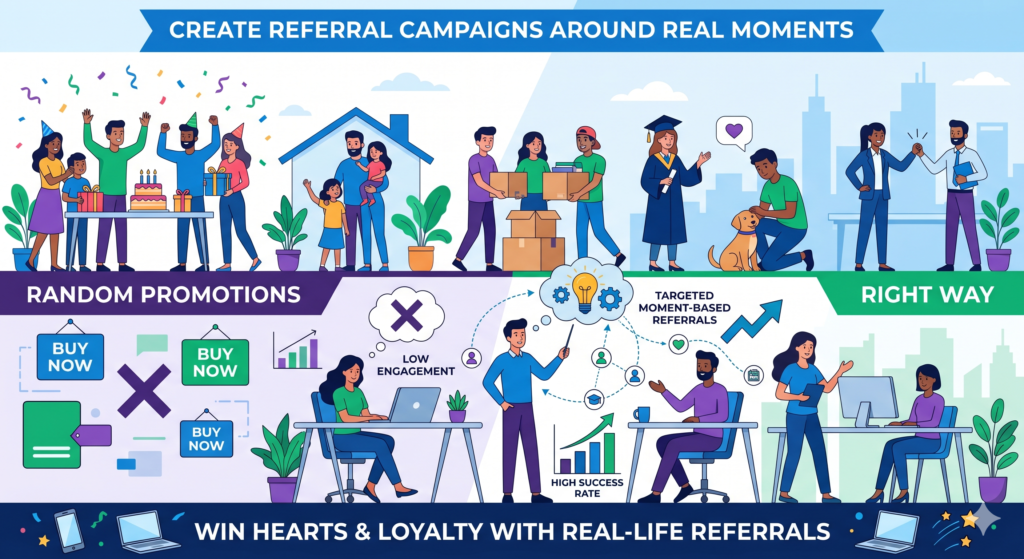
The best referral moments are tied to something real. It could be a product launch, a seasonal need, a customer milestone, a community challenge, a business event, or a special campaign. The moment gives context. It makes the referral feel timely instead of random.
This is important because people are more likely to share when there is a clear reason. A simple “refer a friend” message can be ignored. But a message tied to a fresh event feels more alive.
Use launches and new offers as referral sparks
When you launch something new, your best customers should hear about it first. They should also get a simple way to share it. This works because launches naturally create interest. People like telling others about something new, especially if they feel early.
A product launch referral campaign can be simple. You can tell customers, “We are opening this to customers first. If you know someone who would find it useful, you can share your private invite.” This feels more special than a normal promotion.
For a service business, a launch could be a new package, a new audit, a new workshop, or a new strategy session. For example, a digital marketing agency could launch a “lead leak audit” and let current clients invite one founder who may need it. The referral does not feel like a sale. It feels like giving someone access to a useful review.
The key is to connect the referral to the new value. Do not just announce the launch and add a referral link at the bottom. Build the referral into the launch story.
Turn seasonal problems into referral reasons
Seasonal timing can make referrals feel more urgent. Many customers face certain problems at certain times of the year. If your referral campaign matches that problem, it feels useful.
An ecommerce brand can use holidays, back-to-school periods, summer travel, wedding season, or year-end gifting. A B2B company can use budget planning, annual reviews, tax season, trade show season, or new quarter planning. A marketing agency can use the start of a quarter, product launch season, Black Friday planning, or the year-end growth push.
For example, instead of saying, “Refer a friend this month,” a marketing agency could say, “Know a business owner planning next quarter’s growth? Share this strategy audit with them before they lock the wrong plan.” This gives the referral a real reason.
Seasonal campaigns work best when the message speaks to a current pain. People refer when they think, “This person needs this now.” Your job is to make that need clear.
Use customer milestones as natural referral windows
Customer milestones are some of the strongest referral moments because they are personal. A milestone could be a first purchase, a second purchase, a subscription anniversary, a goal reached, a project completed, or a result achieved.
When a customer hits a milestone, your message can celebrate them first. The referral ask should come second. This order matters. If you lead with the ask, the moment feels commercial. If you lead with the celebration, it feels human.
A simple message could say, “You have been with us for one year, and we are grateful. If someone you know could use the same support, here is a private invite you can share.” That feels warm because the referral is tied to a real relationship.
For service businesses, milestones can be even more powerful. After a successful campaign, a strong report, or a project win, you can ask the client if they know someone facing a similar problem. The timing feels right because the value is fresh.
Design a referral landing page that makes the friend feel safe
A referral does not end when a customer shares a link. That is only the start. The real test begins when the referred friend clicks.
This person may trust the friend who sent the link, but they do not fully trust your brand yet. They may be curious, but they may also be careful. They want to know what this is, why it was shared with them, what they get, and whether it is worth their time.
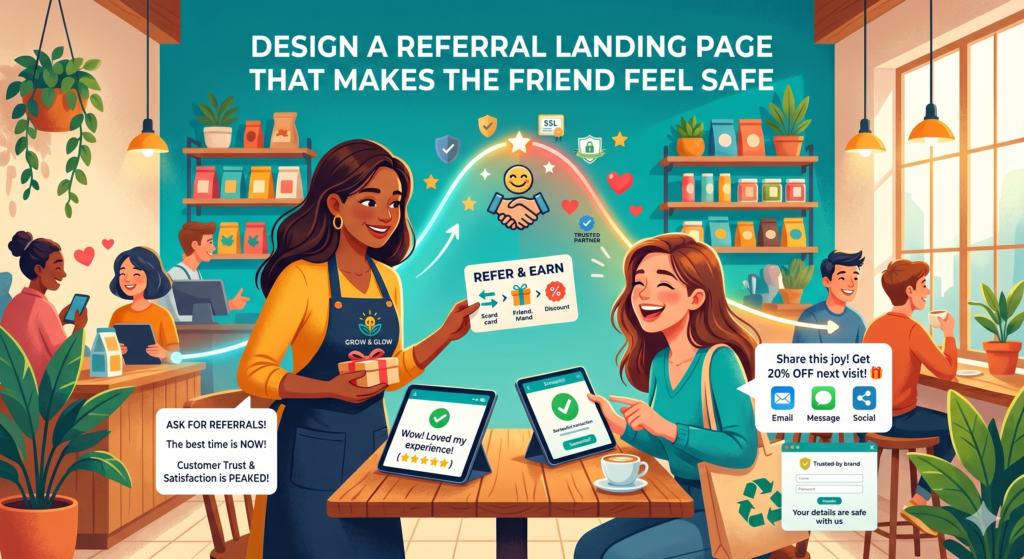
A weak landing page can waste a strong referral. If the page feels generic, confusing, slow, or too sales-heavy, the referred friend may leave. The referral had trust behind it, but the page failed to protect that trust.
Your referral landing page should feel personal, clear, and low-risk. It should make the friend feel like they were invited into something useful, not pushed into a funnel.
Make the invitation feel personal from the first line
The first message on the landing page should remind the visitor that they came through a trusted person. This gives the page warmth. It also makes the referral feel different from a normal ad click.
Instead of using a plain headline like “Get 20% Off Today,” you can write something more personal. You might say, “Your friend thought you would find this useful.” If you can include the referrer’s name, even better. A line like “Sarah sent you a private invite” feels far more human than a cold offer.
This does not need to be complicated. The page can still be clean and simple. The point is to continue the trust that started in the private conversation.
Once the page confirms the invite, it should explain the value in plain words. Do not make the referred friend hunt for meaning. Tell them what your brand helps with, who it is for, and why people use it.
Explain the offer without making the page feel cheap
The referral reward should be clear, but it should not take over the whole page. If the page only screams about a discount, you may attract bargain hunters while losing serious buyers. The friend should understand the offer, but they should also understand the value behind it.
For example, a page can say, “You get $25 off your first order because a customer invited you.” Then it should quickly explain why the product or service is worth trying in the first place.
For a digital marketing agency, the page may not offer a discount at all. It may offer a private audit, a strategy call, or priority access. The page should explain what the person will learn, how long it takes, and what problem it helps them solve.
The offer should feel like a helpful start, not a trick. Avoid hidden terms, confusing rules, and loud countdowns that feel fake. Referred customers arrive with borrowed trust. Do not break that trust with pressure.
Show proof that matches the referred friend’s concern
A referred visitor may still ask, “Will this work for me?” Your page should answer that question with proof. But the proof must match the situation.
If the referral is for an ecommerce product, use reviews, real customer photos, delivery notes, and simple quality claims. If the referral is for a SaaS tool, show short results, user quotes, and clear use cases. If the referral is for an agency or service, show client outcomes, before-and-after examples, and a short explanation of your process.
The proof should not be long. It should be focused. A referred visitor is warmer than a cold visitor, but they still need confidence. Give them enough to feel safe taking the next step.
For service businesses, a short case story can work very well. You can explain the client’s problem, what changed, and what result came next. Keep it simple. The friend should think, “That sounds like my problem too.”
Use email to keep referrals alive after the first share
Many referral programs focus only on the first share. The customer gets a link, sends it once, and then the campaign goes quiet. That is a missed chance. Referrals often need follow-up, but the follow-up must be done carefully.
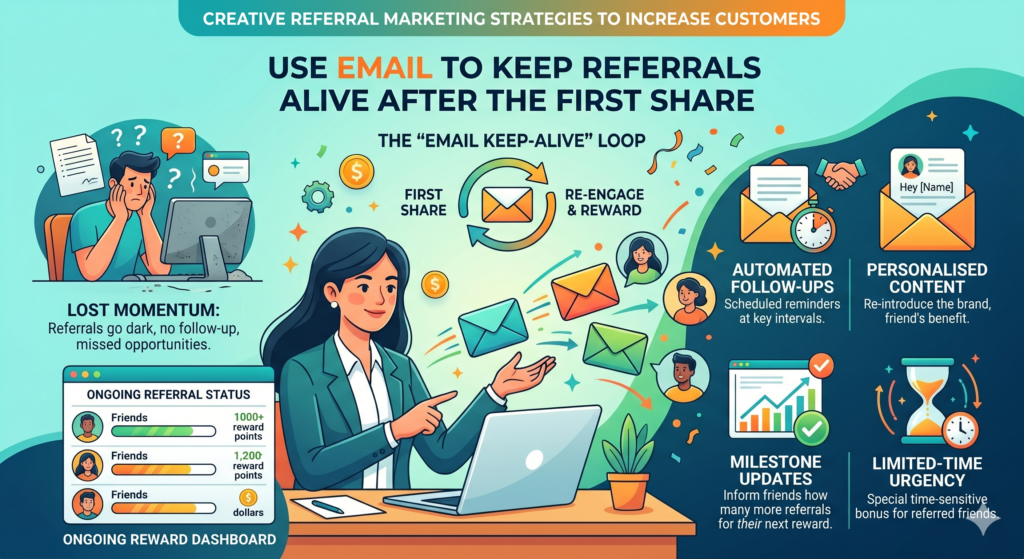
Your customers do not want to be nagged. Their friends do not want to be chased in a cold way. But a thoughtful email flow can keep the referral program active without making it annoying.
Email works because it gives you room to educate, remind, celebrate, and guide. It can help customers remember who to refer. It can help referred friends understand the value. It can also help you bring people back when they showed interest but did not act.
Create a simple referral email flow for current customers
Your customer referral email flow should not be a constant stream of “refer now” messages. That gets old quickly. Instead, build a small flow around value, timing, and appreciation.
The first email can introduce the referral offer in a warm way. It should explain who the offer is for, what both people get, and how easy it is to share. The second email can give examples of who might benefit. This helps customers think of real people. The third email can share a customer story or result that makes the referral easier to explain.
This flow should feel useful even if the customer does not refer right away. Each email should help them understand the value better. That way, when they meet someone with the right problem, your brand comes to mind.
For a digital marketing agency, the emails can be tied to common growth problems. One email might talk about businesses wasting money on ads without a clear funnel. Another might talk about websites getting traffic but not leads. Then the referral ask becomes more specific. It says, “If you know a founder facing this, send them our way.”
Give customers fresh reasons to share over time
A customer may not know someone to refer today. But they may know someone next month. This is why referral emails should give fresh reasons to share over time.
Do not repeat the same message again and again. Instead, create new angles. One month, focus on a new customer story. Another month, focus on a seasonal problem. Another month, focus on a new offer. Another month, focus on a milestone or community update.
This keeps the referral program from feeling stale. It also helps customers see different types of people who could benefit.
For example, an agency could send a message before a new quarter saying, “Many teams are planning their next growth push now. If you know someone who needs a clearer plan before they spend more, this is a good time to introduce us.” That is far better than sending the same “refer a friend” line every month.
Fresh context creates fresh action.
Follow up with referred friends in a way that respects trust
When a referred friend clicks but does not buy or book, you may be tempted to send hard sales emails. Be careful. This person came through a relationship. The tone should respect that.
A referred lead follow-up should feel helpful and personal. Remind them who invited them. Explain the value again. Address common doubts. Share proof. Make the next step easy.
For example, you can say, “You came through a private invite from someone who thought this might help. Here is a quick look at how it works.” That feels much warmer than “Complete your purchase now.”
If the referral is for a service, your follow-up can offer a low-pressure next step. You can invite them to reply with a question, take a short audit, or book a short fit call. The goal is not to push them fast. The goal is to make them feel safe enough to move.
Use social sharing without making customers sound like influencers
Social media can help referral campaigns, but only when it fits how people really share. Most customers do not want to post like influencers. They do not want to write long promotional captions about a brand. They may be happy to share, but only if it feels natural and does not make them look strange to their own audience.
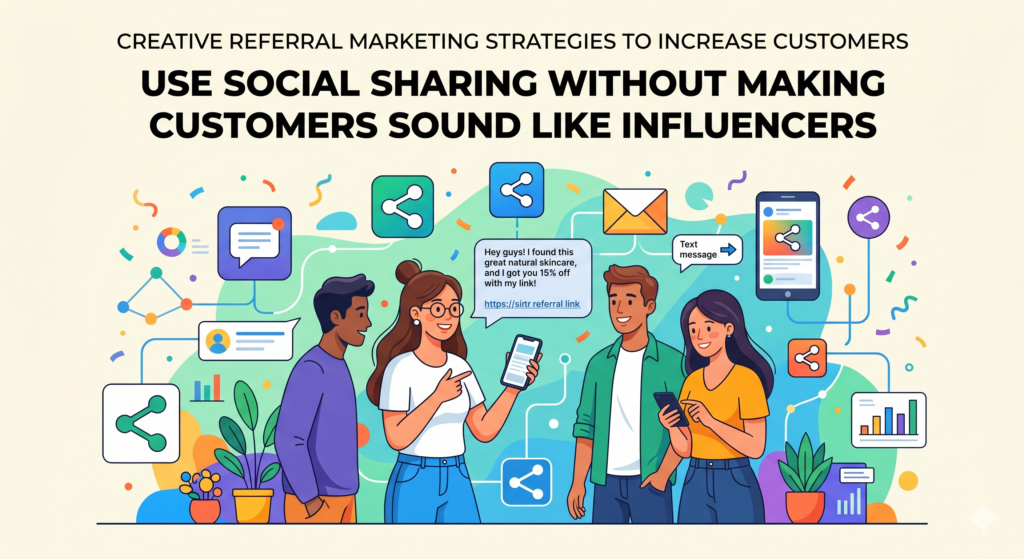
This is why social referral campaigns need a softer touch. Do not ask every customer to “post about us.” Instead, create share moments that feel like something people would already want to say.
A good social referral is built around identity, proof, progress, or usefulness. The customer should feel like they are sharing a moment, not running an ad.
Give customers something worth posting besides a coupon
A coupon alone is not always social-friendly. Most people do not want their feed to look like a discount board. If you want social sharing, give them something more interesting to share.
This could be a result, a milestone, a challenge, a personal win, a visual moment, a template, a quiz result, a score, a before-and-after, or a useful insight. These things give the customer a reason to post that feels connected to their life or work.
A fitness brand can let users share a completed challenge. A learning platform can let students share a certificate. A design tool can let users share something they made. A marketing agency can give clients a simple growth score or audit snapshot they may want to discuss.
The referral link can sit inside that moment, but it should not be the whole message. The post should lead with value or pride. The referral should feel like a helpful next step.
Create social copy that sounds casual and human
If you provide social captions, keep them simple. Do not write captions that sound like a brand wrote them. Customers will not use them, or worse, they will use them and the post will feel fake.
A good caption sounds like a person talking. It may say, “I tried this and it helped more than I expected.” Or, “This made the process much easier for me.” Or, “Sharing this in case it helps someone else too.”
The key is to leave room for the customer’s own voice. You can give them a base message, but let them edit it. You can also offer a few tone options, such as casual, professional, or short. This helps different customers share in a way that feels right.
For B2B referrals, LinkedIn copy should still be human. It should not sound like corporate news. A simple line about a real problem and a useful solution often works better than a polished announcement.
Encourage private social sharing more than public posting
Many referrals happen in private messages, not public posts. WhatsApp, Instagram DMs, LinkedIn messages, Slack groups, and private communities can be more powerful than public feeds. People trust private recommendations because they feel personal.
Your referral program should make private sharing easy. Add share buttons for the channels your customers actually use. Provide short messages that work in DMs. Make the link preview clear and attractive.
For many brands, private sharing will outperform public posting because it is more direct. A customer may not want to post about your product to everyone, but they may happily send it to one friend who needs it.
This is especially true for services. Someone may not publicly say they need marketing help, financial help, legal help, or coaching. But a trusted friend may send them a private note. That private note can carry serious weight.
Build referral loops into your product or service experience
The strongest referral programs are not separate from the customer experience. They are built into it. This means customers do not need to remember your referral program on their own. They meet it naturally while using your product, receiving your service, or getting results.
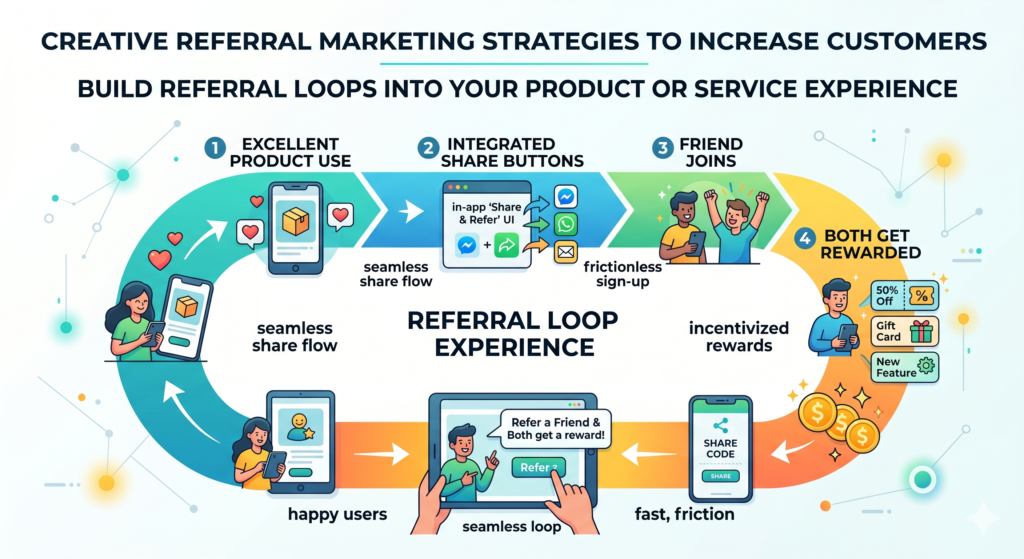
A referral loop is a repeatable path where customer value leads to sharing, sharing brings in new customers, and new customers later create more sharing. This is how referral marketing becomes a growth engine instead of a one-time campaign.
To build this, you need to connect referrals to the moments where your brand is already creating value. The referral should feel like part of the experience, not an extra request pasted on top.
Add referral prompts after completed actions
A completed action is a strong time to ask because the customer has just done something meaningful. This could be finishing setup, placing an order, publishing a project, getting a result, completing a lesson, or receiving a report.
The referral prompt should match the action. If someone just bought a product, the message can say, “Know someone who would love this too?” If someone just finished a course lesson, it can say, “Know someone who wants to learn this with you?” If a client just received a strong campaign report, it can say, “Know another founder who needs this kind of clarity?”
The prompt should not interrupt the customer too much. It should feel like a small, well-timed option. If they are not ready, they can skip it. If someone comes to mind, they can act right away.
This is how you turn happy moments into referral moments.
Create shared experiences that naturally invite others
Some of the best referral loops happen when the product or service becomes better with other people involved. This is common in communities, collaboration tools, learning programs, group challenges, events, and coaching programs.
If customers get more value when friends join, referrals feel natural. They are not just helping your brand grow. They are improving their own experience.
A fitness challenge becomes more fun with friends. A learning program becomes easier with a study partner. A team tool becomes more useful when coworkers join. A private business community becomes more valuable when strong peers are invited.
For service businesses, this can take the shape of private workshops, founder roundtables, or small group audits. A client may invite another business owner because the session itself is useful. The referral is built into the event.
The key is to design experiences where inviting someone makes sense. When the invite improves the customer’s own value, referrals become much easier.
Make the referred customer become a referrer later
A referral loop is not complete until referred customers can become referrers themselves. Many brands forget this. They treat referred customers as the end of the journey. But if those customers have a great first experience, they may become some of your strongest promoters.
This means your onboarding for referred customers matters a lot. Welcome them warmly. Mention that they came through a trusted invite. Help them reach value quickly. Then, after they get a result, invite them to share too.
The timing should still be earned. Do not ask them to refer on day one unless the product has instant value. Wait until they have proof. Once they experience the benefit, they are more likely to continue the loop.
This is how referral marketing compounds. One customer brings one more. That customer brings another. Over time, the system becomes less dependent on paid traffic and more powered by trust.
Use referral challenges to create action without making people feel pressured
A referral challenge can work very well when it feels fun, clear, and fair. The idea is simple. Instead of asking customers to refer whenever they remember, you create a short campaign with a clear goal. This gives people a reason to act now.
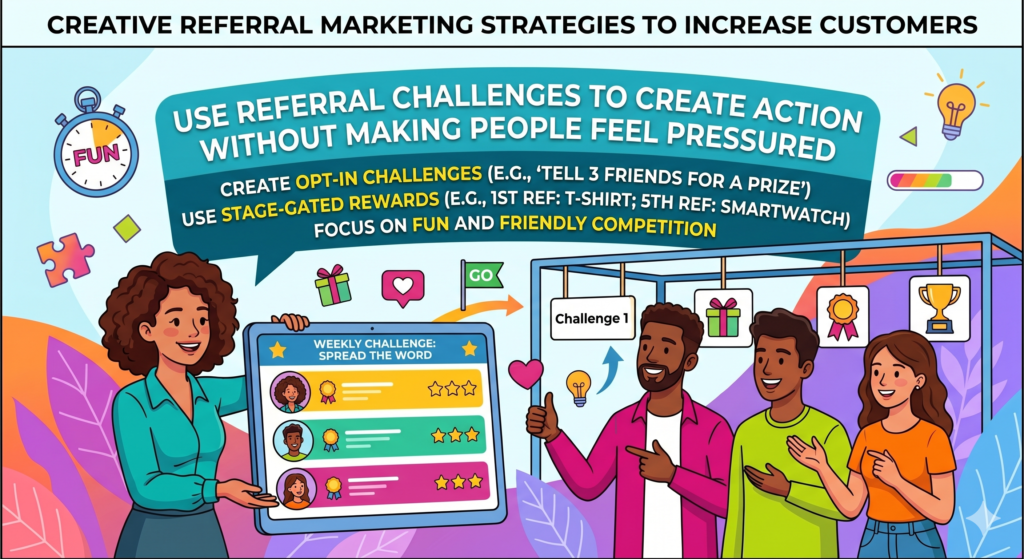
But referral challenges must be handled with care. If they feel too aggressive, customers may feel used. If the reward feels too hard to reach, they may not try. If the rules are confusing, people will lose interest before they even begin.
The best referral challenges do not make customers feel like they are working for your brand. They make customers feel like they are joining a useful mission, unlocking a special reward, or helping people they know find something valuable.
Make the challenge short enough to feel active
A referral challenge should not run forever. If there is no clear end date, there is no reason to act today. A short window gives the campaign energy. It helps customers pay attention because the moment feels live.
For most brands, a referral challenge can run for one to four weeks. The exact length depends on the buying cycle. A low-cost product may need only a week. A higher-ticket service may need longer because people need more time to think, talk, and book a call.
The message should explain the challenge in plain words. Customers should know what counts as a referral, what they can earn, when the challenge ends, and how they can track progress. If the customer needs to ask questions before taking part, the campaign is already too heavy.
The challenge should also feel realistic. Asking a customer to refer ten people in seven days may sound exciting to the brand, but it may feel impossible to the customer. A better challenge may ask for one thoughtful introduction. Quality matters more than noise.
Build the challenge around a customer benefit, not only a brand goal
A weak referral challenge sounds like this: “Help us grow by inviting your friends.” That message may be honest, but it is not very motivating. Customers do not wake up thinking about your growth targets.
A stronger challenge connects the action to something useful for the customer and their friends. For example, an ecommerce brand could say, “Give three friends a better first order and unlock early access to our next drop.”
A course brand could say, “Invite a study partner and unlock a live review session.” A marketing agency could say, “Introduce one founder who needs clearer growth, and we will give both of you a private audit.”
The customer should feel that the challenge creates value, not just referrals. When the campaign helps people, it feels good to share. When it only helps the brand, it feels like work.
This is where many brands miss the mark. They make the challenge about volume. Smart brands make it about useful matches.
Celebrate progress during the challenge
A referral challenge should not go silent after the first announcement. People forget. Life gets busy. A gentle progress update can bring them back without sounding pushy.
The key is to celebrate action, not shame people for doing nothing. You can share how many customers have joined, how many invites have been sent, or how many rewards have been unlocked. Keep the tone warm and simple.
If the challenge is for a smaller group of loyal customers, personal updates work even better. A short message like, “You are one referral away from unlocking your bonus session” can help. But it should still feel helpful, not desperate.
For high-ticket businesses, you can make the progress more human. Instead of saying, “Only three days left to refer,” you might say, “If someone came to mind but you have not introduced us yet, this is a good week to do it. We still have a few private audit slots open.” This feels calmer and more respectful.
Partner with customers on referral content that does the selling for them
Some customers want to refer but do not know how to explain your value. Others may feel uncomfortable sending a direct sales message. Referral content solves this problem. It gives them something useful to share instead of forcing them to make a pitch.
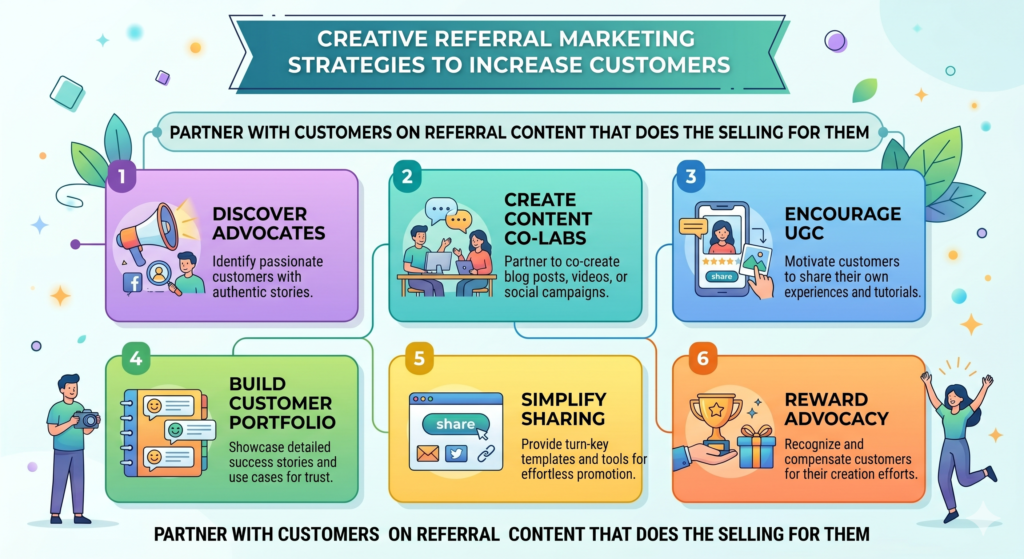
Referral content can be a short guide, quiz, checklist, case study, calculator, audit, webinar, or simple resource. The customer shares the resource because it is helpful. Your brand earns attention because the resource leads people into your world.
This works especially well for businesses where trust takes time. A person may not be ready to buy right away, but they may be willing to read a guide, take a quiz, or watch a short lesson. That first step feels safer.
Create resources customers are proud to pass along
A good referral resource should make the customer look helpful. It should solve a real problem their friend has. It should not feel like a brochure pretending to be useful.
For example, a digital marketing agency could create a “lead leak checklist” that helps founders spot why their website is not turning visits into calls. A financial tool could create a simple savings calculator. A skincare brand could create a routine finder. A SaaS company could create a planning template.
The resource should be easy to explain. A customer should be able to say, “This might help you figure out what is going wrong.” That kind of message feels natural. It does not ask the friend to buy. It invites them to learn.
This is powerful because many referrals do not start with purchase intent. They start with a problem. If your content helps name that problem, your brand becomes part of the solution early.
Add the referral offer inside the content path
The resource should not be a dead end. Once the referred person uses it, the next step should be clear. This does not mean you need to push hard. It means the path should be easy.
If someone downloads a checklist, invite them to get a review. If someone takes a quiz, show them a result and suggest the next action. If someone watches a short training, offer a starter package or call. If someone uses a calculator, show what the numbers mean and how your brand can help.
The referral reward can also appear naturally here. You can say, “Because you came through a customer invite, you can get this bonus when you start.” This keeps the referral benefit tied to the experience.
For agencies, this approach is often better than a basic referral discount. A founder may not care about a small price cut. But they may care about a clear audit that shows where growth is leaking. The content creates trust before the sales call happens.
Give customers different resources for different people
Not every referred friend has the same problem. If you give customers only one thing to share, it may not fit everyone. A smarter approach is to create a small set of referral resources based on different needs.
A marketing agency might create one resource for paid ads, one for SEO, one for landing pages, and one for sales funnels. A SaaS tool might create resources for founders, managers, and teams. An ecommerce brand might create guides for gifting, first-time buyers, and product selection.
This helps the customer make a better match. They can send the resource that fits the person in front of them. A better match means higher trust and better conversion.
You do not need dozens of assets. Start with the three most common problems your customers mention. Build simple, useful resources around those problems. Then give customers clear language for when to share each one.
Use referral scripts for high-value customers and clients
For some businesses, referrals do not happen through links. They happen through real conversations. This is especially true for agencies, consultants, B2B services, high-ticket products, coaching programs, and local service businesses.
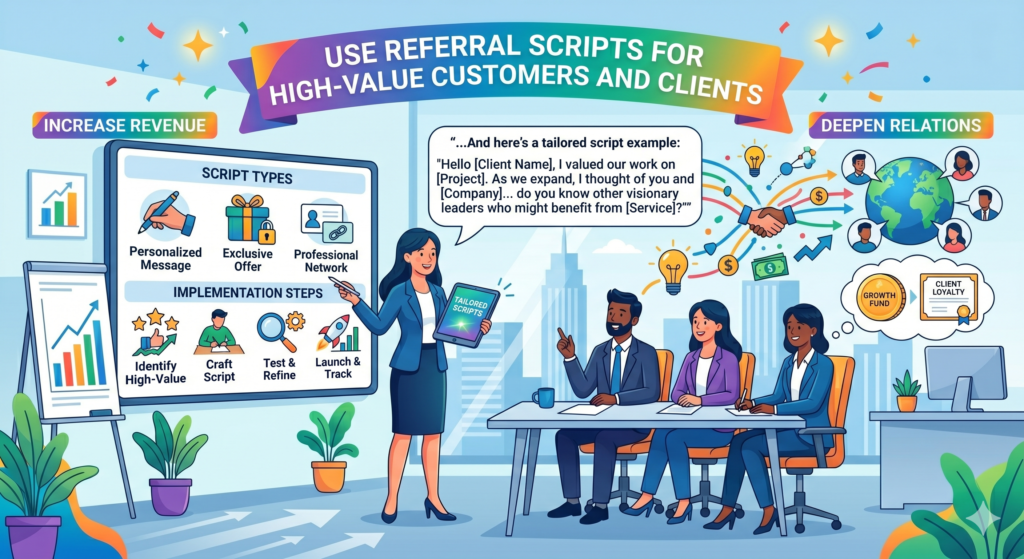
In these cases, the customer may need to introduce you by email, mention you in a call, or connect you to someone they know. That kind of referral can be very powerful, but it also asks more from the customer. If you want it to happen, you must make it easy.
A referral script helps the customer introduce you without doing the thinking. It gives them simple words they can copy, edit, and send. It also protects your positioning because the introduction starts with the right message.
Write scripts that sound like real people
A referral script should not sound like a sales deck. It should sound like one person helping another. Keep it short, warm, and clear.
For example, a client could send this kind of message: “I wanted to connect you with this team because they helped us get clearer about our marketing and find better growth opportunities. I thought it might be worth a quick conversation.” That sounds natural. It does not overpromise. It gives the new person a reason to reply.
The script should not be too long because customers will not use it. It should also leave room for their own voice. Give them a clean base, not a forced message.
For ecommerce or low-ticket brands, scripts can be more casual. A customer might send, “I bought this recently and really liked it. This link gives you a better first order if you want to try it.” Simple words often work best.
Give customers context before they introduce you
Before asking for a warm introduction, help the customer understand who you want to meet. This is where many businesses make the referral ask too broad.
Do not say, “Do you know anyone who needs marketing?” That is too wide. Say something clearer, like, “Do you know any founders who are getting traffic but not enough leads?” or “Do you know any teams spending on ads without a clear funnel?” Specific prompts help customers remember real people.
You can also give them a short description of your best-fit customer. Keep it plain. Mention the problem, the type of person, and the situation where you help most.
This makes the referral better for everyone. The customer does not waste time thinking of poor fits. The referred person gets a more relevant introduction. Your team gets better leads.
Make the next step easy after the introduction
Once the customer makes the introduction, do not make things awkward. Reply quickly. Thank both people. Keep the tone calm. Do not jump into a hard pitch.
Your first reply should confirm the reason for the introduction and offer a simple next step. For a service business, that may be a short call. For a product business, it may be a helpful page or starter offer. For a SaaS company, it may be a demo or trial.
The referred person should feel respected. Remember, your customer put their name behind the introduction. If your follow-up feels pushy, it reflects badly on them. That can hurt future referrals.
A strong referral process protects the referrer’s trust. When customers know you will treat their friends well, they are more likely to introduce you again.
Use reviews and testimonials as soft referral engines
Reviews and testimonials are often treated as proof for cold buyers. But they can also become referral tools. When a customer writes a strong review, they are already saying they trust your brand. That moment can turn into a referral action if you guide it well.
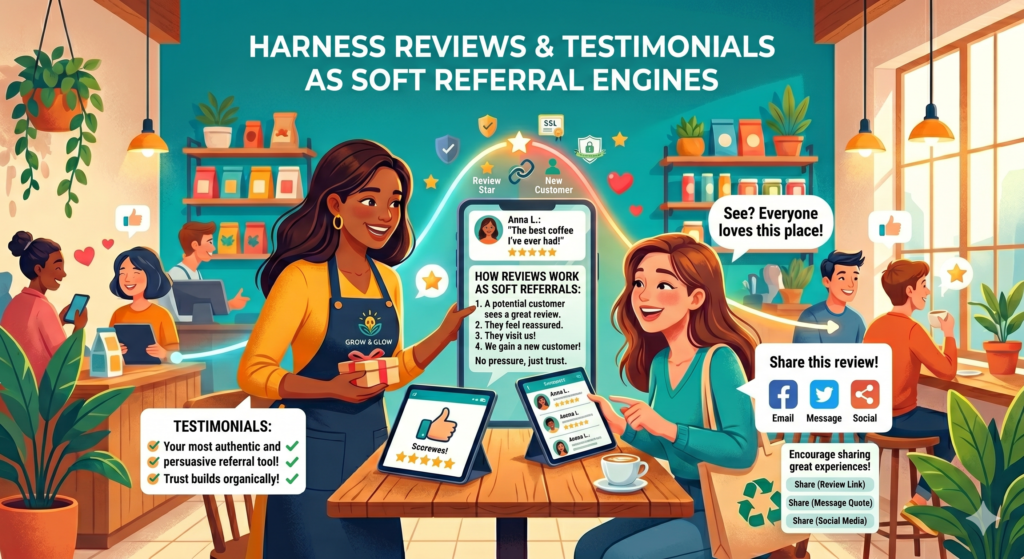
A review is public proof. A referral is personal proof. When you combine both, the message becomes stronger. A customer may leave a review first, then share it with a friend, post it on social media, or send it privately to someone with the same problem.
This works because the customer has already found the words. They have already explained why they like you. The next step is helping them share that message with the right people.
Ask happy reviewers to share their experience with one person
After a customer leaves a positive review, do not simply say thank you and disappear. That is a perfect moment to ask a gentle referral question.
You can say, “Thank you for sharing this. If someone you know is dealing with the same problem, feel free to send them your invite link.” This feels natural because the customer has just described their positive experience.
The key is to ask for one person, not a whole network. “Share this with one person who might need it” feels much easier than “Tell all your friends.” Small asks work because they reduce pressure.
For service businesses, you can make the ask even more personal. If a client gives a kind testimonial, you can reply, “We really appreciate this. If you know another founder who needs this kind of support, we would be glad to help them too.” That feels human and respectful.
Turn testimonials into shareable stories
A strong testimonial can be shaped into a small story that customers are more willing to share. The story should show the before, the change, and the result. Keep it simple.
For example, instead of only showing a quote like, “Great service,” you can frame the story as, “A small team came to us because their ads were getting clicks but not leads. After fixing the landing page and follow-up path, they started getting better calls from the same traffic.” That gives people something to understand and remember.
When customers see stories like this, they may think of someone in the same position. That is where referrals begin. Stories trigger memory better than general claims.
You can use these stories in referral emails, landing pages, social posts, and private customer updates. The goal is not to brag. The goal is to help customers connect your work to real problems in their own network.
Make public praise easy to turn into private sharing
Sometimes a customer comments positively on a post, replies to an email, or shares kind words in a chat. These small moments are easy to miss, but they can lead to referrals.
When someone praises your brand, reply warmly and give them a simple way to share. Do not make it heavy. You might say, “That means a lot. If anyone comes to mind who could use this too, here is a simple invite you can send.”
This works because it meets the customer while the feeling is fresh. They are already thinking positively about your brand. You are simply giving that feeling a path.
Over time, these soft referral moments can add up. Not every customer will act, but the ones who do will often send warmer, better-fit leads than a cold campaign ever could.
Create referral rewards for teams, families, and groups
Many referral programs focus on one customer inviting one friend. That can work, but it misses a bigger chance. In many markets, people buy, decide, or use products in groups. Families share tools and services. Teams choose software together. Friends join challenges together. Business owners talk in circles.
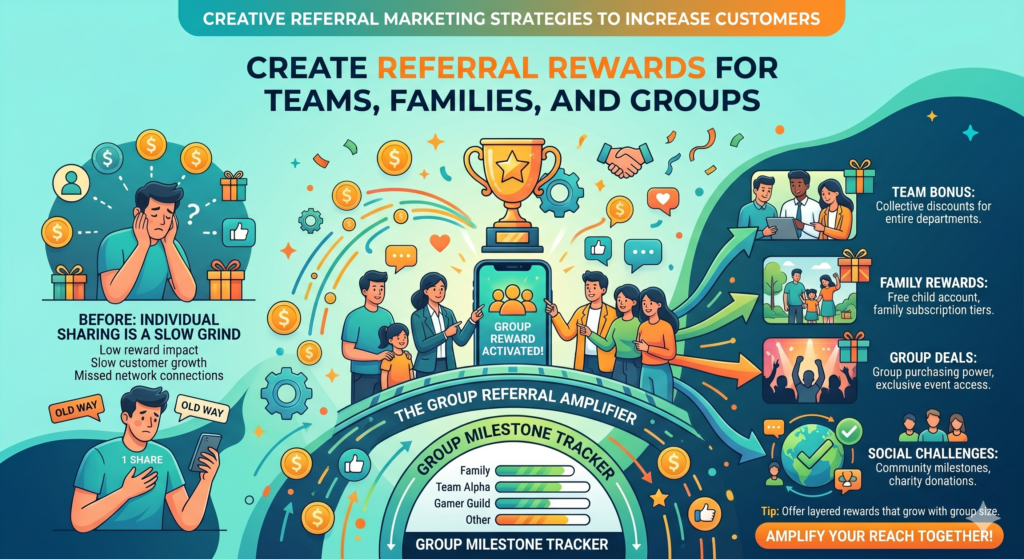
When your product or service can help more than one person at a time, group referrals can be powerful. Instead of asking customers to send one invite, you design an offer that makes it useful for a whole group to join.
This can create faster growth because one customer can open the door to several new customers at once. More importantly, group referrals often feel natural because people already talk about shared needs.
Build offers that make group sharing feel useful
A group referral offer should not feel like a random bulk discount. It should be tied to a real shared benefit. The group should understand why joining together makes the experience better.
A learning program can offer a group study bonus. A fitness brand can offer a team challenge. A SaaS product can offer a team setup session. A family-focused brand can offer a household plan. A marketing agency can offer a founder group audit or private workshop for two or three referred businesses.
The reward should make sense for the group. If people join together, they should get something that helps them together. This could be shared access, a live session, a group bonus, or a better onboarding experience.
For example, a productivity tool could say, “Invite your team and we will help you set up your first workflow together.” That is much stronger than simply saying, “Invite coworkers and get a discount.” The first offer solves a real problem.
Use group identity to drive referrals
Groups often share because they identify with each other. Founders talk to founders. Parents talk to parents. Designers talk to designers. Fitness beginners talk to other beginners. When you understand the group identity, your referral message becomes much sharper.
Instead of writing a general invite, speak to the shared situation. A founder-focused referral message could say, “Know another founder trying to fix their lead flow before next quarter?” A parent-focused message could say, “Know another family that would love an easier way to handle this?” A team-focused message could say, “Bring the people you work with so everyone can use the same system.”
This makes the referral feel relevant. The customer is not just sharing with anyone. They are sharing with people who understand the same problem.
The stronger the group identity, the easier it becomes for customers to know who should receive the invite.
Make group onboarding smooth after the referral
Group referrals can fail if onboarding is messy. When several people arrive at once, they need clear next steps. If the first experience feels confusing, the group may lose interest quickly.
Make sure the landing page explains how the group offer works. Show who should join, what each person gets, and what happens after sign-up. If there is a live session, explain the time and value. If there is a shared plan, explain how access works.
For B2B teams, this is very important. A referred team may include decision-makers, users, and managers. Each person may care about different things. Your page and follow-up should make the value clear for all of them.
A smooth group experience can create even more referrals later. When a whole team or group gets value, more people are exposed to your brand. Each of them can become a future referrer.
Make referrals part of your customer support experience
Customer support is one of the most overlooked places to earn referrals. Most brands see support as a cost center. They think of it only as a place to fix problems, answer questions, and calm upset customers. But support can also become one of the strongest trust builders in your business.
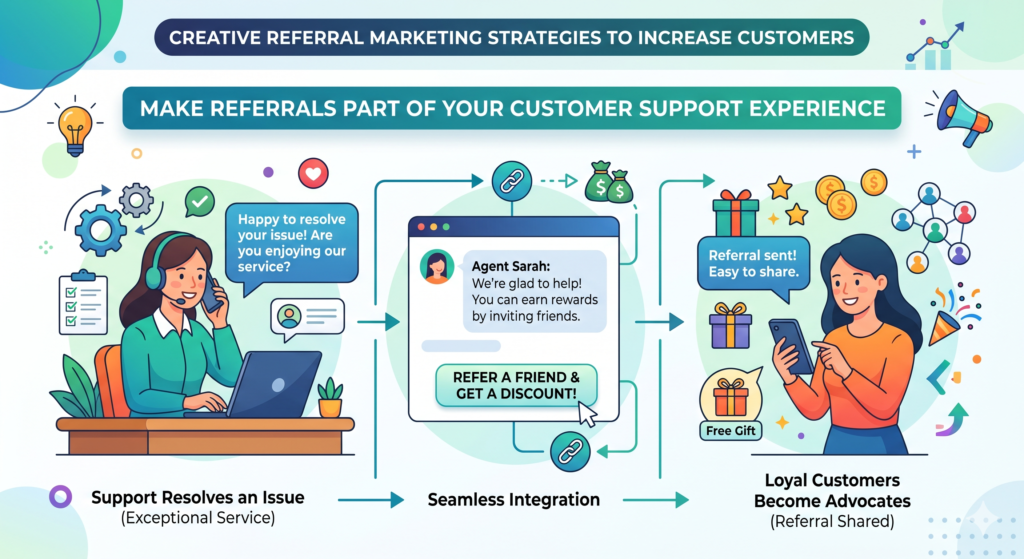
When a customer gets fast, kind, and useful help, they often feel relief. That relief is powerful. A customer who was confused or worried may walk away thinking, “This company actually cares.” That moment can create more loyalty than a smooth purchase ever could.
But you should not ask for referrals while the customer is still frustrated. That would feel careless. The right time is after the problem has been solved and the customer has clearly shown satisfaction. If they say thank you, leave a good support rating, or reply with praise, that is when a gentle referral prompt can make sense.
Turn solved problems into trust moments
A solved problem can create a stronger emotional response than a normal win. When something goes wrong, the customer watches how your brand reacts. If your team handles the issue with care, the customer may trust you more than before.
This is known as the service recovery effect. In simple words, when a brand fixes a problem very well, the customer may become more loyal because they saw proof that the brand stands behind its promise.
You can use this carefully in referral marketing. After a support issue is fully solved, you can send a short thank-you message. The message should first show care. It should not jump straight into asking for a referral.
For example, you might say, “I am glad we could get this fixed for you. Thanks for giving us the chance to help.” If the customer replies warmly, then you can add a light referral note later. The order matters. First solve. Then appreciate. Then invite.
Ask only after the customer shows clear happiness
Support-based referrals should be handled with more care than regular referral prompts. Not every solved ticket should trigger an ask. Some customers may still feel tired after the issue, even if it was fixed. Others may be happy, but not ready to share.
Look for clear signs. A five-star support rating is a sign. A message that says “Thanks, this was really helpful” is a sign. A customer who praises the team by name may also be ready.
When you do ask, keep it soft. You could say, “We are glad this helped. If you know someone who could use this kind of support, you are welcome to share your private invite.” This does not pressure the customer. It simply opens the door.
For a service business, the message can be even more personal. A client who praises your account manager or strategist may be willing to introduce someone else who needs the same level of care. The ask should feel like a continuation of trust.
Use support insights to improve referral messaging
Support conversations can also show you what customers value most. People often explain their real problems in support tickets more clearly than they do in surveys. They say what confused them, what they feared, what they needed, and what made them feel better.
These words can help you write better referral messages. If many customers say, “Thanks for making this simple,” simplicity should appear in your referral copy. If they say, “I finally understand what to do,” clarity should become part of your referral story. If they say, “Your team actually listens,” that is a strong trust angle.
Referral marketing is not only about asking customers to share. It is also about learning why they would share. Support gives you the raw language of customer trust. Use it.
Build referral ideas around the customer’s real social circles
Customers do not live in one big audience. They live inside small circles. They have coworkers, friends, family members, business groups, online communities, local networks, group chats, and professional circles. Each circle has its own way of talking and sharing.
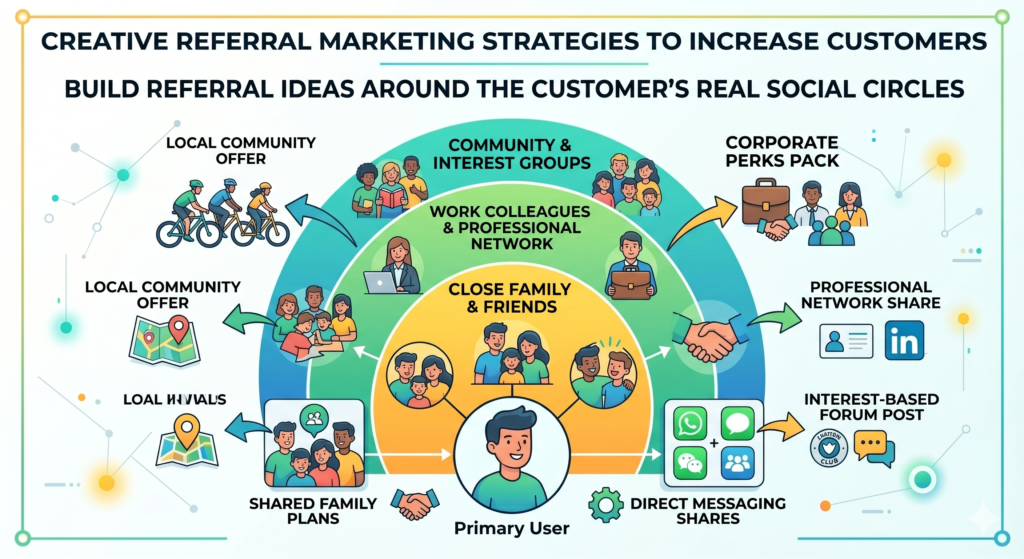
A creative referral strategy understands these circles. It does not ask customers to blast a link everywhere. It helps them share the right message with the right circle in the right way.
This is important because a referral that feels natural in one place may feel strange in another. A customer may happily send a product link to a friend on WhatsApp but never post it on LinkedIn. A founder may introduce you in a private group but not share your agency publicly. A parent may recommend a service in a school group but not on Instagram.
Map where your best referrals are likely to happen
Before writing referral messages, think about where your customers actually talk. Do they discuss work problems in LinkedIn DMs? Do they ask for product ideas in WhatsApp groups? Do they share tools in Slack communities? Do they talk to friends over coffee? Do they ask for advice in Facebook groups?
The better you understand the setting, the better your referral system becomes.
For example, a B2B software brand may get strong referrals from private founder communities and team Slack channels. A home service brand may get referrals in neighborhood groups. A beauty brand may get referrals through Instagram DMs and friend chats.
A digital marketing agency may get referrals through founder circles, investor networks, mastermind groups, and client introductions.
Once you know the likely circle, shape the referral request for that setting. A public post needs a different message from a private intro. A casual friend message needs a different tone from a business email.
Give customers channel-specific referral language
Customers are more likely to share when the message fits the channel. Do not give them one generic block of text and expect it to work everywhere.
For private messages, keep the language short and casual. It should sound like a quick note from one person to another. For email introductions, make the message warmer and more complete. For LinkedIn, keep it professional but still human. For community groups, make the message helpful and avoid sounding like spam.
A private message might say, “I thought of you when I saw this. It helped me, so it might be worth checking out.” An email introduction might say, “I wanted to connect you because this team helped us solve a similar problem, and I thought a quick conversation could be useful.”
The point is not to control every word. The point is to reduce the effort. When customers have the right starting point, they are more likely to act.
Respect the trust rules of each circle
Every social circle has rules, even if no one writes them down. Some communities do not allow promotional links. Some friend groups dislike sales messages. Some professional circles expect warm context before an introduction.
If your referral campaign pushes customers to share in a way that breaks those rules, it can backfire. The customer may feel embarrassed. The friend may ignore it. The community may see it as spam.
So make the referral feel helpful first. Instead of encouraging customers to drop links, encourage them to share when the topic is already relevant. A customer in a founder group can say, “Someone asked about lead generation, and this resource may help.” That is very different from posting, “Use my referral link.”
A strong referral strategy protects the customer’s reputation. When sharing makes them look helpful, they will do it again.
Use referral marketing to bring in better customers, not just more customers
The goal of referral marketing is not only to increase customer count. It is to increase the number of good-fit customers. This distinction matters a lot.
A bad referral program can bring in people who are not serious, not ready, or not aligned with your brand. They may come only for the reward. They may churn quickly. They may need too much support. They may never become profitable.
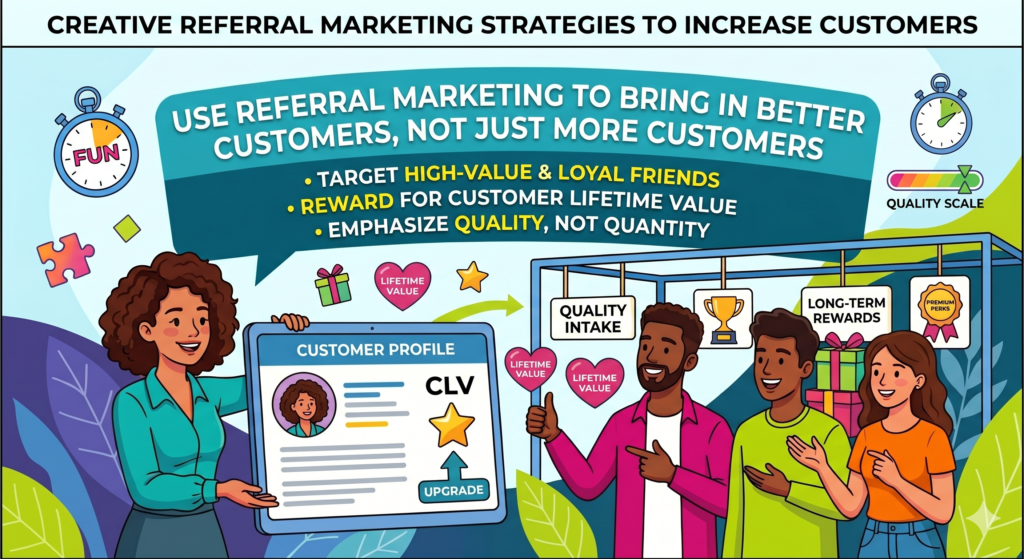
A strong referral program attracts people who are more likely to trust you, buy faster, stay longer, and refer others. This happens when you clearly guide customers on who should be referred and when your offer speaks to the right problems.
Define your best-fit referral customer clearly
Before you ask for referrals, you need to know who you want. This sounds simple, but many brands skip it. They ask customers to refer “friends” without explaining what kind of friend is likely to benefit.
That is too vague. Your customers need a clear picture.
For an ecommerce brand, the best-fit customer may be someone who values quality, wants a simpler routine, or buys for a certain occasion. For a SaaS brand, it may be a team using messy manual processes. For a digital marketing agency, it may be a founder with product-market fit who needs better lead flow but does not want random tactics.
The clearer you are, the better the referrals become. Customers can search their memory faster. They can also avoid sending poor-fit people who will not benefit.
This is not about being narrow for no reason. It is about making the referral useful. When the right person receives the right invite, everyone wins.
Tell customers who is not a good fit
This may feel risky, but it can improve referral quality. If some people are not a good fit for your product or service, say so in a simple and polite way.
For example, an agency might say, “We are best for businesses that already have an offer people want and now need a clearer path to steady leads. We are not the best fit for brands still trying to figure out what they sell.” This helps clients make better introductions.
A SaaS tool might say, “This is best for teams that already handle several projects each month. It may be too much for someone managing only one simple task.” This saves time and builds trust.
Being clear about fit makes your brand look more confident. It also protects your customer from sending an awkward referral. People are more likely to refer when they know the match will make sense.
Reward quality, not just volume
If you reward only the number of referrals, you may encourage people to send anyone. That can create noise. A better system rewards meaningful action.
For low-ticket brands, this may mean rewarding only after the referred friend makes a first purchase. For subscription brands, it may mean rewarding after the referred customer stays for a set period. For service businesses, it may mean rewarding after a qualified call, signed contract, or completed project.
This does not mean you should make rewards hard to earn. It means the reward should match the value you need. If your sales team spends time on every referral, quality matters.
You can also create different rewards for different levels of referral quality. A simple sign-up may earn a small thank-you. A paying customer may earn a stronger reward. A high-value client introduction may earn a personal gift or premium benefit.
Conclusion
Creative referral marketing is not about asking customers to promote you for free. It is about giving happy customers a simple, natural, and rewarding way to share something they already believe in. The best referral systems are built on trust, timing, clear value, and a strong customer experience.
When you ask at the right moment, make sharing easy, reward fairly, and guide customers toward the right people, referrals become more than a growth tactic. They become a steady source of better customers.










Comments are closed.