
WinSavvy Editorial Standards
How this article was created
Most marketing campaigns look busy, but they do not always move the business forward. A team may post daily, run ads, send emails, publish blogs, and still wonder why sales are slow. The problem is not effort. The problem is direction.
Start Every Campaign With One Clear Business Result
Most creative campaigns fail before the first ad is written because the team does not agree on the result. Everyone wants “growth,” but growth can mean many things. It can mean more leads, more calls, more sales, more repeat buyers, or more people knowing the brand.
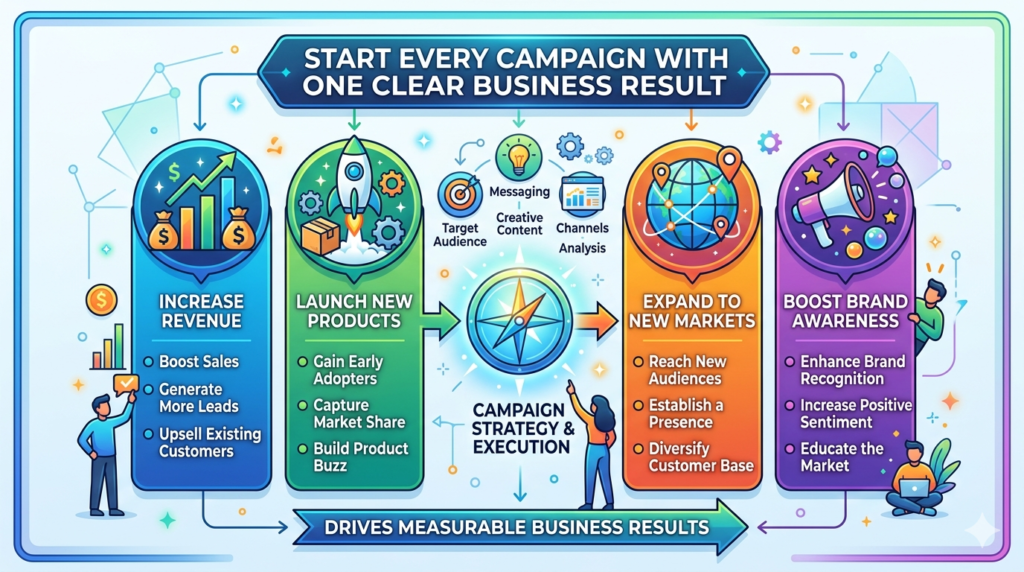
When the goal is not clear, the campaign becomes messy. The message says too much. The offer feels weak. The content tries to speak to everyone.
A strong campaign starts with one clear result. That result becomes the filter for every choice you make. It tells you what to say, who to target, where to show up, and how to measure success. Creativity still matters, but now it has a job. It is not just there to look clever. It is there to move the customer toward one clear action.
A campaign should be built around one main action
The main action is the thing you want the audience to do after they see your campaign. This could be booking a call, downloading a guide, starting a trial, buying a product, joining a webinar, or replying to an email. The action should be simple and easy to understand.
If you ask people to do too many things, most of them will do nothing. A campaign that says “follow us, read this, book a call, watch this video, and check out our services” creates friction. The customer has to think too hard. A better campaign leads them through one clear door.
The main action should match the stage of the customer
Not every customer is ready to buy today. Some people are just becoming aware of a problem. Some are comparing options. Some are almost ready but need trust. Your campaign action should match where they are.
For a cold audience, asking for a sale may be too much. A useful guide, checklist, or short training may work better. For a warm audience, a webinar or case study may move them forward. For a hot audience, a clear offer and strong call booking page may be the right move.
This is where strategy beats guesswork. You are not just asking, “What do we want?” You are also asking, “What is the next natural step for this customer?” When those two answers meet, the campaign becomes much stronger.
Build the Campaign Around a Sharp Customer Problem
A campaign becomes much stronger when it is built around a problem the customer already feels. People do not pay attention to marketing because a brand wants attention. They pay attention when the message touches something they are already trying to fix.
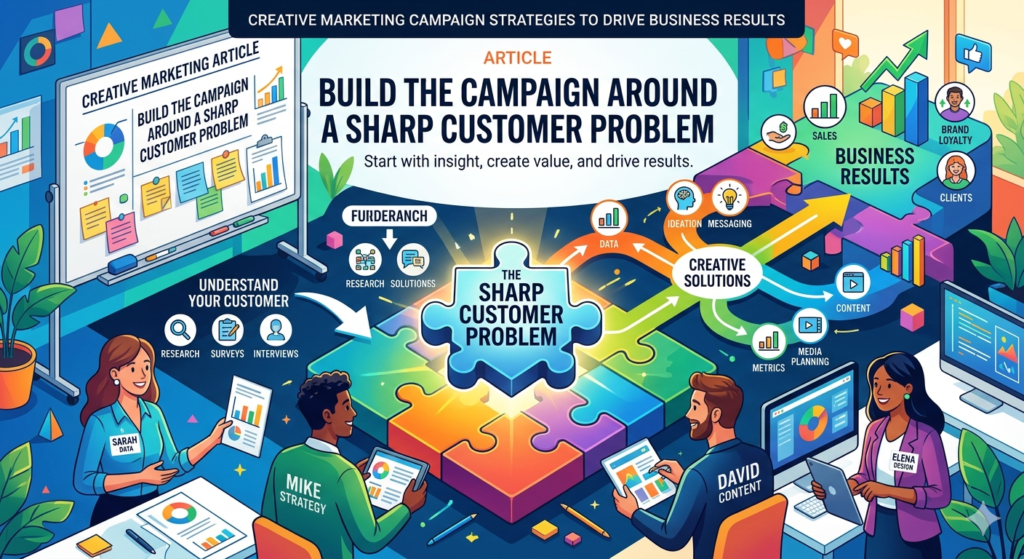
This is why problem clarity matters so much. A weak campaign talks about the business. A strong campaign talks about the customer’s pain in a way that feels real. It shows the customer that you understand what is happening in their world. That creates trust before you even make the offer.
For example, a digital marketing agency should not only say, “We help you grow online.” That is too broad. A sharper message would speak to a real problem, such as getting traffic that does not convert, spending money on ads without knowing what works, or publishing content that brings no qualified leads.
These are problems business owners can feel.
When the campaign starts with a real problem, the customer does not need to be pushed. They lean in because the message feels useful.
The best campaign problems are specific and painful
A general problem creates general interest. A specific problem creates action. Saying “your marketing could be better” is not strong enough. Saying “your team is creating content every week, but none of it is turning into sales calls” is much clearer.
The second message works because it gives shape to the pain. It helps the customer name the issue. Many buyers are not always able to explain what is wrong. They only know that results are slow. Your campaign should help them see the problem clearly.
This does not mean you should scare people or make the message negative. It means you should be honest. Strong marketing does not invent pain. It reveals pain that is already there and then shows a better path forward.
The problem should connect directly to a business cost
A problem becomes urgent when the customer sees what it is costing them. That cost may be lost sales, wasted ad spend, poor team focus, weak trust, low conversion rates, or slow growth.
For example, “Your landing page is unclear” is a problem. But “Your landing page may be making paid traffic more expensive because visitors leave before they understand the offer” is stronger. It connects the issue to money.
This is important because business buyers act when the problem feels tied to results. They may ignore a small design issue. They will not ignore a leak in revenue. Your campaign should make that link simple without sounding dramatic.
The clearer the cost, the easier it becomes for the customer to care. Once they care, your offer has a reason to exist.
Turn the Customer Insight Into a Big Campaign Idea
A big campaign idea is the main thought that ties the whole campaign together. It is not just a slogan. It is the central message people remember after they see your ads, emails, posts, videos, and landing page.
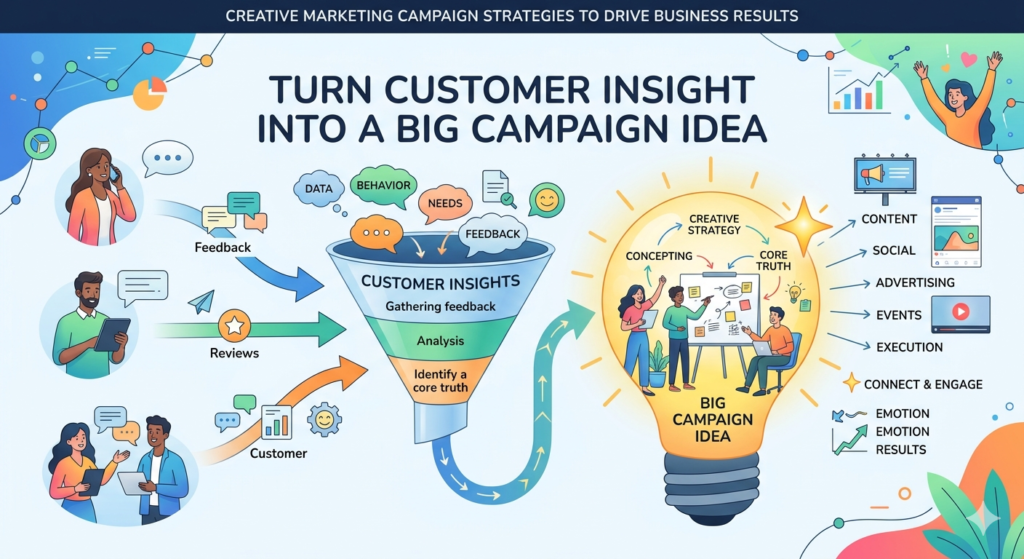
This idea should come from customer insight. That means it should be based on something true about the customer’s life, worries, goals, or habits. When a campaign idea is only clever, it may get a smile. When it is built on insight, it gets attention and action.
For example, a business owner may not wake up thinking, “I need better SEO.” They may wake up thinking, “Why are my competitors showing up everywhere while my brand is invisible?” That insight can shape a much stronger campaign. The campaign is not about SEO as a service. It is about helping the business stop being hidden when customers are ready to buy.
That is the difference between a service message and a campaign idea. The service says what you do. The idea shows why it matters now.
A strong campaign idea should be easy to repeat
If the idea takes too long to explain, it is probably not sharp enough. Your team should be able to say it in one simple sentence. Your audience should understand it quickly. Your content should be able to repeat it in many ways without sounding forced.
A campaign idea like “turn silent traffic into real sales conversations” is simple. It can shape ads, emails, landing pages, case studies, and social posts. It is clear enough to remember and broad enough to support many pieces of content.
The goal is not to create a line that sounds fancy. The goal is to create a thought that can carry the whole campaign. It should give your creative work a backbone.
The idea should make the customer feel seen
People respond when they feel understood. A strong campaign idea should make the customer think, “That is exactly what we are dealing with.” This feeling is powerful because it lowers resistance.
Many businesses jump too quickly into proof, features, or pricing. But before a customer believes your solution, they need to believe you understand their situation. The campaign idea helps do that.
For a digital marketing campaign, this may mean speaking to the stress behind the surface problem. A founder may not only care about website traffic. They may care about proving the business can grow. A marketing head may not only care about leads. They may care about showing leadership that the budget is working.
When the idea touches the deeper concern, the campaign becomes more human. It stops sounding like a pitch and starts sounding like a useful conversation.
Create an Offer That Makes the Next Step Feel Easy
A campaign does not drive results only because the message is strong. It also needs an offer that makes action feel easy. The offer is the bridge between interest and response. If the offer feels weak, confusing, or risky, people will delay even if they like the message.
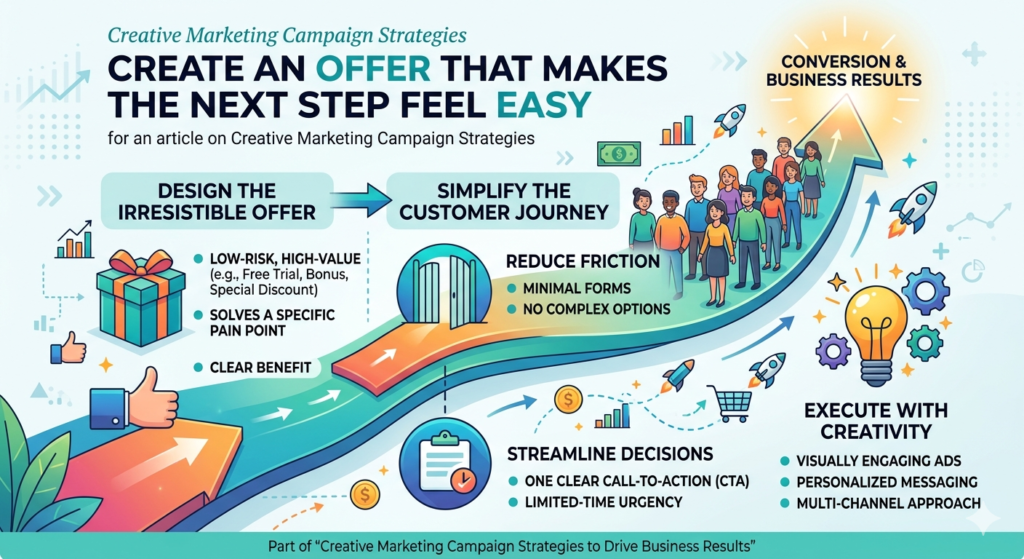
An offer is not always a discount. In many cases, a discount is the least creative offer. A stronger offer helps the customer move forward with less fear, less effort, and more confidence. It gives them a clear reason to act now.
For a service business, the offer could be a free audit, a strategy call, a campaign teardown, a growth plan, or a short workshop. For a product business, it could be a trial, bundle, bonus, sample, or first-purchase benefit. The right offer depends on the customer’s stage and the action you want.
The main point is simple. Do not make the audience do all the work. If your campaign creates interest, the offer should help turn that interest into movement.
A strong offer reduces risk for the customer
Most customers hesitate because they feel risk. They worry about wasting money, choosing the wrong provider, spending too much time, or looking foolish in front of their team. Your offer should reduce that risk.
For example, “Book a call” is common, but it is not always strong. A better offer might be “Get a 20-minute funnel review and leave with three fixes you can use this week.” That feels more useful. It tells the person what they will get. It also makes the call feel less like a sales trap.
This matters because people protect their time. They do not want another vague meeting. They want value. When the offer makes the value clear, the next step feels safer.
The offer should be tied to a clear outcome
A good offer should not only describe what the customer gets. It should show what the customer can do with it. The outcome is what makes the offer feel worth taking.
For example, a “marketing audit” sounds useful, but it is still broad. A “lead leak audit that shows where your website is losing buyers” is sharper. It has a clear purpose. It tells the customer why the audit matters.
This is especially important in crowded markets. Many businesses offer free calls, free guides, or free reviews. The way to stand out is not to make the offer louder. It is to make the outcome clearer.
When the outcome is clear, the customer can picture the value before they act. That picture is what turns passive interest into response.
Match the Message to the Right Customer Stage
A strong campaign does not say the same thing to everyone. Different people need different messages based on how close they are to buying. Someone hearing about your brand for the first time needs a different message from someone who has visited your pricing page three times.
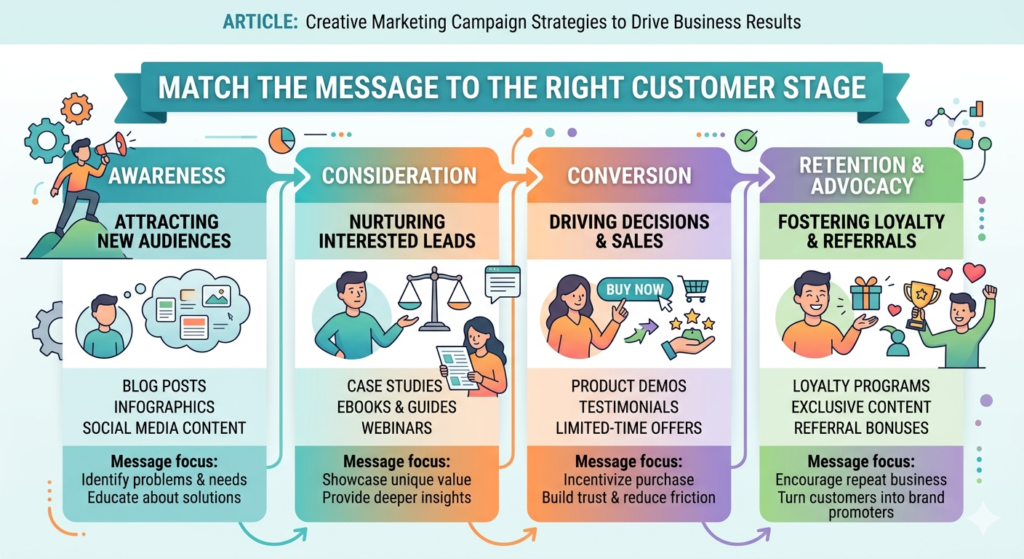
This is where many campaigns lose money. They push a hard sales message to a cold audience, or they keep giving basic education to people who are ready to act. Both mistakes create friction. The customer either feels rushed or held back.
A better campaign maps the message to the customer stage. At the start, the message should create awareness and show the problem clearly. In the middle, it should build trust and show why your solution makes sense. Near the end, it should remove doubt and make the decision easy.
This does not need to be complex. It only needs to be thoughtful. The goal is to meet the customer where they are, then guide them to the next step.
Cold audiences need clarity before persuasion
A cold audience may not know your brand. They may not even know they have the exact problem you solve. So the first job is not to sell hard. The first job is to make the problem clear and relevant.
This type of message should be simple, direct, and useful. It should help the person understand something about their situation. For example, instead of saying, “Hire us for SEO,” you might say, “Most websites do not have a traffic problem. They have a trust problem on the pages that already get visitors.”
That kind of message teaches and challenges at the same time. It gives the audience a reason to pay attention without asking for too much too soon.
Warm audiences need proof and a stronger reason to believe
A warm audience has already shown some interest. They may have read your content, clicked your ads, joined your email list, or visited your website. At this stage, they need more than awareness. They need proof.
Proof can come from case studies, testimonials, before-and-after examples, clear process pages, or simple breakdowns of how your work creates results. The goal is to help the customer believe that your solution can work for them.
This is also where your campaign should answer quiet doubts. The customer may wonder if the service is too costly, too slow, too complex, or not right for their business. Your message should remove those doubts with calm, clear detail.
A campaign becomes powerful when each message feels like the right next answer. That is how trust builds. That is how action becomes easier.
Use Storytelling to Make the Campaign Easier to Remember
Facts can explain your offer, but stories help people remember it. This is why strong campaigns often use a simple story instead of only listing services, features, or benefits. A story gives the customer something to follow. It creates movement. It shows the problem, the struggle, the shift, and the result.
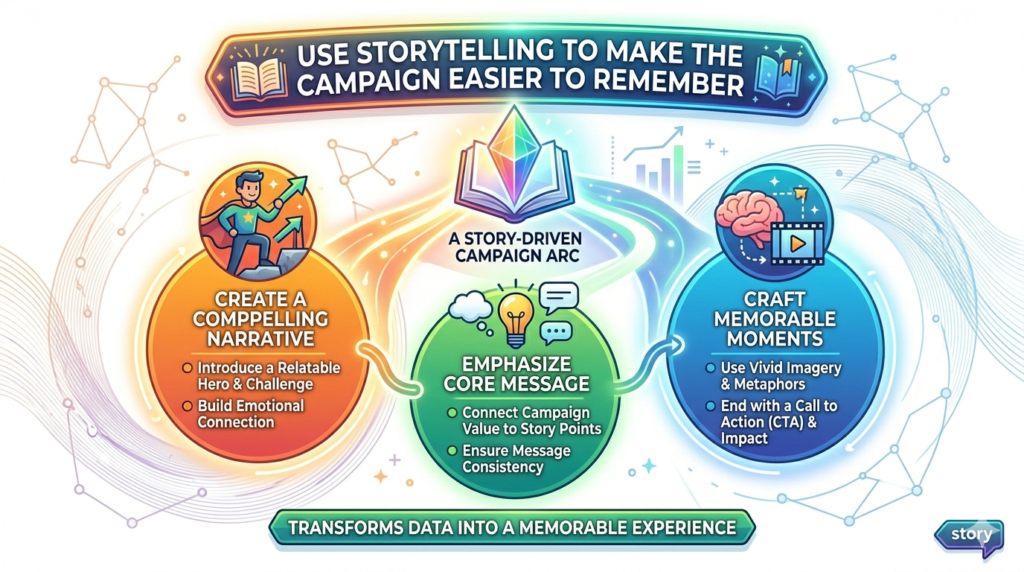
A good campaign story does not need to be long or dramatic. It just needs to feel real. It could show a founder who was getting traffic but no sales. It could show a marketing team that was creating content every week but still missing pipeline goals. It could show a small business owner who was tired of guessing which ads worked.
The story matters because customers often see themselves in it. They may not connect with a generic claim like “we improve conversions.” But they may connect with a story about a business that had leads coming in, yet very few were ready to buy because the landing page was answering the wrong questions.
That kind of story makes the message easier to feel, not just understand.
The best campaign stories follow a clear before and after
Every strong campaign story needs contrast. The “before” shows the pain. The “after” shows the better state. Without contrast, the story feels flat.
For example, the before may be a company wasting money on ads because the message was too broad. The after may be the same company using sharper landing pages, clearer offers, and stronger follow-up emails to turn the same ad budget into better leads.
This kind of story works because it shows progress. It does not just say that marketing can improve results. It shows how the right change can create a better outcome.
The before and after should be simple enough for the reader to picture. If the story has too many details, it becomes hard to follow. If it has no details, it feels empty. The key is to show the turning point clearly.
The turning point should connect to your strategy
The turning point is the moment when the customer sees what was wrong and chooses a better path. This is where your campaign can connect the story to your solution.
For WinSavvy, the turning point could be when a business realizes that traffic alone is not enough. The real issue may be unclear positioning, weak content flow, poor landing page structure, or a follow-up system that does not build trust. Once that becomes clear, the solution feels more natural.
This is important because storytelling should not feel like a random tale. It should lead the customer toward the same belief your campaign is built around. If your campaign is about turning attention into revenue, the story should show why attention alone was not enough.
When the story supports the core message, it becomes more than content. It becomes proof.
Build Campaign Assets That Work Together Instead of Standing Alone
A campaign is not one ad, one email, one blog post, or one landing page. It is a connected system. Each asset should support the next one. When campaign assets are created separately, the customer gets a broken experience. The ad says one thing, the landing page says another, the email feels unrelated, and the offer is unclear.
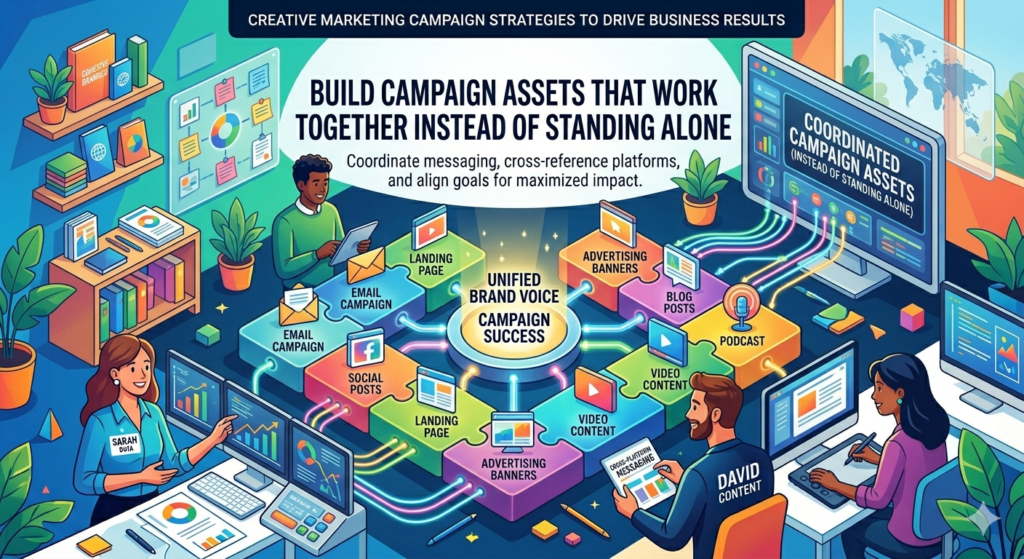
This creates confusion. And confused people do not act.
A strong campaign feels connected from the first touch to the final step. The same core idea runs through every asset. The language feels familiar. The promise stays steady. The offer is easy to understand. The customer never feels like they have landed in a different conversation.
This does not mean every piece should repeat the same words. That would feel boring. It means every piece should support the same journey. The ad creates interest. The landing page deepens belief. The email follow-up answers doubts. The case study proves the result. The call booking page makes action simple.
When everything works together, the campaign feels smooth. That smoothness increases trust.
Each asset should have one job in the journey
A common mistake is trying to make every asset do everything. An ad tries to explain the whole offer. A landing page tries to speak to every audience. An email tries to educate, sell, prove, and push all at once. The result is heavy content that people do not finish.
Each campaign asset should have one main job.
The job of a cold ad may be to get the right person curious enough to click. The job of a landing page may be to explain the problem and present the offer. The job of a case study may be to prove that the process works. The job of an email may be to answer one doubt and bring the person back.
When each asset has one job, the writing becomes clearer. The design becomes simpler. The customer knows what to do next.
The handoff between assets should feel natural
The handoff is the moment when a customer moves from one campaign asset to another. This could be from an ad to a landing page, from a blog to an email signup, from an email to a call booking page, or from a webinar to a sales call.
The handoff must feel natural. If the ad promises a simple growth audit, the landing page should focus on that audit. If the blog talks about fixing lead quality, the offer should help the reader understand their own lead quality problem. If the email talks about wasted ad spend, the call to action should connect to finding where the waste is happening.
A weak handoff makes people feel tricked or lost. A strong handoff makes the next step feel obvious.
This is why campaign planning should happen before asset creation. You should map the customer journey first, then build each asset to support that path.
Make the Landing Page Carry the Campaign, Not Just Collect Clicks
A landing page is often where a campaign either turns into business or falls apart. Many brands spend a lot of time on ads, social posts, and email subject lines, but send people to a page that does not finish the job. That is a costly mistake.
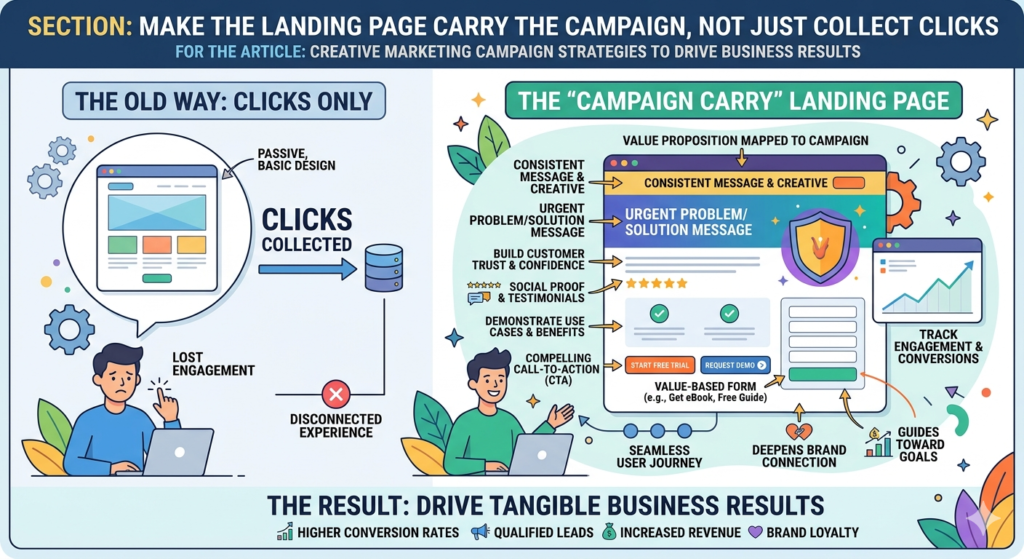
The landing page should not be treated like a place to collect traffic. It should be treated like the main sales conversation of the campaign. It needs to confirm the promise, explain the problem, show the value, reduce doubt, and make the next step feel easy.
If the page is too broad, people leave. If it is too clever, people may not understand. If it is too thin, people do not trust it. If it asks for action too early, people may resist.
A strong landing page is clear, focused, and built around the same idea as the campaign. It does not try to impress the visitor with fancy words. It helps them make a decision.
The first screen should make the visitor feel they are in the right place
The top part of the landing page matters because people decide very quickly whether to stay. The visitor should know three things almost right away. They should know what the page is about, why it matters, and what they can do next.
This does not mean the first screen should be packed with text. It means the message should be sharp. A headline like “Grow Your Business With Digital Marketing” is too broad. A stronger headline might say, “Turn Website Visitors Into Qualified Sales Calls With a Clearer Campaign Funnel.”
The second headline is more useful because it speaks to a result. It tells the visitor what kind of problem the page solves. It also feels more specific.
The first screen should make the visitor feel understood. Once that happens, they are more likely to keep reading.
The page should answer doubts before the customer asks
Every visitor brings quiet doubts to a landing page. They may wonder if the offer is right for their business. They may wonder if they have enough budget. They may wonder how long it will take. They may wonder if the company really understands their market.
A strong landing page answers these doubts inside the flow of the page. It explains who the offer is for. It shows what happens after the person takes action. It gives proof. It makes the process feel simple. It removes fear around wasting time.
This does not mean the page should become long for no reason. It should only be as long as needed to help the right person feel ready. Some offers need a short page. Some need more explanation. The key is to match the page to the risk level of the action.
If the visitor is only downloading a guide, the page can be simple. If they are booking a strategy call or buying a high-ticket service, the page must do more trust-building.
Use Content as a Sales Asset, Not Just a Traffic Tool
Content is often treated as a way to get traffic. That is useful, but it is not enough. A blog post, video, guide, or case study should not only bring people in. It should also help move them closer to buying.
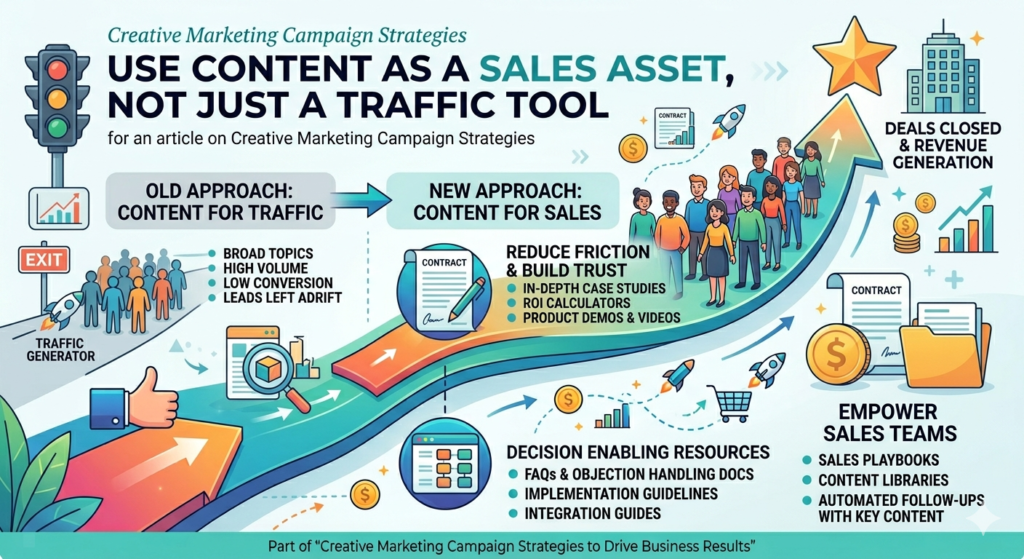
This changes how you plan content inside a campaign. Instead of asking only, “What keyword should we target?” you also ask, “What belief should this content build?” and “What decision should this content support?”
For example, a blog post about improving landing page conversions should not just explain what conversion rate means. It should help the reader see why their current page may be losing serious business. It should show what a better page does differently. It should make the next step feel useful.
When content is planned this way, it becomes part of the sales journey. It warms up cold traffic. It educates leads. It supports email follow-up. It gives sales teams something helpful to share. It keeps working long after the first campaign push is over.
Good content does not just attract attention. It prepares people to act.
Every campaign should include content for trust building
Trust is not built by saying “trust us.” It is built by showing useful thinking before the sale. This is where content becomes powerful.
A campaign can use content to explain the problem, compare choices, break down mistakes, share examples, and show the cost of staying stuck. This gives the customer a reason to believe you know what you are doing.
For WinSavvy, this could mean publishing content that shows how to fix a weak funnel, how to make SEO pages convert better, how to structure an offer, or how to turn paid traffic into leads. These topics do more than attract visitors. They show the agency’s way of thinking.
That matters because customers often choose the team that helps them understand the problem best.
The content should lead naturally to the campaign offer
Content should not end with a random call to action. The next step should feel connected to what the person just read or watched.
If the content explains why paid ads fail without strong landing pages, the offer could be a landing page review. If the content explains why website traffic does not become sales, the offer could be a funnel audit. If the content explains how to improve lead quality, the offer could be a campaign strategy call.
This natural link makes the campaign feel helpful instead of pushy. The reader has just learned about a problem. The offer gives them a way to examine that problem in their own business.
That is how content becomes more than education. It becomes a bridge from awareness to action.
Use Email Follow-Up to Keep the Campaign Alive
Many campaigns lose results because the follow-up is too weak. A person may click an ad, download a guide, visit a page, or join a webinar, but that does not mean they are ready to buy right away. If the campaign stops after the first action, a lot of interest goes cold.
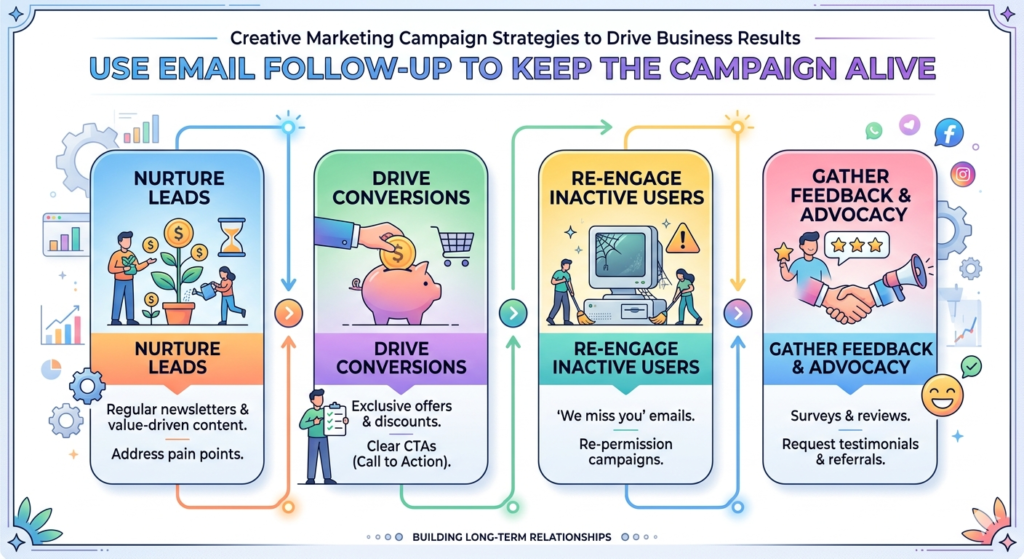
Email follow-up keeps the conversation moving. It gives the customer more reasons to trust you. It answers doubts. It brings them back to the offer when the timing feels better. It also lets you build value without paying again for the same person’s attention.
The key is to make the emails feel useful, not annoying. A good follow-up sequence should not sound like a daily sales pitch. It should feel like a smart guide helping the person understand the problem, see the cost of waiting, and take a clear next step.
This is where many brands can win. Most businesses either do no follow-up or send generic emails that feel disconnected from the campaign. A sharper sequence can turn quiet interest into real pipeline.
The first email should continue the promise of the campaign
The first email after a signup, download, inquiry, or event should feel like the next part of the same conversation. If the person downloaded a guide about fixing lead quality, the first email should not suddenly talk about every service the agency offers. That breaks the flow.
Instead, the email should confirm the reason they took action. It should remind them of the problem they care about and give them one useful next thought. The goal is to make them feel that they made a good choice by engaging with the campaign.
This first email is important because it sets the tone. If it feels helpful, people are more likely to open the next email. If it feels like a bait-and-switch, they will ignore you.
The best email sequences move from value to proof to action
A strong sequence has a natural path. It starts by giving value. Then it builds belief. Then it asks for action.
The value email may explain a hidden mistake, give a simple framework, or show the reader how to spot a problem in their own marketing. The proof email may share a case study, a before-and-after example, or a clear breakdown of how a campaign improved. The action email may invite the reader to book a review, request a plan, or start a conversation.
This flow works because it respects how people decide. They do not want to be pushed before they trust you. But they also need a clear invitation when they are ready.
Good email follow-up is not about writing more emails. It is about writing the right emails in the right order.
Create Social Content That Feels Native to Each Platform
Social media can support a campaign well, but only when the content fits the platform. Many brands make the mistake of copying the same post everywhere. The message may be the same, but the format should not be.
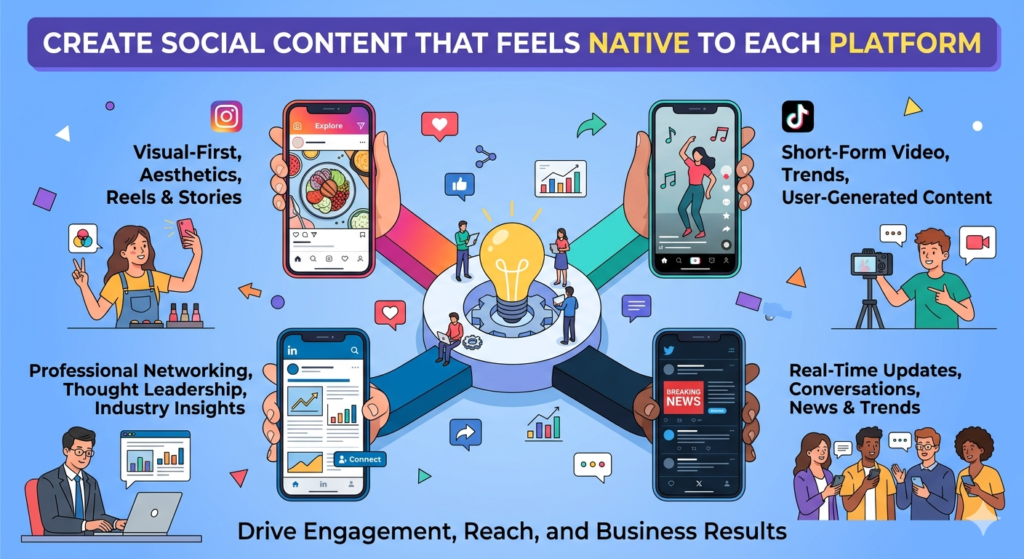
A LinkedIn post, Instagram reel, YouTube short, X thread, and Facebook post all create different kinds of attention. People use each platform with a different mindset. If your campaign ignores that, the content feels out of place.
The campaign idea should stay consistent, but the delivery should change. On LinkedIn, the idea may become a sharp business insight. On Instagram, it may become a simple visual story. On YouTube, it may become a short teaching video. In an email, it may become a deeper explanation.
This makes the campaign feel fresh without losing focus. The audience sees the same core message in different ways. That repetition builds memory, while the format keeps it from feeling dull.
Social content should open a loop people want to close
Good social content creates curiosity. It gives people a reason to pause, read, watch, or click. One of the best ways to do this is to open a loop.
A loop is a small gap in the reader’s mind. For example, “Most businesses do not have a traffic problem. They have a trust problem.” This makes the reader want to know more. It challenges a common belief. It also connects well to a campaign about improving conversions.
Another example could be, “Your best leads may already be visiting your site. The problem is that your pages are not helping them choose you.” This creates interest because it points to a missed chance.
The goal is not to trick people with empty hooks. The goal is to earn attention with a useful idea.
The post should lead to one clear next thought
A social post does not always need to sell directly. But it should move the audience somewhere. That movement may be toward a new belief, a stronger concern, a clearer desire, or a next action.
For example, a post may help the reader understand that low conversion is not always caused by bad traffic. It may be caused by unclear messaging. That one thought can prepare them for a campaign offer around a website or funnel review.
This is how social content becomes strategic. It is not random posting. It is belief building.
Every post should support the wider campaign. Some posts create awareness. Some deepen trust. Some show proof. Some invite action. When you plan social content this way, your feed stops being a content calendar and starts becoming a campaign engine.
Build Creative Ads Around One Strong Promise
Ads are often the first touchpoint in a campaign, so they need to work fast. But working fast does not mean being loud. A good ad is clear before it is clever. It gives the right person a reason to stop and think, “This is for me.”
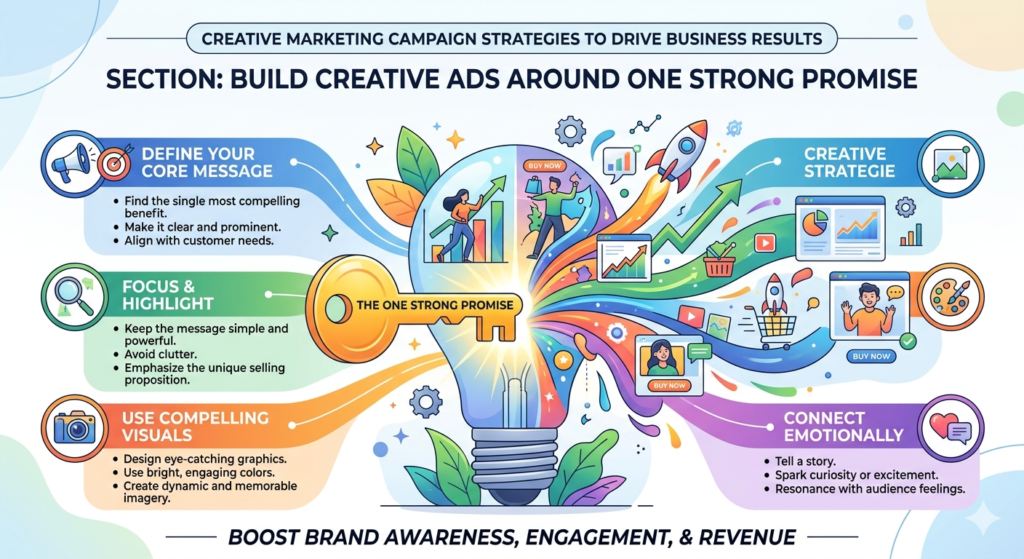
The strongest ads are built around one clear promise. That promise should connect a real customer problem to a desired result. It should not try to explain the whole business. It should not list every service. It should not ask the viewer to solve the message.
For a digital marketing agency, an ad that says “We offer SEO, PPC, content, social media, and web design” is too broad. It may be true, but it does not create urgency. A stronger promise could be, “Find out why your website traffic is not turning into sales calls.” This is sharper because it speaks to a painful business issue.
The promise is what gives the ad power. The creative format supports it.
The ad should focus on the customer’s desired shift
A strong ad is not only about the pain. It is about the shift the customer wants. They want to move from confusion to clarity, from wasted spend to smarter spend, from random traffic to qualified leads, from slow growth to steady momentum.
This shift makes the ad feel useful. It helps the customer picture a better state.
For example, “Stop guessing which part of your funnel is leaking leads” speaks to a clear shift. The customer wants to move from guessing to knowing. That is a powerful promise because it reduces stress and gives control.
When writing ads, ask what the customer wants to stop feeling and what they want to start feeling. They may want to stop feeling stuck, unsure, ignored, or behind. They may want to start feeling clear, confident, visible, and in control. The ad should speak to that movement.
The creative should make the promise easier to understand
Creative should not cover up a weak message. It should make a strong message easier to grasp.
A video ad can show the before and after of a messy funnel becoming clear. A static ad can show one painful question. A carousel can walk through the mistakes causing poor lead quality. A founder-led clip can explain the problem in a personal way. A simple graphic can show where leads drop off.
The format should match the promise. If the promise is about finding leaks, the creative could show a simple funnel leak. If the promise is about turning traffic into calls, the creative could show the gap between visitors and booked meetings.
This makes the message easier to see and remember. People do not need to work hard to understand the point. That is what strong ad creative should do.
Use Proof Before the Customer Asks for It
Proof should not be saved for the end of a campaign. It should appear early and often, because people are naturally careful. They have heard many claims before. They have seen many brands promise growth. They need reasons to believe you.
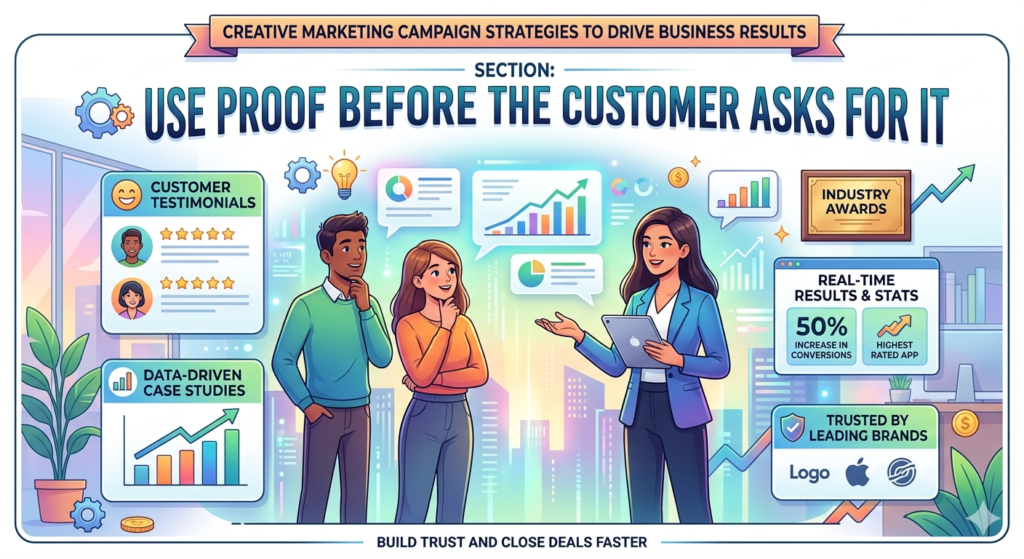
Proof makes the campaign feel grounded. It shows that your message is not just a nice idea. It has real weight behind it.
Proof can come in many forms. It can be a case study, testimonial, review, client quote, data point, before-and-after snapshot, process breakdown, or expert point of view. The best proof depends on the offer and the customer’s level of doubt.
For a service business like WinSavvy, proof should show more than happy clients. It should show thinking, process, and outcomes. A customer wants to know not only that you got a result, but how you approached the problem.
When proof is clear, the campaign feels safer. And when the campaign feels safer, more people take the next step.
Proof should match the exact promise of the campaign
Generic proof is weaker than specific proof. If your campaign promise is about improving lead quality, your proof should show better lead quality. If your promise is about fixing conversion problems, your proof should show conversion improvement.
If your promise is about making paid traffic more profitable, your proof should connect to ad performance, landing page results, or cost per qualified lead.
This matters because customers look for proof that matches their own concern. A testimonial saying “great team” is nice, but it may not answer the buyer’s real doubt. A stronger proof point would explain what problem the client had, what changed, and what result followed.
The proof should feel connected to the campaign story. It should not feel pasted in.
The best proof explains the journey, not just the result
A result is useful, but the journey makes it believable. If you only say, “We increased leads by 40 percent,” the reader may wonder how. If you explain that the campaign fixed the offer, rewrote the landing page, improved the follow-up sequence, and narrowed the audience, the result feels more real.
This also helps the customer see your method. That is important because many buyers are not just buying the outcome. They are buying confidence in the path.
A short case story can work very well inside a campaign. It can show the before state, the problem found, the action taken, and the result reached. This gives the customer a clear picture of how you think.
Good proof does not brag. It reassures. It tells the customer, “This problem can be solved, and here is what a smart path looks like.”
Create a Campaign Hook That Makes People Stop and Care
A campaign hook is the first idea that pulls people in. It is the part of the message that makes someone pause instead of scrolling past, closing the email, or ignoring the ad. Without a strong hook, even the best offer can stay unseen.
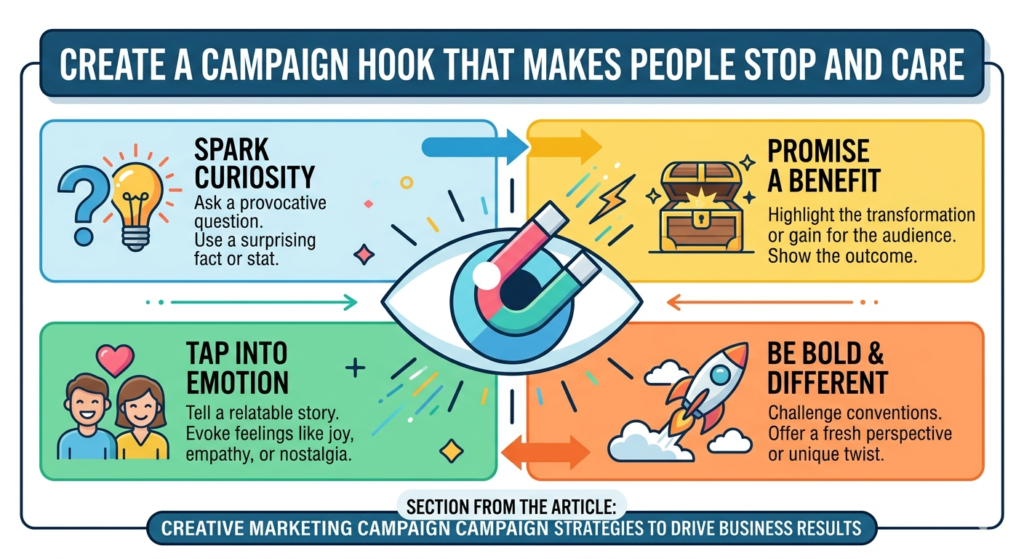
A hook does not have to be loud. It does not have to shock people. It simply has to touch something the customer already cares about. The best hooks often point to a hidden problem, a missed chance, a common mistake, or a better way to get a result.
For example, a weak hook might say, “Improve your digital marketing today.” That is too flat. A stronger hook might say, “Your website may already have enough traffic. It may just be sending buyers away.” This works because it challenges how the customer sees the problem. It also makes them want to know what is going wrong.
A good hook should make the right person feel curious, but it should also stay honest. If the hook gets attention but the campaign does not deliver on it, trust drops fast.
The hook should come from the customer’s real frustration
The easiest way to find a strong hook is to listen to how customers talk when they are frustrated. They rarely use polished marketing words. They say things like, “We are getting clicks, but not enough leads.” They say, “We have tried posting more, but nothing is changing.” They say, “Our ads worked before, but now they are too expensive.”
That kind of language is gold because it is real. It gives you the emotional entry point for the campaign. When your hook sounds close to what the customer is already thinking, it feels personal without needing heavy personalization.
A hook built from real frustration will almost always beat a hook built from clever wordplay. Clever lines may impress marketers. Clear lines move buyers.
The strongest hooks create a small moment of truth
A strong hook often makes the customer admit something to themselves. It may help them see that they have been solving the wrong problem. It may show that they are measuring the wrong thing. It may reveal that the real issue is deeper than they thought.
For example, “More traffic will not fix a weak offer” is a small moment of truth. It is simple, but it forces the reader to think. If they have been chasing traffic without fixing conversion, the line lands.
This is the kind of hook that supports business results because it does not just grab attention. It starts changing the customer’s belief. And once a belief begins to shift, the customer becomes more open to the next step in the campaign.
Make Personalization Feel Useful, Not Forced
Personalization can make a campaign perform better, but only when it helps the customer feel understood. Many brands use personalization in a shallow way. They add a first name to an email or mention an industry in an ad, but the message still feels generic.
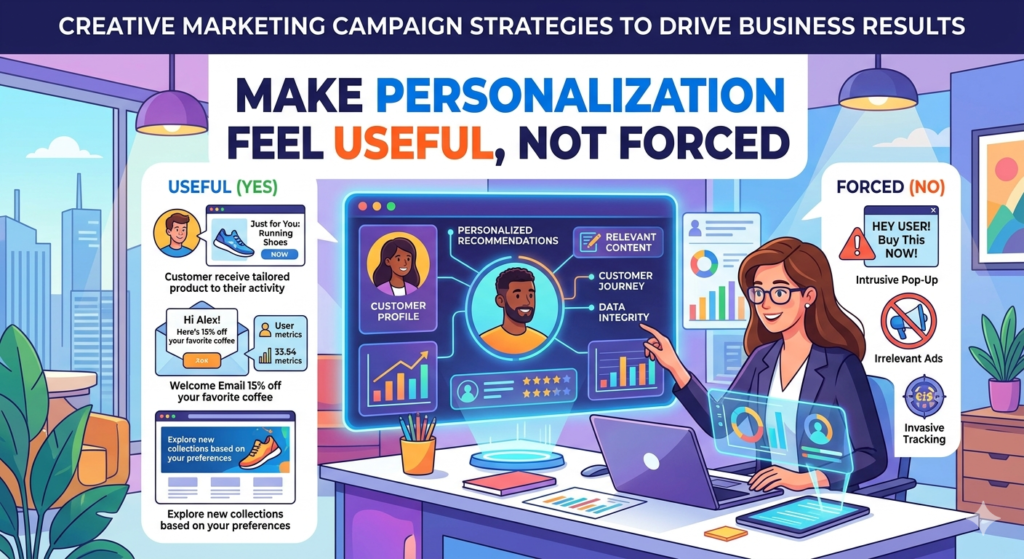
Real personalization goes deeper than names. It speaks to the customer’s situation. It reflects their stage, problem, goal, or market. It shows that the brand understands what the customer is dealing with right now.
For example, a campaign for local service businesses should not sound the same as a campaign for SaaS companies. A local business may care about calls, reviews, map rankings, and nearby buyers. A SaaS company may care about demo requests, free trial conversion, and long sales cycles. The campaign should reflect those differences.
Personalization works when it reduces the mental gap between the message and the customer’s life. The customer should not have to translate the message for themselves.
Personalized campaigns should be based on meaningful segments
A segment is a group of customers who share something important. That shared trait could be their industry, business size, buying stage, pain point, past behavior, or level of awareness.
The mistake is creating too many tiny segments without a clear reason. That makes the campaign harder to manage and often adds little value. A better approach is to create segments only when the message truly needs to change.
For example, you may need one campaign path for cold business owners who do not know why their website is failing, and another path for warm leads who already asked for a marketing audit. These groups need different messages. One needs education. The other needs proof and urgency.
Good segmentation makes the campaign feel more relevant without making it messy.
The message should prove that you understand their context
Useful personalization sounds like context. It shows the customer that you know what matters in their world.
For example, saying “Hi Sarah” is not deep personalization. Saying “If your paid ads are bringing traffic but your booked calls are flat, the issue may be the page people land on after the click” is much stronger. It speaks to a real situation.
This kind of message makes the customer feel seen because it names the moment they are in. It also makes your offer feel more natural. If the campaign understands the problem clearly, the customer is more likely to believe the solution has been built with care.
Personalization should never feel like a trick. It should feel like good listening turned into better marketing.
Use Retargeting to Bring Back People Who Showed Interest
Most people do not act the first time they see a campaign. They may be busy. They may need to think. They may want to compare options. They may like the message but not be ready yet. This is why retargeting matters.
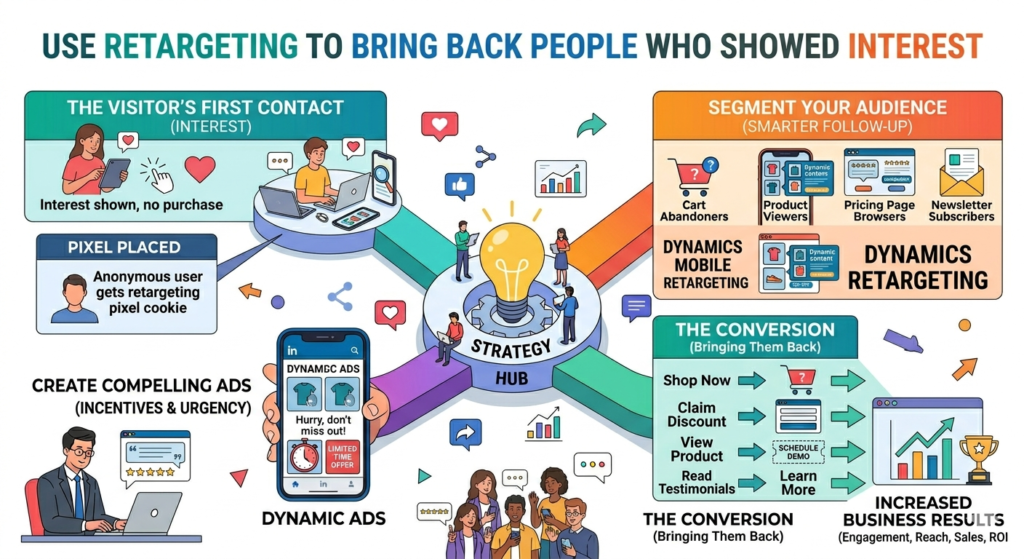
Retargeting helps you stay in front of people who already showed interest. These people may have visited your landing page, watched part of a video, clicked an ad, read a blog post, opened an email, or started a form without finishing it. They are warmer than a cold audience because they have already taken a small step.
But retargeting should not just repeat the same ad again and again. That can feel annoying. A smart retargeting campaign gives the person the next message they need. It moves them closer instead of chasing them.
The goal is not to follow people around the internet. The goal is to continue the conversation in a helpful way.
Retargeting should answer the reason people did not act
When someone visits a page but does not convert, there is usually a reason. They may not trust the brand yet. They may not understand the offer. They may not feel urgency. They may be unsure if the service fits their business. They may need proof.
Your retargeting should address these doubts. If the first ad introduced the problem, the retargeting ad can show proof. If the landing page explained the offer, the retargeting ad can show a case story. If the visitor watched a video but did not book a call, the next ad can explain what happens on the call.
This makes retargeting feel useful because each touch adds something new.
A retargeting sequence should become clearer over time
The longer someone stays in the warm audience, the more direct your message can become. Early retargeting can focus on insight and education. Later retargeting can focus on proof, offer clarity, and action.
For example, the first retargeting message might say, “Here is why traffic does not always turn into leads.” The next might say, “See how a clearer offer can improve campaign response.” The next might invite the person to get a funnel review.
This flow works because it respects the buyer’s pace. It does not demand action before trust is built. It also does not leave the buyer stuck in endless education.
Good retargeting is patient, but it still has direction.
Design Campaigns Around Trust Before You Ask for the Sale
People do not buy only because they understand the offer. They buy because they trust the brand enough to take the next step. This is especially true when the decision involves money, reputation, or business growth.
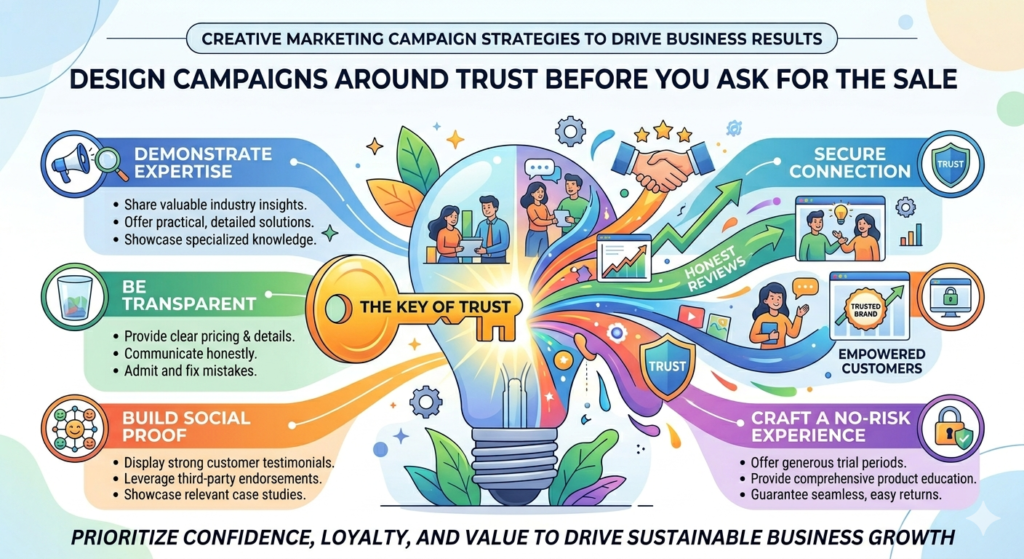
Trust is not built by one claim. It is built through many small signals. The message feels clear. The page looks focused. The proof feels real. The process is easy to understand. The content is helpful. The brand does what it says it will do.
A campaign that skips trust and jumps straight to the sale often feels pushy. It may get some quick clicks, but it will struggle with serious buyers. Strong buyers need confidence. They want to know that you understand the problem, have solved it before, and have a clear way to help.
That is why trust should be planned into the campaign from the start. It should not be added at the end as a testimonial block.
Trust grows when the campaign explains the process clearly
Many customers hesitate because they do not know what will happen after they respond. If they book a call, will it be useful or just a sales pitch? If they request an audit, what will they receive? If they hire the agency, what happens first?
A campaign can reduce this fear by explaining the process in simple terms. Tell people what the next step looks like. Tell them what they will learn. Tell them what they do not need to worry about.
For example, instead of only saying “Book a strategy call,” the campaign can explain that the call will review the current funnel, find the biggest growth block, and suggest the next best move. That feels safer because the customer knows what to expect.
Trust also grows when the brand teaches before it sells
Teaching is one of the strongest ways to build trust. When you help a customer understand a problem clearly, they begin to see you as a guide. They feel that you are not just trying to win the deal. You are helping them make a better choice.
This can happen through blog posts, short videos, email lessons, webinars, audits, or simple breakdowns on social media. The format matters less than the value.
For WinSavvy, teaching could mean showing how to spot weak landing page messages, how to find content gaps, how to fix poor lead quality, or how to connect campaign work to revenue. This kind of teaching gives the customer a preview of the thinking they would get if they worked with the agency.
When a campaign teaches well, the sale feels less like pressure and more like the next natural step.
Turn Customer Questions Into Campaign Content
Customers tell you what your campaign should say long before you write it. They do it through the questions they ask on calls, in emails, in comments, in sales meetings, and even in objections. These questions are not small details. They are signals. They show what people need to understand before they feel ready to act.
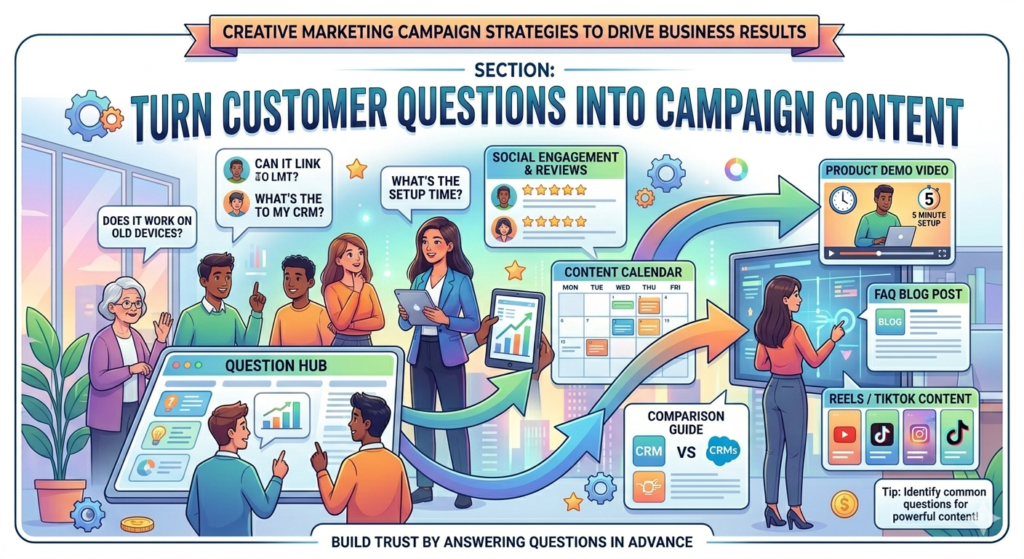
Many campaigns ignore these questions and focus only on what the brand wants to say. That creates a gap. The business talks about services, while the customer is still wondering if the service is right for them, if it will work in their market, how long it will take, and what makes it different from other options.
A stronger campaign takes these questions and turns them into useful content. This makes the campaign feel more helpful because it answers what the customer is already thinking. It also reduces friction. When people find answers before they have to ask, trust grows faster.
For WinSavvy, this could mean turning common sales questions into landing page sections, email topics, ad angles, blog posts, or short videos. The campaign becomes stronger because it is built from real buyer doubt, not guesswork.
The best questions reveal what blocks the sale
Some customer questions are simple. Others show deeper buying concerns. A question like “How much does it cost?” may really mean, “How do I know this will be worth it?” A question like “How long does SEO take?” may really mean, “Can I wait that long, and what happens while I wait?”
This is why your team should not only collect questions. You should study what sits behind them. The surface question gives you the topic. The deeper concern gives you the campaign angle.
If many prospects ask, “Will this work for my industry?” your campaign needs more industry-specific proof. If they ask, “What happens after the audit?” your campaign needs a clearer process. If they ask, “Why are our leads low quality?” your campaign needs content that explains audience, offer, and message fit.
Each major question should become a trust-building asset
A trust-building asset is a piece of content that helps the customer feel more confident. It could be a short email, a landing page section, a case story, a comparison page, a video, or a sales enablement article.
The key is to answer the question fully, but simply. Do not hide behind vague claims. If the customer wants to know why results take time, explain the real reason. If they want to know why one campaign costs more than another, explain what goes into the work. Clear answers make the brand feel honest.
When your campaign answers real questions, it stops sounding like a pitch. It starts feeling like guidance. That is what moves serious buyers forward.
Use Scarcity and Urgency Without Sounding Fake
Urgency can help a campaign perform better, but only when it is honest. People are tired of fake countdowns, false “limited spots,” and pressure that disappears the next day. These tricks may create quick clicks, but they damage trust.
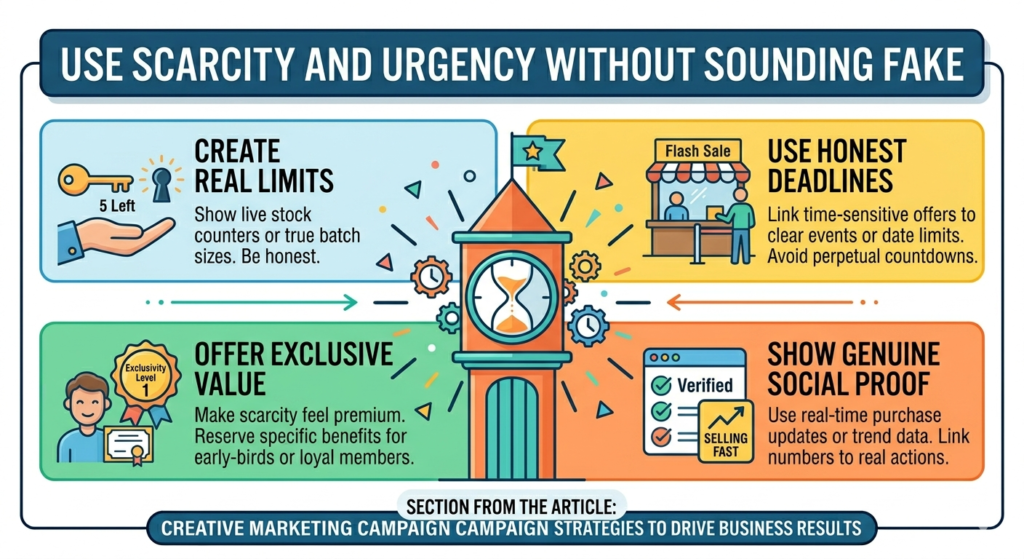
Real urgency comes from a real reason to act now. It may be a limited event, a fixed launch window, a seasonal opportunity, a deadline, a price change, a bonus that ends, or a problem that becomes more costly with time. When the reason is true, urgency feels helpful instead of pushy.
For a service business, urgency can also come from capacity. If your team can only handle a certain number of audits or strategy projects in a month, it is fair to say that. But it must be real. The goal is not to scare people. The goal is to help interested buyers make a decision before the chance passes.
Urgency works best when it is paired with clear value. If people do not want the offer, a deadline will not save it.
The strongest urgency is tied to the customer’s cost of waiting
Sometimes the real deadline is not on your side. It is on the customer’s side. Every month they keep running ads to a weak page, they may waste budget. Every month their content does not convert, they may lose leads. Every month their funnel remains unclear, competitors may win buyers who were already looking.
This kind of urgency is powerful because it comes from the problem itself. It does not depend on a gimmick. It helps the customer see that waiting has a price.
For example, instead of saying, “Book now before spots run out,” a campaign could say, “If your paid traffic is landing on a weak offer, every new click may be making the leak bigger.” That message creates urgency by showing the cost of inaction.
Urgency should make the next step easier, not more stressful
Good urgency gives people a clear reason to act, but it should not make them feel trapped. If the campaign creates too much pressure, careful buyers may step back. They may wonder why the brand is pushing so hard.
A better approach is calm urgency. Show the reason action matters now. Explain the next step. Make it easy to respond. Let the value do most of the work.
For example, a campaign can invite prospects to book a funnel review before the next ad budget cycle. That is specific and useful. It connects action to a real planning moment. It also feels less forced than a random deadline.
Urgency should help customers move when moving is truly in their best interest.
Make the Campaign Easy for Sales Teams to Use
A campaign should not only help marketing. It should also help sales. When marketing and sales work from different messages, the customer experience becomes uneven. The campaign says one thing, but the sales call says another. The ad creates one expectation, but the follow-up conversation feels different.
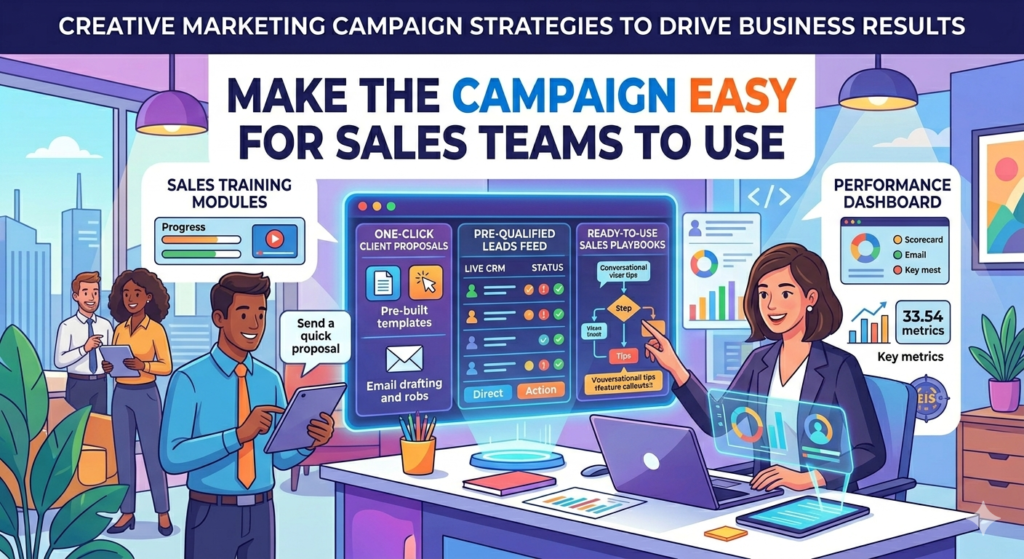
This weakens trust. It also wastes the attention the campaign worked hard to earn.
A strong campaign gives the sales team clear language, useful proof, and simple follow-up assets. This helps them continue the same story the customer already heard. If the campaign is built around fixing lead leaks, the sales call should also use that idea.
If the campaign offer is a funnel review, the sales team should know how to explain what happens during that review.
This makes the whole journey feel smooth. The customer does not feel passed from one department to another. They feel guided by one clear brand.
Sales teams need more than leads from a campaign
Leads are only useful if the sales team knows how to handle them. A campaign should make clear what the lead responded to, what problem they likely care about, and what promise brought them in.
This context helps sales conversations become sharper. Instead of starting from zero, the sales team can continue from the campaign message. They can ask better questions. They can connect the offer to the customer’s pain faster. They can avoid generic pitches.
For example, if a lead came from a campaign about traffic not converting, the sales call should explore where traffic comes from, what page people land on, what action they are asked to take, and where leads drop off. That keeps the conversation focused.
Every campaign should include simple sales support content
Sales support content does not need to be complex. It can include a short campaign brief, a few key talking points, a case study, a common objection guide, and a clear explanation of the offer.
The point is to make sure sales can carry the campaign message without guessing. If they understand the big idea, the promise, the audience, and the next step, they can have better conversations.
This also helps marketing learn faster. Sales can report what buyers ask, where they hesitate, and which messages land best. That feedback can improve the campaign while it is still running.
When sales and marketing share the same campaign story, results become easier to track and easier to improve.
Conclusion
Creative marketing only works when it helps the business move forward. A great campaign is not just clever, pretty, or loud. It is clear, focused, and built around what the customer truly needs. It starts with a real problem, turns that problem into a strong message, and guides people toward one simple next step.
Every ad, page, email, story, and offer should work together. That is how attention becomes trust. Trust becomes action. And action becomes growth. For WinSavvy, the best campaigns are not built to impress. They are built to create real business results.













Comments are closed.