
WinSavvy Editorial Standards
How this article was created
Real estate is a trust business before it is a sales business. People do not choose an agent only because they saw a nice logo, a polished photo, or a clever post online. They choose an agent because they believe that person can help them make one of the biggest money decisions of their life without confusion, pressure, or regret.
Build Your Real Estate Marketing Around One Clear Local Position
Most real estate agents try to market to everyone. That sounds safe, but it is one of the fastest ways to become forgettable.
When your message is too broad, people do not know why they should choose you. They see another agent posting homes, market updates, and “call me if you want to buy or sell” messages. Nothing feels clear. Nothing feels special. Nothing helps them remember you when the right moment comes.

Strong marketing starts with a clear position.
Your position is the simple reason people in your market should trust you instead of another agent. It is not a slogan. It is not a fancy line on your business card. It is the promise your whole marketing system supports.
For example, one agent may become known as the best guide for first-time home buyers in a certain city. Another may become known for helping downsizing homeowners sell with less stress. Another may focus on luxury lake homes, new construction, relocation buyers, investment properties, or family homes near top schools.
The point is not to shrink your business. The point is to make your marketing sharper.
When you speak to a clear group of people, your content becomes easier to write. Your ads become easier to target. Your website becomes easier to understand. Your social posts feel more useful. Your referrals become stronger because people know exactly who to send your way.
Your local market should shape your message
Real estate is local. That means your marketing should not sound like it could belong to any agent in any city.
A weak message says, “I help buyers and sellers with all their real estate needs.”
A stronger message says, “I help young families in Frisco find homes near great schools without overpaying in a fast-moving market.”
Another strong message says, “I help homeowners in Scottsdale sell high-value homes with smart pricing, strong digital marketing, and a calm plan from listing to closing.”
The second and third examples feel real. They tell the reader who the agent helps, where they help, and what outcome they create. That kind of message gives people a reason to pay attention.
Your market may have first-time buyers who feel priced out. It may have empty nesters who need help selling homes they have lived in for twenty years. It may have remote workers moving in from bigger cities. It may have investors looking for rental yield. It may have luxury sellers who care about privacy and presentation.
Your job is to understand what people in your area are worried about, what they want, and what kind of help they are looking for before they call an agent.
Your best message should sound like your client’s real problem
A strong message does not begin with what you do. It begins with what your client is trying to solve.
A first-time buyer may not be thinking, “I need a transaction expert.” They may be thinking, “I do not know if I can afford a home, and I am scared of making a bad choice.”
A seller may not be thinking, “I need a listing agent.” They may be thinking, “I want to sell for a strong price, but I do not want my home sitting for months.”
A relocating buyer may not be thinking, “I need area knowledge.” They may be thinking, “I do not know which neighborhood will feel right for my family.”
When your marketing speaks to these real thoughts, it feels human. It feels useful. It feels like you understand the person before they have to explain everything to you.
That is what makes someone pause, read, save, click, or call.
Pick a lane before you try to grow everywhere
Many agents fear that choosing a niche will cost them business. In most cases, the opposite happens.
When you become known for something specific, people trust you faster. A seller with a waterfront property wants an agent who understands waterfront buyers. A first-time buyer wants someone who can explain each step without making them feel foolish. A busy investor wants someone who can talk numbers, rents, repairs, and resale value without wasting time.
You can still work with other clients. Your public message simply needs a clear center.
Think of your positioning like the front door of your business. It does not mean there are no other rooms inside. It just tells people where to enter.
If you are not sure where to focus, look at your past deals. Notice which clients you served best. Notice which homes you enjoyed marketing. Notice which problems you solved well. Notice where you already have proof.
Your best position often sits at the crossing point between your strengths, your market demand, and your past results.
Your niche should be useful, not random
A real estate niche should help the client trust you faster. That means it must be tied to a real need in the market.
“Luxury homes” can be a useful niche if you understand pricing, privacy, high-end staging, and premium buyer behavior.
“First-time buyers” can be a useful niche if you are good at teaching, calming nerves, and explaining money steps in simple terms.
“Divorce sales” can be a useful niche if you know how to handle sensitive situations with care, fairness, and clear communication.
“Relocation buyers” can be a useful niche if you know neighborhoods, commute times, school zones, local costs, and lifestyle differences.
A weak niche is one you choose only because it sounds profitable. A strong niche is one where your skills, your proof, and your market’s needs all fit together.
Turn your position into a simple promise
Once you know who you want to be known for helping, turn that into a simple promise.
Do not make it clever. Make it clear.
For example, “I help first-time buyers in Austin buy with confidence, even in a competitive market.”
Or, “I help homeowners in Tampa sell faster by using smart pricing, strong online exposure, and clean negotiation.”
Or, “I help families moving to Charlotte choose the right neighborhood before they choose the right house.”
These lines are not meant to be poetry. They are meant to make sense quickly.
Your promise should show up on your website, your social profiles, your email signature, your listing presentations, your ads, and your videos. Over time, repetition builds memory. When the same clear message appears again and again, people start to connect you with that need.
That is how you stop being “another real estate agent” and start becoming “the agent for this kind of move.”
Your promise should pass the stranger test
A good promise should be clear enough that a stranger can repeat it after reading it once.
If someone sees your website and later tells a friend, “She helps young families find homes in North Dallas,” your message is working.
If they say, “He does something with real estate and cares about clients,” your message is too vague.
The clearer your promise, the easier it is for people to refer you. People do not refer what they cannot explain.
This matters because referrals are not just built through good service. They are also built through easy memory. When your brand is simple to remember, people can talk about you with confidence.
Use your position to guide every marketing choice
A clear position saves time because it helps you decide what to create and what to ignore.
If you serve first-time buyers, your content should explain down payments, loan approval, inspection issues, closing costs, bidding strategy, and common mistakes. Your website should have guides for new buyers in your city. Your ads should offer a useful first-time buyer checklist or a local affordability guide. Your videos should answer the questions nervous buyers are already asking.
If you serve sellers in a certain neighborhood, your content should show pricing trends, buyer demand, staging advice, local sale examples, and timing tips. Your email list should receive market updates that make homeowners smarter. Your landing pages should explain your selling process clearly.
If you serve luxury clients, your content should feel calm, polished, and private. Your marketing should show how you handle presentation, exposure, buyer screening, negotiation, and discretion.
This is what strategy looks like. It is not doing more. It is making every piece of marketing point in the same direction.
Your position should help you say no faster
One hidden benefit of positioning is that it protects your time.
Without a clear position, every platform looks important. Every trend feels urgent. Every content idea seems worth trying. That is how agents become busy but not effective.
With a clear position, you can ask a simple question before doing any marketing task: “Will this help my ideal client trust me more?”
If the answer is yes, it may be worth doing. If the answer is no, it is probably noise.
That one question can save hours every week.
Create A Real Estate Website That Works Like A Sales Assistant
Your website should not be a digital business card. It should be a full-time sales assistant.
It should answer questions, build trust, collect leads, show your local knowledge, and help people take the next step before they ever speak to you.
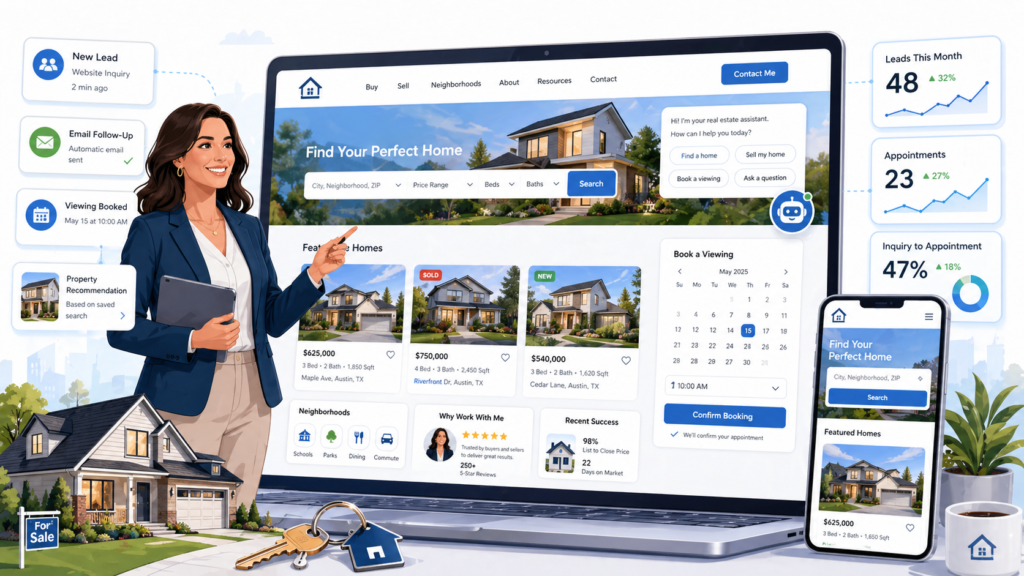
Too many real estate websites look nice but do very little. They have a homepage, a photo, a few listings, a contact form, and the same “buying and selling made easy” message every other agent uses. That is not enough.
A strong website should make a visitor feel like they have found someone who understands their situation.
Your homepage should make the right person feel seen
The first job of your homepage is clarity.
When someone lands on your site, they should understand where you work, who you help, and why they should keep reading within a few seconds.
Do not open with a vague welcome message. Do not waste the top of the page with a slogan that sounds nice but says nothing. Use that space to speak directly to the client you want.
A strong homepage headline might say, “Helping Denver homeowners sell with less stress and stronger results.”
Another might say, “Your local guide to buying your first home in Raleigh with confidence.”
Another might say, “Smart real estate guidance for families moving to North Atlanta.”
Each of these lines tells visitors where they are, who the agent helps, and what kind of result they can expect.
That is far stronger than saying, “Your trusted real estate expert.”
Your first screen should answer three questions fast
The first screen of your website should answer three quiet questions in the visitor’s mind.
They want to know if you work in their area.
They want to know if you help people like them.
They want to know what step they should take next.
You can answer these questions with a clear headline, a short support sentence, and one direct call to action. For example, the button may say, “Get a home value review,” “Start your buyer plan,” or “Book a local strategy call.”
The key is to make the next step feel safe and useful. Do not make every visitor feel like they must call you right away. Some are ready now. Many are not. Your website should serve both.
Your service pages should speak to real situations
Most agent websites have weak buyer and seller pages. They explain the process in broad terms, but they do not make the reader feel understood.
A buyer page should not only say you help people find homes. It should explain how you help buyers avoid overpaying, understand the local market, prepare financing, compare neighborhoods, write stronger offers, and stay calm during the process.
A seller page should not only say you list homes. It should explain how you help with pricing, prep, staging, photos, launch timing, online exposure, showing strategy, offer review, and negotiation.
The more specific your pages are, the more useful they become.
Specific pages also help with search engine visibility. A page about “buying your first home in Phoenix” is more useful than a generic page about buying. A page about “selling a home in Plano after retirement” can speak to a very real group of homeowners.
Your pages should remove fear before asking for contact
People do not contact agents only because they like a website. They contact agents when enough fear has been removed.
A buyer may fear wasting your time because they are early in the process. So your page should say that early planning is welcome.
A seller may fear being pressured to list before they are ready. So your page should explain that your first step is a clear home review, not a hard sell.
A relocating family may fear choosing the wrong area. So your page should explain how you compare neighborhoods based on lifestyle, commute, schools, and budget.
Each page should make the reader feel safer. When people feel safe, they take action faster.
Your website should have strong local pages
Local pages are one of the most useful parts of a real estate website, especially for SEO.
A local page is a page built around a city, neighborhood, suburb, school zone, or community you serve. But it should not be thin. It should not be a copied page with only the location name changed.
A good local page should feel like it was written by someone who actually knows the area.
It should explain what the area is like, who it is good for, what buyers should know, what sellers should watch, what price ranges are common, what lifestyle details matter, and what mistakes people often make there.
For example, a strong neighborhood page might explain why one part of town is popular with young families, why another is better for commuters, and why some homes sell faster than others because of layout, lot size, or school zone demand.
This kind of content does two things. It helps Google understand your local relevance, and it helps real people trust your judgment.
Your local pages should not sound like travel guides
Many agents make local pages that read like tourist brochures. They talk about parks, restaurants, and history, but they do not help someone make a real estate decision.
That is a missed chance.
A buyer does not only need to know that a neighborhood has coffee shops. They need to know what kind of homes are common there, how fast good homes move, what price trade-offs exist, what roads get busy, what buyers often regret, and which questions they should ask before making an offer.
A seller does not only need to know that their area is popular. They need to know what buyers in that area care about, which upgrades matter, how pricing shifts by block, and how to prepare their home for the strongest launch.
Your local content should help people make better choices. That is what turns a page into a lead source.
Your website should collect leads in more than one way
A contact form is not enough.
Some people are ready to talk now. Others are still learning. Others are comparing agents quietly. If your website only says “contact me,” you lose many people who are not ready for a call.
You need soft lead options.
A seller may want a home value review. A buyer may want a first-time buyer guide. A relocating family may want a neighborhood comparison. An investor may want a rental property checklist. A homeowner may want a monthly market update.
These offers give people a reason to raise their hand before they are ready for a full conversation.
Once they do, your follow-up system can build trust over time.
Your lead offer should solve one clear problem
Do not create a generic download just to collect emails. A weak offer gets weak leads.
A strong lead offer helps the person solve one real problem.
For buyers, that problem may be understanding what they can afford. For sellers, it may be knowing which repairs are worth doing before listing. For relocating families, it may be choosing between neighborhoods. For investors, it may be spotting red flags before buying.
The better the offer, the better the lead.
A simple guide called “What To Fix Before Selling Your Home In Nashville” is stronger than a broad guide called “Real Estate Tips.” It feels useful. It feels local. It feels tied to a real decision.
That is the kind of offer people will actually request.
Your website should make trust easy to see
Trust should not be hidden on one testimonials page.
It should appear across your site in natural places.
Use client stories on service pages. Use short quotes near calls to action. Use sale examples where they support your method. Use local proof when you make local claims. Use clear process steps so people know what working with you feels like.
People want to know that you have helped others like them before.
Do not only say you are experienced. Show what your experience does for the client.
For example, instead of saying, “I have deep market knowledge,” explain how that knowledge helps a seller avoid underpricing or helps a buyer avoid a poor offer strategy.
Instead of saying, “I am a skilled negotiator,” explain how you prepare clients before offers arrive, compare terms beyond price, and protect the deal after inspection.
Your proof should be tied to the promise you make
Random proof is not as strong as focused proof.
If your promise is helping first-time buyers feel confident, your best proof should show nervous buyers becoming clear and ready.
If your promise is helping sellers get strong results, your proof should show pricing strategy, strong marketing, buyer interest, and smooth negotiation.
If your promise is helping relocating families choose wisely, your proof should show how you guided people through neighborhoods, timing, and local choices.
Proof works best when it supports your position. That is how your website becomes more than attractive. It becomes persuasive.
Use Local SEO To Become The Agent People Find Before They Ask Friends
Local SEO is one of the most powerful long-term marketing strategies for real estate agents.
When someone searches for “best real estate agent in [city],” “homes for sale in [neighborhood],” “how to sell my house in [city],” or “moving to [suburb],” they are showing real intent. They are not just scrolling for fun. They are looking for help.
![When someone searches for “best real estate agent in [city],” “homes for sale in [neighborhood],” “how to sell my house in [city],” or “moving to [suburb],” they are showing real intent. They are not just scrolling for fun. They are looking for help.](https://www.winsavvy.com/wp-content/uploads/2024/06/ChatGPT-Image-Apr-27-2026-10_51_43-PM-1024x576.png)
If your name appears when that search happens, you are in the right place at the right time.
But local SEO is not just about ranking for one big keyword. It is about building a web of useful local content that makes you visible across many searches.
Your Google Business Profile matters more than most agents think
For local searches, your Google Business Profile can be just as important as your website.
When someone searches for an agent near them, Google often shows a local map pack. This is the box with local business results, reviews, locations, photos, and contact buttons. If you show up there with strong reviews and a clear profile, you can win leads before people even visit your website.
Your profile should be complete, current, and active.
Your service area should be accurate. Your business description should be clear. Your photos should look professional but real. Your posts should show market updates, client education, new listings, sold homes, and useful local advice.
Most agents set up their profile once and forget it. That is a mistake. An active profile gives Google and clients more reasons to trust you.
Your reviews should tell a story, not just show stars
Reviews are not only about rating. They are about proof.
A five-star review that says “Great agent” is nice. But a review that says “She helped us sell our home in two weeks, explained every offer clearly, and made the process less stressful” is far more powerful.
You cannot write reviews for clients, but you can guide them with better prompts.
After closing, instead of simply asking for a review, ask them to share what problem they had before working with you, how you helped, and what the result felt like. This helps future clients see themselves in the story.
The best reviews answer the silent question every lead has: “Can this agent help someone like me?”
Your content should target local intent
Local SEO works when your content matches what people are searching for.
A person searching “homes for sale in Miami” may want listings. A person searching “best neighborhoods in Miami for families” wants guidance. A person searching “is it a good time to sell in Miami” wants market advice. A person searching “costs of selling a house in Miami” wants numbers and planning help.
Each of these searches needs a different kind of page or article.
If your website only has listings, you miss the education searches. If your website only has blog posts, you may miss the high-intent neighborhood searches. A strong SEO system uses both.
You want pages for your main locations, pages for key services, and articles that answer common buyer and seller questions.
Your SEO topics should come from client conversations
The best content ideas are often hiding in your daily calls.
Every time a buyer asks, “How much do I need for closing costs?” that can become a blog post.
Every time a seller asks, “Should I renovate before listing?” that can become a guide.
Every time a relocating family asks, “Which area is better for schools and commute?” that can become a comparison page.
Every time an investor asks, “What makes a rental property risky here?” that can become a local investment article.
SEO is not about guessing what to write. It is about turning real questions into useful pages.
Your neighborhood pages should be deep enough to win trust
Many real estate websites have neighborhood pages, but most are too thin.
They may have a few photos, a map, a short description, and active listings. That is not enough to stand out.
A strong neighborhood page should help a buyer understand what living there and buying there really means. It should explain price ranges, home styles, who the area fits, commute patterns, schools, parks, local feel, common buyer mistakes, and what makes homes in that area sell faster or slower.
It should also speak to sellers. It can explain what buyers in that neighborhood value, how seasonality affects demand, and what homeowners should know before pricing.
The page should feel like a conversation with a smart local expert.
Your neighborhood pages should include honest trade-offs
Trust grows when you are honest.
Do not make every area sound perfect. Buyers know every neighborhood has trade-offs. Some areas have higher prices. Some have older homes. Some have longer commutes. Some have more competition. Some offer more space but fewer walkable places.
When you explain both the strengths and the trade-offs, people trust you more.
A buyer does not need hype. They need guidance.
An honest page may say that a neighborhood is great for space and schools but can be less ideal for people who want a short city commute. Another page may explain that an area is lively and walkable but offers smaller homes and tighter parking.
That kind of detail feels real. It also attracts better leads because people come to you already educated.
Your website structure should help Google and people move around
SEO is not only about writing. It is also about structure.
Your site should make it easy for visitors and search engines to understand which areas you serve and what topics you cover.
Your homepage should link to your main buyer, seller, and local pages. Your local pages should link to related neighborhoods. Your blog posts should link back to service pages when helpful. Your market update pages should connect to the city or neighborhood pages they support.
This creates a clear path through your site.
For example, a blog post about “Should You Sell Your Home Before Summer In Plano?” can link to your Plano seller page, your home value page, and your Plano market update page.
This helps readers take the next step. It also helps search engines understand your site’s focus.
Your internal links should feel helpful, not forced
Do not stuff links into every sentence.
A good internal link should feel like the natural next step. If someone is reading about selling costs, link them to a seller consultation page or a home value review. If someone is reading about neighborhoods, link them to a guide that compares nearby areas. If someone is reading about first-time buying, link them to your buyer process page.
The goal is not to game the system. The goal is to guide the reader.
When your site feels easy to explore, people stay longer. They read more. They trust more. And they are more likely to contact you when the time is right.
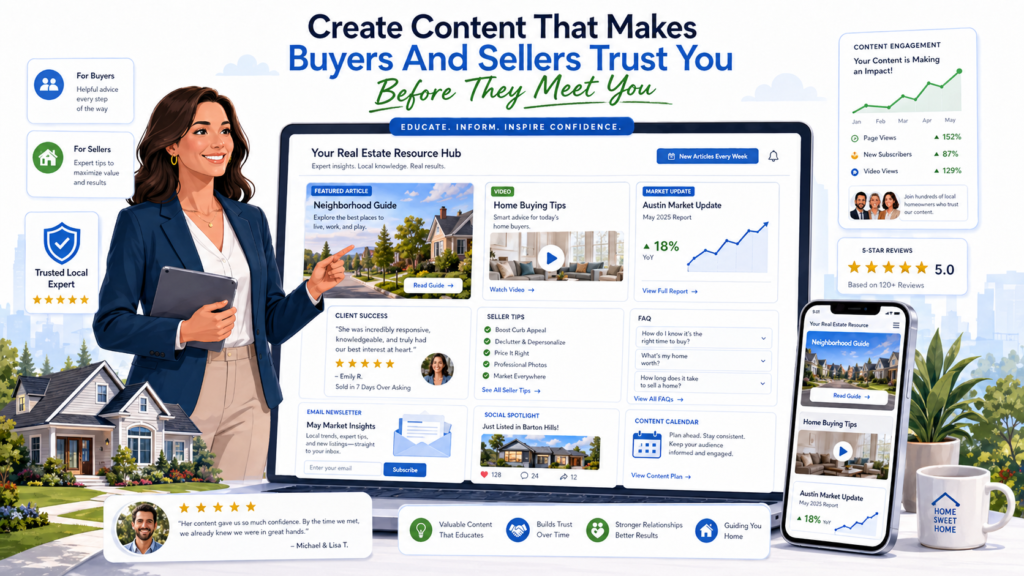
Create Content That Makes Buyers And Sellers Trust You Before They Meet You
Content is not just something agents post to stay active online. Good content is a trust builder.
A person may not be ready to call you today. They may not even know if they want to buy or sell yet. But they are still watching. They are reading. They are judging. They are asking quiet questions in their mind.
Do you understand the market?
Do you explain things clearly?
Do you seem honest?
Do you sound like someone who would be calm under pressure?
Do you know the area?
Do you care more about helping or just closing?
Your content answers these questions before you ever speak to the person. That is why content should not be random. It should be built around the real decisions your future clients are trying to make.
Your content should help people make better real estate decisions
Most real estate content is too weak because it only says what people already know.
“Now is a great time to buy.”
“Call me for a home value.”
“Here are five tips for sellers.”
“Check out this beautiful kitchen.”
These posts may fill space, but they do not build much trust. They do not teach. They do not guide. They do not show how you think.
Strong content helps people understand something they were confused about before.
A buyer should leave your content knowing how to compare two homes more clearly. A seller should understand why the highest listing price is not always the smartest price. A homeowner should understand which upgrades may matter before selling and which ones may waste money. A relocating family should understand how to compare neighborhoods beyond photos and online ratings.
When your content makes people smarter, they begin to see you as an advisor, not just a salesperson.
That shift matters.
People avoid salespeople when they feel pressured. But they seek out advisors when they need help.
Your best content should answer the questions people are scared to ask
Many clients feel embarrassed by what they do not know.
First-time buyers may not want to ask what earnest money means. Sellers may not want to admit they do not understand closing costs. Investors may not want to say they are unsure how to judge cash flow. Homeowners may not understand why their home is not worth the same as a neighbor’s home.
This gives you a huge content opportunity.
When you answer simple questions with respect, you become safer to approach. You show people that they do not need to feel foolish around you. You make the process feel less heavy.
A great post might explain what happens after an offer is accepted. Another might explain why a home can get many showings but no offers. Another might explain what buyers should look for during a second showing. Another might explain why online home value tools can be useful but also wrong.
These topics may seem basic to you. They are not basic to your clients.
What feels normal to you may feel stressful to them. That is where your content has power.
Your content should show your thinking, not just your activity
A lot of agents post about being busy. They post closings, open houses, new listings, and sold signs. There is nothing wrong with that, but activity alone does not prove value.
Clients do not only need to know that you are working. They need to know how you work.
Instead of posting only “Just sold,” explain what helped the home sell. Was it the pricing strategy? The prep before photos? The timing? The way offers were reviewed? The way you handled inspection concerns?
Instead of posting only “New listing,” explain who the home may be right for, what buyers should notice, and what makes the property stand out in that part of the market.
Instead of posting only a market update, explain what the numbers mean for a real person. If inventory is rising, what should sellers do differently? If rates are affecting demand, how should buyers think about offers? If homes are sitting longer, what does that mean for pricing?
The goal is to make your thinking visible.
When people see how you think, they can picture what it would be like to work with you.
Your content should make invisible work visible
Real estate clients often do not see most of the work an agent does.
They see the listing go live. They see the sign in the yard. They see the showing schedule. They see the offer. But they may not see the pricing research, the buyer behavior review, the listing prep plan, the photo direction, the follow-up with agents, the offer comparison, the inspection strategy, or the deal protection behind the scenes.
Your content should bring that hidden work into the light.
For example, you can write about how you prepare a listing before the photographer arrives. You can explain how you help a seller decide between two offers with different terms. You can show how you help buyers compare a lower-priced home with higher repair risk against a higher-priced home with fewer problems.
This type of content proves value without bragging.
It also helps people understand that hiring a good agent is not about finding someone to unlock doors or upload photos. It is about having someone who can guide decisions that carry real money risk.
Your content should be built around content pillars
Content gets easier when you organize it into simple themes.
These themes are often called content pillars, but do not overthink the term. It simply means the main types of topics you talk about again and again.
For a real estate agent, strong content pillars may include buyer education, seller education, local market updates, neighborhood guidance, client stories, home preparation, pricing advice, negotiation lessons, and moving tips.
The point is to avoid waking up each day wondering what to post.
When you have clear pillars, you can rotate through them. One day you help buyers. Another day you speak to sellers. Another day you explain a local market shift. Another day you share a client story. Another day you answer a common question.
This keeps your marketing balanced.
It also helps your audience understand what you are known for.
Your content pillars should match your position
Your content should support the market position you chose earlier.
If you want to be known for helping first-time buyers, then a large part of your content should teach first-time buyers. You should talk about loan approval, down payments, hidden costs, offer mistakes, inspections, appraisals, and how to know when a home is a good fit.
If you want to be known for helping sellers in a certain area, then your content should speak to that area and those homeowners. You should talk about local buyer demand, pricing, home prep, timing, showing strategy, and seller mistakes.
If you want to be known for relocation, then your content should compare neighborhoods, explain local lifestyle choices, show commute trade-offs, and help people understand what does not show up on listing sites.
This is how content becomes strategic. It is not just content for attention. It is content that builds the exact kind of trust your business needs.
Your content should use stories because stories are easier to remember
People remember stories better than tips.
A tip says, “Do not overprice your home.”
A story says, “A seller wanted to list high because a neighbor sold well six months earlier. But the market had shifted, and buyers had more choices. We priced closer to the current demand, attracted stronger showings in the first week, and avoided the price cuts that often make a listing look stale.”
The story is stronger because it shows the lesson in action.
You can use stories without sharing private details. You can change names, remove addresses, and keep the client’s privacy safe. What matters is the lesson.
Real estate is full of stories. A buyer who almost skipped a great home because of paint colors. A seller who wanted to renovate too much before listing. A family that chose a slightly smaller house because the location fit their life better. An investor who avoided a bad purchase because the numbers looked good at first but failed after repairs and vacancy were counted.
These stories teach without sounding like a lecture.
Your stories should always lead to a useful lesson
A story should not be shared only to entertain. It should help the reader make a better choice.
After telling the story, make the lesson clear. Explain what a buyer should watch for. Explain what a seller can learn. Explain what you would do differently next time. Explain the simple rule behind the example.
This is where copywriting matters.
A good story pulls the reader in. A clear lesson makes the story useful. A soft next step turns interest into action.
For example, after telling a pricing story, you might say that sellers should not price based on hope or old sales alone. They should price based on current buyer behavior, competing homes, condition, and timing. Then you can invite them to request a clear pricing review before they list.
That feels helpful, not pushy.
Use Social Media To Build Familiarity, Not Just Followers
Social media can help real estate agents grow, but only when it is used with the right goal.
The goal is not to become famous. The goal is to become familiar to the right people in your market.
Familiarity is powerful. People are more likely to contact someone they have seen often, learned from, and slowly started to trust. They may not like every post. They may not comment. They may not message you for months. But if your content keeps showing up with useful advice, local insight, and a clear point of view, you stay in their mind.
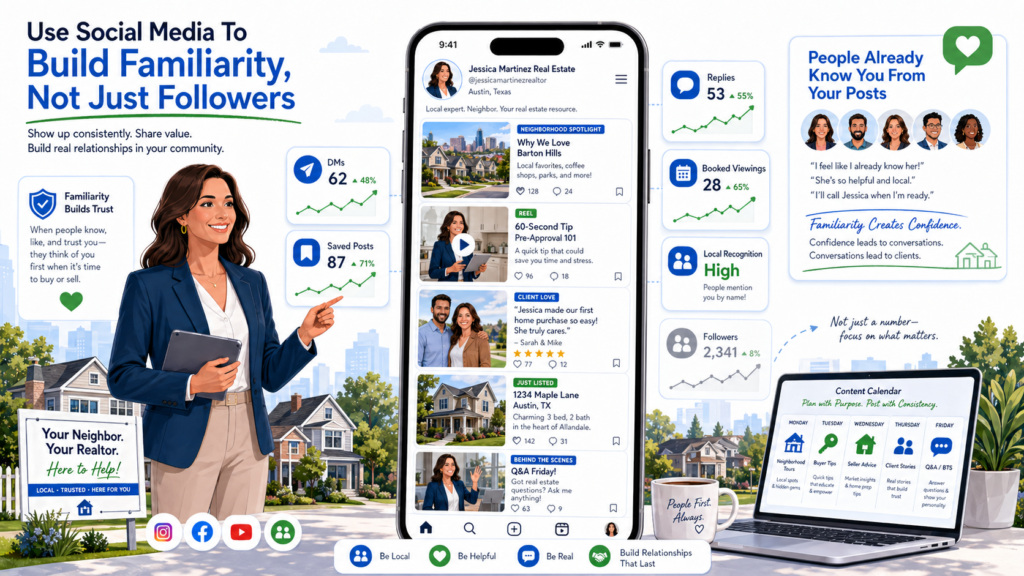
Then one day, when they need an agent, you do not feel like a stranger.
That is the real value of social media.
Your social media should not be only about listings
Listings matter, but they should not be your whole social media strategy.
If every post is a listing, your page becomes useful only to people who are actively looking right now. That is a small group. Most of your future clients are not ready today. They may be six months, twelve months, or two years away from making a move.
You need content that helps people before they are ready.
Talk about how to prepare for buying. Talk about mistakes sellers make before listing. Talk about what is changing in your local market. Talk about neighborhood differences. Talk about what buyers are asking for. Talk about what sellers can do now if they want to move later.
This kind of content keeps people engaged long before they need your service.
Your posts should create small moments of trust
Not every post needs to be a big lesson. Sometimes a small clear point is enough.
A post can explain why the first weekend of a listing matters. Another can explain why the best offer is not always the highest offer. Another can explain why buyers should visit a neighborhood at different times of day. Another can explain why sellers should not ignore small repairs that show up badly in photos.
Each small lesson creates a small moment of trust.
Over time, those moments add up.
People start to think, “This agent explains things well.” Then they think, “This agent seems to know the market.” Then they think, “When we are ready, we should talk to them.”
That is how social media works when it is done well. It does not always create instant leads. It builds the trust that makes future leads easier to convert.
Your personal brand matters because people hire people
Real estate is personal. People want to know the human behind the service.
This does not mean you need to share every part of your private life. It means your audience should get a sense of your values, your style, and your way of working.
Some agents are calm and detailed. Some are energetic and bold. Some are warm and teacher-like. Some are direct and numbers-focused. Some are great at helping nervous clients feel steady. Some are great at helping experienced investors move fast.
Your social media should let people feel your style.
If you are clear and calm, show that. If you are warm and patient, show that. If you are sharp with numbers, show that. If you are deeply local, show that.
Do not copy another agent’s voice just because their content gets attention. Your goal is not to attract everyone. Your goal is to attract people who would enjoy working with you.
Your personality should support your promise
Personal branding does not mean posting random personal updates. It means showing the parts of you that make your service more trusted.
If your promise is helping first-time buyers feel confident, show patience, teaching, and simple explanations.
If your promise is helping luxury sellers protect value, show care, polish, and strategy.
If your promise is helping relocating families choose the right area, show local knowledge, neighborhood context, and real-life guidance.
Your personality should make your market position stronger.
That is how you stay human without turning your business page into a diary.
Your video content should answer real questions
Video is powerful because it builds trust faster than text alone. People can hear your voice. They can see your face. They can feel your energy.
But many agents avoid video because they think it has to look perfect. It does not.
A clear, useful video filmed on your phone can do more than a polished video that says nothing.
Start with simple questions your clients ask all the time.
Explain what sellers should do before getting a home value estimate. Explain what buyers should know before touring homes. Explain what happens during inspection. Explain how to compare two neighborhoods. Explain why some homes sell quickly while others sit. Explain what a price reduction really signals.
Keep the topic tight. Speak like you are talking to one client across a table. Do not perform. Teach.
Your videos should have one clear point
The most common video mistake is trying to say too much.
A strong short video should make one point clearly.
For example, do not make one video called “Everything You Need To Know About Buying A Home.” That is too broad. Make one video about why pre-approval should happen before serious home shopping. Make another video about what closing costs are. Make another about what inspection can and cannot do. Make another about how to avoid falling in love with the wrong home.
One point is easier to watch. One point is easier to remember. One point is easier to share.
This also helps you create more content. One big topic can become ten small videos.
Your social media should lead people somewhere
Social media is not the whole system. It is a doorway.
If someone watches your videos or reads your posts, they should have a clear next step when they are ready.
That next step may be visiting your website, joining your email list, requesting a home value review, downloading a buyer guide, booking a call, or reading a neighborhood page.
This matters because social platforms are rented space. You do not control the algorithm. You do not control reach. You do not control whether people see your next post.
You need to move interested people from social media into places you control, like your website, email list, and CRM.
Your calls to action should feel natural
A call to action does not always need to be hard or salesy.
After a post about selling mistakes, you can say, “If you are thinking about selling this year, start with a pricing and prep review before you spend money on repairs.”
After a video about first-time buyer mistakes, you can say, “If you are planning your first purchase, get clear on the money steps before you start touring homes.”
After a neighborhood post, you can say, “If you are comparing this area with nearby communities, a local side-by-side review can save you a lot of time.”
These calls to action feel like help, not pressure.
That is what makes them work.
Build An Email Follow-Up System That Turns Cold Leads Into Warm Clients
Many agents lose leads because they follow up only when the person first reaches out.
That is a costly mistake.
Most real estate leads are not ready right away. A buyer may be six months from making an offer. A seller may be waiting for the right season. A homeowner may only be curious about value. A relocating family may still be comparing cities.
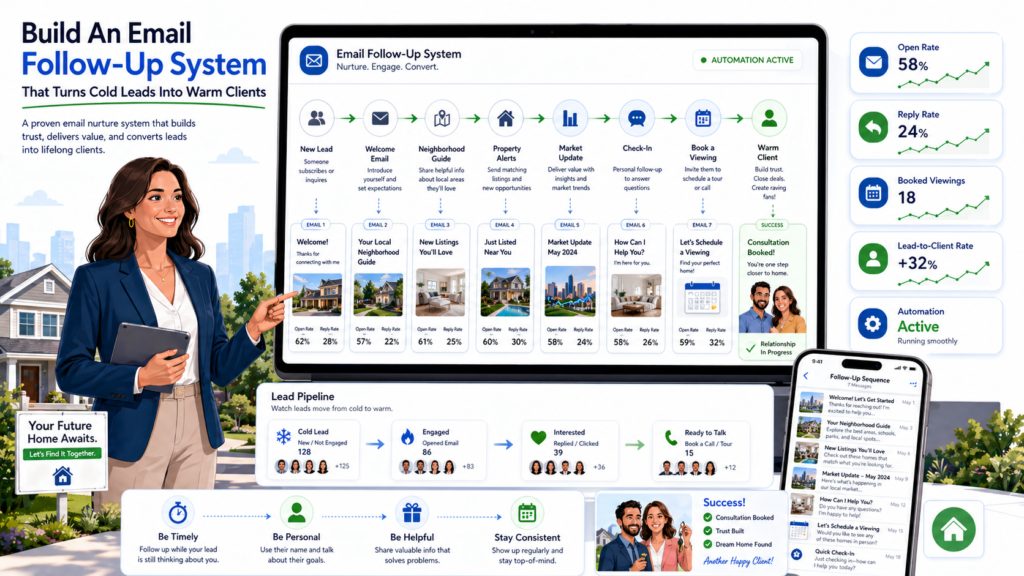
If you only follow up once or twice, you disappear before the decision happens.
Email helps you stay present without chasing people every day.
Your email list should educate, not annoy
A good email system does not spam people. It helps them.
The best emails make the reader feel more prepared. They explain the market in plain words. They answer common questions. They show what to do next. They remind people that you are available when timing becomes serious.
For buyers, emails can explain loan prep, neighborhood research, offer strategy, inspections, appraisals, and mistakes to avoid.
For sellers, emails can explain pricing, home prep, staging, timing, showing feedback, offer review, and negotiation.
For homeowners, emails can explain local market shifts, home value factors, seasonal trends, and smart updates.
The more useful your emails are, the less they feel like marketing.
Your emails should sound like they came from a real person
Do not write emails that sound like a newsletter from a large company.
Write like a helpful local advisor.
Use simple subject lines. Use short paragraphs. Speak directly to one person. Explain one useful idea at a time. Avoid empty phrases like “exciting market opportunities” or “unmatched service.” Those words feel polished but weak.
A better email might begin with, “A lot of homeowners are asking if they should wait until spring to list. The honest answer is that it depends on your home, your area, and how much competition is active right now.”
That feels real.
It sounds like an agent who is paying attention.
Your follow-up should match the lead’s stage
Not every lead should get the same emails.
A first-time buyer needs different guidance than a seller who requested a home value. A relocating family needs different content than a local investor. A homeowner who is two years away from selling needs a softer follow-up than someone who asked for a listing appointment.
Your follow-up should match where the person is in their journey.
This does not need to be complex at first. You can create a simple buyer sequence, a seller sequence, a homeowner sequence, and a past client sequence.
Each one should answer the questions that person is likely to have next.
Your first emails should reduce fear quickly
The first few emails after someone joins your list are important.
This is when they are most aware of you. They requested something, read something, or reached out in some way. Do not waste that moment with a generic welcome email.
Give them immediate value.
If they requested a buyer guide, your next email can explain the first step most buyers skip. The next can explain how to avoid looking at homes before knowing true budget. The next can explain what makes an offer stronger beyond price.
If they requested a home value review, your next email can explain why online estimates miss important details. The next can explain what buyers notice first. The next can explain how pricing too high can hurt a sale.
The goal is to make them think, “This is useful. I should keep reading.”
Your past clients need a real nurture plan too
Many agents spend money getting new leads while forgetting the people who already trust them.
Past clients are one of your best long-term marketing assets. They can work with you again. They can refer friends. They can leave reviews. They can share your content. They can become local advocates for your brand.
But this only happens if you stay in touch in a meaningful way.
A lazy “Happy holidays” email once a year is not enough.
Send useful updates. Share local market changes. Explain what their home value may be affected by. Give seasonal home care advice. Share local events when relevant. Remind them when it may be smart to review equity, refinancing, investment options, or future move plans.
You do not need to sell hard. You just need to remain useful.
Your past client emails should protect the relationship
The tone with past clients should feel warm and personal.
They already know you. Do not treat them like cold leads.
You can write to them like someone you are still looking out for. For example, “I wanted to share a quick note because home values in our area have shifted over the past few months, and many owners are not sure what that means for their equity.”
That kind of message feels helpful.
It gives them a reason to reply without feeling pushed.
Over time, these emails keep the relationship alive. And when someone they know asks for an agent, your name is easier to remember.
Use Paid Ads With A Clear Offer, Not A Weak “Contact Me” Message
Paid ads can work very well for real estate agents, but only when the strategy is clear.
Most agents waste money on ads because they promote themselves too directly to people who are not ready. They run an ad that says, “Thinking of buying or selling? Call me today.” That may sound normal, but it is too broad. It gives the person no strong reason to click. It also assumes they are ready to talk right now.
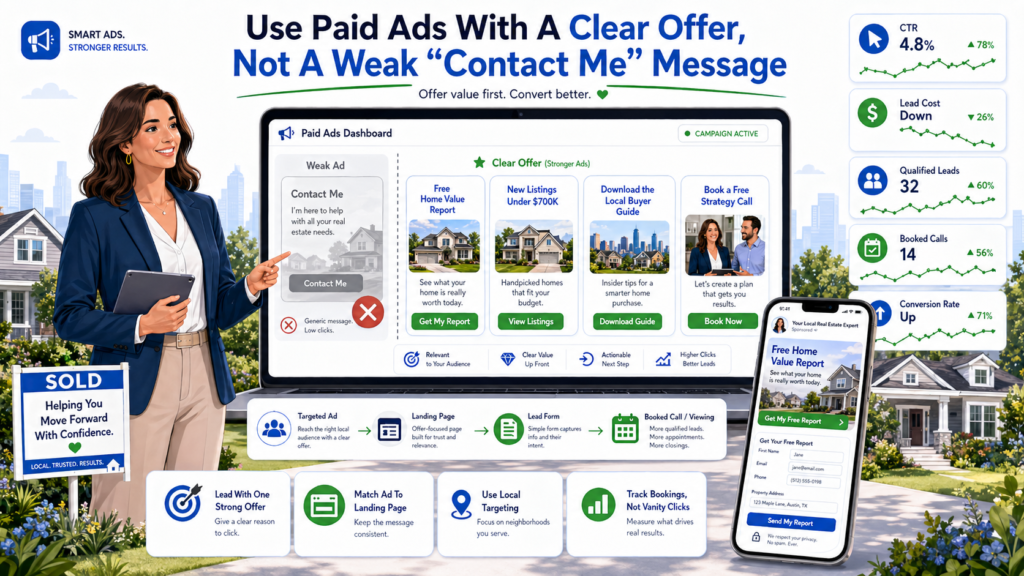
Most people are not.
A seller may be curious about their home value but not ready to list. A buyer may want to understand the market before speaking with an agent. A relocating family may be comparing areas quietly. A homeowner may be wondering if it is smart to sell this year or wait.
If your ad only asks for a call, you lose these people.
A better ad gives them a helpful next step.
Paid ads should not only sell your service. They should start a relationship.
Your ad should match the person’s intent
Every good real estate ad begins with one question.
What is this person likely thinking right now?
A homeowner scrolling Facebook may not be ready to book a listing appointment, but they may be curious about what homes like theirs are selling for. A buyer searching Google may be more active because they are already looking for homes, prices, or agent help. A person watching a local market video may be early in the process and simply trying to learn.
Each of these people needs a different message.
For a seller, an ad might offer a local home value review, a seller prep checklist, or a guide on what buyers are paying for in that neighborhood right now.
For a buyer, an ad might offer a first-time buyer plan, a neighborhood guide, a list of homes under a certain budget, or a local affordability breakdown.
For a relocating family, an ad might offer a city comparison guide, a neighborhood match call, or a moving timeline.
The offer must meet the person where they are.
Your ad should not ask for too much too soon
Many real estate ads fail because the ask is too large.
If a person has never heard of you, they may not be ready to schedule a call. They may not want to give their phone number. They may not want a hard sales conversation. But they may be willing to download a useful guide, request a simple value range, watch a local video, or join a short email series.
That is why soft offers are powerful.
A soft offer gives value before asking for trust. It makes the first step feel safe.
For example, “Find out what buyers are paying for homes in your part of town” feels easier than “Book a listing appointment now.”
“Get the first-time buyer roadmap for Raleigh” feels easier than “Call me to start buying.”
Once the person takes that smaller step, your follow-up can build the relationship.
Your landing page matters more than your ad design
A strong ad can still fail if the page after the click is weak.
When someone clicks, they should land on a page that continues the same promise from the ad. If the ad offers a home value review, the landing page should focus only on that review. If the ad offers a buyer guide, the page should clearly explain what the guide helps them do. If the ad offers a neighborhood comparison, the page should make that next step simple.
Do not send paid traffic to a busy homepage unless the homepage is built for that exact action.
A landing page should be clear, focused, and easy to complete.
The headline should repeat the main offer. The page should explain who it is for, why it is useful, what happens next, and how the person can get it. The form should ask only for what you need at that stage.
If you ask for too much information too early, fewer people will finish the form.
Your landing page should lower risk
People hesitate before filling out forms because they worry about what will happen next.
They may fear being called too much. They may fear getting spammed. They may fear being pressured. They may fear that the “free” offer is only bait for a sales pitch.
Your landing page should remove those fears.
You can explain that the first step is simple. You can say they will receive a clear local review, not a pushy sales call. You can explain that they can ask questions even if they are months away from moving. You can make the tone calm and helpful.
Small trust signals also matter. Client reviews, short case stories, local experience, recent sale examples, and a clear photo of you can help the page feel safer.
The less risk someone feels, the more likely they are to take action.
Your retargeting ads should stay useful
Retargeting means showing ads to people who already visited your website, watched your videos, or engaged with your content.
This is powerful because these people already know you a little. They are warmer than a stranger. But many agents use retargeting badly. They show the same “call me” ad again and again.
That can feel annoying.
Better retargeting keeps adding value.
If someone visited your seller page, show them an ad about pricing mistakes, home prep, or what to do before listing. If someone visited a neighborhood page, show them a guide comparing nearby communities. If someone watched a buyer video, show them a first-time buyer checklist. If someone looked at home valuation content, show them a message about getting a more accurate local review.
Retargeting should feel like a helpful next step, not a chase.
Your retargeting should build confidence over time
People often need many touches before they contact an agent.
They may read your post, visit your site, watch a video, leave, see another ad, read a review, get an email, and then finally reach out weeks later.
That is normal.
The job of retargeting is to keep trust growing during that quiet period.
You can use ads to show client stories, answer common questions, explain your process, share local market insights, or invite people to a low-pressure review. Each message should make the person feel more informed.
When retargeting is done well, it does not feel like stalking. It feels like steady guidance.
Your ad budget should follow proof, not hope
Do not spend more just because you want faster results.
Spend more when you see proof that the system is working.
Start small. Test one audience, one offer, and one landing page. Watch the numbers. See how many people click. See how many people become leads. See how many leads reply. See how many book calls. See how many become real clients.
The goal is not cheap leads. The goal is profitable clients.
A lead that costs less but never answers is not better than a lead that costs more but turns into a listing. Real estate has enough value per client that quality matters more than raw volume.
Your follow-up decides whether ad spend becomes profit
Paid ads do not end when a lead comes in. That is where the real work starts.
If someone requests a guide or home value review and hears nothing useful from you, the ad money is wasted. If they get a fast, helpful, human response, the chance of conversion goes up.
Your follow-up should be quick, but it should not feel robotic. Mention what they requested. Give the next useful step. Ask a simple question that is easy to answer.
For example, if a homeowner requests a value review, you might ask if they are looking for a rough planning number or thinking about selling soon. That gives them room to answer honestly.
The better your follow-up, the less you need to depend on more ad spend.
Build A Referral System That Does Not Depend On Luck
Referrals are one of the best lead sources in real estate.
A referred lead often trusts you faster because the trust has already started through someone they know. They may be easier to speak with, easier to guide, and more likely to become a client.
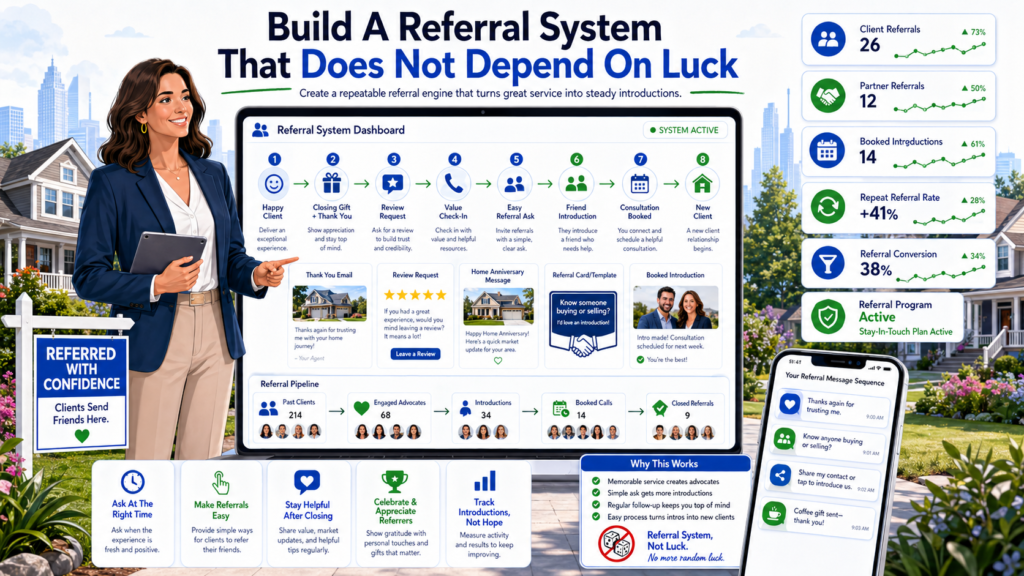
But many agents treat referrals like a happy accident. They hope past clients remember them. They hope friends mention their name. They hope people know what kind of business they want.
Hope is not a system.
A strong referral strategy makes it easy for people to remember you, easy to describe you, and easy to send someone your way.
Your past clients need reminders of your value
People may love working with you and still forget to refer you.
That does not mean they do not care. It means life is busy.
Your past clients have jobs, families, bills, trips, stress, and their own plans. They are not thinking about your business every week. If someone asks them for an agent, they may remember you. But if you have not stayed in touch, they may also forget your name in the moment.
That is why staying visible matters.
You should keep helping past clients after the deal closes. Send market updates. Share home care tips. Check in around move anniversaries. Offer annual home value reviews. Share local changes that may affect their home. Invite them to ask questions before they make future plans.
This keeps the relationship warm.
Your follow-up should feel personal, not automated
A referral system should not make people feel like they are on a cold email list.
Even if you use automation behind the scenes, the message should feel human.
Mention their home when it makes sense. Mention their neighborhood. Mention the kind of move they made. Mention something useful based on their situation. A past buyer may appreciate updates about equity and maintenance. A past seller may appreciate help with their next purchase or investment plans.
The more personal your contact feels, the stronger the relationship stays.
And when the relationship stays strong, referrals happen more naturally.
Your network should know exactly who to refer
Most people do not send referrals because they do not know what to look for.
If you only say, “Send me anyone who needs real estate help,” that is too vague.
A better approach is to teach your network who you help best.
You might say, “I am always happy to help first-time buyers who feel unsure about where to start.”
Or, “If you know a homeowner in the area who is thinking about selling in the next year, I can help them understand what their home may need before listing.”
Or, “If someone is moving here from out of state and trying to compare neighborhoods, that is exactly the kind of person I enjoy helping.”
This kind of message gives people a clear referral trigger.
Now they know what to listen for.
Your referral ask should be tied to a real moment
Do not ask for referrals in a way that feels random or needy.
Tie the ask to a helpful moment.
After sending a useful market update, you might say that if they know someone wondering what their home is worth, you are happy to give them a clear local review.
After helping a buyer close, you might say that if they have a friend who feels nervous about buying their first home, you would be glad to guide them through the first steps.
After a seller has a smooth closing, you might say that if they know anyone who wants to sell without feeling rushed or pressured, you would be happy to help.
The ask feels better when it is linked to the value you just created.
Your referral partners can become a steady lead source
Referral partners are people who serve the same audience but do not compete with you.
This may include mortgage lenders, home inspectors, builders, moving companies, estate attorneys, divorce attorneys, financial planners, insurance agents, interior designers, contractors, property managers, and local business owners.
These relationships can become powerful, but only if they are built with care.
Do not approach referral partners only asking for leads. That feels one-sided. Start by understanding their business. Learn who they help. Learn what kind of clients are best for them. Find ways to create value first.
You can share their helpful advice with your audience. You can introduce them to people who need their service. You can invite them to create local content with you. You can host educational sessions together. You can send them thoughtful referrals when appropriate.
The strongest referral partnerships are built on mutual trust.
Your partner network should protect your reputation
Be careful who you recommend.
Every person you refer reflects on you. If you send a client to a poor contractor, careless lender, or unresponsive service provider, your client may blame you too.
Your referral network should be built around quality, not convenience.
Choose partners who communicate well, treat people fairly, and care about the client experience. Ask past clients about their experience with those partners. Stay alert. If someone stops providing good service, stop referring them.
A strong partner network makes your service better. A weak one can damage trust fast.
Your referral system should include simple touchpoints
A referral system does not need to be complicated. It needs to be consistent.
You can create a simple rhythm that keeps you present with past clients and key contacts throughout the year.
For example, you may send a monthly local market email, a quarterly personal check-in, a yearly home value review offer, and a few thoughtful notes around important dates. You may also keep a short list of top referral partners and make sure you connect with them often.
The point is not to overwhelm people. The point is to remain useful and remembered.
Your best referral system feels like care
The best referral marketing does not feel like marketing at all.
It feels like care.
When you check in after a storm to ask if a past client’s home is okay, that builds trust. When you send a reminder about homestead exemptions or property tax deadlines, that helps. When you share a reliable contractor before they need one, that creates value. When you remember their moving anniversary, that feels personal.
People refer agents they trust, like, and remember.
A referral system helps all three happen more often.
Use Reviews And Client Stories As Proof, Not Decoration
Reviews are not just nice things to display on your website.
They are one of the strongest forms of proof you have.
Real estate clients are making a big decision. They are trusting you with money, timing, family plans, and emotional stress. Before they contact you, they want evidence that you can help. Reviews give them that evidence in the words of people who have already worked with you.
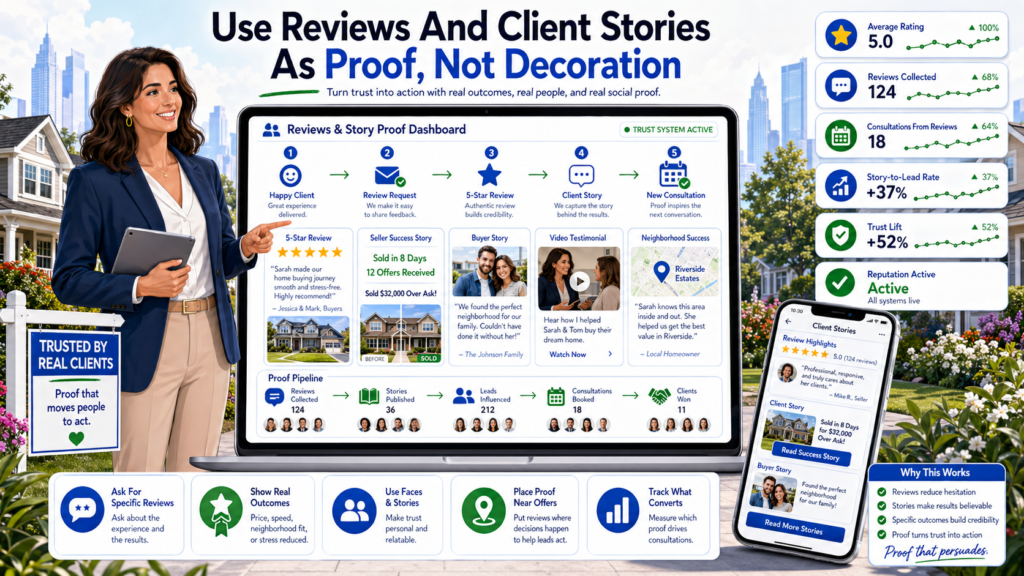
But reviews should not sit hidden on a single page. They should be part of your full marketing system.
Your reviews should answer common client doubts
A good review can do more than say you are friendly.
It can answer a fear.
A nervous buyer wants to know if you will explain things clearly. A seller wants to know if you can guide pricing. A busy professional wants to know if you will respect their time. A relocating family wants to know if you understand the area. A luxury client wants to know if you can handle the process with care and privacy.
When reviews speak to these concerns, they become powerful.
That is why you should think carefully about when and how you ask for reviews.
Do not wait too long after closing. Ask while the experience is still fresh. Make the request simple. Give clients a few gentle prompts so they know what to write about.
You can ask what they were worried about before starting, what part of the process helped them most, and what they would tell someone thinking about working with you.
This leads to stronger, more useful reviews.
Your review request should be easy to answer
Clients are often happy to leave reviews, but they may not know what to say.
If you simply ask, “Can you leave me a review?” they may write one short sentence or put it off.
A better request makes it easy.
You might say, “It would mean a lot if you shared a few lines about what the process was like, what felt helpful, and what you would tell someone who is choosing an agent.”
This is not telling them what to write. It is helping them think.
The easier you make the task, the more likely they are to do it.
Your website should place proof near decisions
Do not make people hunt for proof.
If someone is reading your seller page, place seller reviews there. If someone is reading your first-time buyer page, place first-time buyer reviews there. If someone is reading about relocation, show stories from people who moved into the area.
Proof is strongest when it appears near the moment of doubt.
For example, if your seller page explains your pricing strategy, include a review from a seller who felt your pricing advice helped them make a better decision. If your buyer page explains your offer process, include a review from a buyer who felt guided and protected.
This makes the proof feel directly related to the message.
Your proof should support the next step
Every review should help move the reader closer to action.
If the next step is booking a seller consultation, the proof should make that step feel safe. If the next step is downloading a buyer guide, the proof should show that you are good at teaching buyers. If the next step is requesting a neighborhood review, the proof should show your local knowledge.
Do not use reviews only because they sound nice. Use them with purpose.
Good proof lowers fear. Lower fear creates action.
Your client stories should show the problem, process, and result
A client story is different from a short review.
A review is usually a few lines from the client. A client story is your deeper explanation of how you helped, while protecting private details.
A strong client story has three parts.
First, explain the problem. Maybe the seller was worried about pricing in a changing market. Maybe the buyer kept losing offers. Maybe the family was moving from another state and had only one weekend to tour homes.
Second, explain the process. Show how you guided them. Talk about the plan, the choices, the strategy, and the steps that mattered.
Third, explain the result. This does not always have to be dramatic. A good result may be a smooth sale, a better offer, a calmer move, a stronger decision, or avoiding a costly mistake.
This kind of story helps future clients picture themselves working with you.
Your client stories should teach without bragging
The best client stories are not written to show off. They are written to teach.
Instead of saying, “I sold this home fast because I am great,” explain what helped the result happen.
Maybe the home sold well because the seller followed a prep plan, the pricing matched current buyer demand, the photos were planned carefully, and the launch timing created strong early attention.
That teaches the reader something.
It also shows your skill in a way that feels natural.
People do not want empty bragging. They want to know how you think and how you help.
Your proof should appear across every channel
Reviews and client stories should not stay in one place.
They can be used on your website, in emails, on social media, in listing presentations, in buyer guides, in ads, and in follow-up messages.
A short review can become a social post. A client story can become a blog article. A seller success can become part of a listing presentation. A buyer testimonial can support a first-time buyer email sequence.
You do not need to create new proof from scratch all the time. You need to use the proof you already have in smarter ways.
Your proof should stay specific and believable
Avoid making every story sound perfect.
Real estate is rarely perfect. There are delays, repairs, negotiations, hard choices, and stressful moments. If your proof makes every deal sound effortless, it may feel less believable.
Strong proof often includes the challenge.
A story about a tough inspection that was handled well may be more persuasive than a story where nothing went wrong. A story about a seller who had to adjust pricing and still got a good result may feel more real than a story that only says the home sold fast.
People trust real stories because real stories have texture.
That texture makes your marketing more human.
Use Video Marketing To Make Your Advice Feel More Real
Video is one of the best ways for a real estate agent to build trust before a meeting.
A website can tell people what you do. Photos can show your face. Reviews can prove that past clients liked working with you. But video lets people feel your voice, your pace, your confidence, and your style.
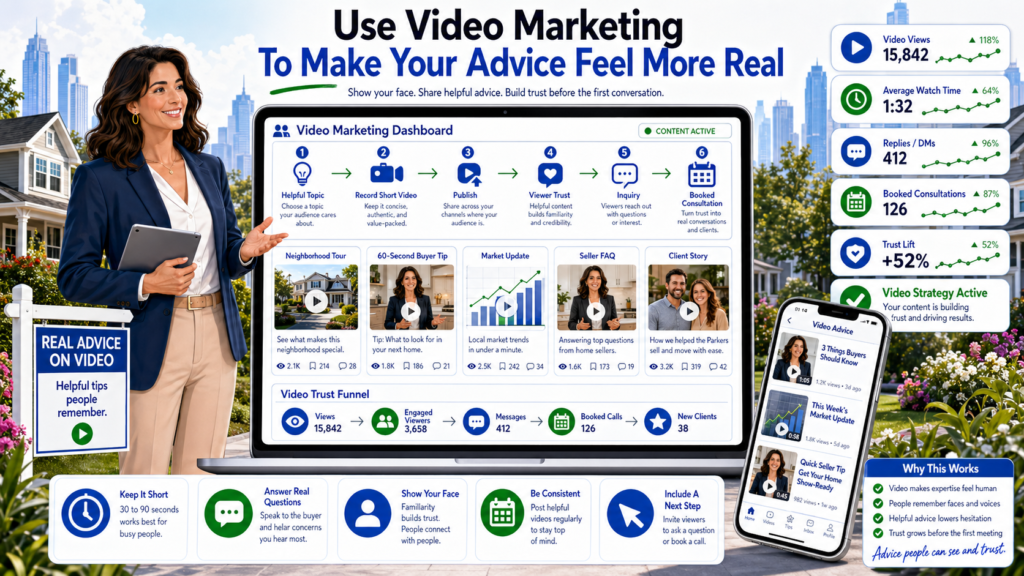
That matters because real estate is emotional.
A buyer wants to know if you will be patient. A seller wants to know if you will be honest. A relocating family wants to know if you can explain the area clearly. A nervous client wants to know if you will stay calm when the process gets stressful.
Video helps answer those questions faster.
The good news is that real estate video does not need to be perfect to work. It needs to be clear, useful, and human. A simple video filmed on your phone can often build more trust than a polished video that feels stiff.
The goal is not to act like a media company. The goal is to become familiar. When someone has watched you explain the market, walk through a neighborhood, answer common questions, and give honest advice, meeting you feels less risky.
Your videos should teach before they sell
Many agents use video only to show listings. Listing videos are useful, but they should not be the whole strategy.
A listing video helps sell one home. An education video can help sell your value again and again.
Think about the questions clients ask all the time. Those questions are your best video topics.
A buyer may ask how much money they need before they start looking. A seller may ask whether they should renovate before listing. A homeowner may ask if online home value estimates are accurate. A relocating buyer may ask which neighborhood is best for their budget and lifestyle.
Each question can become a video.
When you answer these questions in simple words, you help people before they contact you. That builds trust. It also shows that you are not only trying to get a deal. You are trying to guide people toward better choices.
Your video should feel like a short client conversation
Do not write a script that sounds like a formal speech.
A good video should feel like you are explaining something to one person across the table. Start with the problem. Explain why it matters. Give the simple answer. Then explain what the person should do next.
For example, instead of starting with, “Welcome to today’s real estate market update,” you can say, “If you are thinking about selling this spring, there is one mistake I am seeing homeowners make before they even list.”
That kind of opening feels more direct. It gives the viewer a reason to keep watching.
Then keep the rest clear. Do not cover five topics in one video. Cover one point well.
A video about pricing should be about pricing. A video about inspections should be about inspections. A video about neighborhood choice should be about neighborhood choice.
The tighter the video, the easier it is to watch.
Your neighborhood videos can become powerful local trust builders
Neighborhood videos are very useful for agents because they combine local knowledge with personal trust.
People moving within a city, moving from another state, or comparing nearby areas want more than listing photos. They want to know what a place feels like. They want to understand trade-offs. They want to know if an area fits their daily life.
A strong neighborhood video should not sound like a tourist ad.
Do not only say, “This area has parks, shops, and restaurants.” That is too basic. Talk about who the area is good for, what types of homes are common, what buyers should watch for, what commute patterns look like, what price trade-offs exist, and what people often misunderstand before moving there.
This type of video can help buyers feel smarter and safer.
It can also help sellers because it shows that you know how to explain their area in a way buyers understand.
Your neighborhood videos should include honest trade-offs
Honesty builds trust faster than hype.
If an area is popular but expensive, say that. If homes are older and may need more repairs, say that. If the commute can be hard at certain times, say that. If the area offers more space but fewer walkable options, say that.
People do not expect every neighborhood to be perfect. They want an agent who will tell them the truth.
When your videos include fair trade-offs, viewers feel that you are not just trying to sell them anything. You are helping them choose wisely.
That trust can be the reason they call you when they are ready.
Your listing videos should sell the lifestyle, not just the rooms
A weak listing video shows room after room with music.
A stronger listing video explains why the home matters.
It helps the buyer understand how the home lives. It points out details that may not be clear in photos. It shows flow, light, layout, storage, outdoor space, and nearby lifestyle benefits. It also explains who the home may be right for.
For example, instead of only showing a kitchen, you might explain why the kitchen works well for someone who hosts family often. Instead of only showing a backyard, you might explain how the space fits pets, kids, gardening, or quiet evenings. Instead of only showing a home office, you might explain why it works well for remote work because of light, privacy, or distance from the main living area.
The goal is not to describe what people can already see. The goal is to help them feel why the home may fit.
Your listing video should answer buyer questions before they ask
Buyers often have questions that photos do not answer.
How does the layout flow? Is the primary bedroom private? Is the backyard usable? Is there enough storage? How close are the bedrooms to each other? Does the home feel bright? Is the street quiet? Where would guests park? Is there space for a desk, playroom, or workout area?
Your video can answer these questions.
This makes the listing feel easier to understand. It also makes you look more thoughtful as a marketer.
For sellers, this is powerful proof. It shows that you do not just upload homes to the MLS and hope. You know how to present a property in a way that helps buyers make decisions.
Your short videos should be part of a larger system
Short videos on Instagram, Facebook, YouTube Shorts, TikTok, and LinkedIn can help you reach more people. But short videos should not stand alone.
They should connect to your wider marketing system.
A short video about seller mistakes can lead people to your full seller guide. A short neighborhood video can lead people to a deeper neighborhood page on your website. A short buyer tip can lead people to a first-time buyer checklist. A market update can lead people to join your email list.
This is how video becomes more than attention.
It becomes a doorway into your full business.
Your video topics should repeat in different formats
You do not need brand-new ideas every day.
One good idea can become many pieces of content.
A blog post about pricing mistakes can become a short video, an email, a social caption, a carousel, and part of a seller presentation. A neighborhood guide can become a video tour, a website page, an email to relocation leads, and a social post. A client story can become a video lesson, a written case study, and a review graphic.
This saves time and keeps your message consistent.
Repetition is not a problem when the format changes and the message remains useful. In fact, repetition helps people remember you.
Turn Open Houses Into Lead Systems, Not Just Weekend Events
Open houses can still work, but only when they are treated as marketing systems.
Many agents treat open houses like passive events. They put up signs, unlock the door, greet visitors, collect a few names, and hope someone becomes a client. That is not enough.
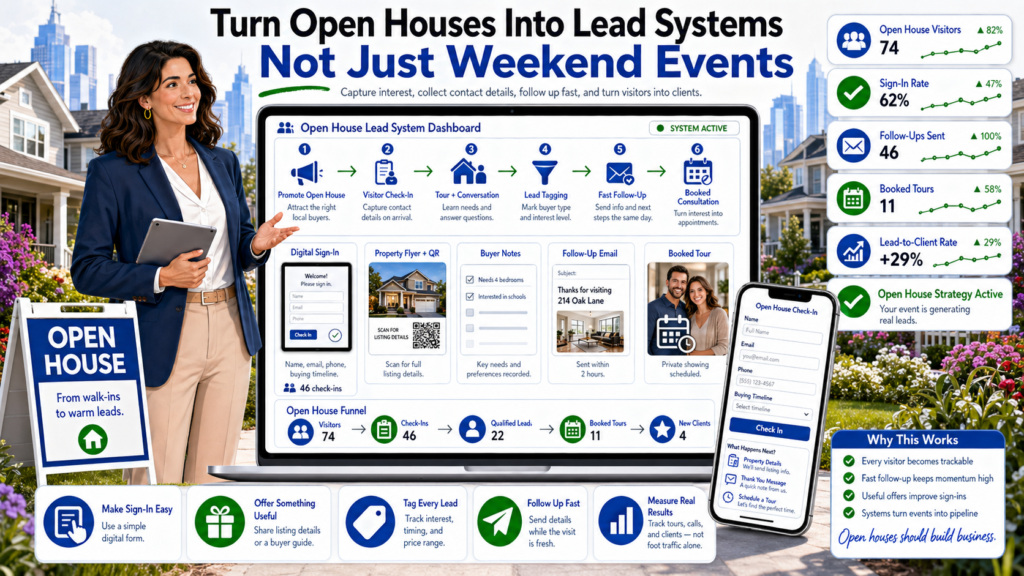
A strong open house has a plan before, during, and after the event.
It should attract the right people, create useful conversations, collect real contact information, and start follow-up that feels personal.
An open house is not only about selling that one property. It is also a chance to meet buyers, connect with neighbors, create content, show sellers your marketing effort, and build local presence.
Your open house should be promoted before the weekend
Do not wait until the day of the open house to create attention.
Start promoting early.
Share the property online with a clear reason people should see it. Talk about the home’s best features, but also talk about the lifestyle it fits. Mention the neighborhood, layout, outdoor space, school zone, commute access, or price range if those details matter to the target buyer.
Use your email list. Post on social media. Share in local groups where allowed. Tell nearby homeowners. Run a small local ad if the property and budget support it. Create a short video preview before the open house.
The goal is to make the event feel active before anyone walks in.
Your pre-event content should speak to neighbors too
Neighbors are not just curious visitors. They can become sellers, referral sources, or future clients.
Many homeowners visit open houses because they want to compare their own home. They want to know what homes nearby are selling for. They want to see how their home stacks up. They may be thinking about selling but are not ready to say it yet.
Your marketing should speak to them too.
Instead of only saying, “Come see this beautiful home,” you can say, “If you own a home nearby, this open house is a useful way to see what buyers are responding to in the current market.”
That message gives neighbors a reason to attend without feeling awkward.
Your open house conversation should qualify without pressure
When people walk into an open house, do not jump into a hard sales pitch.
Start with a warm welcome. Give them space. Then ask simple questions that help you understand why they came.
You can ask if they live nearby or are actively looking. You can ask what they think of the area. You can ask how long they have been searching. You can ask what kind of home they are comparing this one against.
The goal is not to interrogate. The goal is to start a real conversation.
If someone is a buyer, you want to learn where they are in the process. If someone is a neighbor, you want to learn if they are curious about value. If someone is early, you want to offer a useful next step instead of pushing for a meeting too soon.
Your sign-in process should offer value
Many visitors do not want to sign in because they fear being chased.
Make the sign-in feel useful.
Instead of only asking for contact information, offer something helpful. You can offer the full property details, a list of similar homes nearby, a neighborhood market snapshot, or a buyer guide for that price range.
When people understand what they get, they are more likely to share real information.
You can also make the tone clear. Let them know you are happy to send the information and answer questions, not pressure them.
This small shift can improve both the number and quality of leads.
Your follow-up should happen while the visit is still fresh
Open house leads go cold quickly.
If you wait several days, the visitor may forget the conversation. They may tour other homes. They may connect with another agent. They may lose interest.
Follow up soon, but make it personal.
Mention the home they visited. Mention something they said if you remember it. Send the resource you promised. Ask a simple next question.
For a buyer, you might ask if they want to see similar homes with a better layout, bigger yard, or different location. For a neighbor, you might ask if they want a quick review of how their home compares. For an early-stage visitor, you might offer a simple planning guide.
The message should feel like a continuation of the conversation, not a generic lead chase.
Your follow-up should separate buyers, neighbors, and sellers
Not all open house visitors are the same.
A buyer may need listings and buying guidance. A neighbor may need a home value review. A future seller may need prep advice. A curious visitor may only need light nurture.
If you send everyone the same message, you miss the chance to be relevant.
Create simple follow-up paths. Buyers get buyer help. Neighbors get local value insight. Sellers get listing prep advice. Early leads get education.
This is how an open house becomes a lead system.
Your open house can create content even after the event
An open house gives you more than visitor traffic.
It gives you content.
You can share what buyers noticed most. You can talk about common questions from the event. You can explain what the turnout says about demand in that price range. You can share a seller lesson about presentation, pricing, or first impressions. You can create a short video recap for nearby homeowners.
This content helps people who did not attend still learn from the event.
It also shows future sellers that you market actively.
Your event recap should protect privacy and stay useful
Do not share private details or anything that could harm your client’s position.
Keep the recap general and helpful.
For example, you can say that buyers were asking a lot about home office space, backyard privacy, or move-in ready condition. You can say that homes in this price range are getting attention when they are priced well and presented clearly. You can say that small prep details made a strong first impression.
This turns one open house into several pieces of smart marketing.
Use Community Marketing To Become A Recognized Local Name
Real estate is local, so community presence matters.
People often choose agents they feel they know. That feeling can come from online content, but it can also come from seeing you active in the local area.
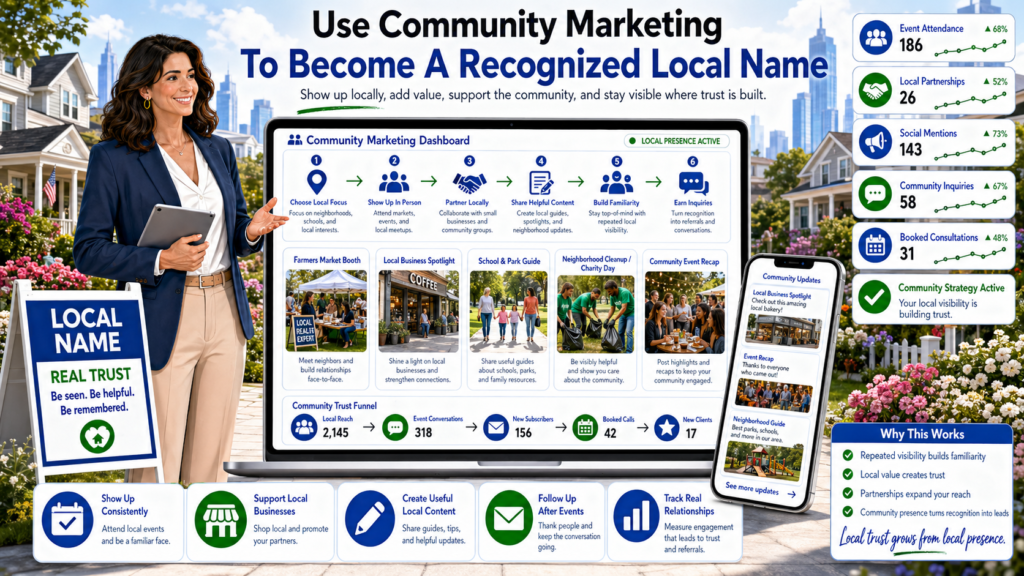
Community marketing is not about handing out business cards at random events. It is about becoming a useful, trusted, and visible part of the places you serve.
When people see your name connected with local insight, helpful events, small businesses, neighborhood updates, and community value, your brand becomes familiar in a deeper way.
Your local content should support real community life
A lot of agents talk about being local, but their content does not show it.
If you want to be seen as a local expert, create content that helps people live better in the area, not just buy and sell homes.
You can talk about neighborhood changes, new businesses, local events, school calendar issues, traffic updates, market shifts, home maintenance needs by season, and local services people may need.
You can interview small business owners. You can feature community stories. You can explain how local development may affect housing demand. You can create guides for people moving into the area.
This kind of content makes your brand useful even when people are not in the market.
Your community content should still connect to real estate
Community content should not become random lifestyle posting.
It should support your role as a local real estate guide.
If you feature a local business, connect it to why people love the neighborhood. If you talk about a new park, explain how nearby homeowners and buyers may think about it. If you discuss a road project, explain how commute patterns may change. If you share school-related information, be careful and fair, but explain why families often research school zones before choosing homes.
The goal is to help people understand the area more deeply.
That is real estate value.
Your local partnerships can grow trust faster
Partnerships with local businesses can help you reach more people in a natural way.
You might work with a coffee shop, gym, home organizer, moving company, contractor, interior designer, or local charity. The best partnerships are not random. They should make sense for your audience.
For example, if you help sellers, a partnership with a stager, cleaner, landscaper, or handyman can create useful content. If you help buyers, a partnership with a lender, inspector, insurance agent, or moving company can help people understand the process. If you help relocating families, partnerships with local service providers can make settling in easier.
The key is to make the partnership valuable for the audience, not just promotional for you.
Your partner content should teach, not just cross-promote
A weak partner post says, “Check out this great local business.”
A stronger partner post teaches something useful.
For example, you can interview a home inspector about the small issues buyers often miss. You can talk with a lender about what buyers should do before making offers. You can ask a stager which low-cost changes help homes photograph better. You can ask a mover how families can avoid last-week stress.
This creates useful content. It also shows that you know good people and can guide clients beyond the transaction.
That makes your service feel more complete.
Your events should solve a real local problem
Events can work well, but only when they are useful.
Do not host events just to say you hosted something. Think about what your audience actually needs.
First-time buyers may need a simple home buying workshop. Homeowners may need a session on preparing to sell next year. Investors may need a local rental market discussion. Relocating families may need a neighborhood Q&A. Past clients may enjoy a home maintenance event, local appreciation night, or family-friendly gathering.
The event should have a clear reason to exist.
A useful event gives people a safe way to meet you before they need to hire you.
Your event follow-up matters as much as the event
Many agents host events but fail to follow up well.
After the event, send a useful recap. Share key points. Offer the next step. Ask if attendees have questions. Add them to the right follow-up path based on their interest.
If someone came to a buyer workshop, send buyer education. If someone came to a seller prep session, send seller planning content. If someone came as a past client, keep the relationship warm.
The event opens the door. Follow-up keeps the door from closing.
Your community presence should be steady, not performative
People can feel when community marketing is fake.
If you only show up when you want business, it feels shallow. If you only support local groups when cameras are there, people notice.
Strong community marketing is steady. You show up because you care about the market you serve. You support useful causes. You celebrate local businesses. You help people understand local changes. You become part of the area’s rhythm.
That kind of presence cannot be built overnight. But once it is built, it becomes hard for competitors to copy.
Your local reputation compounds over time
Every useful post, every kind follow-up, every fair answer, every strong client experience, every community connection, and every helpful event adds to your reputation.
At first, it may feel slow. But over time, people start to recognize your name. They see your content. They hear your clients speak well of you. They notice your local involvement. They trust that you are not just passing through.
That is when marketing becomes easier.
You are no longer trying to introduce yourself from zero each time. You are building on memory.
Build A Strong Personal Brand That Makes You Easier To Choose
A strong personal brand is not about looking famous.
It is about making people feel that they know what you stand for, how you work, and why they can trust you.
In real estate, your personal brand matters because clients are not hiring a logo. They are hiring a person. They want to know if you will be honest, available, calm, skilled, and steady when the pressure rises.
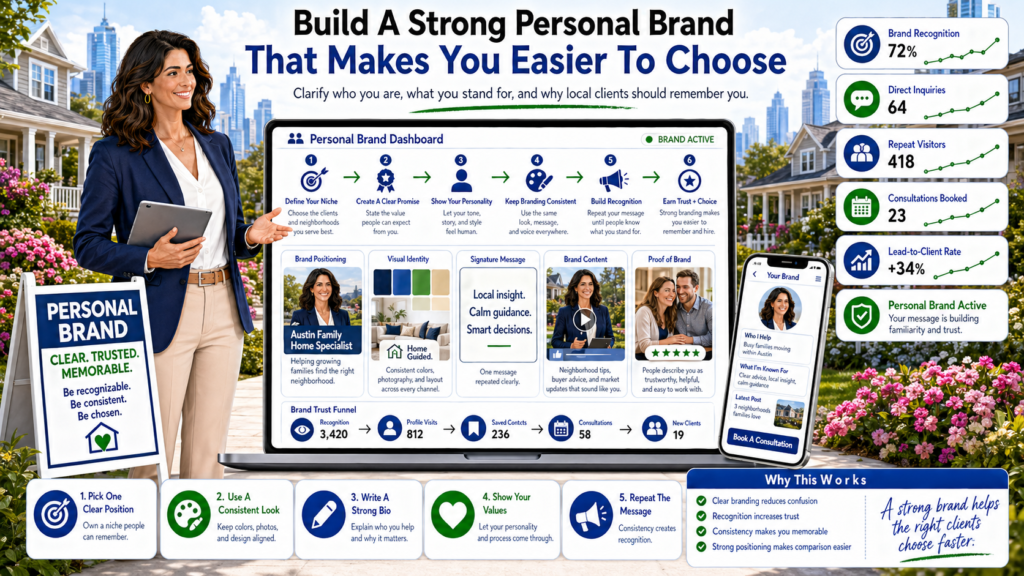
Your brand should help them feel that before the first call.
Your brand should be clear before it is beautiful
Many agents focus on colors, fonts, photos, and logos before they are clear on their message.
Visuals matter, but they cannot fix confusion.
Before you worry about the perfect brand look, answer the deeper questions.
Who do you help best?
What problems do you solve better than most agents?
What do clients feel after working with you?
What kind of experience do you want people to expect?
What should people remember about you?
Once those answers are clear, your visuals can support them.
A luxury agent may need a calm, refined look. A first-time buyer agent may need a warm and approachable look. A relocation expert may need a helpful, local, guide-like feel. A data-focused investor agent may need a sharper and more analytical style.
Your brand look should match your promise.
Your brand should not copy the loudest agent in your market
It is tempting to copy agents who seem popular.
But their style may not fit your clients, your skills, or your market.
If you are naturally calm and thoughtful, forcing a loud and flashy brand will feel false. If you are warm and patient, copying a hard-charging sales style may attract the wrong clients. If you are detail-driven, your brand should show clarity and care, not empty hype.
The best personal brand feels like a stronger, clearer version of you.
It should help the right people feel comfortable choosing you.
Your voice should stay consistent across channels
Your brand voice is how your marketing sounds.
If your website sounds formal, your emails sound casual, your social posts sound generic, and your videos sound completely different, people may not form a clear impression.
You do not need to sound exactly the same everywhere, but your core voice should feel consistent.
If you are the calm guide, your content should sound calm on your website, social media, emails, and videos. If you are the straight-talking market expert, your content should be direct everywhere. If you are the patient teacher, your content should explain things clearly wherever people find you.
Consistency builds memory.
Your brand voice should make clients feel safe
Real estate can be stressful. Your voice should reduce stress, not add to it.
Avoid scare tactics. Avoid fake urgency. Avoid bragging that feels empty. Avoid confusing language. Avoid talking down to people.
Use simple words. Explain clearly. Be honest about trade-offs. Tell people what to expect. Give them useful next steps.
A safe voice does not mean a weak voice. You can still be confident. You can still be direct. You can still guide people firmly.
The point is to sound like someone who can be trusted with a major life decision.
Your brand should be built around proof
A brand is not only what you say. It is what you can support.
If you say you are a local expert, show local insight.
If you say you help sellers get ready, show your preparation process.
If you say you guide first-time buyers, show your teaching content.
If you say you are strong at negotiation, explain how you compare offers, protect terms, and guide clients through risk.
Your marketing should prove your brand promise again and again.
Your proof should be visible before people ask
Do not wait for a listing presentation or buyer call to show proof.
Put proof into your public marketing.
Use reviews, stories, examples, local analysis, process breakdowns, educational content, and before-and-after lessons where appropriate.
The more proof people see before they contact you, the easier the first conversation becomes.
They do not enter the call wondering if you are credible. They enter already leaning toward trust.
Your brand should make referrals easier
A clear personal brand helps people refer you.
If your brand is vague, someone may say, “I know an agent.” That is weak.
If your brand is clear, someone may say, “You should talk to her. She is great with first-time buyers and explains everything in simple terms.”
Or, “You should call him. He knows that neighborhood really well and is very strong with pricing.”
That is much stronger.
Your brand gives people the words to describe you.
Your brand should be easy to repeat
If someone cannot explain your value in one sentence, your brand may be too unclear.
You want people to remember a simple idea.
The agent who helps young families move into the right school zone.
The agent who helps sellers prepare before they list.
The agent who helps out-of-state buyers understand the area.
The agent who gives calm, clear guidance for downsizers.
Simple does not mean small. Simple means memorable.
And memorable brands win more often.
Use Listing Presentations As A Marketing Tool Before The Appointment
A listing presentation should not begin when you sit at the seller’s table.
It should begin before the appointment.
Many agents think the listing presentation is one meeting, one deck, and one conversation about price and commission. But strong agents use the whole pre-appointment experience to build trust before they walk in.
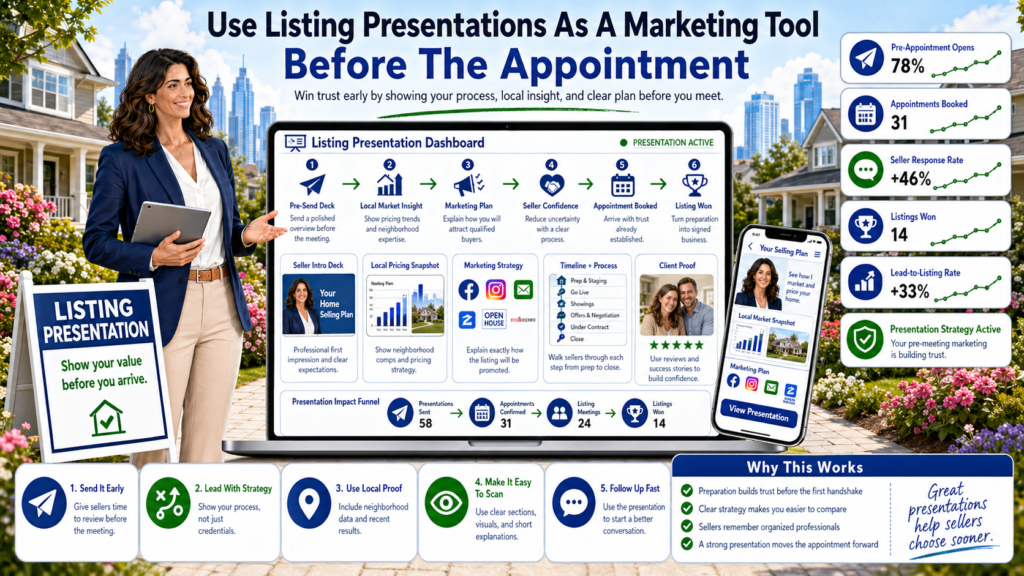
When a seller books a call or meeting, they are already judging you. They notice how fast you respond. They notice how clear your message is. They notice whether you ask smart questions. They notice whether your process feels organized. They notice whether you sound like a professional guide or just another agent hoping for a listing.
This means your marketing has to continue after the lead comes in.
A seller who feels guided before the appointment is more likely to trust you during the appointment.
Your pre-listing process should make sellers feel prepared
A seller does not want to feel like they are walking into a blind meeting.
They want to know what will happen. They want to know what you will review. They want to know what information they should prepare. They want to feel that their time will be used well.
After a seller books an appointment, send a short and helpful pre-listing message. Explain what you will cover. Let them know you will discuss their goals, timing, home condition, pricing, buyer demand, and the best launch plan. Ask them to think about any repairs, updates, or concerns they want to discuss.
This small step makes you feel organized.
It also changes the tone of the meeting. Instead of showing up as someone trying to win business, you show up as someone already helping.
Your pre-listing message should reduce pressure
Some sellers feel nervous before meeting agents because they expect a hard pitch.
Your pre-listing message can lower that worry.
You can make it clear that the first meeting is about understanding their goals and giving them a clear view of their options. You can explain that they do not need to make a decision on the spot. You can say that your job is to help them understand the market, the likely buyer response, and the steps that would lead to a stronger sale.
That kind of message makes sellers feel safe.
And when sellers feel safe, they are more honest. They share their real concerns. They tell you what they are worried about. They ask better questions. That helps you give better advice.
Your presentation should explain your thinking, not just your services
Most listing presentations sound the same.
Agents talk about photos, online exposure, open houses, social media, buyer databases, signs, flyers, and negotiation. These things matter, but sellers have heard them before.
What they have not always heard is how you think.
Your presentation should show your decision-making process. Explain how you study competing homes. Explain how you judge buyer demand. Explain how you decide which prep work matters. Explain how you choose launch timing. Explain how you read showing feedback. Explain how you handle early offers. Explain how you protect the seller from weak terms.
This is where you separate yourself.
Any agent can say they market homes. Fewer agents can clearly explain how they make smarter decisions at each stage of the sale.
Your process should make the seller feel in control
Selling can feel scary because the homeowner is letting go of something important.
Your process should give them a sense of control.
Show them what happens before the listing goes live, during launch week, after showings begin, when offers come in, during inspection, and before closing. Explain what decisions they will need to make and how you will help them make those decisions.
When people know the path, they feel less anxious.
A clear process also makes your service feel more valuable. The seller can see that you are not just putting a sign in the yard. You are guiding a chain of decisions that can affect their money and peace of mind.
Your pricing discussion should be honest and calm
Pricing is often the hardest part of a listing appointment.
Sellers may have a number in mind. They may have seen online estimates. They may be thinking about what they need for their next move. They may compare their home to a neighbor’s sale without seeing the full differences. They may believe certain upgrades added more value than buyers will actually pay.
Your job is to be honest without making the seller feel judged.
Do not attack their expectations. Walk them through the facts.
Explain recent sales. Explain active competition. Explain buyer behavior. Explain condition differences. Explain what happens when a home is priced too high and sits. Explain what happens when a home is priced close to where buyer demand is strongest.
A calm pricing conversation builds trust, even when the seller does not hear the number they hoped for.
Your pricing advice should connect to strategy, not ego
A seller may see a lower price recommendation as a personal insult. They may feel you are saying their home is not special.
Make it clear that pricing is not about the owner’s taste, memories, or pride. It is about buyer behavior in the current market.
The right price is not the price that makes everyone feel good on day one. It is the price that creates the best chance of strong buyer attention, serious showings, and useful offers.
When you explain pricing this way, the seller can think more clearly.
You are not asking them to lower their expectations. You are helping them choose a strategy that protects their result.
Your marketing plan should show how each step creates demand
Do not present your marketing plan as a list of tasks.
Present it as a demand-building system.
Photos are not just photos. They are the first impression that makes buyers stop scrolling.
Staging is not just decoration. It helps buyers understand space, flow, and lifestyle.
Listing copy is not just words. It turns features into reasons a buyer should care.
Online exposure is not just syndication. It makes sure the right buyers and agents see the home fast.
Social media is not just posting. It creates extra attention and helps tell the story of the home.
Open houses are not just weekend events. They create buyer feedback, neighbor awareness, and possible lead opportunities.
When you explain the purpose behind each step, your work feels more valuable.
Your marketing plan should match the home
Not every home needs the same plan.
A luxury home may need more careful storytelling, privacy controls, premium visuals, and targeted outreach. A starter home may need fast exposure, clear pricing, and strong first-week activity. A unique home may need more explanation so buyers understand who it fits. A home in a competitive neighborhood may need sharp launch timing.
A seller wants to know that you are not using the same template for every property.
Show that your plan will be shaped around their home, their market, and their goals.
That is much stronger than saying you use “maximum exposure.”
Use Buyer Consultations To Convert Leads Before Showing Homes
Many agents rush buyers into showings too quickly.
They think the best way to win a buyer is to show homes fast. But without a strong consultation first, the process can become messy.
The buyer may not understand the market. They may not know their true budget. They may want homes that do not match their financing. They may have unrealistic expectations. They may not understand timelines. They may not know what makes an offer strong. They may not be ready to act when the right home appears.
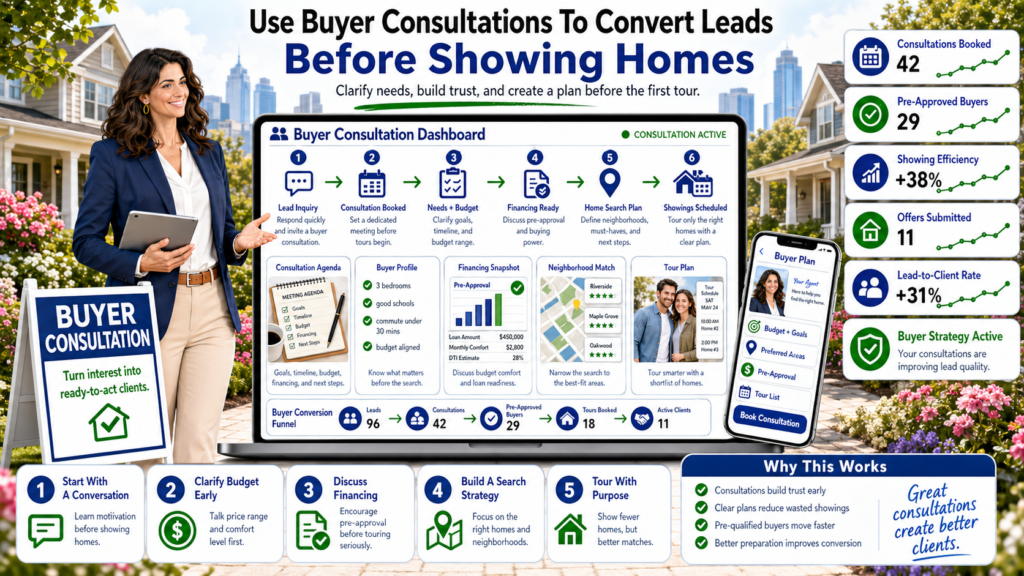
A buyer consultation solves many of these problems before they grow.
It also helps the buyer see you as a guide, not just a person who opens doors.
Your buyer consultation should create clarity before activity
The purpose of a buyer consultation is not to give a sales pitch.
The purpose is to create clarity.
You want to understand the buyer’s goals, timing, budget, lifestyle needs, location needs, deal breakers, fears, and past experience. You also want to explain the buying process in simple terms so they know what will happen next.
This protects both sides.
The buyer gets a better plan. You avoid wasting time on unclear searches. The process becomes more focused, calm, and useful.
A strong consultation can cover financing, search strategy, neighborhoods, offer prep, inspections, closing costs, timelines, and common mistakes. But it should still feel like a conversation, not a lecture.
Your first job is to learn before you advise
Many agents start giving advice before they fully understand the buyer.
Slow down.
Ask why they want to move. Ask what is changing in their life. Ask what they like and dislike about where they live now. Ask how long they expect to stay in the next home. Ask what monthly payment feels comfortable. Ask what worries them most.
These answers help you guide them better.
A buyer who plans to stay three years may need different advice than a buyer who plans to stay fifteen years. A buyer with children may think differently than a single professional. A remote worker may care more about quiet space than commute. An investor may care more about cash flow than emotional fit.
Good marketing brings the lead in. Good consultation turns the lead into a client.
Your buyer education should make the process feel less scary
Buying a home can feel confusing, especially for first-time buyers.
They may hear terms like escrow, appraisal, inspection period, closing disclosure, contingencies, earnest money, and underwriting. Even simple words can feel heavy when money is involved.
Your job is to make the process simple.
Explain what happens step by step. Explain what decisions they will need to make. Explain where buyers often make mistakes. Explain how you will help them compare homes. Explain what happens when they want to make an offer.
The more clearly you teach, the more they trust you.
Your simple explanations can become marketing content
The same things you explain in buyer consultations can become content.
If buyers often ask about closing costs, create a blog post and video about closing costs. If they struggle to compare neighborhoods, create a neighborhood comparison guide. If they do not understand inspections, create a simple inspection guide. If they are unsure about offer strength, create content about what sellers look at besides price.
This saves time because you are not starting from zero with every lead.
It also builds trust before the consultation because buyers may already have learned from you online.
Your buyer consultation should set healthy expectations
Not every buyer expectation is realistic.
Some buyers want the perfect home in the perfect area at a price that does not match the market. Some want to wait too long before making decisions. Some want to make low offers in a competitive area. Some want to skip important steps. Some look at homes before understanding their loan options.
You need to set expectations early.
This does not mean being negative. It means being honest.
Explain what their budget can likely buy. Explain how fast homes move in their target areas. Explain where they may need to compromise. Explain which parts of the process require quick decisions. Explain how you will help them avoid emotional mistakes.
A buyer who understands the market is easier to help.
Your honesty should feel like protection
When you tell buyers the truth, frame it as protection.
You are not trying to crush their excitement. You are trying to keep them from wasting time, losing good homes, overpaying, or making choices they regret.
For example, instead of saying, “You cannot get that kind of home at this price,” you can say, “Based on what is active right now, that budget is more likely to work in these areas or with these trade-offs. My goal is to help you see the real choices clearly before we start touring.”
That feels helpful.
It shows that you are on their side, even when the answer is not perfect.
Your buyer process should make you hard to replace
If a buyer only sees you as someone who finds listings, you are easy to replace.
They can find listings online.
Your value is in helping them think, compare, decide, offer, negotiate, inspect, and close with confidence.
Your consultation should show that.
Explain how you help buyers judge value. Explain how you help them see red flags. Explain how you compare homes beyond the photos. Explain how you write offers based on the seller’s situation and market demand. Explain how you help them stay calm during inspection and appraisal.
When buyers understand your full role, they are less likely to treat you like a door opener.
Your process should create commitment naturally
You should not have to beg buyers for loyalty.
A clear and helpful process creates commitment.
When a buyer feels that you understand them, educate them, protect them, and give them a plan, they are more likely to stay with you. They see that working with you gives them an advantage.
That is much stronger than asking for loyalty before you have shown value.
Use Market Updates To Become The Agent People Look To For Clarity
Market updates are one of the easiest ways for real estate agents to build authority.
But most market updates are boring.
They show numbers without meaning. They talk about median price, days on market, inventory, and interest rates, but they do not explain what those numbers mean for a buyer, seller, or homeowner.
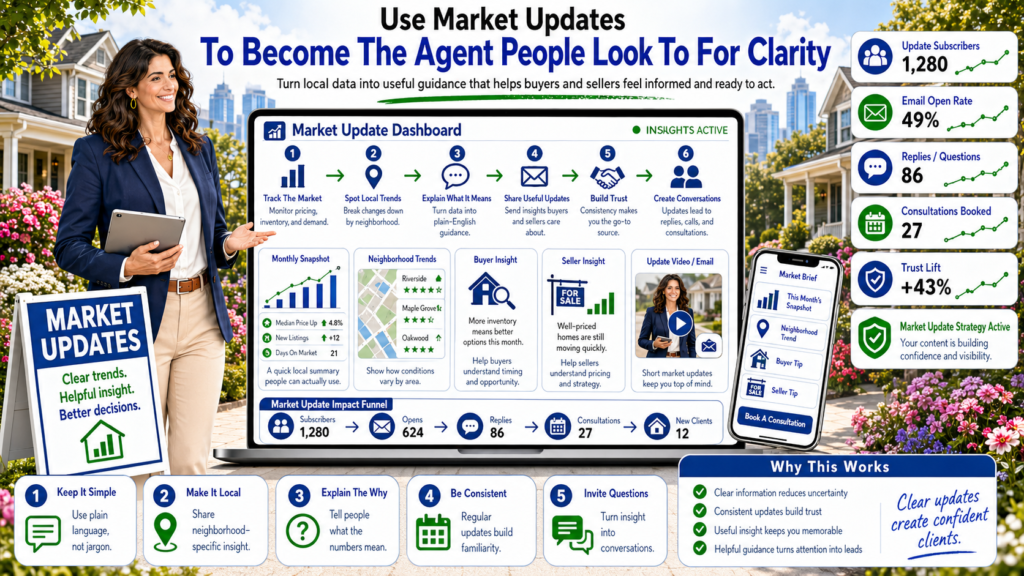
A good market update turns data into guidance.
People do not need more numbers. They need clearer decisions.
Your market update should answer what this means for the client
Every market update should answer the same quiet question.
What does this mean for me?
If inventory is rising, what does that mean for sellers? It may mean pricing needs to be sharper, prep matters more, and buyers have more choices.
If homes are selling faster, what does that mean for buyers? It may mean they need pre-approval ready, clear offer limits, and faster decision-making.
If price growth is slowing, what does that mean for homeowners? It may mean they should not rely on old sale prices when planning.
If rates are changing, what does that mean for affordability? It may change monthly payments, buyer demand, and negotiation room.
Your job is to translate the market into plain advice.
Your update should focus on decisions, not drama
Do not use market updates to create fear.
Fear may get clicks, but it does not build deep trust.
Avoid dramatic lines like “The market is crashing” or “Buy now before it is too late” unless the facts truly support it. Even then, be careful.
People want a steady guide. They do not want an agent who makes every shift sound like a crisis.
A better approach is calm and clear.
Say what changed. Explain why it matters. Share what buyers or sellers should consider next.
That kind of tone makes you the person people trust when the market feels confusing.
Your market updates should be local, not generic
National housing news can be useful, but it is not enough.
Real estate clients care about what is happening in their area, their price range, and their type of home.
A national headline may say the market is slowing. But your local starter-home market may still be very competitive. A national report may say prices are rising. But your luxury segment may be moving slowly. A citywide average may hide big differences between neighborhoods.
This is why local updates matter.
Talk about your city. Talk about specific neighborhoods when possible. Talk about price bands. Talk about property types. Talk about what you are seeing in showings, offers, and seller feedback.
This makes your update feel more useful than a news article.
Your local insight should include what you are seeing on the ground
Numbers are helpful, but real estate also has human signals.
Are buyers hesitating more? Are sellers still pricing too high? Are open houses busier? Are inspection negotiations getting tougher? Are homes with poor photos sitting longer? Are updated homes getting more attention? Are buyers asking more about monthly payments than sale price?
These on-the-ground details make your updates stronger.
They show that you are active in the market, not just repeating reports.
Clients want someone who knows what is happening in real conversations, not just on charts.
Your market updates should be easy to understand
Keep the language simple.
Do not overuse terms that regular people may not understand. If you mention inventory, explain that it means the number of homes available for sale. If you mention days on market, explain that it means how long homes are taking to sell. If you mention median price, explain that it is the middle point, not the average.
Simple explanations do not make you sound less smart.
They make you easier to trust.
Your update should give one clear takeaway
A market update should not leave people more confused.
End with one clear takeaway.
For sellers, the takeaway might be that pricing and preparation matter more than they did last year.
For buyers, the takeaway might be that there is more room to compare homes, but strong homes still move fast.
For homeowners, the takeaway might be that online values may not reflect current local buyer behavior.
One clear takeaway makes the update memorable.
Your market updates should be reused across channels
One market update can become many pieces of marketing.
You can turn it into an email, a blog post, a short video, a social caption, a graphic, a seller follow-up, and a past client message.
This is a smart use of time.
You do not need to create new ideas from scratch every day. You need to take one useful insight and share it in the places your audience pays attention.
Your update rhythm should be consistent
Market updates work best when people expect them.
You can publish monthly, twice a month, or weekly if your market moves fast. The exact rhythm matters less than consistency.
When people know you are the agent who explains the market clearly, they come back to you. They may forward your updates. They may reply with questions. They may save them for later. They may think of you when a friend asks what is happening in the market.
That is how simple content becomes long-term authority.
Use CRM Systems To Stop Losing Leads That Were Already Interested
Many real estate agents do not have a lead problem. They have a follow-up problem.
They meet people at open houses. They get website inquiries. They receive social media messages. They talk to neighbors. They get referrals. They speak with past clients. They collect email addresses from guides and home value forms.
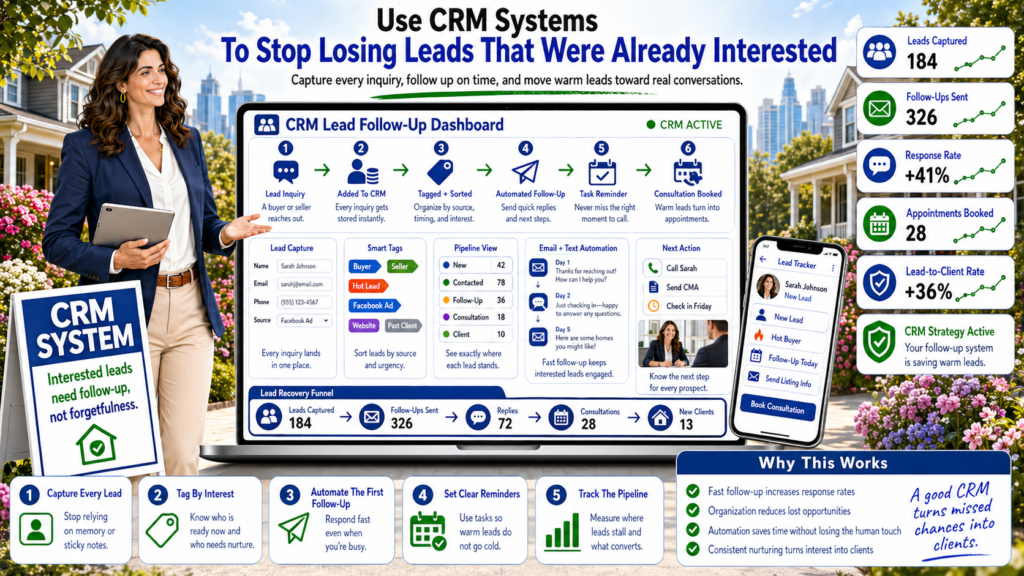
Then those names sit in a phone, a notebook, a spreadsheet, or a messy inbox.
That is dangerous because real estate decisions often take time. A person who is not ready today may be ready in six months. A homeowner who only asked about value may list next spring. A buyer who seemed too early may become serious after getting pre-approved. A past client may have a referral next week.
If you do not have a system, these people slip away.
A CRM is not just software. It is your memory. It helps you stay consistent when life gets busy. It helps you follow up with the right person at the right time with the right message.
Your CRM should show where each lead is in the journey
Not all leads are the same.
Some are ready to meet now. Some are learning. Some are watching the market. Some are waiting for a life event. Some are past clients. Some are referral partners. Some are homeowners who may sell later.
If your CRM treats everyone the same, your follow-up will feel weak.
A strong CRM setup should help you see each person’s stage. You should know if they are a buyer, seller, investor, homeowner, past client, referral partner, or cold lead. You should know what they asked for. You should know when you last spoke. You should know what the next step should be.
This keeps your follow-up from becoming random.
It also helps you avoid awkward messages. You do not want to send first-time buyer tips to a seller. You do not want to send listing advice to someone who just bought a home. You do not want to ask for a call when the person already told you they are a year away.
Good organization makes your marketing feel more personal.
Your CRM notes should capture the human details
A CRM should not only store names and phone numbers.
It should store the details that help you serve people better.
If a buyer cares about a short commute, note it. If a seller is waiting until their child finishes school, note it. If a homeowner is worried about repairs, note it. If a past client loves gardening, note it. If a relocating family is comparing two suburbs, note it.
These details help future follow-up feel human.
For example, a message that says, “I saw a few homes come up near the commute range you mentioned” feels much better than a generic “Are you still looking?”
A message that says, “Since you mentioned selling after the school year, this may be a good time to start thinking about prep” feels thoughtful.
The more useful your notes are, the easier it is to sound like a person, not a system.
Your follow-up tasks should be scheduled, not trusted to memory
Memory is not a marketing plan.
Even the most caring agent can forget to follow up when deals, showings, inspections, family life, and daily work pile up.
Your CRM should tell you who needs attention each day.
If a seller says they want to list in three months, schedule a follow-up. If a buyer says they are waiting on loan approval, schedule a check-in. If a past client closes, schedule future touchpoints. If someone downloads a guide, schedule a personal message after the first automated email.
This removes guesswork.
It also reduces stress because you are not trying to hold every relationship in your head.
Your follow-up timing should match the person’s urgency
A hot lead needs fast follow-up. A long-term lead needs steady nurture. A past client needs relationship care. A referral partner needs thoughtful contact.
Do not use the same timing for everyone.
A buyer who wants to tour homes this week may need same-day contact. A seller who requested a home value review may need a quick response and then a clear next step. A homeowner who is only curious may need monthly updates and a soft check-in later. A past client may need a helpful touch every few months.
The right timing makes follow-up feel natural.
Too much follow-up can feel pushy. Too little follow-up can make you forgotten. The CRM helps you stay in the middle.
Your CRM should support automation without removing your voice
Automation can be very helpful, but it should not make your marketing cold.
Automated emails can deliver guides, send useful education, remind leads about next steps, and keep long-term contacts warm. But people still need to feel that there is a real person behind the messages.
Use automation for structure. Use personal notes for connection.
For example, a buyer can receive an automated first-time buyer sequence, but you can still send a personal message asking where they are in the process. A seller can receive prep advice, but you can still send a custom note about their neighborhood. A past client can receive market updates, but you can still check in personally around important dates.
The system should make you more present, not less human.
Your automated messages should sound like you
Many agents use email templates that sound stiff and generic.
That hurts trust.
Your automated messages should sound like your normal voice. Use simple words. Talk about real concerns. Keep the tone warm and direct. Avoid fake excitement. Avoid heavy sales language. Avoid long blocks of empty praise.
A good automated email should still feel like it came from someone who understands the reader.
For example, instead of saying, “Unlock the power of homeownership with my expert guidance,” say, “Buying your first home can feel confusing at the start. The first thing to get clear on is not the house. It is the monthly payment you can live with.”
That sounds real. It teaches. It builds trust.
Your CRM should help you measure what works
Marketing feels confusing when you do not track results.
Your CRM can help you see where leads are coming from and which sources turn into real clients.
You may find that open house leads are many but slow to convert. You may find that referrals are fewer but stronger. You may find that home value ads create many curious leads but need long nurture. You may find that neighborhood SEO leads are better because they already trust your local content.
This information helps you spend time and money better.
Do not judge marketing only by how many leads it creates. Judge it by how many good conversations, appointments, clients, and referrals it creates.
Your best marketing source may not be the loudest one
Some channels look busy but do not create strong business.
A social post may get likes but no serious leads. An ad may get clicks but poor replies. A networking event may feel small but create two strong referrals. A monthly email may seem quiet but lead to a listing months later.
Your CRM helps you see the truth over time.
It shows which activities create real movement.
Once you know that, you can do more of what works and stop wasting energy on what only looks active.
Use Lead Magnets To Capture People Before They Are Ready To Talk
Most people do not wake up and immediately call a real estate agent.
Before they call, they research. They wonder. They compare. They worry. They ask quiet questions. They look at homes online. They check values. They read about neighborhoods. They think about timing. They talk with family.
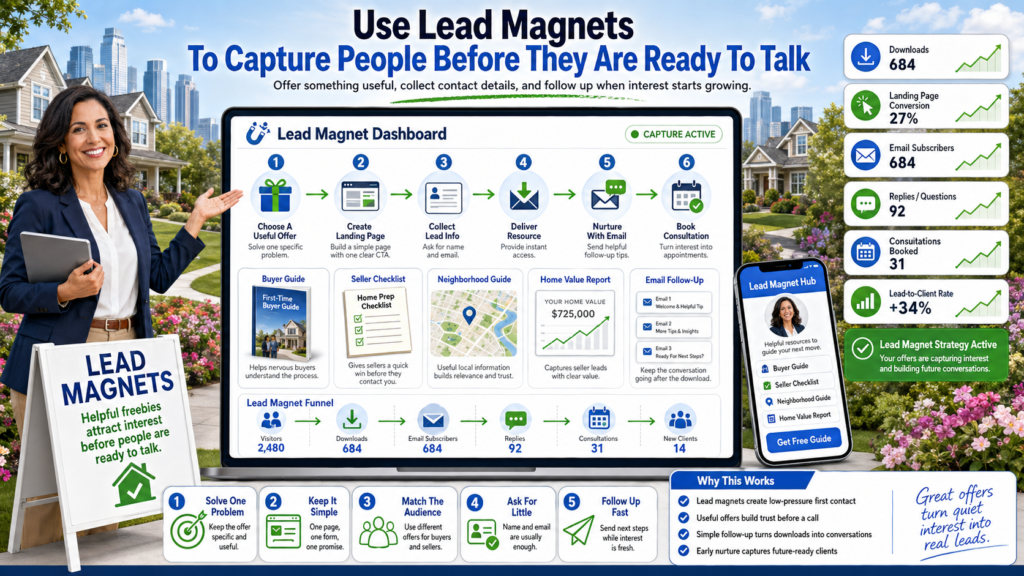
This stage can last weeks, months, or even years.
If your marketing only works for people who are ready right now, you miss a huge part of the market.
Lead magnets help you connect with people earlier.
A lead magnet is a useful resource someone can request in exchange for their contact information. But it should not be a cheap trick. It should solve a real problem and help the person take a better next step.
Your lead magnet should be specific to one type of client
A broad lead magnet usually performs poorly.
A guide called “Real Estate Tips” does not feel urgent. It does not speak to a clear problem. It does not make someone think, “I need this.”
A specific lead magnet is stronger.
A seller may want “The Home Prep Checklist For Selling In Spring.” A first-time buyer may want “The Simple First-Time Buyer Roadmap For Austin.” A relocating family may want “The Neighborhood Comparison Guide For North Atlanta.” A homeowner may want “The Local Home Value Planning Guide For 2026.”
Specific feels more useful.
It also attracts better leads because the topic tells you what the person cares about.
Your lead magnet should solve one small problem well
Do not try to solve the whole buying or selling process in one guide.
People are more likely to request something that solves one clear problem.
A seller may want to know what to fix before listing. A buyer may want to know how much cash they need. A relocating family may want to compare neighborhoods. An investor may want to avoid bad rental numbers. A homeowner may want to understand whether their online value estimate is realistic.
Pick one problem. Solve it clearly.
This makes the resource easier to create and easier to promote.
It also makes the follow-up easier because you know exactly what question brought the person in.
Your lead magnet should feel valuable enough to trade an email for
People protect their inbox.
They will not give you their email for something that feels thin, generic, or copied.
Your lead magnet should be genuinely helpful. It should include local insight. It should explain real choices. It should help the reader avoid a mistake or make a better decision.
For example, a seller prep guide should not only say “clean and declutter.” It should explain which repairs buyers notice, which updates may not pay off, how photos change perception, and why prep should match the likely buyer.
A neighborhood guide should not only list restaurants and parks. It should explain home styles, price ranges, commute patterns, buyer fit, and trade-offs.
A buyer roadmap should not only list steps. It should explain what to do first, where people get stuck, and how to avoid costly confusion.
Your lead magnet should show your expertise without overwhelming the reader
A strong lead magnet does not need to be long.
It needs to be useful.
Keep the language simple. Make the sections easy to follow. Give examples. Show common mistakes. Add local context. Tell people what to do next.
Do not overload the reader with every detail you know.
The goal is not to prove that real estate is complex. The goal is to make the reader feel more confident and more likely to trust you.
When someone finishes the resource, they should think, “This agent explains things clearly.”
That is the real win.
Your lead magnet should connect to a follow-up path
A lead magnet without follow-up is wasted.
If someone downloads a seller checklist, they should receive more seller guidance. If someone requests a buyer roadmap, they should receive buyer education. If someone asks for a neighborhood guide, they should receive local comparison content. If someone requests a home value resource, they should receive pricing and market updates.
The follow-up should continue the same conversation.
Do not send one guide and disappear. Do not send a generic newsletter that ignores the topic they cared about. Use the lead magnet as the start of a relationship.
Your first follow-up should deliver value before asking for a call
The first follow-up email should not be a hard pitch.
Thank them for requesting the resource. Give them the promised item. Then offer one helpful thought related to the topic.
If they requested a seller prep checklist, tell them that the most common mistake is spending money on updates before knowing what buyers in their area actually value. If they requested a buyer guide, tell them that the first step is getting clear on the monthly payment, not falling in love with listings.
If they requested a neighborhood guide, tell them that the right area depends on lifestyle, not just price.
Then invite a soft next step.
You can say that if they want help applying the guide to their own situation, they can ask a question or request a simple review.
That feels helpful, not pushy.
Your lead magnets should be promoted everywhere
Do not hide your lead magnets.
Put them on your website. Mention them in blog posts. Link them from social media. Use them in ads. Share them in videos. Add them to your email signature. Offer them after open houses. Mention them during community events.
A good lead magnet should become part of your full marketing system.
For example, if you have a seller prep checklist, every piece of seller content can point to it. If you have a first-time buyer roadmap, every buyer video can mention it. If you have a relocation guide, every neighborhood post can lead to it.
Your lead magnet should become a bridge from attention to trust
Social media gets attention. SEO brings search traffic. Ads create reach. Open houses create conversations.
Lead magnets turn that attention into a relationship you can nurture.
Without this bridge, many people will see your marketing and leave without a trace. With a strong lead magnet, they have a reason to step closer.
That is why lead magnets are so useful.
They do not force people into a sales call before they are ready. They give people a safe way to begin.
Use Neighborhood Farming To Win A Specific Area Over Time
Neighborhood farming is one of the oldest real estate marketing strategies, but it still works when done well.
The idea is simple. You choose a specific area and become highly visible, useful, and trusted there over time.
The mistake is thinking farming means sending the same postcard every month and waiting for listings.
Modern farming needs more depth.
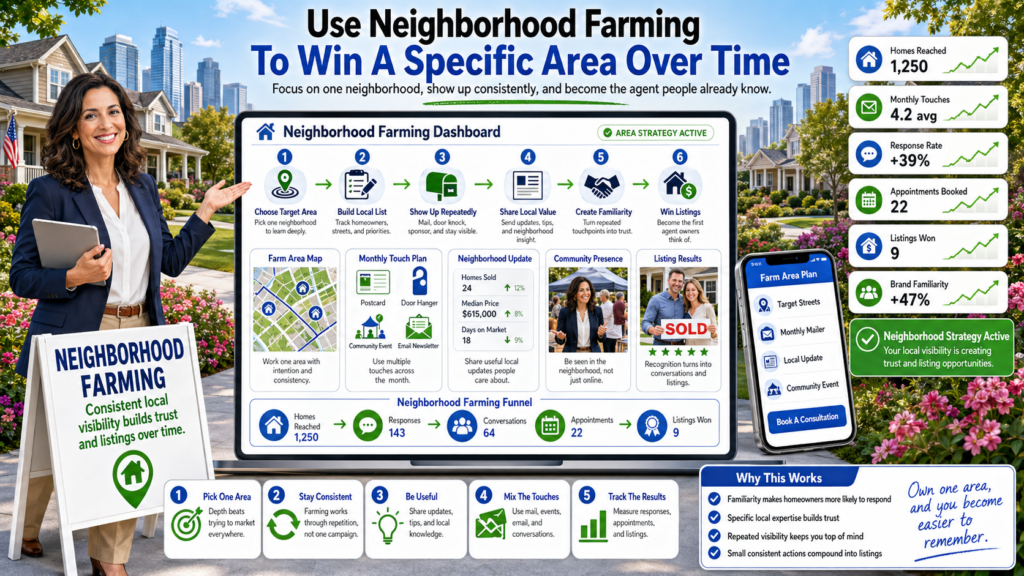
It should combine direct mail, local SEO, social content, email, community presence, homeowner education, market updates, and personal relationships. The goal is not only to be seen. The goal is to become the agent people in that area associate with smart local guidance.
Your farm area should be chosen carefully
Do not choose a farm area only because you like it.
Choose it because it has real business potential.
Look at the number of homes, turnover rate, average sale price, competition, your local knowledge, your past sales, and your ability to stay consistent. A very small area may not produce enough chances. A very large area may be too expensive to reach well. A high-end area may look attractive but may have strong existing agent loyalty.
The best farm area is one where you can build recognition and where enough sales happen to make the effort worthwhile.
You should also care about the area. If you do not enjoy learning about it, visiting it, and talking about it, farming will feel heavy.
Your farm should be narrow enough to remember you
Many agents farm too wide.
They send shallow messages to too many people. This makes recognition harder.
It is often better to dominate a smaller area than barely appear in a larger one.
If homeowners see your name often, receive useful updates, watch your local videos, see your signs, read your market notes, and hear neighbors mention you, your brand grows stronger.
Farming works through repeated trust.
Repetition needs focus.
Your farm content should speak to homeowners, not just buyers
If you want listings, your farm content should help homeowners.
Talk about what affects home value in that area. Explain which updates matter to buyers. Share what is selling and why. Explain how long homes are taking to sell. Share what buyers are asking for. Discuss local changes that may affect demand.
Do not only send “I just sold a home” messages.
A just-sold message is stronger when it teaches something. Explain what helped the home attract attention. Explain what the sale may mean for nearby homeowners. Explain what buyers responded to.
This turns a proof message into a useful message.
Your farm updates should make owners feel smarter
Homeowners like to know what is happening around them.
They want to know what nearby homes sold for. They want to know if values are rising or slowing. They want to know whether buyers are active. They want to know if their home may be affected by local changes.
Your job is to explain these things in a way that feels simple and honest.
A good farm update may say that homes with updated kitchens are getting faster offers, while homes needing major repairs are seeing more negotiation. Another update may explain that buyers are still active, but they are more careful about price. Another may explain that low inventory is helping sellers, but only when the home is presented well.
This kind of insight keeps your name tied to useful local knowledge.
Your direct mail should connect with digital marketing
Direct mail can still work, but it is stronger when it connects to your online system.
A postcard should not stand alone. It should point people to a local market page, home value review, neighborhood video, seller checklist, or email update.
For example, a postcard might say, “See what buyers are paying for homes in [Neighborhood] this month,” and send people to a page with a useful local update.
This makes the mail measurable and more helpful.
It also lets you keep building trust after the postcard is thrown away.
Your mail should not look like every other agent’s mail
Most real estate mail is easy to ignore.
It often has a headshot, a logo, a sold photo, and a line asking if the owner wants to sell. That may work sometimes, but it is not enough to build deep trust.
Make your mail useful.
Share a small market lesson. Answer a homeowner question. Explain a pricing mistake. Give a seasonal prep tip. Share a local buyer trend. Invite them to request a clearer home review.
When your mail helps people, they are more likely to keep it, scan it, or remember you.
Your farming strategy should be consistent for at least a year
Farming takes time.
You cannot send three mailers, post twice about the area, and expect to become the trusted local name.
People need repeated exposure. They need to see that you are not going away. They need to connect your name with real local value.
Plan for at least twelve months.
During that time, show up with market updates, helpful homeowner advice, local content, direct mail, digital retargeting, community presence, and personal outreach when appropriate.
Your farm results should be tracked patiently
Do not judge farming too quickly.
Some homeowners may save your card. Some may read your email quietly. Some may visit your website but not contact you yet. Some may mention you to a neighbor months later. Some may call only when life changes.
Track what you can. Watch website visits, home value requests, email signups, calls, listing appointments, and referrals from the area.
But also understand that farming builds memory, and memory takes time.
When done well, the payoff can last for years.
Use Strategic Partnerships To Reach Clients Before They Start Searching For Agents
Many real estate opportunities begin before someone searches for an agent.
A couple talks to a lender before touring homes. A homeowner talks to a contractor before selling. A family speaks with a financial planner before downsizing. A person going through divorce speaks with an attorney before selling the home. An investor talks to a property manager before buying.
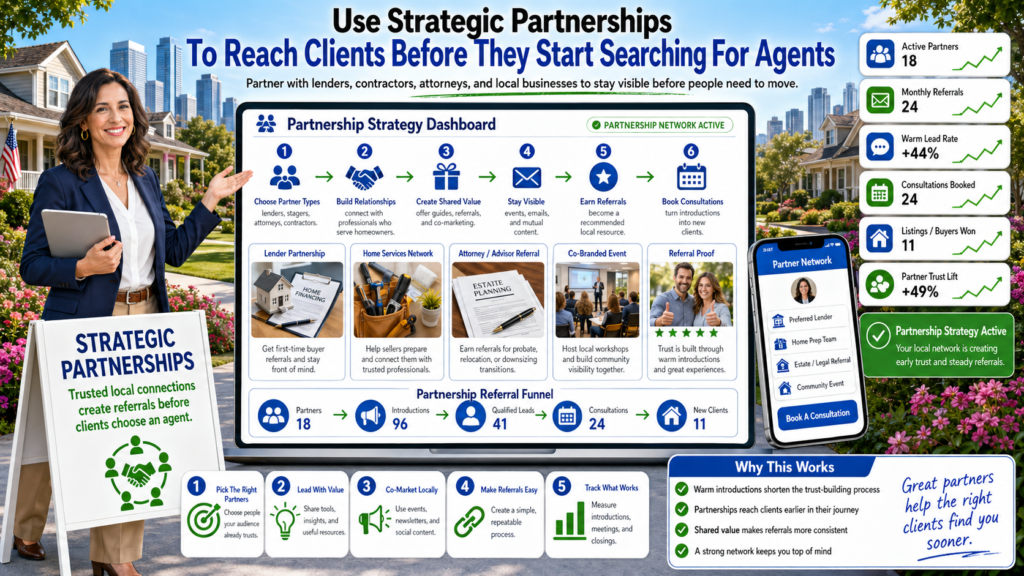
A relocating worker speaks with an employer or local contact before choosing a neighborhood.
Strategic partnerships help you reach people earlier in the decision path.
This does not mean asking everyone you know for leads. It means building real relationships with people who serve the same audience in a different way.
Your best partners should serve the same client at a different stage
A good partner is someone whose clients may also need your help, but whose service does not compete with yours.
Mortgage lenders are obvious partners, but they are not the only option. Depending on your niche, strong partners may include estate attorneys, divorce attorneys, financial planners, home inspectors, builders, senior move managers, insurance agents, relocation consultants, property managers, contractors, stagers, organizers, local employers, and small business owners.
The best partner depends on your position.
If you help first-time buyers, lenders, credit counselors, and local employers may be useful connections. If you help downsizers, estate planners, senior service providers, organizers, and financial planners may fit well. If you help investors, property managers, lenders, contractors, and insurance agents may matter most.
Your partnership should begin with shared value
Do not begin by asking for referrals.
Begin by finding ways to help.
You can create useful content together. You can host a small workshop. You can introduce them to someone who needs their service. You can feature their advice in your email. You can share a simple guide that helps both audiences.
A good partnership grows when both sides see value.
If the relationship is only about getting leads, it will feel shallow.
Your partner content should answer questions from both audiences
Partner content is powerful because it combines trust from two experts.
For example, you and a lender can explain what buyers should do six months before buying. You and a home inspector can explain red flags buyers should not ignore. You and a stager can explain which home prep choices matter most before photos. You and a financial planner can explain what downsizers should think through before selling.
This kind of content helps clients and shows your network.
It also gives both partners something useful to share.
Your partner content should stay simple and practical
Do not make partner content too formal.
People want clear answers.
A short video, a simple article, a live Q&A, or an email interview can work well. The topic should solve one real problem. The advice should be easy to understand. The next step should be clear.
For example, “What should buyers do before talking to a lender?” is useful. “A comprehensive financial analysis of buyer readiness” sounds too heavy.
Keep it human.
Your referral partners need regular care
A partnership is not built in one coffee meeting.
Stay in touch. Share useful updates. Ask what kind of clients they want to meet. Send referrals when it makes sense. Thank them when they help. Keep them informed when they refer someone to you.
People refer to professionals they trust to handle the client well.
If a partner sends you someone, your follow-up reflects on them too. Be fast. Be kind. Be clear. Protect the relationship.
Your partner experience should be easy
Make it simple for partners to refer people to you.
They should know who you help, how to introduce you, and what will happen next.
You can give them a simple sentence to use. For example, “You should speak with [Name]. She helps homeowners understand their options before selling and will not pressure you.”
That kind of introduction feels safe.
The easier you are to refer, the more referrals you can receive.
Conclusion
Powerful real estate marketing is not about doing every tactic at once. It is about building a clear system that helps the right people trust you before they ever sign a contract.
The agents who win long term are not always the loudest online. They are the ones who stay clear, useful, local, and consistent. They know who they serve. They explain the market in simple words. They create content that answers real questions.
They follow up with care. They build proof through reviews and stories. They use websites, SEO, email, social media, video, ads, open houses, and referrals as connected parts of one larger strategy.













Comments are closed.