
WinSavvy Editorial Standards
How this article was created
Every business wants attention. But today, attention is not easy to win. People scroll fast. Buyers ignore most ads. Emails get buried. Social posts disappear in minutes. Even good brands struggle to stand out because everyone is using the same playbook. They post the same tips, run the same ads, use the same offers, and say the same things in slightly different words. That is why out-of-the-box marketing matters.
Start by Finding the Attention Gap Your Competitors Are Ignoring
Most brands fight for attention in the same crowded place
Before you try to create a bold marketing idea, you need to ask a simple question.
Where is everyone else trying to win attention?
In most industries, the answer is easy to see. Competitors are fighting on LinkedIn. They are writing the same blog posts. They are running the same search ads. They are sending cold emails with the same subject lines. They are posting the same “five tips” content. They are offering the same free calls, free trials, free audits, and free guides.
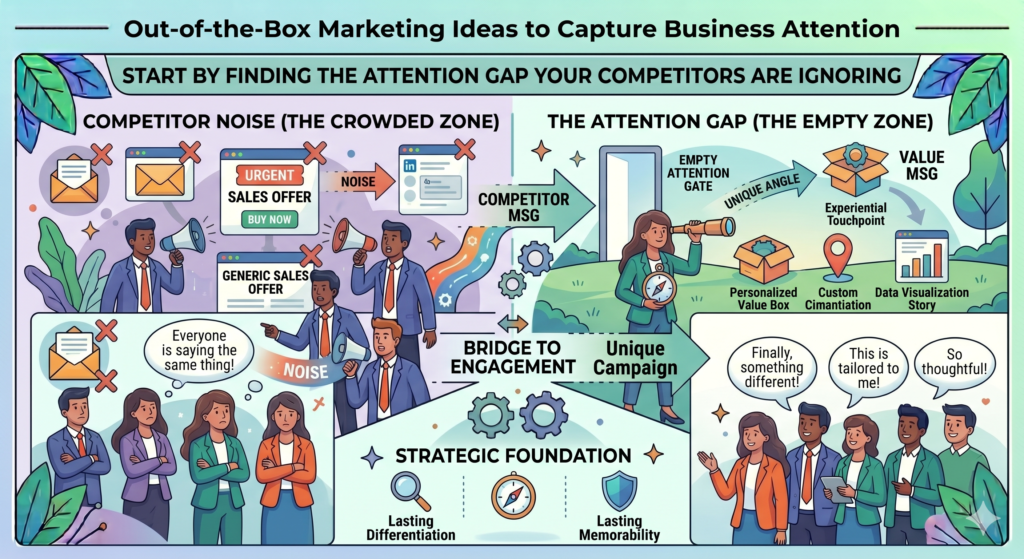
None of these channels are bad. In fact, they can work very well. But when everyone uses the same channel in the same way, buyers stop noticing. The message becomes background noise.
That is where the attention gap appears.
The attention gap is the space where your buyer is present, but your competitors are not showing up in a strong way. It could be a channel they ignore. It could be a content format they do not use. It could be a problem they do not talk about clearly. It could even be a moment in the buyer’s day when no one is trying to help them.
Out-of-the-box marketing starts here. Not with a wild idea, but with a sharper view of the market.
Look for the place where buyers are already paying attention
You do not need to force people to care. It is much easier to enter a place where they already care.
For example, if you sell to busy founders, they may not read long reports during the workday. But they may listen to short voice notes, scan founder communities, watch quick breakdowns, or read honest stories from other operators.
If you sell to HR leaders, they may not want another generic employee engagement guide. But they may pay close attention to real examples of how other companies handled burnout, hiring delays, or team conflict.
The key is to stop asking, “Where can we promote ourselves?” and start asking, “Where is our buyer already looking for help?”
That one shift changes everything.
A software company could create a private swipe file of real workflow examples instead of another blog post. A law firm could publish simple tear-downs of common contract mistakes instead of writing plain service pages. A marketing agency like WinSavvy could show side-by-side examples of weak and strong landing page messaging instead of only saying, “We improve conversions.”
When you meet attention where it already exists, your marketing feels less like interruption and more like timing.
Study what your competitors refuse to explain
Many companies hide behind broad claims. They say they are trusted, fast, expert, data-driven, or customer-first. But buyers do not remember broad claims because broad claims sound safe.
A better move is to explain what others keep vague.
If your competitors say they help businesses grow, explain the exact first steps. If they promise better leads, explain why the current leads are poor. If they talk about brand awareness, explain what weak awareness looks like in real business terms. If they sell strategy, show what a bad strategy misses.
This kind of content captures attention because it gives people words for problems they already feel.
A business owner may not wake up saying, “I need a better positioning framework.” But they may think, “People visit my site, but they do not understand why we are different.” That is the real pain. If your marketing names that pain better than anyone else, you become hard to ignore.
Turn ignored questions into strong marketing assets
Every industry has questions that companies avoid because they seem too basic, too uncomfortable, or too risky.
How much should this really cost? Why do projects fail? Who is not a good fit for this service? What should a client do before hiring us? What do most agencies get wrong? What should a buyer stop paying for?
These questions are powerful because buyers already have them in mind. They may not ask them out loud, but they are thinking about them. When your brand answers them clearly, you earn attention and trust at the same time.
This is one of the simplest out-of-the-box ideas because it does not need a big budget. You can create a blog post, video, email, landing page, webinar, or sales asset around one honest question your competitors avoid.
For example, a B2B service company could publish a page called “When You Should Not Hire Us Yet.” That sounds risky, but it can build deep trust. It tells buyers you are not trying to sell to everyone. It also helps better-fit clients self-select.
A SaaS company could create a guide called “Why Most Free Trials Fail Before the User Even Starts.” A financial consultant could create a simple article called “The Three Reports Most Business Owners Think They Need, But Rarely Use.” A digital marketing agency could create a page called “Why Your Traffic Is Growing but Your Pipeline Is Not.”
These ideas work because they feel honest. And honest marketing stands out in a sea of polished claims.
Your best creative idea may come from customer friction
Most businesses look for marketing ideas in trend reports, competitor pages, and social media feeds. Those places can help, but they are not the best source.
Your best ideas often come from friction.
Friction is where customers hesitate, complain, misunderstand, compare, delay, or ask the same question again and again. It is easy to see friction as a sales problem. But it is also a marketing goldmine.
When a buyer hesitates, they are showing you what your market does not fully believe yet. When they ask a repeated question, they are showing you what your content has not explained well enough. When they compare you to a weaker option, they are showing you what difference you have failed to make clear.
Out-of-the-box marketing becomes much easier when you build ideas from real buyer friction instead of guessing what might sound clever.
Turn sales objections into public content
A strong objection is not something to hide. It is something to use.
If buyers often say your service is expensive, do not run away from price. Create content that explains what cheap options leave out. Show the hidden cost of poor execution. Break down what changes when a business hires experts instead of patching together low-cost help.
If buyers say they need to think about it, create content that helps them make the decision. Explain what they should check before moving forward. Show the cost of waiting. Show the signs that they are ready. Show the signs that they are not ready.
If buyers compare your offer to a tool, freelancer, junior hire, or another vendor, create a clear comparison that helps them see the difference.
This is not about attacking anyone. It is about making the decision easier.
The more clearly you handle objections in public, the more your sales calls improve. Buyers arrive warmer. They already understand your thinking. They have seen that you are not afraid of hard questions. That makes your brand feel more mature.
Use customer language instead of company language
Many brands lose attention because they speak from the inside of the business.
They say things like “integrated growth solutions,” “full-funnel strategy,” “market-leading delivery,” or “performance-driven execution.” These words may sound professional, but they are not how most buyers talk.
Buyers use simpler words. They say, “We need more good leads.” They say, “Our website does not explain what we do.” They say, “Our ads are spending money but not bringing sales.” They say, “Our content sounds like everyone else.” They say, “We are getting traffic, but people are not booking calls.”
That language is gold.
When your marketing uses the words buyers already use in their own head, it feels personal. It feels like you understand them. It makes them stop because your message sounds familiar in the right way.
A simple way to find this language is to review sales calls, emails, form submissions, support tickets, reviews, and customer interviews. Look for exact phrases. Do not clean them up too much. Do not turn them into corporate language. Keep the human edge.
A headline like “Your website is getting visits, but buyers still do not understand why they should trust you” will often work better than “Conversion-focused website optimization for scaling brands.”
The first one feels real. The second one feels like noise.
Build campaigns around moments of doubt
Most marketing focuses on the moment when buyers are ready to buy. But attention often begins much earlier, in the moment of doubt.
A founder doubts whether their current growth plan is working. A marketing manager doubts whether their agency understands the brand. A sales leader doubts whether the leads are the real problem. A CEO doubts whether the team is moving fast enough. A consultant doubts whether their positioning is too broad.
These moments are emotional. They are not always dramatic, but they matter. If your marketing meets people inside those moments, it becomes more powerful.
Instead of creating a campaign that says, “Hire us for SEO,” you could create one that says, “You may not have an SEO problem. You may have a trust problem on the page.” That makes the buyer think. It breaks the pattern. It gives them a new way to see their issue.
Instead of saying, “We help B2B companies scale content,” you could say, “If your content team is publishing every week but sales still does not use the articles, this is what is probably broken.” That is far more specific. It speaks to a real moment of frustration.
Creative marketing does not always need a big visual idea. Sometimes, the creative spark is simply saying the thing your buyer has been thinking but has not heard from anyone else.
Create Content That Feels Like a Useful Experience, Not Just an Article
Most content is easy to ignore because it asks for attention without giving enough value
There is nothing wrong with blog posts. A strong article can attract traffic, build trust, and support sales for years. But most articles fail because they are built only to fill a keyword, not to help a person make a better decision.
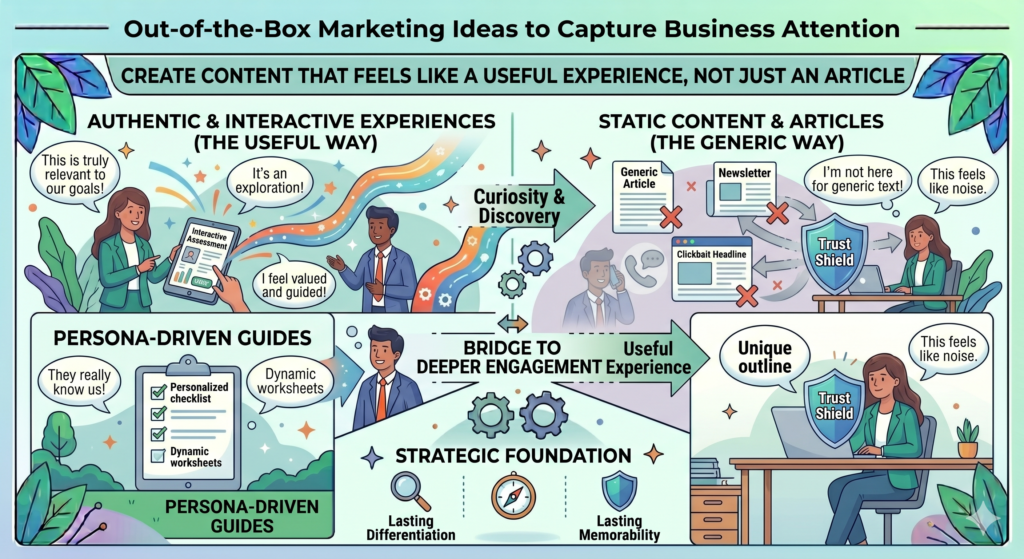
That is why experience-based content stands out.
Experience-based content does not just tell the reader something. It gives them a small moment of progress. It helps them see their problem more clearly. It lets them compare, check, score, diagnose, plan, or decide.
This kind of content captures business attention because it respects the reader’s time. It gives them something they can use right away.
A business buyer does not want more information for the sake of information. They want clarity. They want confidence. They want to know what to do next.
Turn advice into a simple diagnostic
One powerful out-of-the-box idea is to turn your best advice into a diagnostic.
Instead of writing a standard post called “How to Improve Your Landing Page,” create a landing page scorecard. Walk the reader through the key signs of a weak page. Ask them to check whether the headline explains the outcome, whether the proof is specific, whether the call to action is clear, whether the page handles doubt, and whether the offer matches the buyer’s stage.
The content still teaches. But now the reader is active. They are not just reading your ideas. They are applying them to their own business.
That creates a stronger bond.
A cybersecurity company could create a “Vendor Risk Readiness Check.” A hiring firm could create a “First Sales Hire Readiness Test.” An accounting firm could create a “Month-End Close Stress Test.” A marketing agency could create a “Content Waste Audit” that helps brands see how much content they publish that never supports revenue.
The best part is that diagnostic content can support many channels. It can become a blog post, lead magnet, sales tool, webinar, email series, LinkedIn post, or interactive page.
The idea is simple. Do not only tell people what good looks like. Help them see where they stand.
Create teardown content that shows your thinking in public
Teardowns are one of the strongest ways to capture business attention because they show skill instead of claiming skill.
A teardown takes something real and breaks down what is working, what is weak, and what could be improved. It could be a website teardown, ad teardown, email teardown, pricing page teardown, onboarding teardown, LinkedIn profile teardown, sales deck teardown, or content strategy teardown.
This format works because people love seeing expert thinking in action. It also builds trust faster than generic tips.
For example, instead of writing, “Your homepage should have a clear message,” you can show a real or sample homepage and explain why the headline is too broad, why the proof is buried, why the call to action is weak, and how the page could be changed to guide the buyer better.
You do not need to be harsh. In fact, the best teardowns are respectful. The goal is not to shame a brand. The goal is to teach through a real example.
If you want to avoid using real brands, you can create fictional examples based on common patterns. This still works well because buyers recognize the problem.
A teardown gives your audience something rare. It gives them your eyes.
And when buyers trust how you see problems, they are more likely to trust how you solve them.
Build “before and after” content that makes value obvious
Business attention grows when people can see contrast.
That is why before-and-after content works so well. It makes value visible.
You can show a weak headline next to a stronger headline. A cluttered offer next to a clearer one. A vague email next to a sharper one. A slow onboarding flow next to a smoother one. A generic service page next to one built around buyer pain.
The key is to explain the thinking behind the change.
Do not just say, “This is better.” Explain why it is better. Show how the new version reduces doubt, makes the promise clearer, improves trust, or helps the reader take action.
For a business audience, before-and-after content is useful because it lowers confusion. It helps them understand what improvement actually means. It turns abstract value into something they can see.
A marketing agency can use this idea almost anywhere. Show how a weak blog intro becomes stronger. Show how a service page can move from “we help businesses grow” to a clear, specific promise. Show how a cold email can shift from self-focused to buyer-focused. Show how a case study can move from a plain story to a sales asset.
This kind of content is also easy to repurpose. One before-and-after example can become a LinkedIn post, newsletter section, short video, sales deck slide, or blog section.
The deeper point is this. People pay attention when they can quickly see the difference between what they have and what they could have.
Make your content feel personal without making it complicated
Personal content does not always mean using the reader’s name or creating complex automation. Sometimes, it simply means making the reader feel like the content was made for their exact situation.
That feeling comes from detail.
When content says, “Many companies struggle with marketing,” it sounds generic. When it says, “If your team is publishing content every month but sales still creates its own decks because the articles do not answer buyer questions, your content is not close enough to revenue,” it feels personal.
Specificity is one of the best attention tools in marketing.
It shows the reader that you understand the real world, not just the theory.
Write for a clear stage of the buyer’s journey
Many brands create content for a broad audience and then wonder why it does not convert.
A better method is to choose one buyer stage and write directly for that moment.
A person who is just becoming aware of a problem needs language, examples, and signs. They need help understanding what is wrong. A person comparing options needs frameworks, trade-offs, and decision support. A person close to buying needs proof, risk reduction, process clarity, and reasons to act now.
When you mix all stages into one piece, the content becomes weaker. It tries to do too much. But when you write for one stage, it becomes sharp.
For example, a top-of-funnel article might be titled “Why Your Content Gets Traffic but Does Not Create Sales Conversations.” That piece helps the reader name the problem.
A middle-of-funnel article might be titled “SEO Agency vs Content Team vs Freelance Writer: Which One Makes Sense for Your Growth Stage?” That piece helps the reader compare options.
A bottom-of-funnel article might be titled “What Happens in the First 30 Days When You Work With WinSavvy?” That piece helps the reader feel safe taking action.
Each idea has a different job. Each captures attention in a different way.
Use real situations instead of broad advice
Broad advice is forgettable because it does not create a picture in the reader’s mind.
Real situations are different. They feel alive.
Instead of saying, “Improve your follow-up emails,” describe a business that gets a demo request, replies late, sends a vague message, and loses the lead to a faster competitor. Instead of saying, “Create better lead magnets,” describe a founder who downloads a 40-page report but never reads it because what they really needed was a simple checklist to make a decision that week.
Stories do not need to be long. They just need to be clear.
A short real-world situation can make a point stronger than five paragraphs of theory. It helps the reader think, “That sounds like us.”
That moment is attention.
And once the reader sees themselves in your content, they keep reading because the content no longer feels like general advice. It feels relevant.
Create content that saves the buyer from a bad decision
One of the best ways to earn trust is to protect the buyer.
Most marketing tries to push people toward a purchase. Stronger marketing helps them avoid a mistake.
This could mean explaining when not to buy, what warning signs to check, what questions to ask a vendor, what hidden costs to watch for, or what needs to be ready before a project begins.
This kind of content works well because it feels generous. It tells the buyer, “We care about your outcome, not just your money.”
For example, a marketing agency could create content around “Do not hire an SEO agency until you can answer these questions.” A SaaS company could write “Do not choose a CRM until your sales process is clear.” A design studio could publish “Do not redesign your website until you know why the current one is failing.”
This type of content captures serious business attention because it speaks to risk. And in B2B buying, risk matters a lot.
Buyers want growth, but they also want to avoid looking foolish. They want results, but they also want safety. If your content helps them make a smarter choice, they are more likely to see you as a trusted guide.
Use Pattern Breaks That Make People Stop Without Feeling Tricked
Attention starts when the brain notices something different
People ignore what feels familiar. That is not because they are lazy. It is because their minds are protecting their time.
When a buyer sees another ad that looks like every other ad, they skip it. When they see another email that starts with the same fake personal line, they delete it. When they see another article with a tired intro, they leave.
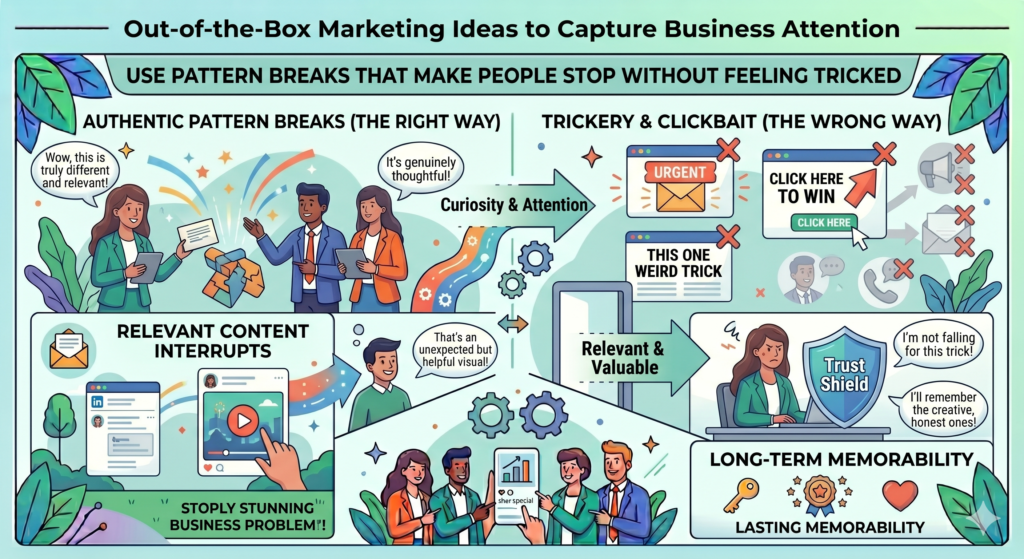
A pattern break interrupts that automatic response.
But there is a right way and a wrong way to use pattern breaks.
A weak pattern break feels like a trick. It uses shock, clickbait, or drama to win a second of attention, but then disappoints the reader. A strong pattern break earns attention by showing a new angle, a fresh contrast, or a surprising truth that still connects to the buyer’s problem.
The goal is not to be loud. The goal is to be interesting in a useful way.
Say the opposite of what the market expects, but only when you can prove it
One strong pattern break is a clear, honest opposite statement.
If everyone says “publish more content,” you might say, “Your content problem may not be volume. It may be that none of it helps sales.” If everyone says “run more ads,” you might say, “More ad spend will not fix a weak offer.” If everyone says “build brand awareness,” you might say, “Awareness is not enough if buyers remember you for the wrong thing.”
These lines make people stop because they challenge a common belief.
But the statement must be true. You need to explain it. You need to support it with logic, examples, and a clear next step. Otherwise, it becomes empty contrarian content.
The best opposite statements work because they name a problem people already suspect. They make the reader feel relief because someone finally said the quiet part clearly.
For example, many businesses believe they need more traffic. But often, they need better conversion from the traffic they already have. A strong campaign could be built around this idea: “Before you chase more visitors, fix the page that is losing the visitors you already paid for.”
That is simple. It is sharp. It creates a useful pause.
Change the format, not just the message
Sometimes the idea itself is not new, but the format makes it feel new.
For example, instead of publishing a normal case study, you could create a “decision diary” that shows the client’s problem, false starts, choices, trade-offs, and final result. Instead of hosting a standard webinar, you could run a live teardown clinic. Instead of sending a normal newsletter, you could send a weekly “one fix” email that improves one small part of the reader’s marketing.
The format changes the experience.
This matters because many buyers have seen the same content types too often. They know what a standard webinar feels like. They know what a standard PDF feels like. They know what a standard case study feels like.
A new format gives familiar value a fresher shape.
A B2B company could create a “mistake museum” that shows common errors in the industry and explains how to fix them. A consultant could create a “strategy clinic” where each issue focuses on one real business problem. A software brand could create a “workflow rescue” series that shows how messy processes become cleaner.
The content does not need to be fancy. It just needs to feel different enough to stop the scroll and useful enough to hold attention.
Use strong naming to make simple ideas more memorable
A good name can make a marketing idea easier to remember.
This does not mean inventing silly terms. It means giving a clear, useful name to a problem, process, mistake, or method.
For example, instead of saying “content that does not support sales,” you could call it “dead-end content.” Instead of saying “a website that gets traffic but does not convert,” you could call it “a leaky trust page.” Instead of saying “a buyer who keeps delaying because the offer is unclear,” you could call it “decision drag.”
These names work because they make invisible problems easier to discuss.
When a buyer has a name for a problem, they can share it with their team. They can remember it. They can return to it. That gives your brand more staying power.
WinSavvy could use this idea across service pages, sales decks, blogs, and emails. For example, a campaign around “content waste” could show companies how much time and money goes into articles that attract visitors but never help buyers move closer to a sale.
The name is simple. The problem is real. The idea is easy to spread.
That is the power of strong naming.
Pattern breaks work best when they lead to a clear business point
A pattern break should never be the whole strategy. It is the door, not the room.
Once someone stops, your marketing still has to deliver. It must make a clear point, teach something useful, or move the buyer closer to action.
This is where many brands fail. They create a clever hook but have nothing strong behind it. The reader clicks, then feels let down. That damages trust.
A good pattern break makes a promise. The rest of the content must keep it.
Make the first sentence carry real weight
The first sentence of a blog, email, ad, or landing page should not waste time.
Many brands start with obvious lines like “In today’s fast-paced digital world…” or “Marketing is more important than ever.” These lines do not create attention because the reader has seen them too many times.
A stronger opening starts closer to the pain.
For example, “Your best leads may not be choosing your competitor because they are better. They may be choosing them because their message is easier to understand.”
That sentence gives the reader a reason to continue. It creates a clear thought. It opens a loop.
Another example could be, “Most content does not fail because the writing is bad. It fails because it answers questions buyers are not asking yet.”
That line makes the reader curious. It also leads directly into a useful business point.
The first sentence should make the reader feel that the piece has a real point of view. It should not feel like a warm-up. Readers do not owe you patience. You have to earn it from the start.
Use contrast to make your message easier to feel
Contrast is one of the most useful copywriting tools because it makes ideas clearer.
You can contrast old way versus new way. Common belief versus better belief. Surface problem versus real problem. Cheap fix versus lasting fix. More activity versus better strategy.
For example, “More content gives you more pages. Better content gives your sales team more reasons to follow up.” That contrast is simple, but it makes the point easy to understand.
Or, “Traffic shows that people found you. Conversions show that they trusted you enough to act.” Again, simple and clear.
Contrast helps business readers because they are often busy. They need ideas to land fast. They do not want to work hard to understand your point.
When your marketing uses contrast well, your message becomes sharper without becoming complex.
End each section with a reason to act
Good content should not only explain. It should move.
That does not mean every section needs a hard sales pitch. In fact, too many hard pitches can weaken trust. But each section should guide the reader toward a useful action, thought, or decision.
After explaining a concept, show what to do with it.
If you explain attention gaps, ask the reader to review where competitors are overactive and where buyers are underserved. If you explain customer language, ask them to pull phrases from real sales calls. If you explain teardowns, ask them to choose one asset and break down what works, what fails, and what needs to change.
This is what makes content actionable.
Readers should leave each part feeling smarter and more capable. They should feel that they can do something now, even before they hire you.
That is not giving away too much. That is building trust.
The more useful your marketing is before the sale, the more believable your service becomes after the sale.
Build Campaigns Around Surprise, Not Noise
Surprise works when it makes the buyer think differently
A lot of brands confuse surprise with shock.
They think an out-of-the-box idea has to be loud, funny, odd, or risky. So they try to create something people have never seen before. But in business marketing, that is not always the best move.
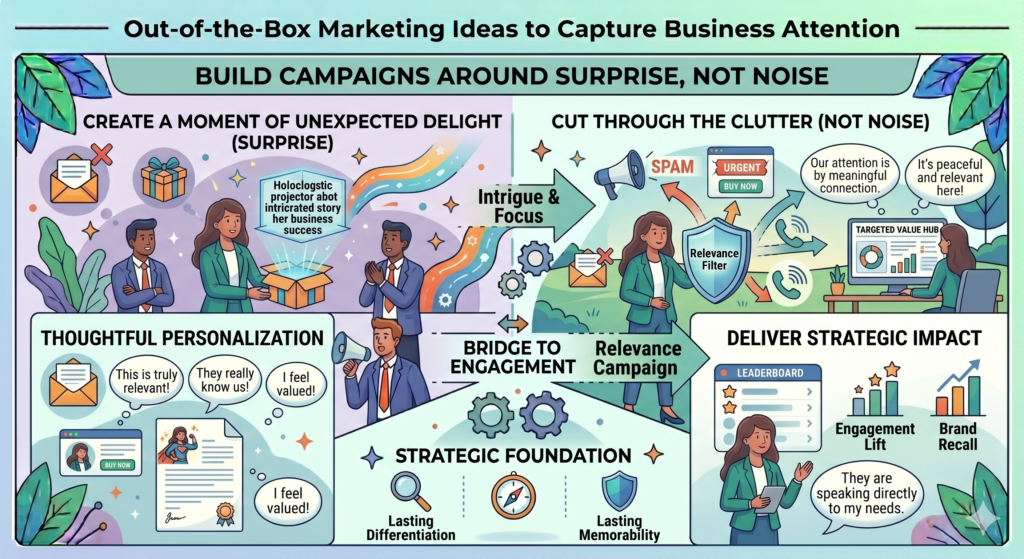
Business buyers do not reward strange ideas just because they are strange. They reward useful ideas that make them pause and think.
That is the kind of surprise you want.
A useful surprise changes how the buyer sees a problem. It shows them something they missed. It gives them a clearer reason to act. It turns a familiar pain into a sharper insight.
For example, saying “We help you get more leads” is not surprising. Most marketing agencies say that. But saying “Your lead problem may actually be a trust problem” is more interesting. It makes the buyer stop. It gives them a new lens. It opens the door for a deeper conversation.
The best surprise in marketing is not random. It is rooted in truth. It works because the buyer feels, “I never thought of it that way, but that makes sense.”
That feeling is powerful.
It makes your brand more memorable because you are not just another vendor repeating common advice. You become the brand that helped the buyer see their problem more clearly.
Surprise should come from a real buyer insight
A strong campaign starts with a truth your buyer already feels but has not fully named.
Maybe they feel that their marketing looks active but does not create sales. Maybe they feel that their website sounds polished but not clear. Maybe they feel that their team keeps creating content, but no one can prove which pieces matter. Maybe they feel that their ads bring traffic, but the wrong people are clicking.
These are not surface problems. They are deeper frustrations.
When you build a campaign around one of these truths, the surprise feels earned.
For example, a campaign could say, “Your content calendar is full. Your sales team is still empty-handed.” That line is surprising because it connects two things many teams treat separately. It points to a real issue. Content is being made, but it is not helping sales conversations.
Another campaign could say, “Your homepage may be answering the wrong question.” That works because most companies assume their homepage should explain what they do. But the buyer may actually be asking, “Why should I trust this company over all the others?”
That shift is useful. It gives the campaign depth.
The more your surprise comes from a real business insight, the less it feels like a gimmick.
A surprising message must still be easy to understand
Some brands try so hard to sound creative that their message becomes confusing.
That is dangerous.
If a buyer has to work too hard to understand your idea, you will lose them. Clever marketing can grab attention for a second, but clear marketing keeps attention longer.
Your message should be fresh, but not hard to decode.
A simple test is this. After someone reads your headline, can they explain the point in their own words within a few seconds? If yes, your idea is probably clear. If not, it may be too clever.
For example, “Stop feeding the content machine. Start feeding the sales conversation” is creative, but still clear. It tells the reader that content should support sales, not just fill a schedule.
But a vague line like “Unlock the new language of growth velocity” sounds bigger than it is. It may feel polished, but it does not help the buyer understand anything.
Clear surprise beats confusing creativity every time.
Make the surprise lead to a useful next step
A campaign should not end at the hook.
Once the buyer stops, you need to guide them. Show them what the surprise means. Explain why it matters. Give them a next step they can take.
If your campaign says, “Your lead problem may be a trust problem,” then the next step could be a trust audit. You could help the buyer review whether their website shows clear proof, handles doubts, explains outcomes, and makes the next action easy.
If your campaign says, “Your content calendar is full but sales is still empty-handed,” the next step could be a content-to-sales audit. You could help the buyer map existing content to sales questions and find the gaps.
If your campaign says, “Your homepage may be answering the wrong question,” the next step could be a homepage message teardown.
This is where out-of-the-box marketing becomes practical. The creative idea gets attention. The useful next step turns that attention into movement.
That is the difference between a fun campaign and a campaign that creates business.
Small creative moves can create big attention when they hit the right nerve
You do not always need a huge campaign.
Sometimes, one small creative move can break through because it is timed well and aimed at the right pain.
A strong subject line can revive a cold email. A smart landing page section can make buyers stay longer. A bold comparison page can help prospects choose faster. A short video teardown can create more trust than a long brand film.
The size of the idea matters less than the sharpness of the idea.
Small moves work especially well for businesses that do not have huge budgets. You can test them quickly. You can learn what people respond to. You can improve without waiting months.
Send a personalized insight instead of a normal pitch
Most outreach fails because it feels like outreach.
The sender talks about themselves too soon. They say they “help companies like yours.” They ask for a meeting before giving any reason to trust them. They use fake praise that feels copied and pasted.
A better approach is to send a useful insight first.
For example, instead of saying, “We help businesses improve SEO,” you could send a short note that says, “I noticed your site ranks for several helpful topics, but most of those pages do not lead readers toward your core service. That may be why traffic is not turning into stronger pipeline.”
That message is different because it proves effort. It gives the buyer something specific. It creates curiosity without pushing too hard.
You can use this idea in many ways. A design agency can send a quick note about a confusing page section. A sales consultant can point out a weak handoff between demo and follow-up. A conversion expert can show where the buyer journey leaks trust. A recruiting firm can point out a job post that may be attracting the wrong applicants.
The rule is simple. Give value before asking for time.
That alone can make your outreach feel rare.
Create a public challenge around a painful business problem
A public challenge can capture attention because it gives people a reason to act now.
But the challenge must be useful. It should not be a thin excuse to collect emails. It should help the audience make visible progress.
For example, a marketing agency could run a “Five-Day Message Clarity Challenge.” Each day, business owners improve one part of their message. Day one could focus on the main promise. Day two could focus on the buyer pain. Day three could focus on proof. Day four could focus on offer clarity. Day five could focus on the call to action.
This kind of challenge works because it turns a large problem into small steps. It also shows your thinking and builds trust over several days.
A SaaS company could run a “Workflow Cleanup Week.” A financial advisor could run a “Cash Flow Clarity Sprint.” A coach could run a “Positioning Reset Week.” A hiring firm could run a “Better Job Post Challenge.”
The challenge creates attention because it has motion. People can join, follow, share progress, and see change.
Most brands publish content and wait. A challenge invites participation.
That is a major difference.
Use a bold public promise, but make it narrow
A bold promise gets attention when it is specific and believable.
A vague promise like “We will grow your business” is too broad. It sounds like every other claim. A narrow promise is stronger because it feels more real.
For example, “We will help you find the three pages where your website is losing the most sales conversations” is clear. It does not promise the whole world. It promises one useful outcome.
A campaign could be built around that promise. You could invite companies to submit their site for a short review. You could publish anonymized lessons. You could turn common findings into content. You could use the best examples in sales conversations.
The key is to make the promise narrow enough to deliver well.
A narrow promise reduces doubt. It tells buyers exactly what they will get. It also gives your team a clean process to follow.
Out-of-the-box marketing often fails when the idea is too broad. The campaign becomes hard to explain, hard to deliver, and hard to measure. A narrow promise keeps the idea sharp.
Surprise can also come from where and how you show up
The message matters. But the delivery matters too.
Sometimes, a brand stands out because it shows up in a place or format the buyer did not expect.
This does not mean chasing every new channel. It means thinking carefully about your buyer’s day. Where do they spend time? What do they ignore? What do they save? What do they share? What do they discuss with their team?
When you understand those patterns, you can show up in a way that feels fresh.
Put your best ideas into formats buyers already use internally
Many brands create content only for public attention. But some of the strongest marketing happens when your content gets shared inside a company.
That is why internal-use content is so powerful.
A buyer may not forward a generic blog post to their CEO. But they might forward a simple one-page checklist, a clear comparison, a decision guide, or a short audit template. They might use it in a meeting. They might share it with sales, marketing, finance, or leadership.
When your content helps the buyer look smart inside their own company, it travels further.
For example, instead of only writing an article about weak website messaging, create a “Homepage Trust Review Sheet” that a marketing manager can use with their team. Instead of only explaining content strategy, create a “Sales Questions to Content Map” that helps teams see which buyer questions have no content support.
This is a smart way to capture business attention because it enters the real decision process.
Many purchases do not happen because one person likes your brand. They happen because that person can explain the problem to others. Your content can help them do that.
Create content that sales teams want to steal
This is one of the clearest signs your marketing is useful.
If your sales team wants to use a piece of content in real conversations, the content is probably strong.
Many companies create marketing content that attracts views but does not help sales. That is a missed chance. Out-of-the-box content should make sales easier, not separate from sales.
Think about what sales teams need. They need ways to explain value. They need proof. They need simple answers to common objections. They need comparison points. They need stories. They need tools that make the buyer feel more confident.
A strong marketing idea could be built around one sales moment.
For example, if buyers often ask why SEO takes time, create a visual story that explains how trust builds across search, content, and conversion. If buyers often ask why your service costs more, create a simple breakdown of what cheap work usually leaves out.
If buyers often delay after a proposal, create a “decision guide” that helps them compare doing nothing, hiring internally, hiring a freelancer, or hiring your agency.
That content captures attention because it is tied to a real buying decision.
The best marketing does not just bring people in. It helps them move forward.
Make your brand feel useful before buyers are ready
Not every buyer is ready now.
In fact, most are not. They may know they have a problem, but they are not ready to book a call. They may be watching, learning, comparing, or waiting for the right time.
This is where many brands lose patience. They only create content for people who are ready to buy. But out-of-the-box marketing can win attention much earlier.
The goal is to become useful before the buyer needs you.
A marketing agency could send a monthly “growth cleanup” email with one practical fix. A SaaS company could publish weekly workflow examples. A consultant could share simple decision notes that help leaders think through common problems. A local business could create seasonal planning guides before customers start searching.
This kind of marketing builds memory.
When the buyer finally feels ready, they already know who helped them think better. That gives you a strong advantage.
Business attention is not always won in one big moment. Sometimes, it is earned through repeated small moments of usefulness.
Turn Your Audience Into Part of the Marketing
People pay more attention when they are involved
One of the strongest ways to capture attention is to stop treating the audience as passive readers.
Invite them into the idea.
People pay more attention when they can take part, respond, compare, submit, vote, challenge, share, or see themselves in the content. This does not mean you need to build a huge community. It means your marketing should create moments of participation.
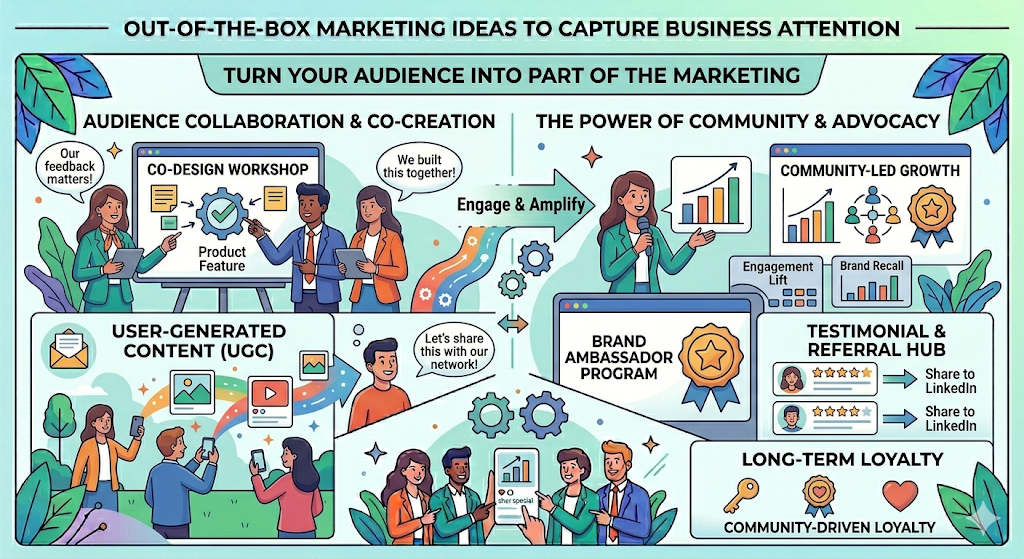
Participation makes the audience feel closer to the brand.
A person who completes a scorecard is more involved than someone who only reads a tip. A person who submits a question for a teardown is more involved than someone who watches a generic video. A person who votes on which problem matters most is more involved than someone who scrolls past a post.
The more involved someone feels, the more likely they are to remember you.
Ask for real problems, then solve them in public
This is a simple idea that can work in almost any business.
Ask your audience to share a real problem. Then choose a few and solve them publicly.
A marketing agency could ask founders to submit a weak landing page section. Then the agency could rewrite a few examples and explain why the changes work. A sales consultant could ask teams to submit follow-up emails that are not getting replies.
Then the consultant could improve them and share the lesson. A SaaS company could ask users to submit messy workflows. Then the team could show how to clean them up.
This works because the content is based on real pain. It is not guessed. It also shows your skill in a practical way.
Even people who do not submit will pay attention because they may see their own problem in someone else’s example.
That is the hidden power of public problem-solving. It helps one person directly, but teaches many people at once.
Use audience language to shape future campaigns
When people respond to your content, they give you clues.
They tell you what they care about. They show you which words they use. They reveal what they understand and what still confuses them.
Smart marketers do not ignore this. They collect it.
If a LinkedIn post gets comments around one specific pain, that pain may deserve a full article. If several people reply to an email with the same question, that question may deserve a sales asset. If a webinar chat keeps returning to one concern, that concern may deserve a campaign.
Your audience is not only a group of people to market to. They are a source of insight.
This makes your marketing sharper over time. Instead of creating content from a boardroom guess, you create it from real demand.
A good habit is to review audience replies every month and look for repeated phrases. What do people keep asking? What do they complain about? What words do they use when they describe the problem? What examples make them say, “This is exactly what we are dealing with”?
Those clues can shape stronger headlines, offers, emails, ads, and landing pages.
Make customers the proof, not just the quote
Most companies use customer proof in a very basic way. They add a few testimonials to a page and hope buyers trust them.
But customer proof can be much stronger than that.
You can turn customer stories into useful teaching assets. You can show the problem, the wrong turns, the decision, the process, and the result. You can explain what changed and why it mattered. You can show the reader how to apply the lesson to their own business.
This makes the customer part of the marketing in a deeper way.
A simple testimonial says, “This company is good.” A strong customer story says, “Here is how a real business solved a real problem, and here is what you can learn from it.”
That is far more useful.
For example, instead of saying, “Client grew leads by 40 percent,” explain what was broken before the growth. Maybe the client had traffic but weak trust. Maybe their service pages were too broad. Maybe their content was attracting the wrong audience. Maybe the call to action was too vague.
When you show the full path, buyers believe the result more.
They also start to picture what it would be like to work with you.
Community-led attention does not need a large audience
Many businesses hear the word community and think it means building a huge group, managing forums, or posting every day.
It does not have to be that big.
Community-led attention can start with a small group of the right people. It can be a private roundtable, a customer panel, a small research group, a live audit session, or a monthly discussion with people facing the same problem.
The point is to create a place where useful conversation happens.
When people gather around a real business challenge, attention becomes easier to earn. You are not only broadcasting. You are hosting the conversation.
Host small expert rooms instead of large empty webinars
Webinars are common. Many are ignored because they feel like sales pitches with slides.
A better idea is to host small expert rooms.
Instead of inviting hundreds of people to a broad topic, invite a smaller group to discuss one sharp problem. Make the topic specific. Make the promise clear. Make the session useful even if no one buys anything.
For example, instead of “How to Improve Your Marketing in 2026,” a stronger session could be “Why Your Content Gets Traffic but Sales Still Does Not Use It.” That is more specific. It attracts people with a real pain. It also makes the discussion better.
Small rooms can feel more valuable because people can ask questions. They can hear from peers. They can get closer to the problem.
A business owner is more likely to remember a focused session where their question was answered than a large webinar where they watched slides for 45 minutes.
Create a buyer panel and turn the insights into content
Most brands talk about buyers. Fewer brands let buyers speak.
A buyer panel can be a powerful marketing asset. You invite a few people from your target market to discuss how they make decisions, what they ignore, what builds trust, what slows them down, and what vendors often get wrong.
This creates value in several ways.
First, it gives your brand fresh insight. Second, it creates content your audience actually wants because it comes from people like them. Third, it positions your company as a serious student of the market, not just a seller.
You can turn one panel into articles, short clips, email lessons, sales insights, research posts, and internal training.
The key is to ask honest questions.
Do not only ask what buyers like. Ask what makes them distrust a vendor. Ask what makes a website feel weak. Ask what kind of content they share with leadership. Ask what causes them to delay a purchase. Ask what kind of proof feels real.
These answers can become some of your strongest marketing.
Build a simple signature series people can expect
Attention grows when people know what to expect from you.
A signature series gives your audience a reason to come back.
It could be a weekly teardown, a monthly mistake review, a founder growth clinic, a buyer question breakdown, a campaign scorecard, or a “one page fixed” series.
The format should be simple enough to repeat. The value should be clear. The name should be easy to remember.
For example, WinSavvy could run a series called “The Revenue Leak Review,” where each edition breaks down one place where businesses lose leads, trust, or sales from their marketing. One week could focus on homepage messaging. Another could focus on weak calls to action. Another could focus on content that attracts the wrong audience.
This creates a rhythm. The audience starts to know what your brand stands for. They begin to associate you with a specific kind of help.
That is how repeated attention becomes brand memory.
Use Physical and Personal Touches in a Digital World
Offline ideas stand out because everyone is crowded online
Digital marketing is powerful. But because it is so easy to send, publish, and automate, buyers are flooded with digital messages.
That creates a chance for physical and personal touches to stand out.
This does not mean you need expensive gifts or big mail campaigns. In fact, the best offline ideas are often thoughtful, simple, and tied to a real business point.
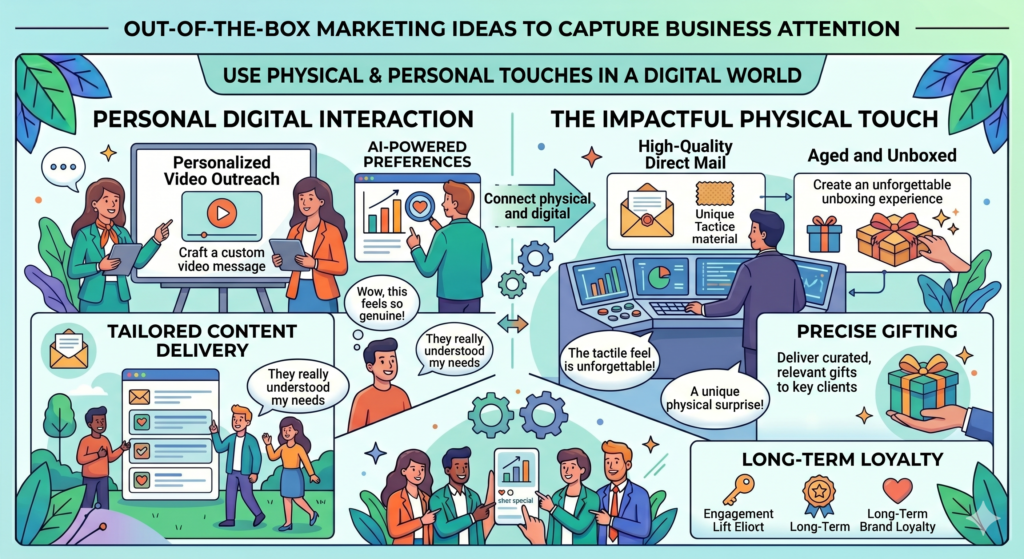
A physical touch works because it feels less common. It shows effort. It interrupts the normal flow of emails, ads, and posts.
But it must be relevant. A random gift may be remembered, but it may not create business value. A smart physical touch connects to the buyer’s pain, goal, or decision.
Send something useful that supports the sales conversation
If you send a gift, make it useful.
A random mug may be nice, but it rarely changes how a buyer sees your brand. A more strategic idea is to send something that helps the buyer think through the problem you solve.
For example, a marketing agency could send a printed “Message Clarity Checklist” to a high-value prospect before a strategy call. A cybersecurity firm could send a simple incident response planning card. A financial consultant could send a cash flow review worksheet. A hiring firm could send a better interview question guide.
The item does not need to be expensive. It needs to be useful.
The goal is to show the buyer that your brand brings clarity before they even pay you.
This kind of touch can also make a follow-up feel more natural. Instead of sending another “just checking in” email, you can say, “I sent over a short checklist your team can use to review the page before your next campaign.”
That feels helpful, not pushy.
Use handwritten notes when the relationship matters
A handwritten note can feel powerful because it is rare.
But it only works when it is sincere. If it feels like a trick, it loses its value.
Use handwritten notes for moments where the relationship matters. After a strong sales conversation. After a client milestone. After an event. After someone refers a lead. After a customer gives helpful feedback.
The note should be short, specific, and human.
Do not fill it with sales language. Mention the real moment. Say what you appreciated. Tie it to the next step only if it feels natural.
For example, after a discovery call, a note could say that you appreciated how clearly they explained the gap between traffic and pipeline, and that your team is already thinking about how to help them make the website work harder for sales.
That kind of note feels personal because it reflects the actual conversation.
In a world full of automation, real attention feels different.
Make events feel more like working sessions than performances
Events can be strong attention tools, but many business events feel too passive.
People sit. Someone presents. Everyone leaves. A few follow-up emails go out. Then the attention fades.
A better approach is to design events as working sessions.
Instead of only teaching, help people do something during the event. Help them rewrite a message. Map a buyer journey. Review a page. Build a content plan. Score an offer. Improve an email.
When people leave with progress, they remember the event.
For example, WinSavvy could host a “Fix Your Homepage Message” session where each attendee leaves with a clearer headline, sharper proof point, and stronger call to action. That is far more useful than a broad session on website strategy.
A working session creates trust because it gives people a taste of your process. It also makes the value of your expertise easier to feel.
Personal touches should be hard to fake
The best personal marketing does not rely on inserting a first name into an email.
Real personal marketing shows that you noticed something specific.
That could be a recent change in the buyer’s business. A gap in their current messaging. A campaign they launched. A customer segment they are trying to reach. A hiring move that signals growth. A piece of content that could be improved.
Personal touches work because they show care. They also show skill.
Reference a real business moment
Timing matters.
A message sent at the right moment can beat a perfect campaign sent at the wrong time.
Look for business moments that may create need. A company launches a new product. A founder announces funding. A team hires a new sales leader. A business enters a new market. A website is redesigned. A company starts posting more content. A brand begins running ads.
Each moment can open a useful conversation.
For example, when a company launches a new product, they may need stronger landing pages, launch content, paid campaigns, or sales enablement. When a company hires a new marketing leader, they may be reviewing what is working and what is not. When a business redesigns its website, it may soon need SEO cleanup or conversion improvements.
The outreach should not say, “Congratulations, do you need help?” That feels lazy.
Instead, connect the moment to a useful insight. Say what often gets missed at that stage. Offer a small way to check it. Give them a reason to think.
That is how timing becomes strategy.
Build follow-up around value, not pressure
Most follow-up messages are weak because they only ask for a reply.
They say, “Just checking in.” They say, “Following up.” They say, “Any thoughts?” These messages add no value. They put the work back on the buyer.
A stronger follow-up gives the buyer something useful.
It could share a relevant example, answer an objection, offer a short audit, send a decision guide, or point out one clear opportunity.
For example, after a prospect goes quiet, instead of saying, “Just checking in,” you could say, “I was thinking about your point on traffic not turning into demos. One thing I would check first is whether your service pages clearly separate problem-aware visitors from ready-to-buy visitors. If those two groups see the same message, conversion often drops.”
That kind of follow-up feels thoughtful. It keeps the conversation alive without pressure.
Buyers notice when a brand continues to help after the first call.
Use personal video when the idea is easier to show than explain
Personal video can work well when you need to show something visual.
For example, if you are reviewing a homepage, ad, email flow, or content gap, a short screen-recorded video can be more powerful than a long written note.
The key is to keep it focused. Do not make a long presentation. Show one or two useful observations. Explain why they matter. Suggest a next step.
A three-minute video that shows a real issue can feel more valuable than a polished pitch deck.
It also creates human connection. The buyer hears your voice. They see your thinking. They feel the effort.
This is especially useful for high-value prospects. You do not need to send personal videos to everyone. Use them where the account value justifies the effort.
Out-of-the-box marketing does not always mean scaling everything. Sometimes, the smartest move is to do something thoughtful that does not scale, because it opens doors that automated campaigns cannot.
Build Strategic Stunts That Tie Back to the Brand
A stunt only works when it supports the message
Marketing stunts can be risky.
When done poorly, they grab attention but do not build trust. People may laugh, click, or share, but they do not understand what the business does or why it matters.
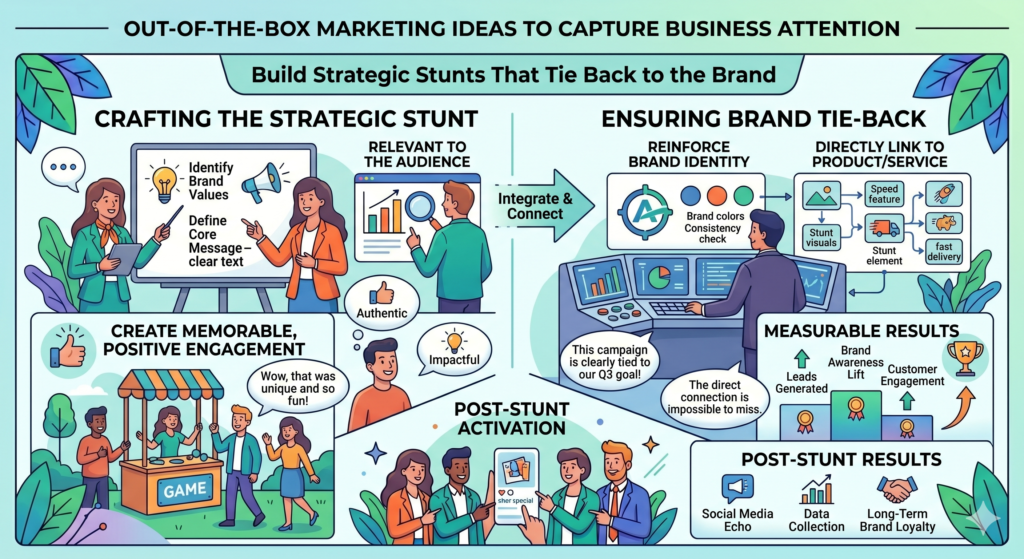
A good stunt is different.
It is a creative act that makes the brand message clearer. It dramatizes a real problem. It turns an idea into something people can see, feel, or talk about.
The stunt should not sit apart from the business. It should make the business point stronger.
For example, if a company helps teams reduce wasted meetings, a smart stunt might involve showing how much time a business loses to unclear calls. If a marketing agency helps reduce content waste, a smart stunt might show a “graveyard” of unused content assets and what they cost.
The idea may be playful, but the point must be serious.
Start with the business truth, then build the creative act
Do not start by asking, “What would get attention?”
Start by asking, “What truth do we want the market to see?”
Maybe the truth is that many companies waste money on traffic before fixing trust. Maybe the truth is that most service pages sound alike. Maybe the truth is that teams keep creating content that sales never uses. Maybe the truth is that buyers do not need more information; they need clearer decisions.
Once you know the truth, you can create a stunt that makes it visible.
For example, if the truth is that companies waste content, you could create a “Content Waste Calculator” and pair it with a public campaign showing how many hours are lost creating unused articles, decks, and posts. If the truth is that websites hide the best proof, you could run a “Proof Above the Fold” challenge where you review pages and show what proof should appear earlier.
The stunt becomes useful because it teaches.
It is not just a show. It is a sharp way to make a real problem hard to ignore.
Keep the stunt simple enough to explain in one sentence
If people cannot explain your idea quickly, they will not share it.
A strong stunt has a simple core.
“We reviewed 100 B2B homepages and found where trust breaks.” That is clear.
“We built a public graveyard of marketing assets sales teams never use.” That is clear.
“We rewrote weak service page headlines from real businesses and showed the before and after.” That is clear.
The idea should not need a long setup. The faster people understand it, the faster they can remember it.
This matters because attention spreads through simple ideas. If your campaign takes too long to explain, it loses energy.
Make sure the stunt creates follow-up content
A good stunt should not be a one-day event.
It should create material you can use again and again.
A homepage review campaign can become a report, blog series, LinkedIn posts, short videos, email lessons, sales insights, and a webinar. A content waste campaign can become a calculator, case studies, audit offers, and a benchmark report. A buyer panel can become clips, articles, quote cards, and a sales guide.
This is how you get more value from the idea.
Before launching any creative campaign, ask what content it will produce afterward. If it only creates a short burst of attention, it may not be worth it. If it creates a library of useful insights, it becomes much more powerful.
The best out-of-the-box ideas do not end when the campaign ends. They keep feeding your marketing.
Stunts should make the buyer feel smarter, not just amused
Entertainment can help, but business buyers still need value.
If your stunt only makes people smile, it may win attention but not action. If it makes them smile and think, it becomes stronger.
The buyer should leave with a clearer view of their own problem.
Use humor carefully and keep it tied to pain
Humor can make a brand more human. But it has to be used with care.
The safest humor in B2B marketing is usually humor that points at shared frustration, not at a person or company.
For example, joking about “the content calendar that never sleeps but never sells” can work because many marketers understand that pain. Joking about “the homepage headline that could belong to any company in the industry” can work because it points to a common issue.
The humor should make the buyer feel seen, not mocked.
When humor is tied to a real pain, it opens the door. Then your strategy gives the buyer a way forward.
Use public data or simple research to add weight
A stunt becomes more serious when it includes research.
You do not always need a huge study. Even a small, focused review can create valuable insight.
For example, you could review 50 websites in one niche and report common mistakes. You could study 100 sales emails and show patterns that weaken replies. You could review 30 pricing pages and explain what most of them hide. You could analyze common blog intros in an industry and show why they fail to hook readers.
This kind of research gives your campaign authority.
It also gives journalists, partners, creators, and prospects something to discuss.
The key is to be honest about the sample. Do not overclaim. Say what you reviewed and what you found. Keep the language simple. Focus on useful lessons.
Small research can create big attention when the topic is specific and the insight is clear.
Connect the campaign to a clear offer
A stunt should lead naturally into what you sell.
If people love the campaign but cannot see how your business helps, the idea is incomplete.
For example, if your campaign reveals that many websites lose trust because proof is weak, your offer could be a website trust audit. If your campaign reveals that sales teams do not use marketing content, your offer could be a content-to-sales alignment sprint. If your campaign reveals that service pages sound the same, your offer could be a positioning and messaging workshop.
The offer should feel like the next logical step.
That does not mean every campaign must push a hard sale. But there should be a bridge from attention to action.
Creative marketing is not just about being remembered. It is about being remembered for the right reason.
Make Your Brand Easier to Talk About
The brands that get shared are often the easiest to explain
A business can have a great service and still be hard to talk about.
This is a problem.
If your customers, partners, and prospects cannot explain what makes you different, they will not spread your message well. They may like you, but they will describe you in vague terms. They may say, “They do marketing,” or “They help with growth,” or “They do SEO.” That does not create strong attention.
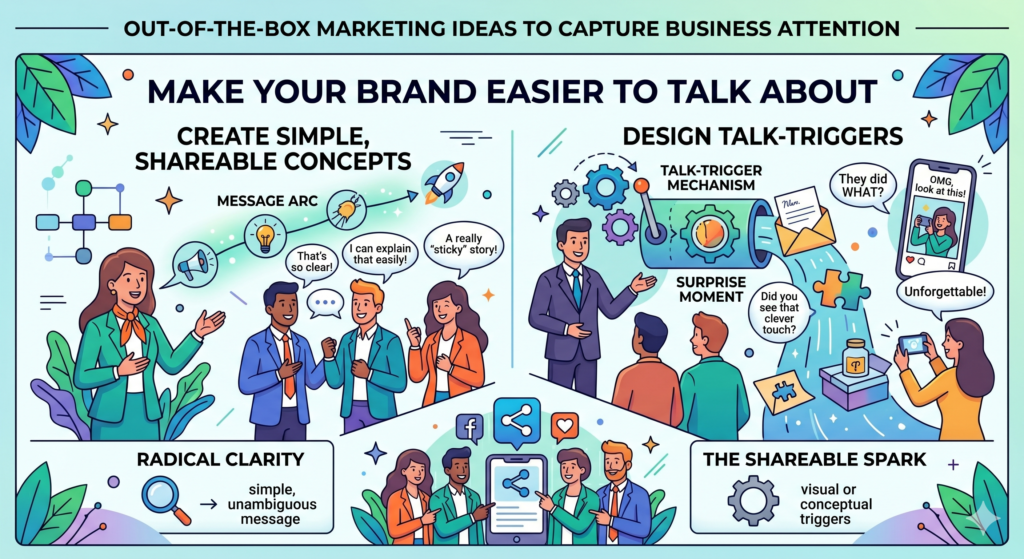
Out-of-the-box marketing is not only about fresh campaigns. It is also about making your brand easier to repeat.
A clear, memorable idea can travel through conversations, meetings, emails, referrals, and social posts.
Create a simple enemy your audience wants to move away from
Strong brands often stand against something.
Not a person. Not a competitor. A problem.
For WinSavvy, the enemy could be empty content that attracts traffic but does not help revenue. It could be marketing that sounds polished but says nothing clear. It could be growth work that chases activity instead of business results.
When you name the thing you stand against, people understand you faster.
This does not need to sound aggressive. It can be simple.
“We help businesses move away from content that fills calendars and toward content that supports sales.”
That is clear. It gives the brand a point of view. It makes the work easier to explain.
A simple enemy gives your marketing energy because it creates contrast. It tells buyers what you believe and what you refuse to waste their money on.
Turn your method into a story
People remember stories better than service lists.
Instead of only saying what you do, explain how you think.
For example, a digital marketing agency could say, “We start by finding where buyers lose trust. Then we fix the message, shape the content, and guide visitors toward action.”
That is more memorable than a list of services like SEO, content, conversion, and strategy.
The method becomes even stronger when each step has a simple name.
You might call the process “Find the leak, sharpen the message, build the path, prove the result.” That is not complicated. It gives the buyer a clear sense of movement.
A named method helps people trust you because it shows that your work is not random. It also helps your team sell more clearly because everyone can explain the process the same way.
Give customers words they can use in referrals
Referrals often fail because people do not know what to say.
A happy client may want to recommend you, but they need simple language.
You can help by giving them words.
This does not mean scripting fake praise. It means making your value easy to describe.
For example, after a successful project, you might say, “A lot of our best-fit clients come to us when they have content or traffic, but not enough sales conversations from it. That is usually where we help most.”
That line gives the client a simple referral trigger. Now, when they meet someone with that problem, they know when to mention you.
You can also build this into your website. Make your positioning clear enough that someone can repeat it after one visit.
The easier your brand is to talk about, the more attention you can earn through other people.
Create Campaigns That Make the Buyer Feel Seen Before They Feel Sold To
Business attention grows when the message sounds like it came from inside the buyer’s world
Most marketing talks at buyers.
Strong marketing talks from inside the buyer’s world.
That is a big difference.
When a brand says, “We help you scale with smart digital solutions,” the buyer may understand the words, but they do not feel seen. The message is too broad. It could belong to almost any company. It does not show that the brand understands the daily pressure, the hard choices, the delays, the doubts, or the real reasons growth feels stuck.
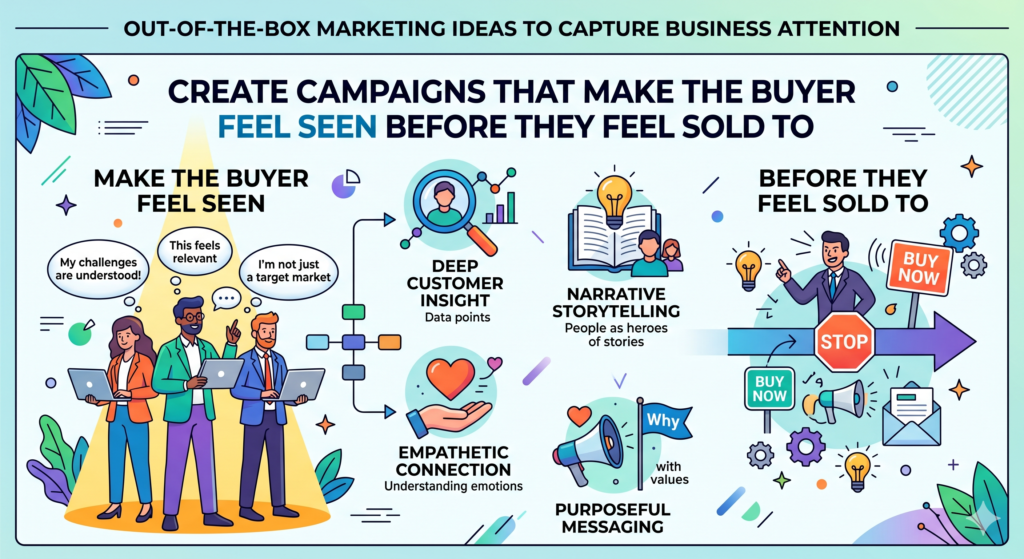
But when a brand says, “You are getting traffic, but your best visitors still leave because the page does not answer the one question they came with,” the buyer pays attention. That line feels closer to their real problem. It does not sound like a pitch. It sounds like insight.
This is where many out-of-the-box ideas begin. Not with a strange campaign, but with a sharper mirror.
The goal is to make the buyer think, “They understand what is happening here.”
That feeling is powerful because attention is emotional before it is logical. People notice what relates to them. They pause when a message names something they have been feeling but could not explain clearly. They lean in when a brand turns their messy problem into simple words.
Build your campaign around a private thought your buyer already has
Every buyer has private thoughts they do not always say out loud.
A founder may think, “We are spending too much on marketing, but I do not know what is actually working.” A marketing manager may think, “Our content looks busy, but sales does not care about it.”
A CEO may think, “The team is doing a lot, but I do not see enough movement.” A head of sales may think, “The leads are not bad. The story we tell after the lead comes in may be the real problem.”
These private thoughts make strong marketing hooks because they feel honest.
A weak campaign starts with what the company wants to sell. A strong campaign starts with what the buyer is already worried about.
For example, instead of building a campaign around “SEO services for B2B companies,” WinSavvy could build one around the private thought, “Why is traffic growing but serious buyers are not booking calls?” That question is more alive. It reflects a real tension.
It also opens the door to talk about search intent, content quality, page trust, conversion flow, and sales support.
The campaign becomes bigger than a service. It becomes a conversation the buyer already wants to have.
That is how you capture attention without forcing it.
Use the buyer’s real day as your creative brief
If you want better marketing ideas, study the buyer’s day.
Not just their job title. Not just their industry. Their actual day.
What happens before they search for help? What meeting creates pressure? What report makes them nervous? What question does leadership ask them again and again? What mistake are they trying not to repeat? What tool do they open every morning? What message do they dread sending? What number are they tired of explaining?
These details can shape much stronger campaigns.
For example, a marketing manager may not wake up thinking, “I need content strategy.” They may wake up thinking, “I need to show what last month’s content did for pipeline before Friday’s leadership meeting.” That is a very different starting point.
A campaign built around that moment could offer a “content-to-revenue review” instead of a generic content audit. It could help the buyer sort content by what supports awareness, trust, sales conversations, and decision-making. It could show them how to explain content value in simple business terms.
That is more useful because it matches the pressure of the real day.
Creative marketing becomes easier when you stop looking at buyers as personas and start seeing them as people under pressure.
Show that you understand the cost of doing nothing
Many brands explain the benefit of buying. Fewer brands explain the cost of waiting in a way that feels real.
This matters because businesses often delay action not because they disagree, but because the pain feels normal. The website has been unclear for months. The content has been weak for years. The ads have been leaking money slowly. The sales team has always complained about lead quality. The business has learned to live with the problem.
A strong campaign makes the hidden cost visible.
If a company keeps publishing content that does not support sales, the cost is not just the writing budget. It is lost time, weaker sales follow-up, confused buyers, slower trust, and missed chances to become the clear voice in the market.
If a website message is unclear, the cost is not just a lower conversion rate. It is every serious buyer who leaves without understanding why the company is worth choosing.
If a brand’s positioning sounds like everyone else, the cost is not just weak copy. It is being compared on price because the buyer cannot see a stronger reason to choose.
When you explain the cost of doing nothing in simple words, you create urgency without using pressure. You help the buyer see why the problem matters now.
That is a much better way to earn attention than shouting, “Act fast.”
The more specific the message, the more personal it feels
Specificity is one of the strongest tools in modern marketing.
A broad message reaches many people but moves very few. A specific message reaches fewer people but hits harder. And in business marketing, hitting the right people hard is often more valuable than reaching everyone softly.
A specific message tells the buyer that you understand their exact situation. It also makes your brand easier to trust because vague promises are easy to make, but specific insight is harder to fake.
Replace broad pain with sharp pain
Broad pain sounds like this: “Are you struggling to grow your business?”
Sharp pain sounds like this: “Are you getting more website visitors, but still relying on referrals because the site does not turn strangers into sales calls?”
The second line is stronger because it gives the reader a clear picture. It speaks to a real business pattern. It also suggests that the brand understands the difference between traffic and demand.
This shift can improve almost every part of your marketing.
A service page becomes stronger when it names the real pain. An email becomes stronger when it mentions a specific challenge. An ad becomes stronger when it calls out a clear moment. A webinar becomes stronger when the topic is narrow enough that the right person feels it was made for them.
Specificity also filters your audience. That is a good thing. You do not need everyone to respond. You need the right people to feel understood.
Use “you might notice” moments to pull readers in
One way to make content feel personal is to describe what the buyer might notice in their own business.
For example, “You might notice that your blog traffic is rising, but your best sales calls still come from referrals.” Or, “You might notice that your team keeps updating the homepage, but the core message still feels hard to explain.” Or, “You might notice that your ads get clicks, but the people who book calls are not the people you want.”
This style works because it is gentle. It does not accuse the reader. It invites them to recognize the pattern.
That matters because business buyers do not want to feel foolish. They want to feel helped. When your marketing helps them see the issue without shame, they are more likely to stay open.
The best copy often feels like a calm, smart person sitting next to the buyer and saying, “Here is what may be happening.”
That tone builds trust.
Write to one clear buyer at a time
Many companies weaken their marketing because they try to speak to every possible buyer in one message.
They want to attract founders, marketing managers, sales leaders, enterprise teams, small businesses, and agencies all at once. So the message becomes thin. It avoids detail because detail might exclude someone.
But detail is what creates attention.
A founder cares about speed, cash, focus, and proof. A marketing manager cares about performance, leadership buy-in, workload, and results they can defend. A sales leader cares about lead quality, sales assets, follow-up, and pipeline. A CEO cares about growth, risk, clarity, and whether the team is working on the right things.
These people may all buy marketing help, but they do not all enter through the same door.
A strong campaign chooses one door.
You can still serve more than one audience, but each piece of content should know who it is speaking to. This makes the copy sharper, the examples better, and the call to action more natural.
Trying to speak to everyone often makes no one feel seen. Speaking clearly to one buyer can make that buyer feel like the whole message was written for them.
Turn Ordinary Offers Into Attention-Grabbing Entry Points
Sometimes the problem is not the service, but the way the service is introduced
Many businesses have useful services that sound boring from the outside.
That is not because the work is boring. It is because the offer is framed in the same way as every competitor.
An SEO audit sounds normal. A content strategy sounds normal. A consultation sounds normal. A website review sounds normal. A discovery call sounds normal. Buyers have seen these offers many times, so they do not feel urgent or interesting.
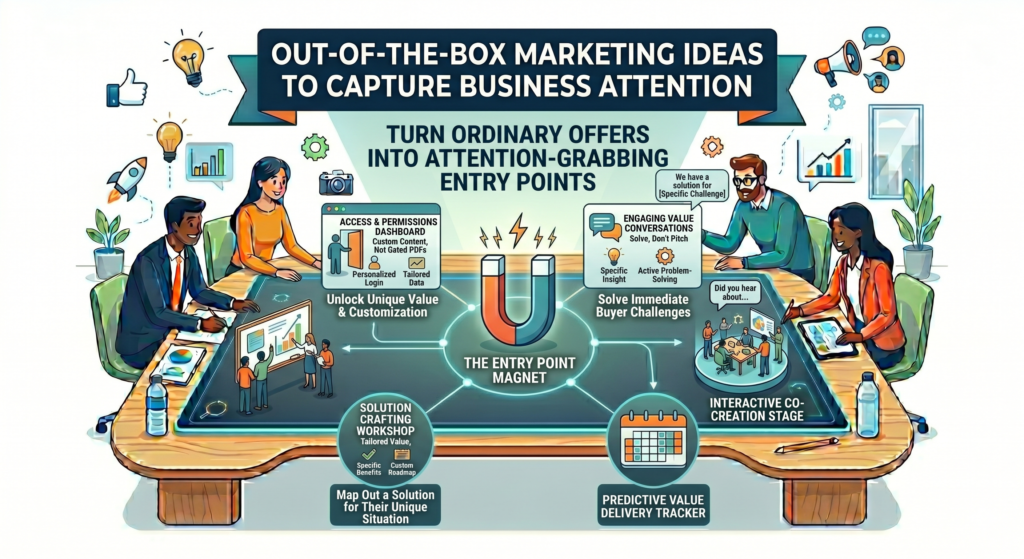
The opportunity is to reframe the entry point.
An entry point is the first small step a buyer takes with your brand. It could be a free tool, audit, call, challenge, report, teardown, workshop, email series, or diagnostic. When the entry point feels specific and valuable, more people pay attention.
Out-of-the-box marketing is often not about inventing a brand-new service. It is about packaging your first step in a way that feels more useful and easier to say yes to.
Change “free consultation” into a clear outcome
A free consultation can work, but the phrase itself has become weak.
To many buyers, “free consultation” sounds like a sales call. They expect to be asked questions, hear a pitch, and then receive a proposal. That does not feel special.
A better entry point promises a clear result from the conversation.
For example, instead of “Book a free consultation,” a marketing agency could say, “Book a 30-minute Traffic-to-Lead Clarity Session.” That is more specific. It tells the buyer what the call is about. It also connects to a real business outcome.
Another example could be “Find the three pages where your site is losing trust.” Or “Map the content gaps that are slowing your sales cycle.” Or “See why your ads are getting clicks but not qualified calls.”
These offers are still simple, but they feel sharper.
The buyer is not signing up to be sold to. They are signing up to understand one important problem better.
That small shift can improve attention and conversion.
Package your audit around the pain, not the channel
Many agencies offer audits by channel. SEO audit. PPC audit. Website audit. Content audit. These can be useful, but they may not match how buyers think.
Buyers often think in business problems, not channels.
They think, “Why are we not getting better leads?” They think, “Why is our traffic not turning into calls?” They think, “Why do prospects keep comparing us on price?” They think, “Why does sales say the content is not useful?”
So instead of packaging the audit around the channel, package it around the pain.
A “Lead Quality Audit” may be more interesting than a “PPC Audit.” A “Trust Leak Review” may be more interesting than a “Website Audit.” A “Content-to-Sales Gap Review” may be more interesting than a “Content Audit.” A “Buyer Clarity Review” may be more interesting than a “Messaging Audit.”
The work behind the scenes may include the same skills. But the front-end promise feels more connected to the buyer’s real concern.
This is not just wordplay. It changes how buyers understand the value.
When you package around pain, you show that you care about the business outcome, not just the marketing task.
Make the first step small enough to feel safe
Big offers can create fear.
A buyer may know they need help, but they may not be ready to commit to a large project. They may need to trust you first. They may need to see how you think. They may need to get internal support. They may need a clear reason to move from interest to action.
A strong entry point lowers that risk.
For example, instead of asking a buyer to commit to a full content program, offer a “Content Waste Review.” Instead of asking them to redesign the website, offer a “Homepage Message Fix.” Instead of asking them to start a long SEO project, offer a “Search Intent Gap Map.”
The first step should give value on its own, but also reveal why deeper work matters.
This works because buyers like progress. A small, useful step feels easier than a large, unclear commitment.
It also gives your team a chance to prove expertise early.
A strong entry point can become the center of a full campaign
Once you have a sharp entry point, you can build content around it.
This is where many companies miss the chance. They create an offer, place it on a landing page, and wait. A better approach is to turn the offer into a campaign theme.
If your entry point is a “Trust Leak Review,” your content can explain what trust leaks are, where they show up, how they hurt conversion, and how to spot them. Your emails can share examples. Your LinkedIn posts can show mini teardowns. Your webinar can walk through common trust leaks. Your case studies can show how fixing trust improved results.
Now the offer is not sitting alone. It is supported by a full story.
Create content that makes the offer feel needed
A buyer should understand why your offer matters before they see the call to action.
If you offer a “Content-to-Sales Gap Review,” your content should first show why the gap exists. Explain how marketing teams often create content for search, while sales teams need content for objections, proof, comparison, and decision support.
Show what happens when those needs are not connected. Then invite the reader to review where their own content is helping or failing sales.
This makes the offer feel natural.
The reader does not feel pushed. They feel guided.
A strong offer campaign should create a sense of recognition first. The buyer should think, “This is probably happening in our business.” Then the offer becomes the obvious next step.
Use proof to reduce fear around the first step
Even a small step can create doubt.
The buyer may wonder whether the call will be useful. They may wonder whether the audit will be too basic. They may wonder whether they will be pressured. They may wonder whether the advice will be generic.
You can reduce that fear with proof.
Show what the buyer will receive. Share a sample page of the report. Explain the questions you will answer. Show a short before-and-after from a past review. Include a short client story. Explain what happens during the call and what does not happen.
Clarity builds comfort.
For example, if you offer a homepage review, show a simple example of what you look at. Explain that you review the headline, proof, buyer pain, offer clarity, call to action, and trust signals. Explain that the buyer leaves with clear notes they can use even if they do not hire you.
That kind of honesty makes the offer feel safer.
Give the entry point a name buyers can remember
Naming matters here too.
A named entry point feels more concrete than a generic service. It also becomes easier to promote, share, and repeat.
“Trust Leak Review” is easier to remember than “website conversion consultation.” “Content Waste Audit” is easier to remember than “content performance assessment.” “Pipeline Page Review” is easier to remember than “landing page analysis.”
The name should be simple. It should connect to a real pain. It should not sound too clever or forced.
A good name helps the buyer understand what the offer does and why it matters.
It also helps your team talk about it consistently. When everyone uses the same name, the offer becomes a stronger part of the brand.
Use Data in a Way That Feels Human, Not Dry
Data captures attention when it helps the buyer see a problem clearly
Data can make marketing stronger, but only if it is used well.
Many businesses use data in a dry way. They add numbers to sound smart. They share charts with no clear point. They quote studies without connecting them to the buyer’s decision. That kind of data may look professional, but it does not always create attention.
Human data is different.
Human data helps the buyer see something important. It makes a hidden problem visible. It confirms a worry. It challenges a false belief. It shows the size of a gap. It helps the buyer make a better choice.
The number is not the story. The meaning behind the number is the story.
For example, telling a business that “organic traffic increased by 40 percent” may sound good. But it becomes more useful when you explain whether that traffic came from the right audience, whether it reached pages with clear calls to action, and whether it helped create sales conversations.
Data without meaning is noise. Data with meaning can change a decision.
Turn simple internal findings into useful market insights
You do not always need outside research to create strong data-led marketing.
You can often use your own observations, as long as you are honest about what they represent.
For example, if WinSavvy reviews a group of B2B websites and finds that many service pages do not explain who the service is best for, that can become a useful insight. If sales calls reveal that many founders confuse traffic growth with demand growth, that can become a campaign.
If content audits show that most blog posts do not link to any sales asset, that can become a report or article.
The key is to collect patterns.
Do not rely on one random example. Look across enough examples to see a theme. Then explain the theme in simple words.
A helpful insight might sound like this: “In many B2B websites we review, the biggest issue is not that the offer is weak. It is that the proof appears too late. Buyers have to scroll too far before they see a reason to trust the company.”
That is useful. It is specific. It leads to action.
Use numbers to create urgency without fear
Fear-based marketing can get attention, but it can also damage trust.
A better approach is to use data to create calm urgency.
Calm urgency means helping the buyer see why the issue matters without making them feel attacked or panicked.
For example, instead of saying, “You are losing thousands every day because your website is terrible,” say, “If your highest-traffic service page is unclear, even a small trust gap can quietly reduce the number of qualified buyers who take the next step.”
That message still creates urgency, but it does not sound dramatic. It sounds mature.
Business buyers respect that.
The goal is to help them see that small leaks can become expensive over time. A weak headline, poor proof, confusing offer, or unclear next step may not feel urgent in one day. But across months of traffic and campaigns, it can cost real money.
When data helps buyers see the long-term cost of small problems, it becomes powerful.
Make data easy to act on
If you share a number, give the reader a next move.
Do not leave them with a statistic and no path.
If you say many buyers do not trust vague claims, show them how to replace vague claims with specific proof. If you say many leads drop after visiting a page, show them which parts of the page to review. If you say sales teams do not use most content, show them how to map content to real sales questions.
Data should lead to action.
A simple way to do this is to pair every insight with a “what this means” section in paragraph form. Explain the business lesson. Then explain the next step.
For example, if your data shows that most service pages use broad headlines, the lesson is that buyers may not quickly understand why the company is different. The next step is to rewrite the headline around the buyer’s pain, the outcome, and the reason to believe.
This makes the data feel practical.
Original research can make your brand harder to ignore
Original research is one of the strongest ways to stand out because it gives the market something new to discuss.
But original research does not have to be huge.
You can start small. Review a clear sample. Ask a sharp question. Study one common business problem. Share useful patterns. Keep the report simple and honest.
The best research-led marketing is not built to impress academics. It is built to help buyers make better decisions.
Choose a research question your audience already cares about
A weak research question is interesting only to the company. A strong research question matters to the buyer.
For example, a marketing agency should not only ask, “How many companies publish blogs?” That may be interesting, but it may not be useful enough. A stronger question could be, “How many B2B blogs clearly guide readers from education to sales action?” That question connects content to business value.
Another strong question could be, “Where do B2B service pages lose buyer trust?” Or, “How often do company websites explain who they are not a fit for?” Or, “What proof do fast-growing companies show above the fold?”
These questions are specific. They also connect to decisions buyers care about.
Good research starts with a question that makes the buyer think, “I want to know the answer because it may affect my business.”
Turn research into many useful assets
One research project can create a lot of marketing value.
It can become a main report, several blog articles, social posts, email lessons, webinar topics, sales slides, landing page proof, and outreach hooks. It can also support PR, partnerships, and speaking opportunities.
But this only happens if you plan for it from the start.
Before you collect data, think about the stories you may be able to tell. Think about the charts, examples, quotes, and lessons that would be useful. Think about which sales objections the research could support. Think about which parts of the research could become short, sharp insights.
This makes the research more valuable.
For example, a report on “B2B Homepage Trust Gaps” could produce separate articles on weak headlines, missing proof, unclear calls to action, poor audience fit, and vague service descriptions. Each article could lead back to the same core offer, such as a website trust review.
That is how research becomes a campaign engine.
Keep the research language simple
Research loses power when it becomes hard to read.
Your audience should not need a dictionary to understand your findings. Keep the language plain. Explain what you studied, what you found, why it matters, and what a business should do next.
Do not hide behind complex terms. Do not over-explain the method unless the audience needs it. Do not fill the report with charts that have no clear lesson.
The best research content feels like a smart person explaining useful findings in a clear voice.
That tone builds trust because it respects the reader’s time.
Create Marketing That Helps the Buyer Sell the Idea Internally
In B2B, your buyer is often not the only decision-maker
One of the biggest mistakes in business marketing is writing only for the person who first finds you.
In many companies, that person still has to convince someone else.
A marketing manager may need approval from the CEO. A founder may need buy-in from a co-founder. A department head may need budget from finance. A sales leader may need the marketing team to agree. A junior champion may need a senior leader to trust their recommendation.
This means your marketing has two jobs.
First, it must win the attention of the reader. Second, it must help that reader explain the idea to others.
Most brands only do the first job. Out-of-the-box brands do both.
Build content your champion can forward
Forwardable content is simple, clear, and useful in a business conversation.
It does not feel like a sales page. It feels like a tool that helps a team make a decision.
For example, a “Website Trust Gap Checklist” can be forwarded to a CEO. A “Content-to-Sales Alignment Map” can be shared between marketing and sales. A “Questions to Ask Before Hiring an SEO Agency” guide can be sent to leadership before budget approval.
This kind of content helps your internal champion look smart.
That matters because people share content that helps them make a point. If your article, guide, or tool gives them the words to explain a problem, they are more likely to pass it on.
The best forwardable content is not too long. It is clear enough to understand quickly. It helps a team agree on what is wrong and what should happen next.
Give buyers a simple business case
Creative marketing gets attention, but business buyers still need a reason to act.
Help them build the business case.
If you sell content strategy, explain how weak content affects more than traffic. Show how it can slow sales, waste team time, weaken follow-up, and make the company harder to trust. If you sell website optimization, explain how unclear messaging can waste paid traffic, lower conversion, and make sales teams work harder to explain value.
The business case should be easy to repeat.
For example, “We are not fixing the website because it looks old. We are fixing it because serious buyers are visiting, but the page does not give them enough trust to take the next step.”
That is a stronger internal argument.
It moves the project from preference to business need.
Help teams compare options without confusion
Many buying decisions get stuck because the team is comparing options that are not really the same.
They compare an agency to a freelancer. They compare strategy to execution. They compare a full project to a cheap fix. They compare doing it now to waiting. They compare hiring internally to using an outside partner.
Your marketing can help by explaining these trade-offs clearly.
Do not pretend your option is always the right choice. That sounds biased. Instead, explain when each option makes sense.
For example, a freelancer may be a good fit when the company knows exactly what it needs and only requires execution. An agency may be better when the business needs strategy, research, content, conversion thinking, and consistent delivery. An internal hire may make sense when there is enough ongoing work and strong leadership to guide it.
This kind of honest comparison builds trust.
It also helps the buyer explain why your solution may be worth more than a cheaper option.
Make internal approval easier by reducing risk
Many deals do not stop because buyers dislike the offer. They stop because the risk feels unclear.
What if the project takes too long? What if leadership does not see value? What if the team does not have time? What if results are hard to measure? What if the agency does not understand the business?
Your marketing should answer these doubts before they become blockers.
Explain your process in plain language
A clear process reduces fear.
Buyers want to know what happens after they say yes. They want to know how much time they need to give. They want to know what you will need from them. They want to know when they will see work. They want to know how decisions will be made.
Do not make the process sound more complex than it is.
Explain it in simple stages. For example, first you learn the business and review what is already working. Then you find the main gaps. Then you build the plan. Then you create or improve the assets. Then you measure and adjust.
That kind of explanation makes the work feel manageable.
A buyer who understands the process is more likely to trust it.
Show what success looks like before the project starts
Many buyers fear vague outcomes.
So show them what success can look like.
This does not mean promising exact results you cannot control. It means explaining the types of progress the project is designed to create.
For example, a messaging project may lead to a clearer homepage, stronger sales language, better ad angles, and a sharper explanation of why the company is different. A content strategy project may lead to better topic choices, stronger buyer journey coverage, more useful sales assets, and less wasted writing.
An SEO project may lead to cleaner search intent, stronger pages, and traffic that has a better chance of becoming demand.
When buyers understand what progress looks like, the work feels less risky.
They can also explain it internally with more confidence.
Give the champion language to defend the decision
Your buyer may need to defend the decision when someone asks, “Why this agency?” or “Why now?” or “Why not do it cheaper?”
Help them answer.
You can do this through proposal language, comparison content, case studies, and sales follow-up. But you can also build it into public marketing.
For example, an article could explain why cheap content often becomes expensive when it attracts the wrong audience, misses buyer questions, or never supports sales. Another article could explain why waiting to fix messaging can waste money from every campaign that sends traffic to a weak page.
This gives the buyer clear words.
The easier you make the decision to defend, the easier you make the decision to approve.
Build Marketing Around Small Moments That Most Brands Ignore
Big attention often starts with a small overlooked moment
Many businesses look for big campaign ideas first.
They want a viral post, a bold ad, a huge launch, or a major brand move. Those things can work, but they are not the only way to capture business attention. In many cases, the strongest ideas come from small moments that other brands do not take seriously.
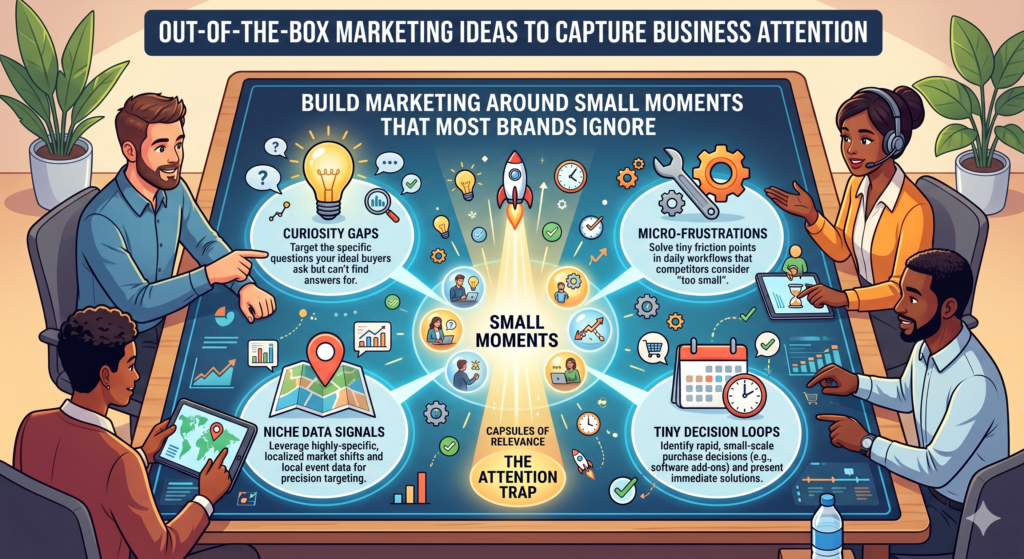
These moments happen before, during, and after the buyer’s main journey.
A person visits your website and does not know where to click. A lead downloads a guide but never hears from you in a useful way. A prospect finishes a sales call and needs help explaining the next step to their team. A customer gets a result but does not know how to talk about it.
A past buyer likes you but forgets to refer you because you have not made the right referral moment clear.
These moments may seem small, but they shape trust.
A brand that improves small moments can feel more thoughtful than a brand with a bigger budget. This is because buyers notice care. They notice when a company makes the next step easier. They notice when a message arrives at the right time. They notice when a brand explains what others leave unclear.
Out-of-the-box marketing is not always about creating something huge. Sometimes, it is about caring more deeply about the moments everyone else treats as routine.
Improve the moment right after someone shows interest
The moment after interest is one of the most valuable parts of marketing.
Someone fills out a form. Downloads a guide. Joins a webinar. Opens a key email. Watches a product demo. Clicks on a pricing page. These actions show curiosity. But many companies waste the moment by sending a weak thank-you email or a plain confirmation message.
That is a missed chance.
The buyer has just raised their hand. They are more open than they were a few minutes ago. This is the time to help them think better, not just confirm that their form was received.
For example, after someone downloads a guide about improving website conversions, the follow-up should not only say, “Here is your guide.” It could say, “Before you read it, start with this simple question: which page already gets attention but does not create action?” That small prompt makes the guide more useful. It also positions your brand as a guide, not just a sender.
After someone signs up for a webinar, you could send a short note asking them to think about one problem they want solved during the session. After someone books a call, you could send a simple pre-call reflection that helps them explain the problem clearly.
After someone views a case study, you could send a related breakdown that explains what made the result possible.
These small moves make your marketing feel more personal and useful.
They also help buyers move forward with less friction.
Turn confirmation pages into conversion pages
Most confirmation pages are boring.
They say, “Thank you. We will be in touch.” That is it.
But a confirmation page can do more. It can deepen trust, answer the next question, guide the buyer to useful content, or help them prepare for the next step.
For example, if someone requests a strategy call, the confirmation page could explain what will happen on the call, what they should bring, and how to get the most value from it. It could also share one short customer story related to the problem they are facing.
If someone downloads a checklist, the confirmation page could show them how to use it in ten minutes. It could suggest one simple action to take before they close the page. It could invite them to compare their current situation against one clear standard.
The point is not to overload them. The point is to keep the momentum alive.
Every time a buyer takes action, they are giving you attention. Do not waste that attention with dead-end pages.
A strong confirmation page can make the buyer feel like they made a smart choice. That feeling matters because it increases trust in the next step.
Make the first reply feel like expert help, not admin work
When a lead contacts a business, the first reply often sets the tone.
Many companies reply with a plain scheduling link, a generic message, or a few basic questions. That may be efficient, but it does not create much confidence.
A better first reply shows that a real expert is already thinking.
For example, if someone asks for help with SEO, the reply could say, “Thanks for reaching out. Before we speak, it would help to know whether your bigger issue is traffic volume, traffic quality, or turning current traffic into leads. Those three problems need different fixes, so we will use the call to separate them clearly.”
That kind of message feels different. It shows judgment. It shows that you do not use the same answer for every problem. It helps the buyer prepare.
This is especially important for service businesses. Buyers are often judging expertise before the first call. Your response time matters, but the quality of the response matters too.
A fast, generic reply may feel efficient. A thoughtful, clear reply can feel valuable.
Small moments can become signature brand experiences
A signature brand experience is not always a big event.
It can be a repeated small touch that people remember.
For example, a company may become known for its sharp pre-call questions. Another may be known for sending useful post-call notes. Another may be known for its clear project kickoff process. Another may be known for turning complex reports into simple next steps.
These details can become part of your brand.
They make people say, “This company is different.” Not because you claimed to be different, but because the experience proved it.
Send post-call notes that help the buyer think
After a sales call, many companies send a basic follow-up.
They thank the person for their time. They attach a proposal. They ask for thoughts.
That is normal. But normal is easy to ignore.
A stronger follow-up captures the buyer’s situation in clear words. It repeats the pain, the business impact, the likely cause, and the next step. It helps the buyer feel understood and gives them language they can share internally.
For example, after a call with a company struggling to turn traffic into leads, the note could say, “From what we discussed, the issue does not seem to be only traffic. You already have visitors reaching key pages.
The bigger gap may be that those pages do not create enough trust or give buyers a clear reason to take action. That means more traffic may add cost before it adds pipeline.”
This kind of note is useful even before the proposal.
It shows the buyer that you listened. It also frames the problem in a way that makes the solution easier to understand.
Strong post-call notes can become one of your best sales and marketing tools because they turn a conversation into clarity.
Create a simple “next best action” habit
Buyers often get stuck because they do not know the next best action.
They may like your content but not know where to start. They may understand the problem but not know what to fix first. They may finish a call but not know how to move the team forward.
Your marketing can help by always guiding the next best action.
This does not mean pushing people to buy at every step. Sometimes the next best action is to review one page. Sometimes it is to gather data. Sometimes it is to ask the sales team which questions buyers keep asking. Sometimes it is to compare current content against the sales journey.
When your brand becomes known for clear next steps, people trust you more.
A simple way to apply this is to end every major piece of content with a practical direction in paragraph form. If the article teaches about weak messaging, end by telling the reader to review the homepage headline and ask whether a new visitor can understand the promise within five seconds.
If the email teaches about content waste, end by asking the reader to pick three recent articles and check whether sales could use them in a real conversation.
The action should be small, clear, and useful.
That is how content becomes more than reading. It becomes progress.
Make reporting feel like a story, not a spreadsheet
Reports are another overlooked marketing moment.
Even after a customer buys, the way you report results shapes whether they stay, trust you, refer you, and expand the relationship. Many agencies send reports full of numbers, charts, and channel updates. The client receives them, skims them, and still wonders what it all means.
A better report tells a simple story.
It explains what changed, why it changed, what it means, what was learned, and what should happen next.
For example, do not only say that organic traffic increased. Explain whether the growth came from the right topics. Do not only say that conversions dropped. Explain whether the drop came from poor traffic quality, weak page intent, or a broken call to action. Do not only say that rankings improved. Explain whether those rankings are connected to buyer intent.
This matters because clients do not just want data. They want confidence.
A clear report can become a retention tool, referral tool, and upsell tool because it proves that your team thinks beyond tasks.
When clients understand the work, they value the work.
Use Partnerships That Feel Useful, Not Forced
The right partner can help you borrow trust without buying attention
Partnership marketing is not new. But most businesses use it in a shallow way.
They swap posts. Co-host a broad webinar. Add each other’s logos. Send one email to each list. Then the partnership fades.
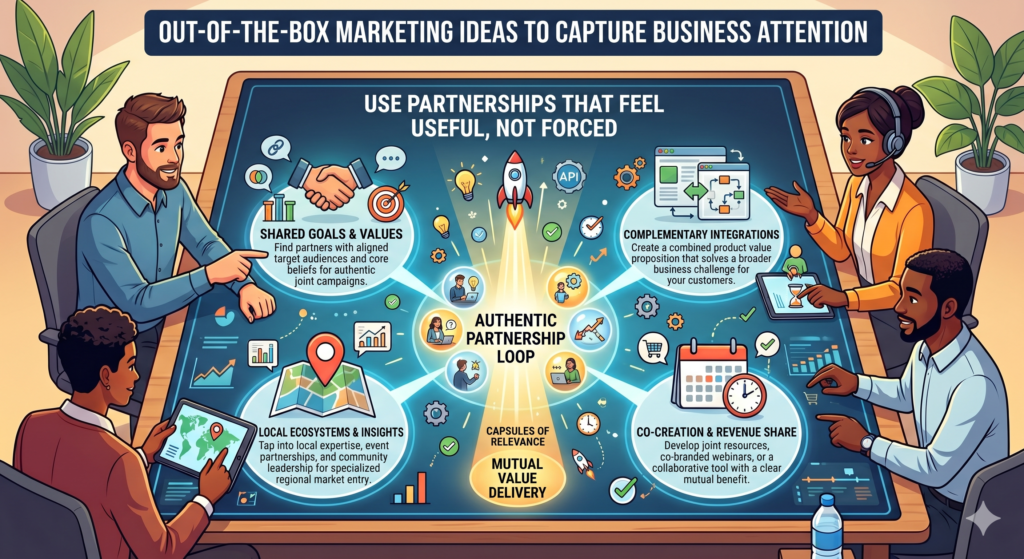
That kind of partnership may create a small spike, but it rarely builds deep attention.
A better partnership is built around shared buyer value.
The right partner helps you reach people who already trust them. But more than that, the partner helps you create something more useful than either brand could create alone.
For example, a marketing agency and a sales training firm could create a campaign around why leads fail after the handoff from marketing to sales. A web design company and an SEO agency could create a workshop on building sites that look good and rank well.
A CRM consultant and a content strategist could create a guide on mapping buyer questions from first touch to closed deal.
These ideas work because the buyer’s problem crosses service lines.
Real business problems do not always fit neatly into one category. Partnerships can help you solve the full problem in a way that feels more complete.
Choose partners based on buyer overlap, not audience size
A big audience is not always the best audience.
When choosing partners, look for buyer overlap. Do they serve the same type of customer? Do their customers face a problem related to what you solve? Does their work happen before or after yours? Would their audience see your expertise as useful?
For example, if WinSavvy serves B2B companies that need better content and SEO, strong partners might include web design agencies, sales consultants, CRM experts, SaaS implementation firms, branding studios, and founder communities. These partners may not all have huge audiences, but they may have deep trust with the right buyers.
A small, trusted partner can outperform a large, loose audience.
Trust is the real asset.
When a partner introduces you in the right context, buyers are more likely to pay attention because the recommendation does not feel cold. It comes through a relationship they already value.
Build the partnership around a specific problem
The partnership should not be about both companies talking about themselves.
It should be about one clear problem the buyer wants solved.
For example, instead of hosting a webinar called “How Marketing and Sales Can Grow Your Business,” choose a sharper topic like “Why Good Leads Still Do Not Close When Your Website and Sales Follow-Up Tell Different Stories.”
That topic is more specific. It gives both partners a role. The marketing side can explain website and content messaging. The sales side can explain follow-up, buyer objections, and sales conversations. Together, they create a fuller answer.
Specific partner campaigns feel more valuable because they are built around the buyer’s real pain, not around each partner’s need for exposure.
This also makes promotion easier. People are more likely to share and attend something that solves a clear problem.
Create something the partner will be proud to share
A good partnership asset should make both brands look smart.
It could be a practical guide, research report, teardown session, checklist, interview series, workshop, or decision tool. The asset should not feel like a thin lead magnet with two logos slapped on it. It should feel like real work.
When the asset is strong, the partner has a reason to promote it more than once.
They can share it with clients. Use it in sales calls. Add it to onboarding. Discuss it in newsletters. Mention it during workshops. Turn it into follow-up content.
That is how partnership value compounds.
A weak partner campaign gets one announcement. A strong one becomes a useful asset in both companies’ ecosystems.
Partnerships can create angles your brand cannot own alone
Sometimes, a partner helps you say something more powerful because you can combine viewpoints.
For example, a marketing agency may see that website content is weak. A sales consultant may see that sales calls are harder because buyers arrive confused. Together, they can make a stronger point: unclear marketing does not only hurt traffic conversion; it also makes sales conversations harder.
That combined insight is more interesting than either brand speaking alone.
Use partner interviews to reveal hidden buyer truths
Partner interviews can create strong content because partners often see your buyer from a different angle.
A CRM expert may know where sales teams lose track of leads. A customer success consultant may know where onboarding breaks trust. A finance advisor may know what makes growth investments hard to approve. A brand strategist may know why companies struggle to explain their value.
Interviewing these partners can help you create content that feels richer and more grounded.
For example, WinSavvy could interview sales leaders about what marketing content they actually use in sales calls. The result would be much more useful than another generic post about content strategy. It would show what sales teams need in the real world.
These interviews can become articles, email lessons, short clips, and sales assets.
They also help your brand stay close to the market.
Build referral moments into the partnership
Many partnerships fail because they depend on vague goodwill.
Both sides say they will refer business, but no clear referral moment is defined.
A better approach is to identify when the partner should think of you.
For example, a web design agency should think of WinSavvy when a client has a beautiful site but weak traffic, unclear service page copy, or no content plan after launch. A sales consultant should think of WinSavvy when a client has leads coming in but buyers arrive confused about the offer.
A branding studio should think of WinSavvy when a client needs to turn a new message into search-friendly content and conversion pages.
These referral moments should be simple and easy to remember.
The clearer the trigger, the easier it is for partners to send the right opportunities.
Co-create proof, not just promotion
One of the strongest partnership moves is to create proof together.
For example, a marketing agency and a web design partner could work on a client project and then create a case story showing how design, messaging, SEO, and conversion worked together. This story would be stronger than either company claiming results alone.
Proof created through partnership feels real because it shows how different parts of growth connect.
It also helps buyers understand that their problem may need more than one skill. That can make the combined offer more appealing.
Partnerships become much more powerful when they move beyond promotion and into shared outcomes.
Make Competitor Comparison Content More Honest and Useful
Buyers compare you whether you help them or not
Many businesses avoid competitor comparison content because they fear it will send buyers away.
But buyers are already comparing.
They compare your company to other agencies, freelancers, tools, internal hires, and doing nothing. They compare price, speed, proof, process, risk, and trust. If you do not help shape that comparison, they will do it alone or rely on someone else’s explanation.
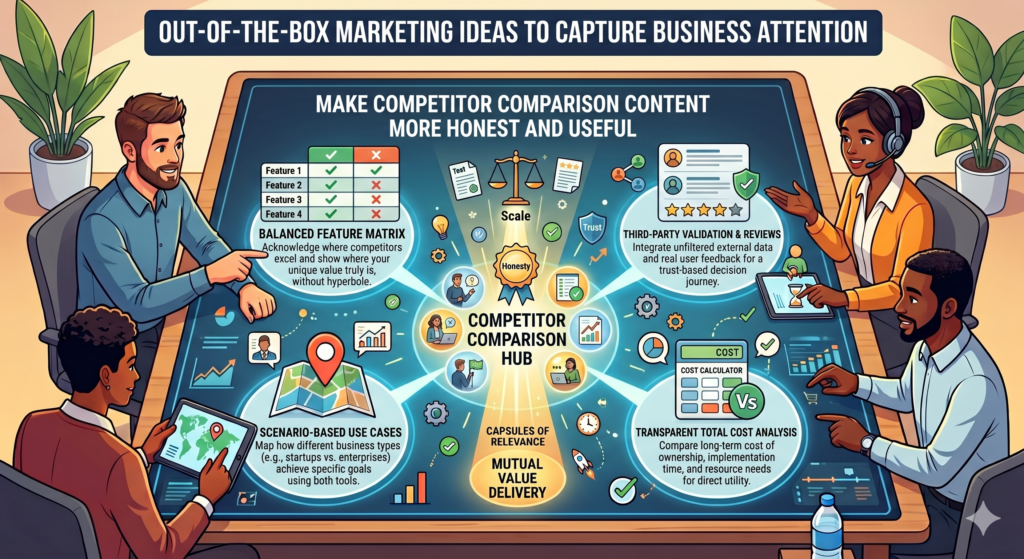
Honest comparison content captures attention because it meets the buyer in a real decision moment.
It says, “We know you are weighing options. Let us help you think clearly.”
That is a mature approach.
Compare options by fit, not by attacking others
Good comparison content is not a hit piece.
It should not mock competitors or make unfair claims. That can damage trust. Instead, compare options by fit.
Explain when each option makes sense. Explain what each one is best for. Explain where each one may fall short. Explain what the buyer should check before deciding.
For example, a business comparing an SEO agency, freelancer, and internal hire needs more than a price list. They need to know which option fits their stage, budget, team skill, content needs, speed, and level of strategy needed.
A freelancer may be a good fit when the business has a clear plan and needs help producing tasks. An internal hire may be a good fit when there is ongoing work and a strong leader who can guide strategy. An agency may be a better fit when the business needs strategy, writing, SEO, conversion thinking, and steady execution together.
This kind of content builds trust because it is honest.
It also helps better-fit buyers choose you for the right reasons.
Compare against doing nothing
One of your biggest competitors is not another company.
It is delay.
Many buyers know they have a problem, but they keep waiting. They plan to fix it next quarter. They want more data. They hope the current approach improves. They decide to keep publishing, keep spending, or keep patching small issues.
Comparison content should explain the cost of doing nothing.
For example, if a company delays fixing weak service pages, every paid ad, SEO visit, referral click, and sales follow-up that sends people to those pages may keep underperforming. The cost is not only the project they delayed. It is the value lost from all the attention they already earned.
That is a strong point because it reframes action.
The question becomes not only, “Can we afford to fix this?” It becomes, “Can we afford to keep sending buyers into a weak experience?”
That kind of comparison creates urgency without hype.
Help buyers spot false savings
Cheap options can look attractive, especially when budgets are tight.
But cheap work becomes expensive when it solves the wrong problem.
For example, cheap blog writing may create more pages, but if those pages do not match buyer intent, support sales, or build trust, the business is still stuck. A low-cost landing page may look fine, but if the message is unclear, ad spend keeps leaking. A quick SEO fix may improve technical health, but if the content strategy is weak, growth may still stall.
Comparison content should help buyers understand the difference between price and cost.
Price is what they pay now. Cost is what the decision creates over time.
This does not mean expensive is always better. It means the buyer should understand what is included, what is missing, and what risk they are accepting.
When you help buyers avoid false savings, you become more than a vendor. You become a trusted advisor.
Strong comparison content can quietly pre-sell your value
Comparison content does not need to push hard.
When written well, it naturally shows why your approach matters.
If your agency is strategic, comparison content can show why strategy matters before execution. If your process is research-heavy, it can show why guessing leads to waste. If your work connects content to sales, it can show why traffic alone is not enough.
The buyer learns what to value.
That is powerful because many buyers begin with a shallow view of the problem. They may think they only need more posts, more ads, more backlinks, or a nicer website. Comparison content can help them see the deeper issue.
Create “best fit” pages for different buyer types
One useful approach is to create content that helps different buyers self-select.
For example, you could write about when a startup should hire a freelancer, when it should hire an agency, and when it should build an internal team. You could explain when SEO is the right move and when conversion work should come first. You could explain when content volume matters and when content clarity matters more.
These pages are useful because they reduce bad-fit leads.
They also attract serious buyers who appreciate honesty.
When a brand admits that it is not the best fit for every situation, the right buyers trust it more.
Use comparison tables only when they support a deeper story
Many comparison pages rely too heavily on tables.
Tables can be useful, but they should not replace explanation. A buyer needs context. They need to understand why a difference matters.
For example, saying one option has “strategy included” and another does not is not enough. Explain what happens when strategy is missing. The business may publish content without knowing which buyer questions matter. It may chase keywords that bring traffic but not demand. It may create pages that rank but do not convert.
That explanation makes the comparison meaningful.
Use tables carefully if needed, but let the main content teach.
End comparison content with a decision path
A comparison piece should help the buyer decide what to do next.
At the end, guide them based on their situation.
If they already have strong strategy but need help producing, a freelancer may work. If they have a strong internal team but need outside direction, a consultant may work. If they need strategy, execution, SEO, content, and conversion thinking together, an agency may be better.
This kind of ending feels helpful because it does not force one answer.
It gives the buyer a path.
And when your brand is the right fit, that path will lead naturally to you.
Use Scarcity Carefully by Making Access Meaningful
Scarcity only works when it is real
Scarcity is a common marketing tactic, but it is often used badly.
Fake countdown timers, false “limited spots,” and made-up urgency can hurt trust. Business buyers are not foolish. They can sense when scarcity is being used as pressure rather than truth.
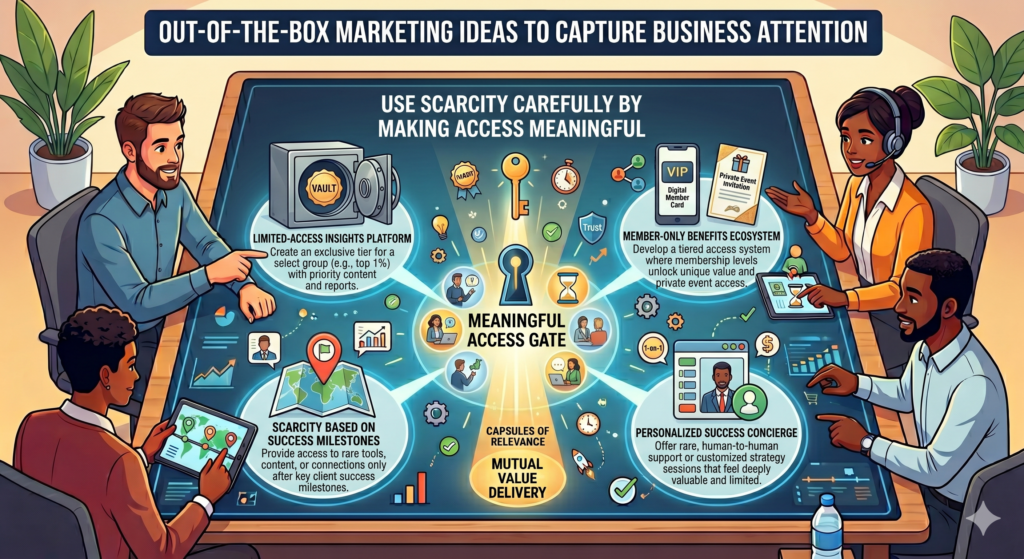
Real scarcity is different.
It comes from limited time, limited capacity, limited fit, limited access, or limited attention from experts.
For a service business, scarcity can be especially real. A good agency cannot take unlimited clients without lowering quality. A senior strategist cannot give deep attention to every lead. A custom audit takes time. A workshop has a practical limit if it is going to be useful.
When scarcity is honest, it can make the offer feel more valuable.
Limit access by fit, not just by number
A stronger way to use scarcity is to limit access based on fit.
For example, instead of saying, “Only five spots left,” you could say, “We are opening a small number of strategy reviews for B2B companies that already have traffic but are not seeing enough qualified sales conversations.”
That is more meaningful.
It tells buyers who the offer is for. It also signals that the work is focused. People are more likely to value something when it is clearly designed for their situation.
Fit-based scarcity also improves lead quality. It discourages people who are not ready and attracts those with the exact problem you solve best.
This is better for the buyer and better for your team.
Explain why access is limited
If access is limited, explain why.
For example, a deep audit may be limited because it includes manual review by a senior strategist. A workshop may be limited because each company gets live feedback. A pilot program may be limited because your team wants to test and improve the process with a small group first.
When you explain the reason, scarcity feels honest.
The buyer understands that the limit exists to protect quality, not to pressure them.
This matters a lot in trust-based selling. If the reason for scarcity is unclear, it may feel like a trick. If the reason is clear, it can make the offer feel more thoughtful.
Use deadlines around real events
Deadlines work better when they are tied to real events.
For example, a company planning a product launch needs messaging ready before launch. A business entering a busy season needs campaigns ready before demand peaks. A team preparing for a board meeting needs a clear report before the meeting. A brand running ads needs landing pages fixed before spend increases.
Your marketing can use these real moments to create urgency.
Instead of saying, “Act now,” say, “If your campaign goes live next month, the landing page message should be fixed before paid traffic starts.” That is a real reason to move.
Deadlines should help the buyer avoid a problem. They should not simply push them to make a decision faster for your benefit.
Meaningful access can make your offer feel more valuable
People value what feels thoughtful, focused, and high-quality.
If your offer is open to everyone all the time with no clear reason to act, it may feel less urgent. But when access is framed around a real outcome, stage, or problem, it feels more serious.
Create private reviews for high-fit accounts
For high-value prospects, you can offer private reviews.
These should not be generic free audits. They should be focused, specific, and useful.
For example, a private review could examine why a company’s content is not supporting sales, why a landing page is not converting paid traffic, or why a service page does not clearly separate the brand from competitors.
The review should give enough value to prove your thinking, but not try to solve the entire business for free.
This works well because it feels personal and high-effort. It also gives the buyer a taste of your expertise.
A strong private review can open a conversation that no cold pitch could.
Run invite-only sessions around a narrow problem
Invite-only sessions can create strong attention when the topic is specific.
For example, an invite-only session for founders could focus on “how to find the message gap that is making paid traffic underperform.” A session for marketing leaders could focus on “how to prove content value when leadership only cares about pipeline.” A session for sales leaders could focus on “how weak website messaging creates harder sales conversations.”
The invite should feel relevant, not exclusive for the sake of it.
The buyer should understand why they were invited and what they will gain.
This kind of session works because it respects the audience’s time. It does not ask them to attend a broad talk. It invites them into a useful room built around a problem they likely care about.
Turn limited offers into learning moments
Even if someone does not take the offer, the campaign should teach them something.
For example, if you open a limited set of “Trust Leak Reviews,” your announcement can explain what trust leaks are, why they hurt conversion, and how businesses can spot early signs. If someone does not apply, they still learn.
This makes the campaign valuable beyond the direct leads.
It also protects your brand from sounding too sales-heavy. The scarcity supports the offer, but the insight supports the audience.
That balance is important.
The best urgency does not make buyers feel pushed. It helps them see why action now makes sense.
Build Marketing Ideas That Can Be Measured Without Killing Creativity
Creative marketing still needs business discipline
Some teams treat creativity and measurement like opposites.
They think a campaign can either be bold or trackable. That is not true. The best out-of-the-box marketing ideas are creative enough to earn attention and clear enough to measure.
Measurement does not kill creativity. It protects it.
When you know what success looks like, you can test bolder ideas with more confidence. You can learn what works. You can improve the next version. You can defend creative work to leadership.
Without measurement, creative marketing becomes opinion. With measurement, it becomes a growth asset.
Decide what kind of attention you want
Not all attention has the same value.
Some attention creates awareness. Some creates trust. Some creates leads. Some helps sales. Some supports retention. Some brings referrals. Some attracts partners.
Before launching a campaign, decide which type of attention you are trying to win.
For example, a public teardown series may be designed to build trust and show expertise. A diagnostic tool may be designed to capture leads. A comparison guide may be designed to help buyers close the gap before a sales call. A customer story may be designed to reduce risk for prospects already considering you.
Each goal needs different measurement.
If the goal is trust, you might look at saves, replies, time on page, quality of comments, and sales mentions. If the goal is leads, you might look at form fills and booked calls. If the goal is sales support, you might look at how often the sales team uses the asset and whether it helps move deals forward.
The metric should match the job.
Measure movement, not just views
Views are easy to count, but they do not always show business value.
A campaign can get many views and no serious buyers. Another campaign can get fewer views but bring in better conversations.
That is why movement matters.
Did people click to learn more? Did they reply? Did they share it with a team member? Did they book a call? Did they ask a better question in sales? Did the content help move a deal forward? Did partners use it? Did past customers re-engage?
These signs show deeper attention.
For example, a post with 500 views that leads to three strong sales conversations may be more valuable than a post with 50,000 views and no business fit.
Creative marketing should not chase attention for its own sake. It should create movement toward trust, conversation, and action.
Track the quality of conversations created
One of the best measures of strong marketing is the quality of conversations it creates.
Are prospects arriving with better understanding? Are they using your language? Are they asking about deeper problems? Are they less focused on price because they understand value? Are they mentioning specific content that changed how they think?
These signals matter.
For example, if several prospects say, “Your article about traffic not turning into pipeline sounded exactly like us,” that is a sign the message is working. If sales calls become easier because buyers already understand the problem, that is business value.
Not every valuable marketing effect shows up in a simple dashboard right away.
Some of it shows up in better sales calls, warmer leads, shorter education time, and stronger trust.
Build a simple testing habit into every creative idea
Out-of-the-box marketing should not mean guessing wildly.
It should mean testing sharper ideas.
A testing habit helps you stay creative without becoming careless. You try ideas, watch how the market responds, and improve.
Test the message before building the full campaign
Before you build a large campaign, test the core message in smaller ways.
Turn the idea into a LinkedIn post, email, short article, sales call question, or simple landing page section. See if people respond. Watch which phrases get attention. Notice which examples create replies.
If the message is “your lead problem may be a trust problem,” test that line in content before building a full campaign around it. If the message is “content calendars are full but sales teams are still empty-handed,” see whether marketing and sales leaders react to that idea.
Small tests reduce risk.
They also help you sharpen the language before you invest more time.
Review creative results with both data and judgment
Numbers matter, but they do not tell the whole story.
A creative idea may show early promise through comments, replies, sales mentions, or partner interest before it creates direct conversions. Another idea may get clicks but attract the wrong audience.
Use both data and judgment.
Ask what the numbers show, but also ask what kind of people responded. Ask whether the campaign brought the right conversations. Ask whether it gave your team stronger language. Ask whether it revealed a pain worth exploring more deeply.
Good marketing teams do not worship data blindly. They use data to make smarter decisions.
Keep the winning idea alive longer than feels comfortable
Many brands move on too quickly.
They publish one post, run one webinar, send one email, and then look for a new idea. But strong marketing often comes from repeating and deepening a winning idea.
If an idea works, build around it.
Turn it into a guide. Create examples. Add case studies. Run a workshop. Build a diagnostic. Use it in sales. Turn it into a named offer. Create comparison content around it. Use it in partner campaigns.
Repetition is not a problem when the idea is strong and the execution keeps adding value.
In fact, repetition is how markets remember you.
Your audience will not see every piece of content. Even when they do, they may need to hear an idea several times before it sticks.
A great marketing idea should not be treated like a one-time post. It should become a platform.
Bring the Ideas Together Into a Practical Out-of-the-Box Marketing System
Creative marketing works best when it becomes a repeatable way of thinking
Out-of-the-box marketing is often misunderstood.
People think it means waiting for a big idea. They imagine a sudden creative spark, a bold campaign, or a viral moment. But the best marketers do not depend on luck. They use a system.
A system does not make marketing boring. It makes creativity easier to repeat.
The system starts with the buyer. What are they struggling with? What are they not saying out loud? What do they misunderstand? What decision are they trying to make? What risk are they trying to avoid?
Then it looks at the market. What is everyone else saying? What channels are crowded? What questions are competitors avoiding? What claims sound the same? What formats feel tired?
Then it finds the gap. The gap may be an ignored pain, a sharper message, a better format, a stronger offer, a more useful tool, or a small moment that can be improved.
Then it builds a creative move around that gap.
That is the heart of strategic creative marketing.
Start with one problem, not ten ideas
The easiest way to create weak marketing is to start with too many ideas.
A better approach is to choose one business problem and go deep.
For example, choose the problem “our content gets traffic but does not support sales.” From that one problem, you can create many strong ideas. You can write articles, build a diagnostic, host a sales and marketing workshop, create a content-to-sales map, run a teardown series, publish research, create a comparison guide, and offer a focused review.
One problem becomes a full campaign world.
This is better than creating scattered content around many loose themes. It gives your brand a clear point of view. It also helps your audience remember what you stand for.
When you go deep on one problem, you become associated with solving it.
That is how attention turns into authority.
Match the idea to the buyer’s stage
Once you choose the problem, shape different ideas for different buyer stages.
A buyer who is just noticing the problem needs signs and simple language. A buyer who understands the problem needs frameworks and examples. A buyer comparing options needs proof and decision support. A buyer close to action needs a clear offer and low-risk next step.
For the content-to-sales problem, an early-stage article could explain why content traffic does not always lead to sales. A middle-stage guide could show how to map content to buyer questions. A late-stage asset could compare hiring a writer, hiring an agency, or building an internal content team.
A bottom-stage offer could be a Content-to-Sales Gap Review.
This creates a full path.
The buyer does not see one random idea. They see a brand that understands the journey from confusion to action.
Build the campaign around one sharp phrase
A strong campaign needs a clear phrase that ties everything together.
This phrase should be simple, memorable, and connected to the buyer’s pain.
For example, “content waste” could anchor a campaign about articles that do not support revenue. “Trust leaks” could anchor a campaign about pages that get traffic but lose buyers. “Decision drag” could anchor a campaign about unclear offers that slow sales. “Traffic without trust” could anchor a campaign about search visitors who do not convert.
The phrase helps the audience remember the idea.
It also helps your team stay consistent. When everyone uses the same language, the campaign becomes stronger.
A sharp phrase can appear in blog titles, emails, landing pages, sales calls, webinars, reports, and offers. Over time, it becomes part of the brand’s voice.
The best out-of-the-box ideas are useful before they are clever
This is the main lesson.
Creative marketing should never be creative only for attention. It should help the buyer see better, decide faster, trust more deeply, or take a smarter next step.
Cleverness may win a glance. Usefulness wins memory.
A buyer may forget a funny line. They will remember the brand that helped them explain a problem to their CEO. They will remember the agency that showed them why traffic was not turning into leads. They will remember the company that gave them a simple tool to find wasted spend.
They will remember the expert who answered the hard question everyone else avoided.
That is the kind of attention that matters.
Make the idea easy to understand
If the idea is too complex, it will not travel.
The buyer should be able to explain it in one or two simple sentences. The team should be able to repeat it. Partners should be able to share it. Sales should be able to use it.
Simple does not mean shallow. Simple means clear.
A strong idea can have deep strategy behind it, but the front door should be easy to enter.
For example, “We help you find where your website loses buyer trust” is simple. Behind that idea, there may be research, conversion strategy, messaging, SEO, content, and design. But the buyer does not need all of that at the first touch. They need a clear reason to care.
The clearer the idea, the wider it can spread.
Make the idea easy to act on
A good idea should lead to action.
After someone reads, watches, attends, or downloads, they should know what to do next. Review a page. answer a question. compare options. book a focused review. share the guide. run a quick test. fix one message.
Action is what separates useful marketing from passive content.
When buyers act on your ideas, they begin to trust your thinking. Even a small action can create momentum.
That momentum is valuable because it moves the buyer from awareness to involvement.
Make the idea easy to connect to revenue
For business attention, the idea should connect to a business outcome.
It does not always need to promise direct revenue. But the link should be clear.
If you talk about messaging, connect it to trust, conversion, and sales clarity. If you talk about content, connect it to buyer education, sales support, and demand. If you talk about SEO, connect it to qualified traffic and business intent. If you talk about design, connect it to confidence, understanding, and action.
Business buyers pay attention when they can see why the idea matters to growth.
This is where WinSavvy’s approach should stay grounded. Creative ideas are not decorations. They are growth tools. They should help companies win better attention, turn that attention into trust, and turn trust into action.
Use Bold Educational Hooks That Make Boring Topics Feel Fresh
A serious business topic can still feel exciting when the angle is strong
Many companies assume their industry is too boring for creative marketing.
They say things like, “Our product is technical,” or “Our service is not exciting,” or “Our buyers are serious people.” Because of that, they create safe marketing. They write plain posts, run plain ads, and use plain service pages. The result is content that may be accurate, but does not make anyone stop.
This is a mistake.
A topic does not need to be flashy to be interesting. It needs a strong angle.
An angle is the way you frame the topic. It is the reason someone should care now. It is the fresh door into a familiar room.
For example, “SEO tips for B2B companies” sounds common. But “Why your SEO traffic is making your sales team busier without making the pipeline stronger” feels more urgent. “How to improve landing pages” sounds basic. But “The five places your landing page quietly loses trust before the buyer reaches the form” feels more specific.
The subject may be the same. The angle changes the attention.
This is one of the most useful skills in out-of-the-box marketing. You do not always need a new topic. Sometimes, you need a sharper way to enter the topic.
Find the tension inside the topic
Every strong educational hook has tension.
Tension is the gap between what the buyer wants and what is actually happening. It is the conflict that makes the topic matter.
A company wants more leads, but the leads are poor. A team wants more content, but the content is not helping sales. A founder wants faster growth, but the message is too unclear. A brand wants lower ad costs, but the landing page wastes the clicks. A sales team wants better close rates, but prospects arrive with weak trust.
That tension creates the hook.
Without tension, the topic feels flat. With tension, the reader has a reason to care.
For example, instead of writing “How to Build a Content Strategy,” you can write about the tension: “Your content calendar may be full, but your buyer journey may still be empty.” That line points to a real problem. It suggests that activity is not the same as progress.
That is the kind of idea business readers notice.
Teach through sharp examples, not long theory
Educational marketing often becomes boring because it explains too much before showing anything useful.
A stronger approach is to teach through examples.
If you want to explain weak messaging, show a weak message and improve it. If you want to explain poor lead quality, show the difference between a high-intent visitor and a low-intent visitor. If you want to explain content waste, show a blog topic that attracts readers but does not support buying decisions.
Examples make the lesson real.
They also make the reader feel like they are learning from someone who has done the work, not someone repeating theory.
For a brand like WinSavvy, examples are especially powerful because marketing problems are often invisible until someone shows them clearly. A business owner may not know why a headline feels weak. But when they see a before-and-after version, the issue becomes obvious.
That moment creates trust.
The reader thinks, “They can see what we cannot see.”
Give the reader a useful phrase they can remember
A good educational hook should leave the reader with language.
For example, “traffic without trust” is easier to remember than “website traffic that does not convert due to poor credibility signals.” “Content waste” is easier to remember than “marketing content that consumes resources but does not support commercial outcomes.” “Decision drag” is easier to remember than “the delay caused by unclear value and internal approval friction.”
Simple phrases help ideas travel.
They also help the buyer talk about the problem inside their company. That matters because business decisions often happen in groups. If your marketing gives one person a clear phrase, that phrase can move through meetings, Slack messages, emails, and sales calls.
This is how education turns into influence.
The goal is not to sound clever. The goal is to make the problem easier to name.
Strong educational content should make the buyer feel more capable
Great content does not make readers feel small. It makes them feel sharper.
This is important because some brands use education to show off. They make the topic sound complex so the reader feels dependent on them. That can create short-term authority, but it often creates distance.
A better approach is to make the reader feel capable.
Explain the issue clearly. Show what to look for. Give simple ways to think. Help the reader make better choices. When you do that, they trust you more, not less.
Use plain language to show deep expertise
Simple language is not a sign of shallow thinking.
In fact, clear language often shows stronger expertise. If you understand a topic deeply, you can explain it without hiding behind jargon.
For example, instead of saying “optimize conversion pathways across high-intent touchpoints,” say “make sure the pages serious buyers visit give them enough reason to take the next step.” The second version is easier to understand. It is also closer to how a real business owner thinks.
This matters for seventh grade reading level content. Simple words do not weaken the article. They make the strategy easier to use.
A master copywriter does not try to impress the reader with hard words. A master copywriter makes the reader feel, “That makes sense. I can use that.”
That feeling keeps people reading.
Build each lesson around one clear action
Educational content becomes more valuable when each section leads to action.
If you teach about messaging, the action might be to rewrite one headline. If you teach about sales content, the action might be to ask sales for the top five questions buyers ask before buying. If you teach about partnerships, the action might be to list three companies that serve the same buyer before or after your work.
One clear action is better than ten vague tips.
This is especially true for busy business readers. They do not need more ideas to store. They need one step they can take.
Out-of-the-box marketing should feel creative, but it should also feel usable. The reader should not leave thinking, “That was interesting.” They should leave thinking, “I know what to try next.”
Make complex choices feel simple without making them shallow
Some marketing topics are genuinely complex.
SEO, positioning, paid ads, conversion, sales enablement, partnerships, and brand strategy all have many moving parts. But your content can still make the decision easier.
The trick is not to remove the depth. The trick is to organize it well.
For example, if a company is unsure whether it needs more traffic or better conversion, explain the difference in simple terms. If enough of the right people are visiting but not acting, conversion and trust may be the issue.
If too few of the right people are finding the brand, traffic and visibility may be the issue. If the wrong people are arriving, search intent or targeting may be the issue.
That is simple, but not shallow.
It gives the buyer a clearer way to think.
The more you help buyers make sense of complex problems, the more they see your brand as a strategic guide.
Create “Anti-Campaigns” That Stand Against Common Bad Advice
Taking a clear stand can be more powerful than chasing attention
A lot of marketing content feels weak because it tries not to offend anyone.
It agrees with everything. It repeats safe advice. It uses soft language. It says “it depends” so often that the reader gets no clear direction.
But business buyers pay attention to brands with a point of view.
That does not mean being rude. It does not mean creating drama. It means being clear about what you believe, what you have seen, and what you think companies should stop doing.
An anti-campaign is a campaign built around what your brand stands against.
It can stand against empty content. It can stand against fake urgency. It can stand against chasing traffic without fixing trust. It can stand against marketing that looks busy but does not help sales. It can stand against generic service pages that make every company sound the same.
Anti-campaigns work because they create contrast.
They tell the market, “We do not believe in the usual way. We believe there is a better way.”
That is memorable.
Choose a bad habit your market already knows is broken
The best anti-campaigns do not attack something random.
They call out a bad habit that many buyers already suspect is causing waste.
For example, many companies know that publishing more content is not always the answer. They have seen blogs grow without pipeline growing. They have seen content calendars fill up while sales teams still ask for better material. They have seen traffic increase while conversions stay flat.
An anti-campaign could say, “Stop feeding the content calendar if it is starving the sales conversation.”
That line stands against a bad habit. It does not attack content. It attacks content without purpose.
This makes the campaign feel smart rather than negative.
A good anti-campaign should make the right buyer feel relief. They should think, “Yes, that is exactly what has been bothering me.”
Explain what to do instead
Standing against something is only half the job.
You also need to show the better path.
If you say companies should stop chasing empty traffic, explain how to focus on traffic with buying intent. If you say they should stop publishing content sales cannot use, explain how to map content to real buyer questions. If you say they should stop using vague proof, explain how to show specific results, clear examples, and real before-and-after change.
The “instead” is what makes the campaign useful.
Without it, the campaign feels like criticism. With it, the campaign feels like leadership.
For WinSavvy, this matters because the brand should not just point out what is wrong. It should help businesses move toward a smarter, cleaner, more revenue-focused way of marketing.
That is how a strong point of view turns into trust.
Keep the tone confident, not bitter
An anti-campaign should not sound angry.
Anger can draw attention, but it can also make the brand feel hard to trust. A better tone is calm confidence.
For example, instead of saying, “Most agencies are lying to you about SEO,” say, “Many SEO plans focus too much on traffic volume and not enough on whether that traffic can become pipeline.” The second line is still clear. It still challenges the market. But it sounds mature.
Business buyers usually respond better to grounded confidence than loud attacks.
The goal is to lead, not rant.
Anti-campaigns help your brand attract better-fit buyers
When you say what you stand against, you also help the wrong buyers self-select out.
That is useful.
If a buyer wants cheap volume content with no strategy, they may not be the right fit for a strategic agency. If a buyer only wants fast hacks and does not care about trust, they may not be ready for deeper growth work. If a buyer wants to chase vanity metrics, they may not value a revenue-focused approach.
A clear point of view attracts people who believe what you believe.
That makes sales easier.
Use the anti-campaign across multiple assets
An anti-campaign should not live in one post.
If the idea is strong, spread it across the buyer journey.
For example, if the campaign stands against “content waste,” you can create a blog article about why content waste happens, a diagnostic to find it, a sales deck section showing its cost, a LinkedIn series with examples, a webinar on fixing it, and an offer called a Content Waste Audit.
This gives the idea depth.
It also helps the market remember it.
One message repeated with fresh examples is stronger than many disconnected messages.
Turn objections into part of the campaign
A strong anti-campaign will create questions.
That is good.
If you say more traffic is not always the answer, someone may ask, “When is traffic the answer?” That can become content. If you say content volume can create waste, someone may ask, “How much content should we publish?” That can become content.
If you say cheap marketing can cost more over time, someone may ask, “How do we know when a cheaper option is enough?” That can become content.
The best campaigns create a conversation.
Do not fear pushback if your point is grounded. Use it to explain your thinking more clearly.
Make the belief visible in your own marketing
If you stand against generic content, your own content must not feel generic.
If you stand against vague proof, your own proof must be clear. If you stand against weak follow-up, your own follow-up must be useful. If you stand against noise, your own campaigns must be focused.
This sounds obvious, but many brands miss it.
Your marketing must act like your message.
That is what makes the point of view believable.
Conclusion
Out-of-the-box marketing is not about being loud, strange, or trendy. It is about seeing what your buyers care about before your competitors do, then showing up with clearer ideas, sharper messages, and more useful experiences. The best campaigns make people stop because they feel understood. They keep people interested because they teach something real.
And they turn attention into action because the next step feels simple and worth taking. When your marketing helps buyers think better, avoid mistakes, and move with confidence, your brand becomes easier to trust, remember, and choose.













Comments are closed.