
WinSavvy Editorial Standards
How this article was created
Patient engagement is not just about sending reminders or posting smile photos on social media. It is about making patients feel seen, heard, safe, and cared for before they book, while they are in the chair, and long after they leave your dental practice.
Build Patient Engagement Around Trust Before You Build It Around Promotion
Patient engagement starts before a patient books an appointment. It begins when they search for a dentist, read your reviews, visit your website, or call your front desk. At that moment, they are not just looking for treatment. They are looking for safety.
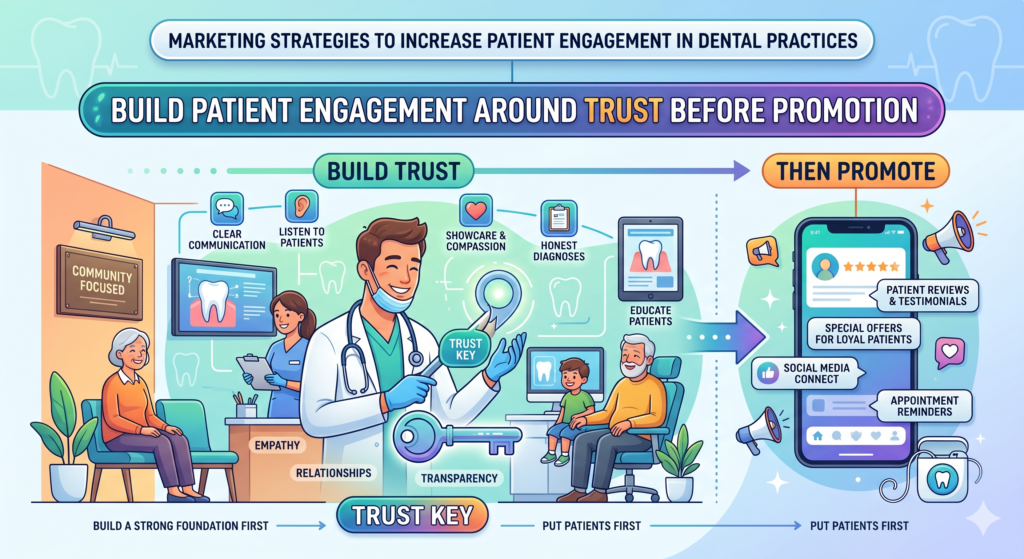
A dental patient may be worried about pain, cost, embarrassment, or bad past experiences. Some may feel nervous because they have delayed care for years. Others may know they need help but keep putting it off because they do not want to hear bad news.
So your marketing must do more than say what services you offer. It must make people feel understood. When patients feel understood, they are more likely to call, book, show up, accept care, return, and refer others.
Your marketing should answer the fears patients rarely say out loud
Most patients will not tell you they are scared before they book. They will not always admit they are embarrassed. They may not ask whether the visit will hurt or whether the team will judge them.
But those questions are still there.
Your website, ads, emails, and social posts should speak to these concerns in a calm way. Instead of only saying, “We offer complete dental care,” say something that feels more human. For example, “Whether it has been six months or six years since your last dental visit, we will help you feel comfortable and explain every step clearly.”
That kind of message works because it lowers pressure. It tells the patient they are not alone. It also gives them a simple reason to trust you.
Your website should make patients feel safe before asking them to book
Your website is often the first real experience a patient has with your practice. If it feels cold, vague, or hard to use, the patient may leave without calling.
A strong dental website should answer simple questions quickly. Where are you located? Do you accept new patients? What services do you offer? What happens during the first visit? Do you explain costs before treatment? Can nervous patients feel comfortable there?
These answers should not be hidden. They should be clear on your home page, service pages, and contact page.
The goal is not to impress people with fancy words. The goal is to help them feel, “This practice gets me. I can take the next step.”
Your tone should feel like your chairside manner
Your marketing voice should match the way your team speaks in person. If your practice is warm and gentle, your content should sound warm and gentle. If your team explains things clearly, your website should do the same.
Do not write like a medical textbook. Write like a caring dentist speaking to one patient.
Instead of saying, “Our preventive dentistry solutions support optimal oral health,” say, “Regular checkups help us catch small problems early, before they become painful or expensive.”
Simple language builds trust faster. Patients should not need to decode your message. They should understand it right away.
Your front desk is also part of your marketing
Many practices spend money to get calls, then lose patients during the call. That is a costly mistake.
When someone calls, they are already interested. The way your team responds can either build trust or break it.
Train your team to listen before they schedule
If a patient says, “I have not been to the dentist in years,” the best reply is not to jump straight into insurance questions. A better response is, “That is completely okay. We see many patients who are coming back after a long break, and we will make the visit as easy as possible.”
That one sentence can calm fear.
A good call should end with a clear next step. Book the visit, send a link, explain what information is needed, or invite the patient to start with an exam. Do not leave them confused.
Trust is the base of engagement. Once patients feel safe, every other marketing strategy works better.
Turn Your Website Into a Patient Engagement Tool, Not Just an Online Brochure
Your website should not sit online like a digital business card. It should work like a helpful front desk team member. It should welcome people, answer their questions, calm their worries, and guide them toward booking without making them feel pushed.

Many dental websites look clean, but they do not engage patients. They list services, show a few photos, and add a phone number. That is not enough anymore. Patients want to understand what it will feel like to visit your practice. They want to know if you can help them, if they can trust you, and what step to take next.
A strong website does not make patients search for answers. It brings the answers to them.
Your home page should make the next step obvious
When a patient lands on your home page, they should understand three things fast. They should know who you help, what kind of care you offer, and how to book.
Do not open with a vague line like, “Welcome to our dental practice.” That says nothing useful. A better opening would speak to the patient’s need. For example, your message could explain that your practice helps families, busy adults, nervous patients, or people who need same-day dental help.
The home page should also make booking feel easy. If patients have to scroll too long to find your phone number, online booking button, address, or office hours, you are adding friction. Every second of confusion can reduce engagement.
Your website should guide different types of patients to the right place
Not every patient arrives with the same need. One person may need a routine cleaning. Another may have tooth pain. Another may be comparing cosmetic options. Another may be looking for a dentist for their child.
Your website should help each person find their path.
A clear home page can guide visitors to important pages like emergency dentistry, family dentistry, dental implants, cosmetic dentistry, clear aligners, and new patient information. But those links should not feel like a menu dump. Each path should explain who it is for and why it matters.
For example, instead of only saying “Dental Implants,” you can say, “If you are missing a tooth or struggling with a loose denture, learn how implants may help you eat and smile with more confidence.”
That small shift makes the service feel real.
Your service pages should be written for patients, not dentists
A service page should not sound like a textbook. It should answer what patients actually want to know.
Patients want to know what the problem means, what treatment involves, whether it may hurt, how long it may take, what choices they have, and what happens if they wait. They also want to know whether your team will explain costs before care begins.
When your service pages answer these questions in simple words, people stay longer. They feel informed. They are more likely to book because the unknown feels less scary.
Every service page should reduce doubt before asking for action
Before asking someone to schedule, help them feel ready.
If the page is about root canals, explain that the goal is to save the tooth and ease pain. If the page is about crowns, explain when a tooth may need extra support. If the page is about whitening, explain what affects results and why a dental exam may be useful first.
Do not hide common concerns. Bring them into the open.
When patients see that you understand their questions, they feel safer. That safety is what turns a website visit into a phone call.
Use Local SEO to Reach Patients at the Moment They Are Ready to Act
Local SEO is one of the most powerful ways to increase patient engagement because it reaches people when they are already looking for dental care. A patient searching “dentist near me,” “emergency dentist near me,” or “teeth cleaning near me” is not just browsing. They may be ready to book.
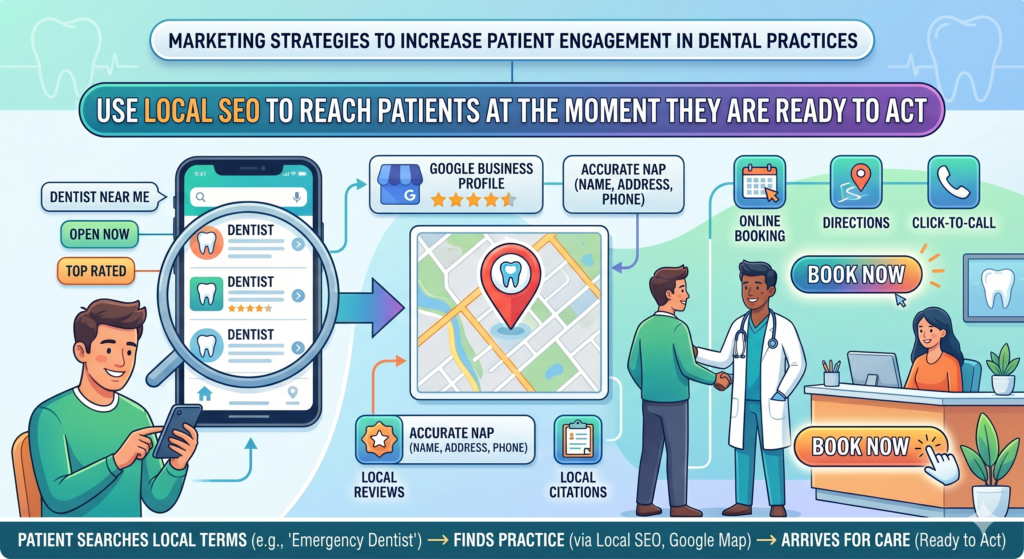
But ranking is only part of the job. Your local presence also needs to build trust fast. When patients see your practice on Google, they look at your reviews, photos, hours, services, location, and how easy it is to contact you. If your profile feels complete and active, they are more likely to engage.
Local SEO is not only about being found. It is about being chosen.
Your Google Business Profile should feel alive and useful
Your Google Business Profile is often the first thing patients see. It may even matter more than your website for some searches because patients can call, get directions, read reviews, view photos, and compare you with nearby practices without leaving Google.
This profile should never feel neglected. It should have correct hours, updated contact details, strong service categories, real photos, and clear descriptions. If your hours are wrong or your photos are old, patients may wonder what else is not being managed well.
A complete profile sends a quiet signal that your practice is organized.
Photos help patients feel familiar before they visit
Dental anxiety often comes from the unknown. Patients may wonder what the office looks like, who works there, and whether the space feels clean and comfortable.
Photos help reduce that worry.
Add real photos of your building, front desk, waiting area, treatment rooms, team members, and patient-friendly details. Avoid using only stock images. Real photos make the practice feel more approachable.
A patient who has already seen your office online may feel less nervous walking in. That is patient engagement before the appointment even starts.
Reviews should be part of your local SEO strategy
Reviews do more than improve trust. They help patients understand the experience they may have with your practice.
A review that says “the dentist explained everything and did not rush me” can matter more than a polished slogan. A review that says “the team helped me feel calm even though I was nervous” can speak directly to someone who has avoided dental care for years.
Your practice should have a simple system for asking happy patients to leave reviews. This should happen soon after a positive visit, while the experience is still fresh. The request should feel personal, not forced.
Reply to reviews like real people are reading them because they are
Many practices only focus on getting reviews. They forget that replies also matter.
When you reply to reviews, future patients are watching. A warm reply shows that your team cares. A cold or copied reply can make the practice feel less human.
You do not need to write long replies. But each response should sound real. Thank the patient, mention that you are glad they felt cared for, and keep private health details out of the reply.
For negative reviews, stay calm. Do not argue online. Invite the person to contact the office so the issue can be handled properly. A thoughtful response can protect trust even when the review is not perfect.
Create Patient Education Content That Makes People Feel Smarter, Not Scared
Patient education is one of the best ways to increase engagement because it gives people confidence. When patients understand their mouth, their symptoms, and their treatment choices, they are more likely to take action.
But many dental practices get education wrong. They either make it too technical or too scary. Both can hurt engagement. If content feels hard to understand, patients leave. If it feels frightening, patients avoid the topic.
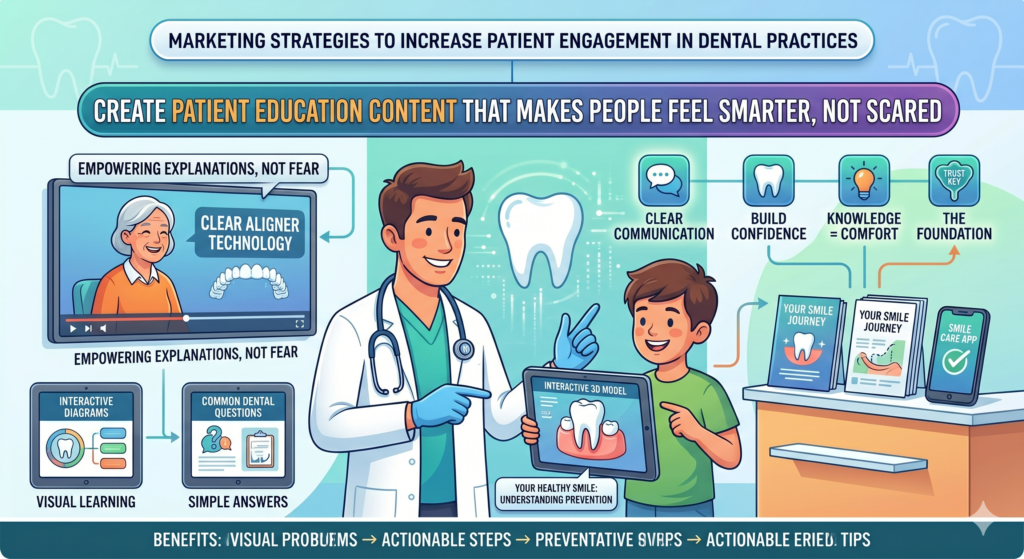
Good education should make people feel calm and capable. It should help them say, “Now I understand what is going on, and I know what to do next.”
Your blog should answer the questions patients already ask
A dental blog should not exist just for SEO. It should support real patient decisions.
Think about the questions your front desk hears every week. Why are my gums bleeding? Is tooth pain always serious? How often should I get a cleaning? What should I do if my crown feels loose? Are dental implants painful? Why does my child have bad breath? What happens during a deep cleaning?
These are strong blog topics because they come from real patient concerns.
When you answer these questions in simple language, you build trust before the patient calls. You also save time for your team because patients arrive with better understanding.
Each article should lead to one clear next step
Patient education should not end with a dead stop. After reading, the patient should know what to do.
If the article is about bleeding gums, the next step may be scheduling a gum health check. If it is about tooth pain, the next step may be calling for an exam. If it is about whitening, the next step may be asking whether whitening is safe for their teeth.
The call to action should feel natural, not pushy.
For example, you can say, “If your gums bleed often, a dental visit can help you find the cause and treat it early.” That is simple. It respects the patient. It gives direction without using fear.
Educational content should also support treatment acceptance
Many patients delay treatment because they do not fully understand why it matters. They may hear “crown,” “deep cleaning,” or “root canal” and feel unsure. If they leave confused, they may not return.
Your content can help close that gap.
Create simple pages or emails that explain common treatment plans. Explain why the dentist recommended the treatment, what can happen if the issue is ignored, what the visit may feel like, and how the practice helps patients plan around time and cost.
Use plain words to explain value, not pressure to force decisions
Patients do not want to be sold. They want to understand.
Instead of saying a crown is “necessary to restore function,” say, “A crown covers and protects a weak tooth so it is less likely to crack or break further.”
Instead of saying “periodontal therapy prevents disease progression,” say, “Deep cleaning helps remove bacteria under the gums, where regular brushing cannot reach.”
Simple words help patients make better choices. When patients understand the value of care, they are more likely to accept it.
Use Email Marketing to Keep Patients Connected Between Visits
Email is one of the simplest ways to keep patients engaged, but many dental practices either ignore it or use it only for reminders and promotions. That is a missed chance.
A good email program keeps your practice present in the patient’s life without feeling pushy. It helps patients understand their care, remember important visits, and feel like your team is still looking out for them after they leave the office.
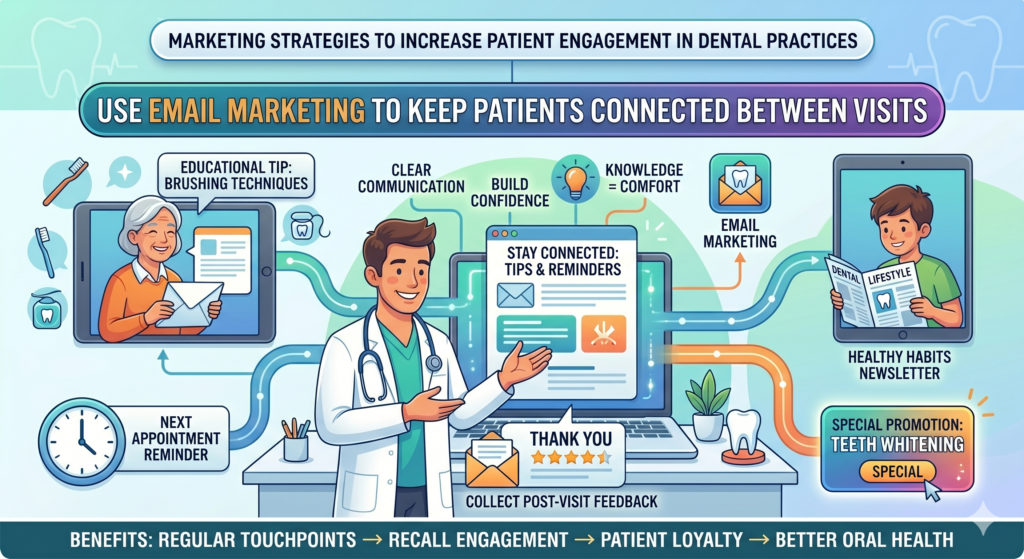
The key is to make every email useful. Patients should feel that opening your message was worth their time. If your emails only say “book now” or “use your benefits,” people will start ignoring them. But if your emails give clear tips, answer common questions, and make dental care feel easier, patients will stay connected.
Your emails should feel like patient care, not sales messages
The best dental emails sound like they came from a helpful practice, not a marketing machine. They should be short enough to read quickly, but useful enough to build trust.
You can send emails about brushing habits, gum health, tooth sensitivity, whitening safety, children’s dental care, bad breath, night guards, dental anxiety, and what to expect during common treatments. These topics work because they connect to problems patients already think about.
A patient may not need a crown today, but they may open an email about tooth sensitivity because it affects them right now. A parent may not be ready to book, but they may read an email about helping a child brush better. That small moment keeps your practice in their mind.
Segment emails based on patient needs so the message feels personal
Not every patient should receive the same email.
A parent with young children needs different content than an adult considering implants. A patient who recently had a filling needs different follow-up than someone who is overdue for a cleaning. A nervous patient may need more reassurance than someone who visits every six months without concern.
This is where simple segmentation helps. You can group patients by visit history, treatment interest, age group, family status, recall status, or recent procedure. Then your emails can feel more relevant.
For example, a patient who recently finished whitening can receive care tips to help results last. A patient who missed a hygiene visit can receive a gentle reminder about getting back on track. A patient who asked about clear aligners can receive a simple email explaining how the first consultation works.
When the email fits the patient, engagement rises.
Recall emails should be gentle, clear, and easy to act on
Recall emails are often treated like routine admin messages. But they are actually a key part of patient engagement.
A patient who is due for a cleaning may not be ignoring your practice on purpose. They may be busy. They may have changed jobs. They may be worried about cost. They may simply need a small nudge.
A good recall email should not sound like a warning. It should feel helpful.
Instead of saying, “You are overdue for your appointment,” you can say, “It looks like it may be time for your next cleaning. We would be happy to help you find a time that works for you.”
That sounds softer and more human.
Make booking from email as simple as possible
If a patient opens your email and decides to book, do not make them work hard.
The email should include one clear booking action. That may be a phone number, a booking link, or a message option. Do not crowd the email with too many choices. Confusion lowers action.
The email should also remind patients why the visit matters in plain words. A cleaning is not just “routine care.” It helps remove buildup, check gum health, catch small problems early, and keep the mouth feeling fresh.
When patients understand the value and the next step is easy, they are more likely to respond.
Use SMS Marketing Carefully Because It Gets Attention Fast
Text messages can be powerful for dental practices because patients usually see them quickly. But that power comes with responsibility. If your texts feel too frequent, too cold, or too promotional, patients may opt out or ignore you.
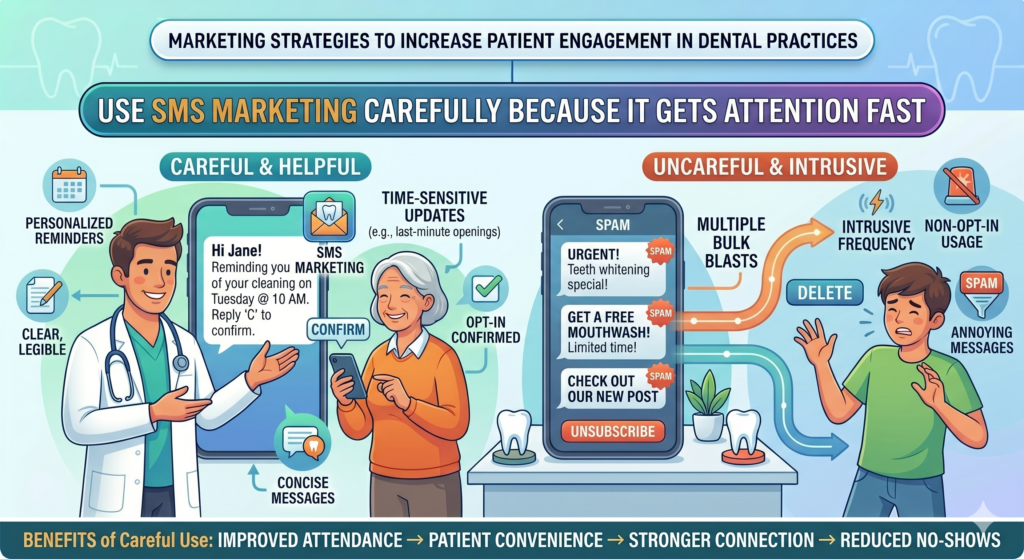
SMS should be used for messages that need quick attention or easy action. Appointment reminders, confirmation links, last-minute openings, follow-up check-ins, and simple recall nudges can work well.
The goal is to be helpful, not noisy.
Text messages should be short, warm, and clear
A dental text should not read like a legal notice or a hard sales pitch. It should sound like a friendly practice giving a clear reminder.
For example, a reminder can say, “Hi Sarah, this is Greenway Dental. We’re looking forward to seeing you tomorrow at 10:00 AM. Reply C to confirm or call us if you need to change your time.”
That message works because it is simple. It gives the patient one clear action. It also makes the practice feel organized.
A bad text would be too long, too vague, or too aggressive. Patients should not have to guess what the message means or what they need to do.
Use SMS to reduce no-shows without making patients feel blamed
No-shows hurt the practice, but the way you handle them matters. Patients miss appointments for many reasons. They forget, get busy, feel nervous, or face last-minute issues.
Your SMS system should help prevent missed visits by making confirmation easy. Send reminders at the right time, such as a few days before and again closer to the appointment. The message should include the date, time, practice name, and a simple way to confirm or reschedule.
If a patient does miss an appointment, avoid shame. A gentle follow-up is better.
You can say, “We missed you today and hope everything is okay. Please call or reply when you are ready to find another time.”
That keeps the relationship open. It makes it easier for the patient to come back instead of avoiding the practice out of embarrassment.
SMS can help fill schedule gaps without cheapening your brand
Every dental practice has cancellations. SMS can help fill those gaps fast, but the message must be handled with care.
If you send too many “open slot” texts, patients may start to see your practice as desperate. But if you send them in a helpful way, they can work well.
For example, you can message patients who are already due or who asked for an earlier time. The message can say, “A cleaning appointment opened tomorrow at 2:30 PM. If you would like it, reply YES and we’ll help confirm.”
This feels useful because it is relevant.
Do not use text messages for every marketing idea
SMS should not replace email, phone calls, or patient conversations. It works best when the message is simple and time-sensitive.
If the topic needs explanation, use email or a website page. If the patient needs reassurance, a phone call may be better. If the issue is sensitive, keep it private and careful.
The best SMS strategy respects the patient’s time. When patients know your texts are useful, they are more likely to read and respond.
Improve Patient Engagement With Better Treatment Plan Communication
Treatment acceptance is one of the most important parts of patient engagement. A patient can like your practice, trust your dentist, and still delay treatment if they do not understand what is being recommended.
This does not always mean the patient is saying no. Sometimes they are confused. Sometimes they are worried about cost. Sometimes they need more time. Sometimes they are afraid of pain. Sometimes they do not see the problem yet because nothing hurts.

Good treatment communication helps patients move from confusion to clarity. It gives them the information they need to make a confident choice.
Explain the problem before explaining the procedure
Many treatment conversations move too fast. The dentist sees the issue clearly, but the patient does not. If you start by naming the treatment, the patient may feel lost.
For example, if you say, “You need a crown,” the patient may immediately think about cost, time, and fear. But if you first explain the problem in simple words, the recommendation makes more sense.
You might say, “This tooth has a large crack, and the filling around it is no longer giving it enough support. A crown can cover and protect the tooth so it is less likely to break.”
That is easier to understand.
Use pictures and plain words so patients can see what you see
Patients are more likely to accept treatment when they can see the issue. Intraoral photos, X-rays, diagrams, and simple chairside explanations can help.
But the tools alone are not enough. You still need plain words.
Do not say, “There is decay under the restoration.” Say, “There is a cavity forming under the old filling.” Do not say, “There is bone loss around the molars.” Say, “The gums and bone around these back teeth are not supporting them as well as they should.”
Clear language shows respect. It also lowers the chance that the patient leaves confused.
Cost conversations should feel honest and calm
Money is one of the biggest reasons patients delay treatment. If cost is handled awkwardly, patients may feel embarrassed or pressured. If it is handled clearly, they are more likely to stay engaged.
Your team should explain the treatment, estimated cost, insurance details, payment choices, and timing in a calm way. Patients should never feel like they are being rushed into a decision they do not understand.
A good treatment coordinator can make a major difference here. Their role is not to push. Their role is to help the patient see the path clearly.
Give patients a clear next step even if they are not ready today
Not every patient will say yes right away. That is normal. The worst thing a practice can do is let the conversation end with silence.
If the patient needs time, guide them gently. Offer to send a summary. Schedule a follow-up call. Help them understand which treatment is urgent and which can wait. Explain what signs to watch for. Make it easy for them to ask more questions.
This keeps the relationship open.
When patients feel respected, they are more likely to come back and move forward when they are ready. Engagement is not always instant. Sometimes it grows because your team stayed helpful after the first “not yet.”
Use Reviews as a Patient Engagement System, Not Just a Reputation Tool
Reviews are not only for ranking on Google. They also help patients feel safe before they contact your practice. A nervous patient may trust another patient’s words more than your own marketing. That is why reviews should be treated as part of your patient engagement strategy.
When people read reviews, they are looking for proof. They want to know if your team is kind, if the dentist explains things clearly, if the office feels clean, if appointments run on time, and if nervous patients are treated with care.
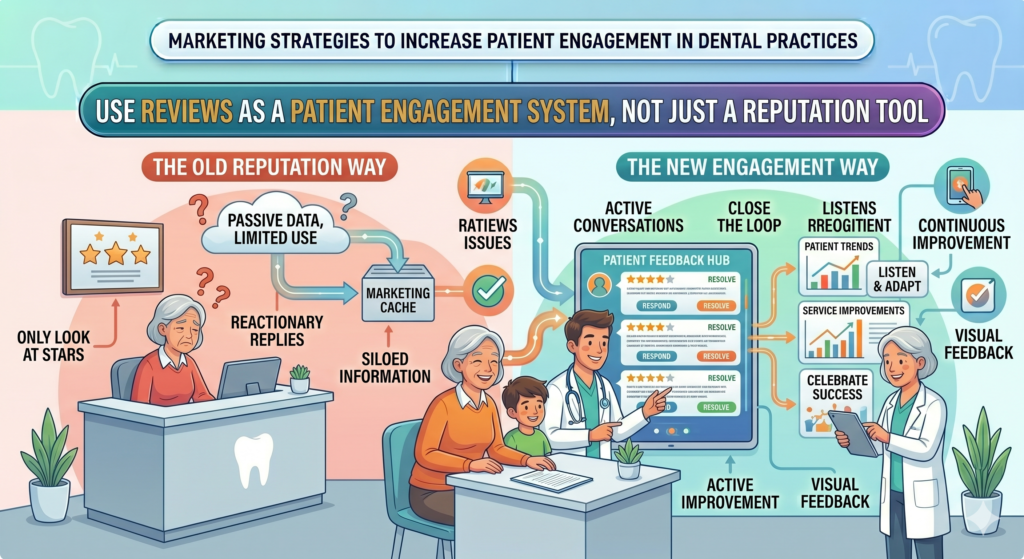
A strong review strategy helps new patients feel confident and reminds current patients that their voice matters.
Ask for reviews at the right moment, not randomly
The best time to ask for a review is after a positive patient experience. This could be after a smooth cleaning, a completed cosmetic treatment, a pain-relief visit, or a kind comment from the patient at checkout.
Do not make the request feel forced. A simple, warm message works best.
You can say, “We’re so glad your visit went well today. If you feel comfortable sharing your experience, your review can help other patients feel more confident about choosing us.”
That makes the patient feel part of something helpful.
Make the review process easy enough to finish in one minute
Even happy patients may not leave a review if the process is hard. Do not ask them to search for your practice or figure out where to post.
Send a direct review link by text or email. Keep the message short. Thank them first. Then explain that their feedback helps other people find trusted dental care.
The easier the process is, the more reviews you will receive.
But never pressure patients. Never offer rewards for positive reviews. Never ask only for five-star feedback. The goal is honest trust, not fake praise.
Use review themes to improve your marketing message
Reviews can teach you what patients truly value about your practice. You may think your biggest strength is your technology, but patients may keep talking about how gentle your hygienist is. You may think people choose you for cosmetic care, but reviews may show that they love your clear explanations.
Read your reviews often. Look for repeated words. If patients keep saying “kind,” “patient,” “gentle,” “clear,” or “honest,” those words should shape your marketing.
Let patient language guide your website and social content
The best copy often comes from real patients. If many reviews say your team helped them feel calm, your website should make that a core message. If people praise your front desk for explaining insurance, your new patient page should mention that clearly.
This makes your marketing feel more real because it is built on actual patient experience.
When your message matches what patients already say about you, it becomes easier to trust. That trust leads to more calls, more bookings, and stronger long-term engagement.
Make Social Media Feel Human Instead of Promotional
Social media can help dental practices build trust, but only when it feels real. If every post is a graphic about brushing or a promotion for whitening, patients may stop paying attention.
People do not follow dental practices because they want ads. They follow because they want useful tips, local connection, friendly reminders, and a sense of who your team is.
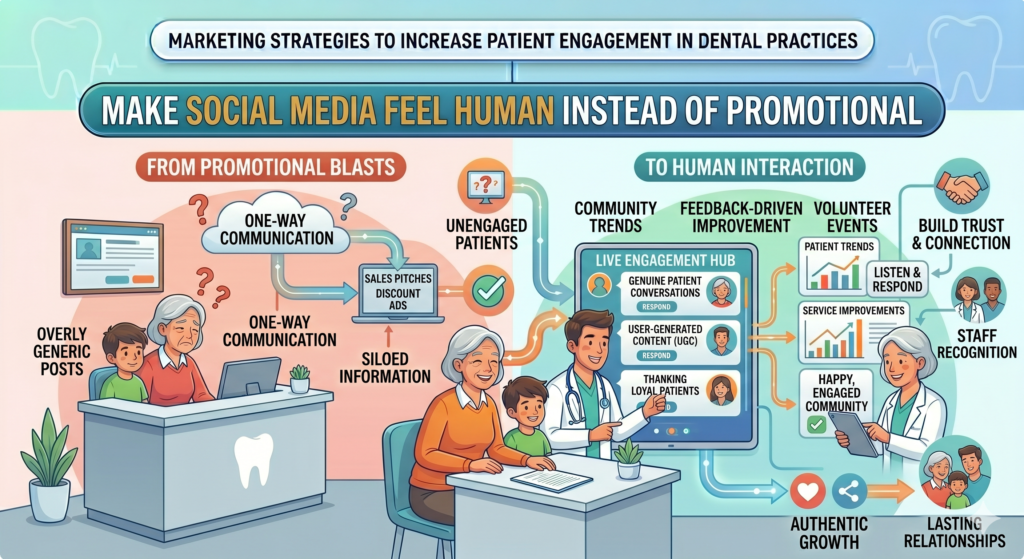
Your social media should make your practice feel familiar. When patients see your team often, the office feels less strange. When they see helpful advice, they start to trust your care even before they visit.
Show the people behind the practice
Patients connect with people, not logos. That is why your team should be part of your social content.
You can share simple moments from the office, dentist introductions, hygienist tips, birthday posts, community events, continuing education days, and behind-the-scenes updates. These do not need to be perfect. In fact, they often work better when they feel natural.
A short video of a dentist explaining what happens during a first visit can calm more fear than a polished ad. A photo of your front desk team can help new patients recognize a friendly face when they walk in.
Keep social content simple and useful
Do not turn every post into a lesson. Patients are busy. They need quick, clear value.
A good post might explain why gums bleed, what to do if a tooth chips, how to help kids brush, or when tooth sensitivity needs attention. Use simple words. Write like you are talking to one patient.
Avoid heavy dental terms unless you explain them. If your content sounds too clinical, people will scroll past it.
Social media works best when it repeats your trust message in small ways. Every post should make the practice feel easier to approach.
Use social media to support recall and treatment awareness
Social media should not replace direct patient communication, but it can support it. If you often post about the value of cleanings, patients are more likely to understand recall reminders. If you explain dental implants in simple ways, patients may feel more ready to ask about them.
The goal is to plant helpful ideas before the patient needs them.
Do not chase trends that weaken your brand
Trends can get attention, but not every trend belongs in dental marketing. If a post makes your practice look careless or silly in the wrong way, it can hurt trust.
Your content can be warm, light, and friendly without losing professionalism.
Patients are trusting you with their health. Your social media should make them feel comfortable, not unsure. A good rule is simple: if the post would make a nervous new patient feel more at ease, it likely supports engagement.
Build Stronger Recall Campaigns That Bring Patients Back Without Pressure
Recall is one of the most important parts of dental growth. A patient who misses regular visits is more likely to develop bigger problems, and the practice loses future revenue. But recall should not feel like chasing people.
A strong recall campaign helps patients return because they understand the value of care and feel supported in taking the next step.
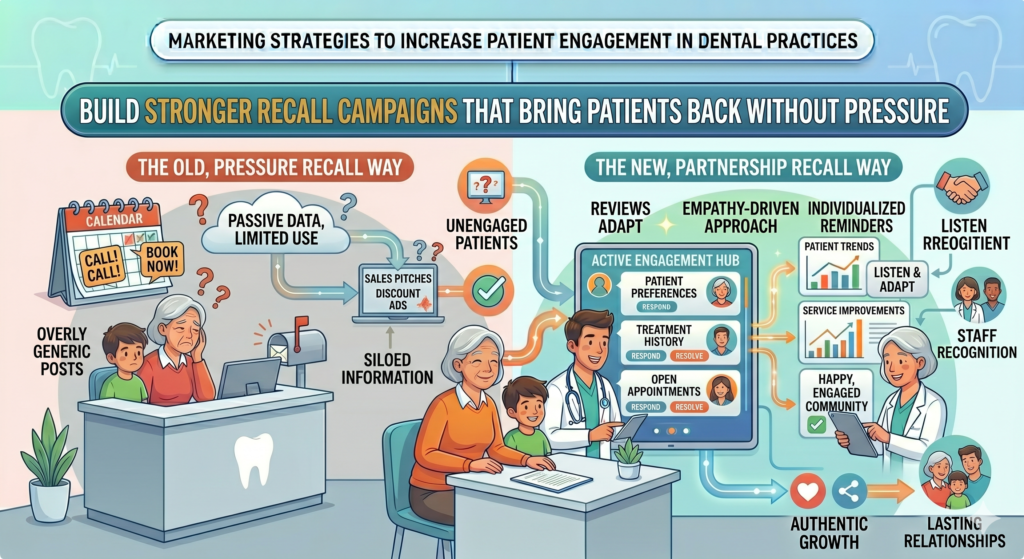
Many patients do not skip visits because they dislike the practice. They skip because life gets busy. They forget. They move. They feel worried about cost. They think nothing is wrong because nothing hurts.
Your job is to make returning feel simple and safe.
Recall messages should focus on care, not guilt
Some practices use harsh language in recall messages. They tell patients they are overdue or warn them about problems. This may get attention, but it can also create shame.
A better approach is gentle and clear.
You can say, “It looks like it may be time for your next cleaning and checkup. Regular visits help us catch small issues early and keep your mouth feeling healthy.”
That message explains the reason without blaming the patient.
Use several touchpoints because one reminder is rarely enough
A patient may miss one email. They may ignore one text. They may forget after one phone call. That does not mean they are not interested.
A good recall system uses a mix of email, SMS, phone calls, and mailed reminders when needed. The tone should stay helpful across every channel.
Do not send the same message over and over. Change the angle. One message can focus on keeping gums healthy. Another can focus on catching small issues early. Another can offer help finding a convenient time.
This keeps the campaign from feeling robotic.
Make it easy for patients to restart care after a long gap
Some patients feel embarrassed when they have not visited in years. If your recall message makes them feel judged, they may avoid you longer.
Your content should make returning feel normal.
Say things like, “If it has been a while since your last visit, that is okay. We will help you get back on track one step at a time.”
Give inactive patients a low-pressure first step
For patients who have been gone a long time, the first step should feel small. Invite them to schedule a checkup, ask a question, or call to talk through options.
Do not overwhelm them with everything they may need. Start with one visit.
Once they are back in the chair, your team can rebuild the relationship. That is the real goal of recall marketing. It is not just to fill the schedule. It is to bring people back into care before small problems become bigger ones.
Use Patient Education Before, During, and After the Visit
Patient education should not only happen when someone asks a question. It should be part of the full patient journey. When patients understand what is happening, they feel more in control. When they feel more in control, they are more likely to stay engaged.
Many people avoid dental care because they do not understand it. A dentist may see a small issue and know it can become serious later. But the patient may think, “It does not hurt, so it cannot be that bad.” This gap creates delay.
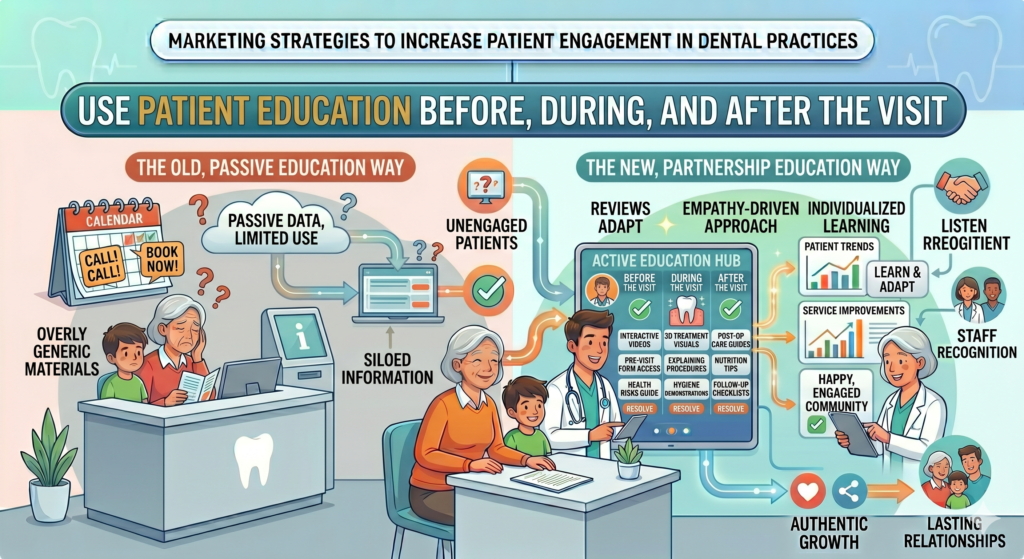
Good education closes that gap without using fear.
Teach patients before they even book
Your website, blog, social media, and emails should answer common questions early. This helps patients feel ready before they contact the office.
For example, explain what happens at a first dental visit. Explain what bleeding gums may mean. Explain why teeth can feel sensitive. Explain when a chipped tooth needs care. Explain how often children should see the dentist.
These topics may seem basic, but basic is useful. Patients do not need complex dental lessons. They need simple answers that help them act.
Make education feel calm, not scary
Some dental content uses fear to get attention. It talks about worst-case outcomes too quickly. This can make nervous patients freeze instead of act.
A better approach is to explain the issue, why it matters, and what the patient can do next.
For example, instead of saying, “Bleeding gums can lead to tooth loss,” you can say, “Bleeding gums are common, but they can be a sign that your gums need care. A dental visit can help find the cause early.”
That message is still serious. But it does not shame or scare the patient.
Use education during treatment conversations
When a dentist recommends treatment, the patient should not feel lost. They should understand the problem, the reason for treatment, and what happens next.
Use photos, X-rays, mirrors, and simple drawings. But more important, use plain words.
Do not say, “There is recurrent decay under the restoration.” Say, “A new cavity has formed under the old filling.”
Repeat key points because patients may be nervous
Patients do not always remember everything they hear in the chair. They may be anxious, distracted, or thinking about cost.
That is why it helps to repeat the main point in a simple way. You can also send a short written summary after the visit.
A clear summary can explain what was found, what treatment was recommended, why it matters, and how the patient can ask questions. This keeps the patient engaged after they leave the office.
Create Follow-Up Systems That Make Patients Feel Cared For
Follow-up is one of the easiest ways to stand out in dental marketing. Most practices say they care, but not every practice proves it after the visit.
A simple follow-up can turn a normal appointment into a memorable experience. It can reduce worry, improve trust, and increase the chance that the patient returns.
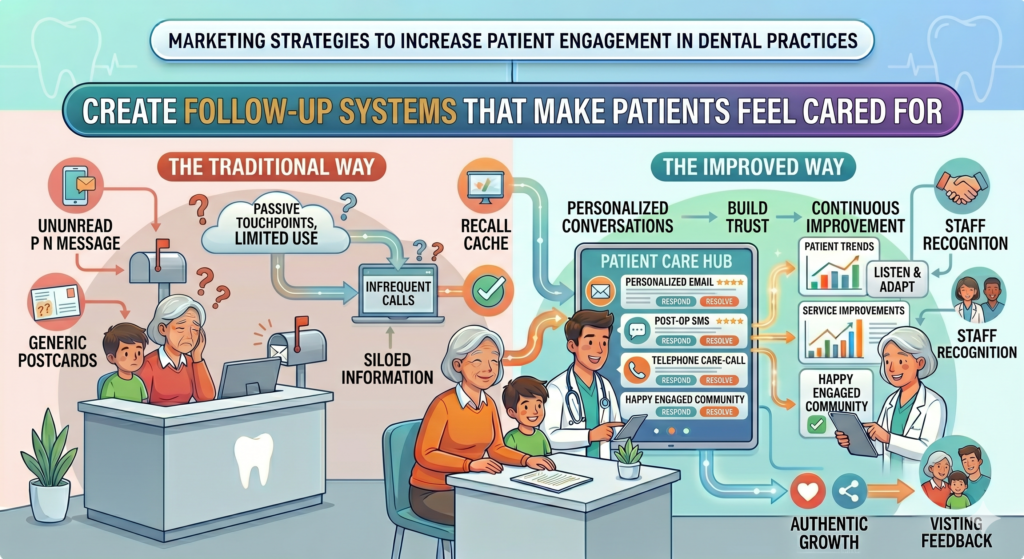
Patients remember how you make them feel after treatment. If they feel forgotten, the relationship weakens. If they feel supported, the relationship grows.
Follow up after important treatments
Not every visit needs a personal call, but some visits do. Patients who had extractions, root canals, implants, deep cleanings, crowns, or emergency care may appreciate a check-in.
The message does not need to be long.
You can say, “We just wanted to check how you are feeling after your visit. If you have any questions or discomfort, please call us.”
That short message can mean a lot.
Follow-up messages can reduce unnecessary worry
Patients may not know what is normal after treatment. They may wonder if soreness, sensitivity, or swelling is expected. If they do not know, they may search online and become more anxious.
A good follow-up can guide them.
Send simple aftercare instructions in plain language. Tell them what is normal, what is not, and when to call. This helps patients feel safe and reduces confusion.
It also shows that your practice cares beyond the appointment.
Follow up after missed treatment decisions
Some patients leave with a treatment plan but do not schedule. This does not always mean they are rejecting care. They may need time, money, or more information.
A thoughtful follow-up can bring them back into the conversation.
Do not say, “You still need to schedule your crown.” That can feel cold. Instead, say, “We wanted to check if you had any questions about the treatment we discussed. We are happy to walk through the details or help you plan a time that works.”
Make it easy for patients to ask questions
Patients may feel embarrassed asking about cost or risk. They may not want to bother the dentist. Your follow-up should invite questions clearly.
Say that questions are welcome. Offer a phone call. Offer to explain payment options. Offer to review the treatment again.
This turns follow-up into support, not pressure. When patients feel supported, they are more likely to move forward.
Make Online Booking Simple Enough for Busy Patients
Online booking can increase engagement because it removes friction. Many patients do not want to call during office hours. They may be at work, caring for children, or searching late at night.
If they are ready to book and your website does not let them take action, they may move to another practice.
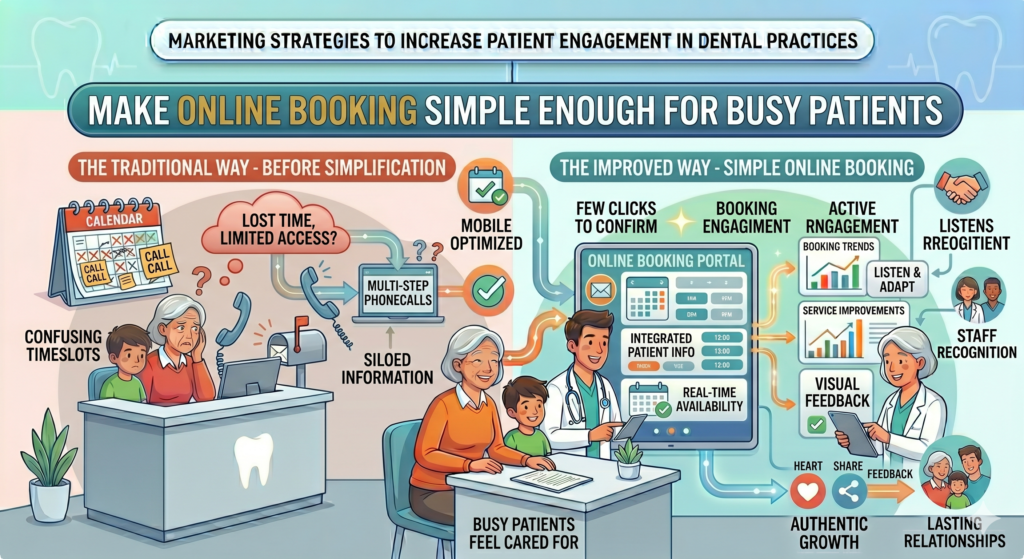
Online booking does not need to replace your front desk. It should support it. The goal is to give patients more ways to say yes.
Place booking options where patients naturally decide
A booking button should not appear only on the contact page. It should be visible on the home page, service pages, new patient page, and mobile menu.
If someone reads about emergency dentistry, they should be able to request help from that page. If someone reads about whitening, they should be able to ask about a consultation there. If someone is reading about cleanings, they should be able to book without hunting for the next step.
Keep the booking process short and clear
A long form can hurt engagement. Ask only for what you need to start the process.
The patient should know what happens after they submit the form. Will your team call them? Will they receive a confirmation? Are they requesting a time or fully booking it?
Unclear booking systems create doubt. Clear systems create action.
Mobile booking matters more than desktop booking
Many patients search for dentists on their phones. If your mobile site is slow, crowded, or hard to use, you may lose them.
The phone number should be easy to tap. The booking button should be visible. The address should open in maps. The form should be simple to fill out on a small screen.
Speed affects trust and action
If a dental website loads slowly, patients may leave before reading anything. A slow site also makes the practice feel less organized.
Fast pages, clear buttons, and simple forms can make a major difference. Patients should not have to fight your website to book care.
A smooth online booking experience tells patients that your practice respects their time. That is a strong engagement signal.
Use Video to Make Dental Care Feel Less Intimidating
Video is powerful because dental care is personal. Patients want to see faces, hear voices, and understand what will happen before they visit. A well-made video can calm fear faster than a long page of text.
This does not mean your practice needs expensive production. Simple videos often work better because they feel real. A dentist speaking clearly into a phone camera can build more trust than a polished ad with stock footage.
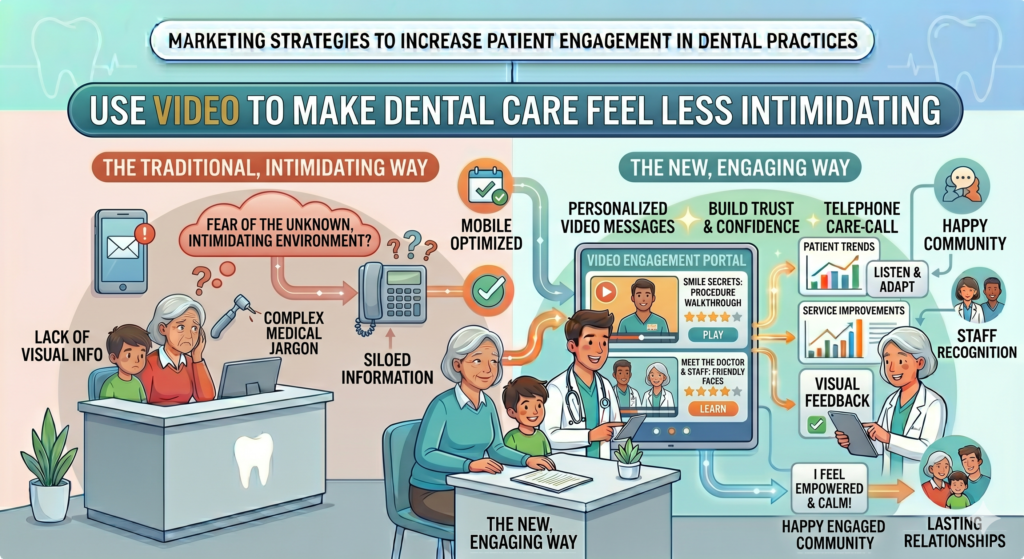
The goal is not to go viral. The goal is to make patients feel more comfortable choosing your practice.
Create videos that answer common patient questions
Start with the questions your team hears every week. What happens during a first visit? Does a root canal hurt? How long does whitening take? What should a patient do if a tooth breaks? Why do gums bleed? How do dental implants work?
Each video should answer one question in simple words. Keep the message clear and focused.
A patient who watches a short video about their concern may feel less nervous. They may also feel like they already know your dentist a little. That small feeling of familiarity can make booking easier.
Keep videos short enough for busy patients to finish
Most dental videos should not feel like lectures. Patients are usually watching on their phones, often between other tasks. They need quick answers.
A useful video can be under two minutes. Start with the patient’s question, explain the answer plainly, and end with a soft next step.
For example, a video about tooth pain can end by saying, “If the pain keeps coming back, it is best to have it checked so we can find the cause early.”
That is helpful without sounding pushy.
Use video on more than social media
Many practices post videos on social media and stop there. But videos can work in many parts of your patient journey.
Place them on service pages, new patient pages, email campaigns, treatment plan follow-ups, and Google Business Profile posts. A video about dental anxiety can sit on your new patient page. A video about crowns can support a treatment plan email. A short office tour can help patients know what to expect before arriving.
Let patients meet your team before the appointment
A nervous patient may feel more comfortable when they recognize the dentist or front desk team before the visit.
Create simple team videos. Let the dentist introduce the practice. Let a hygienist share one brushing tip. Let the front desk explain what new patients should bring. These small videos reduce the feeling of walking into a strange place.
When patients feel familiar with your team, they are more likely to show up relaxed and stay engaged.
Build a New Patient Welcome Journey That Feels Personal
A new patient’s first experience with your practice should not begin only when they walk through the door. It should begin as soon as they book.
That period between booking and the first visit is important. The patient may still feel unsure. They may wonder what to bring, how much time to allow, where to park, what forms to fill out, or whether the visit will be uncomfortable.
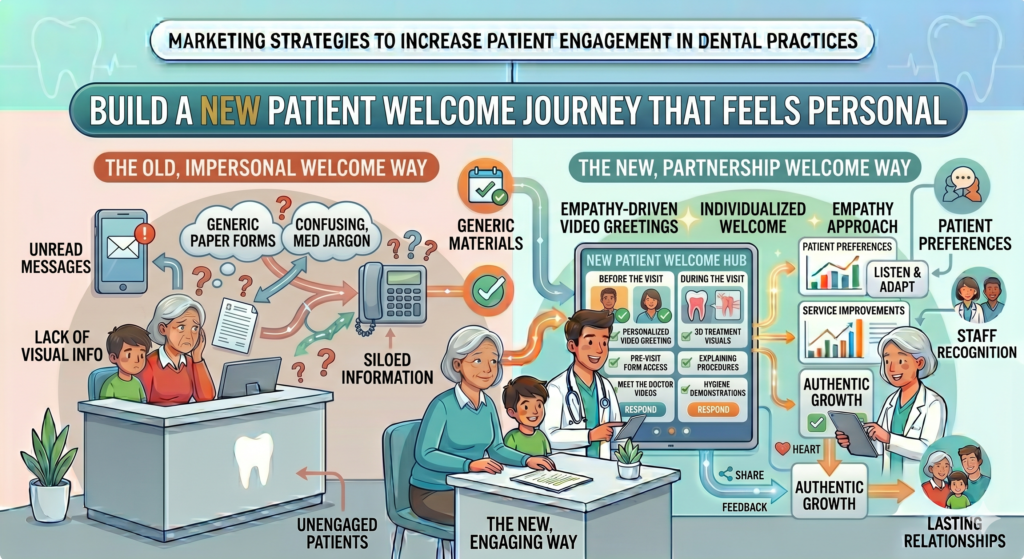
A strong welcome journey answers those questions before they become stress.
Send a warm confirmation after booking
Your confirmation message should do more than repeat the appointment time. It should welcome the patient and make them feel they made a good choice.
Use simple, friendly language. Thank them for choosing the practice. Confirm the date and time. Share the address. Explain what to bring. Include a link to forms if needed.
This message should feel organized and kind.
Explain what happens during the first visit
Many patients are more nervous when they do not know what to expect. A short new patient email can explain the visit step by step.
Tell them they will be greeted, complete any needed forms, meet the team, have an exam, discuss findings, and receive clear next steps. If X-rays may be taken, say that. If costs or insurance will be reviewed, say that too.
Clarity lowers anxiety. A patient who knows what will happen is more likely to arrive on time and feel ready.
Make the first visit feel easy before it starts
Your welcome journey should remove small problems that can create stress. If parking is confusing, explain it. If the building entrance is hard to find, send a photo or simple directions. If forms take time, send them early.
These details may seem small, but they shape the patient’s mood.
A patient who arrives stressed may be less open to care. A patient who arrives calm is more likely to listen, ask questions, and trust the team.
Follow up after the first visit to strengthen the relationship
After the first visit, send a short thank-you message. Let the patient know you were glad to see them. Invite questions. Remind them of any next step if needed.
This small follow-up turns the first visit into the start of a relationship. It also shows that your practice does not treat patients like transactions.
New patients are more likely to become loyal patients when the early experience feels smooth, personal, and thoughtful.
Use Personalized Patient Communication Without Making It Feel Robotic
Personalization is not just using a patient’s first name in a message. Real personalization means sending the right message at the right time based on what the patient needs.
A patient who just had a deep cleaning should not get the same message as a patient who asked about whitening. A parent should not always get the same content as a senior patient. A patient who has missed two recall visits may need a different tone than someone who books every six months.
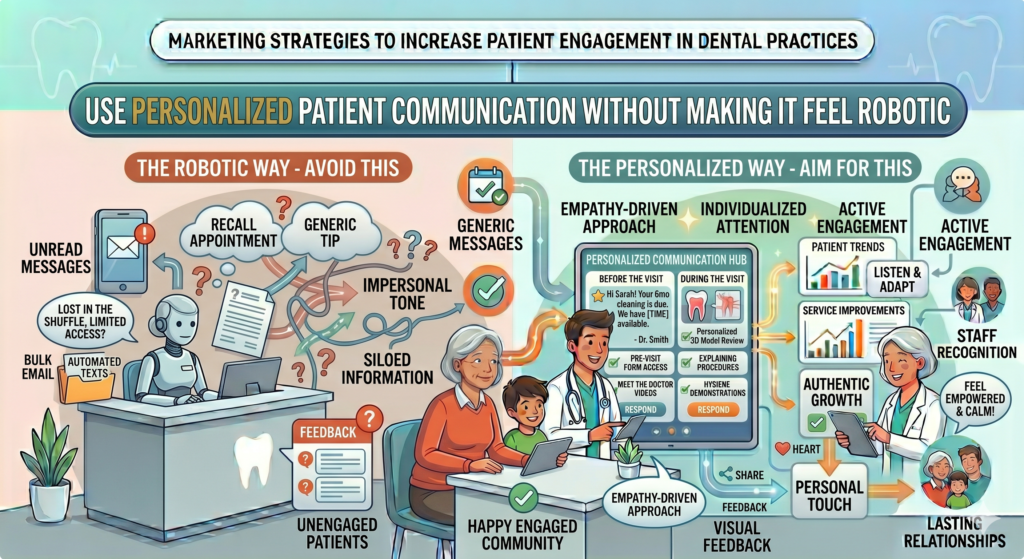
Personal communication makes patients feel noticed. But it must still sound human.
Use patient history to make messages more useful
Your practice management system can help you send better messages. You can create communication based on recall status, treatment history, missed appointments, unscheduled treatment, age group, or service interest.
For example, a patient with unfinished treatment can receive a gentle check-in. A patient who completed aligner treatment can receive retainer care tips. A patient with gum concerns can receive simple gum health education.
The point is not to send more messages. It is to send better ones.
Avoid messages that feel too cold or automated
Even automated messages should sound like they came from a caring practice.
Instead of saying, “You have pending treatment. Contact us to schedule,” say, “We wanted to check if you had any questions about the treatment we discussed at your last visit. We are happy to help you review the next step.”
The second message feels warmer. It opens a conversation instead of creating pressure.
Personalization should respect privacy
Dental care is sensitive. Patients may not want private treatment details shown in texts, subject lines, or shared spaces.
Keep messages careful. Use general wording when needed. For example, instead of naming a specific procedure in a text, you can say, “We wanted to follow up about your recent visit.”
Give patients control over how they hear from you
Some patients prefer texts. Others prefer email. Some still prefer phone calls. Asking for communication preferences can improve engagement.
When patients receive messages in the way they prefer, they are more likely to respond. It also shows that your practice respects their time and comfort.
Personalization works best when it feels helpful, respectful, and easy. That is what keeps patients connected over time.
Use Patient Feedback to Improve Engagement at Every Step
Patient feedback is one of the most useful marketing tools a dental practice can have. It shows you what patients actually feel, not what the practice thinks they feel.
Many practices only look at feedback when something goes wrong. That is too late. Feedback should be part of your growth system. It can show where patients feel confused, where they feel happy, where they feel rushed, and where they need more support.
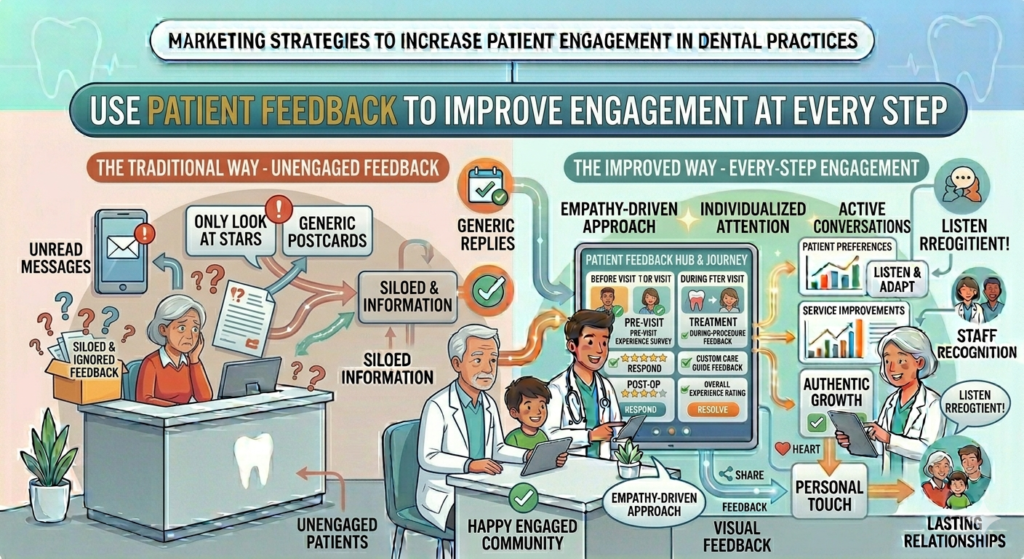
When you listen carefully, you can improve your website, phone calls, appointment flow, treatment conversations, reminders, and follow-ups. Better feedback leads to better patient experience. Better patient experience leads to stronger engagement.
Ask simple questions patients can answer quickly
Patients are more likely to share feedback when the request feels easy. Long surveys often get ignored. Short surveys work better because they respect the patient’s time.
After a visit, ask how the experience felt. Ask whether the team explained things clearly. Ask whether the patient felt comfortable. Ask whether there was anything that could have made the visit easier.
These questions give you useful answers without overwhelming the patient.
Use feedback to find hidden friction
Friction is anything that makes the patient journey harder than it needs to be. It may be a confusing form, a long wait, unclear parking, a hard-to-find booking button, or a treatment plan that felt rushed.
Small problems can create big drop-offs.
If several patients mention that online forms were confusing, fix the forms. If people say they were unsure about cost, improve your financial explanation process. If new patients say they had trouble finding the office, add clearer directions to your confirmation email.
Feedback should not sit in a spreadsheet. It should change how the practice works.
Share positive feedback with your team
Good feedback is not only useful for marketing. It is also useful for team morale.
When a patient praises a hygienist, front desk member, assistant, or dentist, share it with the team. It reminds everyone that their work matters. It also shows which behaviors patients value most.
If patients often praise clear explanations, make that part of your practice culture. If they love the calm tone of your team, protect that tone. If they mention feeling welcomed, train every new team member to keep that standard high.
Turn repeated praise into stronger messaging
Your best marketing messages often come from patient feedback.
If patients keep saying, “They never made me feel judged,” that should shape your content. If they often say, “They explained the cost clearly,” that belongs on your new patient page. If parents say, “My child felt safe,” that should be part of your family dentistry message.
Patient feedback gives you language that already works because it comes from real experience. Use it to make your marketing more believable.
Create a Strong Referral Strategy That Feels Natural and Human
Patient referrals are powerful because they come with trust built in. When a happy patient tells a friend or family member about your practice, that person is more likely to listen than if they saw an ad.
But referrals do not always happen on their own. Patients may love your practice and still forget to mention it. A smart referral strategy gently reminds them that sharing your practice can help someone else get better care.
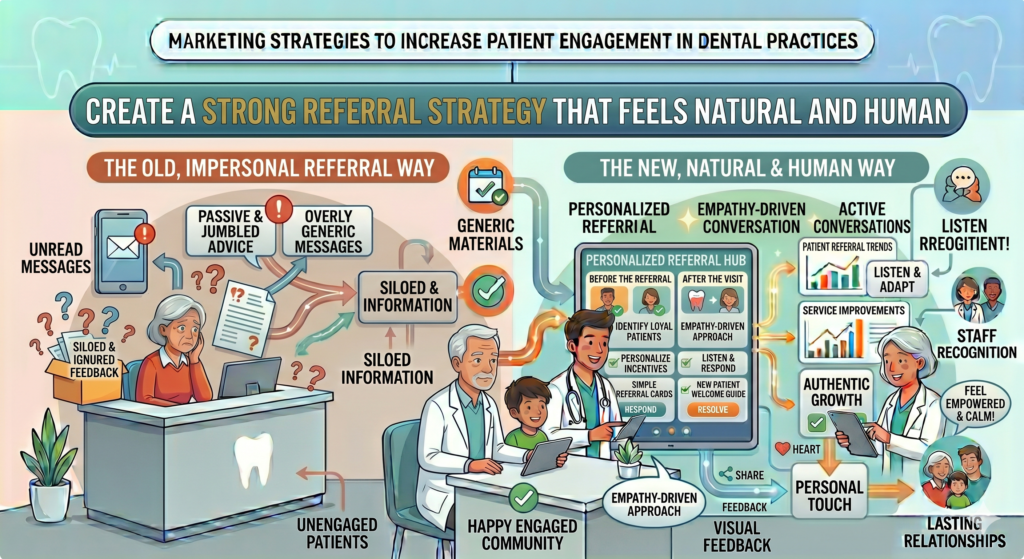
The key is to make referrals feel natural, not awkward.
Ask for referrals when trust is already high
The best time to invite referrals is after a positive moment. This may be when a patient thanks the team, finishes treatment, compliments the dentist, or leaves a good review.
Do not ask in a way that feels transactional. Make it about helping others.
You might say, “We are so glad you had a good experience. If you know someone who feels nervous about dental care, we would be happy to help them feel comfortable too.”
That kind of message feels warm because it connects the referral to care.
Make referrals easy to send
A patient may be happy to refer someone, but they may not know what to say or where to send them.
Give patients an easy path. This could be a simple referral card, a textable link, a website page for new patients, or a short message they can share.
The easier you make it, the more likely they are to do it.
Your referral page should explain who your practice helps, what new patients can expect, and how to book. It should feel welcoming to someone who may be hearing about you for the first time.
Build referral habits without sounding needy
A referral strategy should not depend on one random ask. It should be part of your patient communication in a soft and steady way.
You can mention referrals in thank-you emails, post-visit follow-ups, newsletters, and social posts. The language should stay gentle.
For example, you can say, “Many of our new patients come from kind referrals. If someone you care about is looking for a dental team that explains things clearly, we would be glad to help.”
Focus on the type of patient you serve best
Not every referral message needs to be broad. A family practice can invite patients to refer other families. A cosmetic-focused practice can invite patients who know someone unhappy with their smile. A practice known for gentle care can speak to people who avoid the dentist because of fear.
The more specific the message, the easier it is for patients to think of someone.
Referrals grow when patients know who to send and why your practice is a good fit.
Use Community Marketing to Make Your Practice More Familiar
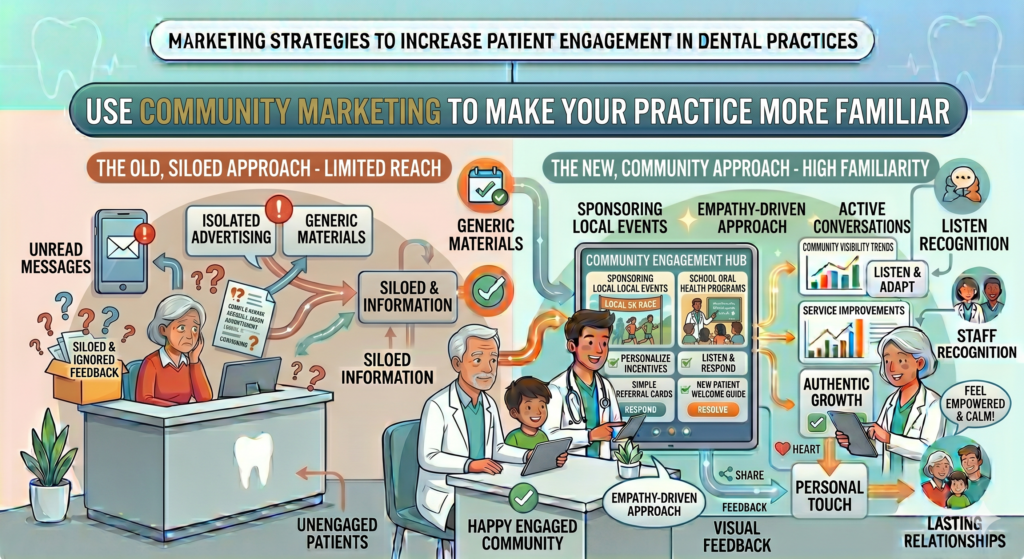
Dental practices are local businesses. People are more likely to engage with a practice they have seen, heard of, or connected with in their community.
Community marketing helps patients feel like your practice is part of their local life, not just another clinic on Google. It builds familiarity before people need you. Then, when they do need care, your name feels known.
This kind of marketing takes time, but it can create deep trust.
Show up where your ideal patients already spend time
Community marketing works best when it is focused. You do not need to sponsor every event or partner with every group. Choose places that match the patients you want to serve.
A family dental practice might connect with schools, parent groups, youth sports teams, and local family events. A practice focused on working adults might connect with nearby offices, gyms, wellness centers, and local business groups.
The goal is not to hand out flyers and disappear. The goal is to become familiar and useful.
Teach simple dental health lessons in the community
Education is a strong way to build trust locally. A dentist or hygienist can offer short talks at schools, community centers, workplaces, or wellness events.
Keep the lessons simple and practical. Teach kids how to brush. Teach parents what to do when a child chips a tooth. Teach adults how gum health connects to daily habits. Teach seniors how to care for dentures or implants.
When people learn from you in a helpful setting, they remember you as a trusted resource.
Bring community stories into your online marketing
Community work should not stay offline. Share it on your website, social media, email newsletter, and Google Business Profile.
If your team visits a school, share a short story. If you support a local event, explain why it matters. If your practice joins a health fair, post photos and key takeaways.
Keep the focus on service, not self-praise
Community content should not sound like bragging. It should show that your practice cares about the people around it.
Instead of saying, “We are proud to be the best dental practice in town,” say, “We loved helping local families learn simple ways to protect their children’s teeth.”
That feels more human.
Community marketing increases engagement because people trust what feels familiar. When your practice becomes part of the local story, patients are more likely to choose you, return to you, and recommend you.
Use Paid Ads to Support Engagement, Not Just Quick Bookings
Paid ads can help dental practices get attention fast, but attention alone is not the goal. A click is not a patient. A booked appointment is not always a loyal patient. The real goal is to bring in the right people, answer their concerns, and move them into a relationship with your practice.
Many dental ads fail because they focus only on offers. They say “free consultation” or “limited-time whitening special” but do not explain why the patient should trust the practice. Offers can work, but they are weak if they are not supported by a clear message, strong reviews, and a smooth booking process.

A good dental ad should feel like the first step in a helpful journey.
Match the ad message to the patient’s need
Different patients search for different reasons. Someone looking for an emergency dentist needs speed and reassurance. Someone looking for dental implants needs trust and clear education. Someone searching for a family dentist wants comfort, safety, and ease.
Your ads should not use the same message for all of them.
An emergency ad should speak to pain, same-day help, and what to do next. An implant ad should speak to missing teeth, confidence, clear options, and a consultation. A family dentistry ad should speak to gentle care, busy schedules, and a team that helps children feel comfortable.
Send each ad to a page that continues the same message
The landing page must match the ad. If your ad talks about emergency dental care, do not send people to a general home page. Send them to a page that explains emergency care, what symptoms need fast attention, how to contact the office, and what happens when they arrive.
This keeps the patient from feeling lost.
When the ad and page match, trust grows. When they do not match, the patient feels like they clicked into the wrong place and may leave.
Retargeting can bring unsure patients back gently
Some patients visit your website but do not book. That does not mean they are not interested. They may need time. They may be comparing practices. They may be nervous.
Retargeting ads can remind them that your practice is there when they are ready.
Use retargeting to educate, not chase
Do not make retargeting feel creepy or aggressive. Use it to share helpful messages. Show a patient review. Share a short video from the dentist. Invite them to learn what happens during a first visit. Remind them that your team welcomes nervous patients.
This approach keeps your practice visible without pressure.
Paid ads work best when they start a relationship, not when they act like a hard sell.
Conclusion
Patient engagement grows when your dental practice feels easy to trust at every step. From your website and Google profile to your phone calls, reminders, reviews, emails, and follow-ups, every touchpoint should make patients feel calm, respected, and clear about what to do next.
The goal is not to push people into appointments. The goal is to guide them with care, simple words, useful education, and smooth systems. When patients feel understood before, during, and after each visit, they return more often, accept care with more confidence, leave better reviews, and refer others. That is how dental practices grow.








Comments are closed.