
WinSavvy Editorial Standards
How this article was created
That may sound simple. But in a market where customers are flooded with sales messages every day, a real thank-you can stand out more than another discount code. People do not only remember what they bought from you. They remember how your brand made them feel. Thanksgiving gives you the perfect moment to make that feeling warm, personal, and honest.
Build your Thanksgiving campaign around real gratitude, not just seasonal sales
Thanksgiving marketing works best when it starts with one clear question: “What are we truly thankful for?”
That question may sound basic, but it changes the whole campaign. Many brands begin with the offer first. They ask, “What discount should we run?” or “How much revenue can we push before Black Friday?” Those questions matter, but they should not lead the campaign. If the message starts with selling, customers feel it right away.
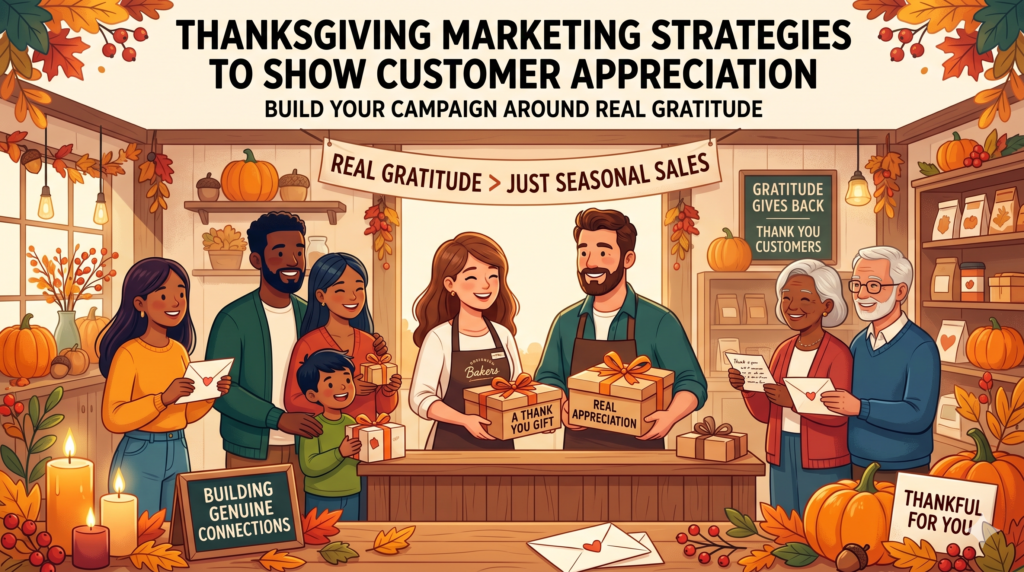
A better Thanksgiving campaign starts with appreciation. Your customers have given you money, trust, attention, reviews, feedback, referrals, and chances to improve. They have chosen you when they had other options. That is not a small thing. Your marketing should make them feel that you understand this.
The strongest Thanksgiving campaigns are not always the loudest. They are often the most honest. They feel like a warm note from a brand that remembers who helped it grow. That kind of message can make a customer open your email, read your post, reply to your survey, visit your store, or buy again later because they feel connected to you.
Make the customer the center of the message
A common mistake is making the Thanksgiving message all about the company. Brands say things like, “We are proud of our growth this year” or “We had an amazing year.” That may be true, but customers do not need a press release during a season built around gratitude.
Your message should focus on what customers made possible. Instead of saying, “We grew fast this year,” say, “Your support helped us serve more families, improve our service, and keep building something we care about.”
That small shift changes the feeling. It gives customers a place in your story. It tells them they were not just buyers. They were part of the journey.
You can also mention specific ways customers helped. Maybe they shared reviews, sent feedback, stayed loyal during changes, supported a small business, or trusted your team with an important problem. The more specific the thank-you is, the more real it feels.
Speak like a person, not a campaign calendar
Thanksgiving messages fail when they sound copied from a holiday email template. Phrases like “In this season of gratitude” are fine, but they are used so often that they can feel empty. You do not need fancy words to sound warm. In fact, simple words often work better.
Write the way a kind founder, team leader, or customer success manager would speak. Say what you mean clearly. Thank customers for being there. Tell them what their support means. Keep the message calm, warm, and direct.
A strong line could be, “We know you had many choices this year, and we are thankful you chose us.” That is simple. It is clear. It feels human.
Another strong line could be, “Your trust helped us keep improving, and we do not take that lightly.” This works because it respects the customer. It does not overdo emotion. It sounds sincere.
Connect gratitude to action
Gratitude should not stop at words. If your brand says it values customers, the campaign should prove it through action. That does not always mean giving a large discount. It can mean early access, a private thank-you gift, a helpful guide, free support, a handwritten note, a loyalty reward, or a small surprise added to an order.
The action should match your brand and your audience. A SaaS company may offer a free strategy session or a useful template. A local bakery may include a thank-you card with each order. An ecommerce brand may give loyal customers first access to holiday bundles. A service business may send a personal message from the founder.
The key is to make the customer feel noticed. A generic “20% off everything” may drive short-term sales, but it does not always build emotional value. A thoughtful thank-you offer can do both.
Give before you ask
Thanksgiving is a perfect time to lead with giving. When a brand gives first, customers are more open to listening later. This is not about tricking people. It is about building goodwill before the busiest selling days of the year.
For example, instead of sending an email that says, “Thanksgiving sale starts now,” you can send a thank-you email first. Share a useful resource, a customer-only perk, or a kind note with no hard sales push. Then, a few days later, you can invite customers to your Black Friday or holiday offer.
This order matters. Appreciation first. Promotion second.
When customers feel valued before they are asked to buy, the sales message feels less pushy. It feels like part of a relationship, not a sudden grab for money.
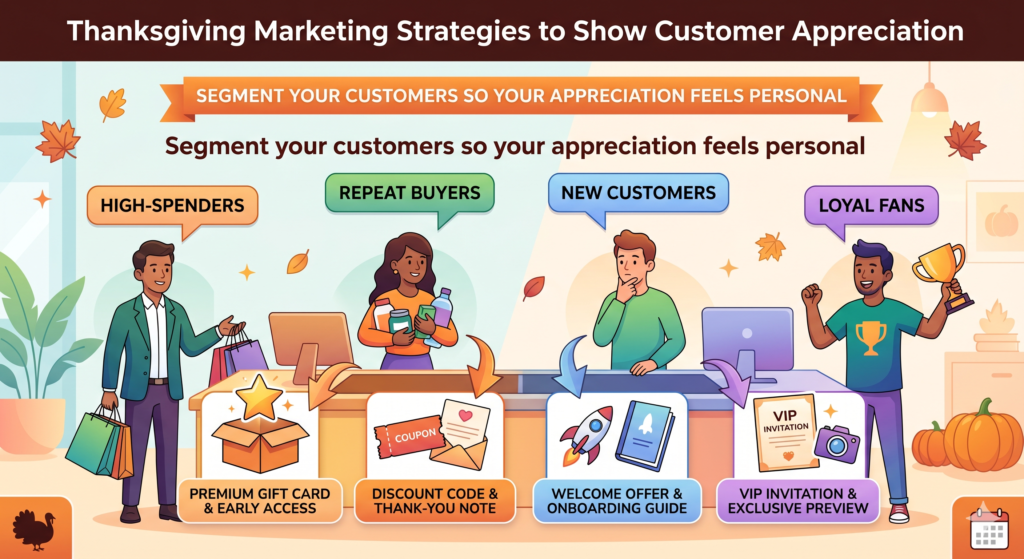
Segment your customers so your appreciation feels personal
Not every customer has the same relationship with your brand. Some bought once. Some buy every month. Some follow your content but have not purchased yet. Some referred friends. Some left feedback. Some have been silent for a while. If you send the same Thanksgiving message to everyone, it may still work, but it will not feel as personal as it could.
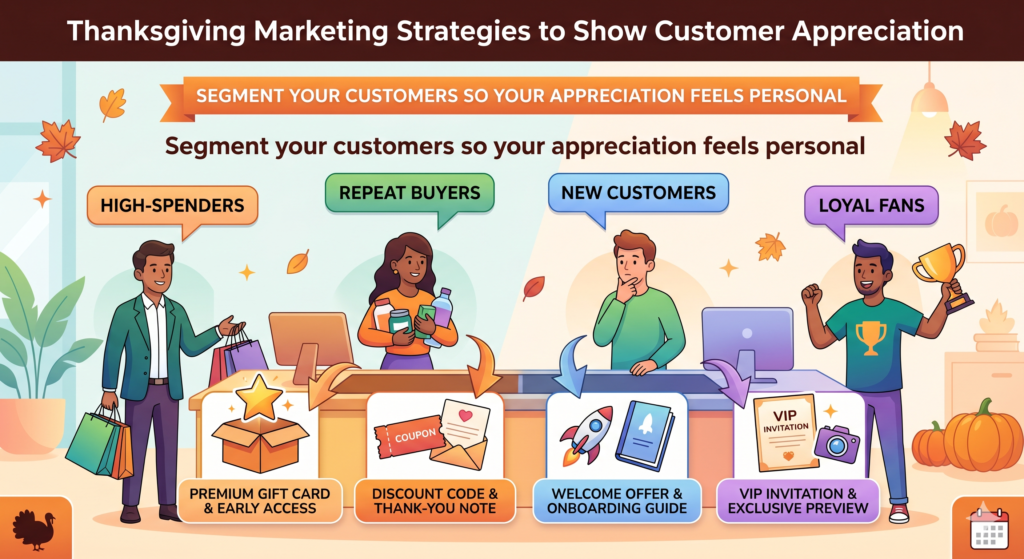
Segmentation helps you say the right thank-you to the right person. It turns one broad holiday campaign into a set of smaller, more meaningful messages. This is one of the simplest ways to make Thanksgiving marketing feel more human.
A loyal customer should not receive the same message as someone who joined your email list yesterday. A repeat buyer deserves to feel seen for their loyalty. A first-time customer deserves a warm welcome. A past customer may need a gentle reason to reconnect. Each group needs a slightly different message.
Start with simple customer groups
You do not need a complex data system to segment your Thanksgiving campaign. Start with groups you can clearly understand. Repeat buyers, first-time buyers, inactive customers, high-value customers, email subscribers, referral customers, and social followers are all useful groups.
For repeat buyers, your message can thank them for coming back again and again. For first-time buyers, your message can thank them for giving your brand a chance. For inactive customers, your message can be warm without sounding needy. For high-value customers, your message can feel more exclusive and personal.
This level of care makes your message stronger. Customers can tell when a brand is speaking directly to their relationship with it.
Match the thank-you to the customer’s behavior
The best appreciation messages are tied to something the customer actually did. If someone referred a friend, thank them for sharing your brand. If someone left a review, thank them for helping others choose with confidence. If someone bought during a hard season, thank them for supporting your work.
This is where many brands miss a major chance. They thank everyone in the same vague way. But vague thanks are easy to forget. Specific thanks are much harder to ignore.
A message to a repeat customer could say, “You came back more than once this year, and that means a lot to us. Every repeat order tells us we are earning your trust, and we are grateful for that.”
A message to a reviewer could say, “Your review helped another customer feel more confident. That kind of support matters more than you may know.”
These messages are simple, but they carry weight because they are rooted in real action.
Use customer data without making it feel cold
Personalization can quickly become uncomfortable if it feels too automated. You want customers to feel known, not watched. The safest way to use data is to keep it helpful, warm, and natural.
For example, saying, “You placed 14 orders and spent $842 this year” may feel too direct for some brands. But saying, “You came back many times this year, and we are truly thankful for your continued trust” feels softer and more human.
The goal is not to show customers how much data you have. The goal is to use what you know to make the message more relevant.
For service businesses, this may mean mentioning the type of project you helped with. For ecommerce brands, it may mean thanking customers for being part of a product community. For B2B brands, it may mean thanking clients for trusting your team with key business goals.
Keep personal messages short, warm, and useful
A personal message does not need to be long. In fact, shorter often feels better when it is clear and sincere. Customers are busy during the holiday season. They may be planning travel, meals, family time, shopping, or year-end work. Your message should respect that.
The best Thanksgiving message should feel easy to read. It should have a clear thank-you, a reason behind the thank-you, and one simple next step if needed.
That next step does not always need to be a purchase. It can be “enjoy this gift,” “read this guide,” “reply and tell us what you need,” “claim early access,” or “share this with someone who may enjoy it.”
When the message is clear, customers are more likely to act.
Create a Thanksgiving email campaign that feels like a real note
Email is one of the strongest channels for Thanksgiving marketing because it gives you space to speak directly to your customer. But it is also one of the easiest places to sound generic. During the holiday season, inboxes get crowded fast. Customers see subject lines about gratitude, sales, early access, holiday deals, and limited-time offers all at once.
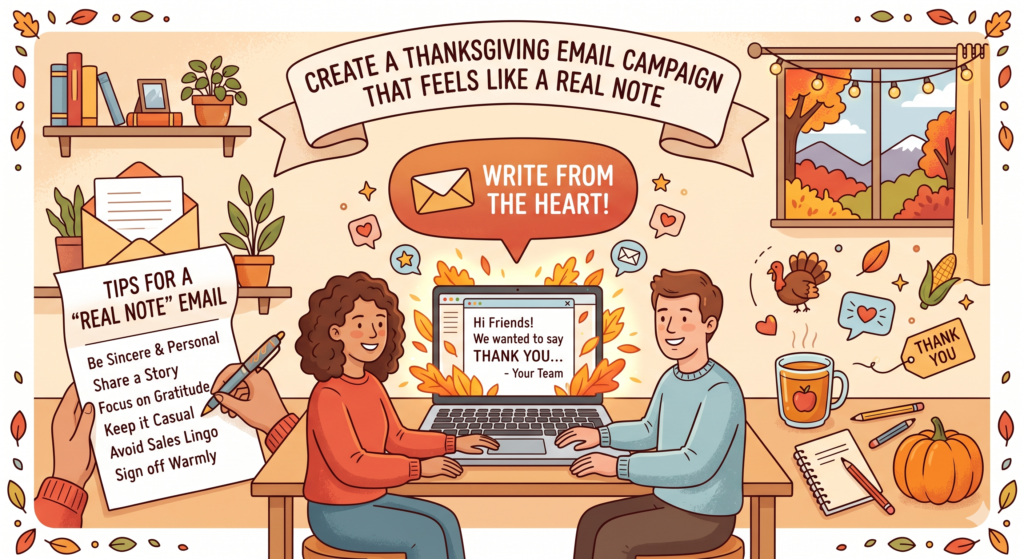
To stand out, your Thanksgiving email should feel less like a blast and more like a real note. It should sound like it came from someone who cares about the customer relationship. That does not mean it must be casual or overly emotional. It just needs to feel honest.
The best Thanksgiving email campaigns often have three parts. First, a pure appreciation message. Second, a helpful or thoughtful gift. Third, a soft bridge into holiday offers. This flow builds trust before asking for action.
Write subject lines that feel warm, not loud
Your subject line sets the tone before the email is opened. If the subject line feels too sales-heavy, the rest of the message has to work harder. A Thanksgiving subject line should feel calm, clear, and personal.
A subject line like “A quick thank-you from our team” can work well because it feels human. “We’re grateful for you” is simple but still effective if the email itself feels sincere. “Before the holiday rush, thank you” works because it hints that this email is not just another sale.
Avoid making every subject line about discounts. “Thanksgiving sale inside” may get clicks from bargain hunters, but it does not build the same emotional connection. If you do include an offer, pair it with appreciation. The message should still feel like the customer matters beyond the purchase.
Let the first line carry the emotion
The first line of your email is important because many people see it as preview text. Do not waste it with a boring phrase like, “As Thanksgiving approaches, we wanted to reach out.” That sounds like many other emails.
Start with something more direct. You could say, “Before the season gets busy, we wanted to pause and thank you.” You could say, “You trusted us this year, and we are grateful for that.” You could say, “This note is simple: thank you for being part of our year.”
These lines are clear and human. They do not try too hard. They get to the point.
Once the email is opened, keep the body focused. Do not turn a thank-you message into a long sales page. If your goal is appreciation, let appreciation lead.
Build a simple Thanksgiving email sequence
One email can work, but a short sequence can work better because it lets you spread the message without crowding everything into one note. The sequence should not feel heavy. It should feel like a natural path from gratitude to helpfulness to a gentle offer.
The first email can be sent several days before Thanksgiving. This should be your pure thank-you message. No hard sell. No pressure. Just appreciation and maybe a small gift or useful resource.
The second email can be sent closer to Thanksgiving. This can share a customer story, team message, holiday tip, or community moment. It should deepen the feeling of connection.
The third email can come after Thanksgiving or as Black Friday begins. This is where you can share your offer, but frame it as a customer-first reward. You are not just selling. You are giving customers a reason to choose you during a busy season.
Make the offer feel like a thank-you, not a trap
If your Thanksgiving email includes a discount, avoid pushy language. Words like “hurry,” “last chance,” and “don’t miss out” can work during Black Friday, but they may feel too harsh in a gratitude campaign.
Instead, position the offer as a customer appreciation perk. You can say, “As a thank-you, we opened this early for our customers.” You can say, “We wanted you to have first access before the holiday rush.” You can say, “This is our small way of saying thanks for being here.”
That framing changes the feeling of the offer. It still creates action, but it does not make the customer feel chased.
Use customer stories to make your gratitude more believable
A brand saying “we appreciate our customers” is nice. A brand showing real customer stories is much stronger.
Customer stories make gratitude feel alive. They show that your brand has real people behind it and real people in front of it. They also help other customers see themselves in your community. This can be powerful during Thanksgiving because the holiday is built around connection, memory, and shared experience.
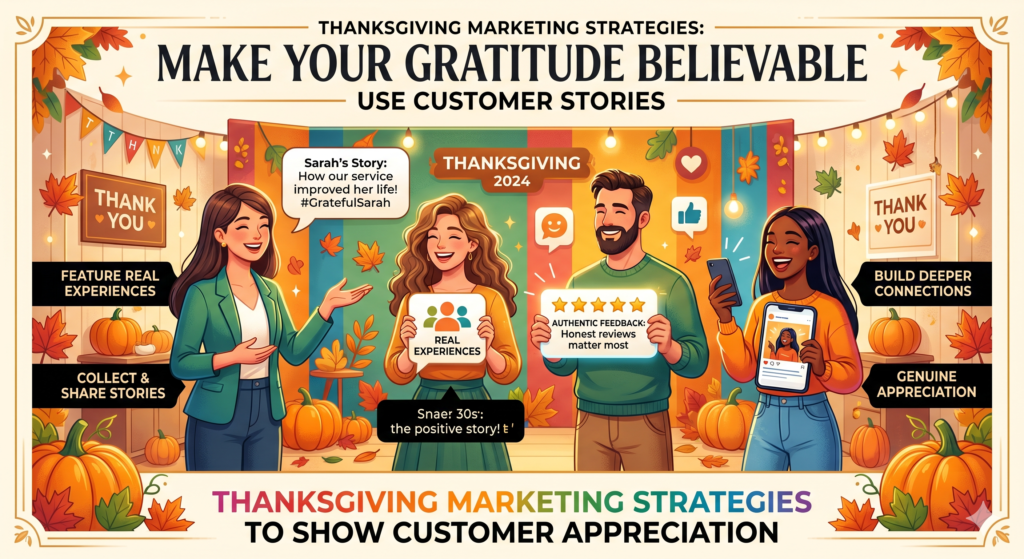
The story does not need to be dramatic. It just needs to be true. A customer who reached a goal, solved a problem, supported your small business, used your product in a meaningful way, or stayed with you through change can become part of your Thanksgiving message.
Choose stories that reflect your brand values
Not every story is the right fit for Thanksgiving. Choose stories that show trust, care, growth, kindness, support, or community. These themes match the season and help your campaign feel natural.
For a marketing agency like WinSavvy, this could mean sharing how a client kept going through a hard growth stage and improved step by step. For an ecommerce brand, it could mean showing how a customer used a product as part of a family tradition.
For a local service business, it could mean highlighting long-time customers who helped the business grow through referrals.
The story should not feel like a case study packed with numbers. Thanksgiving is not the time to sound cold. You can include results, but the human part should come first.
Tell the story with respect and warmth
Customer stories should never feel like you are using someone for content. Always get permission when needed. Keep the story respectful. Do not make the brand the hero every time.
A better approach is to make the customer the hero and your brand the helper. This makes the story feel more honest. It also shows that you understand your role in the customer’s life.
For example, instead of saying, “Our product helped Sarah grow her business,” you could say, “Sarah spent the year building something special. We are grateful our product played a small role in helping her keep that momentum.”
That wording is humble. It gives credit to the customer. It still shows value, but it does not brag.
Turn stories into emails, posts, and landing page sections
A good customer story can be used across many channels. You can share it in an email, turn it into a social post, add it to a Thanksgiving landing page, include it in a short video, or feature it in a founder note.
The format should match the channel. In email, keep the story short and emotional. On social media, use a strong opening line and a warm visual. On a landing page, connect the story to your customer appreciation offer. In video, let the customer or team member speak in a natural voice.
The point is not to overproduce the story. The point is to make customers feel the human side of your brand.
End the story by thanking the wider community
After sharing one customer story, connect it back to everyone. This keeps the message from feeling like it is only about one person.
You can say, “Stories like this remind us why we do the work. To every customer who trusted us this year, thank you.” This creates a bridge from one story to the whole audience.
That kind of ending feels warm and inclusive. It turns one example into a larger message of appreciation.
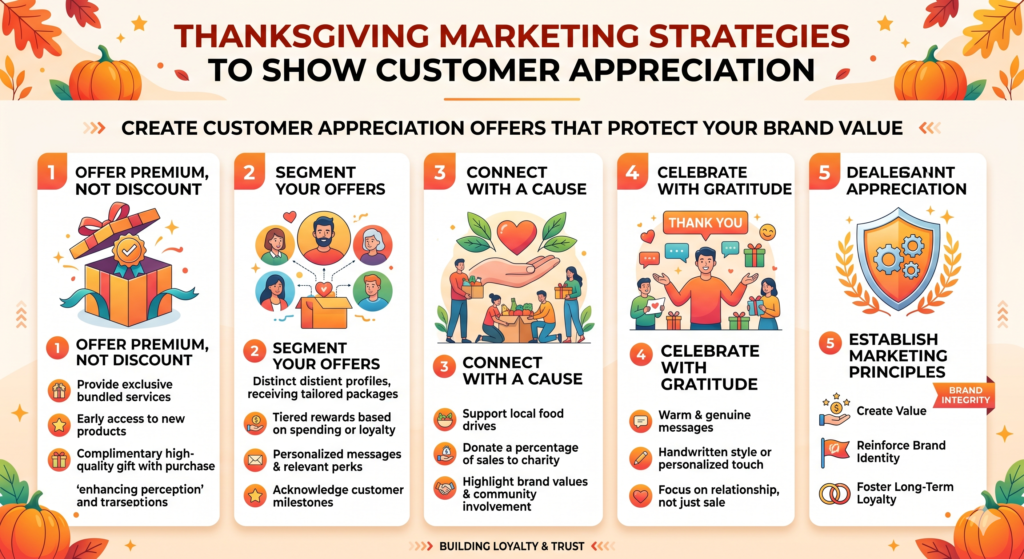
Create customer appreciation offers that protect your brand value
A Thanksgiving offer does not have to be the biggest discount of the year. In fact, it should not always be. If your only way to show appreciation is by lowering prices, customers may start to see your brand as less valuable.
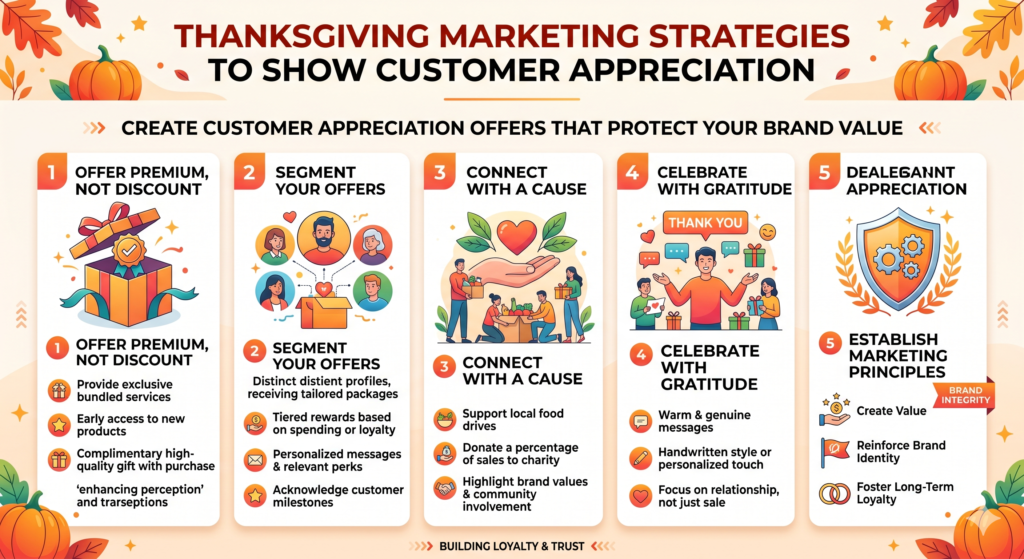
A smarter approach is to create offers that feel generous without training customers to wait for discounts. This is especially important if you sell services, premium products, or long-term solutions. You want customers to feel rewarded, not conditioned to buy only when prices drop.
Thanksgiving appreciation offers should be thoughtful, clear, and tied to customer value. They should make people feel like they are receiving something special because they matter to your brand.
Give added value instead of cutting price every time
Discounts are simple, but added value can be more powerful. Added value means you give customers something extra without reducing the core worth of your product or service.
For example, a service business can offer a free audit, bonus consultation, strategy review, setup support, or extra deliverable. An ecommerce brand can offer free shipping, gift wrapping, a sample, a bonus product, or early access. A SaaS company can offer a free month of a feature, onboarding help, templates, or training.
This kind of offer feels helpful. It also protects your pricing. Customers see that you are giving more, not simply charging less.
Make the offer easy to understand
A Thanksgiving offer should not make customers think too hard. During the holiday season, people are busy and distracted. If the offer is confusing, they will ignore it.
Keep the message simple. Say who the offer is for, what they get, why you are giving it, and how to claim it. Do not hide the terms. Do not make the customer click through five pages to understand the value.
A clear offer might say, “As a thank-you to our customers, we are including free gift wrapping on every order this week.” Another could say, “Book your strategy call before Thanksgiving and we will include a free landing page review.”
The simpler the offer, the easier it is to act on.
Reward loyal customers before new customers
One of the biggest mistakes brands make during holiday marketing is giving the best deals to new customers while loyal customers get nothing special. This can quietly hurt trust.
Your existing customers should feel valued first. They are the people who already believed in your brand. Thanksgiving is the perfect time to prove that loyalty matters.
Give them early access, a better bonus, a private offer, or a personal thank-you. Even if the reward is small, the gesture matters. It tells them they are not being forgotten while your brand chases new buyers.
Let loyal customers feel like insiders
People love feeling included. A customer appreciation campaign can create that feeling without being fake. You can call it a customer-first preview, a thank-you access window, or a private holiday perk.
The language should feel warm, not exclusive in a cold way. The goal is not to make others feel left out. The goal is to make loyal customers feel seen.
You could say, “Before we share this with everyone else, we wanted our customers to have first access.” That line is simple and powerful. It makes the customer feel respected.
When customers feel like insiders, they are more likely to open future emails, join future offers, and stay connected to your brand.
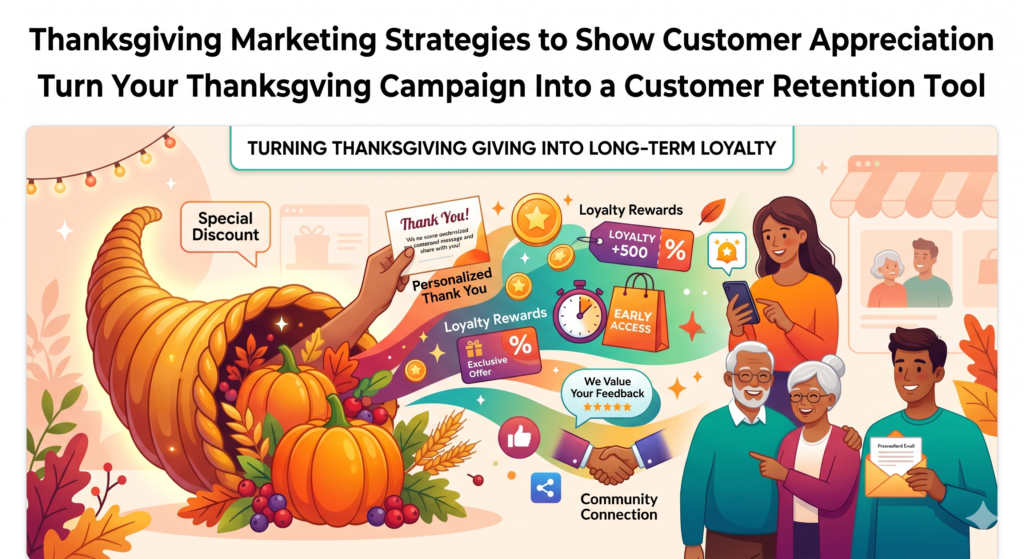
Turn your Thanksgiving campaign into a customer retention tool
Thanksgiving marketing should not be treated as a one-day message. It should be used as a smart way to strengthen customer retention.
Retention means keeping customers connected to your brand after the first sale. It means giving them enough value, care, trust, and reason to come back. Thanksgiving is a strong moment for this because customers are already in a reflective mood.
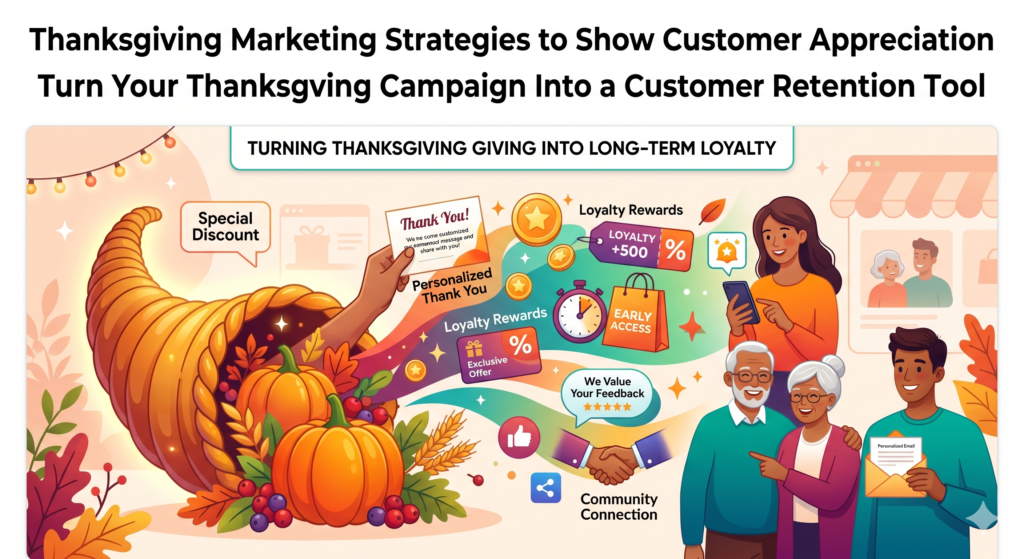
They are thinking about people, memories, plans, family, and the end of the year. If your brand shows up with care during this moment, it can deepen the relationship.
Many businesses spend most of their energy trying to win new customers during the holiday season. That makes sense because shopping activity is high. But the easiest revenue often comes from people who already know you.
They have already trusted you once. They have already opened the door. Thanksgiving gives you a chance to remind them why staying with your brand is worth it.
Retention does not happen because of one coupon. It happens because the customer feels that your brand is still useful after the first purchase. Your Thanksgiving campaign should make that feeling clear.
Use Thanksgiving to remind customers of the value they already received
A strong retention message helps customers remember why they chose you in the first place. This is not bragging. It is reminding.
For example, if you are a skincare brand, you can remind customers that small daily care matters during colder months. If you are a marketing agency, you can remind clients of the growth steps they took this year and how those steps will help them next year.
If you are a software company, you can remind users of the time they saved, the tasks they completed, or the goals they reached with your tool.
This kind of message works because it connects gratitude with progress. It does not just say, “Thank you.” It says, “Look at what we have built together.”
That makes the customer feel their choice had value.
Make the customer feel proud of staying with you
Customers like to feel smart about the brands they support. They want to know they made a good choice. Thanksgiving is a good time to support that feeling.
You can do this by showing how your brand improved because of customer support. Maybe you launched better service hours, improved product quality, added new guides, created faster delivery, built better onboarding, or helped more customers reach a result. When you share these updates, connect them back to customer trust.
Instead of saying, “We added new features this year,” say, “Your feedback helped us improve the features you use most.” Instead of saying, “We expanded our team,” say, “Your support helped us bring in more people so we can serve you better.”
This turns business updates into customer appreciation. It also makes customers feel involved in the brand’s growth.
Create post-Thanksgiving follow-up that keeps the relationship warm
Most brands go quiet after Thanksgiving unless they are sending Black Friday or Cyber Monday emails. That is a missed chance.
A smart follow-up can keep the relationship warm without pushing too hard. After Thanksgiving, you can send a message that says, “We hope you had a peaceful holiday. Here is something useful as you head into the rest of the season.” That “something useful” could be a checklist, guide, plan, recipe, template, reminder, or customer-only tip.
The key is to keep adding value. Do not let the only follow-up be another sale message.
For service brands, this can be a simple year-end planning note. For ecommerce brands, it can be a gift guide based on customer needs. For SaaS brands, it can be a short product tip that helps users get more value before the year ends.
Use the season to start a renewal or repeat purchase path
Thanksgiving sits close to the end of the year, which makes it a natural time to guide customers toward their next step. This should be done carefully. The message should feel helpful, not rushed.
If a customer bought a product that needs refilling, replacing, upgrading, or gifting, Thanksgiving is a good time to remind them. If a client may need planning for the next quarter, Thanksgiving is a good time to start that conversation. If a subscriber has not used a feature in a while, Thanksgiving is a good time to reintroduce it with a warm note.
The best way to do this is to frame the next step around the customer’s benefit. You are not saying, “Buy again because we need sales.” You are saying, “Here is how to keep getting value.”
A simple line could be, “As you plan for the rest of the season, we wanted to make it easier to stock up, schedule ahead, or get support before the year-end rush.” This feels useful because it helps the customer think ahead.
Use social media to show appreciation without sounding performative
Social media is a natural place for Thanksgiving content, but it can also feel fake if the message is too polished. Customers can tell when a brand is posting gratitude only because the calendar says it should.
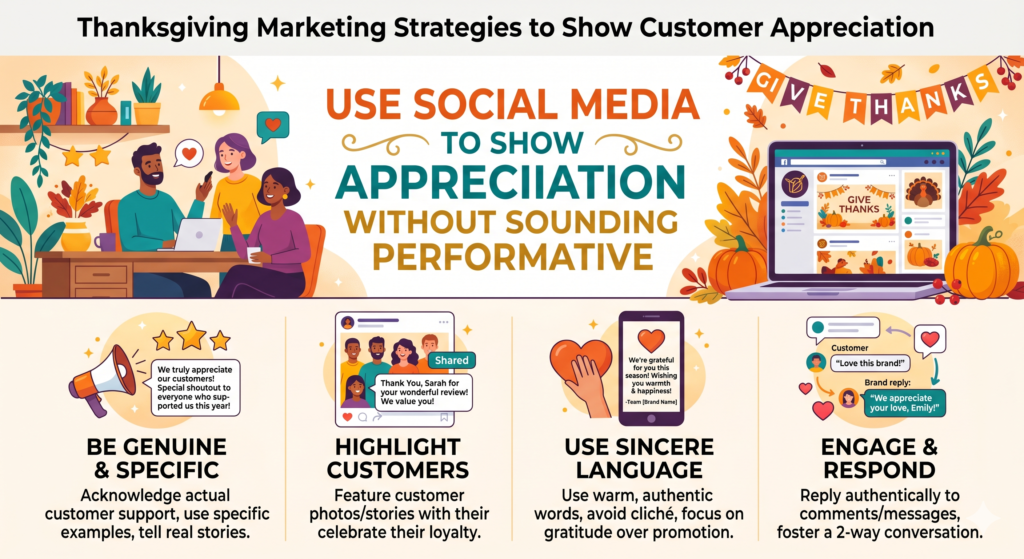
The best Thanksgiving social content feels honest, simple, and grounded in real people. It should not be a generic stock photo with “Happy Thanksgiving” written across it. That may be fine as a basic greeting, but it will not build much connection.
Social media gives you a chance to show the people, customers, moments, and values behind your brand. This is where you can be more relaxed. You can show your team packing orders, writing notes, preparing customer gifts, sharing what they are grateful for, or talking about a customer win that made the year meaningful.
The goal is not to look perfect. The goal is to feel real.
Make your Thanksgiving posts about people, not just the brand
People connect with people. A Thanksgiving post that shows a founder, team member, customer, or community moment will usually feel stronger than a plain branded graphic.
You can share a short founder note that thanks customers for trusting the brand. You can show team members saying what customer support means to them. You can share a behind-the-scenes photo of your team preparing holiday orders. You can highlight customers who helped shape your year.
The most important thing is that the post should feel like it has a heartbeat. It should not feel like it was made only to fill a content slot.
For example, a strong post could talk about one real moment from the year. Maybe a customer sent a kind email. Maybe a client reached a big goal. Maybe your team solved a hard problem. Maybe a small review made everyone’s day. These moments are easy to understand and easy to feel.
Keep the caption clear, warm, and specific
A good Thanksgiving caption does not need to be long, but it should not be empty. Avoid writing something vague like, “We are thankful for our amazing customers.” That line is not wrong, but it is too common.
Make it more specific. You could write, “This year, our customers shared feedback, sent kind notes, gave us second chances when things were not perfect, and trusted us with work that mattered. That is something we do not take lightly.”
That feels more real because it names actual forms of support.
You can also write, “Every order, referral, reply, review, and message helped us keep building. Thank you for being part of our year.” This is simple, but it shows that you notice the small actions customers take.
Specific words make gratitude more believable.
Invite customers into the conversation
Thanksgiving is a good time to let customers speak, not just listen. Social media should not only be a place where your brand posts messages. It should be a place where customers can respond, share, and feel included.
You can ask customers what they are thankful for this year, how they are using your product during the holiday season, what small business they are supporting, or what tradition they look forward to. Keep the question easy to answer. Do not ask something that feels like homework.
A good question could be, “What is one small thing you are thankful for this week?” Another could be, “Who is one person who made your year better?” These questions feel human. They are not just about your brand, but they still create connection around it.
For B2B brands, the question can be more work-related while still staying warm. You could ask, “What customer moment made you proud this year?” or “What is one business lesson you are thankful for this year?”
Respond like a real person
If customers take time to comment, reply with care. Do not only like the comment and move on. A thoughtful reply can deepen the relationship.
If someone shares a personal answer, respond in a way that shows you read it. If someone thanks your brand, thank them back. If someone mentions a team member, pass that message along and say so. These small replies matter because they turn a post into a real conversation.
This is where many brands lose the human touch. They ask a question, get answers, and then ignore them. That makes the question feel like engagement bait. If you invite customers to speak, be ready to listen.
Build a Thanksgiving landing page that does more than sell
A Thanksgiving landing page can be useful if you have a customer appreciation offer, a seasonal campaign, a gift guide, a donation effort, or a loyalty reward. But the page should not feel like a normal sales page with a holiday banner added on top.
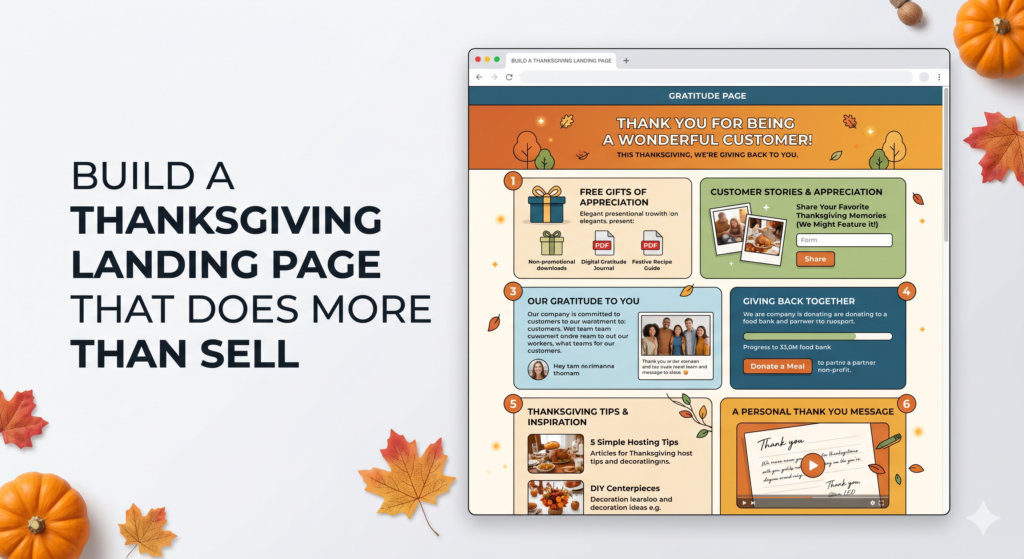
The page should carry the feeling of Thanksgiving. It should be warm, clear, easy to read, and focused on the customer. It should explain why the campaign exists, what customers get, how to take part, and why the offer matters.
This is especially useful if you are running ads, sending email traffic, promoting social posts, or giving customers early access to something. Instead of sending everyone to a normal product page, a Thanksgiving landing page lets you shape the full message.
Start the page with appreciation before the offer
The top of the landing page matters. Do not begin with a loud discount headline unless your whole campaign is built around price. Start with a short thank-you that makes the customer feel welcome.
A strong opening could say, “A small thank-you for the customers who made our year possible.” This tells visitors that the page is about them, not just the sale.
Then you can explain the offer in simple words. The offer should be easy to understand within a few seconds. Customers should know what they are getting, who it is for, and what they should do next.
Do not make the page too clever. A confused customer will leave. A clear customer will act.
Make the page feel calm and easy to move through
Holiday pages often become crowded. Brands add banners, timers, pop-ups, product grids, badges, long blocks of text, and too many calls to action. That can create stress.
Thanksgiving appreciation pages should feel calmer. Use short paragraphs. Use clear section breaks. Let each part of the page do one job. One section can thank the customer. One section can explain the offer. One section can show customer stories. One section can answer common questions. One section can guide the next step.
The page should feel like a smooth path, not a maze.
Even if you include several products or services, group them in a way that makes choosing easy. For example, you can organize gifts by customer need, budget, use case, or timing. This helps people act faster without feeling pushed.
Add trust through real proof
Thanksgiving campaigns are emotional, but customers still need confidence before they act. Your landing page should include trust signals that support the offer.
This can include customer reviews, short testimonials, client results, user photos, press mentions, return details, delivery dates, service guarantees, or simple answers to common concerns. The key is to keep the proof natural. It should support the appreciation message, not overpower it.
For example, if you are offering a customer appreciation bundle, show a few customer comments about why they love those products. If you are offering a strategy session, share one short client quote about how your team helped them find clarity. If you are offering a holiday gift guide, include reviews that help customers choose with confidence.
Use customer words wherever possible
Customer words are often more powerful than brand words. A review that says, “This made my holiday shopping easier” can sell better than a long paragraph from your brand.
Thanksgiving is a great time to use these words because they make the page feel more personal. They show that real people have trusted you and received value.
Do not edit customer words until they sound like advertising. Keep them natural. Fix small errors only if needed for clarity. The more real the words feel, the more trust they build.
A landing page with warm brand copy and real customer voices can become a strong bridge between appreciation and action.
Send handwritten notes or personal messages when the customer value is high
Not every Thanksgiving campaign needs to scale. Sometimes the most powerful marketing is slow, personal, and small.
Handwritten notes, personal emails, voice messages, short videos, and direct thank-you calls can have a deep impact, especially for high-value customers, long-term clients, referral partners, donors, members, or repeat buyers. These touches stand out because customers know they took extra time.
In a world full of automated emails, a personal message feels rare. It tells the customer, “You are not just part of a list.” That feeling can protect loyalty better than many discounts.
This is especially important for service businesses, agencies, consultants, B2B brands, luxury brands, local businesses, and community-based brands. When the relationship matters, personal appreciation matters even more.
Choose the right customers for personal outreach
Personal outreach takes time, so you should be thoughtful about who receives it. Start with customers who have had the biggest impact on your business or community.
This may include your longest-standing customers, highest-value accounts, most active users, strongest referral sources, best reviewers, most engaged community members, or customers who stayed with you during a difficult period.
The goal is not to make other customers feel less important. The goal is to match the level of effort to the depth of the relationship. A personal message should go where it will mean the most.
For smaller businesses, you may be able to send personal notes to many customers. For larger businesses, you may need to focus on key groups. Either way, the message should feel real.
Mention something only that customer would recognize
The power of a personal note comes from detail. If the note could be sent to anyone, it will not feel very personal.
Mention a project, purchase, milestone, referral, conversation, review, or moment that connects to that customer. Keep it simple and respectful. You do not need to include private details. Just show that you remember the relationship.
A note could say, “Thank you for trusting us with your launch this year. Watching your team move from planning to real growth was one of the highlights of our year.”
Another could say, “Your review in March helped more people understand what we do, and we still talk about how kind it was.”
These details make the thank-you feel earned.
Make personal messages part of your system
Personal outreach should not depend only on someone remembering at the last minute. Build it into your Thanksgiving campaign plan.
Decide who will receive personal messages. Decide who will write them. Set a simple deadline. Create a basic message guide, but do not force everyone to use the exact same words. Give your team room to sound human.
If you are sending handwritten cards, prepare addresses early. If you are sending personal videos, keep them short. If you are making calls, make sure the purpose is thank-you only, not a hidden sales pitch.
The customer should not feel trapped in a sales conversation. The gift is the gratitude itself.
Keep the message free from pressure
A personal thank-you message should not end with a hard ask. Do not write a warm note and then immediately push for an upgrade, renewal, or referral. That weakens the sincerity of the message.
You can leave the door open gently. For example, you can say, “We are grateful for your trust and look forward to supporting you in the year ahead.” That is enough.
If you want to include a gift, keep it simple. A small credit, free bonus, donation in their name, gift card, or useful resource can work well. But the note should still be the main thing.
When personal appreciation is done without pressure, customers remember it.
Use Thanksgiving to collect feedback in a way that feels respectful
Thanksgiving is not only a time to thank customers. It is also a good time to listen to them.
When customers feel appreciated, they are often more willing to share honest feedback. They may tell you what they loved, what confused them, what could be better, and what they want next. This feedback can improve your marketing, product, service, sales process, and customer experience.
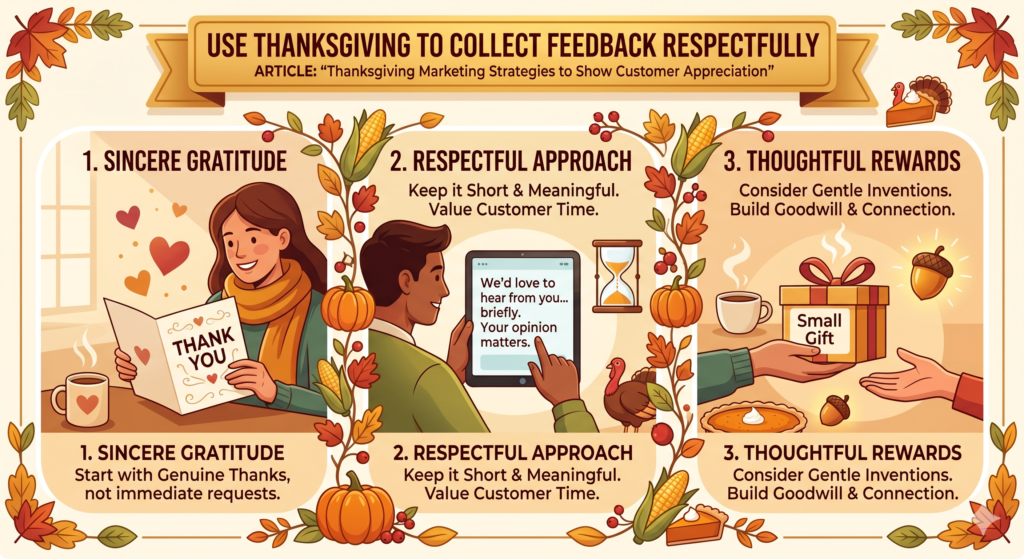
But the way you ask matters. A feedback request during Thanksgiving should not feel like a chore. It should feel like an invitation to help shape the brand they already support.
Ask for feedback after you show appreciation
Do not open with the survey. Open with the thank-you.
A message that says, “Please fill out this survey” feels like work. A message that says, “Your support helped us grow this year, and your feedback can help us serve you better next year” feels more respectful.
This small framing change makes the request feel meaningful. Customers are not just answering questions. They are helping improve something they are part of.
The survey itself should be short. During the holiday season, people do not want to spend fifteen minutes answering long forms. Ask only what you will actually use.
Keep the questions simple and useful
The best feedback questions are easy to answer. Ask what the customer liked, what almost stopped them from buying, what they wish was easier, what they want next, and how you can serve them better.
For example, you can ask, “What is one thing we did well this year?” You can ask, “What is one thing we could make easier for you?” You can ask, “What would you like to see from us next?”
These questions are simple, but they can give you strong insights.
Avoid questions that feel too cold or complex. Do not make customers rank ten different things unless you truly need that data. The easier the survey feels, the more people will complete it.
Turn feedback into future appreciation
Feedback should not disappear into a spreadsheet. If customers take time to share their thoughts, show them that it mattered.
After Thanksgiving, send a follow-up message that explains what you learned and what you plan to improve. You do not need to share every detail. Just show that you listened.
You could say, “Many of you told us you wanted clearer shipping updates, so we are improving those messages before the next holiday rush.” Or you could say, “Several customers asked for simpler planning tools, so we are building a new guide for the new year.”
This closes the loop. It shows customers that their voice has power.
Thank customers again when changes are made
When you make an improvement based on feedback, thank customers directly. This can become a powerful retention moment.
You can say, “You asked for this, and we listened.” That line is simple, but it makes people feel valued. It shows that the relationship is not one-way.
This is one of the most strategic ways to use Thanksgiving. You start with gratitude, invite feedback, improve the customer experience, and then return with proof that customer voices shaped the brand.
That is how appreciation becomes growth.
Create Thanksgiving content that helps before it sells
Thanksgiving content should not only say thank you. It should also make the customer’s life easier during a busy time.
This is where many brands can stand out. Most holiday content is either a greeting or a sale. But useful content gives customers a reason to pay attention before they are ready to buy. It helps them solve a small problem, make a better choice, save time, avoid stress, or enjoy the season more.
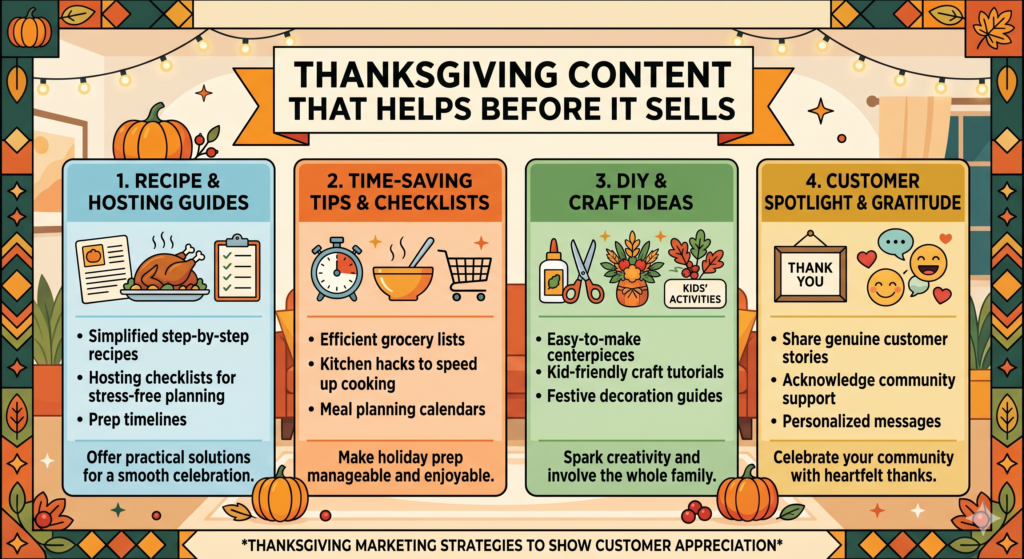
That kind of content feels like service. And service is one of the strongest forms of appreciation.
If your brand can help customers during Thanksgiving, they will remember you with more trust. They may not buy right away, but they will see your brand as helpful. That feeling can lead to stronger sales later, especially when the holiday shopping rush begins.
Think about what your customers are dealing with right now
Good Thanksgiving content starts with the customer’s real life. What are they trying to do this week? What are they worried about? What are they planning? What do they need to decide soon?
For a food brand, customers may need recipes, prep tips, storage ideas, or hosting help. For a fashion brand, they may need outfit ideas for family meals or travel. For a home brand, they may need table setup ideas, cleaning tips, or guest room advice.
For a B2B brand, they may need year-end planning help, budget advice, client gift ideas, or ways to finish the year strong.
The best content is not random. It meets the customer where they are.
A Thanksgiving content piece should feel like it was made because you understand the season, not because you needed another post on the calendar.
Make the content easy to use in minutes
During Thanksgiving, people do not have time for long, hard-to-follow content unless it solves a serious problem. Keep your advice clear and practical. Make each paragraph useful. Remove anything that sounds nice but does not help.
If you create a guide, make it simple. If you create a video, get to the point quickly. If you create an email tip, make it something the customer can act on today.
For example, a home goods brand could write a short guide on how to make a dinner table feel warm without buying many new things. A fitness brand could share how to stay active during a week of travel and big meals without guilt. A marketing agency could share how business owners can use Thanksgiving to reconnect with past clients.
The key is to give customers something they can actually use.
Connect helpful content to appreciation naturally
Useful Thanksgiving content should not feel like a hidden sales pitch. But it can still connect back to your brand in a natural way.
The simplest way is to frame the content as a thank-you. You can say, “As a small thank-you for being part of our community, we put together this simple guide to help you make the holiday easier.” That makes the content feel like a gift.
Then, if you mention your product or service, do it in a way that supports the advice. Do not force the sale into every paragraph. Let the content build trust first.
If the customer needs your product, they will understand the next step. If they are not ready, they will still leave with a better view of your brand.
Use content to warm up your Black Friday audience
Thanksgiving content can also prepare customers for later offers without making them feel rushed. A helpful guide can lead into a gift guide. A thank-you email can lead into early access. A customer story can lead into a seasonal package.
This works because helpful content builds attention before the sales window opens. Instead of showing up only when you want money, your brand shows up first with value.
That is a better path. Customers are more likely to buy from a brand that helped them first.
Use Thanksgiving to bring back quiet customers
Every brand has quiet customers. These are people who bought before, joined your list, followed your brand, or showed interest, but have not engaged in a while.
Thanksgiving is a good time to reach them because the tone can be warm instead of pushy. You do not have to say, “Where have you been?” You can simply say, “We are thankful you have been part of our journey, and we would love to welcome you back.”
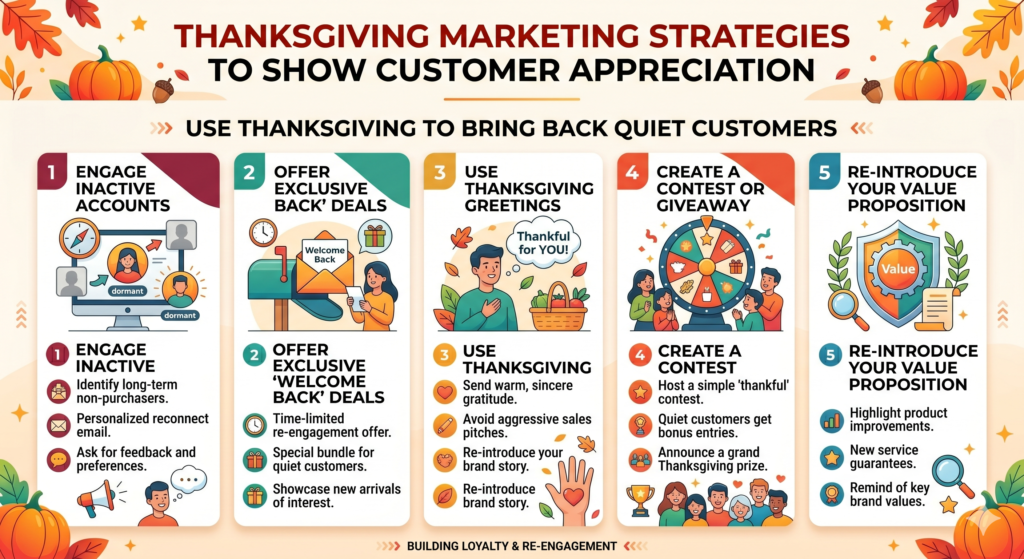
That kind of message feels softer than a normal win-back campaign. It gives people a reason to reconnect without making them feel guilty.
Quiet customers are valuable because they already know your brand. They may need a reminder, a better reason, a more relevant offer, or a fresh message. Thanksgiving gives you a natural reason to start that conversation again.
Write re-engagement messages with care
A re-engagement message should feel kind. Avoid language that sounds needy, dramatic, or fake. Do not say things like, “We miss you badly” or “You have ignored us.” That puts pressure on the customer.
Instead, keep the message calm and respectful. Thank them for being part of your past. Share what has changed. Give them a simple reason to return.
For example, you can say, “You have been part of our community before, and we are grateful for that. Since you last heard from us, we have made a few updates that may be helpful this season.”
This line does three things. It thanks them. It respects the gap. It gives them a reason to keep reading.
Show what is new since they left
Quiet customers often need more than a discount. They need to know why coming back is worth their attention.
Tell them what has improved. Maybe you added new products, better shipping, simpler pricing, faster support, new resources, improved service packages, or better customer care. Keep this update short and focused on their benefit.
Do not list every change. Choose the changes that matter most to the customer. A quiet customer does not need a full company update. They need a clear reason to care again.
A good message could say, “We made checkout faster, added more gift-ready options, and created a few customer-only perks for the holiday season.” That is simple and useful.
Offer an easy path back
Once you have thanked the customer and shared what is new, make the next step easy. Do not send them into a complex funnel. Give them one clear action.
That action might be browsing a gift guide, claiming a customer appreciation offer, updating their preferences, booking a call, reading a useful guide, or replying with what they need.
For inactive email subscribers, a preference update can work well. It shows respect because you are not assuming what they want. You are giving them control.
For past buyers, a small welcome-back gift can work. But again, keep the framing warm. The message should feel like appreciation, not desperation.
Let people leave gracefully if they are no longer interested
Customer appreciation also means respecting people who no longer want to hear from you. Thanksgiving is a good time to clean your list in a kind way.
You can send a simple message that says, “We only want to send emails that are useful to you. If you would rather not hear from us, you can update your preferences or unsubscribe anytime.”
This may seem scary because some people will leave. But a cleaner list is better than a tired list. People who stay are more likely to engage. People who leave were probably not going to buy soon anyway.
Respect builds trust, even when it means letting go.
Make your Thanksgiving ads feel warm instead of aggressive
Thanksgiving ads can work well, but only if they match the mood of the holiday. People expect some promotions during this season, but they are also sensitive to brands that feel too pushy too early.
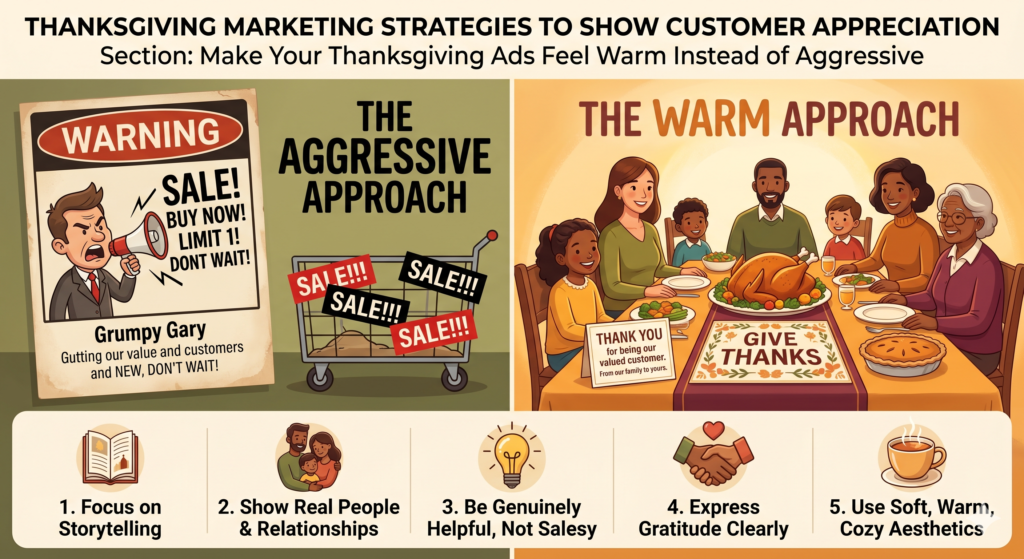
The best Thanksgiving ads do not scream. They invite. They thank. They offer something useful. They make the customer feel like the campaign was made for them, not just pushed at them.
This does not mean your ads should be weak. Strong ads can still be warm. You can sell clearly while keeping the message human. The trick is to lead with the customer’s need and the brand’s appreciation, not with pressure.
Use softer hooks for Thanksgiving ad copy
Ad hooks during Thanksgiving should feel different from regular sales hooks. Instead of starting with “Buy now” or “Limited time deal,” start with a message that connects to the season.
A strong hook could say, “A small thank-you for being part of our year.” Another could say, “Make the season easier with a gift from us.” Another could say, “Before the holiday rush, enjoy early access made for our customers.”
These lines still create interest, but they do not feel harsh.
The visual should also support the message. Warm real-life photos often work better than overly polished graphics. Show people using the product, enjoying the result, preparing for the season, or receiving something thoughtful.
Match the ad to the customer journey
Not every Thanksgiving ad should ask for a purchase. Some ads should build awareness. Some should drive email signups. Some should bring back past visitors. Some should reward existing customers.
For cold audiences, use helpful content or a simple seasonal message. They do not know you yet, so a hard offer may feel too sudden. For warm audiences, use customer stories, gift guides, or appreciation offers. For past buyers, use loyalty messages and early access.
This matters because the same ad will not work for every audience. A new visitor needs trust. A past buyer needs a reminder. A loyal customer needs recognition.
When your ad matches the relationship, it feels smarter and more personal.
Retarget with gratitude, not pressure
Retargeting can become annoying during the holiday season. Customers visit a page once and then see the same urgent ad everywhere. This can hurt the brand experience.
Thanksgiving retargeting should feel more thoughtful. Instead of saying, “You forgot this,” you can say, “Still thinking it over? Here is a small thank-you to make the choice easier.” That feels softer and more helpful.
You can also retarget with proof instead of pressure. Show a customer review, a short product demo, a helpful guide, or a message about your customer appreciation perk. This gives people more reason to trust you without making them feel chased.
Control frequency so your gratitude does not become noise
Even a kind ad can become annoying if people see it too often. During Thanksgiving week, ad space is crowded and customers are already seeing many messages. Keep your frequency under control.
If the same person sees your appreciation message ten times in two days, it no longer feels thoughtful. It feels like a machine.
Set limits where possible. Refresh creative. Stop showing ads to people who already claimed the offer. Create different messages for different stages. This keeps the campaign from feeling repetitive.
Good Thanksgiving ads should feel timely, not tiring.
Partner with a cause in a way that feels honest
Thanksgiving is closely tied to giving, which makes it a good time for cause-based marketing. But this must be handled with care.
Customers can quickly sense when a brand uses a cause only to look good. A weak cause campaign can feel performative. A strong one feels sincere, clear, and connected to the brand’s values.
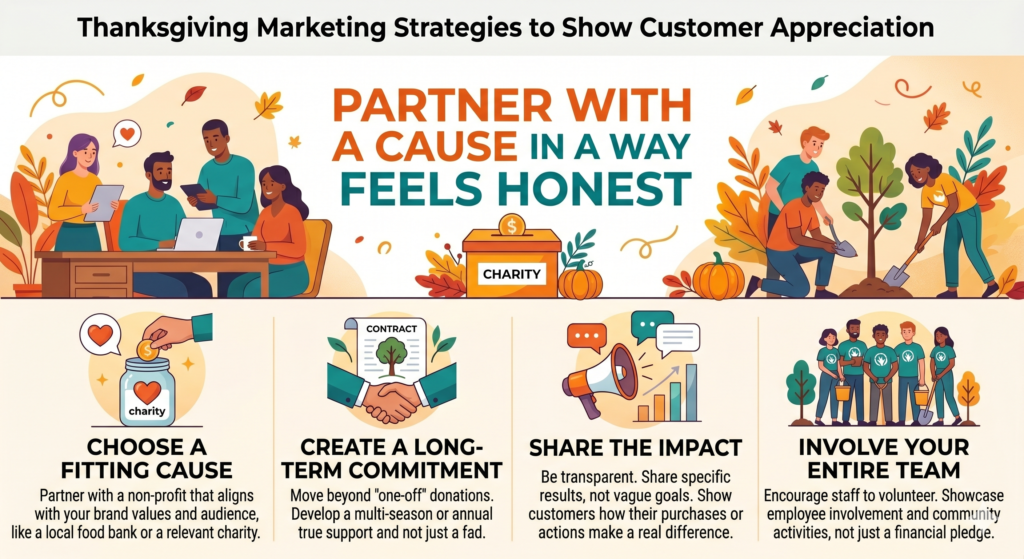
Cause-based Thanksgiving marketing should not be about showing off kindness. It should be about using your business as a channel for real help. That help may support local food banks, community groups, shelters, schools, small business programs, environmental projects, or families in need.
The cause should make sense for your brand and your customers. The connection does not need to be perfect, but it should feel natural.
Choose a cause your brand can explain simply
If customers need a long explanation to understand why you support a cause, the campaign may feel weak. Choose something that your team can talk about clearly.
A food brand supporting hunger relief makes sense. A children’s brand supporting family services makes sense. A local business supporting a local charity makes sense. A marketing agency supporting small business education or local entrepreneurs can also make sense.
The key is to explain the reason in simple words. You can say, “We chose this cause because access to warm meals matters, especially during the holiday season.” Or, “We are supporting local small business owners because they are the heart of many communities.”
Clear reasons build trust.
Be specific about what you are giving
Do not use vague language like “a portion of proceeds” if you can avoid it. Customers want to know what that means. Is it one percent? Five percent? One dollar per order? A fixed donation?
Specific numbers make the campaign more credible. If you are donating meals, say how many meals each purchase helps provide if you can do so honestly. If you are donating money, say the amount or percentage. If your team is volunteering time, share what that time supports.
Clarity matters because cause marketing depends on trust.
If you cannot share exact details yet, be honest. Say what you know and when you will share the final result.
Make the customer part of the impact
A strong Thanksgiving cause campaign helps customers feel involved without making them feel responsible for solving the whole problem.
You can say, “Every order this week helps us donate to local families.” You can say, “Thanks to your support, we are adding to our community fund.” You can say, “You shop, we give, and together we help make the season easier for someone else.”
This works because it connects the customer’s action to a larger good. It gives meaning to the purchase beyond the product.
But the tone should stay humble. Avoid making the campaign sound like your brand is saving the world. Keep it grounded.
Report back after the campaign ends
One of the best ways to build trust is to share the result. After Thanksgiving, tell customers what happened.
You can say how much was donated, how many items were given, how many hours were volunteered, or what the partner organization received. Include a thank-you to customers for making it possible.
This follow-up is important. It proves that the campaign was real. It also gives customers a reason to feel good about taking part.
A good report-back message can become one of your strongest retention emails of the season.
Train your customer service team to deliver Thanksgiving-level care
Marketing does not end when a customer clicks, buys, replies, or asks a question. In many cases, the customer service experience is where appreciation becomes real or fake.
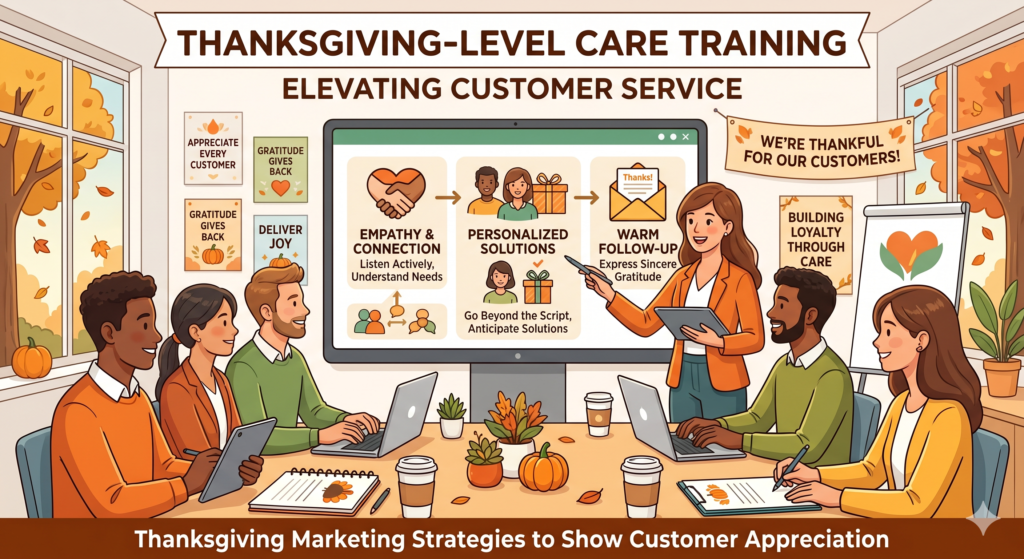
You can write the warmest Thanksgiving campaign in the world, but if your support team is slow, cold, or unhelpful, the message falls apart. Customers judge your gratitude by how they are treated when they need help.
This is why your customer service team should be part of the Thanksgiving marketing plan. They need to know the offers, the message, the tone, the common issues, and the type of care you want customers to feel.
Thanksgiving is a busy time. People may be stressed about shipping, timing, gifts, returns, bookings, or orders. A calm and kind support experience can turn stress into trust.
Give your team clear message guidelines
Your support team should not sound robotic during a customer appreciation campaign. Give them simple language they can use, but do not force every reply to sound the same.
The tone should be warm, clear, and helpful. If something goes wrong, the team should acknowledge it quickly. If a customer is confused, the team should explain the next step in plain words. If a customer is upset, the team should respond with patience.
A good support message could say, “Thank you for reaching out. I know timing matters this week, and I’ll help you get this sorted as quickly as I can.” This feels human and useful.
It does not overpromise. It does not hide behind policy. It shows care.
Prepare answers before the rush begins
Many Thanksgiving customer questions are predictable. People will ask about delivery deadlines, offer terms, gift options, returns, booking times, store hours, refunds, and order changes.
Prepare clear answers before the campaign launches. Put them on your website, landing page, email footer, and support scripts. This reduces stress for customers and your team.
The easier it is to get answers, the more appreciated customers feel.
Good customer care is often about removing friction. When customers do not have to chase basic information, they trust you more.
Empower your team to solve small problems fast
A customer appreciation campaign should give your support team some room to help. If every small issue needs manager approval, customers may wait too long. That can ruin the experience.
Set simple rules for what your team can do on their own. Maybe they can offer free shipping in certain cases, extend a small offer, replace a damaged item, give a store credit, or help with a booking change.
The goal is not to give away value carelessly. The goal is to let the team protect the relationship when it matters.
Celebrate great support moments internally
Your team also needs appreciation. Thanksgiving is a good time to thank the people who serve customers every day.
Share kind customer replies with the team. Thank support staff for handling hard moments. Highlight examples of care that match the brand. This helps build a culture where customer appreciation is not just a campaign. It becomes a habit.
When your team feels valued, they are more likely to make customers feel valued too.
Use Thanksgiving to make your referral program feel more meaningful
Referral campaigns can feel very sales-driven if they are handled the wrong way. Many brands say, “Give your friend a discount and get one too.” That can work, but it does not always feel warm. Thanksgiving gives you a better angle.
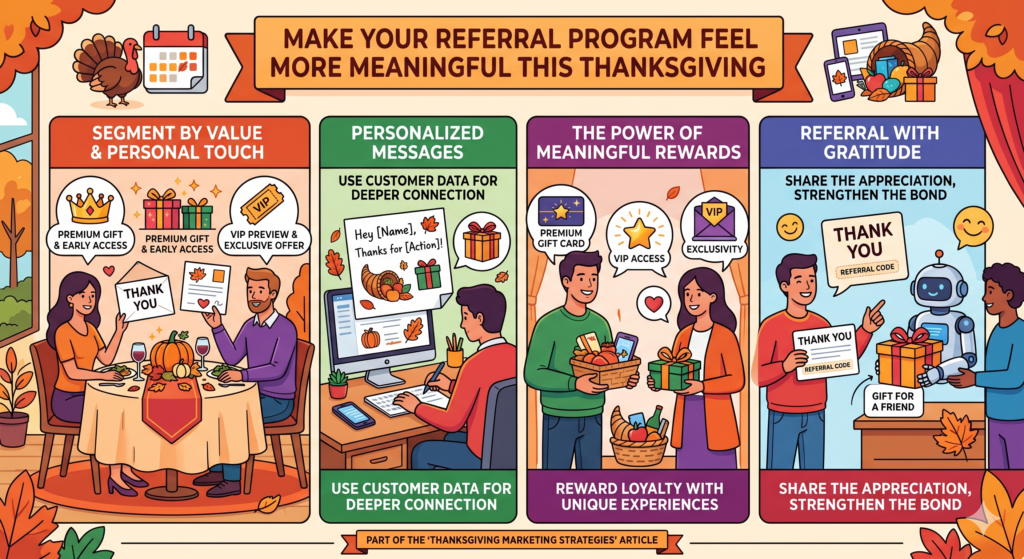
Instead of making referrals feel like a transaction, make them feel like a way to share something useful with people customers care about. This changes the tone. It makes the campaign feel less like a push and more like a thoughtful invitation.
A customer who refers your brand is doing more than helping you grow. They are lending you their trust. They are putting their name beside your business. That deserves real appreciation.
When you build a Thanksgiving referral campaign, the message should not be, “Help us get more customers.” The message should be, “Thank you for helping people find us. If someone you care about could use what we offer, we would love to welcome them with care.”
That feels more human. It respects the customer’s role. It also makes the referral ask softer and easier to accept.
Thank past referrers before asking for new ones
Before you ask for more referrals, look at the people who already shared your brand. These customers are some of your strongest supporters. Thanksgiving is the perfect time to thank them directly.
Send a warm message that names what they did. Do not treat them like a normal buyer. Tell them their trust helped your brand reach new people. Tell them that a referral means more than an ad click because it comes with personal belief.
This can be a simple email, personal note, or private offer. The message should feel sincere. You can say, “You shared our brand with someone this year, and that means a lot. A referral is one of the kindest ways a customer can support a business, and we are thankful for your trust.”
That kind of message makes the customer feel valued beyond the sale.
Give referrers a reward that feels thoughtful
A referral reward does not always need to be cash or a discount. It can be early access, a bonus service, a gift, a credit, a free upgrade, a donation, or a personal thank-you from the founder.
The right reward depends on your brand. If you sell a product people buy often, credit may work well. If you sell services, a bonus session or free review may feel more valuable. If your brand has a strong mission, a donation tied to each referral may fit the Thanksgiving spirit.
The reward should feel easy to understand. Customers should not have to read a long page to know how the program works. Tell them what they give, what their friend gets, and what they receive in return.
A clear referral message builds action because it removes doubt.
Make the referred friend feel welcomed, not targeted
The referred person should also feel the Thanksgiving spirit. They should not land on a cold sales page that says, “Buy now.” They should feel like they were invited by someone who trusts you.
The landing page or email for referred customers should mention the relationship. It can say, “Someone who knows you thought this might help.” That feels warmer than a normal ad message.
Then explain your value simply. Tell them who you help, what problem you solve, and why customers trust you. Keep the message short and friendly. A referred customer already has some trust because a friend sent them. Do not break that trust with aggressive copy.
Protect the trust behind every referral
Referrals are powerful because they are built on trust. That means you must handle them carefully.
Do not spam the referred person. Do not make the referring customer feel used. Do not make the reward hard to claim. Do not hide terms. If something goes wrong, fix it fast.
A referral program can create strong growth, but only when the experience feels fair. Thanksgiving is a good time to check your referral process and remove anything that feels confusing, slow, or one-sided.
When customers feel safe referring you, they will do it more often.
Create Thanksgiving gift guides that feel helpful, not pushy
Gift guides are common during the holiday season, but many of them feel like product catalogs with a holiday title. That is not enough. A strong Thanksgiving gift guide should help customers make better choices with less stress.
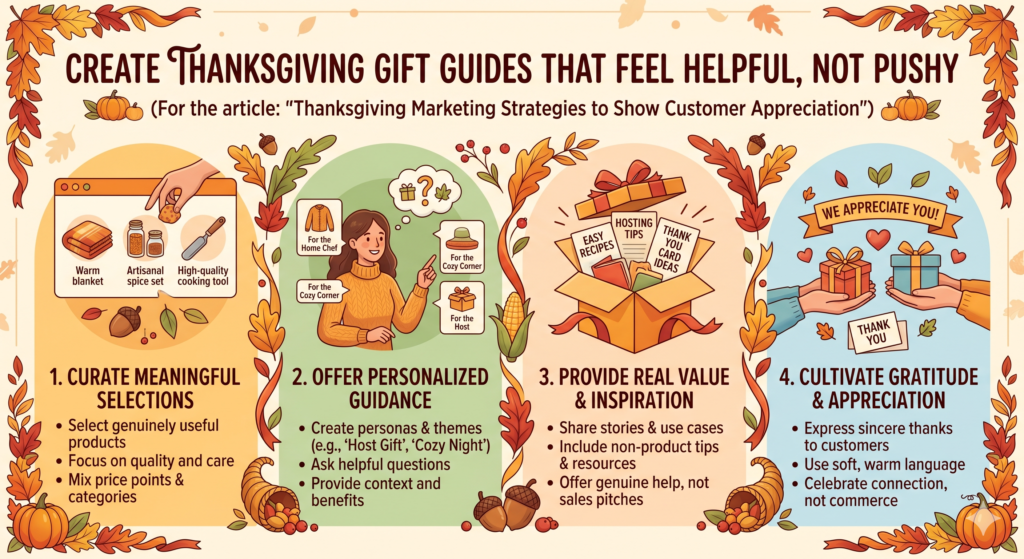
This matters because holiday shopping can feel overwhelming. People are trying to buy for family, friends, coworkers, clients, hosts, teachers, team members, and sometimes themselves. They want good ideas, but they do not want to think too hard.
Your gift guide should act like a helpful friend. It should guide, explain, and simplify. It should not throw every product or service at the customer and expect them to figure it out alone.
Thanksgiving is a great time to launch this guide because many people start thinking seriously about gifts before Black Friday. If your brand helps them early, you become part of their planning process.
Organize the guide by real customer needs
A strong gift guide is not organized only by product type. It is organized by the way people think.
Customers may think, “I need something for my mom.” They may think, “I need a gift under $50.” They may think, “I need something that arrives fast.” They may think, “I need a client gift that feels professional but not boring.”
Build your guide around these needs. This makes it easier for people to choose. It also makes your brand feel more useful.
For example, you can create sections for the busy host, the hard-to-shop-for friend, the loyal client, the new homeowner, the wellness lover, the small business owner, or the person who deserves a break. These categories feel more human than simple product labels.
Explain why each gift makes sense
Do not just show the product and price. Tell customers why that gift works.
A short explanation can make a big difference. You can say, “This is a good choice for someone who likes useful gifts but does not want more clutter.” Or, “This works well for clients because it feels personal without being too casual.”
These small notes help customers feel confident. They also reduce decision stress.
For service businesses, a “gift guide” can still work. You can frame services as gifts of time, clarity, support, growth, or peace of mind. A marketing agency might create a guide for business owners who want to start the new year with a stronger website, better content plan, or clearer sales funnel.
The point is to show value in a way people can picture.
Connect the gift guide to your appreciation campaign
Your Thanksgiving gift guide should not feel separate from your customer appreciation message. Connect them with a clear reason.
You can say, “As a thank-you for being part of our community, we created this simple guide to make holiday planning easier.” That makes the guide feel like a service, not just a sales tool.
You can also give existing customers early access to the guide or a private perk inside it. This rewards loyalty and helps customers feel included.
Add trust signals near key choices
When customers are choosing gifts, they worry about whether the person will like it. Help them feel safer.
Add short customer reviews, delivery notes, return details, size guidance, use tips, or best-for notes near each choice. Keep these details clear and useful.
For example, if a product is your most gifted item, say so. If a service package is best for a founder who needs quick clarity, say that. If an item ships fast, make that clear.
Good gift guides remove doubt. When doubt goes down, action goes up.
Use Thanksgiving to strengthen your local community presence
If your business serves a local area, Thanksgiving can be one of the best times to build community trust. Local customers do not only buy from businesses. They support people they recognize, stores they pass, teams they meet, and brands that show up for the place they call home.
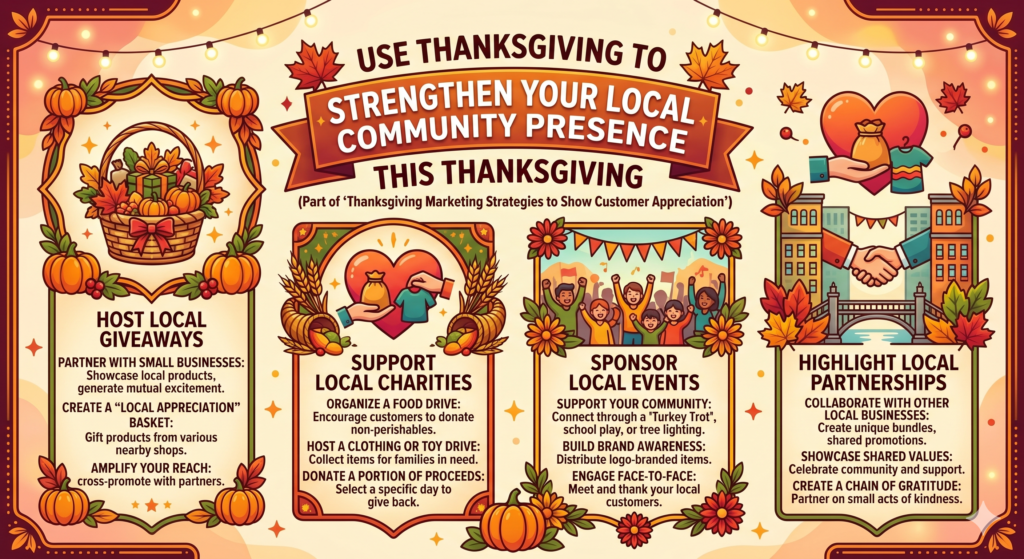
A local Thanksgiving campaign does not need to be expensive. It needs to feel present. It should show that your business cares about more than sales. It should show that you are part of the community, not just selling to it.
This can be especially powerful for restaurants, salons, clinics, gyms, stores, real estate businesses, local agencies, home service companies, schools, and nonprofits. But even online brands can use local roots if the story is real.
Thank the community by name
Local appreciation works best when it feels specific. Do not just say, “We love our community.” Name the town, city, neighborhood, street, customer group, or local partners that helped you grow.
A message like, “Thank you, Austin, for another year of showing up for small businesses like ours” feels stronger than a general holiday greeting. It gives people a place in the story.
You can also thank nearby partners, local makers, delivery drivers, vendors, event hosts, schools, charities, or customers who supported you. These details make the message feel real.
Show real local faces and moments
Local campaigns are stronger when they include real people and real places. Share photos of your team, storefront, neighborhood, local event, community partners, or customers who gave permission.
Avoid making everything look too polished. A natural photo can feel warmer than a perfect design. People like seeing the human side of local businesses.
You can also share a short story about a moment that made the year special. Maybe a customer brought in family members. Maybe the team stayed late to serve a big holiday rush. Maybe a local partner helped you solve a problem. These stories bring the campaign to life.
Partner with nearby businesses
Thanksgiving is a good time to build partnerships with other local businesses. You can create joint offers, shared gift guides, community events, giveaway bundles, charity drives, or local shopping maps.
This helps everyone reach more people. It also gives customers a reason to support the local business community as a whole.
For example, a bakery could partner with a florist for Thanksgiving table bundles. A gym could partner with a healthy meal prep service. A marketing agency could partner with a local print shop to support small business owners with holiday promotions.
The partnership should feel natural. Customers should understand why the businesses fit together.
Make the partnership easy for customers to join
Local campaigns should be simple. If customers need to visit many pages, follow too many rules, or track too many steps, they may not take part.
Create one clear message. Explain what is happening, who is involved, when it happens, and how customers can join. Use simple signs, emails, social posts, and landing pages.
The easier you make it, the more likely the community is to respond.
Make Thanksgiving SMS messages feel personal and respectful
SMS can be a strong Thanksgiving marketing channel because people see text messages quickly. But it is also a very personal space. If your message feels too pushy, it can annoy customers fast.
Thanksgiving SMS should be short, respectful, and useful. It should not feel like a loud ad dropped into someone’s phone. It should feel like a timely note from a brand they chose to hear from.
This means you need to be careful with timing, wording, and frequency. One good message can work well. Too many messages can damage trust.
Use SMS only when there is a clear reason
Do not send a Thanksgiving text just because you can. Send it when the message is worth the customer’s attention.
A good reason might be a customer-only offer, early access, pickup reminder, delivery deadline, appointment opening, event update, or simple thank-you with a useful link. If the message does not help the customer, email or social media may be a better place for it.
For example, a text that says, “Thank you for being with us this year. We opened early access for customers before the holiday rush” has a clear reason. A text that just says, “Happy Thanksgiving from our team” may be nice, but it may not always be worth using SMS.
Keep the message warm and brief
SMS is not the place for long copy. Keep it short but human. Thank the customer, explain the value, and give one clear next step.
A strong text could say, “Thank you for being part of our year. As a small gift, your customer-only holiday perk is ready here.” This is clear and warm.
Do not use too many symbols, all caps, or fake urgency. That can make the message feel cheap. A Thanksgiving text should feel calm and respectful.
Time your SMS with care
Timing matters because SMS interrupts people. Avoid sending messages too early, too late, or during moments when customers may be with family.
For Thanksgiving week, it is often better to send practical messages before the holiday, not during the main meal time. If you send on Thanksgiving Day, keep it simple and avoid hard selling.
Think about the customer’s life. Are they traveling? Cooking? Hosting? Shopping? Working? Choose timing that helps rather than interrupts.
Give customers control
Every SMS campaign should make it easy for customers to opt out. That is not only a compliance issue. It is also a trust issue.
When customers know they can leave, they feel less trapped. This can actually make them more comfortable staying.
Respect is part of appreciation. If your Thanksgiving campaign makes people feel controlled, it misses the point.
Create a simple Thanksgiving video message from your founder or team
Video can make Thanksgiving gratitude feel more personal because customers can see a face, hear a voice, and feel emotion more clearly. A short founder or team video can work well in email, social media, landing pages, customer communities, and even ads.
The video does not need to be fancy. In many cases, a simple and honest video works better than a polished one. Customers are not looking for a movie. They are looking for a real message.
A founder video can be especially strong for small businesses, agencies, service brands, nonprofits, creators, and community-led companies. It helps customers feel closer to the people behind the brand.
Keep the message simple and sincere
The best Thanksgiving video has one clear purpose: to thank customers.
Do not try to fit everything into it. Do not turn it into a full company update, product pitch, and holiday sale announcement all at once. That makes the message feel crowded.
A simple structure works best. Start by thanking customers. Mention one or two specific things their support made possible. Share what your team is grateful for. Close with a warm wish and, if needed, a soft mention of a customer appreciation gift.
For example, the founder might say, “Before the holiday rush begins, I wanted to pause and thank you. Your trust helped us grow, improve, and keep doing work we care about. We are grateful you chose us.”
That is enough. It feels clear and real.
Do not over-script the emotion
A video that is too scripted can feel stiff. It is fine to prepare notes, but the speaker should sound natural. They should speak like they would to a real customer.
Small pauses are fine. A natural voice is fine. A simple background is fine. The goal is trust, not perfection.
If your team is included, let each person share one short thought. Keep it focused. Do not make the video too long. Most customers will not watch a long holiday message unless they have a very close relationship with your brand.
Use the video across your Thanksgiving campaign
Once you create the video, use it in more than one place. Add it to your Thanksgiving email. Pin it on social media. Place it on your landing page. Share it with top clients. Use a short clip as an ad for warm audiences.
This gives your campaign a consistent human face. It also makes your message feel more connected across channels.
Add captions for easy viewing
Many people watch videos without sound. Add captions so they can understand the message even if they are scrolling quietly, traveling, or sitting with family nearby.
Captions also make the video more accessible. That is part of good customer care.
Keep the caption text clean and easy to read. The words should match the warmth of the spoken message.
Conclusion
Thanksgiving marketing works best when it feels real. Customers do not need another loud sales message. They need to feel seen, respected, and valued. When your brand leads with honest thanks, useful help, thoughtful rewards, and better service, you build trust that lasts beyond the holiday season.
The best strategy is simple: appreciate people before you ask them to buy. Thank them for their support, listen to their feedback, reward their loyalty, and make every touchpoint easier. When customers feel your gratitude through action, they remember your brand, return more often, and share it with others.














Comments are closed.