
WinSavvy Editorial Standards
How this article was created
Modern dental marketing is not about shouting louder. It is about being more useful, more visible, and more trusted than the clinic down the road. It is about showing patients that you understand their fears, their budget worries, their time limits, and their need for simple answers. In this guide, we will look at fresh, practical, and highly usable marketing ideas that can help your dental practice get more calls, book more appointments, bring back old patients, and turn happy patients into steady referrals.
Build your dental practice around a clear local promise patients can remember
Most dental clinics sound almost the same online.
They say they offer gentle care. They say they have modern tools. They say they treat patients like family. These are good things, but they are also very common. When every clinic says the same thing, patients do not know who to choose. So they pick the clinic with the most reviews, the closest location, the lowest offer, or the first one that answers the phone.
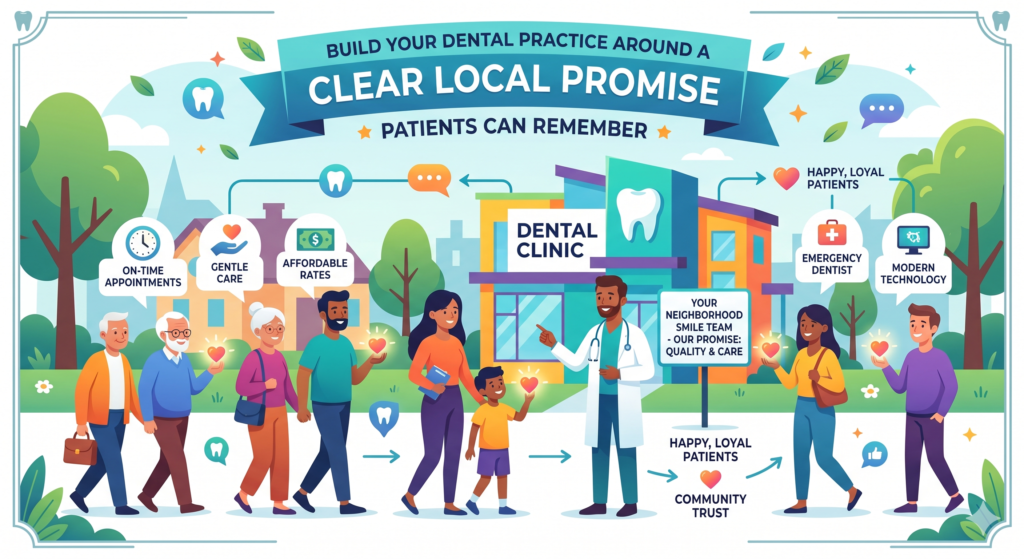
That is why your dental practice needs a clear local promise.
A local promise is not a slogan. It is the simple reason a patient should choose you instead of another dentist nearby. It should be easy to understand, easy to repeat, and easy to prove.
For example, your promise could be that your clinic helps nervous patients feel calm from the first call to the final treatment. It could be that your practice helps busy families getdental care without wasting half a day.
It could be that your clinic focuses on clear treatment plans with no confusing surprises. It could be that your team helps working adults fix dental problems before they become expensive emergencies.
The best promise comes from what your best patients already love about you.
Your strongest marketing message should come from real patient pain, not from your clinic’s list of services
Many dental websites are built around services. They have pages for implants, whitening, braces, crowns, root canals, cleanings, and emergency care. This is needed, but it is not enough. Patients do not wake up thinking, “I need a crown procedure.” They often think, “I cannot chew on this side,” or “I hate my smile in photos,” or “I am scared this will cost too much.”
This difference matters.
If your marketing speaks only in service names, it feels cold. If it speaks to the real worry behind the service, it feels personal. A person with tooth pain wants relief. A parent wants their child to be safe. A bride wants confidence in photos. A business owner wants to fix a dental issue without missing work. A senior wants to eat without discomfort.
Your marketing should name those problems in simple words.
On your homepage, instead of only saying “Comprehensive Dental Services,” you can say something like, “Dental care that helps you stop worrying, understand your options, and smile with more confidence.” That kind of message gives people a reason to keep reading.
Your practice should not try to be the best choice for everyone in town
One of the biggest mistakes dental practices make is trying to market to everyone.
This sounds safe, but it often makes your message weak. A family with small children has different concerns from a young adult looking for Invisalign. A person who has avoided the dentist for ten years needs a different message from someone who comes in every six months.
A patient looking for cosmetic dentistry is not thinking like someone searching for emergency pain relief at midnight.
You can serve many types of patients, but your marketing should still have clear focus.
Start by asking which patients are most valuable for your practice and easiest for you to serve well. This does not always mean the highest-paying patients. It may mean patients who accept treatment plans, return on time, refer others, and enjoy your style of care.
Once you know who those patients are, shape your content around them. If you want more family patients, show how simple and stress-free your visits are for parents. If you want more cosmetic cases, show smile journeys, patient concerns, and the emotional side of feeling proud to smile. If you want more implant patients, explain the process in calm, simple steps so people do not feel lost.
Focused marketing does not reduce your growth. It makes your growth stronger because the right people can see themselves in your message.
Your website should make your promise clear within the first few seconds
When people visit your website, they do not read like they are reading a book. They scan. They judge quickly. They ask silent questions.
Is this clinic near me? Can I trust them? Do they treat people like me? Will they explain costs? Can I book easily? Do they have good reviews? Will this be painful? Are they open when I need them?
Your homepage should answer these questions fast.
The top section of your website should say who you help, what kind of care you provide, and why patients choose you. It should also make booking easy. A phone number should be easy to find. The appointment button should be clear. Your location should be obvious. Your reviews should be visible. Your photos should feel real.
Do not hide your best proof deep inside the site. If you have hundreds of strong reviews, show that near the top. If your clinic is known for gentle care, show real patient words that support it. If you offer same-day emergency appointments, say it clearly. If you have flexible payment options, do not bury that information.
Patients are not looking for a perfect website. They are looking for a reason to feel safe enough to take the next step.
Your clinic photos should feel warm, real, and current
Stock photos can make a dental website look polished, but they often make it feel fake. Patients want to see the actual place they are visiting. They want to see the dentist, the team, the waiting area, the treatment room, and the faces behind the care.
Good photos reduce fear.
A nervous patient may feel calmer when they see a friendly front desk team. A parent may feel better when they see a bright and clean space. A cosmetic patient may feel more confident when the dentist looks professional and approachable. These small feelings matter because dental decisions are emotional.
Use real photos whenever possible. They do not need to look like a luxury magazine. They just need to look clean, bright, friendly, and honest.
Turn your Google Business Profile into a patient-booking machine
For many dental practices, Google Business Profile is more important than the website.
When someone searches for a dentist nearby, they often see the map results before anything else. They compare ratings, distance, photos, hours, services, and reviews. They may call straight from Google without even visiting your website.
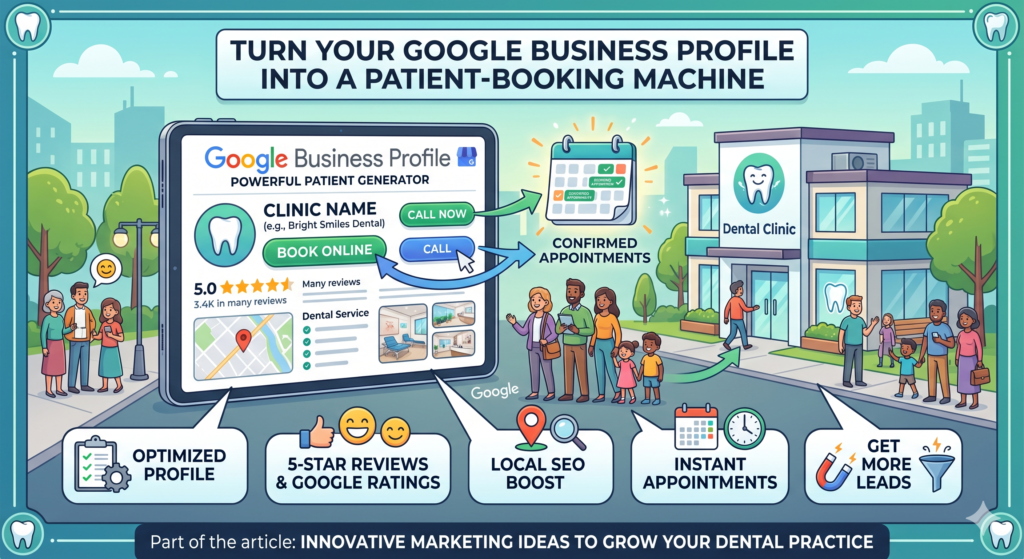
This means your Google profile is not just a listing. It is one of your strongest sales pages.
If it is weak, incomplete, outdated, or ignored, you lose patients who were already close to booking.
Your Google profile should answer the patient’s decision questions before they call
A strong Google Business Profile gives patients enough confidence to act. It should have correct hours, current photos, service details, appointment links, phone number, location, and clear business categories.
But the real power comes from how complete and active the profile feels.
Patients notice when a clinic has fresh photos, recent reviews, clear answers, and updated details. It sends a signal that the practice is alive, trusted, and organized. A profile with old photos, few reviews, and missing information creates doubt.
Make sure your main category is accurate. For most clinics, this will be dentist. If you have a clear specialty, such as orthodontist, pediatric dentist, cosmetic dentist, or dental implants provider, use the right categories where they apply.
Add services in simple language. Add your appointment link. Add your insurance or payment details if relevant. Keep holiday hours updated so patients do not call and get frustrated.
Your goal is simple. When a patient compares you with three other clinics, your profile should feel easier to trust.
Reviews should be treated as a growth channel, not just a nice thing to have
Reviews are one of the biggest reasons patients choose one dental clinic over another.
This is especially true because dentistry involves fear, cost, discomfort, and trust. A patient may not fully understand your training or your equipment, but they understand another patient saying, “They explained everything and made me feel calm.”
That kind of review sells without sounding like sales.
But reviews should not be left to chance. Your clinic needs a simple, steady system for asking happy patients. The best time to ask is usually right after a positive moment. This could be when a patient says thank you, finishes a successful treatment, praises a hygienist, or shares that they felt less nervous than expected.
The request should feel human. Your team can say, “We are so glad you felt comfortable today. Reviews help other people who are nervous about seeing a dentist. Would you be open to sharing your experience on Google?”
That is much better than a cold, automatic message with no context.
The best reviews are specific, so guide patients toward the story without telling them what to write
You should never pressure patients or tell them what to say. But you can make it easier for them to share useful details.
A vague review like “Great dentist” is helpful, but a detailed review is far more powerful. A review that says, “I was scared of getting a root canal, but the dentist explained every step and I felt no pain,” speaks directly to future patients with the same fear.
Your team can gently guide patients by asking them to mention what helped them most. Maybe it was the calm explanation, the friendly staff, the clean office, the quick appointment, the gentle hygienist, or the clear pricing.
This turns reviews into living proof of your brand promise.
Responding to reviews shows future patients how your clinic treats people
Many practices focus only on getting reviews. They forget that responses matter too.
When you respond to reviews, you are not only speaking to the patient who left the review. You are speaking to every future patient reading it. A warm, simple response shows that your clinic listens. It also makes your profile feel active and cared for.
For positive reviews, respond with gratitude and keep it personal without sharing private health details. For negative reviews, stay calm, respectful, and brief. Do not argue. Do not reveal treatment details. Invite the person to contact the office so the matter can be handled privately.
A defensive response can scare away new patients. A calm response can protect trust even when the review is not perfect.
Your review strategy should include different types of patient stories
A strong review profile should not only show that people like your clinic. It should show that different types of patients trust you.
You want reviews from parents, nervous patients, cosmetic patients, emergency patients, implant patients, hygiene patients, and long-term families. This helps future patients find someone like themselves.
When someone sees a review that matches their own fear or need, the decision becomes easier.
Use local SEO to become the obvious dentist in your area
Local SEO helps your practice show up when people near you search for dental care.
This matters because most patients do not want a dentist across the city. They want someone nearby, trusted, and easy to reach. If your clinic does not appear when they search, you may not even enter their mind.
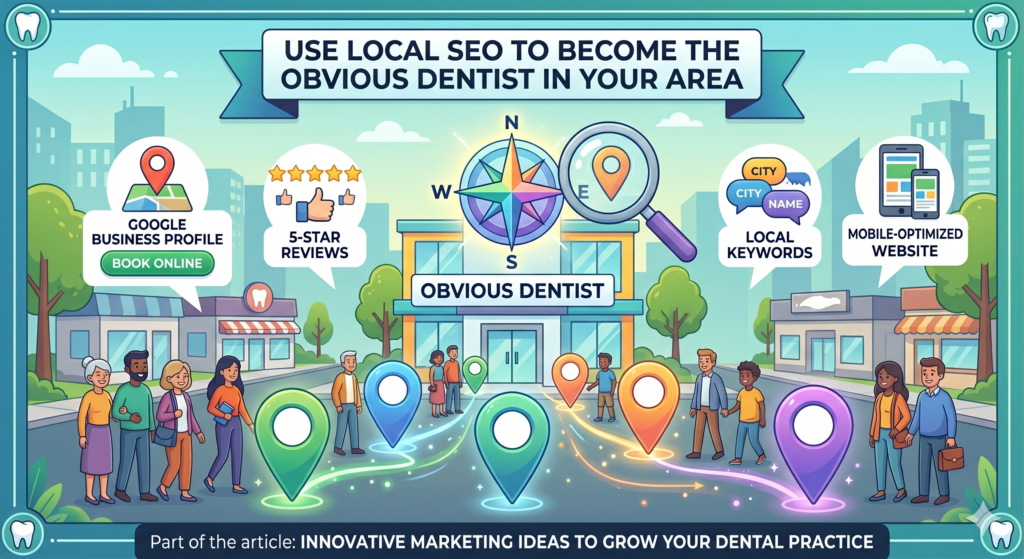
Local SEO is not one single trick. It is a system. Your website, Google profile, reviews, local pages, photos, content, and business details all work together. The goal is to help Google understand where you are, what you offer, and why local patients trust you.
Your service pages should be written for real people, not just for search engines
A service page should do more than name the treatment. It should help the patient understand the problem, the solution, the process, the cost factors, the comfort level, and the next step.
For example, a dental implants page should not only say that you offer implants. It should explain who implants are for, what happens during the first visit, how long the process may take, what makes someone a good candidate, and why waiting can make the problem worse.
A teeth whitening page should explain what kind of stains whitening can help, what results are realistic, how professional whitening differs from store-bought options, and how to keep the smile bright after treatment.
An emergency dentist page should be even more direct. People searching for emergency dental care are often in pain. They need clear answers fast. Your page should say what counts as an emergency, how quickly you can help, what patients should do before they arrive, and how to call now.
Search engines matter, but patients matter more. When your page is useful, clear, and local, it has a better chance of doing both jobs well.
Each main treatment should have its own strong page
Many dental websites place all services on one short page. This is a missed chance.
If you want to rank for dental implants, Invisalign, emergency dentist, teeth whitening, veneers, crowns, pediatric dentistry, or root canal treatment, each service needs its own page. A single services page cannot answer every patient question well.
Each page should focus on one main topic. It should include simple explanations, local trust signals, patient concerns, treatment steps, and clear booking options. The page should also link naturally to related pages.
For example, an Invisalign page can link to teeth whitening if patients often want both. A missing tooth page can link to implants, bridges, and dentures. An emergency page can link to root canal treatment, extractions, and crowns.
This helps patients move through your site in a natural way. It also helps search engines understand your clinic better.
Location pages can help if they are useful and not copied
If your dental practice serves nearby areas, location pages can help you reach patients in those places. But they must be written with care.
A weak location page simply swaps the city name and repeats the same text. This feels cheap and does not help patients much. A strong location page speaks to that area in a real way. It explains how close the clinic is, how patients can reach you, what services are popular, what parking or transport options exist, and why patients from that area choose you.
For example, if your clinic is in one town but also serves families from nearby neighborhoods, create pages that explain the travel time, appointment options, and common needs of those patients. Mention real landmarks only when they are natural and helpful.
The goal is not to trick Google. The goal is to help nearby patients realize your clinic is a good option for them.
Your blog should answer questions patients are already asking
A dental blog should not be a random collection of generic posts. It should be built around patient questions.
People search questions before they book. They ask things like, “Why does my tooth hurt when I bite down?” “How much does teeth whitening cost?” “Is bleeding gum serious?” “Do dental implants hurt?” “How long do veneers last?” “What should I do if my child chips a tooth?”
These questions are marketing gold.
When your clinic answers them clearly, you meet patients early in their decision journey. You also build trust before they are ready to call. A helpful article can bring in search traffic, support service pages, and give your team useful content to share with patients.
The best blog posts are not stuffed with keywords. They are clear, kind, and practical. They explain what may be happening, what the patient should watch for, when to call a dentist, and how your clinic can help.
Your content should make patients feel informed, not embarrassed
Many patients already feel guilty about their teeth. They may have delayed care. They may be scared of judgment. They may feel ashamed about stains, missing teeth, bad breath, or gum problems.
Your content should never make them feel worse.
Use a calm and helpful tone. Say things like, “This is more common than many people think,” or “The sooner you check it, the easier it may be to treat.” This kind of language lowers fear and helps people take action.
A patient who feels judged will leave. A patient who feels understood may book.
Create dental content that makes patients trust you before they meet you
Dental marketing works best when it teaches, reassures, and guides.
Most patients do not know how to judge dental skill. They cannot easily compare clinical methods. So they look for signs of trust. They notice how clearly you explain things. They notice whether you sound patient. They notice whether your content answers the questions they were too shy to ask.
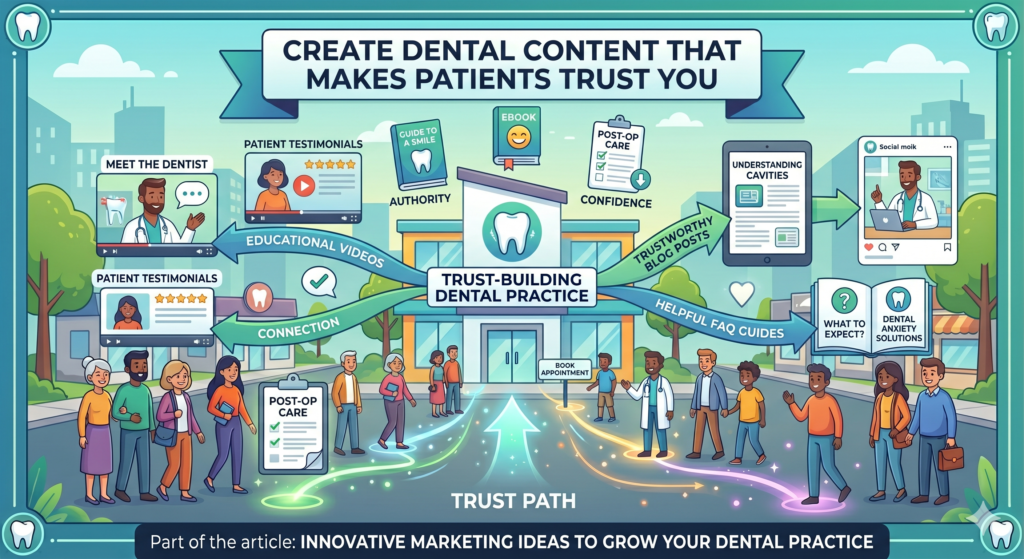
This is why content is not just for traffic. Content is a trust-building tool.
Short videos can make your dentist feel familiar before the first visit
Video is powerful for dental practices because it lets people see your face, hear your voice, and feel your style.
This matters a lot for nervous patients. A written page can explain that your clinic is gentle. A video can show it. When a dentist calmly explains what happens during a first visit, or how a root canal is not as scary as people think, patients begin to feel safer.
Your videos do not need to be fancy. In fact, simple videos often feel more real. A dentist standing in the clinic and speaking clearly for one or two minutes can work very well.
You can answer common questions. You can explain treatments. You can introduce team members. You can show what the first appointment looks like. You can talk about dental fear. You can explain payment options. You can share aftercare tips.
The main rule is to keep each video focused on one question. Do not try to cover everything at once.
Patient education content should move people from fear to action
Good content does not only give information. It helps the patient take the next step.
For example, a post about bleeding gums should not end with a vague message like “Visit your dentist.” It should explain why bleeding gums may happen, why it should not be ignored, what the dentist will check, what treatment may involve, and how booking a visit can prevent bigger problems.
A page about missing teeth should help the patient understand the real cost of waiting. It can explain that nearby teeth may shift, chewing may become harder, bone loss may increase, and future treatment may become more complex. This should be written calmly, not with scare tactics.
The goal is not to frighten people. The goal is to help them see why action matters now.
Your content should speak to each stage of the patient journey
Not every person is ready to book today. Some are only noticing symptoms. Some are comparing options. Some are worried about cost. Some are ready but need proof. Your content should support all of these stages.
Early-stage content answers simple questions. It helps people understand symptoms and choices. Middle-stage content compares treatments and explains what to expect. Late-stage content gives proof, reviews, before-and-after examples, financing details, and clear booking steps.
For example, someone searching “why is my tooth sensitive” may not be ready for treatment yet. Someone searching “emergency dentist open today near me” is ready now. Someone searching “dental implants cost near me” is likely comparing options. Each person needs a different kind of page.
When your content matches the patient’s stage, it feels helpful instead of pushy.
Your best content ideas are hiding inside phone calls and chairside questions
Your front desk and clinical team hear patient questions every day. These questions should become content.
If five patients ask whether teeth whitening hurts, that should become a blog post or video. If people keep asking whether insurance covers crowns, create a simple guide. If parents ask when children should first visit the dentist, answer that clearly. If implant patients ask about healing time, explain it in plain words.
This is how you create content that feels human. It comes from real conversations, not guesswork.
Use patient stories to make your marketing feel real, warm, and believable
People trust people more than they trust claims.
Your dental practice can say, “We offer gentle care,” but a patient story makes that promise feel real. When someone reads about a nervous patient who avoided the dentist for years and finally felt calm in your chair, they can picture themselves doing the same. When a parent sees another parent talk about how easy the first visit was for their child, the fear goes down.
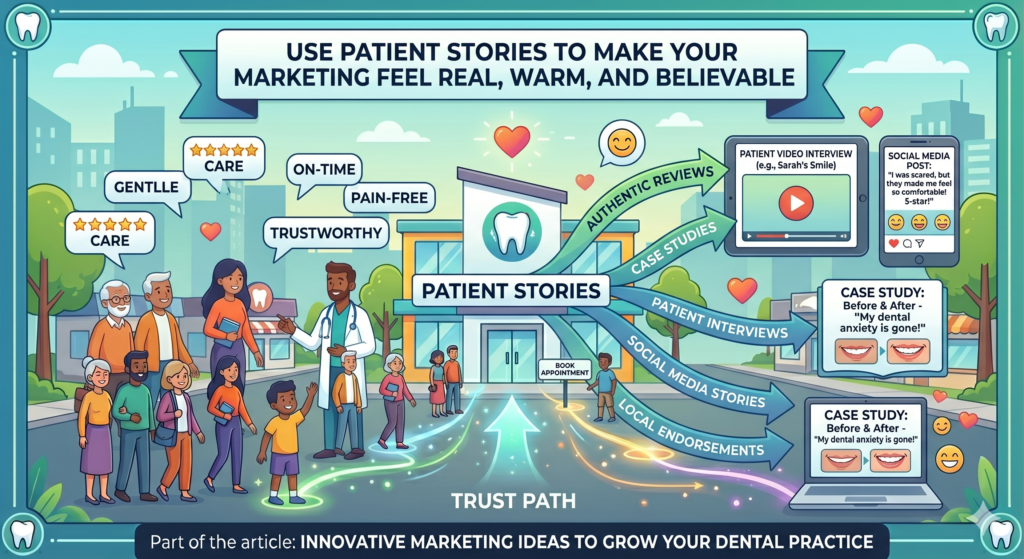
This is why patient stories are one of the strongest tools in dental marketing.
A patient story does not need to be dramatic. It simply needs to show a clear before and after. Before, the patient had a problem, fear, delay, or doubt. After, they felt relief, confidence, comfort, or control. That simple change is what makes the story powerful.
Of course, you must always get proper permission before using any patient story, photo, or treatment result. Privacy matters. Trust matters. But when patients are happy and willing to share, their stories can help many others take the first step toward care.
Your best patient stories should focus on emotion, not just treatment
A common mistake is to make dental case studies too clinical.
The clinic may talk about the crown, implant, whitening, aligner, or gum treatment. But patients are not only buying the treatment. They are trying to fix a feeling.
They want to stop hiding their smile. They want to eat without pain. They want to stop worrying that their teeth look bad. They want to attend a wedding, job interview, or family event with more confidence. They want to stop fearing the dentist. They want to feel like themselves again.
That emotional change should be at the heart of the story.
For example, instead of saying, “The patient received two dental implants,” tell the story in a more human way. Explain that the patient had been avoiding certain foods for months. They felt embarrassed when eating with friends. They wanted a stable option that felt natural. After treatment, they could chew more comfortably and felt more relaxed in social settings.
That kind of story is easier to feel. And when people feel the story, they remember your practice.
Before-and-after content should educate instead of just impressing people
Before-and-after photos can be very strong for cosmetic dentistry, orthodontics, whitening, implants, and smile makeovers. But photos alone are not enough.
If you only show the image, people may be impressed for a second and then move on. If you explain the story behind the result, they stay longer and understand more.
A strong before-and-after post should explain what the patient wanted, what concern they had, what treatment options were discussed, and what kind of result was achieved. Keep it simple and respectful. Do not overpromise. Do not make every case sound perfect. Realistic language builds more trust than hype.
For example, you might explain that the patient wanted a brighter smile but did not want a result that looked fake. You could share that the treatment plan focused on a natural shade, healthy gum shape, and a balanced smile line. This helps future patients understand your taste, your care, and your process.
When you teach through the result, your content becomes more than proof. It becomes a quiet sales tool.
Video testimonials can reduce fear faster than written reviews
Written reviews are valuable, but video testimonials can be even more powerful when done well.
A nervous patient watching another patient speak calmly about their experience can feel instant relief. The voice, facial expression, and natural pauses make the story believable. It does not need to sound polished. In fact, it should not sound scripted. It should sound like a real person sharing a real experience.
You can ask simple questions that help the patient tell the story naturally. Ask what made them choose your practice. Ask how they felt before the visit. Ask what surprised them. Ask what they would tell someone who is scared to book.
Keep the video short. One to two minutes is often enough. The goal is not to create a movie. The goal is to create trust.
The best stories should be reused across your full marketing system
A strong patient story should not be used once and forgotten.
You can turn one story into a website section, a short video, a social post, an email, a Google Business Profile update, a blog example, and a treatment page proof point. The same story can help patients in many places.
For example, a story about a nervous patient can support your sedation dentistry page, your homepage, your dental anxiety blog post, and your follow-up email for patients who have not booked yet. A story about a smile makeover can support your veneers page, your cosmetic dentistry ads, and your Instagram content.
This is how you get more value from your marketing without always creating something new.
Make your dental website feel like a calm guide, not a digital brochure
Your website should not just describe your practice. It should guide people toward booking.
Many dental websites look nice but do not help patients make a decision. They have pretty photos, service lists, and general claims. But they do not answer the real questions in the patient’s mind. They do not reduce fear. They do not make the next step clear. They do not explain why this clinic is the right choice.
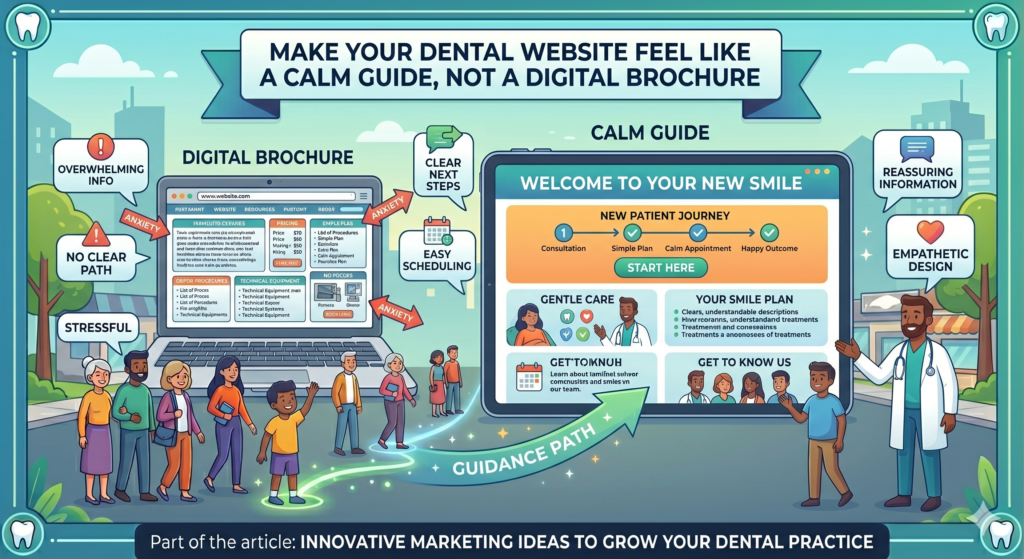
A strong dental website should feel like a calm, helpful conversation.
When someone lands on your site, they should quickly understand where you are, what you do, who you help, why patients trust you, and how to book. They should not have to search for basic information. They should not feel lost. They should not be forced to call just to learn whether you offer the treatment they need.
Your website should make the patient feel, “This clinic understands me.”
Every important page should have one clear next step
A patient should never finish reading a page and wonder what to do next.
Each page should guide them toward a simple action. That action may be calling the clinic, booking online, requesting a consultation, asking about financing, or reading a related page. The call to action should match the patient’s level of urgency.
An emergency dental page should push direct calls because the patient may be in pain. A cosmetic dentistry page may invite the patient to book a smile consultation. A dental implants page may offer a first visit to discuss options. A children’s dentistry page may help parents schedule a gentle first appointment.
The wording should be simple and specific.
Instead of saying “Contact us,” you can say, “Book a visit to talk through your options.” Instead of saying “Learn more,” you can say, “See what happens during your first appointment.” These small changes make the page feel more helpful and less robotic.
Your website copy should remove fear before asking for the appointment
Many patients want to book, but fear stops them.
They worry the treatment will hurt. They worry the dentist will judge them. They worry the price will be too high. They worry they will be pushed into treatment. They worry they have waited too long. They worry the clinic will not accept their insurance. They worry they will feel trapped in the chair.
Your website should answer these fears with care.
For example, if you serve nervous patients, say what you do to make visits easier. Explain that your team moves at the patient’s pace. Explain that you discuss each step before starting. Explain any comfort options you offer. Explain that many patients come in after years away from the dentist, and your role is to help, not judge.
This kind of copy is powerful because it speaks to the hidden reason people delay.
Your treatment pages should explain the process in plain steps without sounding childish
Simple writing does not mean shallow writing.
You can explain dental care clearly without making it feel basic. The key is to use normal words and short, natural sentences. Avoid heavy terms unless you explain them.
For example, do not just say, “We use advanced restorative methods to improve oral function.” Say, “We help repair damaged teeth so you can chew more comfortably and protect your smile.” That is easier to understand and more emotionally useful.
Patients should know what happens first, what the dentist checks, what choices they may have, how comfort is handled, and what happens after treatment. When people understand the path, they feel less afraid.
A confused patient delays. A clear patient acts.
Your website should be easy to use on a phone because most patients will judge you there
Many patients will find your practice on their phone. They may be in a car, at work, at home, or in pain. If your site loads slowly, looks messy, or makes booking hard, they may leave fast.
Your phone experience matters deeply.
The phone number should be easy to tap. The booking button should be visible. The text should be easy to read. Pages should not be crowded. Forms should be short. Photos should load properly. The map should work. Your hours should be easy to find.
A beautiful desktop website does not matter much if the mobile version frustrates people. Dental marketing often fails at the final step because the patient wants to act but the site makes it too hard.
Turn social media into a trust builder instead of a random posting habit
Many dental practices use social media without a real plan.
They post holiday greetings, team birthdays, whitening offers, and the occasional dental tip. None of this is bad, but it often does not create steady growth. Social media becomes a chore instead of a business tool.
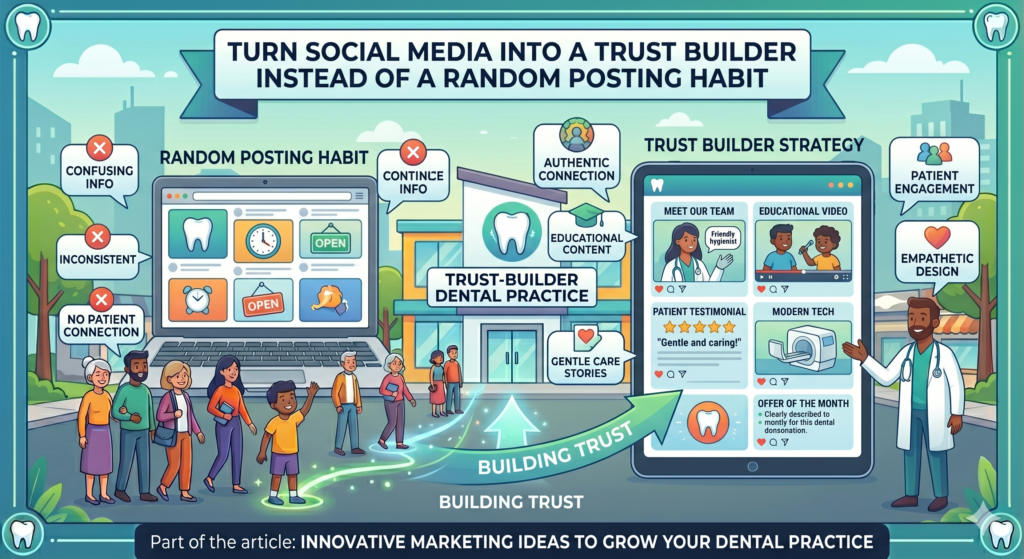
To make social media work, you need a clear purpose.
For a dental practice, that purpose is usually trust. Social media should help people feel familiar with your team, understand your care style, learn simple dental tips, and remember your name when they need a dentist.
It is not about going viral. It is about becoming known in your local area.
Your social media should show the human side of your practice
Dentistry can feel scary from the outside. Social media can make it feel warmer.
Show the faces of your team. Share small moments from the clinic. Introduce your hygienists, front desk staff, assistants, and dentists. Let people see the care behind the care. A simple post showing your team preparing for the day can make the practice feel more approachable.
Patients are more likely to book when the clinic feels familiar. Familiarity lowers fear.
You can also show your office culture. If your team celebrates a patient milestone, updates a treatment room, attends training, or supports a local event, share it in a natural way. Do not force it. Do not make every post sound like an ad. Let your practice feel alive.
The goal is to help people think, “I know this place. They seem kind.”
Educational posts should answer small questions patients care about
Dental tips work best when they answer real, simple questions.
Instead of posting generic advice like “Brush twice a day,” go deeper into the questions people actually have. Explain why gums bleed when brushing. Explain what tooth sensitivity can mean. Explain how to handle a chipped tooth. Explain when bad breath may need a dental visit. Explain why a child may fear the dentist and what parents can do.
Use simple language. Keep one idea per post. Make the advice practical.
A good educational post should make someone feel a little smarter and a little safer. It should not make them feel lectured.
For example, a post about bleeding gums can say that bleeding is common but should not be ignored. It can explain that gentle cleaning and a dental check can help find the cause early. This is useful, calm, and action-focused.
Short reels and videos can make your clinic easier to remember
Short videos are useful because they feel personal and quick.
A dentist can answer one question in thirty seconds. A hygienist can show the right way to clean around braces. A front desk team member can explain what to bring to a first visit. A dentist can explain what happens during a smile consultation. A team member can give a quick tour of the clinic.
These videos do not need heavy editing. Clear sound, good light, and a friendly tone matter more than perfect production.
The best dental videos feel like a helpful answer from a real person. They do not feel like a commercial.
Social media should send people somewhere useful, not just collect likes
Likes are nice, but appointments matter more.
Your posts should often guide people to a next step. That could be reading a full guide on your website, booking an appointment, calling for emergency care, asking about payment options, or saving the post for later.
Do this gently. Not every post needs a hard sales push. But your audience should always know that your clinic can help when they are ready.
Social media should build the relationship, and your website or phone team should help turn that trust into booked appointments.
Use email and text messages to bring patients back before they forget you
Many dental practices focus so much on new patients that they forget the value sitting inside their own patient list.
Your existing patients already know you. Many trust you. Some simply forget to book. Some delay treatment. Some miss cleanings. Some mean to come back but life gets busy. This is where email and text marketing can quietly add a lot of revenue.
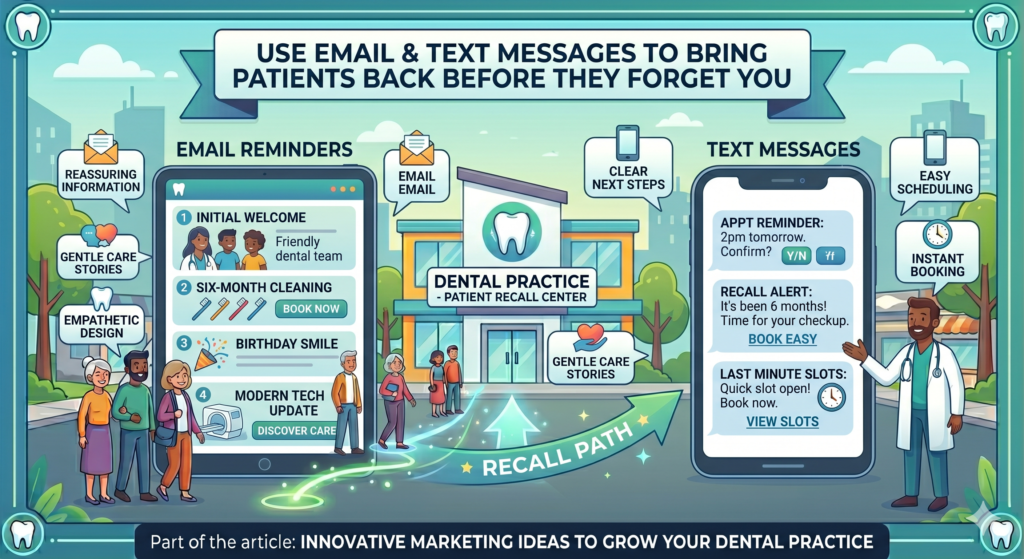
The goal is not to spam patients. The goal is to help them stay on track with their care.
A good reminder system feels useful, not pushy. It helps patients remember what matters, understand why it matters, and take action before small issues become bigger ones.
Recall messages should explain the value of returning, not just say it is time
A basic reminder says, “You are due for your cleaning.”
A better reminder explains why coming back matters. It may say that regular visits help catch small issues early, keep gums healthy, and prevent more costly treatment later. It can also remind patients that the visit is a chance to ask questions about sensitivity, bleeding gums, bad breath, or smile concerns.
This changes the message from a task into a benefit.
Patients are busy. If they do not understand the value, they delay. When they understand the reason, they are more likely to book.
Unscheduled treatment follow-ups should be calm, clear, and helpful
Many patients leave the clinic with a treatment plan but do not schedule it. This does not always mean they are not interested. They may be worried about cost. They may need to check their calendar. They may want to talk to a spouse. They may be scared. They may not fully understand the risk of waiting.
A follow-up message can help.
It should not pressure them. It should remind them what the next step is, why the treatment was recommended, and how the clinic can answer questions. For example, the message can say that the team is happy to talk through timing, payment options, or any concerns before they book.
This keeps the conversation open.
A patient who feels supported is more likely to return than a patient who feels chased.
Email newsletters should be short, useful, and local
A dental newsletter does not need to be long. In fact, shorter is usually better.
You can share one useful tip, one clinic update, one patient-friendly explanation, or one seasonal reminder. For example, before school starts, you can remind parents to book children’s checkups. Before wedding season, you can talk about safe whitening timelines.
Near the end of the year, you can remind patients to use dental benefits before they expire.
Keep the tone warm and simple. Write like a person from the clinic is speaking, not like a corporate brand.
The best patient messages should be based on behavior
Not every patient should get the same message.
A patient who missed a hygiene visit needs a different message from someone who asked about implants. A parent needs different content from a cosmetic patient. Someone with unscheduled treatment needs more specific follow-up than someone who simply came in for a cleaning.
When your messages match the patient’s situation, they feel more helpful. This is how email and text can become a strong growth channel without feeling annoying.
Build a patient referral system that feels natural, not forced
Referrals are one of the best ways to grow a dental practice because they come with trust already attached.
When a happy patient tells a friend, “You should go to my dentist,” that friend does not feel like they are hearing an ad. They feel like they are getting safe advice from someone they know. This makes the new patient easier to book, easier to reassure, and often easier to keep for the long term.
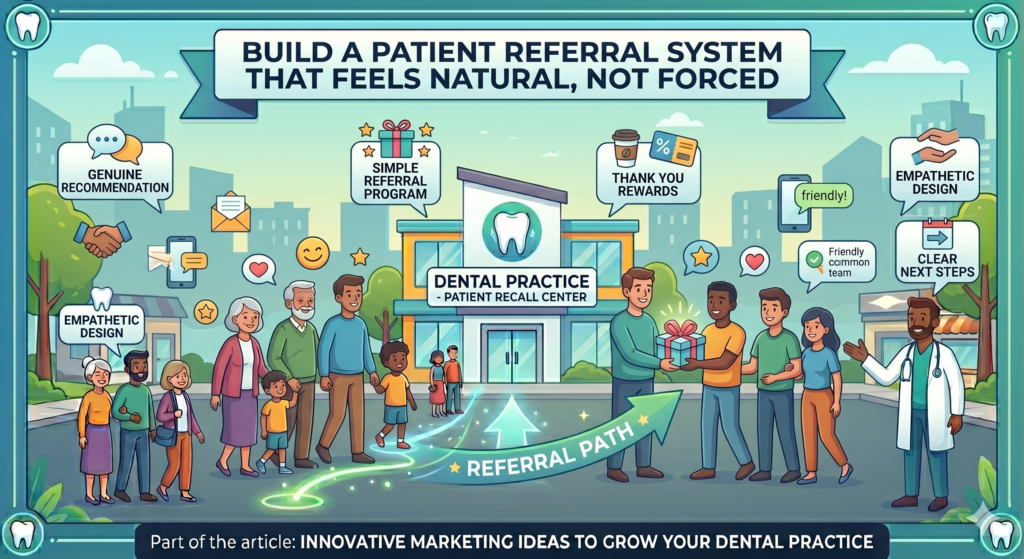
But many dental practices treat referrals like luck. They hope happy patients will talk about them. They hope families will bring in other families. They hope word of mouth spreads on its own.
Hope is not a system.
A good referral system does not need to be aggressive. It does not need to make patients uncomfortable. It simply needs to make referrals easier, more natural, and more consistent.
Your team should ask for referrals at the right emotional moment
The best time to ask for a referral is not at a random point in the visit. It is after a good moment.
That moment might come when a patient says they are happy with the result. It might come after a nervous patient says, “That was easier than I thought.” It might come when a parent says their child enjoyed the visit. It might come after a cosmetic patient sees their new smile. It might come when an emergency patient gets relief from pain.
This is when the patient feels grateful. This is when the ask feels natural.
Your team can say something simple like, “We are so glad you had a good experience. If you know anyone who feels nervous about going to the dentist, we would be happy to help them too.”
That does not sound pushy. It sounds caring. It also tells the patient exactly who to refer.
A vague referral request is easy to forget. A specific one is easier to act on.
Referral cards should not feel like coupons from a grocery store
Some clinics use referral cards, but many make them feel too cheap or too sales-heavy.
A better referral card should feel personal. It can say something warm, such as, “Know someone who needs a dentist they can feel comfortable with?” Then it can include your clinic name, phone number, website, and a simple note about what new patients can expect.
The card should match your brand. If your practice is calm and family-focused, the card should feel calm and friendly. If your practice is cosmetic and premium, it should feel clean and polished. The design should not scream discount unless discounts are truly part of your brand strategy.
The goal is not just to hand out paper. The goal is to give patients an easy way to share you with someone who needs help.
Your referral message should focus on care, not rewards
Referral rewards can work in some settings, but dental practices need to be careful with how they use them. Rules can vary by location, and patient trust should always come first.
Even when rewards are allowed, the emotional reason for referring is often stronger than the reward. Many patients refer because they want to help someone. They know a friend is scared. They know a family member needs a better dentist. They know a coworker is looking for a clinic nearby.
So your referral message should focus on that.
Instead of making it all about a gift or credit, make it about helping people get care they can trust. Tell patients that many new patients find you through friends and family, and that you are always grateful when they share their experience.
This keeps the referral process warm and human.
A referral system should also include your professional network
Patient referrals are powerful, but they are not the only kind.
Your practice can also build referral relationships with other local businesses and health providers. This may include pediatricians, family doctors, orthodontists, physical therapists, speech therapists, wedding planners, beauty salons, gyms, schools, and senior care centers.
The key is to create real value, not just ask for leads.
For example, you can offer simple dental health guides for parents through local schools. You can give a short talk at a senior center about denture care or dry mouth. You can provide wedding planners with a smile timeline guide for brides and grooms. You can partner with gyms on sports mouthguard education.
When your practice becomes useful in the community, referrals become easier.
Run paid ads that match patient intent instead of wasting money on broad clicks
Paid ads can grow a dental practice quickly, but they can also waste money fast.
The problem is not always the platform. The problem is often the message. Many clinics run ads that are too broad, too vague, or too focused on the clinic instead of the patient’s need. They send people to a weak homepage. They do not track calls well. They do not follow up quickly. Then they decide ads do not work.
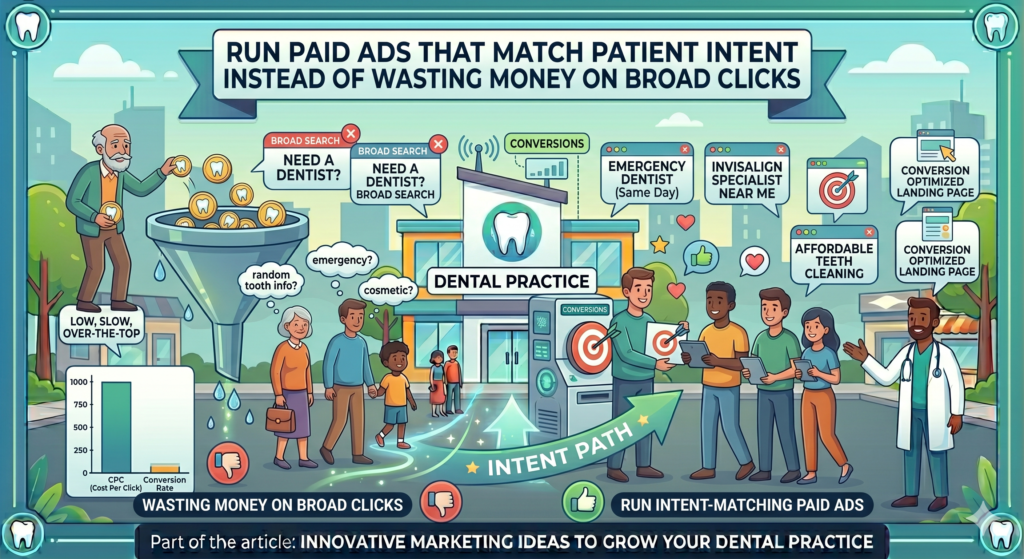
Ads can work very well when they are built around clear intent.
A person searching for “emergency dentist near me” is not the same as someone scrolling Instagram and seeing a whitening offer. A person searching for “dental implants cost” is not the same as a parent who has not yet chosen a family dentist. Each person needs a different message, a different page, and a different follow-up plan.
Search ads should focus on patients who are ready to act now
Search ads are powerful because they reach people at the moment they are looking.
If someone types “dentist near me,” “tooth pain dentist,” “emergency dentist open today,” or “Invisalign dentist near me,” they already have intent. They may be ready to call. Your ad should not waste their time with clever lines. It should quickly show that you can help.
For urgent searches, your ad should make your availability clear. If you offer same-day emergency appointments, say it. If calls are answered quickly, say it. If your clinic is close to a known area, mention the location. If you offer clear payment options, include that when space allows.
The landing page should match the ad. If the ad is about emergency dental care, do not send the person to your homepage and make them hunt. Send them to a page that explains emergency care, gives the phone number clearly, and helps them act fast.
This simple match between search, ad, and page can greatly improve results.
Cosmetic and implant ads need more trust before asking for the booking
Not every dental ad should push for an instant call.
A person thinking about veneers, implants, Invisalign, or a smile makeover often needs more time. These treatments can feel expensive, emotional, and serious. The patient may compare clinics, look at photos, read reviews, and worry about whether the result will look natural.
For these services, your ad should lead with trust and education.
A strong implant ad may invite people to learn their options instead of pushing a hard sale. A cosmetic ad may focus on natural-looking smile improvements. An Invisalign ad may speak to busy adults who want straighter teeth without feeling self-conscious.
The landing page should include patient concerns, treatment options, real photos if allowed, reviews, the dentist’s approach, financing information, and a simple way to request a consultation.
The more expensive or emotional the treatment, the more proof your marketing needs.
Retargeting ads can bring back people who were interested but not ready
Many people visit your website and leave without booking. This does not always mean they rejected you. They may have been interrupted. They may have wanted to compare options. They may have needed to talk to a partner. They may have felt nervous.
Retargeting ads help you stay visible to those people.
These ads can remind visitors about your clinic after they leave your website. But they should not feel creepy or repetitive. They should be helpful. You can show patient reviews, answer common concerns, highlight financing, explain gentle care, or invite them to book a consultation.
For example, someone who visited your dental implants page may later see an ad that says, “Still thinking about replacing a missing tooth? Learn your options in a calm consultation.” That feels more useful than a plain ad shouting, “Book now.”
Retargeting works best when it gently reduces doubt.
Paid ads should always be connected to call tracking and follow-up
Dental ads often create phone calls, not just form fills. If you are not tracking calls, you may not know which ads are working.
Use call tracking carefully so you can see which campaigns lead to real patient calls. But tracking is only part of the system. You also need to review call quality. Are people calling and getting voicemail? Are calls missed during lunch? Are staff asking the right questions? Are leads followed up when they do not book?
A good ad can be ruined by a weak phone experience.
Paid ads do not end when someone clicks. They end when the patient books, shows up, accepts care, and hopefully becomes loyal. Your tracking should follow that full path as much as possible.
Make your front desk part of your marketing strategy
Your front desk is one of your most important marketing channels.
This may sound strange because the front desk does not usually create ads, write content, or post on social media. But the front desk turns interest into appointments. Every call, message, and first interaction shapes the patient’s choice.
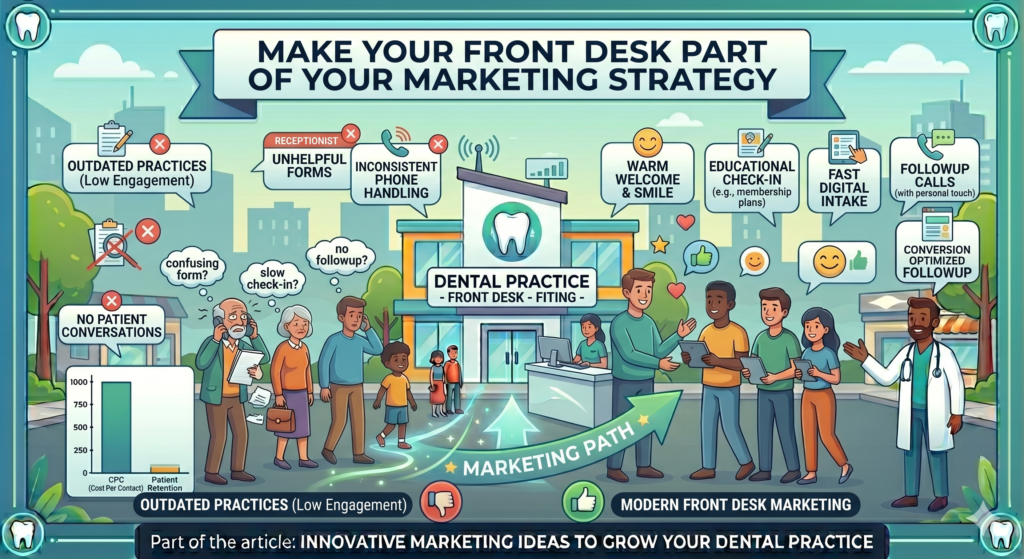
A patient may love your reviews and website, but if the first phone call feels rushed or cold, they may book somewhere else.
This happens more often than many clinics realize.
Marketing gets the phone to ring. The front desk turns that ring into revenue. If those two parts are not connected, growth becomes harder and more expensive.
The first call should make the patient feel heard before it tries to schedule
Many new patient calls begin with questions about availability, insurance, pricing, or pain. The front desk may be busy, so the call can become too quick. But to the patient, this call is a big moment.
They may be nervous. They may be embarrassed. They may be in pain. They may have delayed treatment for years. They may be calling during a work break and hoping for a simple answer.
The first job is to make them feel heard.
A warm opening matters. A calm voice matters. Simple phrases like, “I’m sorry you’re dealing with that,” or “We help patients with this often,” can lower fear. Once the patient feels understood, scheduling becomes easier.
The goal is not to turn the front desk into salespeople. The goal is to help them guide patients with care and confidence.
Your team should know how to answer price questions without losing the patient
Price questions are common in dentistry. Patients may ask, “How much is a crown?” or “What does an implant cost?” or “Do you take my insurance?”
If the answer is too vague, the patient may feel frustrated. If the answer is too direct without context, they may compare only on price and choose the cheapest option. The better approach is to answer with clarity and care.
For example, the team can explain that costs depend on the patient’s needs, but the dentist can give a clear plan after checking the tooth. They can also explain what the first visit includes and whether payment options are available.
The key is to not dodge the question. Patients can sense when they are being avoided. Instead, help them understand why an exam is needed and what they will learn from it.
A strong answer keeps the door open.
Missed calls should be treated like missed revenue
A missed call from a new patient is not just a small issue. It can be a lost appointment.
Many patients will not leave a voicemail. They will call the next clinic. This is especially true for emergency dental care. If someone is in pain, speed matters.
Your practice should have a clear missed-call process. If a call is missed, someone should call back quickly. If calls often come in during busy times, look at staffing. If your phone system makes patients wait too long, fix it. If patients call after hours, consider an online booking option or a clear after-hours message.
Every call is a person who had enough interest to reach out. That interest should be protected.
Call scripts should sound like real speech, not stiff lines
Scripts can help, but only if they are used well.
A bad script makes the team sound robotic. A good script gives them a clear path while still allowing warmth. It helps them ask the right questions, handle concerns, explain next steps, and invite the booking.
The best scripts sound like natural conversation. They include simple phrases for common situations, such as dental fear, cost worries, insurance questions, emergency pain, and treatment hesitation.
Training should include listening to real calls when possible. This helps the team hear what works and where patients drop off. Small changes in tone and wording can make a big difference.
Create offers that bring in the right patients instead of bargain hunters
Offers can help dental practices get attention, but they must be used carefully.
A weak offer attracts people who only want the cheapest option. These patients may not stay, may not accept treatment, and may leave when another clinic offers a lower price. A strong offer lowers the barrier for the right patient while still protecting the value of your care.
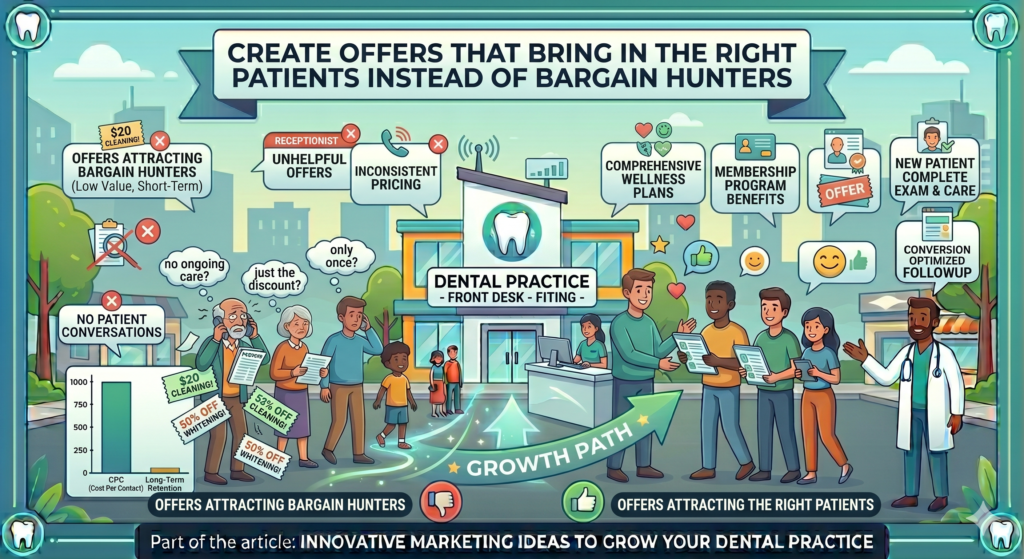
The purpose of an offer is not to make dentistry seem cheap. It is to make the first step feel easier.
This difference matters.
New patient offers should reduce risk, not lower your value
A good new patient offer helps someone who is unsure take the first step. It may include a consultation, an exam, x-rays where appropriate, or a clear treatment discussion. The exact offer depends on your location, rules, and business model.
But the message should be built around confidence, not discounting.
For example, instead of leading with a low price alone, you can lead with clarity. You can say that new patients will understand what is happening, what options they have, and what the next step may cost before making a decision.
This kind of offer appeals to patients who want trust and guidance. It does not train people to see your practice as a coupon.
Cosmetic offers should focus on timing, confidence, and natural results
Cosmetic dental patients are often motivated by life moments. They may be preparing for a wedding, graduation, job change, birthday, vacation, or public event. Your offers can speak to these moments.
A whitening offer before wedding season can work well. A smile consultation campaign before graduation season can work well. An Invisalign campaign at the start of the year can connect with people who want to finally improve their smile.
But the offer should still feel tasteful.
Talk about confidence. Talk about planning ahead. Talk about getting advice early so the patient has enough time before the event. This makes the offer feel helpful rather than desperate.
Emergency offers should focus on speed and relief
Emergency patients are usually not shopping for luxury. They want help now.
Your emergency marketing should make it clear that the clinic can help with pain, swelling, broken teeth, lost fillings, or other urgent problems. The offer does not need to be flashy. It needs to be clear.
If you offer same-day appointments, say so. If you leave room in the schedule for urgent cases, say so. If your team can explain costs before treatment starts, say so.
Emergency patients need quick trust. They want to know they will not be ignored, judged, or left confused.
Every offer should have a follow-up plan
An offer without follow-up is incomplete.
If someone clicks an ad, fills out a form, calls after hours, or asks a question on social media, your team should know what happens next. Speed matters. Clarity matters. Warmth matters.
For higher-value services, the follow-up may need more than one touch. A patient interested in implants or cosmetic dentistry may need a call, an email, a reminder, and a helpful guide. They may not book after one message.
The offer gets attention. The follow-up turns attention into trust. Trust turns into appointments.
Use community marketing to make your dental practice feel like part of daily life
A dental practice grows faster when people do not only see it as a place they visit when something hurts.
The strongest local practices become part of the community. People see the clinic name at school events. They meet the team at health fairs. They see useful advice from the dentist in local groups. They hear other parents mention the practice. They start to feel like the clinic belongs in the neighborhood.
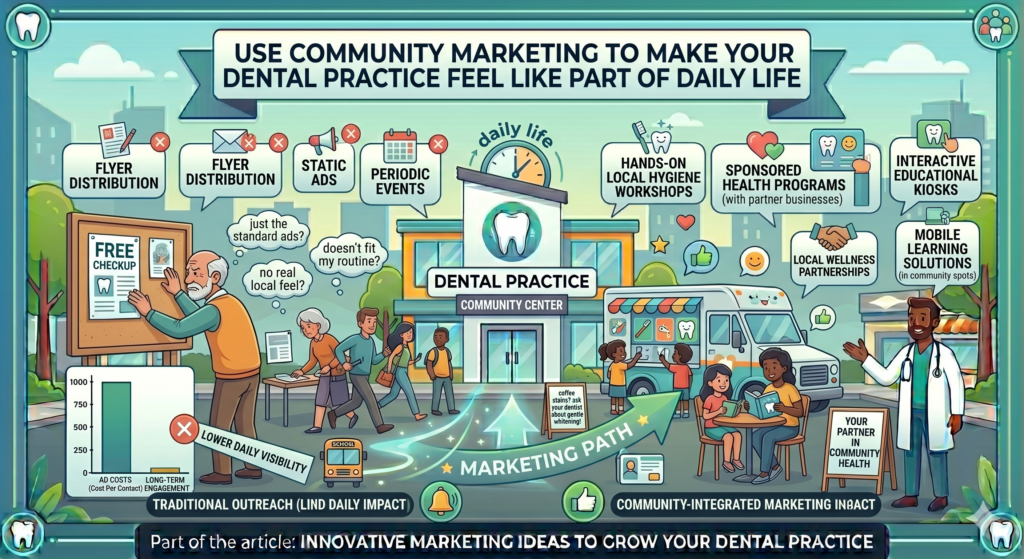
This matters because dental care is deeply local. Most people do not want to travel far for routine care. They want a dentist nearby who feels known, safe, and easy to reach.
Community marketing helps you build that feeling before patients ever search for you online. It also gives your practice a warmer identity. Instead of being just another clinic, you become the dental team that shows up, helps, teaches, and supports local families.
Your best community partnerships should match the patients you want to attract
Community marketing works best when it is focused.
If you want more family patients, schools, daycares, parent groups, children’s activity centers, and local sports teams may be a good fit. If you want more cosmetic patients, you may build relationships with salons, wedding planners, photographers, gyms, and wellness studios.
If you want more senior patients, senior centers, retirement communities, pharmacies, and local health groups may make sense.
The goal is not to place your logo everywhere. The goal is to show up where your best patients already spend time.
For example, a family dental practice can offer a simple dental health session at a school. The session should not feel like a sales pitch. It can teach children how to brush better, what sugary snacks do to teeth, and why dental visits are not scary. Parents remember clinics that help their children.
A cosmetic-focused practice can create a “smile ready” guide for brides, grooms, and professionals preparing for big events. This can be shared through wedding vendors, photographers, salons, and local event planners. The guide gives value first, while gently making the clinic part of the planning process.
A practice that wants more implant patients can offer a simple talk at a senior center about missing teeth, chewing problems, and modern replacement options. The talk should be calm and educational. It should help people understand choices without pressure.
Local events should be used to start relationships, not just hand out flyers
Many businesses attend local events, set up a table, hand out flyers, and then hope something happens.
That is not enough.
If your dental practice attends a community event, the goal should be conversation. People should have a reason to stop, talk, ask questions, and remember you. A table with brochures may be ignored. A table with a simple dental quiz for kids, a smile shade guide, a brushing timer giveaway, or a free “ask the dentist” moment can create real engagement.
Your team should be trained to speak in a warm, natural way. Do not open with a sales pitch. Open with a helpful question. Ask if they already have a family dentist nearby. Ask if their child has had a first dental visit yet. Ask if they have any questions about whitening before a big event. Ask if they know what to do when a tooth chips.
The best community marketing feels like service first.
When people feel helped, they are far more likely to remember your name.
Your practice can become the local source for simple dental education
You do not need to be famous to be trusted. You need to be useful in your own area.
Local newspapers, school newsletters, neighborhood groups, parenting pages, and community websites often need helpful content. Your practice can offer short articles on simple topics. These may include children’s first dental visits, what to do in a dental emergency, how to protect teeth during sports, why gums bleed, or how to plan whitening before a wedding.
This builds authority without sounding like bragging.
When your dentist becomes the person who explains dental care in plain words, people begin to trust the practice. They may not book right away. But when the need comes, your clinic feels familiar.
Community marketing should always lead back to a clear next step
Community activity should not be random. Every event, talk, guide, or partnership should connect to a simple next step.
That next step could be a special landing page for local families. It could be a QR code that opens your appointment page. It could be a downloadable dental emergency guide. It could be an invitation to book a first visit. It could be a follow-up email sequence for people who asked questions at an event.
If someone meets you in the community and then searches for your clinic later, your website, Google profile, and social media should support the same message. The trust should continue across every touchpoint.
This is how community marketing turns from “nice visibility” into real growth.
Build marketing around patient fears because fear is often the real reason people do not book
Dental marketing often talks about services, technology, and results.
But many patients are not stuck because they do not know services exist. They are stuck because they are afraid.
They may be afraid of pain. They may be afraid of cost. They may be afraid of being judged. They may be afraid of hearing bad news. They may be afraid that one small visit will turn into a huge treatment plan. They may be afraid because of a bad past experience.
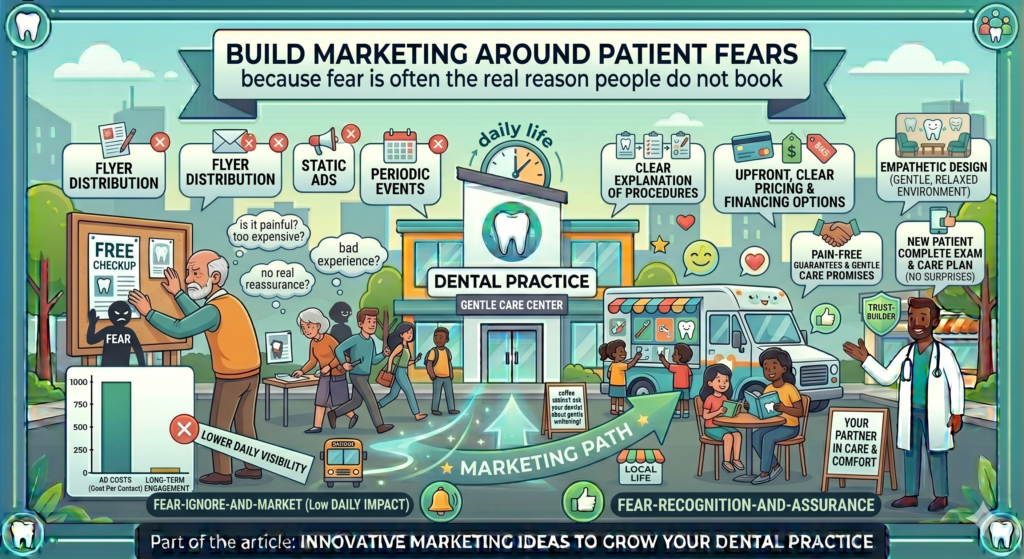
If your marketing does not speak to these fears, it misses the real barrier.
The practices that grow well do not ignore fear. They reduce it before the appointment.
Your dental anxiety message should be specific enough to feel believable
Many clinics say they are gentle. But nervous patients need more than that.
They need to know what “gentle” actually means in your practice. Do you explain each step before starting? Do you give patients time to ask questions? Do you check in during treatment? Do you offer breaks? Do you avoid judgment if someone has not visited in years? Do you have comfort options? Do you help patients understand what will happen before they sit in the chair?
Say these things clearly.
A nervous patient does not want a perfect slogan. They want proof that your team knows how to care for someone like them.
Your website can include a page for nervous patients. That page should speak directly and kindly. It can say that many people feel anxious about dental visits and that your team is used to helping patients move at a pace that feels manageable. It can explain what happens on the first visit and how the dentist keeps the patient informed.
This one page can become one of your strongest conversion tools.
Cost fear should be handled with clarity before the patient asks
Cost is one of the biggest reasons people delay dental care.
Many patients worry they will be surprised by a large bill. Some are embarrassed to ask about money. Some assume they cannot afford care, so they do not book at all. If your marketing does not address this, you may lose patients silently.
You do not need to list every price online if that does not fit your model or local rules. But you should explain how your clinic handles cost conversations.
Tell patients that treatment options will be explained before work begins. Tell them your team can review payment choices. Tell them whether you help with insurance questions. Tell them if financing is available. Tell them that the goal is to help patients make informed choices, not pressure them.
This kind of message can calm a patient who is almost ready but worried about money.
Shame is a hidden barrier that your content must remove
Some people avoid the dentist because they feel embarrassed.
They may have broken teeth. They may have bad breath. They may have gum disease. They may have not visited for ten years. They may think the dentist will scold them. This fear can be stronger than pain.
Your marketing should make it clear that your practice is not there to judge.
Use language that welcomes people back. Say that many patients come in after a long break. Say that the first step is simply understanding what is going on. Say that your team focuses on solutions, not blame.
This message should appear on your website, in your social posts, in your videos, and in your phone scripts. It should also be lived by the team.
A patient who feels safe from judgment may finally book the appointment they have delayed for years.
The most powerful fear-based marketing is calm, not scary
There is a difference between urgency and fearmongering.
You should explain why delaying care can make problems worse. But you should not make patients feel attacked or panicked. Good dental marketing says, “This matters, and we can help.” Bad dental marketing says, “You are in danger, and it is your fault.”
Use calm urgency. Explain that early care is often simpler. Explain that small problems can grow. Explain that pain, bleeding, swelling, or broken teeth should be checked. Then give the patient a clear, safe next step.
This approach respects the patient and still moves them to action.
Create treatment-specific marketing journeys instead of sending every patient the same message
Not all dental patients think the same way.
A person with tooth pain wants quick relief. A parent wants safety and kindness. A cosmetic patient wants confidence and natural results. An implant patient wants trust, cost clarity, and a clear plan. A nervous patient wants reassurance. A patient who missed a cleaning may simply need a reminder.
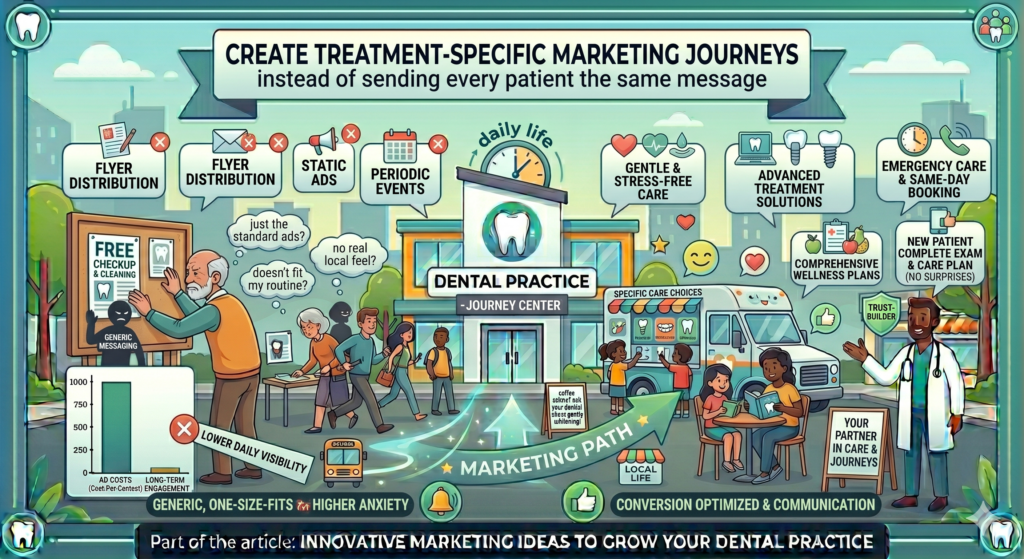
If you send all of these people the same message, your marketing becomes weaker.
A stronger approach is to build treatment-specific journeys. This means each type of patient sees content, ads, emails, pages, and follow-up messages that match their need.
Emergency patients need speed, clarity, and a direct path to help
Emergency dental patients are usually in a high-stress state. They are not calmly reading long pages. They want to know if you can help, how fast you can see them, and what to do next.
Your emergency marketing should be simple and direct.
The page should load fast. The phone number should be large and easy to tap. The copy should name common urgent issues, such as tooth pain, swelling, broken teeth, knocked-out teeth, lost fillings, or dental injuries. It should explain when to call and what the patient can expect.
Your ads should focus on location, speed, and relief. Your front desk should be ready to handle these calls with care. Your follow-up should be fast because emergency patients often call more than one clinic.
For emergency care, the first clinic that feels helpful often wins.
Implant patients need education before they trust the next step
Dental implants are a bigger decision. Patients may be worried about surgery, cost, healing time, pain, and whether implants are right for them.
This journey should not rush.
An implant patient may first read a guide about missing tooth options. Then they may visit your implant page. Then they may look at reviews. Then they may watch a video from the dentist explaining the process. Then they may ask about cost or financing. Then they may book a consultation.
Your marketing should support each step.
A strong implant journey may include a main implant page, a comparison page between implants and bridges, a simple cost factors page, patient stories, a consultation landing page, and a follow-up email that answers common questions.
This helps the patient feel informed. And informed patients are more likely to trust the plan.
Cosmetic patients need to believe you understand taste, not just teeth
Cosmetic dentistry is emotional.
Patients are not only asking if you can change their smile. They are asking if you can make it look right for their face, age, personality, and goals. Many are afraid of results that look fake. Some want a small change. Others want a full smile makeover. Some have been thinking about it for years.
Your cosmetic marketing should show that you listen before you treat.
Talk about natural-looking results. Explain how consultations work. Show examples when allowed. Explain that the right plan depends on the patient’s goals, tooth shape, gum health, bite, shade, and timeline. Speak to life moments like weddings, career changes, photos, and renewed confidence.
A cosmetic patient needs to feel seen. They do not want a one-size-fits-all smile.
Family dental patients need convenience, warmth, and long-term trust
Families choose a dentist based on more than clinical care. They care about scheduling, comfort, location, child-friendly communication, insurance help, and whether the team is patient.
Your family marketing should show that you make life easier.
Talk about care for children, teens, parents, and grandparents. Explain how you help children feel calm. Show that your team understands busy schedules. Share simple parent education. Make booking easy. Highlight long-term prevention, not just treatment.
A family patient can become a patient for many years. This makes family-focused marketing very valuable when the experience is strong.
Use content offers and lead magnets to capture patients who are interested but not ready
Many people visit your website before they are ready to book.
They may be researching implants. They may be thinking about whitening. They may be comparing Invisalign. They may be worried about a symptom but not ready to call. If your website only gives them two choices, book or leave, many will leave.
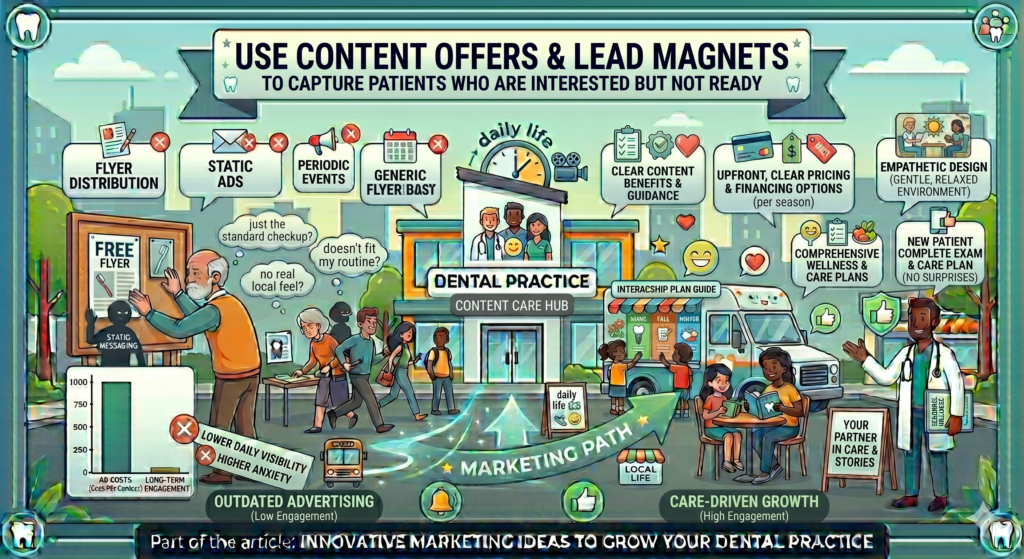
A content offer gives them a softer next step.
This does not need to be complicated. It can be a helpful guide, checklist, quiz, cost explainer, or email series. The goal is to help the patient learn while giving your practice a chance to follow up.
A simple guide can turn a quiet website visitor into a future patient
A guide works well when the patient needs education before action.
For example, an implant guide can explain missing tooth options in simple words. A whitening guide can explain how to plan treatment before an event. A nervous patient guide can explain what to expect at the first visit. A parent guide can explain when children should see the dentist and how to prepare them.
The guide should not be a sales brochure. It should be truly useful.
At the end, it can invite the patient to book a visit or ask a question. This feels natural because the guide has already helped them.
Quizzes can help patients understand their needs in a simple way
A short quiz can work well for cosmetic dentistry, dental anxiety, implants, or orthodontics.
For example, a “Which smile treatment may fit your goals?” quiz can help cosmetic patients think through whitening, bonding, veneers, or aligners. A “Are dental implants worth discussing?” quiz can help people with missing teeth understand whether a consultation makes sense. A “How nervous are you about the dentist?” quiz can guide anxious patients toward comfort options.
The quiz should be simple and honest. It should not diagnose. It should not promise results. It should help the patient choose a sensible next step.
This kind of tool can also give your team better information before the first conversation.
Cost explainers can reduce one of the biggest booking barriers
Many patients search for cost before they search for quality.
If you avoid cost completely, they may go to another website that explains it better. A cost explainer does not have to give a fixed number for every case. It can explain what affects cost and why an exam is needed for a clear quote.
For example, an implant cost guide can explain that cost may depend on the number of missing teeth, bone health, scans, materials, and the final restoration. A veneer cost guide can explain that cost may depend on the number of teeth, smile goals, gum health, and preparation needed.
This helps patients feel respected. They may still need a consultation, but they no longer feel kept in the dark.
Lead magnets should connect to follow-up messages that feel personal
A content offer is only the beginning.
If someone downloads an implant guide, they should not receive the same message as someone interested in children’s dentistry. Their follow-up should match their interest. It can answer common questions, share a patient story, explain the consultation, and invite them to book when ready.
Keep these messages short and human. Write them like a helpful team member is checking in, not like a sales machine.
This is how you build trust with people who need more time.
Use local video marketing so patients feel like they already know your team
Video can do something most dental marketing cannot do quickly.
It can make a stranger feel familiar with your practice before they ever call.
This is powerful because many dental patients are not only choosing a service. They are choosing a person they hope they can trust. They want to know if the dentist sounds kind. They want to know if the team feels warm. They want to know if the office looks clean and calm. They want to know if they will be treated like a person, not just another appointment.
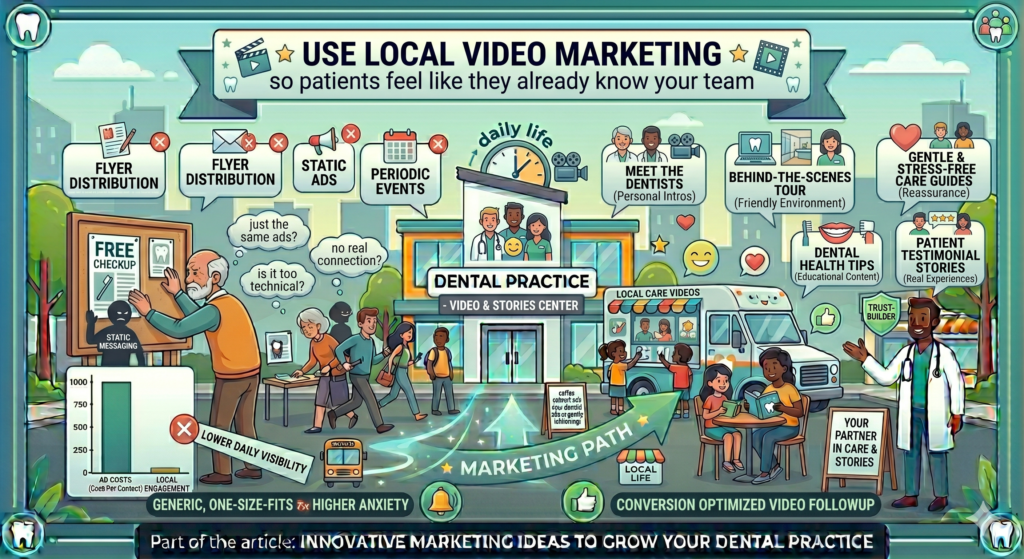
A written page can tell them these things. A video can show them.
For a dental practice, video does not need to be complex. You do not need a studio, a big camera crew, or perfect editing. You need clear sound, good light, simple words, and a real message. In many cases, a short video filmed inside your actual clinic can feel more honest than a polished ad.
Your first videos should answer the questions patients are too shy to ask
Most patients have questions they do not ask out loud.
They may wonder if a root canal hurts. They may wonder if the dentist will judge them for not coming in sooner. They may wonder if whitening damages teeth. They may wonder why their gums bleed. They may wonder if dental implants are only for older people. They may wonder if their child will cry during the first visit.
These questions are perfect video topics.
A dentist can stand in the clinic and answer one question in a calm, friendly way. The video should feel like a simple conversation. It should not sound like a lecture. It should not be full of big clinical words. The goal is to make the viewer feel understood.
For example, a video about dental fear can start by saying that many people feel nervous before a visit, especially if they had a bad experience in the past. Then the dentist can explain how the team helps patients feel more in control.
This could include talking through each step, checking in often, taking breaks, and making sure the patient knows what is happening.
That kind of video can do more than attract attention. It can remove a barrier that stops people from booking.
A clinic tour video can lower fear before the first visit
A first dental visit can feel stressful because the patient does not know what to expect.
A short clinic tour can help. It can show the outside of the building, the reception area, the waiting room, the treatment room, and the faces of the team. It can explain where to park, what happens at check-in, and what a new patient can expect during the first appointment.
This is especially useful for nervous patients, parents, and people who have not seen a dentist in years.
The video should not feel like a real estate tour. It should feel like a welcome. The dentist or a team member can speak directly to the viewer and say, in simple words, that the first visit is about understanding their needs and helping them feel comfortable.
Small details matter. Show the friendly greeting at the front desk. Show a calm treatment room. Show the team smiling naturally. Show the real space, not a fake version of it.
When patients know what they are walking into, the first step feels easier.
Treatment explainer videos should make the next step feel less confusing
Dental treatments can sound scary when patients do not understand them.
Words like implant, crown, extraction, root canal, veneer, and deep cleaning may create fear. The patient may imagine pain, high cost, or a long process. A simple explainer video can reduce that fear.
For each major treatment, create a short video that explains what the treatment is, why it may be needed, what happens during the first visit, and what the patient should ask before deciding.
Keep the video focused. Do not try to explain every detail. A patient does not need a dental school lesson. They need enough understanding to feel safe taking the next step.
For example, an implant video can explain that implants are one option for replacing missing teeth, but the right choice depends on the patient’s mouth, health, bone support, goals, and budget. The video can invite the patient to book a consultation to understand their options clearly.
This is better than pushing the treatment. It shows care, patience, and honesty.
Your videos should be used in many places so they keep working for you
A good video should not sit on one social media post and disappear.
You can place it on your website, service pages, Google Business Profile, email follow-ups, YouTube channel, Instagram, Facebook, and even appointment reminder messages when useful. A video about nervous patients can support your homepage, your anxiety page, and your new patient emails. A video about implants can support ads, consultation pages, and follow-up messages.
This is how video becomes a long-term marketing asset.
The best approach is to create a simple video library. Each video answers one clear question. Over time, this library becomes a trust engine. Patients can see your face, hear your tone, and learn from you before they book.
Use your patient experience as a marketing tool because people share how you make them feel
Marketing does not end when a patient books.
In many ways, that is where the strongest marketing begins.
Every part of the patient experience can either support your growth or weaken it. The first call, the welcome at the front desk, the way the dentist explains treatment, the comfort during the visit, the follow-up after care, and the way billing is handled all shape what the patient says about you later.
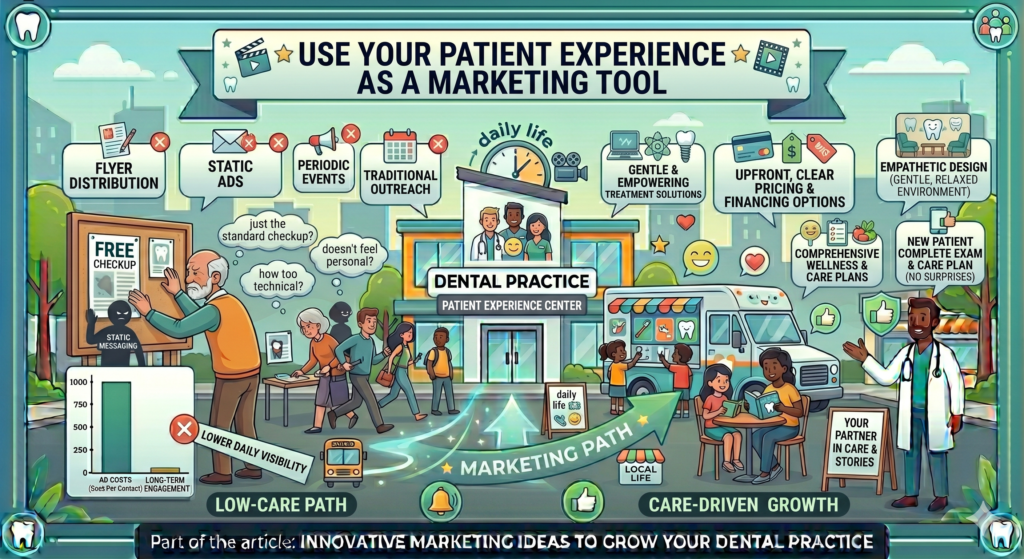
A happy patient may leave a review. They may refer a friend. They may bring their family. They may come back on time. They may accept treatment because they trust your advice. This is why patient experience is not separate from marketing. It is marketing.
Your practice should design the first visit like a trust-building journey
The first visit should not feel rushed or confusing.
For new patients, this appointment sets the tone for the whole relationship. They are asking themselves whether they made the right choice. They are watching how the team speaks, how clearly things are explained, and whether they feel respected.
A strong first visit should make the patient feel welcome, informed, and in control.
Before the visit, send a helpful message that explains what to expect. Tell them what to bring, where to park, how long the visit may take, and how to ask questions. This reduces stress before they arrive.
When they enter, greet them by name if possible. Small touches like this make the clinic feel personal. During the appointment, explain what you are checking and why. After the exam, avoid dumping too much information at once. Walk the patient through the main findings in plain words.
If treatment is needed, explain the options clearly. Patients should leave knowing what matters most, what can wait, what should not wait, and what the next step is.
Small comfort details can become big reasons patients talk about you
Patients often remember how they felt more than the exact treatment details.
They remember if the dentist was gentle. They remember if the team noticed they were nervous. They remember if someone explained the cost without making them feel awkward. They remember if they were offered a break. They remember if the clinic followed up after a tough visit.
These details become stories.
A patient may tell a friend, “They were so kind when I was scared,” or “They explained everything and did not rush me,” or “They checked on me after my procedure.” These are the kinds of comments that grow a practice.
Think about the moments that create emotion. The first phone call. The first greeting. The moment before treatment begins. The moment when cost is discussed. The moment after treatment ends. The follow-up message later that day.
Each moment is a chance to show care.
Follow-up after treatment can turn a good visit into a memorable one
Most clinics finish the appointment and move on. A smart practice keeps caring after the patient leaves.
A short follow-up message after a treatment can mean a lot. It can ask how the patient is feeling, remind them of aftercare steps, and tell them to call if they have concerns. This is especially useful after extractions, root canals, implants, deep cleanings, and major restorative work.
This follow-up does not need to be long. It needs to feel human.
Patients are often surprised when a clinic checks in. That surprise builds trust. It also reduces anxiety and can prevent small concerns from turning into negative reviews.
Every team member should understand that the patient experience affects growth
Marketing should not live only with the owner or the agency.
The whole team shapes the brand. The front desk shapes it. The assistant shapes it. The hygienist shapes it. The dentist shapes it. Even the way someone answers a simple insurance question can affect whether the patient returns.
This is why your team should understand the practice promise. If your promise is calm care for nervous patients, the whole team must act in ways that support that promise. If your promise is clear treatment guidance, every patient conversation should feel clear. If your promise is family-friendly care, parents and children should feel that at every step.
When the patient experience and marketing message match, trust grows faster.
Create a dental membership plan to keep uninsured patients connected to your practice
Many people delay dental care because they do not have insurance.
Some assume dental care will be too expensive. Some wait until pain forces them to act. Some visit only during emergencies. This is bad for their health and bad for practice growth.
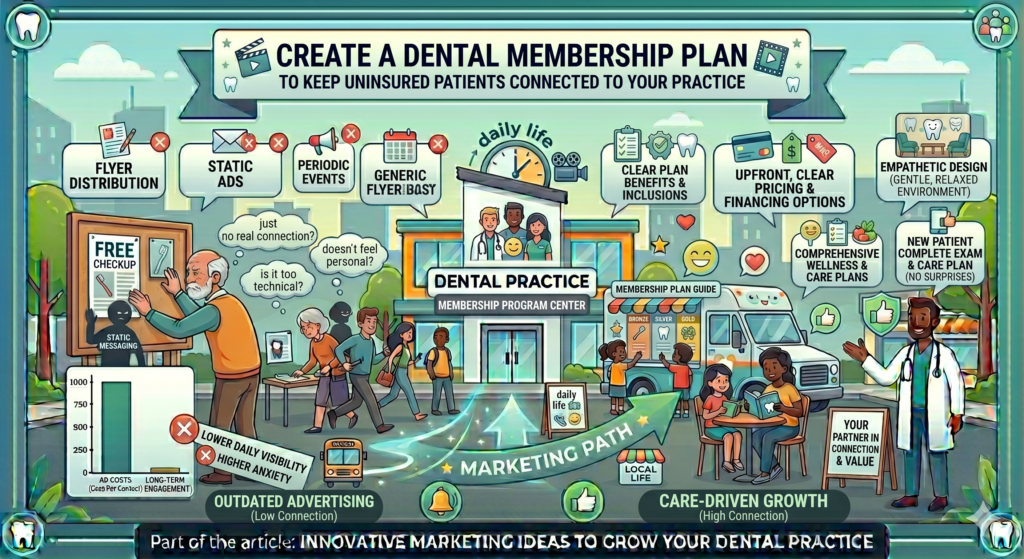
A dental membership plan can help solve this problem.
This is not insurance. It is a simple in-house plan where patients pay a set fee for certain preventive services and receive savings on other treatments. The details depend on your practice, local rules, and financial model. But when designed well, it can make dental care feel easier to plan.
For marketing, a membership plan gives uninsured patients a clear reason to stay with your practice instead of disappearing between problems.
Your membership plan should be simple enough to understand in one minute
If the plan is confusing, patients will not use it.
The best membership plans are easy to explain. A patient should quickly understand what is included, what it costs, how long it lasts, and what savings may apply. Avoid making the plan feel like a legal document in your marketing copy. Keep the full terms clear, but present the main value in plain words.
For example, the message could explain that the plan helps patients stay on track with preventive care and makes other needed treatment more manageable. It can be especially helpful for people without dental insurance, self-employed workers, retirees, and families who want clearer dental costs.
The key is peace of mind.
Patients do not want another confusing payment product. They want to know they can care for their teeth without feeling lost.
A membership plan can increase loyalty because patients feel more connected
When patients join a membership plan, they are more likely to return.
They have already made a choice to stay connected to your practice. They are more likely to book cleanings, keep appointments, and ask about treatment. This can improve retention and create steadier revenue.
But the plan should not be marketed only as a discount. If you make it all about cheap care, you may attract patients who only compare prices. Instead, position it as a simple way to protect oral health and plan care with less stress.
For families, the message can focus on keeping everyone on track. For adults without insurance, it can focus on making routine dental visits easier to manage. For older patients, it can focus on staying ahead of dental problems.
The plan should feel like a helpful path, not a bargain bin.
Your team should bring up the plan during the right conversations
A membership plan will not grow if it only sits on the website.
Your front desk and clinical team should know when to mention it. Good moments include when a patient says they do not have insurance, when someone cancels because of cost, when a new patient asks about pricing, or when a long-time patient loses coverage.
The conversation should be gentle. The team can say that the practice has a plan for patients without insurance and can explain it if the patient would like to learn more.
This keeps the tone helpful instead of pushy.
Your membership plan should have its own clear page on your website
Do not hide the plan inside a small note on your payment page.
Create a simple page that explains who the plan is for, what it includes, why it helps, and how to join. Use clear headings and simple examples. Add common questions. Explain that it is not insurance if that applies. Make the next step easy.
This page can rank for local searches from people looking for a dentist without insurance. It can also support ads, emails, and social posts.
For many practices, this page can become a quiet but steady source of loyal patients.
Build seasonal campaigns that match what patients already care about at that time
Dental marketing works better when it fits the patient’s current life.
People think about dental care differently throughout the year. Parents think about school checkups before the school year starts. Adults think about whitening before weddings, holidays, and big events. Patients think about using benefits before the year ends. Some people want a fresh start in January. Others want to fix a dental issue before vacation.
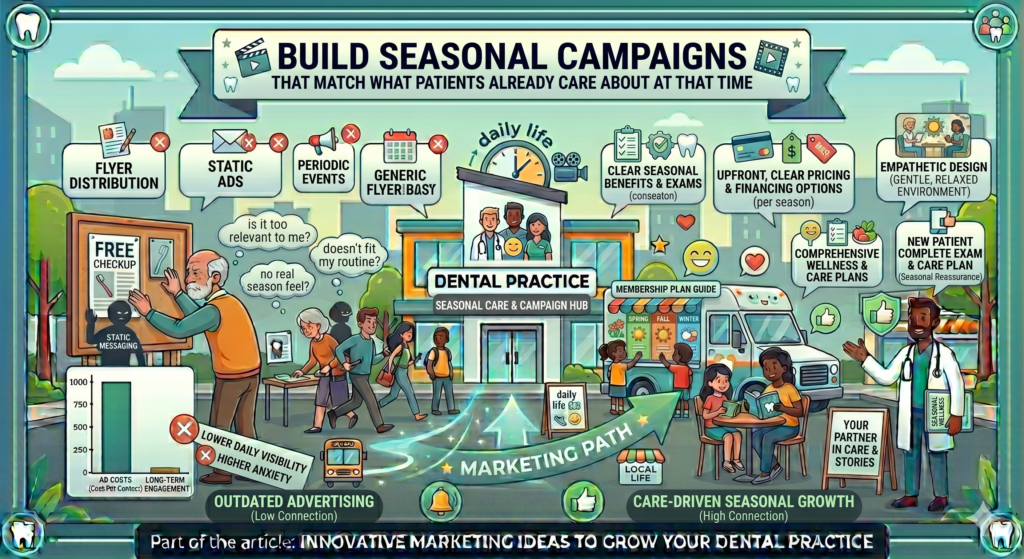
Seasonal campaigns help your marketing feel timely.
They give patients a reason to act now without using fake pressure. The best campaigns connect dental care to real moments in the patient’s life.
Back-to-school campaigns can help parents act before schedules get busy
Before school starts, many parents are thinking about supplies, clothes, forms, and health checks. This is a smart time to remind them about dental visits.
A back-to-school dental campaign can focus on children’s checkups, sports mouthguards, cavity prevention, and building healthy habits. The message should not sound like a scare tactic. It should make life easier for parents.
For example, your campaign can say that booking before school begins helps avoid missed classes and busy schedules later. It can also remind parents that dental issues can affect eating, sleep, and focus.
This campaign can run through email, social media, local school partnerships, Google posts, and your website. If your practice serves families, this should be one of your most important yearly campaigns.
Wedding and event campaigns can work well for whitening and cosmetic care
Many people think about their smile before important events.
Weddings, graduations, reunions, job interviews, birthdays, and vacations can all create interest in whitening, bonding, veneers, and aligners. The key is to start the campaign early enough.
A patient may not know that some treatments need planning time. Whitening may need to be done before certain dental work. Veneers and aligners need more time. Even a simple smile consultation should happen early if the patient has a deadline.
Your campaign can help people plan. It can explain when to book, what options may be available, and how to choose a result that looks natural.
This is not just promotion. It is guidance.
End-of-year campaigns can help patients use benefits and finish needed care
The end of the year is a strong time for many dental practices because some patients have unused dental benefits. But many clinics handle this campaign in a cold way. They send a message that simply says, “Use your benefits before they expire.”
That message can work, but it can be better.
Explain why using benefits matters. Remind patients that delayed treatment may become more complex. Encourage them to schedule early because appointment times fill up. Make the message helpful, not pushy.
You can also segment the campaign. Patients with unscheduled treatment should get a more specific message. Hygiene patients who are overdue should get a recall message. Families should be reminded to book before holiday schedules become crowded.
The more relevant the message, the better it works.
Seasonal campaigns should be planned before the season begins
Many practices start campaigns too late.
If you begin your back-to-school campaign after school has already started, you miss the best moment. If you promote whitening one week before wedding season, many patients may not have enough time. If you remind patients about benefits in the final days of December, your schedule may already be full.
Plan your campaigns ahead.
Create a simple yearly marketing calendar. Decide which services matter most each season. Prepare website banners, emails, social posts, Google updates, ads, and front desk talking points before the campaign begins.
This makes your marketing feel organized and timely. It also helps your team support the same message across every channel.
Conclusion:
Growing a dental practice is not about chasing every new trend.
It is about building trust before the patient books, during the visit, and after they leave. It is about being easy to find, easy to understand, and easy to choose. It is about showing people that your clinic does more than fix teeth. It helps them feel calm, informed, confident, and cared for.




















Comments are closed.