
WinSavvy Editorial Standards
How this article was created
Digital marketing has changed a lot. A few years ago, a business could post on social media, run a few ads, write a few blog posts, and still get decent results. Today, that is no longer enough. People are smarter. Markets are louder. Search engines are stricter. Social platforms are crowded. Buyers compare more, trust less, and take longer to make decisions.
Why Modern Digital Marketing Needs a New Mindset
Digital marketing is no longer just about being seen. It is about being chosen.
That small shift changes everything. In the past, many businesses treated online marketing like a loudspeaker. They wanted more posts, more ads, more emails, more traffic, and more clicks. The thinking was simple. If more people saw the brand, more people would buy.
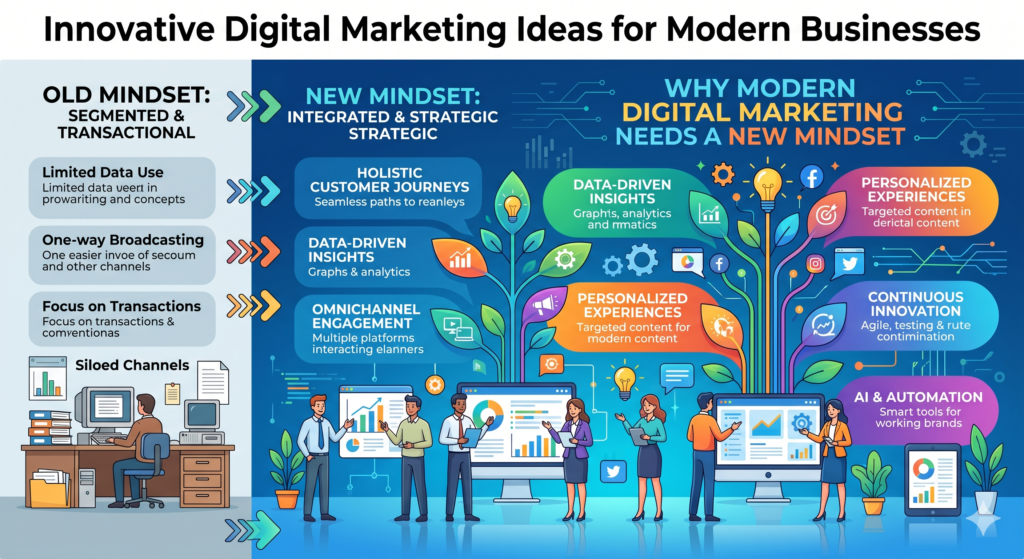
That idea still has some truth, but it is not enough anymore.
Modern buyers do not move in straight lines. They may see your ad today, read your blog next week, watch your video later, check your reviews after that, compare you with three other brands, forget about you, then come back when the need becomes urgent. During that journey, every small touch matters.
This means your marketing cannot be random. It has to feel connected. Your message, your content, your offer, your website, your social posts, your emails, and your sales process must all tell the same story.
If one part feels strong but another part feels weak, trust breaks.
A person may love your Instagram page but leave your website because the message is unclear. Someone may enjoy your blog but never contact you because your call to action feels vague. A lead may click your ad but bounce because your landing page sounds like every other company in your space.
Modern digital marketing needs a new mindset because the buyer has changed. People do not want to be pushed. They want to be helped. They do not want vague claims. They want proof. They do not want brands that talk only about themselves. They want brands that understand their problems before selling the solution.
The best marketing now starts with buyer clarity, not channel choice
Many businesses begin in the wrong place. They ask, “Should we focus on SEO, LinkedIn, TikTok, email, paid ads, or webinars?”
That is not the first question.
The first question is, “Who are we trying to reach, what do they care about, and what must they believe before they buy from us?”
Once you answer that, channel choice becomes easier.
For example, if your buyer is a busy founder looking for fast answers, your content should be sharp, direct, and practical. If your buyer is a senior manager who needs to convince a team, your content should include proof, use cases, and clear business value.
If your buyer is a local customer choosing between nearby service providers, your marketing should focus on trust, reviews, location signals, before-and-after proof, and fast contact options.
The channel is only the road. The buyer is the destination.
Too many businesses spend money building roads before they know where they are going.
Your marketing should answer the questions your buyer is afraid to ask
One of the most useful ways to improve digital marketing is to write down the questions your buyer has but may not say out loud.
They may wonder if your service is too expensive. They may worry that your product will be hard to use. They may fear they will choose wrong and look bad in front of their boss. They may not trust your claims because they have been disappointed before. They may like your offer but need a reason to act now.
Great marketing brings these hidden doubts into the open.
Instead of pretending objections do not exist, strong content handles them with care. Your website should explain who your offer is for and who it is not for. Your sales pages should make the next step clear. Your case studies should show what changed, not just say the client was happy.
Your emails should guide people through doubt, not just announce discounts.
When your marketing answers the real questions inside your buyer’s head, it becomes more than content. It becomes a quiet sales conversation.
The old funnel is too simple for modern buyers
The classic marketing funnel says people move from awareness to interest to decision to action. That model is useful, but it is too clean for the way people behave now.
Modern buyers jump around.
They may discover your business through a search result, then watch your founder’s video, then read two reviews, then visit a competitor’s site, then join your email list, then ignore you for a month, then suddenly book a call after seeing one strong customer story.
This does not mean the funnel is dead. It means your marketing has to support people at many stages at once.
You need content for people who do not know they have a problem yet. You need content for people who know the problem but do not know the best solution. You need content for people comparing options. You need content for people ready to buy but still unsure.
You also need content for customers after they buy, because retention is part of marketing too.
If your marketing only focuses on getting new attention, you will always feel like you are starting from zero.
Think of digital marketing as a trust-building loop
A better way to think about marketing is as a loop.
Someone discovers you. They learn from you. They begin to trust you. They take a small action. They get value. They come back. They share. They buy. They stay. They refer.
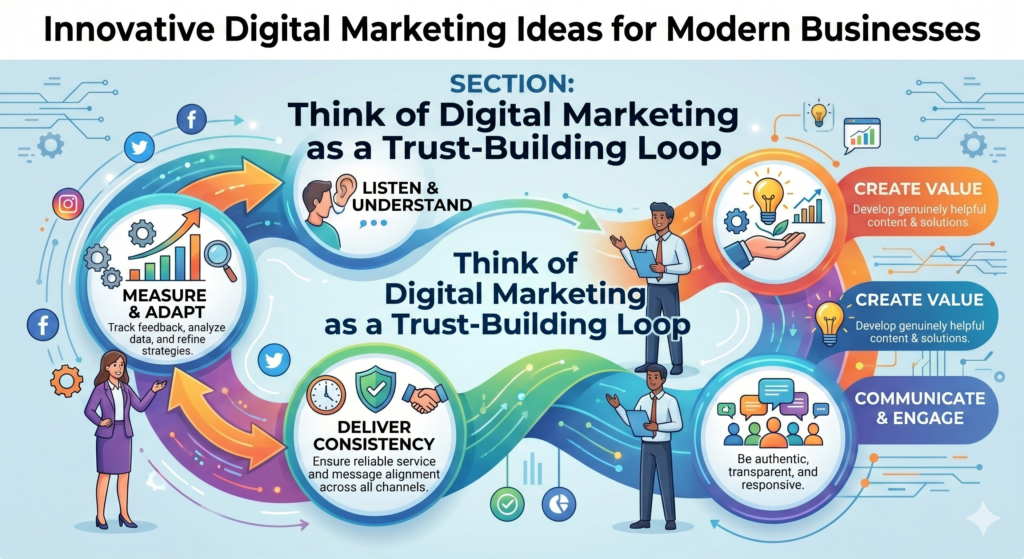
That loop is powerful because it does not depend only on cold traffic. It builds momentum over time.
A blog post can bring someone in through search. A helpful email can keep them close. A webinar can deepen trust. A strong case study can remove doubt. A clear offer can turn interest into action. A great client experience can create reviews and referrals. Those reviews can then support the next buyer.
This is how modern businesses grow without always shouting louder.
They build assets that work together.
Build a Content Strategy Around Real Buying Moments
Content marketing is not about publishing as much as possible. It is about showing up at the exact moment your buyer needs help.
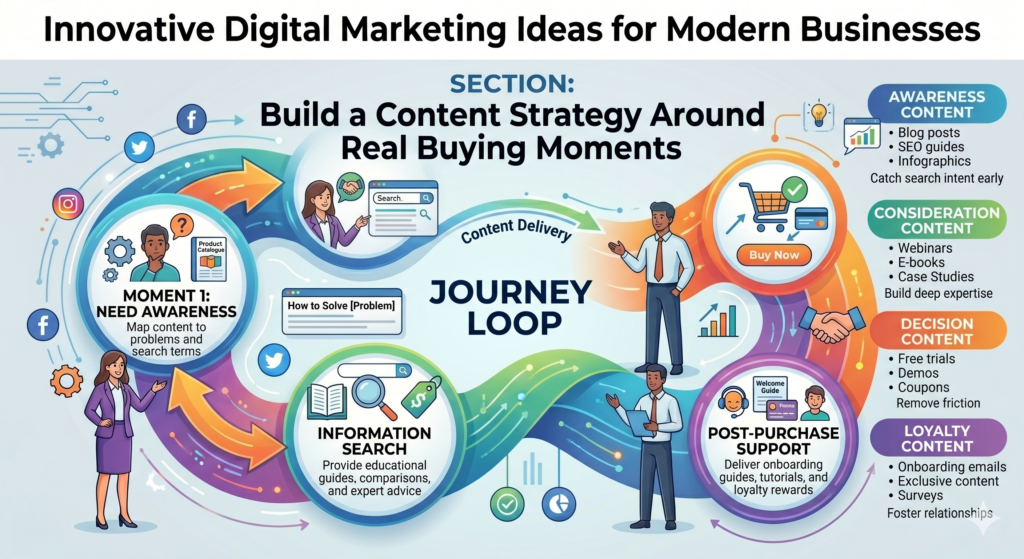
That is a very different way to think.
A weak content strategy starts with topics. A strong content strategy starts with buying moments.
A topic is broad. A buying moment is specific.
“Email marketing tips” is a topic. “How to improve email open rates before a product launch” is a buying moment. “SEO strategy” is a topic. “How to choose blog topics that bring qualified leads” is a buying moment. “Social media marketing” is a topic. “What to post when your audience is not engaging” is a buying moment.
The more specific your content becomes, the more useful it feels.
Modern businesses should stop writing only for traffic and start writing for intent. Traffic is good, but traffic without intent can waste time. You do not need everyone. You need the right people at the right stage.
Map content to the pressure your buyer feels
Every buyer feels some kind of pressure. They may need more leads. They may need better sales. They may need to cut costs. They may need to fix poor retention. They may need to look more credible. They may need to act before a competitor does.
Your content should speak to that pressure clearly.
For example, a business owner does not wake up thinking, “I need a full-funnel digital marketing framework.” They wake up thinking, “We are spending money on marketing, but leads are weak.” Or, “Our website gets visitors, but no one books calls.” Or, “Our competitors look more active than us online.”
That is the language your content should use.
When you write from the buyer’s pressure, the content feels human. It feels close to the problem. It makes the reader think, “This company gets it.”
That feeling is often the first step toward trust.
Use problem-first headlines that sound like real thoughts
Your headlines should not sound like they were built only for search engines. They should sound like something your buyer would actually care about.
Instead of writing a generic title like “Benefits of Digital Marketing,” a modern business could write, “Why Your Digital Marketing Is Getting Clicks But Not Customers.” Instead of “Social Media Strategy Guide,” a stronger title could be “What to Post When Your Audience Has Stopped Paying Attention.” Instead of “SEO Tips for Small Businesses,” a sharper title could be “How to Turn Your Blog Into a Lead Source, Not Just a Traffic Source.”
These headlines work because they carry tension. They show a problem. They invite the reader into a useful answer.
Good content does not just share information. It creates movement. The reader should feel pulled from a pain point toward a clearer path.
Create content for the full decision journey
A strong content plan should not depend on one type of article. You need different content for different levels of buyer awareness.
Some people are early. They are just starting to understand the problem. They need simple education. They may read articles that explain what is going wrong, why it matters, and what common mistakes to avoid.
Some people are in the middle. They know the problem and are looking for options. They need comparison content, strategy guides, checklists, examples, and clear steps.
Some people are near the end. They are deciding whether to trust you. They need case studies, proof, pricing guidance, process pages, service pages, testimonials, and answers to objections.
If your content only teaches and never sells, you may attract readers who never become buyers. If your content only sells and never teaches, people may not trust you enough to act.
The best strategy does both.
Your blog should act like a quiet sales team
A strong blog is not just a place for articles. It is a sales support system.
Each article should help the buyer understand one important thing. It should remove one doubt, explain one problem, show one better way, or make one decision easier.
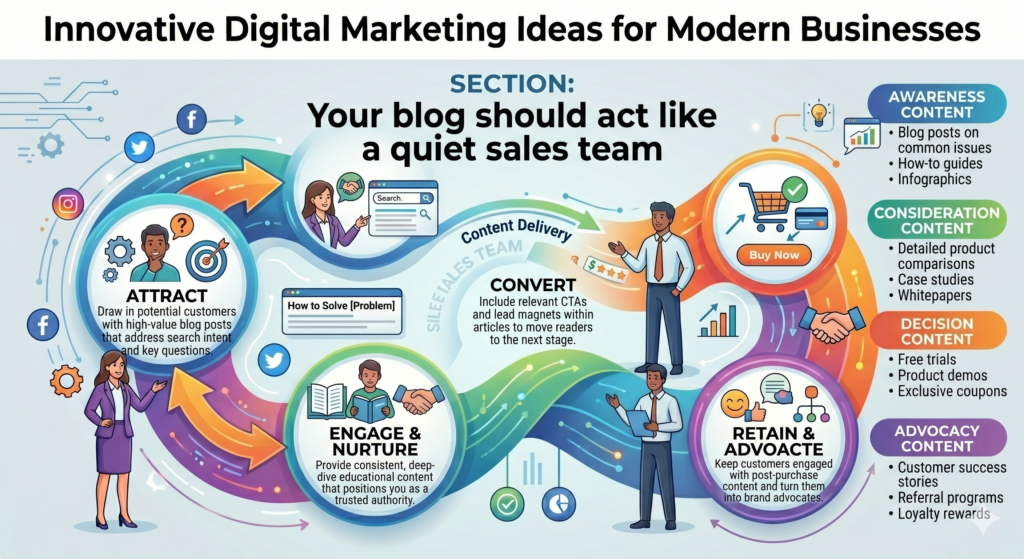
This is where many businesses go wrong. They publish blog posts that are technically correct but commercially weak. The content explains the topic but does not guide the reader toward action. It gives information but does not shape belief.
A better article helps the reader see the cost of staying the same. It explains why the old way is not working. It shows what to do instead. It gives practical steps. It also connects the problem to the business’s offer in a natural way.
This does not mean every blog post should sound like a sales page. It means every blog post should have a purpose.
Before publishing any article, ask what the reader should think, feel, or do after reading it. If the answer is not clear, the article is not ready.
Turn SEO Into a Growth System, Not Just a Ranking Game
SEO is often treated like a technical task. Businesses think about keywords, rankings, backlinks, and traffic. These things matter, but they are not the full picture.
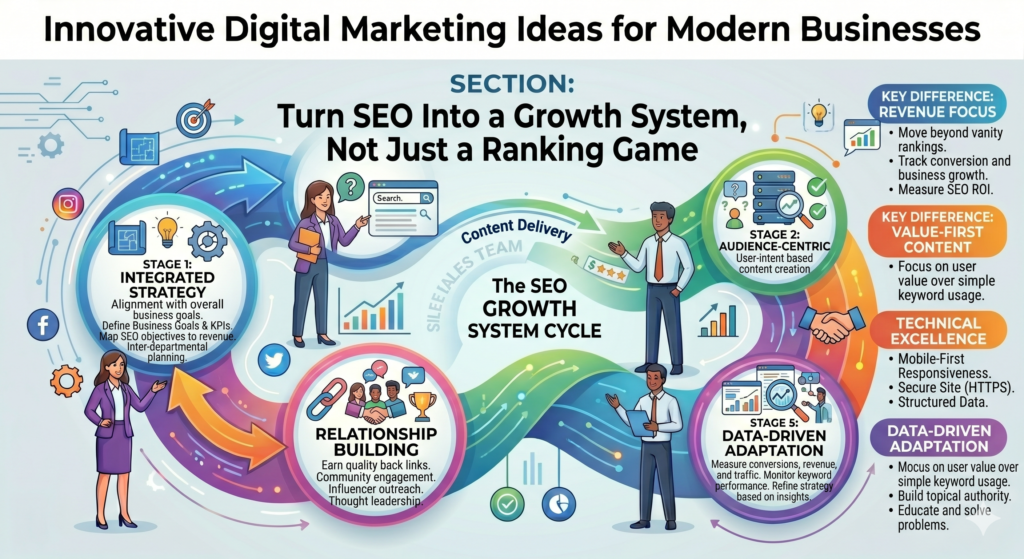
Modern SEO should be treated as a growth system.
The goal is not only to rank. The goal is to be found by the right people, answer their questions better than anyone else, build trust through useful content, and turn search visitors into leads or customers.
A page that ranks but does not convert is only doing half the job.
A page that gets less traffic but brings high-quality leads may be far more valuable.
This is why smart businesses look beyond search volume. They think about search intent, buyer stage, content depth, trust signals, and next steps.
Choose keywords based on business value
Not every keyword deserves your time.
Some keywords bring people who are only looking for basic information. Some bring people who are comparing options. Some bring people who are close to buying. Some bring people who will never be a fit for your business.
A modern SEO strategy should sort keywords by business value.
For example, “what is digital marketing” may bring a lot of traffic, but many readers may be students, beginners, or people far from buying. A keyword like “digital marketing agency for B2B SaaS” may bring fewer visitors, but those visitors are much more likely to become leads.
This does not mean you should ignore educational keywords. They can build trust and topical authority. But your SEO plan should not be built only around large search volume.
The better question is, “Can this keyword attract someone we can truly help?”
Build topic clusters that support buyer decisions
One strong SEO idea for modern businesses is to build topic clusters around buyer decisions.
A topic cluster is a group of related pages that cover a subject deeply. But the best clusters are not built only for search engines. They are built to help a buyer move from confusion to confidence.
For example, a digital marketing agency could build a cluster around improving website conversions. The main page could explain the full strategy. Supporting articles could cover landing page mistakes, call-to-action placement, trust signals, copywriting, page speed, lead forms, analytics, and offer design.
Together, these pages show depth. They help search engines understand your expertise. They also help readers stay on your site longer because each page leads naturally to the next question.
That is how SEO becomes a system.
Instead of publishing scattered posts, you build a connected library that helps buyers solve a real problem.
Make every SEO page useful enough to earn trust
Search engines have become better at spotting thin content. But more importantly, readers have become better at spotting lazy content.
If your article says the same things as every other article, people leave. If your page gives broad advice but no real detail, people do not remember you. If your content feels like it was written only to rank, it will not build trust.
Useful SEO content should feel like it was written by someone who has seen the problem in real life.
It should include clear examples. It should explain what to do, why it matters, and how to avoid common mistakes. It should speak to the reader’s situation. It should not hide behind vague advice.
For example, do not just say, “Create high-quality content.” Explain what high-quality content means. Show how to choose topics, structure the article, write better headlines, add proof, answer objections, and lead the reader to the next step.
That is the difference between content that fills space and content that earns attention.
Add conversion paths inside your SEO content
Many businesses work hard to get search traffic but do not guide that traffic well.
A reader lands on a blog post, gets value, and then has no clear next step. The article may end with a weak line like “Contact us today.” That is not enough.
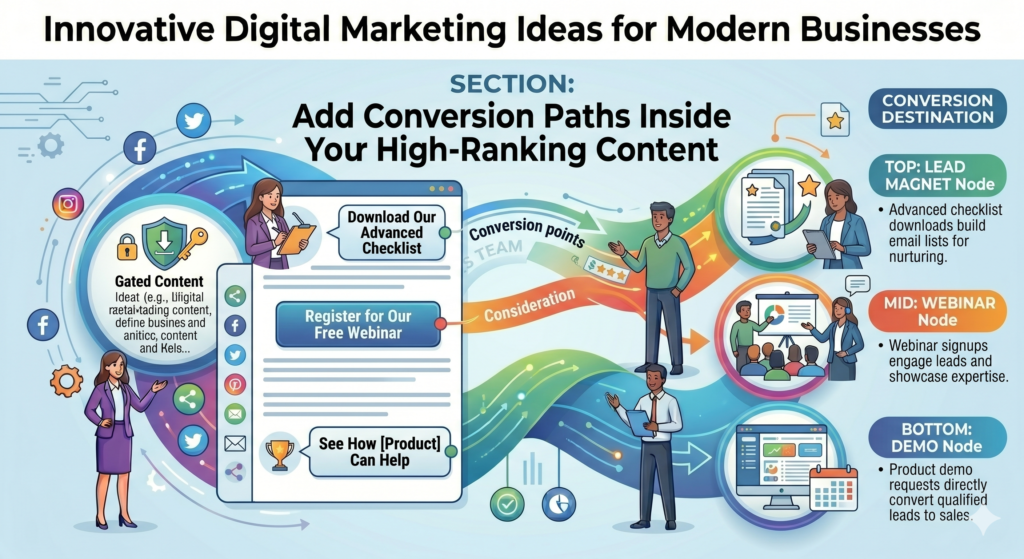
Every SEO page should have a natural conversion path.
For early-stage readers, the next step might be another helpful article, a simple guide, a quiz, a checklist, or an email sign-up. For middle-stage readers, it might be a comparison page, a case study, or a webinar. For late-stage readers, it might be a consultation, demo, audit, or pricing page.
The next step should match the reader’s level of intent.
Do not ask a cold reader to book a call too soon if they are still learning. Do not send a ready buyer to another basic article if they need proof. Meet people where they are.
This one change can make SEO far more profitable.
Use Social Media to Build Trust, Not Just Reach
Social media is one of the most misunderstood parts of digital marketing.
Many businesses treat it like a posting task. They feel they need to be active, so they publish updates, quotes, tips, product photos, or short videos. But activity alone does not build trust.
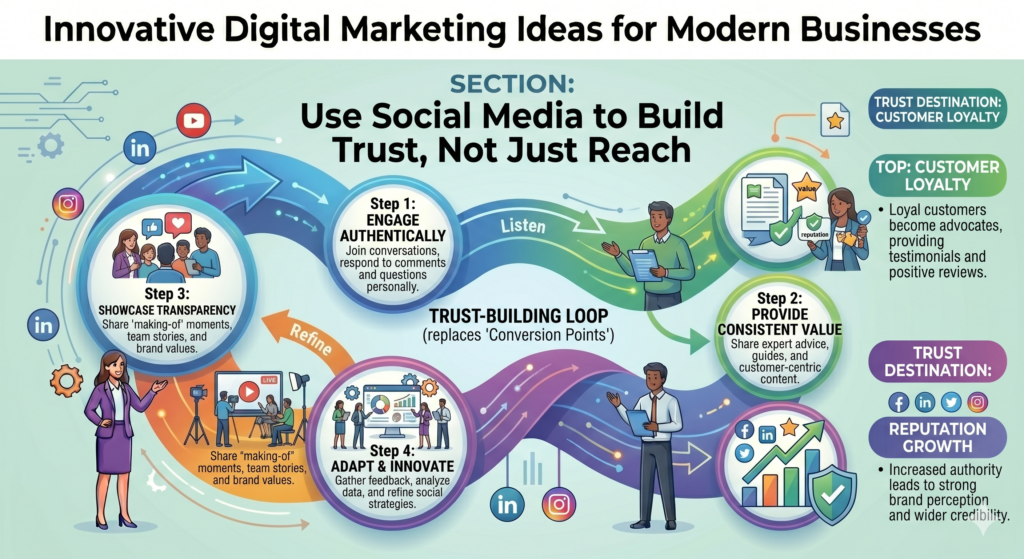
A modern social media strategy should make people feel closer to the brand.
It should show how you think. It should show what you believe. It should show how you solve problems. It should make your business easier to trust before someone ever visits your website.
The best social media does not always feel polished. It feels clear, useful, and real.
Share the thinking behind your work
One of the strongest ways to stand out on social media is to show your thinking process.
Most businesses only show finished results. They post the final product, the final campaign, the final testimonial, or the final announcement. But buyers often care about how you got there.
When you share your thinking, you show expertise without sounding like you are bragging.
For example, a marketing agency could explain why it changed a landing page headline, why it removed certain form fields, why it chose one content angle over another, or why it told a client not to run ads yet.
This kind of content builds trust because it shows judgment.
People do not hire you only because you can perform tasks. They hire you because they trust your decisions.
Turn small lessons into strong social posts
You do not always need big ideas for social media. Small lessons often work better.
A short lesson from a client call can become a post. A common mistake you noticed can become a post. A question a prospect asked can become a post. A change that improved results can become a post. A myth in your industry can become a post.
The key is to make each post clear and complete.
Do not write vague tips like “Know your audience” or “Be consistent.” Those lines are too common. Instead, explain what most businesses get wrong and what they should do instead.
For example, instead of saying, “Post consistently,” you could explain that consistency does not mean posting every day. It means showing up with the same point of view, the same promise, and the same level of usefulness over time.
That is a much stronger idea.
Use founder and expert-led content to humanize the brand
People trust people faster than they trust logos.
This is why founder-led and expert-led content has become so powerful. A company page can still matter, but a real person with a clear voice often builds trust faster.
For modern businesses, this does not mean the founder needs to become an influencer. It simply means the people behind the brand should share useful thinking in public.
A founder can talk about lessons from building the business. A service expert can explain common client problems. A product leader can share how decisions are made. A customer success person can share what helps clients get better results.
This makes the brand feel alive.
It also gives the business more trust signals. When buyers see smart, useful ideas from the people inside the company, they feel more confident that the company knows what it is doing.
Build a simple voice that people can remember
A strong social presence needs a clear voice.
This does not mean being loud or controversial. It means being easy to recognize.
Your business should have a few core beliefs that show up again and again. For example, WinSavvy may believe that content should drive business results, not just traffic. It may believe that strategy should come before tools.
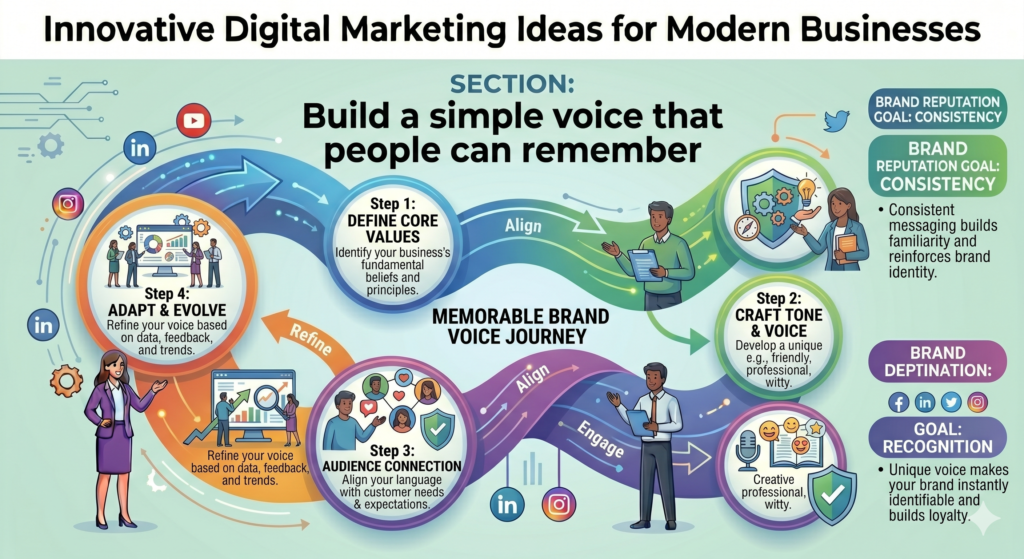
It may believe that simple messaging beats clever wording. It may believe that marketing should support sales, not live in a separate world.
When these beliefs show up across posts, articles, emails, and videos, people begin to remember the brand.
Repetition is not the same as repeating the same sentences. Repetition means returning to the same core ideas in fresh ways.
That is how brands become known for something.
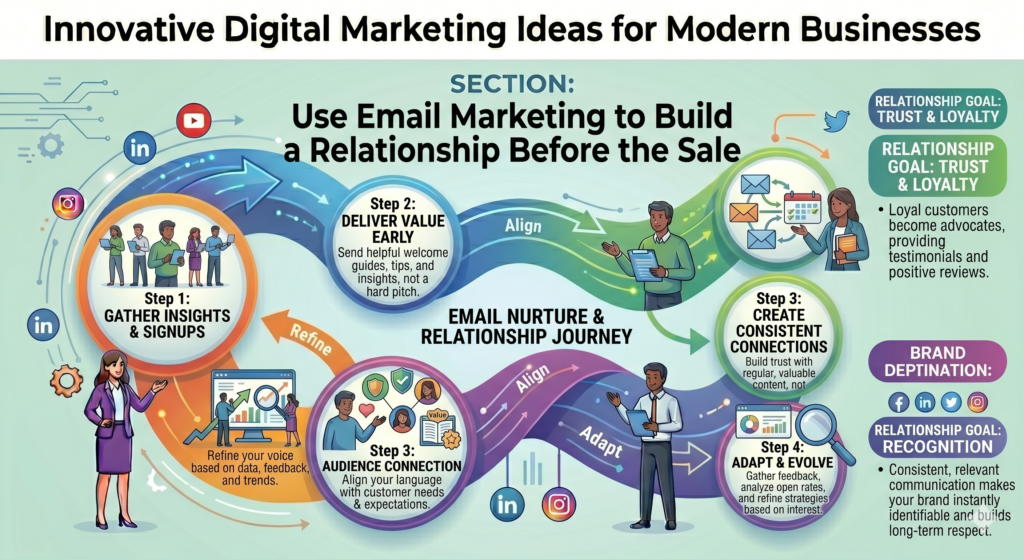
Use Email Marketing to Build a Relationship Before the Sale
Email is still one of the strongest digital marketing channels because it gives you something social media does not fully give you: direct access.
On social media, the platform controls reach. Your post may reach many people today and almost no one tomorrow. An algorithm can change. A trend can fade. A page can lose attention fast.
Email is different.
When someone joins your email list, they are giving you permission to stay in touch. That permission is valuable. But many businesses waste it.
They send only offers. They send random updates. They send newsletters that feel like company announcements. They talk too much about themselves and too little about the reader’s problem.
Modern email marketing should feel like a useful conversation. It should help the reader think better, act faster, and trust your brand more with each message.
Your welcome sequence should teach buyers how to trust you
The first few emails after someone joins your list matter more than most businesses realize.
This is when the reader is paying the most attention. They just took an action. They may have downloaded a guide, joined a webinar, signed up for updates, requested a checklist, or subscribed after reading a blog post.
At this moment, they are open to hearing from you.
So do not waste the welcome sequence with dull company talk.
A strong welcome sequence should explain what problem you help solve, why your view is different, what mistakes buyers should avoid, what small win they can get quickly, and what step they should take next if they want deeper help.
It should also set a clear tone. The reader should feel that your emails will be useful, simple, honest, and worth opening.
Use the first email to confirm the reader made a smart choice
The first email should make the reader feel good about signing up.
Do not start with a heavy sales pitch. Start with reassurance. Tell them what they will get, why it matters, and how to use it.
For example, if someone downloads a guide on improving website conversions, your first email should not only deliver the guide. It should explain what to look for first. It could say that most low-converting websites do not fail because of design alone. They fail because the message is unclear, the offer is weak, or the next step feels risky.
Now the reader has learned something right away.
That is how trust begins.
Use the next emails to remove silent doubts
After the first email, your sequence should handle the doubts that usually stop people from taking action.
A reader may wonder if the advice applies to their business. They may wonder if they have enough budget. They may wonder if their current marketing is really broken. They may wonder if they should fix things themselves or bring in help.
Each email can answer one of those doubts.
One email can show a common mistake. Another can share a short client example. Another can explain the cost of waiting. Another can show what a better process looks like. Another can invite the reader to take a small next step.
This works because people rarely buy the first time they hear from you. They buy when enough doubt has been cleared.
Make your emails feel personal without pretending to be personal
Personalization is often misunderstood.
Many businesses think personalization means using the person’s first name, adding company details, or changing a subject line. That can help, but true personalization is deeper.
An email feels personal when it speaks to the reader’s real situation.
If your reader is a founder, write about founder problems. If your reader is a marketing manager, write about pressure from leadership, limited budgets, and proving results. If your reader is a local business owner, write about foot traffic, reviews, lead quality, and community trust.
The words should make the reader feel seen.
That matters more than inserting a first name.
Segment by intent, not only by identity
Many businesses segment email lists by basic details such as industry, company size, or role. That is useful, but intent can be even more powerful.
Intent means what the person seems interested in right now.
Someone who reads three articles about SEO may need search help. Someone who clicks on case studies may be closer to buying. Someone who attends a pricing webinar may be comparing options. Someone who downloads a beginner guide may need more education before they are ready.
When you segment by intent, your emails become more relevant.
You do not have to send every person the same message. You can send SEO-focused emails to people interested in SEO. You can send conversion-focused emails to people interested in landing pages. You can send proof-heavy emails to people who are close to a decision.
This makes your marketing feel smarter without making it feel robotic.
Use story-based emails to make lessons easier to remember
People remember stories better than plain advice.
A story does not need to be long. It can be a short moment from a client project, a mistake your team noticed, a lesson from a campaign, or a simple before-and-after situation.
For example, instead of writing an email titled “Improve Your Landing Page Copy,” you could tell a story about a business that had good traffic but poor leads. The problem was not the traffic source. The problem was that the landing page talked about features before it explained the pain. Once the message changed, the page made more sense to buyers.
That story teaches the same lesson in a more engaging way.
It helps the reader picture the problem.
End each email with one clear action
Every email should have a job.
That job may be to get the reader to read an article, reply with a question, book a call, watch a video, check a case study, or think about one key idea.
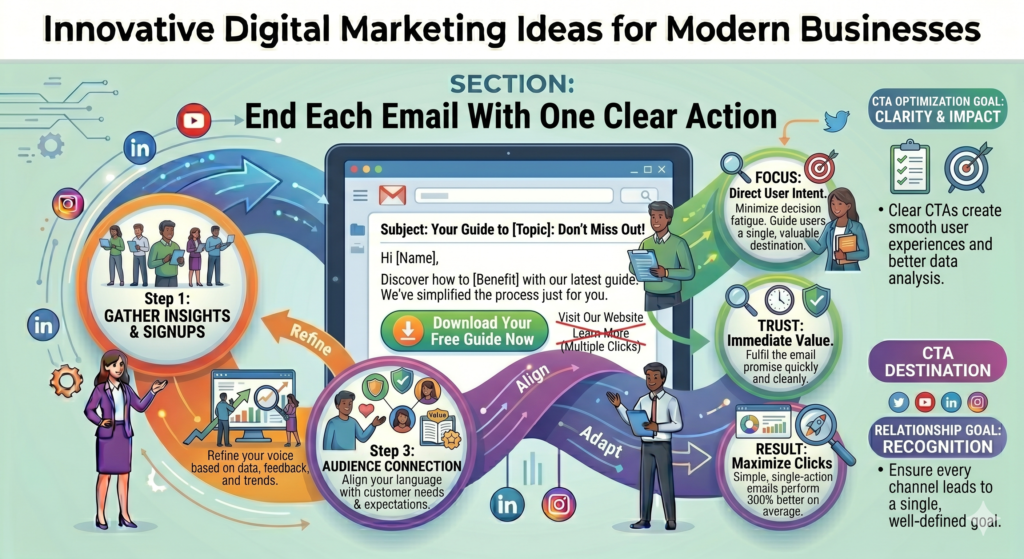
But it should not ask for too many things at once.
When an email has too many links, too many messages, or too many calls to action, the reader does nothing. Clear beats clever.
If you want replies, ask one simple question. If you want bookings, explain why the call is useful. If you want clicks, make the link feel like the natural next step.
A good email does not end suddenly. It guides the reader forward.
Make Paid Ads Smarter by Fixing the Offer First
Paid ads can grow a business fast, but they can also burn money fast.
The problem is that many businesses blame the ad platform too soon. They say Facebook ads do not work. Google ads are too expensive. LinkedIn ads are overpriced. TikTok ads bring poor leads.
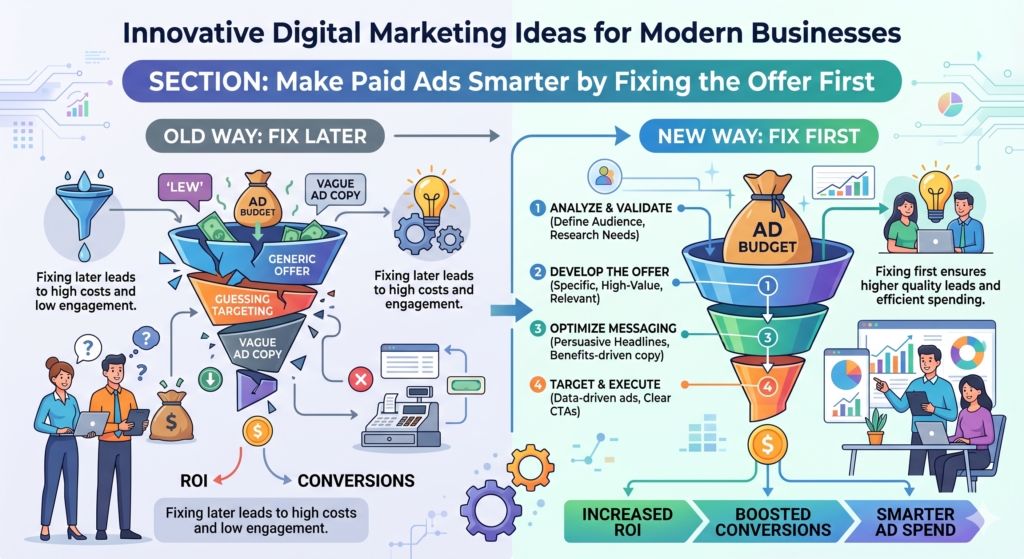
Sometimes that is true. But often the real issue is not the platform. It is the offer.
A weak offer cannot be saved by better targeting. A confusing landing page cannot be fixed by a clever headline. A vague promise will struggle even with a strong ad budget.
Modern paid marketing starts before the ad is written.
It starts with asking why someone should care now.
Your ad should sell the next step, not the whole business
One common mistake is trying to say too much in one ad.
A small ad cannot explain your full company, your full service, every benefit, every feature, every proof point, and every reason to buy. When you try to do that, the message becomes heavy.
The job of the ad is simpler.
It should make the right person interested enough to take the next step.
That next step might be reading a landing page, downloading a guide, booking a call, starting a trial, watching a demo, or claiming an offer.
The ad does not need to close the entire sale. It needs to open the right door.
Write ads around pain, promise, and proof
A strong ad usually has three parts.
It speaks to a real pain. It offers a clear promise. It gives enough proof to feel believable.
For example, a weak ad may say, “We help businesses grow with digital marketing.” That is too broad. It sounds like every other agency.
A stronger ad may say, “Getting traffic but not enough leads? We help service businesses turn weak website visits into booked calls with clearer pages, better offers, and smarter SEO.”
This is better because it names the pain, shows the outcome, and explains the path.
The reader knows who it is for. They understand the problem. They can picture the result.
That is what a paid ad needs to do.
Build landing pages for one decision at a time
A landing page should not feel like a full website squeezed onto one page.
It should help the visitor make one decision.
If the ad promises a free audit, the landing page should focus only on the audit. If the ad promotes a webinar, the landing page should focus only on why the webinar is worth attending. If the ad offers a trial, the page should make starting the trial feel easy and safe.
Many landing pages fail because they are too busy. They include too many offers, too many links, too many sections, and too many messages.
A focused landing page feels calmer.
It tells the visitor, “You are in the right place. Here is the problem. Here is what we offer. Here is why it matters. Here is proof. Here is what happens next.”
Remove friction before asking for the conversion
People do not convert only because they like the offer. They convert when the next step feels safe.
That means your landing page must remove friction.
If the form is long, explain why you need the information. If the call requires time, explain what will happen during the call. If the price is not shown, explain how pricing is decided. If the offer sounds big, show proof that others have used it successfully.
Do not leave the visitor guessing.
A confused visitor does not usually ask for clarity. They leave.
Test big ideas before testing small details
Many businesses waste time testing tiny changes too early.
They change button colors. They test small headline tweaks. They adjust image placement. These things can matter later, but they are not where most early gains come from.
The bigger gains usually come from testing the offer, the audience, the promise, the angle, and the landing page message.
For example, one ad angle may focus on saving time. Another may focus on getting better leads. Another may focus on reducing wasted ad spend. Another may focus on improving sales calls.
These are different buying triggers.
Testing them teaches you what your market cares about most.
Use ad results to improve your whole marketing message
Paid ads give fast feedback.
You can see which pain points get clicks, which promises get attention, which offers convert, and which audiences respond. That information should not stay inside the ad account.
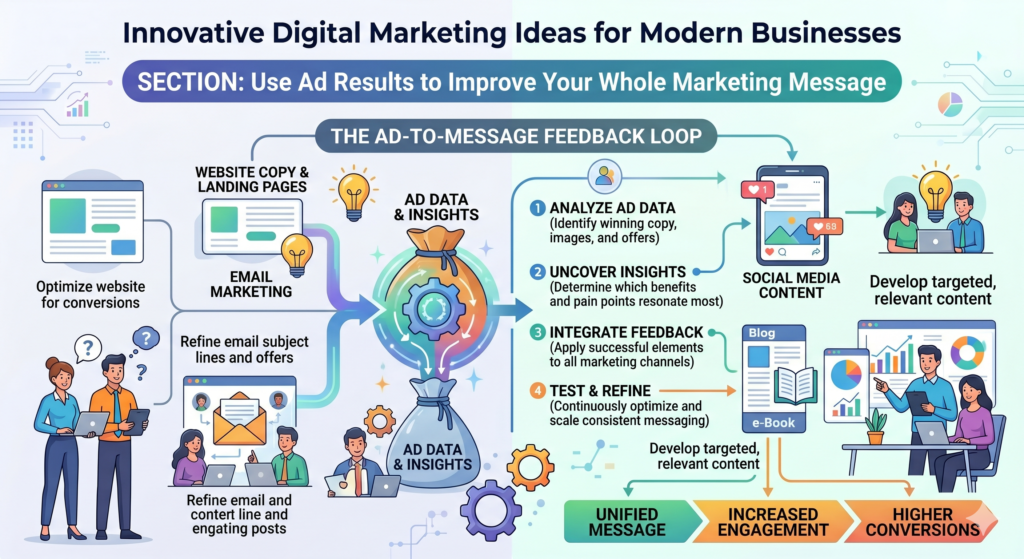
It should improve your website copy, SEO content, email campaigns, sales scripts, and social posts.
If one ad angle gets strong results, turn it into a blog post. Use it in email subject lines. Add it to a landing page. Teach your sales team to use that language. Build a case study around it.
This is how paid ads become more than a traffic source.
They become a research tool.
Build Better Landing Pages by Making the Message Clearer
A landing page is one of the most important parts of digital marketing because it is where attention becomes action.
You can have great ads, strong SEO, useful social posts, and a warm email list. But if your landing page is unclear, people will stop.
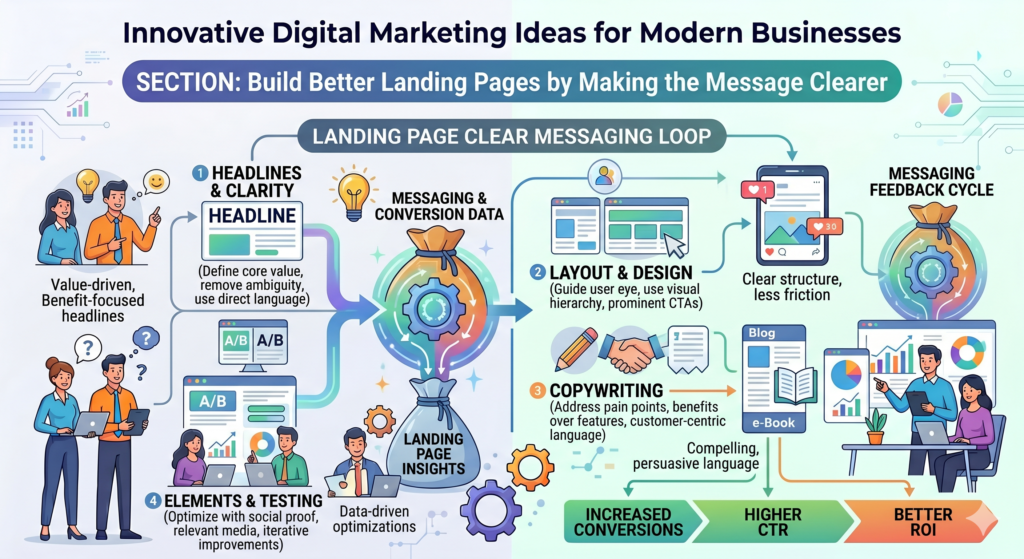
The truth is simple. Most landing pages do not need fancier design. They need clearer thinking.
A visitor should understand what you offer, who it is for, why it matters, why they should trust you, and what they should do next.
If they have to work hard to understand the page, the page has already failed.
The first screen must answer the most important question
The top section of your landing page matters because it shapes the visitor’s first impression.
When someone lands on the page, they quickly ask, “Is this for me?”
Your first screen must answer that question fast.
A weak headline says something broad like “Grow Your Business Online.” A stronger headline says who you help and what outcome you create.
For example, “Turn Your Website Traffic Into More Qualified Sales Calls” is clearer than “Digital Solutions for Growth.” It tells the reader what result they can expect.
The subheading should then explain how you help. It should not repeat the headline. It should add detail.
Make the promise specific enough to believe
A vague promise is easy to ignore.
Words like grow, scale, transform, boost, and optimize can become empty when they are not tied to a clear result. The reader has seen them too many times.
A specific promise feels more real.
Instead of saying “We improve your marketing,” say “We help you find where leads are dropping off, fix the message, and build campaigns that turn more visitors into real sales conversations.”
This is still simple, but it gives shape to the work.
People trust what they can understand.
Show the cost of the problem before showing the solution
Many landing pages rush into the offer too quickly.
They talk about features, services, tools, and process before the visitor fully feels the problem.
But people act when they understand the cost of staying the same.
If a business is getting traffic but no leads, the cost is not just low conversion. The cost is wasted ad spend, missed sales, weak pipeline, poor team morale, and slower growth. If a company has unclear positioning, the cost is not just weak copy. It is confused buyers, longer sales cycles, lower trust, and more price pressure.
A strong landing page helps the reader see that cost clearly.
Not in a fear-based way. In an honest way.
Use problem sections to make the reader feel understood
A good problem section should sound like the reader’s real experience.
It might describe how they are publishing content but not seeing leads. Or how they are getting clicks but poor inquiries. Or how their website looks good but does not explain why buyers should choose them.
This section is powerful because people trust businesses that understand the problem deeply.
Before someone believes your solution, they must believe you understand their situation.
That is why problem clarity often sells better than clever copy.
Turn features into buyer outcomes
Many businesses describe what they do, but not why it matters.
They say they offer SEO, content writing, paid ads, landing pages, analytics, email marketing, or strategy. But buyers do not buy those tasks. They buy the outcome those tasks can create.
SEO matters because it helps the right people find you when they are already looking. Content matters because it builds trust before sales. Paid ads matter because they can create faster demand when the offer is strong. Analytics matter because they show what to fix next.
Every feature should connect to a buyer outcome.
Explain the benefit in plain language
Plain language is not weak. Plain language is powerful because it makes decisions easier.
Instead of saying, “We leverage data-driven funnel optimization to improve acquisition efficiency,” say, “We find where people drop off and fix the pages, messages, and offers that are costing you leads.”
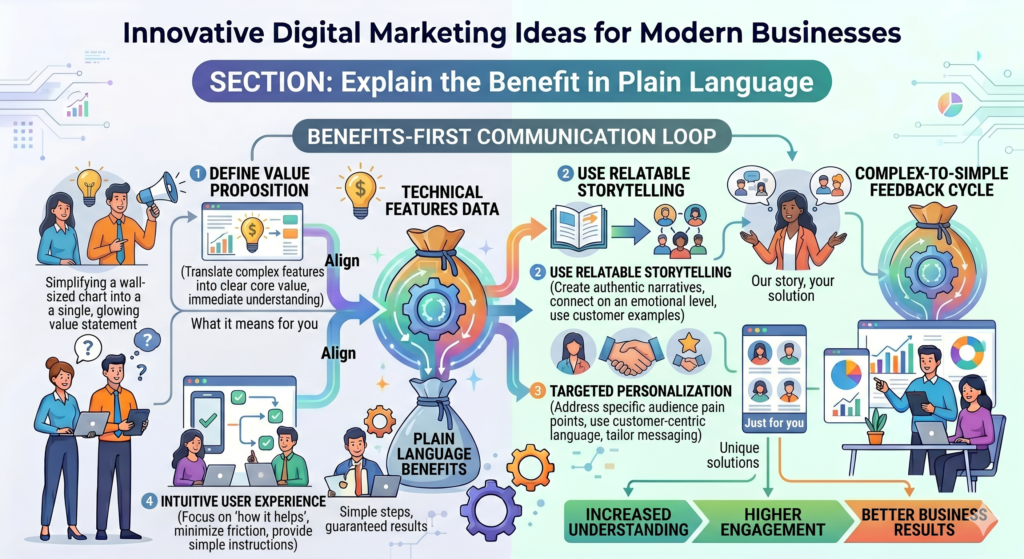
That is much easier to understand.
A buyer should not need a marketing degree to understand your value.
The clearer your page, the easier it is to trust you.
Use Customer Proof in More Strategic Ways
Customer proof is one of the strongest tools in digital marketing, but most businesses use it too lightly.
They collect testimonials and place them on a website. They show star ratings. They add a few client logos. These things help, but they are only the start.
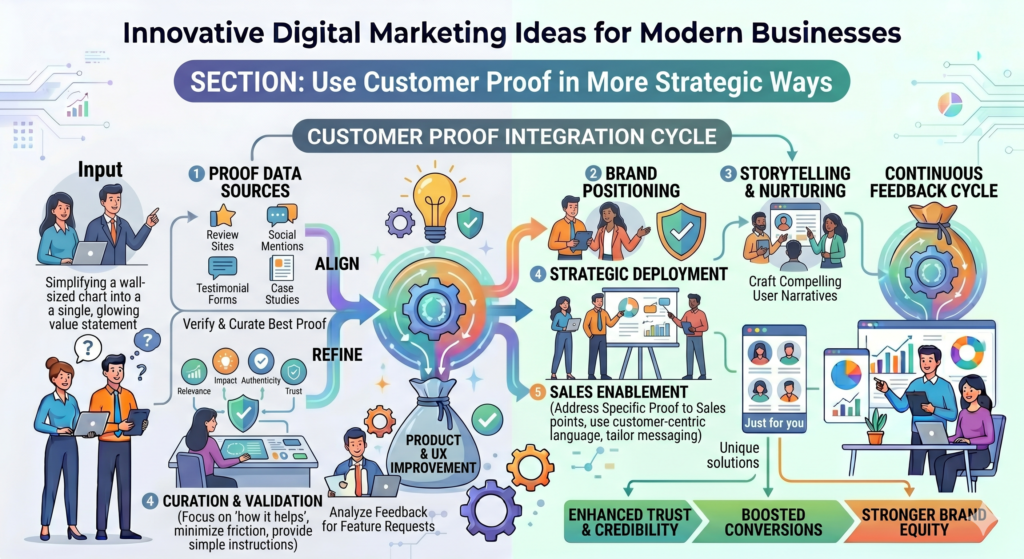
Modern buyers want proof that feels specific.
They want to know what problem the customer had, what changed, how the result happened, and whether the same thing could work for them.
A vague testimonial like “Great team to work with” is nice, but it does not remove much doubt.
A stronger testimonial says what the client struggled with, what the business helped fix, and what result came after.
Build proof around buyer objections
The best proof answers the doubts that stop people from buying.
If buyers worry that your service takes too long, show proof of quick wins. If they worry about price, show proof of return. If they worry that your process is complex, show proof that onboarding is simple. If they worry that you do not understand their industry, show proof from similar clients.
This makes proof more useful.
Instead of placing testimonials randomly, match them to the right part of the buyer journey.
A proof point near pricing should reduce price fear. A proof point near the process section should reduce process fear. A proof point near the call-to-action should reduce final action fear.
Use proof close to the claim it supports
Do not make readers hunt for proof.
If your page says you help businesses get better leads, show a proof point right there. If your email says your strategy improves sales conversations, include a short example in that same email. If your ad says your audit finds hidden conversion problems, show what one audit helped uncover.
Proof is strongest when it appears near the claim.
This helps the reader believe each idea as they move through your message.
Turn case studies into sales assets, not just blog posts
A case study should not be a dull story with a happy ending.
It should help future buyers see themselves in the success.
A strong case study explains the starting problem, the wrong turns the client had already tried, the strategy used, the key changes made, the result, and the lesson other businesses can use.
It should not read like a press release. It should read like a clear business story.
The reader should think, “This sounds like us.”
Show the messy middle, not only the final result
Many case studies jump too quickly from problem to result.
But the most useful part is often the middle.
What did you notice first? What did you decide not to do? What did you test? What surprised the team? What changed the outcome? What would you do differently next time?
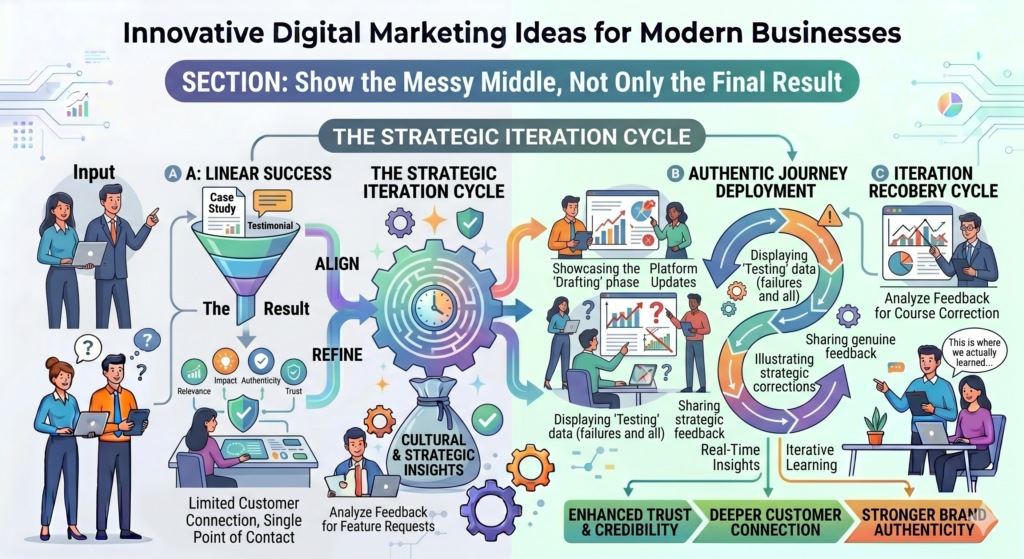
This kind of detail makes the story more believable.
It also shows your expertise.
A result is good. But showing how you got the result is what builds deep trust.
Create Interactive Experiences That Help Buyers Decide Faster
Modern buyers do not always want to read long pages before taking action. Sometimes they want a faster way to understand what they need.

This is where interactive marketing can help.
Interactive tools can turn passive visitors into active participants. A quiz, calculator, audit tool, scorecard, assessment, or guided checklist can help people see their own problem more clearly.
When done well, these tools are not gimmicks. They are decision aids.
They help buyers diagnose where they are, what is missing, and what step makes sense next.
Use quizzes and assessments to create useful self-discovery
People trust conclusions more when they help reach them.
That is why assessments can work so well. Instead of telling a visitor, “Your marketing may need work,” you let them answer questions and see where the gaps are.
For example, a digital marketing agency could create a “Website Lead Readiness Score.” The assessment could ask about the clarity of the headline, strength of the offer, proof points, page speed, calls to action, traffic sources, and follow-up process.
At the end, the visitor gets a score and a clear explanation of what to improve first.
This gives the user value.
It also gives the business insight into the lead’s needs.
Keep interactive tools short enough to finish
A common mistake is making quizzes or assessments too long.
If it feels like work, people leave.
The best interactive tools are easy to start, quick to complete, and useful at the end. Ask only what you need. Use simple questions. Make the result feel worth the effort.
The output should not be generic. It should give a clear next step based on the answers.
If someone scores low on message clarity, guide them toward a messaging resource or audit. If someone scores low on traffic quality, guide them toward SEO or paid strategy content. If someone scores low on follow-up, guide them toward email nurturing.
The more relevant the result, the more useful the tool becomes.
Use calculators to make hidden costs visible
Many buyers do not act because the problem feels vague.
A calculator can make the cost clear.
For example, a business may know its website conversion rate is low, but it may not understand how much revenue is being lost. A simple calculator could show how many leads the business might gain if the conversion rate improved from one percent to two percent.
That kind of insight can create urgency.
It turns a soft problem into a real business number.
Make the calculator lead naturally into your offer
A calculator should not feel like a trick.
It should give real value first. Then it should explain what the result means and what the user can do next.
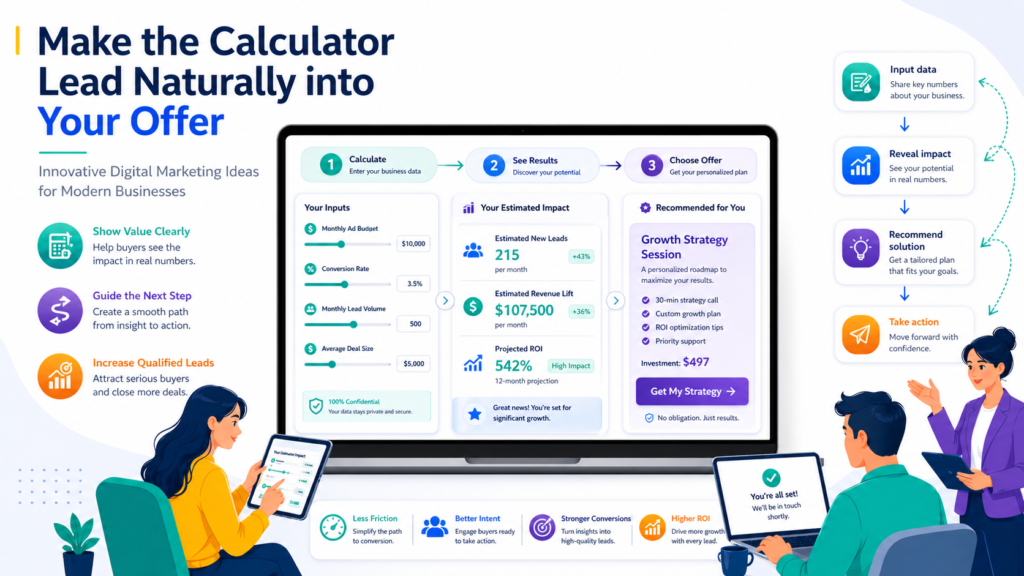
If the calculator shows that a business may be losing leads, the next step could be a landing page review, a conversion audit, or a guide on improving lead quality.
The offer should feel like the next logical step, not a sudden pitch.
That is how interactive marketing builds trust while also creating demand.
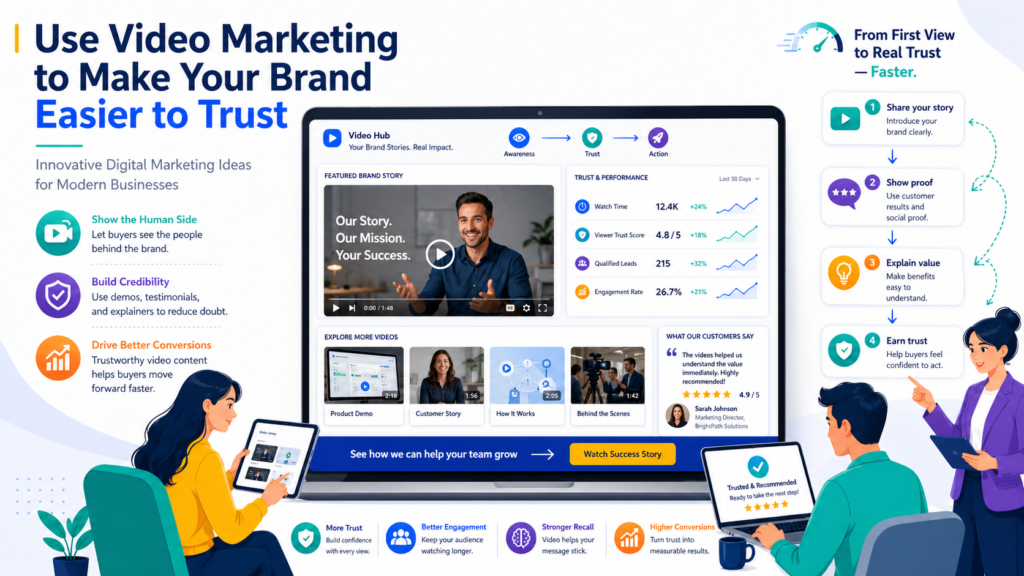
Use Video Marketing to Make Your Brand Easier to Trust
Video works because it makes your brand feel closer.
A visitor can read your blog, scan your website, or look through your social posts, but video gives them something extra. It lets them hear your voice. It lets them see your face. It lets them feel your style, your confidence, and your way of explaining things.
For modern businesses, this matters a lot.
People are more careful before they buy. They want to know who is behind the brand. They want to feel safe before they book a call, start a trial, or spend money. Video helps reduce that distance.
But video marketing does not mean you need perfect lighting, fancy editing, or a large studio setup. In many cases, simple videos work better because they feel more real.
The goal is not to look like a media company. The goal is to explain useful ideas clearly, answer real questions, and make the buyer feel that your business understands their problem.
Build videos around questions buyers already ask
The best video ideas often come from real buyer questions.
If prospects ask the same thing again and again on sales calls, that topic should become a video. If customers often misunderstand part of your service, that should become a video. If people hesitate before buying because of one common doubt, that doubt should become a video.
This makes video useful from the start.
You are not guessing what to say. You are answering questions that already matter.
For example, a digital marketing agency could create videos on why a website gets traffic but no leads, how long SEO takes before results show, when paid ads are worth using, what makes a landing page weak, how to know if content is attracting the wrong audience, and why more followers do not always mean more customers.
These are strong topics because they connect to real decisions.
Turn sales call objections into short trust-building videos
Every objection is a content idea.
If prospects often say, “We tried SEO before and it did not work,” create a video explaining why SEO campaigns fail and how to fix them. If they say, “We are not ready to hire an agency yet,” create a video explaining what to do before hiring one. If they say, “We need leads fast,” create a video explaining when paid ads can help and when they will waste money.
These videos work because they meet buyers inside their doubts.
A buyer may not be ready to talk to your team yet, but they may watch a two-minute video that answers the question already on their mind. If the answer is clear and honest, trust grows.
That trust can shorten the sales process later.
Use video to show how you think, not just what you sell
Many businesses make videos that feel like ads. They talk about services, offers, features, and company updates.
Some of that is fine, but it should not be the whole strategy.
The most valuable videos often show how your team thinks.
When you explain why one strategy works better than another, people see your judgment. When you break down a common mistake, people see your experience. When you review an example, people see how you solve problems. When you explain what you would do in a real situation, people begin to trust your process.
This type of content makes your brand more than a service provider. It makes your brand a guide.
Record simple breakdowns of real marketing problems
A strong video format is the breakdown.
You can take one marketing problem and explain what is happening, why it is happening, and what to do next. This can be done with a whiteboard, a screen recording, or a simple talking-head video.
For example, you could break down a weak landing page and explain why the headline is too vague, why the proof is too low on the page, why the call to action feels risky, and why the offer needs a stronger reason to act now.
You do not need to name a real company. You can use a made-up example or a public example. The value comes from the thinking.
This kind of video is powerful because it gives the viewer a small sample of what it feels like to work with you.
Repurpose every strong video into multiple content assets
A good video should not live in one place only.
One strong video can become a blog section, an email, a LinkedIn post, a short clip, a website FAQ answer, a sales follow-up message, or a training resource for your internal team.
This is how modern businesses get more value from content.
Instead of creating from scratch every day, you build around core ideas and reuse them in different ways.
For example, a five-minute video about why landing pages fail can become a blog article on conversion mistakes, a short social post about unclear headlines, an email about wasted traffic, and a sales follow-up resource for leads who are unsure about conversion work.
The same idea reaches people in different formats.
Build a content engine from one clear idea at a time
Repurposing works best when the original idea is strong.
Do not start with the format. Start with the insight.
Ask what the buyer needs to understand. Then decide how that idea should appear across channels.
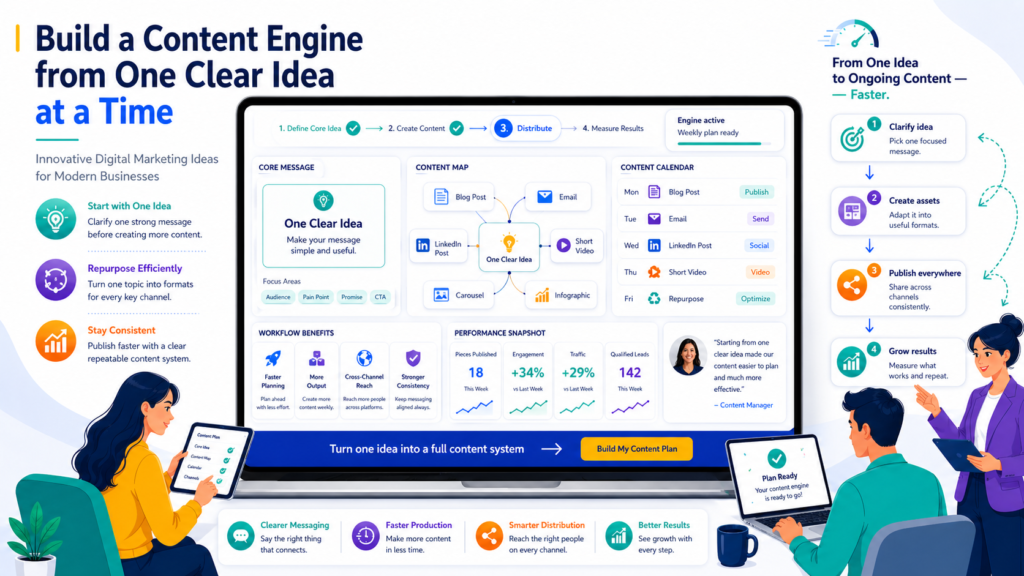
A deep insight may become a long blog post first, then a video, then several social posts. A simple insight may become a short video first, then an email. A customer story may become a case study, then a sales page proof section, then a few social posts.
This keeps your marketing focused.
You are not creating random content. You are building a message system where each idea supports the others.
Conclusion
Innovative digital marketing is not about chasing every new tool, trend, or platform. It is about building a clear system that helps the right people trust you faster and choose you with more confidence. Modern businesses win when they understand their buyers deeply, create useful content, improve every touchpoint, and turn data into better action.
Your website, SEO, ads, emails, videos, and social posts should all work together with one clear purpose: move people closer to a smart buying decision. When your marketing is simple, honest, helpful, and strategic, growth becomes less random and much more repeatable.















Comments are closed.