
WinSavvy Editorial Standards
How this article was created
A few years ago, many businesses treated sustainability like a side message. They added a leaf icon to a package, used words like “green” or “natural,” and hoped customers would feel good about buying from them. That approach does not work anymore.
Build your sustainable marketing message around proof, not promises
Sustainable marketing starts with the truth. That may sound simple, but many brands get this wrong. They begin with the message they want customers to believe, instead of starting with what the business can clearly prove.
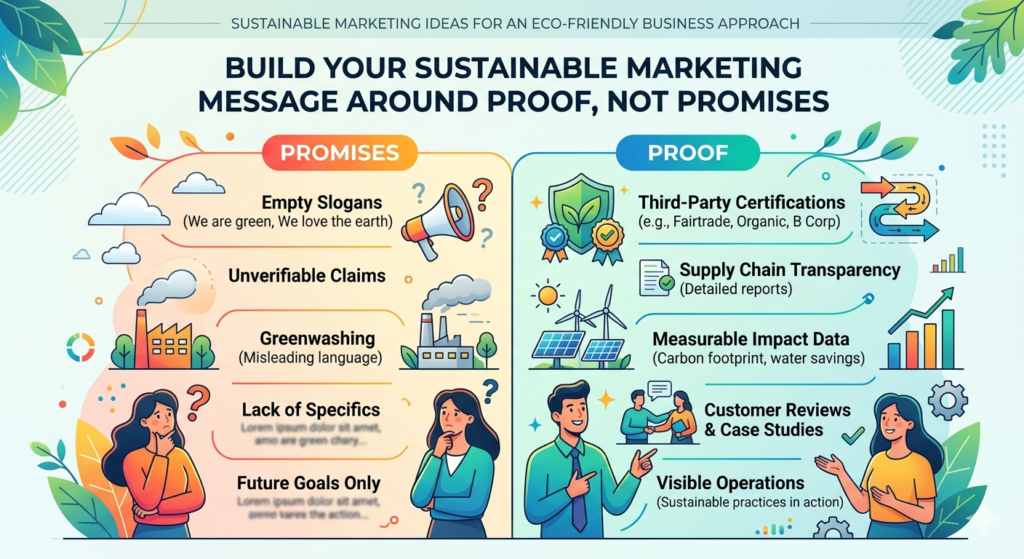
A strong eco-friendly brand does not need to sound perfect. In fact, trying to sound perfect can make people suspicious. Customers today know that no business is completely clean, waste-free, or impact-free. What they trust more is honesty.
They want to see what you are doing, why it matters, what still needs work, and how you plan to improve.
This is where your message becomes much stronger. Instead of saying your brand is “good for the planet,” explain the exact action behind that claim. Do you use recycled packaging? Say what part is recycled. Do you reduce shipping waste? Explain how.
Do you source from local suppliers? Show why that lowers waste or supports better production.
Your message should be clear enough for a customer to repeat
A good sustainability message is not a long mission statement hidden on an “About Us” page. It should be simple enough for a customer to understand in a few seconds and remember later.
For example, a weak message sounds like this: “We are committed to creating sustainable solutions for a better tomorrow.” It sounds nice, but it says almost nothing. A stronger message would be: “We make refillable home cleaning products that help families cut down on single-use plastic.”
The second message works because it is specific. It tells people what the product is, what problem it solves, and why the brand matters. It also avoids sounding like a corporate speech.
Make your main claim narrow before making it big
Many eco-friendly businesses make the mistake of trying to own the whole word “sustainable.” That is too broad. It is better to own one clear idea first.
Your brand may stand for less plastic, cleaner ingredients, local sourcing, longer-lasting products, lower waste, ethical production, repair instead of replacement, or slower consumption. Pick the idea that best matches what your business truly does, then build your message around it.
When your claim is narrow, it becomes easier to prove. When it is easier to prove, it becomes easier to trust. That trust is what turns a sustainability message from decoration into a real sales tool.
Use plain words instead of green-sounding language
Words like “eco-conscious,” “planet-positive,” “green,” and “natural” can be useful, but they are often too vague by themselves. If you use them, support them with simple proof right away.
A customer should never have to guess what you mean. If your product uses less water, say that. If your packaging is compostable in home compost, say that. If it is only compostable in industrial facilities, say that too. Clear language may feel less exciting at first, but it builds more trust.
The best sustainable brands sound calm, clear, and honest. They do not hide behind fancy words. They speak like a helpful person explaining a smart choice.
Turn your website into a sustainability education tool
Your website is one of the most powerful places to practice sustainable marketing. It works all day, it can answer customer questions before they contact you, and it gives you full control over your message.
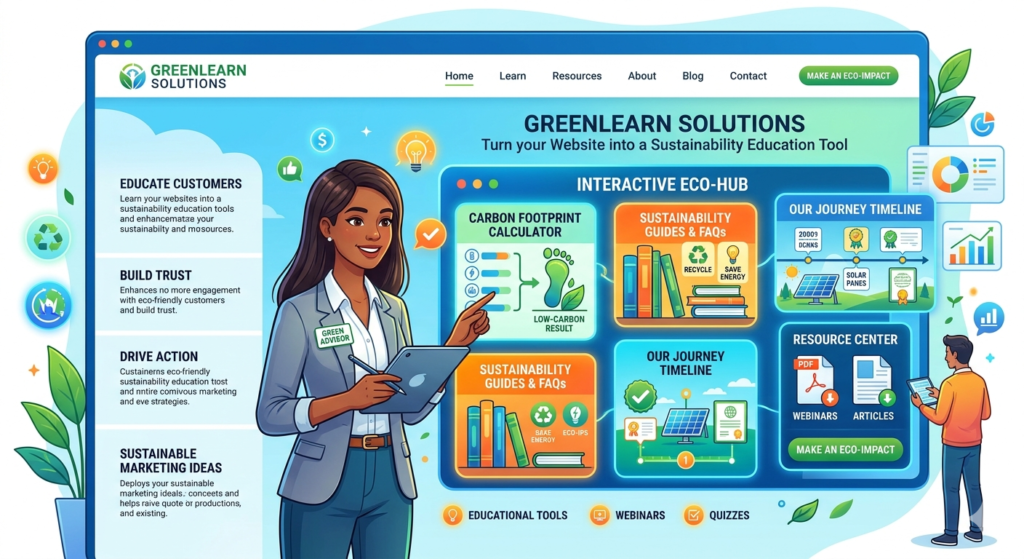
But many eco-friendly businesses use their website only to sell. They add a few product pages, a short brand story, and maybe a sustainability page that says the business cares about the planet. That is not enough anymore. A better website teaches customers how to make smarter choices and shows them why your product fits those choices.
This does not mean your website should feel like a textbook. It should feel helpful. Every page should reduce confusion, answer doubts, and make the customer feel more confident.
Your sustainability page should show the full picture
A strong sustainability page should not read like a public relations statement. It should explain what your business does now, what you are improving, and what your customers can do with your product after buying it.
For example, if you sell skincare in recyclable glass jars, do not just say the packaging is recyclable. Explain how customers should clean the jar, what parts can be recycled, and whether the lid needs to be separated.
If you sell clothing made from organic cotton, explain why that material was chosen, how customers can wash it to make it last longer, and how long use reduces waste.
This turns your sustainability page into a useful guide, not just a trust badge.
Create content that answers real buyer questions
Most customers have simple questions before they buy from an eco-friendly brand. They may wonder if the product works as well as a normal option. They may ask why it costs more. They may want to know if the packaging is really recyclable. They may worry that the brand is just using sustainability as a selling trick.
Your website should answer these questions directly.
A good article could explain why refillable products cost less over time. A product page could show how many single-use items a customer may avoid by using your product. A comparison page could explain the difference between biodegradable, compostable, recyclable, and reusable packaging in plain words.
This kind of content is powerful because it does two jobs at once. It helps customers make better decisions, and it gives search engines clear, useful pages to rank.
Make your product pages more honest and more useful
Product pages are often where sustainable marketing either wins or falls apart. If a product page only talks about features and price, it misses the deeper reason people buy from eco-friendly brands.
A strong product page should explain what the product does, why it is a better choice, how to use it, how to care for it, and what happens at the end of its life. This does not need to be long or complicated. It only needs to be clear.
For example, instead of saying “sustainable packaging,” say “packed in a recyclable paper box with no plastic wrap.” Instead of saying “ethically made,” explain where it is made and what standard or process supports that claim. Instead of saying “low waste,” explain what waste has been removed.
Honest product pages lower doubt. Lower doubt leads to more sales.
Create content that helps customers live your values
Sustainable marketing becomes much stronger when your content helps customers take action. This is important because many people want to make better choices, but they feel confused, busy, or unsure where to start.
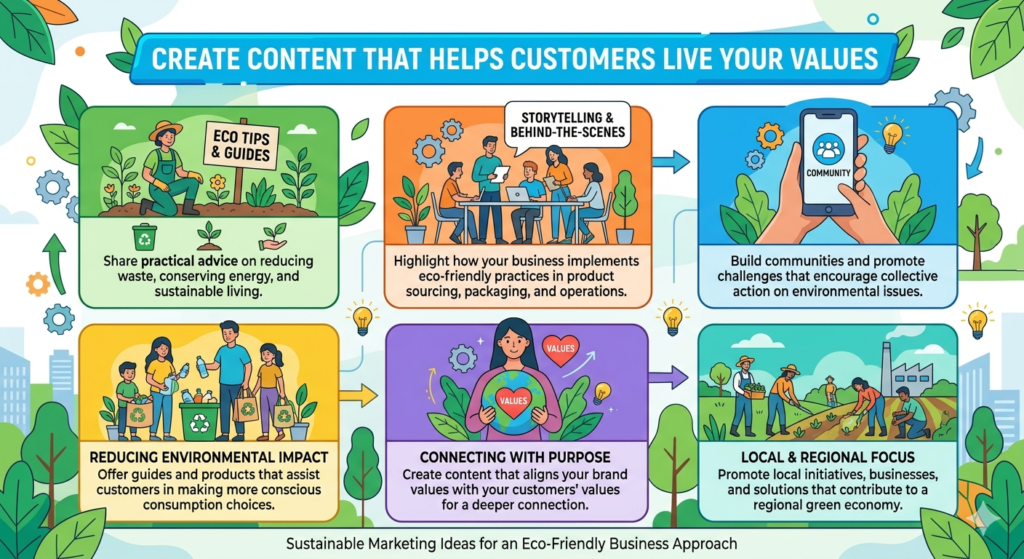
Your brand can become a guide. Not a brand that lectures people. Not a brand that makes customers feel guilty. A guide that makes better choices feel simple, normal, and useful.
This is where content marketing becomes a serious growth tool. Instead of publishing random blog posts, you create content that connects your product to the customer’s daily life.
Teach the small habits that support your product
If you sell eco-friendly kitchen products, your content can teach people how to reduce food waste, store food longer, clean without harsh chemicals, and choose reusable tools without making life harder.
If you sell sustainable fashion, your content can teach people how to build a smaller wardrobe, wash clothes so they last longer, repair small damage, and buy fewer but better pieces.
If you sell green office supplies, your content can teach small businesses how to reduce paper use, set up low-waste workstations, and make team buying decisions that cut waste without hurting productivity.
The goal is not to write content only about your product. The goal is to write content around the life your product supports.
Use customer pain points as your content map
A strong content plan starts with the questions and problems customers already have. What feels hard about making eco-friendly choices? What do they misunderstand? What do they feel guilty about? What stops them from switching?
Maybe they think sustainable products are always expensive. Maybe they worry eco-friendly products will not work well. Maybe they do not know how to dispose of packaging correctly. Maybe they want to support better brands but do not have time to research every purchase.
Each of these concerns can become a useful piece of content.
A blog post can explain how to compare the real cost of reusable and disposable products. A short video can show how to use a refill system without mess. An email can explain what to do with packaging after delivery. A product quiz can help customers choose the right low-waste option for their home.
When your content removes friction, it moves people closer to buying.
Keep the tone helpful, not superior
One of the biggest mistakes in sustainable marketing is sounding like you are judging the customer. People do not want to feel bad when they shop. They want to feel smart, supported, and hopeful.
Your content should never make people feel like they are failing because they still use plastic, drive a car, eat packaged food, or buy from mainstream brands. That tone pushes people away.
A better tone says, “Here is one simple change you can make.” It says, “You do not have to do everything at once.” It says, “This choice can help, and here is how.”
That kind of message feels human. It respects the customer’s real life. It makes sustainability feel possible instead of heavy.
Make your packaging part of your marketing strategy
Packaging is not just a container. For an eco-friendly business, it is one of the strongest parts of the customer experience. It is also one of the first places customers look when deciding whether your sustainability claims feel real.
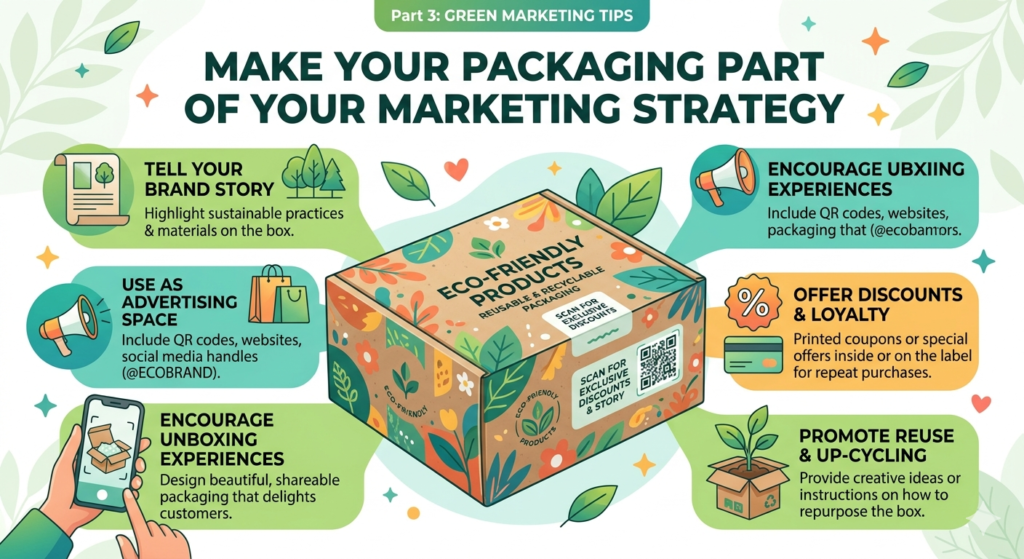
If your brand talks about reducing waste but ships products in oversized boxes, plastic fillers, and layers of unnecessary wrapping, customers will notice. Even if the product itself is good, the packaging can weaken trust.
On the other hand, smart packaging can make your brand more memorable, more shareable, and more believable.
The best packaging explains itself
Customers should not have to guess what to do with your packaging. If it is recyclable, say how to recycle it. If it is compostable, explain where and how. If it is reusable, give customers a reason to keep it. If part of it must go in the trash, be honest about that too.
Clear packaging instructions make customers feel involved in the process. They also reduce the chance that good packaging ends up in the wrong bin.
This is a small detail, but it matters. Sustainability often fails in the final step because the customer does not know what to do next. Your job is to make that step easy.
Use packaging to tell a short, useful story
You do not need to cover your box with long text. A few clear lines can be enough.
You might explain that the mailer is made from recycled paper, the ink is water-based, or the box is sized to reduce empty space during shipping. You might invite customers to reuse the box before recycling it. You might include a short message about the impact of choosing a refill, repair, or reusable product.
This kind of packaging copy should feel warm and practical. It should not sound like a speech. It should make the customer feel like they made a thoughtful choice.
Remove what does not add value
Many brands add extra packaging because they want the product to feel premium. But premium does not have to mean wasteful. For eco-friendly brands, premium can mean clean design, smart material choices, clear instructions, and a package that feels intentional.
Look at every packaging element and ask a simple question: does this protect the product, help the customer, or improve the experience in a meaningful way?
If the answer is no, remove it.
This one habit can reduce cost, cut waste, and make your brand feel more aligned. It can also become part of your marketing message, because customers respect businesses that make thoughtful choices instead of decorative ones.
Use email marketing to build long-term sustainable habits
Email marketing is one of the best channels for eco-friendly businesses because it lets you build a deeper relationship over time. Social media is fast and crowded. Ads can be expensive. Search traffic takes time. Email gives you a direct line to people who already care enough to hear from you.
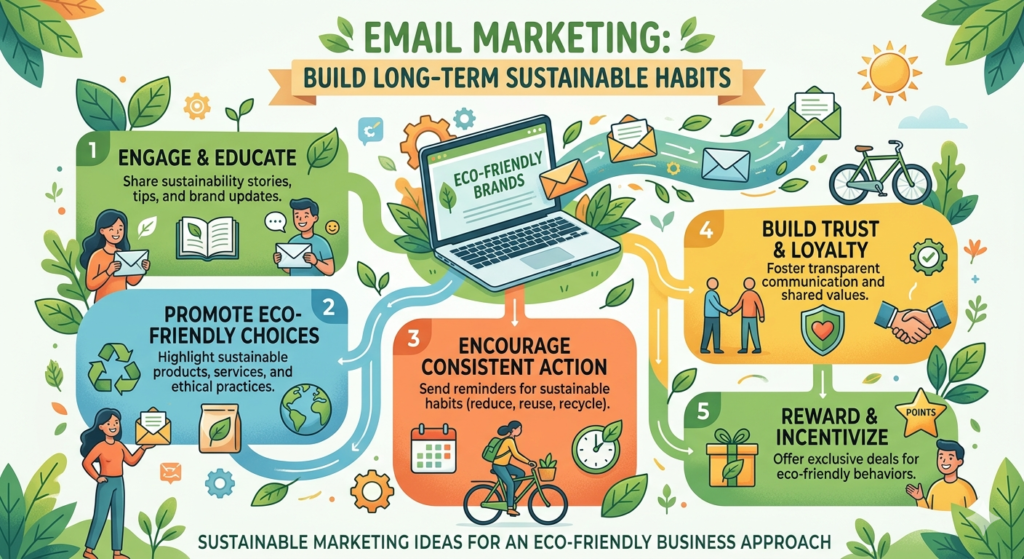
But email should not be used only to push discounts. If your brand wants to stand for sustainability, your emails should help customers use your product better, waste less, and stay connected to your mission.
That does not mean every email needs to be serious. It means every email should have a clear reason to exist.
Welcome emails should teach your brand difference
The first few emails after someone joins your list are very important. This is when the customer is most open to learning who you are and why your brand matters.
Your welcome sequence should explain your core sustainability promise in simple terms. It should show what makes your product different, how to use it, and what kind of impact the customer can support by choosing you.
Do not make the first email a long brand history. Start with the customer. Thank them, explain what they can expect, and give them one useful idea right away.
For example, a refill brand could send a first email that explains how the refill system works. A clothing brand could share a care guide to help garments last longer. A food brand could share simple storage tips to reduce waste.
Send fewer emails, but make them better
Sustainable marketing should also respect attention. Sending too many weak emails can feel wasteful in a different way. It wastes the customer’s time and trains them to ignore your brand.
A better approach is to send emails with real value. Share product care tips, behind-the-scenes improvements, honest impact updates, customer stories, repair guides, reuse ideas, and seasonal buying advice.
Your goal is to make people feel that opening your emails is worth it.
When customers trust your emails, they are more likely to buy when you do make an offer. This is because the relationship is not built only on selling. It is built on usefulness.
Use email to reduce returns and waste
Returns can create a lot of waste, especially for ecommerce brands. They can also damage profit. Email can help reduce this problem before it happens.
Before purchase, send content that helps customers choose the right product. After purchase, send instructions that help them use it correctly. For products like clothing, skincare, furniture, or reusable tools, small education can prevent disappointment.
A sizing guide, care guide, setup guide, or “what to expect” email can reduce confusion. It can also make customers happier with what they bought.
This is sustainable marketing in a very practical sense. You are not just talking about lower waste. You are using better communication to prevent waste.
Build campaigns around slower, smarter buying
Many businesses are built around urgency. They tell customers to buy now, act fast, grab the deal, and avoid missing out. This can work in the short term, but it does not always fit an eco-friendly brand.
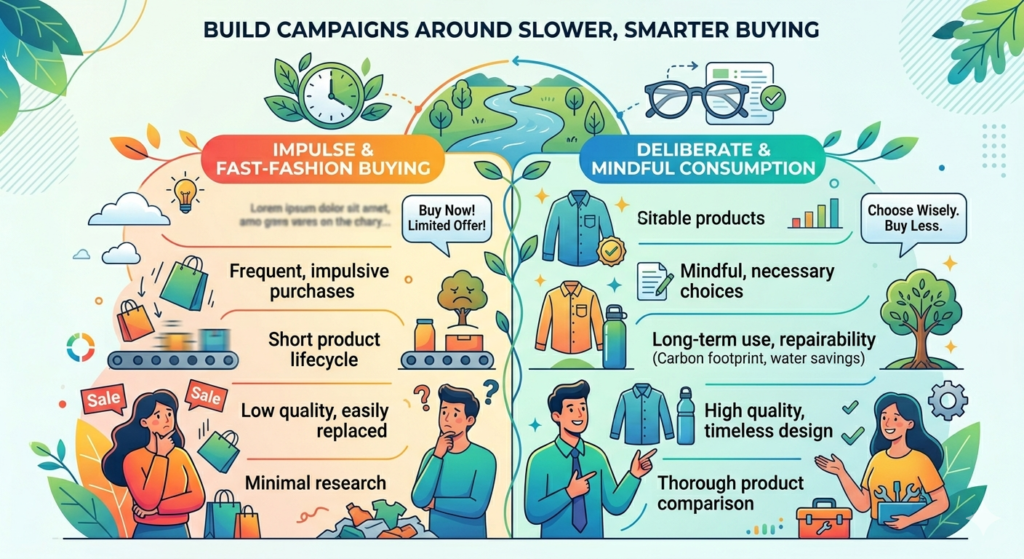
A sustainable business should be careful with false urgency. If you always push people to buy more, faster, and more often, your message can start to feel out of line with your values.
This does not mean you should never sell strongly. You are running a business, and sales matter. But your campaigns should encourage better buying, not mindless buying.
Sell the right product to the right person at the right time
Smarter buying begins with better guidance. Instead of pushing every product to every customer, help people choose what actually fits their need.
This can be done through quizzes, comparison pages, buying guides, customer stories, and simple product filters. The goal is to reduce regret. When people buy the right thing, they use it more, keep it longer, and trust your brand more.
For example, a sustainable home goods brand could help customers choose between starter kits, refills, and single items based on their household size and habits. A clothing brand could guide shoppers toward pieces based on climate, lifestyle, and care needs.
A skincare brand could help customers choose fewer products that match their skin instead of pushing a long routine.
Make durability part of the sales story
If your product lasts longer, say so. But explain it in a way that feels real. Show how to care for it. Show what materials make it durable. Show how long customers can expect to use it. Show repair options if you offer them.
Durability is one of the strongest sustainable marketing angles because it connects directly to value. Customers may pay more upfront if they understand that the product can last longer, replace several lower-quality items, or reduce repeat buying.
This is not just an environmental message. It is a money message too.
A customer who sees the long-term value is less likely to compare you only on price.
Avoid guilt-based selling
Guilt can get attention, but it rarely builds a healthy brand relationship. If your campaign makes people feel ashamed, they may avoid your message. Worse, they may feel that your brand is using fear to sell.
A better strategy is to sell through confidence. Show the better choice. Explain the benefit. Make the next step simple. Let customers feel proud, not pressured.
People are more likely to stay loyal to a brand that makes them feel capable. They want to believe their choices matter, but they do not want every purchase to feel like a moral exam.
Sustainable marketing works best when it gives people a clear path forward.
Make your social media less noisy and more useful
Social media can be a strong channel for eco-friendly businesses, but only when it has a clear job. Many brands post because they feel they have to post. They share random quotes, product photos, awareness days, behind-the-scenes clips, and quick tips without a real strategy.
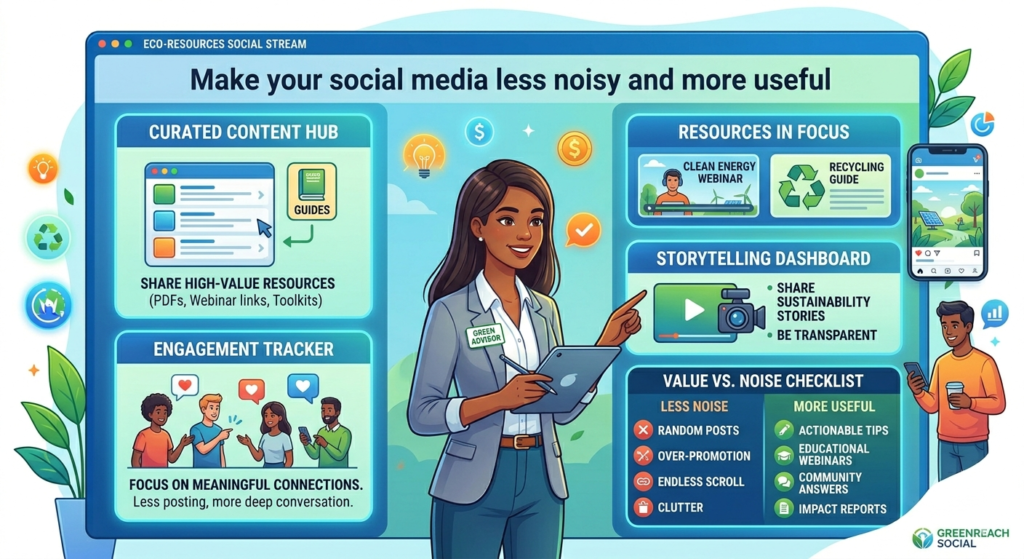
After a while, the feed looks active, but it does not move the business forward.
Sustainable marketing needs a better approach. Your social media should help people understand your values, trust your product, and take small steps toward better choices. It should not feel like a constant sales push. It should feel like a steady conversation with people who care about the same future you care about.
Your social content should answer, show, and guide
A useful social media plan can be built around three simple goals. Answer the questions customers ask before buying. Show the real work behind your product. Guide people toward better habits they can actually keep.
For example, instead of posting only a picture of your eco-friendly bottle, show how it fits into a normal morning routine. Instead of saying your product reduces waste, show the waste it replaces. Instead of saying your process is better, show a short part of that process in a way people can understand.
This kind of content feels more real because it gives people something to learn or notice. It also makes your brand easier to remember. People may forget a polished product photo, but they remember a simple idea that helped them.
Let real people and real use cases lead the story
Sustainable products often become more convincing when customers see them in real life. A product on a clean studio background may look nice, but it does not always answer the deeper question in the buyer’s mind. That question is simple: will this work for someone like me?
Show your product in homes, offices, bags, kitchens, bathrooms, small shops, daily routines, and real customer settings. Show the messy middle, not only the perfect result. If your product saves space, show the drawer before and after.
If it replaces disposables, show what the customer no longer needs to buy. If it lasts longer, show how it looks after weeks or months of use.
This kind of content builds trust because it feels honest. It also gives people a clear picture of ownership. When they can see themselves using your product, buying feels safer.
Stop posting to impress and start posting to reduce doubt
A lot of social content is made to impress other marketers. It uses clever lines, polished visuals, and big claims. But customers often need something simpler. They need proof, clarity, and reassurance.
Before you publish a post, ask what doubt it removes. Does it explain why the product costs more? Does it show how to use it? Does it make disposal easier? Does it answer whether the product works as well as the usual option? Does it show that your brand is honest about limits?
When your social media removes doubt, it becomes part of your sales system. It does not just create likes. It creates confidence.
Use SEO to become the trusted guide in your niche
SEO is one of the best long-term marketing channels for an eco-friendly business. This is because many customers search before they switch. They search for safer products, lower-waste choices, better materials, recycling rules, reusable options, and honest comparisons.
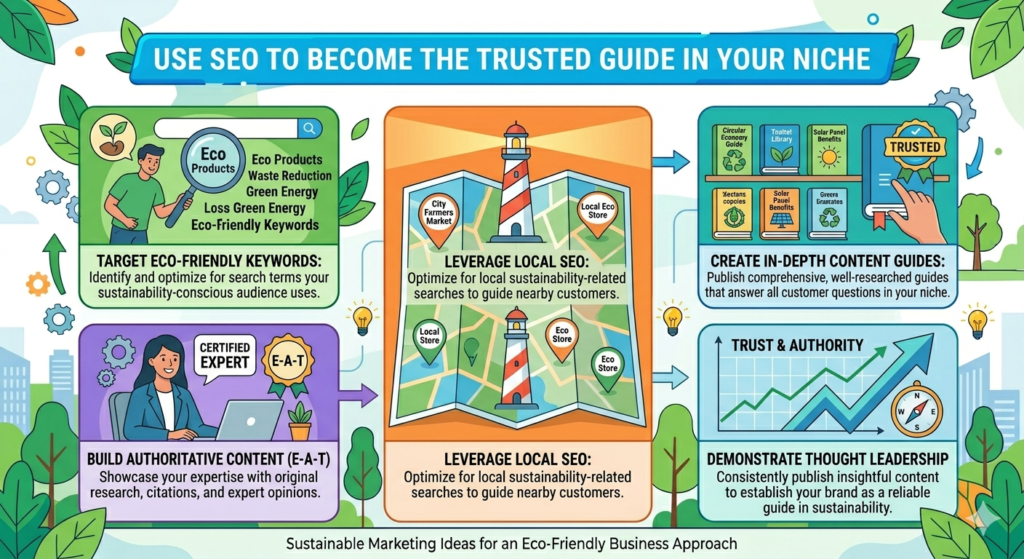
If your brand shows up at that moment with a clear and helpful answer, you earn trust before the sale. You are not interrupting the customer. You are helping them when they already want help.
But sustainable SEO must be handled carefully. The goal is not to stuff pages with green keywords. The goal is to become the most useful guide in your space.
Build your SEO strategy around customer questions
Start with the questions people ask when they are unsure. These questions often reveal strong buying intent.
A customer may search, “Are refillable cleaning products worth it?” Another may search, “Is bamboo fabric actually sustainable?” Someone else may search, “How to recycle compostable packaging?” These searches are not just content ideas. They are chances to meet customers during the decision process.
Your blog should answer these questions in plain words. Your product pages should support those answers. Your comparison pages should help people choose without feeling pushed.
This approach works because it respects how people buy. Most customers do not wake up ready to purchase from a brand they do not know. They learn first. They compare. They ask questions. Then they decide.
Create pages for the hard questions your competitors avoid
Many eco-friendly brands only write content that makes them look good. That is a missed chance. Customers trust brands that are willing to answer hard questions.
If your product is more expensive, write about why. If your packaging has limits, explain them. If your material is better in some ways but not perfect, say that. If a customer needs special disposal steps, teach them.
This kind of content may feel risky, but it often builds stronger trust than polished claims. It shows that your brand respects the customer enough to tell the full story.
For example, a title like “Is compostable packaging always better than recyclable packaging?” can attract people who want a real answer. Inside the article, you can explain the trade-offs in simple terms and then show how your brand made its choice.
That is useful SEO. It educates first, then sells with proof.
Connect your SEO pages to clear next steps
A helpful blog post should not leave the reader wondering what to do next. After teaching them something useful, guide them gently.
If someone reads about reducing plastic in the bathroom, show them your refillable personal care product. If someone reads about making clothes last longer, guide them to your care kit or durable clothing line. If someone reads about low-waste office supplies, show them a starter bundle for small teams.
This should feel natural, not forced. The content should help first, then make the next step easy.
SEO works best when the journey is connected. A reader finds your answer, understands your view, trusts your brand, and sees a product or offer that fits the problem they came to solve.
Build a brand story that admits progress, not perfection
A strong sustainability story does not need to claim that your business has solved everything. In fact, the most believable story often says the opposite. It says, “We saw a problem. We chose a better path. We are still improving.”
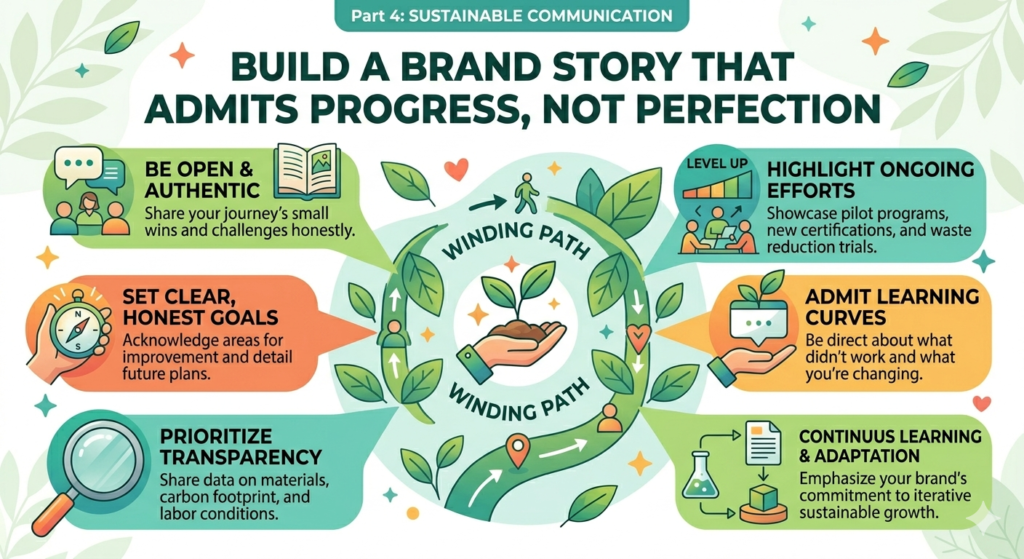
That kind of story feels human. It gives customers a reason to care without asking them to believe something impossible.
Many eco-friendly brands weaken their story by making it too broad. They talk about saving the planet, changing the future, or creating a greener world. Those ideas may be true to the mission, but they are too large to feel personal. A better story starts with a real problem and a clear choice.
Your origin story should explain the moment that mattered
The best brand stories often begin with a moment of frustration. Maybe the founder saw too much plastic waste in a daily routine. Maybe they could not find a product that was safe, beautiful, and low-waste. Maybe they worked in an industry and saw how much was being thrown away behind the scenes.
That moment matters because it gives the brand a human reason to exist. It moves the story away from marketing language and into real life.
Once you explain the problem, show what you decided to do differently. Keep it simple. Customers do not need a long founder biography. They need to understand why your brand exists and why your choices matter.
Tell the story through decisions, not slogans
A brand story becomes stronger when it is shown through decisions. What did you choose to avoid? What did you choose to source? What did you choose to make refillable, repairable, reusable, recyclable, smaller, lighter, or longer-lasting?
Each decision is a proof point. Together, they form the story.
For example, instead of saying “We believe in responsible fashion,” a clothing brand could say, “We release smaller collections, choose stronger fabrics, and design pieces that can be worn across seasons.” That tells a clearer story. It shows what the belief looks like in practice.
This matters because customers are tired of vague values. They want to see how values affect the product they are buying.
Share what you are still working on
It may feel strange to tell customers what is not perfect yet, but this can build trust when done carefully. You do not need to expose every weakness. You only need to be honest about the areas where you are improving.
Maybe you are still trying to reduce shipping emissions. Maybe one part of your packaging is not recyclable yet. Maybe you are looking for better suppliers. Maybe you want to publish more impact data as your business grows.
When you share progress clearly, customers can see that sustainability is a real practice, not a fixed claim. They also become part of the journey. That makes the relationship deeper than a normal buyer and seller relationship.
Turn customers into partners in your sustainability mission
Customers do not want to be treated like passive buyers. Many people who choose eco-friendly brands want to feel that their purchase is part of something better. But they also do not want to be given heavy work. Your job is to make participation simple, clear, and rewarding.
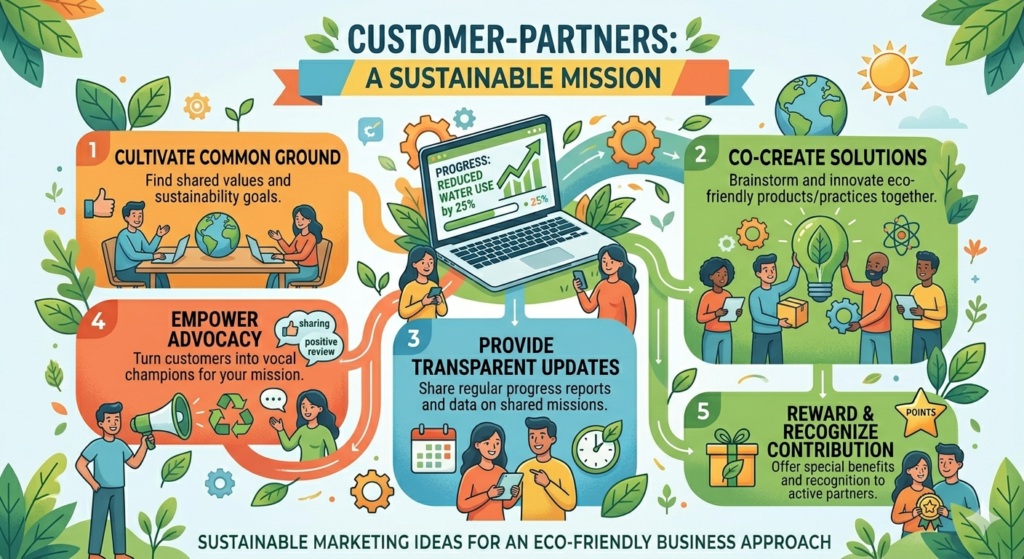
Customer participation can take many forms. They can refill, reuse, return packaging, repair products, share tips, join challenges, give feedback, or support a cause through your brand. The key is to design the experience so the customer knows exactly what to do and why it matters.
Make the sustainable action easy after purchase
A customer’s sustainable journey does not end when they buy. In many cases, it begins there. If they need to reuse, refill, recycle, compost, repair, or return something, your brand must guide them.
Do not assume they will figure it out. Send a clear email. Add simple packaging instructions. Create a page with disposal steps. Add a QR code that explains the next action. Use plain words and short steps.
The easier you make the action, the more likely customers are to do it. This is where sustainability becomes part of the customer experience instead of just a message before purchase.
Reward behavior that supports your values
If you want customers to return containers, buy refills, repair instead of replace, or choose slower shipping, reward those actions. The reward does not always need to be a discount. It can be loyalty points, early access, public recognition, a small thank-you gift, or a donation made in their name.
The goal is to make the better choice feel seen. People like knowing that their effort matters.
For example, a refill brand could reward customers after their third refill order. A clothing brand could reward customers who use a repair service. A food brand could reward customers who choose a lower-waste bundle.
This turns sustainability into a habit loop. The customer acts, the brand responds, and the customer feels good about continuing.
Ask customers for ideas and show what changed
Customers often have useful ideas because they use your product in real life. Ask them what packaging is confusing, what instructions are unclear, what product sizes they need, what waste they still notice, or what would help them make better choices.
Then show what you changed because of their feedback.
This is powerful because it makes customers feel respected. It also gives you strong content. A post that says, “You told us our refill pouch was hard to pour, so we changed the spout,” is more believable than a generic innovation claim.
When customers see that their voice shapes the brand, loyalty grows. They stop feeling like buyers and start feeling like partners.
Create partnerships that make your impact easier to believe
Partnerships can make sustainable marketing much stronger, especially when customers are still learning to trust your brand. A good partner can add proof, reach, and practical value. But the partner must make sense. It should not feel like two brands joined forces only to look good online.
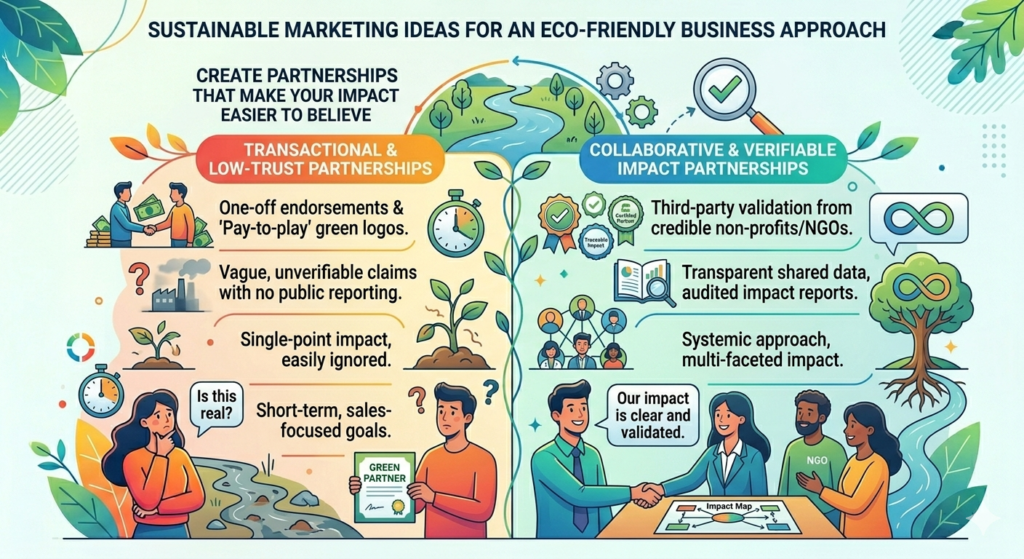
The best partnerships support the same customer goal. They help people waste less, choose better, repair more, learn faster, or make sustainable living easier.
For an eco-friendly business, partnerships can include local suppliers, recycling groups, refill stations, repair experts, environmental educators, ethical creators, community groups, or other brands that serve the same audience without being direct competitors.
Choose partners based on shared action, not shared image
A weak partnership is built around appearance. It says, “We both care about the planet,” and then does very little. A strong partnership is built around a clear action.
For example, a sustainable skincare brand could partner with a refill store to make local refills easier. A clothing brand could partner with a repair studio to help customers extend product life. A low-waste kitchen brand could partner with a food waste educator to create practical home guides.
This kind of partnership gives customers something useful. It also makes your sustainability message more believable because it is tied to action.
Create content that both audiences can use
Partnership content should not feel like a forced announcement. It should teach something valuable.
Instead of posting, “We are excited to partner with this amazing brand,” create a guide, class, challenge, video, email series, or landing page that helps both audiences solve a real problem.
Teach people how to build a low-waste bathroom. Show them how to care for clothes during monsoon season. Explain how to set up a refill station at work. Share a simple guide to reading product labels.
Useful content makes the partnership feel real. It also gives both brands something better than a one-time post. It creates an asset that can keep bringing traffic, leads, and trust.
Measure the partnership by behavior, not just reach
Reach can look nice, but behavior matters more. Did people sign up? Did they download the guide? Did they attend the event? Did they return packaging? Did they buy refills? Did they use the repair service? Did they ask better questions?
These signals tell you whether the partnership actually moved people closer to sustainable action.
A good partnership should create a result that both sides can see. It should not end with a few social posts and polite comments. It should make the customer journey stronger.
Make your paid ads more honest and more focused
Paid ads can work well for eco-friendly businesses, but they need discipline. Because ad space is small, many brands use broad claims to get attention. They say things like “save the planet,” “zero waste,” or “100 percent sustainable.”
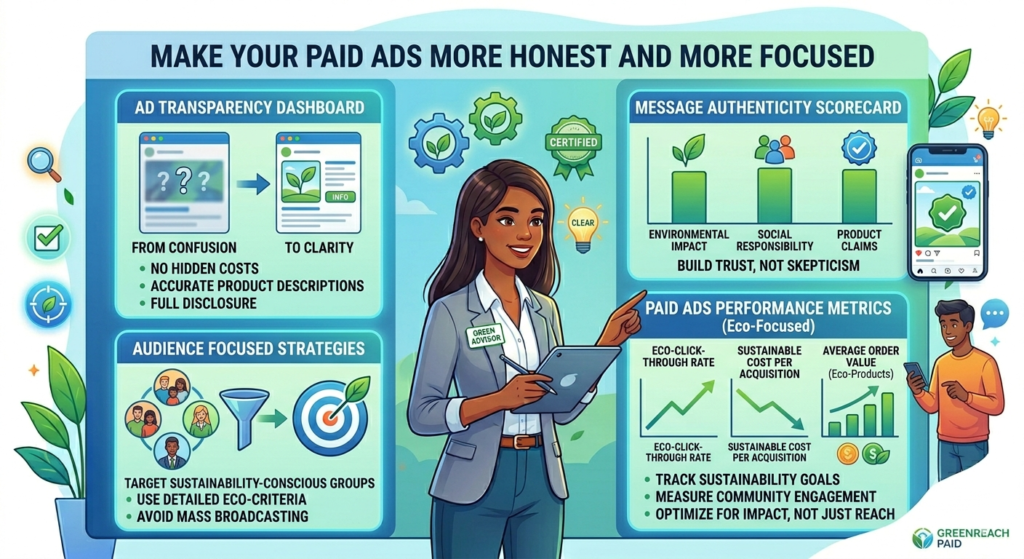
These claims may sound strong, but they can be risky if they are not exact. They can also feel too big for a customer who simply wants a better product.
A better ad strategy is to focus on one clear problem, one clear product benefit, and one clear proof point. The more specific your ad is, the more believable it becomes.
Lead with the customer’s problem before the sustainability claim
Most people do not buy only because a product is sustainable. They buy because it solves a problem and matches their values. Your ads should speak to both.
For example, instead of leading with “eco-friendly laundry products,” you could lead with the problem of plastic-heavy laundry routines, harsh scents, or bulky bottles. Then show how your product helps. The sustainability angle becomes more useful because it is connected to a real daily issue.
This kind of message works because it respects the customer’s life. It does not ask them to care in the abstract. It shows them a better way to handle something they already do.
Test proof-based messages against value-based messages
Not every customer responds to the same angle. Some care most about waste reduction. Some care about health. Some care about saving money over time. Some care about design. Some care about convenience.
Your ad testing should reflect this.
One ad can focus on refill savings. Another can focus on reducing plastic. Another can focus on simple ingredients. Another can focus on how long the product lasts. Over time, you will learn which message brings not just clicks, but better customers.
The key is to test real differences, not tiny wording changes. You want to learn what people value.
Keep your landing page aligned with the ad
If your ad makes a sustainability claim, the landing page must support it quickly. Do not send people to a page that repeats the same claim without proof.
If the ad talks about less plastic, the page should show how much plastic is reduced or what packaging is used. If the ad talks about durability, the page should explain the material, care, and expected use. If the ad talks about refills, the page should show how the refill process works.
This alignment improves trust and conversion. It also protects your brand from looking vague.
Paid ads should not exaggerate your sustainability story. They should make the right part of the story easy to understand.
Use impact reports to turn sustainability into a clear business asset
Many eco-friendly businesses do good work, but they do not explain that work well. They make better choices in sourcing, packaging, shipping, energy, or waste reduction, yet customers never see the full picture. This is a lost chance.
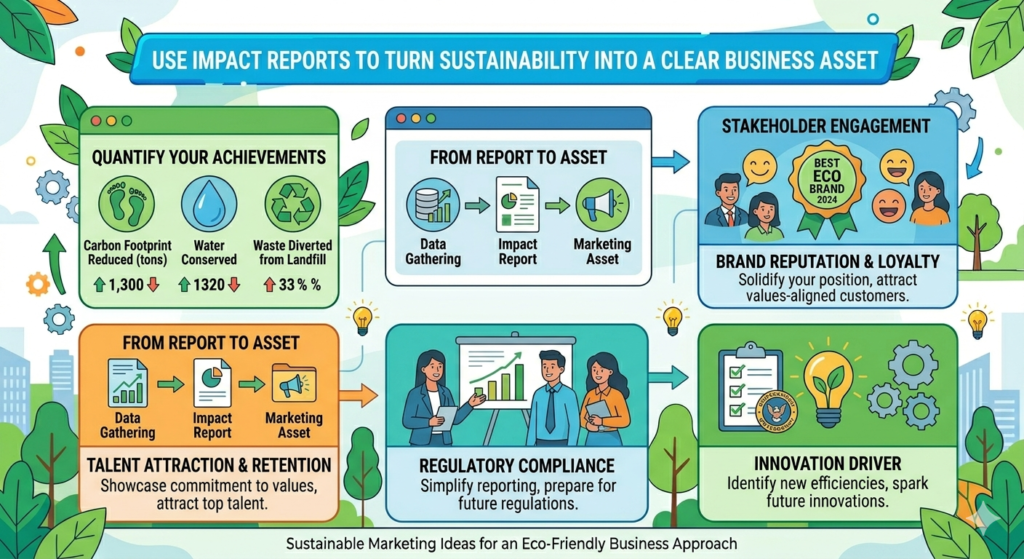
An impact report helps fix that. It gives your business a clear way to show what changed, what improved, and what still needs work. It can also become one of your strongest trust-building tools.
This does not mean you need a long corporate report with charts, formal language, and heavy design. A small business can create a simple impact page or yearly update that explains progress in plain words. What matters most is honesty, clarity, and proof.
Your impact report should be simple enough for normal customers to understand
Most customers do not want to read a technical report. They want to know what your business is doing and why it matters. So your impact report should feel like a clear story, not a dense document.
Start by explaining the main areas your business is working on. These may include packaging, materials, waste, water, energy, shipping, suppliers, product life, returns, repairs, or community support. Then explain what changed during the year.
For example, you might say that you moved from plastic mailers to recycled paper mailers. You might explain that you reduced package size to cut empty space. You might show that more customers chose refills instead of buying new containers. You might share that you added a repair program, changed suppliers, or improved product care education.
After that, explain what is still not perfect. This makes the report more believable. Customers do not expect perfection. They expect truth.
Use numbers only when they are clear and honest
Numbers can make your impact report stronger, but only if they are easy to understand and backed by real tracking. Do not add numbers just to sound impressive.
If you can show how many packages were reused, how much plastic was avoided, how many refills were sold, how many products were repaired, or how many returns were reduced, that can help. But explain the number in plain language. A customer should not need special knowledge to understand it.
For example, instead of saying “we reduced packaging inputs by 18 percent,” you could say, “We used 18 percent less packaging material per order by making our boxes smaller and removing extra inserts.”
That small change makes the message more human. It also makes the result easier to trust.
Turn your report into smaller pieces of content
An impact report should not sit quietly on your website after you publish it. Break it into smaller stories that can be used across your marketing.
One section can become an email. Another can become a product page note. Another can become a social post. Another can become a short founder letter. Another can become a customer thank-you message.
This is smart because impact content is not just about reputation. It can help customers feel involved. When you say, “Because more customers chose refills this year, we helped avoid more single-use packaging,” you are not just reporting a result. You are showing customers that their choices mattered.
That feeling creates loyalty. People like staying with brands that make them feel part of real progress.
Make local marketing part of your sustainable growth plan
Sustainable marketing does not always need to be big, global, or digital. In fact, local marketing can be one of the most natural ways to build an eco-friendly brand.
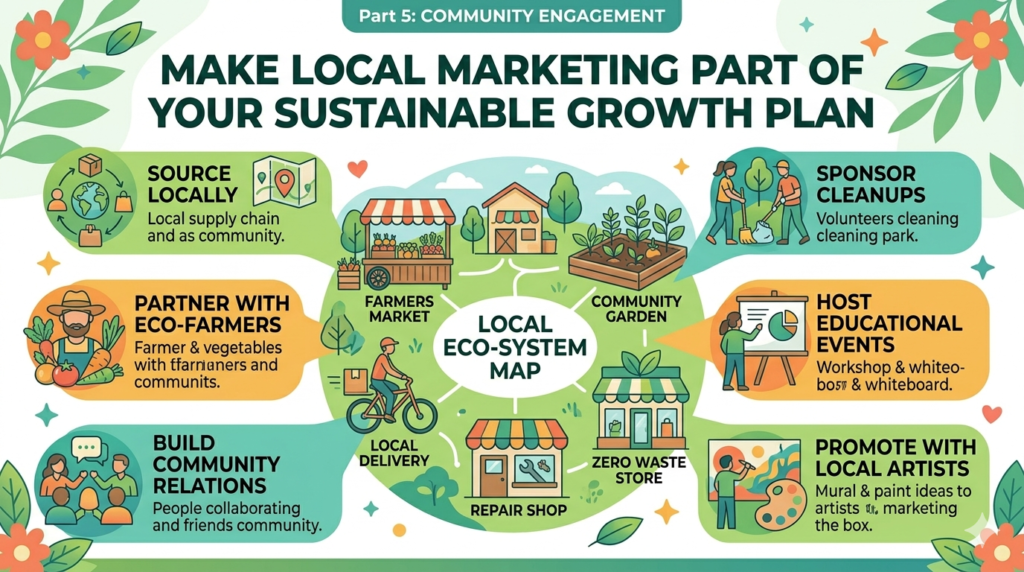
Local marketing can reduce distance between your business and your customers. It can support community trust. It can help you build partnerships that are easier to verify. It can also make your sustainability story feel more real because people can see it happening near them.
For many eco-friendly businesses, local trust is a serious advantage. A customer may not fully believe a big online claim, but they may trust a business they see at a local market, refill station, community event, workshop, or neighborhood store.
Local visibility makes your values easier to prove
When your business shows up locally, your sustainability message becomes more tangible. Customers can meet your team, touch the product, ask questions, return packaging, attend events, or see your process in person.
This is especially useful for brands that sell products customers want to understand before buying. Refillable products, sustainable clothing, natural home goods, composting tools, reusable kitchen items, and low-waste personal care products all become easier to trust when customers can see how they work.
Local marketing also gives you a chance to explain your product without rushing. Online, customers skim. In person, they ask. Those questions can teach you what your website, ads, and emails need to explain better.
Partner with local businesses that already serve your audience
A strong local partnership should make life easier for the customer. If you sell refillable products, look for local stores where customers can refill or collect orders. If you sell sustainable food items, work with cafes, health stores, farmers markets, or community kitchens.
If you sell eco-friendly office products, connect with coworking spaces or local business groups.
The goal is to place your brand where the right people already spend time. This is better than chasing attention in random places.
A local partnership can also help you reduce friction. A customer who does not want to pay for shipping may pick up locally. A customer who wants to avoid waste may return packaging at a partner location. A customer who wants to test a product may attend a small demo.
These moments make sustainability easier to act on.
Use local stories in your digital content
Local marketing and digital marketing should not be separate. The stories you create offline can become strong online content.
If you host a repair event, share what people brought in and what they learned. If you partner with a local refill shop, explain how customers can use it. If you source from a nearby supplier, tell that story with care and detail. If your team joins a cleanup or community project, focus on the lesson and the people, not just the photo opportunity.
Local stories work because they feel grounded. They show your brand doing real things in real places. That is much stronger than another vague post about caring for the planet.
Design customer experiences that naturally reduce waste
A sustainable brand cannot rely only on marketing messages. The experience itself must support the promise. If the customer journey creates confusion, overbuying, high returns, poor product use, or packaging waste, then the marketing will feel weak.
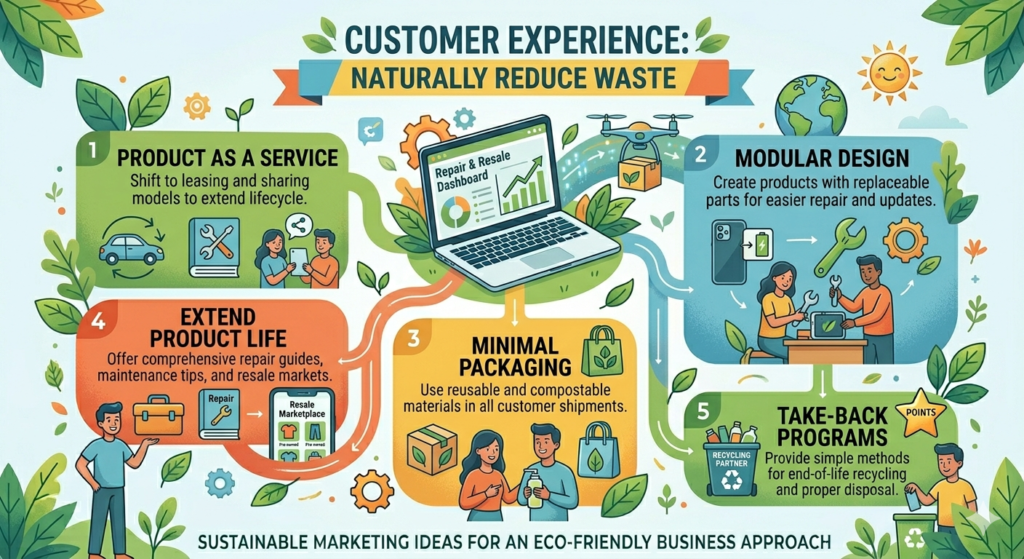
This is why customer experience is a core part of sustainable marketing. Every step should help the customer choose well, use well, and waste less.
A strong customer experience does not need to be complex. It needs to be thoughtful. It should answer the right questions at the right time.
Reduce waste before the customer buys
Many waste problems begin before purchase. A customer buys the wrong size, wrong shade, wrong product type, wrong bundle, or wrong quantity. Then they return it, throw it away, or stop using it.
Good marketing can prevent this.
Your website should help customers choose accurately. Product photos should be honest. Descriptions should be clear. Size guides should be easy. Comparison pages should explain who each product is for. If a product is not right for someone, say so.
That last point is important. Telling the wrong customer not to buy can feel scary, but it builds trust. It also reduces returns and bad reviews.
Make the first use simple and successful
The first time a customer uses your product matters a lot. If they feel confused, they may blame the product even if the issue is poor instruction.
Eco-friendly products sometimes ask customers to change a habit. A refill system, reusable wrap, concentrated cleaner, compostable item, repair kit, or low-waste routine may need a little guidance. Do not leave that guidance to chance.
Use a clear first-use email. Add a simple instruction card only if needed. Create a short video. Put a QR code on the package. Explain common mistakes before they happen.
When the first use goes well, the customer is more likely to keep using the product. That is both better for the planet and better for retention.
Support longer use after the sale
The most sustainable product is often the one that gets used fully and for a long time. Your marketing should support that.
Send care tips. Teach storage. Explain cleaning. Offer replacement parts if possible. Share repair options. Remind customers when it is time to refill instead of replace. Help them build a habit around the product.
This kind of post-purchase marketing is not just customer service. It is growth strategy. A customer who gets more value from a product is more likely to buy again, refer friends, and trust your next offer.
It also proves that your brand cares about use, not just sales. That difference matters.
Use transparent pricing to explain the true value of better choices
Eco-friendly products often cost more than mass-market options. This can create a sales challenge. Many customers like the idea of buying sustainably, but they hesitate when they see the price.
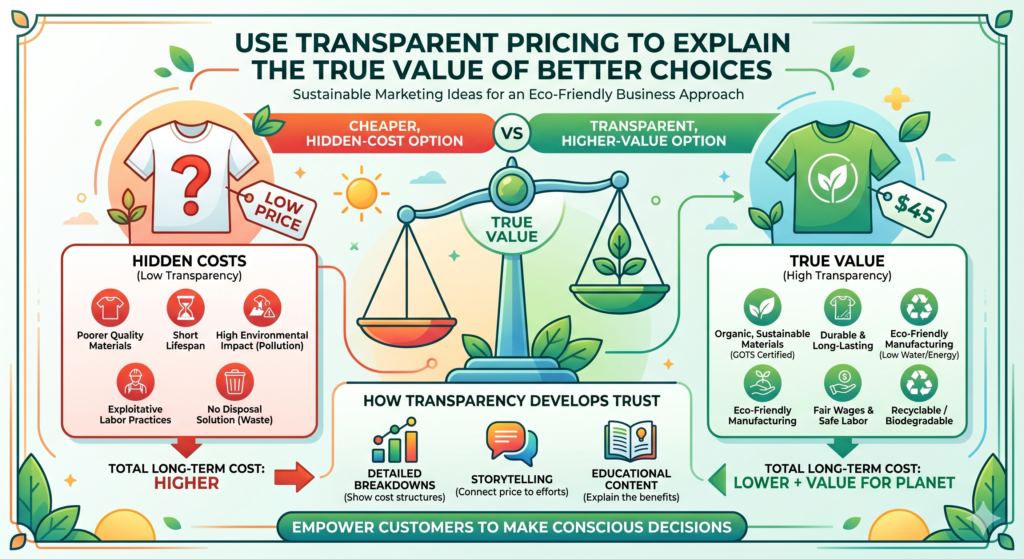
The wrong response is to hide from the price. The better response is to explain value clearly.
Transparent pricing does not always mean showing every cost in your business. It means helping customers understand why your product is priced the way it is and what they get in return.
Explain what the price supports
If your product costs more because you use better materials, pay fairer supplier rates, produce in smaller batches, reduce harmful inputs, or build a longer-lasting product, explain that in plain words.
Do not make customers guess. If they only see a higher price, they may assume your brand is expensive for no reason. If they understand the reason, they can judge the value more fairly.
For example, a sustainable clothing brand can explain that stronger fabric, smaller production runs, and ethical stitching increase cost but help the item last longer. A refillable home brand can explain that the first purchase includes a durable container, while refills cost less over time.
A low-waste food brand can explain how better sourcing and smaller batch production affect price.
The point is not to defend yourself. The point is to educate the customer.
Show long-term savings when they are real
Some sustainable products save money over time. If yours does, make that easy to see.
A refill product may cost more at first but less per use later. A durable item may replace several cheaper items. A repairable product may last years longer. A concentrated product may reduce shipping and storage costs.
Do not exaggerate the savings. Use simple examples. Show the cost per use, cost per refill, or expected replacement cycle if you can support it.
This helps customers move away from only asking, “What is the price today?” and toward asking, “What is the value over time?”
That shift can improve conversion without using pressure or heavy discounts.
Avoid training customers to wait for discounts
Discounts can be useful, but they can also weaken a sustainable brand if used too often. Constant discounts teach customers that the regular price is not real. They can also push people to buy more than they need, which may not match your values.
Instead of using discounts as your main sales tool, use value-based offers. You might offer a starter set that helps customers begin easily. You might reward refills. You might give store credit for returns or repairs. You might offer free local pickup, a care guide, or access to a useful workshop.
The goal is to make the purchase feel more valuable, not simply cheaper.
Transparent pricing builds respect. It tells customers, “Here is what goes into this product, here is why it matters, and here is how it serves you.”
Build a referral strategy around shared values
Referrals are powerful for any business, but they are especially useful for eco-friendly brands. This is because sustainable buying often spreads through trust. People ask friends what works. They want to know which products are worth it. They want honest proof from someone who has already tried the brand.
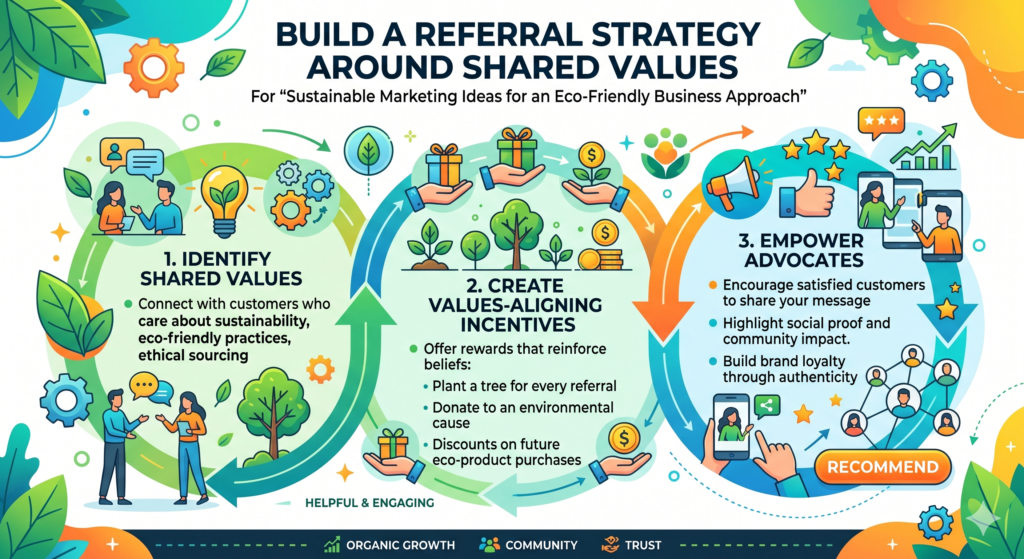
A referral from a happy customer can do what an ad cannot. It carries personal trust.
But a sustainable referral strategy should not feel like a cheap trick. It should feel aligned with your values. The customer should feel proud to share, not pushed to promote.
Give customers a simple reason to talk about you
People refer brands when the story is easy to explain. If your product is useful, different, and tied to a clear value, customers can share it naturally.
For example, a customer might say, “This cleaner helped me stop buying plastic bottles.” Another might say, “These clothes cost more, but they last and do not lose shape.” Another might say, “This brand takes back the empty containers.”
That kind of referral is strong because it is specific. It gives the next person a reason to care.
Your job is to make that story easy to repeat. Use simple language on your website, packaging, emails, and social content. When customers understand your difference clearly, they can share it clearly.
Reward both people in a way that supports better buying
A referral reward should encourage the right behavior. Instead of only offering a quick discount, think about rewards that support loyalty and sustainability.
You could offer refill credit, repair credit, a reusable add-on, store credit toward a next purchase, or a donation tied to a completed referral. The reward should feel useful and connected to your brand promise.
The best referral programs do not make people feel like sales agents. They make people feel like they are helping a friend discover a better option.
That emotional difference matters. Customers who care about sustainability often want to share brands that reflect well on them. Make the sharing experience feel honest and low-pressure.
Use referral stories as proof
When customers refer others, listen to the words they use. Their language often reveals your strongest marketing angle.
Maybe they talk more about convenience than sustainability. Maybe they talk about product quality. Maybe they talk about feeling less wasteful. Maybe they talk about saving space, avoiding harsh chemicals, or buying less often.
Use this language in your content. Real customer wording is often clearer than brand wording.
You can also turn referral stories into testimonials, case studies, social posts, and email content. A simple story from a real customer can be more persuasive than a polished brand claim.
Align your internal culture with your external marketing
Sustainable marketing becomes fragile when the outside message does not match the inside reality. Customers may not see every internal choice, but they can often sense when a brand is only using sustainability as a surface-level message.
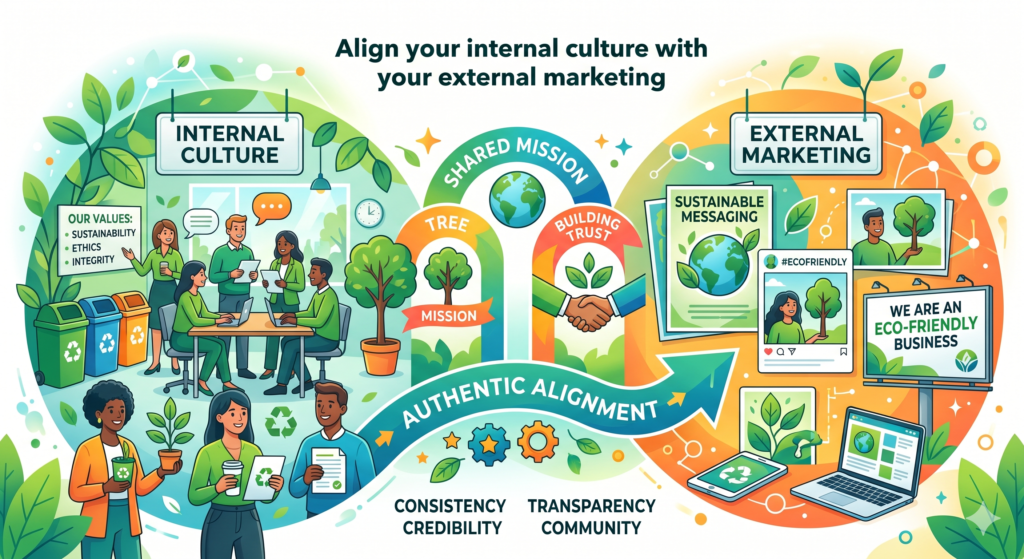
Your team, vendors, processes, and daily habits all shape the brand. If your marketing says one thing but your operations say another, the gap will eventually show.
This does not mean every part of your business must be perfect before you market your sustainability work. It means your internal choices should move in the same direction as your public message.
Make sustainability part of daily decisions, not just campaigns
A business becomes more believable when sustainability affects everyday choices. How do you choose suppliers? How do you plan inventory? How do you handle damaged products? How do you reduce office waste? How do you think about returns, shipping, samples, events, and printed material?
These decisions may seem small, but together they create the real brand.
For example, if your team often prints materials for short events, ask if digital options could work better. If you send product samples, think about smaller sizes or reusable packaging. If you attend trade shows, plan booth materials that can be reused. If you order inventory, avoid overproduction where possible.
This is not just ethics. It can also save money and reduce waste.
Train your team to speak clearly about sustainability
Everyone who talks to customers should understand your sustainability claims. This includes sales teams, customer support, social media managers, retail staff, and founders.
If your team uses vague language, customers may get confused. If they overstate a claim, the brand may lose trust. If they cannot answer basic questions, the message feels weak.
Create simple internal notes that explain what your brand can claim, what it cannot claim, and how to answer common questions. Keep the language plain. Update it when your practices change.
This helps your team speak with confidence. It also keeps your marketing consistent across every customer touchpoint.
Let internal progress become external content
Some of your best content may come from internal improvements. If you changed a supplier, reduced packaging, improved a return process, added a repair option, or found a way to use less material, share that story.
Do not make it sound bigger than it is. Just explain the problem, the decision, and the result.
This kind of content works because it feels specific. It shows that sustainability is not only a campaign theme. It is part of how the business thinks.
When customers see steady improvement, they are more likely to trust your bigger message.
Use cause marketing with care and real purpose
Cause marketing can be powerful for an eco-friendly business, but it can also go wrong fast. Many brands attach themselves to a cause because it looks good. They promise to plant trees, donate a small share, support ocean cleanup, or fund climate work, but the campaign feels thin because it is not connected to the business in a real way.
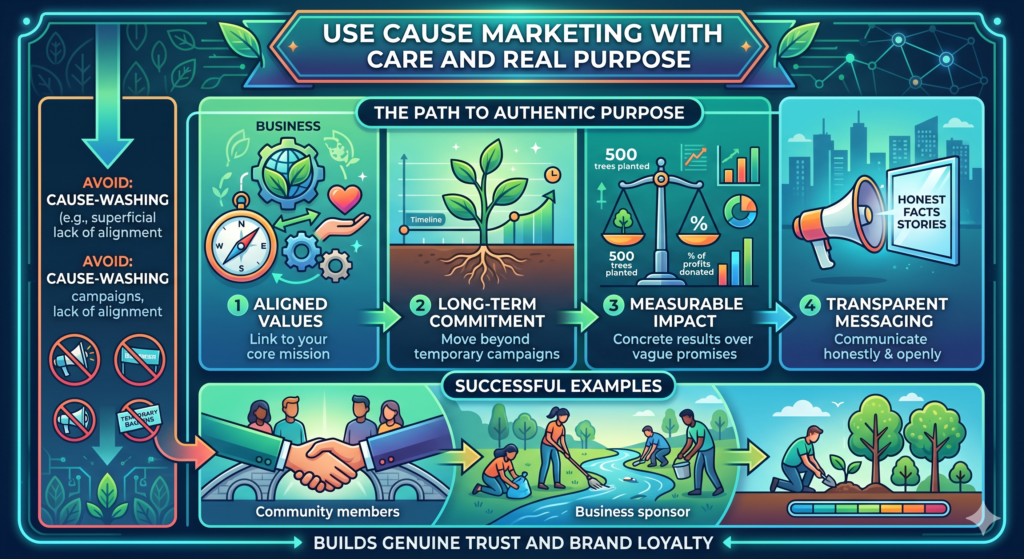
Customers can feel that gap. They may not know every detail, but they can sense when a cause is being used as decoration.
A better approach is to choose causes that match your product, your audience, and your daily work. The cause should feel like a natural extension of your brand, not a random add-on.
Your cause should connect to the problem your business helps solve
If your brand reduces plastic waste, a partnership with a local recycling education group, refill network, or ocean waste project may make sense. If you sell sustainable clothing, repair education, textile recycling, or fair labor support may fit better.
If your business helps offices reduce waste, local business sustainability programs may be a smart match.
The cause does not need to be huge. In fact, smaller and more focused causes often feel more real. A local project with visible outcomes can build more trust than a broad global promise that customers cannot verify.
Cause marketing should make the customer think, “Of course this brand supports that.” When the connection feels natural, the campaign feels stronger.
Make the action clear before asking customers to care
Customers should understand what happens when they support your campaign. If a purchase funds a donation, explain how much. If a product supports a project, explain what the project does. If customers can take part, explain the action in plain words.
Avoid vague lines like “a portion of proceeds goes to helping the planet.” That may sound warm, but it does not tell people anything useful. A clearer message would explain the amount, the partner, the goal, and the time period.
For example, a better message might say that every refill order during April helps fund local waste sorting workshops for schools. That is specific. It gives the campaign shape. It also helps customers picture the result.
The more clearly you explain the action, the easier it is for customers to trust it.
Report back after the campaign ends
The most common mistake in cause marketing is starting strong and ending quietly. A brand announces the campaign, gets attention, makes sales, and then never tells customers what happened.
That weakens trust.
After the campaign, share the result. Explain what was donated, what was completed, what was learned, and what comes next. Thank customers for taking part. If the result was smaller than expected, still be honest. If the project is ongoing, explain the next step.
This follow-up turns a campaign into a relationship. It shows that the cause mattered beyond the sales window.
When customers see the full cycle, they are more likely to believe your next campaign.
Build low-waste events that create high-trust customer moments
Events can be very useful for eco-friendly brands because they create real human connection. A customer can touch the product, ask questions, see how it works, and meet the people behind the brand. That kind of trust is hard to build through a screen alone.
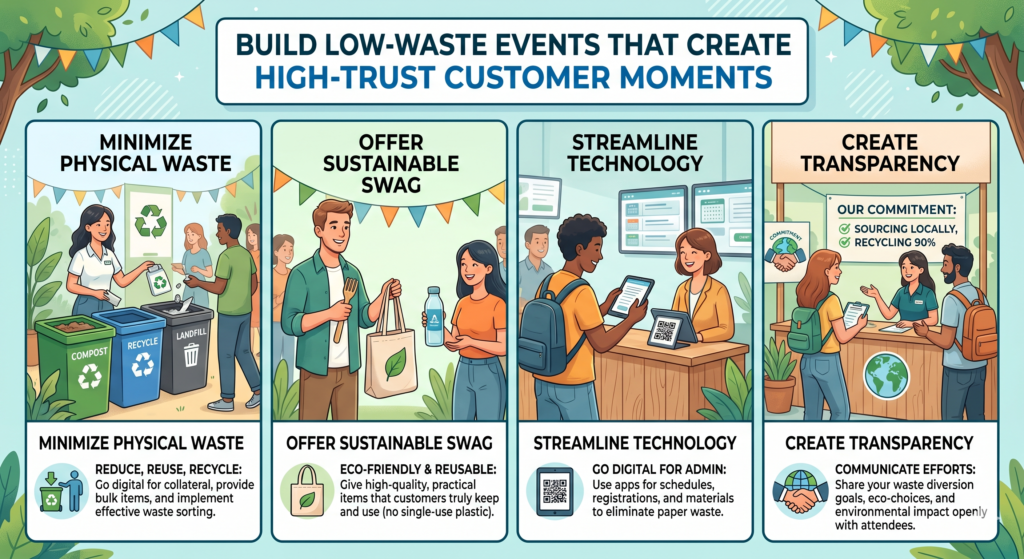
But events can also create waste. Printed banners, single-use samples, plastic giveaways, food waste, travel, packaging, and display materials can work against your message if you are not careful.
A sustainable event strategy does not mean doing boring events. It means designing events with purpose. Every detail should support the customer experience and your values at the same time.
Plan the event around one useful customer outcome
A strong event should not only be about brand exposure. It should help customers learn or do something useful.
A sustainable skincare brand could host a session on building a simple low-waste bathroom routine. A clothing brand could run a repair and care workshop. A cleaning brand could show how concentrated refills work. A food brand could teach storage habits that reduce waste at home.
When the event teaches something practical, people are more likely to remember it. They are also more likely to trust the product because they understand how it fits into their life.
An event with a clear customer outcome feels helpful, not promotional.
Design the event materials so they can be reused
Before creating anything for an event, ask if it can be used again. This applies to signs, table displays, sample containers, packaging, props, name cards, banners, and printed guides.
Instead of printing lots of flyers, use QR codes that lead to a useful landing page. Instead of giving away cheap branded items, offer something customers will actually use. Instead of building a one-time display, create modular materials that can travel to future events.
This does more than reduce waste. It also saves money over time.
Customers notice these choices. When your event looks thoughtful, your sustainability message becomes easier to believe.
Follow up with people based on what they learned
The event should not end when people leave. Send a follow-up email that reminds them of the main lesson, shares useful resources, and offers a clear next step.
If someone attended a repair workshop, send a care guide. If they joined a refill demo, send a starter guide. If they asked about materials, send a simple explanation page. If they sampled a product, explain how to choose the right version.
This follow-up makes the event more valuable. It also moves people closer to buying without making the message feel pushy.
Good event marketing does not chase attention for one day. It creates a small trust moment and then builds on it.
Conclusion
Sustainable marketing is not about sounding green. It is about making better choices, proving them clearly, and helping customers do the same in simple ways. An eco-friendly business grows stronger when its message, product, packaging, content, pricing, partnerships, and customer experience all point in the same direction.
The goal is not perfection. The goal is steady progress that people can see and trust. When your brand teaches instead of pressures, shows proof instead of making vague claims, and builds habits instead of chasing quick sales, sustainability becomes more than a value. It becomes a real business advantage.












Comments are closed.