
WinSavvy Editorial Standards
How this article was created
Growing a chiropractic practice today takes more than skill, care, and a good location. Those things matter, of course. But they are no longer enough on their own. People now search online before they book. They read reviews before they call. They compare websites before they trust. They ask friends, check Google, scroll social media, and look for signs that your practice feels safe, helpful, and worth visiting.
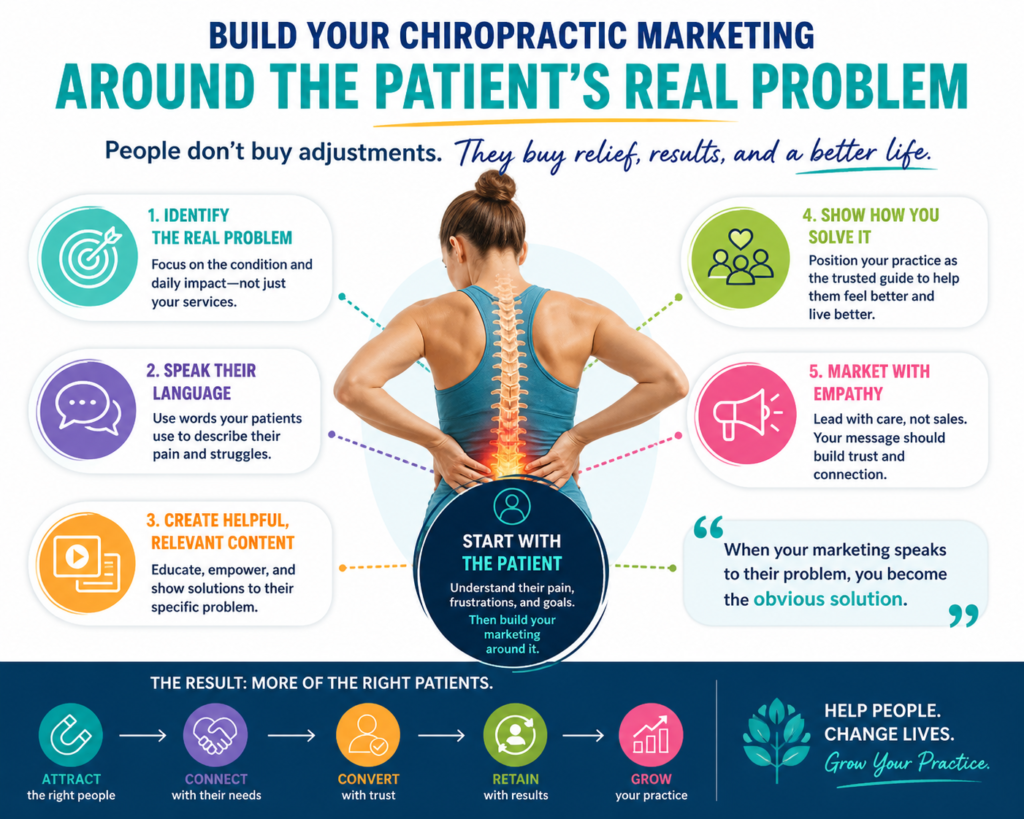
Build Your Chiropractic Marketing Around the Patient’s Real Problem
Most chiropractic marketing starts in the wrong place. It starts with the clinic, the doctor, the service, the adjustment, the equipment, or the years of experience. These things matter, but they are not what most patients think about first.
A person with back pain is not searching for “spinal correction services” because they love clinical terms. They are usually thinking, “Why does my back hurt when I sit?” or “How do I stop this pain before it gets worse?” Your marketing must meet them at that level first.
Speak to the pain your patients already understand
Your best marketing should sound like the thoughts your patients already have in their own heads. A busy parent may not say they need chiropractic care for posture problems. They may say their lower back hurts after carrying their toddler all day.
A desk worker may not say they need spinal alignment. They may say their neck feels tight every afternoon.
When your website, social posts, ads, and emails use real patient language, people feel understood. That feeling is powerful. It lowers fear. It builds trust. It makes your practice feel less like a clinic trying to sell something and more like a guide that knows what they are going through.
This does not mean you should avoid education. It means you should earn the right to educate by first showing that you understand the problem in plain words.
Turn service pages into problem pages
Many chiropractic websites have pages titled “Chiropractic Adjustment,” “Corrective Care,” or “Wellness Care.” These pages may explain the service, but they often fail to match how people search. A better approach is to build pages around the problems patients want solved.
Instead of only having a page for chiropractic adjustments, create strong pages for lower back pain, neck pain, headaches, sciatica, posture pain, sports injuries, pregnancy-related discomfort, and pain after car accidents.
Each page should explain what the patient may be feeling, why it can happen, when they should seek care, how your clinic evaluates the issue, and what the first visit looks like.
This makes your website more helpful. It also gives Google clearer pages to rank when someone searches for care in your area. More important, it makes the patient feel like they landed in the right place.
Choose a clear position in your local market
Trying to be the chiropractor for everyone can make your message weak. You may treat many types of patients, but your marketing should still give people a clear reason to choose you.
Your position does not have to be fancy. It simply needs to answer one question clearly: why should a patient choose your practice instead of another clinic nearby?
Maybe your practice is best known for helping office workers with neck and back pain. Maybe you focus on family care. Maybe you are strong in sports recovery. Maybe you are the clinic that explains everything simply and makes nervous first-time patients feel comfortable. Maybe your strength is fast scheduling and clear treatment plans.
The clearer your position, the easier your marketing becomes. Your website copy becomes sharper. Your ads become more focused. Your content becomes more useful. Your reviews start to support the same message again and again.
Make your message easy to repeat
A strong marketing message should be simple enough for a patient to repeat to a friend. If someone asks, “Why did you choose that chiropractor?” your patient should be able to say, “They really helped me understand my back pain and gave me a clear plan,” or “They are great for people who sit all day,” or “They made my first visit feel easy.”
That kind of message spreads.
Avoid trying to sound too broad or too polished. Patients do not need a perfect slogan. They need a clear promise. They need to know who you help, what you help with, and what kind of experience they can expect.
Turn Your Website Into a Patient Booking Tool
Your website is not just an online brochure. It is often the first real conversation a patient has with your practice. Before they call, they judge your website. They look at your photos, your reviews, your words, your services, and your booking process.
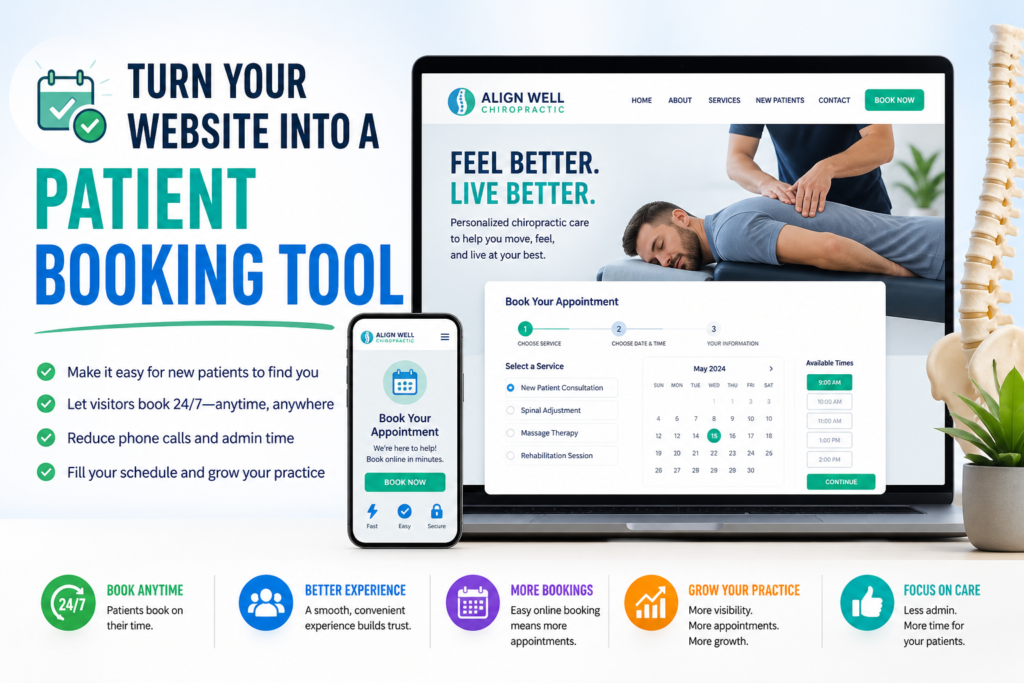
If the website feels confusing, cold, slow, or outdated, they may leave without saying a word.
A good chiropractic website should do three jobs well. It should build trust fast, explain care clearly, and make booking easy.
Make the first screen answer the patient’s biggest questions
When someone lands on your homepage, they should not have to work hard to understand what you do. The top of the page should quickly tell them that you are a chiropractic practice, where you are located, who you help, and how they can book.
Many websites waste this space with vague lines like “Helping you live your best life” or “Your path to wellness starts here.” These lines sound nice, but they do not say enough. A stronger message would be something like, “Chiropractic care for back pain, neck pain, and everyday movement problems in Austin.”
That is clear. It tells the visitor they are in the right place.
Your call to action should also be easy to see. “Book an Appointment” or “Schedule Your First Visit” is better than unclear wording. Patients should not have to hunt for the next step.
Use trust signals before patients start doubting
Trust is built in small moments. A patient may feel unsure about visiting a chiropractor for the first time. They may wonder if treatment will hurt, how many visits they will need, whether insurance is accepted, or if the doctor will listen to them.
Your website should calm these doubts early. Show real patient reviews. Use real photos of your clinic and team. Explain what happens during the first visit. Share your location, hours, phone number, and booking button clearly. If you have strong ratings, show them near the top of the page.
Do not hide your human side. A warm photo of the doctor, a simple welcome message, and a clear explanation of your care style can do more than a page full of technical claims.
Make every service page useful enough to earn trust
A service page should not feel like a short note. It should answer the questions a patient would ask before booking. For example, a page about neck pain should explain common causes, signs the issue should not be ignored, how chiropractic care may help, what your exam process looks like, and what the patient can expect during the visit.
The goal is not to scare people. The goal is to help them feel informed.
Patients are more likely to book when they feel less confused. If your page simply says, “We treat neck pain. Call today,” you are asking the patient to take a leap. If your page explains the problem in simple words and shows a clear path forward, you are guiding them.
Write pages for humans first and search engines second
SEO matters, but patient trust matters more. The best pages do both. Use phrases people search for, such as “chiropractor for lower back pain in Dallas” or “neck pain chiropractor near me,” but place them naturally inside helpful writing.
Do not stuff keywords. Do not repeat the city name in every sentence. Do not write like a machine. Google is trying to reward useful pages, and patients are trying to find a clinic they can trust. The same kind of page often works for both.
A strong page feels like a helpful conversation. It gives the patient enough information to feel safe, then invites them to take the next step.
Use Local SEO to Show Up When Patients Are Ready to Book
Local SEO is one of the most important growth channels for chiropractic practices. This is because many patients search when they already have a need. They are not casually browsing. They are looking for help nearby.
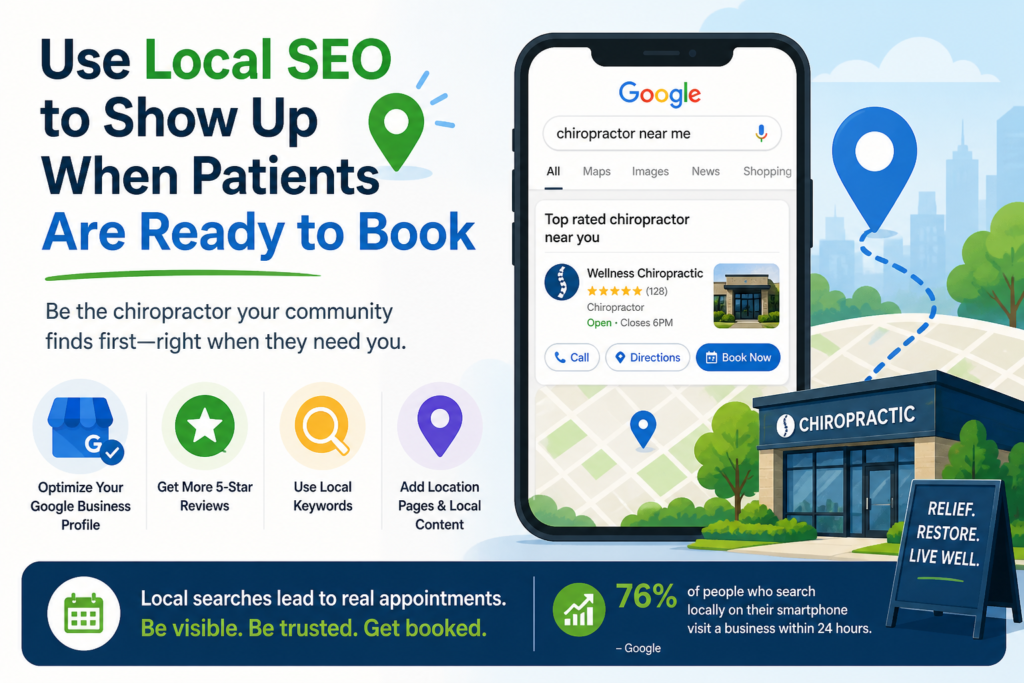
When someone searches “chiropractor near me,” “back pain chiropractor,” or “chiropractor in [city],” they are often close to booking. If your practice does not show up, your competitors get that chance instead.
Build your Google Business Profile like a landing page
Your Google Business Profile is often more visible than your website. Many patients will see your profile before they ever click through to your site. They may look at your reviews, photos, hours, location, services, and phone number right from Google.
This means your profile should be treated like a serious marketing asset, not a quick listing you set up once and forget.
Make sure your name, address, phone number, website, hours, and services are accurate. Add strong photos of your clinic, treatment rooms, front desk, outside signage, and team. Use the service fields to describe the care you offer. Keep your profile active with updates, helpful posts, and fresh photos.
Photos can reduce fear before the first visit
A patient who has never visited your practice may feel nervous. They do not know what the building looks like. They do not know if parking is easy. They do not know if the clinic feels clean, modern, friendly, or calm.
Photos answer those silent questions.
Show the front entrance so people can recognize it. Show the waiting area so they know what to expect. Show the doctor and staff smiling naturally. Show treatment rooms without making them look cold or scary. These small details can make the first step feel easier.
The more familiar your practice feels before the visit, the less friction there is when the patient decides to book.
Build location pages that are actually helpful
If your practice serves several nearby towns or neighborhoods, location pages can help you rank for those areas. But these pages must be written with care. Many clinics create thin pages that only swap out city names. That can feel lazy to both readers and search engines.
A good location page should feel local and useful. It should explain the area you serve, common patient needs, directions, parking notes, nearby landmarks, and how easy it is to visit your clinic from that place. It should also link to your main condition pages and booking page.
For example, if you serve a nearby suburb with many office parks, your page can speak about neck pain, posture strain, and long sitting hours. If you serve a family-heavy area, you can speak more about parents, teens, sports, and daily movement issues.
Match local intent with real local details
People searching locally want care that feels close and practical. They want to know if you are nearby, if you treat their issue, if you are open at the right time, and if other local patients trust you.
So, your location pages should not sound like generic SEO pages. They should feel like they were written by a real practice that knows the area.
Mention your service area naturally. Explain travel time where useful. Add real driving or parking details if they help. Share reviews from patients in those areas when possible. Make the page useful enough that someone from that location would feel it was written for them.
Make Reviews a Core Part of Your Growth Strategy
For chiropractic practices, reviews are not just nice to have. They are one of the strongest trust builders you have. Many patients are cautious before choosing care. They want to know if other people felt listened to, if the doctor explained things clearly, if the clinic was friendly, and if treatment felt worth it.

A strong review profile can help answer those questions before the patient calls.
Ask for reviews at the right emotional moment
The best time to ask for a review is when the patient has just experienced a clear positive moment. Maybe they say they feel better. Maybe they thank the doctor. Maybe they mention they slept well for the first time in weeks. Maybe they say the visit was easier than expected.
That is the moment to ask in a simple and respectful way.
You can say, “I’m really glad to hear that. Reviews help other people in the area feel more comfortable choosing care. Would you be open to sharing your experience on Google?”
This feels natural because it connects the review request to helping others. It does not feel pushy. It does not feel like a script. It feels like a human request at the right time.
Make the review process easy
Even happy patients may not leave reviews if the process is hard. Your job is to remove friction. Send a direct review link by text or email. Keep the message short. Thank them first. Tell them it only takes a minute.
Do not ask them to write a perfect story. Do not tell them what to say. Just make it easy for them to share their honest experience.
You can also train your front desk team to listen for positive comments. When a patient says, “Everyone here is so helpful,” that is a review opportunity. The team can kindly ask if they would be willing to share that online.
Respond to reviews like future patients are reading
Your review replies are not only for the person who wrote the review. They are also for every future patient who reads them. A thoughtful reply shows that your practice pays attention. It shows warmth, care, and professionalism.
For positive reviews, thank the patient in a personal but privacy-safe way. Keep it simple. Avoid mentioning private health details. For negative reviews, stay calm. Do not argue. Do not reveal patient information. Invite them to contact the office so the issue can be handled directly.
The way you respond to criticism can build trust. Future patients know every business gets an unhappy review sometimes. What they watch is how you handle it.
Look for patterns inside your reviews
Reviews are also market research. They tell you what patients value most. Read them often and look for repeated themes. Do patients praise your clear explanations? Your gentle care? Your friendly front desk? Your fast scheduling? Your clean clinic? Your results?
These repeated themes should shape your marketing message.
If many patients say, “They explained everything so clearly,” then your website should say that. If many patients mention feeling comfortable on the first visit, use that in your first-visit page. If patients praise your work with athletes, build more content around sports recovery.
Your best marketing language often comes straight from your patients.
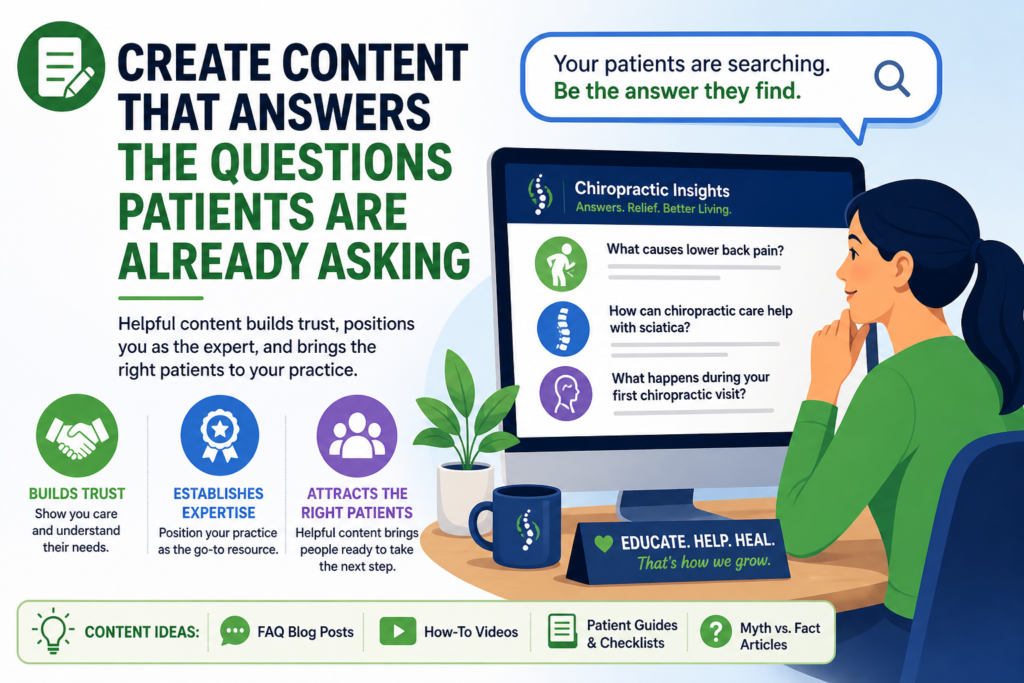
Create Content That Answers the Questions Patients Are Already Asking
Content marketing can be one of the best ways to grow a chiropractic practice, but only when it is done with a clear purpose. Many clinics post content because they feel they should. They share quick health tips, random exercise posts, or short updates that do not lead anywhere.
That kind of content may keep a page active, but it rarely builds real growth.
Good content should help patients before they are ready to book. It should answer the questions they type into Google late at night. It should explain pain in simple words. It should reduce fear. It should show that your practice understands the problem and has a clear path forward.
Start with patient questions, not topic ideas
The best chiropractic content does not begin with “What should we post this week?” It begins with “What are patients worried about before they call us?”
Think about the questions you hear every day. Patients ask why their back hurts after sitting. They ask if cracking their neck is bad. They ask why pain comes back after rest. They ask whether headaches can be linked to neck tension.
They ask how long care may take. They ask if they should use heat or ice. They ask when pain is serious enough to get checked.
Each of these questions can become a useful blog post, short video, email, social post, or website section. More important, each question comes from a real person with a real need.
When your content is built around real patient questions, it feels helpful. It also attracts people who are already thinking about care.
Write content for the full patient journey
Not every person who reads your content is ready to book today. Some are still trying to understand their pain. Some are comparing options. Some are nervous because they have never visited a chiropractor. Some are ready to schedule but need one last reason to trust you.
Your content should help at each stage.
Early-stage content can explain common problems in plain language. For example, “Why does my lower back hurt after sitting?” or “What causes neck pain at a desk?” These posts help people understand what may be happening.
Middle-stage content can compare choices. For example, “Should I see a chiropractor or massage therapist for back pain?” or “When should I get neck pain checked?” These posts help patients make a better decision.
Late-stage content should reduce friction. For example, “What to expect at your first chiropractic visit” or “How our clinic creates a care plan.” These pages make booking feel safer.
Make every article useful, local, and easy to read
A chiropractic blog should not sound like a medical textbook. It should sound like a calm, smart doctor explaining the issue to a patient across the desk. Use short paragraphs. Use simple words. Explain the “why” behind your advice. Avoid heavy terms unless you explain them right away.
A strong article should also include local meaning when it makes sense. If your clinic serves a busy business area, talk about long work hours, desk posture, commuting, and stress. If you serve families, talk about school sports, lifting kids, weekend activity, and daily strain. Local content feels more personal because it reflects the patient’s real life.
This does not mean stuffing your city name into every paragraph. It means writing with an understanding of the people you serve.
Give the reader a clear next step
Many blog posts fail because they teach but do not guide. A patient reads the article, understands the problem better, and then reaches the end with no clear path.
Every content page should give the reader a natural next step. If the article is about lower back pain, invite them to schedule an exam if the pain keeps returning. If it is about headaches, guide them to your neck pain or headache care page. If it is about a first visit, invite them to book.
The next step should not feel like a hard sell. It should feel like the next helpful move.
A simple line can work well: “If this sounds like what you are dealing with, a clear exam can help you understand what is causing the pain and what to do next.” That is direct, calm, and patient-focused.
Use Social Media to Build Familiarity Before Patients Need You
Social media is not always the fastest way to get new chiropractic patients, but it can be very powerful when used the right way. The main job of social media is not to chase likes. It is to build familiarity. People trust what they see often, especially when it feels real, useful, and human.
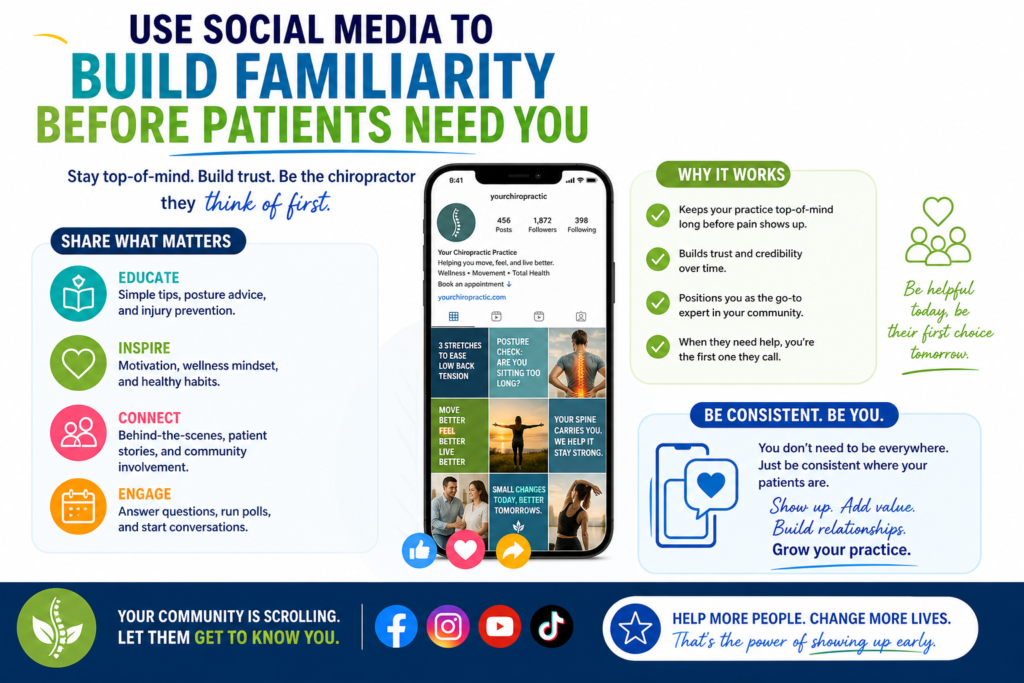
A person may follow your page for months before they ever need care. Then one day their back hurts, their neck locks up, or a friend asks for a chiropractor. If your posts have been helpful and consistent, your clinic is the one they remember.
Show the human side of your practice
People do not only choose a chiropractor based on services. They choose based on comfort. They want to know who they are walking in to see. They want to know if the clinic feels friendly. They want to know if the doctor seems clear, calm, and trustworthy.
Social media is a good place to show that.
Share short videos explaining common questions. Show your front desk team. Introduce the doctor. Walk through the first-visit process. Show the outside of the clinic so people know where to go. Share simple movement tips. Talk about common mistakes people make at work, while driving, or after workouts.
These posts do not need to be perfect. In fact, overly polished posts can feel less trustworthy. Clear, warm, real content often works better.
Use simple video to build trust faster
Video helps patients feel like they know you before they visit. A short video of the doctor explaining back pain in plain words can build more trust than a long written post. Patients can hear your tone. They can see your face. They can sense whether you feel calm and helpful.
Start with easy video topics. Explain what happens during a first visit. Talk about why sitting can make the lower back tight. Share what patients should avoid when neck pain first starts. Explain when pain should not be ignored.
Keep videos focused. One video should answer one question. Do not try to teach everything at once. A short, clear answer is easier to watch and easier to remember.
Do not turn every post into a sales pitch
One of the biggest mistakes clinics make on social media is asking people to book in every post. That can make the page feel needy instead of helpful. Social media works better when most of your content teaches, reassures, or builds connection.
That does not mean you should avoid calls to action. It means they should feel natural. After a helpful post about desk posture, you can say, “If neck pain keeps coming back even after changes at your desk, it may be time to get it checked.” That is softer and more useful than simply saying, “Book now.”
The goal is to stay present in the patient’s mind without making them feel pressured.
Build a weekly rhythm your team can actually keep
A simple content rhythm is better than a big plan your team cannot follow. You might share one educational video, one patient question, one behind-the-scenes post, and one local community post each week. That is enough to stay visible without making social media feel like a full-time job.
The key is consistency. Patients may not see every post, but they will notice your presence over time. Your page starts to feel active. Your clinic starts to feel familiar. Your name becomes easier to remember.
This matters because patients often choose the practice they feel they already know.
Build Paid Ads That Bring the Right Patients, Not Just More Clicks
Paid ads can help a chiropractic practice grow faster, but only when they are built carefully. Many clinics waste money because their ads are too broad, their message is too weak, or their landing page does not match what the patient needs.
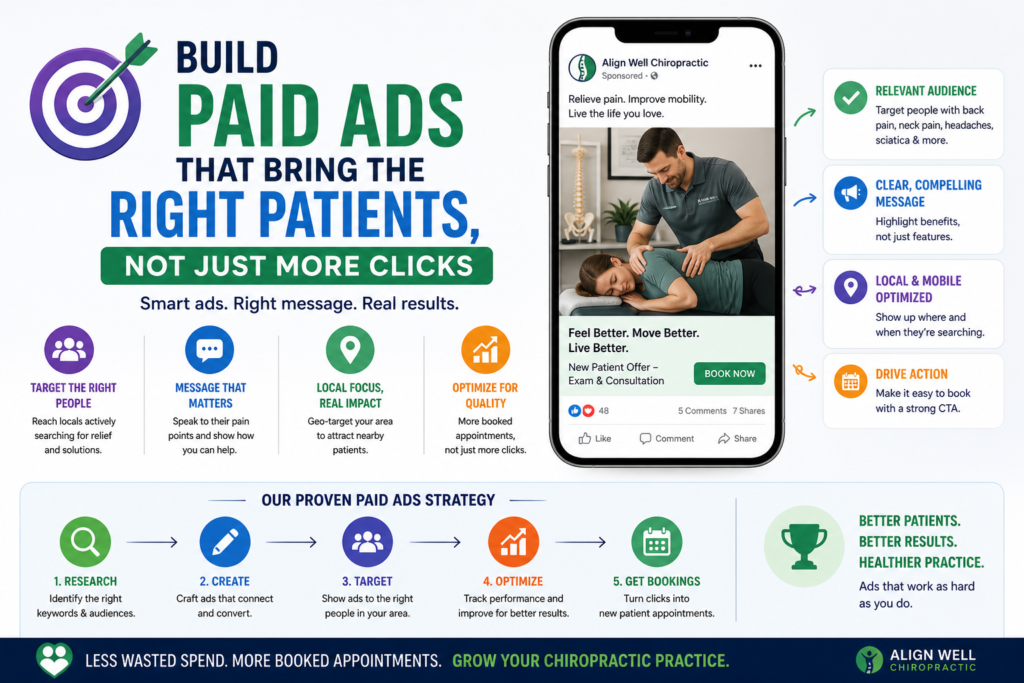
The goal of paid ads is not to get as many clicks as possible. The goal is to get the right people to take the right action at the right time.
Focus Google Ads on high-intent searches
Google Ads can work well for chiropractors because they can reach people who are already searching for help. Someone typing “chiropractor near me” or “back pain chiropractor in Phoenix” is much closer to booking than someone casually scrolling social media.
That is why your Google Ads should focus on high-intent keywords. These are search terms that show a person is looking for care, not just information. Terms around chiropractors, back pain treatment, neck pain care, sciatica help, sports injury chiropractor, and local chiropractic clinics may be strong starting points.
But you must be careful. Broad keywords can waste money. A term like “back pain” may bring people looking for home remedies, exercises, or general causes. A more focused term like “chiropractor for lower back pain near me” is more likely to bring a patient who wants care.
Send ad traffic to the right page
Many practices send every ad click to the homepage. That is often a mistake. If someone searches for help with sciatica, they should land on a sciatica page. If someone searches for a chiropractor after a car accident, they should land on a page about accident-related care. If someone searches for neck pain, they should land on a neck pain page.
A matching landing page makes the patient feel understood. It also keeps the message clear.
The page should explain the problem, show your local trust signals, include reviews, explain what happens next, and make booking easy. It should not be cluttered. It should not force the patient to search for answers. It should guide them from concern to action.
Use social ads for awareness and retargeting
Social ads work differently from Google Ads. People on Facebook or Instagram are usually not searching for chiropractic care in that moment. They are scrolling. That means your ad needs to earn attention without feeling pushy.
Social ads can work well for education, offers, first-visit awareness, and retargeting. Retargeting means showing ads to people who already visited your website or engaged with your content. These people are warmer because they already know your practice exists.
A good social ad may explain a common problem, show a short doctor video, or invite people to learn what may be causing their pain. The message should feel helpful, not loud.
Track booked appointments, not just clicks
Clicks can be misleading. A campaign may get many clicks and still bring few patients. What matters is whether people call, book, show up, and become good-fit patients.
Track phone calls from ads. Track form submissions. Track online bookings. Ask new patients how they found you. Review which campaigns lead to real appointments, not just traffic.
This is where many clinics become more profitable. They stop judging ads by surface numbers and start judging them by business results.
If one ad brings fewer clicks but more booked visits, it may be the better ad. If one keyword costs more but brings high-value patients, it may be worth keeping. Marketing gets stronger when you measure what actually matters.
Make Email and Text Follow-Up Part of the Patient Experience
Many chiropractic practices focus so much on getting new patients that they forget about follow-up. But follow-up can make a huge difference. It can help new leads book, help patients stay on track, and help past patients come back when they need care again.
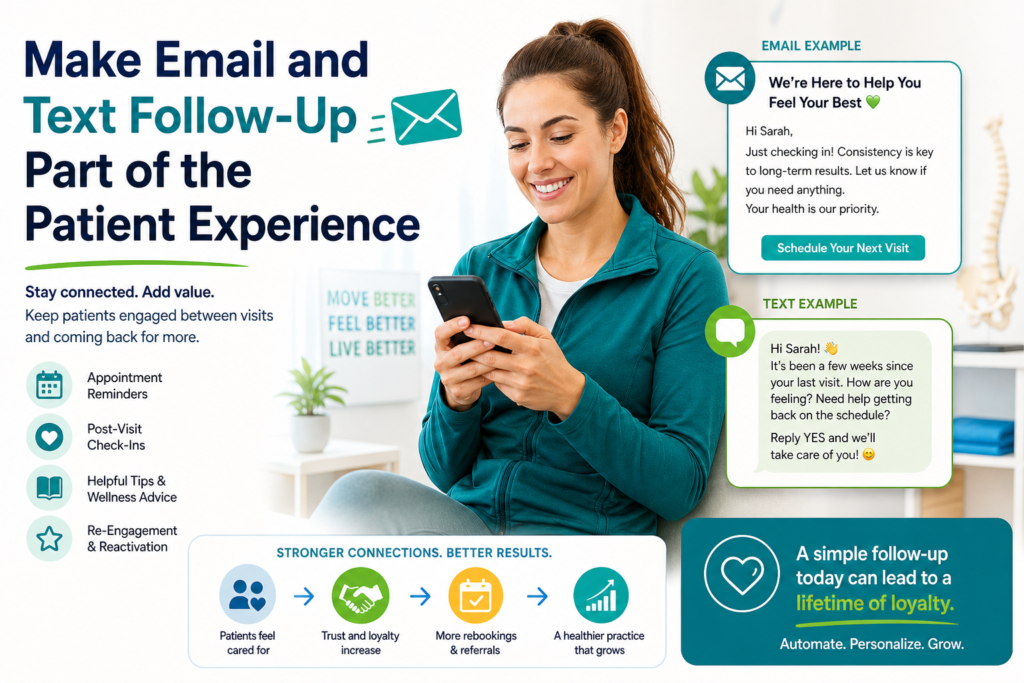
Email and text do not need to be complicated. They just need to be useful, timely, and human.
Follow up quickly with new leads
When someone fills out a form or requests an appointment, speed matters. The longer you wait, the more likely they are to lose interest, call another clinic, or talk themselves out of booking.
A fast response shows that your practice is organized and attentive. If your team can call within a few minutes, that is ideal. If not, a simple text or email can help hold the connection.
The message should be warm and clear. Thank them for reaching out. Let them know the next step. Make it easy to confirm a time. Avoid long messages that feel automated or cold.
Reduce fear before the first visit
Once a new patient books, your follow-up should help them feel ready. Many first-time patients are nervous. They may not know what to wear, what to bring, where to park, how long the visit will take, or what will happen during the exam.
A simple first-visit email or text can answer these questions. It can explain the process in plain language. It can remind them of the appointment time. It can include forms, parking details, and a friendly note from the clinic.
This kind of follow-up reduces no-shows because it makes the visit feel easier. It also improves the patient experience before they arrive.
Stay in touch with past patients without being annoying
Past patients already know your practice. If they had a good experience, they are much easier to bring back than a brand-new lead. But many clinics let these relationships go quiet.
A simple monthly email can keep your practice top of mind. It can share helpful seasonal tips, common pain reminders, clinic updates, and simple movement advice. Around busy seasons, you can send messages about back pain during travel, posture during school season, winter stiffness, or safe movement during yard work.
The goal is not to sell every time. The goal is to remain useful.
Use reminders with care and respect
Text reminders can be helpful, but they should be used wisely. Patients may appreciate appointment reminders, follow-up prompts, and simple care plan reminders. But too many messages can feel intrusive.
Keep texts short. Make them useful. Give patients a clear way to respond. Respect their preferences.
When follow-up feels helpful, patients see your practice as caring and organized. When it feels aggressive, they pull away. The difference is tone, timing, and value.
Turn Patient Referrals Into a Steady Growth Channel
Referrals are one of the strongest ways to grow a chiropractic practice because they come with trust already attached. When a happy patient tells a friend, “You should go see my chiropractor,” that friend does not see your practice as a stranger. They see you as a safe choice.
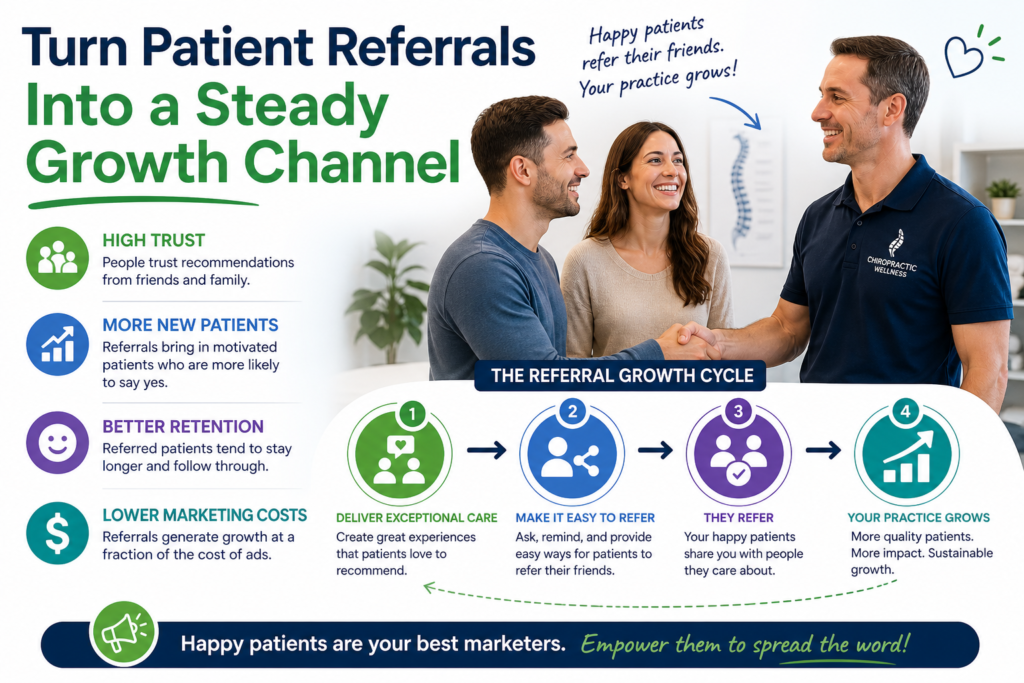
But referrals should not be left to luck. Many patients are willing to refer, but they need a simple reason, a clear moment, and an easy way to do it. If you wait for referrals to happen on their own, you will get some. If you build a referral system around great care, you can get many more.
Make the patient experience worth talking about
A referral starts long before you ask for one. It starts the moment the patient finds your practice, calls your front desk, walks into your clinic, meets the doctor, understands their care plan, and leaves feeling better informed.
People refer when something feels worth sharing. That does not always mean the pain is gone right away. Sometimes patients refer because they felt heard. Sometimes they refer because the doctor explained things clearly. Sometimes they refer because the office was kind, calm, and easy to deal with.
Your whole patient experience should be designed around these moments. When a patient feels cared for in a way they did not expect, they remember it. And when a friend later mentions back pain, neck pain, headaches, or stiffness, your name comes to mind.
Create small moments patients remember
Referral growth often comes from small details. A warm greeting at the front desk. A clear explanation after the exam. A simple printed or emailed care summary. A check-in message after the first visit. A calm answer when the patient feels nervous.
These moments may seem small to your team because you see them every day. But to a patient, they can mean a lot. A person in pain often feels unsure, rushed, or ignored by the healthcare system. When your practice slows down and treats them like a human being, that becomes memorable.
You do not need to create a flashy experience. You need to create a clear, kind, and dependable one.
Ask for referrals in a natural way
Many chiropractors avoid asking for referrals because they worry it will feel awkward. But it does not have to. The key is to ask at the right time and make the request about helping others, not about helping your business.
A good moment is when a patient says they are feeling better, moving better, sleeping better, or understanding their body more clearly. You can respond with warmth and say, “I’m really glad to hear that. If you know someone else dealing with something similar, we would be happy to help them understand what is going on too.”
That kind of request feels natural. It does not push. It simply opens the door.
Give patients simple words to use
Patients may want to refer, but they may not know how to explain what you do. Make it easy for them. Your own marketing should give them simple language they can repeat.
For example, if your practice is known for helping people understand the cause of recurring back pain, patients can say, “They explain things really clearly and help you figure out why the pain keeps coming back.” If your practice is strong with first-time chiropractic patients, they can say, “They make the first visit really easy and not scary.”
The clearer your message, the easier it is for patients to share it.
You can also use simple referral cards, follow-up emails, or website pages that explain who you help. But the heart of referral marketing is still the patient experience. People refer when they trust you enough to put their own name behind the recommendation.
Build Local Partnerships That Put Your Practice in Front of the Right People
Local partnerships can help a chiropractic practice grow in a way that feels natural. You do not always need to reach patients through ads. Sometimes the best growth comes from trusted local relationships.
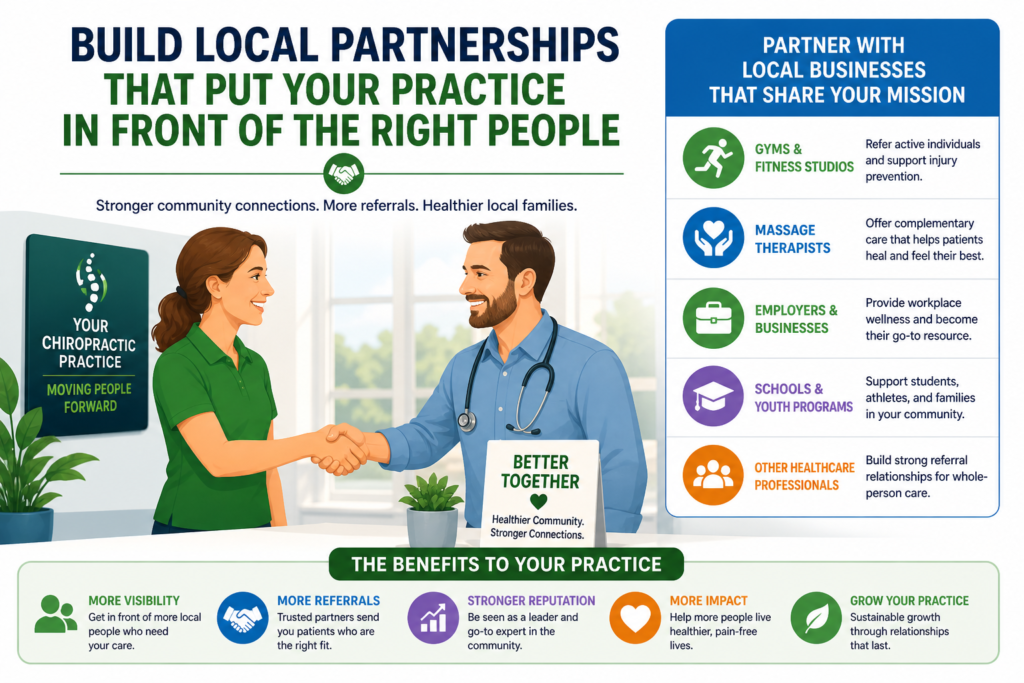
The right partners already serve the same people you want to reach. They may not offer chiropractic care, but they work with people who care about movement, pain relief, health, fitness, recovery, or daily function. When those partners know and trust you, they can become a steady source of awareness and referrals.
Choose partners based on patient fit
Not every local business is a good partner. The best partners serve people who may need your help and who already trust the partner’s advice.
Fitness studios, gyms, yoga teachers, massage therapists, physical therapists, running stores, sports coaches, doulas, personal trainers, wellness centers, and local employers can all be strong fits, depending on your practice focus.
If you treat many office workers, local companies may be useful partners. If you treat athletes, gyms and coaches may make more sense. If you work with families, parenting groups, schools, and community events may fit better.
The goal is not to collect random relationships. The goal is to build a small group of strong local connections that make sense for your patients and your position.
Lead with value before asking for anything
A weak partnership pitch sounds like, “Can you send us referrals?” A strong partnership starts with value.
Offer to teach a short workshop. Create a simple guide their clients can use. Help their members understand posture, recovery, lifting form, desk strain, or injury warning signs. Invite the partner to visit your clinic and understand how you care for patients. Share their useful content with your audience when it makes sense.
When you lead with help, the relationship feels real. The partner gets to see your style, your knowledge, and your care. That makes referrals safer for them. They are not just sending people to a name. They are sending them to someone they trust.
Create workshops that are simple and practical
Workshops can be powerful because they let people experience your expertise before they become patients. But the topic must be practical. People are more likely to attend when the workshop solves a problem they already feel.
A workshop called “Spinal Health Education” may sound too broad. A workshop called “How to Reduce Neck and Back Pain From Sitting All Day” is clearer. A workshop called “Simple Ways Runners Can Protect Their Hips and Lower Back” speaks to a specific group.
A workshop called “What New Parents Should Know About Back Pain From Lifting and Carrying” feels useful and timely.
The best workshops teach enough to build trust, but not so much that people feel lost. Keep the language simple. Show real examples. Give people a clear next step if they need more help.
Turn one workshop into many marketing assets
A single workshop can create more value than the event itself. You can turn the topic into a blog post, a short video series, a social media post, an email, and a printed handout. You can also use questions from the audience to create future content.
This is how smart marketing compounds. You do not keep starting from zero. You take one useful idea and share it in different ways across different channels.
For example, a workshop about desk pain can become a website page about office worker back pain, a Google Business Profile post, a short video about monitor height, an email about stretching breaks, and a follow-up offer for local companies. One good topic can support your marketing for weeks.
Improve Your Front Desk Process So More Leads Become Patients
Marketing does not end when someone calls your clinic. In many ways, that is where the most important part begins. You can spend money on SEO, ads, social media, and content, but if calls are missed or handled poorly, growth will leak out of the business.
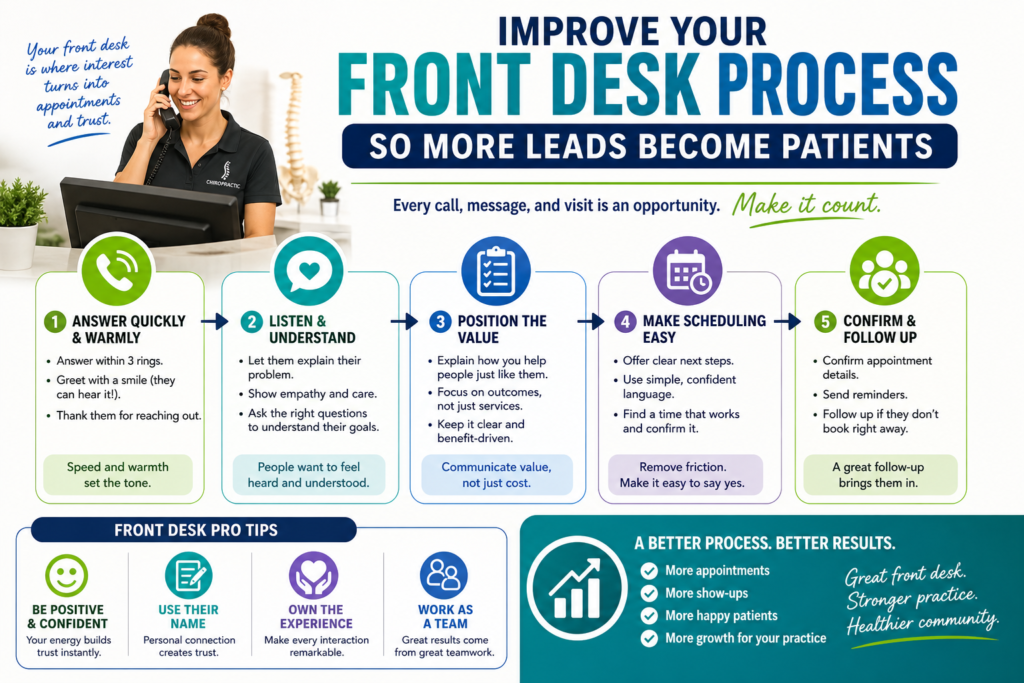
Your front desk is part of your marketing. The first call shapes the patient’s first real impression. A kind, clear, confident call can turn an unsure lead into a booked patient. A rushed or confusing call can send that person to another clinic.
Treat every call like a trust-building moment
A new patient calling your office may be in pain, worried, busy, or unsure. They may have never seen a chiropractor before. They may not know what to ask. They may be comparing several clinics. The way your team handles that call matters.
The call should feel warm and organized. The patient should hear that your practice can help them understand the problem, not just book a slot. Your team should ask enough to guide the person, but not so much that the call feels like an exam.
A strong call does three things. It makes the patient feel heard, explains the next step clearly, and makes scheduling easy.
Avoid sounding like an order taker
Some front desks handle calls like simple transactions. The patient asks about price, hours, or availability, and the team gives a short answer. That may be polite, but it is not enough.
If someone asks, “How much is a visit?” they may really be asking, “Will this be worth it?” If they ask, “Do you treat back pain?” they may really be asking, “Can I trust you with my problem?” If they ask, “Do you take insurance?” they may really be asking, “Can I afford this?”
Train your team to answer the question and guide the next step. For example, instead of only giving a price, they can say, “The first visit includes a consultation and exam so the doctor can understand what is causing the pain. Once we know what is going on, we can explain the best options clearly before you decide what to do next.”
That answer gives more confidence than a number alone.
Track missed calls and slow responses
Missed calls are one of the easiest ways for a practice to lose patients. Many people will not leave a voicemail. They will simply call the next clinic. If you are investing in marketing, missed calls can quietly waste that investment.
Track how many calls are missed each week. Track how fast voicemails are returned. Track how many website forms are answered within the first few minutes. Track how many calls become booked appointments.
These numbers do not need to be complicated. They just need to be visible.
Use call recordings for training, not blame
Call recordings can help your team improve, but they should be used with care. The goal is not to catch mistakes. The goal is to find patterns and coach better conversations.
Listen for common issues. Are callers asking the same questions? Are they confused about pricing? Are they nervous about the first visit? Are they asking about insurance? Are they calling after hours? Are they not booking because the next available appointment is too far away?
These insights can improve your website, ads, emails, and front desk scripts. If many callers ask the same thing, your marketing should answer it earlier. If many callers worry about the first visit, create a better first-visit page. If many ask about insurance, explain the process more clearly online.
The front desk is not separate from marketing. It is where marketing becomes revenue.
Use Patient Retention to Grow Without Always Chasing New Leads
New patients matter, but long-term growth also depends on retention. A practice that constantly needs new leads just to stay busy can become stressful and expensive. A practice that keeps strong relationships with patients has a more stable base.
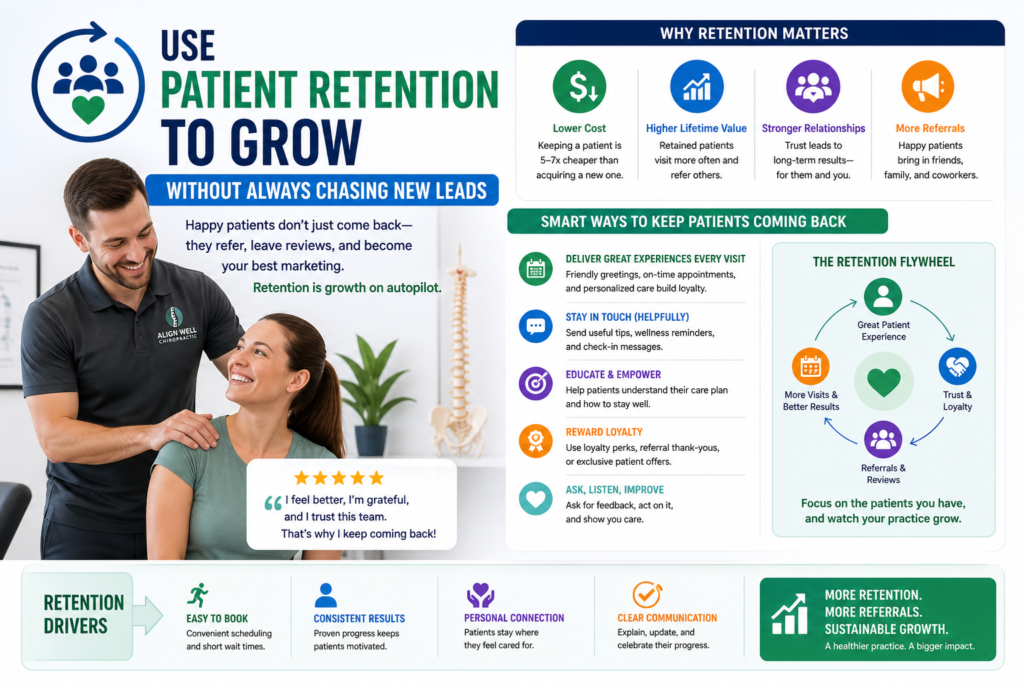
Retention does not mean pushing patients into care they do not need. It means staying helpful, clear, and connected so patients continue to value your practice over time.
Help patients understand their care plan
Patients are more likely to stay on track when they understand what is happening and why. Confusion causes drop-off. If a patient does not understand the plan, they may stop coming as soon as they feel a little better. Or they may feel unsure about the value of continued care.
Explain the care plan in simple words. Show what you found during the exam. Explain what the first phase of care is meant to do. Explain how you will measure progress. Explain what signs you want the patient to notice.
The patient should never feel like they are being asked to come back without a reason. They should feel like there is a clear plan and that they are part of it.
Set expectations before motivation fades
A patient may start care with high motivation because the pain is strong. But once the pain improves, motivation often drops. This is normal. Your job is to set expectations early so they understand the difference between feeling better and building better function.
Use simple language. You might explain that pain relief is often the first goal, but the body may still need time to improve movement, strength, or habits that caused the issue. Keep this honest and specific. Do not overpromise. Do not use fear. Just explain the path clearly.
When patients know what to expect, they are less likely to disappear halfway through care.
Keep past patients connected with useful education
A past patient may not need care every week, but they may still value your guidance. Staying in touch helps them remember you when a new issue appears or when a friend needs help.
Email is useful here. So are occasional texts, social posts, and seasonal reminders. The content should be simple and relevant. Talk about safe lifting during moving season, posture during school months, travel stiffness during holidays, or back strain from yard work.
This kind of content keeps your practice present without feeling pushy.
Make reactivation feel helpful, not sales-driven
Some patients stop coming because life gets busy. Others feel better and forget. Others mean to return but never schedule. A reactivation message can help, but it must be written with care.
Do not write like you are scolding them. Do not make them feel guilty. A better message might say, “We haven’t seen you in a while, and we hope you’re doing well. If the old issue is starting to return or you want to check in before it gets worse, we’re happy to help.”
That tone feels human. It respects the patient. It opens the door without pressure.
Retention grows when patients feel supported, not chased.
Use Your Brand to Make Your Practice Easier to Trust
A chiropractic brand is not just your logo, colors, or clinic name. Those things are part of it, but they are not the whole story. Your brand is the feeling people get when they see your practice online, talk to your team, read your reviews, visit your office, and explain your care to someone else.
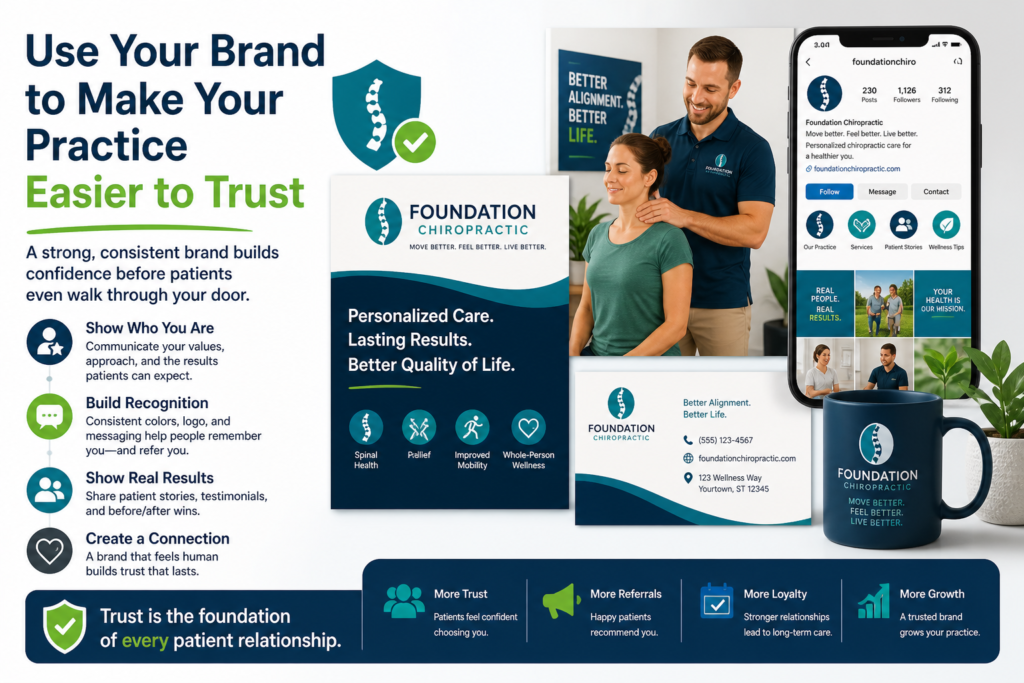
For a chiropractic practice, trust is the center of the brand. Patients are not buying a simple product. They are trusting you with their body, pain, movement, and health. That means your brand must make people feel safe before they even meet you.
Make your brand promise clear and simple
Your brand promise should tell patients what kind of experience they can expect. It should not be vague. Lines like “Live better” or “Feel your best” may sound nice, but they do not say enough. A stronger promise speaks to a real patient need.
For example, your practice might promise clear answers for people with recurring back pain. Or gentle chiropractic care for nervous first-time patients. Or practical care for busy families who need simple scheduling and honest guidance. Or movement-focused care for active adults who want to get back to life faster.
The exact promise depends on your practice. But it should be easy to understand, easy to believe, and easy to prove through your patient experience.
A clear brand promise also helps your team. Everyone knows what the practice stands for. The front desk knows how to speak to patients. The doctor knows what to explain during visits. Your website copy, emails, ads, and social posts all start to sound like they belong to the same practice.
Make your words match the patient’s fears
Many patients come to chiropractic care with quiet fears. They may worry that treatment will hurt. They may worry they will be pressured into a long plan. They may worry they will not be listened to. They may worry that the doctor will use hard terms they do not understand.
Your brand should answer these fears before patients have to ask.
If your practice is gentle, say that clearly and show it through patient stories. If you explain care plans in plain words, make that part of your message. If you do not pressure patients, let your website explain that your goal is to help them understand their options. If first visits are calm and simple, show that process step by step.
The best chiropractic brand is not built by trying to look bigger than you are. It is built by being clear, human, and consistent.
Keep your brand consistent across every touchpoint
Patients should not feel like they are dealing with a different practice at every step. Your website should match your Google profile. Your ads should match your landing pages. Your front desk tone should match your online message. Your office experience should match what your reviews promise.
When everything feels consistent, trust grows. When things feel scattered, doubt grows.
For example, if your website says you offer warm, patient-first care, but your phone call feels rushed, the brand breaks. If your ads promise clear answers, but your first visit feels confusing, the brand breaks. If your social media feels friendly, but your clinic photos are cold and outdated, the brand feels uneven.
Consistency does not mean everything has to be perfect. It means the patient keeps getting the same core feeling at every step.
Create a simple voice guide for your team
A voice guide helps your practice sound the same everywhere. It does not need to be long. It can be a simple internal note that explains how your practice talks to patients.
You may decide your voice should be calm, clear, friendly, and honest. You may decide you avoid fear-based language. You may decide you explain care in plain words. You may decide you do not make big promises or use pressure. You may decide every message should help the patient understand the next step.
This guide can shape your website copy, social media posts, emails, review replies, call scripts, and in-office language.
When your words are consistent, patients feel like they know you. And when patients feel like they know you, it becomes easier for them to trust you.
Use Offers Carefully So They Attract the Right Patients
Offers can bring attention to a chiropractic practice, but they can also create problems if they are used without strategy. A low-price offer may bring many calls, but not all of those callers will be a good fit. Some may only want the discount. Some may not value care. Some may not show up. Some may leave as soon as the offer ends.
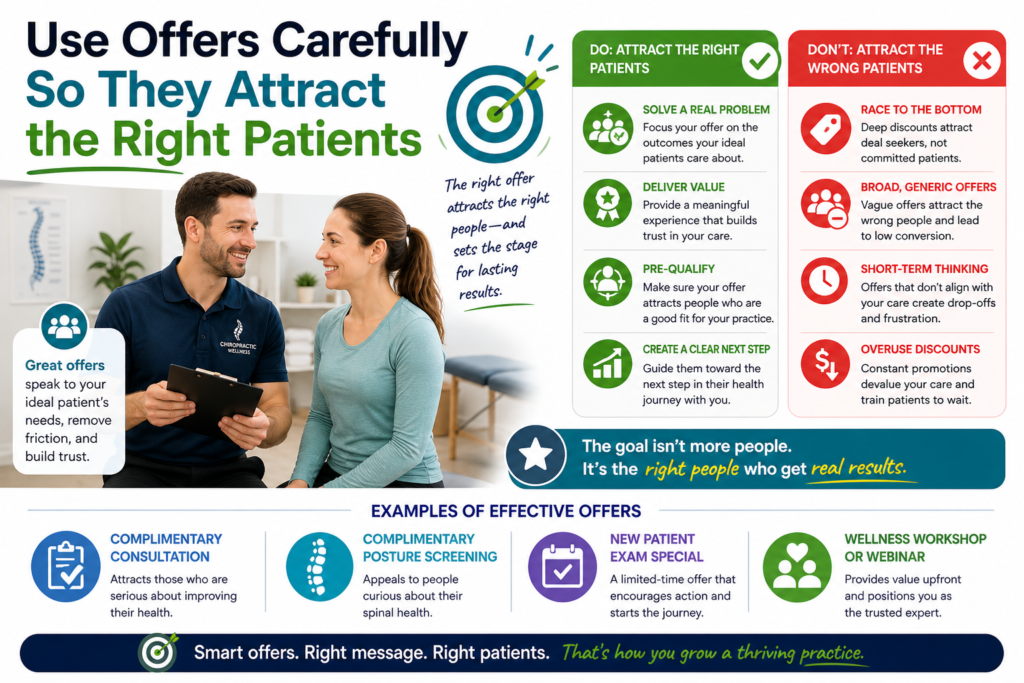
That does not mean offers are bad. It means they need to be designed with care. The best offers reduce fear and make the first step easier without cheapening the practice.
Make the first step feel safe, not cheap
A strong offer should help patients overcome hesitation. Many people delay care because they are unsure what is causing the pain, what the visit will include, how much it will cost, or whether chiropractic care is right for them.
An offer can answer that fear.
For example, instead of promoting a bargain adjustment, you might promote a clear first-visit consultation and exam. The message is not “cheap care.” The message is “get answers.” This attracts a better patient because it focuses on understanding the problem, not just getting a deal.
The way you frame the offer matters. A patient looking for the cheapest visit is different from a patient looking for clarity. Your marketing should attract the second kind.
Avoid offers that train people to wait for discounts
Some practices run constant discounts. Over time, this can hurt the brand. Patients begin to see the clinic as a deal provider instead of a trusted healthcare practice. It can also create pressure on your team because the practice needs more volume to make the same revenue.
Use offers as a door opener, not as your whole strategy. The value should come from the experience, the exam, the explanation, the plan, and the trust you build.
If you use a special offer, make sure the rest of the journey is strong. The landing page should explain the visit. The front desk should set expectations. The doctor should provide clear value. The follow-up should help the patient understand the next step.
The offer may bring them in, but trust keeps them there.
Match offers to patient intent
Different patients need different offers because they are at different stages. Someone in strong pain may want fast scheduling. Someone who is unsure may want a low-risk consultation. Someone who has visited before may respond to a check-in visit. Someone from a local employer may value a workplace posture screening.
Do not use the same offer for every channel.
A Google search ad may work best with a direct appointment message because the person is actively looking for care. A Facebook ad may work better with an educational angle because the person was not searching.
A past patient email may work better with a gentle reactivation message. A local workshop may work better with a free assessment or simple next-step invitation.
When the offer matches the moment, it feels natural.
Measure patient quality, not just offer response
A weak offer can look successful at first because it brings many leads. But if those leads do not show up, do not follow care plans, do not return, or do not refer others, the offer may not be healthy for the practice.
Track what happens after the lead comes in. Look at show-up rate, booked appointment rate, care plan acceptance, patient lifetime value, and retention. Also pay attention to how the team feels. If an offer brings difficult, low-trust conversations all day, it may not be the right fit.
The best offer is not the one that gets the most clicks. It is the one that brings the right patients and starts the relationship in a healthy way.
Use Analytics to Find Where Growth Is Leaking
Marketing becomes much easier when you can see what is working. Without tracking, every decision feels like a guess. You may think your ads are working because the phone rings more. You may think SEO is working because website traffic is up. You may think social media is working because posts get likes.
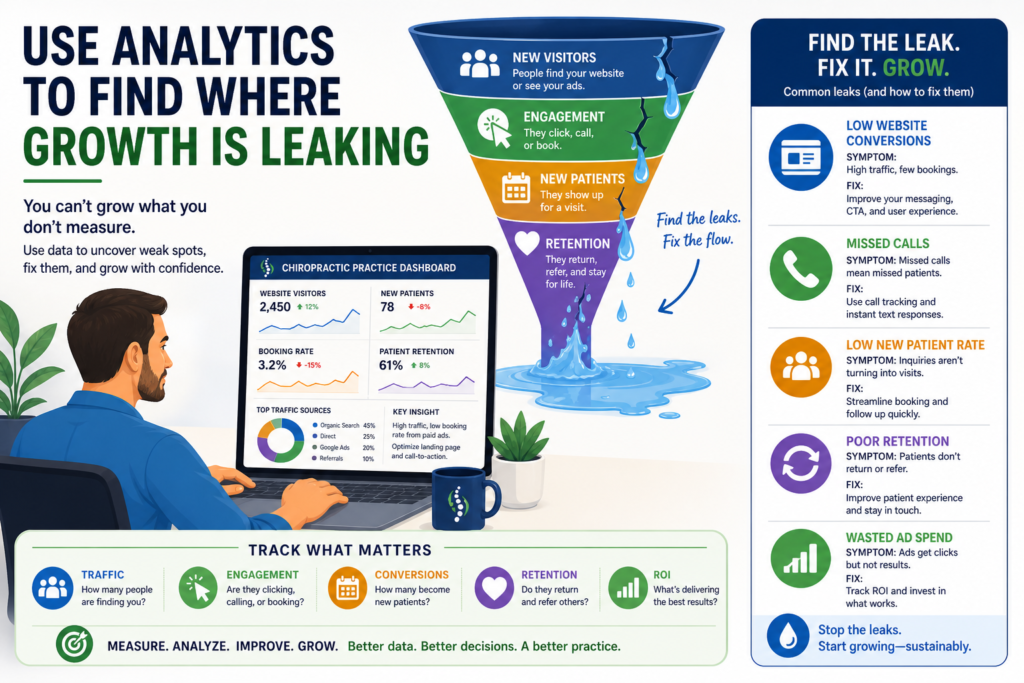
But real growth comes from knowing which actions lead to booked appointments, kept visits, and long-term patients.
Track the numbers that connect to revenue
You do not need a complex dashboard to make better marketing decisions. Start with a few simple numbers that show the health of your growth system.
Track website visits, calls, form fills, online bookings, booked new patient appointments, show-up rate, source of new patients, and review growth. If you run ads, track cost per lead and cost per booked appointment. If you do SEO, track which pages bring calls and bookings. If you use email, track replies and reactivation appointments.
The point is not to stare at numbers all day. The point is to spot problems early.
If traffic is high but bookings are low, your website may not be clear enough. If calls are high but appointments are low, the front desk process may need work. If appointments are booked but patients do not show up, your confirmation process may be weak.
If patients come once and disappear, the first visit or care plan explanation may need improvement.
Look for the weakest link in the patient journey
Growth is usually limited by the weakest step in the journey. Many practices try to add more traffic when the real problem is conversion. Others try to run more ads when the phone process is leaking leads. Others push for more reviews when the website still does not explain care clearly.
Think of your marketing as a chain. A patient searches, finds you, reads your profile, visits your website, calls or books, shows up, accepts care, returns, leaves a review, and refers others. If one part of that chain is weak, growth slows.
Your job is to find the weak link and fix it before spending more money.
This is why analytics matter. They show you where attention is needed. They help you stop guessing. They make marketing feel less emotional and more practical.
Review results every month with your team
Marketing review should be a monthly habit. It does not need to be long. Sit down with your numbers and ask what improved, what dropped, and what needs attention.
Look at which channels brought new patients. Look at which pages got traffic. Look at which ads created booked visits. Look at which reviews mentioned the strongest parts of your practice. Look at which calls did not become appointments. Look at which patient questions came up again and again.
These meetings help connect marketing with real clinic life.
Turn patient questions into marketing fixes
Your patients are always telling you what your marketing should explain better. If new callers keep asking whether chiropractic care is safe, your website needs a better first-visit and safety explanation.
If patients keep asking how long care takes, your care plan content needs improvement. If people keep asking whether you treat headaches, you need a stronger headache page.
Do not treat repeated questions as interruptions. Treat them as clues.
Each common question is a chance to improve your website, ads, email, social media, and front desk script. When you answer common questions earlier, patients feel more informed before they call. That makes the whole process smoother.
Good analytics are not just numbers. They are also patterns in human behavior.
Build a Patient Journey That Feels Smooth From Search to Visit
A strong chiropractic marketing system is not made from one great ad or one good blog post. It is built from the full journey. Every step should make the patient feel more confident, not more confused.
Most patients do not book because of one single thing. They book because several trust signals line up. They see strong reviews. They like your website. They understand your services. Your photos feel real. Your message speaks to their pain. Your booking process is easy. Your team sounds kind on the phone.
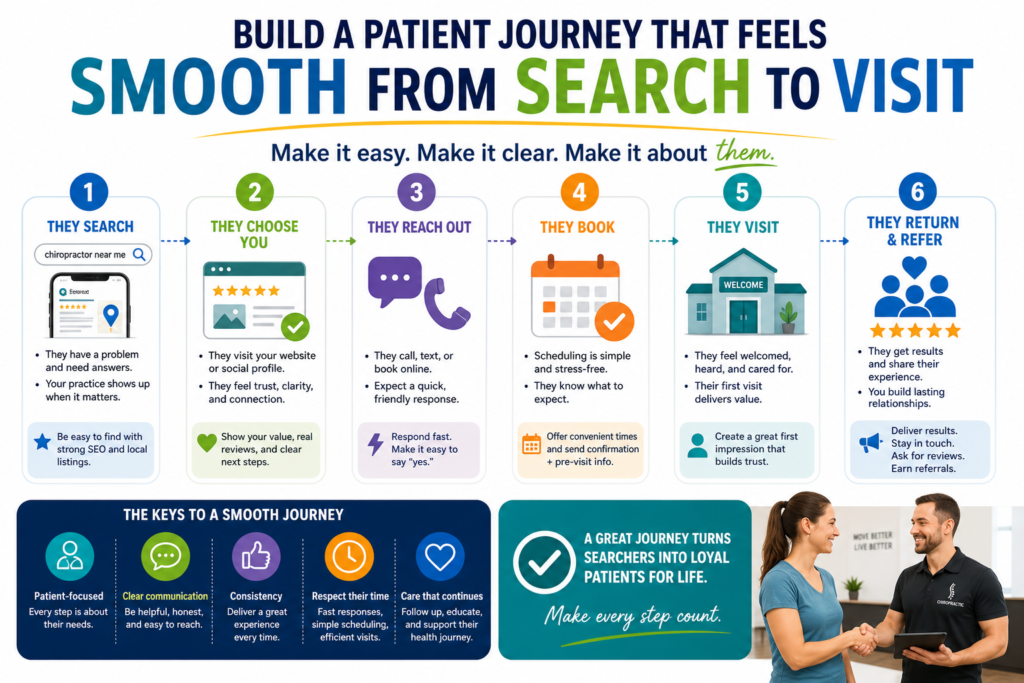
When these pieces work together, growth feels smoother.
Remove friction from every step
Friction is anything that makes the patient pause, doubt, delay, or leave. A slow website creates friction. A hidden phone number creates friction. A confusing service page creates friction. A long form creates friction. A cold first call creates friction. A lack of pricing guidance creates friction. Poor parking details can even create friction.
Patients in pain do not want extra work. They want clarity.
Walk through your journey like a new patient. Search for your clinic on Google. Look at your profile. Click your website. Read your homepage. Try to book. Call the office. Visit the first-visit page. Look at your reviews. Ask yourself where a patient may feel unsure.
You may find simple fixes that improve results quickly.
Make the booking path obvious
Every main page should make the next step clear. A patient should not have to scroll forever to find your phone number. They should not wonder which form to fill out. They should not have to click through five pages to book.
Use clear calls to action in natural places. Put your phone number and booking button where people can see them. On mobile, make calling easy. Most local healthcare searches happen when people are busy, distracted, or in discomfort. A simple mobile experience matters.
The booking path should feel like a straight road, not a maze.
Connect your online promise to the in-office experience
Marketing creates expectations. The clinic experience must fulfill them. If your marketing promises clear answers, the doctor should explain findings in a clear way. If your marketing promises a calm first visit, the office should feel calm. If your marketing promises family-friendly care, the experience should support busy parents.
This is where many practices miss the point. They think marketing ends when the patient books. But the patient is still judging. They are asking, often silently, “Did I make the right choice?”
Your in-office experience should confirm that they did.
Use the first visit to strengthen trust
The first visit is one of the most important marketing moments in the whole practice. It can turn a nervous new patient into a loyal patient. It can also turn a booked appointment into a one-time visit.
During the first visit, explain what you are doing and why. Use plain words. Give the patient time to ask questions. Avoid rushing into a plan before they feel heard. Show them the path forward without pressure. Make sure they leave knowing what happened, what it means, and what comes next.
A strong first visit does more than start care. It creates the kind of confidence that leads to retention, reviews, and referrals.
Create a Long-Term Marketing Plan Instead of Chasing Random Tactics
Many chiropractic practices do marketing in bursts. They run ads when the schedule gets slow. They post on social media when someone remembers. They ask for reviews after noticing a competitor has more. They update the website only when it feels outdated.
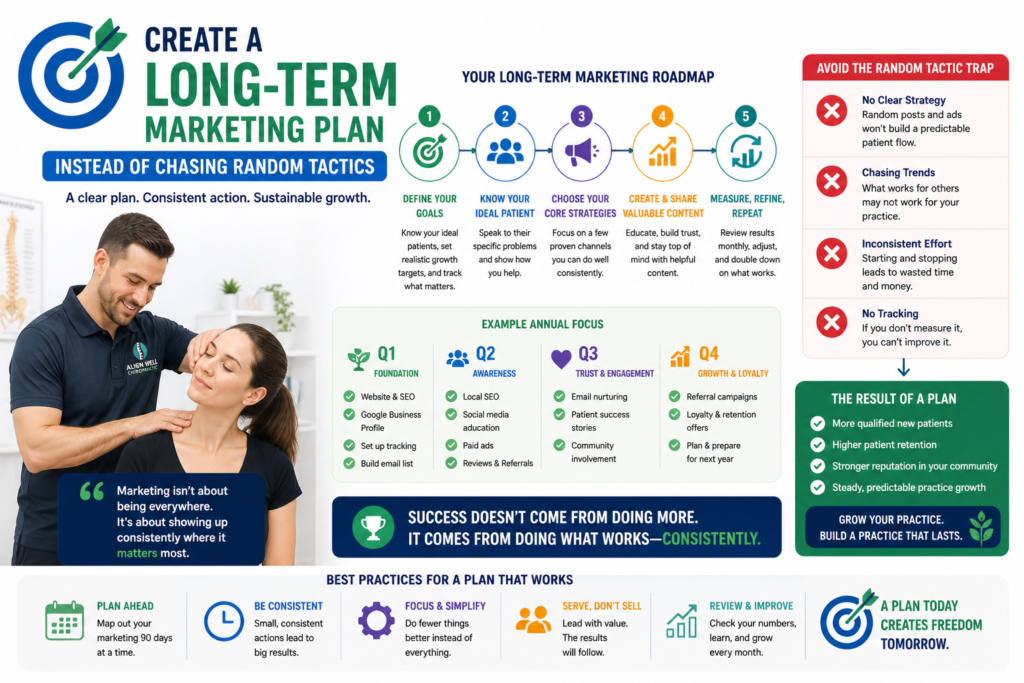
This creates stress because growth becomes reactive. A better approach is to build a long-term marketing plan that works even when the clinic is busy.
Choose a few core channels and do them well
You do not need to be everywhere. In fact, trying to do everything often leads to weak execution. A chiropractic practice usually grows best by focusing on a few strong channels first.
Local SEO should be a core channel because patients search nearby. Reviews should be a core channel because trust matters. Website conversion should be a core channel because every other channel sends people there. Content should support SEO and patient education. Paid ads can be added when the basics are strong and tracking is in place.
Social media can help build familiarity, but it should not replace search and reviews. Email and text follow-up can support retention and reactivation. Local partnerships can add trust in the community.
The mix may change by market, but the principle stays the same. Do fewer things with more care.
Build a simple monthly marketing rhythm
A monthly rhythm keeps marketing from becoming random. You might update your Google profile, request reviews, publish one strong blog post, record a few short videos, review call tracking, send one patient email, and check your ad results. This kind of rhythm is simple, but it compounds over time.
The goal is not to create noise. The goal is to keep improving the system.
One month, you may improve your lower back pain page. Another month, you may build a first-visit page. Another month, you may create a review request process. Another month, you may train the front desk. Each improvement makes the practice stronger.
Small, steady action beats random bursts.
Plan campaigns around patient seasons
Chiropractic needs often follow patterns. People may deal with back pain during yard work season, travel stiffness during holidays, sports injuries during school seasons, posture issues during busy work periods, and wellness goals at the start of the year.
Use these patterns to plan campaigns ahead of time.
A spring campaign might focus on safe lifting and yard work pain. A back-to-school campaign might focus on backpacks, student athletes, and parent routines. A holiday campaign might focus on travel stiffness and stress tension. A workplace campaign might focus on desk posture and neck pain.
Planning ahead makes your marketing feel timely instead of rushed.
Keep your message tied to real patient life
The strongest campaigns connect care to daily life. Patients may not wake up thinking about spinal health, but they do think about missing work, struggling to sleep, feeling stiff after driving, avoiding workouts, or not being able to pick up their child comfortably.
Talk about those real moments.
When your marketing connects to real life, it feels more human. It does not sound like a clinic shouting about services. It sounds like a practice that understands what pain interrupts and wants to help patients get back to normal life.
That is the kind of marketing people respond to.
Use Video to Explain Care Before Patients Walk In
Video is one of the fastest ways to make your chiropractic practice feel familiar. A patient can read your website and still feel unsure. But when they see the doctor speaking in a calm and simple way, trust can build faster.
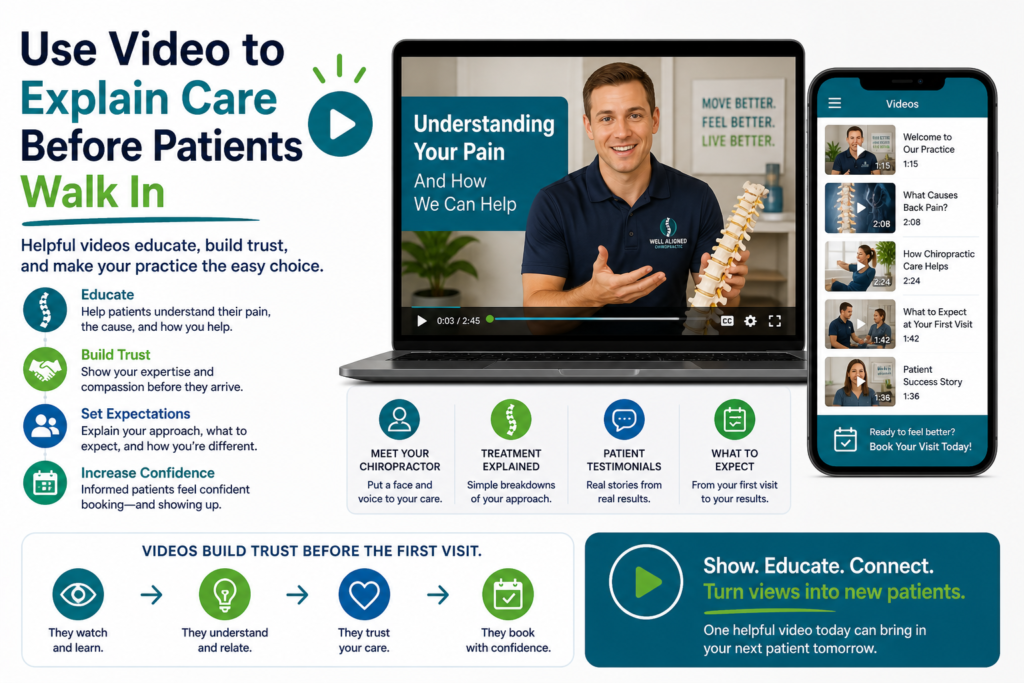
This does not mean you need a big camera setup or a studio. In most cases, a clear phone video with good lighting and clean sound is enough. Patients are not looking for a movie. They are looking for a real person who can explain their pain and help them feel safe.
Make videos that answer one patient question at a time
The best chiropractic videos are focused. They do not try to explain everything in one clip. They answer one question clearly.
You might record a short video about why lower back pain can get worse after sitting. Another video can explain what happens during a first visit. Another can talk about neck tightness from phone use. Another can explain why headaches may be linked to tension in the neck and shoulders.
Each video should feel like a quick, helpful answer from the doctor. Start with the problem, explain it in plain words, and then guide the viewer toward the next step if the issue keeps coming back.
Keep the tone calm, not dramatic
Avoid fear-based videos. Do not tell people their pain will become terrible if they do not act right away. That may get attention, but it can hurt trust.
A better tone is calm and practical. You can say, “If this pain keeps coming back, it is worth getting checked so you can understand what is causing it.” That feels helpful. It gives the patient a reason to act without making them feel scared.
Patients want honesty. They want confidence. They want clear advice. A simple, steady tone can make your practice feel more trustworthy than a loud or dramatic message.
Place videos where they support action
Do not only post videos on social media and hope people see them. Use videos across your full marketing system. Put a first-visit video on your first-visit page. Put a back pain video on your lower back pain page. Put a doctor introduction video on your homepage. Put short clips in emails and ads.
This helps patients at the exact moment they are deciding what to do next.
A person reading your neck pain page may still feel unsure. A short video from the doctor explaining how your clinic looks at neck pain can reduce that doubt. A person who booked a first visit may feel nervous. A short welcome video can make the visit feel easier.
Use video to support your team
Videos can also save time for your front desk and doctor. If patients often ask the same questions, make videos that answer them. Then your team can send those videos before or after the first visit.
For example, if many patients ask what to expect at the first appointment, send a short video after booking. If many ask how long care takes, create a video that explains how care plans are based on the exam and the patient’s goals.
If many ask whether chiropractic care is only for pain, create a video that explains how your practice thinks about movement and daily function.
This makes your marketing more useful and your patient experience smoother.
Build Service Pages That Sell Without Sounding Salesy
Your service pages are some of the most important pages on your website. These are the pages patients read when they are close to making a decision. They want to know if you treat their problem, if you understand what they are feeling, and if your clinic is the right choice.
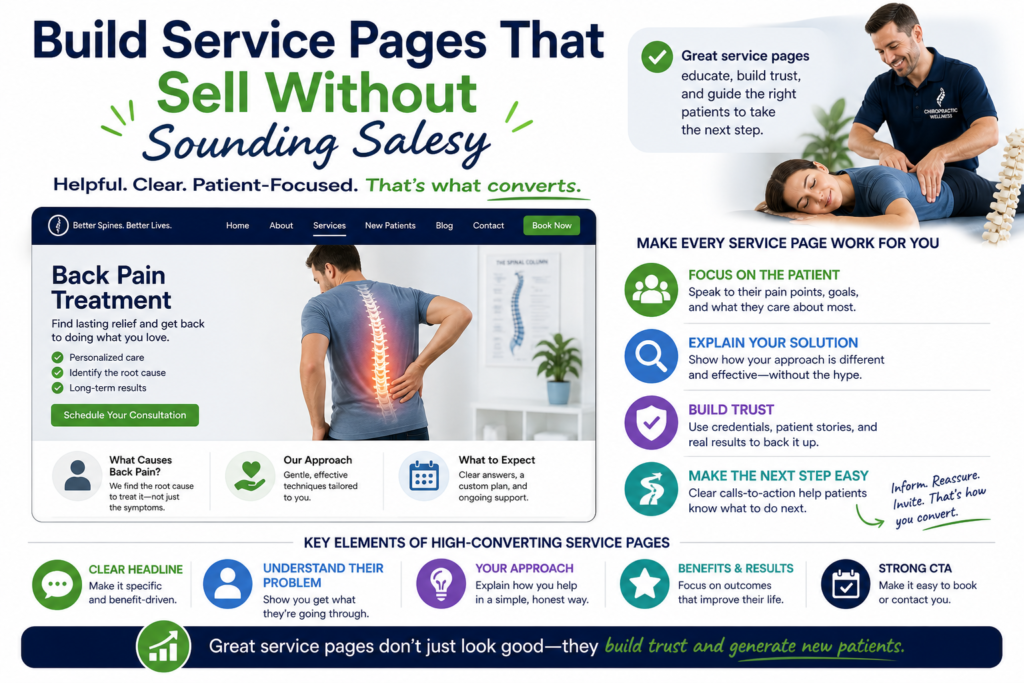
A weak service page talks mostly about the service. A strong service page talks about the patient’s problem and then shows how your care can help them take the next step.
Start with what the patient feels
A page about lower back pain should not begin with a long clinical explanation. It should begin with the patient’s real experience. Maybe the pain gets worse when they sit. Maybe they feel stiff in the morning. Maybe they avoid lifting things. Maybe the pain keeps returning even after rest.
When the first few lines sound like the patient’s life, they keep reading. They feel seen. They feel like the page was written for them, not for search engines.
After that, you can explain possible causes in simple words. You can talk about posture, movement habits, muscle tension, joint stress, old injuries, or daily strain. Keep it easy to understand. The goal is not to diagnose them through the page. The goal is to help them understand why getting checked may be useful.
Show your process, not just your promise
Patients are careful because they do not want empty promises. Do not just say, “We can help with back pain.” Show how you approach it.
Explain that your clinic starts with a conversation, looks at how the patient moves, checks the area of concern, reviews their history, and then explains what may be going on. Explain that the care plan is based on the exam and the patient’s goals.
This makes your page feel more believable. It also lowers fear because the patient knows what happens next.
The more clearly you explain your process, the less the patient has to guess.
Include proof in a natural way
Proof helps patients trust you, but it should not feel forced. Reviews, patient stories, years in practice, local trust, photos, and clear explanations all support belief.
Use reviews that match the page topic when possible. If the page is about headaches, show a review from a patient who mentions headaches or neck tension, as long as it is shared in a privacy-safe way. If the page is about sports injuries, use proof that shows your work with active patients.
The point is to make the patient think, “People like me have been helped here.”
End with a clear and gentle call to action
The end of a service page should not feel abrupt. After you have explained the problem, your approach, and the first visit, guide the patient toward action.
A good ending might say that if the pain is affecting work, sleep, movement, or daily life, the next step is to schedule a visit and get a clearer understanding of what is going on. This is simple and direct.
Avoid pressure. Avoid big claims. Avoid making the patient feel foolish for waiting. Good chiropractic copy should feel like a helpful hand on the shoulder. It should give the patient confidence to move forward.
Make Your Practice More Visible in the Community
Local trust matters a lot in chiropractic marketing. People often choose a practice because they have seen the name before, heard someone talk about it, or noticed it involved in the community. Visibility builds comfort.
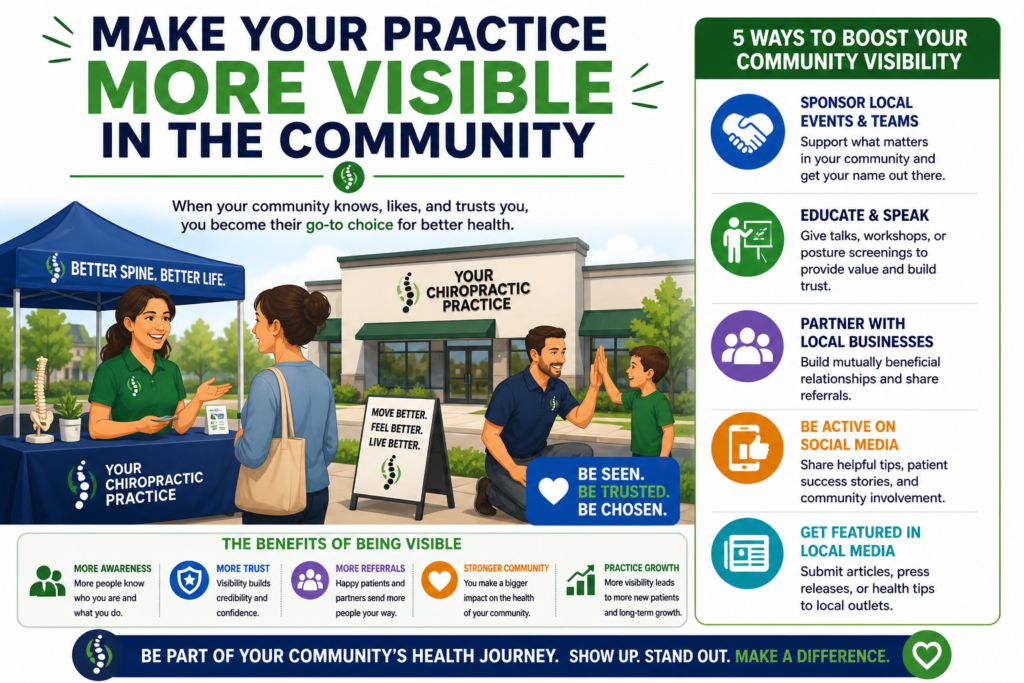
Community marketing does not need to be expensive. It needs to be consistent and real. Your goal is to become known as a helpful local health resource, not just another clinic asking for appointments.
Show up where your best patients already are
Think about the people you want to serve most. Then ask where they spend time locally. Busy parents may be at school events, youth sports, family fairs, and local Facebook groups. Active adults may be at gyms, races, fitness studios, and wellness events.
Office workers may be reached through local employers, coworking spaces, lunch-and-learn events, and business groups.
You do not need to attend every event. Choose the ones that match your practice and your message.
When you show up, do not make the conversation only about booking visits. Teach something useful. Offer simple advice. Answer questions. Be easy to talk to. People remember the professional who helped them understand something, not the one who only handed out a card.
Make local education part of your brand
Education can make your practice more visible without feeling pushy. You can teach short sessions about desk posture, safe lifting, sports recovery, back pain during pregnancy, or how to reduce stiffness during travel.
These topics work because they connect to real life. They are not vague health talks. They solve daily problems.
After each session, give people a simple way to learn more. That might be a website page, a first-visit guide, or an invitation to call if pain keeps returning. Keep the next step clear, but do not make the event feel like a sales pitch.
Use local stories in your marketing
Your practice does not exist in a vacuum. It is part of a real town, city, neighborhood, or region. Your marketing should reflect that.
Talk about local events your team supports. Share photos from community activities. Mention local partnerships. Create content around local needs, such as back pain from long commutes, sports injuries in local school seasons, or posture strain among office workers in your area.
This makes your brand feel rooted. Patients like knowing they are choosing a practice that understands their community.
Keep community marketing connected to your main strategy
Community work should not be random. It should support your larger position. If your practice focuses on active families, choose events and content that speak to families and movement. If your practice focuses on office workers, build relationships with local employers and business groups.
If your practice focuses on athletes, connect with gyms, coaches, races, and sports groups.
This keeps your efforts focused. It also helps people remember what you are known for.
A clear local reputation is stronger than broad awareness. It is better for the right people to know exactly why they should choose you than for many people to vaguely recognize your name.
Conclusion
Growing a chiropractic practice takes more than ads, posts, or a good website. It takes a clear system built around trust. Patients want simple answers, easy booking, real proof, and care that feels personal. When your website, reviews, local SEO, content, follow-up, referrals, and front desk all work together, growth becomes more steady and less stressful.
The goal is not to sound louder than every other clinic. The goal is to be clearer, more helpful, and easier to choose. Keep improving small parts of the patient journey, and your practice will grow with more trust and consistency.


















Comments are closed.