
WinSavvy Editorial Standards
How this article was created
Marketing Medicare plans is not like marketing a normal product. You are not selling shoes, software, or a meal plan. You are helping older adults make choices that can shape their health, costs, doctors, medicines, and peace of mind for the next year.
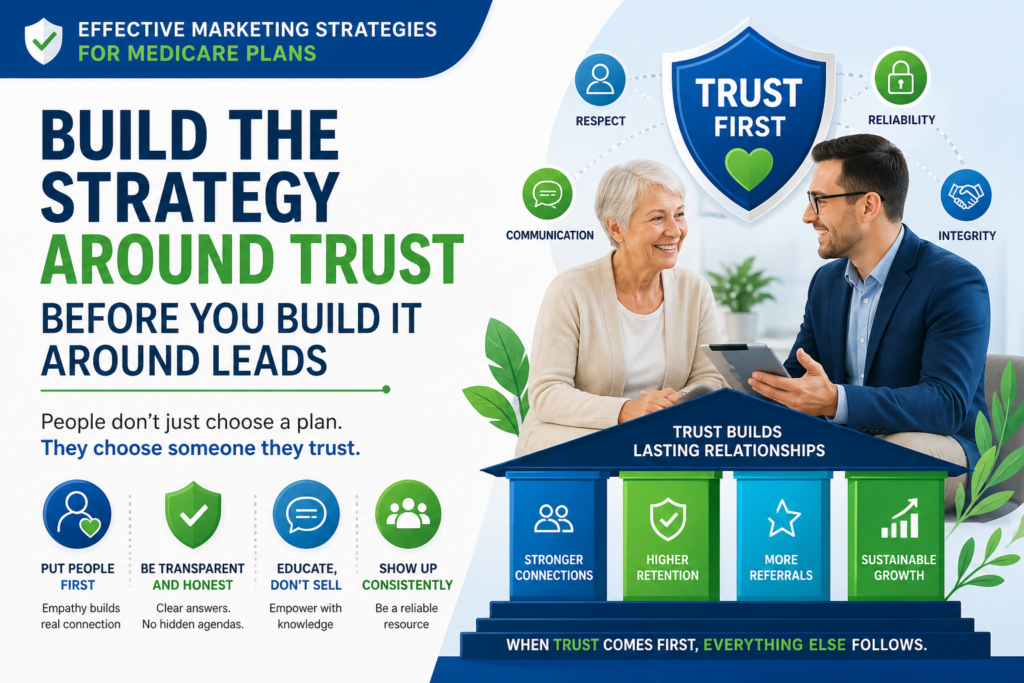
Build the Strategy Around Trust Before You Build It Around Leads
Medicare marketing works best when it starts with one simple truth: people do not want to be “sold” a Medicare plan. They want to feel sure that they are not making a costly mistake.
That changes the whole job of marketing.
Your first goal is not to collect a phone number. Your first goal is to reduce fear. If someone feels confused, rushed, or unsure, they will either delay the decision or choose the company that feels safest. This is why trust must come before every lead form, ad, landing page, email, and call script.
Many Medicare marketers treat trust like something that happens at the end of the funnel. They believe a person sees an ad, fills out a form, talks to an agent, and then trust is built during the call. That is too late. Trust begins the first time someone sees your brand, your words, your website, or your promise.
When your message sounds clear, calm, and useful, people stay. When it sounds pushy, vague, or too good to be true, people leave.
Your Marketing Should Feel Like Guidance, Not Pressure
A strong Medicare marketing strategy should make the person feel guided from the very first touch. This means your content should explain choices in simple words. Your ads should avoid hype. Your landing pages should tell people what will happen next.
Your forms should not ask for more information than needed. Your agents should continue the same tone that your marketing started.
The biggest mistake is creating a sharp gap between marketing and sales. If the ad says, “Compare plans in your area,” but the call feels like a hard sell, the trust breaks. If the landing page says, “Speak with a licensed Medicare advisor,” but the person receives multiple confusing calls, the trust breaks again.
A better strategy is to make every step feel connected. The ad should set a clear promise. The landing page should explain that promise. The form should make the next step simple. The follow-up should match the person’s concern. The agent should act like an advisor, not a closer.
Trust Grows When People Know What To Expect
People are more likely to respond when they know what will happen after they take action. This is especially true in Medicare, where many seniors are cautious about scams, spam calls, and hidden costs.
So your website and landing pages should say what happens after someone submits a form. Explain that a licensed agent may call. Explain what information they may need. Explain that the person is not required to enroll. Explain that the goal is to compare plan options based on location, doctors, medicines, budget, and benefits.
This kind of plain explanation may seem small, but it lowers resistance. It tells the visitor, “You are in control.” That feeling matters.
When people feel in control, they listen longer. When they listen longer, they understand more. When they understand more, they are far more likely to choose with confidence.
Know the Real Audience Behind the Medicare Search
The Medicare audience is not one single group. That is where many campaigns go wrong. A 64-year-old turning 65 is not thinking the same way as a 72-year-old who is unhappy with a current plan.
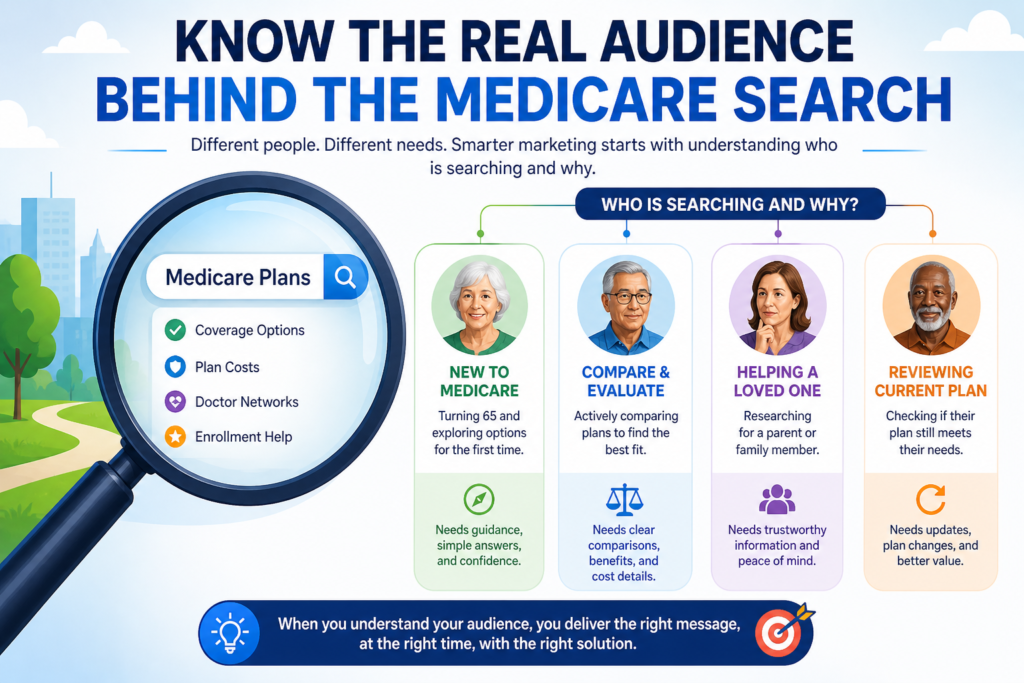
A caregiver helping a parent is not searching with the same emotion as a retired couple comparing drug costs. A person with a fixed income may care most about monthly costs, while someone with several doctors may care most about network access.
If your marketing speaks to all of them in the same way, it will feel flat.
Good Medicare marketing starts by understanding the reason behind the search. Someone who types “best Medicare Advantage plan near me” may be ready to compare. Someone who searches “does Medicare cover dental” may still be learning.
Someone searching “can I change Medicare plans after open enrollment” may be worried and needs a careful answer.
Each person needs a different message.
Segment by Situation, Not Just Age
Age is useful, but it is not enough. Most Medicare marketers already know the audience is older adults, but that does not create a strong strategy. You need to segment by life moment.
One group is approaching Medicare for the first time. They need simple education. They may not understand the difference between Original Medicare, Medicare Advantage, Part D, and Medigap. They need calm explanations and step-by-step content.
Another group is already enrolled but unhappy. They may be dealing with higher drug costs, a doctor leaving the network, surprise copays, or a plan that no longer fits. They need comparison content and clear guidance on when changes are allowed.
A third group is made up of caregivers. These people may be adult children helping a parent make a decision. They want clarity, safety, and proof. They may be less moved by benefit language and more moved by trust signals, reviews, plain explanations, and easy scheduling.
The Best Message Matches the Person’s Worry
Every Medicare campaign should be built around the worry behind the decision. For a new enrollee, the worry may be, “I do not know where to start.” For someone comparing plans, it may be, “I do not want to lose my doctor.”
For someone looking at drug coverage, it may be, “I cannot afford my medicine.” For a caregiver, it may be, “I need to help my parent without choosing the wrong plan.”
When your content names the worry clearly, people feel seen. They do not feel like they are reading generic insurance copy. They feel like the page understands their problem.
That is why the best Medicare pages often use simple, direct lines. They do not try to sound clever. They explain. They reassure. They show the next step. They make the person feel less alone in the decision.
Turn Medicare SEO Into a Year-Round Education System
SEO is one of the strongest channels for Medicare plan marketing because people search when they have real questions. They do not wake up wanting to speak with an insurance agent. They wake up wondering if their doctor is covered, if dental is included, if their medicine will cost less, or if they can change plans this year.
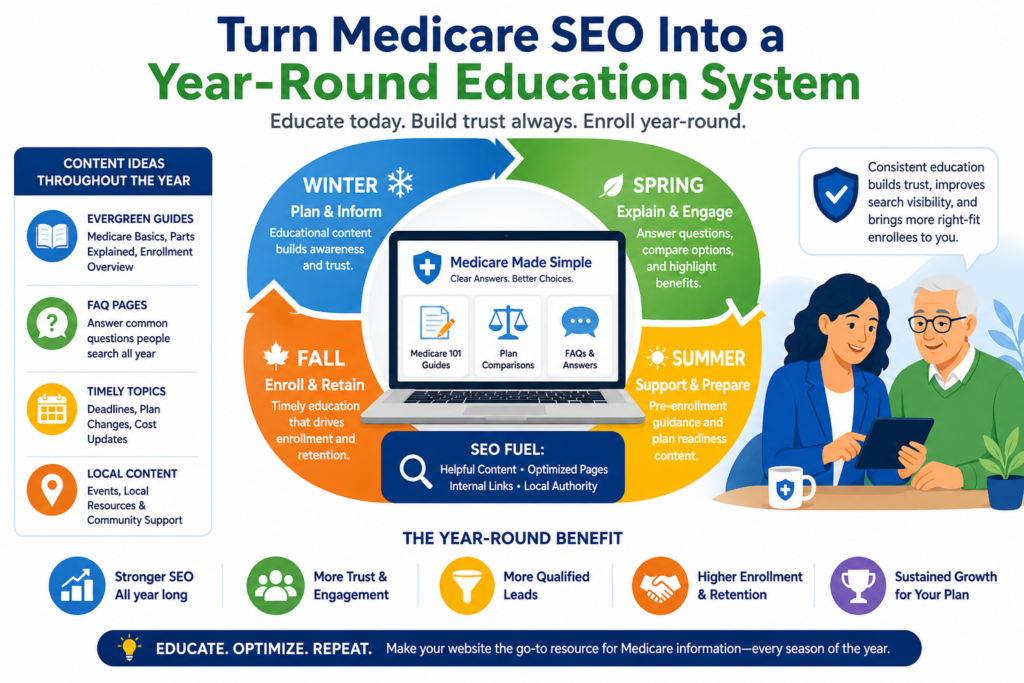
That is why Medicare SEO should not be treated like a small set of sales pages. It should be built like a complete education system.
A good SEO plan helps people at every stage. It answers beginner questions, local comparison questions, plan-type questions, enrollment questions, drug coverage questions, cost questions, and caregiver questions. Over time, this builds topical authority. More importantly, it builds trust before the person ever speaks to your team.
Create Content for the Full Medicare Journey
A strong Medicare SEO strategy needs more than “Medicare Advantage plans in [city]” pages. Those pages matter, but they are only one part of the journey.
You also need content for people who are still learning. These may include plain-language guides on how Medicare works, what changes at age 65, how Medicare Advantage differs from Original Medicare, how Part D works, what annual enrollment means, and how to review a plan before switching.
Then you need comparison content. This type of content helps people understand tradeoffs. It might explain how to compare premiums, copays, provider networks, drug coverage, dental benefits, vision benefits, hearing benefits, and out-of-pocket limits.
Finally, you need action-focused content. This helps people who are close to making a decision. It should explain how to speak with a licensed agent, what information to prepare, how to check doctors and drugs, and how to avoid rushing into a plan that does not fit.
Local SEO Should Answer Local Medicare Questions
Medicare is national, but plan choice is local. This makes local SEO very important. People want to know which plans are available in their county, whether nearby doctors accept a plan, and what options exist in their service area.
Your local pages should not be thin pages with only a city name changed. That kind of content does not build trust and often does not perform well. A useful local Medicare page should explain the local decision clearly.
It should talk about the area, the need to check plan availability by ZIP code, the importance of doctor networks, and the value of reviewing prescriptions before choosing a plan.
The goal is not to pretend that one page can list every perfect answer. The goal is to help the visitor understand what must be checked before choosing. That makes the page useful, honest, and more likely to convert.
Write Landing Pages That Calm People Down and Move Them Forward
A Medicare landing page has one main job. It should help a visitor feel safe enough to take the next step.
Many landing pages fail because they try to do too much too fast. They load the page with benefit claims, stock photos, badges, long forms, and urgent language. The visitor feels pressure instead of clarity. In Medicare marketing, that can hurt performance because the decision feels serious.
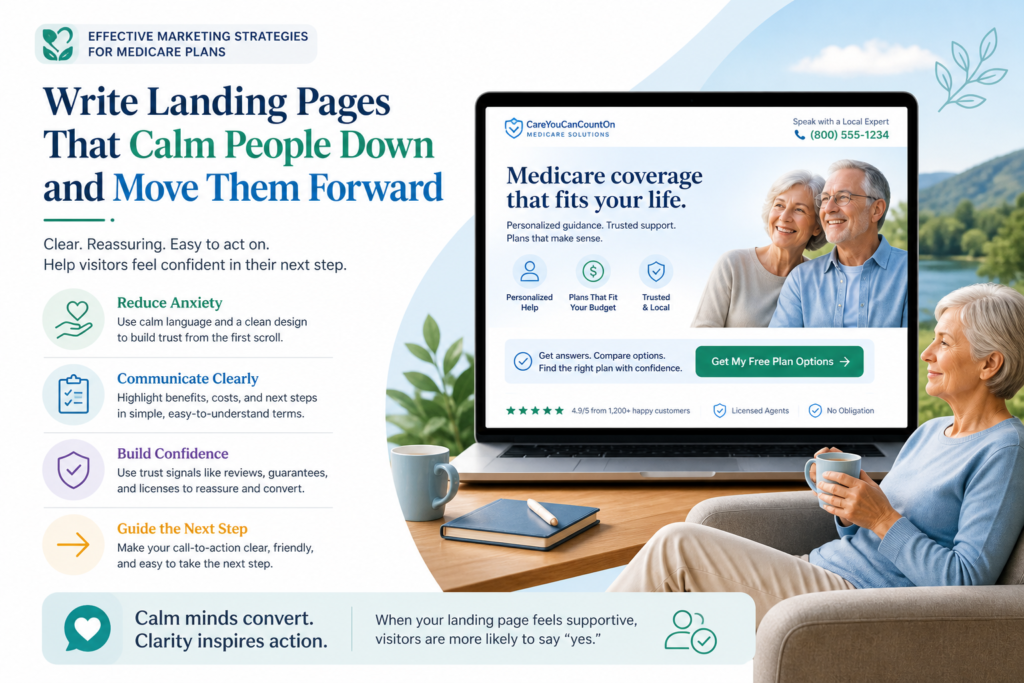
The best landing pages are calm, clear, and focused. They explain who the page is for, what the person can do there, what happens next, and why the company can be trusted.
The Page Should Open With a Clear Human Promise
The top of the page should not sound like an ad shouting across the room. It should sound like a helpful guide.
Instead of vague claims like “Get the best Medicare plan today,” the message should be more careful. A stronger opening would explain that the visitor can compare Medicare plan options available in their area and speak with a licensed advisor who can help review doctors, prescriptions, costs, and benefits.
That kind of message works because it feels specific. It does not promise that one plan is best for everyone. It tells the visitor what they can compare and how the process helps them.
Your landing page should also avoid making the form feel like a trap. Before asking for contact details, explain the value of the next step. Tell people they can ask questions. Tell them they can review options. Tell them they are not forced to enroll just because they request help.
The Form Should Feel Easy, Not Demanding
Every extra field can lower trust. This does not mean every Medicare form must be extremely short, but it does mean every field must feel necessary.
Ask only for what is needed to start the process. Name, ZIP code, phone number, and basic plan interest may be enough for many campaigns. If you ask for too much too soon, the person may wonder why you need it. That doubt can stop the conversion.
The page should also support people who are not ready to call. Some visitors may want to read more first. Some may want to schedule a time. Some may be helping a parent and need to talk later. Give them a clear next step that matches their comfort level.
A strong Medicare landing page does not push everyone through the same door. It gives people a safe path forward and keeps the message simple enough to understand without stress.
Use Paid Ads Carefully Because Speed Without Trust Wastes Budget
Paid ads can work very well for Medicare plans, but they can also become expensive fast. The problem is not always the ad platform. The problem is often the message.
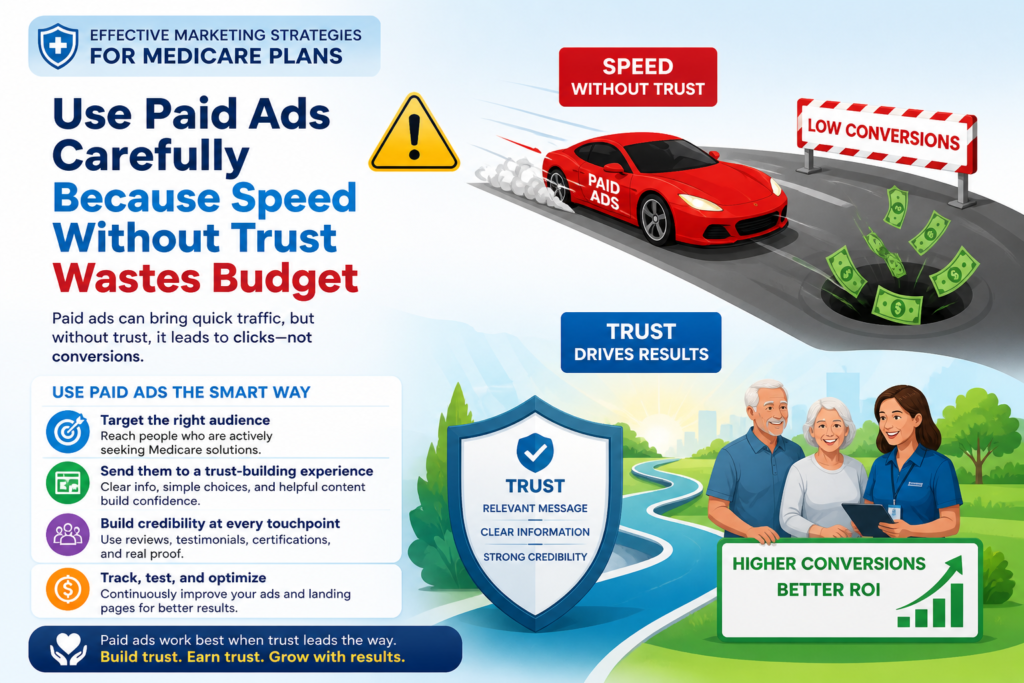
If your ads make broad promises, attract the wrong people, or send visitors to weak landing pages, you will pay for clicks that do not become good conversations. Worse, you may create distrust before your brand has a chance to help.
Paid Medicare campaigns need careful targeting, plain language, and strong follow-up. They should not be built only around cheap leads. A cheap lead that does not trust you is not cheap. It is wasted time for your team and a poor experience for the consumer.
Match the Ad to the Search Intent
Search ads should match what the person is trying to do. If someone searches for “Medicare Advantage plans near me,” they likely want to compare options. The ad should speak to local plan comparison and licensed help.
If someone searches for “Medicare dental coverage,” they may not be ready to enroll. The ad should lead to an educational page or a simple guide that explains what dental coverage may look like in different plan types.
If someone searches for “change Medicare plan,” they may be trying to understand timing and rules. The ad should not jump straight into a hard enrollment message. It should explain that plan changes depend on enrollment periods and personal situation, then offer help reviewing options.
Paid Ads Should Filter as Much as They Attract
Great ads do not just bring in more people. They bring in better-fit people.
This matters because Medicare marketing teams often measure the wrong thing. They celebrate lead volume before checking lead quality, call connection rate, appointment rate, enrollment rate, and member fit.
When the campaign is judged only by cost per lead, the message often becomes too broad. That may lower lead cost, but it can damage the whole funnel.
A better ad strategy is to be clear about who the help is for. Mention plan comparison. Mention ZIP code availability. Mention licensed advisors. Mention reviewing doctors and prescriptions. These details may reduce casual clicks, but they improve serious interest.
Paid ads should not create confusion just to increase form fills. They should start a useful conversation with people who truly need help.
Make Compliance Part of the Marketing Strategy, Not a Last-Minute Check
Medicare marketing cannot be separated from compliance. The rules are not a small detail at the end of the campaign. They shape what you can say, how you can say it, how you collect leads, how agents follow up, and how people experience the sales process.
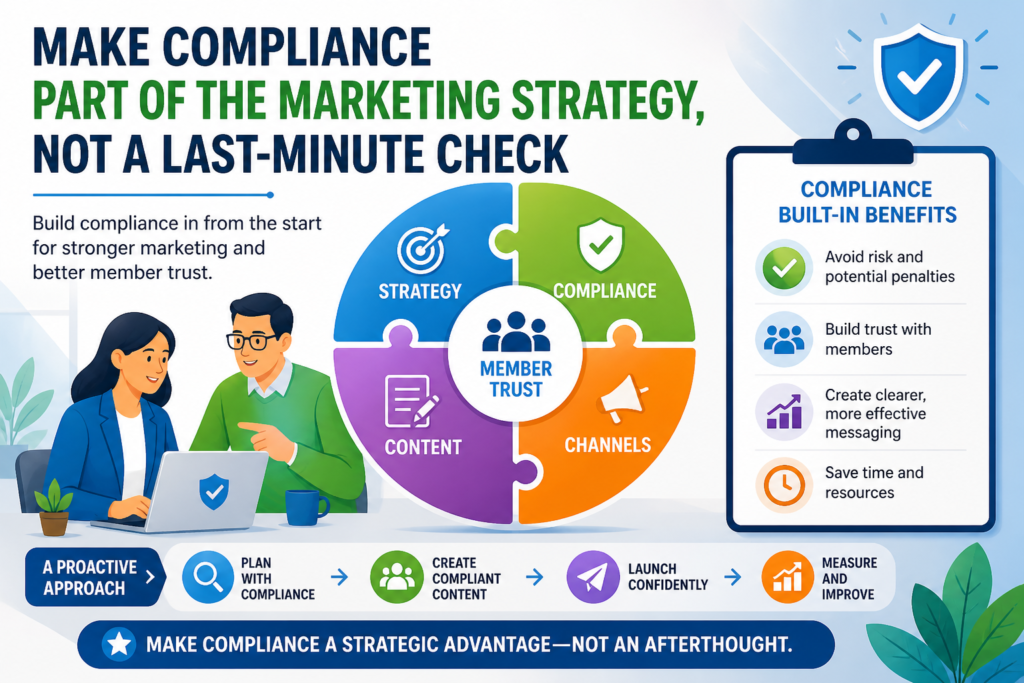
If compliance is treated as a final review step, it can slow down campaigns and create risk. If it is built into the strategy from the start, it can make the marketing stronger.
Why? Because compliant marketing is usually clearer marketing. It avoids misleading claims. It explains limits. It keeps language honest. It respects the consumer. That is also what builds trust.
Do Not Let Strong Copy Become Risky Copy
Good copywriting does not mean exaggeration. In Medicare marketing, the most powerful copy is often the most honest copy.
Avoid words that suggest one plan is best for everyone. Avoid promises that sound absolute. Avoid benefit claims without context. Avoid making people think they can get something that may not be available in their area or plan. Avoid fear-based pressure that makes the person feel rushed.
Instead, use clear and careful language. Say that plan availability and benefits may vary by location. Say that provider networks and prescription coverage should be reviewed before choosing. Say that a licensed agent can help compare options. These phrases may seem less flashy, but they are safer and often more believable.
Compliance Should Improve the Customer Experience
Compliance should not make your marketing cold or hard to read. It should make it more useful.
For example, if a landing page explains that submitting a form may lead to a call from a licensed agent, that is not just a compliance detail. It also helps the visitor know what to expect. If an ad avoids saying “free benefits for everyone” and instead says “compare plan options in your area,” it is not just safer. It is also clearer.
The best Medicare marketers do not fight compliance. They use it as a guardrail for better communication.
When you make the truth easy to understand, you protect the consumer and the brand at the same time.
Create Medicare Content That Answers the Question Before Asking for the Lead
Content marketing for Medicare plans should never feel like a trick. If the title promises an answer, the page should give the answer. If the page only gives half an answer and then forces the person to call, trust drops.
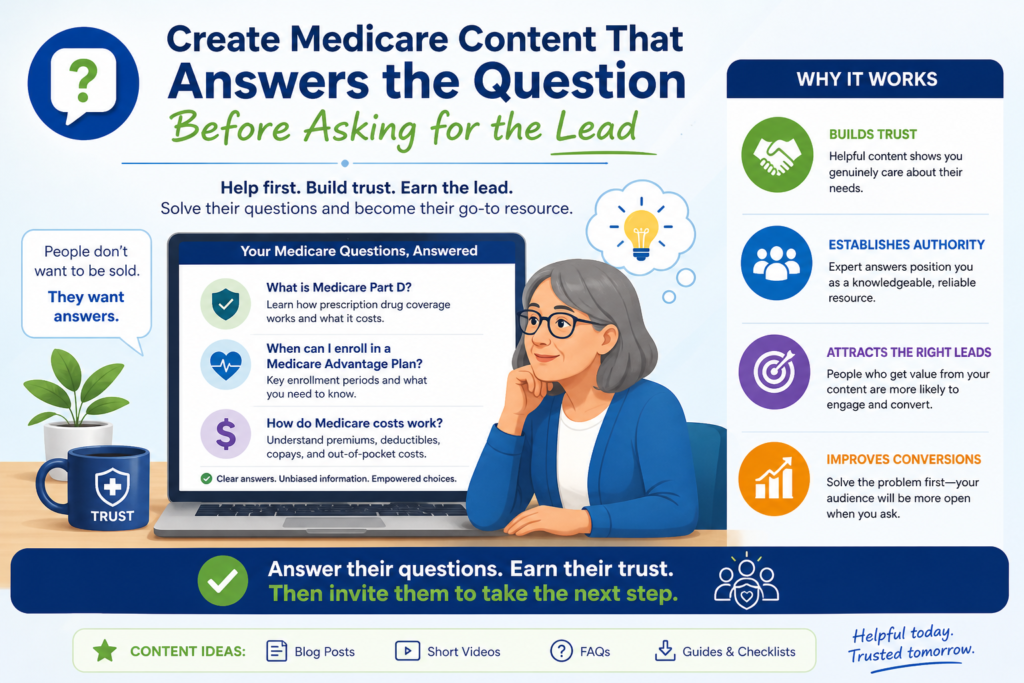
This does not mean you should turn every page into a full plan comparison tool. It means your content should be useful enough that the reader feels helped before they are asked to act.
That is how strong Medicare content earns leads. It does not beg for them. It creates enough clarity that the reader naturally thinks, “I may need help with this.”
The Best Medicare Content Starts With One Real Question
Every strong page should begin with one clear question. Not a broad topic. Not a keyword stuffed into a headline. A real question a person would ask when they are confused or worried.
For example, a page about Medicare Advantage should not only say what Medicare Advantage is. It should answer the deeper question behind the search, such as whether Medicare Advantage is a good choice for someone who wants lower monthly costs but still needs to keep certain doctors.
A page about Part D should not only explain prescription drug plans. It should help the reader understand why their medication list matters, why pharmacy choice matters, and why a plan that worked last year may not be the best fit this year.
A page about dental benefits should explain that dental coverage can vary by plan and location. It should help the reader understand what to check before assuming a benefit is included.
The Reader Should Feel Smarter After Every Section
The goal of Medicare content is not just to rank. The goal is to make the reader feel more able to make a decision.
This is where many Medicare websites fall short. They publish thin pages that repeat the same basic lines about premiums, benefits, and enrollment. The pages may mention the right keywords, but they do not help the person think clearly.
A better page teaches the reader how to compare. It explains what matters, what can change, what can go wrong, and what to ask before choosing. It gives the person a simple mental path.
For example, instead of saying, “Compare plans today,” explain what comparison should include. Tell the reader to check whether their doctors are in network, whether their prescriptions are covered, what their expected copays may be, whether their preferred pharmacy is included, and what the yearly out-of-pocket limit could mean for them.
That kind of content feels useful. It builds respect. It also makes the lead more prepared when they speak with an agent.
Use Local Marketing to Become the Familiar Name in the Community
Medicare decisions often feel local because healthcare feels local. People care about nearby doctors, local hospitals, local pharmacies, local events, and local agents who understand the area.
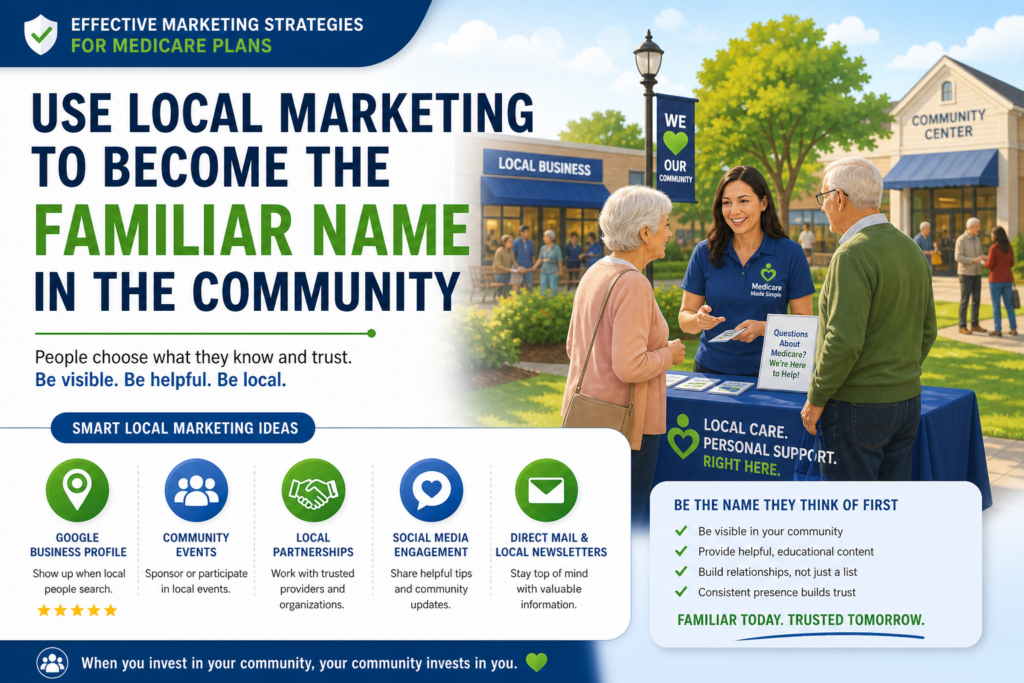
This gives Medicare marketers a major chance to stand out.
A national brand may have a big budget, but a local or regional marketer can win with familiarity. When people see your name in helpful local content, community events, local search results, neighborhood talks, and trusted referral settings, your brand begins to feel safer.
Local marketing is not just about showing up on Google Maps. It is about becoming known before the person needs you.
Your Local Presence Should Feel Real, Not Manufactured
Local Medicare marketing should not be built from copy-and-paste city pages. People can feel when a page was made only for search engines. The wording is usually thin, vague, and lifeless.
A better local strategy connects the Medicare decision to the real area. The page can explain that plan options may vary by ZIP code and county. It can remind people to review local doctor networks and nearby hospitals.
It can discuss the importance of checking pharmacies in the area. It can invite people to speak with someone who can help them compare based on where they live.
Local content should also support local events. If your team hosts Medicare education meetings, webinars, senior center sessions, library talks, or community Q&A events, your website should make those events easy to find. The page should explain who the event is for, what people will learn, and whether they need to bring anything.
Community Trust Is Built Before Enrollment Season
Many Medicare marketers only become visible during annual enrollment. That is a mistake.
If the first time someone sees your brand is during a busy enrollment period, you are competing with every other marketer at the noisiest time of the year. The person may already feel overwhelmed. Your message becomes one more voice in a crowded room.
A stronger local strategy works all year.
Publish educational content before people are ready to switch. Build relationships with local organizations where appropriate. Create clear guides for people turning 65. Offer simple checklists that help people prepare for Medicare conversations.
Keep your local listings accurate. Ask satisfied clients to leave honest reviews where allowed. Make your team visible as helpful educators, not seasonal sellers.
By the time enrollment season arrives, your brand should not feel new. It should feel familiar.
That familiarity can lower resistance more than any clever ad line.
Build a Follow-Up System That Respects the Buyer’s Pace
A Medicare lead is not just a name and phone number. It is a person who may be nervous, busy, skeptical, or helping someone else make a decision.
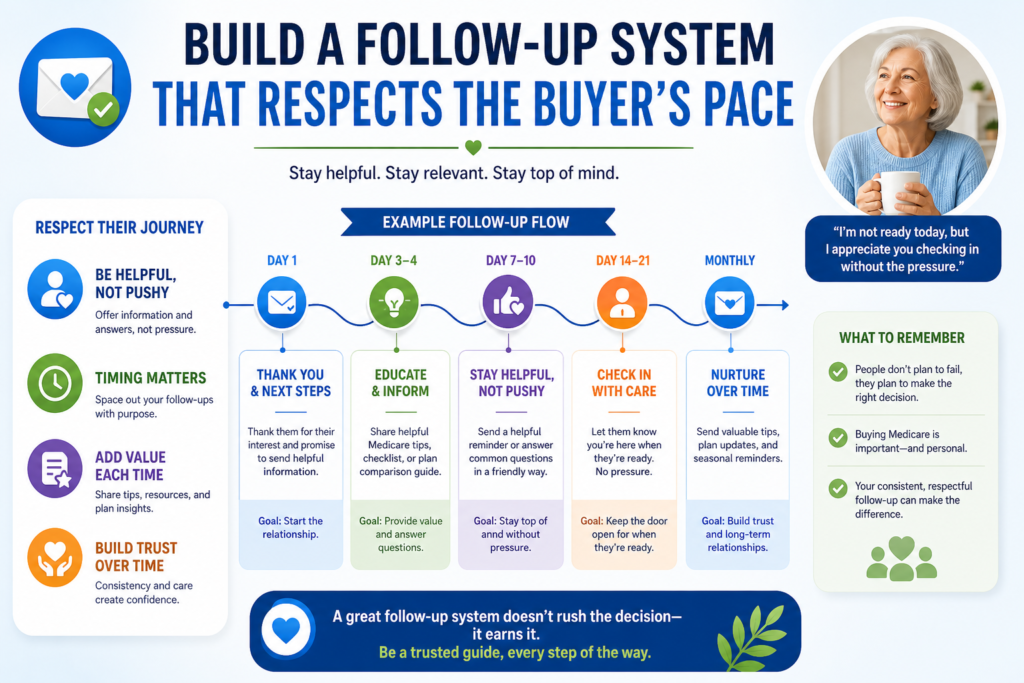
That is why follow-up must be handled with care.
Fast follow-up matters, but speed alone is not enough. A fast call with the wrong tone can hurt trust. A pushy text can make the person feel trapped. A confusing voicemail can cause them to ignore future contact.
The best follow-up system combines speed, clarity, patience, and respect.
The First Follow-Up Should Confirm the Promise
When someone fills out a form, your follow-up should match what the page promised. If the page said they could compare Medicare plan options, the first call or message should say that clearly. If the page offered help reviewing doctors and prescriptions, the agent should begin there.
This may sound simple, but it is often missed. Many teams use generic call scripts that do not reflect the ad or landing page. The visitor clicked for one reason, but the call starts with another. That gap creates doubt.
A better approach is to pass lead source details into the CRM. The agent should know which page the person came from, which form they filled out, what they were interested in, and whether they asked about Medicare Advantage, Part D, switching plans, or turning 65.
That context makes the call feel personal without being creepy. It lets the agent open with a helpful line instead of a cold pitch.
Follow-Up Should Educate, Not Chase
Not every person is ready to enroll right away. Some are early in the research stage. Some need to talk with a spouse or caregiver. Some need to find their medicine list. Some are waiting for plan details. Some are simply scared of choosing wrong.
If your follow-up treats every lead like an immediate sale, you will lose people who could have converted later.
A strong nurture system gives people room to move. It can include simple emails that explain how to prepare for a Medicare plan review. It can remind them to list doctors and prescriptions. It can explain common plan comparison mistakes. It can invite them to schedule a time when they are ready.
The tone should stay calm. The message should not sound like a countdown clock unless there is a real deadline. Even when deadlines matter, the wording should be helpful, not frightening.
People remember how your brand made them feel. If your follow-up feels respectful, they are more likely to come back.
Train Agents to Continue the Marketing Experience
Your marketing does not end when the phone rings. In many ways, that is where the real brand experience begins.
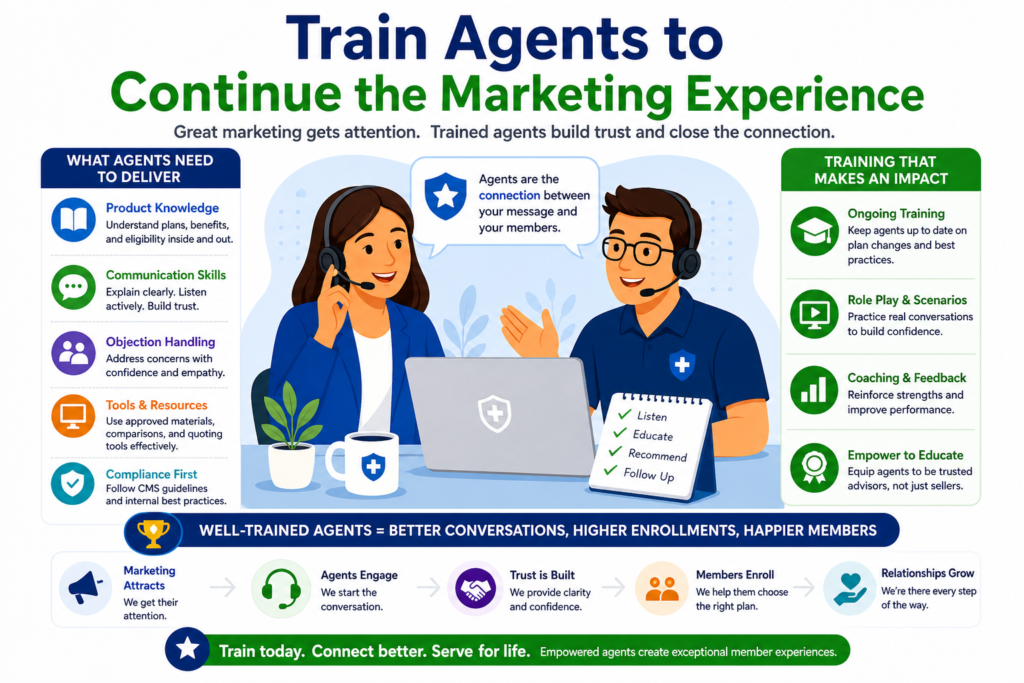
If your ads, website, and emails are clear and helpful, but the agent sounds rushed or aggressive, the whole strategy breaks. The person does not separate the marketing from the call. To them, it is one experience.
This means agent training is part of marketing. It is not only a sales issue. It affects conversion, retention, referrals, reviews, and compliance.
A strong Medicare marketing system needs agents who can listen, explain, and guide with care.
The Agent Should Start With the Person’s Situation
A weak Medicare call begins with a script. A strong Medicare call begins with the person.
The agent should understand why the person reached out. Are they turning 65? Are they unhappy with their current plan? Are they worried about drug costs? Are they trying to keep a doctor? Are they helping a parent? Are they comparing Medicare Advantage and Medigap? Are they confused about enrollment windows?
Starting with the situation shows respect. It also helps the agent avoid giving generic information that does not matter to the person.
This is where training makes a real difference. Agents should learn how to ask simple questions, listen without interrupting, and explain options in plain words. They should avoid sounding like they are reading policy language. They should explain tradeoffs clearly.
A good call should make the person feel calmer than they felt before the call.
The Best Agents Reduce Confusion Before They Ask for Action
In Medicare sales, confusion can create short-term movement, but clarity creates better long-term outcomes. If a person enrolls without understanding the plan, they may become unhappy later. That can lead to complaints, cancellations, poor reviews, and low trust.
So agents should be trained to slow down at the right moments.
They should explain that plan fit depends on location, doctors, prescriptions, costs, and personal needs. They should help the person understand what is being compared. They should avoid skipping over limits or tradeoffs. They should check for understanding before moving forward.
This does not weaken sales. It strengthens sales.
When people understand the choice, they are more confident. When they are more confident, they are less likely to regret the decision. When they feel respected, they are more likely to refer others.
That is why agent training should be measured not only by enrollments, but also by call quality, customer understanding, complaint rate, and long-term member satisfaction.
Make Caregivers a Core Part of the Medicare Marketing Plan
Many Medicare decisions are not made by one person alone. Adult children, spouses, relatives, friends, and caregivers often help with research, plan comparison, paperwork, and calls.
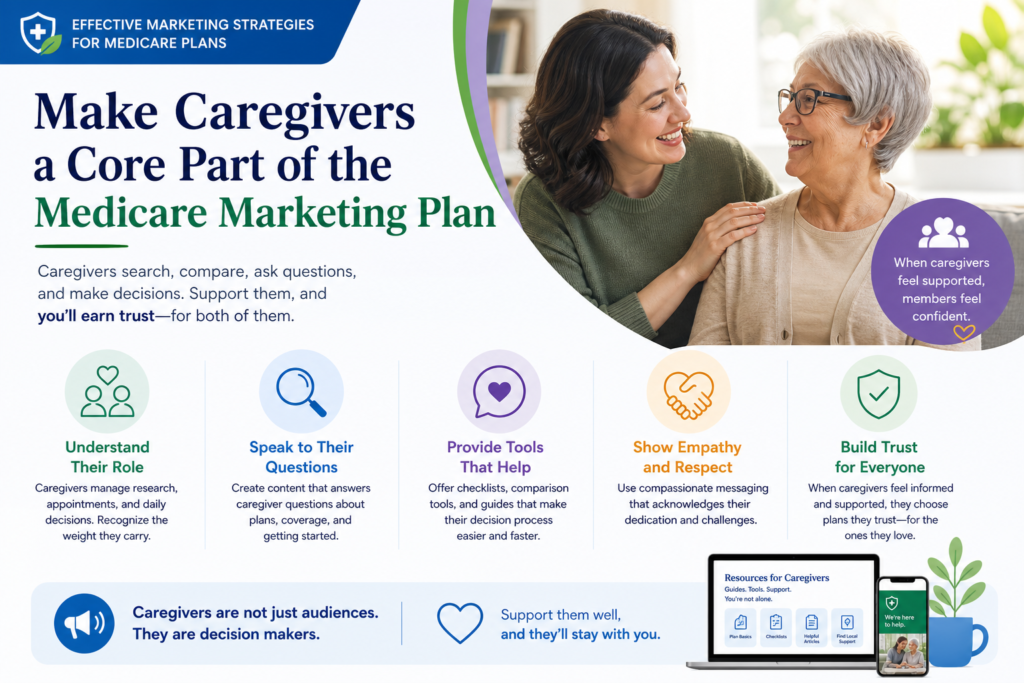
Yet many Medicare marketing campaigns speak only to the Medicare-eligible person.
That leaves a major gap.
Caregivers often search online because they want to protect someone they love. They may be more digital than the senior. They may compare options across several websites. They may read reviews, check trust signals, and look for clear explanations before they ever suggest a call.
If your marketing does not speak to caregivers, you may miss one of the most important voices in the decision.
Caregivers Need Clarity, Safety, and Proof
A caregiver is usually not looking for a flashy promise. They are looking for safety.
They want to know whether the company is real. They want to know whether the agent is licensed. They want to know whether their parent will be pressured. They want to know what information is needed. They want to understand the choice well enough to help without making a mistake.
Your content should support that need.
Create pages that explain how to help a parent compare Medicare plan options. Explain what documents or details may be useful before a call. Explain how to review doctors, prescriptions, pharmacies, costs, and benefits. Explain what questions a caregiver can ask during a plan review.
This content should not talk down to caregivers. It should treat them as careful decision partners.
Family-Friendly Marketing Builds More Trust
Caregiver-focused marketing should feel open and transparent. Make it easy for someone to schedule a call with a parent present. Make it clear whether a family member can join the conversation. Explain that the goal is to help the Medicare-eligible person understand their options.
This creates comfort for both sides. The senior feels supported. The caregiver feels included. The agent gets better information. The final decision is more likely to be thoughtful.
This approach can also improve referrals. When a caregiver has a good experience, they may tell others. They may have friends going through the same process with their own parents. They may return in future years when plan needs change.
Caregivers do not just help with one decision. They can become long-term trust bridges for your brand.
Use Reviews and Testimonials With Care, Context, and Honesty
Reviews matter in Medicare marketing because the decision is personal. People want to know whether others had a good experience. They want to know whether the company was helpful, patient, and clear.
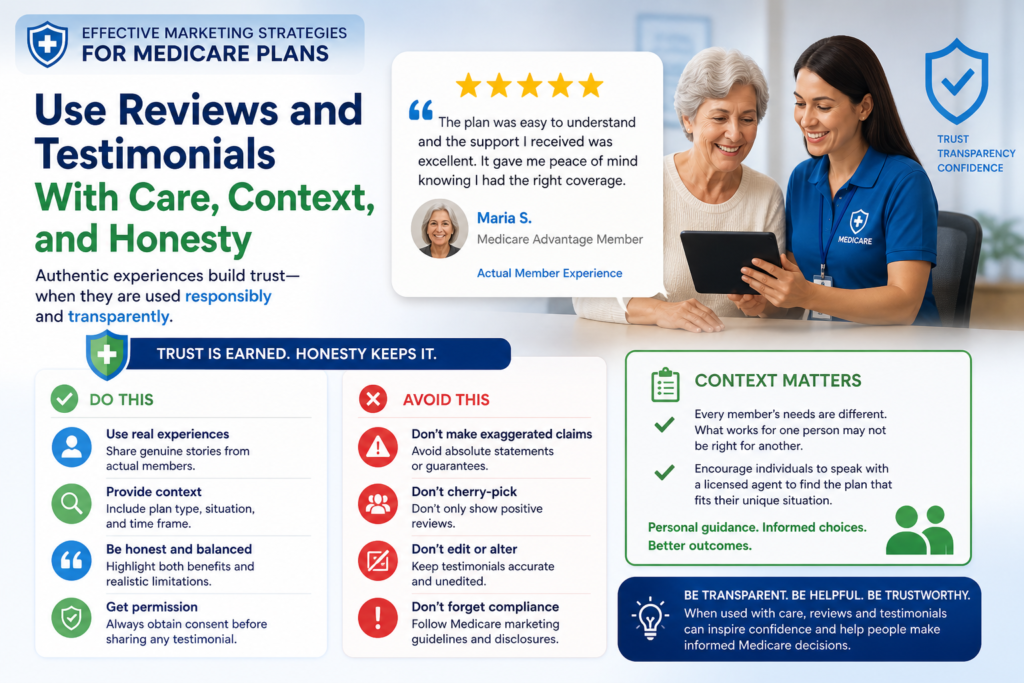
But reviews must be handled carefully. Medicare marketing is sensitive, and any public claim should be truthful, fair, and not misleading.
A good review strategy does not try to make the brand look perfect. It tries to show that real people had real help from a team that explained things clearly.
Ask for Reviews After a Helpful Experience
The best time to ask for a review is after the person has had a positive and clear experience. This might be after an educational call, after a successful plan review, or after the person says they felt helped.
The request should be simple and respectful. Do not pressure people. Do not tell them what to say. Do not offer anything that could create problems. Just invite them to share their honest experience if they feel comfortable.
The reviews that help most are often not the most dramatic. Simple reviews can be powerful when they mention patience, clarity, kindness, and useful guidance.
A review that says the agent took time to explain options may be more valuable than a review that only says the company is great.
Place Trust Signals Where People Feel Doubt
Reviews and trust signals should be placed near moments of hesitation. On landing pages, place them near the form or next-step section. On local pages, include them near the section that explains how to get help. On caregiver pages, show trust signals before asking someone to schedule a call.
Trust signals can include reviews, years of experience, licensed advisor language, clear contact information, local presence, privacy explanations, and simple process details.
The key is to avoid clutter. Do not flood the page with badges, claims, and proof points. Too much can look forced.
Use enough proof to answer the quiet question in the reader’s mind: “Can I trust these people with an important decision?”
When your marketing answers that question calmly, conversion becomes easier.
Build Email Campaigns That Help People Prepare, Not Just Push Them to Enroll
Email can be one of the most useful channels in Medicare marketing, but only when it is treated as a support tool instead of a pressure tool.
Most people do not make a Medicare decision in one sitting. They read, compare, pause, ask someone, look at costs, check doctors, and come back later. Email helps you stay close during that thinking period without forcing the person to act before they are ready.
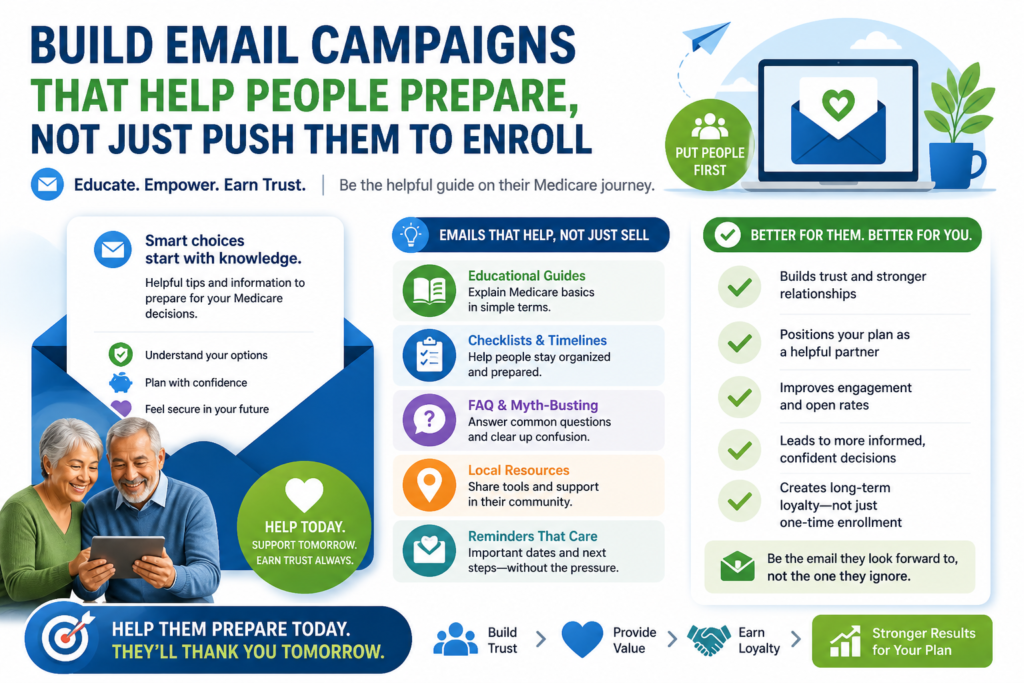
But the tone matters. A bad Medicare email campaign feels like a chase. A good one feels like a helpful reminder from someone who understands the decision.
Your Email Sequence Should Match the Person’s Stage
A person turning 65 needs a different email sequence than someone comparing plans during Annual Enrollment. A caregiver helping a parent needs a different message than someone asking about prescription drug coverage.
This is why one generic email sequence is not enough.
If someone downloads a guide about turning 65, your emails should explain the first steps. You can walk them through what to review, when to start, what questions to ask, and why doctors and prescriptions should be checked before choosing.
If someone visits a page about changing plans, your emails should focus on review points. You can explain how to compare current coverage against new options, why last year’s plan may not fit this year, and why benefit changes should be checked carefully.
If someone asks about dental, vision, or hearing benefits, your emails should explain that these benefits may vary by plan and area. The message should help the reader understand what to verify before making a decision.
The more closely your email matches the first concern, the more useful it feels.
Every Email Should Make the Next Step Feel Smaller
Medicare can feel big. Your emails should make it feel smaller.
Instead of asking people to “enroll now” in every message, help them take one simple step. One email can ask them to gather their medicine list. Another can explain why they should write down their doctors. Another can help them think about monthly costs and possible out-of-pocket costs.
Another can invite them to schedule a plan review when they are ready.
This kind of email builds momentum without pressure.
It also creates better conversations for agents. When a person has already gathered their doctors, medicines, and questions, the call becomes more useful. The person feels prepared. The agent can guide them better. The final choice is more likely to fit.
Good email marketing does not replace the agent. It prepares the person for a better agent conversation.
Use Social Media to Build Familiarity, Not to Win the Whole Sale
Social media is not always the place where someone makes a final Medicare decision. But it can be a strong place to build familiarity, answer common questions, and make your brand feel more human.
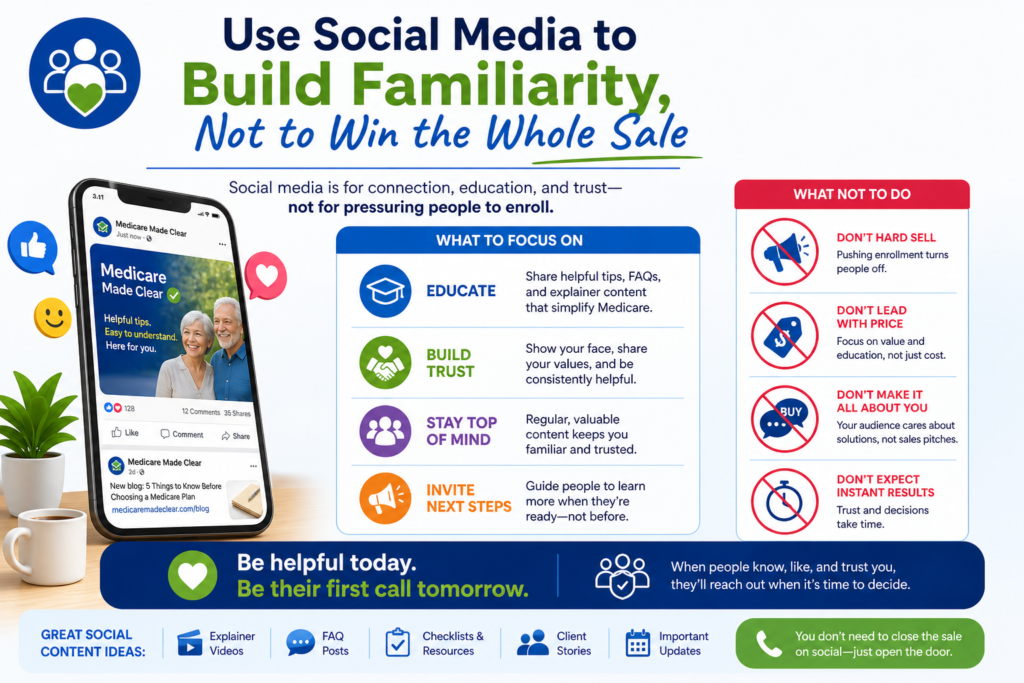
Many Medicare marketers use social media only during enrollment season. They post reminders, benefit messages, and calls to compare plans. That can help, but it is not enough.
The better strategy is to use social media throughout the year as a simple education channel. The goal is not to explain every detail in one post. The goal is to become a familiar, steady voice that people trust before they need help.
Keep Social Content Simple, Clear, and Useful
Medicare social content should be easy to understand at a glance. People are often scrolling quickly. They may not be ready to read a long guide. Your content should answer one small question at a time.
A post can explain why people should check their prescriptions each year. Another can explain why doctor networks matter. Another can remind people turning 65 to start learning before their birthday month. Another can explain that caregivers can join Medicare conversations to help a parent compare options.
The best posts often come from real questions agents hear every week. If people keep asking the same thing on calls, that question should become content.
This is how social media becomes useful instead of random. It reflects real confusion in the market.
Human Faces Make the Brand Feel Safer
Medicare is personal. A faceless brand can feel cold.
When possible, show the people behind the company. Let licensed advisors share simple tips. Let team members explain what people should prepare before a call. Share short educational videos where someone speaks calmly and clearly. Show community events, office updates, and helpful reminders.
This does not mean every post needs to be polished like a commercial. In fact, overly polished content can sometimes feel less trustworthy. A simple, clear video from a real advisor can feel warmer than a perfect graphic.
The goal is to make the brand feel reachable.
When people recognize a face, hear a calm voice, or see that your team teaches instead of pushes, they are more likely to trust you when it is time to compare options.
Make Video a Core Part of Medicare Education
Video works well for Medicare marketing because it can make a hard topic feel easier. Many people would rather listen to a clear explanation than read a long page about plan types, costs, networks, and enrollment periods.
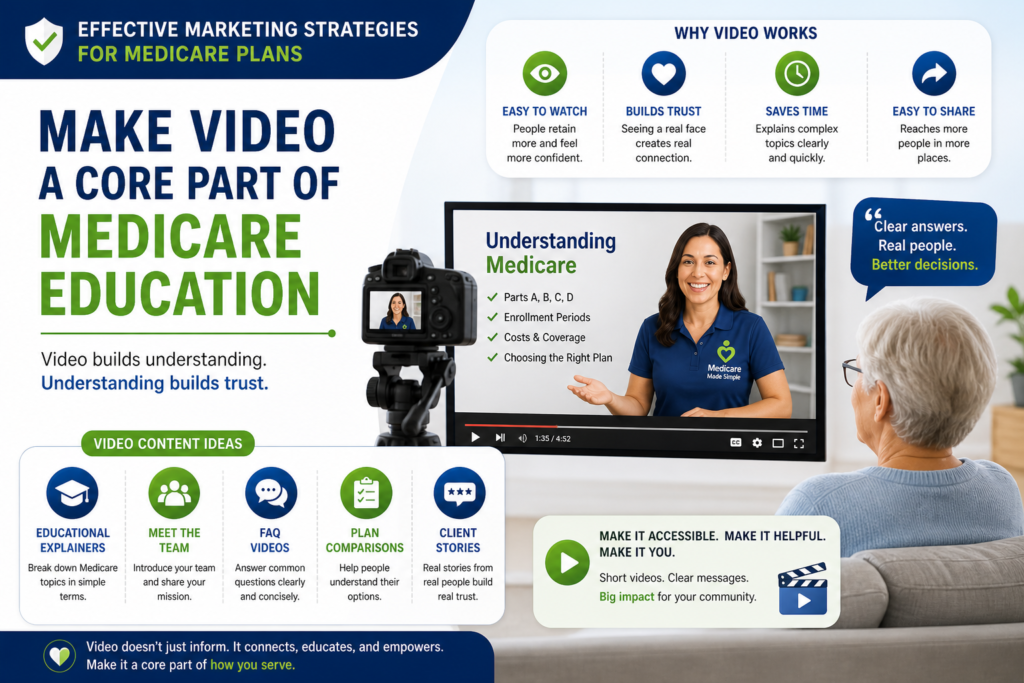
But video must be planned carefully. It should not be a sales pitch dressed up as education. It should help the viewer understand one thing clearly.
A good Medicare video feels like a calm conversation. It explains the topic in plain words, gives context, and tells the viewer what they may need to check next.
Create Videos Around the Questions People Actually Ask
The best video ideas often come from sales calls, customer service calls, search data, and local event questions.
If people keep asking whether Medicare Advantage includes dental, make a video about what to check before choosing a plan for dental benefits. If people ask whether they can keep their doctor, make a video explaining why networks matter and how to review them.
If people are confused about Part D, make a video about why medicine lists and pharmacy choice can affect costs.
Each video should cover one main idea. Do not try to explain all of Medicare in one piece. That usually overwhelms the viewer.
A short, focused video can do more than a long, crowded one. The viewer should finish with a clear answer and a clear next step.
Put Videos Where They Support Action
Video should not live only on YouTube or social media. It should also support your website, landing pages, emails, and local pages.
A landing page can include a short video explaining what happens after someone requests help. A local page can include a video from an advisor talking about how to compare plans in that area. An email can link to a video that shows how to prepare for a plan review. A caregiver page can include a video explaining how family members can support the conversation.
This makes the experience warmer.
Video can also reduce call friction. When someone has already seen a real person explain the process, the next step feels less unknown. The call feels less like a cold sales moment and more like a natural continuation.
That is the power of good Medicare video. It does not just inform. It lowers fear.
Design the Website for Older Adults and Caregivers at the Same Time
A Medicare website should be simple, fast, clear, and easy to use. This sounds basic, but many Medicare websites are hard to read, hard to navigate, or full of too many choices.
Older adults may visit the site directly. Caregivers may visit it on behalf of a parent. Agents may send people to specific pages. Paid ads may send traffic to landing pages. SEO may bring visitors into blog posts. Each path should feel smooth.
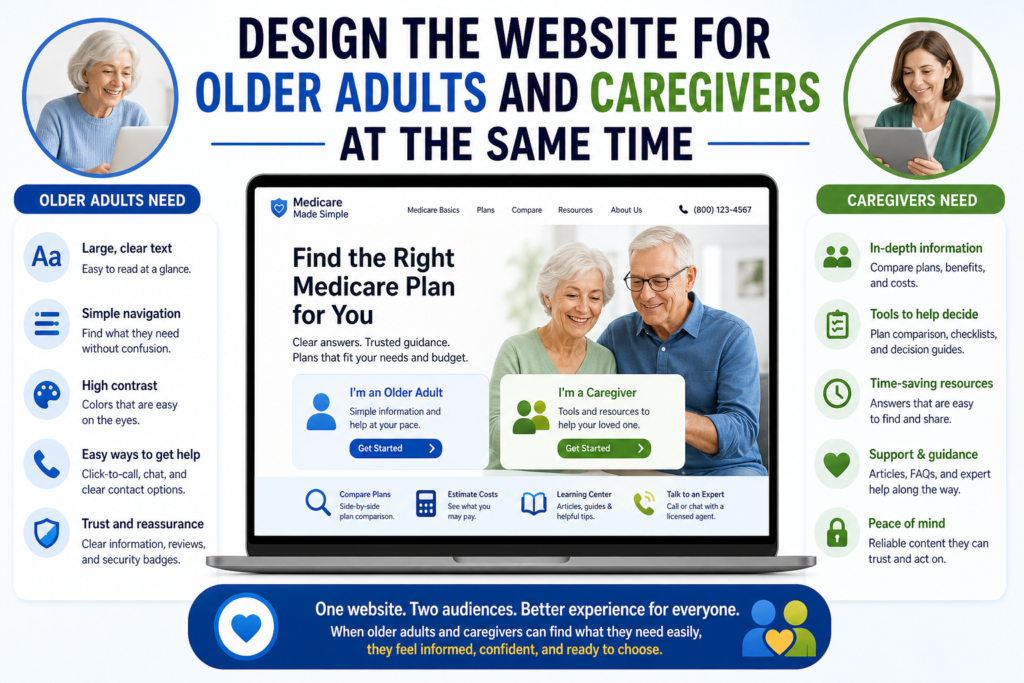
The website should not make people work hard to understand what to do next.
Readability Should Drive the Design
Good Medicare website design starts with readable content. Use large enough text. Keep paragraphs short but complete. Use clear headings. Avoid clutter. Avoid tiny disclaimers that force people to zoom in. Avoid placing important information inside busy graphics that are hard to read.
The design should support calm decision-making.
A visitor should quickly understand who you help, what kind of Medicare support you offer, how the process works, and what to do next. The main calls to action should be clear, but not aggressive. The page should invite action without making the visitor feel trapped.
This is especially important on mobile. Many caregivers will use phones. Many seniors will too. If the form is hard to fill out, the phone number is hard to tap, or the text is too small, the campaign loses people who may have been ready to act.
Simple Navigation Creates More Confidence
The website menu should not be crowded with too many choices. People should be able to find Medicare Advantage information, Part D information, turning 65 guidance, plan comparison help, contact details, and local support without confusion.
A good website also makes the next step clear on every page. If someone is reading about prescription coverage, the next step can invite them to review their medicine list with a licensed advisor.
If someone is reading about turning 65, the next step can invite them to schedule a first Medicare conversation. If someone is on a caregiver page, the next step can invite them to book a call with their parent present.
The next step should fit the page.
That is what makes the website feel thoughtful. It does not push the same message everywhere. It meets the visitor where they are.
Measure the Full Funnel, Not Just the Cost Per Lead
Cost per lead is easy to track, but it can also mislead you.
A campaign can look successful because leads are cheap, while the sales team knows those leads are weak. Another campaign may look expensive at first, but bring in people who are better informed, easier to reach, and more likely to enroll in the right plan.
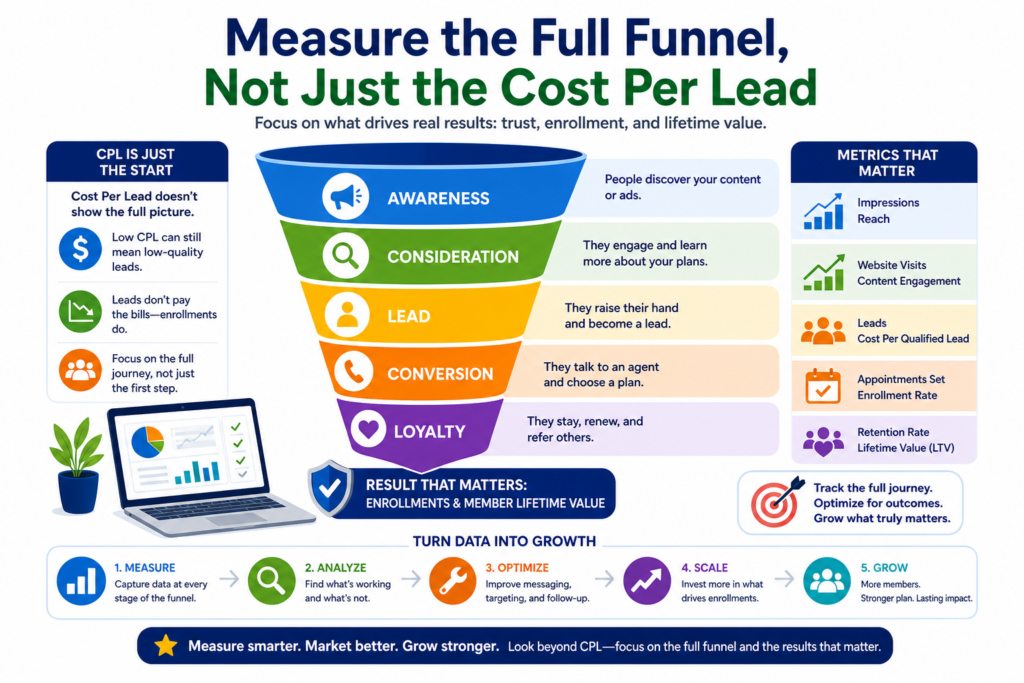
That is why Medicare marketers need full-funnel measurement.
The goal is not just to get more leads. The goal is to create more good conversations, better plan fit, stronger trust, and cleaner growth.
Track What Happens After the Lead Comes In
Every campaign should be judged by what happens after the form is submitted or the call is placed.
You need to know whether the person answered the phone, whether the contact information was valid, whether the person was eligible, whether they were interested in the plan type, whether they booked a review, whether they enrolled, and whether the enrollment stayed healthy over time.
This helps you find the real winners.
For example, one keyword may create cheap leads but poor contact rates. Another keyword may cost more but produce serious shoppers. One landing page may convert well but create confusion on calls. Another may convert at a lower rate but bring in better-prepared people.
Without full-funnel tracking, you may scale the wrong campaign.
Quality Signals Should Shape Budget Decisions
The best Medicare marketing teams do not only ask, “Which campaign got the lowest lead cost?” They ask better questions.
They look at which campaigns produced informed prospects. They look at which messages led to better call quality. They look at which pages created fewer complaints or misunderstandings. They look at which sources produced members who seemed to understand the plan they selected.
This kind of measurement protects both growth and brand trust.
It also helps marketing and sales work together. Marketing can see which messages create strong conversations. Agents can share what people misunderstood before the call. Compliance teams can flag language that may create risk. Leadership can put budget behind campaigns that create the best long-term outcomes.
When measurement improves, strategy improves.
Build a Year-Round Medicare Marketing Calendar
Medicare marketing has clear seasonal peaks, but the best strategy does not begin and end with enrollment season.
People turn 65 every day. Caregivers search all year. Current members have questions all year. Plan dissatisfaction can happen outside the busiest months. Education can happen long before someone is ready to enroll.
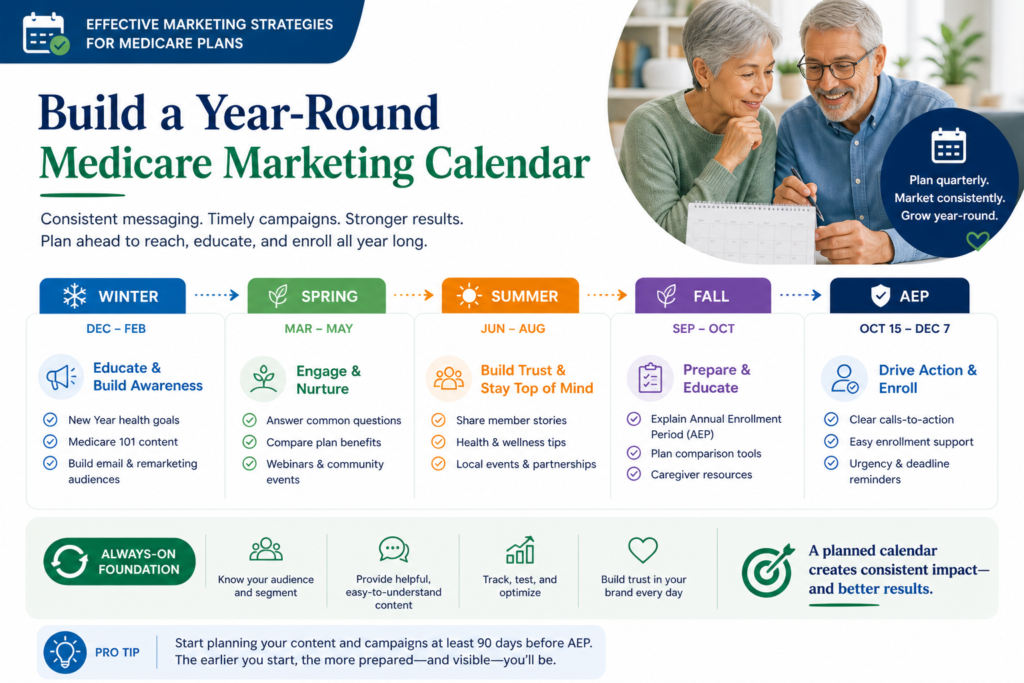
A year-round calendar helps your brand stay useful instead of only becoming visible when everyone else is advertising too.
Each Season Should Have a Clear Marketing Purpose
The months before Annual Enrollment should focus on education, list building, content updates, local visibility, and audience warming. This is the time to help people understand what they may need to review when plan details change.
During Annual Enrollment, the focus should shift to clear comparison support, appointment scheduling, fast follow-up, and careful messaging around deadlines. The tone should still be calm, but the path to action should be easy.
After Annual Enrollment, the focus should not disappear. You can support people who have questions about using their plan, understanding benefits, preparing for future reviews, or helping family members who are turning 65.
For age-in campaigns, the calendar should run every month. People approaching 65 need timely education based on where they are in the process. A person six months away from turning 65 needs beginner guidance. A person one month away may need a more direct plan review conversation.
Planning Ahead Makes Compliance and Content Better
A rushed campaign is more likely to make mistakes. The copy may be vague. The landing page may be thin. The follow-up may not match the ad. Compliance review may become stressful. Agents may not be trained on the campaign message.
A year-round calendar gives your team time to do better work.
You can plan educational content early. You can update local pages before traffic spikes. You can review landing pages before ad budgets rise. You can prepare email sequences before leads start coming in. You can train agents on the exact promises being made in the campaign.
This turns Medicare marketing from a seasonal scramble into a steady growth system.
And steady systems usually win.
Use Direct Mail as a Trust Builder, Not Just a Response Tool
Direct mail still has a place in Medicare marketing because many older adults are used to receiving important health and insurance information through the mail. A well-made mail piece can feel more real than a digital ad, especially when it is clear, calm, and useful.
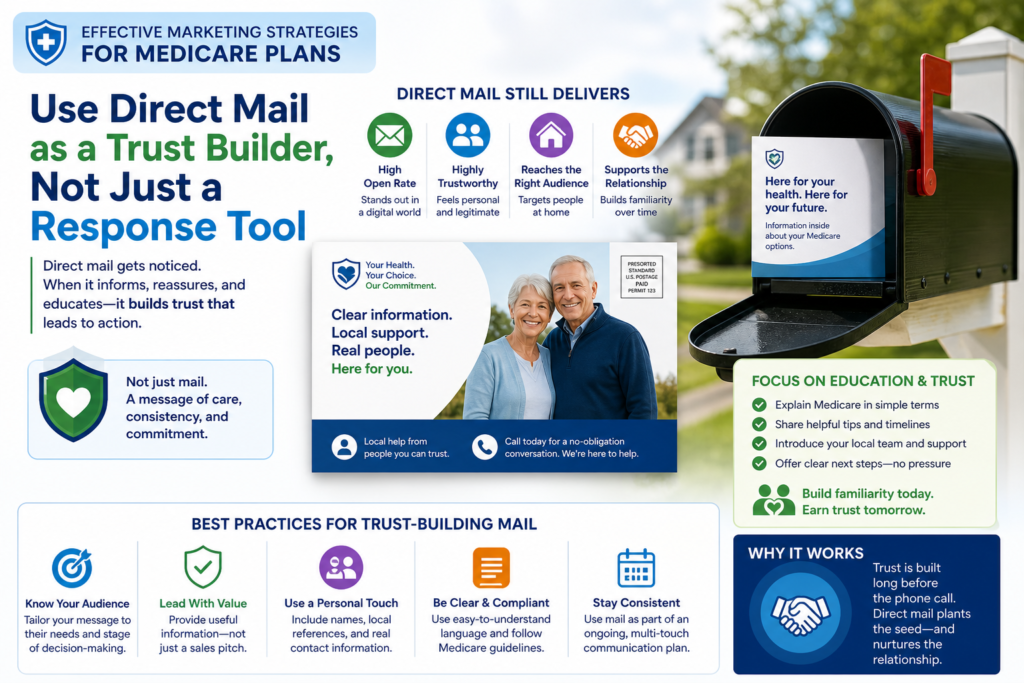
But direct mail can also fail when it looks too busy or too aggressive. Many Medicare mailers are packed with large claims, crowded benefit language, tiny text, and urgent wording. That may get attention, but it can also create doubt. The reader may wonder what is hidden, what is being sold, and whether the offer is safe.
A better direct mail strategy treats the mail piece as the start of trust, not the end of persuasion.
The Mail Piece Should Feel Like Help Arrived at the Right Time
A strong Medicare mailer should focus on one clear situation. It may speak to people turning 65, people reviewing plans before Annual Enrollment, people who may want to compare drug coverage, or caregivers helping a parent prepare.
The message should be simple enough to understand in a few seconds. It should explain what the reader can do next and why that next step may help. It should avoid trying to explain every plan detail on one card.
For example, a mailer for people turning 65 can explain that Medicare choices may affect doctors, prescriptions, monthly costs, and future flexibility. It can invite the person to schedule a simple review with a licensed advisor before choosing. That is much stronger than using a loud message that makes the decision feel urgent but unclear.
Direct Mail Works Better When It Connects to Other Channels
Direct mail should not stand alone. It should connect to your website, phone system, local events, and follow-up process.
If the mailer invites people to compare plan options, the landing page should match that promise. If it promotes a local seminar, the event page should be easy to read and register for. If it encourages a phone call, the agents should know which campaign the person received.
This connection matters because people may not respond right away. They may keep the mailer on the table, search your brand online, ask a family member, or visit your website later. If your digital presence does not support the mail message, the trust can fade.
A smart direct mail campaign creates recognition. Then SEO, reviews, local pages, and agent follow-up turn that recognition into action.
Build Medicare Seminars That Teach First and Sell Later
Seminars can be powerful in Medicare marketing because they create space for education. People can listen, ask questions, and see the advisor’s style before making a private decision.
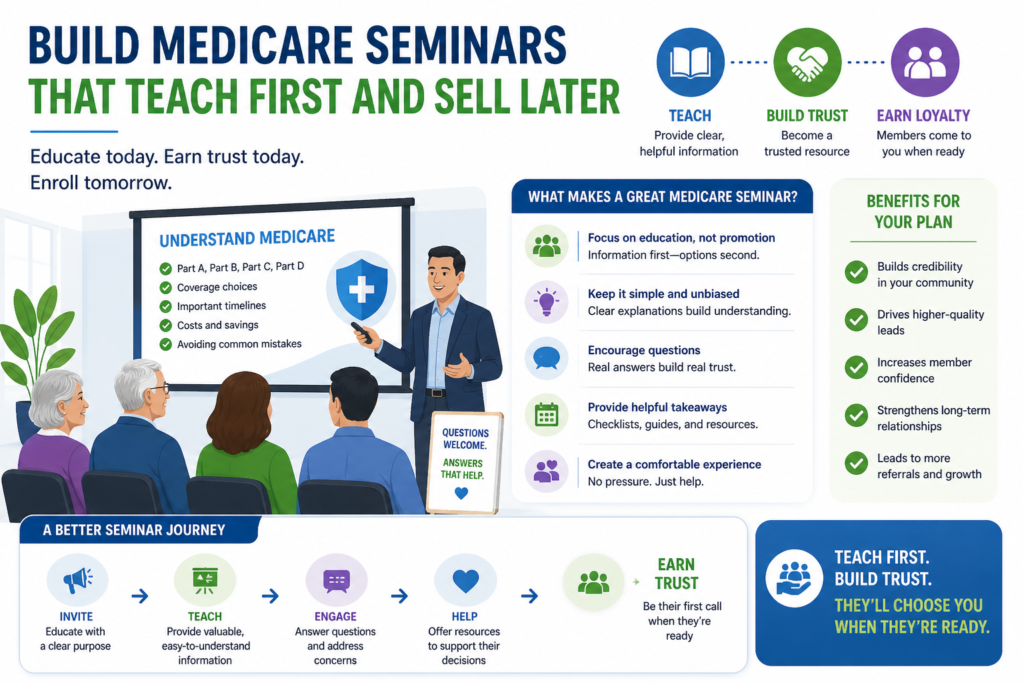
But seminars only work when they are built around teaching. If the event feels like a sales pitch, people shut down. They may attend, but they will not trust the speaker. In Medicare marketing, the room can feel the difference between real guidance and a hidden pitch.
A good seminar should help people leave with more clarity than they had when they walked in.
Choose Topics That Match Real Confusion
A strong seminar is not just called “Medicare 101” every time. That topic can work, especially for people turning 65, but you should also create seminars around specific questions.
One event can focus on how to prepare for Medicare before turning 65. Another can help people understand what to review during Annual Enrollment. Another can explain why prescriptions, pharmacies, and doctor networks should be checked before selecting a plan. Another can help caregivers understand how to support a parent during Medicare decisions.
The more specific the topic, the easier it is for the right person to say yes.
The event description should make the value clear. It should explain what the person will learn, who the session is for, and what they should bring if they want to ask better questions. This makes the seminar feel useful instead of vague.
The Follow-Up After the Seminar Should Stay Educational
The seminar does not end when people leave the room. The follow-up is where trust is either strengthened or weakened.
After the event, send a simple thank-you message. Recap what was covered. Invite people to schedule a one-on-one review if they want help applying the information to their own doctors, medicines, budget, and location. Keep the tone helpful.
Do not make the follow-up feel like a sudden hard sell. If the seminar was calm and educational, the follow-up should be calm and educational too.
This consistency matters. People came because they wanted help understanding Medicare. If your next message feels rushed, it breaks the experience.
A well-run seminar builds authority because it lets people experience your brand in person. They see whether you explain clearly. They hear how you answer questions. They feel whether you respect their pace. That kind of trust is hard for ads to create alone.
Conclusion
Marketing Medicare plans well is not about shouting louder during enrollment season. It is about earning trust before people are ready to choose. The strongest strategy uses clear content, local education, careful ads, simple landing pages, respectful follow-up, trained agents, and honest guidance at every step.
When people feel safe, they listen. When they understand their options, they act with more confidence. And when your brand helps them make a better choice, you build more than leads.














Comments are closed.