
WinSavvy Editorial Standards
How this article was created
Good swag does more than put your logo on a mug, pen, or tote bag. It gives people a small, useful reason to remember your brand in real life. That matters because most marketing today lives on screens. People scroll past ads, skip videos, ignore banners, and forget emails. But when your brand shows up on something they use, wear, carry, or keep on their desk, it stays in their world a little longer.
Start With Swag Your Audience Will Actually Use
Swag only works when it earns a place in someone’s day. That sounds simple, but it is the rule most brands ignore. They choose items because they are cheap, easy to print, or popular at trade shows. Then they wonder why people forget them.
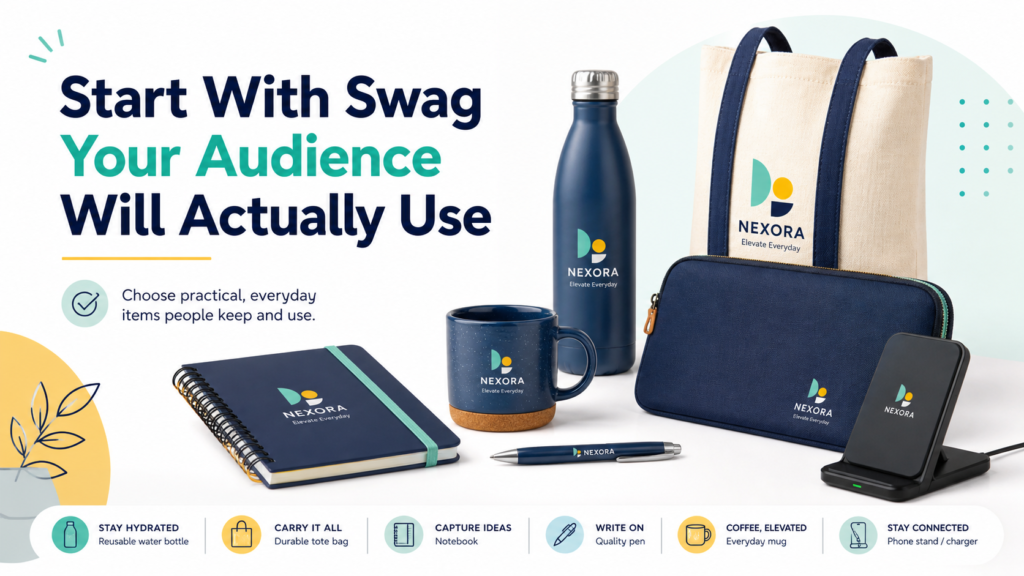
The best swag starts with one question: what would your audience be happy to keep even if your logo was not on it?
That question changes everything. It moves the focus away from your brand and toward the person receiving the item. And that is where strong marketing always begins.
Useful swag creates repeat brand exposure without feeling like an ad
A person may see your digital ad once and forget it in seconds. But if they use your branded notebook every morning, carry your tote bag to work, or drink from your bottle at the gym, your brand gets repeated exposure without pushing for attention.
This is why practical swag often performs better than flashy swag. People keep what solves a small problem. They keep what saves time, reduces friction, or makes daily life a little easier.
Think about daily habits before choosing the item
Before you choose any swag product, map it to a real habit. If your audience works at a desk all day, desk items make sense. If they travel often, travel items make sense. If they attend outdoor events, weather-friendly items make sense.
If they are founders, marketers, or sales teams, tools that help them stay organized will likely be used more often than random novelty gifts.
For example, a branded power bank is not just a tech item. It solves the fear of a dead phone during travel, events, meetings, and long workdays. A quality notebook is not just paper. It becomes a place where someone writes ideas, plans campaigns, tracks meetings, or sketches a strategy.
A soft hoodie is not just apparel. It becomes something they reach for on busy mornings, during flights, or while working from home.
This is the mindset that separates useful swag from forgettable swag.
Everyday items work best when quality is high
There is nothing wrong with common swag items. Pens, mugs, bottles, tote bags, notebooks, caps, and stickers can still work very well. The problem is not that these items are common. The problem is that many brands choose the cheapest version.
Cheap swag sends a quiet message. It tells people the brand did not think much about the experience. The pen breaks. The mug feels thin. The tote bag tears. The bottle leaks. The notebook paper feels rough. These small things hurt the brand more than people admit.
Quality turns a basic item into a brand asset
A basic item becomes powerful when it feels better than expected. A pen with a smooth writing feel can stay on someone’s desk for months. A heavy ceramic mug can become their favorite office mug. A thick cotton tote can turn into a grocery bag, laptop bag, or event bag. A soft T-shirt with a clean design can actually be worn in public.
This does not mean you need to buy luxury swag for every campaign. It means you should avoid items that feel disposable. If the item feels cheap, people treat the brand the same way.
A good rule is to order a sample before placing a large order. Hold it. Use it. Wash it if it is apparel. Carry it if it is a bag. Write with it if it is a pen. Drink from it if it is a bottle. Ask yourself if you would keep it. If the honest answer is no, do not expect your audience to keep it either.
Your logo should not ruin the item
Many brands make their swag too loud. They print a huge logo across the front and turn a useful item into a walking billboard. That may feel good internally, but it often makes people less likely to use it.
People do not want to feel like free ad space. They want items that look good, feel natural, and fit their style.
Subtle branding often gets more real-world use
A small logo on the corner of a notebook may be used more than a large logo across the cover. A tasteful mark on the sleeve of a hoodie may be worn more than a giant logo on the chest. A clean icon on a water bottle may travel further than a full slogan wrapped around the bottle.
This is especially true if your audience includes professionals, executives, creators, or buyers who care about how things look. They may like your brand, but they still want items that feel personal and wearable.
The goal is not to make the logo as big as possible. The goal is to make the item so good that people choose to use it often. The branding should remind them of you, not embarrass them.
Choose Swag Based on the Marketing Goal, Not Just the Event
Many brands pick swag because an event is coming up. They rush to order something, print the logo, and ship it to the venue. That is the wrong starting point.
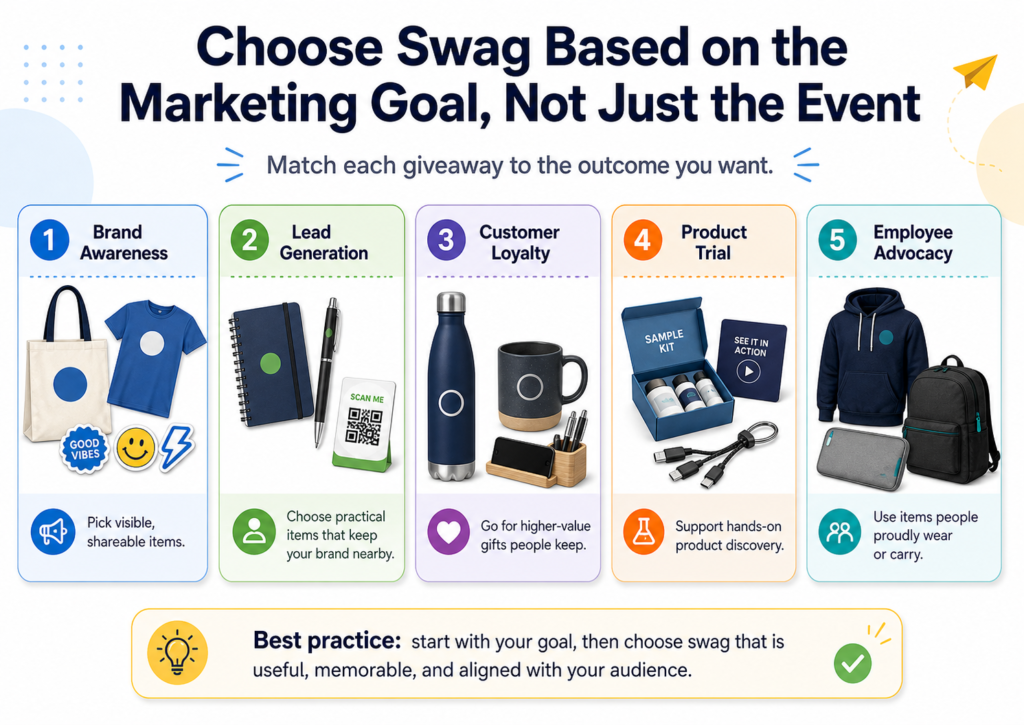
The better starting point is the goal.
Are you trying to get booth traffic? Start sales conversations? Thank loyal customers? Welcome new clients? Reward employees? Build social media buzz? Stay remembered after a meeting? Each goal needs a different kind of swag.
When swag is tied to a clear goal, it becomes part of the marketing plan instead of a random expense.
Trade show swag should help you start better conversations
At trade shows, most people collect too much stuff. They walk around with bags full of brochures, pens, stress balls, stickers, and snacks. By the end of the day, they are tired. Most of the swag gets forgotten.
If your brand wants to stand out at a trade show, your swag should not only attract people. It should help your team start a useful conversation.
Giveaways should connect to the problem your brand solves
For example, if you are a cybersecurity company, a webcam cover, privacy screen cloth, or password notebook could tie into the idea of safety. If you are a project management tool, a desk planner or meeting notebook could tie into better organization.
If you are a wellness brand, a sleep mask, water bottle, or small recovery kit could tie into better daily habits.
This makes the giveaway easier to explain. Your booth team can say something simple like, “We help teams protect their work, so we made a small privacy kit for your desk.” That is much stronger than, “Take a free pen.”
The item becomes an opening line. It gives your team a reason to talk about the pain point without jumping straight into a pitch.
Customer swag should feel more personal than public giveaways
Swag for customers should not feel like event leftovers. A paying customer has already trusted you. That means the gift should feel warmer, more thoughtful, and more connected to the relationship.
Customer swag can be used after onboarding, after a renewal, after a major milestone, or after a successful project. It can also be used to welcome high-value clients into your community.
A customer gift should show that you understand their world
If your customer is a busy founder, a premium desk kit may be better than a flashy branded shirt. If your customer is a sales leader, a quality travel mug or meeting notebook may fit their day. If your customer is a remote team, a work-from-home comfort kit may feel thoughtful.
The more personal the swag feels, the more it works as a relationship builder. It tells the customer, “We see you. We know your day. We care about the experience beyond the invoice.”
This is where packaging also matters. A plain mailer can make even good swag feel average. A clean box, a short note, and a simple message can turn the same item into a memorable moment.
Employee swag should build pride without feeling forced
Employee swag is often overlooked, but it can be one of the strongest forms of brand promotion. When employees actually like company swag, they wear it, use it, post it, and share it. That creates natural brand reach.
But employee swag should not feel like a uniform unless the role requires one. It should feel like something people are proud to own.
Internal swag works best when employees have choice
One of the easiest ways to make employee swag better is to let people choose. Instead of sending everyone the same T-shirt, create a small swag store or give people a few options. Some may want a hoodie. Some may want a backpack. Some may want a desk mat. Some may want a water bottle.
Choice increases use because people select what fits their life. It also reduces waste because fewer people receive items they do not want.
Good employee swag can also support culture. A launch hoodie, anniversary gift, team retreat kit, or milestone item can make people feel part of something real. The item becomes tied to a memory, not just a logo.
Make Apparel People Would Wear Even Without the Brand Name
Apparel is one of the most popular swag categories, but it is also one of the easiest to get wrong. A branded shirt can travel far if people wear it. But if it sits in a drawer, it does nothing.
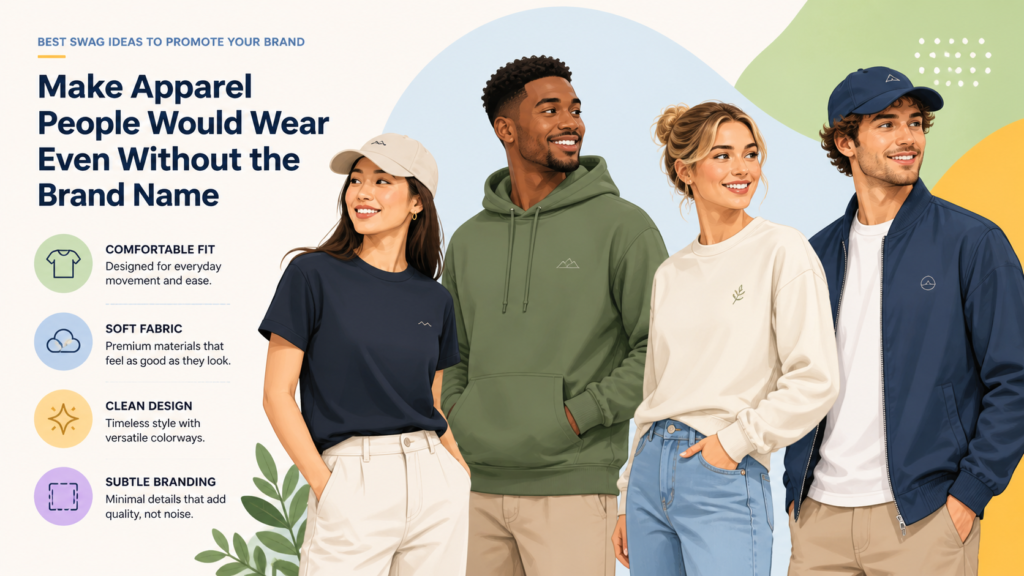
The mistake many brands make is designing apparel for themselves instead of the person wearing it. They make the logo too large, the fabric too thin, the fit too awkward, or the design too corporate. Then the shirt becomes sleepwear, cleaning cloth, or donation pile material.
Great branded apparel starts with fashion first and branding second.
T-shirts should feel soft, fit well, and look simple
A T-shirt is not a creative idea by itself. Almost every brand has made one. But a great T-shirt can still be one of the best swag items because it turns the person wearing it into a moving brand touchpoint.
The difference is in the details.
A shirt people wear in public must feel like real clothing
Choose fabric that feels soft. Avoid stiff, scratchy shirts that shrink badly after one wash. Pick cuts that work for different body types. Keep the design clean enough that someone could wear it on a casual Friday, at a coffee shop, to the gym, or while traveling.
The best branded shirts often do not look like ads. They may use a small logo, a clever phrase, a design tied to the brand’s mission, or a visual that only the community understands. This makes the shirt feel more like identity and less like promotion.
For example, a marketing agency could create a shirt with a simple line about growth, clarity, or smart campaigns instead of placing a huge logo across the front. A software company could use a phrase that its users say often. A fitness brand could create a design that feels energetic and clean.
When people feel that the shirt says something about them, not just about you, they are more likely to wear it.
Hoodies and jackets create higher perceived value
Hoodies, sweatshirts, and jackets cost more than T-shirts, but they also feel more valuable. People tend to keep them longer and use them more often when the quality is good.
This makes apparel a strong choice for customer gifts, employee milestones, creator partnerships, investor events, and premium campaigns.
Premium apparel should feel earned and special
Not every person needs to receive your best hoodie. In fact, premium swag often works better when it is tied to a meaningful action. A customer finishes onboarding. A client reaches one year with you. A partner helps close a major deal. An employee completes a big project. A community member becomes a top contributor.
When apparel is linked to a moment, it feels less like a freebie and more like a badge.
The design should also match the level of the gift. A premium hoodie with poor branding feels confused. Use clean embroidery, a subtle patch, or a small mark. Think about the kind of hoodie someone would buy for themselves. Then make your brand fit into that style.
Caps, socks, and small wearables can add personality
Not every apparel item needs to be a shirt or hoodie. Caps, socks, beanies, scarves, and even simple bandanas can work well when they fit the brand and audience.
These smaller wearables are good because they are easier to size, easier to ship, and often easier to style.
Small apparel items work best with playful design
A cap with a clean logo can work for a startup, sports brand, event company, or local business. Socks can work well for brands with a fun voice or community feel. Beanies can be strong for winter campaigns, outdoor brands, remote teams, or holiday gifts.
The key is to avoid making these items feel like leftovers. A bad cap looks cheap fast. Thin socks feel disappointing. A loose beanie with a huge logo may never be worn.
Small wearables should still feel intentional. The colors should match your brand without looking too loud. The design should feel easy to use. The item should be practical for the season and audience.
Use Desk Swag to Stay Close to Work Decisions
Desk swag is powerful because it lives near the place where many business decisions happen. People write plans at their desk. They take calls there. They compare vendors there. They join demos there. They think through budgets, problems, and next steps there.

If your brand sells to professionals, founders, marketers, sales teams, HR leaders, finance teams, or executives, desk swag can keep your name close to active work.
But desk swag must be useful and calm. No one wants clutter.
Notebooks remain strong because people still write things down
Even in a digital world, notebooks still work. People use them in meetings, during calls, at events, while planning, and when they need to think clearly. A good notebook feels personal. It collects ideas, notes, and plans. That gives your brand quiet staying power.
The notebook should feel better than a throwaway item
A strong branded notebook has good paper, a cover that feels nice, and a design that does not scream for attention. It can include subtle brand details, a useful inside page, or a short message that connects to your value.
For example, a digital marketing agency could include a simple campaign planning page at the front. A sales software company could include a deal notes page. A consulting firm could include a decision checklist. These small touches make the item more useful and more connected to your offer.
The goal is to make the notebook feel like a tool, not a brochure.
Desk mats, mouse pads, and cable tools solve small daily problems
A messy desk creates small friction all day. Cables get tangled. Mice drag on rough surfaces. Devices slide around. Chargers disappear. This is why simple desk tools can make strong swag.
A desk mat, cable organizer, phone stand, or wireless charging pad can be used every day if it is well made.
Desk tools should look clean because they stay visible
Unlike a pen that may sit in a drawer, a desk mat or phone stand is often visible during the workday. It may even show up in video calls or desk photos. That makes design very important.
The branding should be clean and placed with care. The color should not clash with common desk setups. The item should feel like it belongs in a modern workspace.
For B2B brands, this kind of swag can be very effective because it keeps the brand near the buyer without being pushy. A useful desk item says, “We understand your workday,” in a quiet but steady way.
Calendar and planning swag can support long-term recall
Planning tools can work well for brands that help people grow, manage, improve, or organize something. This includes agencies, software companies, coaches, consultants, finance brands, wellness brands, and education brands.
A branded planner, wall calendar, desk calendar, goal tracker, or campaign board can be used for weeks or months.
Planning swag should help the user make progress
A plain calendar with your logo may be fine. But a calendar that helps the user plan better is much stronger. A marketing agency could create a campaign calendar. A fitness brand could create a habit tracker. A finance brand could create a savings planner. A SaaS brand could create a quarterly goal map.
This turns swag into a helpful tool. It also positions your brand as a guide, not just a seller.
When your swag helps someone do something better, your brand earns trust. That trust is more valuable than a large logo.
Pick Drinkware That Feels Useful, Not Generic
Drinkware is one of the safest swag choices because almost everyone drinks coffee, tea, water, or something they carry through the day. But because it is so common, it can also feel boring fast.
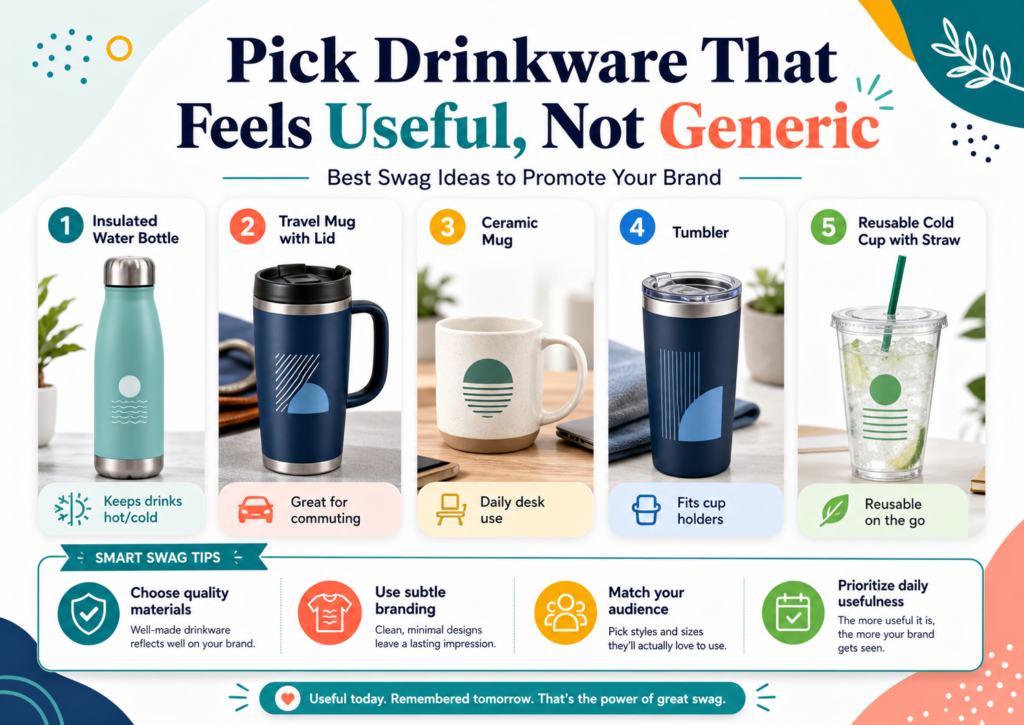
A branded mug or bottle is not enough on its own. The item has to feel good in the hand. It has to fit the person’s routine. It has to be easy to clean, easy to carry, and nice enough to keep.
That is why drinkware should never be treated as a cheap backup idea. When chosen well, it can become one of the most used items in your swag plan.
Water bottles work best when they match how people move
A water bottle can travel with someone to the office, gym, car, airport, event, school, or home desk. That gives your brand many chances to be seen. But people are picky about bottles, and they should be.
A bottle that leaks, smells odd, feels too heavy, or does not fit in a cup holder will not be used for long.
Choose the bottle based on the setting where it will be used
If your audience attends conferences, a slim bottle that fits in a bag is better than a large gym bottle. If your audience works out or spends time outdoors, a larger insulated bottle may be better. If your audience works at a desk, a simple stainless steel bottle with a clean design may be enough.
For events, lightweight bottles can be useful because people can carry them around without feeling annoyed. For premium customer gifts, insulated bottles feel more valuable and last longer. For employee swag, a bottle that fits both office and travel use is usually a strong choice.
The branding should be simple. A small logo, clean mark, or short line works better than covering the whole bottle with graphics. People are more likely to use drinkware when it looks like something they chose, not something they were handed for free.
Coffee mugs can become part of a daily ritual
A mug is more personal than many brands realize. People often have a favorite mug. They use it at the same time each day. They keep it near their desk. They may even bring it to meetings.
That makes mugs powerful, but only when they feel worth keeping.
A good mug should feel like comfort, not clutter
A thin, plain mug with a giant logo will often get pushed to the back of the cabinet. A heavier mug with a good shape, nice finish, and simple design has a much better chance of being used every morning.
For B2B brands, mugs can work well in welcome kits, client gifts, event follow-ups, and employee onboarding boxes. They also pair well with coffee, tea, hot chocolate, cookies, or a handwritten note.
The best mug swag feels like a small pause in the day. It says, “Take a breath. Start fresh. Keep going.” That is a much warmer brand feeling than a hard sales message.
Travel cups are strong for busy buyers and teams
Travel cups sit between water bottles and mugs. They are great for people who commute, visit clients, attend events, drive often, or move between home and office.
A good travel cup can be used daily. A bad one becomes a spill risk.
The lid matters as much as the cup
Before ordering travel cups, test the lid. Check if it leaks. Check if it feels easy to drink from. Check if it fits in common cup holders. Check if it is easy to wash.
People do not forgive bad drinkware. If your branded cup spills coffee on a laptop, bag, or shirt, your brand becomes part of a bad moment. That is the opposite of what swag should do.
For premium campaigns, choose travel cups that feel sturdy and clean. For event giveaways, choose simple versions that still feel reliable. The best cup is not always the flashiest one. It is the one people trust enough to use when they are moving.
Build Swag Kits Around a Clear Moment
Single swag items can work well. But swag kits often create a stronger brand moment because they feel planned. A kit gives you a chance to tell a small story. It can welcome, thank, surprise, guide, or celebrate someone.
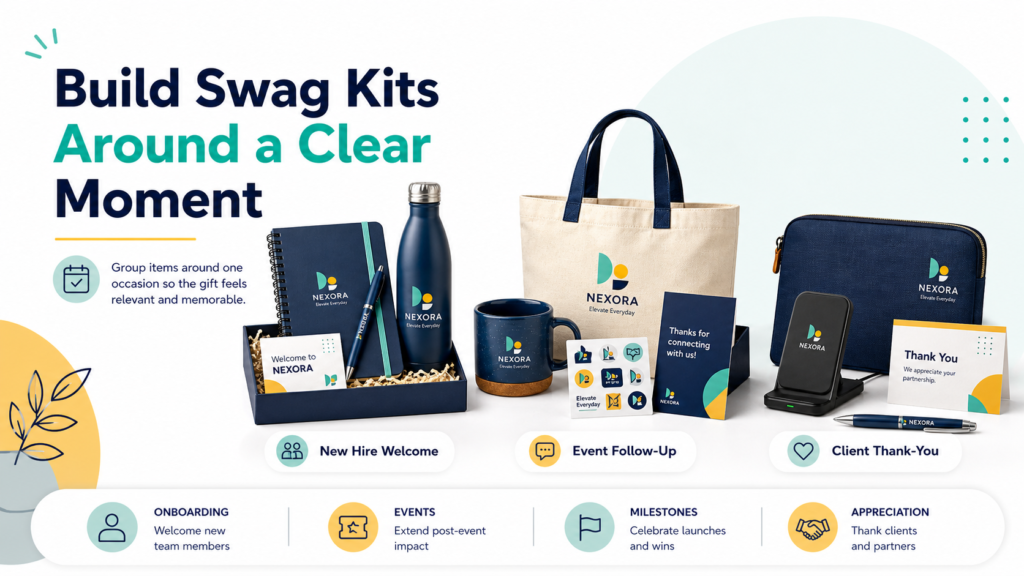
The danger is that many kits become boxes full of random things. That is not a kit. That is clutter in packaging.
A good swag kit has a clear purpose. Every item should support the same moment.
Welcome kits should make people feel like they made the right choice
A welcome kit is often sent after someone becomes a customer, joins a program, signs up for a premium service, joins a team, or enters a brand community. This is a sensitive moment. The person has taken a step toward you. Your job is to confirm that they made a smart choice.
A welcome kit can help do that.
The first physical touch should feel calm, useful, and thoughtful
For a new client, a welcome kit might include a notebook, a pen, a mug, a short printed guide, and a personal note. For a new software user, it might include a quick-start card, laptop stickers, a desk item, and a small treat. For a new employee, it might include apparel, desk tools, a culture card, and something that helps them feel included.
The kit should not feel like a pile of promotional material. It should feel like a useful start.
The message inside matters as much as the items. A simple note can explain why each item is included. For example, “The notebook is for your next big idea. The mug is for the mornings when strategy needs coffee. The guide is here to help you get value faster.” This turns simple items into part of a story.
Event kits should make the experience easier
Event swag is often designed around brand exposure, but the best event kits are designed around attendee comfort. Events are tiring. People stand, walk, talk, carry things, lose chargers, forget snacks, and run out of water.
A smart event kit solves these small problems.
Help people get through the event with less stress
An event kit might include a reusable tote, water bottle, snack, small notebook, pen, phone charger, hand sanitizer, badge holder, lip balm, or comfort item. The right mix depends on the event, audience, venue, and season.
For a conference, focus on practical items that help people move through the day. For an outdoor event, think about sun, rain, heat, and walking. For a private workshop, include items that help people take notes, focus, and remember key ideas.
When your swag makes the event easier, people feel grateful in the moment. That feeling can attach to your brand.
Launch kits should create excitement and sharing
A launch kit can work when you are releasing a new product, opening a new location, announcing a rebrand, starting a campaign, or inviting a small group into something early.
Launch kits should feel more exciting than everyday swag. They are about energy, attention, and momentum.
Make the kit feel like the start of something
A launch kit might include a limited-edition item, a founder note, a sample product, a branded card, a useful tool, and a share-worthy piece of packaging. The goal is to make the recipient feel like they are part of an inside group.
This is where design and timing matter. The kit should arrive close to the launch moment. The message should be clear. The items should connect to the new offer or idea.
If you want social sharing, do not simply ask people to post. Give them something worth sharing. A clean box, smart message, personal note, and useful item will do more than a generic “Tag us on social” card.
Use Tech Swag Carefully Because Expectations Are Higher
Tech swag can be powerful because it solves modern problems. People need to charge devices, clean screens, join calls, protect privacy, manage cables, and work from many places.
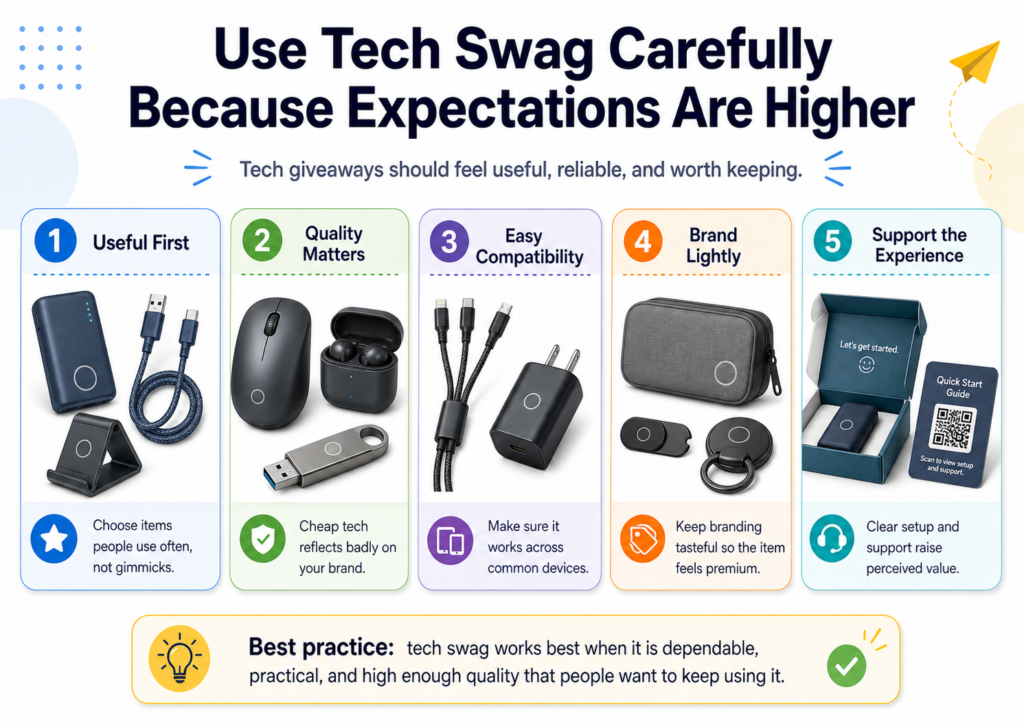
But tech swag also carries risk. Cheap tech items break quickly. Low-quality chargers can feel unsafe. Weak gadgets can make your brand look careless.
So tech swag should be chosen with extra care.
Power banks are useful when they are reliable
A power bank is one of the most practical tech swag items because battery anxiety is real. People rely on phones for work, travel, maps, payments, photos, and communication. A dead phone can ruin a day.
That makes a good power bank valuable.
Do not cut corners on safety or capacity
When choosing power banks, look at real capacity, charging speed, safety certifications, and connector needs. A tiny power bank that barely charges a phone may look cute, but it will not create much value. A reliable one that helps someone through a long flight or conference day can become a trusted item.
Make sure the design is simple and portable. A bulky power bank may stay at home. A slim one may live in a bag. The more often it travels, the more often your brand travels too.
This type of swag is best for business events, travel-heavy audiences, sales teams, founders, executives, students, and remote workers.
Webcam covers and privacy tools can tie to trust
Small tech items can work well when they connect to your brand message. Webcam covers, screen cleaners, privacy cards, and cable clips are simple, but they can feel useful.
They are especially strong for brands that talk about security, trust, productivity, remote work, or modern business.
Simple tech swag should still have a clear reason
A webcam cover from a cybersecurity brand makes sense. A privacy screen cloth from a legal tech company makes sense. A cable organizer from a productivity brand makes sense. A random tech item from a bakery may not make sense unless there is a creative reason behind it.
The item should support the story you want people to remember. That is what makes it feel smart instead of random.
For example, a brand that helps companies protect data could send a small “privacy at work” kit. It could include a webcam cover, screen cloth, password card, and a short guide with simple security habits. This is useful, tied to the brand, and easy to understand.
Wireless chargers can work as premium desk swag
Wireless chargers can be strong gifts because they live on the desk and get used often. They also feel more premium than many small tech items.
But not all wireless chargers work well. Some charge slowly. Some do not work through cases. Some overheat. Some feel cheap.
Test the charger before you put your name on it
This is one of those items where testing is not optional. Try it with different phones and cases. Check the speed. Check the build. Check the cable. Check if it slips on the desk. Make sure the logo placement does not make it look tacky.
A good wireless charger can keep your brand visible every day. A bad one can frustrate the user every day. That is too much risk for a gift that should build goodwill.
Use wireless chargers for high-value audiences, not mass giveaways. They are better for customer gifts, partner gifts, VIP events, executive meetings, and employee kits.
Make Eco-Friendly Swag Feel Practical, Not Performative
Eco-friendly swag has become popular for good reason. People are more aware of waste. Many companies also want gifts that reflect better values. But eco-friendly swag can backfire if it feels like a weak item wrapped in a green message.

People can sense when sustainability is used only as a selling point. The item still needs to be useful. It still needs to be good quality. It still needs to make sense for your audience.
The best eco-friendly swag does not preach. It helps people make a better choice in a simple way.
Reusable bags work when they are strong and good-looking
Tote bags are everywhere, but a strong reusable bag can still work well. People use them for groceries, events, books, laptops, gym clothes, and daily errands.
The problem is that many branded totes are too thin. They cannot carry much. They wrinkle badly. They look like event bags, not real bags.
A tote should be built for real life
Choose thicker fabric, strong stitching, comfortable handles, and a clean design. Think about what the person will actually carry. A small tote may work for a local event. A larger, stronger tote may work better for daily use.
The design should be good enough that someone feels fine carrying it in public. A subtle logo, nice color, and useful shape can make a simple tote feel much better.
For retail brands, agencies, wellness brands, schools, events, and local businesses, reusable bags can be very strong. They are visible, practical, and easy to connect with everyday life.
Recycled notebooks and pens can support a thoughtful message
Eco-friendly stationery is a safe and useful swag category. Recycled notebooks, bamboo pens, seed paper cards, and refillable pens can work well when they are chosen with care.
But do not choose them only because they sound eco-friendly. The notebook still needs good paper. The pen still needs to write well. The seed paper still needs clear instructions.
The useful part must come before the eco story
A recycled notebook that people enjoy using will carry your brand longer. A scratchy notebook that feels cheap will not. A refillable pen can be a smart gift if it writes smoothly and looks clean. A bamboo pen can work if it does not feel flimsy.
The eco message should be simple and honest. Avoid making huge claims unless you can back them up. A small line like “Made with recycled paper” is better than a big statement that feels vague.
People respect brands that are clear and modest. They do not need a speech. They need a useful item that feels like a better choice.
Plant kits can create a memorable brand moment
Plant kits, seed kits, and small grow kits can be very memorable because they involve action. The person does not just receive the item. They plant it, water it, watch it grow, and remember where it came from.
This can work especially well for brands tied to growth, wellness, education, home, food, sustainability, or long-term change.
A plant gift should be easy to use and hard to mess up
If the kit is too complex, people may never start. Choose simple seeds, clear instructions, and packaging that explains what to do. Small herb kits, desk plant kits, or seed paper cards can work well.
The message should connect to your brand in a natural way. A marketing agency could use the idea of growth. A coaching brand could use the idea of progress. A food brand could use herbs. A real estate brand could use the idea of putting down roots.
This kind of swag is not for every campaign. But when it fits, it creates a deeper memory than another pen or sticker.
Use Food Swag When You Want Fast Warmth and Easy Delight
Food is one of the fastest ways to make a brand feel warm. People may ignore another brochure, but they rarely ignore a good snack, a small box of cookies, or a thoughtful coffee pack. Food swag works because it gives the person a simple moment of pleasure. It does not ask much from them. It does not need a long pitch. It just creates a good feeling.

But food swag also needs care. It can feel cheap if it is too generic. It can feel risky if you ignore allergies, dietary needs, shelf life, or shipping conditions. It can also feel forgettable if the packaging does not connect the treat back to the brand.
The best food swag is simple, safe, well packed, and tied to a clear brand moment.
Food gifts work best when they match the mood of the campaign
Not every food gift fits every situation. A fun snack box may work well for a casual event, but it may not feel right for an executive client gift. A luxury chocolate box may work well for a high-value customer, but it may be too costly for a large trade show.
A local treat may feel personal for a regional brand, while a coffee kit may feel natural for a B2B team that starts early and works long days.
Food should match the mood you want to create. If the campaign is about energy, choose snacks, coffee, tea, or protein bites. If the campaign is about comfort, choose cookies, cocoa, brownies, or baked goods. If the campaign is about celebration, choose cupcakes, sweets, or a small dessert box.
If the campaign is about local pride, choose something from a local maker.
The message should make the food feel intentional
A food gift becomes stronger when the note explains why it is there. A simple line can do a lot. For example, a marketing agency could send coffee with a note that says, “For your next big planning session.”
A SaaS company could send cookies after onboarding with a message that says, “You did the hard part. Now let us make the next step smoother.” A real estate brand could send a local snack box with a line about feeling at home.
The message does not need to be clever. It needs to feel human. The food is the warm gesture. The note is what turns that gesture into a brand memory.
Snack boxes are strong for remote teams and virtual events
Remote work changed how brands use swag. When people are not gathering in one room, a mailed snack box can help create a shared moment. It works for webinars, virtual workshops, online summits, sales meetings, employee events, customer onboarding, and community programs.
A snack box makes a digital experience feel more physical. It gives people something to open, enjoy, and connect with while they join from home.
The box should be easy to enjoy during the event
For virtual events, choose snacks that are simple to eat, not messy, and easy to open. Avoid items that need cooking, tools, or extra steps unless that is part of the experience. Think about timing too. If the event is in the morning, coffee, tea, granola, and light snacks make sense.
If it is in the afternoon, cookies, nuts, chips, or small sweets may work better.
The packaging should include a clear card that ties the box to the event. This helps the person understand that the gift is not random. It is part of the experience.
For remote teams, snack boxes can also help with morale. Sending a box before a team day, planning session, or company update can make people feel included. It says, “Even though we are apart, we are still sharing this moment.”
Local food gifts can make your brand feel more personal
Local food is a smart choice when you want the gift to feel special without being loud. It shows that thought went into the selection. It also supports small makers, which can add a positive feeling around your brand.
This works especially well for local businesses, agencies, real estate firms, tourism brands, event hosts, hospitality brands, and companies welcoming clients to a city.
Local flavor helps your brand tell a better story
A local coffee roaster, bakery, spice maker, chocolatier, or snack brand can turn a simple gift into a story. You are not just sending food. You are sharing a piece of a place.
For example, a business hosting a conference in Austin could send a small local coffee and snack kit. A real estate firm could send a welcome box with local treats to new homeowners. A consulting firm could send a regional gift box after closing a client in a new city.
The key is to keep it easy and thoughtful. Do not overload the box. A few good items are better than many average ones. Quality matters more than size.
Create Swag That Helps People Learn or Do Something Better
Some of the best brand swag is not just something people use. It is something that helps them improve. This is especially powerful for service businesses, agencies, consultants, coaches, education brands, SaaS companies, and B2B firms.
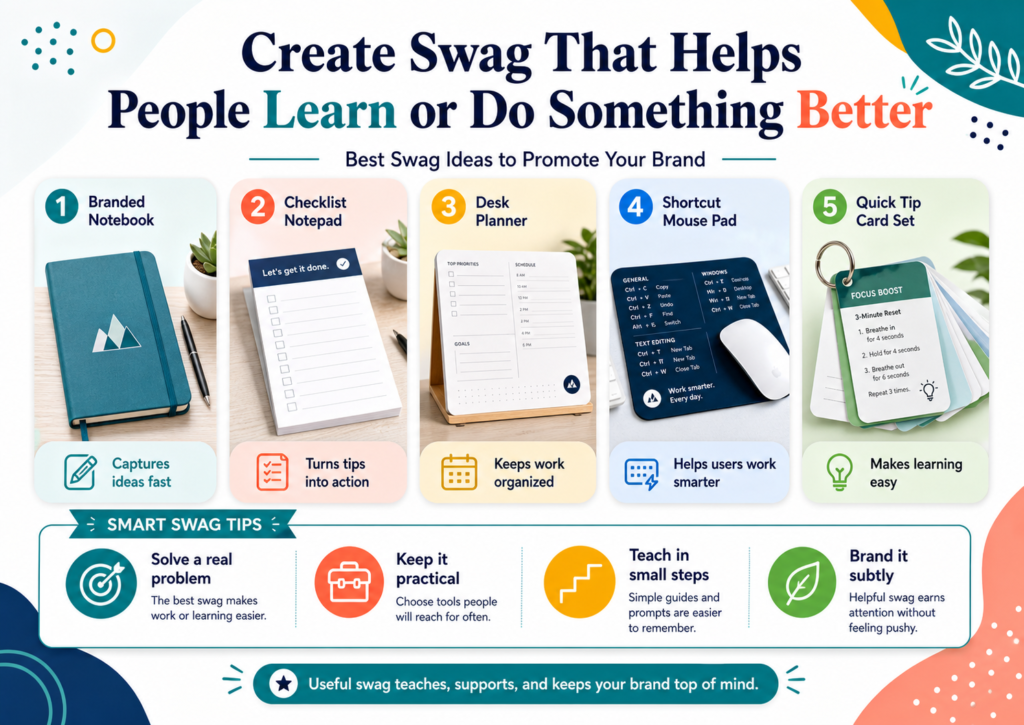
Learning-based swag works because it gives value before asking for anything. It shows your expertise in a helpful way. It also positions your brand as a guide.
This kind of swag can include printed guides, workbooks, checklists, planners, templates, card decks, audit sheets, strategy maps, or small training kits. The goal is not to give people more paper. The goal is to give them a tool they will come back to.
Printed guides can make your expertise easier to remember
Digital content is easy to share, but it is also easy to forget. A printed guide feels more lasting. It can sit on a desk, be marked up, passed around, or used during a meeting.
For a brand like WinSavvy, this kind of swag can be very strong. Instead of only giving a pen or mug, a marketing agency could create a short guide that helps business owners improve one real part of their marketing.
The best guide solves one clear problem
A printed guide should not try to explain everything your company does. That makes it too broad and too hard to use. Pick one problem and solve it well.
For example, a digital marketing agency could create a “30-minute website conversion checkup” guide. It could walk the reader through their headline, call to action, offer, trust signals, page speed, and contact form. A sales consultant could create a “deal review worksheet.”
A finance brand could create a “monthly cash flow planning sheet.” A wellness brand could create a “seven-day reset tracker.”
The more specific the guide is, the more useful it becomes. And the more useful it becomes, the longer your brand stays in the person’s world.
Card decks can turn advice into a simple daily tool
A card deck is a creative swag idea because it feels interactive. It can sit on a desk and be used one card at a time. It also gives your brand many small chances to deliver value.
Card decks can work for marketing tips, sales prompts, leadership questions, customer research ideas, wellness reminders, writing prompts, design checks, hiring questions, or meeting starters.
Each card should give one useful action
A good card deck is not a stack of slogans. It should help the user think, act, or decide. Each card should contain one clear idea, question, prompt, or action.
For example, a brand strategy agency could create a deck with questions like, “What would make your offer easier to say yes to?” A sales training company could create cards with call review prompts. A content agency could create cards with headline angles, blog ideas, or editing checks.
The best part is that the deck can show expertise without feeling like a lecture. It lets people engage at their own pace. It also creates a strong desk presence, which helps brand recall.
Workbooks are powerful for workshops and high-value leads
A workbook can be one of the most useful forms of swag when you are running a workshop, webinar, masterclass, event, sales session, or client onboarding process. It gives people a place to apply what they are learning.
This is much better than giving them a slide deck they will never open again.
A workbook should guide action during and after the experience
A strong workbook does not just repeat the presentation. It helps the person make progress. It should include space to write, simple prompts, examples, and next steps.
For example, a digital marketing workshop could include pages for defining the audience, reviewing the offer, writing a better headline, mapping a funnel, and choosing follow-up actions. A customer success workshop could include pages for onboarding goals, risk signals, and renewal planning.
When the workbook is useful, people may keep it long after the session ends. That means your brand remains attached to the progress they made.
Make Swag Shareable Without Begging People to Post
Many brands want swag to spread on social media. That is understandable. A good unboxing post can create reach, trust, and excitement. But the wrong approach feels forced.
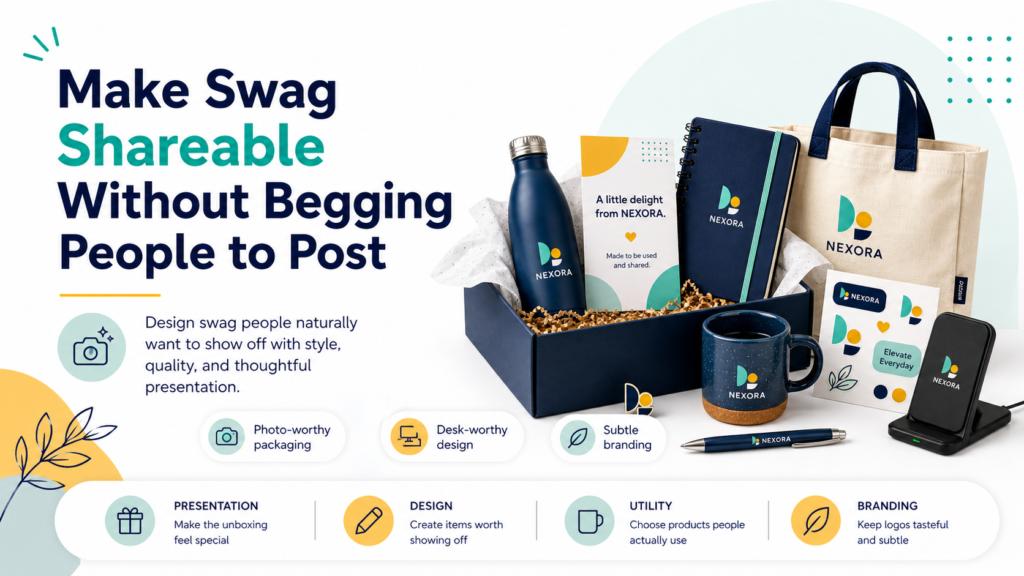
People do not post swag because you ask them to. They post it because it looks good, feels personal, or makes them want to share the moment.
Shareable swag starts with design, timing, packaging, and emotion.
Packaging can make ordinary swag feel special
The box is the first thing people see. Before they touch the item, they notice the packaging. That first impression shapes how they feel about the gift.
A basic item in great packaging can feel more valuable. A great item in poor packaging can feel less exciting.
The outside should create curiosity and the inside should create clarity
Good packaging does not need to be expensive. It needs to feel planned. A clean mailer, tissue paper, a short card, and neat item placement can make a big difference.
The outside of the box can create curiosity with a simple line. The inside should explain the gift clearly. The note should sound like a real person wrote it. Avoid stiff brand language. Avoid long paragraphs about your company. Focus on the recipient and the moment.
For example, instead of saying, “We are pleased to provide you with branded merchandise as a token of appreciation,” say something warmer like, “Here is a small thank-you for building with us. We hope this makes your next workday a little easier.”
That feels human. And human moments are more likely to be shared.
Personalization makes people feel seen
A person’s name on a card, their company name on a note, or a gift chosen for their role can make swag feel far more valuable. Personalization shows effort. Effort creates emotion.
This does not always mean custom printing every item. Sometimes the personal touch can be in the note, the timing, or the reason for the gift.
Small personal details can do more than big budgets
A handwritten card can make a simple mug feel special. A note that mentions a recent milestone can make a notebook feel earned. A gift sent after a customer’s first successful campaign can feel more thoughtful than a bigger gift sent randomly.
For high-value clients and partners, personalization is worth the extra effort. It tells them they are not just another name in a list.
For larger campaigns, you can still create a personal feel by segmenting the gift. Send different kits to founders, marketers, sales leaders, students, creators, or employees based on what they need most. Even simple segmentation makes the swag feel more relevant.
Design for photos, but do not forget real use
Shareable swag should look good in photos. But it still needs to be useful after the photo is taken. Some brands focus so much on the unboxing moment that the item itself becomes weak.
That is a mistake. The post may last one day. The item can last months.
The best shareable swag has both beauty and utility
Choose colors, textures, and packaging that look clean on camera. But also make sure the item is something the person will use. A beautiful box with a poor-quality product may get one polite post, then disappear. A useful item with strong design may show up again and again in daily life.
For example, a clean desk kit may be posted when it arrives, then appear in future desk photos. A well-designed hoodie may be posted once, then worn often. A quality bottle may show up at the gym, in meetings, or during travel.
This is where swag becomes more than a campaign. It becomes part of the person’s lifestyle.
Use Low-Cost Swag Only When the Idea Is Strong
Not every swag campaign needs a large budget. Low-cost swag can work well when the concept is sharp, the design is good, and the item fits the moment. The problem is not cheap swag by itself. The problem is careless cheap swag.
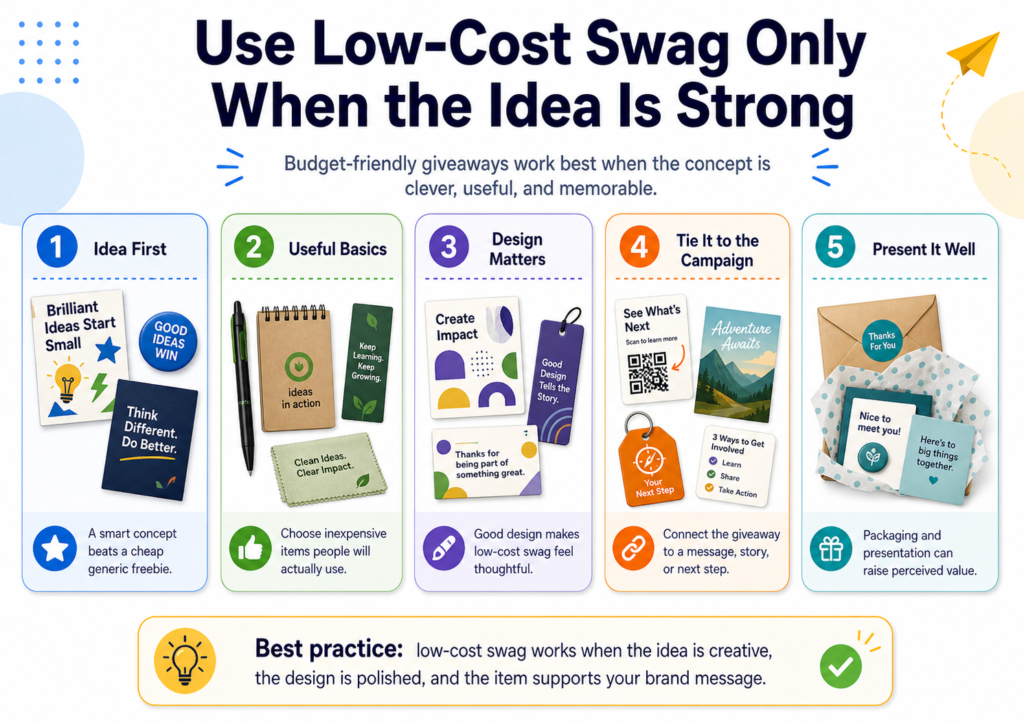
A low-cost item with a smart idea can beat an expensive item with no thought behind it.
Stickers can work when they feel like identity
Stickers are cheap, easy to ship, and popular with some audiences. But a logo sticker alone is not always exciting. People usually put stickers on laptops, bottles, notebooks, and cases when the sticker says something about them.
That means the sticker should feel like a symbol, joke, belief, or community marker.
Make stickers about the audience, not just the brand
A marketing agency could create stickers with short lines about testing, growth, better copy, or smart strategy. A developer tool could create stickers based on inside jokes users understand. A fitness brand could create stickers tied to discipline, progress, or daily effort.
A small logo can still be included, but the main idea should belong to the audience. People display stickers when they feel the message fits them.
This is a small but important shift. The sticker should not say, “Look at our brand.” It should say, “This is something our people believe.”
Pens can still work if they write well
Pens are one of the oldest swag items, so many marketers dismiss them. But people still use pens. The issue is that most branded pens are bad.
A good pen can stay in use for months. A bad pen gets tossed fast.
A pen should feel smooth enough to steal
There is a simple test for branded pens. Would someone quietly keep it after borrowing it? If yes, it may be worth using. If no, choose another pen.
The design should be clean. The ink should flow well. The grip should feel comfortable. The pen should not break after a few uses. A good pen is not exciting, but it is reliable. And reliable can be powerful when your brand wants to feel trustworthy.
Pens work best when paired with notebooks, forms, workbooks, event materials, or desk kits. Alone, they may feel too basic. As part of a useful writing setup, they make more sense.
Magnets, cards, and small tools need a clear reason to stay
Low-cost flat items can be useful because they are easy to mail. This includes magnets, wallet cards, bookmarks, rulers, reference cards, and small checklists.
But these items need a reason to be kept. If they only show your logo, they will likely be thrown away.
Put useful information on small-format swag
A local service business could create a fridge magnet with emergency contact details. A marketing agency could create a small conversion checklist. A finance brand could create a monthly money review card. A health brand could create a simple habit tracker. A home services brand could create a seasonal maintenance card.
The item should answer a real need. That is what earns its place.
Low-cost swag is not about spending less for the sake of it. It is about making a small item useful enough to stay in someone’s life.
Match Swag to the Buyer Journey, Not Just the Brand
Swag becomes much more powerful when it shows up at the right time. Many brands think about what to send, but they do not think enough about when to send it. Timing can change how the same item feels.

A notebook handed out to a stranger at a crowded event may feel ordinary. The same notebook sent after a strong sales call, with a short note about planning the next stage, can feel thoughtful. A hoodie sent to anyone may feel like a giveaway. The same hoodie sent after a customer reaches a big milestone can feel like a reward.
This is why swag should be mapped to the buyer journey. Each stage has a different goal. Each stage needs a different feeling.
Awareness-stage swag should earn attention quickly
At the awareness stage, people may not know your brand well. They may have just met you at an event, seen you online, joined a webinar, or visited your booth. At this point, your swag should be easy to understand and easy to accept.
The goal is not to close the sale. The goal is to create a small memory.
Keep first-touch swag simple, useful, and easy to carry
At this stage, lightweight items usually work best. A good tote bag, sticker sheet, small notebook, event snack, screen cloth, pen, or pocket guide can make sense. The person should not need to think hard about whether to take it.
But even simple swag should connect to your message. If you are a marketing agency, a small “website checkup” card may be more useful than a random keychain. If you help companies hire better, a short interview scorecard may work better than a generic mug.
If you sell productivity software, a simple planning sheet may be better than another stress ball.
Awareness swag should leave people with one clear idea about your brand. Not five ideas. Not your whole pitch. Just one simple connection.
Consideration-stage swag should help people decide
At the consideration stage, the person knows your brand but has not decided yet. They may be comparing options. They may be talking with their team. They may be thinking about budget, trust, timing, and results.
This is where useful, decision-friendly swag can make a real difference.
Give prospects tools that make the buying process easier
A good consideration-stage gift does not need to be expensive. It needs to reduce doubt. A printed buyer guide, comparison worksheet, audit checklist, strategy workbook, sample kit, or planning tool can help the prospect think clearly.
For example, a digital marketing agency like WinSavvy could send a simple growth audit workbook after a discovery call. The workbook could help the prospect review their website, traffic sources, conversion points, content gaps, and follow-up process.
This kind of swag does more than carry a logo. It helps the buyer see their own problem more clearly.
That is powerful because buyers often delay decisions when the problem feels vague. Your swag can help turn a vague problem into a clear next step.
Customer-stage swag should deepen trust after the sale
After someone becomes a customer, swag should no longer feel like a pitch. It should feel like support. The customer has already said yes. Now your job is to help them feel confident, cared for, and excited about what comes next.
This is where welcome kits, milestone gifts, onboarding tools, and thank-you packages can work very well.
Use customer swag to reduce regret and increase loyalty
Many customers feel a small wave of doubt after buying, especially if the purchase is expensive or important. They may wonder if they made the right choice. A thoughtful welcome gift can calm that doubt.
For example, after a client signs with a marketing agency, a welcome kit could include a planning notebook, a simple campaign timeline card, a mug, and a note from the team. The message could make the client feel guided, not sold to.
Later, you can use swag to mark progress. Send something after the first campaign goes live. Send something after the first big win. Send something after a renewal. These moments help the relationship feel active and human.
Design Swag Around Your Brand Positioning
Swag should not feel separate from your brand. It should support the way you want people to see you. If your brand is premium, your swag should feel premium. If your brand is playful, your swag can be playful. If your brand is practical, your swag should solve real problems. If your brand is bold, your swag can make a stronger statement.
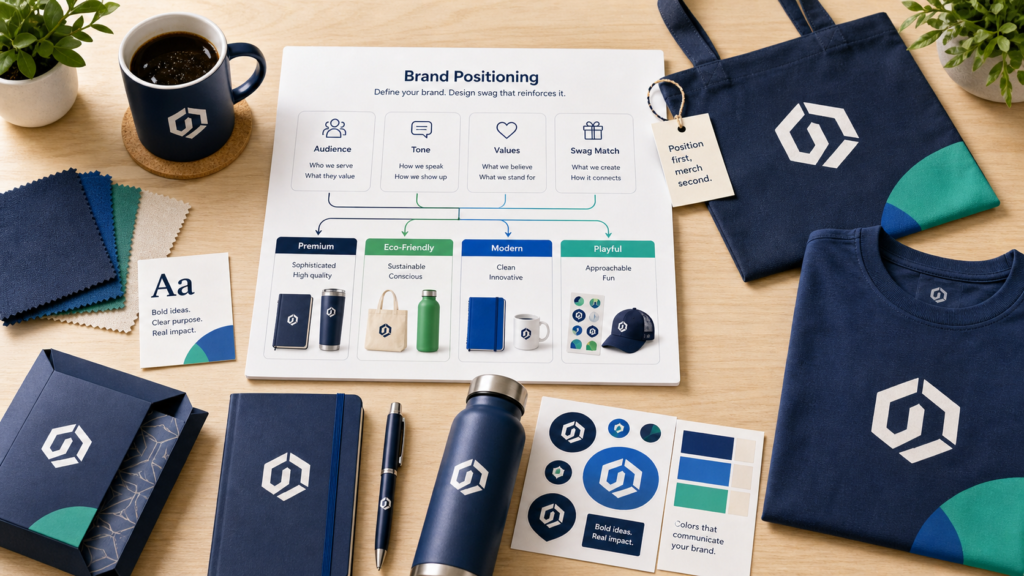
The item itself is only one part of the message. The design, color, material, packaging, copy, and timing all shape how the brand is remembered.
Your swag should say something before people read the logo
A strong brand does not depend only on a logo. People should be able to sense the brand feeling through the whole item. A calm wellness brand should not send harsh, loud, cluttered swag. A high-end consulting firm should not send cheap plastic items.
A creative agency should not send something that feels dull and safe.
The swag should feel like your brand in physical form.
Choose materials and colors that support the brand feeling
A premium brand may use heavier materials, muted colors, clean packaging, and subtle branding. A youth-focused brand may use brighter colors, playful copy, and more expressive items. A sustainability-focused brand may use recycled paper, organic cotton, reusable items, and simple natural textures.
A tech brand may use clean lines, useful gadgets, and modern desk tools.
These choices matter because people read them fast. They may not say it out loud, but they feel the difference between a thoughtful brand and a careless one.
Before ordering swag, ask what the item says about you without any words. Does it feel smart? Warm? Cheap? Fun? Helpful? Premium? Generic? That honest answer will save you from bad choices.
Your swag copy should sound like a person, not a slogan machine
The words you put on swag can make it better or worse. A short line can add charm, meaning, or usefulness. But forced slogans can make the item feel awkward.
Good swag copy is simple. It sounds natural. It matches the moment.
Use words that make the recipient feel included
Instead of printing a broad slogan that only talks about your company, write something that connects with the person using the item. A project management brand could say, “Make today easier to finish.” A marketing agency could say, “Turn good ideas into better growth.” A fitness brand could say, “Show up again tomorrow.”
These lines are simple, but they speak to the user’s world. They are not just shouting the brand name.
You can also use copy inside the packaging. A card, sleeve, insert, or inside-box message gives you more room to be human. This is often better than printing too many words on the item itself.
Brand consistency matters more than decoration
Some brands treat swag as a chance to be random. They use different colors, odd fonts, unrelated jokes, and strange items that do not match their usual style. That can confuse people.
Swag should still feel creative, but it should not feel disconnected.
Keep the visual system clean and recognizable
Use your brand colors with care. Use fonts that match your website and sales materials. Use the same tone of voice people see in your emails, ads, and landing pages. Keep the design simple enough that the item still looks good.
This does not mean everything needs to be boring or overly controlled. It means the swag should feel like it came from the same brand people already know.
When brand touchpoints match, trust grows. The ad feels connected to the website. The website feels connected to the sales call. The sales call feels connected to the welcome kit. The welcome kit feels connected to the service. That is how a brand becomes easier to remember.
Use Swag to Start Conversations, Not End Them
One of the biggest mistakes brands make is treating swag as the final touch. They hand it out and stop there. But swag can do much more when it is tied to a follow-up plan.
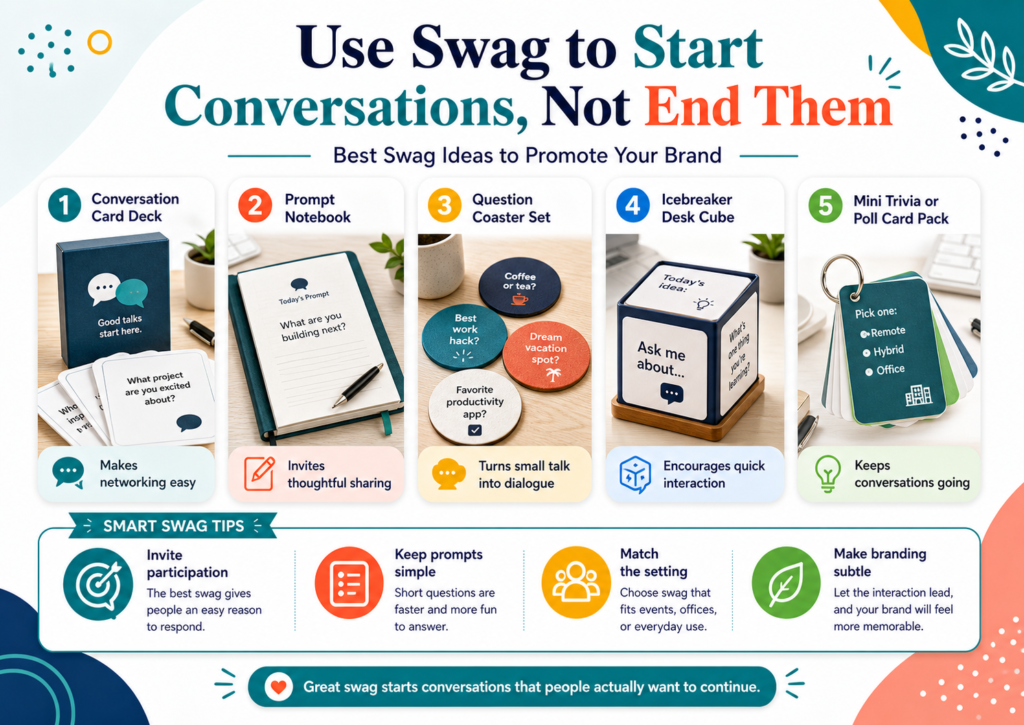
The best swag gives people a reason to talk, reply, scan, share, visit, book, or take the next step. It should not feel like a hard push. But it should create a natural path forward.
Swag works best when it opens the door to a deeper brand experience.
Add a simple next step without making the item feel salesy
A call to action can belong in swag, but it needs to be handled with care. A giant QR code on the front of a shirt may look bad. A small QR code on a card inside the box may work well. A printed link on a useful guide can make sense. A short message on packaging can invite action without pressure.
The next step should match the gift.
Make the follow-up useful enough to earn the scan
Do not send people to a generic homepage unless there is a strong reason. Send them to something that connects with the swag. If you give a website audit checklist, the QR code could lead to a free audit video, a landing page teardown, or a booking page for a strategy call.
If you give a fitness habit tracker, the QR code could lead to a seven-day challenge. If you give an event kit, the QR code could lead to the event agenda, slides, or bonus resources.
The action should feel like the next helpful step, not a trap.
This is where many brands lose trust. They give something useful, then send people to a page that only sells. A better move is to continue helping first. When people feel helped, they are more open to buying.
Train your team to use swag as a talking point
Swag can help your sales or event team start better conversations, but only if they know how to use it. If your team just says, “Here is a free gift,” you lose the chance to connect it to the brand message.
Your team should know the reason behind each item.
Give your team a simple story for every swag item
If you give out a notebook, the story might be, “We made this for teams planning their next growth move.” If you give out a privacy kit, the story might be, “We help companies protect their data, so we wanted to give you a simple way to protect your workspace too.”
If you give out a snack kit at a long workshop, the story might be, “We know these sessions can be packed, so this is here to keep you going.”
These small lines make the swag feel more intentional. They also help your team shift from a giveaway to a conversation.
This matters at trade shows, client meetings, sales calls, webinars, and onboarding sessions. The item should support the message your team is already trying to deliver.
Follow up while the gift is still fresh
Swag creates a moment. That moment fades if you do nothing with it. A smart follow-up can turn the gift into a real marketing touchpoint.
The timing matters. If someone receives a kit on Monday, following up two weeks later may be too late. A short message soon after delivery can feel natural and helpful.
Mention the gift in a human way
The follow-up should not sound like a cold sales script. It should refer to the gift lightly and connect it to the next step.
For example, after sending a planning notebook, you could say, “I hope the notebook is useful as you map out the next campaign. I also wanted to share the audit template we mentioned, since it pairs well with the first few pages.” That feels much better than, “Did you receive our branded merchandise?”
A good follow-up keeps the conversation warm. It reminds the person why you sent the item. It also helps move the relationship forward without pressure.
Avoid Swag That Creates Waste, Friction, or Brand Damage
Bad swag is not harmless. It can waste money, create clutter, annoy people, and make your brand look careless. In some cases, it can even cause real problems, like broken tech, poor sizing, shipping delays, or gifts that clash with company policies.
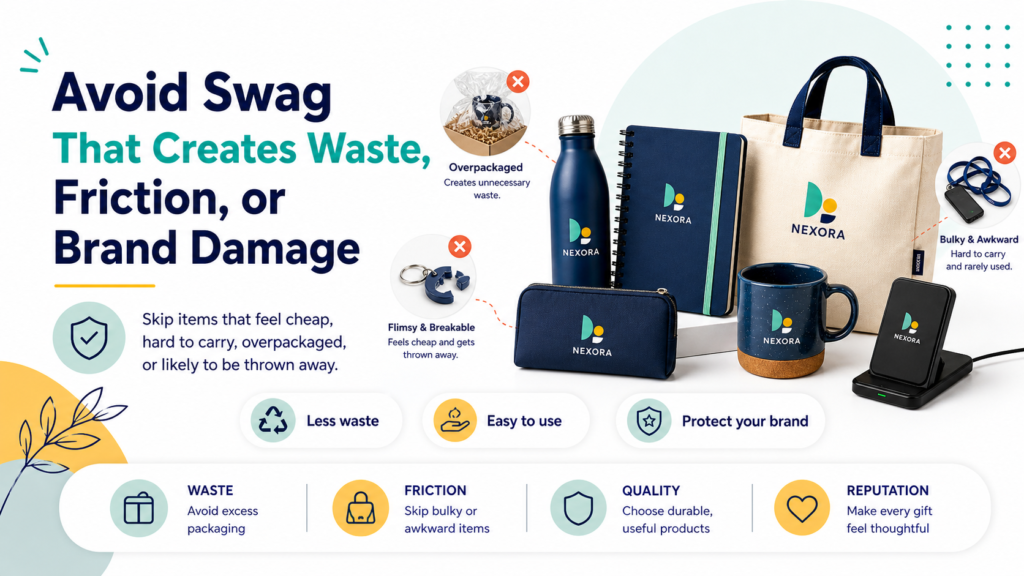
A smart swag strategy includes knowing what to avoid.
The goal is not to be afraid of swag. The goal is to choose with care.
Do not buy items only because they are cheap
Cheap items can be useful, but cheapness should not be the main reason you choose them. If the item breaks, looks bad, or feels pointless, it does not matter how little it cost. It still wastes money because it does not create value.
A low unit cost can hide a high total waste.
Think in cost per use, not cost per item
A one-dollar item used once may be more expensive than a ten-dollar item used fifty times. That is the real math of swag. You are not only buying objects. You are buying moments of attention, use, and recall.
A cheap pen that stops writing after a day has almost no value. A better pen used for three months has much more value. A thin tote that tears quickly hurts your brand. A stronger tote used every week can keep your brand visible for a long time.
Before choosing an item, ask how often the person is likely to use it. That one question can help you avoid a lot of waste.
Avoid items that are hard to ship, store, or manage
Some swag looks great in a product photo but becomes a headache in real life. It may be too heavy, too fragile, too large, too costly to ship, or too hard to store. It may have too many size options. It may need special packing. It may arrive late or damaged.
These details matter because execution affects the brand experience.
Operational friction can ruin a good idea
A ceramic mug may be a good gift, but if half the mugs arrive broken, the campaign becomes a problem. A custom jacket may be impressive, but if sizing is wrong for many people, it creates frustration. A food item may be lovely, but if it melts during shipping, it becomes a mess.
Think about the full path before you order. Where will the items be stored? Who will pack them? How long will shipping take? What happens if someone needs a different size? Can the item survive heat, cold, pressure, and delays? Does it have any rules around shipping to certain places?
The best swag plan is not just creative. It is practical.
Be careful with humor, trends, and edgy ideas
Fun swag can work very well, but it must fit your audience. A joke that feels funny to your team may not land with customers. A trend that feels fresh today may feel old by the time the items arrive. An edgy line may get attention, but it can also create risk.
Swag is physical. It lasts longer than a social post. That means poor judgment can stick around.
Make sure the idea will still feel good later
Before printing a joke, phrase, meme, or bold statement, ask if it will still make sense in six months. Ask if it could be misunderstood outside your team. Ask if it would feel right if a senior buyer, partner, employee, or public audience saw it.
This does not mean your swag has to be dull. It means your creativity should be controlled by good judgment.
The safest strong ideas are usually tied to the audience’s real life, not short-lived internet jokes. A useful insight, shared belief, simple phrase, or clean design will age better than a trend.
Measure Swag Like a Real Marketing Channel
Swag often gets treated as a “nice to have” expense because brands do not measure it well. But if you are spending money on items, design, shipping, packaging, and team time, you should know whether the campaign helped.
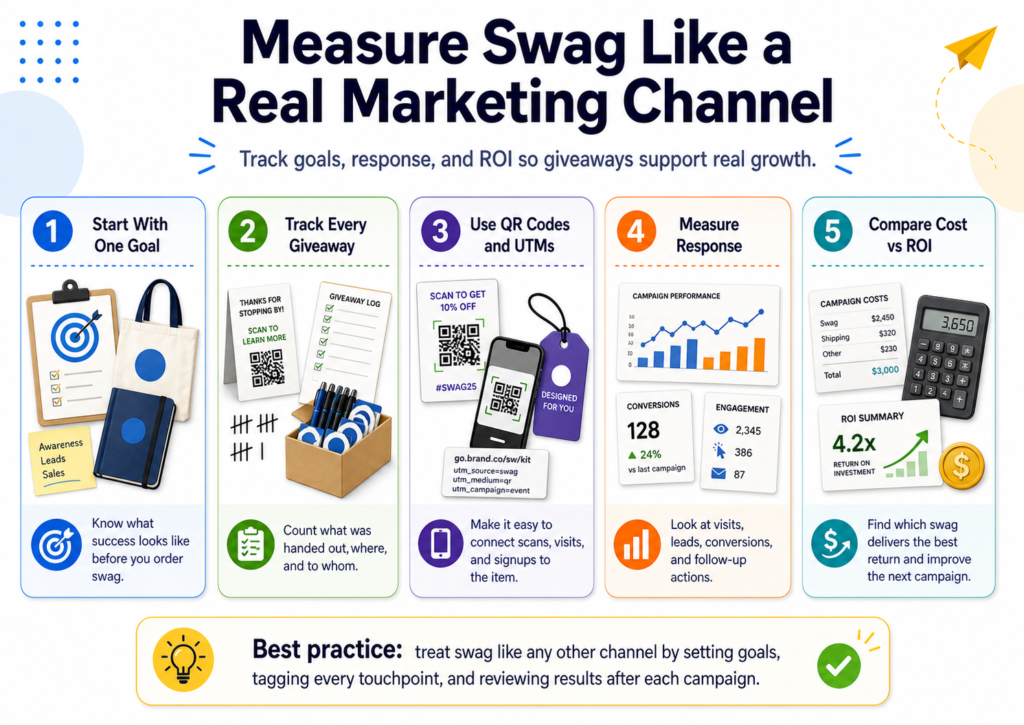
You may not measure swag the same way you measure paid ads, but you can still track clear signals. The key is to decide what success means before you order anything.
Swag should have a purpose, a cost, a target audience, and a way to judge impact.
Choose one main goal for each swag campaign
A single swag campaign should not try to do everything. If you want event booth traffic, measure booth visits, scans, meetings booked, or qualified conversations. If you want customer loyalty, measure retention, expansion, feedback, referrals, or engagement.
If you want social reach, measure posts, mentions, shares, and replies. If you want sales support, measure follow-up replies, call bookings, and deal movement.
The goal shapes the item, message, and follow-up.
A clear goal makes the campaign easier to improve
If the goal is booth traffic, you may learn that small, visible items work best. If the goal is executive gifting, you may learn that fewer, higher-quality gifts create better replies. If the goal is onboarding, you may learn that practical tools reduce confusion and improve early engagement.
Without a clear goal, every result feels vague. People may say the swag was “nice,” but nice is not a strategy.
A simple goal gives your team a way to learn. That learning makes the next campaign better.
Use trackable links, QR codes, and segmented landing pages
You do not need to make swag feel like a tracking device. But small tracking tools can help you see what happens after the gift is received.
A QR code, short link, unique offer page, event code, or campaign-specific landing page can show whether people took action.
Track the next step without hurting the experience
The tracking should feel natural. A QR code on a printed guide can lead to bonus resources. A link inside a welcome kit can lead to onboarding steps. A code on an event card can unlock a template. A URL on a product sample can lead to a special page.
The landing page should match the swag. If the gift is about planning, the page should offer planning help. If the gift is about a launch, the page should explain the launch. If the gift is for customers, the page should support customers.
This keeps the experience smooth. It also gives your team useful data without making the recipient feel watched.
Ask for feedback from the people who received it
Numbers matter, but direct feedback matters too. Ask people what they used, what they liked, what they ignored, and what they would have preferred. This can save you from repeating bad choices.
Your own team can also provide helpful feedback. Sales teams, event teams, customer success teams, and account managers often hear comments that never show up in dashboards.
Real reactions are better than internal opinions
A leadership team may love an item that customers do not care about. A design team may like a look that employees do not wear. A marketing team may think a kit is clever, while recipients find it confusing.
Ask simple questions. Did people use it? Did they mention it? Did they post it? Did it help start conversations? Did it feel worth the cost? Did it arrive in good condition?
The answers will help you build a smarter swag system over time.
Use Seasonal Swag to Stay Relevant Without Feeling Random
Seasonal swag works because it fits what people are already doing. A winter gift feels useful when the weather is cold. A summer kit feels natural when people are outdoors, traveling, or attending events. A year-end gift feels timely because people are reflecting, planning, and closing out the year.
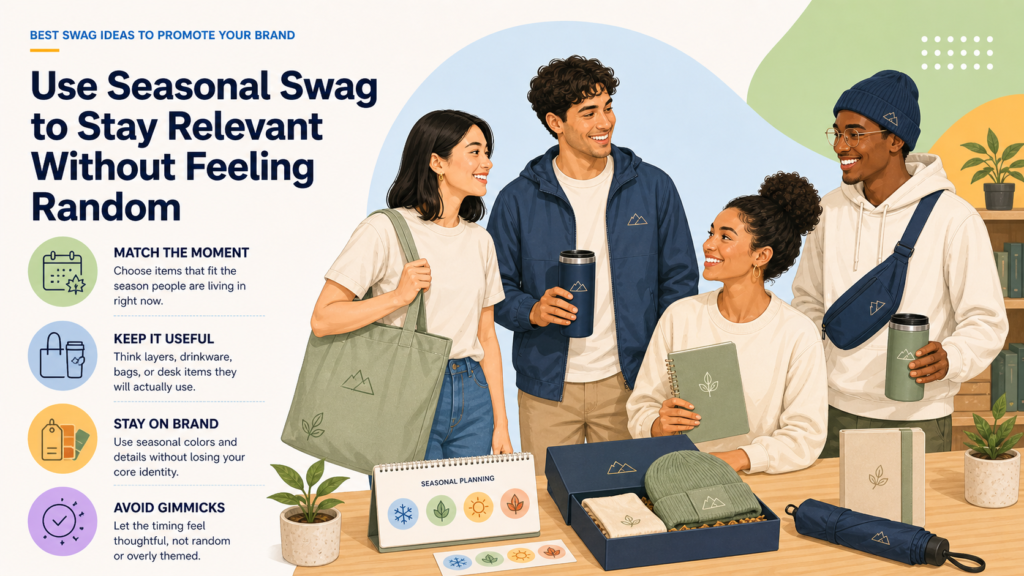
The mistake is using seasons as an excuse to send generic items. A holiday card with a logo can be fine, but it will not do much by itself. A seasonal gift should match both the moment and the person’s real life.
When seasonal swag is done well, it feels less like promotion and more like good timing.
Winter swag should focus on comfort and warmth
Winter swag gives brands a chance to create comfort. People spend more time indoors, drink more hot beverages, layer clothing, and look for simple ways to feel cozy. This makes winter a strong time for mugs, blankets, socks, beanies, hot cocoa kits, tea sets, candles, desk warmers, and soft apparel.
But winter gifts should still feel polished. A scratchy blanket or thin beanie can make your brand feel cheap. A soft, useful, well-packed gift can create a warm memory.
Comfort swag should feel personal, not lazy
The best winter swag does not just say, “Here is a blanket with our logo.” It says, “Here is something to make your busy season easier.” That small shift changes the whole feeling of the gift.
For example, a client gift could include a soft blanket, a quality mug, and a short note about taking a well-earned pause after a busy quarter. A remote employee kit could include warm socks, tea, and a small desk item that makes long workdays feel better.
A customer thank-you box could include cocoa, cookies, and a message about ending the year with gratitude.
The item should not be buried under loud branding. Winter swag works best when it feels calming. Subtle branding, soft colors, and simple packaging usually perform better than loud prints.
Summer swag should support movement, travel, and outdoor use
Summer swag works best when it helps people move through hot days, outdoor events, vacations, conferences, team outings, or casual work weeks. Good summer swag can include caps, sunglasses, cooling towels, water bottles, picnic blankets, sunscreen holders, beach totes, travel pouches, and lightweight shirts.
The goal is to make the person’s day easier while keeping your brand visible in public spaces.
Summer gifts should be easy to carry and easy to use
Summer events often involve walking, heat, crowds, and travel. Heavy items can become annoying. Fragile items can break. Items that need careful handling can get left behind.
A strong summer swag item should feel simple. A good bottle helps people stay hydrated. A cap helps with sun. A tote helps carry event items. A light towel helps during workouts, races, outdoor festivals, or company retreats.
For brands that attend outdoor events, summer swag can create high visibility. People may use the item during the event itself, which turns your swag into part of the scene. But again, quality matters. Sunglasses that break in one day or bottles that leak will hurt the brand more than they help.
Year-end swag should help people reflect, reset, or plan ahead
The end of the year is a strong time for thoughtful brand gifts because people are thinking about what happened and what comes next. This is especially useful for B2B brands, agencies, consultants, coaches, SaaS companies, and professional services firms.
Year-end swag should not only say thank you. It should help the person feel ready for the next step.
Planning gifts make your brand part of the next year
A planner, goal-setting workbook, desk calendar, journal, or strategy map can be a strong year-end gift. It gives the person a tool they may use as they plan the coming year. That puts your brand close to future goals and decisions.
For a marketing agency like WinSavvy, a year-end planning kit could include a simple growth workbook, a campaign calendar, a quality pen, and a short note that says something like, “Here is to clearer goals, sharper campaigns, and smarter growth next year.” That message feels useful because it fits the season.
This kind of swag is not just a gift. It is a soft strategic reminder. It places your brand inside the planning moment, which is exactly where many business buying decisions begin.
Use Swag to Strengthen Partnerships and Referrals
Swag is not only for customers and event visitors. It can also support partners, affiliates, referral sources, creators, vendors, and community leaders. These people can extend your brand far beyond your own channels.
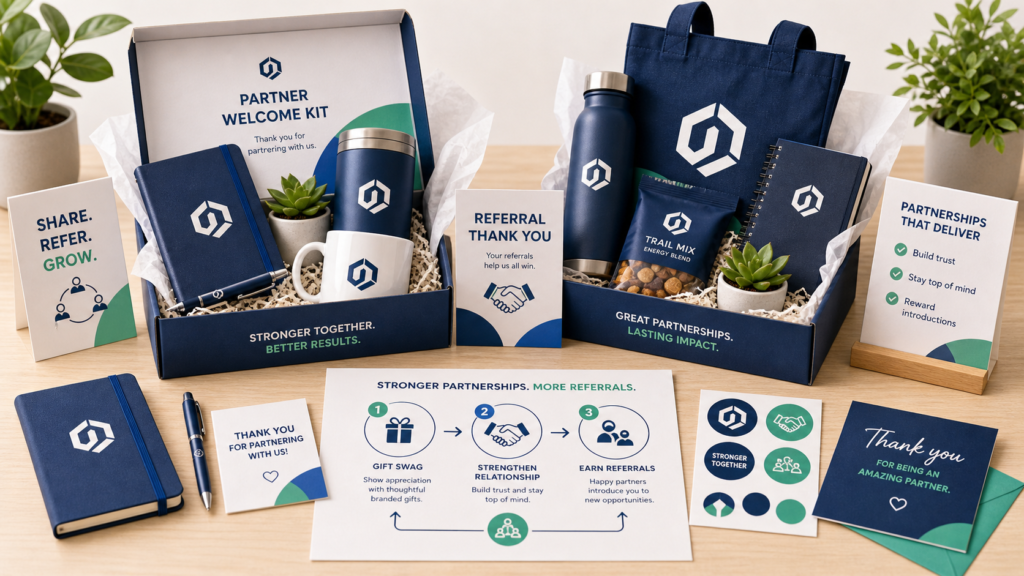
But partner swag should feel different from mass giveaway swag. Partners are closer to your brand. They may represent you, recommend you, co-market with you, or introduce you to buyers. The gift should help them feel valued and equipped.
The best partner swag makes it easier for someone to talk about you, remember you, and feel proud to be linked with you.
Referral gifts should feel like a real thank-you
When someone refers business to you, they are giving you trust. They are putting their name behind your brand. That deserves more than a quick “thanks” email.
A thoughtful referral gift can make the person feel appreciated and more likely to refer again.
Make the gift match the value of the relationship
A small referral may call for a warm handwritten note and a useful gift. A high-value referral may deserve a premium box, personal message, or custom item. The gift should feel proportional without feeling like a bribe.
For example, after a strong referral, a digital agency could send a desk kit, a premium notebook, or a local food box with a note that says, “Thank you for trusting us with people you care about. We do not take that lightly.” That kind of message feels sincere because it names the real value of the referral.
Do not make referral swag too transactional. If the gift feels like a payout, it can weaken the warmth. If it feels like gratitude, it can strengthen the relationship.
Partner kits should help people explain your brand
If you work with partners who introduce, resell, recommend, or co-promote your services, swag can become a simple enablement tool. It can help them understand your message and share it with others.
This is especially useful when your offer is complex or when partners need to explain your value quickly.
Include tools that make conversations easier
A partner kit can include more than branded items. It can include a short positioning card, a simple offer guide, a one-page buyer profile, a conversation starter, a small gift partners can pass to prospects, and one or two high-quality branded items for the partner themselves.
For example, if WinSavvy worked with business consultants who refer clients needing SEO and content strategy, a partner kit could include a plain-language guide called “How to Spot a Business That Needs Better Search Visibility.” It could also include a small stack of printed audit cards that the partner can share with clients.
This turns swag into a sales support tool. It helps partners talk about you with more confidence and less guesswork.
Creator and community swag should feel like belonging
Creators, ambassadors, and community members can help spread a brand message in a way paid ads cannot. But they need to feel like insiders, not just distribution channels.
Swag can help create that feeling of belonging.
Limited items can make the community feel special
A limited-run hoodie, pin, notebook, cap, or welcome box can make members feel part of a group. The item should not be available to everyone. That makes it feel earned.
For example, a brand could send a special item to top contributors, long-time customers, early users, active community members, or people who helped support a launch. The message should make the reason clear. People value gifts more when they understand why they received them.
Community swag should focus less on promotion and more on identity. The item should say, “You are one of us.” When people feel that, they are more likely to wear, share, and talk about the brand with real pride.
Make Swag Part of a Bigger Brand Experience
Swag works best when it is not alone. It should connect to your website, emails, sales process, events, customer journey, social content, and brand story. When all those pieces work together, swag becomes part of a larger experience.
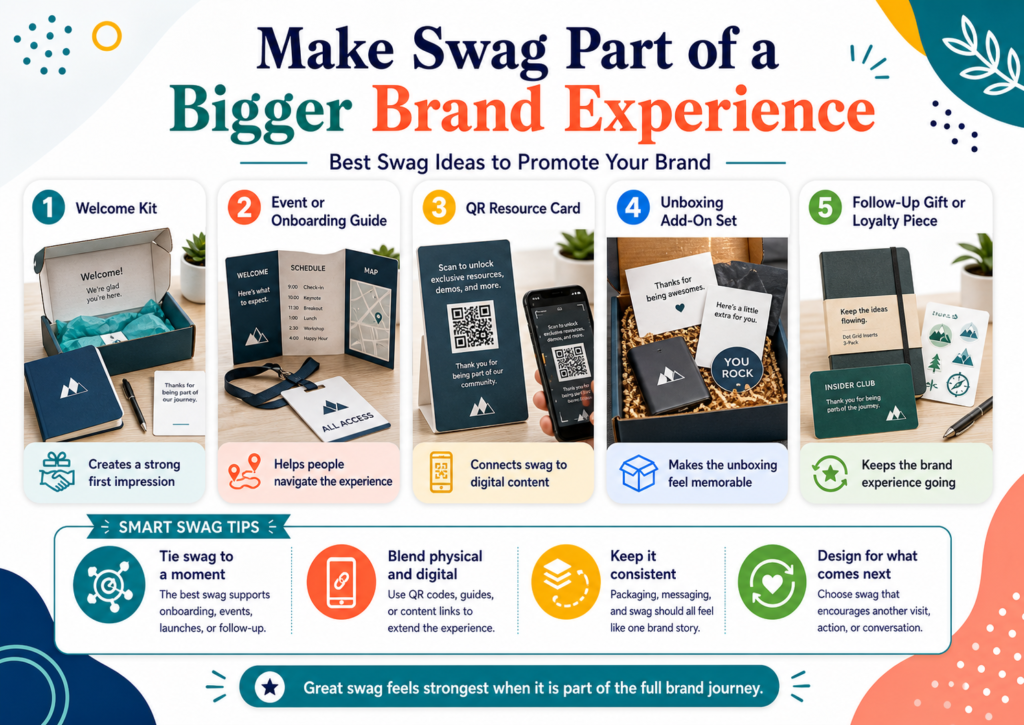
This matters because people rarely remember a brand from one touch. They remember patterns. They remember how the brand made them feel across many small moments.
Swag can be one of those moments, but it needs support.
Connect swag to your content strategy
Swag and content can work together very well. A useful gift can point people toward helpful content. Helpful content can make the gift more valuable. This is especially important for brands that sell services, advice, software, or expertise.
For example, a printed checklist can lead to a full online guide. A planning notebook can connect to a video workshop. A card deck can link to a weekly email series. A sample kit can lead to a landing page with deeper education.
Physical items can make digital content feel more real
Most brands fight for attention online. A physical item can help your best content stand out. Instead of sending another email with a link, send a small tool that makes the content easier to use.
For a marketing agency, this could mean sending a conversion checklist that links to a full landing page teardown guide. For a sales training company, it could mean sending call coaching cards that link to sample call reviews. For a wellness brand, it could mean sending a habit tracker that links to a daily audio guide.
The physical item gives people a reason to care. The digital content gives them more depth. Together, they create a stronger brand experience than either one alone.
Connect swag to your sales process
Sales teams often need small ways to stay remembered without sending another “just checking in” email. Swag can help, but only if it is used with care.
The key is to send items that support the sales conversation, not distract from it.
Send swag when it adds value to the decision
A gift after a discovery call can help summarize the problem. A workbook before a strategy session can help the buyer prepare. A sample kit can help the buyer understand the product. A customer story booklet can help a buying committee build trust. A simple desk item can keep your brand present during a long decision cycle.
But do not use swag as a shortcut for poor sales follow-up. A gift will not fix a weak offer, unclear value, or slow response time. It should support a strong process, not replace it.
For B2B sales, the best swag often feels like a tool. It helps the buyer think, compare, plan, or explain. That is more useful than a random treat sent with a vague hope that the deal will move.
Connect swag to your customer experience
Once someone becomes a customer, swag can support onboarding, adoption, loyalty, and advocacy. It can make the relationship feel more human.
This matters because customers do not only judge the result. They judge the experience around the result.
Use small gifts to mark progress and build momentum
A welcome kit can help customers feel confident at the start. A milestone gift can celebrate progress. A renewal gift can show thanks. A referral gift can honor trust. A surprise gift can create delight when the customer does not expect it.
These moments do not need to be expensive. They need to be well timed and sincere.
For example, after a client’s first successful campaign, an agency could send a small framed campaign snapshot, a notebook for the next goal, or a simple thank-you box. The point is to make the win feel seen. That emotional layer can turn a normal service relationship into a stronger brand bond.
Conclusion
The best swag is not the loudest, cheapest, or trendiest item. It is the item people actually want to keep, use, and remember. When your swag fits the audience, the timing, and the message, it becomes more than a giveaway. It becomes a small brand experience.
Choose items with purpose. Keep the design clean. Make the gift useful. Add a human note. Connect it to a clear next step. Done well, swag can build trust, start conversations, reward loyalty, and keep your brand present in daily life without feeling pushy or forced.















Comments are closed.