
WinSavvy Editorial Standards
How this article was created
Digital marketing can feel noisy, fast, and hard to control. One day everyone says you need to post more on social media. The next day, someone tells you to run ads, start a newsletter, improve SEO, make videos, build funnels, use AI, or redesign your website. For many business owners, this creates more confusion than clarity.
Start With a Clear Business Goal Before Choosing Any Channel
A digital marketing strategy should never begin with the question, “Where should we post?” It should begin with the question, “What are we trying to grow?”
This sounds simple, but many businesses skip it. They start running ads, posting on LinkedIn, writing blogs, or sending emails without knowing what success should look like. As a result, their marketing becomes busy, but not useful. They get activity, but not direction.
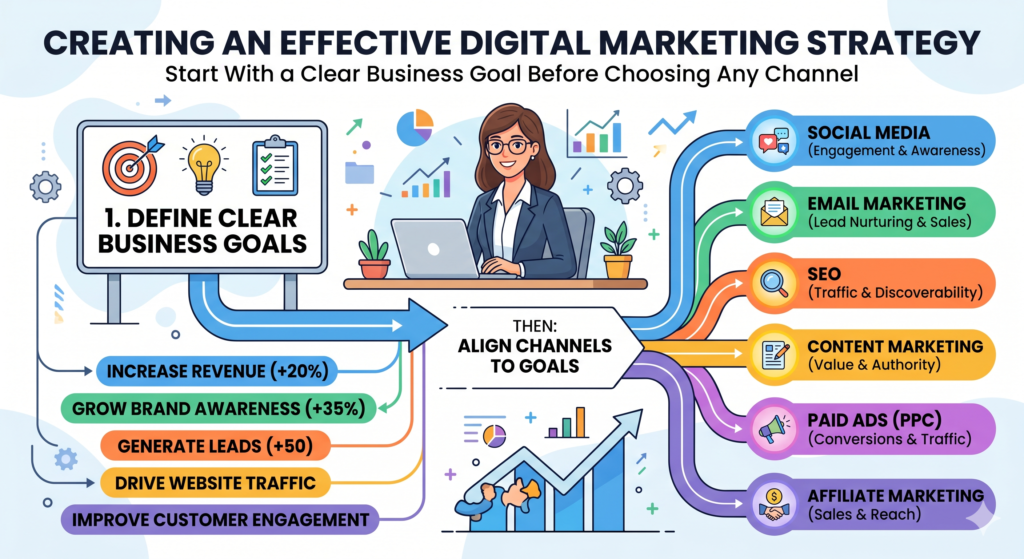
A clear business goal gives your marketing a job. It tells every campaign what it must support. If your goal is more leads, your strategy will look different from a business trying to increase repeat sales. If your goal is to enter a new market, your message will be different from a company trying to retain current customers.
Marketing works best when it is tied to a real business outcome. That outcome could be more booked calls, more demo requests, higher order value, stronger brand trust, more email subscribers, or better customer retention.
The point is not to choose a goal that sounds impressive. The point is to choose a goal that matters to the business right now.
Your marketing goal should be narrow enough to guide daily choices
A weak goal sounds like “we want more visibility.” That may feel good, but it is too vague to guide action. What kind of visibility? With whom? For what purpose? A stronger goal would be “we want to increase qualified consultation calls from mid-sized B2B companies over the next six months.”
That kind of goal gives your team something real to work with. It shapes your content topics. It shapes your landing pages. It shapes your ad targeting. It shapes your email offers. It also helps you say no to work that does not serve the goal.
When a goal is too broad, every idea feels worth trying. When a goal is clear, you can judge each idea by one simple standard: will this help us move closer to the outcome we want?
Turn your goal into a simple marketing promise
Once your business goal is clear, turn it into a marketing promise. This does not mean a slogan. It means a clear idea your market can understand.
For example, if your business goal is to get more leads from small business owners, your marketing promise might be about helping them get steady growth without wasting money on random tactics. If your goal is to sell to larger companies, your promise may need to focus on trust, process, proof, and lower risk.
This promise becomes the base of your strategy. It tells people why they should pay attention. It gives your content a clear voice. It makes your offers feel connected instead of scattered.
Without this promise, your marketing can become a collection of unrelated posts, pages, emails, and ads. With it, every part of your marketing starts to feel like it belongs to the same story.
Know Exactly Who You Are Trying to Reach
Most digital marketing fails because it tries to speak to too many people at once. The message becomes soft. The offer becomes unclear. The content feels general. And when people do not feel like you are speaking directly to them, they move on.
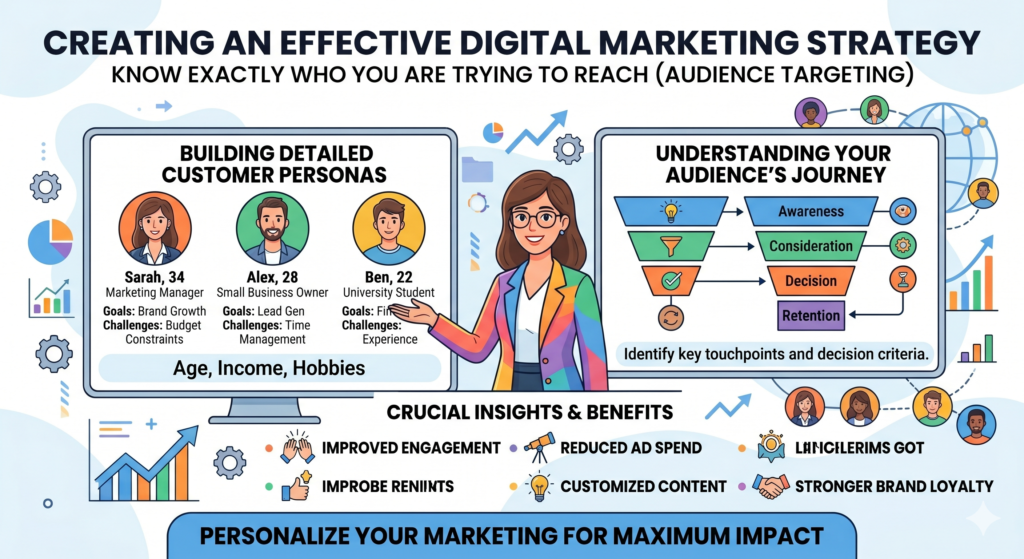
Knowing your audience does not mean writing down basic details like age, job title, or location and stopping there. Those things can help, but they are not enough. You need to understand what your audience is trying to solve, what they are afraid of, what they have already tried, and what would make them trust you.
Good marketing feels personal because it reflects the customer’s real world. It uses their language. It answers their hidden doubts. It shows that you understand the pressure they are under.
Your best audience is not always the biggest audience
A common mistake is trying to reach everyone who could possibly buy from you. This usually weakens your strategy. The best audience is not always the largest group. It is the group most likely to value what you offer, trust your method, and take action within a reasonable time.
For example, a digital marketing agency could serve many types of businesses. But the strategy becomes stronger when it chooses a sharper focus. It may focus on funded startups that need lead generation. Or service businesses that need stronger local SEO. Or B2B firms that need content to support longer sales cycles.
Each audience has different pain points. Each needs a different message. Each responds to different proof.
When you define your audience clearly, your marketing becomes easier to create and easier to measure. You no longer have to guess what to say. You can build your message around the problems your buyers already care about.
Study the gap between what your customers want and what they believe
People do not buy only because they want a result. They buy when they believe your business can help them get that result.
This is where many strategies break down. A business may know what its customers want, but it does not understand what those customers believe. They may want more leads, but believe agencies waste money. They may want better SEO, but believe it takes too long. They may want a stronger website, but believe redesigns are expensive and risky.
Your strategy must address these beliefs. If you ignore them, your marketing will feel incomplete. You will talk about the result, but not the reasons people hesitate.
Strong marketing closes the belief gap. It helps people move from doubt to confidence. It does this through clear content, honest proof, simple explanations, strong case studies, and offers that feel safe enough to try.
Build Your Positioning Before You Build Campaigns
Positioning is the way your business is understood in the mind of the customer. It answers a simple question: why should someone choose you instead of another option?
This is one of the most important parts of digital marketing, yet it is often rushed. Many businesses jump straight into content, ads, and social media without first deciding how they want to be seen. That creates weak marketing because every channel ends up saying something slightly different.
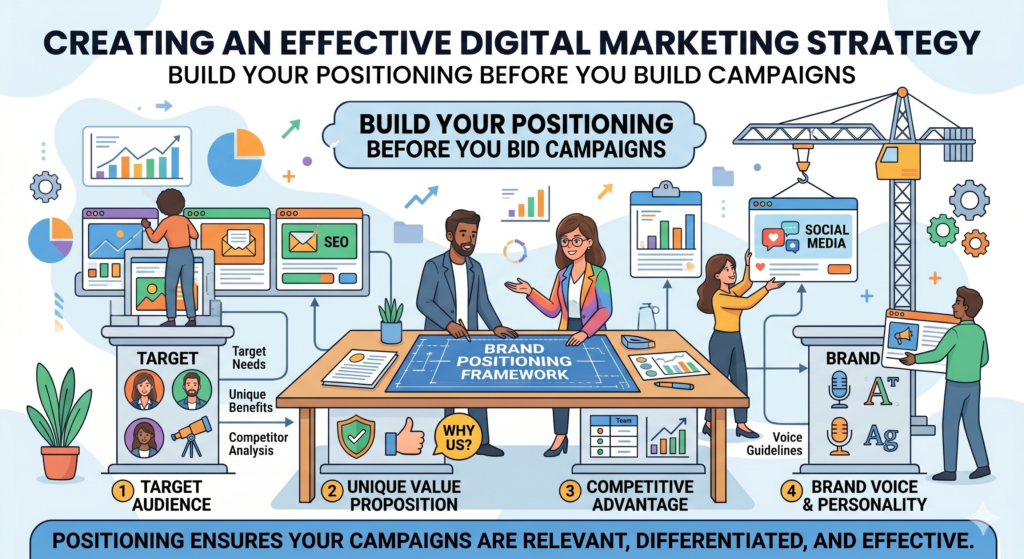
Your positioning should make your business easy to understand. It should make your value clear. It should also show why your approach is different in a way that matters to the buyer.
This does not mean you need to sound clever. In fact, simple positioning is usually stronger. People are busy. They do not want to decode your message. They want to know who you help, what you help them achieve, and why your way is better or safer.
Strong positioning makes your marketing easier to remember
A business that says “we help companies grow online” is hard to remember. Too many companies say the same thing. But a business that says “we help B2B service firms turn their websites into steady lead engines” is much easier to understand.
The second message is sharper. It tells us who the business helps. It tells us what outcome they create. It also suggests a clear problem they solve.
This kind of clarity matters because people rarely buy the first time they see you. They may read a blog, visit your website, see a post, watch a video, and then come back later. If your message is clear and repeated often, it sticks. If your message changes all the time, people forget you.
Positioning gives your marketing memory power. It helps customers place you in a clear box in their mind. That box should be simple, useful, and tied to a real need.
Use contrast to make your message sharper
One of the easiest ways to improve positioning is to show what you are not.
For example, you may say your approach is not about chasing vanity metrics. It is about building a marketing system that turns attention into revenue. You may explain that your content is not written just to fill a blog. It is built to answer buyer questions and support the sales journey.
This kind of contrast helps people understand your standards. It also helps you stand apart from weaker options in the market.
But contrast should be used with care. You do not need to attack competitors. You only need to show how your approach is different. The goal is to help the customer make a clearer choice.
When your positioning is strong, your campaigns become easier to build. Your ads have a clearer angle. Your website has a stronger message. Your content has a sharper point. Your sales calls become smoother because people already understand what you stand for before they speak to you.
Map the Customer Journey Before Creating Content
Content works best when it meets people at the right stage of their decision. Someone who is just learning about a problem does not need the same message as someone ready to buy. If you treat every visitor the same, your content will miss the moment.
The customer journey is the path a person takes from not knowing you to trusting you enough to act. This path is rarely straight. People may find you through Google, leave, see your post later, join your email list, read a case study, compare you with others, and then book a call weeks later.
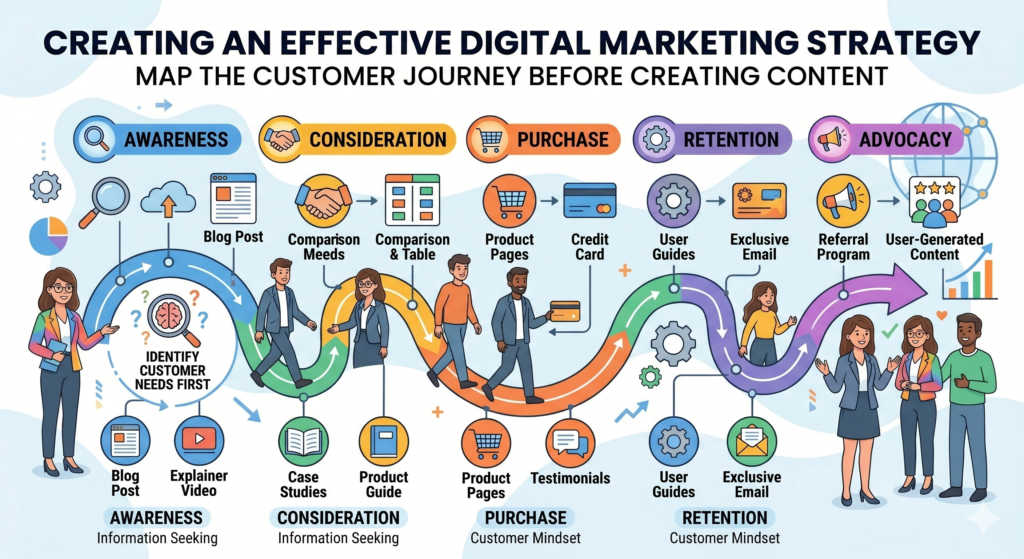
A strong strategy plans for this. It does not expect one blog post or one ad to do all the work. It builds content for each step of the journey.
Your content should answer the questions buyers ask before they contact you
At the early stage, people may ask broad questions. They want to understand the problem. They may search for why their traffic is not converting, why their ads are expensive, or why their website is not bringing leads.
At the middle stage, they compare options. They want to know whether SEO, paid ads, content, email, or a full strategy makes sense for them. They are trying to choose a path.
At the final stage, they need proof and confidence. They want to know if you can deliver, how your process works, what results are realistic, and what the next step looks like.
If your content only focuses on broad topics, you may attract visitors but fail to convert them. If your content only focuses on selling, you may miss people who are still learning. A balanced strategy covers the full path.
Build trust before asking for action
Many businesses ask for the sale too early. Their content gives a few light tips and then quickly pushes people to book a call. That can work for some ready buyers, but it often fails with people who need more trust first.
Trust is built through depth, honesty, and usefulness. When your content explains a problem clearly, the reader feels understood. When it gives practical advice, the reader feels helped. When it shows real proof, the reader feels safer.
This is why journey mapping matters. It helps you decide what each piece of content should do. Some content should attract attention. Some should educate. Some should remove doubt. Some should help people compare. Some should invite action.
When every piece has a clear role, your marketing starts working like a system instead of a pile of random assets.
Make Your Website the Center of Your Digital Strategy
Your website is not just an online brochure. It is the main place where people decide whether your business is worth their time. Even if someone finds you through social media, ads, search, referrals, or email, they will often visit your website before taking the next step.
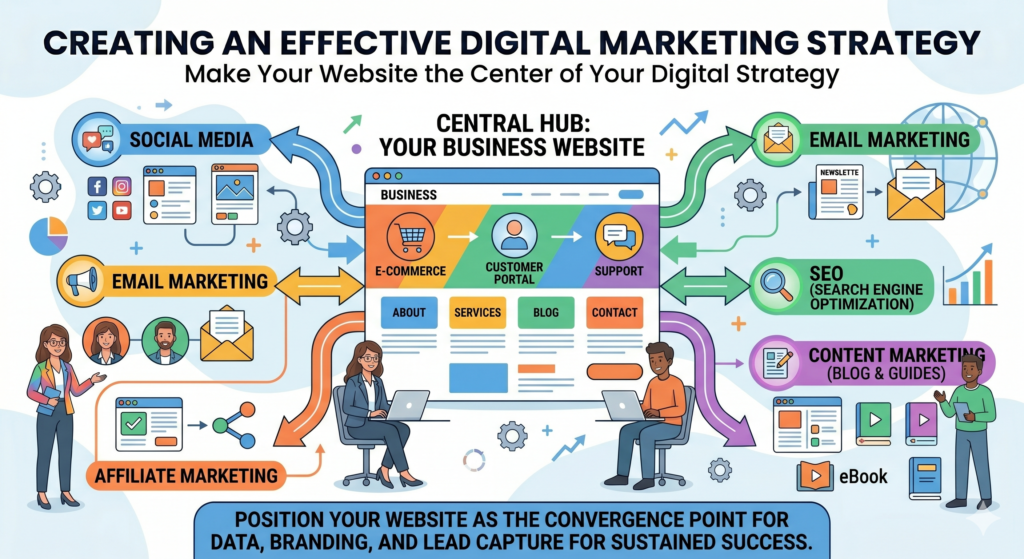
That means your website must do more than look nice. It must explain your value quickly. It must guide people clearly. It must answer the questions that stop people from acting.
A strong website does not make visitors work hard. It tells them where they are, what you offer, who it is for, why it matters, and what to do next.
Your homepage should make the right person feel they are in the right place
A common website mistake is using vague language at the top of the homepage. Phrases like “growth solutions for modern brands” may sound polished, but they often do not say enough. Visitors should not have to scroll or guess to understand what you do.
The first section of your homepage should make three things clear. It should show who you help, what result you help them get, and why your approach is worth trusting.
This does not mean cramming everything into one sentence. It means making the message clear enough that a real visitor can understand it within seconds.
Your homepage should also guide different types of visitors. Some may be ready to contact you. Some may want to read more. Some may need proof. Some may want to understand your services. Good website structure helps each person move forward without confusion.
Every important page should have one clear next step
Many websites lose leads because they do not guide visitors well. A person reads a service page, feels interested, and then does not know what to do next. Or they see too many calls to action and feel unsure.
Each key page should have one main purpose. A service page may lead to a consultation. A blog post may lead to a related guide or email signup. A case study may lead to a strategy call. A pricing page may lead to a demo or inquiry.
The next step should feel natural based on where the visitor is in the journey. Asking for too much too soon can reduce action. Asking for too little can waste interest.
Your website should work like a helpful guide. It should not pressure people. It should lead them with clarity.
Use SEO to Capture Demand That Already Exists
SEO is one of the strongest parts of a digital marketing strategy because it helps people find you when they are already looking for answers. Unlike social media, where you often interrupt people while they are scrolling, SEO lets you meet buyers at the moment they are searching.
But SEO is often misunderstood. Many businesses think it is only about keywords, rankings, and traffic. Those things matter, but they are not the full point. The real goal of SEO is to bring the right people to your website and help them move closer to a business decision.
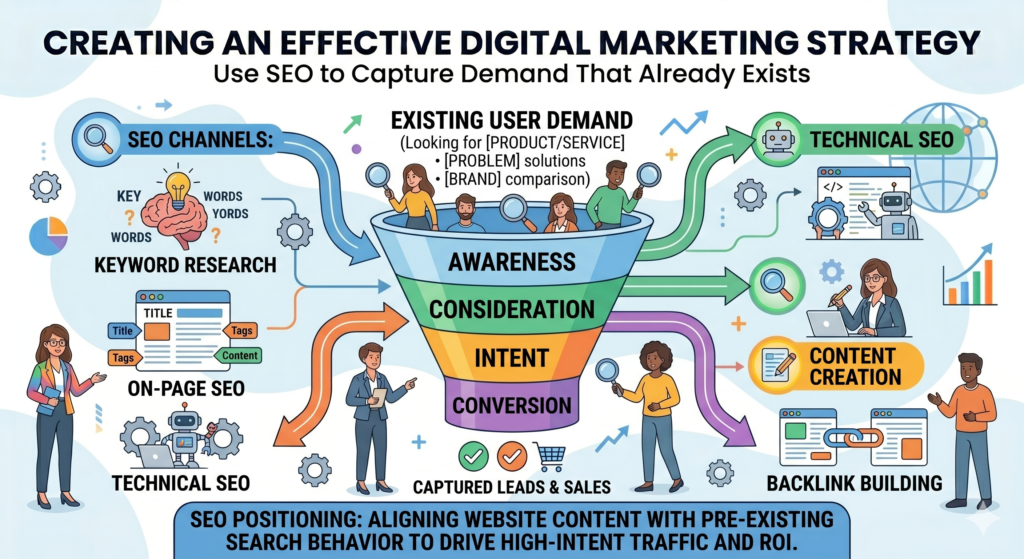
Getting traffic from people who will never buy is not useful. Ranking for random terms can make reports look good, but it does not always help revenue. A smart SEO strategy focuses on the questions, problems, and search terms that connect to real customer intent.
Search intent should guide every SEO decision
Search intent means the reason behind a search. When someone types a phrase into Google, they are not just typing words. They are trying to solve something. Your job is to understand what they want and give them the best possible answer.
For example, someone searching “what is digital marketing” is likely early in their journey. They may want a simple explanation. Someone searching “digital marketing strategy for small business” is more serious. They may be looking for a plan they can use. Someone searching “digital marketing agency for B2B lead generation” is much closer to buying.
Each search needs a different type of page. A simple guide may work for the first search. A detailed strategy article may work for the second. A service page or case study may work for the third.
If you treat every keyword the same, your SEO will feel weak. You may rank, but you may not convert. When you match the page to the intent, SEO becomes far more valuable.
Build topic depth instead of chasing single keywords
Strong SEO is not built on one article. It is built on topic depth. This means your website should cover the key problems your audience cares about from many helpful angles.
For a business that offers digital marketing services, this may include content about SEO, paid ads, content strategy, conversion, email marketing, lead generation, landing pages, analytics, and customer journeys. But these topics should not be scattered. They should connect to each other in a clear way.
When your site covers a topic deeply, search engines can better understand what your business is about. More importantly, your visitors can see that you know the subject well.
This builds trust. A person may land on one article, then read another, then visit a service page, then check a case study. That path is where SEO becomes more than traffic. It becomes a trust-building system.
Create Content That Solves Real Problems, Not Just Content That Fills Space
Content marketing is not about publishing more. It is about being useful in a way that helps people trust your business.
Many companies create content because they feel they have to. They post blogs, videos, social updates, and newsletters without a clear reason. The result is often thin content that says the same things everyone else is saying. It may fill a calendar, but it does not change anyone’s mind.
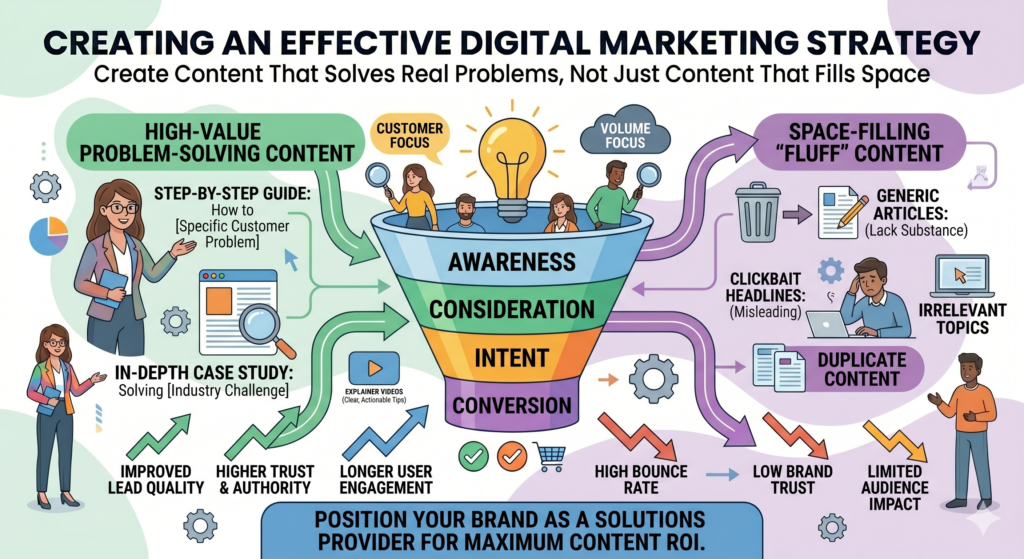
Good content should make the reader feel clearer after reading it. It should help them understand a problem, make a decision, avoid a mistake, or take a smarter next step.
Every piece of content should have a job
Before creating content, ask what job it should do. Is it meant to attract new visitors? Is it meant to answer a sales question? Is it meant to build trust with people who already know you? Is it meant to help leads compare options? Is it meant to reduce doubt before a call?
When content has no job, it becomes noise. When it has a job, it becomes an asset.
For example, a blog post about “common SEO mistakes” may attract people who are struggling with search traffic. A case study may help a serious lead believe you can deliver. A comparison page may help someone choose between hiring an agency and building an in-house team. A newsletter may keep your business top of mind until the buyer is ready.
This is how content supports strategy. It does not just exist. It moves people.
Write with proof, examples, and clear next steps
Content becomes stronger when it feels grounded. Readers do not want vague claims. They want examples. They want simple steps. They want to see how the idea applies to their own business.
Instead of saying, “Improve your website copy,” explain what weak copy looks like. Show why it fails. Then show what better copy should do. For example, a weak service page may talk mostly about the company. A stronger service page speaks to the customer’s problem, explains the outcome, gives proof, and invites a clear next step.
This kind of content feels useful because it teaches. It does not just tell the reader what to do. It helps them see the issue clearly.
At the end of each piece, the next step should match the reader’s stage. A person reading an early guide may not be ready for a sales call. They may need a related article, checklist, or email signup. A person reading a detailed service page may be ready to book a consultation.
Good content respects timing.
Make Your Brand Message Simple Enough to Repeat
A strong digital marketing strategy needs a message people can remember. If your audience cannot explain what you do after visiting your website or reading your content, your message is too complex.
Many businesses try to sound impressive. They use big claims, broad words, and polished phrases. But the best message is usually the clearest one. People should be able to understand it fast and repeat it easily.
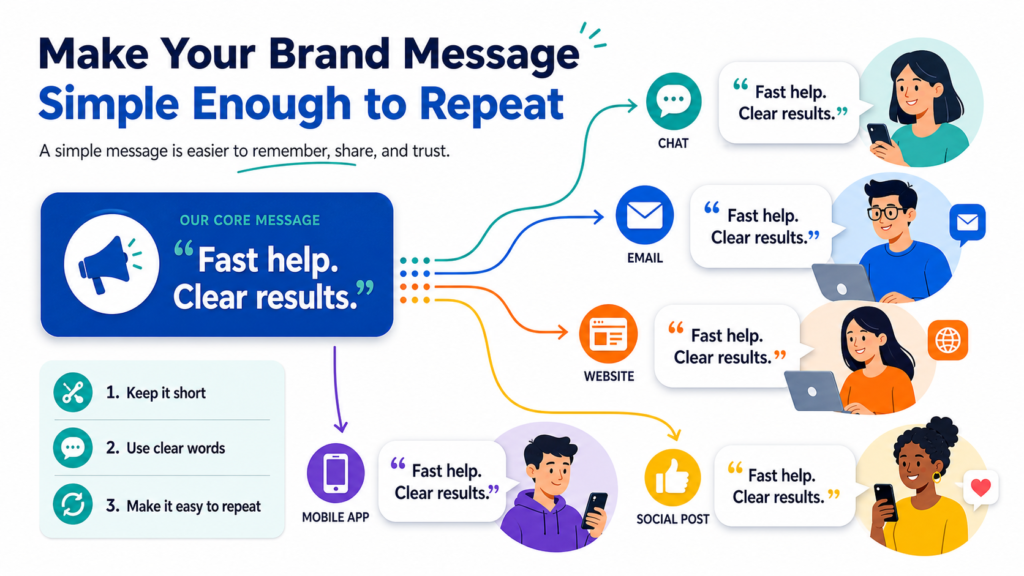
Your message should answer the questions already in the customer’s mind. What do you do? Who do you help? What problem do you solve? Why should I trust you? What should I do next?
Clear messaging builds trust faster than clever messaging
Clever words may grab attention for a moment, but clear words build confidence. A buyer does not want to feel confused. They want to feel safe. They want to know that you understand their problem and have a practical way to solve it.
For example, saying “we create digital growth ecosystems” may sound modern, but it does not say much. Saying “we help service businesses get more qualified leads from search, content, and conversion-focused websites” is much clearer.
Clear messaging does not mean boring messaging. It means useful messaging. It gives the reader a reason to keep reading.
This matters across every channel. Your website, ads, emails, social posts, proposals, and sales calls should all carry the same core message. The words can change, but the promise should stay steady.
Repeat your core message until the market remembers it
Many businesses change their message too often. They get bored before the audience even remembers what they stand for. This is a mistake.
Your market needs to hear your core idea again and again. Not in the exact same sentence every time, but in a consistent way. Repetition builds memory. Memory builds trust. Trust makes action easier.
If your business helps companies turn websites into lead engines, that idea should show up in your homepage, blog content, case studies, ads, and email campaigns. Over time, people begin to connect your brand with that outcome.
That is how a simple message becomes a market position.
The goal is not to say everything. The goal is to say the right thing clearly enough that the right person remembers it when they need help.
Use Paid Ads to Speed Up Learning, Not Just to Buy Traffic
Paid ads can be powerful, but only when they are used with a clear strategy. Many businesses spend money on ads too early, before their message, offer, landing page, and follow-up process are ready. Then they blame the platform when the results are poor.
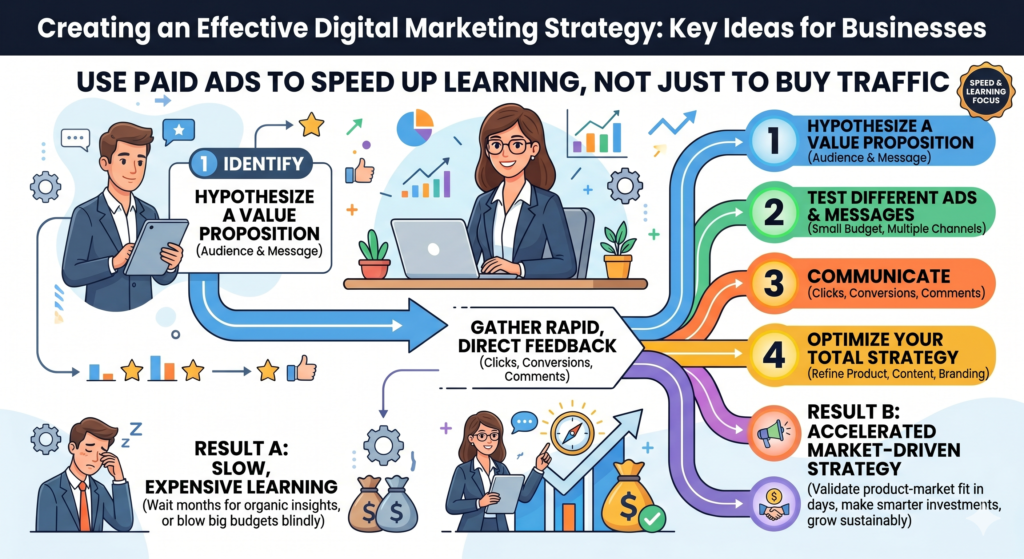
The truth is that paid ads do not fix weak marketing. They make it more visible. If your offer is unclear, ads will send more people to an unclear offer. If your landing page is weak, ads will send more traffic to a weak page. If your follow-up is slow, ads will create leads that go cold.
A smart paid ads strategy starts with learning. Ads can show you which messages people respond to, which offers get interest, which audiences are more likely to act, and which pages convert better.
Paid ads work best when the offer is specific
A vague offer usually performs poorly. “Contact us for digital marketing help” is not very strong because it asks for action without giving a clear reason. A better offer speaks to a specific pain or result.
For example, a business may offer a website conversion review, an SEO growth audit, a paid ads account check, or a lead generation strategy session. These offers feel more concrete. They help the buyer understand what they will get and why it matters.
The more specific the offer, the easier it is to write strong ads. The ad can speak directly to the problem. The landing page can explain the value. The follow-up can continue the same conversation.
Specific offers also help filter leads. Not everyone who clicks will be a fit, but the right offer attracts people with the right problem.
Test one major idea at a time
Many ad campaigns fail because too many things change at once. The audience changes, the message changes, the offer changes, the landing page changes, and then no one knows what caused the result.
A better approach is to test one major idea at a time. You may test two different messages for the same offer. Or two landing page headlines for the same audience. Or two offers for the same market.
This makes learning cleaner. You can see what is working and what needs to improve.
Paid ads should not be treated like a slot machine. They should be treated like a research tool with revenue potential. When used well, they help you learn faster than waiting for organic channels alone.
The best results often come when paid ads and organic marketing work together. SEO builds long-term demand. Content builds trust. Ads speed up reach. Email follows up. The website converts. Together, they form a system.
Build an Email List Before You Think You Need One
Email is one of the most overlooked parts of digital marketing. Many businesses focus on traffic and social media but fail to build a direct line to their audience. That is risky because platforms change. Search rankings move. Ad costs rise. Social reach can drop without warning.
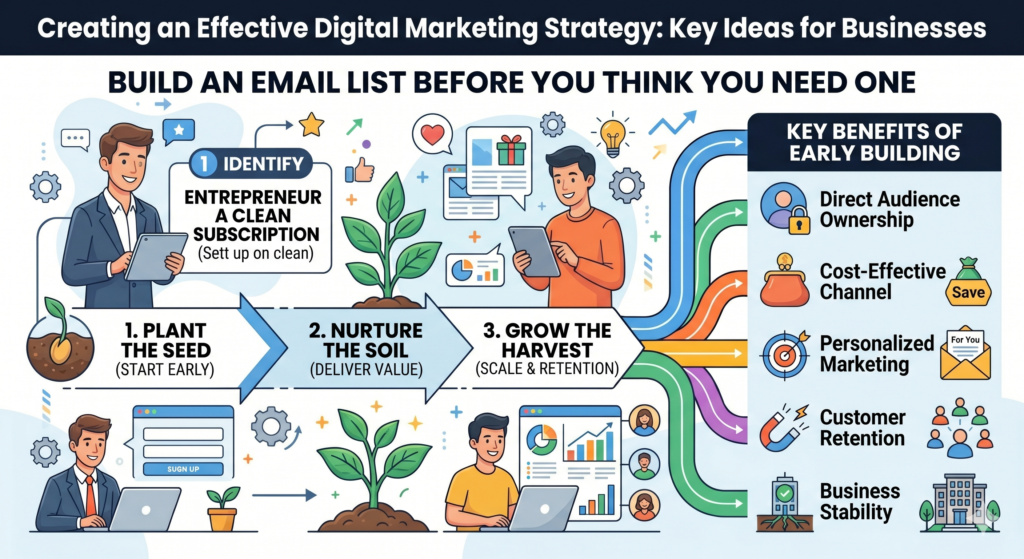
An email list gives you more control. It allows you to stay in touch with people who have shown interest but are not ready to buy yet. This is important because most buyers do not act the first time they find you.
They may like your content, trust your advice, and still need time. Email gives you a way to keep helping them until the timing is right.
Your email strategy should nurture trust, not just sell
Many businesses only email when they want something. They send promotions, offers, or company updates that do not give much value to the reader. Over time, people stop opening.
A better email strategy is based on trust. Your emails should help readers think better, avoid mistakes, and make smarter decisions. They should feel like useful advice from someone who understands their business.
For a digital marketing agency, this could mean sending simple lessons about improving website conversions, choosing better keywords, fixing weak ads, writing stronger landing pages, or planning campaigns. The goal is to make the reader feel helped before they ever become a client.
When people get value from your emails, they are more likely to remember you. When they are ready to act, your business feels familiar and safe.
Create email paths based on buyer interest
Not every subscriber needs the same emails. Someone who downloaded an SEO guide may care about search growth. Someone who signed up after reading about paid ads may care about faster lead generation. Someone who joined from a case study may be closer to buying.
Your email strategy becomes stronger when it respects these differences.
This does not mean you need a complex setup from day one. You can start simple. Send a welcome email that explains what kind of help they can expect. Then send a few useful emails that match the topic they cared about. Later, invite them to take a clear next step.
The key is to avoid treating email as a dumping ground for random updates. Email should continue the journey. It should make the reader more informed, more confident, and more ready to choose you when the need becomes urgent.
Turn Social Media Into a Trust Channel, Not a Distraction
Social media can help a business grow, but only when it has a clear role. Without a strategy, it becomes a daily pressure machine. You feel like you must post all the time, follow trends, comment everywhere, and keep up with every platform.
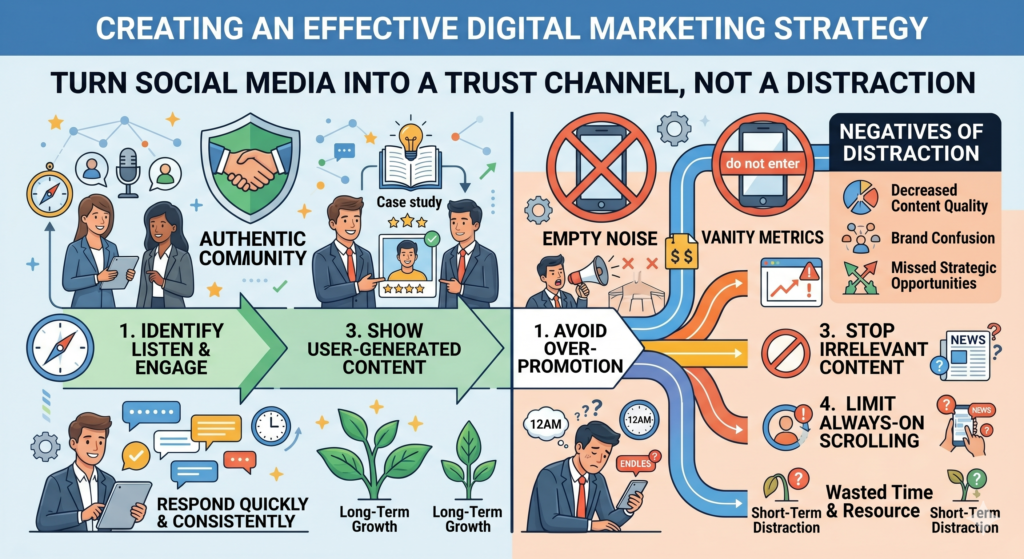
That is not a strategy. That is stress.
Social media should support your business goals. It can help you share ideas, show your point of view, build trust, start conversations, and bring people back to your website or email list. But it should not become the center of your whole marketing plan unless your audience truly buys that way.
For many businesses, social media is best used as a trust channel. It helps people see how you think before they speak to you.
Choose platforms based on buyer behavior, not popularity
A platform is only useful if your buyers spend time there and are open to the kind of message you share. A B2B service business may get more value from LinkedIn than Instagram. A visual product brand may get more value from Instagram, Pinterest, or TikTok. A local business may benefit from Facebook groups or short local videos.
The right platform depends on the buyer, the offer, and the decision process.
Do not choose a channel only because it is popular. Popular does not always mean profitable. It is better to show up strongly on one or two channels than to be weak on five.
When choosing a platform, ask where your audience already looks for advice, ideas, proof, and recommendations. Then build your presence there with purpose.
Share thinking that makes people trust your judgment
The best social content does not always sell directly. Often, it shows how your business thinks. It explains what you believe, what mistakes you see, what patterns you notice, and what advice you would give to someone trying to solve a real problem.
For example, instead of posting “we offer SEO services,” you might explain why many SEO campaigns fail because they chase traffic before fixing conversion. Instead of saying “book a call,” you might share what a strong landing page needs before paid ads can work.
This kind of content builds trust because it gives people a sample of your thinking. It helps them see your standards.
Social media should not be random noise. It should be a steady signal. When people see your posts often, they should understand what you care about, who you help, and why your approach makes sense.
Make Conversion Rate Optimization Part of the Strategy From Day One
Getting more traffic is not always the fastest way to grow. Sometimes the biggest opportunity is getting more value from the traffic you already have.
Conversion rate optimization means improving the parts of your marketing that turn visitors into leads, leads into calls, and calls into customers. It is not only about button colors or page design. It is about removing friction from the buyer’s path.
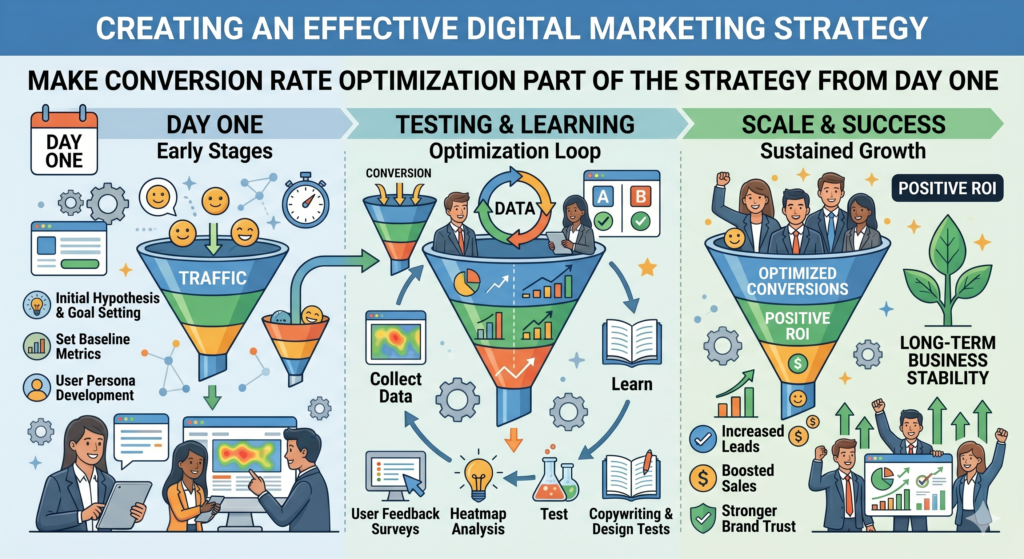
If people are visiting your website but not taking action, the problem may not be traffic. It may be unclear messaging, weak proof, confusing pages, slow load times, poor offers, or forms that ask for too much too soon.
Small conversion improvements can create major growth
Imagine your website gets 5,000 visitors a month and 1 percent become leads. That means 50 leads. If you improve the conversion rate to 2 percent, you now get 100 leads from the same traffic.
That is why conversion matters. It can make every other channel more profitable. SEO becomes more valuable. Paid ads become more efficient. Social traffic becomes more useful. Email clicks become more likely to turn into action.
Many businesses spend more money to bring people in before fixing the place those people land. This is like pouring water into a leaking bucket.
A better strategy is to improve the bucket while you grow traffic.
Fix the moments where people hesitate
Conversion improves when you understand where buyers slow down. A visitor may hesitate because they do not understand your offer. They may doubt your claims. They may not see proof. They may worry about cost. They may not know what happens after they fill out a form.
Your page should answer those doubts before they become exits.
A strong service page should explain the problem, the outcome, the process, the proof, and the next step. A strong landing page should keep the message focused and remove distractions. A strong contact page should make reaching out feel easy and low risk.
Conversion is not about tricking people. It is about helping them move forward with less confusion.
When your digital strategy includes conversion from the start, growth becomes easier. You stop chasing more traffic as the only answer. You build a system that makes better use of every visitor you earn.
Use Data to Make Better Choices, Not to Create Bigger Reports
Data should make your marketing clearer, not more confusing. Many businesses track too many numbers and still do not know what to do next. They look at traffic, likes, clicks, impressions, open rates, bounce rates, and rankings, but they do not connect those numbers to real business growth.
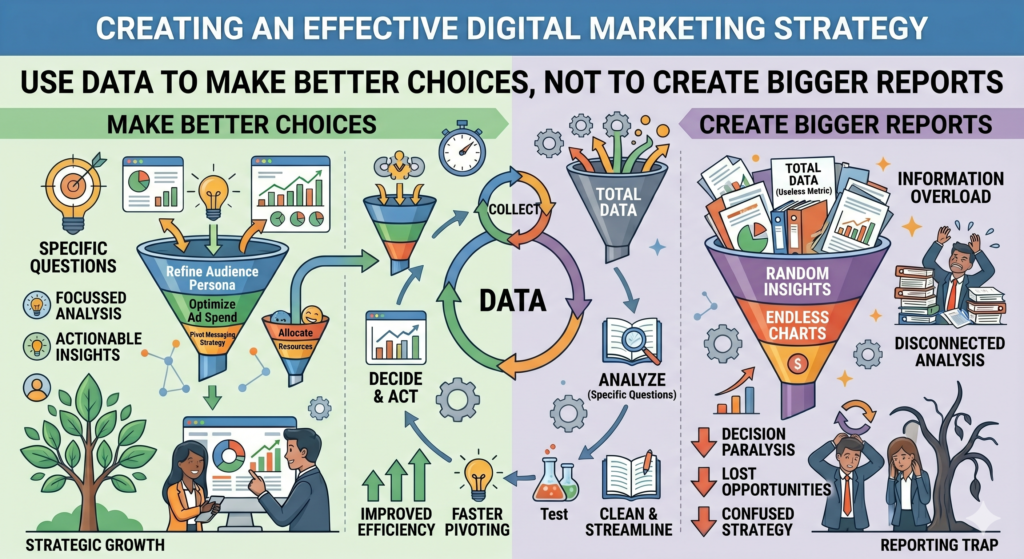
A good digital marketing strategy uses data to answer useful questions. Are the right people finding us? Are they staying long enough to understand our offer? Are they taking the next step? Which channels bring serious leads? Which pages help people decide? Which campaigns create revenue, not just attention?
When data is used this way, it becomes a guide. It helps you stop guessing. It also helps you stop wasting time on work that looks active but does not move the business forward.
The best metrics are the ones tied to buyer movement
Not every number deserves the same level of attention. A post may get many views but bring no leads. A blog may get less traffic but attract buyers who are much closer to action. An email may have a modest open rate but generate strong replies. This is why context matters.
The best metrics show movement. They help you see whether people are moving from awareness to trust to action. This may include qualified leads, booked calls, demo requests, email signups, returning visitors, assisted conversions, and sales from specific campaigns.
Traffic still matters, but it should not be the only measure. A website with fewer visitors and stronger conversion can often beat a website with large traffic and weak intent.
Review data with a decision in mind
Do not review marketing data just to “check performance.” Review it to make a decision. Before opening a report, ask what you are trying to learn.
You may want to know which blog topics lead to consultations. You may want to know which ad message creates better leads. You may want to know where visitors leave a landing page. You may want to know which email topic gets replies from serious prospects.
This keeps reporting practical. It also keeps your team focused on improvement instead of decoration.
A simple monthly review can be enough for many businesses. Look at what brought attention, what built trust, what created action, and what should change next. Over time, these small reviews create sharper marketing judgment.
Build a Strong Offer Before You Try to Scale
A weak offer makes every marketing channel harder. You can have great ads, strong SEO, helpful content, and a clean website, but if the offer does not feel clear or valuable, people will not act.
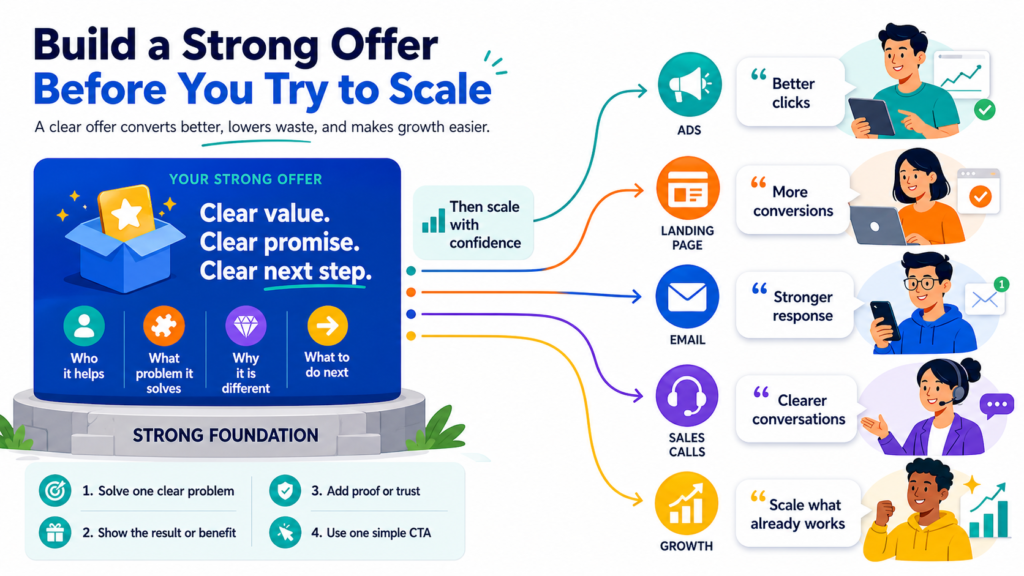
An offer is not only your product or service. It is the way you present the value of taking the next step. It tells the buyer what they get, why it matters, why now is a good time, and why choosing you feels safe.
For service businesses, the offer may be a strategy call, audit, consultation, package, workshop, or ongoing service plan. For product businesses, it may be a trial, bundle, guarantee, sample, demo, or first purchase deal. The format can change, but the job is the same. The offer must make action feel worth it.
A strong offer reduces doubt before the buyer asks
People hesitate for many reasons. They may worry about cost. They may fear wasting time. They may doubt whether the result is possible. They may not understand what happens after they inquire. They may have been disappointed before.
A strong offer answers these concerns early.
For example, instead of saying “book a call,” a digital marketing agency might say the call will review the buyer’s current website, main traffic sources, lead quality, and fastest growth gaps. That feels more useful because the buyer knows what they will receive.
The offer becomes stronger when it is specific. “Get marketing help” is weak. “Find the three biggest gaps stopping your website from turning traffic into leads” is stronger.
Match the offer to the buyer’s level of trust
Not every visitor is ready for the same action. Someone who has just found your brand may not want to speak with sales yet. They may prefer a guide, checklist, short email course, or simple diagnostic tool. Someone who has read several pages and checked your case studies may be ready for a consultation.
Your strategy should include different offers for different stages. This does not mean making things complex. It means giving people a next step that feels natural.
Early-stage offers should be easy and helpful. Middle-stage offers should educate and build confidence. Late-stage offers should make it simple to talk, buy, or request a proposal.
When your offers match the buyer’s trust level, more people move forward without feeling pushed.
Align Sales and Marketing So Leads Do Not Get Lost
Marketing does not end when a lead fills out a form. In many businesses, this is where the most important part begins. If sales and marketing are not aligned, good leads can be lost through slow replies, weak follow-up, unclear handoffs, or messages that do not match what the buyer saw online.
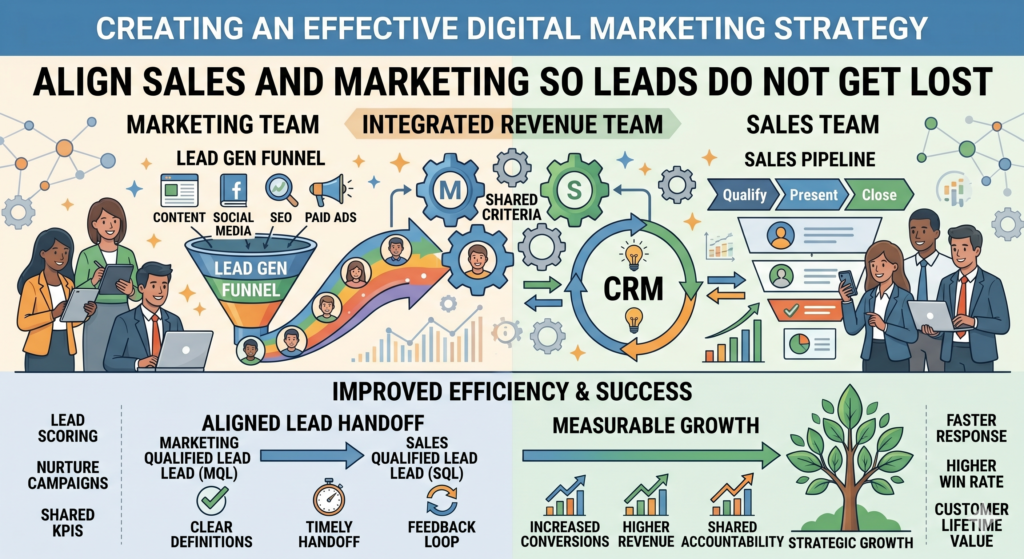
This is a common problem. Marketing promises one thing. Sales says another. The website creates interest. The follow-up email feels generic. The lead asks a question, but the team does not know which content they read or what problem brought them in.
A strong digital marketing strategy connects both sides. It treats the buyer’s journey as one experience, not separate departments.
Sales teams should know what marketing has already promised
When a lead comes in through a campaign, the sales team should understand the message that created the lead. Did the person respond to an SEO audit offer? Did they download a guide about lead generation? Did they read a case study about website conversion? Did they come from an ad focused on reducing wasted ad spend?
This context matters. It helps the sales conversation start in the right place. It also helps the buyer feel understood.
If the buyer clicked on a message about fixing poor-quality leads, the first conversation should not begin with a broad pitch about every service. It should begin with the problem they showed interest in.
Use sales questions to improve marketing content
Sales calls are one of the best sources of content ideas. Every objection, concern, and repeated question can become useful marketing material.
If prospects keep asking how long SEO takes, create a clear article about timelines and realistic expectations. If they worry about ad spend, create content explaining how to test paid ads without wasting budget. If they ask why they need strategy before execution, write a page that explains the cost of random marketing.
This makes marketing sharper because it is based on real buyer conversations.
Sales should not just receive leads from marketing. Sales should feed insight back into marketing. When both teams share what they are learning, the whole strategy becomes stronger.
Build Trust With Proof Before Making Big Claims
Every business wants to sound confident. But confidence without proof can feel empty. Buyers are used to seeing bold claims online. They have seen promises about fast growth, easy leads, better rankings, and higher revenue. Many have been burned before.
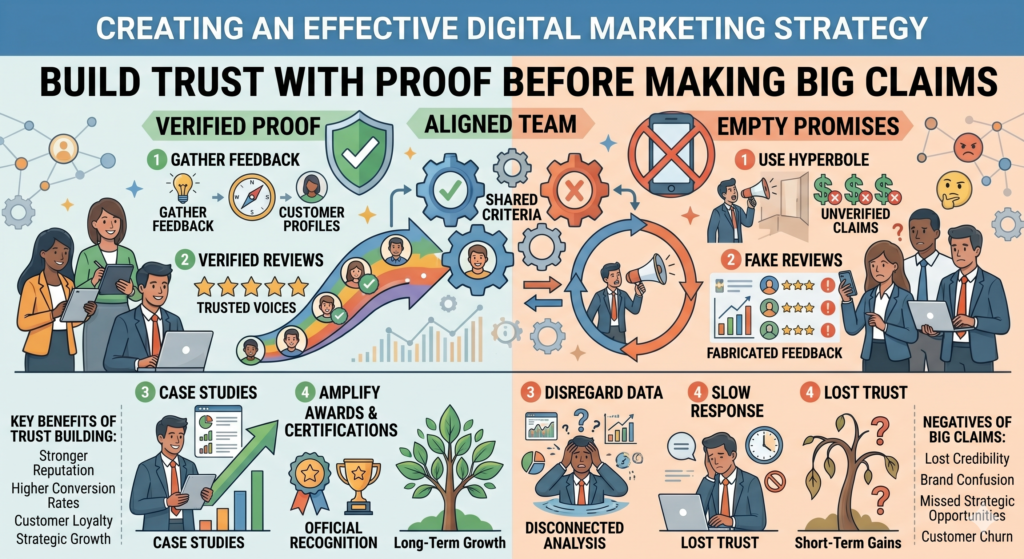
This is why proof matters. Proof turns a claim into something safer to believe. It helps the buyer feel that your business is not just saying the right things, but has actually helped people solve similar problems.
Proof can take many forms. It may include case studies, client results, testimonials, examples, screenshots, process breakdowns, before-and-after stories, reviews, or clear explanations of how your work gets done.
The best proof is specific and easy to understand
Vague proof is better than no proof, but specific proof is much stronger. Saying “we helped a client grow” is not as powerful as explaining what the problem was, what changed, and what result followed.
You do not always need huge numbers. In fact, smaller but clearer proof can feel more believable. A story about helping a business improve lead quality, reduce wasted traffic, or turn a weak landing page into a stronger sales asset can be very persuasive if it is explained well.
The key is to make the proof relevant to the buyer’s own situation. A small business owner wants to see proof that feels possible for their stage. A larger company wants to see proof that your process can handle complexity.
Show the thinking behind the result
Many case studies focus only on the result. That can be useful, but the thinking behind the result often builds deeper trust. Buyers want to know how you solved the problem because that shows your judgment.
Explain what you noticed first. Explain what was broken. Explain why you chose a certain strategy. Explain what was tested. Explain what improved. Explain what the client learned.
This makes your proof feel more human and more useful. It also shows that your business does not rely on luck. You have a method.
Proof should appear throughout your marketing, not only on one case study page. It should show up on service pages, landing pages, emails, proposals, and sales conversations. When proof is placed close to the claim, it becomes more powerful.
Use Content Repurposing Without Sounding Repetitive
Creating fresh content all the time can drain your team. But that does not mean you need to start from zero every day. A smart strategy uses content repurposing. This means taking one strong idea and turning it into different formats for different channels.
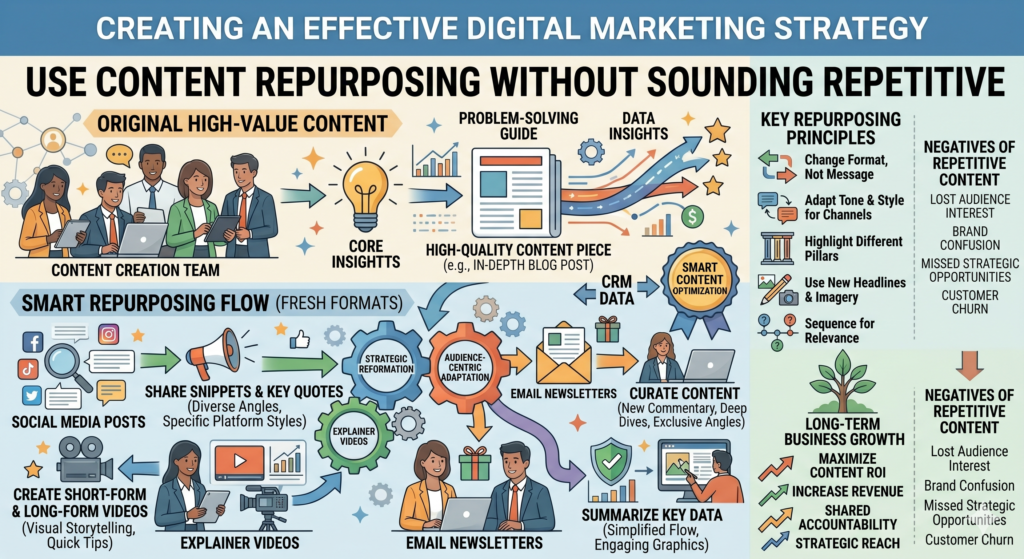
The mistake is copying the same words everywhere. That feels lazy and repetitive. Good repurposing keeps the core idea but changes the angle, depth, and format based on where it appears.
A detailed blog post can become a short LinkedIn post, an email lesson, a webinar topic, a video script, a sales enablement note, and a section on a service page. The idea stays connected, but the delivery changes.
One strong idea can serve many parts of the buyer journey
For example, imagine your core idea is that businesses should fix website conversion before increasing ad spend. That idea can become many useful assets.
A blog post can explain the full strategy. A social post can share one common mistake. An email can tell a short story about wasted ad spend. A landing page section can explain why traffic alone is not enough. A sales call follow-up can include a simple checklist for checking conversion gaps.
This approach gives your message more reach without making your team create from scratch every time.
It also helps your audience remember your point. People need to hear important ideas more than once. Repurposing lets you repeat the lesson without repeating the exact same sentence.
Repurpose based on format, not convenience
A blog post is not a social post. A webinar is not an email. A case study is not an ad. Each format has its own job.
When repurposing, ask what the person needs in that moment. On social media, they may need a quick insight. In a blog, they may want depth. In an email, they may want a useful thought they can read fast. On a landing page, they need clarity and confidence.
This keeps repurposed content fresh. It also makes your marketing feel more natural.
Content repurposing works best when you start with strong source material. If the original idea is weak, repurposing only spreads weak content. But if the idea is sharp, useful, and tied to real buyer needs, it can fuel your strategy for weeks or months.
Plan Campaigns Around Problems, Not Around Channels
Many businesses plan marketing by channel. They ask what to post on social media, what to write for the blog, what ads to run, and what emails to send. This can work, but it often leads to scattered campaigns.
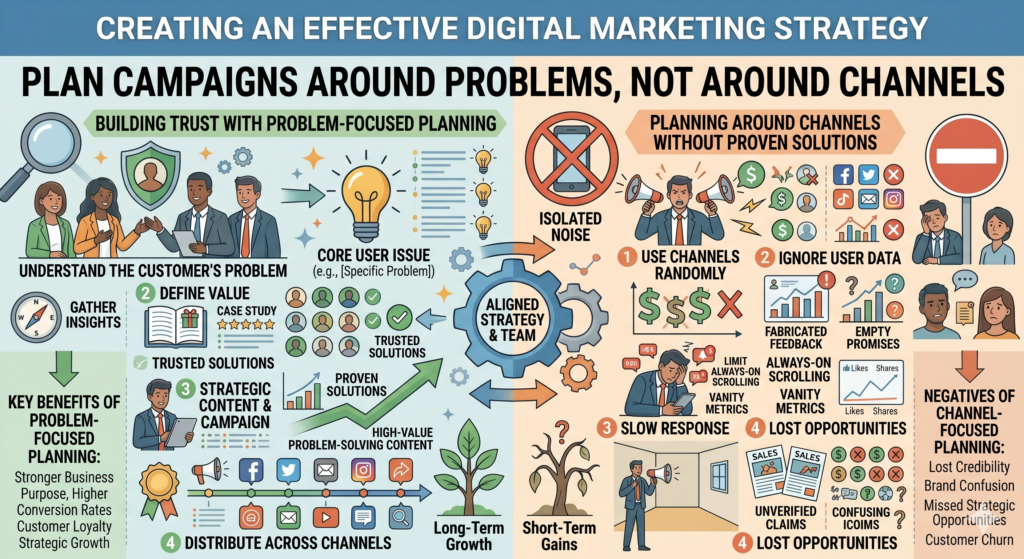
A better way is to plan around a customer problem.
Start with one real problem your audience wants to solve. Then build a campaign that helps them understand and act on that problem across several channels. This makes your marketing feel connected instead of random.
For example, if your audience struggles with poor-quality leads, your campaign can focus on why lead quality drops, how to fix messaging, how to improve targeting, how to qualify visitors, and how to build better landing pages.
Problem-led campaigns feel more relevant to buyers
Buyers do not wake up thinking about your channels. They think about their problems. They think about slow sales, weak leads, low traffic, wasted ad spend, poor conversions, unclear messaging, or lack of trust.
When your campaign starts with the problem, it becomes easier to get attention. The buyer sees something they already care about.
A problem-led campaign can include a blog post, a few social posts, an email series, a landing page, a webinar, a case study, and a consultation offer. Each asset supports the same theme, but each one plays a different role.
This creates focus. It also makes your marketing easier to measure because you can see whether that problem area is creating interest and action.
Give each campaign a clear end point
A campaign should lead somewhere. It should not only educate people and then leave them without a next step.
The end point may be a strategy call, a downloadable guide, a workshop, a product trial, a demo, or a service inquiry. The right end point depends on the buyer’s stage and the seriousness of the problem.
If the campaign is aimed at early-stage buyers, the end point may be a helpful guide or email series. If it is aimed at people with urgent pain, the end point may be a consultation or audit.
Clear campaign structure helps buyers move forward. It also helps your team stay focused. Instead of creating random content, you are building a path from problem to action.
Keep Your Strategy Simple Enough to Execute Well
A digital marketing strategy does not need to be complex to be powerful. In fact, many complex plans fail because they are too hard to execute. The team gets excited at first, but then the work becomes too much. Campaigns are started but not finished. Channels are opened but not maintained. Reports are created but not used.
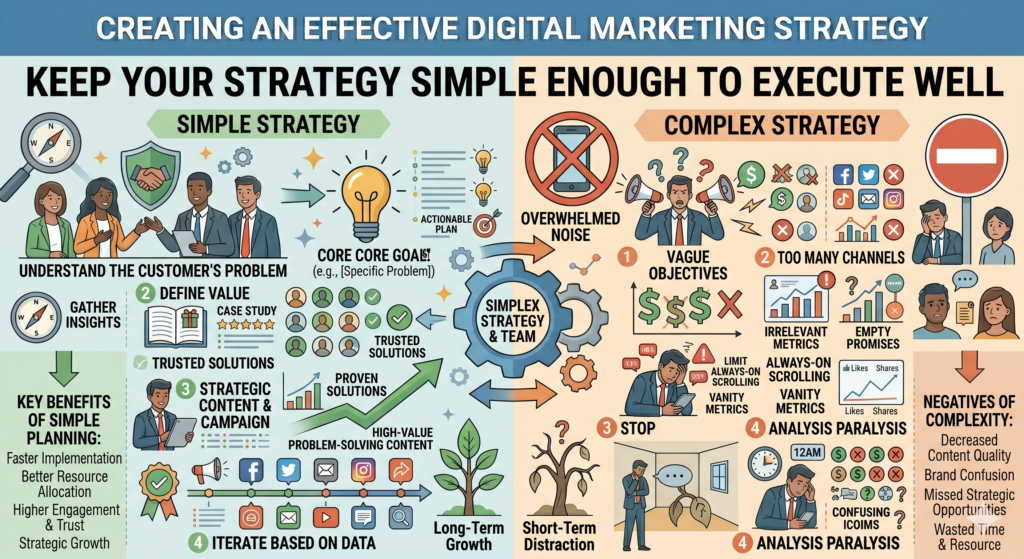
Simple strategy wins because it can be repeated. It gives your team a clear focus. It also makes it easier to improve because you can see what is working.
A simple strategy does not mean a small ambition. It means choosing the few moves that matter most and doing them well.
Focus beats scattered effort
Most businesses do not need to be everywhere. They need to be strong where it counts. That may mean one clear website message, one strong SEO plan, one main social channel, one useful email path, and one conversion-focused offer.
Once those parts work, you can expand. But if you try to build everything at once, quality often drops.
Focus creates depth. Depth creates trust. Trust creates better results.
A focused strategy also helps your team avoid panic. When a new trend appears, you can ask whether it supports your goal. If it does not, you can ignore it without guilt.
Build a rhythm your team can maintain
The best strategy is the one your business can actually follow. If your team can only publish two strong articles a month, do that well. If you can only manage one social channel, make that channel useful. If you can only run one campaign per quarter, make it clear and complete.
Consistency matters more than bursts of effort.
A strong rhythm may include regular content planning, weekly channel checks, monthly performance reviews, and quarterly strategy updates. It does not need to be complicated. It just needs to happen.
Marketing compounds when good actions are repeated over time. Simple actions, done with care, often beat big plans that never get finished.
Build a Content Calendar That Supports Strategy, Not Just Posting
A content calendar should not be a place where random ideas are stored. It should be a simple plan that helps your business publish the right message at the right time for the right reason.
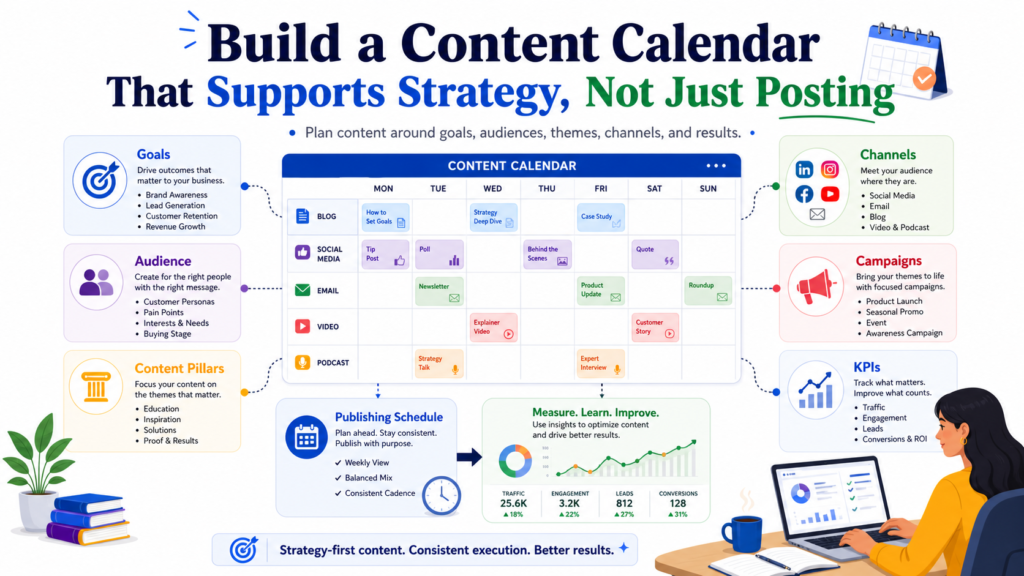
Many businesses create calendars by asking, “What should we post this week?” That question often leads to weak content because it starts with the need to fill space. A stronger question is, “What does our buyer need to understand next?”
This changes the way you plan. You stop creating content only because the calendar is empty. You start creating content because each piece has a role in the buyer journey.
A strong content calendar connects topics to business goals. It should include content that attracts new people, builds trust with warm leads, answers sales questions, supports offers, and strengthens your market position.
Your calendar should balance education, trust, and action
If every piece of content teaches but never invites action, your audience may learn from you but never buy from you. If every piece asks for action but does not educate, your marketing may feel too pushy. If every piece talks about your company, your audience may lose interest.
Balance matters.
Some content should help people understand their problem. Some should show them what to do next. Some should explain your process. Some should prove your results. Some should invite them to take a step toward working with you.
This balance keeps your content useful without making it passive. It also keeps your marketing active without making it feel aggressive.
A good calendar should show why each topic exists. If you cannot explain the purpose of a content idea, it may not belong in the plan yet.
Plan themes before planning titles
One of the easiest ways to build a stronger calendar is to plan themes first. A theme is a larger problem or idea your business wants to own for a period of time.
For example, a digital marketing agency may choose a monthly theme such as improving website conversions, building SEO demand, reducing wasted ad spend, or turning content into leads. Once the theme is clear, it becomes easier to create blog posts, emails, social posts, videos, and offers around it.
This gives your marketing a clear rhythm. Your audience hears connected ideas instead of random messages. Your team also saves time because each piece supports the others.
Themes help your content feel more strategic. They also help your brand become known for solving specific problems, not just publishing frequent updates.
Conclusion
An effective digital marketing strategy is not built by doing more. It is built by doing the right things with clear purpose. Your goal, audience, message, website, content, SEO, ads, email, social media, and data should all work together. When they do, marketing becomes less random and more powerful.
The best strategy helps people trust you before they buy from you. It answers their questions, removes doubt, and gives them a clear next step.

















Comments are closed.