
WinSavvy Editorial Standards
How this article was created
Growing a dental practice today is not just about being good at dentistry. That matters, of course. But the truth is simple: people cannot book with you if they do not know you exist, do not trust you yet, or do not understand why your clinic is the right choice for them.
Build Your Dental Practice Around the Right Patients Before You Spend on Marketing
A dental practice does not grow just because more people see its name. It grows when the right people see the right message at the right time and feel ready to book. This is why smart dental marketing starts before ads, social posts, SEO pages, or email campaigns.
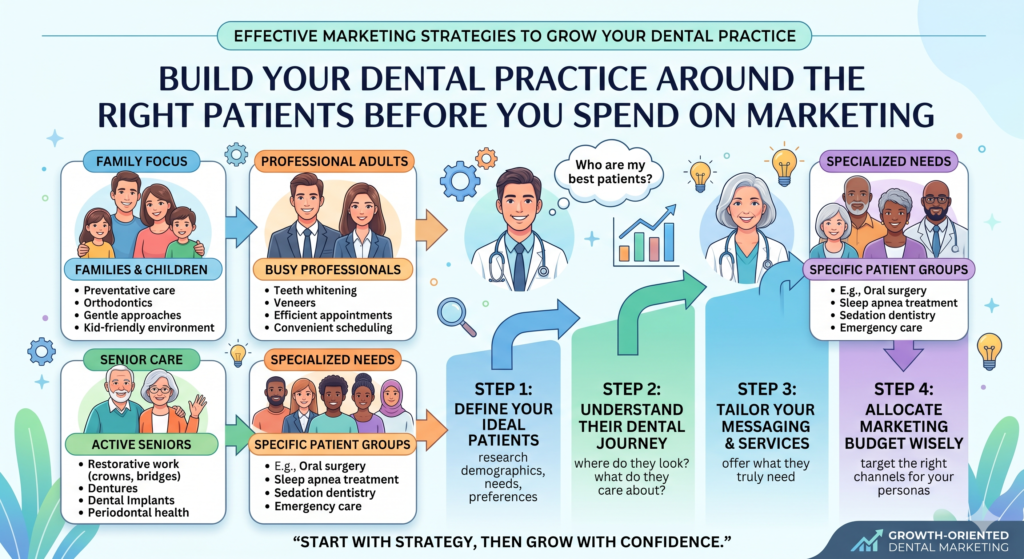
It starts with knowing exactly who your best patients are and what makes them choose one dentist over another.
Many clinics make the mistake of trying to market to everyone. They say they offer family care, cosmetic care, emergency care, implants, whitening, Invisalign, and everything else. While this may be true, it can make the practice sound like every other clinic in town. When your message is too broad, patients do not feel like you are speaking to them.
A better approach is to build your marketing around the patients you most want to attract. This does not mean you reject other patients. It simply means your message becomes clearer, stronger, and easier to trust.
Your best patients should guide your marketing strategy
Your current patients can teach you what your future marketing should say. Look at the patients who already trust you, return for care, accept treatment plans, leave kind reviews, and refer others. These patients are not just a source of revenue. They are a map.
Study why your best patients chose your clinic in the first place
Ask yourself what your best patients had in common when they first found you. Some may have been looking for a gentle dentist because they were nervous. Some may have wanted a nearby clinic for their family.
Some may have needed urgent help for tooth pain. Some may have been unhappy with their smile and wanted cosmetic treatment. Some may have wanted a dentist who explained things clearly without pressure.
These reasons matter because they show the emotional trigger behind the booking.
Most patients do not choose a dentist only because of a service list. They choose because they feel a problem, fear, goal, or need. A parent wants a clinic that will be patient with their child. A nervous adult wants to feel safe.
A professional wants quick appointments that fit a busy week. A cosmetic patient wants proof that the dentist can deliver a natural-looking smile.
When your marketing speaks to these real reasons, it becomes much more powerful.
Build patient groups instead of writing for everyone
Your practice may serve many types of patients, but your marketing should still be built around clear patient groups. A family dentistry message should not sound the same as an implant dentistry message. An emergency dental page should not sound the same as a smile makeover page. Each patient group has different questions, fears, and reasons to act.
A family patient wants to know if your clinic is friendly, calm, and easy to visit with children. An emergency patient wants to know if you can see them fast. An implant patient wants to know if the treatment is safe, lasting, and worth the cost. A cosmetic patient wants to know if the results will look real and not fake.
When you write for one clear group at a time, your message feels personal. Patients feel understood. That feeling builds trust before they ever call.
Your most valuable services need their own growth plan
Every dental service matters, but not every service should be marketed in the same way. A teeth cleaning patient, a dental implant patient, and an emergency patient all move through different decision paths. If your marketing treats them the same, you will lose many of them along the way.
Match your marketing to how each patient makes a decision
A patient with sudden tooth pain may search quickly, compare a few nearby clinics, check reviews, and call. They are not looking for a long education process. They want fast help, clear hours, location, and a simple phone number.
A patient thinking about dental implants may take much longer. They may worry about pain, price, surgery, healing time, and whether implants are right for them. They may read several pages, watch videos, compare clinics, and need more than one touch before booking a consultation.
A patient interested in whitening or veneers may care more about trust, appearance, before-and-after proof, and whether the result will look natural.
This is why each service needs its own page, its own message, and its own next step. Your marketing should fit the patient’s mindset, not force every visitor into the same path.
Focus on services that support long-term practice growth
Some services bring quick appointments. Others bring high-value treatment. Others bring patients who stay for many years. Your job is to understand which services support the kind of practice you want to build.
Emergency dentistry may bring new patients fast, but you need a follow-up system to turn those visits into long-term care. Cosmetic dentistry may bring higher-value cases, but you need trust-building content and strong proof.
Family dentistry may grow slowly, but it can create loyal patients for years. Implant dentistry may need more education, but it can become a major revenue driver when marketed well.
A strong dental marketing plan does not promote everything equally. It gives more attention to the services that match your goals, your strengths, and your local demand.
Your local market should shape your dental marketing message
Dental marketing is local. Most patients do not want to travel far for routine care. Even for higher-value treatments, location still matters. This means your competition is not every dentist online. It is the clinics nearby that patients see when they search, ask friends, or compare options.
Study nearby dental practices without copying them
Look at the dental practices in your area. Read their websites. Check their Google reviews. Notice what they promise. Notice what patients praise. Notice what patients complain about.
You may find that many clinics say the same things. They may all talk about friendly care, modern tools, gentle treatment, and beautiful smiles. These claims are common, so they may not help you stand out.
Your opportunity is in the gaps.
Maybe nearby clinics do not explain treatment clearly. Maybe their websites feel cold. Maybe they do not speak well to nervous patients. Maybe they have strong clinical pages but weak proof. Maybe they have good reviews but poor booking flow. Maybe they offer the same services, but they do not explain why those services matter.
Your marketing should fill the gap your local market has left open.
Give patients a clear reason to choose you
Patients need a simple reason to remember your clinic. This reason should be easy to understand and easy to repeat.
You might become known as the dental practice that makes nervous patients feel calm. You might be the family dentist that makes visits easy for parents and kids. You might be the cosmetic dentist who creates natural-looking smiles. You might be the local clinic that explains every option clearly before treatment begins.
This kind of clear position helps patients choose faster.
Without a clear reason, your clinic becomes one more option. With a clear reason, your clinic becomes the option that feels right for a certain type of patient.
Turn Your Website Into a Patient Booking Machine
Your website is one of the most important growth tools your dental practice has. It is often the first serious place where a patient checks whether they can trust you. Before they call, they may visit your website, read your service pages, look at your team, check your reviews, and decide if your clinic feels right.
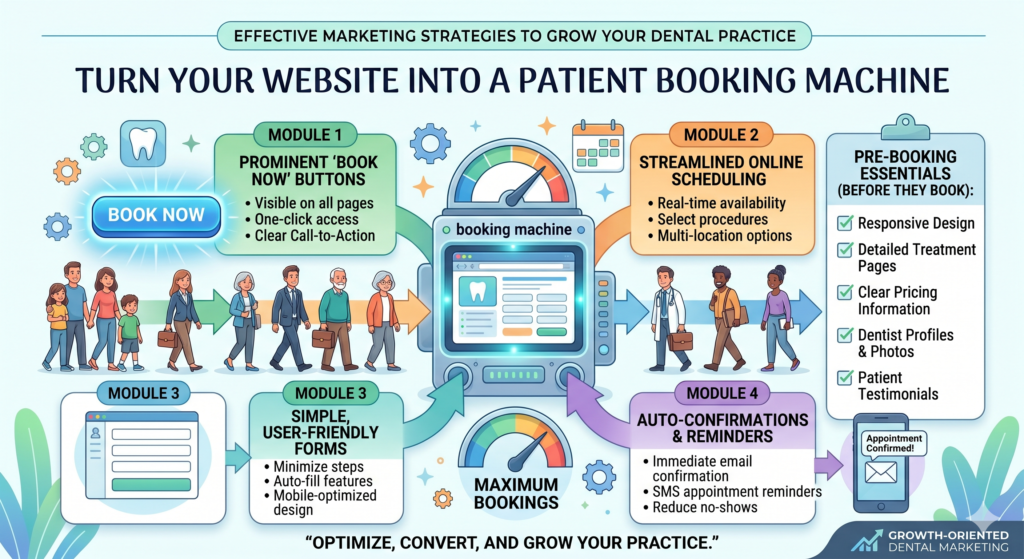
A dental website should not only look nice. It should help people take action. It should make visitors feel safe, informed, and ready to book.
Many dental websites fail because they act like online brochures. They list services. They show a few smiling stock photos. They use general words like quality care and modern dentistry. But they do not guide the patient. They do not answer enough questions. They do not make booking easy enough.
A strong website works like a quiet salesperson. It welcomes the visitor, explains your value, builds trust, removes fear, and leads them toward an appointment.
Your homepage should make the right first impression fast
Patients judge your website quickly. If the page is confusing, slow, vague, or hard to use, they may leave and call another clinic. This does not mean your website needs to be fancy. It means it needs to be clear.
Use a headline that tells patients exactly why they should stay
The top of your homepage should answer a simple question: “Is this the right dental practice for me?”
A weak headline may say something like “Creating Beautiful Smiles.” That sounds pleasant, but it does not say much. A stronger headline speaks to a real patient need. For example, a family practice could say, “Gentle dental care for busy families in Austin.”
A clinic focused on anxious patients could say, “Calm, clear dental care for people who feel nervous about the dentist.” A cosmetic practice could say, “Natural-looking smile improvements planned around your goals.”
The best headline is not the most clever one. It is the clearest one.
Your homepage should also make your location clear. Local patients want to know you are nearby. If they have to search around to find your city, neighborhood, or service area, the page is already making them work too hard.
Make the booking step obvious and easy
Your website should make booking simple from the first screen. A patient should not have to hunt for your phone number or appointment button. The action should be clear, visible, and repeated naturally across the page.
The call to action should also feel low-stress. Instead of only saying “Schedule Now,” you can use warmer language like “Book a visit,” “Request an appointment,” or “Call our team.” The right words depend on your practice style, but the goal is always the same. Make the next step feel easy.
For mobile users, this matters even more. Many dental searches happen on phones. A patient with tooth pain, a parent looking between errands, or a busy worker checking during lunch needs fast action. Your phone number should be tap-friendly.
Your booking form should be short. Your page should load quickly. Your address should open easily in maps.
Every extra step can cost you a patient.
Your service pages should do more than describe treatments
A service page is not just a place to explain what a treatment is. It is a page that should help a patient decide whether to book. This is especially important for services like dental implants, Invisalign, veneers, crowns, root canals, emergency dentistry, and children’s dentistry.
Write each service page around the patient’s real questions
Most patients are not looking for a textbook answer. They want to know what the treatment means for them. They want to know if it hurts, how long it takes, what it costs, whether they need it, what happens if they wait, and what the result will feel like.
A good service page should answer these questions in simple words.
For example, a dental implant page should not only say that implants replace missing teeth. It should explain who may need them, why missing teeth can cause bigger problems, what the process usually looks like, how the consultation works, and what the patient can expect at each stage.
A root canal page should not sound scary. It should explain that the treatment is meant to save the tooth and stop pain. It should calm the patient by explaining the process in a plain, kind way.
An Invisalign page should help patients understand fit, timeline, comfort, daily use, and what makes someone a good candidate.
When your page answers real questions, patients stay longer, trust you more, and feel less need to keep searching.
End each service page with a clear next step
A service page should not simply end after the explanation. It should lead the patient forward. If someone has just read about a treatment, they need a simple next step.
This next step may be booking a consultation, calling the clinic, requesting an appointment, or asking a question. The wording should match the service. Emergency dentistry needs urgency. Cosmetic dentistry needs confidence. Implant dentistry needs reassurance. Family dentistry needs warmth.
The key is to avoid leaving patients with no direction. A page that informs but does not guide will lose bookings.
Your website copy should sound like a real human wrote it
Dental websites often sound stiff. They use words that patients do not use in daily life. They talk about advanced solutions, comprehensive care, state-of-the-art technology, and optimal oral health. These phrases are common, but they can feel empty.
Simple language works better.
Replace dental jargon with words patients understand
Patients do not want to feel confused. They want to feel safe. When your website uses complicated terms without explanation, it can create distance. When it uses plain language, it creates trust.
Instead of saying “periodontal disease,” you can say “gum disease” and then explain what it means. Instead of saying “edentulism,” say “missing teeth.” Instead of saying “restorative procedures,” say “treatments that repair damaged teeth.” Instead of saying “occlusion,” say “how your teeth meet when you bite.”
This does not make your practice look less professional. It makes your practice easier to trust.
Patients are more likely to book when they understand what you do and why it matters.
Write in a calm and helpful voice
Your website should not scare people into booking. Fear can get attention, but it can also make patients freeze. A better approach is to be calm, honest, and helpful.
For example, instead of saying, “Ignoring tooth pain can lead to serious dental disaster,” you can say, “Tooth pain is your body’s way of asking for help. The sooner we check it, the easier it may be to treat.”
This kind of message still creates urgency, but it does not feel harsh. It respects the patient. It helps them act without shame.
That tone is especially important in dentistry because many patients already feel nervous, embarrassed, or guilty. Your marketing should make them feel welcome, not judged.
Use Local SEO So Nearby Patients Find You First
Local SEO is one of the strongest marketing channels for a dental practice. When someone searches for a dentist near them, they are often close to booking. They may need a cleaning, a tooth checked, a broken crown fixed, or a new dental home. If your practice appears clearly and strongly in those local searches, you can win patients without chasing them.
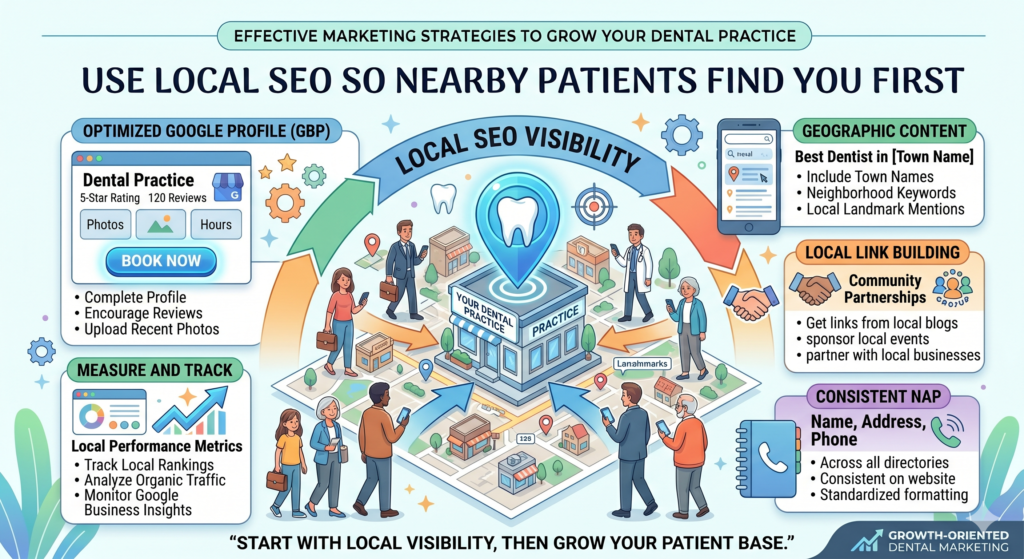
Local SEO is not only about ranking on Google. It is about showing patients that your clinic is nearby, active, trusted, and ready to help.
Your Google Business Profile is your local search front door
For many patients, your Google Business Profile is the first thing they see. They may see your rating, reviews, photos, hours, address, phone number, and appointment link before they ever visit your website. This profile can either bring people closer or push them away.
Keep every detail accurate and complete
Your clinic name, address, phone number, website, hours, categories, and services should be correct. Even small errors can hurt trust. If your hours are wrong, patients may call when no one answers. If your address is unclear, they may choose another clinic. If your services are missing, Google may not understand what you offer.
Your main category should match your practice. Most general practices should use a dental clinic or dentist category. If you have strong specialty services, those should be added where relevant. Your services should be listed clearly, but not stuffed with awkward words.
Photos also matter. Real photos of your clinic, team, treatment rooms, front desk, and outside building help patients feel more comfortable. Stock photos cannot build the same trust. Patients want to know what the place really looks like before they visit.
Post updates that show your practice is active
Your Google profile should not look abandoned. Regular updates can show patients that your clinic is active and engaged. These updates can talk about seasonal dental tips, new patient availability, whitening offers, children’s dental visits, emergency care, or helpful reminders.
The goal is not to post for the sake of posting. The goal is to make your profile feel alive.
A patient comparing two clinics may feel more confident choosing the one that looks current, cared for, and active.
Reviews are one of the strongest local SEO assets you have
Reviews affect both trust and visibility. Patients read them closely. They want to know what real people say about your care, your team, your pain control, your honesty, and your communication. A high rating helps, but the words inside the reviews matter even more.
Ask for reviews in a simple and steady way
Many happy patients will leave reviews if you ask at the right time. The best time is usually after a smooth visit, a successful treatment, or a kind moment where the patient expresses thanks.
Your team should have a simple review request process. This can be done by text, email, or an in-office reminder. The message should be short and warm. It should never pressure the patient. It should simply say that reviews help other local patients find care they can trust.
A steady flow of reviews looks more natural than a sudden burst once a year. Google and patients both like to see recent reviews because they show that the practice is still delivering good care now.
Respond to reviews with care and professionalism
Review responses are part of your public marketing. When you reply to positive reviews, you show gratitude. When you reply to negative reviews, you show maturity.
Your responses should be kind, brief, and careful. For privacy reasons, you should not reveal treatment details. You can thank the patient, show that you care, and invite them to contact the office if needed.
A thoughtful response to a negative review can sometimes help future patients trust you more. People understand that no business is perfect. What they watch is how you handle problems.
Your website needs local pages that match real searches
Local patients search in many ways. They may type “dentist near me,” “family dentist in Dallas,” “emergency dentist open today,” “dental implants near me,” or “Invisalign dentist in Chicago.” Your website should have pages that match the services and locations you want to grow.
Build strong pages for your main services and city
Each major service should have a clear page that includes your location naturally. This does not mean stuffing the city name into every sentence. It means making it clear that you offer that service in your area.
A strong page might explain the treatment, who it helps, why patients choose your clinic, what the visit looks like, and how to book. It should include real trust signals like reviews, photos, doctor experience, payment guidance, and simple answers to common questions.
The page should be written for people first and search engines second. Google wants useful content. Patients want useful content. If you serve both, your pages will perform better.
Avoid thin location pages that say nothing new
Some dental practices create many city pages with almost the same text. They only swap the city name. This is weak marketing. It does not help patients and can make the website feel low quality.
If you create location pages, each one should have a real reason to exist. It should explain your connection to that area, nearby landmarks, travel guidance, services offered, and why patients from that location choose your clinic.
A local page should feel helpful, not copied.
Create Content That Educates Patients Before They Book
Dental content can be a powerful growth tool when it is done well. Patients have many questions before they call a dentist. They search about tooth pain, bleeding gums, bad breath, whitening, braces, implants, veneers, root canals, and dental anxiety. If your practice answers those questions clearly, you can become the clinic they trust before they ever meet you.
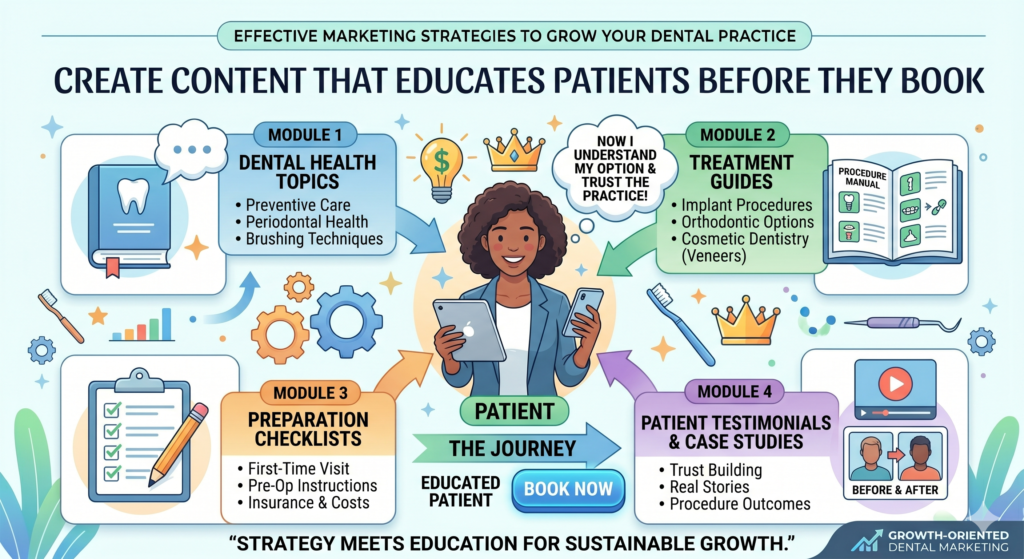
Content is not just about blog traffic. It is about trust. It helps patients understand their problems, see their options, and feel ready to take the next step.
Your content should answer questions patients are already asking
The best dental content starts with real patient questions. Your front desk hears these questions. Your hygienists hear them. Your dentists hear them. These questions are marketing gold.
Turn common patient questions into helpful articles
If patients often ask why their gums bleed, write an article explaining the common causes and when to book a visit. If patients ask whether teeth whitening is safe, write a clear guide. If patients ask how long dental implants last, explain the answer in simple terms.
If nervous patients ask what happens during a root canal, write a calm step-by-step explanation.
Each article should help the reader feel smarter and safer. It should not sound like a sales pitch from the first line. The sale happens because the patient starts to trust your guidance.
Good content makes people think, “This clinic explains things in a way I understand.”
That feeling can turn a reader into a patient.
Write for local patients, not a national magazine
Your blog does not need to sound like a medical journal. It should sound like your dental team speaking kindly to a local patient.
Use simple examples. Mention your local area when it makes sense. Explain what a patient can do next. Keep the advice clear and safe. Avoid making promises that only an exam can confirm.
For example, an article about tooth pain should explain possible causes but also make it clear that a dentist needs to check the tooth to know for sure. This builds trust because it is honest.
Patients do not need dramatic claims. They need clear guidance.
Your content should help patients overcome fear and delay
Many people delay dental care. They may be scared of pain, worried about cost, embarrassed by the condition of their teeth, or unsure if their issue is serious. Your content should speak to these barriers with care.
Address fear without making patients feel ashamed
Dental fear is common. If your content ignores it, you miss a major reason people avoid booking. A strong dental marketing strategy makes nervous patients feel seen.
Write content that explains what your practice does to make visits easier. Talk about clear communication, gentle care, breaks during treatment, numbing options, sedation if offered, and a no-judgment approach. Use warm language. Make it clear that many patients feel nervous and that your team is used to helping.
This kind of content can be especially powerful because nervous patients are often looking for emotional safety before clinical skill. They want to know they will be treated with respect.
Explain cost in a way that lowers stress
Cost is another major reason people delay care. Many dental websites avoid talking about money, but patients still worry about it. You do not always need to list exact prices, especially when treatment depends on the exam. But you should explain how your office helps patients understand costs before treatment begins.
Talk about estimates, insurance support, payment options, financing if available, and treatment planning. Explain that patients can ask questions before saying yes to care.
This does not cheapen your brand. It builds confidence.
A patient who feels financially prepared is more likely to book than one who fears a surprise bill.
Your content should connect naturally to appointments
Educational content should not leave patients wondering what to do next. Each article should guide them gently toward a useful action.
Invite readers to book when the topic calls for care
If an article explains signs of gum disease, it should invite readers to schedule a gum health check. If a page explains dental implants, it should invite readers to book an implant consultation. If a post explains tooth pain, it should guide readers to call if pain is ongoing, severe, or linked to swelling.
The call to action should feel natural. It should not interrupt the article with heavy selling. It should simply help the reader take the next safe step.
Use internal links to guide patients through your site
Your content should connect to your service pages. A blog post about missing teeth can link to your implant page. An article about crooked teeth can link to Invisalign. A post about bleeding gums can link to periodontal care. This helps patients learn more and helps search engines understand your site.
Internal links also keep visitors moving through your website. The more helpful pages they read, the more familiar and trusted your practice becomes.
This is how content turns into growth. Not by publishing random articles, but by creating a clear path from question to trust to booking.
Use Patient Reviews as a Growth Engine, Not Just Social Proof
Patient reviews are one of the strongest marketing tools a dental practice can have. A review is not just a kind comment. It is a trust signal. It tells a new patient, “Someone like me came here, felt safe, got help, and had a good experience.”
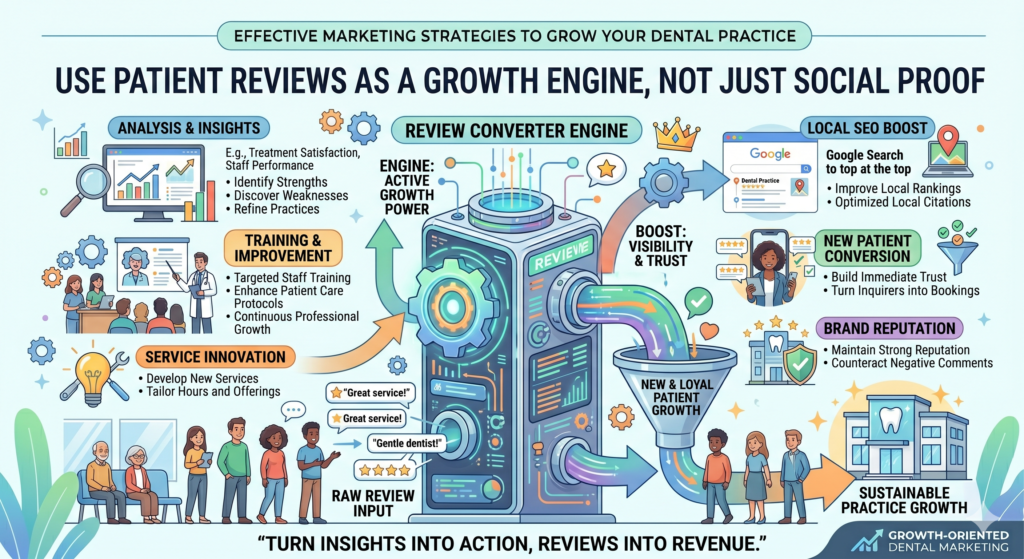
For dental practices, this matters a lot because patients often feel unsure before booking. They may be worried about pain. They may feel embarrassed about their teeth. They may be afraid of high costs. They may have had a bad dental experience before. Reviews help lower those fears before your team ever speaks to the patient.
But reviews should not be treated like a passive thing that happens only when someone feels like writing one. A growing dental practice needs a steady review system. It should ask at the right time, make the process easy, respond with care, and use reviews across the full marketing journey.
Reviews help patients trust you before they call
Most new patients do not know you yet. They are judging your practice from the outside. They look at your website, your photos, your location, your services, and your reviews. Out of all these things, reviews often feel the most real because they come from other patients.
Patients look for feelings, not just ratings
A high star rating is helpful, but the words inside the reviews matter even more. A patient may read several reviews to understand what the experience feels like.
They want to know if the dentist is gentle. They want to know if the team is kind. They want to know if the office explains costs clearly. They want to know if appointments run on time. They want to know if the clinic is clean, calm, and welcoming. They want to know if people felt judged or respected.
This is why a five-star review that says “Great office” is nice, but a review that says “I was nervous, but the dentist explained everything and made me feel calm” is much stronger.
The second review answers a real fear.
Your job is not to tell patients what to write. That would be wrong and unnatural. But you can create such a good experience that patients naturally mention the things future patients care about.
Recent reviews make your practice feel active and trusted
A practice with many old reviews can still look weak if there are no recent ones. Patients want to know what the clinic is like now. A review from three years ago may not feel as strong as one from last week.
This is why consistency matters. You do not need a flood of reviews all at once. In fact, a steady flow looks more natural. A few good reviews every month can build trust over time and support your local SEO.
When people see recent reviews, they feel that your practice is still active, still serving patients well, and still trusted by the local community.
Your team needs a simple review request process
Many happy patients leave without reviewing because no one asks. They enjoyed the visit, they thanked your team, and then they went back to their busy lives. If you want more reviews, you need a simple process that fits naturally into the patient journey.
Ask when the patient is happiest
The best time to ask is when the patient has just had a positive moment. This may happen after a pain issue is solved, after a child has a good first visit, after a cosmetic result, after a smooth cleaning, or when a nervous patient says the visit was easier than expected.
Your team should learn to notice these moments.
If a patient says, “Thank you, that was much easier than I thought,” the team can reply warmly and ask if they would be willing to share that experience in a review. The request should feel human, not scripted. It should be gentle and quick.
A simple message works best. You can say that reviews help other local patients find a dentist they can trust. That gives the patient a reason beyond helping your business.
Make leaving a review easy
Even happy patients will not leave a review if the process is hard. Do not ask them to search for your practice, find the right page, and figure it out alone. Send a direct link by text or email.
The message should be short. It should thank them for visiting and invite them to share their experience. It should not ask for a five-star review. It should not pressure them. It should simply make the next step easy.
Your front desk can also mention that the link will arrive shortly. This helps the patient recognize the message and act on it.
The easier the process, the more reviews you will receive.
Review responses are part of your public brand
Many practices respond to reviews as an afterthought. Some do not respond at all. This is a missed chance. Your responses show future patients how you treat people after the visit.
Respond to positive reviews with warmth
A good response does not need to be long. It should thank the patient and sound like a real person wrote it. Avoid copying and pasting the same response to every review because patients can spot that.
A warm response might say that the team is glad the patient felt comfortable, or that you appreciate them trusting the practice. But you must be careful not to reveal private health details. Even if the patient mentions a treatment, your response should stay general.
This protects privacy and keeps your brand professional.
Respond to negative reviews calmly and carefully
A negative review can feel painful, especially when you believe it is unfair. But your reply is not only for that reviewer. It is for every future patient reading it.
Do not argue. Do not reveal treatment details. Do not sound defensive. A calm response shows that your practice listens and cares.
You can thank the person for sharing feedback, say that your team takes concerns seriously, and invite them to contact the office directly. This does not mean you admit fault. It means you show professionalism.
Sometimes a thoughtful reply can reduce the damage of a negative review. In some cases, it can even build trust because future patients see that you handle concerns with respect.
Reviews should appear across your marketing, not only on Google
Reviews are powerful on Google, but they should also support your website, service pages, landing pages, emails, and ads. A strong review can help a nervous patient take the next step at the exact moment they are deciding.
Place reviews near important booking points
Your homepage should show a few strong reviews. Your service pages should show reviews that match the service when possible. For example, an implant page should include patient feedback about feeling informed, supported, and happy with the result. A family dentistry page should include comments from parents. An anxiety-focused page should show reviews from patients who felt calm and respected.
This makes the review more relevant.
A general review is helpful. A review that matches the patient’s exact concern is much stronger.
Use patient words to improve your messaging
Reviews can also teach you how patients describe your practice. Pay attention to repeated words. Do people say gentle, honest, friendly, calm, clear, patient, painless, easy, or welcoming? These words matter because they come from real patients.
You can use this language in your website copy, ads, and social posts. Not by copying private details, but by learning what patients value most.
The best marketing often comes from listening closely to the people you already serve.
Create Service Pages That Turn Searches Into Appointments
Service pages are some of the most important pages on a dental website. They help patients who already have a need. Someone searching for dental implants, emergency dentistry, Invisalign, teeth whitening, veneers, root canals, or children’s dental care is not just browsing. They are often comparing options and deciding where to book.
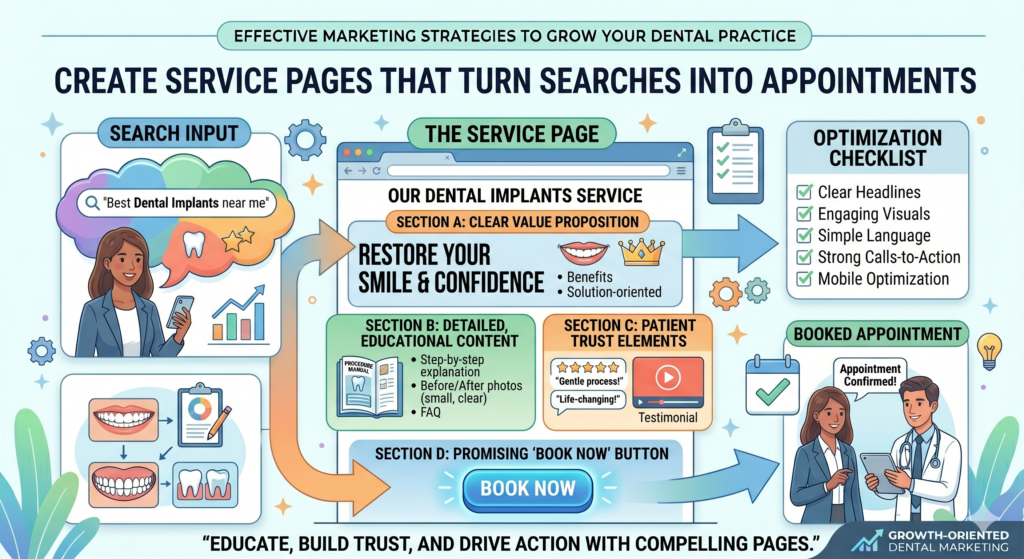
A weak service page simply explains the treatment. A strong service page sells trust. It answers questions, lowers fear, shows proof, and makes the next step clear.
Each major service needs its own clear page
Some dental websites put all services on one page. This may seem simple, but it limits growth. Each major service should have its own page because each service has its own patient mindset, search demand, and decision process.
One page cannot speak deeply to every patient need
A patient looking for emergency dental care wants fast help. A patient considering veneers wants to know about smile design, natural results, and confidence. A patient thinking about implants wants to understand the process, cost factors, healing time, and long-term value.
These needs are too different to handle well on one short page.
When every major service has its own page, you can speak directly to the patient’s concern. You can answer better questions. You can use stronger examples. You can build a better path to booking.
This also helps search engines understand your website. A clear dental implant page has a better chance of ranking for implant searches than a general services page with only one small implant section.
Your service pages should match your growth goals
You do not need to build every possible page at once. Start with the services that matter most to your practice growth. If you want more implant cases, your implant page needs serious attention. If you want more Invisalign patients, that page should be deep and clear. If emergency visits are a strong entry point, your emergency page should be fast, direct, and built for mobile users.
Your website should reflect your business goals.
Too many practices bury their most valuable services. They mention them in a menu but do not give them enough depth. If a service is important to your revenue and growth, it deserves a page that works hard.
A strong service page follows the patient’s thought process
The best service pages are built around what the patient is thinking, not what the dentist wants to explain first. This is a key difference.
A dentist may think in terms of diagnosis, procedure, materials, tools, and clinical steps. A patient thinks in terms of pain, fear, cost, time, appearance, trust, and outcome.
Your page should meet the patient where they are.
Start with the problem the patient wants solved
The opening of a service page should show that you understand the patient’s situation. If the page is about dental implants, start with missing teeth and the daily problems they cause. If the page is about emergency dentistry, start with pain, swelling, broken teeth, or fear about what to do next.
If the page is about Invisalign, start with wanting straighter teeth without metal braces.
This makes the page feel relevant right away.
Once the patient feels understood, you can explain the treatment. But do not start with a cold definition. Start with the reason the patient came to the page.
Explain the treatment in plain words
After you name the problem, explain the treatment in simple language. Keep it clear and calm. Avoid long clinical terms unless you explain them.
For example, instead of saying, “Dental implants are titanium posts surgically placed into the alveolar bone,” you can say, “A dental implant is a small post placed in the jaw to hold a replacement tooth. It is made to feel stable, so you can chew and smile with more confidence.”
That is easier to understand and less scary.
Patients do not need every clinical detail before they book. They need enough understanding to feel safe taking the next step.
Your service pages should remove common objections
Every dental service has common reasons patients hesitate. If your page does not address these concerns, patients may leave and keep searching.
Talk about comfort before patients ask
Many patients worry about pain. This is true even for routine care, but it is especially true for root canals, extractions, implants, and deep cleanings.
Your page should explain how your team helps patients stay comfortable. You can mention gentle care, local numbing, breaks, clear communication, and sedation options if your clinic offers them. Keep the tone calm.
Do not promise that every treatment will be completely painless. That can feel false. Instead, say how you help make the visit as comfortable and easy as possible.
Honest reassurance works better than big claims.
Explain cost without making the page feel cheap
Many patients want to know what treatment may cost, but exact pricing often depends on the exam. You can still reduce stress by explaining what affects cost and how your team helps patients understand their options.
For example, an implant page can explain that cost may depend on the number of teeth being replaced, bone health, type of restoration, and whether extra steps are needed. A cosmetic page can explain that price depends on the treatment plan and goals. A general care page can mention insurance help, payment options, and clear estimates before treatment.
This helps patients feel more in control.
When patients feel that your office will explain costs clearly, they are more likely to call.
Proof makes service pages stronger
Patients want to know that you can do what you say. Proof helps them believe you.
Use reviews that match the service
A service page becomes stronger when it includes reviews related to that service or concern. A nervous patient wants to see that others felt calm. An implant patient wants to see that others felt informed. A cosmetic patient wants to see that others loved their smile.
The review does not need to be long. It needs to be relevant.
Place proof close to the parts of the page where doubt may appear. If you explain a complex treatment, show a trust signal nearby. If you ask the reader to book, place a review before or near the action.
Show real photos when appropriate and allowed
Real photos can build trust, especially for cosmetic and restorative services. This may include office photos, team photos, treatment rooms, technology, and before-and-after images when you have proper permission.
Photos should feel real and warm. Patients can usually tell when a website uses too many stock images. Stock photos may look polished, but they do not help patients picture themselves in your clinic.
Real images make the practice feel more human.
Every service page needs a clear booking path
A service page should never leave the patient wondering what to do next. Once the patient understands the service and trusts your clinic, the next step should be easy.
Match the call to action to the service
Different services need different calls to action. An emergency dental page should encourage the patient to call now or request urgent help. An implant page may invite them to schedule a consultation. A cosmetic page may invite them to discuss their smile goals. A family dentistry page may invite them to book visits for the family.
The action should feel natural for the patient’s stage of decision.
Do not use cold or aggressive language. Use clear, warm words. Make the step feel simple.
Keep forms short and friendly
If your page uses an appointment form, keep it short. Ask only for what your team needs to follow up. Long forms can reduce bookings because patients may not want to share too much or spend time filling out many fields.
A simple form can ask for name, contact details, preferred appointment time, and a short note. You can collect more details later.
The goal of the page is not to complete the full intake process. The goal is to start the conversation.
Make Paid Ads Work by Sending Patients to the Right Place
Paid ads can help a dental practice grow faster, but only when they are handled with care. Many clinics waste money on ads because they send every click to the homepage, use broad keywords, or run offers without a follow-up plan.
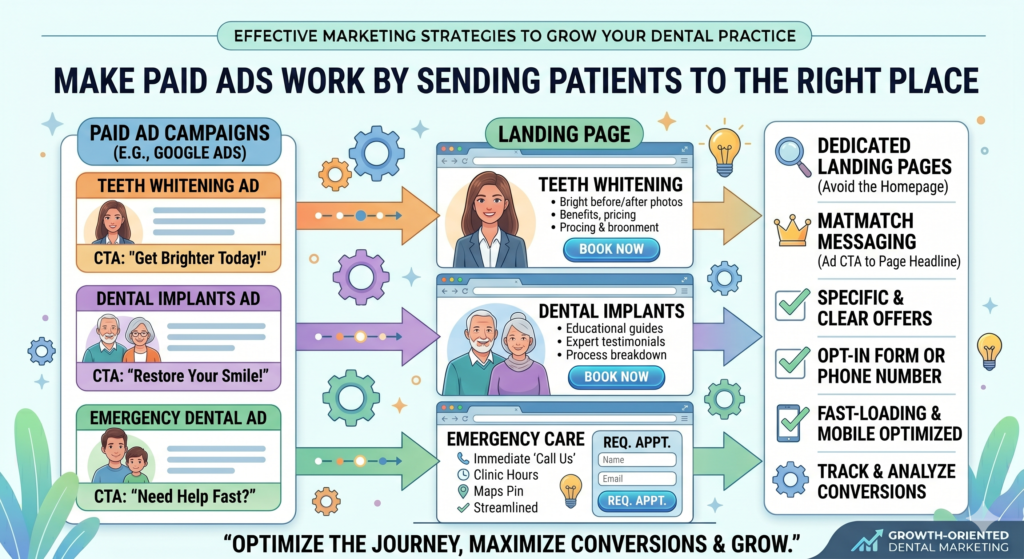
Ads are not magic. They are traffic. If the message, landing page, offer, and phone process are weak, paid traffic will not save the campaign.
When done well, ads can bring in emergency patients, implant consultations, Invisalign leads, cosmetic cases, new patient exams, and hygiene bookings. But each campaign needs a clear goal.
Paid search works best when intent is high
Search ads can be powerful because they reach people who are already looking for help. Someone searching “emergency dentist near me” or “dental implants in Phoenix” is showing clear intent. They may be much closer to booking than someone casually scrolling social media.
Focus on searches that show real patient need
Not every keyword is worth paying for. Some searches are too broad. Some are from people looking for jobs, school information, or general education. Your budget should focus on searches that suggest the person may become a patient.
Emergency searches, service-specific searches, and local dentist searches often have stronger intent. These should be grouped by service so the ad can match the need.
For example, an emergency campaign should speak to fast help, same-day availability if offered, pain relief, and calling now. An implant campaign should speak to missing teeth, stable replacement options, consultation, and trust. An Invisalign campaign should speak to clear aligners, smile goals, and easy evaluation.
When the ad matches the search, people are more likely to click. When the landing page also matches, they are more likely to book.
Avoid sending every ad to the homepage
A homepage is usually too general for paid ads. If someone clicks an implant ad, they should land on an implant page. If someone clicks an emergency ad, they should land on an emergency page. If someone clicks an Invisalign ad, they should land on an Invisalign page.
This is called message match. It means the patient sees the same promise from search to ad to landing page.
Without message match, the patient may feel lost. They clicked for one thing but landed on a page about everything. That extra confusion can waste your ad spend.
Landing pages should be built for action
A paid ad landing page has one main job. It should turn a visitor into a lead or appointment request. It does not need to show everything about your practice. It needs to support one decision.
Keep the page focused on one service
If the ad is for dental implants, the landing page should focus on dental implants. It can mention your practice, team, reviews, location, and process, but it should not distract the visitor with every other service.
A focused page helps the patient move forward faster.
The page should explain the problem, the treatment, why your clinic is trusted, what happens at the visit, and how to book. It should include a clear phone number and form. It should show reviews and simple proof.
Everything on the page should support the same action.
Make phone calls easy to track
Many dental leads come by phone. This is especially true for urgent care. If you run ads but do not track calls, you may not know which campaigns are actually working.
Call tracking can help you understand which ads produce real conversations. But tracking alone is not enough. You also need to review call quality. Are calls being answered? Is the front desk warm? Are patients being offered clear appointment options? Are missed calls being called back fast?
A strong ad campaign can fail if phone handling is weak.
Your marketing does not end when the phone rings. In many ways, that is where the real conversion happens.
Social ads need a different strategy than search ads
Social media ads can work for dental practices, but they usually reach people earlier in the decision process. Someone on Facebook or Instagram may not be actively searching for a dentist at that moment. So the message needs to earn attention without feeling pushy.
Use social ads for desire-based services
Social ads often work better for services people want, not only services they urgently need. Whitening, veneers, Invisalign, smile makeovers, and sometimes implants can perform well because they connect to confidence, appearance, and life goals.
The creative matters a lot. Real photos, short videos, doctor explanations, patient education, and simple before-and-after style content can help. You must follow all advertising rules and privacy rules, but the goal is to make the treatment feel understandable and possible.
A good social ad does not just say “Book now.” It opens a thought in the patient’s mind. It makes them think, “Maybe this is something I should finally look into.”
Retarget interested visitors with helpful reminders
Many people will visit your website but not book right away. Retargeting ads can bring them back. These ads can show helpful reminders, answer common questions, or invite them to schedule a consultation.
For example, someone who visited your implant page could later see an ad about what to expect during an implant consultation. Someone who visited your Invisalign page could see an ad about finding out if clear aligners are a good fit.
Retargeting should feel helpful, not annoying. The goal is to continue the conversation.
Improve Your Front Desk Process So Marketing Does Not Leak Leads
Marketing can bring attention, clicks, calls, and appointment requests. But if your front desk process is weak, many of those opportunities will disappear. This is one of the most overlooked parts of dental growth.
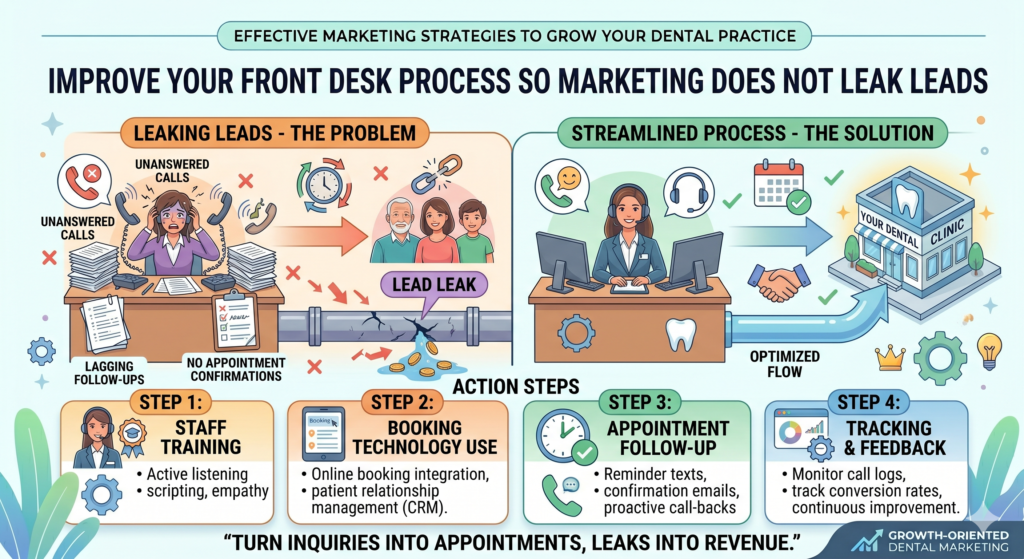
A practice may spend thousands on SEO and ads, but if calls go unanswered, messages sit too long, or the booking conversation feels cold, growth slows down.
Your front desk is not separate from marketing. It is part of marketing.
The first phone call shapes the patient’s trust
When a new patient calls, they are often still deciding. They may have found your clinic online, but they are not fully sold yet. The phone call can either build trust or break it.
Answer with warmth and control
A strong call starts with a warm greeting. The patient should feel that they reached a real person who is ready to help. This matters even more if the patient is in pain, nervous, or embarrassed.
The team should ask clear questions, listen carefully, and guide the caller toward the right next step. The tone should be calm, friendly, and confident.
Small details matter. A rushed voice can make the clinic feel too busy. A cold tone can make the patient feel like a number. A confused answer can make the patient lose trust.
Patients are not only judging what your team says. They are judging how it feels to talk to your practice.
Offer appointments in a way that makes booking easy
When a patient asks about availability, do not make the process feel open-ended and hard. Instead of saying, “When do you want to come in?” it may be better to offer two clear choices.
For example, the team can say, “We have an opening Tuesday morning or Thursday afternoon. Which works better for you?” This makes it easier for the patient to decide.
The same idea applies to consultation requests. Guide the patient gently. Explain what the first visit includes. Confirm what they should bring. Make the next step feel simple.
A patient who feels guided is more likely to book.
Speed matters when patients request appointments online
Online forms are useful, but only if your team responds quickly. A patient who submits a form may also contact another clinic. The first practice to respond warmly often wins.
Follow up while the patient is still interested
A fast response shows that your office is organized and attentive. If a patient asks for an appointment and hears nothing for hours or days, they may assume the clinic is not available or not interested.
Your team should have a clear process for checking form submissions, missed calls, voicemails, texts, and emails. New patient leads should not sit unseen.
This is especially important for high-value services. A dental implant lead may need education and trust. If your follow-up is slow, another practice may take over the conversation.
Use more than one follow-up method
Some patients prefer calls. Others prefer texts or emails. Your follow-up system should use the methods patients are most likely to answer, while following all consent and privacy rules.
A simple follow-up might begin with a phone call, then a text if there is no answer, then another helpful message later. The tone should stay warm and useful. Do not make the patient feel chased. Make them feel helped.
The message should remind them why they reached out and make booking easy.
Missed calls should be treated like missed revenue
Every missed call may be a lost patient. This is especially true during business hours. If someone calls with tooth pain and no one answers, they may call the next clinic immediately.
Track missed calls and call back fast
Your practice should know how many calls are missed, when they are missed, and how quickly they are returned. This is basic growth data.
Calling back fast can recover some leads, but timing matters. A callback two hours later may be too late for an emergency patient. A callback the next day may be too late for almost anyone.
If your team is often too busy to answer, that is not only an operations issue. It is a marketing issue because paid and organic leads are leaking out of the system.
Review call recordings if available and allowed
Call recordings can reveal what is really happening. You may discover that leads are asking about implants but not being guided to consultations. You may find that price questions are handled too quickly. You may hear that nervous patients need more reassurance. You may notice that the team is kind but not asking for the appointment clearly.
This is not about blaming the front desk. It is about coaching and improving the system.
Small call improvements can lead to major growth because the practice may already be getting enough interest. It just needs to convert more of it.
Use Email and Text Follow-Up to Bring Patients Back at the Right Time
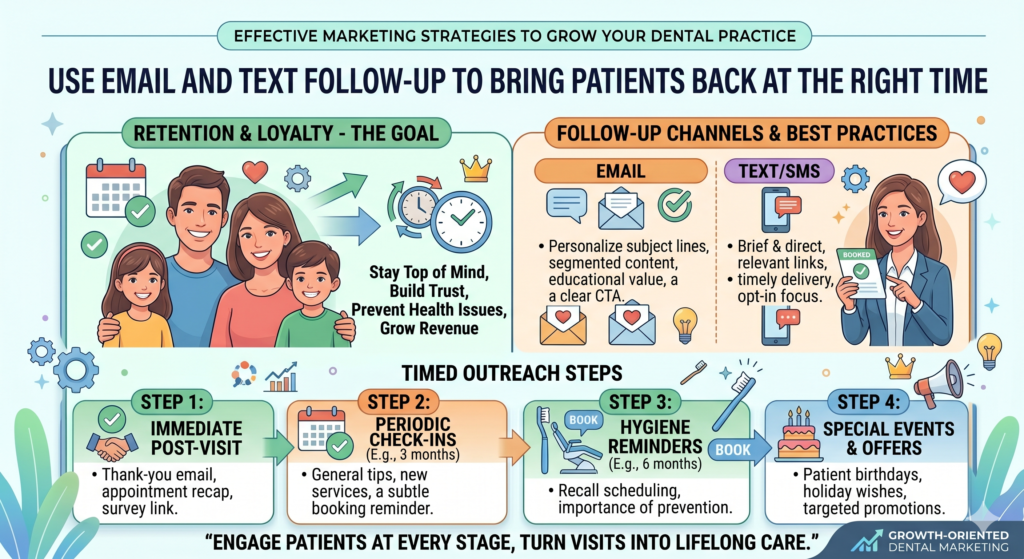
A dental practice should not depend only on new patients. New patients matter, but long-term growth comes from keeping the patients you already have. A patient who returns for cleanings, accepts needed treatment, brings family members, and refers friends can be worth far more than a one-time appointment.
This is why follow-up matters so much.
Many dental practices lose patients quietly. The patient does not complain. They do not leave a bad review. They simply get busy, miss a cleaning, delay treatment, move your reminder to later, and slowly disappear. Without a strong recall and follow-up system, this happens every month.
Email and text messages can help bring patients back, but only when they feel useful and timely. Patients do not want spam. They want simple reminders, clear next steps, and helpful guidance that makes dental care easier.
Your recall system should feel helpful, not annoying
Recall is one of the most valuable growth systems in a dental practice. It brings patients back for routine care, helps catch problems early, and keeps your schedule steady. But many recall systems are too weak, too generic, or too easy to ignore.
A strong recall message should feel like a kind reminder from a team that knows the patient, not like a cold automated notice.
Send reminders before patients fully fall out of habit
The best time to bring a patient back is before they have completely drifted away. If someone is due for a cleaning, do not wait too long to contact them. A simple reminder can help them act while dental care is still fresh in their mind.
The message should be short and clear. It can say that they are due for a visit, that the team would be happy to help them find a time, and that regular care can prevent small issues from becoming bigger problems.
The tone should not shame them. Do not say they have neglected their teeth. Do not make them feel guilty. Guilt can make people avoid care even more. Use a calm, friendly tone that makes returning feel easy.
Use simple language that makes action easy
A recall message should not make the patient think too hard. If the goal is to book a cleaning, say that clearly. If the patient can call, text back, or use an online link, make that easy.
For example, a message can say, “Hi Sarah, you are due for your next dental visit. We have openings next week and would be happy to help you find a time that works.”
This feels much better than a stiff message packed with office language.
Good follow-up should reduce friction. It should make the patient feel that booking is simple, not like another task on a long list.
Treatment follow-up can increase case acceptance
Many patients do not say yes to treatment right away. They may need time to think. They may want to check their budget. They may need to talk with a spouse. They may still feel unsure. If your practice does not follow up, many of these patients never return to the decision.
This does not mean you should pressure people. It means you should support them.
Follow up after treatment plans are presented
When a patient receives a treatment plan and does not schedule, your team should have a clear follow-up process. The message should be helpful and low-pressure.
You can remind the patient what the next step is, ask if they have questions, and offer to help them understand timing, payment options, or appointment choices.
The goal is not to push. The goal is to make sure the patient does not feel alone with a decision they may not fully understand.
A patient may delay because they are confused, not because they are uninterested. A kind follow-up can help them move forward.
Use education to support bigger treatment decisions
For larger treatments like implants, veneers, Invisalign, crowns, and full-mouth care, one follow-up message is often not enough. These patients may need more education.
You can send simple content that explains what to expect, how the treatment helps, what questions to ask, and why timing matters. This can be done through email, text links, or consultation follow-up messages.
The content should not sound like a hard sales pitch. It should sound like guidance.
For example, an implant patient may benefit from a message that explains what happens during the consultation, why bone health matters, and how the team creates a plan. A cosmetic patient may benefit from a message about natural-looking results and how smile goals are discussed before treatment begins.
Helpful education builds confidence. Confidence leads to action.
Reactivation campaigns can bring back inactive patients
Inactive patients are a hidden growth opportunity. Many practices focus so much on new patient ads that they forget about people who already know the clinic. These patients may not need much convincing. They may only need a simple reason to return.
Segment inactive patients by how long they have been away
A patient who is six months overdue is different from a patient who has not visited in three years. Your message should match the level of distance.
Someone who is only a little overdue may need a friendly reminder. Someone who has been gone for a long time may need a warmer re-introduction. They may wonder if they will be judged for not coming in. Your message should make them feel welcome.
A strong reactivation message might say that life gets busy, that the team would be happy to see them again, and that the first step is simply booking a checkup.
This type of message removes shame. That matters because shame is one of the biggest reasons people avoid dental care.
Give returning patients a simple reason to act now
A reactivation campaign works better when there is a clear reason to respond. This reason does not always need to be a discount. It can be open appointment times, a reminder to use benefits, a seasonal checkup message, a new patient comfort option, or a note about preventing small issues from becoming bigger.
If your practice uses offers, they should be thoughtful and aligned with your brand. Do not train patients to only respond to discounts. Instead, frame the message around health, ease, and getting back on track.
The best reactivation campaigns feel like an invitation, not a promotion.
Email newsletters should build trust between visits
A dental newsletter does not need to be long. It does not need to be fancy. It needs to be useful enough that patients do not ignore it.
Most patients do not think about dentistry every day. A good newsletter keeps your practice present in a gentle way. It helps patients remember you before they need you.
Share simple advice patients can use
Your newsletter can include short guidance on common issues like tooth sensitivity, bleeding gums, bad breath, whitening safety, children’s brushing habits, dental anxiety, or when to call about tooth pain.
The content should be written in plain words. It should feel like advice from a friendly dental team, not a medical textbook.
When patients learn from you over time, they trust you more. Then, when a need appears, your practice is the one they remember.
Keep the focus on care, not constant selling
If every email is a promotion, patients will tune out. A strong email plan balances helpful education, gentle reminders, and occasional service messages.
You can talk about whitening before wedding season, sports guards before school sports, dental benefits near the end of the year, or emergency care before holiday travel. But each message should still be useful.
The goal is not to fill inboxes. The goal is to stay trusted.
Build a Social Media Presence That Feels Human and Local
Social media may not be the main booking channel for every dental practice, but it still plays an important role. It helps people see the human side of your clinic. It makes your practice feel familiar before a patient walks in. It can support trust, referrals, patient education, and brand recall.
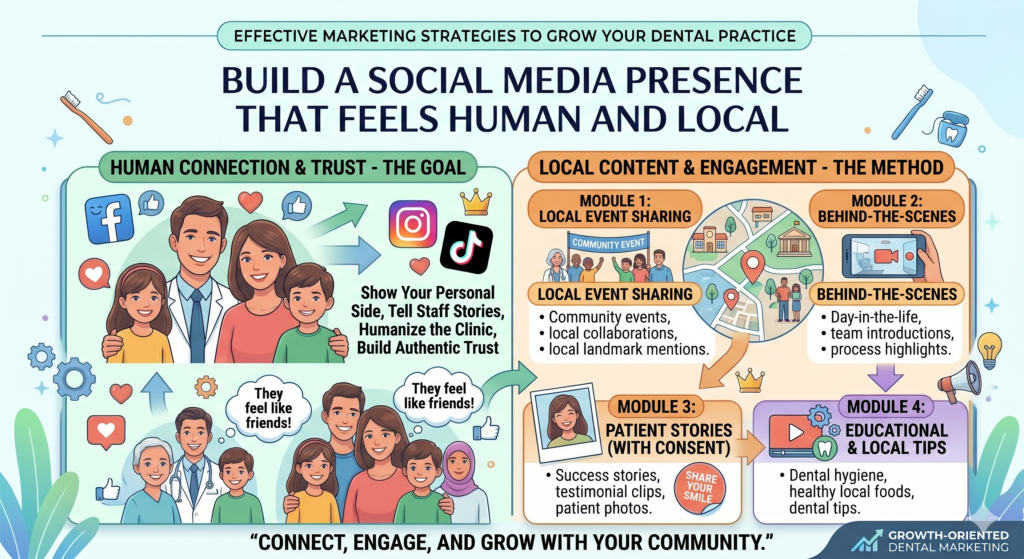
The mistake many practices make is treating social media like a random posting task. They post a tooth tip here, a holiday graphic there, and maybe a stock image when someone remembers. That kind of posting rarely creates growth.
Good dental social media should make your clinic feel real. It should show your team, your values, your patient experience, and your helpful advice in a simple way.
Social media should show the people behind the practice
Patients are not only choosing dental services. They are choosing people. They want to know who will greet them, who will clean their teeth, who will explain treatment, and who will help them feel comfortable.
Share real team moments with a clear purpose
Real team content can build trust faster than polished stock graphics. This may include a team member introduction, a behind-the-scenes look at the office, a birthday, a training day, a new piece of equipment, or a simple message from the dentist.
But the post should still have a purpose. It should help patients feel closer to your practice.
For example, a team introduction can explain what that person does and how they help patients. A behind-the-scenes post can show how the office prepares for a safe and comfortable visit. A dentist video can answer a common patient question in a warm and simple way.
This kind of content makes the practice feel approachable.
Let your tone match the experience patients get in the office
Your social media should sound like your clinic feels. If your practice is warm and family-focused, your posts should feel friendly and calm. If your practice is cosmetic and high-end, your posts may feel polished but still human. If your practice focuses on nervous patients, your posts should feel reassuring and gentle.
Consistency matters. A patient should feel the same brand personality on your social media, website, phone call, and in-office visit.
When the tone matches across every touchpoint, trust builds faster.
Educational posts can create demand without pressure
Many patients do not book because they do not understand what is happening in their mouth. Social media can help educate them in small, easy pieces.
Answer one small question at a time
A social post does not need to explain everything. In fact, it should not. One post can answer one simple question.
You can explain why gums bleed, what tooth sensitivity may mean, when a chipped tooth should be checked, why cleanings matter even when nothing hurts, or how to help children brush better.
Each post should be clear and short, but not empty. Give one useful idea. Then guide people to call or visit your website if they need care.
This keeps your content useful without overwhelming people.
Use video to build comfort and trust
Short videos can work very well for dental practices because they let patients see your face and hear your voice. A dentist explaining a topic calmly can reduce fear. A hygienist sharing a brushing tip can feel friendly. A front desk team member explaining what new patients should expect can make booking easier.
The videos do not need to be perfect. They need to be clear, well-lit, and real.
A simple video filmed in the office can often feel more trustworthy than a polished ad because it shows the real people patients will meet.
Local content helps your practice stay connected to the community
Dental practices grow through local trust. Social media can help show that your clinic is part of the community, not just a business in the area.
Talk about your local area naturally
You can share posts about community events, school seasons, local partnerships, charity drives, sports mouthguard reminders, or holiday hours. You can also create content around local patient needs, such as back-to-school dental visits or end-of-year insurance reminders.
The key is to keep it natural. Do not force local mentions into every post. Use them when they help the message feel relevant.
When people see your practice involved locally, your name becomes more familiar. Familiarity makes referrals and bookings easier.
Encourage sharing without making it awkward
Social media can support word-of-mouth. Patients may tag a friend, share a helpful post, or remember your clinic when someone asks for a dentist recommendation.
To encourage this, create content people actually want to share. A clear post about what to do for a knocked-out tooth may be useful. A kind reminder about children’s dental visits may help parents. A simple guide to tooth pain may help someone who is unsure what to do.
Helpful content travels better than self-promotional content.
Use Video Marketing to Make Dental Care Feel Less Scary
Video is one of the best ways to build trust in dental marketing. Dentistry can feel personal and stressful. Many patients want to see who they are dealing with before they book. Video helps them feel familiar with your team, your office, and your way of explaining care.
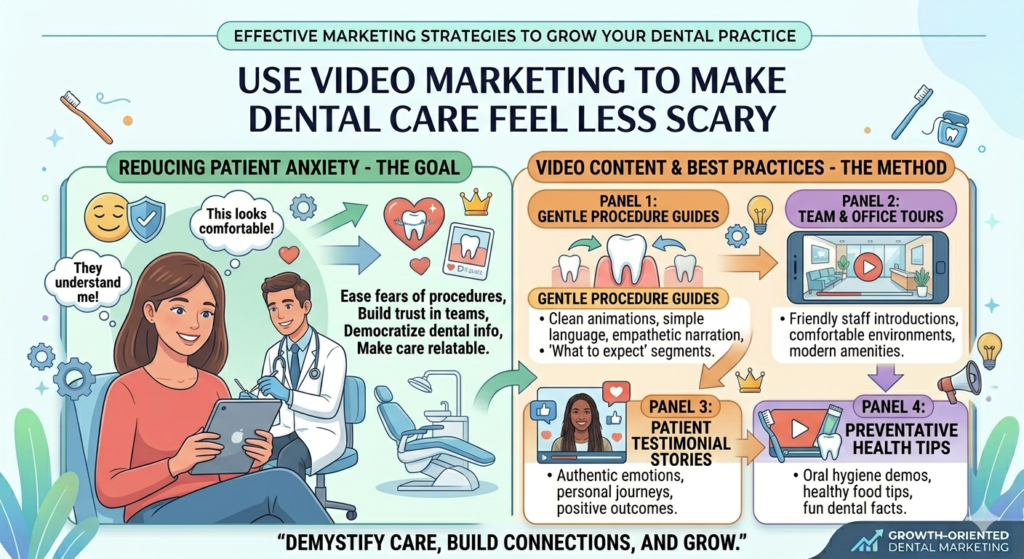
A patient may read your website and still feel unsure. But when they watch a calm dentist explain a treatment in simple words, the fear can start to drop. That is the power of video.
Start with simple videos that answer real patient questions
You do not need a large production team to begin using video. You need clear topics, good lighting, clean sound, and a helpful tone.
Record the questions patients ask every week
The best video topics are already inside your practice. Think about what patients ask before treatment. Does whitening hurt? Is a root canal painful? How long do implants take? What should I do if a tooth breaks? Why do my gums bleed? Is Invisalign right for adults? What happens at a new patient visit?
Each of these can become a short video.
The video should answer the question in plain words. It should not try to cover every clinical detail. It should help the patient understand enough to feel safer and take the next step.
Keep videos short and focused
A strong dental video does not need to be long. In many cases, one to three minutes is enough. The dentist or team member should answer one question clearly and then invite the viewer to contact the practice if they want help.
Short videos are easier to watch, easier to share, and easier to reuse across your website, social media, emails, and ads.
If the topic is complex, such as dental implants, you can create several shorter videos instead of one long one. One video can explain who implants are for. Another can explain the consultation. Another can explain healing. Another can answer cost questions in a general way.
This makes the content easier for patients to understand.
Use office videos to reduce first-visit anxiety
Many people feel nervous before visiting a new dentist. They wonder what the office looks like, what the team is like, and whether they will feel judged. Office videos can reduce that uncertainty.
Show what a new patient can expect
A simple welcome video can walk patients through the first visit. It can show the front desk, waiting area, treatment room, and the friendly faces they will meet. It can explain that the team will review their concerns, take needed images, discuss findings, and explain options clearly.
This kind of video is especially helpful for nervous patients because it removes the fear of the unknown.
When people know what to expect, booking feels easier.
Let the dentist speak directly to the patient
A short message from the dentist can be powerful. It can explain the practice philosophy, the focus on comfort, the no-pressure approach, or the way treatment plans are discussed.
The words should be simple and sincere.
Patients can often sense when a message is real. A warm, honest video can do more for trust than a page full of polished claims.
Place videos where they support patient decisions
Creating videos is only the first step. You also need to use them in the right places.
Add service videos to service pages
A dental implant page should include a video explaining implants. An Invisalign page can include a video about clear aligners. A root canal page can include a calming video about what the treatment is really like. A new patient page can include a welcome video.
Videos help keep people on the page longer and help them feel more connected to your practice.
A patient who watches a dentist explain a service may be more likely to trust that dentist with the treatment.
Use videos in follow-up messages
Videos can also help after a consultation. If a patient is thinking about a treatment plan, your team can send a helpful video that explains the next step. This feels more personal than sending only written instructions.
For example, after an implant consultation, the patient could receive a video about what happens before treatment begins. After an Invisalign consultation, they could receive a video about daily aligner use. After a new patient exam, they could receive a video about how to understand a treatment plan.
Video keeps the conversation going even after the patient leaves the office.
Track the Numbers That Actually Show Practice Growth
Marketing without tracking is guesswork. A dental practice may feel busy but still not know which marketing channels are working. It may spend money on ads without knowing how many real patients those ads bring. It may get website traffic but not know whether visitors are booking. It may have many calls but not know how many turn into appointments.
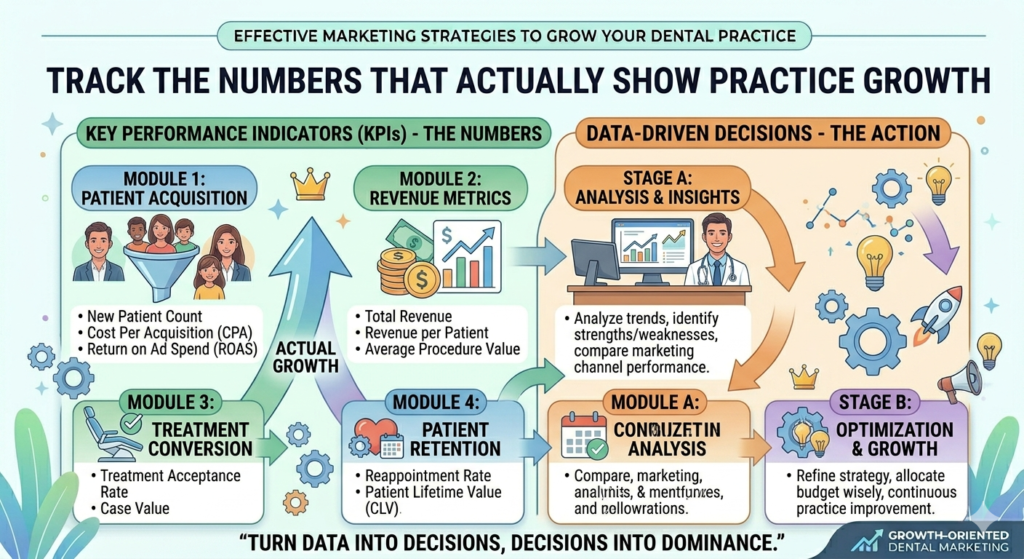
Good tracking helps you make better decisions. It shows where to invest more, what to fix, and what to stop doing.
Track leads by source, not just total calls
Total calls can be misleading. You need to know where those calls come from. A call from Google Ads, organic search, Google Business Profile, a referral, social media, or email follow-up should not all be treated the same.
Know which channels bring real appointments
A channel is only valuable if it brings the right kind of patients. Some channels may bring many calls but few bookings. Others may bring fewer leads but higher-quality patients.
For example, emergency ads may bring many calls quickly. SEO may bring steady new patient interest over time. Implant pages may bring fewer leads but higher-value consultations. Referral campaigns may bring highly loyal patients.
When you know the source, you can judge performance more fairly.
You should track not only leads, but booked appointments, completed visits, treatment acceptance, and revenue when possible. This gives you a clearer picture of true growth.
Watch for lead leaks in the patient journey
If many people visit your website but few call, the website may need improvement. If many people call but few book, the phone process may need work. If many people book but do not show up, reminders may need improvement. If many people receive treatment plans but do not accept, case presentation and follow-up may need attention.
Tracking helps you find the leak.
Without tracking, it is easy to blame the wrong thing. You may think ads are bad when the real issue is the landing page. You may think SEO is weak when the real issue is missed calls. You may think patients are price shopping when the real issue is unclear treatment explanations.
Good data helps you fix the right problem.
Track website behavior so you can improve the booking path
Your website can show you how patients behave before they contact you. This can reveal problems that are not obvious from the outside.
Look at the pages that bring in patients
Some pages may attract more traffic than others. Some may lead to more calls or form submissions. These pages deserve attention.
If your emergency dental page brings many calls, make it even better. If your implant page gets traffic but few leads, improve the proof, clarity, and call to action. If your new patient page is often visited, make sure it answers the most important questions.
Your best pages should be treated like assets. They should be updated, tested, and improved over time.
Check mobile performance often
Many dental searches happen on phones. If your mobile site is slow, hard to read, or difficult to use, you may lose patients.
Check how your pages look on a phone. Is the phone number easy to tap? Is the appointment button visible? Is the text readable? Do images load quickly? Is the form simple? Can patients find your address?
Mobile experience is not a design detail. It is a booking issue.
Review marketing performance every month
Marketing should not be reviewed only when things feel slow. A monthly review helps your practice stay in control.
Compare spend, leads, bookings, and patient value
A simple monthly review should look at how much you spent, how many leads came in, how many booked, how many showed up, and which services they needed. If possible, compare this to revenue and treatment acceptance.
This helps you understand which efforts are truly paying off.
For example, a campaign with expensive leads may still be profitable if those leads become implant patients. A campaign with cheap leads may be weak if they do not show up or accept treatment.
The goal is not just cheaper leads. The goal is better growth.
Make small improvements every month
Strong dental marketing is built through steady improvement. You do not need to rebuild everything constantly. You need to keep fixing the next most important bottleneck.
One month, you may improve your Google Business Profile. Another month, you may rewrite your implant page. Another month, you may train the front desk on call handling. Another month, you may create a reactivation campaign. Another month, you may add better reviews to service pages.
Small improvements compound. Over time, they create a practice that attracts, converts, and keeps more patients.
Build Referral Systems That Make Happy Patients Bring More People In
Referrals are one of the best ways to grow a dental practice because they come with trust already attached. When a patient tells a friend, family member, co-worker, or neighbor about your clinic, that person does not see you as a random dental office. They see you as a safe choice recommended by someone they know.
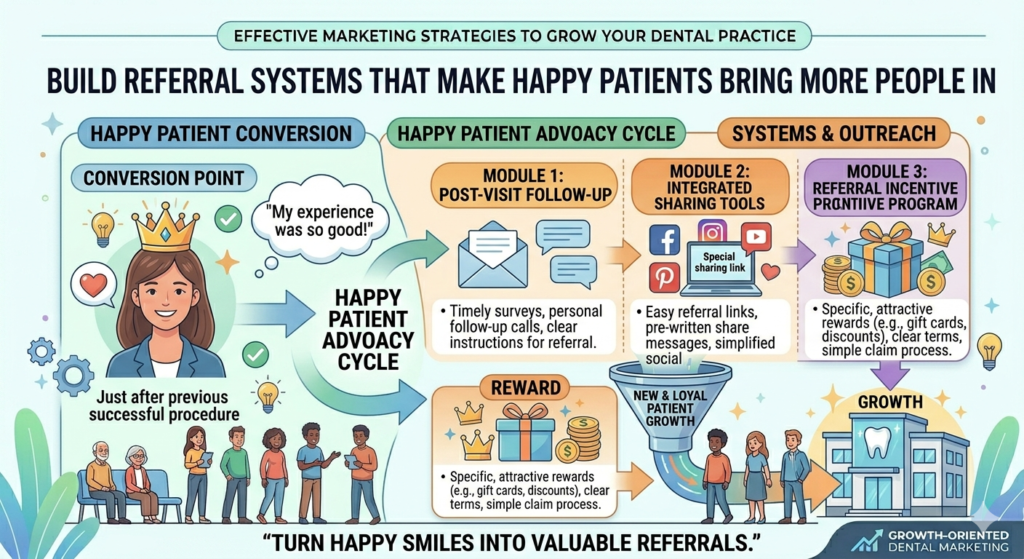
That trust shortens the decision process.
A referred patient is often easier to convert because they have already heard something good about you. They may already know that your team is kind, your dentist explains things well, your office feels calm, or your treatment does not feel rushed. This kind of trust is hard to buy with ads.
But referrals should not be left to chance. Many happy patients would gladly refer others, but they are busy. They may not think about it unless you make it easy and natural.
A good referral system starts with a remarkable patient experience
Before asking for referrals, your practice must be worth talking about. Patients refer when something stands out. It may be the way your team calmed their fear. It may be how clearly the dentist explained treatment. It may be how easy it was to book. It may be how gently their child was treated. It may be how honest the cost discussion felt.
People rarely refer an average experience. They refer an experience that made them feel safe, respected, surprised, relieved, or cared for.
Find the moments patients remember most
Every practice has small moments that patients remember. The problem is that many clinics do not design these moments on purpose.
A nervous patient may remember that the assistant checked in often and told them they could raise a hand if they needed a break. A parent may remember that the hygienist spoke kindly to their child and made the visit feel fun.
A busy patient may remember that your team helped them schedule treatment without making them call back several times. A cosmetic patient may remember that the dentist listened carefully before suggesting options.
These moments become stories.
And stories drive referrals.
Your team should talk about these moments often. Ask what patients praise most. Ask what makes people smile at checkout. Ask what patients mention in reviews. Then make those moments part of your standard patient experience.
Make patients feel proud to recommend you
A patient refers your practice when they feel confident that you will treat their friend well. They are putting their own name on the line. If they worry that their friend may have a bad experience, they will stay quiet.
This means consistency is key.
Every patient touchpoint should feel reliable. The phone call, check-in, waiting time, explanation, treatment, checkout, billing conversation, and follow-up should all support the same feeling. A referral-friendly practice does not only deliver good dentistry. It delivers a smooth and caring experience around the dentistry.
When patients know what to expect from you, they feel safer recommending you.
Ask for referrals in a way that feels natural
Many practices avoid asking for referrals because they fear it will feel awkward. It does not have to. The best referral ask feels like a warm invitation, not a sales pitch.
Ask after a positive patient moment
The best time to ask is after a patient expresses happiness. If someone says, “This was the best dental visit I have had,” that is the moment. If a parent says, “My child was so nervous, but you made this easy,” that is the moment. If a patient is thrilled with a smile result, that is the moment.
Your team can respond with warmth and then gently say that you would be happy to care for their friends or family too.
This kind of ask feels natural because it follows real appreciation.
It should not sound scripted. It should sound human.
Give patients simple words they can share
Sometimes patients want to refer but do not know what to say. You can make it easier by giving them a simple message.
For example, your team might say, “If you know anyone who feels nervous about the dentist, please feel free to send them our way. We always try to make the first visit feel calm and easy.”
That gives the patient a clear type of person to think about. It also gives them language to use.
A family practice might mention families with young kids. A cosmetic practice might mention people thinking about improving their smile. An emergency-focused practice might mention anyone who needs help quickly.
The more specific the ask, the easier it is for patients to remember someone.
Make referrals easy to complete
A referral should not require effort from the patient or the person being referred. If it is hard, fewer people will do it.
Create a simple referral path
Your team should have a clear way to handle referred patients. When someone calls and says they were referred, the front desk should thank them, ask who referred them, and make the booking process easy.
Your website can also include a simple new patient page that referred patients can use. This page should explain what to expect, how to book, what to bring, and why many local patients choose your practice.
The easier the path, the more referrals turn into appointments.
Use referral cards only when they make sense
Referral cards can still work in some practices, but they should not feel outdated or forced. A simple card can be useful if it includes your phone number, website, address, and a warm message. But many patients now prefer digital sharing.
A textable referral link, a simple website page, or a shareable social post may be easier.
The tool matters less than the ease. Patients should be able to recommend you in seconds.
Track referrals so you can grow them on purpose
If you do not track referrals, you cannot improve them. Your practice should know how many new patients come from patient referrals, which patients refer often, and what kinds of patients are being referred.
Ask every new patient how they found you
This should be part of your intake and phone process. If someone says they were referred by a friend or family member, record it. This helps you understand how much growth is coming from word-of-mouth.
It also helps your team thank the referring patient.
A simple thank-you can strengthen loyalty. It does not need to be expensive. It can be a kind note, a personal thank-you at the next visit, or a small gesture that fits your local rules and brand.
Learn what creates referrals in your practice
Over time, referral tracking can show patterns. Maybe your pediatric experience drives family referrals. Maybe your gentle approach brings nervous patients. Maybe implant patients refer others after they regain confidence. Maybe emergency patients become strong advocates because you helped them when they were in pain.
These patterns tell you what to strengthen in your marketing.
When you know why people refer, you can talk about those strengths more clearly on your website, in your ads, in your emails, and in your patient conversations.
Use Community Marketing to Become the Dental Practice People Know by Name
Dental practices grow faster when people in the local area recognize and trust the name. This is why community marketing still matters. Digital marketing can help patients find you, but local presence helps them remember you.
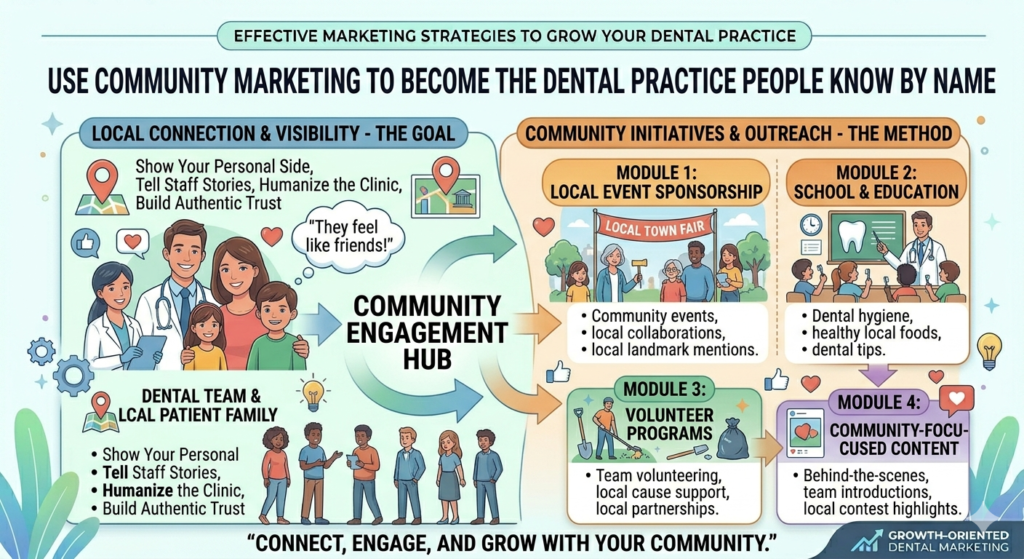
Community marketing does not mean sponsoring everything or handing out flyers at every event. It means showing up in places where your ideal patients already spend time and doing it in a way that feels useful.
A dental practice is a local health business. People want to feel that you are part of the community, not just another clinic trying to get bookings.
Choose community efforts that match your patient goals
Not every community activity is worth your time. The right choice depends on the patients you want to reach.
Family practices should build trust with parents
If your practice wants more families, focus on places where parents are already paying attention. This may include schools, daycares, children’s events, parent groups, youth sports, and local family fairs.
The goal is not to sell treatment on the spot. The goal is to become familiar and helpful.
A short talk about children’s brushing habits, a simple dental care guide for parents, or a sports mouthguard reminder can create trust. Parents remember businesses that help them take better care of their kids.
When they later need a dentist, your name feels familiar.
Cosmetic and implant practices should focus on education and confidence
If your practice wants more cosmetic or implant patients, community marketing may look different. You may host a small smile confidence event, partner with local wellness businesses, speak at senior centers, or create educational sessions about missing teeth, dentures, implants, or smile options.
The tone should be helpful, not sales-heavy.
People considering bigger dental treatments often need time and trust. A community event lets them meet your team in a lower-pressure setting. It helps them see that your practice explains things clearly and treats people with respect.
Build partnerships with local businesses
Local partnerships can create a steady flow of awareness. The best partnerships are built around shared audiences and real value.
Partner with businesses that already serve your ideal patients
A family dental practice may partner with schools, childcare centers, pediatric offices where appropriate, children’s activity centers, or family photographers. A cosmetic dental practice may connect with salons, wedding planners, fitness studios, med spas, or professional groups.
A practice that serves older adults may connect with senior centers, retirement communities, or local wellness groups.
The partnership should make sense for both sides.
For example, a dental practice can provide a simple oral health guide for a local daycare’s parent packet. A cosmetic practice can provide smile preparation tips for brides through a wedding vendor. An implant-focused clinic can provide educational resources for older adults who struggle with missing teeth.
This works because it is helpful, not random.
Make the partnership easy for the other business
Busy local businesses will not promote you just because you ask. You need to make it easy and useful for them.
Give them simple materials. Offer a short educational session. Provide content they can share. Create a benefit for their audience. Keep the ask light.
The best local partnerships do not feel like advertising swaps. They feel like two trusted businesses helping the same community.
Use local events to collect attention you can follow up with
Community marketing becomes stronger when you have a way to continue the relationship. If someone meets your team at an event, that is good. If they also join your email list, follow your social page, scan a QR code, or take home a useful guide, that is better.
Give people a reason to stay connected
At events, do not only hand out pens or toothbrushes. Give people something useful. This could be a guide to children’s dental visits, a checklist for choosing an implant dentist, a tooth pain action guide, or a simple smile consultation invite.
The content should match the audience.
A helpful resource gives people a reason to remember you. It also gives your team a natural way to invite follow-up.
Bring the local experience back into your digital marketing
When your practice attends or supports a community event, share it online. Post photos when appropriate. Thank the local group. Explain why the event mattered.
This makes your social media feel more local and real. It also shows website visitors and social followers that your practice is active in the area.
Community marketing should not sit apart from digital marketing. The two should support each other.
Build Trust With Before-and-After Proof the Right Way
Before-and-after proof can be very powerful in dental marketing, especially for cosmetic dentistry, Invisalign, implants, crowns, veneers, whitening, and full-mouth cases. Patients want to see what is possible. They want to know whether your work looks natural. They want confidence before they book.
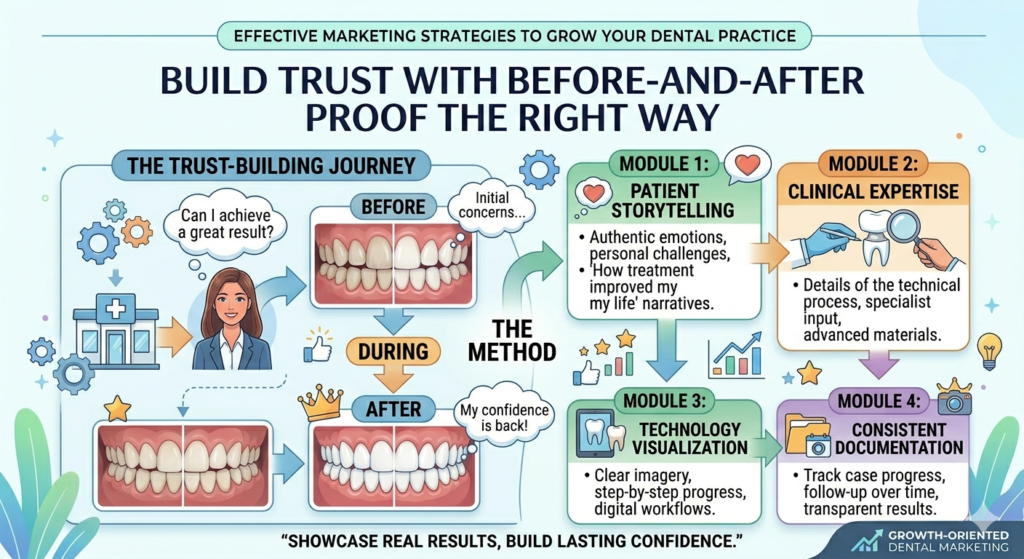
But this kind of proof must be used carefully. It should be honest, clear, and shared only with proper patient permission. It should never make promises that every patient will get the same result.
Good visual proof helps patients picture their own change
Many patients struggle to imagine what treatment can do for them. A written explanation helps, but a real result can make the benefit easier to understand.
Show results that feel real, not overly polished
Patients want beautiful results, but they also want results that feel believable. Overly edited photos can reduce trust. Real, clear images often work better because they show the kind of change patients can understand.
The photos should be high quality, but they should not feel fake. Use consistent lighting, angles, and framing when possible. This helps patients compare fairly.
A natural-looking result can be more persuasive than an overly dramatic one because many patients fear looking fake or overdone.
Explain the patient goal behind the result
A before-and-after image becomes stronger when you explain the goal in simple words. For example, you can say that the patient wanted to repair worn teeth, brighten their smile, close spacing, replace missing teeth, or feel more confident in photos.
This helps viewers connect emotionally with the case.
The story should be brief and privacy-safe. Do not share details that identify the patient unless you have clear permission. Keep the focus on the problem, the goal, and the kind of result.
Use case examples to educate, not just impress
Before-and-after proof should not only say, “Look what we did.” It should help patients understand their options.
Explain why treatment plans are personal
When showing results, remind patients that every mouth is different. One person may need whitening. Another may need bonding. Another may need veneers. Another may need Invisalign first. Another may need gum care before cosmetic work.
This helps set honest expectations.
It also positions your practice as thoughtful rather than sales-driven. Patients want to know you will recommend what fits them, not push the most expensive treatment.
Show different types of cases
If all your examples look like perfect smile makeovers, some patients may feel that your practice is not for them. Show a range when possible. Include small improvements, repair cases, alignment cases, missing tooth cases, and natural cosmetic changes.
This makes your work feel more accessible.
A patient who only wants to fix one chipped tooth may not relate to a full smile makeover. A patient who needs implants may not relate to whitening results. Different examples speak to different needs.
Place proof where patients need confidence most
Before-and-after examples should not be hidden in a gallery that few people visit. They should appear in the right places across your marketing.
Add relevant proof to service pages
A veneers page should show veneer-related results. An Invisalign page should show alignment changes. An implant page should show tooth replacement examples when appropriate. A bonding page should show small repairs.
This gives patients proof at the exact time they are learning about the service.
The page should also include a clear next step. After seeing what is possible, the patient should know how to book a consultation.
Use proof in consultation follow-up
If a patient has already discussed treatment but has not booked, a relevant case example can help them feel more confident. Your team can send a follow-up message with educational content, a case example, or a video that explains similar treatment goals.
This should be done thoughtfully and within privacy rules.
The goal is to help the patient see a path forward, not to pressure them.
Create a New Patient Experience That Supports Marketing Promises
Marketing gets patients to the door. The patient experience decides whether they stay, accept treatment, leave reviews, and refer others. If your marketing promises gentle care, clear answers, and a stress-free visit, your in-office experience must deliver that.
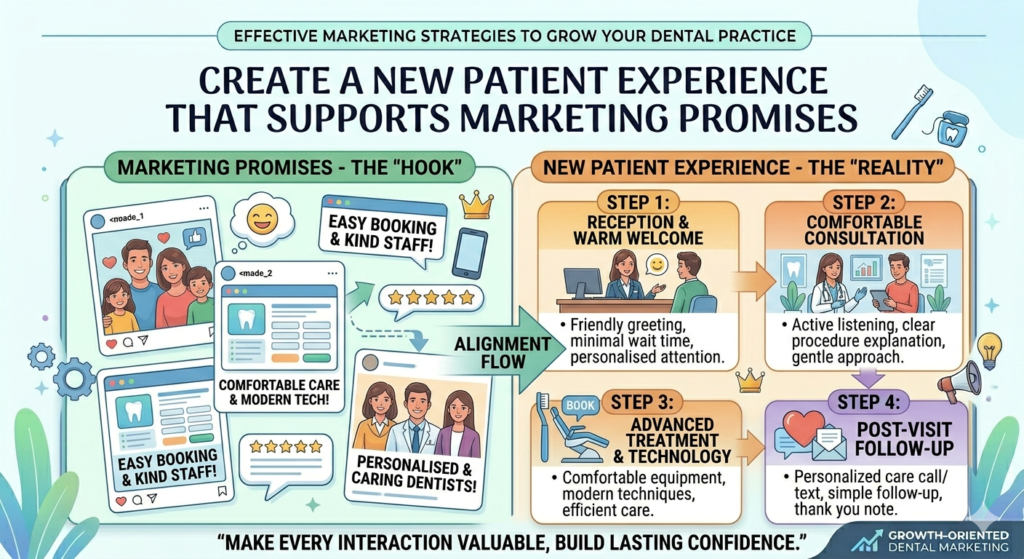
A great new patient experience is one of the strongest growth tools you have because it turns first visits into long-term relationships.
The first visit should feel organized and welcoming
New patients are often unsure. They do not know your team, your process, your fees, or what the dentist will say. A smooth first visit helps them relax.
Set expectations before the appointment
Before the patient arrives, send a simple message explaining what to expect. Tell them when to arrive, what to bring, how long the visit may take, and how to complete forms. If parking is difficult, explain it. If insurance details are needed, tell them clearly.
This reduces stress.
A patient who arrives prepared is more likely to have a good first impression.
Make check-in feel personal
The front desk should greet new patients warmly. If possible, use their name. Make the process simple. Do not make them feel like they are interrupting a busy team.
Small details matter. A warm smile, a clear explanation, and a calm tone can change how the patient feels about the whole visit.
The patient may not remember every clinical detail, but they will remember how your office made them feel.
The exam should build trust through clear communication
Patients want to understand what is happening. They want to know what you see, what it means, and what their options are.
Explain findings in plain words
During the exam, avoid overwhelming the patient with clinical language. Use simple explanations. Show images when helpful. Pause to ask if they have questions.
If you find an issue, explain what it is, why it matters, and what can happen if it is left alone. Then explain the options.
Patients are more likely to accept treatment when they understand the reason behind it.
Avoid making patients feel judged
Many patients already feel embarrassed about their teeth. If they sense judgment, they may not return. Your team should use a no-shame approach.
Instead of saying, “You should have come in sooner,” say, “We are glad you came in now, and we can help you take the next step.”
That simple shift can make a patient feel safe.
A safe patient is more likely to stay engaged.
The treatment plan should feel clear and manageable
Treatment planning is where many practices lose patients. If the plan feels confusing, expensive, rushed, or scary, the patient may delay.
Present the plan in order of priority
Patients need to know what matters most. If they need several treatments, explain what should be handled first and why. Separate urgent needs from optional or cosmetic goals.
This helps the patient feel in control.
A large treatment plan can feel overwhelming. A clear phased plan feels more manageable.
Discuss payment and scheduling with care
Cost conversations should be handled with respect. The patient should understand the estimate, insurance support, payment options, and next steps. The team should invite questions and avoid making the patient feel embarrassed.
This part of the experience is directly tied to marketing. If your ads and website promise clear care, your cost discussions must feel clear too.
Trust can be won or lost at checkout.
Build a Brand Patients Can Remember and Trust
A dental brand is not just your logo, colors, or website design. Your brand is the feeling patients connect with your practice. It is what people say about you when your team is not in the room.
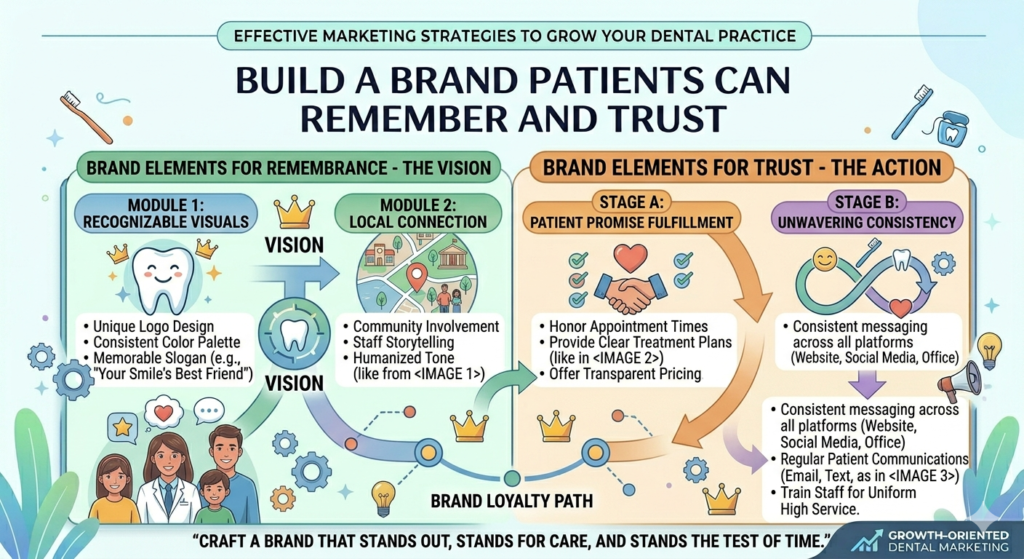
A strong brand makes marketing easier because patients remember you. They understand what you stand for. They know why you are different.
Your brand should be built on a clear promise
Every strong dental brand has a simple promise. This promise should match what your practice does best and what your patients care about most.
Choose a promise you can deliver every day
Do not build your brand around something that sounds good but is not true in daily practice. If you promise fast appointments, your schedule must support it. If you promise gentle care, your team must be trained for it. If you promise clear pricing, your cost conversations must be transparent.
If you promise family-friendly care, the office experience must feel easy for parents and children.
A brand promise is not a slogan. It is a standard.
When you deliver it again and again, patients begin to believe it.
Keep the message simple
Patients should be able to understand your brand quickly. Avoid vague language that every clinic uses. Words like quality, modern, caring, and comprehensive are fine, but they are not enough by themselves.
A clearer promise might focus on calm care for nervous patients, easy dentistry for busy families, natural-looking cosmetic results, or clear treatment plans without pressure.
Simple messages are easier to remember.
Your brand voice should sound the same everywhere
Your website, social media, emails, ads, phone scripts, and in-office signs should feel connected. They do not need to use the exact same words, but they should sound like the same practice.
Write like you speak to patients
If your team is warm and simple in person, your marketing should not sound cold and formal. If your dentist explains treatment clearly in the chair, the website should do the same.
This makes the brand feel real.
Patients trust brands that feel consistent. If the website sounds friendly but the phone call feels cold, trust drops. If the ad promises comfort but the office feels rushed, trust drops. Every touchpoint should support the same experience.
Remove empty claims from your marketing
Many dental brands rely on claims that do not mean much to patients. Saying you provide excellent care is not enough. Saying you use modern technology is not enough. Saying patients are your priority is not enough.
Show what those claims mean.
If you offer excellent care, explain how you plan treatment carefully. If you use modern technology, explain how it helps patients. If patients are your priority, show how you make visits easier.
Specific proof is stronger than broad praise.
A memorable brand helps every channel perform better
Branding is not separate from SEO, ads, reviews, referrals, or social media. It improves all of them.
Strong branding makes clicks more likely to turn into calls
When a patient lands on your website and quickly understands who you help and why you are different, they are more likely to stay. When they see the same message in reviews, photos, videos, and service pages, trust grows.
This makes your traffic more valuable.
You do not always need more visitors. Sometimes you need a clearer brand so more existing visitors become patients.
Strong branding makes referrals easier
People refer what they can explain. If your practice has a clear identity, patients know who to send your way.
They can say, “Go there if you are nervous. They are very gentle.” Or, “That office is great with kids.” Or, “They explain everything and do not pressure you.” Or, “They do beautiful cosmetic work that looks natural.”
That is brand power in plain language.
Use Offers Carefully So You Attract Good Patients, Not Just Bargain Hunters
Offers can help a dental practice get attention, but they must be used with care. A good offer can bring in the right patients and make the first step feel easier. A weak offer can attract people who only want the cheapest option and have no real interest in long-term care.
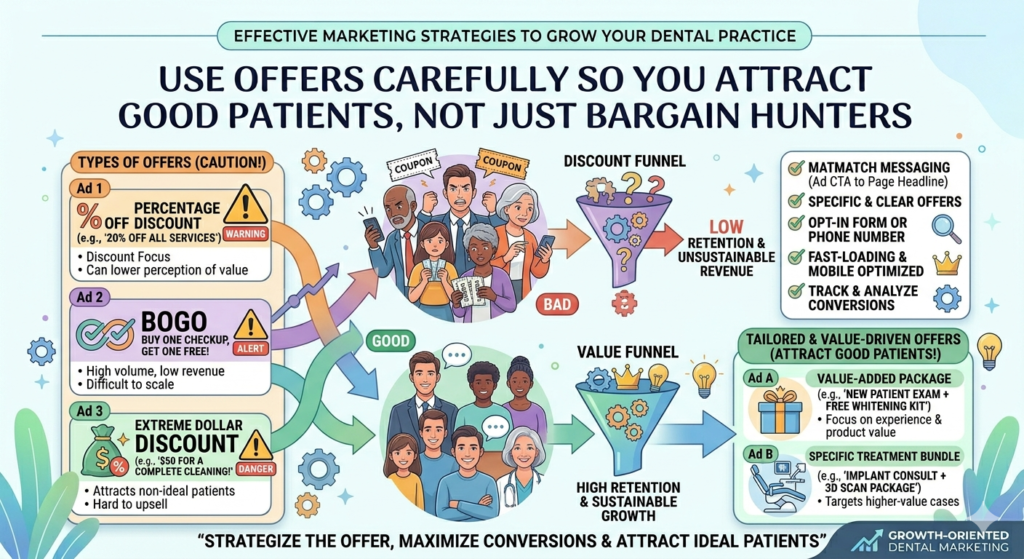
This is where many dental practices make a costly mistake. They think a discount is the fastest way to grow. So they run cheap cleaning offers, whitening specials, or low-price exam campaigns without thinking about what happens next. The schedule may fill for a short time, but the practice may not gain strong long-term patients.
The goal of an offer is not just to get someone through the door. The goal is to start a relationship with a patient who can trust you, return to you, and accept the right care when they need it.
Your offer should match the type of patient you want
Not every offer sends the same message. A very low-price offer may create quick interest, but it may also make patients focus only on cost. A comfort-focused offer, consultation offer, or clear first-visit offer can bring in people who care about trust, quality, and fit.
New patient offers should make the first visit feel easy
A new patient offer can work well when it removes uncertainty. Many people delay booking because they do not know what the first visit includes, how much it may cost, or whether they will feel pressured. A clear offer can lower that barrier.
For example, a new patient exam offer can explain what is included in the visit, what the patient can expect, and how your team will explain findings. The message should focus on clarity and comfort, not just price.
When you present the offer, make sure it does not sound like a quick transaction. It should sound like an easy way to begin care with a trusted local practice.
High-value service offers should focus on consultation and confidence
For services like implants, Invisalign, veneers, or smile makeovers, the offer should not cheapen the treatment. These patients need trust before they need a discount. They want to know if the service is right for them, what the process looks like, what it may cost, and whether they can believe the result.
A consultation offer can work better than a heavy discount. It gives the patient a clear first step without making the service feel low-value.
The consultation page should explain what will happen, what questions will be answered, and how the team will help the patient understand options. This makes the offer feel safe and useful.
Avoid training patients to wait for discounts
If your practice runs discounts all the time, patients may learn to wait. They may stop seeing your care as valuable and start seeing it as something to shop for. That can hurt your brand over time.
Use offers as entry points, not your main identity
Your practice should not become known only for deals. It should be known for trust, comfort, clear care, strong results, and a great patient experience. Offers should support that message, not replace it.
A strong offer gives people a reason to act now, but your main reason to choose the clinic should still be deeper than price.
Patients should think, “This practice feels right, and this offer makes it easy to start.” They should not think, “This is the cheapest place I found.”
Make the value clear before the price
Before you mention savings, explain what the patient gets and why it matters. If you offer a new patient visit, describe the exam, images if included, gum check, personal discussion, and clear treatment guidance. If you offer a consultation, explain that the patient will get answers and a better understanding of their options.
Value should come first. Price should support the decision, not lead the whole message.
This also helps patients feel that they are choosing care, not just buying a deal.
Every offer needs a follow-up plan
An offer without follow-up is incomplete. A patient may claim an offer, book a visit, or ask a question, but that does not mean they will become a long-term patient. The practice must guide them.
Follow up quickly when someone responds
If someone fills out a form or calls about an offer, your team should respond fast. The longer you wait, the more likely the patient is to lose interest or contact another clinic.
The follow-up should connect to the offer they saw. If they asked about implants, do not treat them like a general patient. If they asked about whitening, do not send a vague response. Match the conversation to their interest.
This makes the patient feel understood.
Turn offer patients into full patient relationships
Once the patient comes in, the experience should not feel like a coupon visit. Your team should welcome them, understand their goals, explain findings clearly, and invite them into ongoing care.
If they came for whitening, they may also need routine care. If they came for an emergency visit, they may need a long-term dental home. If they came for an implant consultation, they may need education and staged treatment planning.
The offer starts the relationship. The patient experience grows it.
Use Dental Membership Plans to Grow Without Depending Only on Insurance
Many dental practices serve patients who do not have insurance. Some of these patients delay care because they fear the cost. Others only come in when something hurts. A dental membership plan can help solve this problem.
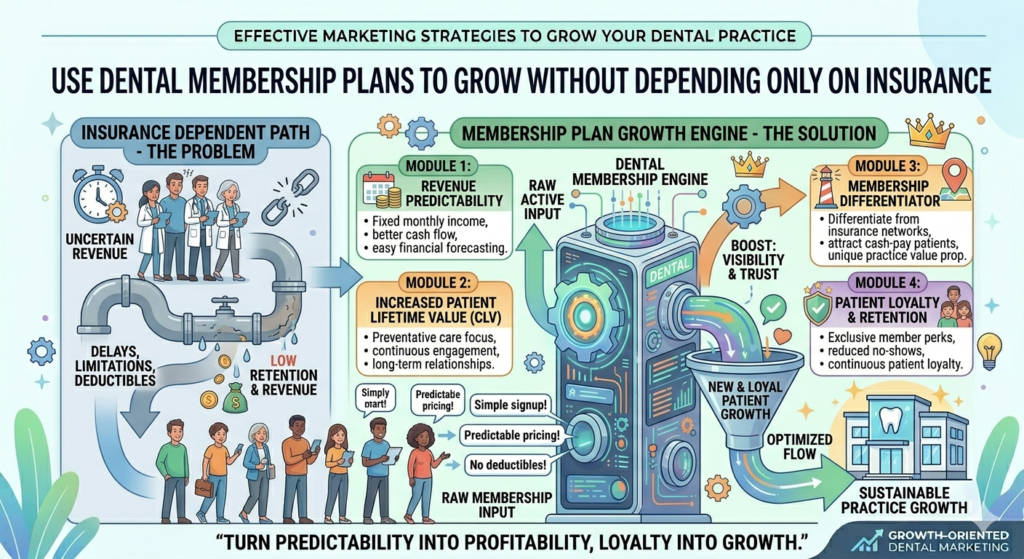
A membership plan is not insurance. It is a simple in-house program where patients pay a set fee for certain preventive care and may receive savings on other treatments. When done well, it can help patients stay consistent while giving the practice more predictable revenue.
This can be especially helpful for practices that want to build stronger patient loyalty and reduce dependence on insurance-driven decisions.
A membership plan can make care feel simpler for patients
Patients without insurance often feel unsure. They may not know what a cleaning will cost. They may worry about surprise bills. They may think dental care is out of reach.
A clear membership plan can make the decision easier.
Keep the plan easy to understand
The best membership plans are simple. Patients should be able to understand what is included without reading a long document. The plan may include exams, cleanings, routine X-rays, emergency exam savings, or a percentage off certain treatments, depending on your practice model and local rules.
The exact structure should be carefully planned, but the message should be plain.
The patient should feel, “This helps me keep up with care and avoid guessing about every visit.”
If the plan is too complex, patients may not trust it. Simple wins.
Focus the message on staying healthy
A membership plan should not feel like a discount club. It should feel like a way to make regular dental care easier. The message should focus on prevention, peace of mind, and having a dental home.
This is important because patients who join only for discounts may not stay engaged. Patients who join because they want steady care are more likely to return.
The plan should support a healthier patient relationship.
Membership plans can improve recall and patient loyalty
When patients pay for a plan, they are more likely to use it. This can help them come in for cleanings, exams, and follow-up care. It also gives your practice more chances to catch issues early and build trust.
Make membership patients feel cared for
Do not treat the plan like a billing product. Treat it like part of the patient experience. Send reminders when they are due. Explain what is included. Help them use the benefits they already have.
This makes the plan feel valuable.
A patient who feels cared for is more likely to renew and refer others.
Use the plan to reduce treatment delay
When patients know they have savings or clear access to care, they may be less likely to delay treatment. This does not remove all cost concerns, but it can reduce some of the fear.
Your team should explain treatment clearly and connect it back to the patient’s goals. The plan can support the financial side, but trust still drives the decision.
Patients say yes when they understand the need, believe the recommendation, and feel able to move forward.
Market the plan across the full patient journey
A membership plan should not be hidden on one page of your website. It should be part of your larger growth strategy.
Add the plan to your website in simple language
Your website should have a clear membership page. It should explain who the plan is for, what it includes, how it works, and how to join. It should answer common questions in plain words.
The page should not sound like a legal document. It should sound like a helpful explanation from your team.
Also mention the plan in places where uninsured patients may look, such as new patient pages, cleaning pages, and payment information pages.
Train the team to explain it naturally
Your front desk and treatment coordinators should be able to explain the plan in a warm, simple way. If they sound unsure, patients will feel unsure too.
The team should know who the plan helps, what it includes, and how to answer common questions. They should also know when not to push it. The plan should be presented as a helpful option, not forced on every patient.
Trust matters more than pressure.
Use Patient Education Inside the Office to Improve Treatment Acceptance
Marketing does not only happen online. It also happens inside the office. Every explanation, image, handout, conversation, and follow-up can help a patient understand their health and make a better decision.
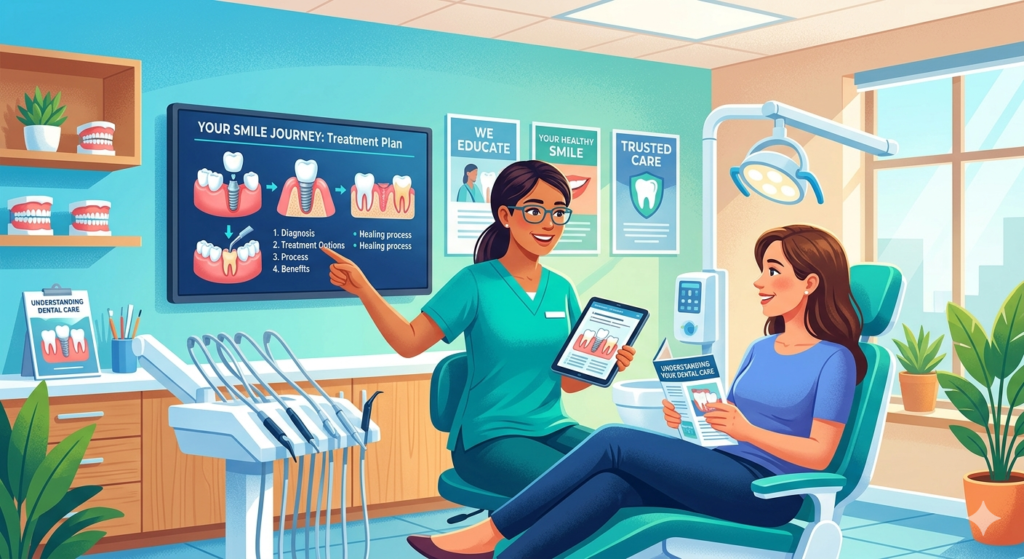
Treatment acceptance often rises when patients clearly understand what is happening in their mouth. Many patients do not reject care because they do not care. They reject or delay because they do not understand the problem, do not feel pain yet, fear the cost, or feel overwhelmed.
Better education can change that.
Patients need to see and understand the problem
A dentist may see an issue clearly, but the patient may not. If nothing hurts, they may wonder why treatment is needed. This is why visual education is so powerful.
Use images to make the issue real
Intraoral photos, X-rays, scans, and simple diagrams can help patients see what the dentist sees. When patients can look at a cracked tooth, worn filling, gum issue, or missing tooth space, the conversation becomes clearer.
The key is to explain the image in simple words. Do not point to a screen and use clinical language that leaves the patient confused.
Say what they are looking at. Explain why it matters. Then explain what can be done.
Seeing the issue helps the patient move from doubt to understanding.
Explain what happens if the patient waits
Patients need to understand the risk of delay, but this should be done calmly. Do not scare them. Do not make dramatic claims. Explain the likely path in simple terms.
For example, a small cavity may become deeper. A cracked tooth may break more. Gum disease may get harder to manage. A missing tooth may affect chewing or cause nearby teeth to shift.
This helps patients understand timing.
Urgency should come from clarity, not fear.
Treatment plans should feel like a clear path, not a wall
When patients hear several treatment needs at once, they can feel overwhelmed. If the plan sounds too large, they may do nothing. This is why presentation matters.
Break treatment into stages when possible
If a patient needs several treatments, explain the order. Start with what is urgent. Then explain what should come next. Then explain what is optional or cosmetic.
This helps the patient feel that they do not have to solve everything in one moment.
A phased plan can turn a scary treatment list into a manageable path.
Connect treatment to the patient’s own goals
Patients care more when treatment is linked to what they want. Some want to avoid pain. Some want to chew better. Some want to smile with confidence. Some want to keep their teeth for life. Some want to avoid surprise dental problems.
Use the patient’s own words when you explain the plan.
If a patient said they want to avoid emergencies, explain how the recommended care helps reduce that risk. If they said they want to smile more freely, explain which steps support that goal. If they said they are worried about cost, explain the priority order and payment options.
Personal relevance improves acceptance.
The team should support the same message
Treatment acceptance is not only the dentist’s job. The whole team affects it. A patient may ask the assistant a question. They may ask the front desk about cost. They may call later to clarify something. If the team gives mixed or unclear answers, trust drops.
Make sure the team understands common treatments
Your team does not need to explain treatment like a dentist, but they should understand the basics. They should know how to talk about crowns, fillings, implants, Invisalign, deep cleanings, nightguards, whitening, and emergency visits in simple terms.
This helps keep the patient experience consistent.
When every team member explains care clearly and calmly, patients feel safer.
Use follow-up after major treatment conversations
After a large treatment plan, send a follow-up message. Thank the patient for coming in. Remind them that the team is available for questions. Include the next step. If helpful, send a simple resource that explains the treatment.
This can make a big difference because many patients think of questions after they leave.
A thoughtful follow-up shows that your practice cares about the decision, not just the sale.
Conclusion:
Growing a dental practice is not about chasing every new trend. It is about building a clear system that helps the right patients find you, trust you, book with you, return to you, and tell others about you.
Your website, local SEO, reviews, service pages, ads, emails, social media, follow-up, front desk process, and patient experience should all work together. When they do, marketing stops feeling random. It becomes a steady growth engine.











Comments are closed.