
WinSavvy Editorial Standards
How this article was created
Today, people discover restaurants through Google, Instagram, TikTok, maps, reviews, food photos, local searches, short videos, events, email, loyalty offers, and simple word of mouth. Your job is not to be everywhere in a messy way. Your job is to build a clear system that brings new guests in, keeps old guests coming back, and turns happy customers into free promoters In this guide, we will break down proven marketing strategies that help restaurants drive more traffic without wasting money. You will learn how to attract local diners, improve your online presence, create offers that actually work, use social media with purpose, and build a brand people remember.
Build your restaurant marketing around local intent, not random reach
Most restaurants do not need to become famous across the whole city. They need to become the obvious choice for people who live, work, shop, study, or stay nearby.
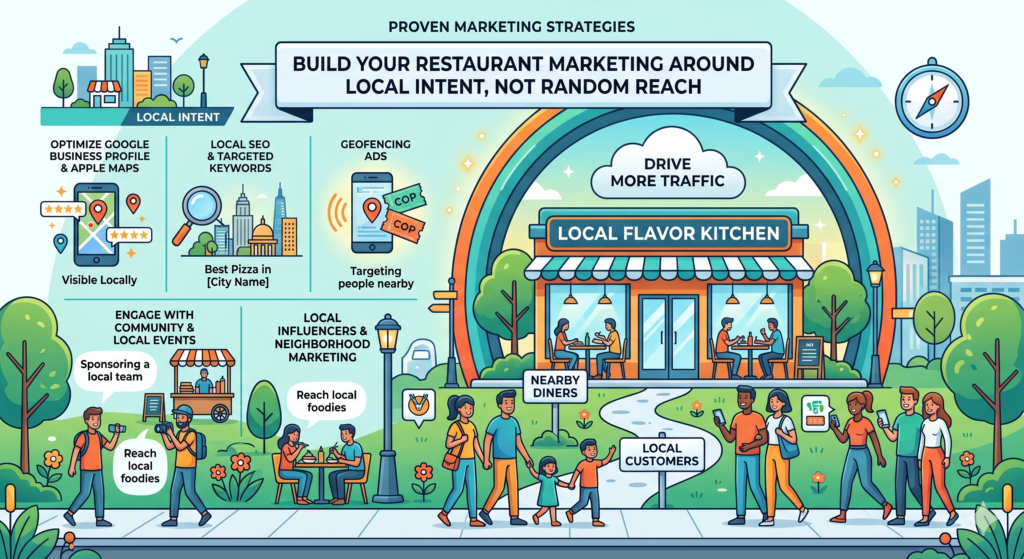
That one idea can change your entire marketing plan.
A restaurant in a busy neighborhood does not win by chasing everyone. It wins by being easy to find for the people who are already close enough to visit. Someone searching for “best lunch near me,” “family restaurant near me,” “date night restaurant in [area],” or “coffee and breakfast near [landmark]” is not just browsing.
That person already has intent. They are hungry, interested, and close to making a decision.
This is why local intent is more valuable than broad attention.
A post that gets 10,000 views from random people may feel good, but it may not bring a single customer through the door. A Google search listing seen by 200 people who are nearby and ready to eat can bring real bookings, walk-ins, calls, and orders. That is the kind of traffic a restaurant needs.
Your marketing should begin with one clear question: what are people already looking for when they are most likely to choose a restaurant like yours?
The answer will depend on your concept. A family restaurant may need to show up for “kid-friendly restaurants near me.” A pizza shop may need to rank for “best pizza delivery near [area].” A fine dining restaurant may need to appear when people search for “anniversary dinner in [city].”
A cafe may need to win searches like “best coffee near me” or “brunch near [location].”
When you understand this, your marketing becomes sharper. Your website gets clearer. Your Google Business Profile gets stronger. Your social content becomes more useful. Your offers become more timely. Your photos show the right dishes. Your reviews mention the right things. Your whole presence starts working together.
This is where traffic starts to become predictable.
Your restaurant should own the searches that happen right before people decide where to eat
The most powerful restaurant searches usually happen close to the moment of action. People search when they are hungry, planning a meal, choosing a place with friends, looking for delivery, or trying to solve a simple problem like where to take their family tonight.
That means your first job is to appear when these searches happen.
Start with your Google Business Profile because it is often the first thing people see. For many diners, your Google listing matters more than your website. They check your photos, rating, menu, hours, location, reviews, price level, and popular times before they even click anywhere else.
If your listing is weak, outdated, or empty, you lose traffic before the guest ever reaches your site.
Your profile should make the decision easy. Your restaurant name should be correct. Your category should match what you actually are. Your opening hours should be accurate, especially on holidays and weekends.
Your menu should be updated. Your phone number should work. Your booking or ordering link should be clear. Your address should lead people to the right door, not a nearby building or old location.
These details sound basic, but they matter because hungry people are impatient. If they are unsure, they move on.
Photos matter even more. A restaurant with dull photos feels risky. A restaurant with fresh, bright, real photos feels alive. Add photos of your best dishes, your dining room, your entrance, your staff, your bar, your outdoor seating, and your busiest moments. Do not only upload perfect studio shots. People trust real photos because they help them imagine the visit.
Your goal is not just to look good. Your goal is to remove doubt.
When someone sees your listing, they should instantly understand what kind of food you serve, what the place feels like, whether it fits their need, and why they should choose you over the place down the street.
Your Google listing should be treated like your second homepage
Many restaurant owners spend money on a website but ignore the listing that gets more daily attention. That is a mistake.
Think of your Google Business Profile as your second homepage. In some cases, it is your first homepage. It is where people judge you fast. It is where they compare you with nearby restaurants. It is where they decide whether to call, book, order, or keep scrolling.
So treat it like a living sales page.
Update it every week. Add new photos. Post your weekly specials. Share event updates. Mention new dishes. Answer questions. Reply to reviews. Check that your menu link works. Make sure delivery and reservation links are active. Remove old images that no longer reflect the restaurant.
A stale profile sends a quiet message that nothing interesting is happening. A fresh profile sends the opposite message. It tells people your restaurant is active, cared for, and worth checking out.
The reviews section deserves special attention. Do not just collect reviews. Shape them through great guest moments.
When guests praise something in person, ask them to mention it in a review. If someone loved the service, the patio, the pasta, the vegan options, or the birthday experience, invite them to share that detail.
Specific reviews are stronger than generic ones. “Great place” is nice. “Best chicken biryani in the area and very fast lunch service” is far more useful because it helps both people and search engines understand what you are known for.
You should reply to reviews in a warm, real voice. A simple “Thank you” is better than nothing, but a thoughtful reply is better. Mention the dish they tried. Thank them for visiting. Invite them back in a natural way. When a bad review appears, stay calm. Do not argue. A respectful response can win future customers even if the original reviewer never returns.
People read how you handle problems. Your reply is not only for the unhappy guest. It is for every future guest who wants to know whether you care.
Your website should turn interest into visits, not just look nice
A restaurant website has one main job. It should help people decide to visit, book, order, or contact you.
It does not need to be fancy. It needs to be clear.
Many restaurant websites make the same mistake. They focus too much on design and not enough on action. The homepage has a large image, a vague line like “A modern dining experience,” and then hides the menu, hours, address, and booking button. That may look elegant, but it slows people down.
Your website should answer the questions diners have before they choose you.
What do you serve? Where are you? Are you open now? Can I see the menu? Can I reserve a table? Can I order online? Is there parking? Do you offer takeaway? Do you have vegetarian, vegan, gluten-free, halal, or kid-friendly options? Is the space good for groups, dates, families, work lunches, or events?
The easier you make these answers, the more traffic you convert into real visits.
Your homepage should quickly show your food, your location, your type of restaurant, and your main action. If reservations matter, make the booking button visible. If online orders matter, make the order button impossible to miss.
If walk-ins are common, show your hours and address clearly. If your restaurant is near a known area, station, office complex, mall, campus, hotel zone, or tourist spot, say it on the page.
Local words help people and search engines understand where you fit.
For example, instead of only saying “We serve fresh handmade pasta,” a better line could say, “We serve fresh handmade pasta in the heart of [Neighborhood], just minutes from [Landmark].” That small change gives context. It helps someone nearby feel that you are close and relevant.
Your menu page should be built for hungry people, not for design awards
Your menu is one of the most visited parts of your website. It should load fast, be easy to read on a phone, and be visible without forcing people to download a PDF.
PDF menus are common, but they are often clunky on mobile. They can load slowly, pinch awkwardly, and create friction. A clean web menu is usually better because people can scroll, read, and decide quickly.
The menu should include dish names, simple descriptions, prices when possible, and clear sections. Do not make people guess what they are ordering. A short dish description can sell better than a clever name. “Slow-cooked lamb with saffron rice, mint yogurt, and roasted onions” creates more desire than “Chef’s Special Lamb Plate.”
Use your menu page to guide choices. Feature bestsellers. Mention signature dishes. Highlight dishes that photograph well. Show what first-time visitors should try. Add real food photos where useful, but do not overload the page. A few strong images can do more than twenty weak ones.
Your menu should also support search traffic. People search for dishes, not just restaurant names. If you serve ramen, tacos, thali, burgers, sushi, seafood, brunch, steak, biryani, dumplings, or artisan coffee, those words should appear naturally on your site. This is not about stuffing keywords. It is about making your actual offer clear.
Search engines cannot guess your strengths if your site hides them behind vague language.
Your restaurant should have pages for the reasons people choose you
Most restaurants only have a homepage, menu page, contact page, and maybe an about page. That is fine as a starting point, but it often leaves traffic on the table.
People do not only search for food. They search for occasions.
They search for where to have a birthday dinner, where to take clients, where to go for brunch, where to eat before a show, where to bring kids, where to book a private room, where to find late-night food, where to get quick lunch near the office, and where to enjoy a quiet dinner.
Each of these needs can become a useful page on your website if it truly fits your restaurant.
A page about private dining can bring people planning events. A page about birthday dinners can bring groups. A page about office lunch can bring nearby teams. A page about date night can bring couples. A page about catering can bring bigger orders. A page about vegan options can bring diners who are tired of guessing.
These pages should not be thin or fake. They should be genuinely helpful. Explain what you offer, who it is best for, what dishes work well, how booking works, what the space feels like, and why people choose you for that occasion.
When done well, these pages help both search and sales.
Occasion-based pages bring better traffic because the guest already has a clear need
A person searching “best restaurant for birthday dinner in [city]” is not casual traffic. They have a plan. They may bring a group. They may spend more. They may book in advance. That makes them more valuable than someone who is just browsing food photos.
This is why occasion-based marketing is so powerful for restaurants.
You are not just selling food. You are selling moments. A relaxed Sunday brunch. A fast lunch before a meeting. A warm dinner after work. A safe place for a family meal. A fun table for a birthday. A quiet corner for a date. A place to celebrate without stress.
Your content should show that you understand these moments.
For a birthday page, do not simply write, “Book your birthday with us.” Say what makes it easy. Talk about group seating, shareable dishes, cake policy, music, photo spots, advance booking, and how your team helps make the meal smooth.
For a date night page, speak to mood. Mention lighting, seating, signature dishes, drinks, dessert, and the best times to visit. For an office lunch page, focus on speed, clear pricing, reliable service, takeaway, group orders, and how close you are to business areas.
This kind of content works because it matches the guest’s real thought process.
They are not asking, “Which restaurant has a clever brand story?” They are asking, “Will this place work for what I need?”
Answer that clearly, and you will win more of the right traffic.
Make your restaurant easy to choose on social media
Social media can drive traffic, but only when it gives people a reason to act. Posting random food photos is not enough. Sharing pretty plates without a clear message may get likes, but likes do not always turn into visits.
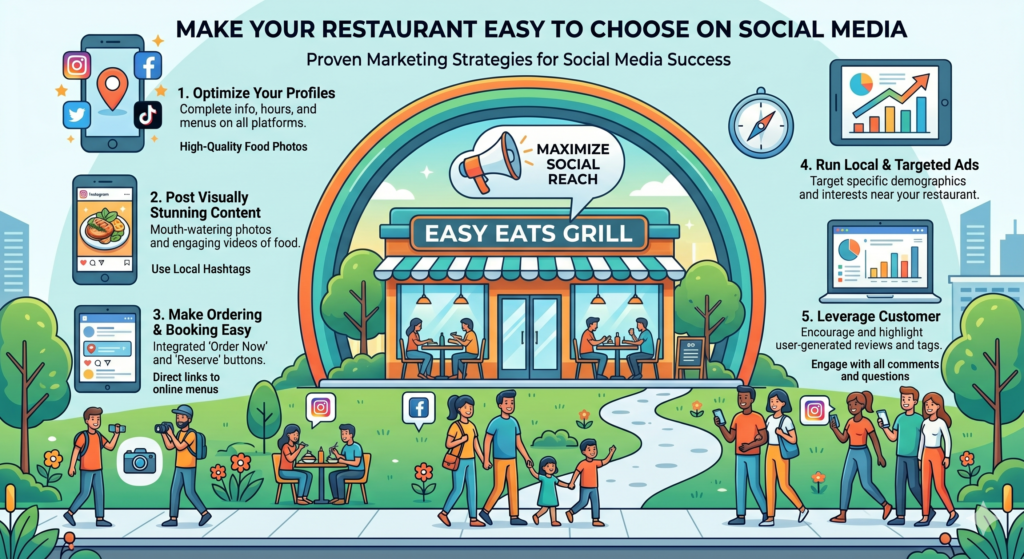
A strong restaurant social media strategy should make people hungry, curious, comfortable, and ready to come in.
Your content should show the food, but it should also show the feeling of eating there. People want to know what the place is like. They want to see the table, the room, the staff, the crowd, the sound, the plating, the steam, the pour, the first bite, and the small details that make the visit feel real.
Restaurants are lucky because food is naturally visual. But that also means the competition is high. Your content needs to feel more alive than a flat dish photo.
Show movement. Show hands making the food. Show sauce being poured. Show bread being torn. Show a chef finishing a dish. Show a server placing plates on a table. Show guests enjoying a busy evening, when allowed. Show your team setting up before opening. Show the moment that makes someone think, “I want that.”
That is the goal.
Not “nice photo.” Not “good engagement.” The goal is desire.
Your social content should answer why someone should visit this week
The best restaurant content often has a time-based reason behind it.
A new dish this week. A weekend brunch special. A rainy-day comfort meal. A limited dessert. A happy hour offer. A chef’s tasting menu. A live music night. A seasonal drink. A lunch combo for office workers. A festival menu. A game-night deal. A family Sunday offer.
These posts work because they give people a reason to come now instead of someday.
“Someday” is dangerous in restaurant marketing. People may save your post and forget it. They may say they want to visit and never do. They may like the dish and then choose another place when the meal decision happens.
You need to bring the decision closer.
Instead of posting, “Our pasta is made fresh,” you could say, “This weekend, we are serving fresh mushroom cream pasta with garlic bread from 6 pm. It is rich, warm, and made for slow dinners.” That gives the post a moment, a dish, a time, and a feeling.
Instead of saying, “Visit us for brunch,” you could say, “Our Sunday brunch tables fill fastest between 11 am and 1 pm, so come early if you want the window seats and the first batch of pancakes.” That feels specific. It feels real. It gives people a picture in their mind.
Specific content sells better because it feels believable.
A simple content rhythm can keep your restaurant visible without making your team tired
You do not need to post all day to make social media work. You need a rhythm your team can actually follow.
Think in terms of repeatable content themes. One day can focus on a signature dish. Another can show behind-the-scenes prep. Another can highlight a guest favorite. Another can promote the weekend. Another can show your team. Another can answer a common question. Another can share a review or customer story.
This keeps your content fresh without forcing you to invent something new every time.
The best restaurant content usually comes from normal daily moments. A fresh batch coming out of the oven. A chef tasting a sauce. A bartender testing a drink. A server explaining a dish. A busy dinner rush. A quiet morning setup. A new menu item being photographed. A loyal customer ordering their usual.
Capture these moments as they happen. Do not wait for perfect production. People often trust simple phone videos more than polished ads because they feel closer to the truth.
That does not mean quality does not matter. Use good light. Keep the lens clean. Film close enough to show texture. Avoid messy backgrounds. Make sure the food looks fresh. Keep videos short, clear, and easy to understand without sound.
Most people scroll fast. Your first second matters. Start with the best visual. Do not begin with a logo or long intro. Show the cheese pull, the sizzling pan, the colorful plate, the dessert crack, the pour, the steam, or the first bite.
Then tell people what to do next in a natural way. Come in tonight. Book for Friday. Try it at lunch. Order before 9 pm. Bring a friend. Ask for the special. Save it for your next visit.
A clear next step turns attention into traffic.
Use offers carefully because cheap discounts can train people to value you less
Offers can drive restaurant traffic, but they can also hurt your brand if they are used without care.
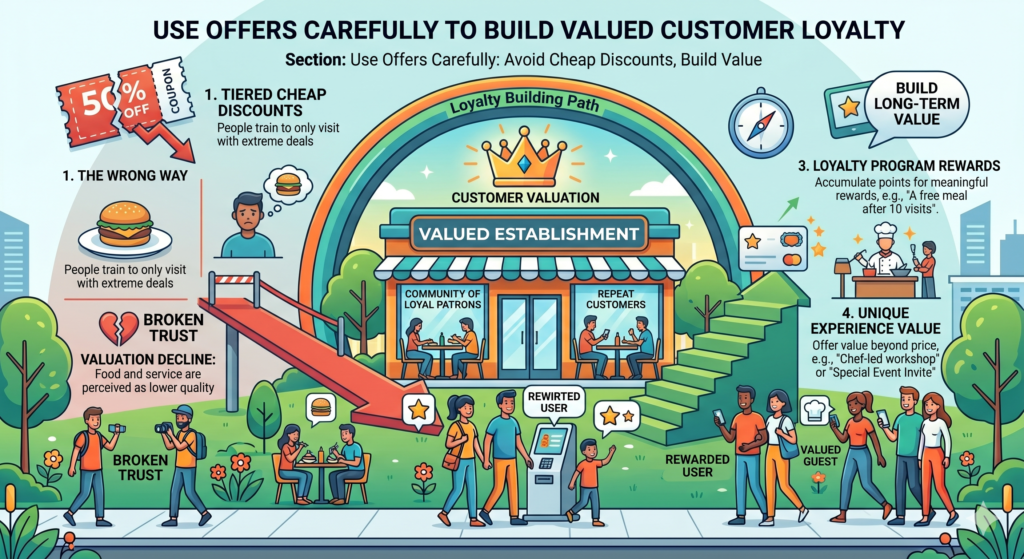
A weak offer says, “We are cheaper.” A strong offer says, “Here is a good reason to visit now.”
That difference matters.
Many restaurants run discounts when traffic drops. They cut prices, post a deal, and hope people come in. Sometimes it works for a few days. But if the offer is too broad or too frequent, it trains customers to wait for discounts. It also attracts people who may not come back at full price.
The better approach is to build offers around behavior you want to grow.
If Mondays are slow, create a Monday reason to visit. If lunch traffic is weak, make lunch easier and more attractive. If families come on weekends but not weekdays, create a simple weekday family meal. If people order starters but skip dessert, create a dessert pairing. If first-time guests do not return, give them a reason to come back within two weeks.
Your offer should solve a business problem, not just reduce the bill.
The best restaurant offers feel like value, not desperation
A strong offer does not have to be a huge discount. It can be a smart bundle, a limited special, a bonus item, an experience, or early access.
For example, a lunch combo can work because it saves time and removes decision stress. A two-course weekday dinner can work because it makes a slower night feel planned. A free dessert for birthday bookings can work because it supports group visits. A limited chef’s special can work because it creates urgency without cutting your main menu price.
Value is not always about being cheaper. Sometimes it is about making the choice feel easier, richer, or more timely.
A restaurant should protect its best dishes from constant discounting. If your signature item is always on sale, it can lose its power. Instead, use offers to introduce people to your restaurant, fill weaker time slots, or increase average spend.
The offer should also be easy to understand. If people need to read five conditions, they will ignore it. Keep it simple. Make the benefit clear. Make the time window clear. Make the action clear.
A good offer should answer three questions fast: what do I get, when can I get it, and how do I claim it?
Your offers should bring people back, not just bring them in once
The real money in restaurant marketing is not only in the first visit. It is in the second, third, and fourth visit.
This is why your offer strategy should include a return path.
When someone visits for the first time, you should have a way to bring them back soon. That could be a bounce-back card, a text club, an email list, a loyalty program, or a simple next-visit invite printed on the receipt. The goal is to avoid letting the relationship end when the meal ends.
Timing matters. If someone enjoyed the meal, the best time to invite them back is soon after the visit. Not three months later. Not when you are desperate for traffic. Soon.
A simple message like “Come back next week for our new lunch special” can work better than a generic monthly newsletter. A focused return offer can work even better when it is tied to what they already liked. If they ordered brunch, invite them to next Sunday’s brunch. If they came for dinner, invite them to a tasting night. If they ordered takeaway, show them your dine-in special.
The more relevant the message, the more likely they are to act.
This is why collecting customer contact details matters. Social media is useful, but you do not own the platform. Delivery apps are useful, but they often control the customer relationship. Your own email list, SMS list, reservation database, and loyalty program give you more control.
A restaurant that can contact past guests directly has a major advantage.
Build your own customer list so you are not trapped by platforms
One of the biggest mistakes restaurants make is depending too much on platforms they do not control.
Instagram can help people discover you. Google can send you search traffic. Delivery apps can bring orders. Reservation apps can help fill tables. But none of these should be your only connection to your customers.
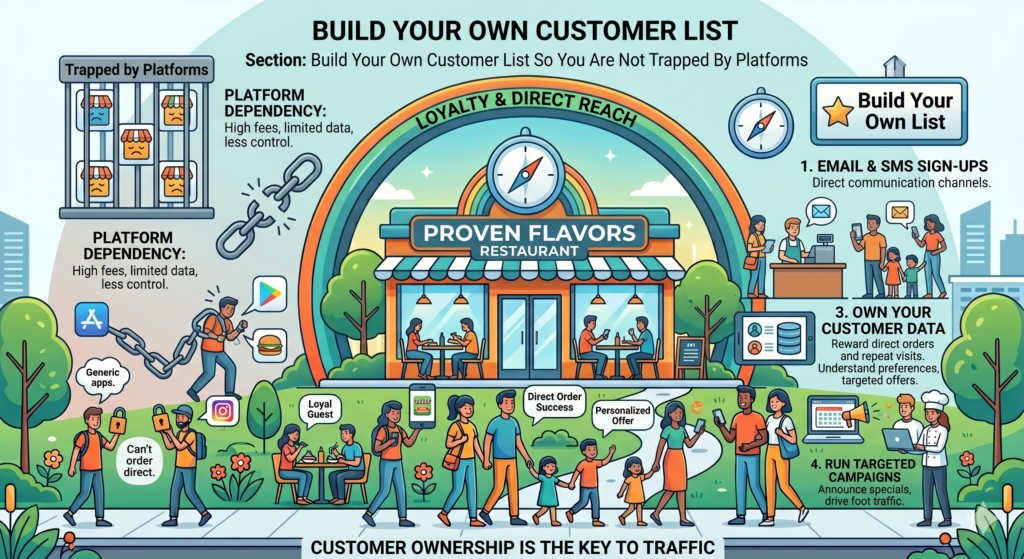
The reason is simple. You do not own those audiences.
A social platform can change its algorithm. A delivery app can raise fees. A review site can place competitors next to your listing. A paid ad can stop working when costs rise. If your restaurant has no direct way to reach past guests, you are always renting attention.
That is a weak position.
A smarter restaurant builds its own customer list. This can include email subscribers, SMS subscribers, loyalty members, birthday club members, catering leads, event inquiries, and past reservation guests. These are people who already know you, have shown interest, or have eaten with you before.
That makes them more valuable than strangers.
You do not need a huge list to make this work. A list of 1,000 local people who actually visit your restaurant is worth more than 50,000 social followers from random places. Restaurant marketing is local. A smaller list with real buying intent can drive steady traffic when used well.
Your list gives you the power to create demand when you need it. Slow Tuesday? Send a lunch message. New menu? Invite your best guests first. Rainy weekend? Promote comfort food and takeaway. Holiday coming? Push reservations early. Private dining room empty next month? Send an event offer to local businesses.
This is how you move from hoping people remember you to reminding them at the right time.
Your customer list should begin inside the restaurant, not only online
The best place to grow your restaurant list is not always your website. It is inside your restaurant, while guests are already enjoying the experience.
A happy guest is more likely to join your list than a cold visitor who has never tasted your food. That means your team should have simple, natural ways to invite people to stay connected.
This should not feel pushy. It should feel useful.
For example, if you offer a birthday club, the message can be simple. Guests can join to receive something special during their birthday month. If you run weekly specials, guests can sign up to get the new menu before it is posted. If you host events, they can join to hear about tasting nights, live music, holiday menus, or early booking windows.
The key is to give people a reason that feels worth it.
“Join our newsletter” is weak because it sounds like work. “Get first access to our weekend specials” is stronger because it has a clear benefit. “Join our birthday list and we’ll send you a treat during your birthday month” is even better because it feels personal.
You can collect signups through QR codes on tables, a small card with the bill, your Wi-Fi login page, your reservation system, your online ordering page, your website pop-up, or a simple form linked from social media. The method matters less than the offer and the timing.
Train your staff to mention it when it makes sense. If guests compliment the food, that is a good moment. If someone asks about future events, that is a good moment. If a table is celebrating, that is a good moment to invite them into your birthday or events list.
Do not make your staff deliver a long script. Keep it natural. A line like “We send our new specials to guests first, so you can scan this if you want to get them before they go live” is enough.
Your list should be segmented by what people care about
A restaurant list works best when you do not send the same message to everyone all the time.
Different guests visit for different reasons. Some care about lunch. Some care about dinner. Some order delivery. Some bring family. Some book events. Some come for drinks. Some love brunch. Some only visit on special occasions.
If you treat them all the same, your messages become less useful.
You do not need a complex system at first. Start with simple segments that match your business. You can group people by birthday month, visit type, online order history, event interest, location, menu preference, or how recently they visited.
This lets you send better messages.
A guest who came for brunch should hear about your next brunch feature. A past catering lead should hear about office lunch packages. A birthday club member should get a birthday message before their birthday, not after. A guest who has not visited in 90 days should get a warm return invite. A regular should get early access before the public.
Better timing makes the same message feel more personal.
The language should sound like a real person wrote it. Do not write stiff marketing emails that say, “We are pleased to announce our latest dining experience.” Write like a restaurant owner or manager speaking to a familiar guest.
A message like “We’re making our slow-cooked lamb again this Friday, and we wanted our regulars to know before we post it publicly” feels human. It feels like an inside note. It gives people a reason to act.
That is the tone you want.
Email and SMS should bring people back with clear reasons, not random updates
Many restaurants avoid email because they think people do not read it. That is only half true. People ignore boring emails. They still open useful, timely, personal messages from places they like.
The same is true for SMS. It can work very well, but only when used carefully. Text messages feel more personal, so you should not overuse them. Send fewer messages, make each one valuable, and always respect permission.
A restaurant email or text should usually do one of four things. It should announce something new, remind people about something timely, invite them to an event, or give them a reason to return.
A weak message says, “Come visit us.” A strong message says, “Our winter soup is back today, and we’re serving it with fresh bread from 12 pm.” A weak message says, “Book now.” A strong message says, “Friday dinner is almost full, but we still have early tables open before 7 pm.”
Specific messages feel more believable.
Restaurants also have a big advantage because food is emotional. You can write messages that make people picture the meal. Instead of saying, “Try our new dessert,” say, “We added a warm chocolate cake with salted caramel this week. It is rich, soft in the middle, and best shared after dinner.”
That kind of detail makes the message do real selling.
Do not send updates just because the calendar says you should. Send when there is something worth saying. But do not disappear either. A good rhythm might be weekly for email and less often for SMS, depending on your restaurant and audience.
The main rule is this: every message should make the guest think, “That sounds good. I should go.”
Your comeback campaigns can recover lost guests before they forget you
Not every guest becomes a regular right away. Some visit once, enjoy the food, and then forget to return. That does not mean they disliked you. Life gets busy. People fall back into old habits. New restaurants compete for attention.
This is why comeback campaigns are useful.
A comeback campaign is a simple message sent to people who have not visited or ordered in a while. It should feel warm, not desperate. The goal is to remind them what they liked and give them a timely reason to return.
For example, if someone has not ordered in 60 days, you can send a message that says, “We haven’t cooked for you in a while, so we wanted to let you know our garlic butter prawns are back this week.” That feels softer than “We miss you, here is 20% off.”
Discounts can be part of comeback campaigns, but they should not always be the first move. Sometimes a new dish, a seasonal menu, or a personal note is enough. If you do use an offer, make it simple and time-limited.
The mistake is waiting too long. If someone has not heard from you in six months, they may no longer feel connected. Reach out while the memory of the restaurant is still fresh.
You can also build comeback paths after specific actions. A first-time diner can receive a thank-you message after the visit and a return invite a week later. A delivery customer can receive an invitation to dine in. A group booking customer can receive a future event offer. A brunch guest can receive a next-weekend reminder.
This kind of follow-up turns one visit into a relationship.
Turn regular guests into your strongest marketing channel
Your best customers are not just buyers. They are your most trusted promoters.
People trust other people more than they trust ads. When a friend says, “You need to try this place,” it carries weight. When someone posts your food in their story, it feels real. When a coworker brings your lunch boxes to the office, others notice. When a family keeps choosing your restaurant for birthdays, that becomes social proof.
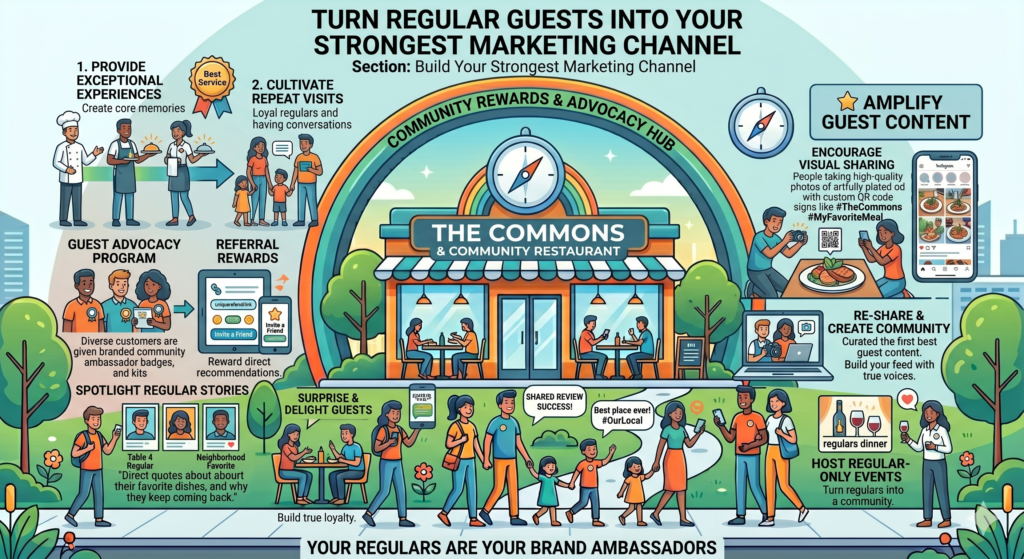
Your job is to make these moments happen more often.
Word of mouth is not fully random. You can encourage it by creating things worth talking about and making sharing easy.
Start with the restaurant experience itself. Marketing cannot fix a forgettable meal. If the food is average, the service is cold, or the atmosphere feels flat, people will not promote you with real energy. But if the experience has strong moments, guests will naturally talk.
Strong moments do not always need to be expensive. A warm greeting can be a strong moment. A server remembering a regular’s favorite table can be a strong moment. A beautiful dessert presentation can be a strong moment. A handwritten birthday note can be a strong moment. A chef stepping out to explain a dish can be a strong moment.
People share moments, not menus.
Create small signature moments that guests remember and repeat
A signature moment is something guests connect with your restaurant and remember after they leave.
It could be a welcome drink. A special sauce served at the table. A dramatic dessert. A unique way you plate a dish. A photo-friendly wall. A handwritten thank-you card. A staff ritual. A secret menu item. A small treat at the end of the meal. A chef’s note on the menu. A tableside finish. A simple phrase your team uses when serving your signature dish.
The point is not to create a gimmick. The point is to make the visit feel distinct.
Restaurants become memorable when they give guests something easy to describe. “They have great food” is good, but it is vague. “They bring the dessert with a tiny candle even if it’s not your birthday” is specific. “They pour the hot sauce at the table” is specific. “They remember your name after two visits” is specific.
Specific things spread faster.
Look at your current guest experience and ask where the memorable moments are. What happens when someone arrives? What happens when the food comes? What happens when they celebrate? What happens when they pay? What happens when they leave? Where can you add a small touch that feels personal and repeatable?
A signature moment should be easy for your team to deliver even on busy nights. If it depends on one person or takes too much time, it will break. Keep it simple enough to repeat and special enough to remember.
Your most shareable moments should still feel true to your brand
Not every restaurant needs neon signs, giant desserts, or loud social media tricks. The best shareable moment is one that fits your concept.
A cozy family restaurant can create warmth. A premium restaurant can create quiet surprise. A cafe can create charm. A bar can create energy. A fast casual place can create speed and fun. A bakery can create comfort and smell. A fine dining place can create theater.
The moment should feel like a natural extension of who you are.
If your brand is calm and elegant, a loud gimmick may feel wrong. If your brand is playful, a serious formal touch may feel stiff. The goal is not to copy what works for another restaurant. The goal is to make your own experience more memorable.
This also matters for social media. Guests are more likely to post when something feels worth showing. But they are also more likely to trust it when it feels real. A dish that looks amazing but tastes average may get one post, but it will not build lasting traffic. A dish that looks good, tastes great, and fits your story can become a real driver.
Think of shareability as a bonus on top of quality, not a replacement for it.
When a dish or moment starts getting shared often, use that signal. Feature it more. Give it a name. Mention it on your website. Add it to your Google photos. Turn it into a reel. Place it in email. Train staff to mention it to new guests.
Let your customers show you what they already love, then build around it.
Ask for reviews in a way that feels natural and well-timed
Reviews are one of the strongest traffic drivers for restaurants because they influence people at the exact moment they are choosing where to eat.
A high rating helps, but the content of reviews matters too. Future guests want to know what the food is like, whether the service is good, whether the place is clean, whether the value is fair, and whether the experience matches their occasion.
That means your review strategy should be active, not passive.
Do not wait and hope people review you. Ask at the right moment.
The right moment is usually when a guest gives a positive signal. They compliment the food. They thank the server. They say they will come back. They take photos. They ask for the chef. They tell you the birthday went well. They mention that the service was great.
That is when the ask feels natural.
Your staff can say, “That means a lot to us. If you have a minute later, a Google review mentioning that dish would really help our team.” This is simple, honest, and specific. It does not pressure the guest. It also guides them toward a more useful review.
Specific review requests often lead to specific reviews. If a customer loved the brunch, ask them to mention brunch. If they loved the vegan options, ask them to mention that. If they loved the service, ask them to mention the team. These details help future customers find what matters to them.
Negative reviews should become public proof that you care
Every restaurant gets bad reviews. Even great restaurants have off nights. A delayed order, a cold dish, a booking issue, a tired server, or a misunderstanding can lead to a poor review.
The worst response is to ignore it. The second worst response is to fight.
A good response is calm, clear, and human. Thank the guest for sharing. Acknowledge the issue without making excuses. Invite them to contact you directly if needed. Show that you take feedback seriously.
You do not need to admit fault for things that are not true, but you should never sound defensive. Future guests are watching. They want to see whether your restaurant handles problems with care.
A thoughtful review response can soften the damage. Sometimes it can even build trust. People know mistakes happen. What they care about is whether you care enough to fix them.
You should also look for patterns in bad reviews. One complaint may be random. Five complaints about slow service on weekends are a signal. Three complaints about confusing parking are a signal. Several complaints about cold delivery are a signal.
Reviews are not just marketing. They are free customer research.
Use them to improve the restaurant, then use the improvements in your marketing. If you fixed wait times, say so. If you updated packaging, say so. If you added clearer parking instructions, say so. This shows guests that their feedback matters.
Partner with local businesses because nearby audiences are easier to convert
Restaurants are local by nature, so local partnerships can drive strong traffic when they are done with thought.
You are surrounded by people who need food. Office workers need lunch. Gyms need healthy meals. Hotels need dinner options for guests. Salons need refreshments for events. Schools need family-friendly spots. Real estate agents need client gift ideas. Wedding planners need rehearsal dinner venues. Local shops need cross-promotions. Coworking spaces need catering partners.
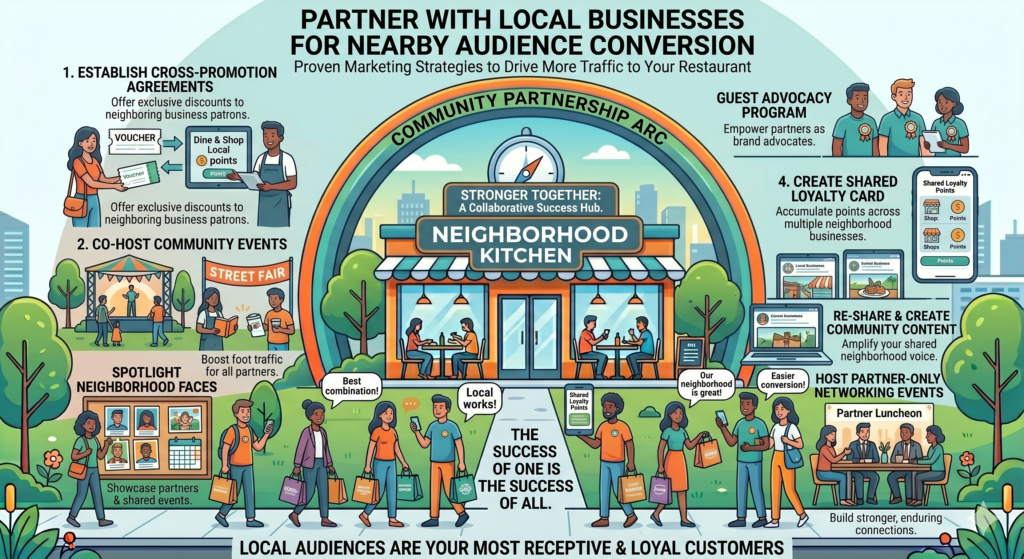
Most of these people are already near you. That makes them easier to convert than cold audiences online.
The mistake is approaching partnerships as a one-time promotion. A better approach is to build simple relationships that create repeat traffic.
A nearby office may need weekly lunch boxes. A gym may want a post-workout smoothie offer. A hotel may want a trusted dinner recommendation for guests. A local theater may need pre-show dining offers. A florist may want to bundle flowers with anniversary dinner bookings.
Good partnerships work because both sides win.
Your best partners already serve the people you want to reach
Start by thinking about your ideal customer. Then ask which local businesses already have that person’s attention.
If you want lunch traffic, look at offices, coworking spaces, clinics, banks, schools, agencies, and retail teams nearby. If you want date night traffic, look at cinemas, theaters, florists, salons, boutiques, and hotels.
If you want family traffic, look at schools, kids’ activity centers, family photographers, toy stores, and community groups. If you want event bookings, look at planners, venues, photographers, real estate firms, and corporate offices.
The partner should make sense for your restaurant. Do not chase every possible collaboration. Choose partners whose audience fits your food, price point, location, and brand.
Then make the offer easy for the partner to share.
A complicated partnership will not last. A hotel front desk will not explain a long offer to every guest. A gym manager will not push a confusing menu. An office manager will not coordinate lunch if ordering is messy.
Make it simple. Give partners a clear landing page, a short message, a clean menu, a direct contact, and a reason their audience will care.
For example, a restaurant near a hotel could create a page for hotel guests with directions, hours, best dishes, reservation link, and a small welcome offer. A lunch restaurant near offices could create a corporate lunch page with set menus, delivery windows, group order rules, and contact details.
This turns a loose partnership into a real traffic channel.
Local partnerships work better when you make the other side look good
The secret to strong partnerships is not asking, “How can they promote us?” It is asking, “How can we help them serve their people better?”
A hotel wants guests to have a good stay. If your restaurant gives their guests a reliable meal, you help the hotel. An office manager wants lunch to arrive on time. If you make ordering easy, you help them. A gym wants members to feel supported. If your food matches their goals, you help them. A local event planner wants vendors who do not create stress. If your team is reliable, you help them.
When you make the partner look good, they are more likely to keep recommending you.
You can also create small touches for partner referrals. A hotel guest can receive a welcome note. An office order can include labeled meals and easy setup. A gym member can get a special menu item. A theater guest can get faster pre-show service.
These details turn a simple promotion into a better experience.
Track each partnership so you know what works. Use unique booking links, simple codes, dedicated landing pages, or staff notes. You do not need perfect data, but you need enough to know which relationships bring traffic.
Then nurture the partners that perform. Thank them. Share results. Invite them in. Give their team a tasting. Make them feel like insiders.
Local partnerships grow when they are treated like relationships, not quick hacks.
Use paid ads only when your restaurant has a clear reason for people to act now
Paid ads can bring traffic fast, but they can also waste money fast.
This is where many restaurants get stuck. They boost a post, run a random ad, choose a wide area, add a pretty food photo, and hope people show up. Sometimes they get likes. Sometimes they get clicks. But the tables do not fill, and the owner starts thinking ads do not work.
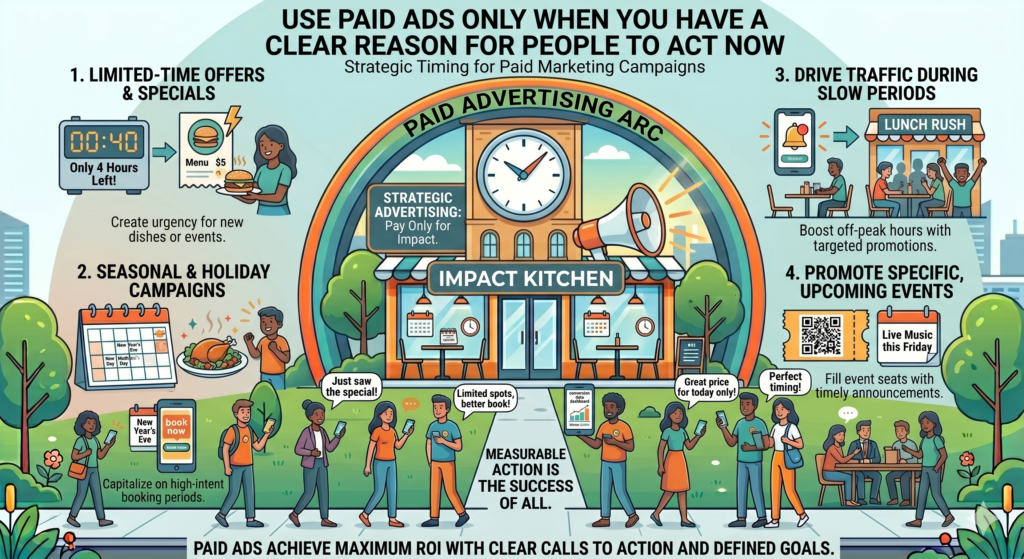
The truth is more simple. Ads work when the offer, audience, timing, and landing page all match.
A hungry person does not need a long story. They need a clear reason to choose you now. That reason could be a lunch special, weekend booking, new menu, happy hour, family meal, event night, catering offer, or limited dish. If your ad does not give a strong reason to act, it becomes easy to ignore.
You should not use ads to fix unclear marketing. Paid ads should make a working message reach more people. If your Google listing is weak, your menu is hard to read, your website is slow, your photos are dull, or your offer is confusing, ads will only send more people into a broken path.
Before you spend more, make sure the basics are strong. Your ad should lead people to a page that matches the promise. If the ad promotes brunch, send them to a brunch page or booking page, not your homepage. If the ad promotes catering, send them to a catering page with clear details.
If the ad promotes online ordering, send them straight to the order page.
Every extra click creates drop-off. Keep the path short.
Your restaurant ads should focus on nearby people who can actually visit
A restaurant ad should rarely target a huge area unless the restaurant is a destination brand. Most restaurants should keep ads local.
People may love your food photo from far away, but that does not mean they will drive across the city tonight. You want people who are close enough to act without thinking too hard. This usually means targeting people within a small radius around your restaurant, nearby offices, residential areas, hotels, schools, shopping areas, gyms, or event spaces.
The right radius depends on the type of restaurant. A quick lunch spot may need a tight radius because people will not travel far during a workday. A fine dining restaurant may use a wider radius because people are willing to travel for a special night.
A bakery, cafe, or casual place may focus on foot traffic and nearby residents. A catering or private dining offer may target a wider business audience.
This is why one ad setup does not fit every restaurant.
Your ad should match how people use your restaurant. A lunch ad should run before lunch decisions happen. A dinner ad should run in the afternoon and early evening. A weekend booking ad should start earlier in the week. A holiday menu ad should start far enough ahead for people to plan. A late-night offer should run when people are actually thinking about late-night food.
Timing can make a simple ad feel much more powerful.
If you promote a dinner special at 9 in the morning, many people may ignore it. If you promote it at 4:30 in the afternoon, when they are thinking about dinner, the same ad can work better. If you promote office lunch at 11:45, it may be too late. If you promote it at 9:30, the office manager still has time to order.
Good advertising is not only about who sees the message. It is about when they see it.
A good restaurant ad should sell one clear action, not five things at once
Many restaurant ads fail because they try to say too much.
They mention the full menu, private events, delivery, happy hour, live music, brunch, and catering in one small ad. That creates confusion. A person scrolling on their phone will not stop to sort through all that.
One ad should usually sell one action.
Book a table for Friday. Order lunch today. Try the new burger this week. Reserve for Valentine’s Day. Bring the family on Sunday. Join the tasting night. Order catering for the office. Visit for happy hour before 7 pm.
The clearer the action, the easier it is to measure.
This also helps your creative. The image or video should match the message. If the ad is for brunch, show brunch. If the ad is for date night, show the mood, the table, and the dish. If the ad is for office lunch, show easy group meals, packed orders, or fast service. If the ad is for happy hour, show drinks, snacks, and the feeling after work.
Do not make people guess what the ad is about.
Your ad copy should be short, but not lifeless. A strong line can do a lot of work. “Lunch that gets you back to work on time” is better than “Visit us for lunch.” “Book your Friday table before the rush” is better than “Reservations open.” “Hot, fresh pizza ready for game night” is better than “Order now.”
The best ads make the choice feel easy, timely, and safe.
Retargeting can bring back people who already showed interest
Not everyone who visits your website, views your menu, clicks your ad, or watches your video will visit right away. That does not mean the interest is lost.
Retargeting helps you reach people who already showed some level of interest. These people are warmer than strangers. They may have viewed your menu, checked your booking page, visited your catering page, watched your food video, or engaged with your social posts.
A retargeting ad can remind them to take the next step.
For a restaurant, retargeting should be simple and timely. If someone views your private dining page, show them an ad about group bookings.
If someone views your menu, show them a strong dish or reservation reminder. If someone watches your brunch reel, show them a weekend brunch booking message. If someone adds items to an online order but does not finish, remind them to complete the order.
This works because the message matches their interest.
You do not need to stalk people with endless ads. That can feel annoying. Set limits and keep the message fresh. The goal is to be a helpful reminder, not a brand that follows them everywhere.
Track real actions so you do not confuse attention with profit
Paid ads should be judged by business results, not vanity numbers.
Likes are nice, but they do not pay rent. Views are useful, but only if they lead to action. A restaurant should track calls, bookings, online orders, direction clicks, coupon redemptions, event inquiries, catering leads, and actual visits where possible.
This does not need to be perfect, but it should be practical.
Use unique links for campaigns. Use booking notes. Use simple promo codes. Use separate landing pages for catering, brunch, or events. Ask new guests how they heard about you when it feels natural. Compare traffic on promoted days against normal days. Watch which ads bring real orders, not just comments.
The goal is to learn what works, then put more money behind it.
If a lunch ad brings clicks but no orders, the offer may be weak, the page may be confusing, or the audience may be wrong. If a catering ad brings inquiries but few bookings, the follow-up may be slow or the package may lack clear pricing. If a dinner ad gets saves but no reservations, the message may feel interesting but not urgent.
Do not just turn ads on and off. Read the signals.
Good restaurant advertising gets better over time because each campaign teaches you something.
Make your menu a marketing tool, not just a list of dishes
Your menu is not only an operations item. It is one of your strongest sales tools.
A good menu helps guests choose faster, spend with more confidence, and feel excited about what they ordered. A weak menu creates doubt. It makes dishes sound flat. It hides your best items. It gives too many choices. It makes guests ask basic questions your menu should have answered.
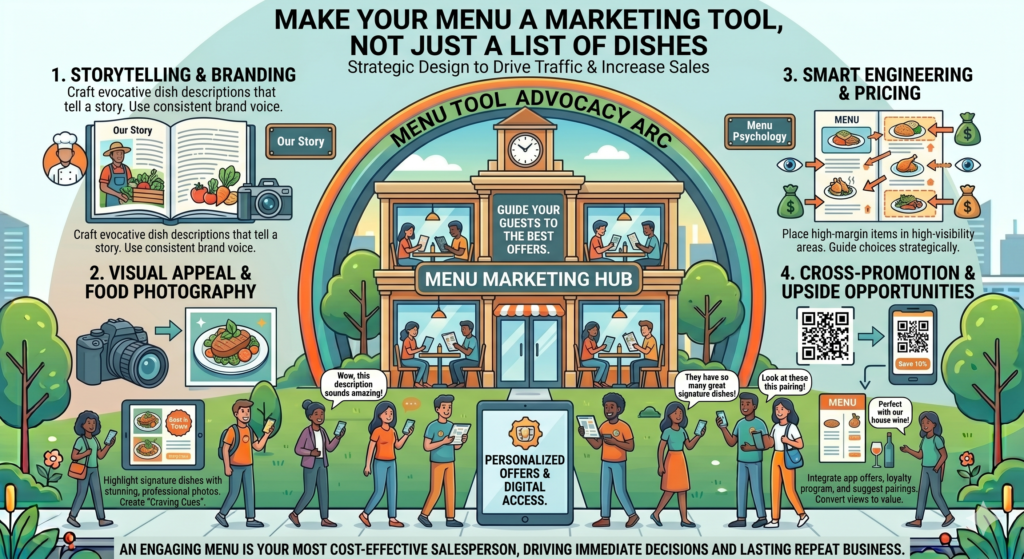
More traffic matters, but what happens after people arrive matters just as much. If your menu helps guests have a better first visit, they are more likely to return, review, and recommend you.
This is why menu marketing is so important.
Your menu should guide attention toward your most profitable, most loved, and most brand-building dishes. Not every dish deserves equal focus. Some items bring people in. Some raise average spend. Some create social sharing. Some are easy for the kitchen to execute. Some show what makes you different.
You need to know which dishes do which job.
A signature dish should be easy to find. A high-margin dish should be described in a way that makes it appealing. A dish that looks great on camera should be placed where guests notice it. A new dish should have a short story. A dish that often gets questions should have a clearer description.
A menu should reduce friction and increase desire at the same time.
Your dish descriptions should make people taste the food before it arrives
Dish descriptions are small pieces of copywriting. They do not need to be long, but they should create a picture in the guest’s mind.
A plain menu says, “Chicken sandwich.” A better menu says, “Crispy chicken sandwich with garlic mayo, pickled onions, and soft toasted bread.” The second version helps the guest imagine texture, flavor, and freshness.
That small change can increase orders.
Use simple words that people understand. Avoid overdoing it. A menu that tries too hard can feel fake. You do not need to call every dish “handcrafted,” “elevated,” or “iconic.” Clear words sell better than fancy words.
Focus on what makes the dish good. Is it slow-cooked? Charred? Crispy? Creamy? Smoky? Fresh? Spicy? Tangy? Buttery? Warm? Made daily? Served with a house sauce? Finished at the table? Good for sharing?
These details help guests choose.
Your descriptions should also match your brand. A casual burger place can sound fun and bold. A family restaurant can sound warm and simple. A fine dining restaurant can sound calm and refined. A cafe can sound cozy and fresh.
The voice of the menu should feel like the voice of the restaurant.
Your best dishes should be easy for staff to recommend
Your team is part of your marketing. Servers, hosts, cashiers, and managers can guide choices in a way no ad can.
But they need to know what to recommend.
Every staff member should understand the dishes that define the restaurant. They should know what first-time guests should try. They should know which dishes are best for sharing, which are quick, which are rich, which are light, which are spicy, which are kid-friendly, and which pair well with drinks or dessert.
This helps guests feel cared for.
A simple staff recommendation can turn a normal meal into a better experience. When a server says, “That pasta is one of our most loved dishes, but if you want something lighter, the grilled fish is a better choice,” the guest feels guided, not sold to.
That builds trust.
Your marketing should support this. If social media promotes a dish, staff should know it may get asked about. If your website highlights a signature item, staff should know the story behind it. If an ad brings people in for a special, the front-of-house team should know the details.
Nothing feels worse than seeing an offer online and then finding that the staff has no idea about it.
Strong restaurants connect marketing with service. The guest should feel one smooth experience from the first post to the final bill.
Your menu should create reasons for people to return
A static menu can still work, but returning guests need fresh reasons to come back.
This does not mean changing everything all the time. That can confuse regulars and stress the kitchen. Instead, keep your core menu stable and create smaller rotating reasons to return.
Seasonal specials can do this. Weekly features can do this. A chef’s dish can do this. A limited dessert can do this. A new drink can do this. A festival menu can do this. A guest favorite brought back for a short time can do this.
The point is to give regulars something new without losing the dishes they already love.
This also gives your marketing more energy. It is easier to post, email, text, and advertise when there is something fresh to talk about. “Come visit us” gets old. “Our roasted pumpkin soup is back this week” feels timely.
Seasonal dishes also create emotional pull. People like food that matches the weather, holidays, and mood of the month. Warm soups in winter. Fresh drinks in summer. Comfort meals on rainy days. Light lunch plates during busy workweeks. Festive menus during holidays.
Use the calendar, but do not let it become boring. Add your own angle.
Limited-time items should be used to create urgency without making guests feel pressured
Urgency works in restaurant marketing because meals are time-based. People choose where to eat today, tonight, this weekend, or for a specific event.
A limited-time item gives them a reason to choose now.
But urgency should feel honest. Do not say something is limited if it is always available. Do not invent fake scarcity every week. Guests can feel when marketing is not sincere.
Use real limits. Maybe the dish uses seasonal ingredients. Maybe the chef is testing a new recipe. Maybe it is available only for weekend brunch. Maybe the dessert is made in small batches. Maybe the tasting menu is only offered on Thursday night.
When the limit is real, the message feels stronger.
You can also use limited-time items to test demand. If a special sells well, earns good feedback, and gets shared often, it may deserve a permanent spot. If it does not move, you learn without changing the full menu.
This turns your menu into a testing tool.
Restaurants that test well can grow faster because they stop guessing. They learn what people actually want, what they will pay for, what they will talk about, and what brings them back.
Use events to turn quiet days into reasons to visit
Events can be one of the most effective ways to drive restaurant traffic, especially on slower days.
A normal Tuesday may not give people enough reason to go out. But a tasting night, live music session, quiz night, chef’s table, wine pairing, family dinner, local artist night, or themed menu can turn that same Tuesday into a plan.
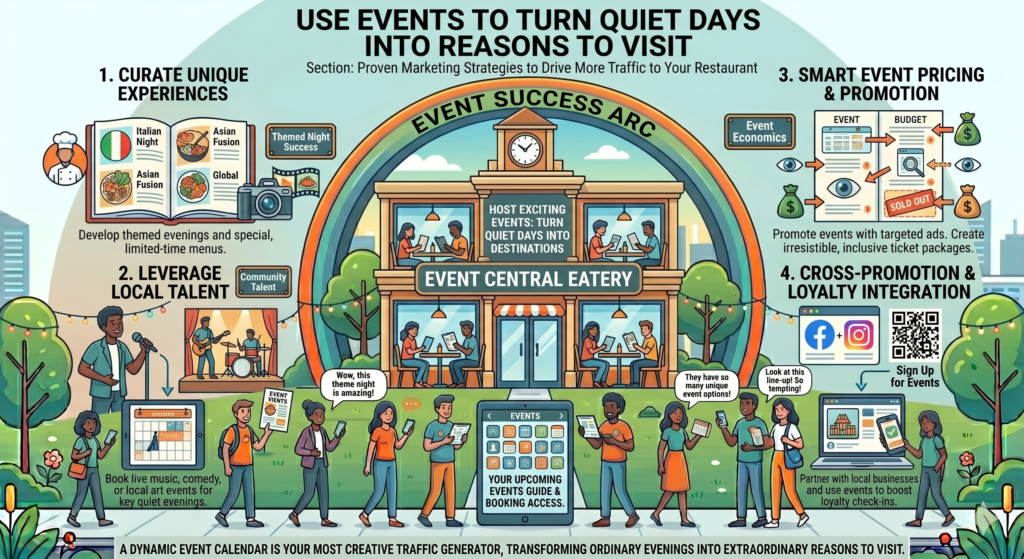
People like having a reason.
An event gives guests something to invite others to. It changes the decision from “Should we go out?” to “Do you want to go to this?” That small shift matters. It gives the visit a shape, a time, and a reason to commit.
Events also create marketing content before, during, and after they happen. You can announce the event, show preparation, share behind-the-scenes clips, post limited seats, capture the night, thank guests, and promote the next one. One good event can give you days of useful content.
But events should not be random. They should fit your restaurant and your customers.
A fine dining restaurant may do tasting menus. A casual restaurant may do game nights. A cafe may do poetry, acoustic music, or book clubs. A family restaurant may do kids-eat-early evenings. A bar may do themed drink nights. A bakery may do decorating workshops. A local restaurant may do community dinners.
The event should feel natural, not forced.
Your best events solve a traffic problem while building your brand
Do not host events just because other restaurants do. Start with the business problem.
Do you need more weekday traffic? Do you need more early dinner bookings? Do you need to attract families? Do you want to grow private dining? Do you want more bar sales? Do you want to introduce a new menu? Do you want to bring back regulars?
The event should support that goal.
If Mondays are slow, a Monday-only comfort meal can help. If early evenings are empty, a pre-7 pm tasting menu can help. If you want more wine sales, a pairing night can help. If you want to become known for local culture, a local artist dinner can help. If you want more corporate bookings, a small business networking lunch can help.
This keeps events from becoming expensive distractions.
You also need to price events carefully. A free event can bring people, but it may not bring the right spend. A paid event can create commitment, but it needs clear value. A set menu can help your kitchen plan better. A deposit can reduce no-shows. A limited seat count can create urgency and protect the guest experience.
The goal is not just to fill the room once. The goal is to create a repeatable traffic driver.
Promote events early enough for people to plan, but keep the final push close to the date
Event promotion needs two kinds of timing.
First, you need early awareness. This gives people time to plan, invite friends, book a table, arrange childcare, or choose the date. For bigger events, holiday meals, tastings, or group nights, start earlier.
Second, you need a final reminder close to the event. Many people decide late. They may have seen the first post and forgotten. A reminder two or three days before, and another on the day if seats remain, can drive action.
Do not rely on one post.
Use your website, Google Business Profile, email list, SMS list, social media, staff mentions, table cards, receipts, local partners, and nearby community groups. Your staff should know what is coming so they can mention it to guests in a natural way.
The event page or booking link should be clear. People should know the date, time, price, menu, what is included, who it is for, and how to reserve.
Confusion kills bookings.
After the event, keep the momentum. Share photos, thank guests, mention sold-out moments, and announce the next date if you have one. This builds proof. People who missed the event should feel like they want to attend the next one.
That is how events become a traffic system instead of a one-time idea.
Use food photography and video to make people feel hungry before they read a word
People often decide with their eyes first.
Before they read your caption, check your menu, or click your booking link, they see the food. If the food looks fresh, warm, rich, crisp, colorful, or comforting, they slow down. If it looks flat, dark, messy, or dry, they move on.
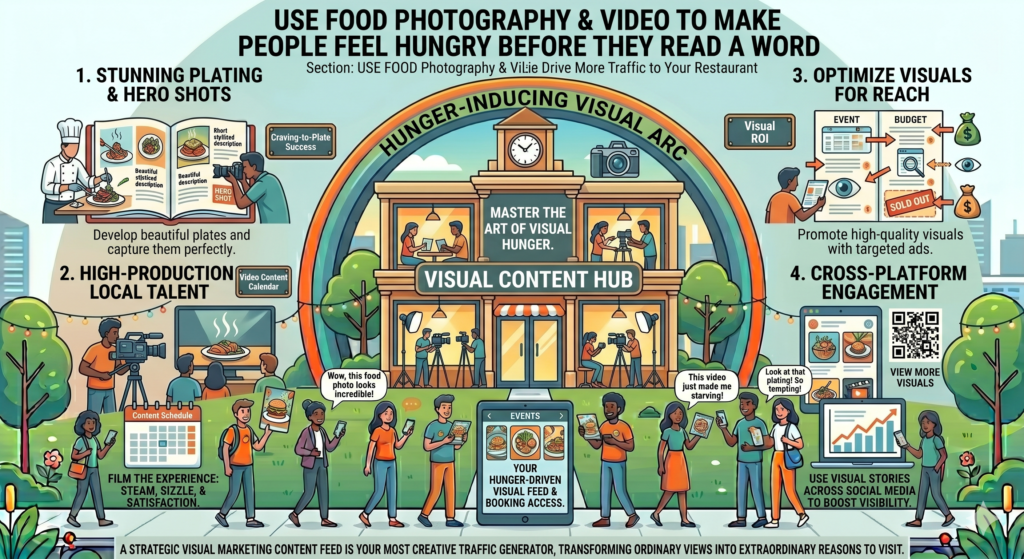
This does not mean every restaurant needs expensive studio photography. In fact, overly polished photos can sometimes feel less real. What you need is food content that makes people want to taste the dish.
Good food content shows texture. It shows steam, sauce, crunch, softness, freshness, and portion size. It makes the dish feel close. A burger should look juicy. A curry should look rich. A pizza should look hot. A salad should look fresh. A dessert should look tempting. A drink should look cold and refreshing.
The goal is not just to show what you sell. The goal is to create appetite.
A restaurant that uses strong visuals can turn normal menu items into traffic drivers. One short video of a fresh pasta toss, a sizzling platter, a cake slice, or a loaded sandwich can do more than a long caption. People do not always need to be convinced with many words. Sometimes they need to see one dish at the right moment and think, “That is what I want tonight.”
This is why your best dishes should be filmed again and again in different ways.
Not every video has to introduce a new item. A signature dish can be shown during prep, plating, serving, cutting, dipping, pouring, packing, and eating. Each angle gives the same dish new life. Repetition is not a problem when the content feels fresh. In fact, repetition helps people remember what you are known for.
Your photos should show the food clearly, not hide it behind trends
Restaurant content can easily become too clever. Some photos are taken from strange angles. Some videos move too fast. Some posts focus more on effects than food. Some captions try too hard to sound trendy.
That may get attention for a second, but it does not always sell the dish.
Simple is often stronger.
Put the dish near natural light when possible. Keep the background clean. Make sure the plate is not messy unless the food is meant to look rustic. Show enough of the dish so people understand what it is. Use close-ups when texture matters. Show the full plate when portion size matters. Show the table when the experience matters.
A person should be able to look at the photo and know what they are seeing.
This is especially important for paid ads, Google photos, menu pages, and delivery listings. If people cannot understand the dish fast, they may not order it. A beautiful but unclear photo can lose sales. A simple, clear, appetizing photo can win them.
For dine-in restaurants, show more than food. Show the table with dishes placed together. Show drinks beside the meal. Show hands sharing starters. Show the booth, the lighting, the bar, the window seat, or the outdoor table. People are not only choosing food. They are choosing a place to spend time.
Your visuals should help them imagine being there.
Your videos should start with the best moment immediately
Short video is one of the best tools for restaurant marketing because food has movement.
A still photo can show a dish. A video can show desire building. It can show the pour, the cut, the stretch, the sizzle, the steam, the crunch, the garnish, the flame, the shake, the stir, and the first bite.
But attention is short. You cannot waste the opening.
Do not start with your logo. Do not start with a slow shot of the outside wall unless the location itself is the hook. Do not start with a long intro. Start with the most satisfying moment.
If the dish has melted cheese, start with the pull. If the dessert cracks, start with the crack. If the drink is colorful, start with the pour. If the pan is sizzling, start with the sound and steam. If the dish is huge, start with the reveal. If the chef is finishing a plate, start with the final touch.
Then explain the dish quickly.
A good restaurant video can be very simple. Show the dish being made, name it clearly, mention when it is available, and tell people how to get it. That is enough.
Do not make every video feel like an ad. Some videos should simply make people hungry. Others should answer questions. Others should show your team. Others should push a booking or offer. A healthy mix keeps your content from feeling too sales-heavy.
The best restaurant videos feel like a window into the kitchen, not a commercial break.
Your visual content should be planned around dishes that can actually drive traffic
Not every dish deserves equal marketing attention.
Some dishes may taste great but not look strong on camera. Some dishes may look good but be low-margin. Some dishes may be hard for the kitchen to make during rush hours. Some dishes may attract the wrong kind of order if promoted too much. Some dishes may not represent your brand well.
So choose your content heroes carefully.
Your hero dishes should usually be popular, profitable, easy to explain, visually strong, and connected to what you want to be known for. These are the dishes you should feature on your website, Google listing, social media, ads, email, and menu highlights.
This does not mean you ignore the rest of the menu. It means your marketing needs anchors.
When people think of your restaurant, what should come to mind? Your wood-fired pizza? Your weekend brunch? Your biryani? Your seafood platter? Your handmade dumplings? Your steak night? Your dessert bar? Your family-style thali? Your coffee and croissants?
If you do not shape that memory, customers will shape it randomly.
Pick a few core items and make them famous.
Your best photos should be reused across the full customer journey
A strong food photo should not be used once and forgotten.
Use it on your menu page. Add it to your Google Business Profile. Turn it into a social post. Use it in an email. Place it in a paid ad. Add it to a landing page. Use it in a table tent. Share it with local partners. Put it in your online ordering system. Use it in your delivery app listing if the platform allows.
This creates consistency.
When someone sees the same dish on Instagram, then sees it on Google, then sees it on your menu, the memory gets stronger. They begin to connect that dish with your restaurant. That is how a menu item becomes part of your brand.
Do not think of content as a one-time task. Think of it as an asset.
One good shoot can support weeks of marketing if you plan it well. During one session, you can capture full dish photos, close-ups, vertical videos, staff shots, table scenes, kitchen prep, and short clips for ads. This saves time and gives your brand a cleaner look.
Even if you use a phone, plan before you shoot. Know which dishes matter. Know where the best light is. Know what action shots you need. Know which offers or pages the content will support.
Better planning creates better traffic.
Build a review and reputation system that earns trust before people visit
A restaurant’s reputation often sells the first visit before your staff ever speaks to the guest.
People check reviews because eating out has risk. They do not want to waste money. They do not want a bad meal. They do not want slow service before a show. They do not want to take family somewhere uncomfortable. They do not want to choose the wrong place for a birthday, date, client lunch, or weekend plan.
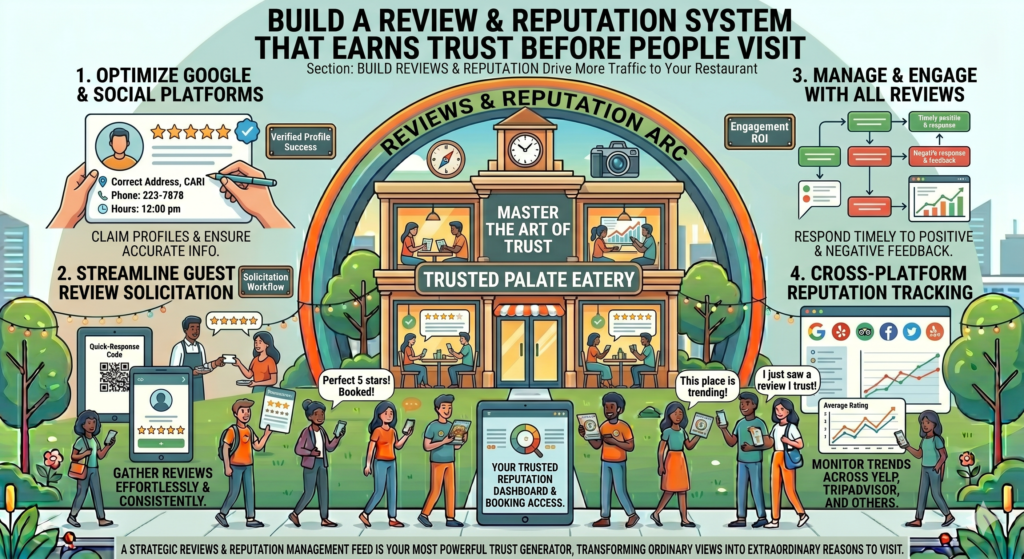
Reviews reduce that risk.
This is why review marketing is not a small task. It is one of the main ways people decide whether your restaurant is safe to try.
A strong review profile does three things. It helps you rank better in local searches. It builds trust with people comparing options. It gives you useful words and proof you can use in your marketing.
But reviews do not grow by accident. Most happy guests leave quietly. Unhappy guests are often more motivated to speak. That means you need a simple system to encourage satisfied guests to share their experience.
This system should be polite, consistent, and easy.
Ask at the right time. Make the link easy to find. Train your team. Add a review request to receipts, follow-up emails, booking messages, and table cards. Focus on guests who already show happiness. Never pressure people. Never offer rewards for fake reviews. Never write reviews for customers.
Your goal is to make honest feedback easier.
Your review requests should guide guests toward useful details
A review that says “great food” is helpful, but a review with detail is much stronger.
When guests mention the dish, service, occasion, location, atmosphere, speed, or value, future customers get a better picture. Those details also help your restaurant appear relevant for more local searches.
So when you ask for reviews, be specific in a natural way.
If a guest loved your pasta, you can say, “We’re so glad you enjoyed the pasta. If you mention it in a Google review, it really helps other guests know what to try.” If a family had a great lunch, you can say, “It means a lot to hear that. A review about your family visit would really help other parents find us.”
This is not manipulation. It is guidance.
Many customers are willing to help, but they do not know what to write. A small prompt makes it easier for them. It also leads to reviews that sound more real because they are based on actual moments.
You can also use review themes to understand what your market values.
If people keep praising your fast lunch service, that should appear in your marketing. If people mention your friendly staff, highlight that. If reviews talk about large portions, use that if it fits your brand. If guests love the atmosphere for date night, build a page and campaign around it.
Your customers often give you the best marketing language. Pay attention.
Your review replies should sound like they come from a real person
Many restaurants reply to reviews with cold templates. Every response says the same thing. “Thank you for your feedback. We hope to serve you again soon.”
That is better than silence, but it does not build much connection.
A better reply feels human. Use the guest’s name if available. Mention what they ordered or what they enjoyed. Thank them warmly. Invite them back in a way that fits the review.
If someone says they loved the seafood pasta, reply with a note about how happy the kitchen will be to hear that. If someone says they celebrated a birthday, thank them for choosing you for the celebration. If someone says the staff was kind, mention that you will share it with the team.
Small details make your response feel real.
For negative reviews, the same rule applies. Sound human. Stay calm. Acknowledge the issue. Avoid long arguments. Do not copy and paste a defensive response. Do not blame the customer. Do not reveal private details. Do not sound annoyed.
A poor review response can hurt you more than the review itself.
People reading reviews understand that mistakes happen. What they judge is your attitude. If your response shows care, future guests may still trust you. If your response sounds rude, even people who were not involved may avoid you.
Your reputation is built not only by what guests say about you, but also by how you answer.
Turn your best reviews into marketing assets across every channel
Good reviews should not sit only on Google.
A strong review can become social proof on your website, menu page, booking page, private dining page, email campaign, social post, ad creative, or table display. When real customers say what makes your restaurant good, it often feels more trusted than anything you say about yourself.
Use short review lines where they support action.
A review about fast lunch service belongs on your lunch page. A review about a great anniversary dinner belongs on your date night or celebration page. A review about friendly staff belongs on your homepage. A review about catering reliability belongs on your catering page.
A review about vegetarian options belongs near your vegetarian menu section.
This keeps proof close to the decision.
Do not overload pages with too many reviews. A few strong, relevant reviews can do more than a wall of praise. Choose reviews that answer doubts. If people worry about parking, show a review that mentions easy parking if that is true.
If people worry about bringing kids, show a review from a family. If people wonder whether the place is good for groups, show a group booking review.
Social proof works best when it reduces a real concern.
Treat reputation work as a weekly habit, not a crisis task
Many restaurants only focus on reviews after a bad one appears. That is too late.
Reputation should be managed every week. Check new reviews. Reply quickly. Share good feedback with staff. Look for repeated complaints. Ask happy guests to review. Update your photos. Fix outdated information. Watch what competitors are being praised for.
This does not need to take hours. But it does need to be consistent.
A restaurant with steady review growth looks active and trusted. A restaurant with old reviews and no replies can look neglected, even if the food is good. Fresh reviews tell people that guests are still visiting and enjoying the place now.
That matters because restaurants change. Chefs change. Menus change. Service changes. Customers want current proof.
Your reputation is not only what people said two years ago. It is what people are saying this month.
Use delivery and takeaway marketing without letting apps own your customer relationship
Delivery and takeaway can bring strong revenue, but they can also weaken your customer relationship if you are not careful.
Many restaurants rely on delivery apps for orders. These apps can help with visibility, but they often take fees and control the customer experience. Your restaurant may prepare the food, but the app owns the customer data, the ordering flow, and often the first point of contact.
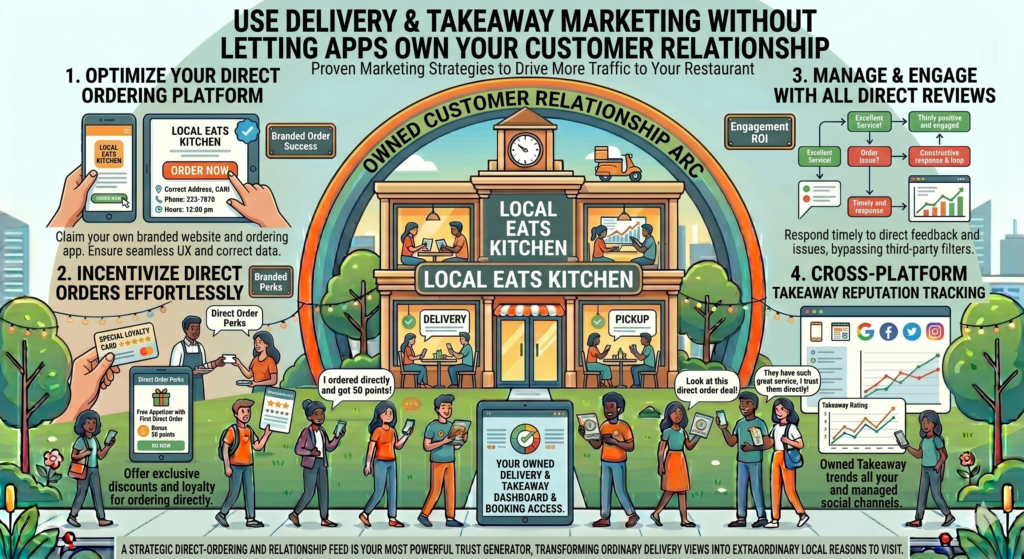
That means you need a smart balance.
Use delivery platforms where they make sense, but do not let them become your whole strategy. Your goal should be to turn delivery customers into direct customers over time. Direct orders usually give you more control, better margins, and a closer relationship with guests.
This starts with making direct ordering easy.
If people have to search hard, create an account, deal with a slow page, or wonder whether the order went through, they will go back to the app. Your direct ordering page should be simple, mobile-friendly, clear, and linked from your website, Google profile, social media, and emails.
The food must also travel well. Marketing cannot save a bad delivery experience. If fries arrive soggy, soup leaks, pizza gets cold, or desserts melt, customers blame the restaurant even if delivery was the issue.
Takeaway and delivery menus should be built around food that holds quality.
Your delivery menu should be designed for speed, quality, and repeat orders
A dine-in menu and a delivery menu do not always need to be the same.
Some dishes are great in the restaurant but weak after 30 minutes in a box. Some items are too hard to pack. Some lose texture quickly. Some require plating that delivery cannot protect. Promoting those dishes for delivery can lead to bad reviews.
Instead, build a delivery menu around items that travel well, stay clear, and make people want to order again.
Packaging is part of marketing here. A neat, warm, well-packed order tells the customer you care. A messy bag tells them you do not. Labels help group orders. Clear reheating notes can help with certain dishes. A small thank-you card can make the experience feel more personal.
You can also use delivery to introduce people to your brand.
Add a card inviting them to order direct next time. Mention your dine-in experience. Share a QR code for your loyalty list. Offer a simple next-order benefit through your own site. Invite them to follow your social media for specials.
Do this carefully and within platform rules where relevant. The goal is not to annoy the customer. The goal is to make sure they know there is a better direct path next time.
Takeaway customers can become dine-in guests if you invite them properly
Someone who orders takeaway already trusts your food enough to buy it. That makes them a warm lead for dine-in.
But many restaurants never invite takeaway customers to visit in person.
Use packaging, email, SMS, and order follow-ups to show them what they are missing. If your dine-in experience has fresh plating, special drinks, live events, outdoor seating, weekend brunch, or chef specials not available for delivery, mention that.
A message like “This dish is even better fresh from the kitchen. Join us for dinner this weekend and try the full version at the table” can plant the idea.
You can also create dine-in-only specials. These give delivery customers a reason to come in. Maybe the full dessert is only available in the restaurant. Maybe the tasting menu is dine-in only. Maybe happy hour is only at the bar. Maybe a family platter is best served fresh at the table.
This helps you avoid becoming only a delivery brand.
Delivery brings convenience. Dine-in builds memory. A strong restaurant uses both, but understands the difference.
Direct ordering should feel more rewarding than third-party ordering
Customers often choose delivery apps because they are easy. To shift them toward direct ordering, you need to make direct ordering feel just as easy and more rewarding.
This does not always mean cheaper. It can mean better.
Direct customers can get access to full menu items, better customization, loyalty points, exclusive dishes, faster pickup, lower service fees, better support, or first access to specials. Make these benefits clear.
If your direct order page looks hidden or weak, people will not use it. Put the direct order button on your homepage, Google profile, Instagram bio, email footer, and menu page. Mention it in takeaway packaging. Train staff to remind callers and pickup guests.
Make the message simple. Ordering direct helps guests get the best experience while supporting the restaurant more directly.
Do not guilt people. Give them a better reason.
Measure delivery profit, not just delivery sales
High delivery sales can look good, but they do not always mean healthy profit.
You need to know which channels are profitable after platform fees, packaging, labor, discounts, refunds, and food costs. A busy delivery night may still be weak if margins are poor or the kitchen becomes overloaded.
Track which menu items work best for delivery. Track which offers attract repeat customers. Track complaints by channel. Track direct orders versus app orders. Track whether delivery customers join your list or return.
This helps you make better choices.
You may find that some dishes should not be on delivery apps. You may find that pickup is more profitable than delivery. You may find that direct orders rise when you promote them with packaging inserts. You may find that certain discounts bring low-value customers who never return.
Marketing should not only bring traffic. It should bring traffic that supports the business.
Build a loyalty system that makes the next visit feel natural
A restaurant grows faster when it does not have to win every visit from zero.
That is the real value of loyalty marketing. It is not only about giving points or discounts. It is about making guests feel like coming back is the obvious next step.
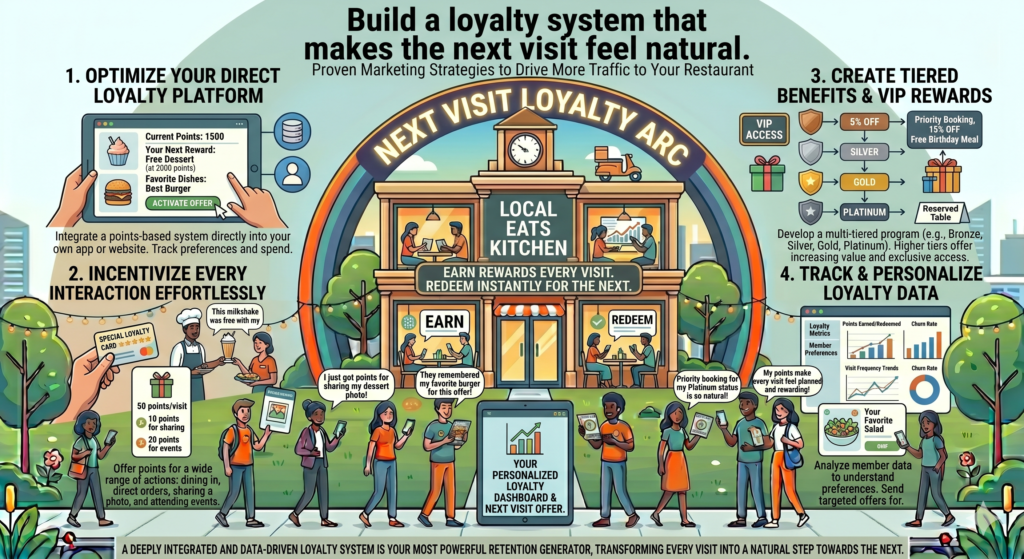
Many restaurants think loyalty means a punch card or a basic reward after ten visits. That can work, but it is not the full picture. A strong loyalty system understands why people return. They return because the food is good, the experience feels familiar, the staff remembers them, the value feels fair, and there is always a small reason to come again.
Your job is to build those reasons into the customer journey.
A first-time guest should not leave and disappear. A second-time guest should feel noticed. A regular should feel valued. A high-spending guest should feel appreciated. A birthday guest should feel remembered. A delivery customer should be invited into the dine-in experience. A past event guest should be shown the next event.
This is how loyalty becomes a traffic engine.
The best loyalty systems are simple. If customers have to download a difficult app, remember strange rules, or calculate points in their head, they may not care. The reward should be easy to understand and easy to use. More important, the whole system should feel worth joining.
A loyalty program should not make your restaurant feel cheap. It should make your guests feel smart for coming back.
Your loyalty offer should match how people actually use your restaurant
A coffee shop may benefit from a visit-based reward because customers come often. A fine dining restaurant may need a different approach because guests visit less often but spend more. A pizza shop may use family bundles and repeat order rewards.
A lunch spot may use office meal perks. A bakery may use early access to seasonal items. A bar may use member-only tasting nights.
The loyalty system should fit the dining pattern.
If your restaurant has frequent, low-ticket visits, small rewards can work well. If your restaurant has larger, occasion-based visits, experience-based rewards may feel better. A free dessert, priority booking, birthday treat, chef’s special invite, or early access to holiday menus may be more powerful than a small discount.
Think about what your customers would actually value.
Some guests love savings. Some love access. Some love recognition. Some love convenience. Some love surprise. If you know your audience, you can build a loyalty system that feels personal instead of generic.
The easiest starting point is a simple return offer. After a first visit, give the guest a reason to come back within a short window. It could be a special dish available next week, a thank-you reward, or an invite to a quieter night. The goal is to create a second visit quickly because the second visit is where habits begin.
Once someone has visited twice, your relationship is stronger. They have more memories. They trust you more. They are more likely to recommend you. They are easier to bring back again.
Your loyalty program should reward behavior that helps your business
Do not reward everything equally.
A smart loyalty system supports the parts of the business you want to grow. If you need more weekday traffic, reward weekday visits. If you want more direct orders, reward direct ordering. If you want more group bookings, reward referrals or party reservations. If you want more lunch traffic, build lunch perks. If you want people to try new dishes, give early access or tasting rewards.
This keeps loyalty from becoming a cost center.
For example, instead of giving a discount every time someone visits on your busiest Saturday night, you may offer a weekday reward that helps fill slower hours. Instead of discounting delivery app orders, you may reward direct pickup orders. Instead of giving everyone the same offer, you may give regulars first access to a limited menu.
The best loyalty programs feel generous to customers while still making business sense.
Do not hide the value. Make the program clear on your website, at the counter, in booking emails, on receipts, and in follow-up messages. Your staff should also understand it. If the team cannot explain the program in one simple sentence, customers will not remember it.
A good loyalty line might be, “Join our guest list and get first access to specials, birthday treats, and member-only dining nights.” That feels better than “Sign up for promotional messages.”
The words matter.
Personal touches can create more loyalty than discounts
People remember how a restaurant makes them feel.
A discount can bring someone in once. A personal touch can bring them back for years.
This is where smaller restaurants can beat bigger chains. A local restaurant can remember names, favorite dishes, usual tables, allergies, birthdays, and special moments. It can make people feel like guests, not transactions.
That feeling is powerful.
A server who remembers that a guest likes extra spice creates loyalty. A manager who thanks a family for coming back creates loyalty. A birthday note creates loyalty. A small sample of a new dish creates loyalty. A chef greeting a regular creates loyalty. A thoughtful reply to a customer email creates loyalty.
These moments do not have to cost much. They require attention.
Train your team to notice repeat guests. Use reservation notes wisely. Keep track of important preferences. Encourage staff to share guest details before service. If someone had a poor experience and returns, make sure the team knows and handles the visit with extra care.
Loyalty is not only a marketing system. It is an operations habit.
The more known a guest feels, the less likely they are to switch
Most restaurants compete on food, price, location, and convenience. But emotional familiarity is harder to copy.
When guests feel known, they have a reason to return that goes beyond the menu. They may still try other places, but your restaurant becomes their safe choice. Their usual place. Their family place. Their Friday place. Their celebration place.
That is what you want.
Marketing can support this by using language that feels warm and local. Speak to regulars like people you recognize. Thank them often. Share behind-the-scenes stories. Let them meet your team through content. Invite them into the life of the restaurant.
A strong restaurant brand does not only say, “Come eat here.” It says, “You belong here.”
That feeling builds traffic in a quieter but stronger way. It brings people back without needing a heavy discount every time.
Use local SEO content to become the answer for nearby diners
Search traffic is one of the most valuable traffic sources for restaurants because it often comes from people who are close to choosing.
But many restaurants treat SEO as if it only means adding keywords to a homepage. That is too limited.
Restaurant SEO is about helping nearby people find clear answers. Where should I eat lunch near this office area? Where can I book a birthday dinner? Which restaurant has vegan options? Where can I eat before the show? Who offers catering near me? Which cafe is open early? Where can I take my family this weekend?
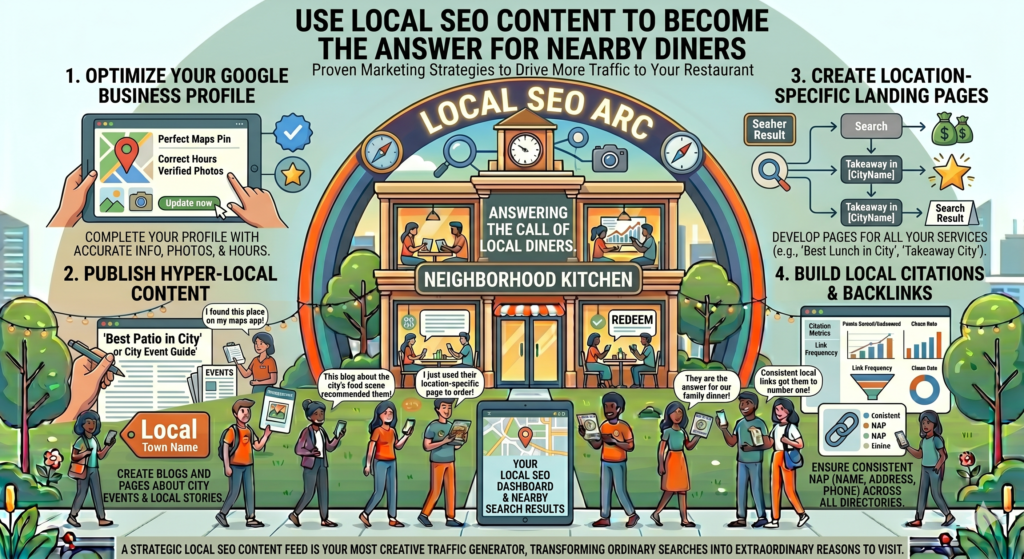
If your website answers these questions better than your competitors, you can earn more traffic.
Local SEO content should be practical. It should not be stuffed with repeated keywords. It should sound like a helpful local guide written by people who know the area and know the restaurant.
A restaurant blog can help, but only if it is useful. Do not publish random posts that no diner cares about. Write content that connects directly to real dining decisions.
A page about “best dishes to try at our restaurant” can help first-time visitors. A guide to “where to eat before a show near [venue]” can bring pre-event traffic. A page about “private dining for small office teams in [area]” can attract group bookings. A page about “family dinner near [neighborhood]” can help parents choose you.
Every piece of content should have a job.
Your website should speak the same language your customers use
Restaurant owners often describe their business in broad or fancy terms. Customers search in simple words.
They search for “best tacos near me,” “quiet restaurant for date night,” “birthday dinner place,” “good lunch near office,” “brunch with outdoor seating,” “family restaurant with parking,” or “late night food near [area].”
Your website should include this kind of natural language where it fits.
This does not mean forcing search terms into every sentence. It means writing clearly about what people actually want. If you have outdoor seating, say so. If you are good for groups, say so. If you are near a known landmark, say so. If you offer fast lunch, say so. If you have vegetarian dishes, say so.
Do not make people guess.
Search engines also need clear signals. Your page titles, headings, menu text, image names, location details, and internal links should all help explain what your restaurant offers and where it is located.
A restaurant that says “modern dining experience” everywhere may sound stylish, but it gives search engines and customers very little to work with. A restaurant that clearly says “wood-fired pizza in [neighborhood], with weekday lunch, outdoor seating, and private party bookings” gives much stronger signals.
Clear beats clever.
Your location pages and neighborhood content can capture people already nearby
If your restaurant serves people from specific neighborhoods, office areas, hotels, campuses, or event venues, your website should reflect that.
You can create helpful pages that explain how close you are to these places and why your restaurant is a good fit for visitors from that area. This is especially useful if you are near tourist spots, business districts, universities, hospitals, shopping centers, theaters, stadiums, or transit stations.
For example, a restaurant near a theater can create a page for pre-show dining. The page can mention ideal booking times, quick dishes, walking distance, and how to reserve. A restaurant near offices can create a lunch page for nearby teams. The page can mention speed, group orders, takeaway, and corporate meal options.
These pages are not just for ranking. They help real people decide.
Good local content should feel grounded. Mention real details that matter. Parking. Walking time. Best times to visit. Whether reservations are needed. Which dishes are quick. Whether groups can be handled. Whether takeaway is easy. Whether the space is quiet or lively.
The more useful the page, the more likely it is to convert.
Your content should answer doubts before the guest has to ask
Many people do not visit a restaurant because they are unsure.
They wonder if the place is too expensive. They wonder if it is good for kids. They wonder if they need a reservation. They wonder if the menu has options for them. They wonder if parking is hard. They wonder if the restaurant is too loud. They wonder if the food is spicy. They wonder if large groups are welcome.
If your website does not answer these questions, people may choose a competitor that does.
This is why FAQ-style content can be useful, as long as it is written naturally. You can include answers on your menu pages, booking pages, event pages, private dining pages, and contact page.
Do not bury important information.
If your restaurant is good for families, say what makes it good for families. If you offer gluten-free options, explain how guests can ask. If you have parking, explain where. If reservations are recommended on weekends, say so. If walk-ins are welcome, say so. If your kitchen closes before the restaurant closes, say so.
Clear information builds trust.
Helpful content reduces calls, confusion, and lost bookings
Good content does not only bring traffic. It also makes your operations smoother.
When your website answers common questions, your staff spends less time repeating the same details on the phone. When your private dining page is clear, event inquiries are better qualified. When your menu is easy to read, customers order faster. When parking details are clear, guests arrive less stressed. When booking rules are clear, fewer people are surprised.
This improves the guest experience before they arrive.
It also helps you capture people who do not want to call. Many customers, especially younger diners, prefer to check details online. If they cannot find the answer, they may not contact you. They may just choose another restaurant.
Your website should work like your best host. It should welcome people, answer questions, guide them, and help them take the next step.
Use community marketing to become part of local life
A restaurant is not just a place that serves food. It can become part of the local routine.
The restaurants that last are often the ones people feel connected to. They are where neighbors meet, teams celebrate, families return, friends gather, and regulars feel at home. That kind of connection cannot be built with ads alone.
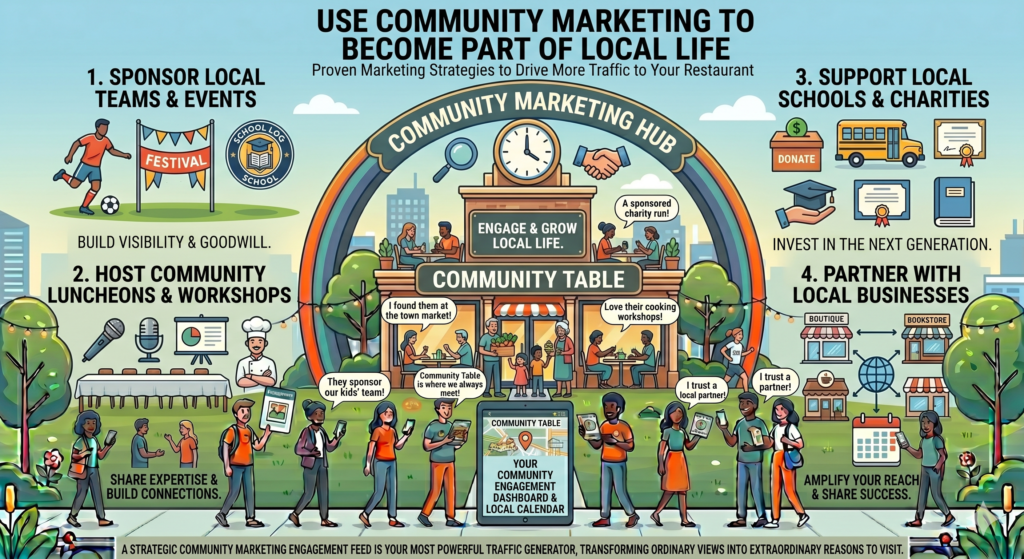
Community marketing helps your restaurant become more than a listing on a map.
This can mean supporting local events, working with schools, joining neighborhood groups, hosting charity nights, partnering with local creators, celebrating local culture, or simply showing up consistently in the area.
The key is sincerity. People can tell when a restaurant is only using the community for attention. Good community marketing starts with real involvement.
If your restaurant supports a local cause, choose one that fits your values. If you host community events, make them welcoming. If you partner with local groups, make the relationship fair. If you celebrate local stories, do it with respect.
A restaurant that gives to the community often earns attention in a deeper way.
Local people promote restaurants they feel proud to support
People like recommending places that make them feel good.
If your restaurant supports local artists, hires locally, uses local suppliers, sponsors small events, or creates a welcoming space for the neighborhood, customers may feel proud to bring others there.
This kind of pride creates word of mouth.
You can show this through your content, but do not make it all about you. Tell the stories of the people involved. Feature the local baker who supplies your bread. Show the farmer who grows your produce. Highlight the musician playing on Friday. Share the charity you are supporting and why it matters. Thank the school, club, or group that visited.
When people see real local connections, your restaurant feels more rooted.
This is hard for big chains to copy. A local restaurant can build meaning through place, people, and shared history. That meaning helps you stand out in a market where many places may sell similar food.
Community marketing works best when it becomes consistent
One charity event is nice. One local partnership is useful. But community trust grows through consistency.
Choose a few community actions you can keep doing. Maybe once a month you host a local artist night. Maybe every quarter you support a neighborhood cause. Maybe every Friday you feature a local supplier. Maybe every season you run a family event. Maybe you build a regular partnership with nearby schools, gyms, offices, or clubs.
Consistency makes the community remember you.
It also makes marketing easier because you are not always starting from scratch. Regular events and partnerships become part of your calendar. People begin to expect them. Guests tell others. Local pages may share them. Partners help promote them.
Over time, your restaurant becomes known for something beyond the menu.
That is powerful because food brings people in, but belonging brings them back.
Use influencer and creator marketing with local trust, not just follower counts
Influencer marketing can work very well for restaurants, but only when it is handled with care.
A restaurant does not need a creator with a million followers if most of those followers live too far away to visit. A local creator with a smaller but active audience can often bring better traffic because their followers are nearby, trust their taste, and actually need restaurant ideas in the area.
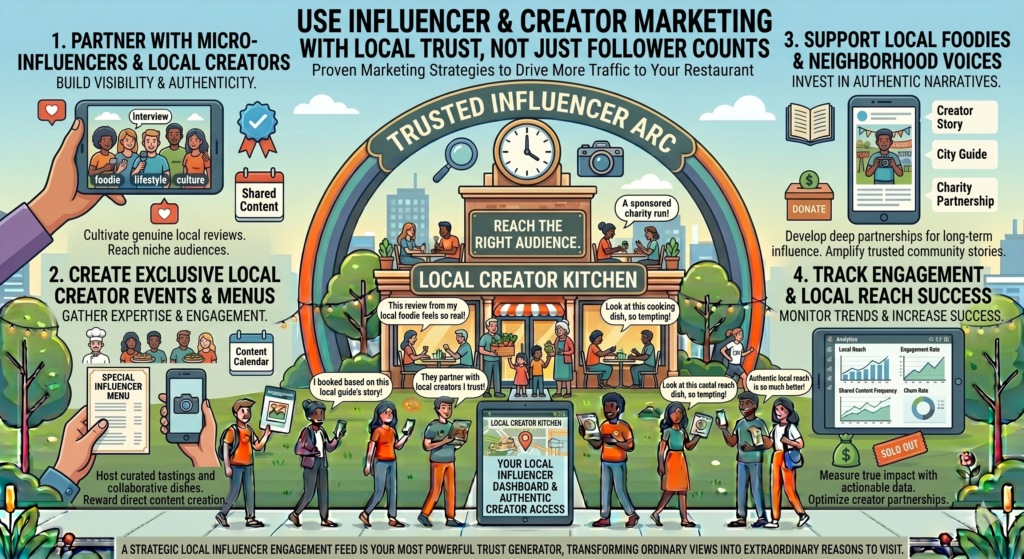
This is where many restaurants make the wrong choice. They look at follower count first. But follower count does not pay the bill. Local influence does.
The better question is simple: can this person make nearby people want to visit?
A good restaurant creator knows how to show food in a way that feels real. They can explain what to order, what the place feels like, who it is good for, when to visit, and why it is worth trying. Their content feels like a trusted recommendation, not a forced ad.
That kind of content can drive traffic because it removes doubt.
People often need social proof before they try a new restaurant. They want to see someone else visit first. They want to know what the food looks like in real life. They want to hear whether the place is worth the time. A good creator gives them that comfort.
But you should not invite every creator who asks for a free meal. You need a clear system.
Look at their audience. Are the followers local? Do people comment with real interest? Do their restaurant posts get saves, shares, and questions? Do they create clean content? Do they explain the experience well? Do their values match your brand? Would you be proud to share their content on your own page?
If the answer is yes, the partnership may be worth testing.
Your creator brief should guide the story without making the content feel fake
A creator visit works best when there is a clear focus.
Do not simply say, “Come try our food.” That leaves too much to chance. Give the creator a story to tell. Maybe you want to promote your weekend brunch. Maybe you want people to know about your new tasting menu. Maybe you want to highlight your lunch service for nearby offices.
Maybe you want more date night bookings. Maybe you want to show that your restaurant is family-friendly.
The creator should understand the goal before they arrive.
At the same time, do not control every word. If the post feels too scripted, people will sense it. Give guidance, not a fake speech. Share the dishes you want featured, the best time to film, the story behind the restaurant, the type of guest you want to attract, and any key details like parking, reservations, or limited-time offers.
Then let the creator speak in their own voice.
This balance matters. Your restaurant knows the business goal. The creator knows how to speak to their audience. When both sides respect that, the content feels natural and useful.
A strong creator post should do more than show food. It should help the viewer decide. It should answer what to order, who to bring, when to go, how to book, and what makes the place different.
That is what turns content into traffic.
Invite creators to experience the restaurant the way real guests should experience it
Do not create a fake version of your restaurant just for creators.
If the food looks different from what normal guests receive, people will feel misled. If the service is unusually perfect for the creator but poor for others, the campaign can backfire. If the dishes are staged in a way that guests cannot actually order, the content may bring disappointment instead of loyalty.
The creator visit should show your restaurant at its best, but still truthfully.
Serve the dishes you want to become known for. Seat them where the experience feels right. Give them the same warmth and care that any strong guest should receive. Explain the dishes naturally. Let the content show the real mood of the place.
You can create a great experience without making it false.
After the content goes live, do not let it fade. Share it on your own social channels. Add the best clips to your story highlights. Use strong quotes on your website if you have permission. Turn common comments into content ideas. If people ask about a dish, promote that dish again. If viewers ask about booking, make the booking link easy to find.
Creator content should become part of your wider marketing, not a one-day burst.
Track creator campaigns with simple signals that show real business value
Restaurant influencer marketing can become messy if you do not measure it.
You do not need complex tracking, but you need some way to know whether the campaign helped. Give each creator a unique booking note, offer code, landing page, or phrase guests can mention. Watch your reservations, direct messages, website visits, Google searches, and orders after the post goes live.
Also watch the quality of engagement.
A post with fewer likes but many comments like “Let’s go this weekend” or “I’m booking this” may be more valuable than a post with thousands of empty likes. Saves and shares can also matter because restaurant decisions often happen later. A person may save the post today and visit next week.
Ask your staff if guests mention the creator. Check whether the promoted dish gets more orders. Look at whether your follower growth comes from local people. Notice whether the content keeps bringing attention after the first day.
This helps you decide which creators to work with again.
Long-term creator relationships often work better than one-off posts
A single post can bring a spike. A long-term relationship can build memory.
If a local creator visits your restaurant several times across the year, their audience starts to see your place as a real recommendation, not a paid stop. They may feature your brunch one month, your dinner another month, your holiday menu later, and your event night after that.
This repeated exposure builds trust.
You can also create deeper collaborations. A creator can help host a tasting night, launch a limited dish, create a local dining guide with you, or bring a small group of followers for a special event. These ideas work best when the creator truly fits your restaurant and their audience matches your ideal guest.
Do not chase noise. Build trust.
The most effective restaurant creator marketing feels like a friend saying, “I found a place you should try.” That is the standard to aim for.
Improve your front-of-house experience because marketing cannot save a weak visit
Traffic is only useful if the visit makes people want to return.
This is why the guest experience is part of marketing. Every person who walks in becomes a possible repeat customer, reviewer, referrer, content sharer, or critic. The meal does not end when they pay. It continues in what they say afterward.
A restaurant can spend money on ads, SEO, social media, influencers, events, and email. But if the guest arrives and feels ignored, confused, rushed, or disappointed, the marketing money is wasted.
The visit must match the promise.
If your ads show warm service, the greeting should feel warm. If your website says family-friendly, families should feel welcome. If your social media shows beautiful dishes, the real plate should look close to that. If your reviews praise fast lunch, the lunch service should actually be fast.
Consistency builds trust.
Guests do not separate marketing from operations. To them, it is one experience. They saw you online, chose you, arrived, ate, paid, and left. If any part feels broken, it affects how they remember the brand.
That is why restaurants need to treat service details as traffic drivers.
A strong experience creates reviews. It creates word of mouth. It creates repeat visits. It creates social posts. It makes paid ads work better because people who come in are more likely to come back.
The first five minutes shape how guests judge the whole meal
The start of the visit matters more than many restaurants realize.
When guests arrive, they are asking quiet questions. Did we choose the right place? Are they happy to see us? Is our table ready? Does the place feel clean? Does the staff seem in control? Are we going to enjoy this?
A warm, smooth start lowers anxiety.
A slow or cold start creates doubt. Even if the food is good later, the guest may already feel tense. That is especially true for first-time visitors, families, date nights, birthdays, and guests who booked for an occasion.
Your host stand is a marketing touchpoint. Your greeting is a marketing touchpoint. Your waiting area is a marketing touchpoint. Your first glass of water is a marketing touchpoint. Your first staff interaction sets the tone.
This does not mean service has to be formal. It has to fit your brand. A casual restaurant can be lively and friendly. A fine dining restaurant can be calm and polished. A cafe can be warm and easy. The key is to make guests feel noticed.
People forgive waiting more easily when they feel informed. If a table is delayed, tell them clearly. If the kitchen is busy, manage expectations. If a guest looks confused, help before they ask. Small acts of attention prevent small problems from becoming bad reviews.
Your staff should know which guests need extra care before they ask for it
A guest celebrating a birthday needs a different kind of care from someone grabbing a quick lunch. A family with small children has different needs from a couple on a date. A corporate table has different needs from a solo diner. A first-time guest has different needs from a regular.
Great restaurants notice these differences.
Your reservation notes, host communication, and pre-shift briefings can help. If a guest mentioned an anniversary, the server should know. If a large group is coming, the team should be ready. If someone has an allergy note, it should not be discovered late. If a customer had a poor experience last time and is returning, the team should handle it with care.
This kind of attention turns service into loyalty.
It also gives your marketing more truth. When you say your restaurant is great for celebrations, it will be true. When you promote family dining, it will be true. When you invite business lunches, it will be true.
Marketing is much easier when the operation can support the promise.
Train your team to sell with helpful guidance, not pressure
Good selling in a restaurant should feel like service.
A server does not need to push guests into spending more. They need to help guests choose a better meal. When done well, this improves both revenue and satisfaction.
A guest may not know your best dish. They may not know which starter is good for sharing. They may not know the portion sizes. They may not know which drink fits the meal. They may not know that a dessert takes ten minutes and should be ordered early.
Your team can guide them.
This guidance should sound natural. Instead of asking, “Do you want appetizers?” a server can say, “If you’re sharing, the crispy cauliflower and the lamb sliders are the two starters people order most.” Instead of asking, “Any dessert?” they can say, “The warm chocolate cake takes a few minutes, but it is the one dessert people come back for.”
That is not pushy. It is useful.
Helpful suggestions can increase average spend, but they also make the guest feel better taken care of. The meal becomes easier. The choices feel safer. The table is more likely to order dishes they enjoy.
Your best marketing ideas often come from the dining room
Your staff hears what customers ask, praise, doubt, and complain about.
That information is gold.
If guests keep asking whether you have gluten-free options, your website should answer that better. If many people ask what dish is most popular, your menu should highlight it. If customers say they found you on Google, invest more in local SEO. If they mention a specific Instagram reel, create more like it. If they keep praising one server, study what that server does well.
Your dining room is a research lab.
Create a simple habit of asking staff what they are hearing. What dishes are guests excited about? What questions keep coming up? What objections stop people from ordering? What are people taking photos of? What are first-time guests surprised by? What do regulars ask for?
Use these answers to improve your content, offers, menu, and service.
The closer your marketing is to real guest behavior, the stronger it becomes.
Track the numbers that actually show whether your restaurant marketing is working
Restaurant marketing should be creative, but it should not be blind.
If you do not track results, you will not know what is really bringing traffic. You may keep spending on channels that only create noise. You may stop doing things that were quietly working. You may mistake busy nights for profitable nights. You may chase followers while missing repeat customers.
Good tracking helps you make better decisions.
This does not mean you need a complex dashboard at the start. You need simple numbers that connect marketing to business outcomes.
Look at covers, bookings, walk-ins, calls, website visits, direction requests, online orders, direct orders, delivery orders, average spend, repeat visits, email signups, review growth, event bookings, catering leads, and offer redemptions. These numbers tell you whether attention is turning into action.
The goal is not to track everything perfectly. The goal is to stop guessing.
A restaurant owner should be able to answer basic questions. Which days are slow? Which offers bring first-time guests? Which channels bring bookings? Which dishes get promoted and then sell more? Which events actually make money? Which campaigns bring repeat visits? Which partnerships bring valuable customers?
When you can answer these questions, marketing becomes sharper.
Your weekly marketing review should connect traffic, spend, and guest behavior
A weekly review can keep your restaurant focused.
Look at what you promoted, what happened, and what you learned. If you posted about brunch, did brunch bookings rise? If you emailed your list, did reservations or orders increase? If you ran a paid ad, did it bring calls or bookings? If you hosted an event, did guests return later? If you promoted a dish, did it sell more?
This review does not need to be long. It needs to be honest.
Some campaigns will look good online but weak in the restaurant. Some will bring fewer people but better spend. Some will drive first-time visits but not repeat visits. Some will work only during certain seasons. Some will reveal that the offer is strong but the booking path is weak.
Every result teaches you something.
Do not judge too fast from one day. Weather, holidays, local events, school schedules, paydays, and even traffic can affect restaurant demand. Look for patterns over time.
Marketing becomes more profitable when you keep learning.
Track the full path from first attention to repeat visit
A new customer may see your restaurant on Instagram, check your Google reviews, visit your website, look at the menu, book a table, eat dinner, join your list, and return two weeks later.
If you only look at one step, you miss the full picture.
This is why restaurants should think in terms of the customer path. How do people first discover you? What do they check before visiting? What makes them choose you? What happens during the visit? How do you follow up? What brings them back?
Each step can be improved.
If discovery is weak, you need stronger local SEO, social content, partnerships, or ads. If interest is strong but bookings are weak, your website, menu, photos, or offer may need work. If first visits are strong but repeat visits are low, your loyalty and follow-up system may be weak. If reviews are poor, the guest experience needs attention before more traffic is added.
Tracking helps you find the real bottleneck.
Many restaurants think they need more marketing when they actually need better conversion. Others think the food is the problem when the real issue is that nobody nearby knows they exist. Good numbers help you see the difference.
The best restaurant marketing plan is built around testing, not guessing
No restaurant can know every answer in advance.
You may think one offer will work, but another performs better. You may think customers care most about price, but they care more about speed. You may think Instagram brings most guests, but Google drives more bookings. You may think a dish is your hero item, but reviews show customers love something else.
Testing protects you from expensive assumptions.
Test different offers. Test lunch messages. Test event nights. Test photos. Test landing pages. Test email subject lines. Test creator partnerships. Test direct ordering benefits. Test seasonal specials. Test weekday promotions.
But test one clear thing at a time when possible. If you change the offer, audience, image, and timing all at once, you will not know what caused the result.
Small tests are often enough.
A restaurant does not need to gamble on huge campaigns. It can test a Tuesday dinner offer for two weeks. It can test a brunch reel format for a month. It can test a corporate lunch page with nearby offices. It can test a birthday club. It can test a limited dish before making it permanent.
The goal is to keep improving with real feedback.
Stop doing what only looks good and double down on what brings real guests
Some marketing looks impressive but does not move the business.
A viral post from viewers too far away may not help. A discount that fills tables with low-spend guests may hurt margins. An event that looks exciting but drains the team may not be worth repeating. A platform that sends orders but eats profit may need to be managed carefully.
Be honest about results.
If something brings real guests, good spend, strong reviews, repeat visits, or profitable orders, study it. Make it better. Repeat it. Build a system around it.
If something only brings surface-level attention, adjust it or stop.
Restaurant marketing should not be about doing more things. It should be about doing the right things more consistently.
Bring all your restaurant marketing into one simple traffic system
The biggest mistake restaurants make is treating every marketing activity as separate.
Google is one thing. Social media is another. Ads are another. Reviews are another. Email is another. Events are another. Staff is another. The menu is another.
But customers do not see it that way.
A guest may discover you on Google, check your Instagram, read reviews, view your menu, ask a friend, see a creator post, visit your website, book a table, eat with you, post a story, join your list, and return later.
To the guest, that is one journey.
Your marketing should support that journey from start to finish.
Discovery brings people in. Trust helps them choose. Clear information helps them act. A strong visit makes them happy. Follow-up brings them back. Reviews and referrals bring in the next wave of guests.
That is the system.
When each part supports the next, traffic becomes more predictable. Your social content makes people curious. Your Google profile gives proof. Your website answers questions. Your booking path makes action easy. Your staff delivers the promise. Your follow-up brings guests back. Your reviews help new people trust you.
This is how a restaurant stops depending on luck.
Your monthly marketing calendar should match the natural rhythm of your restaurant
A good restaurant marketing plan follows the rhythm of real life.
People eat differently on weekdays and weekends. They plan differently for holidays. They spend differently after payday. They behave differently during school breaks, rainy days, sports events, office seasons, tourist seasons, and local festivals.
Your calendar should reflect this.
Plan your month around what you need to drive. Maybe the first week focuses on lunch traffic. The second week promotes a weekend event. The third week pushes direct orders. The fourth week highlights private bookings. Around that, you keep regular content running for your signature dishes, reviews, staff, and behind-the-scenes moments.
This gives your marketing direction.
Without a calendar, restaurants often post whatever comes to mind. That creates random content and weak results. With a calendar, each piece has a job. Some content builds trust. Some drives bookings. Some brings back regulars. Some promotes offers. Some supports SEO. Some builds community.
You do not need to plan every post in detail. You need enough structure to avoid drifting.
Your restaurant should always know the next reason people should visit
This is one of the simplest and strongest marketing habits.
At any point, your team should know what the next reason to visit is.
Is it the new seasonal dish? The Friday dinner rush? The Sunday brunch menu? The live music night? The lunch combo? The holiday booking window? The chef’s special? The family meal? The office catering package? The patio reopening?
When you know the next reason, your marketing becomes clear.
Your staff can mention it. Your social media can show it. Your email can promote it. Your Google profile can post it. Your website can feature it. Your ads can amplify it. Your partners can share it.
This creates alignment.
Instead of random messages going in different directions, your whole restaurant points toward the same action. That makes it easier for customers to notice, remember, and respond.
Turn happy guests into a simple referral engine that brings new people through the door
Most restaurants already have people who would recommend them. The problem is that the recommendation often happens by chance.
A guest may love your food, but they may not think to tell a friend. They may bring someone next month, or they may forget. They may post a story once, but not tag you. They may say nice things at the table, but never turn that praise into a review, referral, or repeat booking.
This is where a referral system helps.
A referral system does not need to feel formal or pushy. It should feel like a natural extension of a good meal. When someone enjoys the visit, you give them a simple way to share it with someone else.
That could be a “bring a friend” invite, a group dining offer, a birthday club, a loyalty reward, a small referral card, or a direct message after the meal asking them to share the restaurant with someone who would enjoy it.
The best referral systems are easy to understand.
Do not make guests follow many steps. Do not ask them to download something complicated. Do not hide the reward in fine print. If you want people to refer friends, make the action feel light.
A simple message can work well. After a great visit, you can send a thank-you note that says, “Know someone who would love our weekend brunch? Bring them with you next time and we’ll treat the table to dessert.” That feels warm. It gives the guest a reason to return and a reason to bring someone new.
The goal is not only to reward the referrer. The goal is to make the shared visit feel special.
Your referral offer should bring in the right kind of new customer
A referral program should not attract people who only show up for a free item and never return. It should bring people who are likely to enjoy your restaurant and come back.
That means the offer should match the type of guest you want.
If your restaurant depends on group bookings, build referral offers around group visits. If you want more brunch traffic, create a brunch referral. If you want more office lunch orders, reward teams that introduce another office nearby. If you want more catering leads, thank customers who refer a company event or party.
The offer should support your real business goals.
For example, a family restaurant could invite regular families to bring another family on a weekday evening. A cafe could offer a small reward when a customer brings a friend for coffee and breakfast. A fine dining restaurant could give past guests early access to a tasting night and let them invite one friend.
A lunch spot could reward office managers who introduce another department or nearby business.
The best referral offer feels useful, not random.
A weak referral offer says, “Get 10% off when you bring someone.” A stronger one says, “Bring a friend who has never visited us before, and we’ll send a dessert to your table on your next dinner.” The second feels more personal and more connected to the dining experience.
Referrals work better when the guest has a clear story to tell
People recommend restaurants when they know what to say.
If your restaurant is just “good,” the referral may be weak. If your restaurant is known for something clear, guests can spread the word more easily.
They might say, “You need to try their Sunday brunch.” They might say, “That place is perfect for a quiet date night.” They might say, “They have the fastest lunch near the office.” They might say, “Their dessert is worth going for alone.” They might say, “The staff is amazing with kids.”
This is why your positioning matters.
Your restaurant should have a clear memory in the guest’s mind. If you want referrals, make sure guests know what makes you worth sharing. Your staff can support this by mentioning signature dishes, special events, and unique parts of the experience. Your website can support it. Your menu can support it. Your social content can support it.
When guests know your story, they can repeat it.
That is how word of mouth becomes stronger.
Use restaurant PR to become more visible in your local market
Restaurant PR sounds big, but at its core, it is simple.
It means getting other people, pages, writers, creators, local media, and community groups to talk about your restaurant in places your customers already pay attention to.
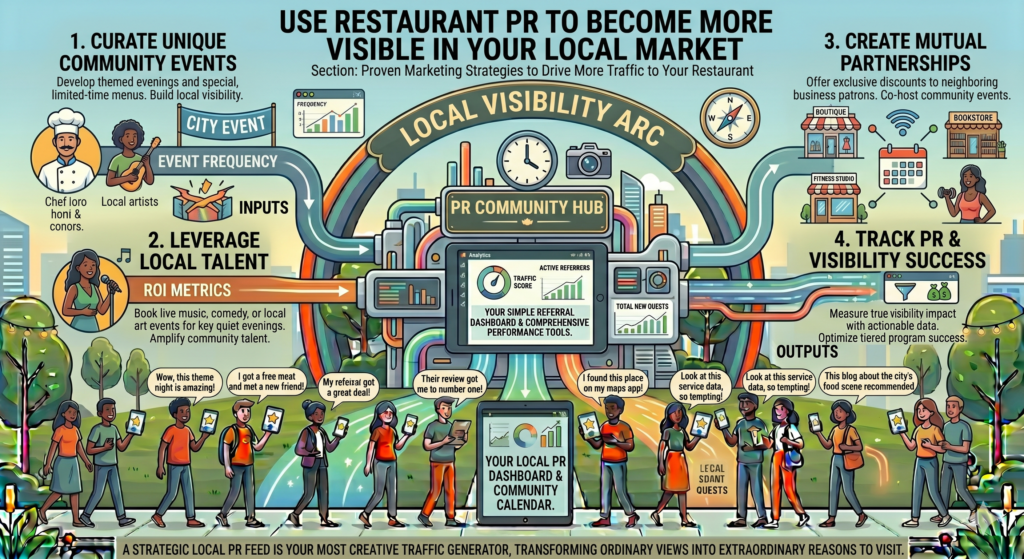
This can include local newspapers, city blogs, food pages, radio shows, neighborhood newsletters, tourism sites, hotel guides, event calendars, business groups, and local “things to do” websites. These channels may not always bring instant traffic like an ad, but they build awareness and trust over time.
The key is to give them a story worth sharing.
“Restaurant exists” is not a strong story. “Restaurant launches a new seasonal menu using local produce” is better. “Restaurant hosts a community dinner for nearby families” is better. “Restaurant brings back a dish guests have been asking for” is better. “Restaurant opens a private dining space for small celebrations” is better. “Restaurant creates a special pre-show menu near a local theater” is better.
PR works when there is a reason for people to care.
You do not need to wait for a major event. Small stories can work if they are timely, local, and useful. A new brunch menu can be a story. A chef collaboration can be a story. A charity night can be a story. A holiday menu can be a story. A local supplier partnership can be a story. A milestone anniversary can be a story.
The mistake is sending boring announcements with no angle.
A strong PR pitch should answer one clear question: why would their audience want to know this now?
Local media and community pages want useful stories, not plain ads
If you want local pages to talk about your restaurant, do not send them a sales pitch dressed up as news.
Think about their audience first.
A local food page wants places worth trying. A neighborhood newsletter wants updates that matter to residents. A tourism site wants good places for visitors. A business group may care about lunch, catering, or event space. A family page may care about kid-friendly dining. A lifestyle writer may care about date nights, brunch spots, or seasonal menus.
Match your story to the channel.
If you are pitching a family page, talk about why your restaurant works for parents. Mention early dinner hours, simple kids’ options, space for strollers, friendly service, and family meal offers if they are true.
If you are pitching an office newsletter, focus on quick lunch, group orders, direct ordering, and delivery windows. If you are pitching a weekend guide, focus on brunch, events, drinks, or special menus.
Make their job easy.
Send clear details, good photos, accurate dates, prices where needed, booking links, and a short explanation of why the story matters. Do not make them chase basic information. If your pitch is easy to use, it has a better chance of being shared.
Your restaurant should keep a small media kit ready at all times
A media kit does not need to be fancy. It just needs to make your restaurant easy to feature.
It should include a short description of the restaurant, your location, your best dishes, high-quality photos, owner or chef background, opening hours, booking details, social links, and contact information. If you host events or offer catering, include those details too.
This saves time when an opportunity appears.
If a local writer asks for photos, you should not scramble. If a creator wants your story, you should have the basics ready. If a hotel wants to include you in a guest guide, you should have a clean description and images available.
Good PR often depends on speed and clarity.
A restaurant that responds quickly with useful material is easier to feature than one that takes days to send a blurry photo and half the information.
Keep your media kit updated whenever your menu, hours, photos, or story changes.
Build relationships with local writers and pages before you need coverage
PR works better when it is based on relationships.
Do not only contact local writers, bloggers, or community page owners when you want something. Follow their work. Share their posts when relevant. Invite them to events that fit their audience. Send useful updates, not constant requests. Treat them with respect.
You do not need to become close friends. You just need to become a reliable local source.
If your restaurant regularly hosts interesting events, launches seasonal dishes, works with local suppliers, or supports community causes, you can become part of their local food conversation.
This takes time, but it builds trust.
PR should support your SEO and social proof, not just short-term buzz
A good restaurant feature can help in more than one way.
It can bring direct traffic. It can give you content to share on social media. It can create trust on your website. It can support your Google presence if people search your restaurant after reading about it. It can also help local SEO if the feature links to your website.
Use PR coverage wisely.
Add strong mentions to your website. Share the article with your email list. Post about it on social media. Thank the writer or page. Train staff to know about it if guests mention it. If a feature drives interest in a specific dish or offer, keep promoting that item.
Do not let good coverage disappear after one day.
Turn it into proof.
Build campaigns around seasons, weather, holidays, and local habits
Restaurant demand changes with life.
People eat differently in summer than in winter. They order differently on rainy days. They plan differently around holidays. They spend differently after payday. They search differently during tourist season. They make different choices during school breaks, office rushes, festivals, sports nights, and local events.
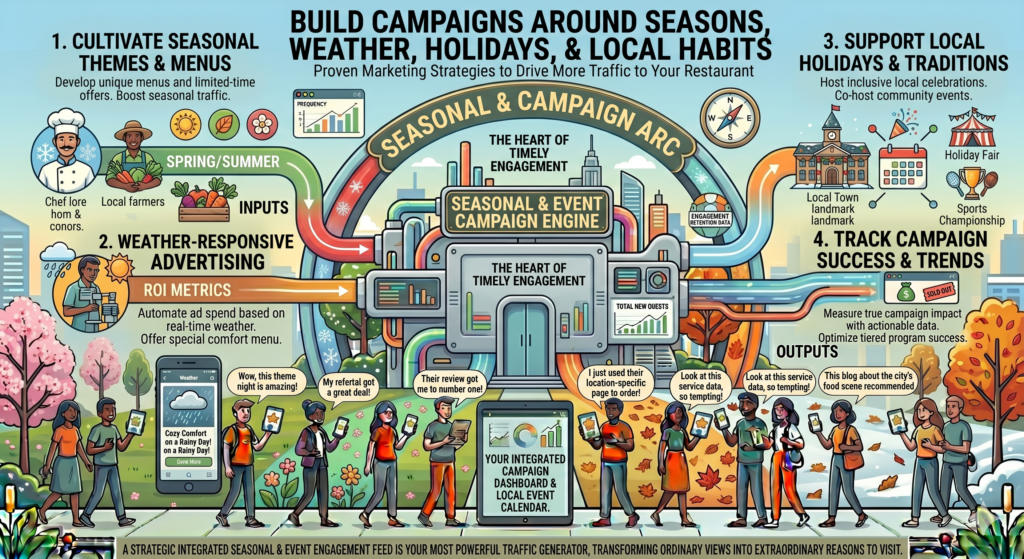
Your marketing should move with these patterns.
Many restaurants post the same kind of content all year. That makes the brand feel flat. A smarter restaurant uses the calendar to create timely reasons to visit.
In hot weather, promote cold drinks, light meals, patios, fresh desserts, and early evening visits. In cold weather, promote soups, warm dishes, rich desserts, indoor comfort, and takeaway meals.
During holidays, promote booking windows, group menus, gift cards, catering, and celebration packages. During busy work seasons, promote lunch speed and office meals. During school holidays, promote family dining.
This is not about chasing every holiday. It is about using moments your customers already care about.
A timely message feels more relevant than a generic one.
“Come try our pasta” can work. But “Rainy evening pasta bowls are on tonight” feels closer to the customer’s mood. “Book dinner with us” can work. But “Reserve your Mother’s Day table before the weekend fills” gives a clearer reason to act.
Timing sharpens the message.
Your seasonal campaigns should be planned before the season starts
Most restaurants promote seasonal offers too late.
They remember Valentine’s Day one week before. They start holiday catering after companies have already booked. They announce summer drinks after the weather has already turned hot. They promote New Year dinners when guests have already made plans.
Planning early gives you an advantage.
For major holidays and seasonal moments, prepare ahead. Decide the offer, menu, photos, landing page, booking link, staff notes, email schedule, social content, Google updates, and ad plan before the demand peaks.
This helps you capture planners and last-minute guests.
Some customers book early. Others decide late. Your campaign should speak to both. Early content creates awareness and bookings. Later content creates urgency and fills gaps.
For example, a holiday dinner campaign can start with a soft announcement, then show the menu, then share photos, then remind people about limited seats, then push final openings. This feels natural because the message develops over time.
Weather-based marketing can fill seats when people’s mood changes fast
Weather affects restaurant behavior more than many owners think.
Rain may increase demand for comfort food, delivery, or cozy indoor dining. Heat may increase demand for cold drinks, salads, outdoor evenings, and lighter meals. Cold nights may make soups, curries, roasts, hot drinks, and rich desserts more appealing.
You can use this in real time.
If it is raining, post the warm dish people crave. If the day is too hot, promote a cold drink or fresh dessert. If the evening is pleasant, show the patio. If there is a sudden cold spell, send a message about your most comforting meal.
This kind of marketing feels alive.
It shows that your restaurant is in the same world as your customers. You are not just posting planned content. You are responding to the day they are having.
Keep a few weather-ready content assets prepared. Have good photos of comfort dishes, cold drinks, takeaway meals, soups, desserts, and patio scenes. When the right moment comes, you can post quickly instead of rushing to create content.
Local events can become traffic opportunities if you prepare for them
Every area has natural traffic moments.
There may be concerts, school events, markets, sports games, festivals, conferences, theater shows, local holidays, shopping days, or tourist peaks. These events bring people into the area, change dining times, and create demand.
A restaurant should know the local calendar.
If a theater nearby has a show, offer pre-show dining. If a stadium has a game, promote quick meals or post-game drinks. If a conference is nearby, promote lunch, dinner, and group bookings. If a local market runs on weekends, promote brunch or takeaway. If hotels are full during tourist season, build partnerships and update your local search content.
Do not wait for people to find you by accident.
Create pages, posts, offers, and partnerships around these moments. Make your location useful. Mention walking distance. Mention ideal booking times. Mention group options. Mention if you can handle quick service before an event.
Your local calendar should become part of your marketing calendar
Once a month, look ahead at what is happening nearby.
This simple habit can create many traffic ideas. You may find event nights where you should stay open later. You may find school holidays where family offers make sense. You may find office-heavy weeks where lunch campaigns matter. You may find quiet periods where events or partnerships can help.
A restaurant that understands local rhythm can market with better timing.
This is one reason local restaurants can beat bigger brands. A chain may run national campaigns. A local restaurant can respond to the street, the weather, the community, and the exact week people are living through.
That makes your marketing feel closer and more human.
Conclusion:
More traffic is never just about getting more people to notice your restaurant. Attention is only the first step. The real goal is to turn that attention into visits, then turn those visits into loyalty, reviews, referrals, and repeat revenue.
That is where strong restaurant marketing becomes powerful.












Comments are closed.