
WinSavvy Editorial Standards
How this article was created
Real estate has never been a quiet market. Every town has agents. Every city has agencies. Every buyer sees the same home photos. Every seller hears the same pitch. “We know the market.” “We get the best price.” “We care about clients.” These lines may be true, but they do not make a real estate business stand out anymore.
Build Your Real Estate Brand Around a Clear Local Promise
Most real estate businesses try to appeal to everyone. They want first-time buyers, luxury sellers, investors, landlords, tenants, families, retirees, and business owners. On paper, this sounds smart. In real life, it makes the brand weak.
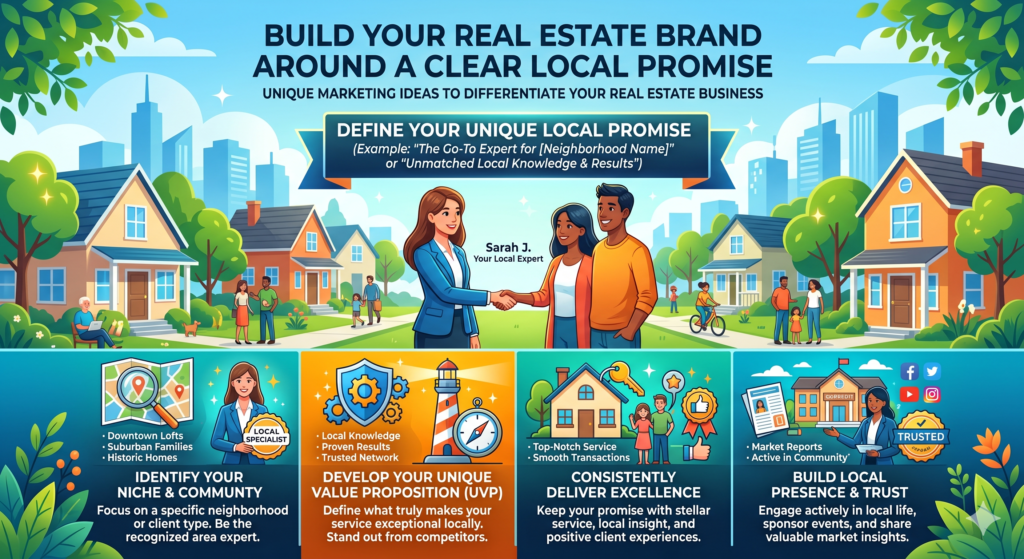
When your message speaks to everyone, it often feels personal to no one.
A strong real estate brand needs a clear promise. Not a fancy slogan. Not a clever tagline. A real promise that tells people why they should remember you, trust you, and choose you over another agent or agency.
Your promise should answer a simple question in the client’s mind: “Why should I work with you?”
Your brand should be known for one strong thing before it tries to be known for everything
The mistake many real estate brands make is trying to show too many strengths at once. They say they are fast, friendly, expert, affordable, premium, local, trusted, data-driven, caring, and results-focused. These are good traits, but when they all appear together, the message becomes plain.
A buyer or seller does not remember a long list of nice words. They remember one sharp idea.
You may become known as the agent who helps young families buy their first home without stress. You may become known as the agency that sells homes faster in a certain neighborhood. You may become known as the real estate advisor for people moving from another city.
You may become known as the expert for downsizing seniors who want a calm and respectful process.
The narrower your promise, the stronger your brand feels.
This does not mean you can never serve other people. It simply means your marketing needs a clear center. People trust specialists faster than generalists, especially when the decision involves money, risk, and emotion.
Your local promise should be simple enough for clients to repeat
A good brand promise is not written for your website alone. It should be simple enough that a past client can say it to a friend.
For example, “They help busy families find the right home near good schools” is easy to repeat. “They offer full-service real estate solutions with personalized guidance and market-driven strategy” is not easy to repeat.
Real estate grows through memory and word of mouth. If people cannot explain what makes you different, they will not spread your name clearly.
This is why simple words matter. Your clients are not looking for a speech. They are looking for confidence.
So instead of saying, “We deliver end-to-end property advisory services,” say, “We help homeowners sell with less stress and better preparation.”
Instead of saying, “We use a client-centric transaction process,” say, “We guide you from the first question to the final signature.”
The second version feels human. It feels clear. It feels like someone is actually speaking to a real person.
Make your brand promise visible in every part of your marketing
A promise only works when people see it often. It should not hide on your About page. It should shape your home page, social posts, email signature, listing pages, videos, ads, brochures, open house signs, and client follow-up messages.
If your promise is about helping first-time buyers feel calm and ready, your content should prove that again and again. You should explain loan basics in simple language. You should show short videos about what happens during a home inspection.
You should create posts about hidden costs buyers forget. You should write guides about how to compare neighborhoods without feeling lost.
If your promise is about helping sellers get better offers through better presentation, your marketing should show before-and-after home prep stories. It should explain how small fixes can change buyer interest. It should show your process for pricing, staging, photos, and launch timing.
A brand promise becomes believable when your actions keep proving it.
Your market should feel your point of view before they ever contact you
Real estate marketing becomes powerful when people feel your point of view. This means you do not just post listings. You teach people how you think.
For example, you may believe sellers should not rush to list before the home is ready. Say that. Explain why. Show examples. Teach the cost of poor photos, unclear pricing, or weak staging.
You may believe buyers should choose a neighborhood before choosing a house. Say that. Explain how lifestyle, school routes, traffic, local shops, and long-term growth matter.
You may believe investors should focus less on hype and more on rental demand, repair costs, and exit options. Say that too.
A clear point of view makes you different. It tells people you are not just chasing transactions. You have standards. You have a way of working. You know what matters.
That is what makes clients lean in.
Turn Neighborhood Knowledge Into Your Strongest Marketing Asset
Real estate is local. Everyone says this, but very few businesses use it well.
Most agents post the same type of content. They share new listings, sold homes, market updates, and generic tips. These things are useful, but they are not enough to create deep local trust.
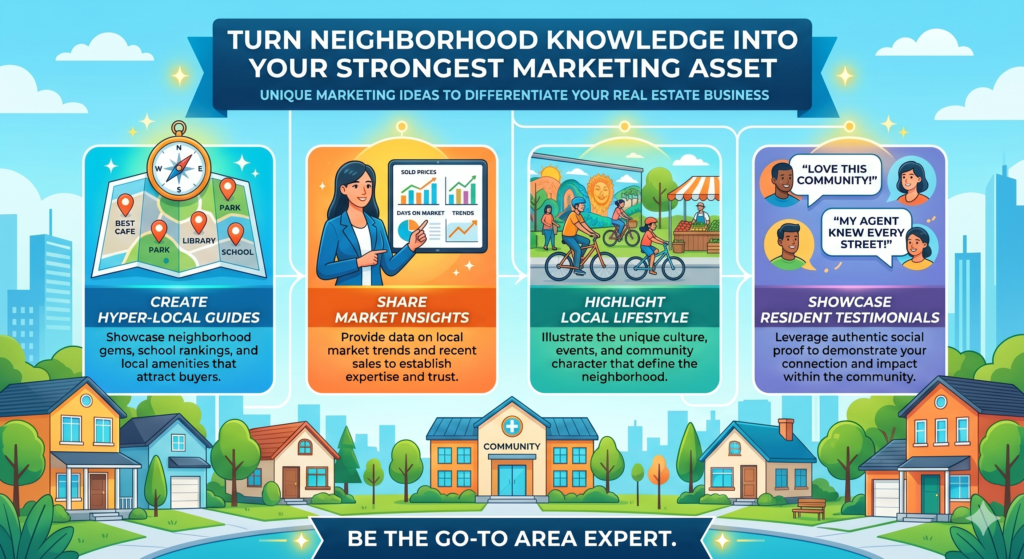
Your edge is not just that you work in a place. Your edge is that you understand the place better than the average person.
That knowledge can become your strongest marketing asset.
Create content that makes you feel like the guide to the area, not just a person selling homes there
People do not only buy a property. They buy a daily life. They buy a morning route. They buy nearby schools, parks, shops, roads, noise levels, safety feelings, weekend habits, and future value.
A listing tells people about the home. Your marketing should tell people about the life around the home.
This is where most real estate brands miss a huge chance. They talk about square feet, bedrooms, bathrooms, and price. But buyers are also asking quieter questions.
What is it like to live here? Is this street calm or busy? Where do families go on weekends? Are there good cafes nearby? How long does it really take to reach the business district? Which parts of the area feel more private? Which roads get crowded? What kind of people enjoy this neighborhood most?
When you answer these questions in your content, you become more than an agent. You become the local guide.
Build neighborhood pages that feel like honest local advice
Most neighborhood pages are thin. They repeat basic facts and use the same polished words. They say the area is “vibrant,” “well-connected,” “family-friendly,” and “fast-growing.” These words are common, so they do not build trust.
A better neighborhood page should feel like a real local guide. It should explain who the area is best for, who it may not suit, what homes usually sell there, what buyers should check, and what sellers should understand before pricing.
You can include simple sections written in paragraph form. Talk about the feel of the streets. Talk about the type of homes. Talk about parking. Talk about school access. Talk about noise. Talk about walkability. Talk about resale demand. Talk about what has changed in the last few years.
The goal is not to make every area sound perfect. The goal is to sound honest.
Honesty is rare in real estate marketing. That is why it stands out.
If an area has traffic during school hours, say it. If homes near the main road sell slower, explain it. If buyers pay more for a certain pocket because it is quieter, share that insight.
When you are honest about small drawbacks, people trust your praise more.
Use local stories instead of dry market updates
Market updates are useful, but many of them sound cold. They talk about average price, inventory, demand, and days on market. These numbers matter, but they can feel boring if you do not connect them to real life.
A better way is to turn market data into local stories.
Instead of saying, “Inventory is down 12% this quarter,” explain what that means for a family trying to move before the school year starts. Instead of saying, “Average prices rose in the east side,” explain why buyers are paying more there.
Maybe the area has better road access now. Maybe more cafes and gyms opened nearby. Maybe newer families are moving in because the homes are larger for the price.
Data tells. Stories make people care.
Your clients do not need numbers alone. They need meaning.
Use street-level insight that large portals cannot copy
Big property websites have listings, prices, maps, and filters. They can show a lot of data. But they cannot easily copy your street-level judgment.
You know which streets feel better at night. You know which buildings have stronger maintenance. You know which gated communities have better management. You know which blocks have more owner-occupied homes.
You know which locations look close on a map but feel far because of traffic turns. You know which homes get more sunlight, better air, or less noise.
This is the kind of insight buyers and sellers value deeply.
Turn this into content.
Write posts like, “What buyers should know before choosing between these two nearby neighborhoods.” Create videos like, “Why two homes with the same size can sell very differently in this area.” Share articles like, “The small local details that affect resale value but do not show up on listing sites.”
This type of marketing is hard for competitors to copy because it comes from lived experience.
It also makes you look useful before anyone speaks to you.
Create Real Estate Content That Solves Fear, Not Just Questions
Most real estate content answers basic questions. That is helpful, but it is not enough.
People do not search for real estate advice only because they need facts. They search because they feel unsure. They are afraid of overpaying. They are afraid of selling too low. They are afraid of choosing the wrong agent. They are afraid of hidden repairs. They are afraid of paperwork. They are afraid of making a costly mistake.
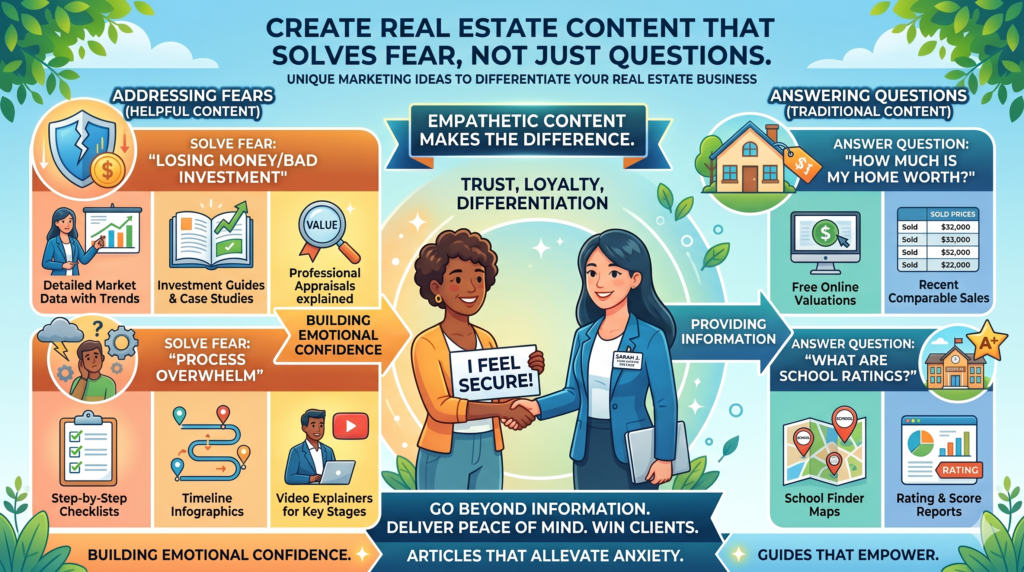
If your content only gives information, it may get attention. If your content lowers fear, it builds trust.
Write for the worries people are too shy to say out loud
The best real estate content often starts with silent fears.
A first-time buyer may not say, “I am scared I will look foolish because I do not understand the process.” A seller may not say, “I am worried my home is not good enough compared to others.” An investor may not say, “I am afraid I will buy a property that looks good but becomes a money drain.”
Your content should speak to these feelings in a calm and direct way.
For example, instead of writing only “Steps to Buy a Home,” write “How to Buy Your First Home Without Feeling Lost or Pressured.” Instead of writing “How to Sell Your Home,” write “What to Fix Before Selling and What Is Not Worth the Money.”
Instead of writing “Real Estate Investment Tips,” write “How to Spot a Property That Looks Profitable but May Hurt Your Cash Flow.”
These topics feel closer to the real thoughts people have.
When someone reads a headline and thinks, “That is exactly what I was worried about,” they are more likely to trust the writer.
Use simple explanations that make clients feel smarter, not smaller
Many real estate terms confuse people. Closing costs, contingencies, escrow, valuation, appraisal, title search, pre-approval, earnest money, rental yield, capital gains, and zoning can all feel heavy to someone who does not deal with property every day.
Your job is not to show how much you know. Your job is to make the client feel safe enough to keep learning.
This is where simple writing becomes a marketing advantage.
Do not explain things like a textbook. Explain them like a patient advisor sitting across the table.
For example, instead of saying, “A contingency protects the purchaser subject to fulfillment of certain conditions,” say, “A contingency is a safety rule in the contract. It means the buyer can move forward only if certain things happen, like loan approval or a clean inspection.”
That kind of language builds comfort.
The more clearly you explain, the more expert you seem. Simple does not make you look less smart. Simple makes you easier to trust.
Build content around moments of decision
Every real estate journey has key decision moments. These moments are where people feel pressure. They need guidance, but they may not be ready to call an agent yet.
Your content should meet them at those moments.
For buyers, decision moments include choosing whether to rent or buy, setting a budget, picking a neighborhood, making an offer, handling inspection results, and deciding when to walk away.
For sellers, decision moments include choosing the right time to list, deciding what repairs to make, setting the asking price, comparing offers, and dealing with a home that does not sell fast.
For investors, decision moments include choosing an area, checking rental demand, estimating repairs, comparing cash flow, and planning an exit.
Each moment can become a strong article, video, email, or social post.
Show people how to think, not just what to do
Basic tips are easy to find. What people really need is a better way to think.
For example, many agents say, “Get pre-approved before you shop.” That is correct, but it is common. A stronger version explains why pre-approval changes the way a buyer thinks. It helps them know their real range.
It protects them from falling in love with homes they cannot buy. It helps sellers take their offer seriously. It also saves time because the buyer can focus on homes that fit their life, not just their dream board.
This is more useful because it teaches the reason behind the step.
The same applies to sellers. Instead of saying, “Price your home correctly,” explain how buyers compare homes online, why overpricing can make a listing stale, and why the first two weeks often shape the whole selling journey.
Good content gives advice. Great content changes how the reader sees the problem.
That is what makes people remember you.
Use Client Stories as Proof, Not as Bragging
Every real estate business needs proof. But proof does not have to feel loud or self-centered.
Many agents use proof in a way that sounds like bragging. They post “Sold above asking!” or “Another happy client!” again and again. This can work sometimes, but if every post is a celebration, people may stop paying attention.
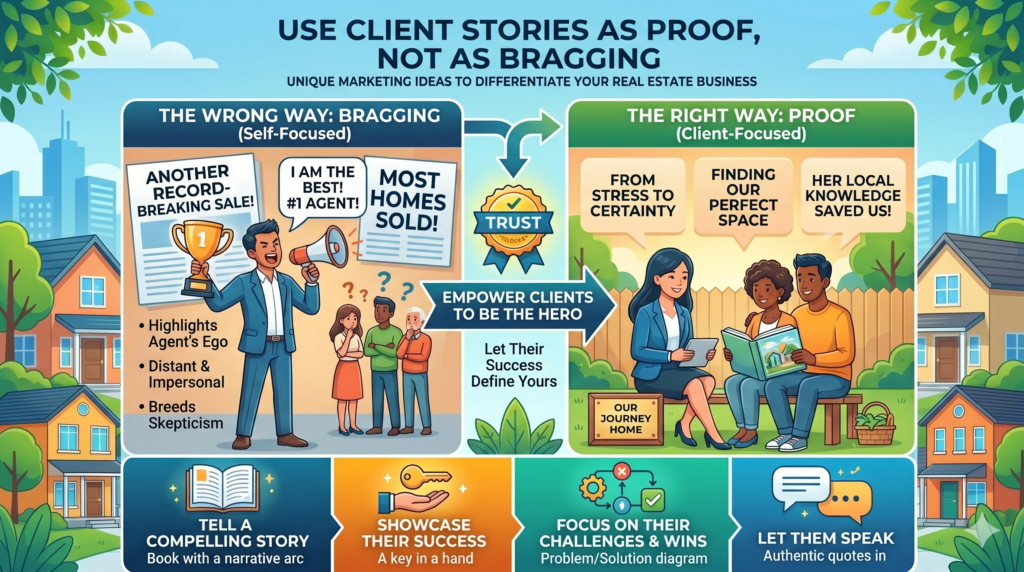
A better way is to turn client stories into useful lessons.
Your client wins should teach future clients what is possible, what to avoid, and how your process works.
Tell the full journey, not just the final result
A sale price is only one part of the story. The real value is in the journey.
What was the client worried about at the start? What challenge did the property have? What decision changed the outcome? What did your team do differently? What can another buyer or seller learn from it?
This makes the story more human.
For example, instead of saying, “We sold this home in 10 days,” tell the story behind it. Maybe the seller first wanted to list right away, but you advised them to repaint two rooms, improve lighting, and retake photos after staging.
Maybe the first pricing idea was too high, but you showed real comparison data and helped them choose a stronger launch price. Maybe the home got more showings because the listing copy focused on the quiet street and home office setup, not just the number of rooms.
Now the story has a lesson. It shows your judgment. It shows your process. It helps future sellers understand why preparation matters.
Make the client the hero of the story
In strong marketing, the business is not the hero. The client is the hero. Your role is the guide.
This matters because people do not want to feel like props in your success story. They want to imagine themselves getting a good result with your help.
So when you tell a client story, focus on the client’s goal, concern, and decision.
You might say, “The owner wanted to move closer to family but was worried the home would sit too long because two similar homes nearby had not sold. We started by looking at what those listings missed. The issue was not demand. The issue was presentation and pricing. Once we fixed that, the home attracted stronger buyers.”
This kind of story feels respectful. It shows the seller’s situation. It shows your thinking. It gives the reader a reason to trust you.
It is much stronger than simply posting a sold sign.
Turn testimonials into specific trust builders
Most testimonials sound the same. “Great service.” “Very professional.” “Highly recommend.” These are nice, but they are not specific enough to persuade someone who is nervous.
Specific testimonials are far more powerful.
A strong testimonial explains what the client was worried about and how you helped. It may mention that you explained every step, helped them avoid a poor offer, guided them through repairs, found the right neighborhood, or stayed calm during a stressful negotiation.
The more specific the testimonial, the more believable it feels.
Ask better questions after the deal closes
Clients often do not know how to write a helpful review. If you simply ask, “Can you leave us a review?” they may write something short and general.
Instead, guide them with simple questions.
Ask what they were most nervous about before working with you. Ask what part of the process felt easier than expected. Ask what advice they would give someone in the same situation. Ask what they felt made your service different.
You do not need to publish the questions. You use their answers to help them shape a better review or case story.
This creates proof that speaks to real concerns.
A buyer who says, “We were scared of overpaying, but they showed us how to compare homes street by street,” is far more persuasive than a buyer who says, “Great agent.”
A seller who says, “They told us which repairs mattered and which ones would waste money,” gives future sellers a reason to call.
Proof works best when it removes doubt.
Make Open Houses Feel Like Local Events, Not Property Walkthroughs
An open house should not feel like a quiet room where people walk in, look around, take a brochure, and leave. That is the standard way. Standard does not stand out.
A better open house feels like a small local event. It still sells the property, but it also creates energy, memory, and conversation.
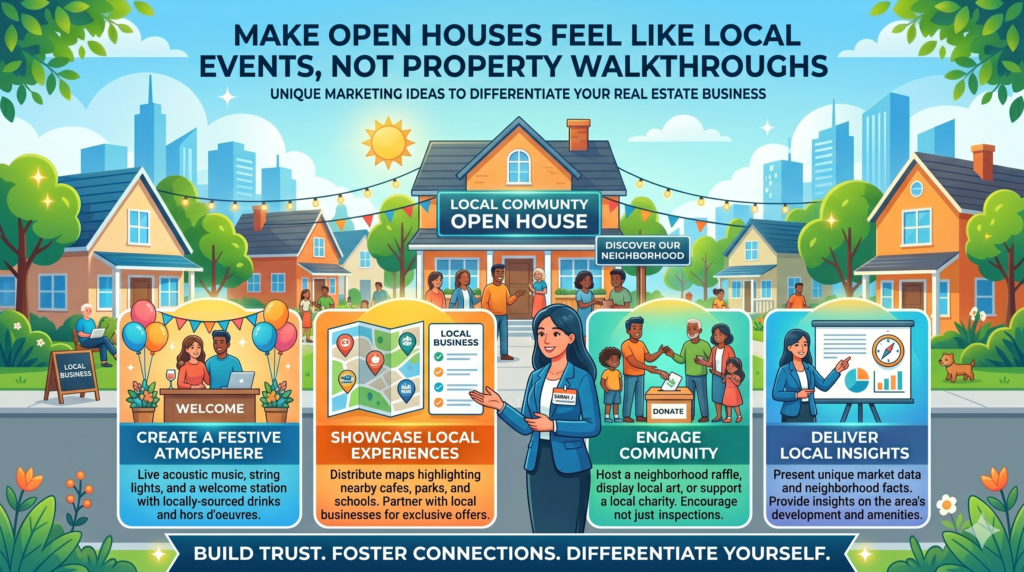
People remember how a place made them feel. Your job is to help the right buyers feel the life the property can offer.
Design the open house around the buyer’s lifestyle
Every home has a likely buyer. A young couple, a growing family, a remote worker, an investor, a retiree, or someone moving from another city. The open house should match that buyer’s lifestyle.
If the home is great for families, make the event feel warm, calm, and practical. Show how the kitchen connects with family time. Highlight storage, school routes, play areas, and weekend spots nearby.
If the home is great for remote workers, show how the workspace can feel. Set up a clean desk, good lighting, and a small sign that explains internet options or quiet hours in the area.
If the home is ideal for entertaining, create a relaxed setting that helps buyers picture friends, food, and evening conversations.
Do not overdo it. The goal is not to create a party. The goal is to help buyers imagine living there.
Use small sensory details that make the home easier to remember
People may visit several homes in one day. After a while, the rooms blur together. Small sensory details help your listing stay in their mind.
A clean smell, soft natural light, calm music, fresh flowers, warm drinks, or a simple local snack can change the feeling of the visit. These details do not replace pricing or location, but they help create memory.
The key is to keep it tasteful. The home should still be the focus.
You can also create simple printed cards in each key room. Not feature lists, but short lifestyle notes written in natural language. In the kitchen, the card might say, “This layout makes weekday mornings easier because the breakfast area sits close to the main prep space.” In the balcony, it might say, “This spot gets softer light in the evening, which makes it a calm place to sit after work.”
These small notes guide attention without sounding pushy.
Partner with nearby businesses to create a stronger local feel
A smart open house can also promote the neighborhood. This is where local partnerships help.
You can serve coffee from a nearby cafe, small desserts from a local bakery, flowers from a local florist, or moving checklists from a local storage company. You can invite a local interior stylist to give simple home setup ideas. You can include a small neighborhood guide featuring nearby shops, parks, schools, gyms, and services.
This makes the open house feel connected to the area.
It also gives local businesses a reason to share your event with their audience.
Make the event useful even for people who do not buy that home
Not everyone who attends will make an offer. That does not mean the event failed.
Some visitors may be future buyers. Some may be neighbors who know someone looking. Some may be homeowners thinking about selling. Some may simply be curious about property values in the area.
Give them something useful to take away.
This could be a short neighborhood price guide, a seller prep checklist, a first-time buyer timeline, or a simple sheet explaining what makes homes in that area sell faster.
When people leave with useful advice, they remember you as helpful, not just sales-focused.
That is how an open house becomes a lead-building tool, not just a showing event.
Create a Signature Real Estate Report That People Wait For
Many agents share market updates. Few create a report that feels worth saving, sharing, and reading every month or quarter.
A signature report can become one of your strongest marketing assets. It positions you as the local expert, gives people a reason to stay connected, and creates content you can reuse across your website, email, social media, ads, and client calls.
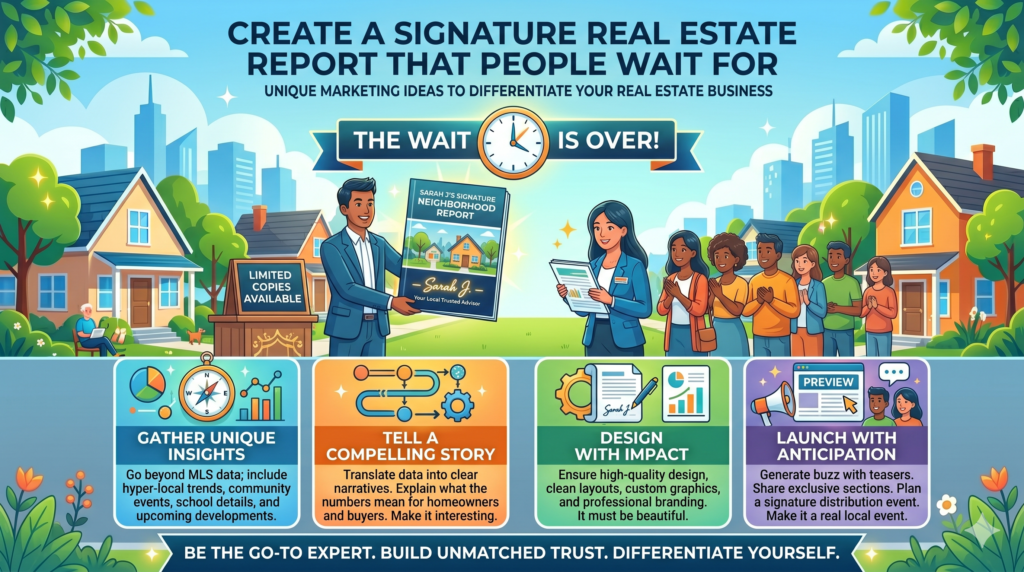
The goal is not to create a long academic report. The goal is to create a clear, useful, human report that helps buyers and sellers make better decisions.
Give your report a clear angle, not just a pile of numbers
A basic market report says what happened. A strong report explains what it means.
Instead of simply sharing price changes, days on market, and inventory, build the report around the real questions clients care about.
Are sellers still getting strong offers? Are buyers gaining more room to negotiate? Which neighborhoods are moving faster? Which types of homes are sitting longer? Are renovated homes getting better results than homes needing work? Are first-time buyers being priced out of some areas? Are investors becoming more active?
These questions make the report feel practical.
Your report should help a reader think, “Now I understand what is happening and what I should do next.”
Add plain-language advice for each type of reader
A strong report should speak to buyers, sellers, and investors in different ways.
For sellers, explain what they should do if they plan to list soon. Maybe they need to price closer to real demand. Maybe they should invest in better photos. Maybe they should fix small issues before listing because buyers have more choices now.
For buyers, explain how to act in the current market. Maybe they should move fast on well-priced homes. Maybe they can negotiate more on homes that have been listed for several weeks. Maybe they should widen their search by one nearby area.
For investors, explain what matters most right now. Maybe rental demand is strong near transit. Maybe repair costs are affecting returns. Maybe smaller units are moving faster than larger ones.
This kind of advice makes the report useful, not just informative.
Turn one report into many pieces of content
The best part of a signature report is that it gives you a content engine.
One report can become a blog article, several short videos, email content, social posts, listing presentation slides, seller call talking points, buyer consultation material, and local press pitches.
You can create a video called “Three things sellers should know this month.” You can create a post about “The neighborhood where buyers are moving faster.” You can write an email with the subject line “What changed in the local market this quarter?” You can use one chart as a simple visual on social media.
You do not need new ideas every day. You need one strong idea that can be used in many ways.
Make the report feel branded and easy to recognize
Give your report a simple name. It could be something like “The Westside Home Pulse,” “The Monthly Seller Signal,” “The First-Time Buyer Market Watch,” or “The Downtown Property Brief.”
The name should match your brand promise and local focus.
Use the same structure each time, so readers know what to expect. Over time, this builds habit. People begin to see your report as a trusted local resource.
This is how you move from being another real estate business to being a known voice in the market.
A known voice earns attention more easily.
Build a Referral System That Feels Personal, Not Forced
Referrals are powerful in real estate, but many businesses treat them too casually. They hope happy clients will remember them. They send one thank-you message after closing. Then they disappear until they need another lead.
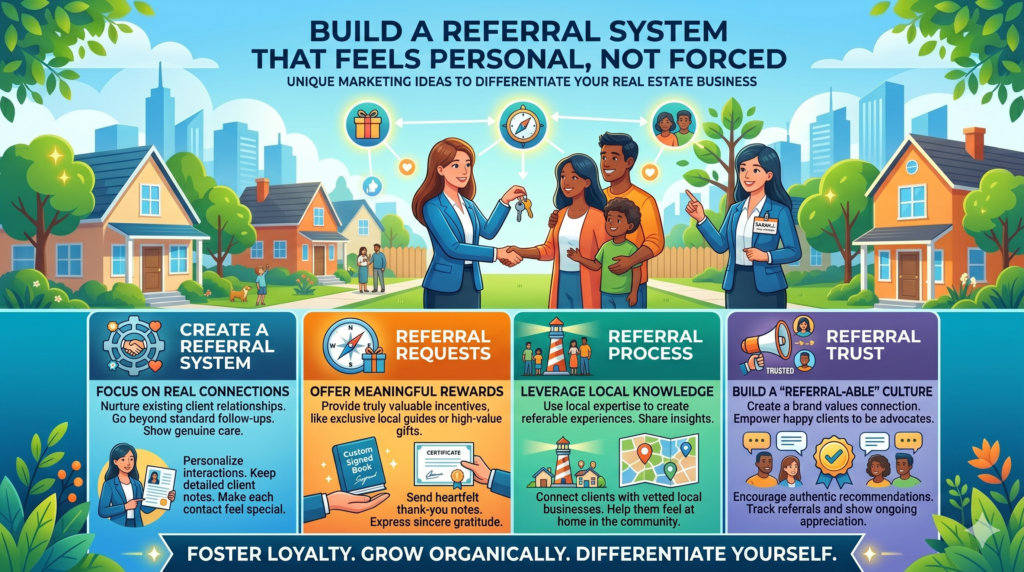
That is not a referral system. That is luck.
A better referral system keeps relationships warm in a natural, useful, and human way. It does not pressure clients. It gives them reasons to remember you and easy ways to recommend you.
Stay useful after the deal is done
The relationship should not end at closing. In many ways, that is when long-term trust begins.
After someone buys a home, they may need help with movers, repairs, cleaners, decorators, utility setup, local services, property taxes, insurance, maintenance, and neighborhood questions. If you keep helping during this stage, you become more than the person who handled the deal. You become their real estate connection.
This is powerful because homeowners often know other people who are thinking about buying or selling. But they only refer agents they remember and trust.
If your last meaningful contact was months or years ago, you make that harder.
Create a simple post-closing care plan
A post-closing care plan can be simple. Send a helpful message one week after move-in. Check if they need local service contacts. After one month, send a home maintenance reminder. After three months, share a simple update on local property values.
After six months, send a guide on small home improvements that can protect value. After one year, send a warm home anniversary note.
These messages should not feel automated, even if you use a system to remind yourself. Add personal details where possible.
Mention their neighborhood. Mention something they cared about during the search. Mention the home style. Mention their plans if they shared them.
A message that feels personal will always beat a generic newsletter.
Make referrals easy to give
Many happy clients would refer you, but they do not know how. They may not know what kind of clients you want. They may not know what to say. They may not even realize you welcome referrals.
You can make this easier without sounding needy.
Instead of saying, “Please send me referrals,” say something more human. For example, “I mostly help families who are trying to move without feeling rushed or confused. If someone you know is starting to think about buying or selling, I am always happy to answer early questions, even if they are months away from making a move.”
This feels helpful, not pushy.
It also tells the client who to send your way.
Give past clients small tools they can share
You can create simple resources that past clients can forward to friends. A first-time buyer guide. A seller prep checklist. A neighborhood comparison article. A moving timeline. A home value planning guide.
When you send these to past clients, do not frame them as sales material. Frame them as helpful tools.
You might say, “I made this simple guide for people who are starting to think about selling but are not sure what to fix first. Feel free to pass it along if someone you know is in that stage.”
This gives them a reason to share your name in a natural way.
The best referral marketing does not feel like a campaign. It feels like helpfulness that is easy to pass on.
Use Video to Show Your Judgment, Not Just Your Face
Video is one of the best tools for real estate marketing, but many agents use it in the same way. They stand in front of a property, smile, and give a quick tour. That can help, but it is not enough to make you different.
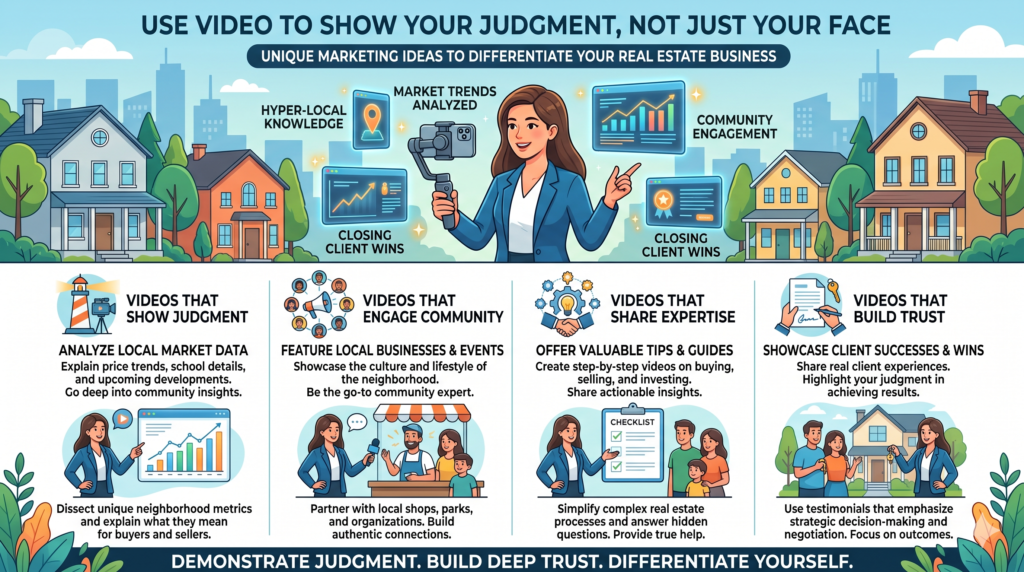
The real power of video is not just showing homes. It is showing how you think.
People want to know if they can trust your judgment. Video lets them feel your calm, your honesty, your local knowledge, and your ability to explain things clearly.
Create videos that answer real buying and selling decisions
Do not make videos only when you have a listing. Make videos when you have a useful point to share.
You can explain why one home sold faster than another. You can walk through a neighborhood and explain who it suits. You can talk about three things buyers should check before making an offer. You can explain when a seller should accept a slightly lower offer with stronger terms.
You can show what poor listing photos fail to capture. You can compare two nearby areas and explain why prices differ.
These videos do not need to be fancy. They need to be clear.
A simple video with honest advice can outperform a polished video with no real value.
Use short stories to make video advice easier to remember
People remember stories better than tips. So instead of saying, “Do not overprice your home,” tell a short story.
You might say, “Last month, I saw two similar homes in the same area. One was priced close to buyer demand and had strong photos. It got good showings in the first week. The other launched too high and had to reduce later. By then, buyers started wondering what was wrong. That is why launch price matters so much.”
This teaches the lesson without sounding like a lecture.
Story-based video feels more natural. It also makes your advice easier to trust because it sounds grounded in real work.
Use video to reduce the fear of contacting you
Many people delay calling an agent because they are afraid of being pressured. They do not want to be pushed into buying, selling, or signing before they are ready.
Your videos can lower that fear.
Speak calmly. Explain that early questions are welcome. Tell people what happens in a first call. Tell them they do not need to have everything figured out. Explain that a good first conversation is about clarity, not pressure.
This is simple, but it matters.
Show your process so people know what working with you feels like
A lot of client fear comes from not knowing what will happen next.
Create videos that explain your process step by step in plain language. For buyers, show what happens from first call to keys. For sellers, show what happens from home review to closing. For investors, show how you compare options.
Do not make these videos too long or too formal. Make them feel like a helpful conversation.
When people understand your process, contacting you feels safer. They know what to expect. They know you have a plan. They know they will not be left guessing.
That kind of comfort is a real marketing advantage.
Build a Content Series Around Real Estate Myths Your Clients Believe
Every market has myths. Buyers believe them. Sellers believe them. Investors believe them. Sometimes even experienced property owners believe them because they heard them from friends, family, social media, or old market stories.
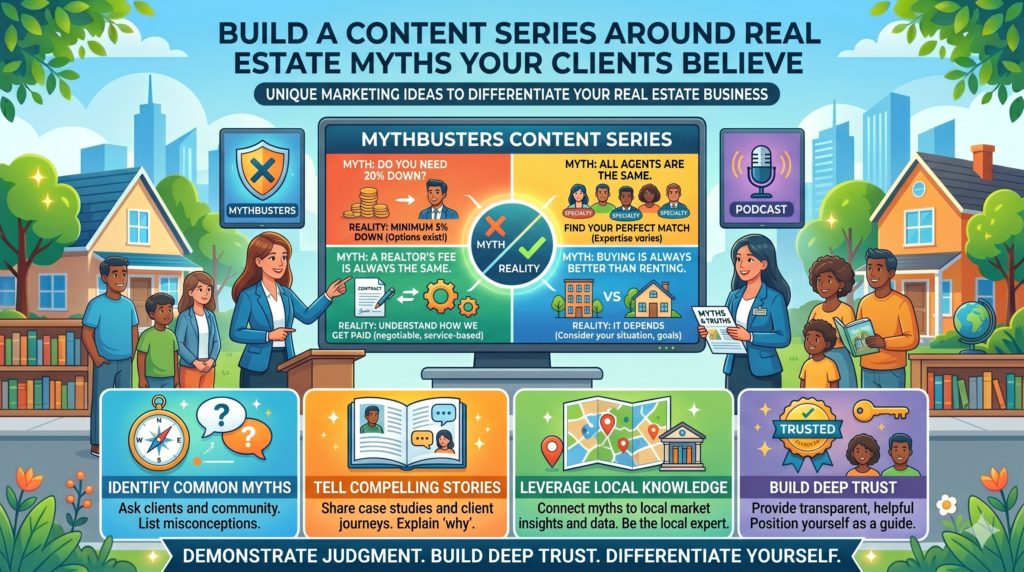
These myths create bad decisions.
A buyer may think the lowest priced home is always the best deal. A seller may think they should always start high and reduce later. An investor may think any property in a “hot area” will make money. A landlord may think good photos do not matter if the rent is fair. These ideas sound simple, but they can cost people time, money, and peace of mind.
This is why myth-based content works so well for real estate marketing. It catches attention because it challenges what people assume. It builds trust because it protects clients from mistakes. It also shows that you are not just repeating common advice. You are helping people think clearly.
A real estate myth series gives your audience a reason to keep coming back
One good article can help. A full series can build authority.
You can create a weekly or monthly content series where each post breaks down one common belief and explains what is actually true. The idea should be simple, but the lesson should be strong.
For example, one post can explain why the home with the lowest price is not always the best value. Another can explain why waiting for the “perfect time” to buy can sometimes create more stress. Another can show why a home that sits on the market is not always a bad home.
Another can explain why expensive renovations before selling do not always bring a better return.
This type of content keeps your brand useful. It also gives people a reason to follow you before they are ready to buy or sell.
Most people do not wake up one day and suddenly choose an agent. They watch. They read. They compare. They notice who gives practical advice. Then, when the time comes, they reach out to the name that has helped them think better for months.
That is the quiet power of a myth series.
Choose myths that connect to money, timing, risk, and regret
Not every myth is worth turning into content. The best ones are tied to strong emotions. In real estate, those emotions are usually money, timing, risk, and regret.
People worry about paying too much. They worry about selling too low. They worry about missing a good chance. They worry about choosing the wrong home. They worry about repairs they did not see coming. They worry about moving too fast or waiting too long.
Your myth content should speak to these worries.
For example, “You should always choose the highest offer” is a strong seller myth. At first, it sounds right. But the highest offer may have weak financing, too many conditions, or a buyer who is not serious. A slightly lower offer with stronger terms may be safer.
When you explain this, sellers begin to see that your value is not only finding offers. Your value is helping them choose the right offer.
Another strong myth is, “The best time to buy is when prices drop.” That may be true in some cases, but not always. If rates, competition, supply, and personal timing do not line up, waiting can still hurt the buyer. A better way to think is, “The right time to buy is when the numbers work, the home fits, and the risk feels clear.”
This type of advice is useful because it does not push people. It helps them judge better.
Use myth content to show your honesty
A myth series is not just a content idea. It is a trust tool.
When you tell people what not to do, you show that you care about their outcome. When you explain where common advice fails, you show that you are not trying to rush them into a deal. When you admit that the right answer depends on the client’s situation, you sound more real.
This matters because real estate clients are often careful. They know agents earn money when deals close. So they watch closely for signs of pressure. If your content only says, “Now is a great time to buy” or “Now is a great time to sell,” it can feel one-sided.
But when your content says, “Here is when buying makes sense, and here is when it may be better to wait,” you become more believable.
A strong point of view makes your content harder to ignore
Safe content often gets ignored. Strong content gets remembered.
This does not mean you should be rude, loud, or dramatic. It means you should be clear about what you believe.
If you believe sellers should not list before fixing obvious presentation issues, say it. If you believe buyers should not skip due diligence just to win a home, say it. If you believe investors should stop trusting rental promises without checking real numbers, say it.
A clear point of view gives your brand shape.
People may not agree with every detail, but they will understand where you stand. That is better than sounding like every other real estate page online.
The goal is not to create conflict. The goal is to create clarity.
Create “Before You Decide” Guides for Every Major Client Choice
Real estate decisions are rarely simple. People often feel stuck because they are trying to make a big choice with only half the picture.
Should they buy now or wait? Should they sell first or buy first? Should they renovate before selling or list as-is? Should they choose a larger home farther out or a smaller home in a better location? Should they accept the first strong offer or wait for more interest? Should they rent out the old home or sell it?
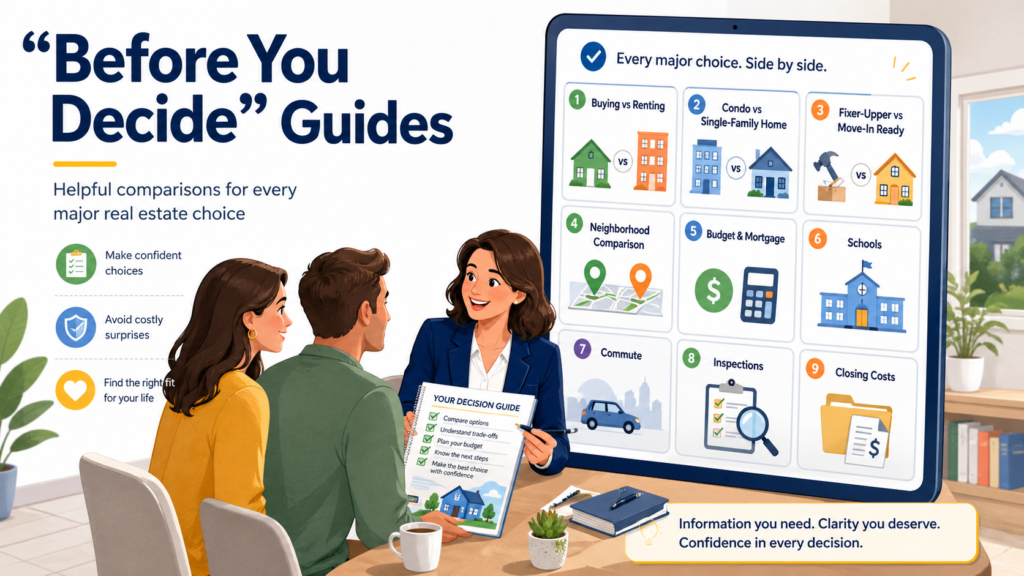
These are not small questions. They shape money, lifestyle, stress, and future options.
A “Before You Decide” guide helps people slow down and think clearly. It gives them a way to compare choices before they make a move. It also positions your business as a calm advisor, not just a sales agent.
Decision guides work because they meet people before they are ready to call
Many people do research long before they contact a real estate business. They may not want to speak to anyone yet because they are still unsure. They do not want to be sold to. They just want to understand their options.
This is where decision guides become powerful.
A guide titled “Before You Decide to Sell Your Home This Year” feels helpful. A guide titled “Before You Decide to Buy a Bigger Home” speaks to families who feel cramped but nervous about cost. A guide titled “Before You Decide to Invest in a Rental Property” helps cautious investors avoid emotional choices.
These guides attract people earlier in the journey. That matters because by the time someone searches “best real estate agent near me,” they may already have several names in mind. But if your brand helped them months earlier, you are not just another option. You are already familiar.
Familiarity creates trust. Trust creates calls.
Each guide should help the reader compare trade-offs
A useful decision guide does not just say which choice is best. It explains the trade-offs.
For example, if someone is deciding whether to renovate before selling, the guide should explain when small updates help, when large renovations may not pay back, and when selling as-is may be the smarter move. It should talk about buyer expectations, local competition, time pressure, repair costs, and likely return.
If someone is deciding whether to sell first or buy first, the guide should explain the stress of carrying two homes, the risk of not finding the right next home, the role of financing, and how local market speed changes the answer.
The reader should finish the guide feeling sharper. They should feel like they understand the decision better, even if they still need personal advice.
That is the sweet spot. You do not need to solve every case in the article. You need to show that you know how to think through the case.
Make the guide feel like a conversation, not a lecture
A decision guide should not sound like a legal paper or a bank document. It should sound like a smart advisor explaining things at a table.
Use simple words. Use real examples. Use calm warnings. Use phrases people actually think.
For example, instead of saying, “Liquidity constraints may impact transaction timing,” say, “If most of your money is tied up in your current home, buying before selling can feel stressful unless your financing is already clear.”
Instead of saying, “Renovation ROI depends on market dynamics,” say, “Some fixes help buyers say yes faster. Others only make the home nicer without raising the offer enough to cover the cost.”
This kind of writing feels more human. It also makes your brand easier to trust.
End each guide with a soft next step
A decision guide should invite action without pressure.
Do not end with a hard sell. End with a helpful next step. For example, you can say, “If you are weighing this choice, start by looking at your timing, your cash position, and the homes you would compete with. A short planning call can help you see the numbers before you decide.”
This kind of call to action works because it matches the reader’s stage. They are not ready for a sales pitch. They are ready for clarity.
When your next step feels safe, more people take it.
Build a Local Partner Network That Markets With You, Not Just To You
Real estate is connected to many other local services. Buyers need lenders, movers, inspectors, contractors, cleaners, designers, lawyers, insurance agents, landscapers, storage companies, and local shops. Sellers need many of the same people, plus stagers, photographers, repair workers, and sometimes estate sale help.
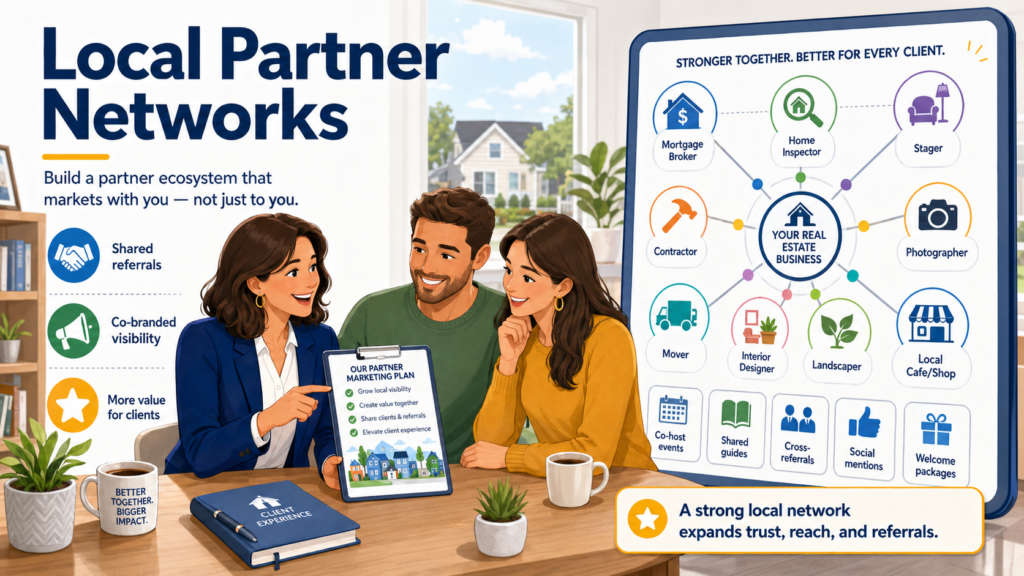
Most real estate businesses know these partners. But they do not turn those relationships into a real marketing system.
A local partner network can help you reach more people, create more useful content, and become better known in the community. The key is to build partnerships that serve the client first.
Good partnerships are based on shared trust, not quick promotion
A weak partnership is just two businesses posting about each other once and moving on. A strong partnership is built around shared value.
For example, a real estate business and a local moving company can create a “stress-free moving month” guide. A real estate business and a home inspector can create content about what buyers should look for before making an offer. A real estate business and an interior designer can create a simple guide on low-cost changes that make a home show better.
These partnerships work because they answer real client needs.
The partner gets visibility. You get useful content. The client gets help. Everyone wins.
Choose partners your clients would thank you for recommending
Your partner network should protect your reputation. Do not partner with someone only because they have a large audience or offer referral fees. Partner with businesses that are good at what they do, communicate well, and treat people fairly.
Your clients will connect that partner’s service back to your name. If the partner does poor work, your trust suffers.
This is why quality matters more than quantity.
A small network of reliable partners is better than a long list of weak contacts. When you recommend someone, it should feel like you are putting your name behind them.
That level of care makes your brand stronger.
Turn partner knowledge into content your audience actually wants
Partners can help you create content that feels practical and fresh.
A home inspector can explain the small signs buyers often miss. A lender can explain what buyers should prepare before applying. A contractor can explain which repairs should be handled before listing.
A designer can explain how to make a small room feel larger. A local cafe owner can talk about why people love a certain neighborhood. A school consultant can explain what families should ask when comparing areas.
This kind of content is more interesting than another basic listing post.
It also helps you show the full life around real estate. You are not only helping people buy or sell a building. You are helping them move into a better daily life.
Make the content feel helpful, not like an ad for the partner
The content should not sound like, “Meet our amazing partner.” That feels promotional and easy to ignore.
Instead, lead with the client’s problem.
For example, “What a home inspector wishes every first-time buyer checked before making an offer” is useful. “Meet our inspection partner” is not as strong.
“Five small fixes that make listing photos look better” is useful. “Our favorite home stylist” is less compelling.
The partner can still be featured, but the lesson should come first.
When the content helps the reader, promotion becomes natural.
Use Email Like a Relationship Tool, Not a Newsletter Dump
Email can be one of the most profitable marketing channels for a real estate business. But only if it feels personal and useful.
Many real estate emails fail because they are too generic. They send random listings, broad market updates, holiday greetings, and “just checking in” messages. These emails may keep your name visible, but they do not always build deep trust.
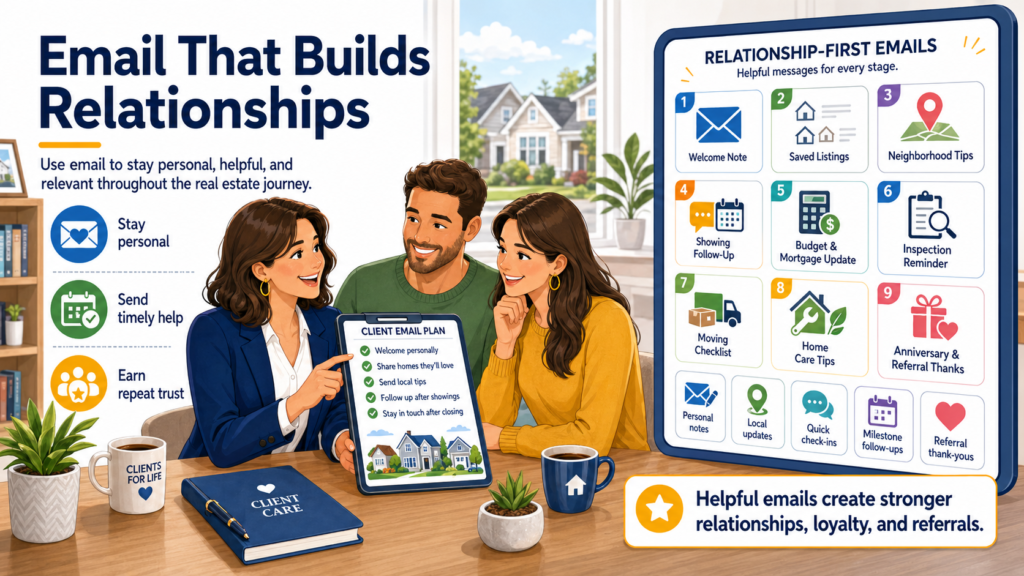
A better email strategy should feel like quiet, steady guidance. It should help people before they need you. It should speak to their stage. It should make them feel known.
Segment your email list by what people care about
Not every contact wants the same thing.
A first-time buyer does not need the same advice as a luxury seller. A past client does not need the same message as an investor. A homeowner thinking about selling in two years does not need the same push as someone planning to list next month.
If you send everyone the same email, most people will feel like the message is not for them.
Segmentation fixes this.
You can group people by buyer, seller, investor, landlord, past client, neighborhood interest, price range, life stage, or timeline. You do not need a complex system at first. Even a few simple groups can make your emails much stronger.
Send advice based on the client’s next likely question
The best email answers the question the reader is about to ask.
For a first-time buyer, the next question may be, “How much money do I really need before I start?” For a seller, it may be, “What should I fix before I invite an agent to look at the home?” For an investor, it may be, “How do I know if the rent will support the price?” For a past client, it may be, “What should I do this season to protect my home’s value?”
When your emails match these questions, they feel timely.
This is what makes someone open your next message. They begin to see your emails as useful, not noisy.
Write emails that sound like they came from a real person
Real estate emails often sound too polished. They feel like company announcements. They use stiff words. They try to sound important, but they lose warmth.
A better email feels like a short note from a trusted advisor.
Start with a real observation. Mention something happening in the local market. Talk about a common client question. Share a simple lesson from recent experience. Then explain what it means for the reader.
For example, you might write, “I have noticed more sellers asking whether they need major renovations before listing. In most cases, the answer is no. But small fixes still matter a lot. Buyers notice light, smell, paint, handles, and clean corners faster than most owners expect.”
That feels useful. It also feels like it came from someone active in the market.
Keep the call to action gentle and clear
Every email should have a next step, but it does not need to be aggressive.
A good next step might be, “Reply with your neighborhood if you want a quick view of what similar homes are doing.” Or, “Send me the type of home you are considering, and I will tell you what to watch for.” Or, “If selling is on your mind this year, I can help you decide what to fix first.”
This feels like help, not pressure.
The best real estate emails do not shout. They open a door.
Create a Homeowner Education Program Before People Are Ready to Sell
Many real estate businesses only market to homeowners when they want listings. That is too late.
Homeowners think about selling long before they actually sell. Sometimes they think about it for years. They wonder what their home is worth. They wonder which upgrades matter. They wonder if they should move now or later. They wonder how the neighborhood is changing. They wonder whether their home will be hard to sell.
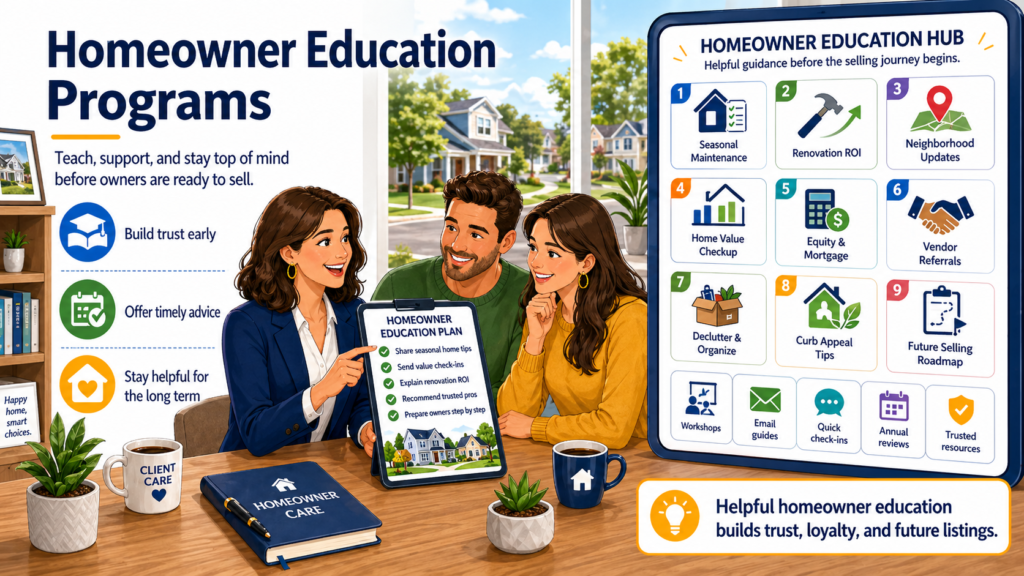
If you educate homeowners during this early stage, you become the natural person to call when the decision becomes real.
Teach homeowners how to protect and grow their home value
Homeowners care about value even when they are not planning to sell. This gives you a strong reason to stay in touch.
You can create content around seasonal maintenance, simple upgrades, curb appeal, energy savings, storage, layout changes, outdoor space, and local buyer preferences. The goal is to help owners make better choices before they spend money.
For example, you can write about which home improvements usually help resale and which ones are mostly personal. You can explain why neutral paint often matters more than expensive custom design. You can show how lighting changes the way buyers feel in a room. You can explain why poor maintenance records can create doubt later.
This kind of content is useful now and valuable later.
Help owners avoid wasteful upgrades
Many homeowners spend money on changes that may not help them sell. They choose upgrades based on personal taste, not future buyer demand. They over-improve one room while ignoring basic repairs. They add features that look nice but do not solve buyer concerns.
You can become the voice that helps them avoid waste.
For example, a homeowner may want to install expensive custom cabinets before selling next year. But if the roof, flooring, or bathroom condition is a bigger buyer concern, that money may be better used elsewhere. Another homeowner may want bold colors and unique fixtures, but if resale is likely soon, simple and broad appeal may work better.
When you teach this honestly, people trust you because you are helping them save money, not just spend it.
Turn homeowner education into a long-term lead source
A homeowner education program can include blog posts, emails, videos, workshops, short guides, and yearly home value check-ins. It should not always say, “Sell now.” In fact, that would weaken trust.
The message should be, “Make smart choices now so you have better options later.”
This is a powerful position. It lets you build relationships before urgency begins.
Offer a yearly home strategy review
Instead of only offering a home valuation, offer a home strategy review.
A valuation answers, “What is my home worth?” A strategy review answers a bigger question: “What should I know if I may sell, refinance, rent, renovate, or hold this home?”
That feels more useful.
During this review, you can discuss current value, neighborhood demand, buyer expectations, small improvements, timing, and possible next steps. The owner may not sell right away. That is fine. You are building trust early.
When they are ready, they are much less likely to start from scratch with another agent.
Build a Real Estate Brand Voice That Sounds Like a Trusted Human
Your brand voice is how your business feels in words. It shows up on your website, captions, emails, ads, signs, brochures, videos, and messages.
Many real estate brands sound the same because they use the same phrases. “Dream home.” “Hidden gem.” “Prime location.” “Must-see.” “Rare opportunity.” “Luxury living.” “Perfect for entertaining.” These phrases are not always wrong, but they are overused. When every agency uses them, they lose power.
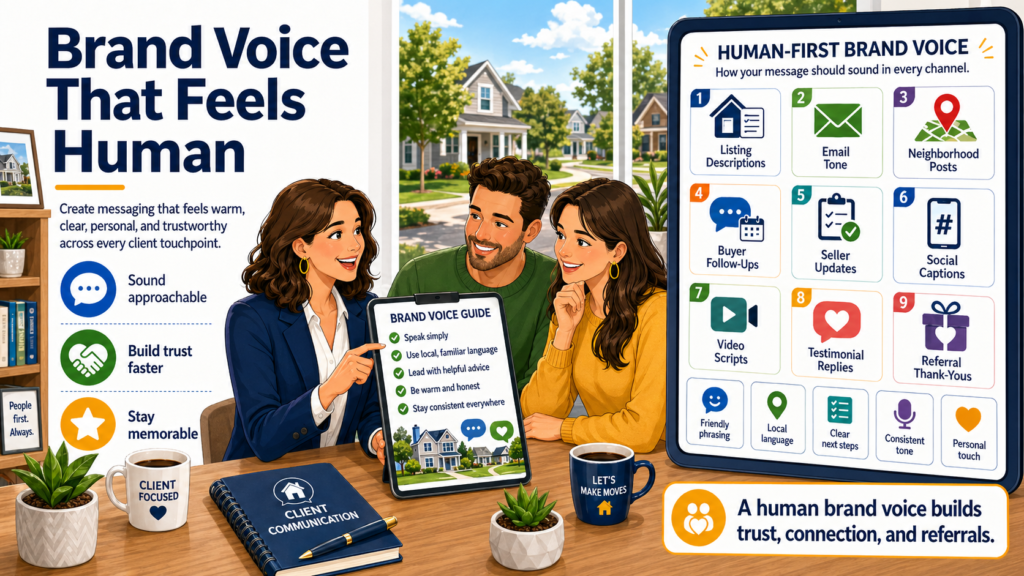
A different voice can make your brand more memorable.
Write the way your best advisor would speak
A strong real estate voice should feel calm, clear, warm, and confident. It should not sound like a robot. It should not sound like a hard-selling ad. It should sound like someone who knows the market and respects the client.
This means using simple words. It means explaining things clearly. It means avoiding fake excitement. It means being specific.
Instead of saying, “This stunning property offers unmatched lifestyle benefits,” say, “This home works well for someone who wants more quiet, more storage, and a short drive to daily needs.”
Instead of saying, “A rare chance to secure a premium asset,” say, “Homes on this street do not come up often, mainly because owners tend to stay for a long time.”
The second version feels more real. It also gives a reason.
Specific words beat fancy words
Fancy words can make marketing feel thin. Specific words make it feel true.
If a kitchen is useful, explain why. Maybe the counter space is wide enough for two people to cook. Maybe the pantry keeps clutter out of sight. Maybe the dining area is close enough for easy school mornings.
If a neighborhood is convenient, explain what that means. Maybe groceries, parks, and transport are all within a short trip. Maybe the school route is simple. Maybe weekend needs can be handled without crossing town.
If a home is peaceful, explain why. Maybe it sits away from the main road. Maybe the bedrooms face the back. Maybe the balcony gets soft evening light.
Specific details make people picture the home. That is what good copy does.
Create simple rules for your brand language
To keep your voice consistent, create a few writing rules for your business.
You might decide that your brand avoids hype, explains trade-offs honestly, uses plain language, writes short paragraphs, and always gives reasons behind claims. You might decide that every listing description should explain who the home is best for, not just what features it has. You might decide that every market update must include a “what this means for you” section.
These rules make your marketing stronger because they keep your message steady.
Your voice should make clients feel safe asking basic questions
The best real estate brands do not make people feel small for not knowing things.
If your content is full of complex terms, some people may feel they are not ready to talk to you. If your content is clear and kind, they feel safer asking questions.
This is especially important for first-time buyers, older sellers, relocating families, and people dealing with emotional moves.
A human voice lowers the wall between the client and your business.
And in real estate, that wall is often what stops people from reaching out.
Use Hyperlocal SEO to Own the Searches Bigger Competitors Ignore
Many real estate businesses aim for broad keywords. They want to rank for phrases like “real estate agent,” “homes for sale,” or “property consultant.” These searches are valuable, but they are also crowded. Large portals, big agencies, and long-established brands often dominate them.
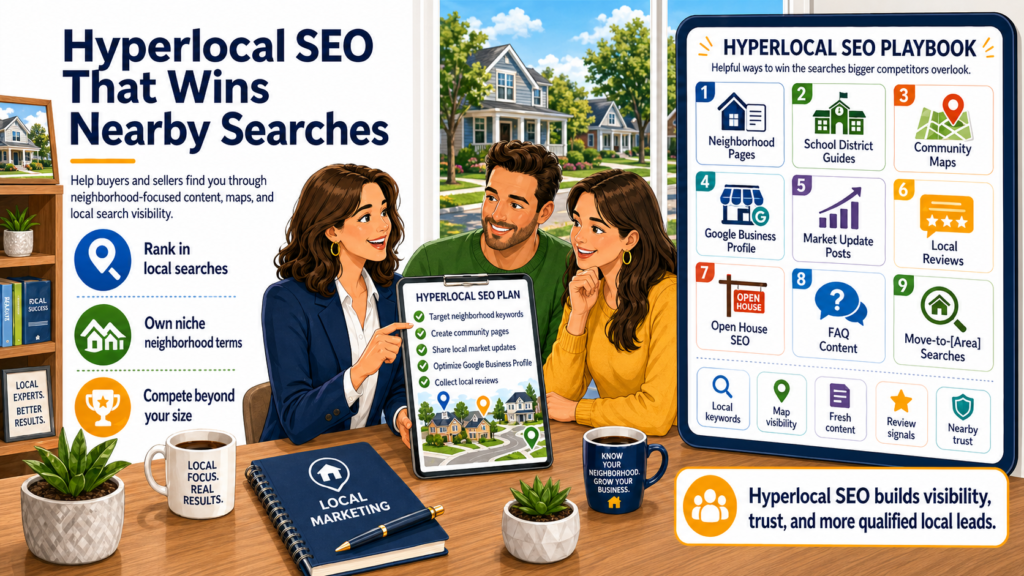
A smarter path is to win the smaller local searches that serious clients actually use.
These searches may have less traffic, but they often have stronger intent. Someone searching for “best areas for families near downtown” or “homes near good schools in [area name]” may be closer to action than someone typing a broad phrase. They already have a need. They already have a place in mind. They are looking for guidance.
That is where hyperlocal SEO becomes a real advantage.
Your best SEO opportunities are often hidden in small local questions
People do not always search like marketers expect. They search in natural, messy, human ways.
They ask things like, “Is [neighborhood] a good place to live?” They search, “Average home price near [school name].” They look up, “quiet streets near [popular area].” They ask, “Should I buy a flat or house in [city area]?” They search, “cost to sell a home in [city].” They look for “best neighborhoods for young families near [business district].”
These are not just keywords. They are signs of real concern.
If your website answers these questions better than anyone else, you can attract people before they reach the listing sites. You meet them at the thinking stage, not just the buying stage.
That matters because the thinking stage is where trust begins.
Build pages around real places, not just search terms
A weak SEO page is written only to rank. It repeats the area name again and again. It gives shallow advice. It sounds like it could apply to any neighborhood in any city.
A strong local page feels like it was written by someone who knows the place.
If you create a page about a neighborhood, talk about the streets, the home types, the daily lifestyle, the buyers who fit well there, the common trade-offs, the price patterns, and the things people should check before choosing it.
Do not make every area sound perfect. That will make your content feel fake.
Some neighborhoods are better for families. Some are better for young professionals. Some are better for investors. Some offer more space but longer travel times. Some are lively but noisy. Some are affordable because they are still developing. Some are expensive because supply is low and people rarely leave.
When you explain these differences honestly, your content becomes more useful. Search engines may help people find you, but useful content is what makes people stay.
Create SEO content for sellers, not only buyers
Most real estate SEO focuses on buyers because buyers search for homes and areas. But sellers also search. They just search differently.
A seller may search, “How much is my home worth in [area]?” They may search, “Should I renovate before selling?” They may search, “Best time to sell a house in [city].” They may search, “Why is my home not selling?” They may search, “How to choose a real estate agent to sell my home.”
These searches are valuable because they come from people who may soon need an agent.
If your website only talks to buyers, you are missing a large part of the market.
Seller SEO should focus on trust, timing, and money
Sellers want to know three things. They want to know what their home may be worth. They want to know when to sell. They want to know how to get the best result without making a mistake.
Your seller content should answer those concerns in simple language.
You can create articles like “How to Know If Your Home Is Priced Too High,” “What Makes Homes Sell Faster in [Area],” “Small Repairs That Matter Before Listing,” “How Buyers Compare Homes Online,” and “What to Do If You Want to Sell but Have Not Found Your Next Home Yet.”
These topics are practical. They also show that you understand seller fear.
A seller who reads your content should feel, “This person knows what I am worried about.”
That feeling is often what leads to the first call.
Make Your Listings Tell a Better Story Than the Competition
A listing is not just a set of facts. It is a sales page for a home.
Yet many listings sound flat. They mention the number of rooms, the size, the location, and a few common features. They use words like beautiful, spacious, modern, charming, and must-see. The result is a listing that looks like every other listing.
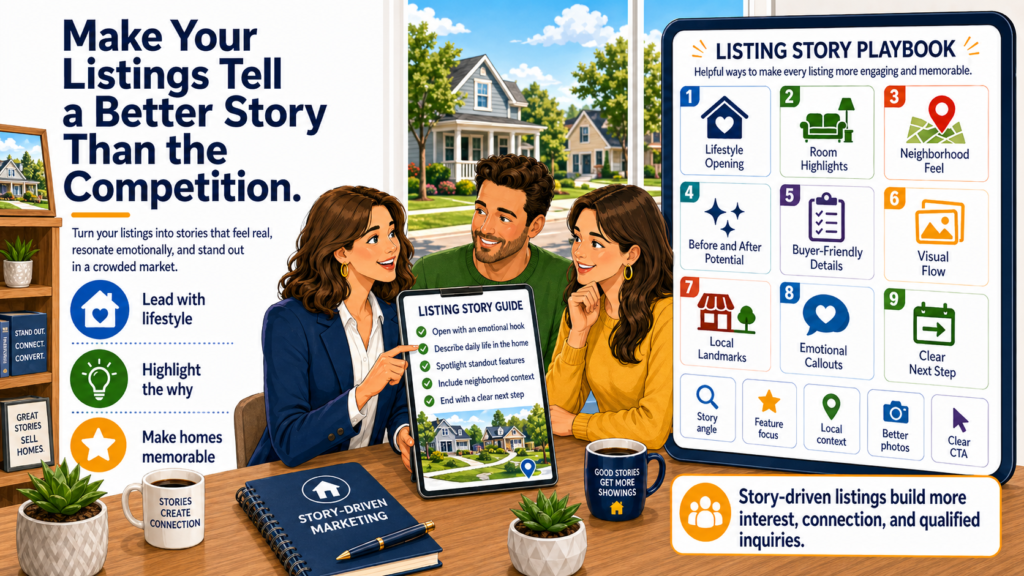
A better listing helps buyers picture their life in the home. It shows why the property matters. It explains who it suits. It makes the strongest features easy to feel, not just easy to see.
Start with the buyer’s real desire, not the home’s basic features
Buyers do not only want three bedrooms. They want enough space to stop feeling crowded. They do not only want a balcony. They want a quiet place for morning coffee or evening air. They do not only want parking. They want daily life to feel easier.
They do not only want a home office. They want a place where work does not take over the dining table.
Good listing copy connects features to feelings and use.
Instead of writing, “Large living room with natural light,” write, “The living room gives you enough space to relax, host guests, and still keep the room feeling open during the day.”
Instead of writing, “Close to schools and shops,” write, “School runs, grocery trips, and weekend errands are easier here because daily needs sit close by.”
This does not mean you should overdo emotion. It means you should explain why the feature matters.
Every listing should answer the question, “Who is this home really for?”
A strong listing does not try to attract everyone. It helps the right buyer recognize themselves.
If the home is perfect for a growing family, say why. If it suits a working couple who wants a low-maintenance lifestyle, explain that. If it is good for an investor, talk about tenant appeal and practical demand. If it suits someone downsizing, show how it offers comfort without too much upkeep.
This helps buyers self-select.
It also saves time because the people who inquire are more likely to fit the home.
A listing that says “perfect for everyone” feels weak. A listing that says, in a natural way, “this is especially useful for this kind of buyer” feels sharper.
Use listing photos and copy as one story
Photos and words should not work separately. They should guide the buyer together.
If the best feature is morning light in the kitchen, make sure the photo shows it and the copy explains it. If the main strength is a smart layout, use photos that show flow from one room to another, then write about how the layout makes daily life easier. If the outdoor space is a selling point, do not just show it empty. Help people picture how they would use it.
Most buyers scan first. They look at photos before reading. So your photos must create interest. Then your copy must deepen that interest.
Avoid empty listing words that buyers have learned to ignore
Some words are so common that they no longer carry much meaning. Stunning, gorgeous, rare, dream, perfect, luxurious, and hidden gem can all feel lazy if they are not backed by detail.
If you use a strong word, prove it.
Do not just say the home is peaceful. Say the bedrooms sit away from the road. Do not just say it is convenient. Say the grocery store, park, and main road are all within easy reach. Do not just say it is spacious. Explain how the layout keeps the living area open while still giving privacy to the bedrooms.
Specific proof makes simple copy stronger than fancy copy.
The best listing copy does not shout. It helps the right buyer see the value clearly.
Build a Social Media Strategy Around Trust, Not Just Reach
Social media can bring attention, but attention alone does not build a real estate business. Many agents chase likes, trends, and views without asking a deeper question: does this content make someone more likely to trust me with a major property decision?
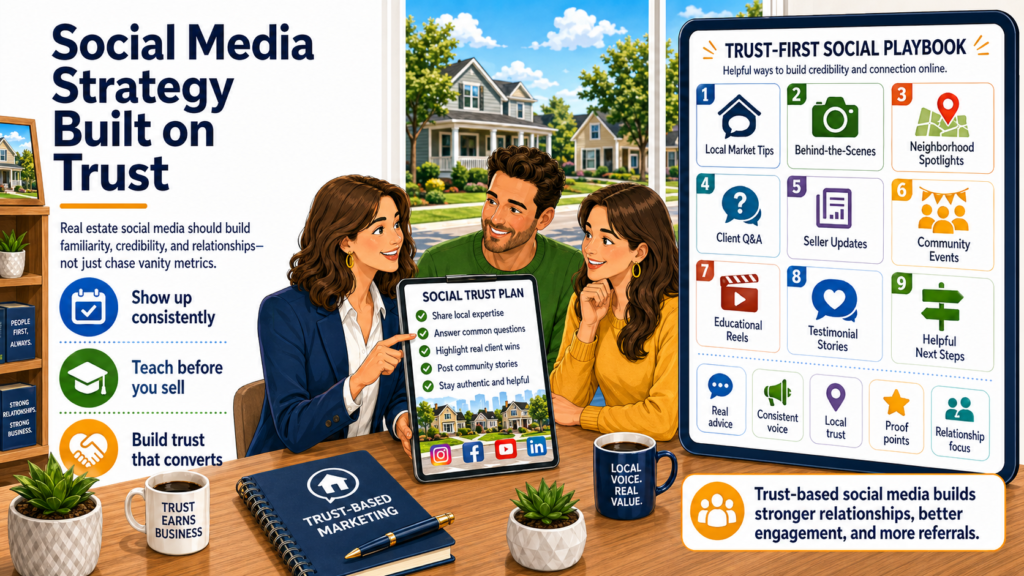
That is the question that matters.
Real estate is not an impulse buy. People may enjoy a funny video, but they hire the person they believe can guide them well. So your social media should show your knowledge, your care, your process, and your local understanding.
Use social media to make your thinking visible
The strongest real estate social content does not just say, “Look at this home.” It says, “Here is how to think about this home, this market, or this decision.”
You can break down why a home sold quickly. You can explain why two similar properties have different prices. You can show what buyers often miss during showings. You can explain what sellers should do before photos are taken. You can compare neighborhoods.
You can talk through the pros and cons of buying near a busy road. You can explain why the highest offer is not always the safest offer.
This type of content helps people see your judgment.
That matters because clients do not just hire you for access to listings. They hire you for decision support.
Share small lessons from real situations without exposing private details
You do not need to reveal client information to teach from your work.
You can say, “A seller recently asked whether they should spend money on a full kitchen upgrade before listing. In many cases, that is not the first place I would start. Buyers notice repairs, light, paint, smell, and clean presentation quickly. A large renovation only makes sense if the price range and local competition support it.”
This kind of post feels real because it comes from a real question.
It also speaks to many people at once. Other sellers may have the same concern but never asked it out loud.
Your day-to-day conversations are a goldmine for content. Every repeated client question can become a post, video, article, or email.
Balance visibility content with trust content
Some content helps people discover you. Some content helps people trust you. You need both.
Visibility content may include short videos, local highlights, behind-the-scenes clips, market reactions, and simple tips. Trust content includes deeper explanations, client stories, decision guides, neighborhood insights, and process breakdowns.
A common mistake is posting only visibility content. This may grow reach, but it may not create serious leads. Another mistake is posting only heavy education content, which may be useful but not easy to discover.
The balance matters.
Make each platform serve a clear role
You do not need to use every social platform in the same way.
Instagram may work well for property visuals, short local videos, client stories, and lifestyle content. Facebook may help with community posts, local groups, events, and homeowner education. LinkedIn may work better for investor content, relocation advice, professional networks, and market commentary.
YouTube can host deeper neighborhood guides, buyer education, and seller strategy videos. TikTok or short-form video platforms can help you explain quick real estate lessons in a simple way.
The point is not to copy the same post everywhere without thought. The point is to shape the message for how people use that platform.
Your brand should feel consistent, but the format can change.
Good social media does not just make people notice you once. It makes them feel, over time, that you are the real estate person who explains things clearly.
Create Local Community Content That Does Not Feel Like Real Estate Marketing
Some of the best real estate marketing does not look like real estate marketing at first.
Why? Because people care about their community even when they are not buying or selling. They care about where to eat, where to walk, where to shop, where to take children, where to work out, where to spend weekends, and what is changing nearby.
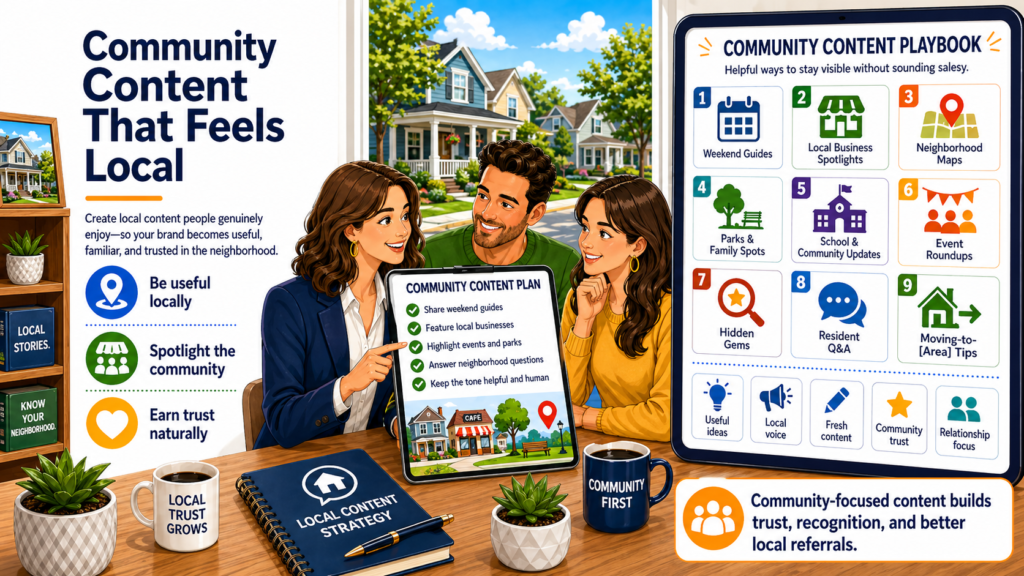
If your brand becomes a source of useful local content, you stay visible in a way that feels welcome.
Talk about the life around the homes
Homes sit inside a larger life. The more you show that life, the more useful your brand becomes.
You can create content about local cafes, parks, schools, small businesses, fitness studios, weekend spots, pet-friendly places, quiet streets, walking routes, new developments, road changes, and community events.
This content works because it attracts both future buyers and current residents. It also makes you look deeply connected to the area.
A person may not need an agent today, but they may still follow your page because your local content helps them enjoy the neighborhood. Later, when they need real estate help, your name is already familiar.
Make local businesses part of your story
Local business features are a simple way to build goodwill and reach.
You can interview a cafe owner, show a family-run store, talk to a local gym trainer, highlight a florist, or feature a moving company. But the content should not feel like a random shoutout. It should tell a small story.
Why did the owner start? What do locals love most? What should new residents try first? What does the business add to the area?
This turns a simple feature into community storytelling.
It also gives the business a reason to share your content, which expands your reach without paid ads.
Use community content to attract relocation buyers
People moving from another city often need more than listings. They need context. They want to understand how life works in the new area.
Community content helps them feel oriented before they arrive.
A relocation buyer may watch your video about the best areas for families, read your guide to commute patterns, save your post about local schools, or follow your page because you explain the city in a simple way.
By the time they contact you, they may already feel like you have been guiding them.
Build “moving to” content for people who are new to your market
“Moving to” content can be very powerful for SEO, social media, and email.
You can create guides like “What to Know Before Moving to [City],” “Best Areas in [City] for Families,” “What New Residents Should Know About [Neighborhood],” or “How to Choose Between [Area A] and [Area B].”
These guides should be honest. Talk about cost, lifestyle, transport, home types, schools, traffic, climate, safety feelings, and local habits. Do not make the city sound perfect. Make it understandable.
People trust guides that include trade-offs.
If you can help someone feel less lost before they move, you become a natural person to contact when they need help finding a home.
Use Paid Ads to Amplify Trust Content, Not Just Listings
Paid ads can help real estate businesses grow faster, but many campaigns are too narrow. They promote listings, free valuations, or “contact us today” messages to people who barely know the brand.
That can work when the offer matches the timing. But many buyers and sellers are not ready right now. If your ads only target people at the final step, you miss the larger group that needs education first.
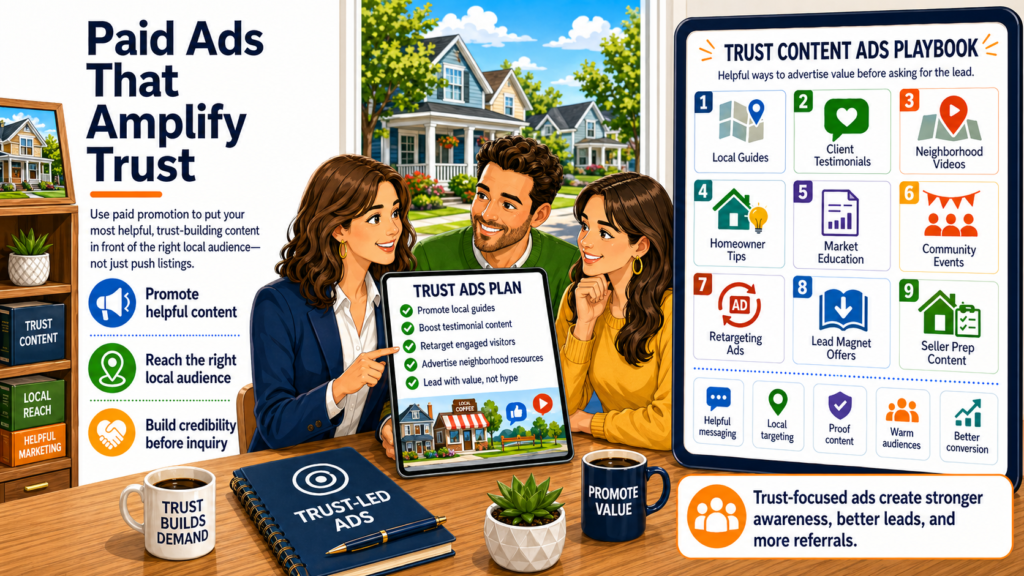
A stronger paid ad strategy promotes trust-building content before asking for the sale.
Warm up cold audiences before asking for a call
Imagine seeing an ad from an agent you do not know. It says, “Sell your home with us.” You may ignore it because there is no trust yet.
Now imagine seeing an ad that says, “Thinking of selling this year? Here are five repairs that usually matter more than a full renovation.” That feels useful. It does not demand a call. It helps you think.
This is how trust content works in ads.
You can promote guides, videos, market reports, neighborhood comparisons, seller checklists, buyer timelines, and myth-busting content. People who engage with these pieces can then see more specific ads later.
This creates a natural path from awareness to trust to inquiry.
Build simple ad journeys based on client stage
A buyer at the early stage may need a neighborhood guide. A buyer at the middle stage may need a budget checklist. A buyer close to action may need a consultation offer.
A seller at the early stage may need a home value planning guide. A seller at the middle stage may need a repair checklist. A seller close to action may need a home review offer.
Your ads should match these stages.
If you ask for the appointment too early, many people will ignore you. If you help first, more people will be open to hearing from you later.
Use retargeting to stay visible after someone shows interest
Most people will not contact you the first time they see your content. That is normal.
Retargeting lets you stay in front of people who visited your website, watched your videos, opened your lead magnet, or engaged with your social posts. These people already showed some interest. Your job is to keep building trust.
You can show them client stories, market insights, simple process videos, open house invitations, or guides tied to their interest.
Retarget with proof, not pressure
Retargeting should not feel like being chased around the internet. It should feel like helpful reminders from a brand they already found useful.
If someone read a seller guide, show them a case story about how better preparation helped a seller attract stronger interest. If someone watched a neighborhood video, show them a deeper guide to that area. If someone downloaded a buyer checklist, show them a video explaining what happens during the first buyer consultation.
This keeps the journey natural.
The goal is not to force a lead. The goal is to make your business feel familiar, helpful, and safe when the person is ready.
Make Your Website Feel Like a Real Estate Advisor, Not a Digital Brochure
Your website should not be a static brochure. It should help people make decisions.
Many real estate websites look nice but do very little. They have a home page, listings, an about page, a contact page, and maybe a blog. The words are often generic. The site does not guide buyers or sellers. It does not answer fear. It does not show a clear process.
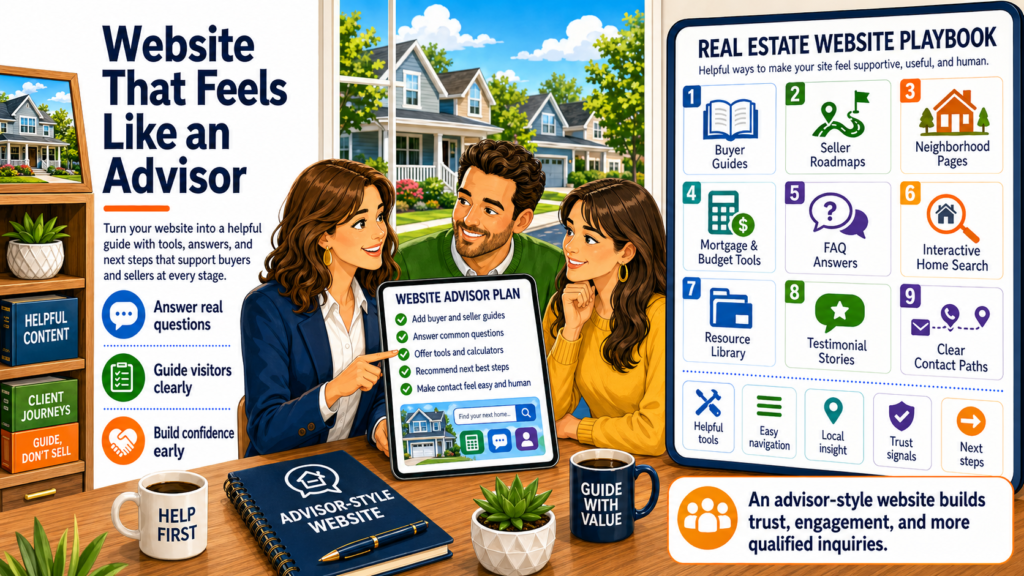
A better website works like a quiet advisor. It helps people understand where they are, what they need, and what step to take next.
Build separate paths for buyers, sellers, investors, and relocating clients
Different clients have different concerns. Your website should not force all of them through the same message.
A buyer wants to know if you can help them find the right home, understand the area, avoid overpaying, and move through the process with confidence.
A seller wants to know if you can price well, prepare the home, market it strongly, negotiate carefully, and reduce stress.
An investor wants to know if you understand numbers, rental demand, risk, and long-term return.
A relocation client wants to know if you can help them understand the city, compare neighborhoods, and manage the move from a distance.
Each group deserves its own page and message.
Each page should answer the client’s hidden worries
A strong buyer page should not only say, “We help you buy homes.” It should answer the worries behind buying.
Will I overpay? Will I miss something important? How do I compare areas? How do I know when to make an offer? What if I am not ready yet?
A strong seller page should answer seller worries.
What is my home worth? What should I fix? How do I avoid sitting on the market? How will you attract serious buyers? How do I compare offers? What happens if I need to buy and sell at the same time?
When your website answers these worries, it feels useful before the visitor ever fills out a form.
Make your calls to action feel safe and specific
Many websites use vague calls to action like “Contact us” or “Get started.” These are not wrong, but they can feel too broad.
A stronger call to action tells people exactly what they will get.
For buyers, you might invite them to request a simple buying plan. For sellers, you might offer a home prep review. For investors, you might offer a rental potential discussion. For relocation clients, you might offer a neighborhood match call.
These feel more useful than a generic contact form.
Reduce the fear of the first conversation
People often avoid contacting real estate businesses because they do not want pressure. Your website should make the first step feel low-risk.
Explain what happens after they reach out. Tell them the first call is about understanding their situation, not pushing them into a decision. Tell them they can ask early questions. Tell them they do not need to be ready to buy or sell right away.
This small reassurance can increase inquiries because it lowers emotional friction.
In real estate, trust often begins before the first conversation. Your website should make that conversation feel easy to start.
Conclusion
Standing out in real estate is not about louder ads or prettier slogans. It is about becoming more useful, more trusted, and more memorable than the next agent. When your marketing teaches clearly, speaks simply, tells real stories, shows local knowledge, and helps people make better choices, your brand becomes easier to choose.
The best real estate marketing does not chase every lead. It builds trust before the lead is ready. Focus on helping first. Show your thinking. Make every message feel human. When people feel guided, not pushed, they remember you when it matters most.














Comments are closed.