
WinSavvy Editorial Standards
How this article was created
Running a salon is not just about giving great haircuts, glowing skin, clean nails, or relaxing treatments. Those things matter, of course. But they are only one side of the business. The other side is getting people to notice you, trust you, book with you, come back again, and tell their friends about you.
Build your salon marketing around one clear type of client
A salon that tries to attract everyone often ends up speaking to no one clearly. This is one of the biggest marketing mistakes salon owners make. They post about hair, skin, nails, offers, trends, bridal looks, color work, and walk-ins all at once, but there is no clear message behind it.
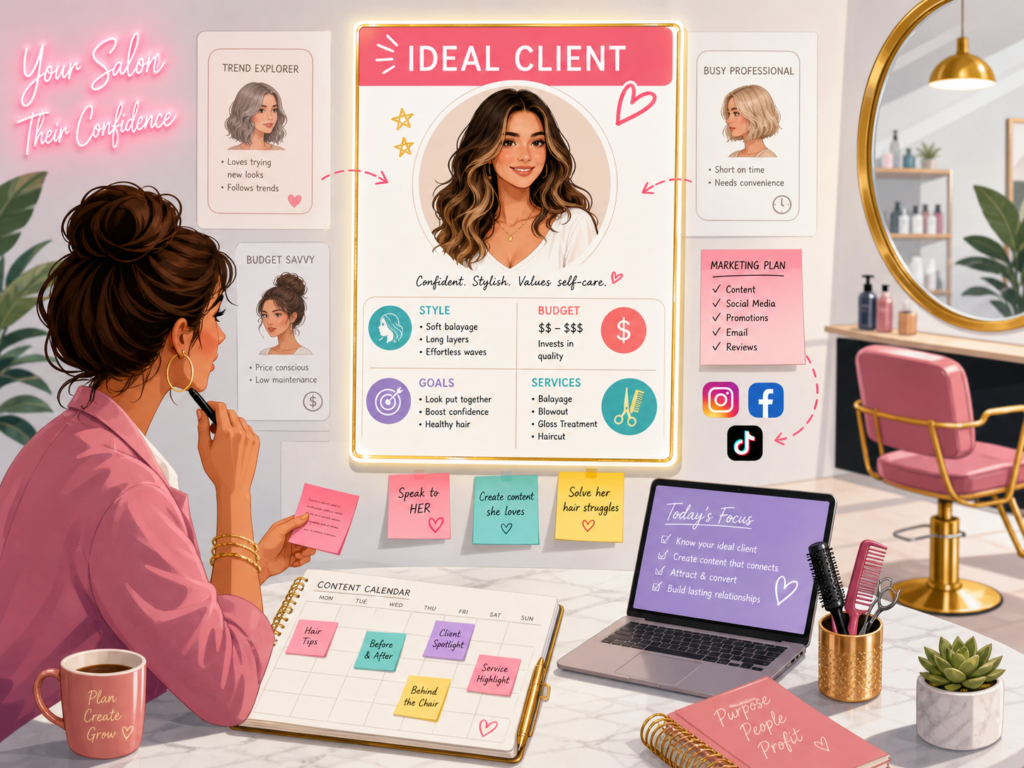
A new client looks at the salon and does not know whether it is the right fit for them.
Your marketing becomes stronger when you know who you want to attract most.
This does not mean you turn away everyone else. It simply means your message becomes sharper. A busy working woman looking for easy-to-maintain hair color has different needs than a bride looking for a luxury makeup package.
A college student looking for an affordable haircut is not thinking the same way as a professional who wants premium hair care and a calm salon visit.
When you know your ideal client, your photos, offers, captions, website, prices, and even your salon experience become easier to shape.
Your best client is not always the one who spends the most once
A lot of salon owners assume their best clients are the ones who book the most expensive service. That is not always true. Your best clients are the ones who return often, trust your advice, respect your time, buy add-on services, leave reviews, and refer other people.
For example, a client who books a simple hair color every six weeks may be more valuable than someone who books one bridal package and never comes back. A client who brings her sister, mother, and friends may be worth far more than a one-time visitor who came only because of a discount.
This is why salon marketing should not only chase new bookings. It should attract the kind of people who fit your salon well and are likely to stay.
Start by looking at the clients you already love serving
Before you spend money on ads or promotions, look at your current client list. Think about the clients who make your business better. Who books on time? Who listens to your advice? Who buys the right treatment instead of always asking for the cheapest option? Who posts about your salon without being asked?
These people give you clues. They show you what kind of client your salon should attract more often.
Once you know this, your marketing gets easier. You can write posts that speak to their needs. You can create offers that match their habits. You can show photos that reflect their style. You can stop sounding like every other salon and start sounding like the salon they have been searching for.
Make your salon brand feel easy to understand in seconds
People judge your salon fast. They may find you on Google, Instagram, Facebook, TikTok, or through a friend. In just a few seconds, they decide whether to keep looking or move on.
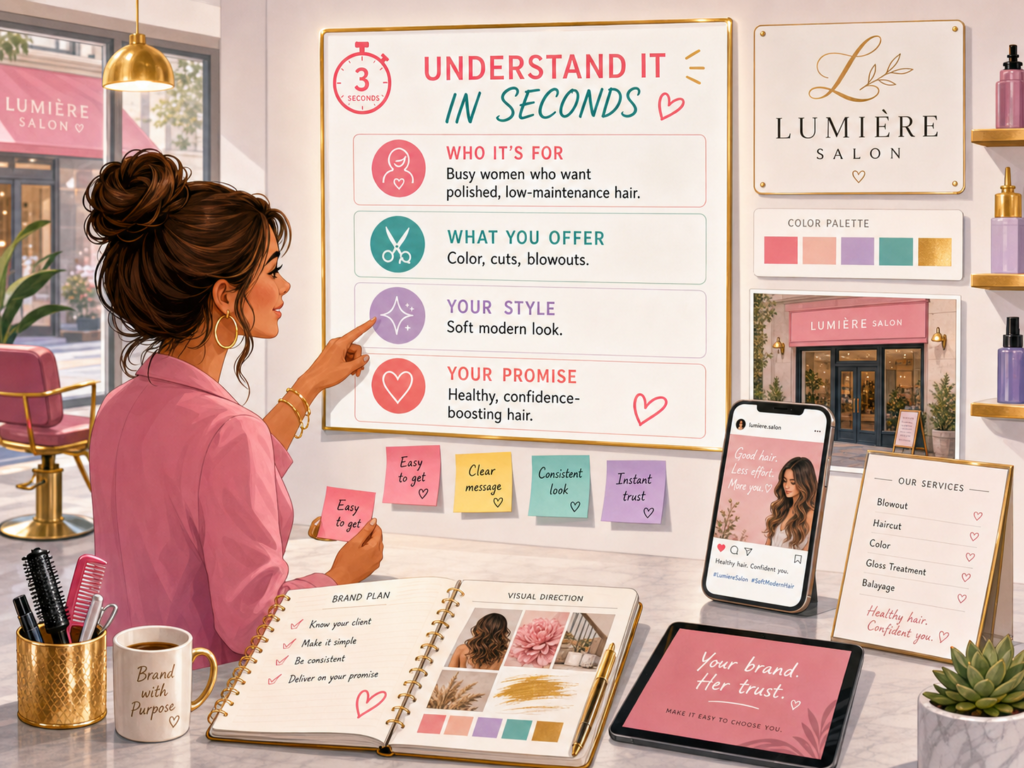
This is why your brand needs to be clear. Your salon should not feel confusing. A new visitor should quickly understand what you do best, who you serve, what kind of experience you offer, and why they should book with you.
A strong salon brand is not just a logo or color theme. It is the feeling people get when they see your name, photos, words, reviews, and space. It is the promise your salon makes before the client even walks in.
If your salon is warm, friendly, and family-focused, your marketing should feel that way. If your salon is high-end and calm, your photos and words should reflect that. If your salon is bold, trendy, and creative, your content should show energy and style.
Clear beats clever when you want more bookings
Many salons try too hard to sound fancy. They use vague lines like “where beauty meets elegance” or “your beauty destination.” These lines sound nice, but they do not tell the client much.
A clear message works better.
A client should know what you are known for. Are you the salon for soft natural hair color? Fast and polished workday styling? Bridal beauty? Curly hair care? Skin treatments for glow and confidence? Nail art with clean detail?
When your message is clear, clients feel less unsure. They know what to expect. That makes booking easier.
Your salon should have one simple promise
A useful way to shape your brand is to finish this sentence: “We help clients feel confident by giving them…”
Your answer should be simple. For example, you may say, “We help busy women feel confident with low-maintenance hair color that still looks fresh for weeks.” Another salon may say, “We help brides feel calm, beautiful, and photo-ready on their big day.” Another may say, “We help clients care for their natural curls with cuts, treatments, and styling that make daily life easier.”
This promise should guide your marketing. It should appear in your bio, website, service pages, captions, and client conversations. When the same clear message shows up again and again, people remember you.
That is how a salon starts becoming known for something.
Turn your Google Business Profile into a client magnet
For salons, local search is one of the most powerful marketing tools. When someone searches “salon near me,” “hair color near me,” “best facial near me,” or “bridal makeup near me,” they are not just browsing for fun. They are close to booking.
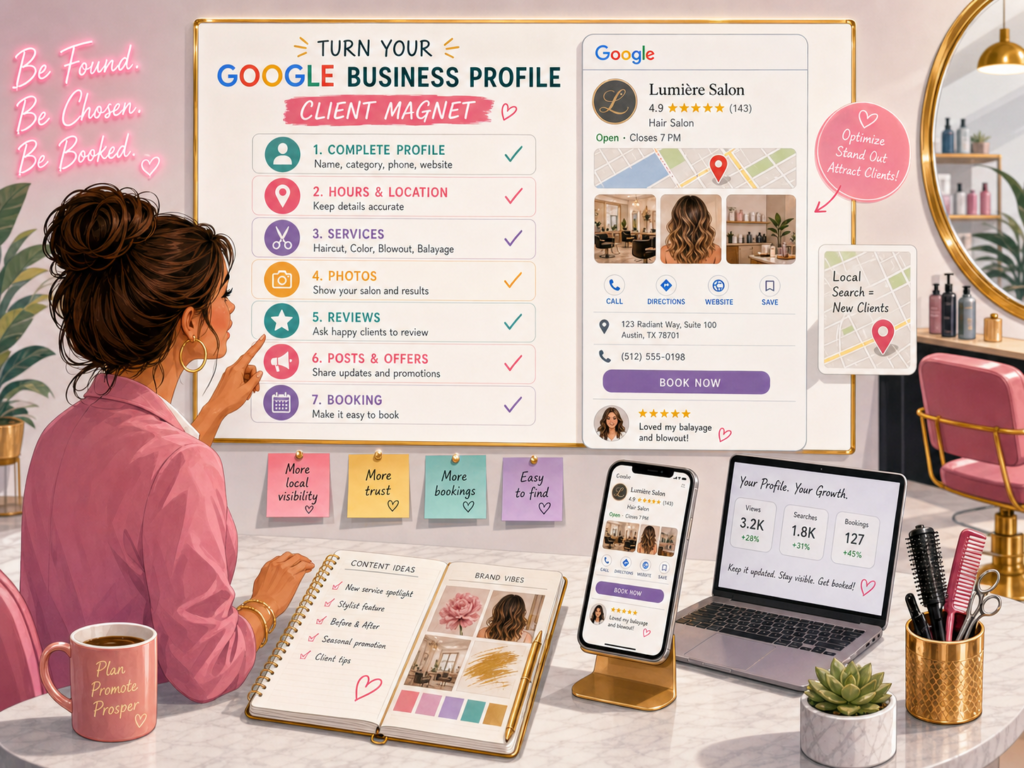
That is why your Google Business Profile matters so much.
Many salons create a profile and then ignore it. They add the address, phone number, and a few photos, but they do not treat it like a sales page. This is a missed chance. Your Google profile may be the first real impression a client has of your salon.
A strong profile can help you show up more often, earn trust faster, and get more calls without paying for ads.
Your photos should sell the result before your words do
Salon clients want to see proof. They want to know what your work looks like. They want to imagine themselves getting that result. This is why photos on your Google profile should be fresh, clear, and real.
Add photos of your salon entrance, chairs, treatment rooms, team, finished work, and happy client transformations. Show different angles. Show natural lighting when possible. Show clean spaces. Show the kind of services you want to sell more often.
Do not upload only one batch of photos and stop. Add new photos every week if you can. Google likes active profiles, and clients trust salons that look current.
Your service list should match what clients search for
Your Google profile should include clear service names. Do not rely only on broad words like “hair services” or “beauty treatments.” Use the words real clients type into search.
For example, if you offer balayage, keratin treatment, bridal makeup, hair spa, gel nails, waxing, facials, brow shaping, or scalp treatment, add them clearly. Each service helps Google understand what your salon does. It also helps clients see that you offer what they need.
Your description should also be simple and direct. Say where you are located, what you specialize in, and what kind of client experience you provide. Avoid stuffing it with keywords in a strange way. Write like a real person helping a new client choose with confidence.
Get more reviews by making the request part of the client journey
Reviews are trust builders. A salon can say it is great, but when real clients say it, the message is stronger. Reviews help new clients feel safe. They reduce doubt. They also help your salon show up better in local search.
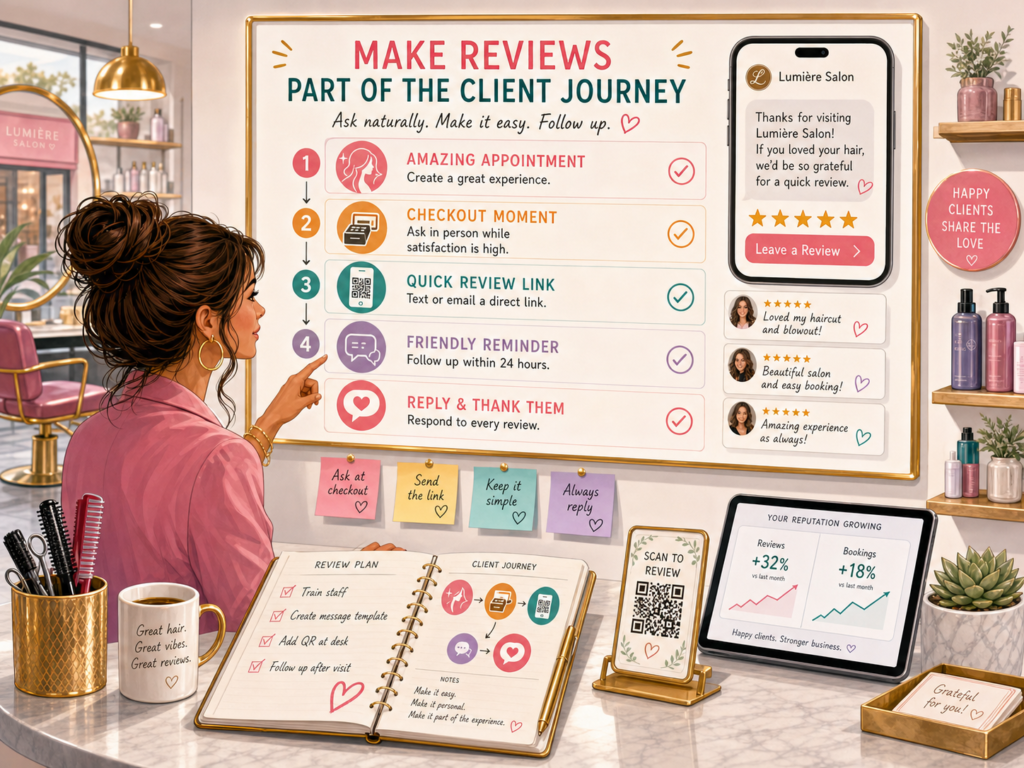
But most happy clients do not leave reviews on their own. They may love the service and still forget. That is why you need a simple system for asking.
The best time to ask is when the client is happiest. That may be right after they see the final look, when they smile in the mirror, or later that day after they receive a photo. Do not make the request feel heavy. Keep it warm and natural.
Make the review request personal, not pushy
A simple message works best. You can say, “I’m so glad you loved your hair today. Your review would really help more local clients find us. I’ll send you the link.”
This feels human. It tells the client why the review matters. It also makes the action easy.
The easier you make it, the more reviews you will get. Send the direct Google review link by text or WhatsApp. Do not ask them to search for your salon and figure it out. That adds friction.
Train your team to ask at the right moment
If you have a team, do not leave review requests to chance. Make it part of your process. When a client gives a compliment, that is the perfect opening. If they say, “I love it,” your stylist can reply with warmth and then ask for a quick review.
You can also create a follow-up message after each appointment. It should thank the client, remind them of any aftercare tips, and include the review link. This keeps the tone helpful instead of needy.
Over time, reviews become one of your strongest marketing assets. They keep working long after the appointment is over.
Use Instagram to show trust, not just pretty results
Instagram is a natural fit for salons because beauty is visual. But posting pretty photos is not enough anymore. Many salons post good work and still struggle to get bookings because their content does not build enough trust.
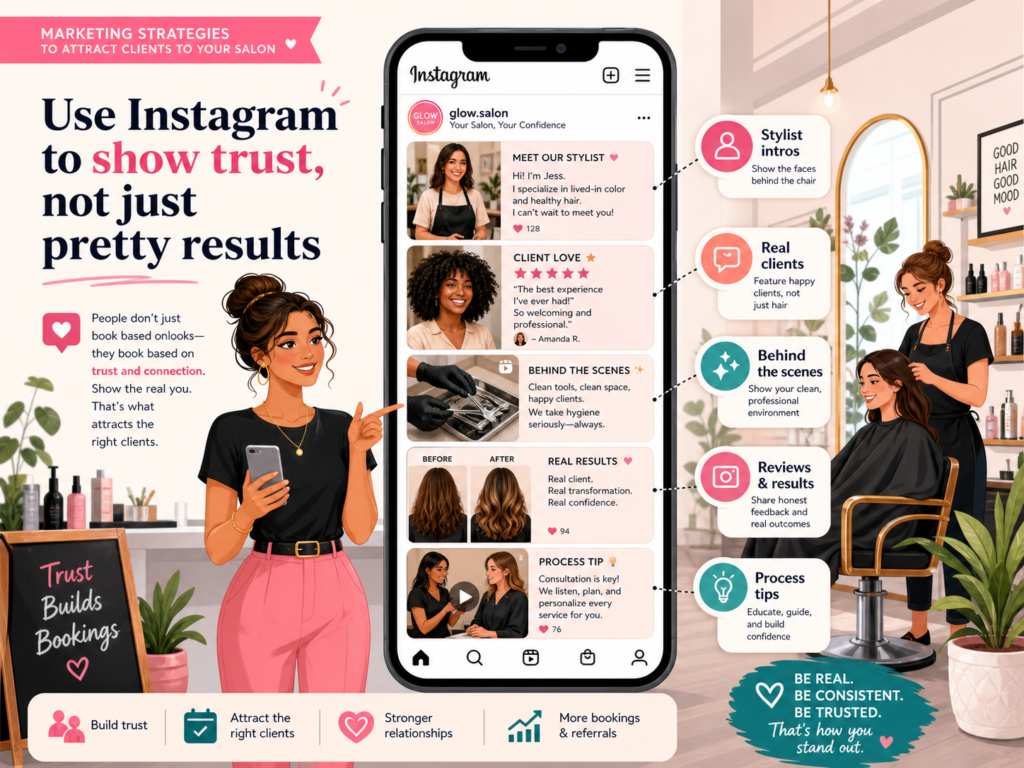
Clients need to see more than the final result. They want to understand your process, your skill, your care, and your salon vibe. They want to know whether they will feel comfortable sitting in your chair.
This is where better content makes a big difference.
Instead of only posting finished looks, show the full story. Show the before. Show the consultation. Show the sectioning. Show the treatment. Show the styling. Show the final result in natural light. Explain what you did and why it mattered.
Your captions should answer the question in the client’s mind
A photo may catch attention, but the caption can create desire. Do not waste captions with only “Beautiful transformation today.” That does not help the client understand why they should book.
Explain the problem and the solution.
For example, talk about how the client wanted softer color without high upkeep. Explain how you chose a shade that grows out naturally. Mention how often they may need maintenance. Share who the service is best for.
This makes your content more useful. It also shows that you think like a professional, not just a content creator.
Use your Instagram bio like a booking page
Your Instagram bio should be clear and useful. It should say what you do, where you are, who you help, and how to book.
A vague bio loses bookings. A clear bio creates action.
Instead of writing only “Hair and beauty salon,” write something more specific, such as “Low-maintenance hair color and skin treatments in Austin. Helping busy women look polished without spending hours getting ready. Book below.”
The link in your bio should take people directly to booking, services, WhatsApp, or a simple landing page. Do not make clients hunt for the next step. When they are ready, the path should be easy.
Create offers that bring in clients without cheapening your salon
Discounts can bring people through the door, but they can also hurt your salon if you use them too often. If clients only come because the price is low, they may leave when someone else becomes cheaper.
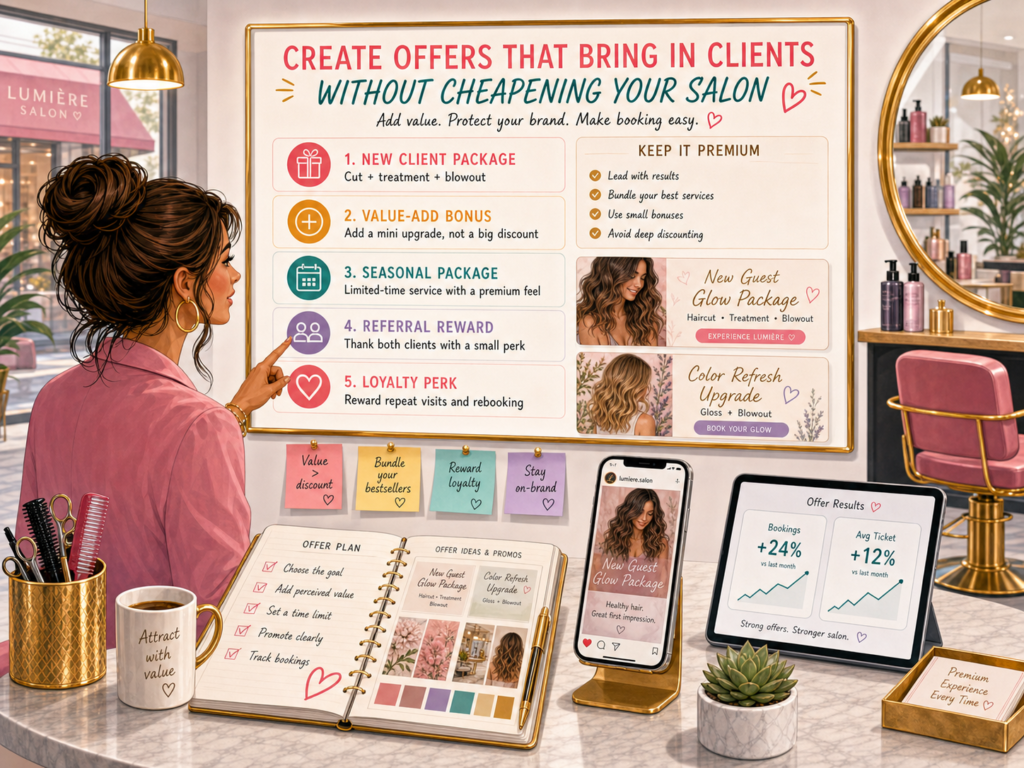
This does not mean offers are bad. It means they must be planned carefully.
A strong salon offer should give clients a reason to try you while still protecting your value. It should feel like a smart first step, not a desperate price cut.
For example, instead of saying “50% off all services,” you could create a first-visit package that includes a consultation, main service, and aftercare advice. This makes the offer feel complete and helpful. It also gives the client a better experience.
Bundle services around a clear client need
Bundles often work better than random discounts. They help clients see the full result. They also raise the value of each booking.
For example, a “First-Time Hair Glow Package” could include a haircut, deep conditioning treatment, and blow dry. A “Bridal Skin Prep Package” could include a series of facials before the wedding. A “Workweek Ready Package” could include brows, nails, and blowout.
The key is to name the package around the outcome the client wants. Do not just list services. Sell the result.
Use offers to start a longer client relationship
The best offer is not just about one visit. It should lead naturally into the next booking.
If someone comes in for a first-time color package, explain when they should return for toner, gloss, or maintenance. If they book a facial, recommend a simple plan for the next few weeks. If they get nails done, invite them to rebook before they leave.
This is how offers become growth tools instead of one-time discounts. They bring people in, give them a great experience, and guide them toward coming back.
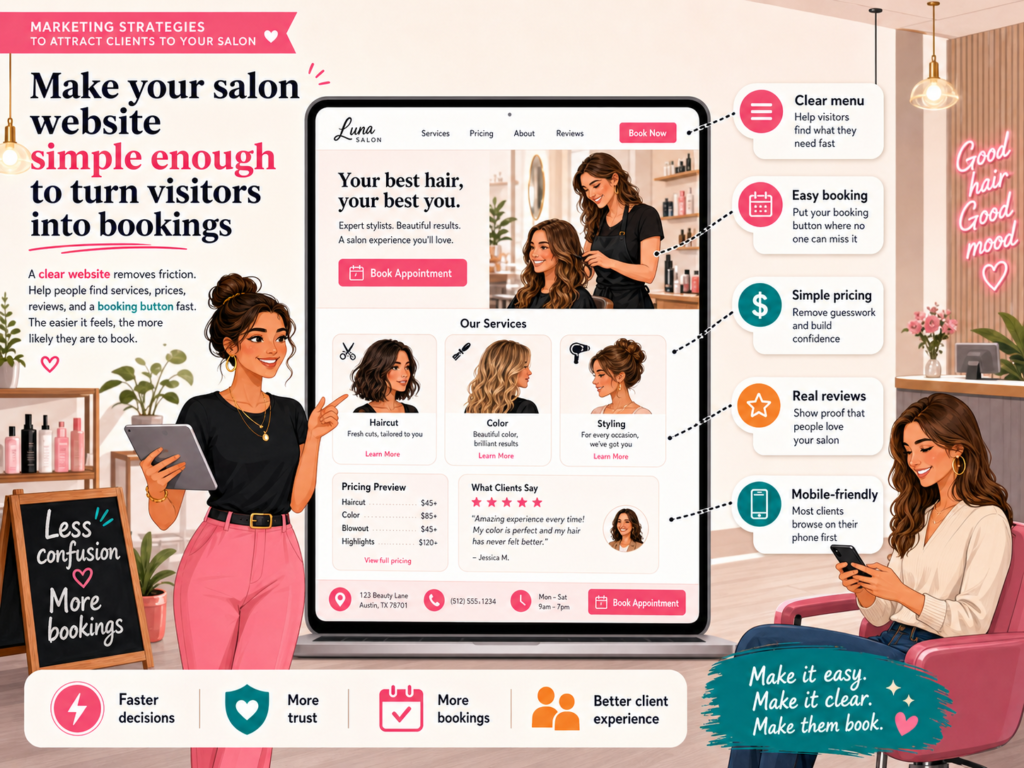
Make your salon website simple enough to turn visitors into bookings
Your website does not need to be fancy to bring in clients. It needs to be clear, fast, helpful, and easy to use. Many salon websites look pretty but do not guide people toward booking. They have beautiful photos, but the service menu is hard to find.
They talk about passion, but do not explain prices, location, hours, or what makes the salon different.
A client who visits your website is already interested. Your job is to remove doubt.
Think of your website as your best front desk person. It should welcome people, answer their common questions, show proof of your work, and make booking feel easy. If your site makes people think too hard, many will leave and choose another salon.
Your homepage should quickly say what your salon does, where you are located, and who you serve best. It should show real photos of your work and your space. It should also have a clear booking button that is easy to see without scrolling too much.
Your service pages should explain more than the service name
A simple list of services is not enough. Many clients do not fully understand what they need. They may not know the difference between balayage and highlights. They may not know whether they need a facial, peel, or cleanup. They may not know how long a keratin treatment lasts.
This is where your service pages can sell without sounding pushy.
For each main service, explain who it is for, what problem it solves, how long it takes, what the client can expect, and how to prepare. You can also explain what happens after the service and when they should return.
This helps clients feel informed. It also makes your salon look more professional.
Make your booking button visible on every important page
Do not hide your booking button at the bottom of the website. Add it near the top, in the menu, on each service page, and after important sections. A client should never have to search for how to book.
The words on the button also matter. “Book Now” is clear. “Start Your Beauty Journey” may sound nice, but it is less direct. Clear words win because clients are busy.
Your contact page should include your address, phone number, WhatsApp if you use it, opening hours, parking details, and a map. These small details reduce friction. When people feel sure about the next step, they are more likely to take it.
Use local SEO so nearby clients find your salon first
Local SEO means helping your salon appear when people nearby search for beauty services. This matters because most salon clients do not want to travel too far. They want a trusted place close to home, work, school, or the places they already visit.
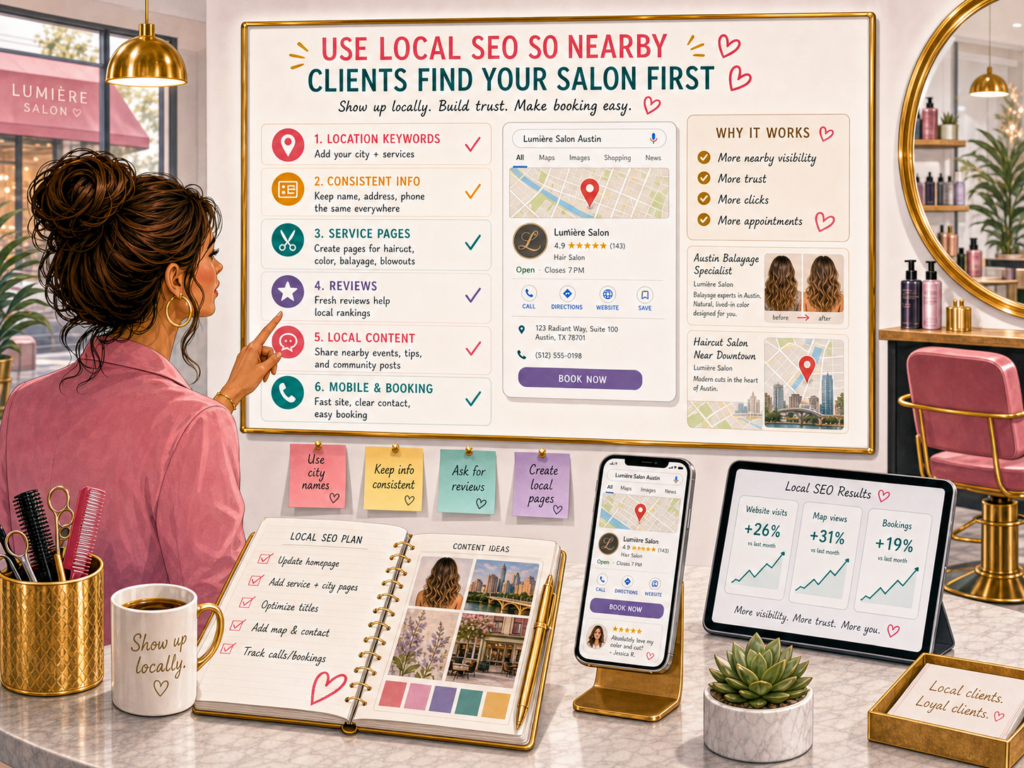
If your salon is not showing up for local searches, you may be losing clients to salons that are not better than you. They are simply easier to find.
Local SEO starts with your Google Business Profile, but it does not stop there. Your website also needs to use local words in a natural way. Your pages should mention your city, neighborhood, and nearby areas you serve. Your content should help Google understand where your salon is and what services you offer.
This does not mean stuffing your website with awkward phrases. It means writing in a way real clients and search engines can both understand.
Create pages for your most valuable services
If hair color is one of your main money-makers, do not hide it under one general “services” page. Create a dedicated page for it. If bridal makeup brings strong bookings, create a page for that too. If facials, nail extensions, waxing, or curly haircuts are important to your salon, each should have its own page.
A dedicated page gives you room to explain the service well. It also gives Google a better reason to show your salon when someone searches for that service nearby.
For example, a page titled “Balayage Hair Color in Miami” is clearer than a general page called “Hair Services.” It speaks to both the client and the search engine.
Write location content that sounds natural and useful
Your website should mention your local area in helpful ways. You can talk about the type of clients you serve in that area. You can mention nearby landmarks if they help people find you. You can explain whether clients visit before work, after school pickup, during lunch breaks, or before events in the city.
This kind of writing feels natural because it is tied to real life.
You can also create simple blog posts that answer local client questions. For example, you might write about the best low-maintenance hair color for humid weather in your city, how to prep skin before wedding season, or what to know before booking bridal makeup in your area.
These posts help you show up in search and build trust before the client ever contacts you.
Turn your salon menu into a smarter sales tool
Your service menu is not just a price list. It is one of your strongest sales tools. A confusing menu can stop people from booking. A smart menu helps clients choose faster and spend more with confidence.
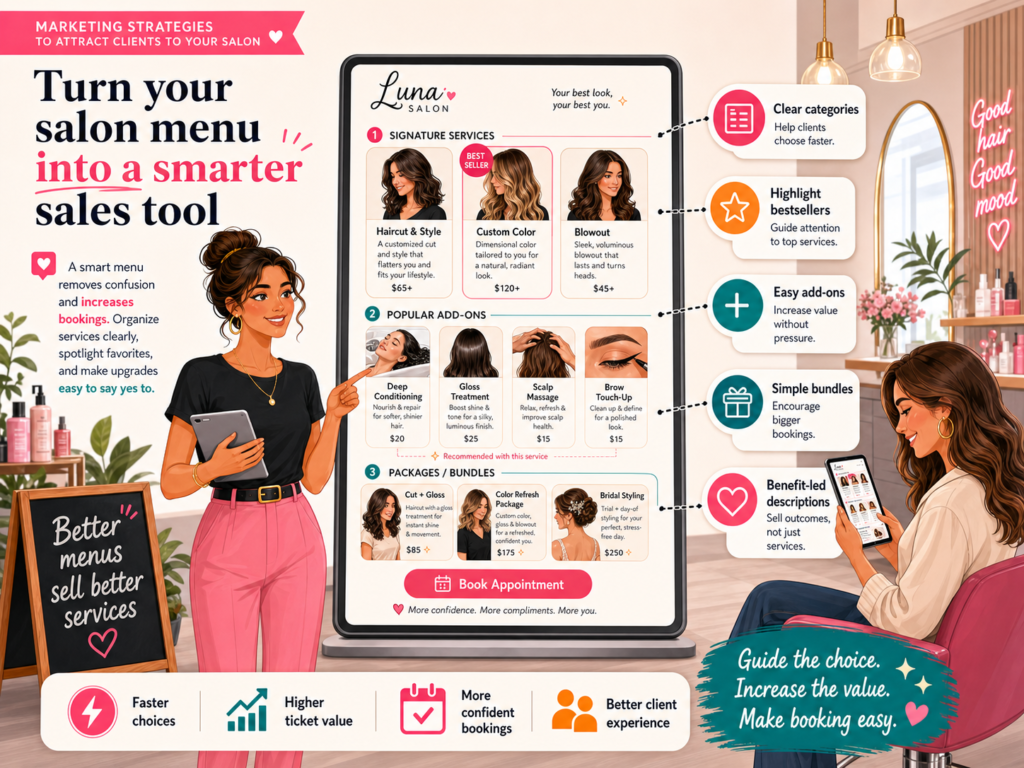
Many salon menus are too long, too vague, or too hard to understand. They list every service, but they do not guide the client. This can make people feel unsure. When clients feel unsure, they delay booking or choose the cheapest option.
A better menu makes the decision easier.
Group your services in a way that matches how clients think. Instead of listing everything in a flat list, organize your menu by goals. Hair color, hair care, styling, skin care, bridal, nails, brows, and body services can each have their own section.
Within each section, explain the result in plain words.
Service names should make the value clear
A service name should not only sound nice. It should help the client understand what they are buying.
For example, “Gloss Treatment” may be clear to a stylist, but not to every client. “Shine and Tone Refresh” may be easier to understand. “Deep Conditioning” is fine, but “Dry Hair Repair Treatment” may speak more directly to someone with a real problem.
This does not mean you need to rename every technical service. It means you should add short explanations that connect the service to the client’s need.
A confused client often asks, “What should I book?” A clear menu answers that question before they ask.
Add guidance without overwhelming the client
Under each key service, include a short note about who it is best for. Keep it simple. For example, a color refresh may be best for clients whose shade has faded but who do not need a full color change. A deep repair treatment may be best for dry, dull, or heat-damaged hair.
You can also mention time and starting price if that fits your business. Clients do not always need the exact final price before consultation, but they do need a basic idea. If your prices change based on hair length, product use, or service type, say that clearly.
The goal is not to explain everything. The goal is to help clients feel safe enough to book.
Use before-and-after content to prove your skill
Before-and-after content works because it shows change. It lets clients see the problem, the process, and the result. For salons, this kind of proof is powerful because beauty decisions feel personal. People want to know that you can handle their hair, skin, nails, or look with care.
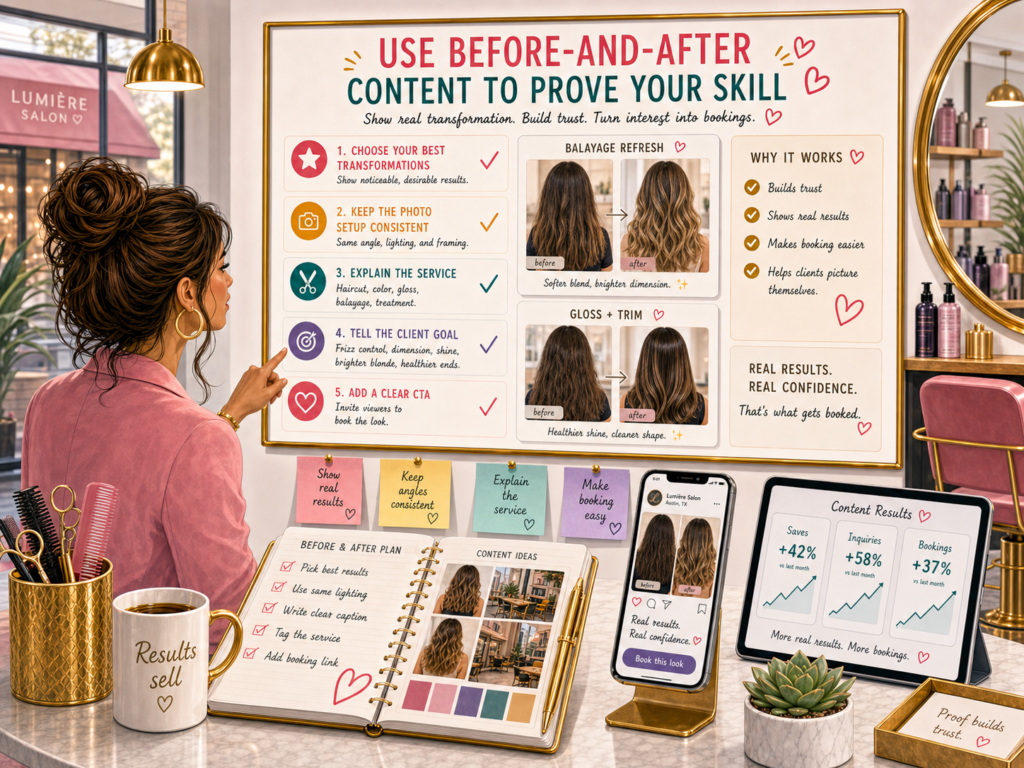
But not all before-and-after posts are equal. A rushed photo with bad lighting may not help much. A strong transformation post tells a story.
Show where the client started. Explain what they wanted. Share what you did. Then show the final result clearly. This turns a simple photo into a trust-building piece of content.
You do not need to make the client look bad in the before photo. The goal is not to shame. The goal is to show the journey.
Good lighting and honest photos build stronger trust
Clients can spot over-edited photos. If the result looks too filtered, it may create doubt. Use clean lighting, clear angles, and honest images. Natural light often works well for hair color and skin results.
Try to take photos in the same spot when possible. This makes your content look more polished and helps people compare the change better.
For hair, show the front, side, and back if it makes sense. For nails, show clean close-ups. For skin, be careful and respectful. Always get permission before posting client photos, especially for face or skin treatments.
Tell the story behind the result
The caption should explain the strategy. For example, if a client came in with dry, uneven color and wanted something softer, explain how you corrected the tone, protected the hair, and created a look that would grow out well.
This shows your thinking. It helps people understand that you are not just doing services. You are solving problems.
A good transformation post can also answer common questions. How long did it take? How many sessions were needed? Is the result easy to maintain? Who is this service best for?
When your content teaches while it sells, people trust you more.
Build a rebooking system that brings clients back before they drift away
Attracting new clients is important, but keeping existing clients is often easier and more profitable. A client who already knows you, trusts you, and likes your work is much more likely to book again. But many salons lose repeat visits simply because they do not ask at the right time.
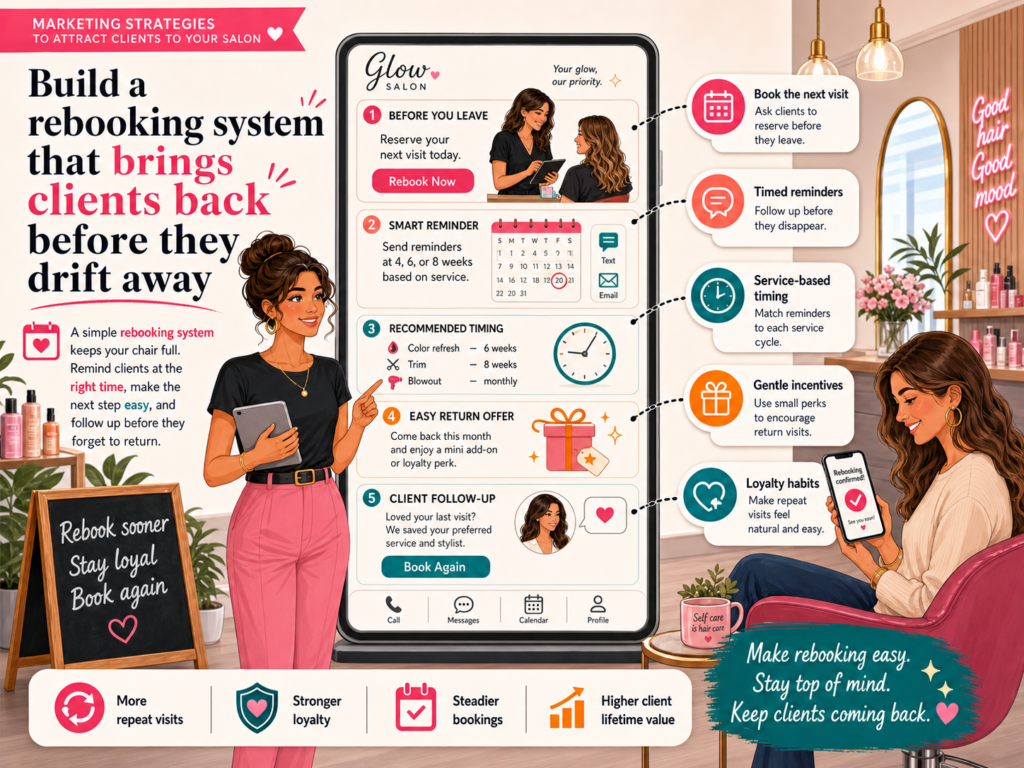
Rebooking should not feel pushy. It should feel helpful.
When a client finishes a service, your team should guide them on when to return. This is part of good care. Hair color needs maintenance. Skin treatments work better with a plan. Nails need regular upkeep. Brows need shaping before they lose form.
If you leave it to the client to remember, many will wait too long or go somewhere else when life gets busy.
Explain the next visit as part of the result
The best time to talk about rebooking is during or right after the service. Do not make it feel like a sales pitch. Tie it to the result they want to keep.
For example, you can say, “To keep this tone fresh, I’d suggest coming back in six weeks for a gloss.” Or, “Your skin should look even better over the next few days. For long-term results, we should plan the next facial in about four weeks.”
This kind of advice feels professional. It shows the client you are thinking beyond today.
Use reminders that feel personal and useful
Automated reminders can help, but they should not sound cold. A simple message can bring clients back without pressure.
You might send a note that says, “Hi Maya, it has been six weeks since your color refresh. This is a good time to book your gloss so the tone stays soft and fresh.”
That feels more helpful than “Book now before slots fill up.”
Your reminder system can be simple. Use your booking software, WhatsApp, email, or text messages. The key is consistency. When clients hear from you at the right time, they are less likely to forget you.
Create referral moments your clients actually want to share
Word of mouth is still one of the strongest ways to grow a salon. People trust friends more than ads. If someone loves their haircut, facial, nails, or bridal look, they may talk about it naturally. But you can make referrals happen more often by creating moments worth sharing.
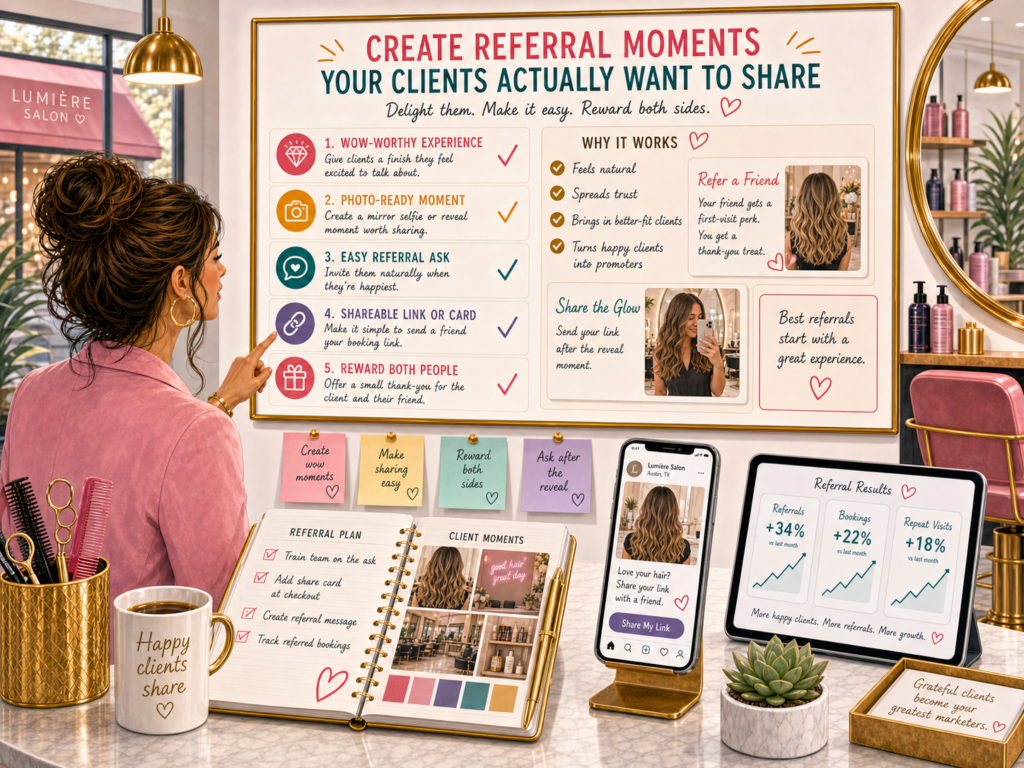
A referral does not start when you ask for one. It starts with the experience.
Clients talk about salons that make them feel seen, cared for, and proud of the result. They talk about small details too. A warm greeting, a clean space, a stylist who listens, a good drink, a relaxing head massage, or a thoughtful aftercare message can all become part of the story.
Make the client feel proud to recommend you
People refer businesses that make them look good. If a client sends her friend to your salon, she wants that friend to have a good experience too. So your brand must feel reliable.
A referral program can help, but it should be simple. Do not make clients follow too many steps. You can offer a thank-you credit, a small service upgrade, or a treatment add-on when they refer someone who books.
The reward does not have to be huge. It just has to feel clear and fair.
Ask for referrals after a strong experience
The right time to ask is after the client is happy. You can say, “I’m so glad you loved it. If you have a friend who has been looking for this kind of color, I’d be happy to take care of her too.”
This sounds natural because it connects the referral to a real result.
You can also send a follow-up message with a soft referral note. Keep it warm. Thank them first. Then let them know you would love to help their friends or family.
The more human the request feels, the better it works.
Use email marketing to stay close without chasing clients
Email may not feel as exciting as Instagram, but it is still a strong tool for salons. Social media depends on algorithms. Email gives you a direct way to reach clients who already know your salon.
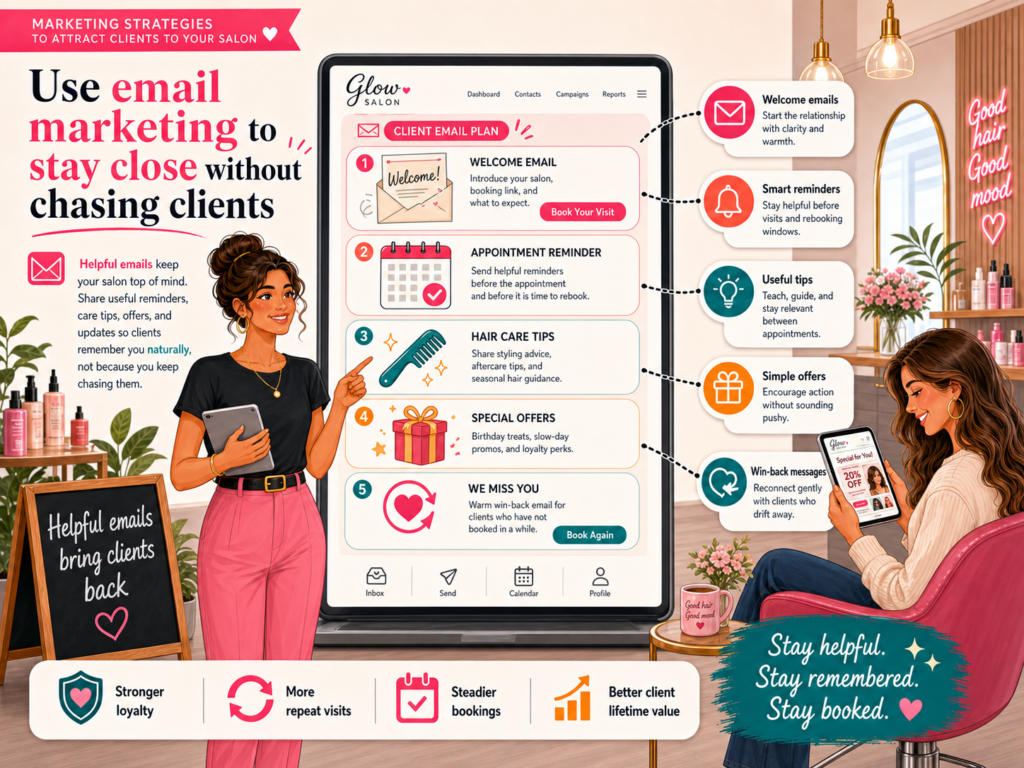
The mistake many salons make is only sending emails when they have a sale. That trains clients to wait for discounts. A better email strategy builds trust, gives helpful tips, shares updates, and gently brings people back.
Your emails do not need to be long. They need to feel useful.
You can send aftercare tips, seasonal service ideas, new treatment updates, stylist notes, birthday messages, and reminders about booking before busy times. The goal is to stay present in the client’s mind without sounding needy.
Send emails based on the client’s service history
The best salon emails feel personal. A client who had hair color should not always get the same message as someone who booked facials. A bride should not get the same message as a monthly nail client.
Even simple grouping can improve results.
You can group clients by service type, visit frequency, or interest. Hair clients can get color care tips. Skin clients can get seasonal skin advice. Bridal clients can get prep timelines. Nail clients can get trend ideas and refill reminders.
This makes your emails feel more relevant.
Write emails like a real person from the salon
Avoid stiff marketing language. Write like you are speaking to a client you know.
For example, instead of saying, “Take advantage of our exclusive seasonal promotion,” say, “The weather is getting drier, so this is a good time to give your hair a little extra care.”
That sounds more natural. It also feels more helpful.
Every email should have one clear next step. Book a treatment. Read a short guide. Reply with a question. Save a date. Claim an appointment. Do not ask the client to do five things at once.
A calm, useful email can bring back clients who were not even thinking about booking yet.
Use text messages carefully so clients feel helped, not chased
Text messages can work very well for salons because they feel direct and personal. Most clients check texts faster than emails. This makes texting useful for appointment reminders, rebooking prompts, last-minute openings, birthday notes, and simple follow-ups.
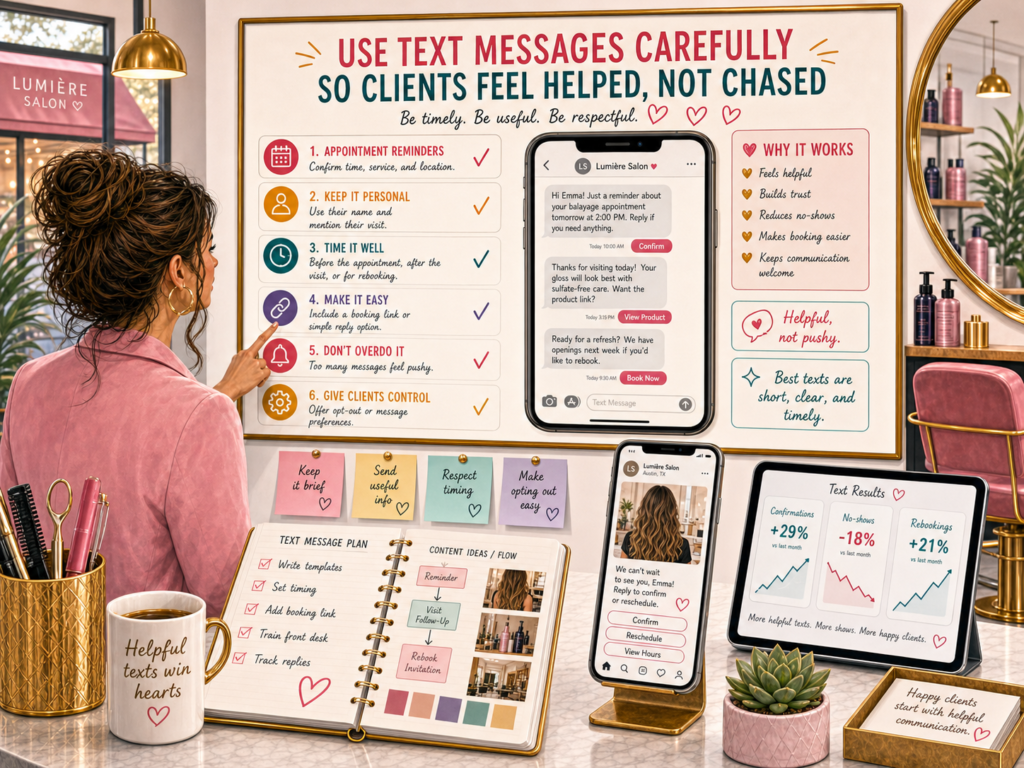
But texting is powerful only when it is used with care.
If you send too many messages, clients may feel bothered. If every message is about selling, they may stop paying attention. The goal is to make each text feel useful, timely, and easy to respond to.
A good salon text should sound like it came from a real person. It should be short, warm, and clear. It should not feel like a loud ad.
Send texts when timing matters
Texting works best when the message is tied to a clear moment. For example, a reminder the day before an appointment is helpful. A message about a last-minute opening can be useful if the client has been waiting for a slot. A rebooking reminder makes sense when enough time has passed since the last service.
Random promotional texts do not work as well because they interrupt the client without a strong reason.
Think about the client’s life. They are busy. They may be at work, with family, driving, cooking, or resting. Your text should respect that. It should help them make a simple choice, not force them to read a long message.
Give clients an easy way to reply
Texting should feel like a conversation. If you say, “We have two color slots open this Friday,” make it easy for the client to reply with “Friday works” or “What time?”
Do not send a message that makes them click through five pages just to ask a question. For many salon clients, a simple reply is the easiest path to booking.
You can also use texts for thoughtful follow-ups. After a hair color appointment, you might ask how the color is settling. After a facial, you might remind the client to use sunscreen and avoid harsh products for a day or two. These small messages show care. They also make your salon feel more professional.
When clients feel cared for after they pay, they are more likely to return.
Make your salon content answer the questions clients are afraid to ask
Many clients have questions before booking, but they do not always ask them. They may feel embarrassed, unsure, or worried about sounding silly. This is especially true with beauty services because people are often talking about their appearance, skin, hair damage, aging, body hair, or personal style.
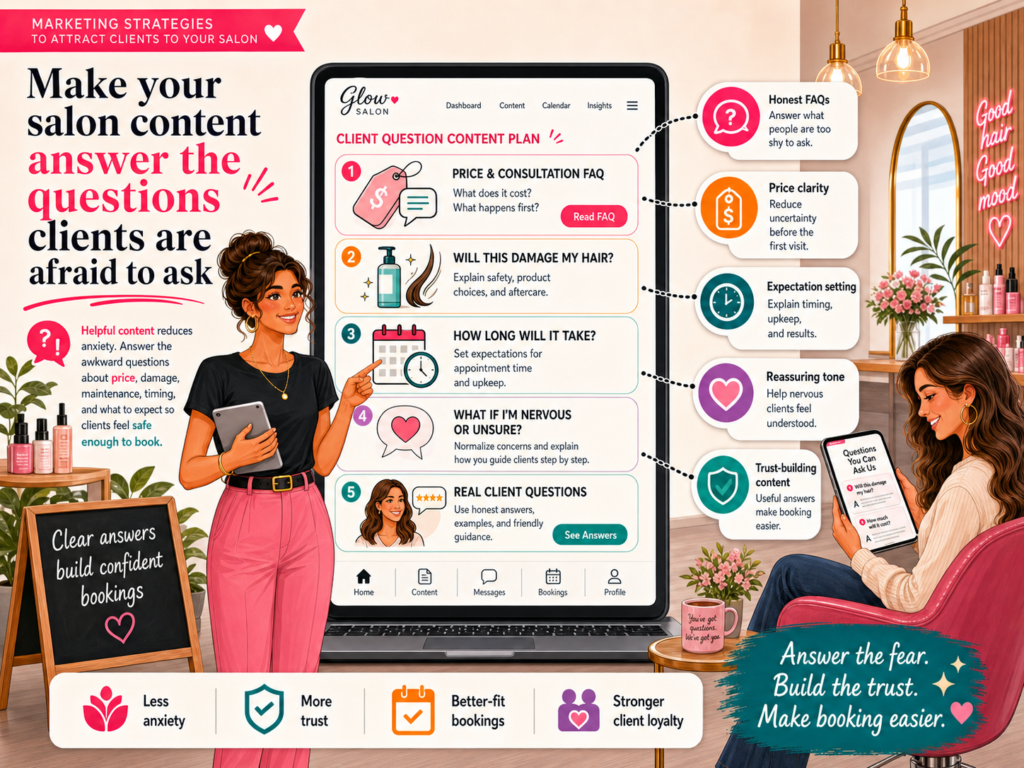
Your content can remove that fear.
When your posts, blogs, captions, and videos answer real questions in simple words, clients feel safer. They begin to trust you before they ever sit in your chair.
This is one of the best ways to attract clients who are serious, informed, and ready to book.
Instead of only showing finished looks, talk about what clients want to know. Explain how often to get a trim. Explain when hair color needs more than one session. Explain what a facial can and cannot do. Explain why a patch test matters. Explain how to choose the right nail shape. Explain how to prepare for bridal makeup.
Teach in a way that feels calm and kind
The goal is not to make clients feel wrong. The goal is to guide them.
For example, do not say, “Stop making this mistake with your hair.” That can sound harsh. Instead, say, “If your color fades quickly, this may be why.” That feels more helpful.
Kind teaching builds trust. It shows that your salon is not judging the client. You are helping them make better choices.
Clients often book with the salon that explains things clearly because clarity reduces fear.
Turn common chair conversations into content
Your best content ideas are already happening inside your salon. Every question a client asks during a visit can become a post, a short video, an email, or a blog section.
If three clients ask whether keratin treatment damages hair, make content about it. If people keep asking how long balayage takes, explain it. If brides ask when to start skin prep, turn that into a simple guide.
This kind of content works because it comes from real client concerns. It is not random. It is based on what people already care about.
Over time, your salon becomes known as the place that explains beauty in a simple and honest way. That can be a major reason people choose you over another salon.
Build service packages that make decisions easier
Too many choices can stop people from booking. A salon menu with dozens of services may look complete, but it can also feel confusing. Clients often do not know what they need. They just know what result they want.
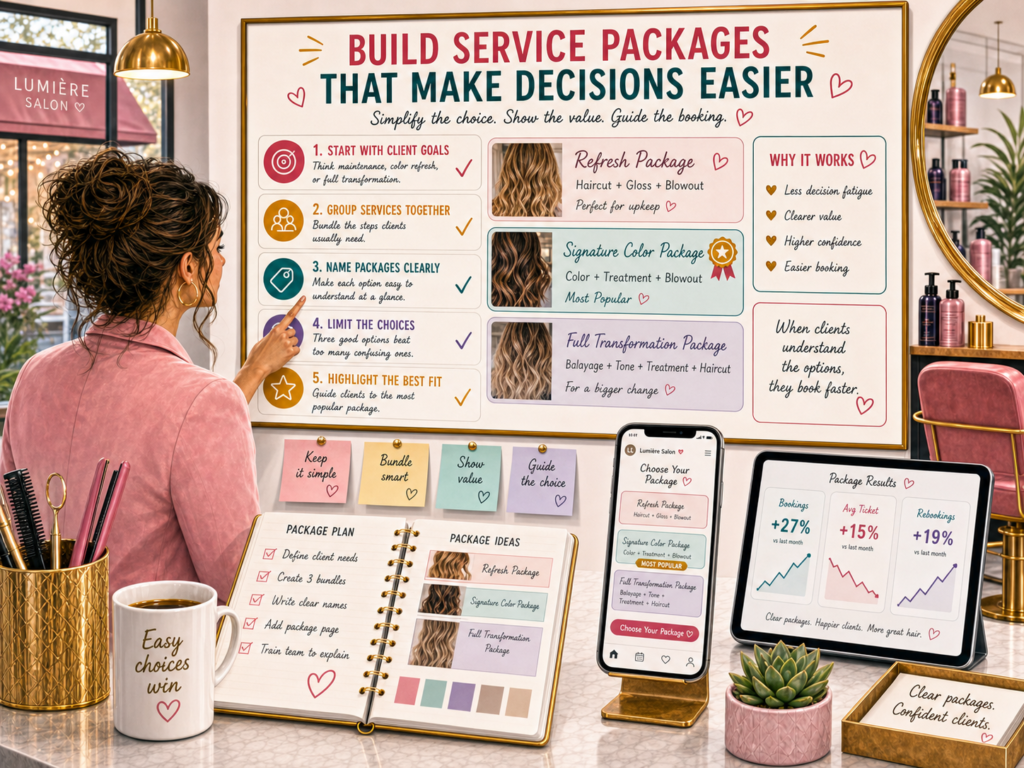
This is why service packages work so well.
A package takes several services and groups them around one clear outcome. It helps the client choose without needing to understand every detail. It also helps your salon increase booking value without pushing random add-ons.
A good package should feel like a solution, not a bundle made only to raise the bill.
For example, a client does not wake up wanting “toner plus gloss plus blow dry.” She wants her color to look fresh again. So a package called “Color Refresh Visit” may make more sense. It speaks to the result in her mind.
Name packages after the result clients want
The name of the package matters. A good name makes the value easy to understand.
A “New Client Hair Plan” feels more useful than “Package A.” A “Bridal Glow Prep” sounds clearer than “Facial Combo.” A “Healthy Hair Repair Visit” speaks better than “Treatment Bundle.”
The name should help the client picture the outcome. It should also help your team explain the package easily during calls, chats, and consultations.
Packages are especially useful for first-time clients, brides, color clients, skin clients, and anyone who needs a series of visits.
Keep the package promise clear
Every package should answer one simple question: what will this help the client achieve?
If the package is for damaged hair, explain that it helps hair feel softer, smoother, and easier to manage. If it is for bridal skin, explain that it helps the skin look more even and makeup-ready over time. If it is for nails and brows, explain that it helps the client look polished for a trip, event, or busy week.
Also make the terms clear. Say what is included, how long it takes, whether consultation is needed, and whether the price starts from a certain amount.
Clear packages sell better because they lower doubt.
Use paid ads only after your booking path is ready
Paid ads can bring new people to your salon fast, but they can also waste money if your basics are weak. If your website is confusing, your booking page is slow, your Google reviews are poor, or your offer is unclear, ads will not fix the problem. They will simply send more people into a weak system.
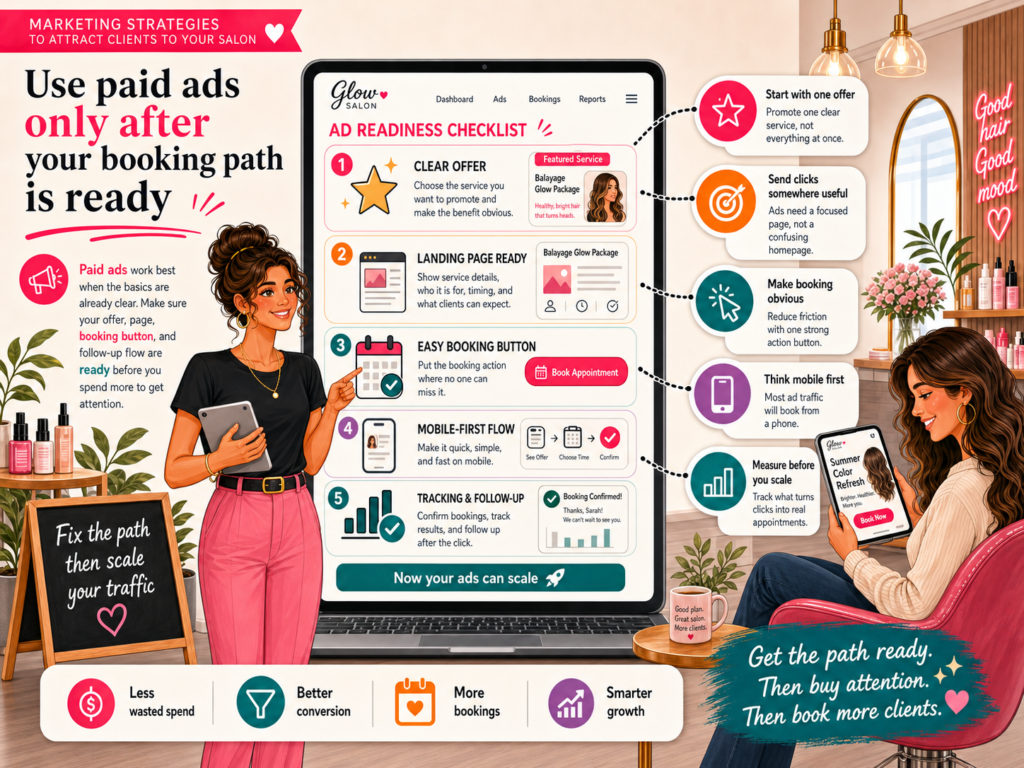
Before spending on ads, make sure your salon is ready to convert attention into bookings.
This means your photos should look strong. Your reviews should create trust. Your service pages should explain what you offer. Your booking process should be easy. Your team should answer messages quickly. Your offer should be clear.
Once these pieces are in place, paid ads can work much better.
Start with one service and one audience
Many salons make the mistake of advertising everything at once. They run ads for hair, nails, facials, bridal, waxing, and offers in one campaign. This makes the message weak.
It is better to choose one high-value service and one clear audience.
For example, you might run ads for bridal makeup to women recently engaged in your local area. Or you might promote balayage to women within a few miles of your salon. Or you might run a skin treatment offer for clients preparing for events.
A focused ad is easier to write, easier to target, and easier to measure.
Send ad traffic to the right page
Do not send every ad to your homepage. If the ad is about bridal makeup, send people to a bridal page. If the ad is about hair color, send them to a color page. If the ad is about facials, send them to a facial page.
The page should match the promise of the ad. It should show photos, explain the service, include reviews, answer common questions, and make booking easy.
This is how you turn ad clicks into real appointments.
Ads do not work because people see them once. They work when the message, offer, proof, and booking path all fit together.
Build a social proof system, not just a review collection
Social proof means showing that real people trust your salon. Reviews are part of it, but they are not the whole thing. Client photos, video reactions, testimonials, tagged posts, repeat visits, press mentions, awards, and even behind-the-scenes moments can all build social proof.
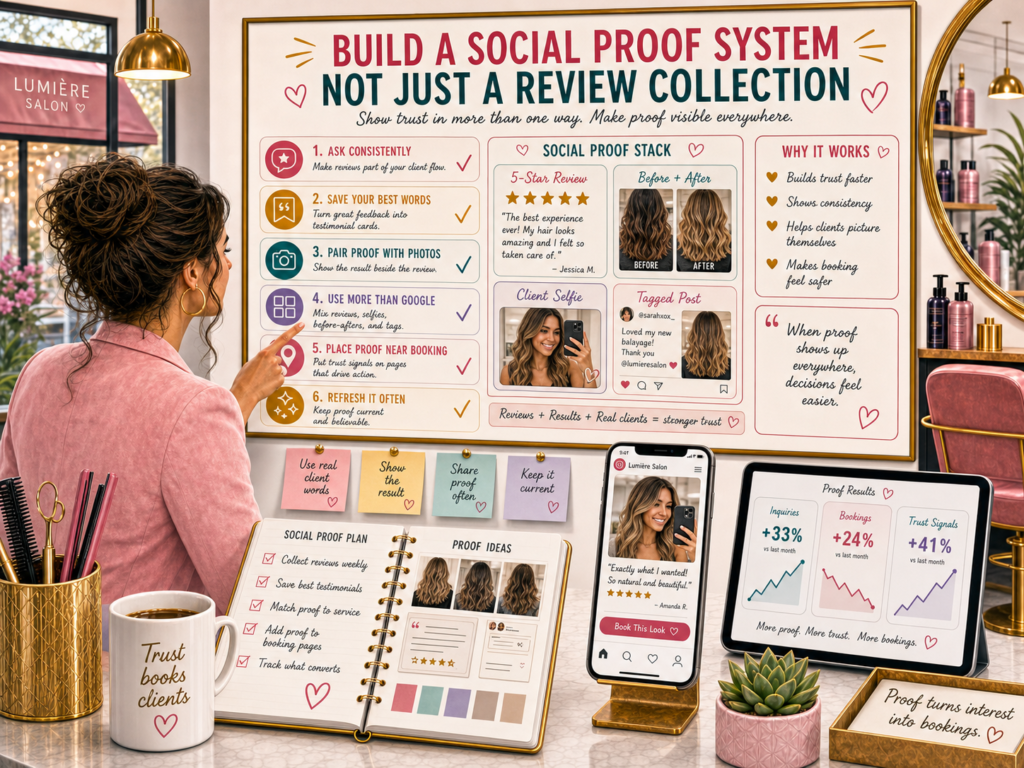
People want to feel safe before choosing a salon. They want signs that others have had a good experience. Social proof gives them that comfort.
But it needs to be visible. If your reviews are only on Google and your client photos are buried deep on Instagram, many new clients may never see them.
You need to use social proof across your marketing.
Place proof where clients make decisions
Add reviews to your website service pages. Share client quotes in Instagram captions. Save client transformations in highlights. Add testimonials to your booking page. Use short review screenshots in stories. Mention real client results in emails.
Do not make people search for proof. Put it close to the booking decision.
For example, if someone is reading your bridal makeup page, they should see bridal reviews and bridal photos. If someone is looking at hair color, they should see color transformations and comments from color clients.
Proof works best when it matches the service the client wants.
Ask for different types of proof
Not every client wants to record a video or post a photo. That is okay. Give them simple options.
Some may leave a Google review. Some may let you share a back-view hair photo. Some may send a text saying they loved the result. Some may tag your salon in a story. Some may give a short quote for your website.
Each type of proof has value.
The key is to collect it often and use it well. Social proof should become part of your weekly marketing rhythm, not something you think about only when bookings slow down.
Use events and local partnerships to get in front of better clients
Your salon is a local business. That means some of your best marketing can happen close to home. Local events and partnerships help you reach people who live, work, shop, and celebrate near your salon.
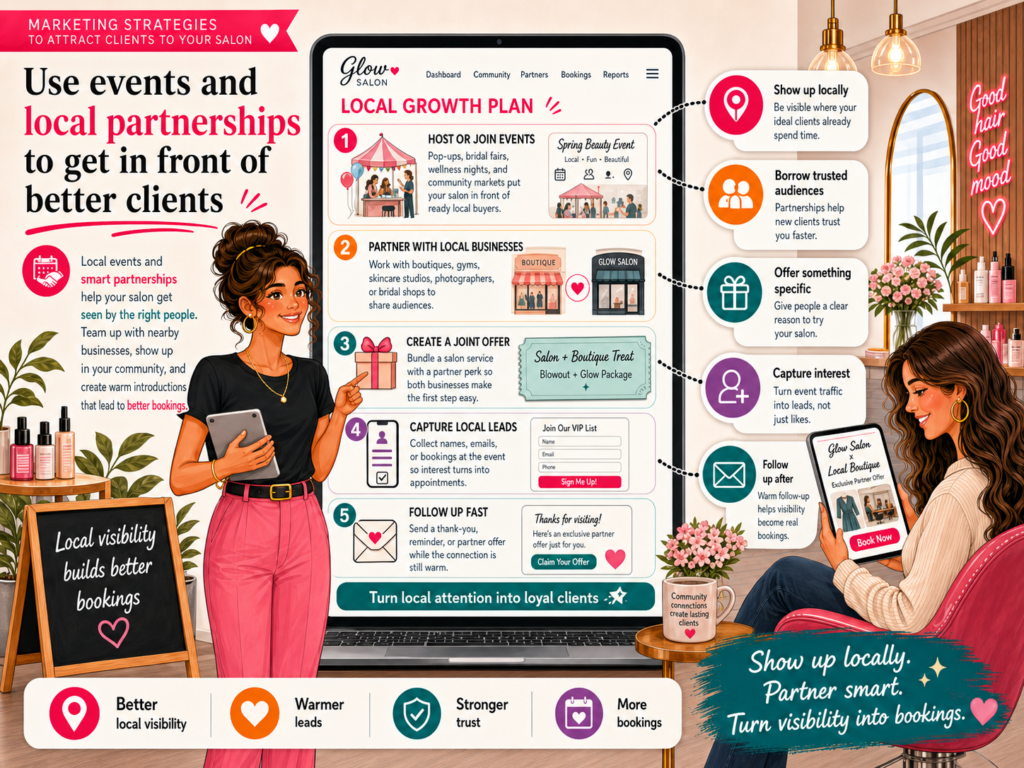
This works especially well because trust can transfer. If a local boutique, gym, wedding planner, photographer, café, or wellness studio introduces your salon to their audience, you are no longer a stranger. You arrive with a small layer of trust already built in.
The best partnerships are not random. They should connect to the kind of clients you want.
A bridal salon can partner with wedding planners, photographers, dress shops, florists, and venues. A premium hair salon can partner with boutiques, fitness studios, and personal stylists. A skin-focused salon can partner with wellness clinics, yoga studios, or makeup artists.
Create partnerships that help both sides
A good partnership should not feel like begging for referrals. It should help the other business too.
For example, you could offer a mini styling session for a boutique’s client event. The boutique gets a better event experience, and your salon meets potential clients. You could create a bridal prep guide with a photographer. They share it with brides, and you both look more helpful.
You could also offer preferred client perks between businesses, but keep them simple.
The goal is shared trust, not complicated deals.
Make the next step easy after the partnership
If you meet potential clients at an event, do not let the connection end there. Have a simple next step ready.
You might offer a consultation booking link, a first-visit package, a skin prep guide, or a styling checklist. You can invite people to follow your Instagram, join your email list, or message your salon for a personal recommendation.
Do not rely on people remembering you later. Give them a reason to act while the interest is fresh.
Local partnerships grow slowly, but they can bring high-quality clients because the connection starts with trust.
Create a client experience that markets your salon for you
Marketing does not stop when the client books. In many ways, that is where the most important marketing begins. Every part of the client experience either supports your marketing or weakens it.
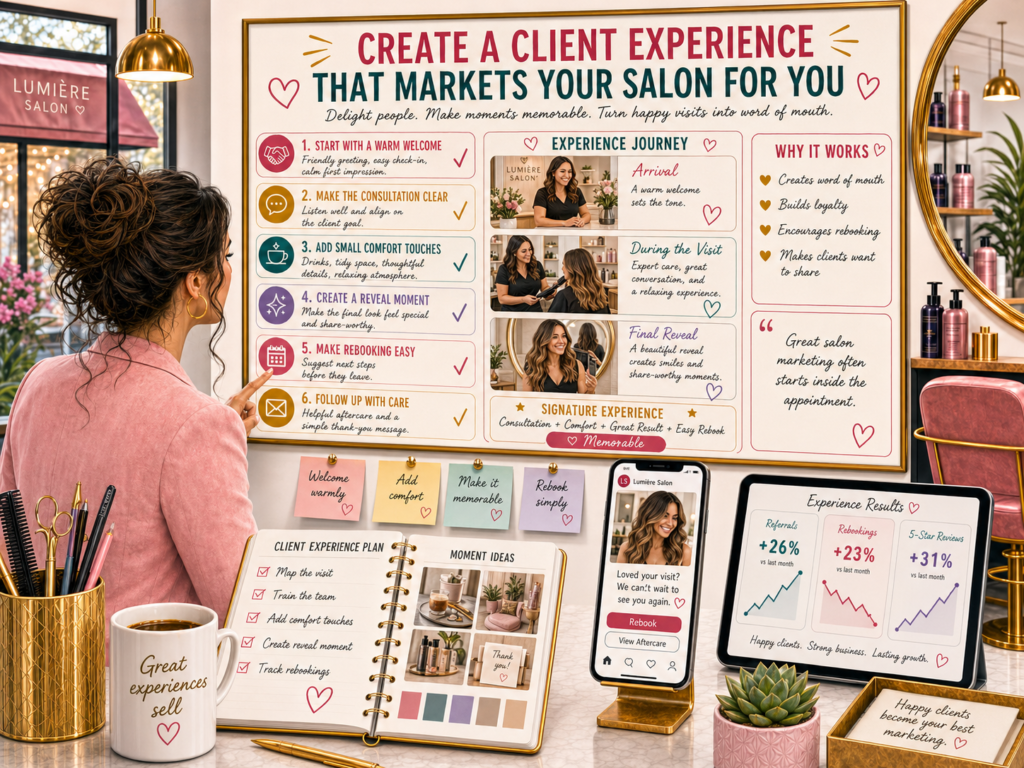
If your ads look polished but your salon feels rushed, clients may not return. If your Instagram looks warm but your front desk feels cold, trust breaks. If your services are good but follow-up is poor, referrals may not happen.
The experience must match the promise.
A strong client experience turns clients into repeat buyers, reviewers, referrers, and fans. It gives people a story to tell. That story becomes marketing you do not have to pay for.
Make every visit feel guided from start to finish
Clients like to feel taken care of. They do not want to feel lost, ignored, or unsure.
The experience should be smooth from the first message to the final goodbye. Respond quickly when they ask questions. Confirm the appointment clearly. Welcome them warmly. Explain what will happen. Listen before giving advice. Check comfort during the service. Show the final result with care. Explain aftercare in simple words.
These steps may seem basic, but they are not small. They shape how the client feels.
A client may forget every product you used, but she will remember whether she felt heard.
Use aftercare as part of the experience
Aftercare is a powerful marketing tool because it shows the client you care after the payment is done.
Send simple aftercare notes based on the service. For hair color, explain how to keep the shade fresh. For skin treatments, explain what to avoid and what to use. For nails, explain how to protect them. For bridal clients, send prep tips before the event.
This small habit can make your salon feel more professional than others.
It also reduces complaints because clients know how to care for the result. Better results lead to happier clients. Happier clients lead to more reviews, referrals, and repeat visits.
Conclusion
Attracting clients to your salon is not about doing more random marketing. It is about building a clear system that helps the right people find you, trust you, book with you, return often, and tell others about you.
When your brand is clear, your Google profile is active, your reviews are strong, your content is useful, and your client experience feels personal, your salon becomes easier to choose. Start with one strategy, improve it, then move to the next. Small, steady actions can turn your salon into the place clients remember, recommend, and come back to.










Comments are closed.