
WinSavvy Editorial Standards
How this article was created
Autumn is more than a change in weather. It is a change in mood, habits, spending, and attention. People come back from summer trips. Families return to routines. Businesses start pushing harder before the year ends. Shoppers begin thinking about holidays, gifts, home comfort, personal goals, and fresh plans. In other words, autumn gives brands a rare chance to meet customers when they are ready to act.
Build Your Autumn Campaign Around How People Feel, Not Just What They Buy
Autumn marketing works best when it starts with the customer’s mood. This season has a very clear feeling. People are slowing down after summer, getting back into routines, thinking about family, planning for the end of the year, and looking for comfort. Your campaign should speak to that shift.

A weak autumn campaign says, “Fall sale is here.” A stronger one says, “Make this season feel easier, warmer, calmer, and more rewarding.” That is the real difference. You are not just selling a product. You are fitting your offer into the way people already think during this time of year.
Understand the emotional change that comes with autumn
People do not enter autumn with the same mindset they had in July. In summer, they often want fun, travel, freedom, and escape. In autumn, they want focus, comfort, order, and preparation. They are open to buying things that help them feel ready, relaxed, organized, or ahead of schedule.
For example, a skincare brand can talk about protecting skin from cooler weather. A SaaS company can talk about getting systems in shape before the year ends. A home decor brand can talk about making the house feel warm and welcoming. A fitness brand can talk about building a steady routine before the holidays.
The product may stay the same, but the reason to buy changes.
Connect your offer to a seasonal problem your customer already feels
The easiest way to make your autumn campaign stronger is to ask one simple question: what problem becomes more important for our customer during autumn?
A busy parent may need smoother school routines. A business owner may need stronger Q4 results. A homeowner may want a more comfortable space. A shopper may want to buy gifts early without stress. A student may want better focus. A local restaurant customer may want cozy meals and seasonal flavors.
Once you find that seasonal problem, your message becomes sharper. Instead of using autumn as a theme, you use it as a reason to act.
Your campaign should not say, “Buy this because it is autumn.” It should say, “This season brings a challenge, and we can help you handle it better.”
Use autumn language without sounding forced
Seasonal copy can become cheesy very quickly. Words like “spice up,” “cozy,” “fall into savings,” and “pumpkin season” can work, but only when they feel natural. If every line sounds like a greeting card, customers stop paying attention.
The better move is to use autumn language in a way that supports the message. Talk about fresh starts, cooler days, busy schedules, earlier evenings, year-end goals, family plans, school routines, holiday prep, home comfort, and smart timing. These ideas feel seasonal without being too obvious.
For WinSavvy-style marketing, the goal is not to sound cute. The goal is to sound useful, timely, and human.
Write copy that sounds like a real person understands the season
A strong autumn message might say, “The year is moving fast, but there is still time to fix what is not working.” That feels more human than “Fall into better marketing results.” It speaks to a real feeling many business owners have in autumn.
Another example could be, “Before holiday traffic gets expensive, now is the time to clean up your campaigns.” This is clear, direct, and tied to the season. It gives the reader a reason to act now.
Good seasonal copy does not need to shout. It needs to make the customer think, “Yes, that is exactly where I am right now.”
Refresh Your Content Strategy Before the Holiday Rush Begins
Autumn is one of the best times to improve your content because people are actively searching, comparing, planning, and preparing. They are not always ready to buy at once, but they are often ready to learn. This makes autumn a smart season for blog posts, guides, landing pages, email content, social posts, and lead magnets.
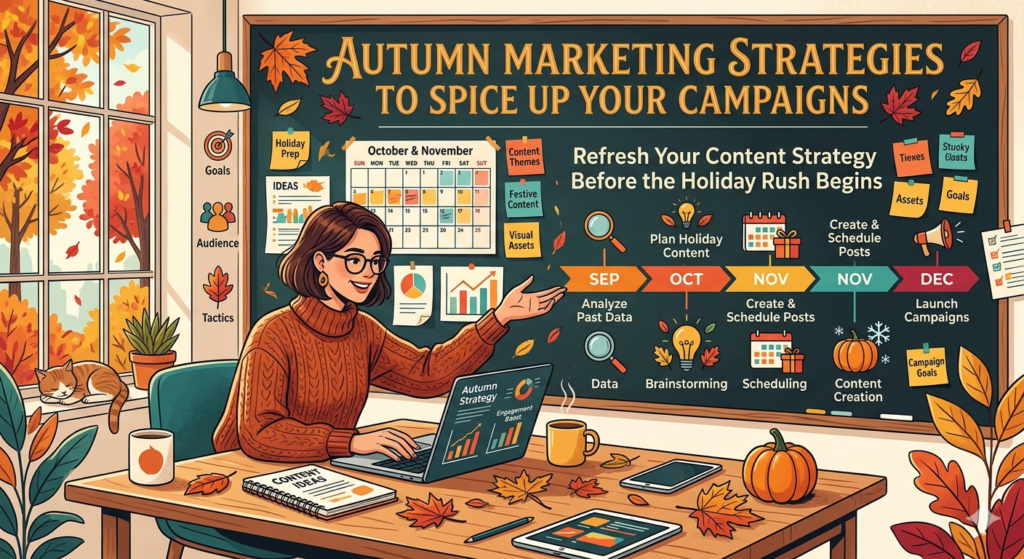
The key is to create content that helps people make better choices before the busiest buying season arrives. If your content only appears when everyone else is running holiday ads, you are late. Autumn gives you a head start.
Create content for people who are planning ahead
Many customers start thinking about holiday needs, year-end goals, winter problems, and budget choices during autumn. Your content should meet them at that planning stage.
A digital marketing agency could publish content about preparing paid ads before Black Friday, improving website speed before holiday traffic, updating SEO pages before Q4, or building email lists before December.
An ecommerce brand could create gift guides, product care tips, autumn trend articles, or comparison pages. A service business could write about year-end checkups, seasonal maintenance, or planning for the new year.
This kind of content works because it reaches customers before the final buying moment. It builds trust early.
Focus on questions customers ask before they spend
The best autumn content often comes from simple customer questions. What should I prepare before winter? What should I buy early? How can I save money before the holidays? What mistakes should I avoid before the year ends? What can I fix now so I do not struggle later?
These questions are powerful because they show intent. The person may not be ready to buy today, but they are moving closer. If your brand gives them a clear, helpful answer, you become part of their decision process.
Do not write content just to fill a calendar. Write content that helps your customer make a smart move this season.
Update old content with autumn angles
You do not always need to create new content from scratch. Autumn is a good time to refresh old blog posts, service pages, and landing pages with stronger seasonal hooks. This can help your content feel current while saving time.
For example, a general article about email marketing can become more useful with a section on autumn email campaigns. A page about SEO audits can include a year-end search visibility angle. A product page can mention how the product fits colder weather, school routines, holiday planning, or Q4 goals.
This does not mean stuffing autumn words into every page. It means adding useful seasonal context where it makes sense.
Improve the first few lines of important pages
One of the fastest content wins is to update the opening lines of your highest-value pages. The first few lines decide whether someone keeps reading. During autumn, those lines should quickly show why your offer matters right now.
For example, instead of opening a marketing service page with a broad line like, “We help businesses grow online,” you could say, “Autumn is the time to fix weak campaigns before holiday costs rise and year-end targets get harder to reach.”
That sentence gives urgency. It shows timing. It speaks to a real business concern. Most importantly, it gives the visitor a reason to stay.
Use Email Marketing to Warm Up Buyers Before Peak Season
Email is one of the strongest channels for autumn because it lets you build interest before customers are ready to make a final choice. Instead of waiting until Black Friday, Christmas, or year-end promotions, you can use autumn to prepare your audience step by step.
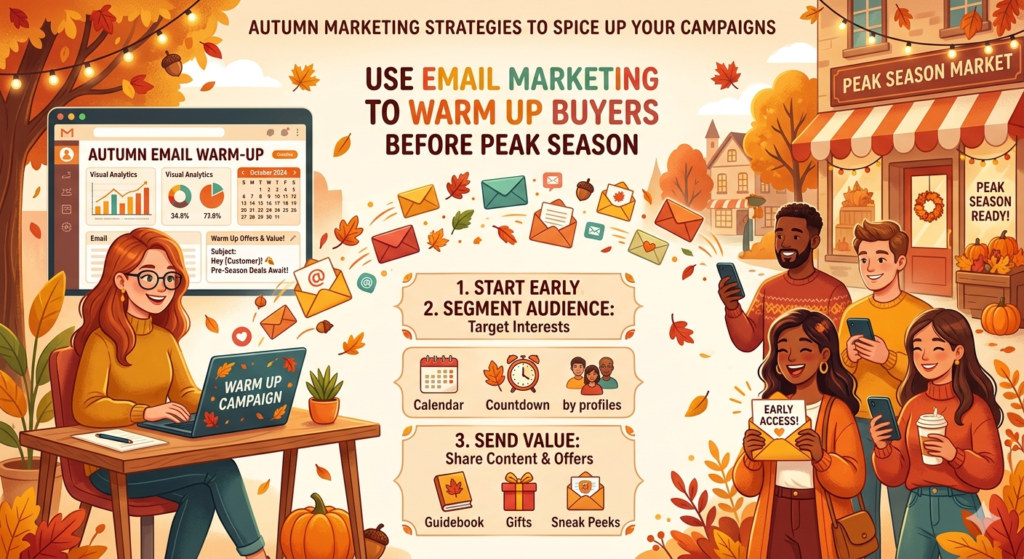
The mistake many brands make is sending only sales emails. That turns the inbox into a discount board. A better autumn email strategy mixes useful advice, timely reminders, product education, soft offers, and stronger calls to action as the season moves forward.
Start with value before you push the sale
In early autumn, your emails should not feel too aggressive. People are getting back into routines, and many are still planning. This is the time to educate, inspire, and guide.
A brand selling home products can send tips on making the home feel warmer. A B2B company can send a checklist for improving year-end performance. A fitness brand can send a routine reset plan. A marketing agency can send a campaign readiness guide.
This kind of email builds trust. It makes later sales emails feel more natural because you have already helped the reader.
Write emails that feel like useful reminders
The best autumn emails often feel like a smart friend pointing something out at the right time. They do not need heavy design or long copy. They need a clear reason for being in the inbox.
An email could open with, “Before the holiday rush begins, this is a good time to check whether your website is ready for more traffic.” That line works because it is timely and useful. It does not beg for attention. It earns it.
Every email should answer one silent question in the reader’s mind: “Why should I care about this today?” If your email cannot answer that, it is not ready.
Segment your list based on seasonal intent
Not every subscriber should get the same autumn message. Some people are new leads. Some are past buyers. Some clicked but never purchased. Some bought last year during the same season. Some opened several emails but took no action.
These groups need different messages.
A past buyer may need a reminder to reorder, upgrade, renew, or prepare early. A new lead may need education and trust-building. A cold subscriber may need a simple re-engagement email. A high-intent lead may need a direct offer or consultation invite.
Segmentation makes your emails feel more personal without needing complex wording.
Use customer behavior to decide the next message
Autumn campaigns become much stronger when your emails respond to what people do. If someone clicks a guide about holiday planning, send them a related offer. If someone views a product but does not buy, send a helpful comparison or a reminder.
If someone has not opened emails in months, send a simple “still interested?” message with a clear reason to stay subscribed.
This approach feels natural because the message matches the person’s action. It also reduces wasted emails.
The more relevant your autumn emails are, the less you need to rely on big discounts.
Turn Autumn Offers Into Smart Reasons to Act
Autumn offers do not have to be loud or cheap. In fact, the best seasonal offers often do more than cut the price. They give customers a timely reason to move now.
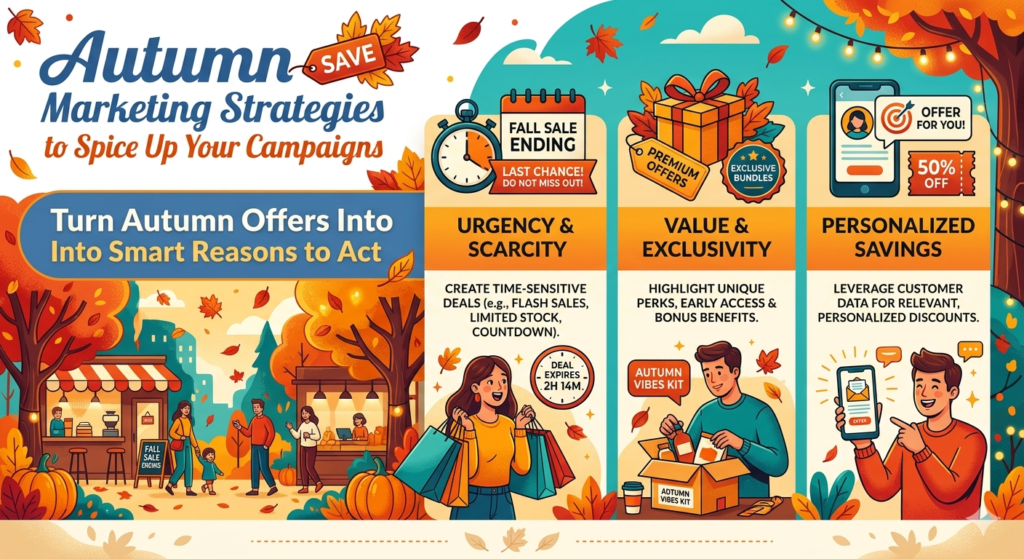
A discount can work, but it should not be the only tool. You can offer bundles, early access, seasonal packages, limited-time bonuses, free checks, planning sessions, gift-ready options, loyalty rewards, or upgrade paths. The aim is to make the offer feel useful for this season, not random.
Build offers around timing, not pressure
Customers are tired of fake urgency. They know when a countdown timer means nothing. Autumn gives you real urgency because the season naturally leads into busier months. Use that honestly.
For example, a service business can say, “Book your campaign audit now so changes are live before holiday traffic peaks.” An ecommerce brand can say, “Order early to avoid last-minute gift stress.” A local business can say, “Reserve your autumn appointment before weekend slots fill.”
These messages work because the timing is real. The customer can understand why acting now helps them.
Make the benefit of early action clear
A good autumn offer should explain what the customer gains by acting early. Do they save time? Avoid stress? Get better results? Beat higher ad costs? Prepare before the holidays? Lock in a better date? Get first choice? Reduce risk?
Do not just say, “Limited time offer.” Say why the time matters.
For a marketing agency, this could mean offering an autumn campaign audit that helps clients fix weak ads, landing pages, and email flows before holiday competition gets expensive. The offer is not just “audit available now.” The offer is “find the leaks before peak season makes those leaks cost more.”
That is a stronger reason to act.
Create bundles that feel seasonal and practical
Autumn is a great time for bundles because people are thinking in sets. They want routines, plans, kits, packages, and easier decisions. A bundle can reduce choice stress and raise order value at the same time.
A skincare brand could create a cold-weather care set. A food brand could create a cozy meal pack. A consultant could create a year-end planning package. A software company could bundle setup support with a quarterly subscription.
A digital agency could bundle SEO cleanup, email planning, and landing page review into a pre-holiday growth package.
The best bundles feel like they were made for a real seasonal need.
Give the bundle a clear outcome
Do not bundle items just because they are related. Bundle them because together they help the customer reach a clear result.
For example, “Autumn Growth Kit” is vague on its own. But “Autumn Growth Kit: clean up your website, warm up your email list, and prepare your ads before holiday traffic rises” is much stronger. It tells the buyer what the package is meant to do.
A clear outcome makes the bundle easier to understand, easier to sell, and easier to remember.
Use Autumn SEO to Capture Early Search Demand
Autumn SEO is not only about ranking for “fall marketing ideas” or “autumn sale.” It is about understanding what people start searching for when the season changes. Their needs shift, their questions change, and their buying timeline becomes more serious.
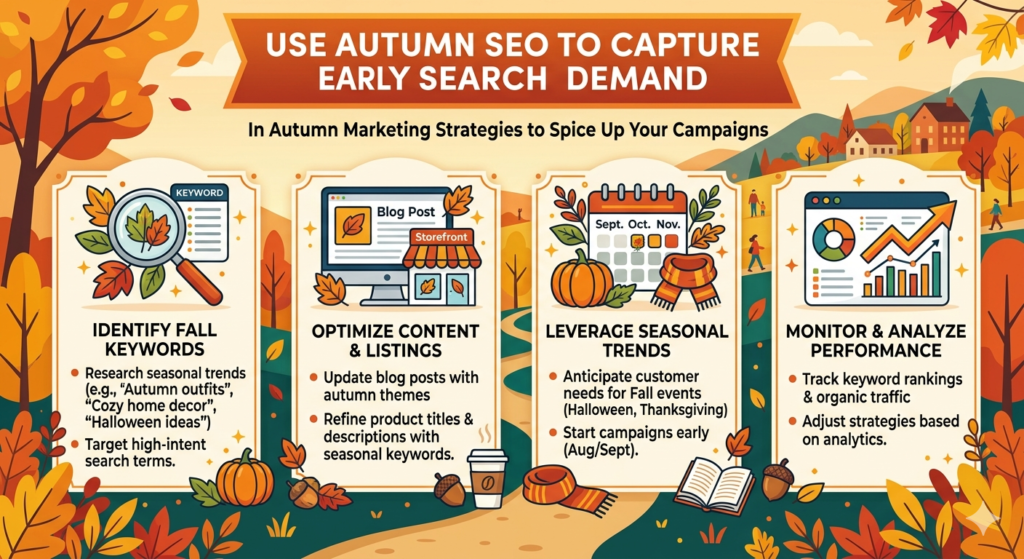
This is why autumn is a strong time to update your search strategy before the holiday rush becomes too crowded.
Many brands wait until November to work on seasonal SEO. By then, they are already late. Search engines need time to crawl, understand, and rank content. Customers also need time to discover your brand, compare options, and build trust. Autumn gives you the space to reach them before they are flooded with ads and offers.
Search for seasonal intent, not just seasonal keywords
A seasonal keyword is easy to spot. It may include words like autumn, fall, Halloween, Thanksgiving, Black Friday, winter prep, or holiday planning. But seasonal intent is deeper. It is the reason behind the search.
For example, someone searching for “how to prepare my website for holiday traffic” may not use the word autumn at all, but the intent is clearly seasonal. Someone searching for “best email campaign ideas for Q4” is also showing autumn intent. They are preparing for what comes next.
This is where smart SEO wins. You do not only target the obvious words. You target the questions and concerns that grow during the season.
Build pages around problems that become urgent in autumn
Start by looking at what your audience worries about between September and November. Business owners may worry about hitting year-end targets. Ecommerce teams may worry about rising ad costs. Local shops may worry about foot traffic.
Coaches and consultants may worry about filling their calendar before the holidays. Home service companies may worry about winter bookings.
Each of these worries can become a useful page, blog post, or landing page.
A digital marketing agency could create content around autumn website audits, Q4 campaign planning, pre-holiday SEO fixes, year-end lead generation, or email list growth before Black Friday. These topics are not random. They match the customer’s calendar and help them take action before pressure builds.
Good autumn SEO meets the customer before the panic starts.
Refresh pages that already have traffic
One of the fastest ways to improve autumn SEO is to update pages that already get visitors. You do not always need new content. Sometimes, the best move is to make existing content more timely, more complete, and more useful.
Look at your best blog posts, service pages, and landing pages. Ask whether they answer the questions people are asking this season. If they do not, add sections that connect the topic to autumn planning, Q4 goals, holiday prep, or seasonal customer behavior.
This helps your content feel fresh without losing the value it already has.
Make old content feel current without forcing the season
The goal is not to add “autumn” ten times and call it SEO. That can feel cheap and unnatural. The goal is to improve the page with useful seasonal context.
For example, if you have a blog post about improving conversion rates, add a section on why conversion fixes matter before holiday traffic increases. If you have a page about paid ads, add a section on why autumn is the time to test offers before ad costs rise.
If you have a guide on email marketing, add examples of warm-up sequences before peak buying weeks.
These updates help readers because they connect the advice to what they are dealing with now.
Search engines reward useful content, but customers reward timing. When both work together, SEO becomes much stronger.
Create Autumn Social Content That Feels Useful, Not Decorative
Social media is full of seasonal posts that look nice but say very little. A brand adds leaves, pumpkins, warm colors, and a caption about cozy vibes. That may get a few likes, but it rarely creates action. Autumn social content should do more than match the season. It should help your audience think, plan, decide, or feel understood.
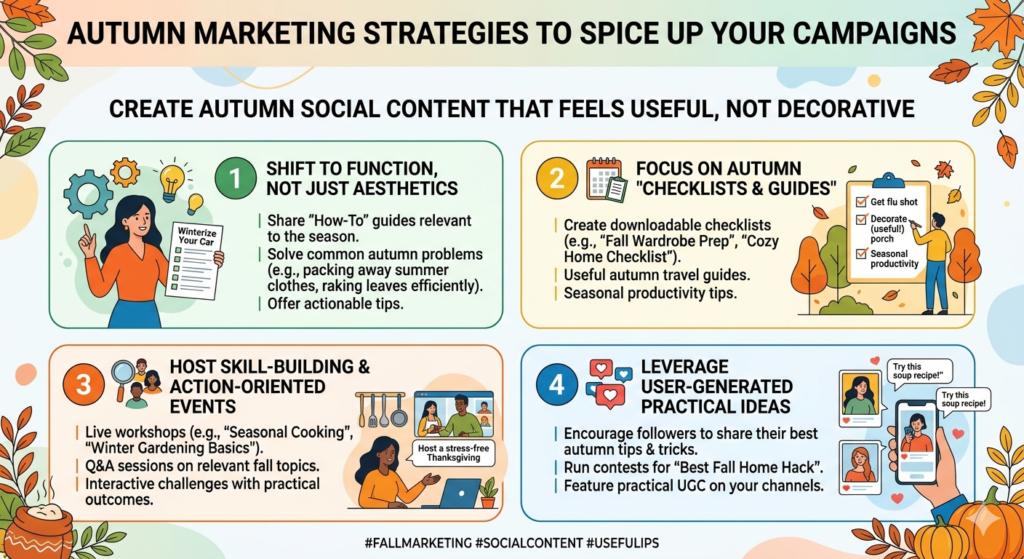
This does not mean every post must be serious. Seasonal content can still be warm, light, and fun. But it should have a purpose. It should teach something, start a real conversation, show a useful idea, or move people closer to trust.
Turn seasonal moments into helpful content themes
Autumn gives you many natural content angles. Back-to-school routines, cooler weather, Halloween, harvest season, Thanksgiving planning, year-end goals, Q4 pressure, early holiday shopping, budget planning, and winter prep can all become useful themes.
The key is to connect these moments to your customer’s life.
A marketing agency can talk about cleaning up campaigns before Q4. A wellness brand can talk about building better routines before the holidays. A food brand can share seasonal meal ideas. A local shop can show how customers are using products this season. A software company can share ways to organize work before the year ends.
The season gives you the hook. Your customer’s problem gives you the value.
Use captions that teach one clear idea
A strong autumn caption should not try to say everything. It should teach one clear idea in a way that feels easy to read.
For example, instead of saying, “Autumn is the perfect time to refresh your marketing strategy,” explain why. You could write, “Autumn is when buyers start planning, comparing, and budgeting. If your campaign only starts when they are ready to buy, you miss the trust-building stage.”
That is still simple, but it gives the reader a useful insight. It also positions your brand as thoughtful instead of noisy.
Good social content makes people pause because it says something true.
Show behind-the-scenes seasonal preparation
People enjoy seeing how brands prepare. Autumn is a great time to show the work behind your campaigns, products, services, or customer experience. This type of content feels human because it does not only show the final result. It shows care.
A bakery can show fall recipes being tested. A retail brand can show seasonal stock arriving. A marketing team can show a campaign planning board. A service business can show appointment prep before the busy season. A consultant can share how they review client goals before year-end.
This builds trust because people see that your brand is active, thoughtful, and ready.
Make your process part of the story
Behind-the-scenes content works best when it has a simple story. Do not just show a photo and say, “Getting ready for autumn.” Tell people what you are doing and why it matters.
For example, a marketing agency could say, “This week we are reviewing landing pages before holiday ad traffic increases. A weak page can waste good clicks, so autumn is the right time to fix the leaks.”
That kind of post is useful because it teaches while showing your process. It also gives potential clients a reason to think about their own campaigns.
When your process teaches something, your social content becomes more than content. It becomes proof of skill.
Use Paid Ads to Test Before the Market Gets Expensive
Autumn is a smart time to test paid ads because competition usually rises as the holiday season gets closer. If you wait until peak weeks to test your message, audience, offer, and landing page, you may waste money when clicks are more expensive. Autumn gives you a better window to learn.
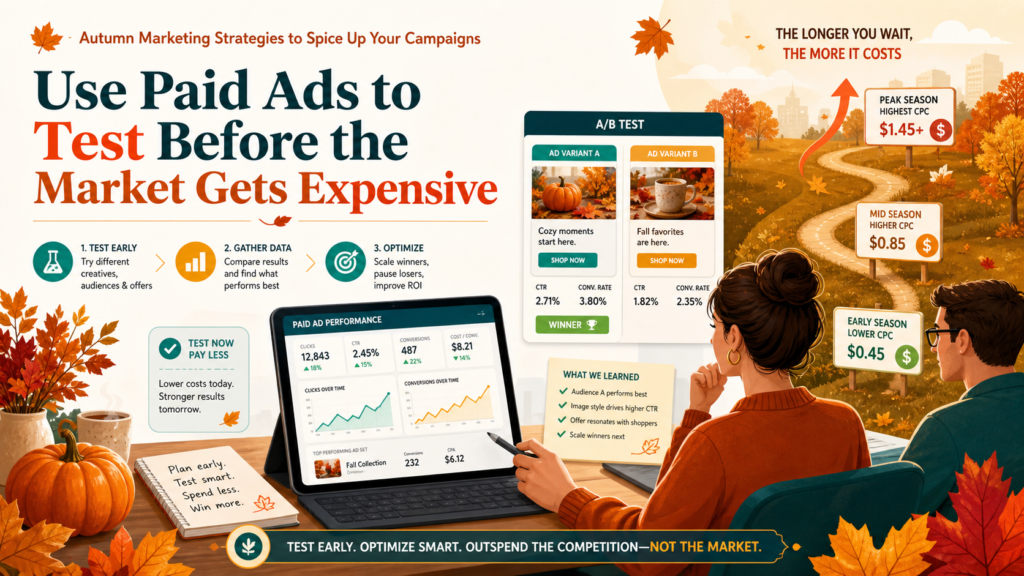
The goal is not always to spend heavily right away. The goal is to find what works before you scale. You can test different offers, creative angles, headlines, audiences, and calls to action while there is still time to improve.
Test your message before you increase your budget
Many brands test products or discounts, but they do not test the message enough. This is a mistake. The way you frame the offer often decides whether people care.
For autumn campaigns, test different angles. One message may focus on saving time before the holidays. Another may focus on getting ahead before the year ends. Another may focus on comfort, ease, planning, or avoiding stress. The same product can feel very different depending on the angle.
For example, a marketing service could be framed as “Prepare your campaigns before Q4 traffic rises” or “Stop wasting ad spend before holiday costs climb.” Both sell the same service, but they trigger different concerns.
Watch what people click and what they ignore
Ad testing is not about guessing which message sounds best to you. It is about watching what your audience does. A headline with a high click rate may show strong interest. A landing page with low conversions may show that the promise is not being carried through.
An ad with many saves or comments may show that the topic matters, even if people are not buying yet.
Autumn is a good time to collect these signals. They help you shape stronger campaigns for November, December, and year-end offers.
Do not treat early ad testing as wasted spend. Treat it as research you can use to avoid bigger mistakes later.
Retarget warm audiences before peak season
Autumn is also a strong time to build and retarget warm audiences. People who visit your website, watch your videos, open your emails, or engage with your posts are showing some level of interest. They may not be ready to buy yet, but they are not cold anymore.
Instead of showing them the same hard sales message, retarget them with content that moves them forward. Show proof, answers, comparisons, case studies, reminders, and simple offers. Help them feel more confident.
This matters because warm audiences usually cost less to convert than cold ones.
Match the retargeting message to the customer’s stage
Someone who visited a blog post may need education. Someone who viewed a pricing page may need proof or a direct offer. Someone who added a product to cart may need reassurance or a reminder. Someone who watched most of a video may need the next step.
A smart autumn retargeting campaign does not treat all visitors the same. It gives each group a message that matches their behavior.
For example, if someone reads a guide about holiday ad planning, a marketing agency could retarget them with an offer for a campaign audit. That feels natural because the offer connects to the content they already cared about.
Retargeting works best when it feels like the next helpful step, not a random chase around the internet.
Build Local Autumn Campaigns That Bring People Through the Door
For local businesses, autumn can be one of the most useful times of the year. People are back in town after summer. Families return to school routines. Weekends become more centered around local events, food, shopping, and services.
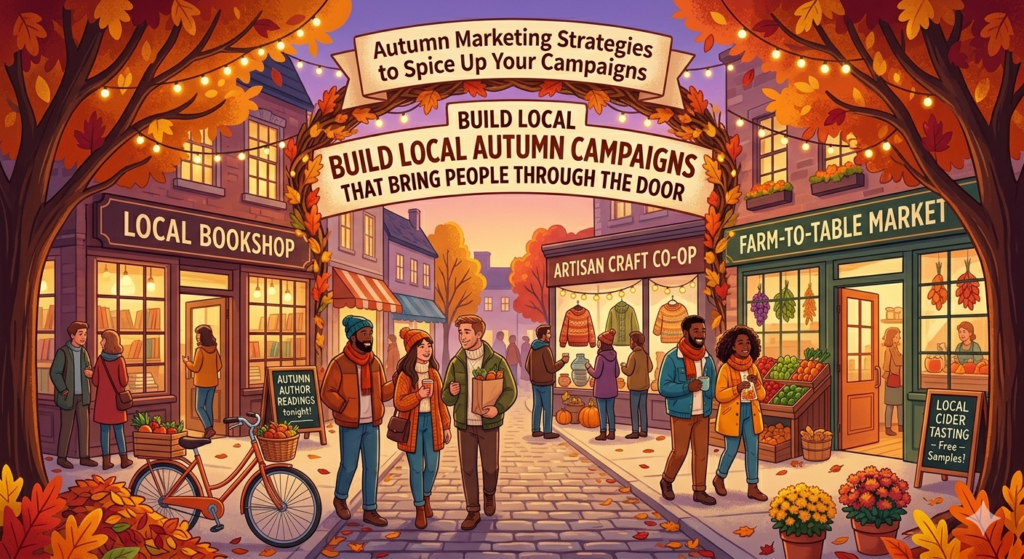
This creates a strong chance to bring nearby customers into your store, office, restaurant, studio, or service area.
Local autumn marketing should feel close to the community. It should not look like a national brand copied a fall template. It should show that you understand what people in your area are doing, planning, and needing this season.
Connect your campaign to local habits and events
Every area has its own autumn rhythm. Some places have school events, markets, festivals, sports games, fairs, charity drives, harvest events, or early holiday shopping days. These moments give local businesses strong campaign hooks.
A café can create offers around chilly morning commutes. A salon can promote autumn refresh appointments before holiday parties. A gym can run a routine reset campaign after summer. A home service company can promote seasonal maintenance before winter.
A boutique can build campaigns around local events and weekend shopping.
The campaign becomes stronger when it feels tied to real life in the area.
Use local details in your copy
Local copy should sound specific. Instead of saying, “Get ready for autumn,” say something that reflects what your customers are actually experiencing. Mention local weather changes, school calendars, community events, neighborhood routines, or common seasonal problems.
For example, a local cleaning company could say, “Before guests start coming over for the holidays, autumn is the right time to deep clean the rooms you ignored all summer.” That line is simple, clear, and tied to real behavior.
A local restaurant could say, “Cooler evenings are back, and so is the kind of meal you want after a long day.” It feels human because it speaks to a moment customers know.
Specific beats generic every time.
Update your local search presence for autumn demand
Local customers often search when they are close to taking action. They look for nearby services, open hours, seasonal items, appointments, menus, deals, and reviews. Autumn is a good time to make sure your local search presence is clean and current.
Your Google Business Profile, website, local landing pages, photos, service descriptions, and reviews should reflect what you offer this season. If your autumn hours change, update them. If you have seasonal services or products, add them. If you are running local events, mention them. If you have fresh photos, upload them.
A customer should not have to guess whether your business is ready for the season.
Make seasonal actions easy for local customers
Local marketing often fails because the next step is not clear. A customer sees a post, likes the idea, then has to search for your hours, call for details, or figure out how to book. Each extra step lowers action.
Make the seasonal next step simple. Let customers book autumn appointments, reserve tables, request quotes, order seasonal products, download local guides, or claim offers without friction.
If your campaign says “prepare for autumn,” your page should help them do it right away.
Convenience is not a small detail. For local customers, convenience often decides who gets the sale.
Make Autumn Landing Pages Feel Timely and Easy to Act On
A strong autumn campaign needs more than good ads, emails, and social posts. It also needs landing pages that match the season and make action simple. Many brands get attention with seasonal campaigns, then send people to a general page that feels cold, broad, or out of date. That breaks the flow.
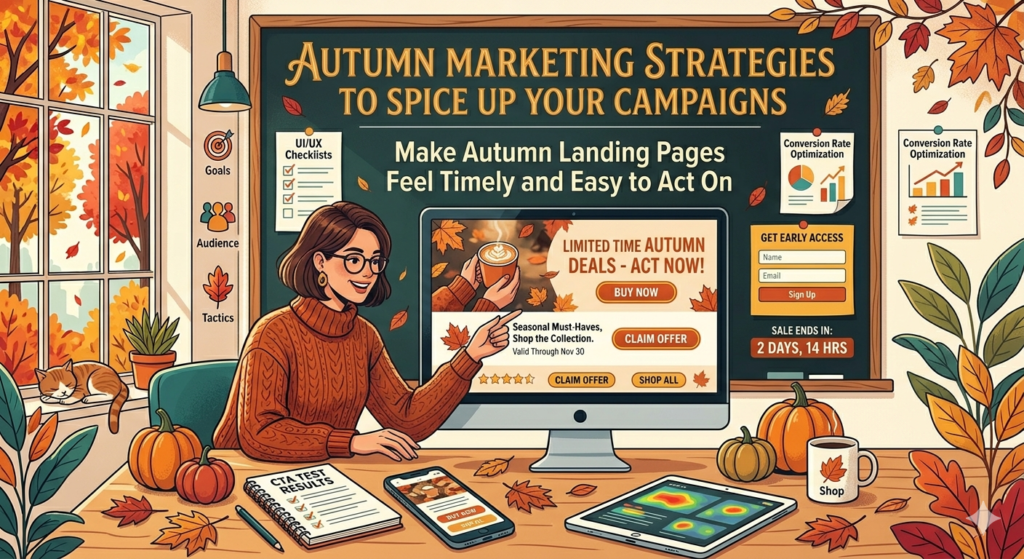
Your landing page should continue the same message that brought the visitor there. If your ad talks about preparing campaigns before the holiday rush, the landing page should speak about that same problem. If your email offers an autumn reset, the page should clearly explain what the reset includes and why now is the right time.
Autumn landing pages do not need to be fancy. They need to be clear, focused, and useful.
Match the page headline to the seasonal reason for action
The headline is the first test. If the headline does not quickly tell people why the offer matters now, they may leave. A weak headline says something broad like “Grow Your Business With Our Marketing Services.” That could work any time of year, which means it does not feel urgent.
A stronger autumn headline says, “Fix Your Campaigns Before Holiday Traffic Gets More Expensive.” This gives the visitor a reason to care today. It connects the service to a seasonal problem. It also makes the value easy to understand.
Your landing page should make the customer feel like they arrived in the right place at the right time.
Keep the message focused on one clear outcome
Autumn pages often fail because they try to sell too many things at once. A page may talk about SEO, paid ads, email marketing, branding, social media, web design, and strategy all at the same time. That makes the visitor work too hard.
A better page focuses on one clear outcome. For example, “prepare your website for holiday traffic,” “book your autumn home service check,” “build a colder-weather skincare routine,” or “plan your year-end growth campaign.” When the result is clear, the page feels easier to trust.
This does not mean you cannot mention related services. It means everything on the page should support the main promise. If a section does not help the visitor understand, trust, or act on that promise, it should be removed or rewritten.
Write landing page copy that removes doubt
People rarely act just because a page sounds nice. They act when the page answers their doubts. During autumn, those doubts often sound like this: Is now the right time? Will this help before the busy season? Is this worth the money? Can I trust this brand? What happens after I click? How fast can I see value?
Your page should answer these questions in plain language. Do not hide behind big claims. Be direct. Tell people what they get, who it is for, what problem it solves, and what the next step looks like.
If your offer is a campaign audit, explain what you review. If your product is part of a seasonal bundle, explain how the items work together. If your service helps with year-end planning, explain what the customer will walk away with.
Make the call to action feel low-stress
A call to action should feel like a natural next step, not a hard push. In autumn, many people are busy and thinking ahead. They may not want to commit to a big purchase right away. This is why softer actions can work well.
Instead of only saying “Buy Now,” you may use a seasonal action like “Book Your Autumn Audit,” “Plan Your Q4 Campaign,” “Reserve Your Fall Appointment,” or “Get Your Holiday Prep Checklist.” These calls to action feel more specific and less harsh.
The best call to action makes the customer think, “Yes, that is exactly what I need to do next.”
Use Autumn Storytelling to Make Your Brand Easier to Remember
Autumn is a strong season for storytelling because it already has a natural sense of change. People understand the feeling of moving from one chapter to another. Summer ends. Routines return. The year starts to feel shorter. Plans become more serious. This gives brands a powerful story frame.
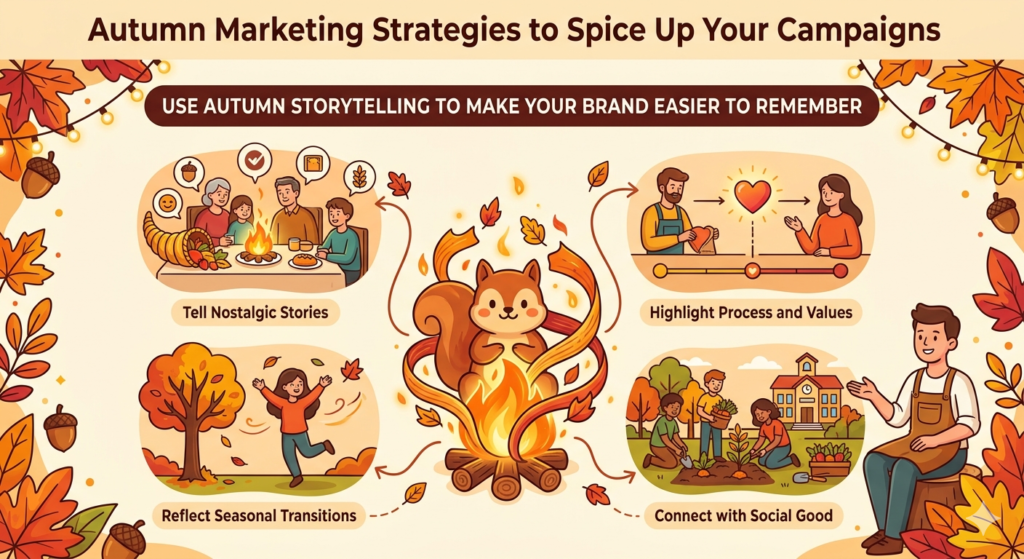
But storytelling in marketing does not mean writing long, dramatic brand stories. It means helping customers see themselves in the message. It means showing the before, the turning point, and the better outcome.
A campaign becomes more memorable when it tells a simple story that customers recognize.
Turn seasonal change into a customer story
Your customer is likely going through some kind of change in autumn. They may be trying to get organized, save money, prepare for holidays, improve routines, finish the year strong, or avoid stress. Your campaign should show that change clearly.
For a business owner, the story might be about moving from scattered summer campaigns to focused Q4 growth. For a parent, it might be about moving from chaotic mornings to smoother routines. For a homeowner, it might be about moving from a tired summer space to a warm, ready home.
The story does not need to be complex. It just needs to feel true.
Show the problem before you show the offer
A common marketing mistake is rushing to the offer too quickly. The brand says, “Here is our product,” before the customer feels the need. Storytelling fixes that by showing the problem first.
For example, a digital marketing agency could start with this idea: “By autumn, many businesses know their campaigns are leaking money, but they wait until November to fix them. By then, traffic costs more, inboxes are crowded, and every mistake is more expensive.”
That sets the stage. Now the offer has meaning. A campaign audit is not just a service. It is the way to avoid a costly seasonal mistake.
When the customer sees the problem clearly, the solution feels more valuable.
Use real moments instead of generic seasonal lines
Autumn marketing becomes stronger when it speaks in real moments. “Cozy season is here” is fine, but it is not always enough. A real moment is more specific. It could be the first cold morning, the first packed school week, the first holiday shopping list, the first look at Q4 targets, or the first time a business owner notices ad costs rising.
These moments help people feel seen.
A great campaign might say, “That first week when your calendar fills up again is the week to fix the systems that slowed you down all summer.” This feels more vivid than “Get ready for fall.” It gives the reader a scene they recognize.
Write like you are describing the customer’s day
The more clearly you describe the customer’s day, the more human your copy feels. Instead of saying, “Our service helps you save time,” show the moment where time is being lost. Instead of saying, “Our product brings comfort,” show the tired evening when comfort matters.
For example, a food brand could say, “When the evenings get darker and cooking feels like one more job, a ready meal that still tastes homemade can feel like a small win.” That line sells comfort without shouting about comfort.
A marketing agency could say, “When your team is busy planning holiday offers, the last thing you need is a landing page that turns good traffic into lost leads.” That line speaks to a real work problem.
Real moments make copy feel less like advertising and more like understanding.
Plan Autumn Campaigns Around the Whole Customer Journey
A strong autumn strategy does not treat every customer the same. Some people are just discovering your brand. Some are comparing options. Some are almost ready to buy. Some have bought before and need a reason to return. Each group needs a different message.
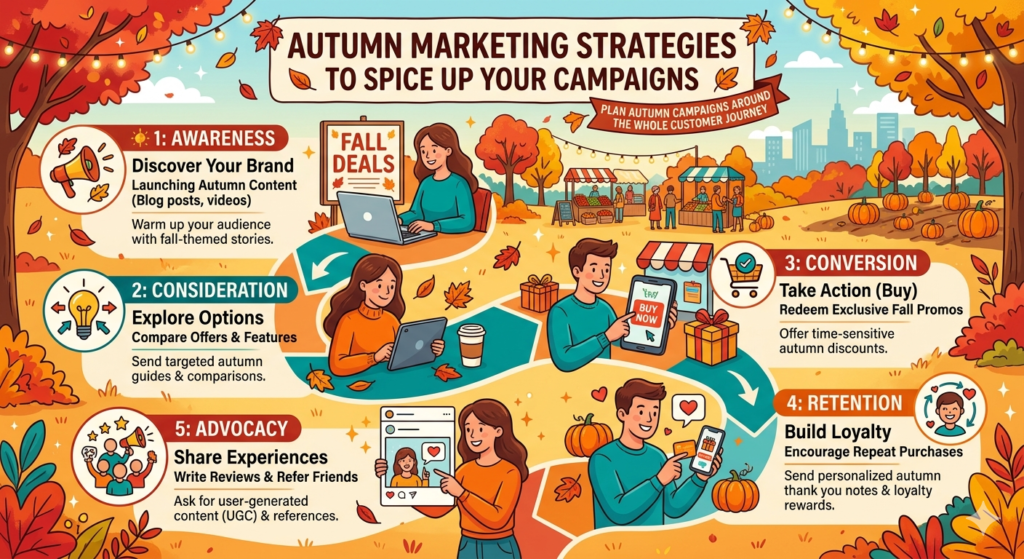
This is why the customer journey matters. Autumn is not just one campaign. It is a season where people move through stages. If you guide them well, they are much more likely to buy when the time is right.
The goal is to avoid random marketing. Every piece of content should have a role.
Create awareness content for early-stage customers
Early-stage customers may not know they need your product or service yet. They are feeling a problem, but they may not know how to solve it. Autumn is a great time to reach them with useful, simple content.
A marketing agency might create content about why autumn is the right time to review campaigns before Q4. A home service company might explain what homeowners should check before colder weather. A retail brand might share seasonal style ideas or gift planning tips. A wellness brand might talk about rebuilding healthy habits after summer.
This content should not push too hard. Its job is to make the customer aware of the problem and see your brand as helpful.
Give early-stage readers a next step that does not feel too big
When someone is just becoming aware of a problem, asking them to buy right away can feel too soon. Give them a smaller step. Invite them to read a guide, take a quiz, download a checklist, view a comparison, or sign up for useful emails.
This builds the relationship without pressure.
For example, instead of asking a cold visitor to book a full marketing package, a digital agency could offer an autumn campaign checklist. That checklist can then lead to a stronger offer later. The small step makes the bigger step easier.
Good autumn marketing does not rush trust. It builds it in order.
Create decision content for people closer to buying
Some customers already know they have a problem. They are comparing options, checking prices, reading reviews, and looking for proof. These people need stronger content. They need case studies, testimonials, product comparisons, service breakdowns, pricing guidance, and clear answers to common doubts.
Autumn adds urgency to this stage because people often have a deadline. They want results before the holidays, before winter, before year-end, or before a busy family season. Your content should help them make a smart choice without delay.
This is where proof matters most.
Make your proof specific and easy to believe
Vague proof does not help much. Saying “we get great results” is weak. Saying “we helped a client clean up their email flow before a seasonal launch, which led to better repeat purchases” is stronger. Even without sharing every number, the proof feels more real because it shows a clear action and outcome.
For autumn campaigns, show proof that fits the season. Talk about early planning, faster setup, better campaign timing, improved traffic handling, higher repeat sales, better booking rates, or smoother holiday prep.
People close to buying do not need more hype. They need more confidence.
Use Customer Retention as a Core Autumn Growth Strategy
Autumn is not only a time to find new customers. It is also one of the best times to bring back people who already know your brand. Past customers are often easier to reach, easier to persuade, and more likely to trust you.
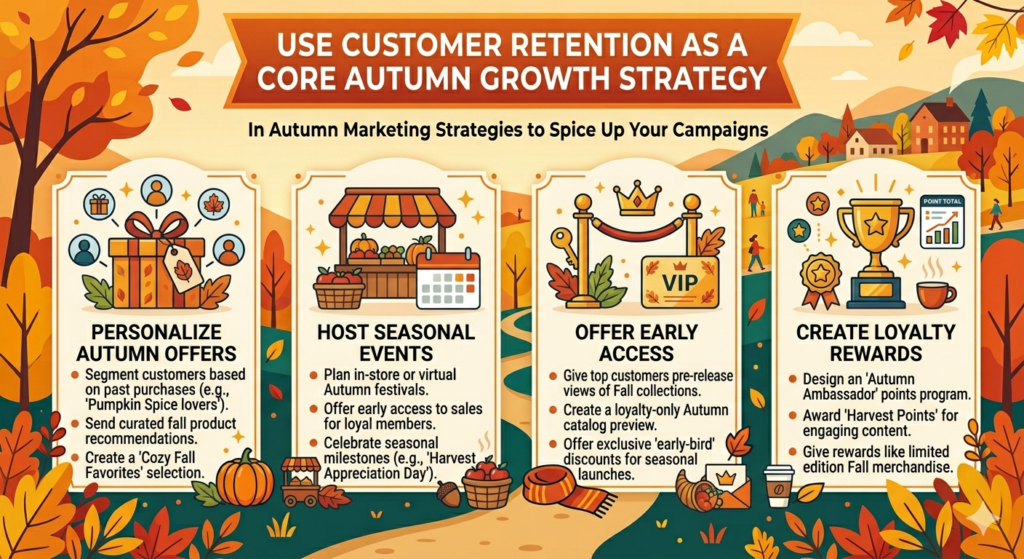
Yet many brands spend most of their autumn budget chasing new buyers while ignoring the people who have already bought from them.
That is a costly mistake.
A smart autumn retention plan helps past customers buy again, upgrade, renew, refer, or re-engage before the holiday season gets loud.
Bring back customers with seasonal reminders
Past customers may not be ignoring you. They may simply be busy. A seasonal reminder can bring your brand back into their mind at the right time.
A skincare brand can remind customers to adjust their routine for cooler weather. A clothing brand can show how to style past purchases for autumn. A marketing agency can remind past clients to review campaigns before Q4. A local service business can remind customers to book seasonal maintenance.
The message should feel helpful, not needy. You are not saying, “Please buy again.” You are saying, “This season is here, and this may be useful for you now.”
Tie the reminder to what they bought before
A strong retention message uses what you already know about the customer. If someone bought a certain product, show them how to use it this season. If someone used a certain service, suggest the next useful step. If someone joined a past campaign, invite them into a new seasonal version.
This makes the message feel personal and relevant.
For example, a digital agency could email past audit clients and say, “Last time, we reviewed your landing pages. Before holiday traffic rises, it may be worth checking whether those pages still match your current offers.” That feels specific. It also gives a clear reason to reconnect.
Relevance is what makes retention work.
Reward loyal customers before chasing strangers
Your best customers should feel valued during autumn. They should not see better offers given only to new buyers. That can damage trust. Instead, create early access, loyalty rewards, private offers, special bundles, or personal check-ins for people who have already supported your brand.
This does not have to be complex. Even a simple “you get first access before the public sale” can make customers feel seen.
Autumn is a good time to strengthen loyalty before the holiday rush brings more choice and noise.
Make loyal customers feel like insiders
People like feeling included. An insider-style autumn campaign can work very well because it gives loyal customers a reason to pay attention before everyone else.
A brand could say, “We are opening our autumn planning slots to past clients first.” Another could say, “Our seasonal bundle goes live next week, but past customers can get it today.” A local business could say, “Regular customers can reserve weekend appointments before we open the calendar publicly.”
This approach builds goodwill and action at the same time.
When customers feel valued before they are sold to, they are more likely to come back.
Use Autumn Promotions Without Training Customers to Wait for Discounts
Autumn is a strong time for promotions, but it can also become dangerous if every campaign depends on price cuts. When customers learn that your brand always discounts before the holidays, they may stop buying at full price. They may wait, compare, and only act when the price drops.
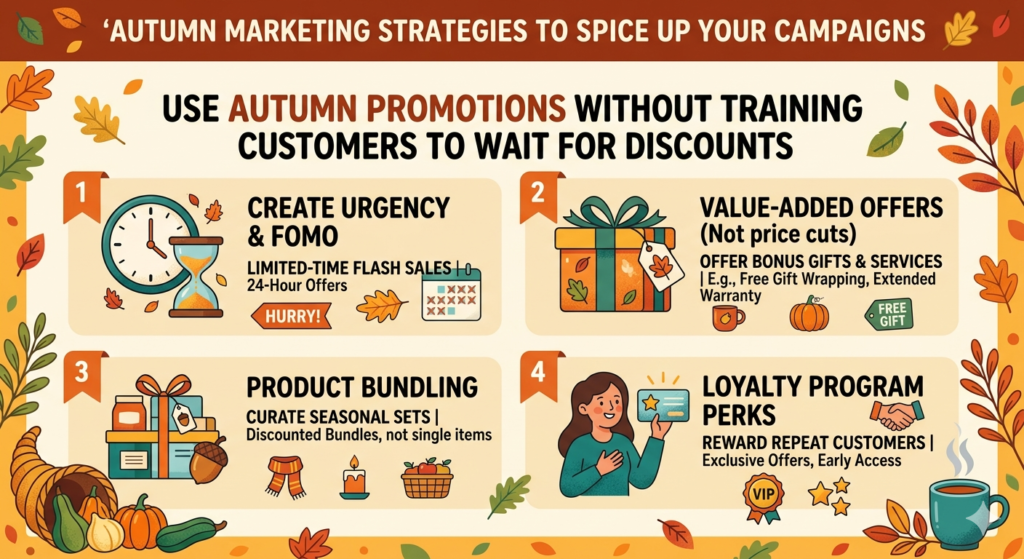
That does not mean you should avoid promotions. It means your autumn offers should be built with care. A good promotion gives people a smart reason to act now without making your brand look cheap. It protects your value while still giving the customer something worth noticing.
The goal is to make the offer feel timely, useful, and connected to the season.
Give more value instead of only lowering the price
A discount is easy to understand, but it is not always the best move. Sometimes, adding value works better. You can include a bonus, extra service, early access, free setup, personal review, upgrade, gift wrap, faster delivery, extended support, or a seasonal guide.
This works because the customer still feels they are getting more, but your brand does not have to cut its price too deeply. It also helps you stand out in a market where many brands are shouting about sales.
For example, a digital marketing agency could offer a free landing page review with an autumn campaign package. An ecommerce store could include a small seasonal gift with orders over a set amount. A local service provider could include a free checkup with a booked appointment.
These offers feel useful because they solve small problems that matter during the season.
Make the bonus match the buying reason
A bonus should not feel random. It should help the customer get more value from the main offer. If the bonus feels unrelated, people may see it as a trick instead of a benefit.
If you sell marketing services, a campaign checklist or audit makes sense. If you sell skincare, a cold-weather care guide makes sense. If you sell home goods, a seasonal styling guide makes sense. If you sell fitness coaching, a routine reset plan makes sense.
The bonus should make the main purchase easier, better, or more complete.
This is how you protect your brand value while still making the autumn offer feel special.
Use deadlines that are honest and easy to believe
Autumn already has natural deadlines. The holiday season is coming. Year-end planning is starting. Weather is changing. Shopping windows are getting shorter. Event calendars are filling up. You do not need fake pressure when real timing already exists.
A weak deadline says, “Hurry, offer ends soon,” without giving a clear reason. A stronger deadline says, “Book by October 20 so your campaign changes are live before November traffic rises.” That feels real because the deadline is tied to a useful outcome.
Customers are more likely to trust urgency when they understand why it exists.
Explain what happens if they wait too long
Good urgency is not about fear. It is about clarity. Show the customer what they may lose by waiting, but do it in a helpful way.
A business owner who delays campaign planning may face higher ad costs, weaker landing pages, crowded inboxes, and rushed decisions. A homeowner who delays seasonal maintenance may face fewer appointment slots. A shopper who waits too long may lose access to the best sizes, colors, or delivery windows.
When the cost of waiting is clear, action feels more natural.
The strongest autumn promotions do not scream. They calmly show why now is the better time.
Turn Autumn Email Flows Into a Seasonal Sales Engine
Single emails can help, but email flows can do much more. A flow lets you guide people through a clear path over several days or weeks. This is especially useful in autumn because many customers are not ready to buy the first time they hear from you. They need reminders, proof, trust, and timing.
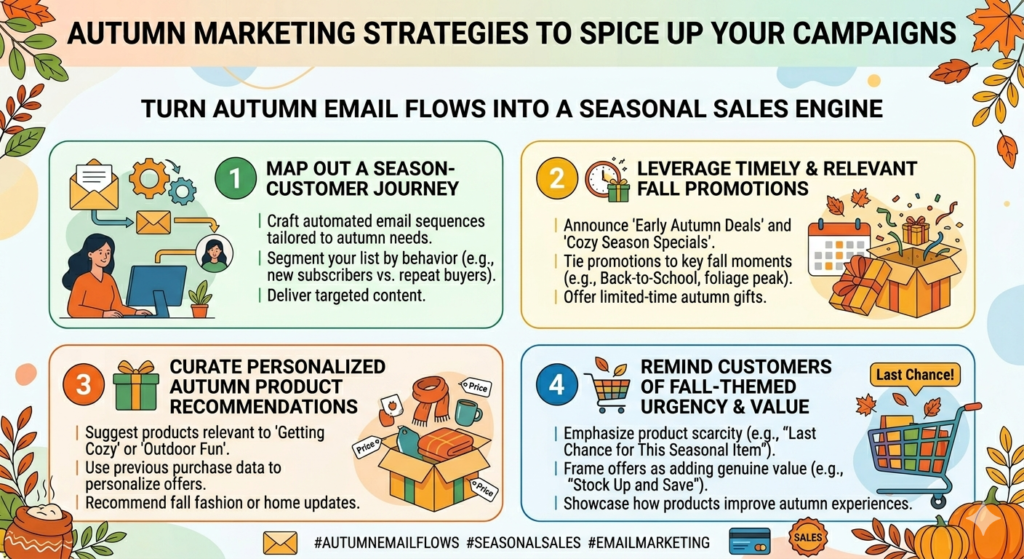
An autumn email flow should feel like a helpful seasonal journey. It should not feel like the same sales message repeated five times. Each email should move the reader one step closer to action.
When done well, email flows can quietly turn autumn attention into holiday and year-end revenue.
Build a simple warm-up flow before the main offer
Before you ask for a sale, warm up the reader with useful content. This is even more important if your product or service takes thought before purchase. People need to understand the problem, see why it matters now, and trust that your solution can help.
A simple autumn flow might start with a seasonal insight, then share a practical tip, then show proof, then introduce the offer, then answer a common concern. The flow does not need to be long. It needs to feel connected.
For a marketing agency, the first email might explain why autumn is the best time to fix weak campaigns. The next could share signs that a landing page is wasting traffic. The next could show how an audit works. The final email could invite the reader to book.
This feels more natural than sending a discount right away.
Make each email answer one clear question
Every email in the flow should have one job. If one email tries to educate, sell, prove, compare, and explain everything at once, the reader may lose interest.
One email can answer, “Why does this matter now?” Another can answer, “What mistake should I avoid?” Another can answer, “How does this offer help?” Another can answer, “Why should I trust you?” Another can answer, “What should I do next?”
This keeps the flow simple and easy to follow.
Good email flows do not overwhelm people. They help people make a decision with less doubt.
Create separate flows for new leads and past customers
New leads and past customers should not receive the same autumn sequence. A new lead needs trust. A past customer already knows you, so they may need a reminder, an upgrade path, or a reason to return.
For new leads, focus on helpful education and proof. Show that you understand their seasonal problem. Give them practical advice. Make the first offer feel low-risk.
For past customers, focus on what they have already experienced. Remind them of the value they received. Show them what the next step could be this season. Give them early access or a loyalty-based reason to act.
This makes the message feel more personal without making the campaign hard to manage.
Use past behavior to make the flow more relevant
If a customer bought a product last autumn, remind them when that product becomes useful again. If they booked a service before the holidays last year, invite them to book earlier this year. If they downloaded a checklist but never bought, send them a stronger guide or a lighter offer.
Behavior gives you clues. Use those clues to make each message feel timely.
For example, if someone clicked on a blog post about Q4 ad planning, do not send them a general agency email. Send them a message about preparing paid campaigns before costs rise. That small change can make the email feel far more useful.
Relevance is what turns a flow from noise into revenue.
Use Autumn Content to Build Trust Before Black Friday and Holiday Campaigns
By the time big holiday campaigns begin, customers are already surrounded by offers. Their inboxes are full. Their feeds are crowded. Their attention is split. If your brand only starts talking to them during that noisy period, you are asking for trust at the hardest possible time.
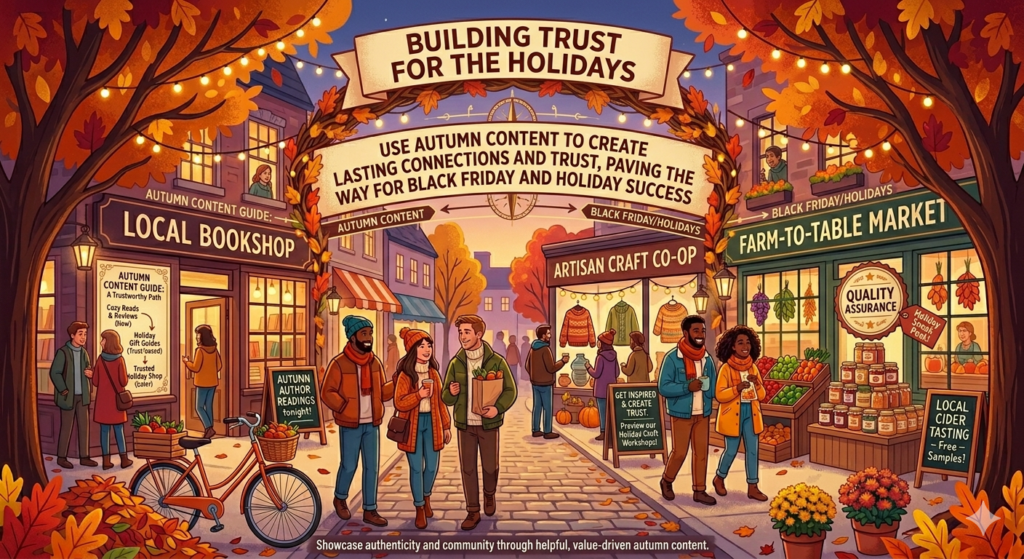
Autumn gives you a better path. You can build trust before the busiest sales weeks begin. This means your holiday offers will not feel like they came from a stranger. They will feel like the next step from a brand the customer already knows.
That is a major advantage.
Teach before you sell
The easiest way to build trust in autumn is to teach your audience something useful. Give them practical advice that helps them make a better decision, avoid a mistake, or prepare for what is coming.
A digital marketing agency can teach businesses how to check campaign readiness. A retail brand can teach customers how to choose gifts early. A beauty brand can explain how skin needs change in cooler weather. A home brand can show how to prepare rooms for guests. A SaaS company can explain how to clean up workflows before year-end.
Teaching works because it reduces risk in the customer’s mind. They start to feel that your brand is not just trying to sell. It is trying to help.
Share advice that leads naturally to your offer
Useful content should not be random. It should connect to what you sell. The connection should feel natural, not forced.
For example, if you sell paid ad services, teach people how to spot signs of wasted ad spend before Q4. If you sell email marketing support, teach people how to warm up a list before Black Friday. If you sell home decor, teach people how to make a small room feel warmer before guests arrive.
The advice should create a clear bridge to your offer. After reading it, the customer should understand why your product or service matters.
That is how content builds demand without sounding pushy.
Publish comparison content before customers start shopping hard
Autumn is also a strong time for comparison content. People are starting to think ahead. They may not buy today, but they are making lists, checking options, and forming opinions. If your brand helps them compare choices clearly, you can influence the final decision.
Comparison content can explain product types, service options, price ranges, features, use cases, or common mistakes. It can also show who each option is best for. This helps customers feel less confused.
For a marketing agency, this could mean content comparing SEO and paid ads for Q4 growth, email campaigns and social campaigns for holiday sales, or landing page audits and full website redesigns before peak traffic.
Be honest about who your offer is not for
Trust grows when you are willing to say who should not buy. This may sound risky, but it often makes your message stronger. Customers can sense when a brand is trying to sell to everyone. That makes the offer feel weaker.
If your service is best for businesses with existing traffic, say so. If your product is not ideal for a certain use, explain that. If a lower-cost option is enough for some customers, be honest.
This kind of honesty makes your recommendation feel more believable. It also helps attract better-fit buyers.
Autumn trust-building is not about saying more. It is about saying what helps the customer choose with confidence.
Prepare Your Website for Autumn and Holiday Traffic
A campaign can bring people to your site, but the website must finish the job. If your site is slow, confusing, outdated, or hard to use, autumn traffic will not turn into results. This becomes even more important as the holiday season gets closer and customers have less patience.
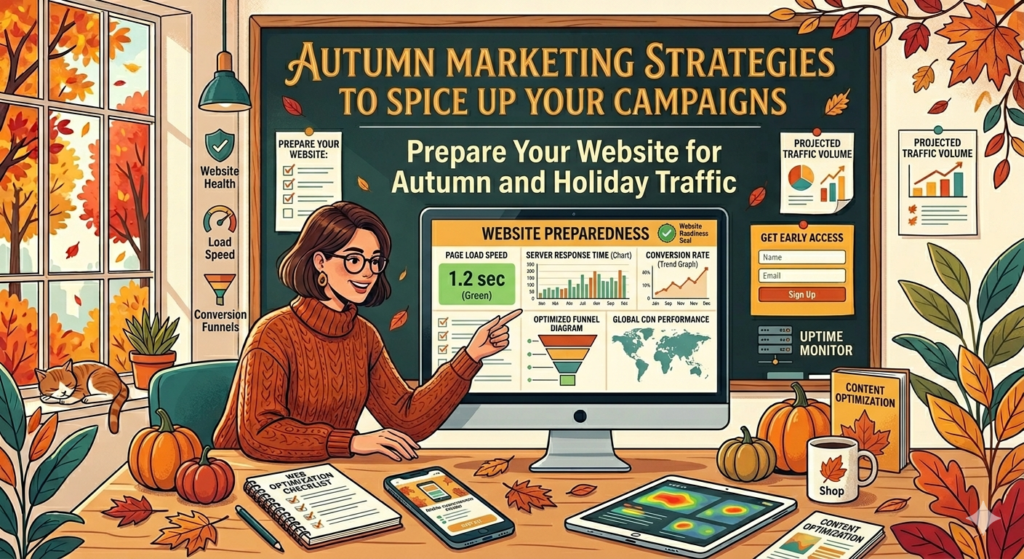
Autumn is the right time to fix website problems before traffic becomes more expensive and more competitive. Even small improvements can make a big difference when more people are visiting your pages.
Your website should help people understand your offer quickly, trust your brand, and take action without friction.
Make your key pages faster and clearer
Speed and clarity are two of the biggest website wins. A page that loads slowly loses attention. A page that looks crowded loses confidence. A page that hides the next step loses sales.
Start with your most important pages. These may include your homepage, service pages, product pages, pricing pages, booking pages, lead magnet pages, and landing pages for seasonal campaigns. Look at each page like a new visitor would. Ask whether the main offer is clear within a few seconds.
If someone has to scroll too much, read too much, or guess too much, the page needs work.
Improve the top section before changing everything else
The top section of a page matters because it shapes the first impression. Before redesigning your whole site, improve the headline, opening text, image, and call to action.
A good autumn-focused top section should quickly answer what you offer, why it matters now, and what the visitor should do next. For example, a marketing agency page could say, “Get your campaigns ready before holiday traffic gets more costly.
We help you find weak spots in your ads, landing pages, and email flows before peak season.”
That is clear. It is timely. It gives the visitor a reason to keep reading.
Small changes at the top of the page can often create faster results than large design changes hidden lower down.
Remove friction from forms, checkout, and booking steps
Autumn customers are often busy. They may be planning work, family events, shopping, travel, and year-end tasks. If your website makes action hard, many will leave.
Check your forms, checkout process, booking system, contact page, and mobile experience. Remove fields you do not need. Make buttons easy to see. Make pricing or next steps clear. Make sure confirmation messages are simple. Test the full path from visit to action.
Do not assume your website works because it looks fine. Use it like a customer would.
Make mobile action simple
A large share of customers will interact with your autumn campaigns on mobile. They may see an ad while commuting, open an email during a break, or check your page while standing in a store. If the mobile page is hard to read or use, the campaign loses power.
Mobile copy should be clear. Buttons should be easy to tap. Forms should be short. Pages should load quickly. Important details should not be buried.
Autumn marketing often wins in small moments. Your mobile experience decides whether those moments turn into leads or sales.
Use Autumn Data to Find What Your Customers Care About Right Now
Autumn campaigns should not be built only on taste, guesses, or seasonal ideas that sound nice in a meeting. The best campaigns come from watching what customers are already doing. Data helps you see which topics, products, offers, pages, and messages are gaining attention as the season changes.
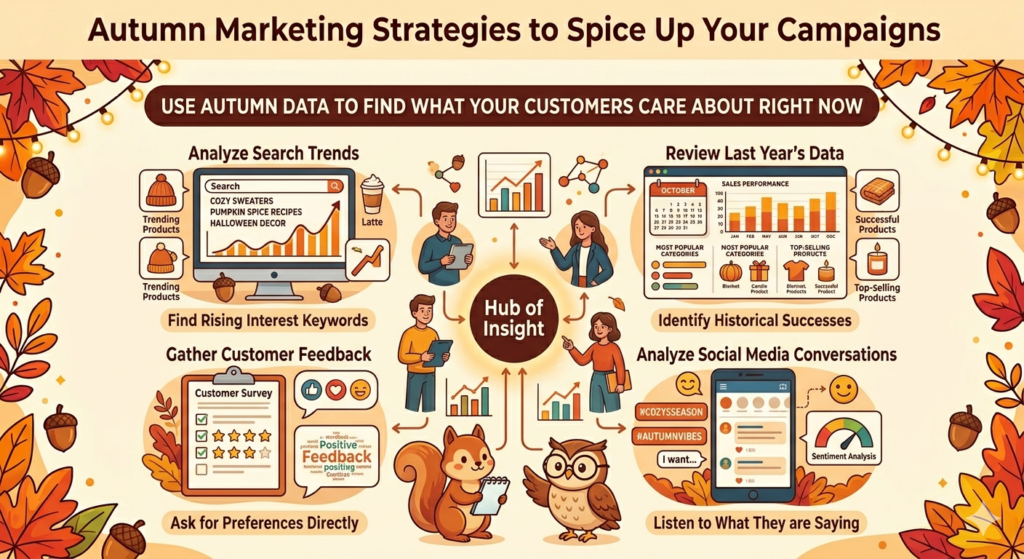
This does not mean you need a complex dashboard. You can learn a lot from simple signals. Look at search terms, email clicks, product views, ad engagement, social comments, website behavior, past autumn sales, and customer questions.
These clues show what people are ready for, what they are unsure about, and what might make them act.
Autumn is a fast-moving season, so your campaign should not stay fixed for months. It should improve as real customer behavior becomes clearer.
Read your recent customer behavior before planning new campaigns
Before you create a fresh autumn campaign, look at what happened in the last few weeks. Which pages are getting more traffic? Which products are being viewed more often? Which emails got replies or clicks? Which social posts made people comment or save? Which search terms brought people to your site?
These signs are valuable because they show current demand. A product you thought would lead the season may not be the one customers care about most. A simple how-to topic may get more attention than a big campaign idea. A small customer worry may become the strongest hook for your next offer.
When you listen to the data, your campaign becomes less about what you want to say and more about what customers are ready to hear.
Turn customer questions into campaign angles
Customer questions are one of the best sources of autumn marketing ideas. If people keep asking the same thing, that question should become content, email copy, ad copy, or a landing page section.
For example, if customers ask whether they should book before the holidays, create a campaign around early booking. If they ask what package is best for Q4, write a guide that explains the options. If they ask whether a product works in colder weather, make that the focus of your next product page update.
A question is not just a support issue. It is a signal of interest.
The brands that answer customer questions clearly often win trust before the customer even speaks to sales.
Compare this autumn with last autumn
Past seasonal data can help you plan better, especially if your business has been running for more than one year. Look at what worked last autumn. Study which offers sold, which emails performed well, which products moved early, which pages converted, and which campaigns failed.
Do not copy last year without thinking. Customer behavior changes. Competitors change. Prices change. Your own business changes. But past data can show patterns that are still useful.
If customers bought earlier than expected last year, you may need to launch sooner. If a late discount hurt full-price sales, you may need a better value-based offer. If a guide brought strong leads, you may need to refresh and promote it again.
Find the gap between attention and action
One of the most useful things data can show is where interest does not turn into action. Maybe a landing page gets traffic but few leads. Maybe an email gets clicks but no sales. Maybe people view a product often but do not add it to cart. Maybe many users start booking but do not finish.
These gaps are not failures to ignore. They are places to improve.
Autumn is the right time to fix them because holiday and year-end traffic can make every weak point more costly. If your page already loses buyers in October, it will likely lose even more in November when people have more choices and less patience.
Fixing leaks before peak season is one of the smartest ways to grow without spending more on traffic.
Build Autumn Campaigns That Help Customers Prepare, Not Panic
A lot of seasonal marketing uses pressure. It tells people they are running out of time, missing out, or falling behind. Sometimes urgency works, but too much pressure can make customers feel tired or defensive. Autumn gives you a better angle. Instead of making people panic, help them prepare.
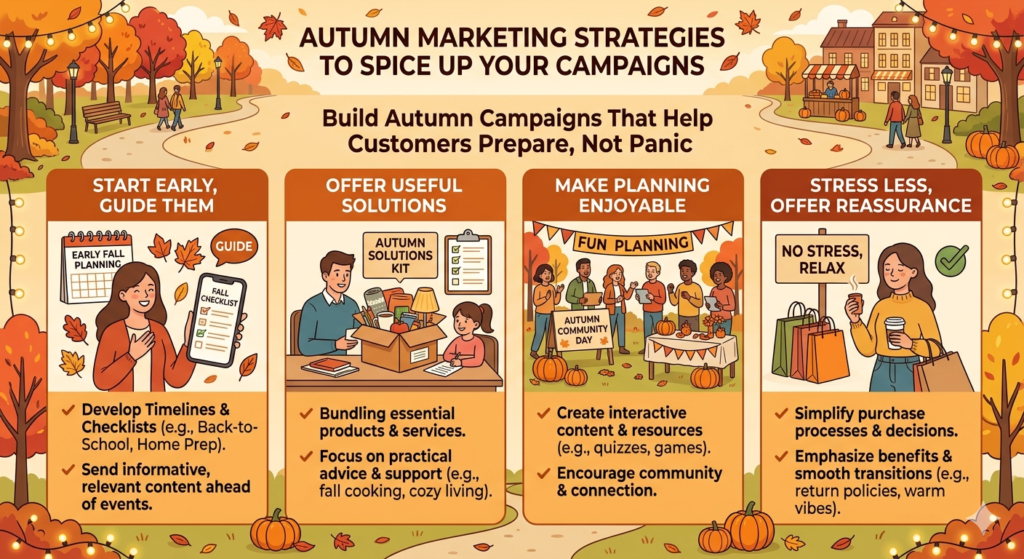
Preparation is a strong message because it feels useful. It gives customers control. It shows them that acting early can make the next few months easier. This works for both consumer and business campaigns.
A customer who feels prepared is more likely to trust the brand that helped them get there.
Position your offer as a way to make the season easier
Autumn can feel busy. People are handling school, work, home needs, budgets, goals, shopping, travel plans, and early holiday tasks. A strong campaign shows how your offer makes one part of that season easier.
This can be simple. A meal brand can make weeknight dinners easier. A software brand can make year-end reporting easier. A cleaning service can make holiday hosting easier. A marketing agency can make Q4 campaign planning easier. A retail brand can make early gifting easier.
The message should not be “buy this because we want sales.” It should be “use this because it helps you handle the season better.”
Show the before and after clearly
Preparation campaigns work best when the customer can picture the change. Show what life looks like before your solution and after it.
Before, the business owner is rushing to fix ads after costs have already risen. After, the campaigns are tested, pages are ready, and email flows are planned. Before, the parent is stressed by busy school mornings. After, the routine feels smoother. Before, the shopper is scrambling for gifts. After, the best items are already chosen.
This kind of copy is powerful because it helps the customer feel the outcome before they buy.
When people can see the better future, taking action feels easier.
Create planning tools that lead toward your offer
Autumn is a great season for checklists, calendars, short guides, quizzes, planners, audits, and templates. These tools work because they help customers organize their thoughts. They also help your brand capture leads and learn what customers care about.
A digital agency could create a Q4 campaign readiness checklist. A home service brand could create a winter prep checklist. A fitness coach could create a fall routine planner. A financial brand could create a year-end budget review guide. A retailer could create an early gift planning guide.
The tool should be useful on its own, but it should also point naturally toward your paid offer.
Keep the tool simple enough to finish
A planning tool should not feel like homework. If it is too long, customers may download it and never use it. Keep it simple, clear, and focused on one outcome.
For example, instead of a fifty-page marketing workbook, a digital agency could offer a two-page campaign readiness scorecard. It could help business owners check their ads, landing pages, email list, tracking, and offer. At the end, it can invite them to book a deeper review.
That is useful, fast, and tied to a clear next step.
The best tools give customers a quick win and make them want more help.
Use Autumn Visuals to Support the Message, Not Replace It
Autumn is visually rich. Warm colors, changing leaves, soft light, cozy spaces, seasonal food, warm clothes, and harvest themes all make campaigns feel attractive. But visuals can also become a trap. Many brands rely on autumn design without saying anything useful.
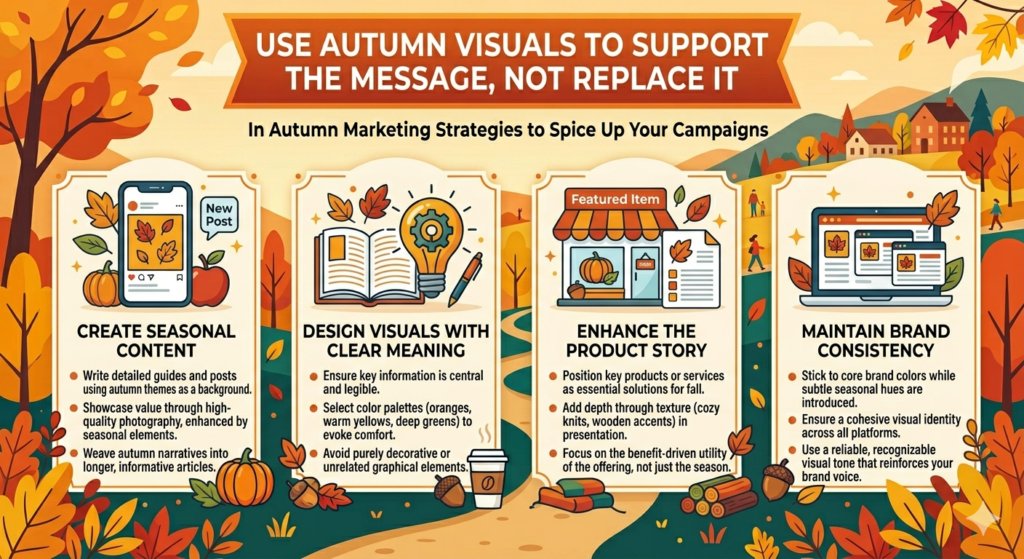
A pretty campaign may get attention, but attention alone is not enough. The visual should support the message. It should make the offer easier to understand, the mood easier to feel, and the action easier to take.
Design should help the strategy, not cover up the lack of one.
Choose visuals that match the customer’s real mood
Not every autumn campaign needs pumpkins and leaves. The right visual depends on your audience and offer. A serious B2B campaign may need clean, focused visuals that show planning, growth, or year-end readiness. A home brand may need warm rooms and soft textures.
A fitness brand may need routine, movement, and fresh starts. A food brand may need comfort and freshness.
The visual should match what the customer wants to feel.
If your campaign is about reducing stress, the design should feel calm and clear. If it is about early action, the design should feel focused. If it is about comfort, the design should feel warm. If it is about a limited seasonal product, the design should feel special.
Avoid using seasonal design that hides the offer
Sometimes a campaign looks so seasonal that the actual offer gets lost. The customer sees a nice image but does not know what is being sold, why it matters, or what to do next.
This often happens when brands make the design first and write the message later. The better order is to decide the customer problem, the offer, the promise, and the action first. Then create visuals that make those things easier to notice.
For example, if the message is about fixing campaigns before holiday traffic gets expensive, the visual should not only show leaves. It could show a simple campaign checklist, a dashboard review, or a before-and-after landing page. That visual supports the idea.
Pretty is good. Clear is better.
Keep your autumn brand style consistent
Seasonal campaigns can be fun, but they should still feel like your brand. If your brand is normally clean and professional, do not suddenly become cartoonish. If your brand is calm and premium, do not use loud discount graphics that feel cheap. If your brand is friendly and simple, keep that warmth in the design.
Customers should recognize you even when the campaign has a seasonal touch.
This matters because trust grows through consistency. If your autumn campaign feels completely different from the rest of your brand, people may enjoy it but not remember who it came from.
Use seasonal touches with control
Small seasonal changes often work better than a complete visual change. You can adjust colors, images, textures, icons, backgrounds, product styling, or photography while keeping your core brand look.
A marketing agency may use warmer tones and planning-focused images while keeping clean layouts. A retail brand may use autumn product scenes while keeping the same logo, type style, and page structure. A local café may show seasonal drinks but keep its usual voice and look.
The goal is to feel timely without losing identity.
Seasonal design should make your brand feel alive, not unfamiliar.
Create Autumn Partnerships That Expand Your Reach
Autumn is a strong time for partnerships because many brands are trying to reach customers before the holiday season. This creates chances to work together, share audiences, and build campaigns that feel more useful than a solo promotion.
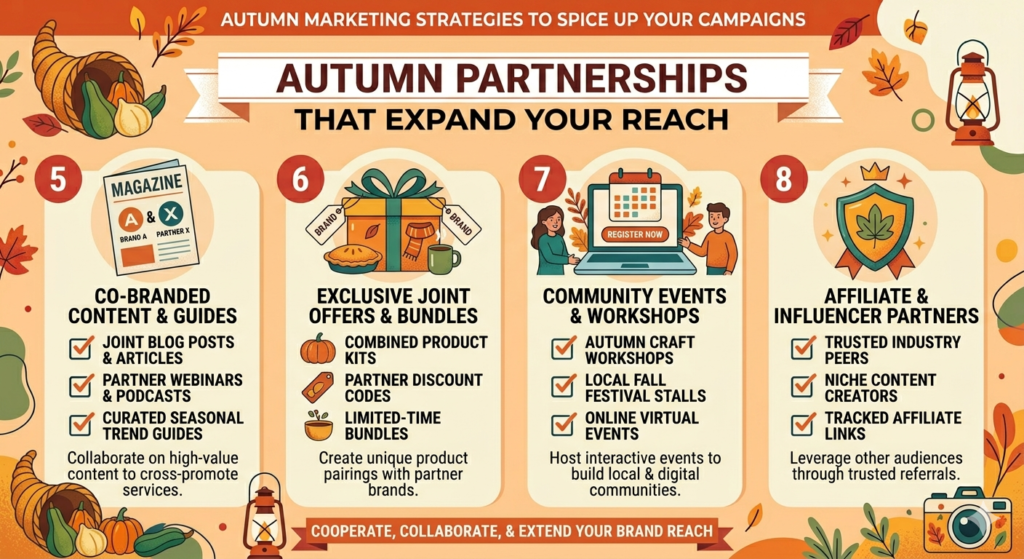
A good partnership does not need to be large. It can be a local collaboration, a joint email, a shared guide, a bundle, a giveaway, a webinar, a seasonal event, or a content swap. The key is that both brands serve a similar audience without directly competing.
Partnerships work best when the customer gets a clear benefit from both sides.
Partner with brands that solve a related seasonal problem
The best autumn partners are brands that help your customer with a connected need. A fitness studio could partner with a meal prep company. A home decor shop could partner with a cleaning service. A digital agency could partner with a web developer or CRM consultant.
A local bookstore could partner with a café. A skincare brand could partner with a wellness coach.
The partnership should feel natural. Customers should instantly understand why the two brands are working together.
If the connection needs too much explanation, it may not be the right fit.
Build the partnership around one simple seasonal outcome
Do not create a partnership just to cross-promote. Build it around a clear result the customer wants.
For example, a digital agency and a web developer could create a “holiday readiness check” for businesses. The agency reviews campaign messaging and email flow. The developer reviews site speed and checkout issues. Together, they solve a bigger problem than either one alone.
A café and bookstore could create a “cozy weekend bundle.” The café offers a seasonal drink, and the bookstore offers a recommended autumn read. This gives customers a complete experience.
The clearer the outcome, the easier the partnership is to market.
Use partnerships to build trust faster
When another trusted brand introduces you to its audience, you borrow some of that trust. This is especially helpful in autumn because customers are starting to choose which brands they will buy from during the holidays and year-end season.
A warm introduction can work better than a cold ad. It feels more personal and less forced.
This is why partner emails, joint events, and shared content can be powerful. They place your brand in front of people who may already be interested but have not discovered you yet.
Make the partner message feel personal
A partnership campaign should not sound like a copied press release. It should feel like one brand is genuinely recommending another.
Instead of saying, “We are excited to announce our partnership,” explain why the partnership helps the customer. Say what problem you noticed. Say why you chose this partner. Say how the customer can use the combined offer.
For example, “Many of our clients are getting ready for holiday traffic, but their websites still have slow pages and weak checkout steps. That is why we teamed up with a trusted web team to create a simple readiness review.”
That feels useful. It gives the partnership a real reason to exist.
When the reason is clear, the promotion feels less like marketing and more like help.
Conclusion
Autumn is not just a season for warm colors and themed promotions. It is a smart window for sharper marketing, stronger planning, and better customer connection. When you understand how people feel, what they need, and what they are preparing for, your campaigns become far more useful and far more persuasive.
The best autumn strategy is simple. Help customers act before the rush. Give them clear reasons, useful content, timely offers, and an easy next step.

















Comments are closed.